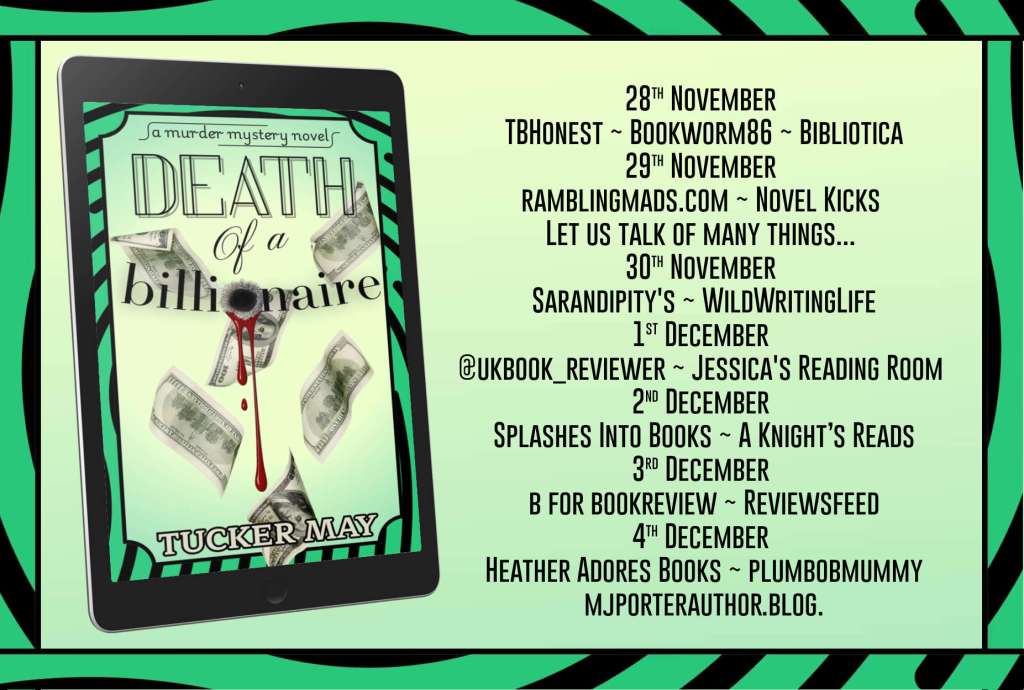
I’m sharing my review for Death of a Billionaire by Tucker May #mystery #blogtour #bookreview @tuckermaymysteries @rararesources @rachelsrandomresources
Here’s the blurb
Ever dream of killing your boss? Alan Benning knows how you feel.
The problem: his billionaire boss actually winds up murdered. And the whole world thinks he did it.
When globetrotting tech billionaire Barron Fisk is found dead on the floor of his swanky Silicon Valley office, all evidence points to Alan.
Alan must venture into the glitzy, treacherous world of tech billionaires to clear his name by sorting through a long list of suspects with motive aplenty. If he can’t find the real culprit, Alan’s going down. The clock is ticking.
Who killed Barron Fisk? The truth will shock— and change— the entire world.
Fans of Richard Osman’s The Thursday Murder Club series, Carl Hiaasen’s tales of high-stakes hijinx, or Ruth Ware’s page-turning mysteries will love Death of a Billionaire.
Death of a Billionaire is indeed a fun mystery, with a varied cast of characters, some of them not very nice, as they live their uber-rich lifestyles. It is a story told with irreverence and an eye to what’s currently happening in the world of tech. It is a very enjoyable, fast-paced mystery that you will power your way through.
I was drawn to the title by the mention of Carl Hiaasen, and while it’s been far too long since I read a Carl Hiaasen book that I can’t definitely make comparisons, the humour certainly reminded me of one of Carl’s books.
For a debut novel, Death of a Billionaire is very accomplished, and I do recommend it to fellow readers who love a good contemporary mystery (well, actually, it’s slightly futuristic) and like to have a little giggle along the way.
Meet the author
Tucker May was raised in southern Missouri. He attended Northwestern University where he was trained in acting and playwriting. He now lives in Pasadena, California with his wife Barbara and their cat Principal Spittle. He is an avid reader and longtime fan of the Los Angeles Rams and Geelong Cats. Death of a Billionaire is his debut novel.
I’m sharing a fab post from crime novelist Ian McFadyen about writing ‘The Twist’ to celebrate the release of The Corpse Bell #blogtour #newrelease #mystery
The Twist
Having a clever and enticing plot and introducing a range of vivid, life-like and interesting characters are paramount for any successful murder story. However, in my view, the kernel of all the best and most memorable whodunits has to be the twist.
I read once that ‘plot twists can be a thrill for the reader, but they’re overwhelming for the writer’. I’d agree with that.
If the novel is constructed in such a way that the reader has absolutely no inkling it’s coming, and when it’s revealed to the audience it is as plausible to them as it is surprising, then the twist will elevate the story to a new level.
And why just have one twist, if the book has sub-plots or a series of red herrings, why not introduce a little twist with those, to add even more intrigue and, dare I say, confusion in the reader’s mind – particularly if your twist reveals that a character high on the reader’s list of suspects is, in fact, innocent of the main crime and there’s a credible reason why they have been behaving in a way you ( the reader) thought was suspicious.
If you don’t agree with me, I’d ask you to just think of your favourite murder mystery books. I’m sure they all will have many, many truly wonderful elements – the setting, the use of language, the plot, the characters for example. However, I’d wager it’s the twist that you remember.
When thinking about a new Carmichael book it’s the twist that almost always comes first. Whether it’s a character who isn’t all they seem to be, a misunderstanding which only comes to light late on in the story, or a lie that’s not unearthed at first, the twist is my starting point.
For my books, it’s only once the twist is fleshed out in my head that I feel I can then create a storyline. A plot that builds up to that twist being revealed to the reader. Then using my team of ever-present detectives and introducing new characters, I attempt to take the reader on a journey that leads to the twist.
One of my favourite twists is in ‘The Death of Roger Ackroyd’ by Agatha Christie. I’ll not share the details here, for obvious reasons, but if you’ve not read that particular book, I’d recommend you give it a whirl.
However, if pushed, I’d say my favourite twist was in the TV programme, Tales of the Unexpected in 1979. In an episode written by Roald DahI, called ‘Lamb to the Slaughter’; the twist is delicious! If you haven’t seen it, look it up on YouTube.
I’ll obviously not be sharing the twist in my latest book, ‘The Corpse Bell’, but I hope you enjoy it when it arrives.
Here’s the blurb
The last thing Penny Carmichael expected when she joined the local bellringing group was for her debut to be thwarted by the discovery of a body just yards from the belfry door. As her husband and his loyal team painstakingly sift through the evidence and delve deep into the dead man’s past, it’s clear that solving Peter Mackenzie’s murder may prove a challenge, even for someone with DCI Carmichael’s renowned detective prowess.
What was a man who’d lived for decades in North London doing in Moulton Bank? Was his chequered past a factor?
And what about the other members of Penny’s bellringing group. Did any of them have a reason to do Peter harm?
As the case unfolds, DCI Carmicheal and his trusty team seek answers to a complex puzzle which leads them along various paths and, at times, way outside the comfort zone of their rural Lancashire surroundings.
This fast-paced, cleverly crafted whodunit is the eleventh murder mystery in the gripping Carmichael series from the pen of Ian McFadyen.
IIan McFadyen was born in Liverpool and enjoyed a successful career in marketing before becoming a writer. Ian’s titles are available in Italian and Czech and, although the author isn’t totally convinced it’s true, he’s been favourably compared with Wilkie Collins and Colin Dexter. He lives in Hertfordshire with his wife but spends a great deal of his time writing in his bolthole retreat on the Norfolk / Suffolk border. The Corpse Bell is the eleventh in his series featuring DCI Carmichael.
The Secret Sauce is on blog tour with Rachel’s Random Resources hosts. Check out the reviews, blog posts and Q & As below #histfic #historicalmystery
Here’s the blurb
Birmingham, England, November 1944.
Chief Inspector Mason of Erdington Police Station is summoned to a suspicious death at the BB Sauce factory in Aston on a wet Monday morning in late November 1944.
Greeted by his enthusiastic sergeant, O’Rourke, Sam Mason finds himself plunged into a challenging investigation to discover how Harry Armstrong met his death in a vat containing BB Sauce – a scene that threatens to put him off BB Sauce on his bacon sandwiches for the rest of his life.
Together with Sergeant O’Rourke, Mason follows a trail of seemingly unrelated events until something becomes very clear. The death of Harry Armstrong was certainly murder, and might well be connected to the tragedy unfolding at nearby RAF Fauld. While the uncertainty of war continues, Mason and O’Rourke find themselves seeking answers from the War Office and the Admiralty, as they track down the person who murdered their victim in such an unlikely way.
Join Mason and O’Rourke for the third book in the quirky, historical mystery series, as they once more attempt to solve the impossible in 1940s Erdington.
I’m sharing my review for Desolation by Keith Moray, a brand new historical mystery #bookreview #blogtour #newrelease
Here’s the blurb
A BRAND NEW wickedly dark medieval mystery from Keith Moray. If you like your murder truely gruesome – this series is for you! 🩸☠️🗡️
The Black Rood of Scotland, stolen.
A coroner of York, murdered
An evil worse than plague itself, at large…
1361, York. As the country recovers from the war with France, and whispers that the pestilence has returned to England grow louder, fear is in the heart of every nobleman and commoner alike. Sir Ralph de Mandeville, ex-solider and newly appointed Justice of the Peace is sent to Langbarugh, just outside York, to investigate the murder of Coroner Sir Boderick de Whitby.
More deaths quickly follow, and while these are swiftly dealt with as plague victims, Sir Ralph and his two assistants Merek and Peter soon uncover something altogether more horrifying… A greater evil is at large in the northern wapentakes.
As panic escalates and the lines between plague and murder blur, Sir Ralph is thrust into a desperate race against time. Every shadow hides a potential killer, every cough could be a death knell. Can he unmask a murderer lurking in the terrifying shadow of the Black Death before they’re all consumed by a terror more sinister than any plague?
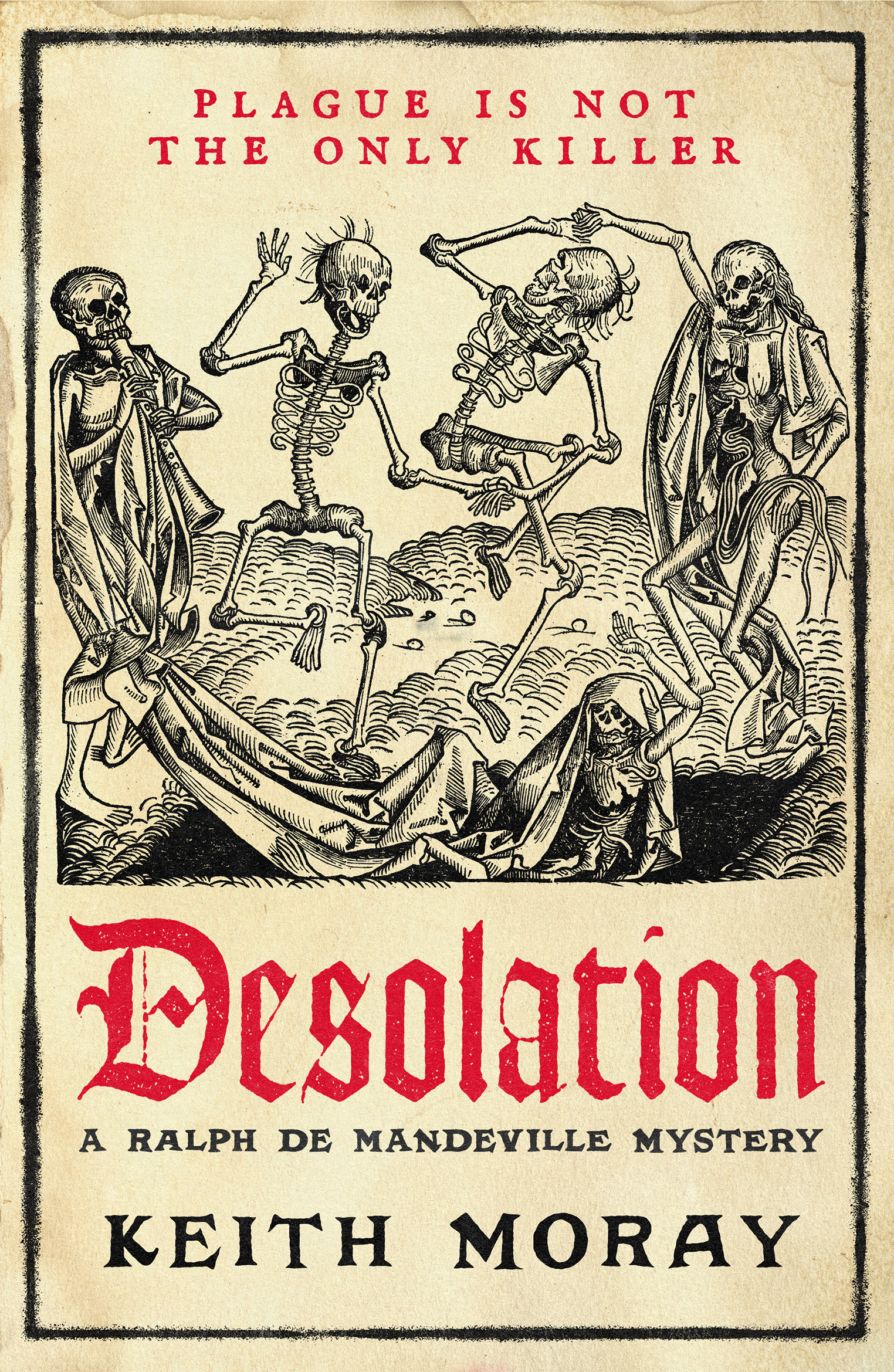
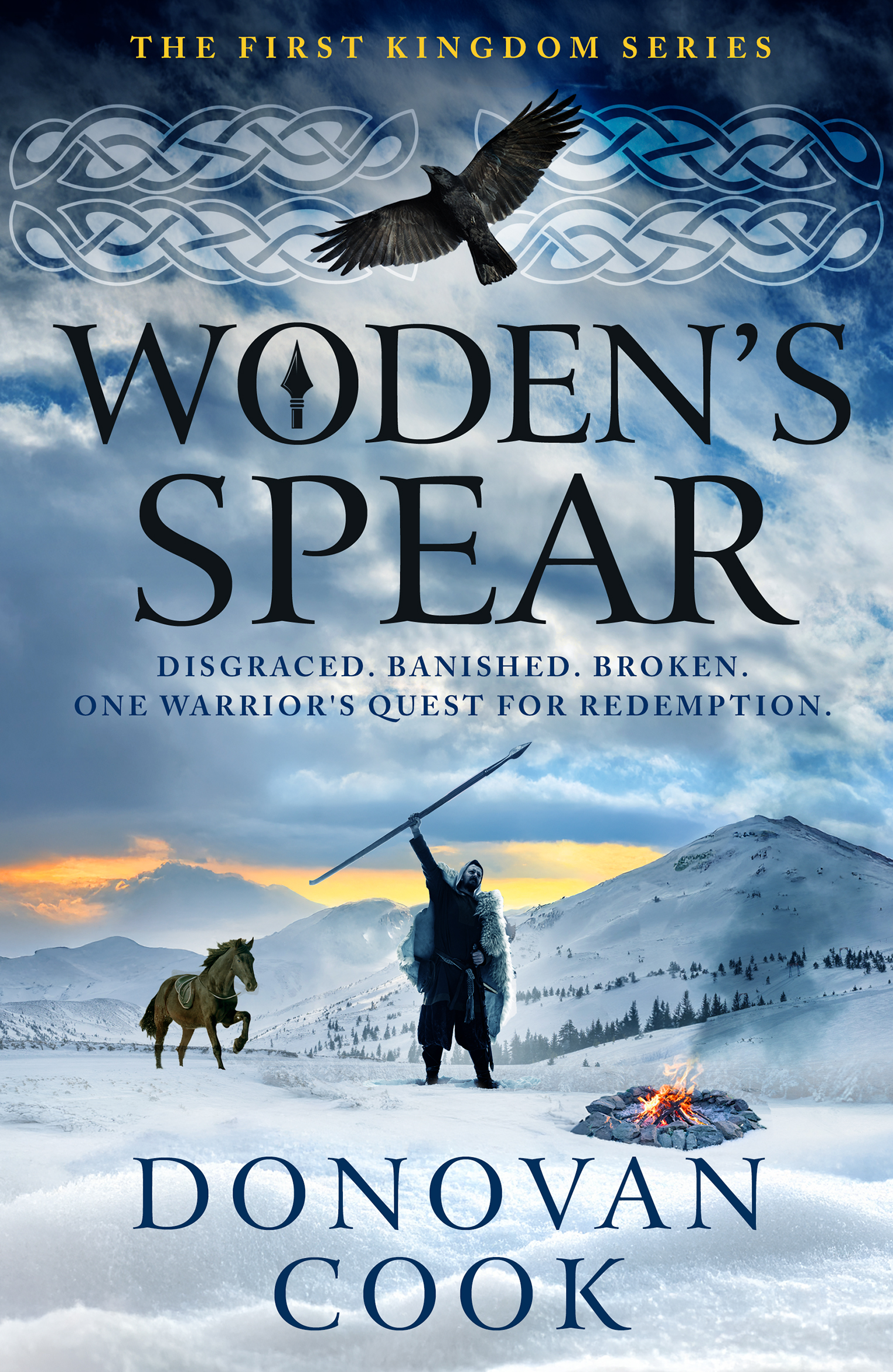
Desolation is the first book I’ve read by Keith Moray. I think the cover is fabulous and very evocative.
The story is intriguing, with a wide cast and it takes quite some time until we finally meet Ralph de Manville because there are so many other characters to meet first. I do hope that in later books in the series, Ralph will enter the narrative a little quicker.
It is quite a complex plot, because the narrative switches between characters so much. The reader does have to work to make sense of what’s happening. We are told certain things, but not others – so we know what’s happening but not necessarily who is doing it. The body count is HUGE!
When Ralph finally begins to make sense of what’s happening, the resolution comes quite quickly, and the ending is certainly satisfying.
I read a lot of mysteries. If I don’t work out ‘who did it’ I am always impressed, although with Desolation there are so many people implicated, it does feel as though there are a lot of people to guess. I worked out some elements, but not others, and I did very much enjoy the mystery element of the story.
Meet the author
Keith is a retired GP, medical journalist and novelist, writing in several genres. As Keith Moray he writes historical crime fiction in the medieval era and in ancient Egypt, The Inspector Torquil McKinnon crime novels set on the Outer Hebridean island of West Uist, and as Clay More he writes westerns. Curiously, his medical background finds its way into most of his fiction writing.
I’m sharing my review for The Little Black Book Killer by Fiona Walker, the third book in her The Village Detectives series #bookreview #cosycrime #newrelease
Here’s the blurb
Matchmaking has never been so murderous… 💔🔪
Juno is feeling ready – at last – to start dating again, after losing her husband some years ago. She is sure she can make time from being a Village Detective, indeed it might help distract her from her crush on hunky (but far-too-young!) pub landlord – Mil.
So she’s signed up to an exclusive new dating app and cannot wait. But when one of the founding investors in that same dating app drops dead in front of fellow Village Detective Phoebe in a nearby hotel – and then a second investor is found hanging in the local cricket pavilion just days later – Juno knows she’ll have to put her love life on hold.
Teaming up once more with Phoebe, Felix and Mil… the Village Detectives are back. And this time Juno – who’d thought she was getting under the covers with a new lover – is going undercover to catch a killer…
Wickedly funny cozy crime, from million-copy bestselling author Fiona Walker! Fans of The Thursday Murder Club and A Death on Location will love the Village Detectives!
The Little Black Book Killer is the third book in the Village Detective Series, and I definitely think it’s my favourite so far. I laughed so hard at one line in particular, and I think all readers will love it.
Freddy is out of her ‘funk’ (which has been a running theme). Juno is certainly ‘dialled down’ a few notches (yay), and their switching narratives ensure the reader almost always knows what’s happening. The characters involved in the actual mystery are a delightful mix of local villagers who all bring something to the table. The graveyard vandals and the missing underwear also add a delightful side story.
The mystery itself is quite complex, and there are a ton of red herrings (yay), so I didn’t work out all the elements of the resolution, which I always appreciate.
As I said, this is the third book in the series, and my favourite so far.
Check out my review for The Poison Pen Letters, the second book in the series. I have read book 1 too, but clearly not popped it on the blog.
Meet the author
Fiona Walker is the million copy bestselling author of joyously funny romantic comedies. Most recently published by Head of Zeus, she will be turning to cozy crime for Boldwood.
I’m sharing my review for Murder in the Soho Graveyard, a Victorian mystery #histfic #bookreview (as well as reviews for the 1st two books in the series) #mystery
Here’s the blurb
A churchyard discovery. A shocking secret. A deadly confrontation.
London, 1890. When the body of a wealthy widow is found in the neglected graveyard of St Anne’s Church, Soho, Emma Langley and Penny Green soon discover her respectable façade concealed a web of bitter enemies.
From a disgraced doctor stripped of his livelihood to a governess whose reputation was destroyed by lies, the victim, Mrs Melbourne, left a trail of devastation in her wake.
Then Mrs Melbourne’s Belgravia mansion is consumed by a mysterious fire. Emma and Penny must race to decipher water-damaged papers salvaged from the ruins that could hold the key to the truth.
But as anonymous threatening letters arrive warning them to abandon their investigation, the friends realise they’re hunting someone who will kill again to protect their secret. In the shadow-filled streets of Victorian London, can Emma and Penny expose the murderer before they become the next victims?
An atmospheric Victorian mystery that takes you from the crumbling graveyards of Soho to the grand squares of Belgravia – and will keep you reading late into the night.
Murder in the Soho Graveyard is the third book in the Emma Langley Victorian Mystery series. I have read the previous two books in the series (see the reviews lower down the page).
Our two main characters once more find themselves involved in an unexpected mystery, while our cast of regular extras is expanding once more. When Emma comes upon the forlorn figure of a woman sitting on a bench she can’t help but ask if she’s well, and from then, Emma and Penny are determined to help her clear her name of any involvement in the murder of a rather nasty individual, masquerading as an unpright, wealthy Victorian lady while at heart, she’s manipulative and really quite horrible.
There are several suspects, all of them with their own particular axe to grind and the reveal, when it comes, wasn’t at all what I thought it would be.
Murder in the Soho Graveyard is another well-paced and well-plotted Victorian mystery featuring our two amateur sleuths.
If you want to start at the beginning of the series… (which you should!)
The Whitechapel Widow
London hunts the Ripper. A widow hunts her husband’s killer.
London, 1888. While Jack the Ripper’s reign of terror grips the city, Emma Langley’s world shatters when her husband is found murdered in Whitechapel. But grief is quickly overshadowed by a startling discovery: William Langley was not the man she thought she knew.
As panic fills London’s streets, Emma delves into her husband’s secret life, uncovering a web of lies that stretches from glittering society drawing rooms to the seedy gambling dens of the East End. Aided by Penny Green, a former reporter with a nose for trouble, Emma follows a trail of blackmail and corruption.
But exposing her husband’s killer could make her the next victim and in the shadows of gaslit streets, a murderer waits, ready to strike again…
The Whitechapel Widow is a very well-plotted historical mystery set at the time of the attacks by Jack the Ripper in London. The author does a fabulous job of weaving the narrative through known events, and I really enjoyed the mystery elements. Emma is a great new main character, but I also enjoyed the inclusion of Emily’s heroine, Penny Green.
I will certainly be reading more of the series.
The Poison Puzzle
A secret society. A suspicious death. A trail of deadly clues.
London, 1889. When Emma Langley discovers a mysterious symbol in her late husband’s diary, she uncovers a connection to a secretive treasure-hunting group with powerful members. Her investigation takes an unexpected turn when Lord Charles Harpole, a society member, is found dying in his hotel room.
The authorities rule it suicide, but Emma and her friend Penny Green aren’t convinced. As they follow a trail of cryptic clues leading from St. Paul’s Cathedral to Hampton Court, they find themselves caught in a deadly game.
With suspects ranging from the lord’s grieving fiancée to his ambitious brother, Emma must solve the puzzle before the killer claims another victim. But in the fog-shrouded streets of Victorian London, someone will stop at nothing to keep the society’s secrets buried…
Emma Langley returns in this gripping Victorian mystery that weaves historical detail with page-turning suspense.
I very much enjoyed The Poison Puzzle, the second book in the Emma Langley Historical Mystery series, but I must admit, I felt the buildup was somewhat better than the eventual resolution, which fell a little flat for me. That said, I will be continuing the series, as I do adore all the period detail for the books, and I certainly appreciated the research that went into making the treasure hunt feel very authentic.
I’m sharing my review for A Mirror Murder, the first book in a delightful 1970s cozy mystery series by Helen Hollick #bookreview #mystery #blogtour
Here’s the blurb
A Mirror Murder – First In The Jan Christopher Cozy Mystery Series
The first in a series of quick-read, cozy mysteries set during the 1970s in North East London and North Devon, featuring the characters of Jan Christopher, her Aunt Madge, her uncle, DCI Toby Christopher and romantic interest DC Lawrence Walker – plus several other endearing, regular characters.
The background of Jan’s career as a library assistant is based on the author’s own library years during the 1970s, using many borrowed (often hilarious!) anecdotes, her life in suburban north east London on the edge of Epping Forest, and her present life in rural North Devon…
July 1971 Eighteen-year-old library assistant Jan Christopher’s life is to change on a rainy evening, when her legal guardian and uncle, DCI Toby Christopher, gives her a lift home after work. Driving the car, is her uncle’s new Detective Constable, Lawrence Walker – and it is love at first sight for the young couple. But romance is soon to take a back seat when a baby boy is taken from his pram, a naked man is scaring young ladies in nearby Epping Forest, and an elderly lady is found, brutally murdered… Are the events related? How will they affect the staff and public of the local library where Jan works – will romance survive and blossom between library assistant Jan Christopher and DC Walker? Or will a brutal murder intervene?
“I sank into this gentle cosy mystery story with the same enthusiasm and relish as I approach a hot bubble bath, (in fact this would be a great book to relax in the bath with!), and really enjoyed getting to know the central character…” Debbie Young (bestselling cozy mystery author)
“Jan is a charming heroine. You feel you get to know her and her love of books and her interest in the people in the library where she works. She’s also funny, and her Aunt Madge bursts with character – the sort of aunt I would love to have had. I remember the 70s very well and Ms Hollick certainly gives a good flavour of the period.”Denise Barnes (bestselling romance author Molly Green)
“A delightful read about an unexpected murder in North East London. Told from the viewpoint of a young library assistant, the author draws on her own experience to weave an intriguing tale”Richard Ashen (South Chingford Community Library)
“Lots of nostalgic, well-researched, detail about life in the 1970s, which readers of a certain age will lap up; plus some wonderful, and occasionally hilarious, ‘behind the counter’ scenes of working in a public library, which any previous or present-day library assistant will recognise!”Reader’s Review
I do love a cozy crime series, and Helen Hollick’s Jan Christopher stories are fabulous.
As I so often do, I have read the series slightly out of order, and all you sensible people will start with A Mirror Murder, and you are in for a real treat as you read your way through the entire series.
The first book, A Mirror Murder, sets the scene for the series and introduces us to the cast. As someone who loves a really well-written and tightly plotted cosy mystery, I adored this book.
Perfectly evoking the early 1970s, with reference to newspaper events and Jackie magazine, including the cost of chocolate and a bus ticket, as well as some evocative pre-electronic library administration, I thoroughly enjoyed this mystery. It did bring back memories of my school days when I was forced to volunteer in the local library, and they sent us to the depths of the library and let us loose on the card filing system.
South Chingford Library Copyright A Morton.
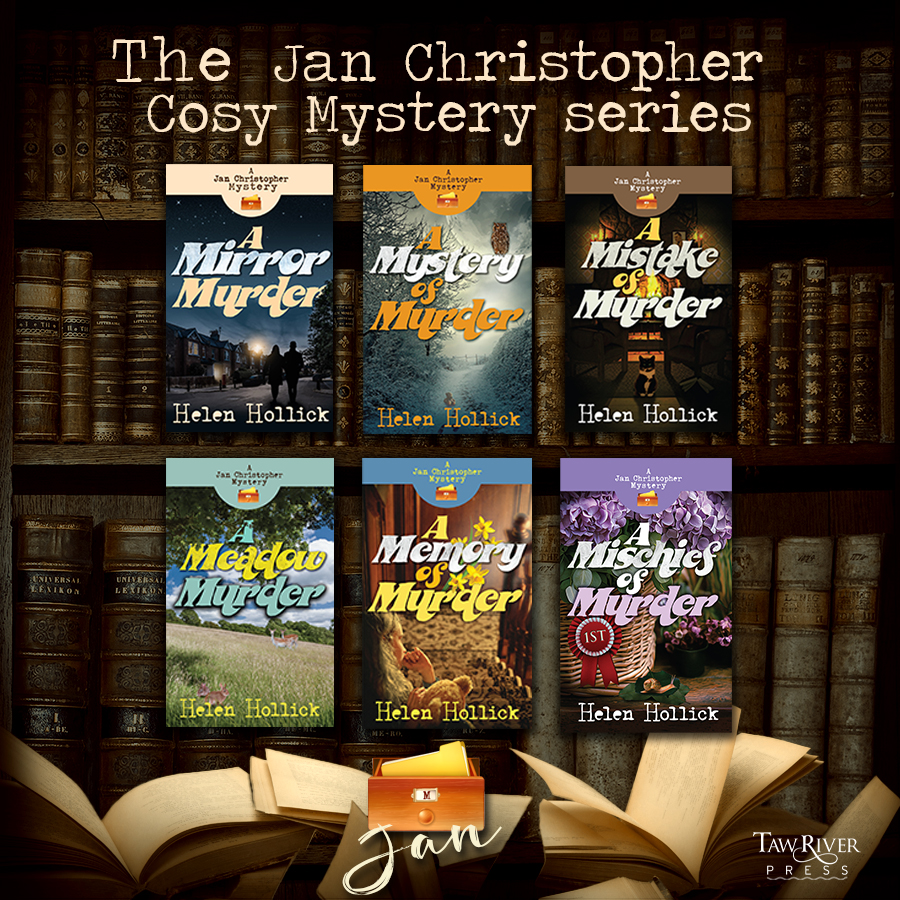
Episode 2: A MYSTERY OF MURDER
set in rural Devon, Christmas 1971
Library Assistant Jan Christopher is to spend Christmas in Devon with her boyfriend, DS Laurie Walker and his family, but when a murder is discovered, followed by a not very accidental accident, the traditional Christmas spirit is somewhat marred…What happened to Laurie’s ex-girlfriend? Where is the vicar’s wife? Who took those old photographs? And will the farmer up the lane ever mend those broken fences?
“There are lots of things to enjoy in the second in the Jan Christopher cosy mystery series” Best-selling cozy mystery author Debbie Young
“A laid back sort of novel, the kind that you can relax while reading, and simply let the story happen. This author has a particularly unique style of writing… this book wasn’t simply a story, but an experience. You almost have the feeling that the author is reading the book to you, and is adding in her own little quips every now and again. I loved every second… The whole mystery is well thought out… utterly amazing!” Review: I Got Lost In A Book Blog
“The pace is gently cosy, despite the murder… Jan is a wonderful character; young, naïve, but also savvy when needed. And Laurie is a gem. All the characters and their foibles and actions stay true to the era… a lovely, warm story.” Review: Ruins & Reading
More in the series:
Episode 3 A MISTAKE OF MURDER
Was murder deliberate – or a tragic mistake?
Episode 4 A MEADOW MURDER
Make hay while the sun shines? But what happens when a murder is discovered, and country life is disrupted?
Episode 5 A MEMORY OF MURDER
A missing girl, annoying decorators, circus performers and a wanna-be rock star to deal with. But who remembers the brutal, cold case murder of a policeman?
Episode 6 A MISCHIEF OF MURDER
The village Flower and Veg Show should be a fun annual event – but who added mischief and murder to the traditional schedule?
Known for her captivating storytelling and rich attention to historical detail, Helen’s historical fiction, nautical adventure series, cosy mysteries – and her short stories – skilfully invite readers to step into worlds where the boundaries between fact and fiction blend together.
Helen started writing as a teenager, but after discovering a passion for history, was initially published in 1993 in the UK with her Arthurian Pendragon’s Banner Trilogy and two Anglo-Saxon novels about the events that led to the 1066 Battle of Hastings, one of which, The Forever Queen (USA title – A Hollow Crown in the UK) became a USA Today best-seller. Her Sea Witch Voyages are nautical-based adventures inspired by the Golden Age of Piracy. She also writes the Jan Christopher cosy mystery series set during the 1970s, and based around her, sometimes hilarious, years of working as a North London library assistant. Her 2025 release is Ghost Encounters, a book about the ghosts of North Devon – even if you don’t believe in ghosts you might enjoy the snippets of interesting history and the many location photograhs.
Helen and her family moved from London to Devon after a Lottery win on the opening night of the London Olympics, 2012. She spends her time glowering at the overgrown garden, fending off the geese, chasing the peacocks away from her roses, helping with the horses and wishing the friendly, resident ghosts would occasionally help with the housework…
I’m sharing my review for Death At the School of Translators, A Rebecca DeToledo Medieval Mystery by Esther Knight #bookreview #historicalmystery #histfic #blogtour
Here’s the blurb
Ivanhoe meets Phryne Fisher in this medieval adventure of a woman sleuth.
Toledo, 1193: A city of scholars, secrets, and simmering tensions. When Queen Eleanor of Aquitaine’s Jewish spy is found dead, whispers of treachery reach all the way to England.
Rebecca DeToledo, a gifted healer and wealthy Jewish heiress, arrives under royal orders to investigate at the School of Translators. Her mission quickly turns perilous as she faces threats to her life and a sudden battle over her inheritance.
Assigned to guard her is Sir John of Hampstead, a disillusioned crusader burdened with knowledge that could threaten King Richard’s release from captivity. Forced into this partnership, he must protect Rebecca while grappling with his own prejudices.
As they navigate Toledo’s complex alliances, where Christians, Jews, and Muslims coexist in fragile peace, they uncover a web of secrets reaching deep into the cathedral. Can Rebecca and John unearth the truth before they become the next targets?
For fans of historical sleuths, slow-burn tension, and secret missions cloaked in royal intrigue.
Death at the School of Translators is a medieval mystery told from two points of view: Rebecca, our Jewish heiress, and John, our disillusioned knight. They are thrust together in England by Queen Eleanor of Aquitaine, in somewhat confusing circumstances, and quickly embark on their journey to Toledo, where the real investigation quickly gets underway.
The author endeavours to bring together the many cultures within Toledo and the many interested parties at play. There is no end to the intrigue, as the appearance of Rebecca and John stirs up problems for those living in Toledo, while others have things they wish to keep hidden.
There are a few moments where the story falters slightly, but as it approaches the conclusion, it really excels, and I think the author finds her footing with these two characters, who will undoubtedly reveal more mysteries in the future. There are also one or two modernisms that detract from the depth of research the author must have undertaken to write the mystery, but they are only slight.
Overall, I found Death at the School of Translators to be a fine first story in this new mystery series, and I look forward to reading more of Rebecca and John’s mysteries.
Meet the author
Esther Knight writes historical mysteries featuring a bold heroine who challenges the norms of her time.
*Terms and Conditions –Worldwide entries welcome. Please enter using the Gleam box below. The winner will be selected at random via Gleam from all valid entries and will be notified by Twitter and/or email. If no response is received within 7 days then Rachel’s Random Resources reserves the right to select an alternative winner. Open to all entrants aged 18 or over. Any personal data given as part of the competition entry is used for this purpose only and will not be shared with third parties, with the exception of the winners’ information. This will passed to the giveaway organiser and used only for fulfilment of the prize, after which time Rachel’s Random Resources will delete the data. I am not responsible for despatch or delivery of the prize.
I’m delighted to welcome Julia Ibbotson and her book, Daughter of Mercia, to the blog with a guest post.
Lady Mildryth of Mercia
It might surprise us to know that women in the Anglo-Saxon period, even early in their history, were regarded as equal in importance to their male counterparts. Women could hold their own wealth, land, possessions; they could inherit from their fathers or mothers on their own account and they could bequeath it to their children. They were not regarded as the property of their husbands or fathers. Their rights were protected in law and it seems that this applied across the social spectrum, from high-status families presumably to ealdormen to thegns to freedmen ceorls and grant-bearer geburs.
High-status women could be leaders of settlements / regions in the years following the immigration and settling of even the early tribes of Anglo-Saxons. They could be strategists and negotiators. Later, for example, Lady Ǣthelflaed of Mercia, the 10th century daughter of King Alfred, strategized battles to take Derby, Leicester, York, and of whom it is said that she was a “man in valour, a woman in name”. The Anglo-Saxon word cūning (king)applies to either male or female leaders, while the word queen (cwene) applies only to the wife of a king. The historical significance of strong female leaders goes right back to Boudicca of the Iceni in the first century AD. Post-Roman Britain was composed of many small kingdoms, and kingdoms fought to take over other kingdoms and thus wield greater power over a larger region. But our theories of this time of great change are beginning to recognise the way that stable everyday life and the quest for peace were also significant.
Lady Mildryth is a fictional character but is bred of such strong female leaders as these. I have based her on other Anglo-Saxon women who have a place in the history of Britain and I wanted her to represent an idea of the powerful yet peace-loving early settlers who wanted to create stable, secure communities, from the chaos and blood-shed of previous generations. Clearly, I have taken liberties with historical characters and events for the sake of my novel and it is not intended to be an accurate academic analysis of the time, but since archaeological excavation is only just gaining a clearer picture of the early Anglo-Saxon period and its domestic and cultural signigifance, maybe my imagination is not so far out!
Recent archaeological excavation and research has demonstrated that even back to the 5th century, high status ladies were buried with signifiers of their wealth in their grave goods: rich jewellery, gold artefacts, precious glass, beautiful fabrics.
Lady Mildryth, as the leader of a region, would have worn fabrics that were richly dyed and decorated: a chemise or shift, a long-sleeved kirtle (under-gown) often of expensive linen or wool, an over-gown trimmed with fur or braid, and an embroidered mantle(cloak). As a high-status woman, she would have eaten well, with home-grown meat, fish, dairy, vegetables, fruit (hedgerow berries but also imported dates, figs, almonds), and she would have drunk honeyed mead and imported wine, during her mead hall feastings.
Although her antecedents are pagan, and she accepts the duality of her people, she finds herself on the cusp of Christianity, yet still drifting to some of the pagan beliefs of her upbringing. Her late mother was from the Cornovii tribe from the people of Pengwern / Powys, Celtic-Brythonic pagans. She was hand-fasted to Mildryth’s father and died when Mildryth was young. Lady M’s character takes after her mother’s strength of will and determination to be on a par with her brothers (Crydda and Cynewald) – although she knows that she must earn this.
Her antecedents are historical (well, possibly legendary!) characters. Her grandfather is Icel, son of Eomer, of the Icinglas (or Iclingas), an Angle from across the seas in Jutland. He is said to have led his people across the North Sea in around 515 AD to the region we now call East Anglia, and is said to have moved westwards across the country, founding the kingdom of Mercia in the 520s AD. His son, Lady Mildryth’s father, is Cnebba who ruled after Icel from possibly around 535 AD.
We speak of the archetypes ‘Peace-weavers’ and ‘Shield-maidens’ in Anglo Saxon society and I see Lady Mildryth as a Peace-weaver. She is a strategist and commander of men, like Lady Æthelflæd of Mercia generations later. But she is also a negotiator and does not wish to conquer other lands or fight to subdue other tribes. She is dedicated to her settlement, her community, and my novel is more about domestic history than that of battles and high kings.
Lady Mildryth strives to make her settlement run smoothly and to encourage the cultural enrichment of her people: a culture taken from her Angeln ancestors as shown in her use of the scōp, the poet story-teller who regales the thegns of the mead-hall with tales of tradition, of warriors, family and legendary heroism. Peace-weavers were often encouraged, or chose, to make expedient marriages with other kingdoms to avert potential strife. There is evidence to suggest that there were battles for lands, yes, but also deals and negotiations so that tribes could coexist. In Daughter of Mercia, Lady Mildryth is certainly aware of this.
If you’d like to read more of life in Anglo-Saxon times, you may like to look at my blog on my website and the 7-part series ‘Living with the Anglo-Saxons’ athttps://juliaibbotsonauthor.comwhere there are also some reference texts.
Here’s the Blurb
Echoes of the past resonate across the centuries as Dr Anna Petersen, a medievalist and runologist, is struggling with past trauma and allowing herself to trust again. When archaeologist (and Anna’s old adversary) Professor Matt Beacham unearths a 6th century seax with a mysterious runic inscription, and reluctantly approaches Anna for help, a chain of events brings the past firmly back into her present. And why does the burial site also contain two sets of bones, one 6th century and the other modern?
As the past and present intermingle alarmingly, Anna and Matt need to work together to solve the mystery of the seax runes and the seemingly impossible burial, and to discover the truth about the past. Tensions rise and sparks fly between Anna and Matt. But how is 6th century Lady Mildryth of Mercia connected to Anna? Can they both be the Daughter of Mercia?
For fans of Barbara Erskine, Elena Collins, Pamela Hartshorne, Susanna Kearsley and Christina Courtenay.
This title is available to read on #KindleUnlimited
Meet the Author
Julia Ibbotson is fascinated by the medieval world and the concept of time. She is the author of historical mysteries with a frisson of romance. Her books are evocative of time and place, well-researched and uplifting page-turners. Her current series focuses on early medieval time-slip/dual-time mysteries.
Julia read English at Keele University, England, specialising in medieval language / literature / history, and has a PhD in socio-linguistics. After a turbulent time in Ghana, West Africa, she became a school teacher, then a university academic and researcher. Her break as an author came soon after she joined the RNA’s New Writers’ Scheme in 2015, with a three-book deal from Lume Books for a trilogy (Drumbeats) set in Ghana in the 1960s.
She has published five other books, including A Shape on the Air, an Anglo-Saxon timeslip mystery, and its two sequels The Dragon Tree and The Rune Stone. Her latest novel is the first of a new series of Anglo-Saxon dual-time mysteries, Daughter of Mercia, where echoes of the past resonate across the centuries.
Her books will appeal to fans of Barbara Erskine, Pamela Hartshorne, Susanna Kearsley, and Christina Courtenay. Her readers say: ‘Julia’s books captured my imagination’, ‘beautiful story-telling’, ‘evocative and well-paced storylines’, ‘brilliant and fascinating’ and ‘I just couldn’t put it down’.
I’m sharing a post about the inspiration for The Secret Sauce to celebrate release day #histfic #historicalmystery
Why The Secret Sauce?
As fans of my historical mysteries set in Erdington, Birmingham (UK), will know, I always like to pick a ‘quirky’ hook for my stories. The Secret Sauce is no different. For those who don’t know, HP Sauce was made for many, many decades at Aston in Birmingham (it isn’t any more). As a child, I drove past the sign below at least monthly, if not more often. Initially, I hoped to call this book The Body in the Beans (what a great title), but alas, HP didn’t make baked beans in the 1940s. As such, I had to have a little rethink. I thought the idea was too good to forget. And so, The Secret Sauce has as its Birmingham-specific hook; brown sauce, which, for the purposes of the story, I’ve renamed BB Sauce (you need to read the book to find out what that stands for).
Image from Birmingham Museum, taken by my sisterImage from Birmingham Museum, taken by my sister
However, HP Sauce is a brown, fruity sauce, with a fascinating history, and, I believe, a recipe that remains a ‘secret.’ It started life at the end of the nineteenth century, and through fair means or foul, ended up in the hands of the owners of the Midlands Vinegar Company. It survived the uncertainties of both world wars, although sourcing the ingredients was often challenging. The True Story of HP Sauce, produced in 1985, states that advertising for HP Sauce was stopped during the Second World War because it was so difficult to get a bottle. There was also a bomb shelter beneath the factory during WW2. The Ultimate HP Sauce Lover’s Guide mainly contains recipes. I have been ‘forced’ to try HP Sauce, as I’d never had it before. It reminds me a little bit of Branston Pickle:) I don’t think I’m a fan, but I suspect it’s probably a bit like Marmite – you love it, or hate it.
Just like the Bird’s Custard Factory, which was the inspiration for The Custard Corpses, HP Sauce was a Birmingham staple. In fact, I suspect, for many locals, HP Sauce is more well-known, whether fondly or not (because it could stink), than the custard factory.
If you look at the cover for The Secret Sauce, you’ll notice, as with the other books in the series, that I’ve made some changes to the ‘brand.’ One of the changes was to make the BB Sauce bottle bulbous, a stark contrast to the elongated one of HP Sauce. I also added another Birmingham staple to the BB Sauce bottle by opting for colours inspired by Aston Villa Football Club’s kit. Why did I do this? Well, a reader shared some photos of my books and beside them was an Aston Villa programme. It was too good an opportunity to miss, as after all, the two would have been located in Aston.
Trinity Road Stand, Aston Villa Football Club, taken by my brother
Here’s the blurb
Birmingham, England, November 1944.
Chief Inspector Mason of Erdington Police Station is summoned to a suspicious death at the BB Sauce factory in Aston on a wet Monday morning in late November 1944.
Greeted by his enthusiastic sergeant, O’Rourke, Sam Mason finds himself plunged into a challenging investigation to discover how Harry Armstrong met his death in a vat containing BB Sauce – a scene that threatens to put him off BB Sauce on his bacon sandwiches for the rest of his life.
Together with Sergeant O’Rourke, Mason follows a trail of seemingly unrelated events until something becomes very clear. The death of Harry Armstrong was certainly murder, and might well be connected to the tragedy unfolding at nearby RAF Fauld. While the uncertainty of war continues, Mason and O’Rourke find themselves seeking answers from the War Office and the Admiralty, as they track down the person who murdered their victim in such an unlikely way.
Join Mason and O’Rourke for the third book in the quirky, historical mystery series, as they once more attempt to solve the impossible in 1940s Erdington.
All 3 hardbacks in the Erdington Mystery series in a row.