It’s time for a new Bradecote and Catchpoll historical mystery. I’m reviewing Feast for the Ravens by Sarah Hawkswood #historicalmystery #bookreview
Here’s the blurb
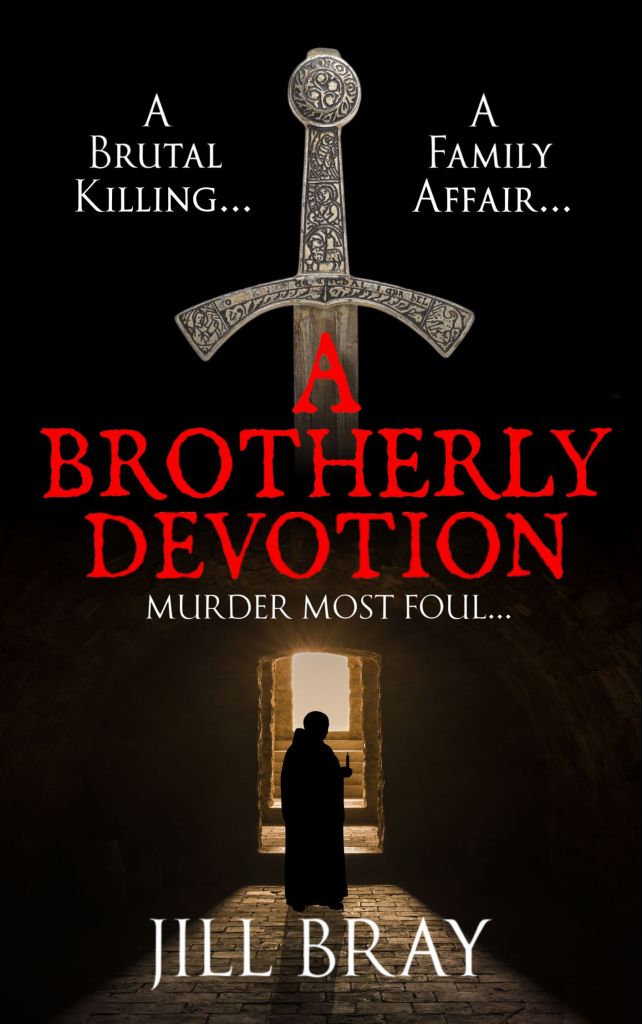
Worcestershire, September 1145: A Templar knight is found dead in the Forest of Wyre, clutching a bloodstained document naming a traitor. Undersheriff Hugh Bradecote, Serjeant Catchpoll, and Underserjeant Walkelin must uncover whether the killing was personal, political, or the work of outlaws. They are surprised to find that the locals believe the killer to be the Raven Woman, a mythical shape-shifter said to haunt the woods. Then the knight is identified as Ivo de Mitton – believed to have long ago murdered his own kin – and the mystery deepens.
As the trio dig through legend and lies, they must determine the truth and bring a cunning killer to justice.
Sarah Hawkswood’s medieval mysteries are some of my favourite books. I wish I could savour them when they’re released once a year, but I find myself reading far too quickly.
Her main characters, Bradecote, Catchpoll and Wakelin are determined and intrepid in their desire to solve each mystery presented to them, and the same applies for Feast for the Ravens.
When our dead man is found in the woodlands, it seems impossible that any will recognise him, but slowly a devastating tale of treachery, revenge and cunning is revealed as our intrepid investigative trio work hard to determine who is being truthful, and who less so. The tale quickly turns quite dark and is filled with peril, although not, thankfully, for our sleuthing threesome. All the usual characters benefit from a brief mention, and this tale is firmly grounded in the political conspiracy of the reign of King Stephen and Empress Matilda. A great deal is at stake if the truth is not discovered.
I adore this series. I have long grown used to the author’s decision to have her characters speak and think in ‘ye olde worlde’ way, and it enhances the atmosphere of these books.
If you’ve not started the series, then you can start with this book, but I would highly recommend stepping back a few titles, if not to the very beginning of the series (which I think you can enjoy when you know the characters better) to fully immerse yourself in this twisty, dark and perilous medieval mystery.
Check out my reviews for other books in the series (I have read them all)
I’m sharing my review for A Mirror Murder, the first book in a delightful 1970s cozy mystery series by Helen Hollick #bookreview #mystery #blogtour
Here’s the blurb
A Mirror Murder – First In The Jan Christopher Cozy Mystery Series
The first in a series of quick-read, cozy mysteries set during the 1970s in North East London and North Devon, featuring the characters of Jan Christopher, her Aunt Madge, her uncle, DCI Toby Christopher and romantic interest DC Lawrence Walker – plus several other endearing, regular characters.
The background of Jan’s career as a library assistant is based on the author’s own library years during the 1970s, using many borrowed (often hilarious!) anecdotes, her life in suburban north east London on the edge of Epping Forest, and her present life in rural North Devon…
July 1971 Eighteen-year-old library assistant Jan Christopher’s life is to change on a rainy evening, when her legal guardian and uncle, DCI Toby Christopher, gives her a lift home after work. Driving the car, is her uncle’s new Detective Constable, Lawrence Walker – and it is love at first sight for the young couple. But romance is soon to take a back seat when a baby boy is taken from his pram, a naked man is scaring young ladies in nearby Epping Forest, and an elderly lady is found, brutally murdered… Are the events related? How will they affect the staff and public of the local library where Jan works – will romance survive and blossom between library assistant Jan Christopher and DC Walker? Or will a brutal murder intervene?
“I sank into this gentle cosy mystery story with the same enthusiasm and relish as I approach a hot bubble bath, (in fact this would be a great book to relax in the bath with!), and really enjoyed getting to know the central character…” Debbie Young (bestselling cozy mystery author)
“Jan is a charming heroine. You feel you get to know her and her love of books and her interest in the people in the library where she works. She’s also funny, and her Aunt Madge bursts with character – the sort of aunt I would love to have had. I remember the 70s very well and Ms Hollick certainly gives a good flavour of the period.”Denise Barnes (bestselling romance author Molly Green)
“A delightful read about an unexpected murder in North East London. Told from the viewpoint of a young library assistant, the author draws on her own experience to weave an intriguing tale”Richard Ashen (South Chingford Community Library)
“Lots of nostalgic, well-researched, detail about life in the 1970s, which readers of a certain age will lap up; plus some wonderful, and occasionally hilarious, ‘behind the counter’ scenes of working in a public library, which any previous or present-day library assistant will recognise!”Reader’s Review
I do love a cozy crime series, and Helen Hollick’s Jan Christopher stories are fabulous.
As I so often do, I have read the series slightly out of order, and all you sensible people will start with A Mirror Murder, and you are in for a real treat as you read your way through the entire series.
The first book, A Mirror Murder, sets the scene for the series and introduces us to the cast. As someone who loves a really well-written and tightly plotted cosy mystery, I adored this book.
Perfectly evoking the early 1970s, with reference to newspaper events and Jackie magazine, including the cost of chocolate and a bus ticket, as well as some evocative pre-electronic library administration, I thoroughly enjoyed this mystery. It did bring back memories of my school days when I was forced to volunteer in the local library, and they sent us to the depths of the library and let us loose on the card filing system.
South Chingford Library Copyright A Morton.
Episode 2: A MYSTERY OF MURDER
set in rural Devon, Christmas 1971
Library Assistant Jan Christopher is to spend Christmas in Devon with her boyfriend, DS Laurie Walker and his family, but when a murder is discovered, followed by a not very accidental accident, the traditional Christmas spirit is somewhat marred…What happened to Laurie’s ex-girlfriend? Where is the vicar’s wife? Who took those old photographs? And will the farmer up the lane ever mend those broken fences?
“There are lots of things to enjoy in the second in the Jan Christopher cosy mystery series” Best-selling cozy mystery author Debbie Young
“A laid back sort of novel, the kind that you can relax while reading, and simply let the story happen. This author has a particularly unique style of writing… this book wasn’t simply a story, but an experience. You almost have the feeling that the author is reading the book to you, and is adding in her own little quips every now and again. I loved every second… The whole mystery is well thought out… utterly amazing!” Review: I Got Lost In A Book Blog
“The pace is gently cosy, despite the murder… Jan is a wonderful character; young, naïve, but also savvy when needed. And Laurie is a gem. All the characters and their foibles and actions stay true to the era… a lovely, warm story.” Review: Ruins & Reading
More in the series:
Episode 3 A MISTAKE OF MURDER
Was murder deliberate – or a tragic mistake?
Episode 4 A MEADOW MURDER
Make hay while the sun shines? But what happens when a murder is discovered, and country life is disrupted?
Episode 5 A MEMORY OF MURDER
A missing girl, annoying decorators, circus performers and a wanna-be rock star to deal with. But who remembers the brutal, cold case murder of a policeman?
Episode 6 A MISCHIEF OF MURDER
The village Flower and Veg Show should be a fun annual event – but who added mischief and murder to the traditional schedule?
Known for her captivating storytelling and rich attention to historical detail, Helen’s historical fiction, nautical adventure series, cosy mysteries – and her short stories – skilfully invite readers to step into worlds where the boundaries between fact and fiction blend together.
Helen started writing as a teenager, but after discovering a passion for history, was initially published in 1993 in the UK with her Arthurian Pendragon’s Banner Trilogy and two Anglo-Saxon novels about the events that led to the 1066 Battle of Hastings, one of which, The Forever Queen (USA title – A Hollow Crown in the UK) became a USA Today best-seller. Her Sea Witch Voyages are nautical-based adventures inspired by the Golden Age of Piracy. She also writes the Jan Christopher cosy mystery series set during the 1970s, and based around her, sometimes hilarious, years of working as a North London library assistant. Her 2025 release is Ghost Encounters, a book about the ghosts of North Devon – even if you don’t believe in ghosts you might enjoy the snippets of interesting history and the many location photograhs.
Helen and her family moved from London to Devon after a Lottery win on the opening night of the London Olympics, 2012. She spends her time glowering at the overgrown garden, fending off the geese, chasing the peacocks away from her roses, helping with the horses and wishing the friendly, resident ghosts would occasionally help with the housework…
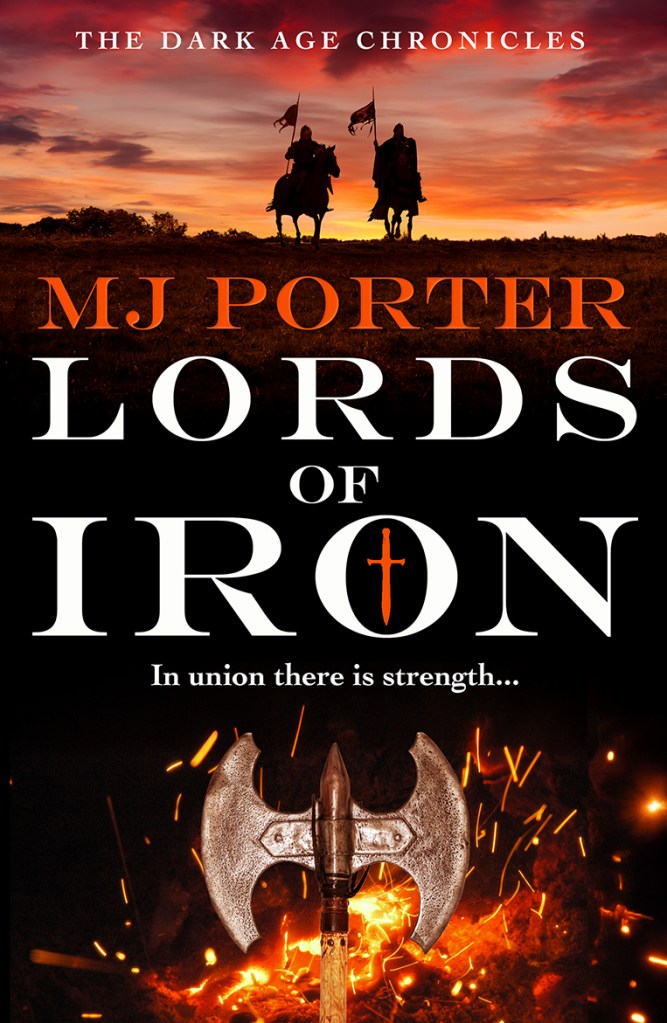
What languages were being spoken in Post-Roman Britain? #newrelease #MenOfIron #WarriorsOfIron #histfic
What languages were being spoken in Post-Roman Britain?
As with everything to do with this period of the ‘Dark Ages,’ much was in flux. It’s believed that many languages were spoken by the inhabitants of the island of Britain. From the native Brythonic (also often termed British) who would have spoken a version of Welsh, to the Latin of the Christians, the Old Norse (or even older versions of Old Norse) being spoken by those emigrating to Britannia, as well as Pictish, and potentially other languages as well.
Our only written source commonly believed to be from this period, that of Gildas’ On The Ruin of Britain, was written in Latin, but then, he’s said to have been an educated Christian, raised in the ways of both Rome and Christianity. If he spoke Latin on a day to day basis, I’m unsure. I know scholars complain about his grasp of the written Latin language being somewhat convoluted, but whether that’s due to him, or the way his writings have been transmitted to us through the years, I’m unsure.
How then might these people have communicated with one another if so many different languages were being spoken? There must have been translators who could facilitate trade between the tribes. It would be amazing to discover one of these individuals in the archaeological record, but it seems unlikely.
I’ve worked hard to find names for my characters which feel authentic for the period. The Eorlingas have Brythonic names, Meddi has been shortened from Meddiwysti for fear it was impossible to pronounce, whereas Wærmund and his warriors, while having names that feel very Saxon, are, I hope, ones I’ve not used before, and according to the resource I used, are deemed as ‘early’ Saxon names. Other characters also have Latin names, and some have slightly made-up Latinised names i.e. Terricus who was named after one of my readers, who wanted to be a warrior, but became a blacksmith instead. I think he’s still one of my readers:)
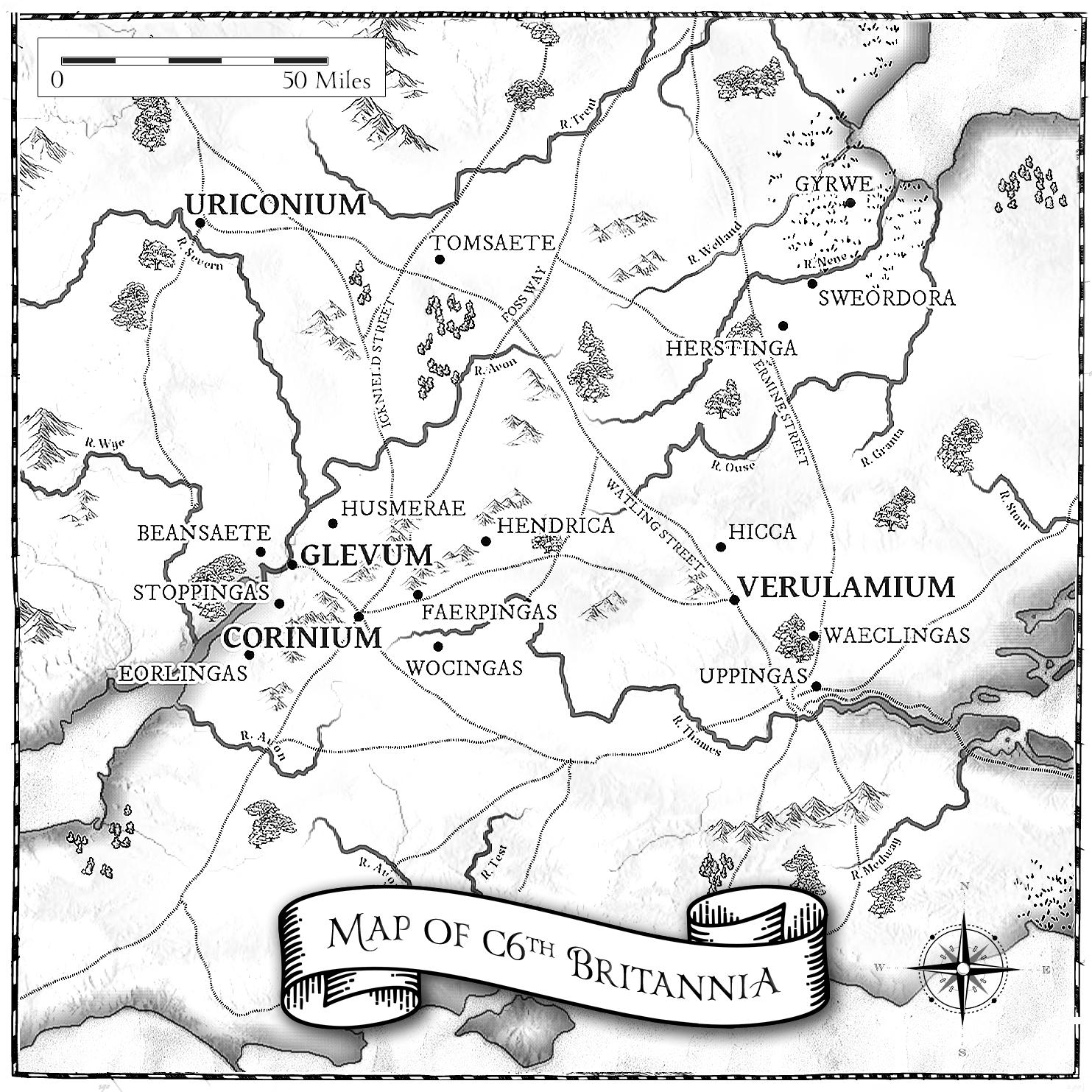
I’ve also used different names for the settlements, again to reflect the mix in language. The Eorlingas, Gyrwe and other tribal names are from the Tribal Hidage a contentious (later and difficult to date) source but one believed to document the very small tribal affiliations that might have existed at this time. Uriconium/Viriconium has its Latin name, although I used a version of the name I found that’s not the most commonly used one. Corinium (Cirencester), Glevum (Gloucester) and Verulamium (St Albans) have their Roman-era names. The River Severn, has its Old Welsh name, Habren, and so, as I was writing the trilogy I was being mindful of reflecting the hodgepodge of names and languages my characters might have known and heard being spoken.
It also added to the drama to make it difficult for my characters to easily communicate with one another.
The physical and political setting for Lady Estrid, a novel of eleventh century Denmark #histfic #lostwomenofhistory
Lady Estrid is set in Denmark, as well as in wider Scandinavia and England, during the eleventh century. But it’s events in Denmark, Norway and Sweden that inspired me to write about Lady Estrid, although, of course, I couldn’t do it without including England.
Denmark, at this time, is really starting to cohere into what we might think of as a coherent kingdom. I’m not an expert on what comes before, but The House of Gorm, into which Lady Estrid is born, has ruled Denmark for a couple of decades (through her grandfather, Gorm, and father, Swein Forkbeard), but a lasting peace hasn’t necessarily been achieved. The family are portrayed as conquerors, coming into what would become Denmark, and imposing themselves over an unruly elite. The number of intermarriages between families in (what we call today) Norway, Sweden and Denmark offers a landscape that is riddled with double-crossing and the potential for mischief and war against a backdrop of uncertainty in Denmark. You can find family trees for Lady Estrid here.
And what a cast of characters I had to play with – King Swein of Denmark, his two sons, his daughters, and the men they marry, and the sons and daughters they birth, and of course, his wife as well. It seems that not only was she married to Swein, she was also the wife of the king of Sweden before his death, and might even have been pursued by Olaf Tryggvason. (There are arguments about her actual identity, but not about her marital history.)
And into all this steps Lady Estrid, who, like similar royal women, has the advantage of living a much longer life than many of her male family members. She is someone who would have lived through turbulent times, and I always find that overriding viewpoint, just too good to ignore, because it gives an author so much scope to play with. Yes, I might know what ultimately happens, but when you weave the story of Lady Estrid, and what is, and isn’t known about her, around bigger events, in Denmark, Norway, Sweden and England, it makes for both a complex and a simple story. The people she met along the way are perhaps better known than she is herself, but that’s just a means of adding context to a much longer narrative than can often be explored when writing about Swein, or Cnut, or Harald or Harthacnut or Svein (yes, another one) or Beorn.
I’m sharing my review for Death At the School of Translators, A Rebecca DeToledo Medieval Mystery by Esther Knight #bookreview #historicalmystery #histfic #blogtour
Here’s the blurb
Ivanhoe meets Phryne Fisher in this medieval adventure of a woman sleuth.
Toledo, 1193: A city of scholars, secrets, and simmering tensions. When Queen Eleanor of Aquitaine’s Jewish spy is found dead, whispers of treachery reach all the way to England.
Rebecca DeToledo, a gifted healer and wealthy Jewish heiress, arrives under royal orders to investigate at the School of Translators. Her mission quickly turns perilous as she faces threats to her life and a sudden battle over her inheritance.
Assigned to guard her is Sir John of Hampstead, a disillusioned crusader burdened with knowledge that could threaten King Richard’s release from captivity. Forced into this partnership, he must protect Rebecca while grappling with his own prejudices.
As they navigate Toledo’s complex alliances, where Christians, Jews, and Muslims coexist in fragile peace, they uncover a web of secrets reaching deep into the cathedral. Can Rebecca and John unearth the truth before they become the next targets?
For fans of historical sleuths, slow-burn tension, and secret missions cloaked in royal intrigue.
Death at the School of Translators is a medieval mystery told from two points of view: Rebecca, our Jewish heiress, and John, our disillusioned knight. They are thrust together in England by Queen Eleanor of Aquitaine, in somewhat confusing circumstances, and quickly embark on their journey to Toledo, where the real investigation quickly gets underway.
The author endeavours to bring together the many cultures within Toledo and the many interested parties at play. There is no end to the intrigue, as the appearance of Rebecca and John stirs up problems for those living in Toledo, while others have things they wish to keep hidden.
There are a few moments where the story falters slightly, but as it approaches the conclusion, it really excels, and I think the author finds her footing with these two characters, who will undoubtedly reveal more mysteries in the future. There are also one or two modernisms that detract from the depth of research the author must have undertaken to write the mystery, but they are only slight.
Overall, I found Death at the School of Translators to be a fine first story in this new mystery series, and I look forward to reading more of Rebecca and John’s mysteries.
Meet the author
Esther Knight writes historical mysteries featuring a bold heroine who challenges the norms of her time.
*Terms and Conditions –Worldwide entries welcome. Please enter using the Gleam box below. The winner will be selected at random via Gleam from all valid entries and will be notified by Twitter and/or email. If no response is received within 7 days then Rachel’s Random Resources reserves the right to select an alternative winner. Open to all entrants aged 18 or over. Any personal data given as part of the competition entry is used for this purpose only and will not be shared with third parties, with the exception of the winners’ information. This will passed to the giveaway organiser and used only for fulfilment of the prize, after which time Rachel’s Random Resources will delete the data. I am not responsible for despatch or delivery of the prize.
I’m delighted to share my review for Adam Lofthouse’s Eagle and the Flame #historicalfiction #blogtour #Roman #bookreview
I’m reviewing Eagle and the Flame by Adam Lofthouse
Here’s the blurb
Rebellion is in the air at the far reaches of empire.
Wall of Hadrian, Britannia, AD 367. Tribune Sixtus Victorinus is scouting north of the Wall when he first sees the smoke. Riding south he finds a province in chaos, the local populace in flight, the soldiers absent.
Britannia is ablaze, overrun with barbarians and Valentia is the word on everyone’s lips. But no one seems to have the first clue what it means…
Victorinus may have let his life run to ruin and drunk his youth away, but now he must forge himself into the soldier he always wanted to be, the hero his children think he is.
Because his family are among the missing, and traitors lurk much closer than he could ever believe.
To save his family, he must first save an empire.
EAGLE AND THE FLAME will sweep you through the tumultuous years of the late Roman Empire.
The Eagle and the Flame by Adam Lofthouse is a fascinating reimagining of Britannia during the late 360s. This then is Roman Britain, complete with Roman soldiers and senators, Roman weapons and, of course, Hadrian’s Wall. But, this is also a world of Germanic warriors, Saxon invaders, the tribes from beyond the Wall, and even some pirates.
Historically, the end of Roman Britain might be a few years in the future, but this is a world on the brink, the reach of the Romans starting to fade, and the events in Eagle and the Flame tell of a people as yet unaware of the coming calamities, and, Adam describes it very well. We have abandoned Roman forts, discontented Roman soldiers who aren’t getting paid on time, and the tribes from across Hadrian’s Wall are more aware of what might be happening than the Romans. And the emperor is very far away in Rome.
Our two main characters, Tribune Sixtus Victorinus, and Felicius are opposites of the same coin; one jaded and drunk, the other, still a career Roman soldier. Between them, they must disentangle the unexplained events on the borderlands, and then they must rouse support from all that they can to defeat the coming rebellion.
Eagle and the Flame starts fantastically well, immediately sucking the reader into the world of the 360s. It’s really quite hard to put the book down as the tension ramps up. Tribune Sixtus is a sympathetic character; for all, he is perhaps to blame for many of his problems. The small group of warriors who make up his area of command are well-sketched, and there is tragedy in the offing. Felicius’ life is more regimented, and it is Felicius who gives us a glimpse of what it was to be a Roman in the waning years of the Empire.

I really enjoyed Eagle and the Flame. The book starts with a bang and builds nicely to its conclusion, introducing a great cast of characters along the way. If you’re a fan of stories set in Saxon England, then you’ll love this earlier glimpse of Britannia.
Adam has for many years held a passion for the ancient world. As a teenager he picked up Gates of Rome by Conn Iggulden, and has been obsessed with all things Rome ever since. After ten years of immersing himself in stories of the Roman world, he decided to have a go at writing one for himself. He lives in Kent, UK.
I’m resharing an interview I gave when I’d finished writing Lady Estrid, a novel of eleventh century Denmark #histfic #writingadvice #authorinterview
Why did you decide to write about Lady Estrid?
Lady Estrid has been a character that’s long fascinated me. She crops up as a ‘bit part’ character in another series I write, but as time has gone on, I’ve realised that she offers a lot more than I’ve been allowing her so far. And so, I hope at a suitable point in the other series, I decided to explore Lady Estrid for herself. It involves stepping away from my comfort zone of pre-Conquest England in the eleventh century, and allows me to write about Scandinavia at this time period, which has always been a huge area of interest for me.
I’ve written a few long story arcs before, but only two other books which cover such a huge amount of time (about four decades). Such a project allows me to focus on the bigger picture and to put historical characters into a much wider story-arc than writing just about them would allow.
By necessity, Lady Estrid must be a strong woman, able to manipulate the politics taking place around her. I think that there’s a huge and growing interest in such women, and of course, Denmark (and Scandinavia as a whole) at this time, isn’t something that I believe has been tackled before, potentially because of the lack of English Language books about the era.
What drew you towards the Early Medieval era in which you set your book?
I’m fascinated by everything pre-1066 in England, but also wider afield. It’s impossible to tell the story of just one of these later countries, inhabited by Northmen or Norsemen, without looking to what’s happening elsewhere. These characters didn’t abide by our current national boundaries.
What were the challenges you faced in researching this period of history and were there any unexpected surprises?
The biggest problem with writing about this time period is the sources. I’m not as familiar with the Saga material and the works of Adam of Bremen and Saxon Gramaticus, as I’d like to be. As such, I rely much more on secondary sources than I might when writing about the Early English period. And of course, it’s a period where written sources are quite scarce anyway. Not only is it difficult to ‘find’ Lady Estrid, but, as you might have noticed, many of the character share the same names – there are no ends of Swein/Svein/Sven’s and equally, just as many Gytha’s and Gunnhild’s.
I was surprised by just how little the women of the Danish royal family are mentioned in any secondary sources. I’ve recently been on a book buying spree, and even in a new monograph on Cnut, Lady Estrith is only cited in the index seven times, and in a 798-page book, she has about 3 words!
What do you think is the most challenging aspect of writing Historical Fiction?
I think this depends on how much history you want to put in your book. I’ve just written three books in The Ninth Century Series, and while they’re historical in nature, much of the day-to-day activity is actually fighting and swearing. Lady Estrid has a much weightier content. It has a cast of many more people; they all have to be placed in the right time period and at the right events, and there is not as much information about any of them as I’d like there to be. Obviously, The Ninth Century Series was easier to write once the time period was set. Lady Estrid was an altogether different project. It took much longer, and was more frustrating because I was trying to ensure it didn’t conflict with previous stories I’ve written, which have a very ‘Early English’ basis.
What advice do you have for aspiring Historical Fiction authors?
Know the time period you’re writing about, and not just what happens during it, but also what happens both before, and after, and in neighbouring countries as well. And, be aware of what ‘might have happened’ if certain events – normally births, deaths or wars – hadn’t happened. Remember, your characters don’t have the benefit of hindsight that you have as a writer. Everything to them would have been immediate, imminent and happening to them. Don’t fall into the trap of presenting everything as a fait accompli.
And, be prepared to be frustrated. There’s always some niggly little fact that is just not mentioned anywhere. The decision then has to be made as to whether to ‘make it up’ or write around it, and readers will somehow always know if you make it up.
And on a final note, be prepared to do something a little bit ‘different,’ be bold, be creative, do whatever has to be done to engage an audience with the time period.
Who was Lady Estrid, and why did I write about her life? #histfic #TheEleventhCentury #England #Denmark #non-fiction
Lady Estrid, or Edith or even Margaret, daughter of King Swein Forkbeard of Denmark (and briefly England) is one of those beguiling characters who lived through momentous change.
I’ve long been drawn to her, and used her as a ‘bit’ part character in my The Earls of Mercia series, but I wanted to dedicate both more time to Lady Estrid, and also to Denmark. Even when I’ve written about Cnut, who was king of England and Denmark, much of the action has taken place in England. There’s simply not enough ‘space’ to fit everything in.
Lady Estrid, like similar royal women (Queen Eadgifu of England and Lady Elfrida in the tenth century), had the advantage of living a much longer life than many of her male family members (check out the family trees here). She was the ‘glue’ that held together the narrative of what was happening in Denmark. And because of her vast family, it also allowed me to weave the story of not just Denmark, but also Norway, Sweden, England, and Normandy, into the narrative.
She was the daughter of a king, the sister of three kings, the aunt of four kings, the mother of one king, and in time, the grandmother of three further kings.
Having written about Queen Eadgifu, Lady Elfrida, and King Edward the Elder’s daughters (in tenth century England), I wanted a new ‘woman’ to bring to life. I could have chosen Queen Emma, or even Queen Edith of England, but their stories are more well-known. I’ve long been fascinated by the Scandinavian countries during the Viking Age, and Lady Estrid was just too good a character to leave in her ‘bit’ part without adding anything further.
For all Lady Estrid’s claims as mother, aunt, sister and daughter, there’s very little that can be said about her, not even the order of her three marriages, if they occurred, can be confirmed. It’s only possible to say that her marriage to Jarl Úlfr took place because of the survival of her children. It’s the lack of ‘hard facts’ about her, and the potential to weave a story that includes so many of the other well-known women and men of the period, that made Lady Estrid so irresistible. When stories focus on Earl Godwine, or King Cnut, or even on King Harald Hardrada, it’s possible to lose sight of the bigger picture, and Lady Estrid certainly provides the potential to show the overarching events that occurred from AD1013-1050 within Denmark and England.
On the 1100th anniversary of King Athelstan’s coronation #histfic #OnThisDayInHistory #non-fiction
Who was Athelstan?
He was the oldest son of Edward the Elder, but who was his mother?
It’s been suggested his mother might have been Mercian, and this also made him acceptable for the Mercians to declare him as king- but it’s impossible to determine more about her. We don’t even know her name, although it’s suggested that it was Ecgwynn. She was soon replaced, either because of her death or because Edward, on becoming king of Wessex, needed to cement his position through marriage with a powerful ealdormanic family. Lady Ælfflæd was Edward’s second wife.
Later discussions abound about Athelstan’s suitability to become king of Wessex, with many casting doubt on the union, but it is evident that Alfred believed the union was a lawful one, and his grandson would one day become king, although of where, we don’t know.
Equally, we don’t actually know when Edward’s second marriage occurred, was it before or after his father’s death?
Athelstan’s early life
Athelstan and his younger half-brother, Ælfweard, who we must assume was the oldest son born to Edward and his second wife, begin to attest charters in 901 both as filius regis although Ælfweard is named above Athelstan despite being younger.
Athelstan attests eleven of his father’s charters (Sawyer, P.H. (ed.), Anglo-Saxon charters: An annotated list and bibliography, rev. Kelly, S.E., Rushforth, R., (2022). http://www.esawyer.org.uk/ S365, S366, S371, S375, S376, S377, S378, S379, S381, S382, S383), Ælfweard only eight, but again, the number is still small and so may not be representative – in 901, Athelstan witnesses 2 charters, but Ælfweard only one.
Only three of the eleven charters that Athelstan witnesses under his father are deemed to be authentic, and only one of those witnessed by Ælfweard and Athelstan together which is dated to 901, when they were both young children. This would have been very early in Edward’s reign, when his cousin, Æthelwold, was still alive and contesting the rulership of Wessex, something that wasn’t resolved until the decisive Battle of the Holme, in either 901 or 902. Edward may have wanted to labour the point that he was the father to two potential male heirs, or æthelings. (His brother, Æthelweard is also termed filius regis, and so Edward might have been highlighting that if something did befall him, he had a brother who could also succeed him, as opposed to two young children.)
However, there is a large gap in the charter evidence for Edward the Elder in the middle of his reign, and so it is difficult to track any developments.
But with all that said, I don’t find Athelstan’s charter witnessing very helpful when trying to determine his place at the Wessex royal court at this time, his position as a young man or even how he got on with his father’s second wife (as well as his third wife) and her many, many children, who would bedevil him when he became king.
Was Athelstan raised in Mercia by his aunt and uncle?
The fact Athelstan was declared king of Mercia does seem to corroborate a statement made by William of Malmesbury, in the later Gesta Regum Anglorum, or The History of the English Kings, that Athelstan was raised in Mercia by his aunt and uncle, alongside his full birth sister, who may have been called Edith.
Or, it could be that his mother was Mercian. It’s frustratingly difficult to find explanations when events are merely told us as supposed ‘fact,’ and William of Malmesbury’s assertion has been little questioned, other than by historian David Dumville, even though it dates to two centuries after the events. It seems to be the ‘easy’ explanation as to why Athelstan became king of Mercia after his father’s death.
What was happening in Wessex?
Ælfweard, his younger half-brother, was declared king, until his death, 16 days after his father.
How did Athelstan become king of Wessex?
So, once he was chosen as Mercia’s king, how did he then become king of Wessex on the death of Ælfweard so soon after that of Edward?
This period is as equally hazy as what happened to make Athelstan king of Mercia.
But, after Ælfweard’s death, there is another son of Edward’s second marriage who could have become king, Edwin. As could the sons of Edward’s third wife, Lady Eadgifu, who were very young at the time, perhaps no more than one and three years old.
Why Athelstan was chosen is difficult to rationalise, especially if the Wessex witan were so uneasy with him. Some suggest he reached an agreement with Lady Eadgifu (his father’s third wife) that her sons would be his heirs. Others think there was a period of unease where Wessex was kingless. We have no explanation for Edwin being overlooked, and certainly, it seems he went on to cause his older half-brother problems. We have reports of Edwin’s death in 933 – apparently from drowning, but it seems likely, it was some sort of rebellion against his half brother, the king. The Gesta Abbatum S. Bertini Sithiensium, reports his burial by his cousin in Flanders.
I find this period quite interesting as by now, another Eadgifu, a half sister of Athelstan, who had been married to King Charles III of the West Franks, might have been in Wessex. She had a young son, Louis, but Charles had been usurped and imprisoned and certainly Louis was at the Wessex court when his grandfather died. It’s possible Eadgifu was as well. Would she not have supported her full brother against Athelstan claiming the kingship? Equally, we don’t know if Edwin’s mother was still alive. It is all very perplexing.
What we do know is that Athelstan underwent his coronation in September 925, so over a year after his father’s and half-brother’s death. The coronation took place at Kingston upon Thames. This delay has been interpreted as showing he met resistance in Wessex to his rule, but it might not have been that unusual. His father’s coronation was not immediate, although, admittedly, his father was faced with the rebellion of Æthelwold, his cousin and the surviving son of Alfred’s older brother, Æthelred I. Alfred and his brother seem to have reached an accord about the succession before Æthelred I’s death, and Alfred then rode roughshod over it.
A coronation with a crown?
There is some discussion about whether the surviving Coronation ordo (ceremony) was devised for Athelstan or not, but he was crowned with a crown and not a helmet, as earlier kings had been. We have a famous image of Athelstan, (we only have two contemporary/near-contemporary images of the tenth century kings) presenting a book to St Cuthbert, and in this image, he is shown wearing a crown. This was a departure from earlier ceremonies.
Frontispiece of Bede’s Life of St Cuthbert, showing King Æthelstan (924–39) presenting a copy of the book to the saint himself. Public domain, via Wikimedia Commons
For more suggestions, and my fictional recreation of how Athelstan became king of Mercia, Wessex and the English, do check out my books, Kingmaker (the story of Lady Eadgifu), and King of Kings (which begins with the coronation of King Athelstan on 4th September 925).
Anglo-Saxon Chronicle quotations from M Swanton, The Anglo-Saxon Chronicles.
Check out the Brunanburh Series page on my blog for more information.
I’m delighted to welcome Mike Weedall and his new book, Escape to the Maroons, to the blog with an excerpt.
Excerpt
Nathanial On Arriving At Maroons Camp
Besides the people waiting here, more are coming. I’m the center of attention. People whisper and point at me. I don’t like what’s going on. No one looks friendly. They must think I’m a white man. Should I say something? Better leave that to Lincoln.
This place looks sizable. The ground is dry. Trees and thick brush are on all sides. We crossed smaller islands like this getting here. Moses called them hummocks. This appears to be much bigger. There must be different ways in and out of here. I’m exhausted and need to sit. Better stand until Lincoln says that’s okay.
How did this day lead me here? This morning, I planned to stand up in court and explain why they should grant me freedom. My stepfather said I’d be a fool to do that and better run if I got the chance. I wasn’t expecting that advice from a minister who preached we should always obey the law. When that lazy deputy got distracted, I took off. What choice did I have other than to flee? I pray they don’t punish my family for raising me as a freeman.
What’s next? Lincoln is waving for me to follow him.
Here’s the Blurb
In 1792, an escaped slave, raised and living as white, is discovered and forced to flee into the Great Dismal Swamp.
Barely escaping a bounty hunter, a Maroons community of fugitive slaves rescues him. Over time, Nathanial comes to accept his true identity while fighting to overcome the suspicions of his new community. Because of his pale skin, he becomes a conductor on the underground railroad, slipping runners onto ships going north. On one of his missions, fate intervenes and places Nathanial’s community at risk.
This little-known chapter in American history tells how escaped enslaved people gave their all to live free while creating a community and economy in one of the world’s most unforgiving environments.
As the author of three books, Mike’s passion is finding the little-known stories of history and bringing them to life. History in school is too often events and dates. Mike seeks to discover the people who lived those events and reveal why those individuals made the decisions they did. Ultimately, there are stories to be mined, and who doesn’t love a good story?
In his historical novel “Escape To The Maroons,” Mike tells the little-known story of 1791 self-liberated slaves who chose to struggle for survival in The Great Dismal Swamp in their determination to live free. The term Maroons delineates areas where escaped slaves fled and could not be recaptured. It’s estimated that over 2,000 survived deep in the swamp around the turn of that century.
His first book “Iva: The True Story of Tokyo Rose” describes the tragic life of Iva Toguri. Trapped in Japan during World War II, this Japanese American woman was forced to work for Radio Tokyo. Although she never participated in propaganda, the racial animus of post-war America led to her being falsely labelled as Tokyo Rose and prosecuted for treason. Through her incarceration and the ongoing discrimination heaped upon her, Iva never lost her courage and determination.
“War Angel: Korea 1950” was his second book that followed a reservist nurse thrust into the carnage of The Korean War. Serving as an operating room nurse in a Mobile Army Surgical Hospital, the real MASH and strength of a woman is revealed.
Mike resides with his family in the Pacific Northwest where they enjoy experiencing the outdoors.