

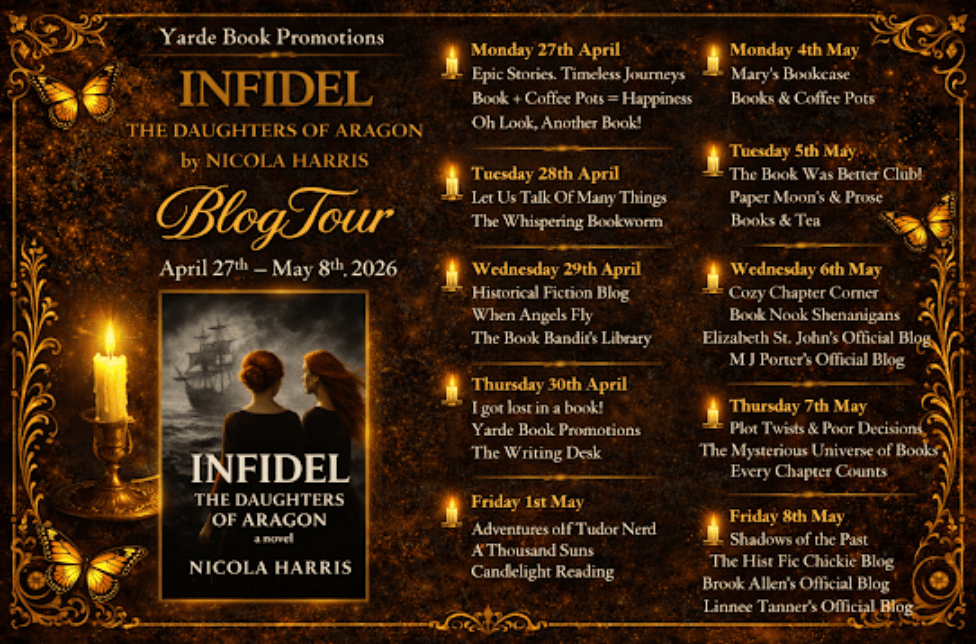
I’m welcoming Nicola Harris to the blog with her new novel, Infidel
Guest post by Nicola Harris
My research for Infidel began long before I ever thought of writing a novel about Catherine of Aragón. It began on a beach in Tenerife, years before tourism transformed the island. To a child, it felt like another world. The light, the heat, the colours, the food, the rhythm of life.
I was fortunate enough to spend a great deal of time with a Spanish family who welcomed me into their home and their culture year after year. They taught me fragments of their language and, more importantly, the stories that shaped their history. Through them, I first encountered the world of Muslim Spain and the Catholic warrior monarchs who fought to reclaim it. It was impossible not to be fascinated.
Catalina’s mother, Isabella of Castile, stood out immediately. She was disciplined, relentless, and utterly convinced of her divine purpose. She was also a mother raising her children in a kingdom defined by conflict.
That tension between power and vulnerability became the foundation of my interest in Catalina’s early life. Before she was a queen, she was a child shaped by siege warfare, political ambition, and the expectations of a dynasty that demanded strength from its daughters.
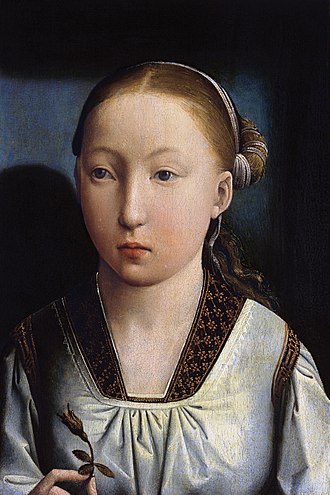

As I began to research more deeply, I found myself drawn to the wider world that touched Catalina’s childhood. I have always been captivated by the fall of Constantinople and the Turkish Sultan Mehmed II’s audacious plan to take the city.
On a trip to Turkey a few years ago, I spoke with a Turkish waiter about his view of the sultan. His pride and respect for Mehmed stayed with me. It reminded me that history is never simple. Every figure we study has another side, another story, another set of loyalties and beliefs.
That conversation helped me approach the period with a wider lens, aware that the Christian and Muslim worlds were not simply enemies but complex civilisations with their own brilliance and contradictions.
Juana of Castile, Catalina’s older sister, became a vital part of the novel for this reason. She is often reduced to the label Juana the Mad, but she was far more than that. In Infidel, Juana allows me to explore the moral questions surrounding the Muslim wars and the Inquisition.
She is outspoken, intelligent, and unwilling to accept cruelty as the natural cost of faith. Through her, I could give voice to the discomfort a modern reader might feel when confronted with the punishments and persecutions of the age. Without revealing too much, Juana’s own journey takes her far from home, and the emotional cost of that distance shapes her view of the world.
Her brother Juan was married to Margaret of Austria, who is frequently remembered for educating Anne Boleyn. What is less often acknowledged is that long before Anne ever entered Margaret’s household, Catalina was already connected to Margaret by family.
In Infidel, those family connections matter. It reminds us that Catalina did not exist only in relation to Henry VIII and Anne Boleyn. She belonged to a wider European network of women whose lives, loyalties, and alliances shaped the courts that Anne would later enter.
There is a great deal of sadness in this story, because there was a great deal of sadness in Catalina’s early life. She lost people she loved. She witnessed the brutality of war. She learned to read cyphers and how to read hearts. She watched her parents arguing over her father’s love affairs. She learned to stand firm even when everything around her was shifting.
Her childhood was not soft or sheltered. It was an ordeal. She came face to face with native Americans who were snatched from their land and brought to the palace. I wanted to understand what forged her, what hardened her, and what gave her the strength she carried into England. Her resilience did not appear by magic. It was earned.
Infidel grew from all these threads: my early love of Spain, my fascination with the fall of Constantinople, my respect for the complexity of the period, my interest in the overlooked connections between women like Catalina and Margaret of Austria, and my desire to show Catalina not as a symbol but as a girl shaped by fire.
She was fierce, vulnerable, determined, and unforgettable long before she became a Tudor queen. I wanted to bring that girl to life. I wanted to show the sisters who stood beside her, the world that formed her, and the dynasty that demanded so much from its daughters.
Here’s the blurb
Born in the glittering courts of Castile and Aragon and forged in the shadow of war, Catalina de Aragón grows up surrounded by queens, rebels, and explorers. She is her mother’s last daughter, the final jewel of a dynasty built on conquest and faith, and the one child Isabella of Castile cannot bear to lose.
But destiny has already claimed Catalina.
Promised to Prince Arthur of England since childhood, she is raised to bind kingdoms, soothe old wounds, and carry the hopes of an empire across the sea. Yet, Spain fractures under rebellion, grief, and the ruthless zeal of its own rulers.
From the burning streets of Granada to the storm‑lashed Bay of Biscay, Catalina and her sisters must navigate a treacherous path shaped by ambition, betrayal, and the dangerous love of men who fear the power of queens. She learns to read cyphers, to read hearts, and to stand unbroken even as her childhood is stripped from her piece by piece.
And when she finally sails for England armed with her mother’s lessons, her father’s steel, and the ghosts of the Alhambra at her back, Catalina steps into her fate not as a girl, but as a force.
A princess.
A survivor.
A daughter of Aragon.
Infidel is the story of a young woman raised for greatness and destined to reshape the fate of nations. This is Catalina, as she has never been seen before. She is fierce, vulnerable, and unforgettable.
A sweeping, intimate portrait of sisterhood, survival, and the making of a dynasty, Infidel reveals the hidden lives of a woman whose courage shaped the Tudor world.
Any Triggers: Grief, mild peril, the Spanish Inquisition, enslaved people, death in childbirth and miscarriage.
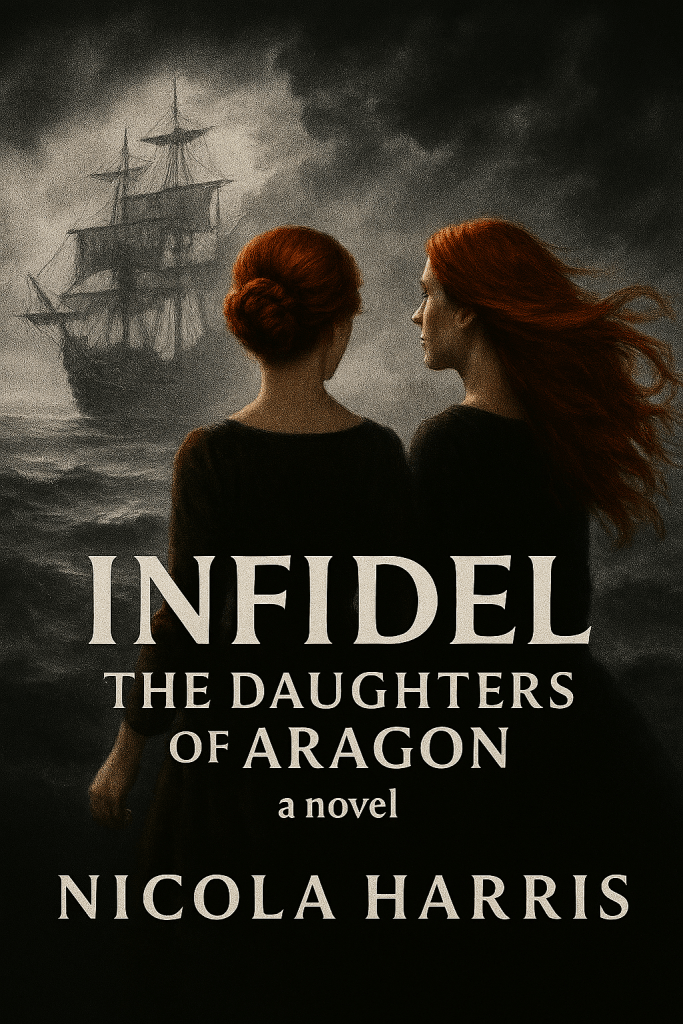
https://books2read.com/u/4AZDEJ
Read with #KindleUnlimited
Meet the author
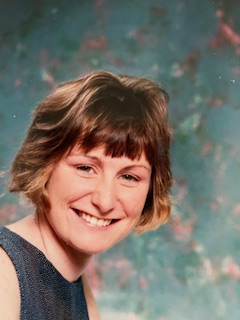
I’ve always been a writer, but it was only when illness forced me to stop everything that I finally had the time to write a novel. After decades of misdiagnosis, I learned I was born with a serious genetic condition, not rare, but profoundly misunderstood. The clues were there from birth, and suddenly, a lifetime of struggle made sense.
Writing became my lifeline: a way to step beyond my pain, to shape my experience into a story, and to find meaning where there had once been only endurance.
I have a lifelong love of children, Counselling, and Psychotherapy Theory and history.
https://nicolaharrisauthor.com/
Posts
Stay up to date with the latest from the blog.















 MJ Porter