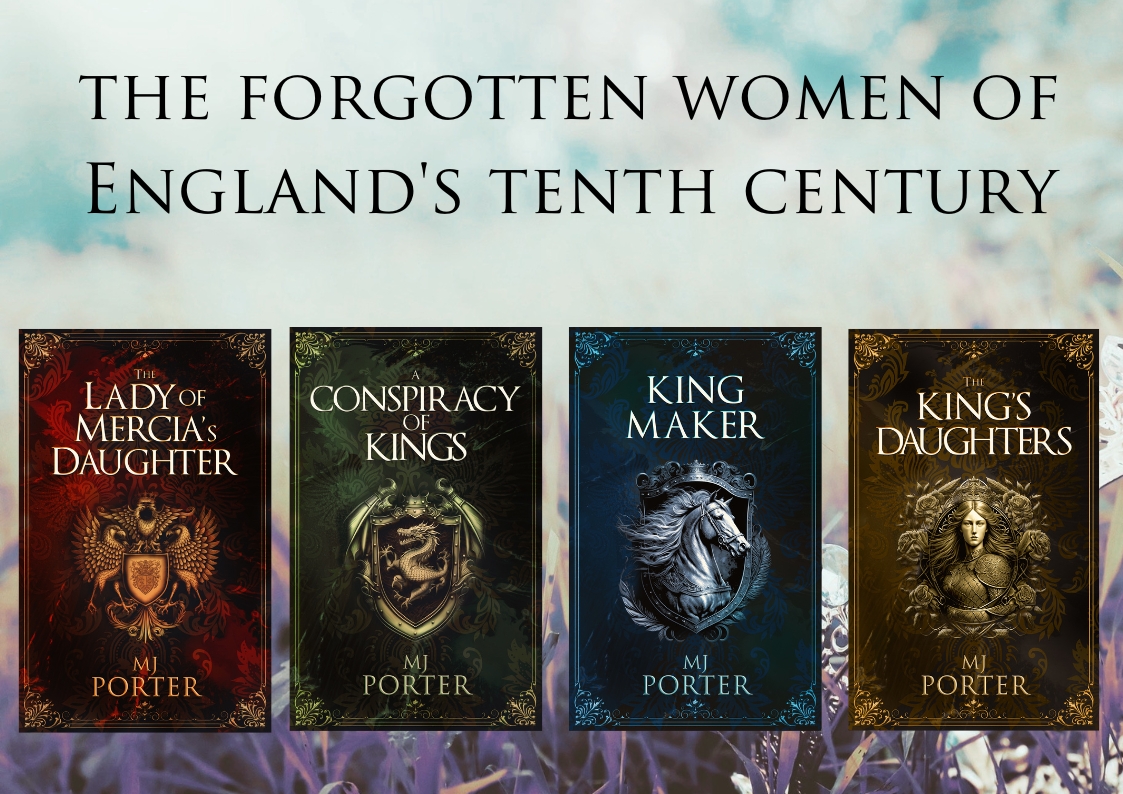
Author of Saxon historical fiction and non-fiction, 20th-century historical mysteries, and Norse-inspired historical romantasy. Book reviewer and blog host.
I thought I’d share some of my frustrations with writing about the lives of the ‘lost women’ of the tenth century.
The Tenth Century in Saxon England is often seen as heralding the triumph of Wessex to form England and to drive the Viking raiders far from England’s shores. That is both right and wrong, but it does mean that the names of the kings of the House of Wessex are well-known (comparatively speaking). The same can’t be said for the women who were wives, daughters and mothers of these kings. We can debate why this is but it doesn’t solve the problem of who these women were. For some of them, we don’t even know their names. We don’t know the name of King Athelstan’s mother, which astounds me. Equally, some of his half-sisters are quickly ‘lost’ in Continental Europe. Much of this is because they didn’t create huge dynasties to revere them after their death (apart from perhaps Eadgyth, who married Otto of the East Franks and whose sudden death deeply affected her husband). Of course, this problem is also compounded by the few surviving contemporary records.
Even those sources which do survive are not easy to access. Language barriers are a huge problem. The Anglo-Saxon Chronicles have been studied and translated into easily accessible volumes, but alas, only Ealhswith, wife of King Alfred, Æthelflæd of Mercia, her daughter Ælfwynn, and two unnamed sisters of Athelstan are actually mentioned in the ASC. We can find more names in Æthelweard’s Latin translation of the ASC known as the Chronicon but it is still not an exhaustive list of his own relatives. Æthelweard claimed descent from King Alfred’s brother, Æthelred I.
This situation doesn’t just apply to the tenth-century. The online resource, The Prosopography of Anglo-Saxon England (PASE), has a database of 33,981 male names listed for the entire period of Saxon England. Only 1460 female names are listed. As such, we know much more about the male members of Saxon England, than we do the females.
And, these women have received very little study. While there are academic books about the much better known eleventh-century queens, Emma of Normandy and Edith, the wife of Edward the Confessor, it’s not been possible to pick up a single title and learn about these lost women, aside from Elizabeth Norton’s monograph on Lady Elfrdia.
To begin with, I wished to fictionalise the life of Lady Elfrida, wife of King Edgar, thanks to the work by Elizabeth Norton. I then turned my mind to other women of the tenth century and, indeed, even to Lady Estrid, the sister of King Cnut. Time and again, I found that so little information had survived, the majority of it only a reference in relation to male members of the family, that much of their lives had to be reconstructed based on what is documented as happening at the time. There was certainly no tangible way to connect with these women, other than a possible surviving piece of embroidery which might have been stitched by King Edward the Elder’s second wife, and if not by her hand, then at her command, and which was found inside the tomb of St Cuthbert when it was opened in the early nineteenth century (1827).
I can’t help feeling this is how Æthelweard felt when he wrote his Chronicon. The passage of time has not made it any easier to uncover the names of the women, let alone their personalities.
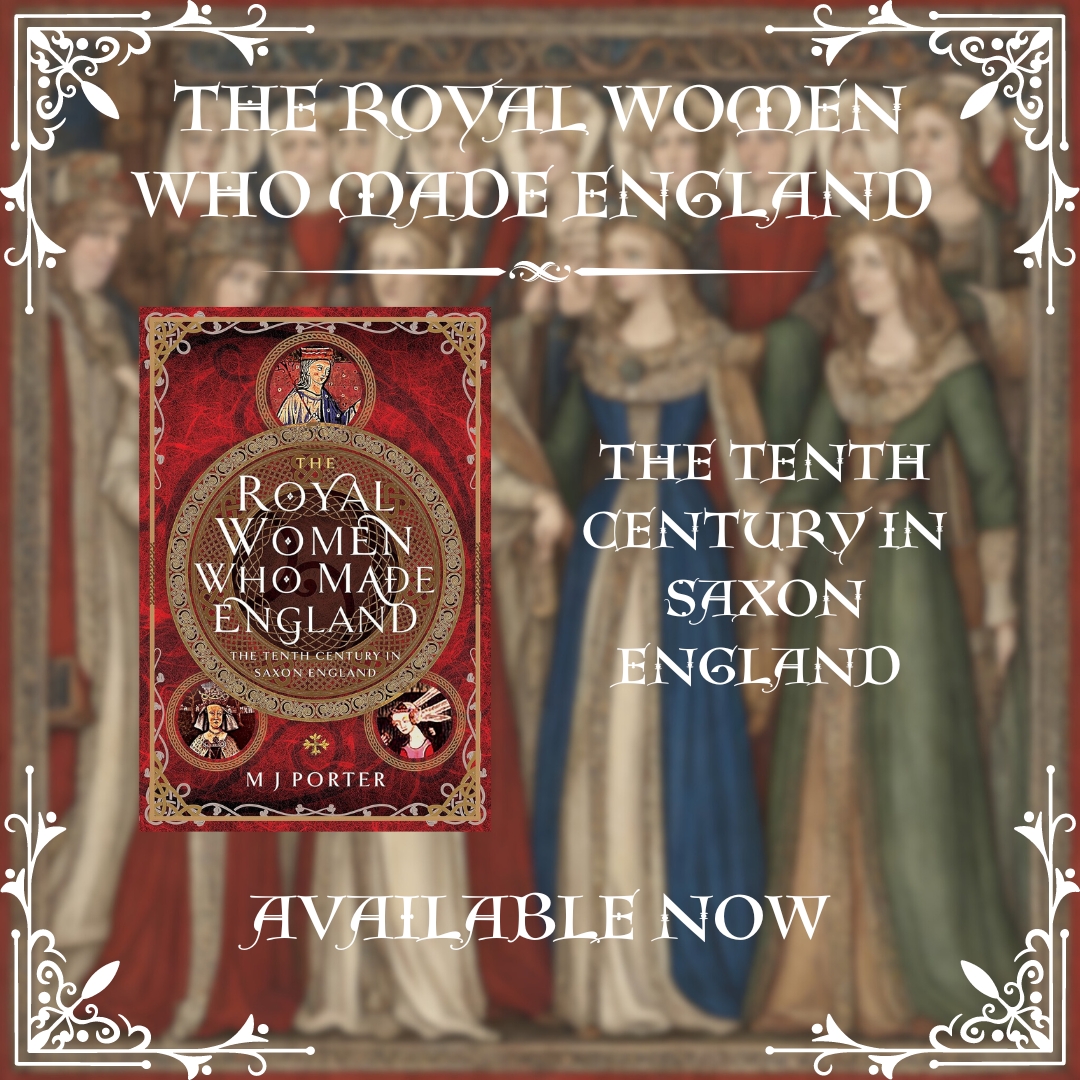
I have now written a non-fiction account of this period, and it is now available from Pen and Sword books – The Royal Women Who Made England. I hope, alongside the fictionalised accounts of their lives, that this will inspire more interest in them.
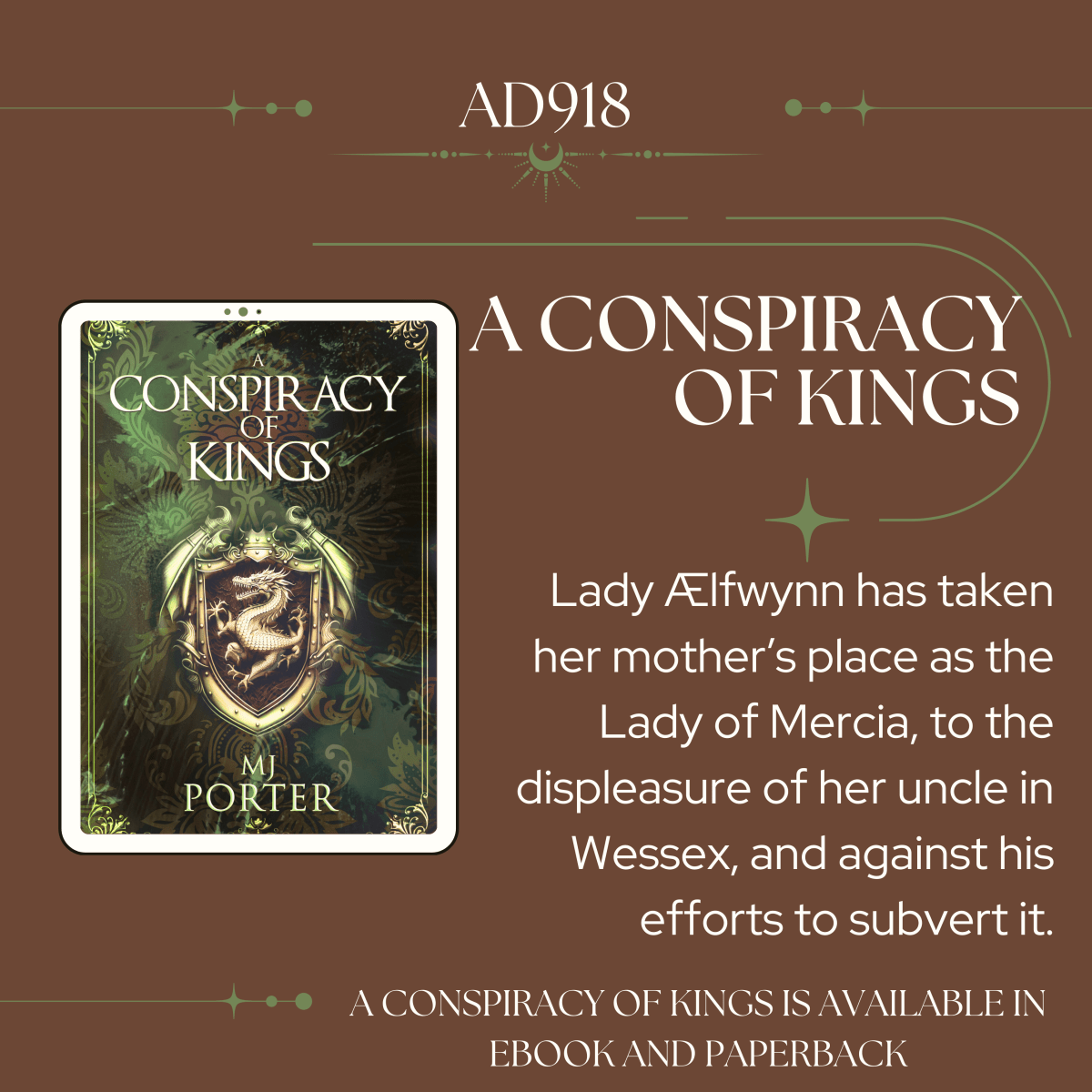
I’m reading the beginning from A Conspiracy of Kings. Hopefully, you’ll enjoy listening below. Just click on the image. This does contain spoilers if you’ve not yet read book 1, The Lady of Mercia’s Daughter.
Who was Lady Æthelflæd, and what do we know about her from the contemporary sources?
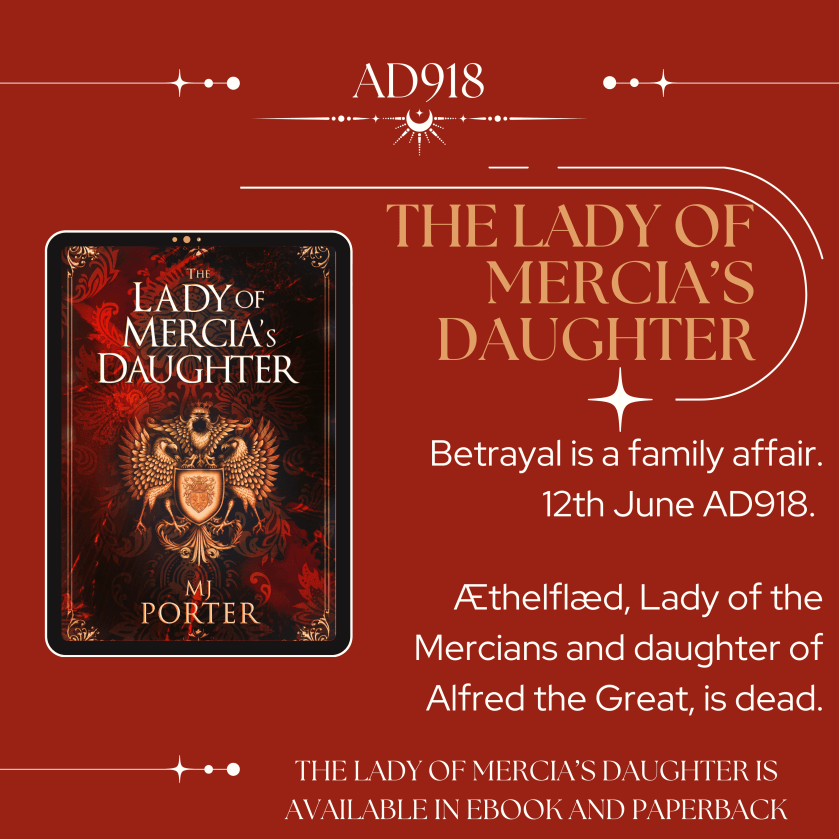
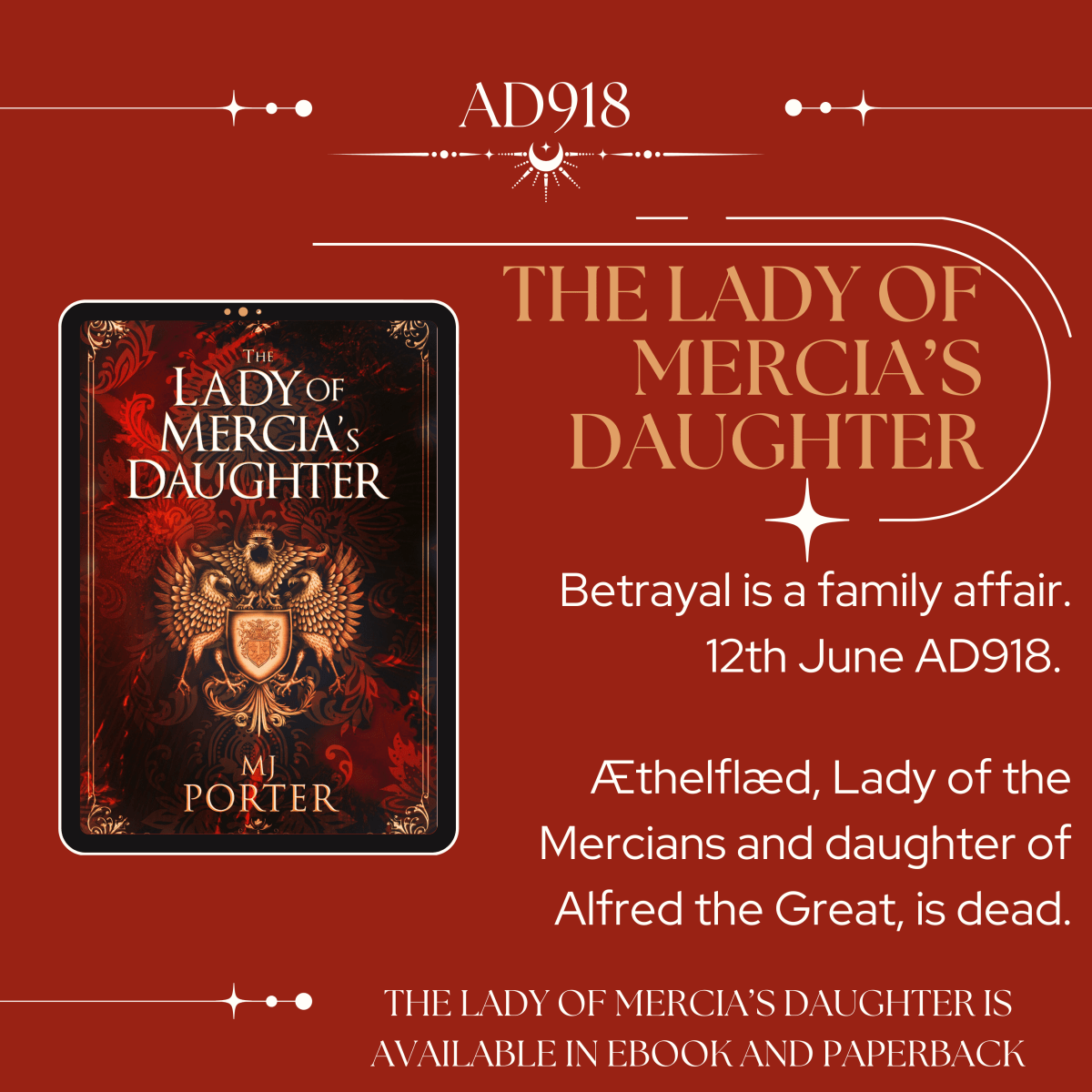
Æthelflæd,[i] said to be the oldest of the children of King Alfred, and his wife, Lady Eahlswith, was born around 866, the exact details are unknown, although the date of her death is well attested as 12 June 918.[ii]
She was married to Lord Æthelred of the Mercians at some point during the 880s, although an exact date cannot be given. The first mention of this union occurs in a charter dated to 887,[iii] although the date may not be reliable. There is also little information about who Lord Æthelred might have been, and his subsequent military successes should not be dismissed, as they often are. Lord Æthelred is assumed to have been a nobleman from Mercia, and one with enough of a reputation to secure the marriage alliance with the Wessex royal family (and it must be assumed, unrelated to her mother’s birth family, and also her father’s family through his sister’s union to Burgred).
Their marriage was a success, and yet there was only one child, a daughter, Ælfwynn, born to the union, perhaps quite soon after the marriage occurred.
During her lifetime, Æthelflæd’s name appears on fifteen surviving charters. These are a real collection, some promulgated by her father, her brother, her husband and then, in her name alone. The earliest to feature her name is S223 dated to 884×9, so between 884 and 889, which survives in two manuscripts, and discussed the building of the burh at Worcester. In her final charters, she’s the sole promulgator, her husband no doubt having already died. It is believed he died in 911. S224 and S225 date to 914 and 915. S225 names Æthelflæd as the ruler of Mercia, something which The Anglo-Saxon Chronicle mirrors in some versions.
In 912, the C text records, ‘Here, on the eve of the Invention of the Holy Cross, Æthelflæd, Lady of the Mercians came to Scergeat and built a stronghold there, and the same year, that at Bridgnorth.’[xxvii]
In 913, the C text further records, ‘Here, God helping, Æthelflæd, Lady of the Mercians, went with all the Mercians to Tamworth, and then built the stronghold there early in the summer, and afterwards before Lammas that at Stafford.’[xxviii]
In 917, the C text writes, ‘Here, before Lammas, God helping, Æthelflæd, Lady of the Mercians took possession of the stronghold which is called Derby, together with all that belonged to it.’[xxxi]
Æthelflæd’s death is recorded in the A and C editions of the Anglo-Saxon Chronicle and also in the E version of the Anglo-Saxon Chronicle, even if only in passing. ‘Here Æthelflæd, Lady of the Mercians, passed away.’[xxxii]
A text states: ‘and then when he (Edward) was settled in the seat there, his sister Æthelflæd at Tamworth, died 12 days before midsummer … and all the nation of the land of Mercia which was earlier subject to Æthelflæd turned to him.’
The C text of 918 offers:
Here in the early part of this year, with God’s help, she [Æthelflæd] peaceably got in her control the stronghold at Leicester and the most part of the raiding-armies that belonged to it were subjected. And also the York-folk had promised her – and some of them granted so by pledge, some confirmed with oaths – that they would be at her disposition. But very quickly after they had done that, she departed, twelve days before midsummer, inside Tamworth, the eighth year that she held control of Mercia, with rightful lordship; and her body lies inside Gloucester in the east side-chapel of St Peter’s Church.[xxxiii]
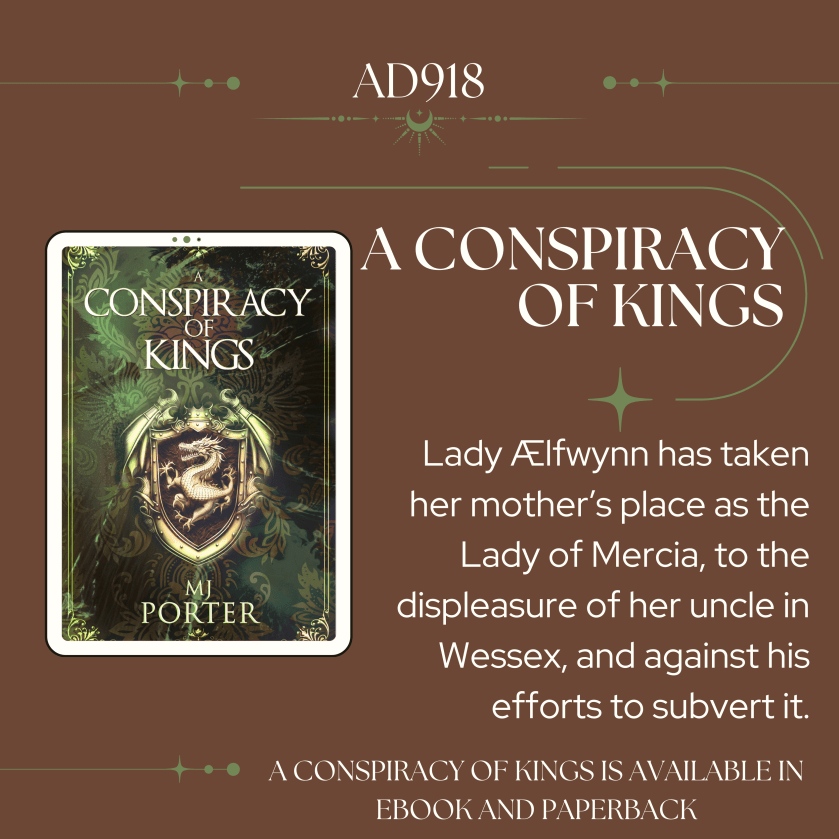
It seems highly probable that Æthelflæd’s death, when it came, was unexpected, occurring in the middle of an advance into the Danelaw and the Five Boroughs (Derby, Nottingham, Lincoln, Stamford, Leicester). It was left to her daughter, and also her brother, to continue her work, and you can read their story in The Lady of Mercia’s Daughter and A Conspiracy of Kings.
[xviii] Baker, N. and Holt, R. ‘The city of Worcester in the tenth century’, in St Oswald of Worcester: Life and InfluenceBrooks, N. and Cubitt, C. ed, (Leicester University Press, 1996), pp.134–5
[xix] Sawyer, P.H. (ed.), Anglo-Saxon charters: An annotated list and bibliography, rev. Kelly, S.E., Rushforth, R., (2022). http://www.esawyer.org.uk/, S1446
[xxi] Sawyer, P.H. (ed.), Anglo-Saxon charters: An annotated list and bibliography, rev. Kelly, S.E., Rushforth, R., (2022). http://www.esawyer.org.uk/, S1282
[xxii] Hart, C.R. The Early Charters of Northern England and the North Midlands (Leicester University Press, 1975), p.102 (100)
[xxvi] Swanton, M. ed. and trans. The Anglo-Saxon Chronicles, (Orion Publishing Group, 2000) Ibid., p.94
[xxxv] See Stafford, P. After Alfred. Anglo-Saxon Chronicles and Chroniclers 900–1150, (Oxford University Press, 2020), for a full discussion of the Æthelflæd and Edward Chronicles.
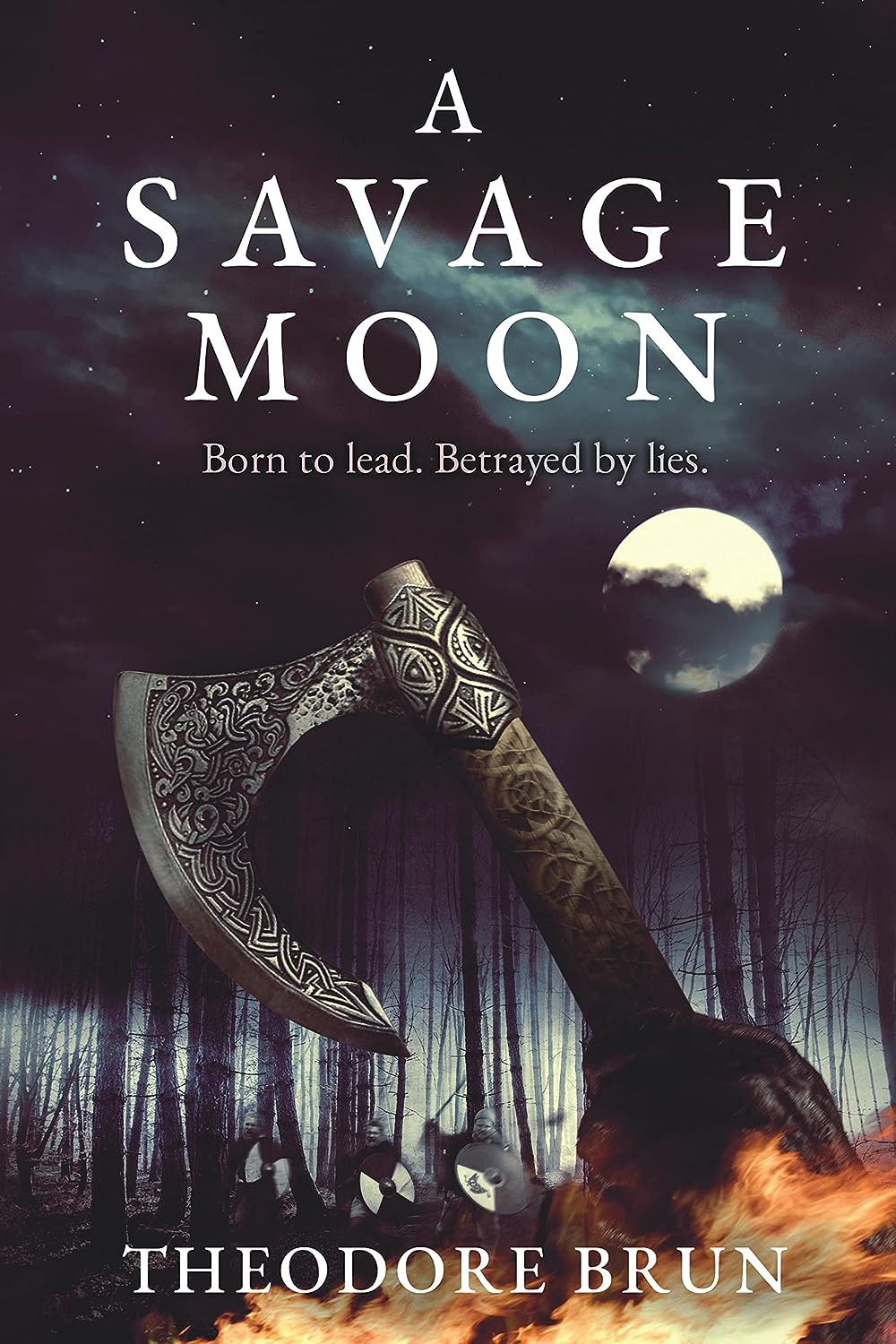
Byzantium, 718AD The great siege is over. Crippled warrior, Erlan Aurvandil, is weary of war. But he must rally his strength to lead a band of misfit adventurers back to the North, to reclaim the stolen kingdom of his lover, Lilla Sviggarsdottir. For this, they need an army. To raise an army, they need gold. Together they plot a daring heist to steal the Emperor’s tribute to his ally. Barely escaping with their lives, they voyage north, ready for the fight. But when fate strands them in a foreign land already riven by war, Erlan and Lilla are drawn inexorably into the web of a dark and gruesome foe. As blades fall and shadows close in, only one thing for them is certain; a savage moon is rising. And it demands an ocean of blood.
A Savage Moon is the fourth book in The Wanderer Chronicles. I’ve read book 1 (You can find the review here), but it was a while ago (2017), and so I can remember some elements of it, but not all of them. I do remember the character of Erlan, or Hakon as I knew him.
A Savage Moon feels very different from how I remember the first book – but this might be more to do with the complete culture shift – we’re no longer in Scandinavia, but Byzantium, and clearly Erlan has been put through the ringer since I last read about him. So I’m going to review this with no reference to the first book.
I love a story of the early eighth century, which takes the reader to complex times and places, all in great flux.
Byzantium always feels extremely exotic and also well documented. The stories I’ve read set in Byzantium have a familiar feel, and A Savage Moon is as well-researched. The events that befall our collection of characters – there are three main POVs, Erlan, Lilla and Kataros – are really well portrayed. The first part of the book is very exciting for Erlan and Lilla, while Kataros finds his way to another major location, that of Rome, on the cusp of being claimed by the Lombards and increasingly becoming a Christian centre. Again, Rome is well documented, and I loved the recreation of it for this story.
The author doesn’t stop there but takes us to Austrasia and Neustria, place names that might perplex but which are again enduring significant change as they become the kingdom known by the more familiar name of Frankia. Our characters’ journey is enormous, from Byzantium to Austrasia – a grand tour of Europe at this time.
Not just the locations are varied, but our three characters are all grappling with major life decisions. I really enjoyed the way the stories wound around one another and that there are many incidental characters encountered along the way who all add essential details to the narrative. The climactic reunion between the three, when it comes, because we all know IT IS coming, feels very natural. And I think the scene has been set for a fabulous book 5.
There are still some more fantastical elements to this story – it’s not all history, although we do encounter many ‘real’ historical figures – and the final encounter – A Savage Moon – builds towards a crescendo where the reader is never truly sure who will triumph in the dark woodlands. While the first action scene builds slowly, and as readers, we all wonder how they’ll triumph, the final action scene is the opposite, almost too sudden, too spur of the moment, and the reader can’t help but expect our stranded characters to fail.
A Savage Moon is vast in scope, but the ending is personal and climactic, a tale of friendship, love, trust and, for one of the characters, renewal, set against a backdrop of almost indescribable savagery. It’s sure to appeal to fans of historical fiction and historical fantasy.
Meet the author
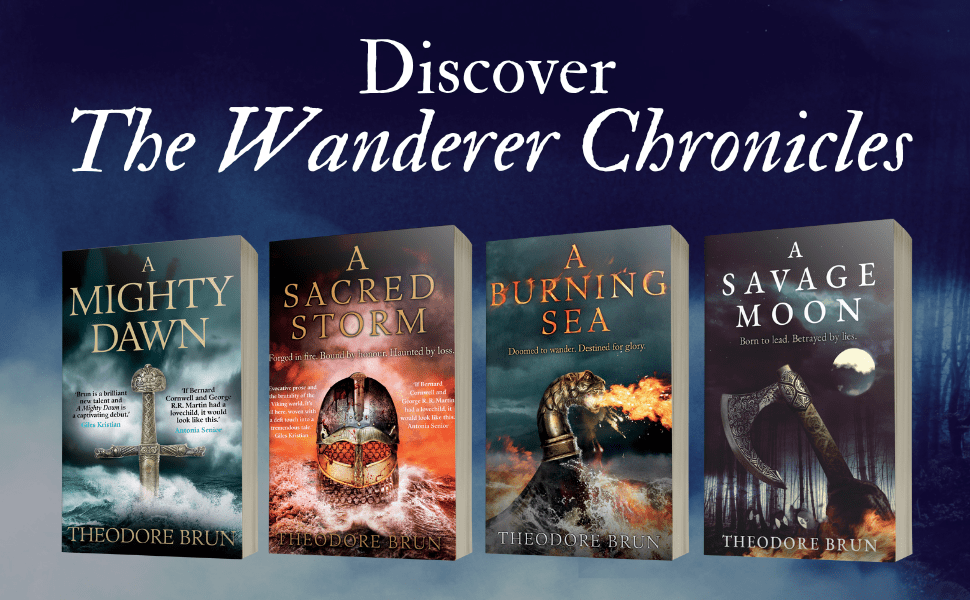
Theodore Brun is author of the critically-acclaimed historical fiction series, THE WANDERER CHRONICLES. He studied Dark Age archaeology at Cambridge and afterwards worked for several years in international arbitration law – first in London, then Moscow, Paris, and finally Hong Kong. In 2010, with the germ of an idea for a novel in his head, he quit his legal job in Hong Kong, jumped on a bicycle and pedalled 10,685 miles across Asia and Europe to his home in Norfolk. There, he sat down in a spider-infested cottage to write the first volume in his epic historical fiction series, THE WANDERER CHRONICLES. Four years later, Corvus Atlantic published his debut novel, A Mighty Dawn. The sequel, A Sacred Storm, was released in June 2018. The third book in the series, A Burning Sea, was out in September 2020.
Theo is a third generation Viking immigrant, his Danish grandfather having settled in England in 1932. You might say Viking stories are in his blood. Yet it was only through the unlikely portal of Wagner’s Ring Cycle that he discovered the hoard of ancient Scandinavian and Germanic stories which underlie the works of authors like Tolkein, CS Lewis, George RR Martin, Neil Gaiman, Giles Kristian and Bernard Cornwell to name a few. It was this material that provided the inspiration for THE WANDERER CHRONICLES. Theo is married to Natasha. They live in London, together with their girls, Ella, Talitha & Colette, and a wild dog named Wilmo.
A few weeks ago, I was granted exclusive access to King Coelwulf.
A few weeks ago, I was granted exclusive access to King Coelwulf. Here’s what the enigmatic king of Mercia had to say.
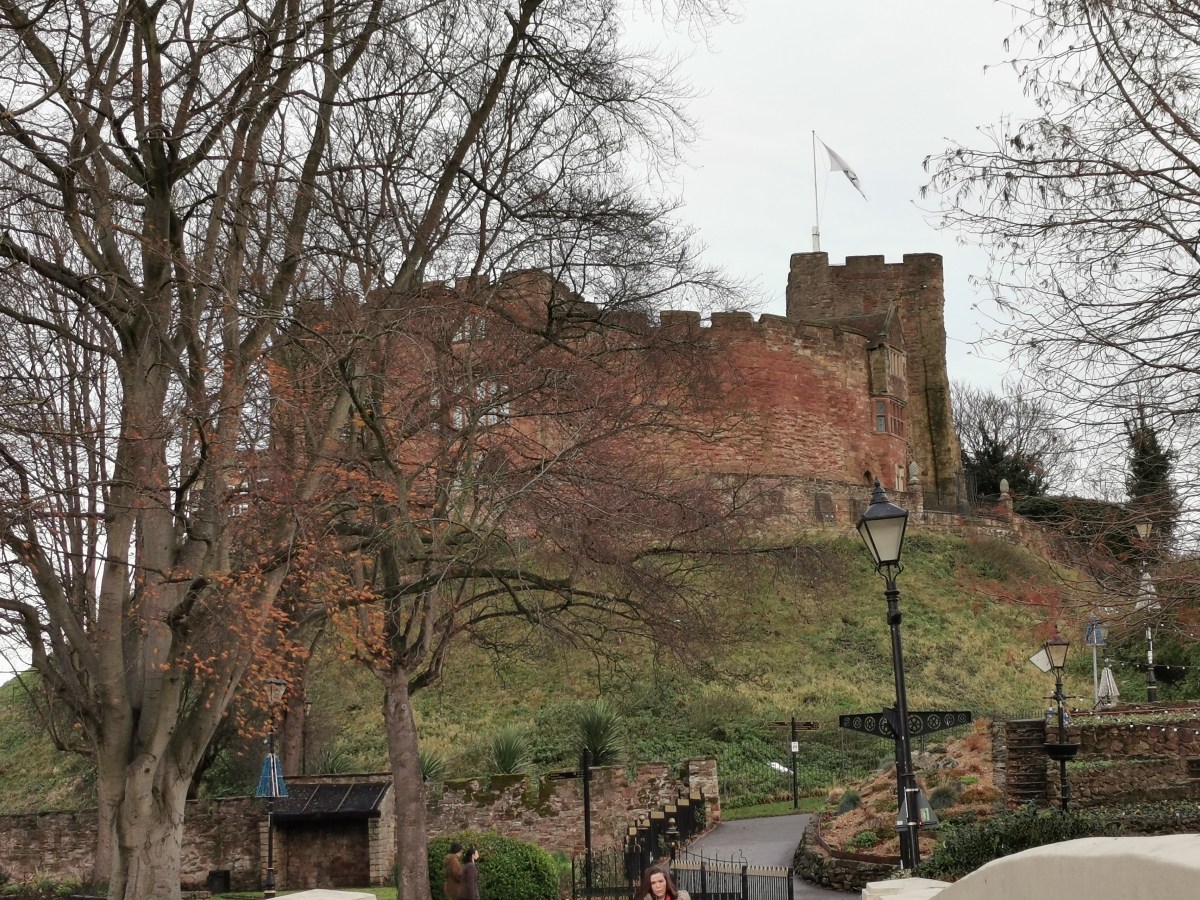
King Coelwulf, thanks for allowing me entry into your stronghold at Northampton. It’s quite interesting to be at the heart of the Mercian defence against the Raiders. Now, can you tell me why people should want to read about you?
“Well, I’m not saying that they will. I mean, if they’re like me, then they probably don’t have time to be reading a story. I’ve got bodies to bury, Raiders to hunt down, and a kingdom to rule. I would tell anyone to spend their time more wisely than reading a book. That sort of thing is for the monks and the clerics, not warriors trying to defend a kingdom.”
Ah, well, in that case, thank you for finding the time to speak to me.
“I didn’t have much choice. Or rather, I was advised it would be a good use of my time, by my Aunt, Lady Cyneswith.”
Well, Lady Cyneswith is a wise woman, and I’m grateful that she’s encouraged you to speak to me.
“She is a highly intelligent woman. Braver than many men when it comes to the Raiders, and skilled when it comes to healing injuries of the body, as well as the mind.”
And her dogs have very interesting names, what was it again? Wiglaf and Berhtwulf, surely the names of old Mercian kings? Men who usurped the ruling line from your family?
“Oh really. I’d never realised. Funny, that.”
Ah, well, moving on, could you tell me about your books? I’m sure my readers would love to hear about it.
“Nothing to say really. Same old, same old. Raiders to evade, Raiders to find, Raiders to kill, a kingdom to keep whole. It’s a grand old bloody mess. I swear, I’ve barely managed to scrub the grime and body fluids from my sword and seax. Or rather, Wulfhere has. He’s a good lad. Quick on his feet. He’s one of my squires. Couldn’t do it without him.
That’s interesting that you should mention your squire, did you say? I wouldn’t have expected you to even know the lad’s name. After all, you are the king of Mercia, surely your squire is beneath you. Are there any more of your warriors you’d like to mention by name?
“Of course there are. I’d name them all if I had the time, which I don’t, just to make you aware. I’ve got to go to a crown-wearing ceremony shortly. But, I’ll mention a few, just to keep you happy. And you should know that no man is ever above knowing the names of those who serve him. Remember that.
But, I’ll mention some of my warriors by name. If only because it’ll infuriate some of them. Edmund, he’s my right-hand man, a skilled warrior, missing an eye these days, but it’s not stopped him, not at all. His brother, Hereman. Well, where do I start? Hereman does things no one would consider, in the heat of battle, and he’s a lucky b……. man, sorry, he’s a lucky man. And then there’s Icel. He’s lived through more battles than any of the rest of my warriors. I almost pity the Raiders who come against him. None of them live for much longer.
And Pybba. You know, he fights one handed now, and the Raiders seem to think he’s easy picking, but he’s not. Not at all. And, I can’t not mention Rudolf. He’s the youngest of my warriors, but his skill is phenomenal, not that you can tell him that. Cheeky b……, sorry cheeky young man. But, all of my warriors are good men, and we mourn them when they fall in battle, but more importantly, we avenge them all. All of them. No Raider should take the life of a Mercian without realising they’ve just ensured their own death.
Yes, I’ve heard that you avenge your men, with quite bloody means. And Edmund, there’s a suggestion that he’s a scop, a man who commits the deeds of the fallen to words? That fascinates me, as someone who also makes a living from using words.
“Well, Edmund has some small skills with words, but he honours our fallen warriors by weaving them into the song of my warriors. In fifty years, when we’re all dead and gone, our legend will live on, thanks to Edmund, and his words.
Can I ask you about Alfred, in Wessex? Have you met him? Do you think he’s doing a good job in keeping the Raiders out of Wessex?
“I’ve never met him. Couldn’t say either way. It’s not for me to comment on a fellow king. We’re all after the same thing. Kill the f……, sorry, kill the b……., sorry, kill the enemy. All of them, until Mercia is safe once more. And Wessex, if you’re from there.”
Well, it looks like you’re needed. Is that your crown?
“Yes, and now I need to go and perform some ceremonial task. It’ll take a long time, no doubt. Make sure you have an escort when you leave here. I wouldn’t put it passed the f……, sorry, the Raiders, to be keeping a keen eye on the bridge over the Nene.
Thank you for your concern, and yes, I’ll make sure I do. Good luck with the new book.
“I don’t need luck. I just need to kill all the b……., sorry, Raiders.
As you can tell, King Coelwulf was a very busy man. But I found him to be honourable and worthy of leading the Mercians against our persistent enemy. Long live the king.
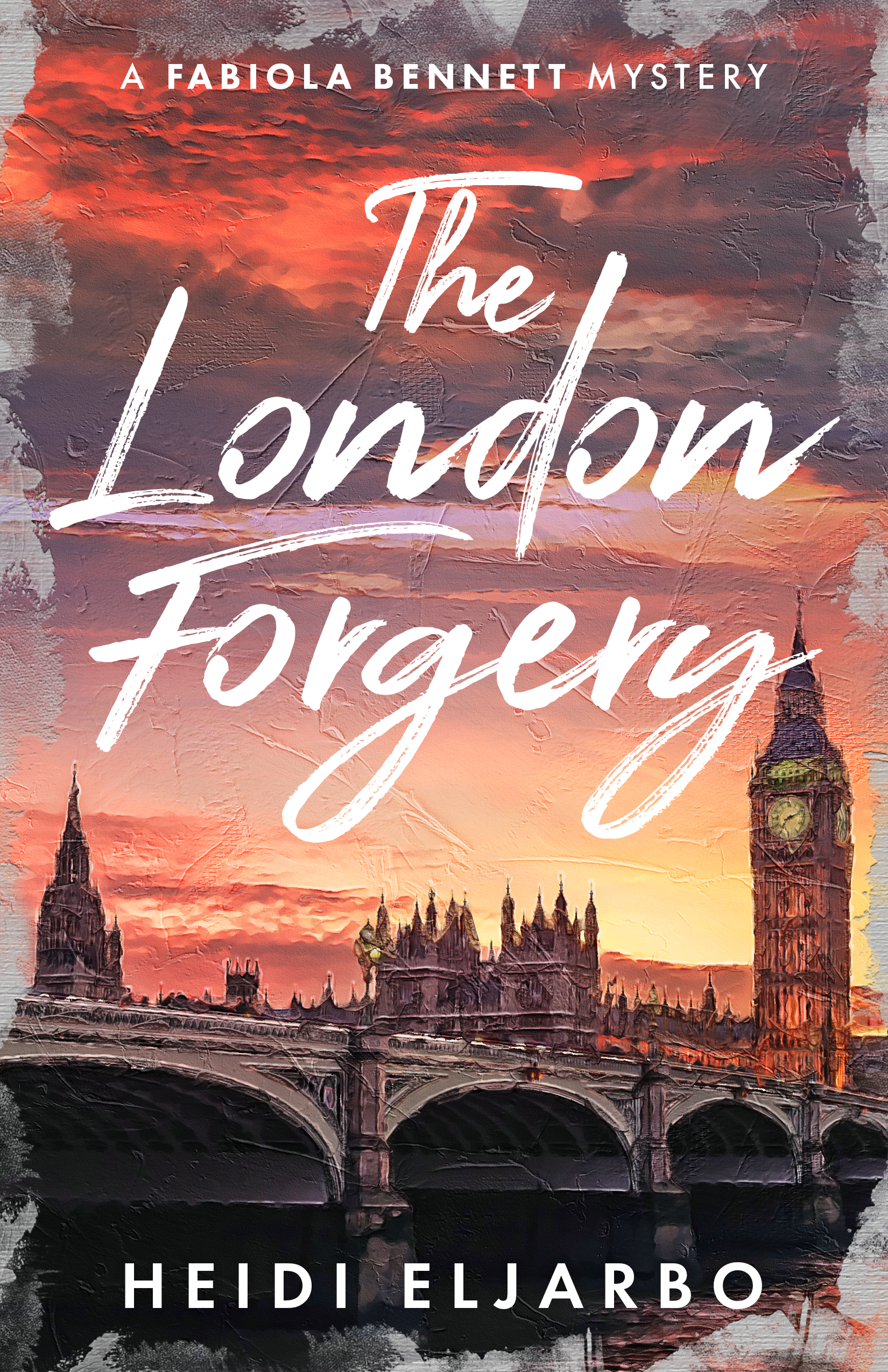
I’m delighted to welcome Heidi back to the blog with a post about her new novel, The London Forgery.
They say a historical novel takes place at least fifty years back in time. It has its setting in a certain period in history, and the author paints a picture with words of what it was like to live back then. That author must love research, must love history, must love delving into the sight, sounds, and smells of that time.
And what’s not to love about that? I have days when I probably spend more time on research than I do on the actual writing process. Because historical accuracy is important, right? It would be an anachronism to read about a cell phone in a 1960’s novel.
To make things even more complicated, I love dual-timeline novels. And I enjoy writing them. The London Forgery is such a novel. The main character, an art historian named Fabiola Bennett, has been asked to help solve an art mystery…a serious one…and there’s a problem at the National Gallery in London.
The year is 1973. Phew! Just enough years back in time to call it historical fiction. But back up a minute. I was in my early teens in 1973. I’ve lived a while, but don’t feel like I’m historical quite yet. But, oh, how fun it was to check the facts about everything from blue and white police cars to what year chocolate digestives came on the market. I went into my own memory bank when I did research for the main story, and I looked at old pictures. My sister was several years older than me and ruled the fashion of that decade. I can remember the long skirts and dresses I wore, my orange platform shoes, and listening to my favorite music. Back then, my bedroom had green walls and sported a bright-orange plastic lampshade. A small transistor radio tuned to Radio Luxembourg sat on the windowsill.
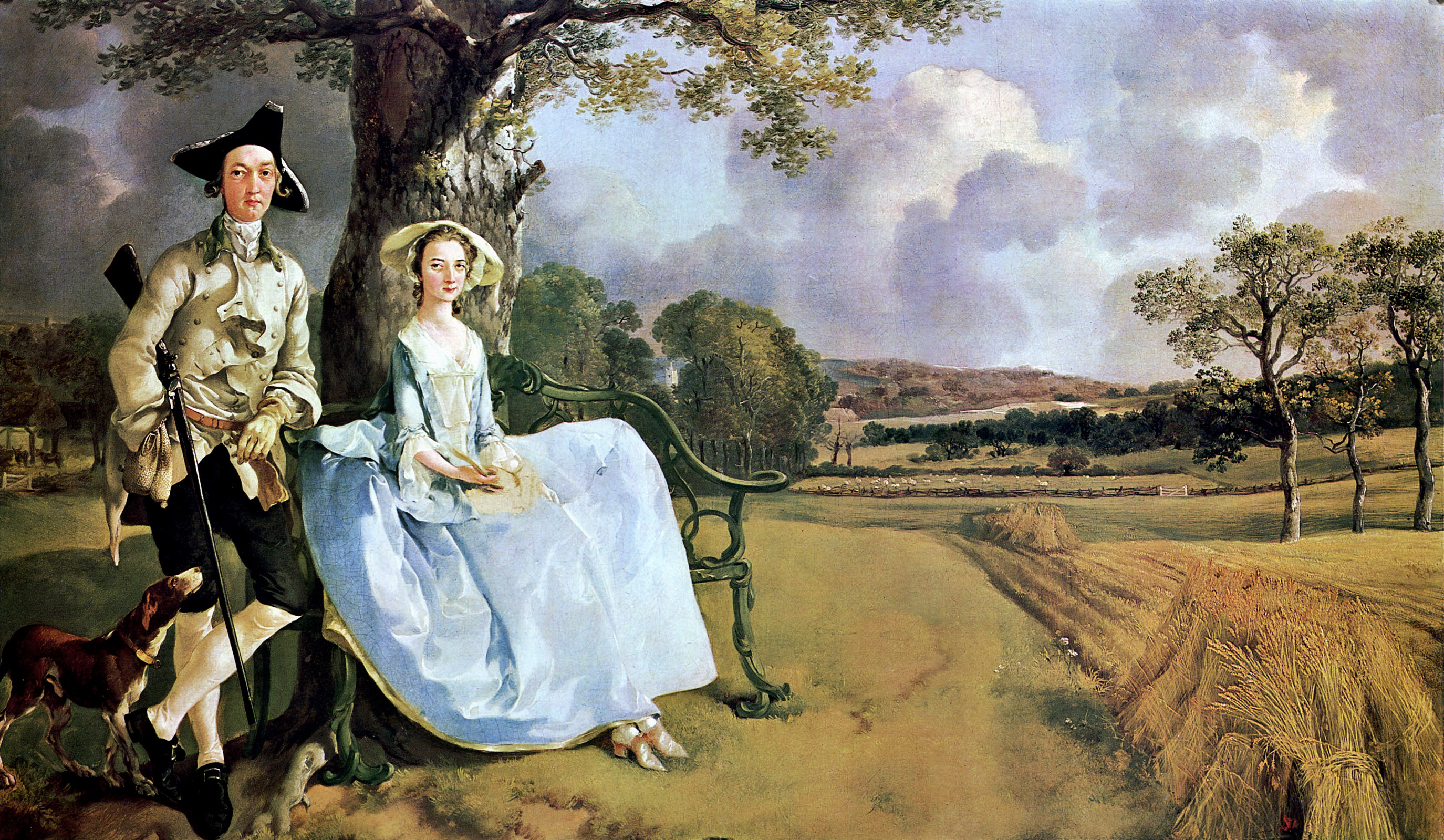
In The London Forgery, Fabiola rushes off to London. A mysterious note has been delivered anonymously at the door of the National Gallery, and the director needs her help. The message is confusing, but it seems one of her favorite eighteenth-century portraits is in trouble. As always, Fabiola will take too many risks as she tries to solve the mystery involving the British artist Thomas Gainsborough and his 1750 portrait called Mr. and Mrs. Andrews.
But what about the other story? I mentioned The London Forgery is a dual-timeline novel. Each of the books in this series will have a secondary story about a famous artist—a story that blends in with the main theme of the book.
Writing about Gainsborough and his love for his wife, the process of painting the famous masterpiece, and the young sitters Robert and Frances Andrews was pure joy. There’s much information about these two couples. I listened to lectures about them, read umpteen articles, and studied the beautiful painting.
Mr. and Mrs. Andrews now hangs upstairs in room thirty-five in the National Gallery on Trafalgar Square in London. Go see it if you can. It’s worth the trip.
Take care, Heidi Eljarbo
Here’s the blurb
1973. Art historian Fabiola Bennett sees herself as a prudently observant deer who becomes a daring and even mischievous lioness if the situation calls for it. And that’s exactly what’s required when greedy criminals steal, forge, and tamper with treasured artwork. When the crooks add murder to their list of crimes, the chaos is complete.
A mysterious note is delivered anonymously at the door of the National Gallery in London, and the director immediately calls Fabiola’s office in Oslo and pleads with her to come without delay. The message is confusing, but it seems one of her favorite eighteenth-century portraits is in trouble.
Fabiola hops on the first plane and meets up with her vibrant side-kick Pippa Yates and the ever-loyal Detective Inspector Cary Green from New Scotland Yard. But she is not naïve enough to think untangling the purpose and meaning of the mysterious note will be as simple as a walk in Hyde Park. These things never are.
1750. Newly married Robert and Frances Andrews, members of the landed gentry of Suffolk, England, hire young and talented Thomas Gainsborough to paint their wedding portrait. Their desire is a lovely conversation piece showing their wealth and class, an artwork to remember them by for generations to come.
Little do they know the gifted artist portrays their personalities exactly how he perceives them, and the artistic symbolism is not as flattering as they’d hoped for. Even the looming clouds in the distance promise a troublesome future.
This is the first book in a new dual timeline series by Heidi Eljarbo—an intriguing spin-off from the much-loved Soli Hansen Mysteries.
Fans of Lucinda Riley, Rhys Bowen, Kathleen McGurl, Kate Morton, and Katherine Neville will love this cozy historical art mystery, which takes the readers back to the nostalgia of the groovy seventies and the classical Georgian era of the eighteenth century.
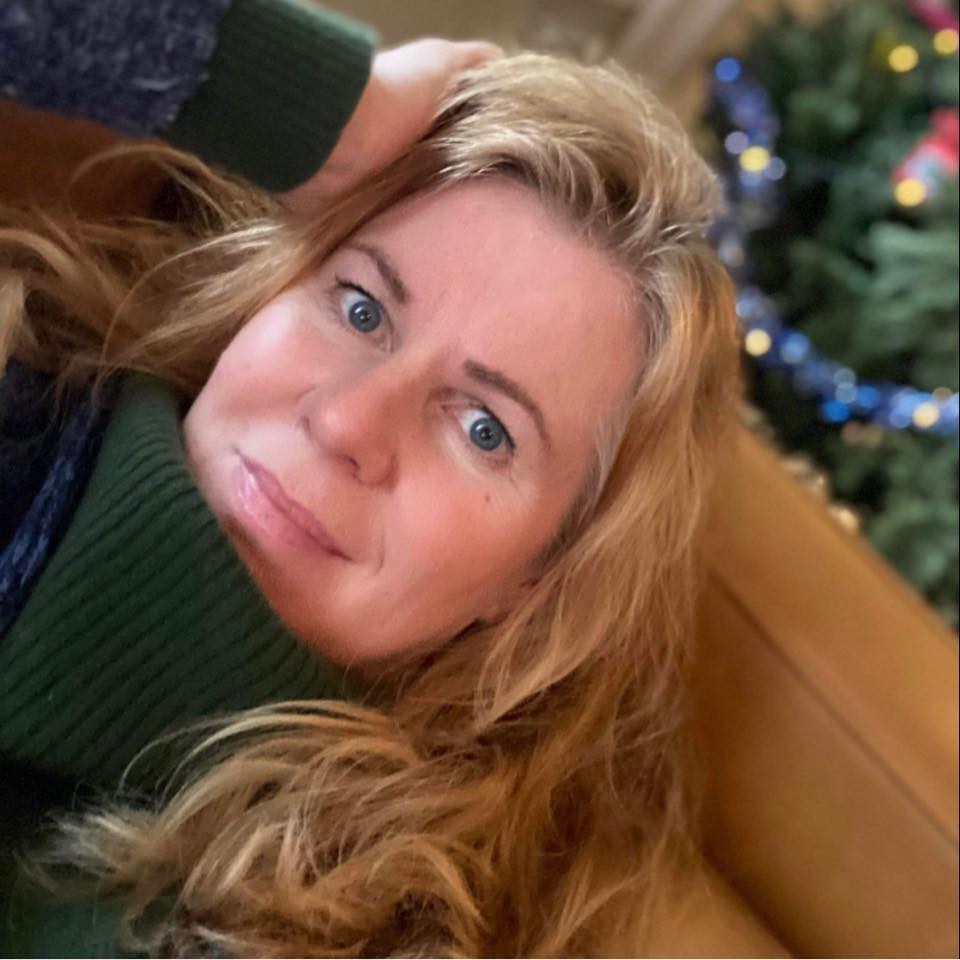
Heidi Eljarbo is the bestselling author of historical fiction and mysteries filled with courageous and good characters that are easy to love and others you don’t want to go near.
Heidi grew up in a home filled with books and artwork and she never truly imagined she would do anything other than write and paint. She studied art, languages, and history, all of which have come in handy when working as an author, magazine journalist, and painter.
After living in Canada, six US states, Japan, Switzerland, and Austria, Heidi now calls Norway home. She and her husband have fifteen grandchildren—so far—in addition to a bouncy Wheaten Terrier.
Their favorite retreat is a mountain cabin, where they hike in the summertime and ski the vast, white terrain during winter.
Heidi’s favorites are family, God’s beautiful nature, and the word whimsical.
Really, I wouldn’t think he’d do that. He’ll make some excuse about having no time, or some such. Oh wait, did Lady Cyneswith set this up?
Yes, she did, and I’ve already spoken to her. But tell me, do you know the king? You seem to know who everyone is.
Of course I do. I’m Rudolf. His old squire, and now member of his warband. Why?
Would you like to talk to us about his latest book?
Well, I suppose I have the time. If you’re quick, and I don’t get caught. I’m supposed to be showing young Hiltiberht the ropes, and Haden can be a real handful.
Tell me, what’s King Coelwulf like? As a warrior?
Bloody lethal. You don’t want to be facing off against him. I’ve never seen anyone kill so quickly. And the moves he can do? I wish I had even half of his skill. I mean, he says I’m a good warrior and all, but I make up for my lack of skill with speed. And he doesn’t have that because he’s so bloody …. Um, because he doesn’t need to do that. Sometimes, I swear the enemy make it look so easy it’s as though they’re falling onto his seax or sword.
He’s quite good then?
Better than good. I’ve never seen anyone fight the way he does. Well, apart from Icel, and Edmund, and maybe Hereman. But, certainly, the Raiders stand no chance against him.
I hear he even camps in the woodlands and forests? It’s not really the sort of thing a king should do, is it?
Now, you see here. He was a warrior long before he was king. King Coelwulf only has one aim, to kill all the Raiders. To drive them from Mercia and make sure they don’t come back. He’s not into all that fancy clothes, and court etiquette, or sleeping in a bed of silk sheets. They’d be too damn cold, anyway. He’s told me. No, the king of Mercia is a damn warrior, and the only man capable of defeating the Raiders, and the Welsh, if it comes to it.
And, have you read the new book?
Got no time for reading. I’m sure King Coelwulf told you that, and he’s right. I’d like a good night’s sleep without interruption more than I’d like to read a book. Maybe a scop could tell the tale. But, that would be Edmund and I’d have to listen to him tell the tale. He’s good, of course he’s good, but he probably wouldn’t mention me as much as I might like.
To all the young lads who do read the book, what would your advice be? How could they get into King Coelwulf’s warband?
Well, they should probably have joined it a while ago, and at the moment, there’s a few squires that need training up, so there’s no room, not for a while. So, I’d tell them to wait, and while they’re waiting, learn a few things, like how to clean saddles and seaxs. It’s a mucky job, but someone’s got to do it. And with King Coelwulf, you’ve got to earn his respect first. And then, well, once you’ve got it, you’ve got to keep it. A hard man, but a great man. Mercians should be pleased with their king. He’ll keep them safe, or he’ll die trying. You didn’t find the old king doing that. Far from it in fact. He’s scuttled off to Rome, or somewhere like that. Gone to pray for his soul. He’s got a lot to need forgiveness for, abandoning his kingdom like that.
Oh, sorry, I’ve got to go.
And there you have it. A few words from Rudolf, King Coelwulf’s old squire. I hear he fights incredibly well, and offers some important advice for any would be members of the king’s warband.
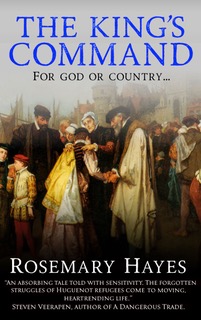
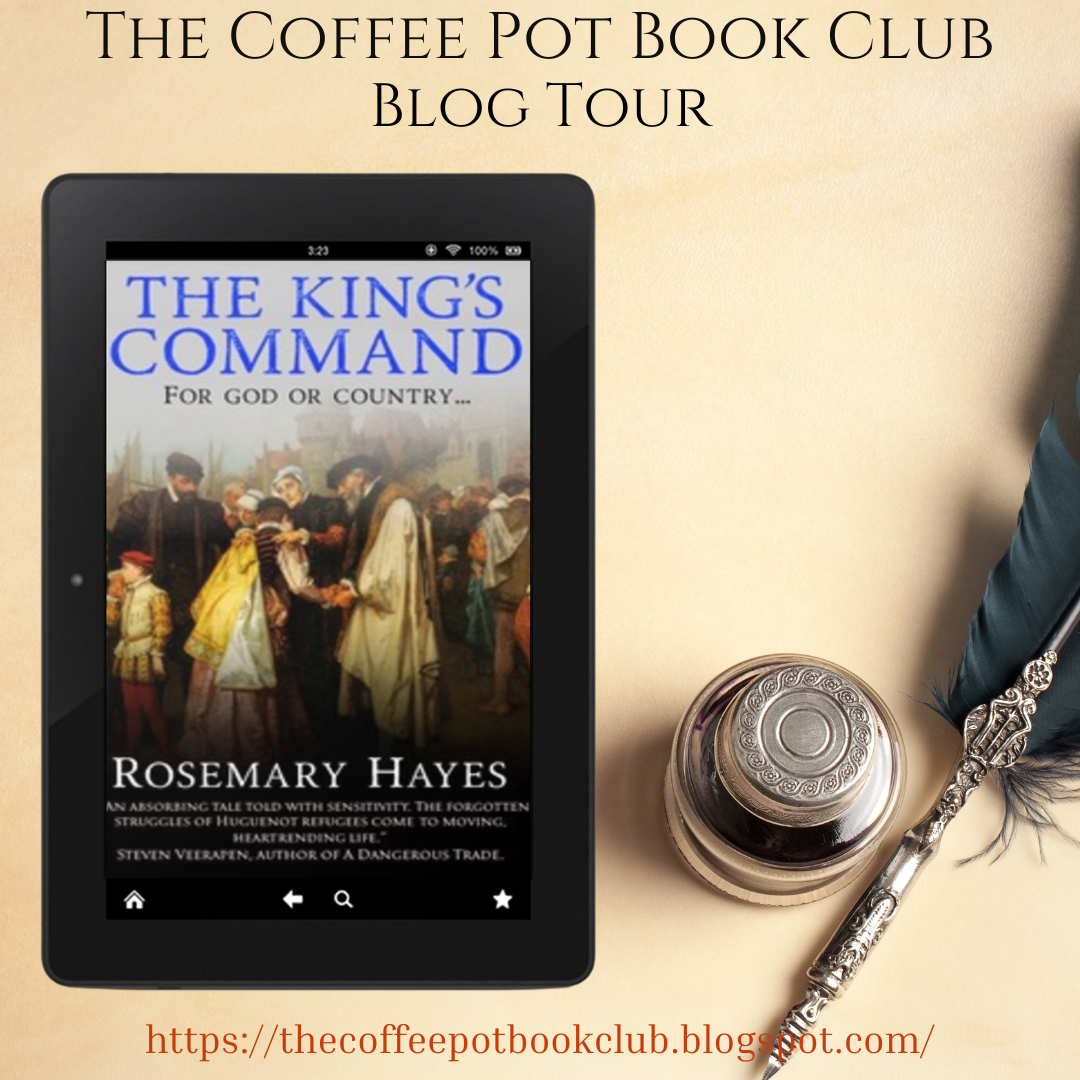
I’m delighted to welcome Rosemary Hayes and her new novel, The King’s Command to the blog.
INSPIRATION AND RESEARCH FOR MY NOVEL ‘THE KING’S COMMAND’
Carving above French Church in London
I’d always known that I had Huguenot ancestors but had not given it much thought until a cousin mentioned that they had been driven out of France for their religious beliefs. This sparked my interest and I decided to find out more.
My ancestors – the facts
Many of those who try to trace their Huguenot roots find the process laborious and frustrating, coming across contradictions and going down blind alleys, but I was lucky. A lot is known about my Huguenot forebears, Lydia and Samuel La Fargue. They feature in the Annals of the Huguenot Society and some meticulous research was done on them by an Edwardian ancestor of mine, so I had a head start.
I knew where they lived in France; in a small town in Gascony, not far from Bordeaux, originally called Castillon-sur-Dordogne and now called Castillon-la-Bataillie. I knew what they did (they were predominately lawyers, physicians and minor nobles) and that they were friends with other prominent Protestant families in the region with whom they inter married and socialised. In the baptism records of the time, it can also be seen that they were godparents to one another’s children. The Edwardian ancestor states that they lived just outside the town centre in ‘the pleasant faubourg’ and, although I found no evidence of this, it seems likely to be true. They also owned land in the plains South of the town.
So, they came from the bourgeoisie, were committed Huguenots, following the teachings of Calvin, and their own ancestors had fought against the Catholics in the sixteenth century Wars of Religion.
I also knew that Lydia, Samuel, their surviving children and Lydia’s widowed mother left Castillon and fled to Geneva in 1690. And also, intriguingly, that Samuel returned alone to Castillon in 1692 where he died, aged 32, on the very day on which he converted to Catholicism. He may, of course, have died from natural causes, but these were turbulent times, so who knows? I did discover from local documents that he had returned to try and reclaim forfeited property.
After his death Lydia, her children and her mother then left Geneva for London and settled in the pleasant village of Hammersmith where there was a small Huguenot community. Lydia’s only surviving child, Elias, became a Church of England vicar in Lincolnshire and is my direct ancestor.
Why did the Huguenots flee France? A brief background
The wars of religion between Protestants and Catholics raged in France during the second half of the 16th century where hatred ran deep, armies were raised and atrocities committed by both sides. These wars were finally brought to an end through the actions of King Henry IV. Henry, originally a Protestant, was a pragmatist. In a bid to unite the country he converted to Catholicism, reportedly saying “Paris is well worth a mass” and promulgated the Edict of Nantes (1598) which granted official tolerance to Protestantism, and for eighty years or so the Huguenots thrived.
Henry’s successors, however, were far less tolerant of the Huguenots, destroying their strongholds and breaking up their military organisation and when the young Louis XIV finally took control of his throne in 1661, he vowed to make France a wholly Catholic country and wipe out the ‘false religion’ of Protestantism once and for all. During his reign, the Edict of Nantes, which had protected Huguenots for so long, was revoked and their lives became impossible.
Unless they denied their faith, they would forfeit their property, be unable to practise their professions or trades and their children would be forcibly removed from them to be brought up as Catholics. They were banned from holding gatherings, even in private, and their temples were destroyed. Yet they were not allowed to leave the country; the King did not want to lose the skills of these hardworking and successful people.
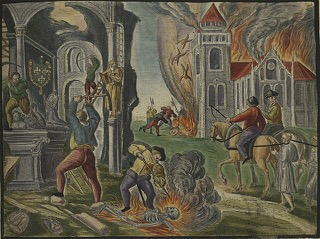
here destruction of Huguenot temple
Hardly surprising then, that many converted and many fled despite the penalties if they were caught.
Huguenot women in prison
The fiction
It has been an intriguing journey finding out about my ancestors and, more generally, about the circumstances which forced Huguenots like them to flee France. My book ‘The King’s Command’ is based, very loosely, on their experience. I have set the story in Castillon, called the main character Lydia (or Lidie, as she was known by her family) and her husband Samuel, but a lot of the other characters are fictional, as is the account of Samuel’s death and Lidie’s escape. I know nothing of the family’s actual escape to Geneva but night travelling was common. There were ‘Huguenot Trails’ known only to those within a trusted network, safe houses along the escape routes, false identities adopted and bribes paid. There were also plenty of financial rewards offered to those betraying Huguenots and to soldiers finding stowaways, with spies and informers everywhere, so any escape would have been fraught with danger.
In my story, I have made Lidie stay in Castillon and then escape not from nearby Bordeaux, which was heavily guarded, but from a little port called La Tremblade a good way up the West coast. Many Huguenots did escape from here and I used, as background, a contemporary account of one such escape, cranking up the tension as the family tried to avoid detection.
To add to the tension, I made the King’s dragoons visit Castillon to try and force unconverted Huguenot households to abjure. I don’t know if this is true, but certainly there were plenty of reports of this happening in the region.
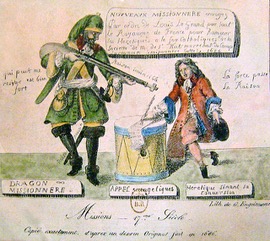
dragoon forcing Huguenot to sign abduration papers
I also made Samuel die a violent death as a direct result of his association with Claude Brousson, a Protestant lawyer and preacher who fought tirelessly for justice for the Huguenots. Brousson had to flee for his life to Switzerland and then, very bravely, returned in secret to become part of the Church of the Desert, in the wild and mountainous region of the Cevennes, where he preached and gave succour to his fellow Protestants. He died a martyr and hero but he is largely forgotten now and I felt he merited some recognition.
In reality, once Lidie reached London, it seems that she led a very quiet and worthy life, centred on the French church in Hammersmith, but I decided to make her lively and vivacious with a strong character and a love of fashion and of the new silks being made in Spitalfields. I also invented for her a naughty surviving daughter, a new romance and another child from a (fictitious) second marriage.
In her will, Lidie left the bulk of her estate to her son Elias and the rest to the French church in Hammersmith and the French poor of London. It seems that she was still relatively well off and it is known that she brought with her from France some family portraits (presumably taken out of their frames and rolled up), some small pieces of family silver and the La Fargue seal.
The Huguenots were hardworking and talented people and they integrated so seamlessly into their adopted countries that, generations on, it is easy to forget the circumstances which forced them to flee their native France in the 17thcentury.
Thank you so much for sharing your fabulous post.
Here’s the blurb
16 year old Lidie Brunier has everything; looks, wealth, health and a charming suitor but there are dark clouds on the horizon. Lidie and her family are committed Huguenots and Louis XIV has sworn to stamp out this ‘false religion’ and make France a wholly Catholic country. Gradually Lidie’s comfortable life starts to disintegrate as Huguenots are stripped of all rights and the King sends his brutal soldiers into their homes to force them to become Catholics. Others around her break under pressure but Lidie and her family refuse to convert. With spies everywhere and the ever present threat of violence, they struggle on. Then a shocking betrayal forces Lidie’s hand and her only option is to try and flee the country. A decision that brings unimaginable hardship, terror and tragedy and changes her life for ever.
‘One of the very best historical novels I have ever read’
Sandra Robinson, Huguenot Ancestry Expert
Buy Links:
This title is available to read with #KindleUnlimited.
Rosemary Hayes has written over fifty books for children and young adults. She writes in different genres, from edgy teenage fiction (The Mark),historical fiction (The Blue Eyed Aborigineand Forgotten Footprints),middle grade fantasy (Loose Connections, The Stonekeeper’s Childand Break Out) to chapter books for early readers and texts for picture books. Many of her books have won or been shortlisted for awards and several have been translated into different languages.
Rosemary has travelled widely but now lives in South Cambridgeshire. She has a background in publishing, having worked for Cambridge University Press before setting up her own company Anglia Young Books which she ran for some years. She has been a reader for a well-known authors’ advisory service and runs creative writing workshops for both children and adults.
Rosemary has recently turned her hand to adult fiction and her historical novel ‘The King’s Command’ is about the terror and tragedy suffered by the French Huguenots during the reign of Louis XIV.
The hero of the Mercian Ninth Century Series, King Coelwulf, has not been treated kindly by history.
He appears in the Anglo-Saxon Chronicle (the main narrative source for the period) as a ‘foolish king’s thegn’ (in the ASC E Version, although not in the older A version) and not actually a king at all.
´Here the raiding army went from Lindsey to Repton and took winter-quarters there, and [[874] drove the king Burhred across the sea 22 years after he had the kingdom; and conquered all that land…And the same year they granted the kingdom of Mercia to be held by a foolish king’s thegn, and he swore them oaths and granted hostages, that it should be ready for them whichever day they might want it, and he himself should be ready with all who would follow him, at the service of the raiding-army. (A) 874 [873]
´Here the raiding-army went from Lindsey to Repton, and there took winter quarters, and drove the king Burhred across the sea 22 years after he had the kingdom, and conquered all that land. And he went to Rome and settled there, and his body lies at St Mary’s church in the English Quarter. And the same year they granted the kingdom of Mercia to be held by Ceolwulf, a foolish king’s thegn.’ (E)874 [873] (Both quotes from M Swanton ed. and trans. The Anglo-Saxon Chronicles).
His ‘reign’ has been explained as being entirely dependent on Viking overlords who really ruled Mercia, from their ‘base’ at Repton. He was a ‘puppet king,’ a sop to assist the independent Mercians as they struggled to come to terms with their new warlords.
The survival of two charters, carrying Coelwulf’s name, and witnessed by the ealdormen and bishops of Mercia, have not been given the attention they deserve because they suggest a different interpretation to that of King Alfred (the Great) single-handedly defeating the Vikings, and making ‘England,’ as does the discovery of the Watlington Hoard of coins which suggests that Coelwulf and Alfred were ruling jointly.
So, if we put aside the problems of what Coelwulf did, or didn’t achieve, who might he actually be, and why might he have been named as king?
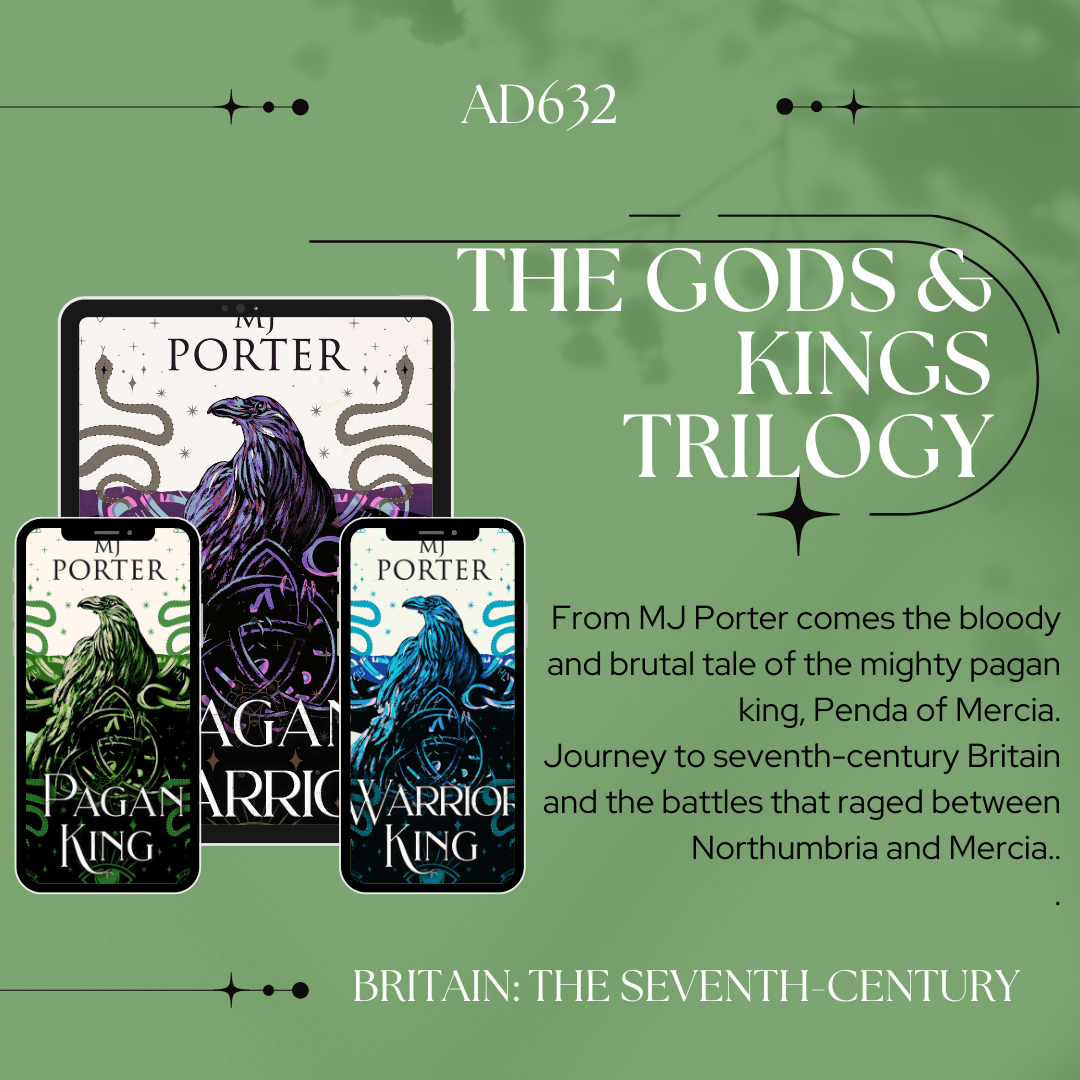
Coelwulf’s name leads historians of the period to suggest he was a member of a branch of the Mercian royal family whose last ruler was King Coelwulf I, who ruled in Mercia from AD821-823. He succeeded his brother, Coenwulf, who ruled from AD796-821. They were descended from the brother of the mighty seventh-century king, Penda, most famously known for being pagan, warlike and terrorising the Northumbrian kingdom during its ‘Golden Age.’ (Read about Penda and the Northumbrian kingdom in my Gods and Kings trilogy). He was therefore a member of a long-lived ruling dynasty that could trace its descendants all the way back to the early 600s.
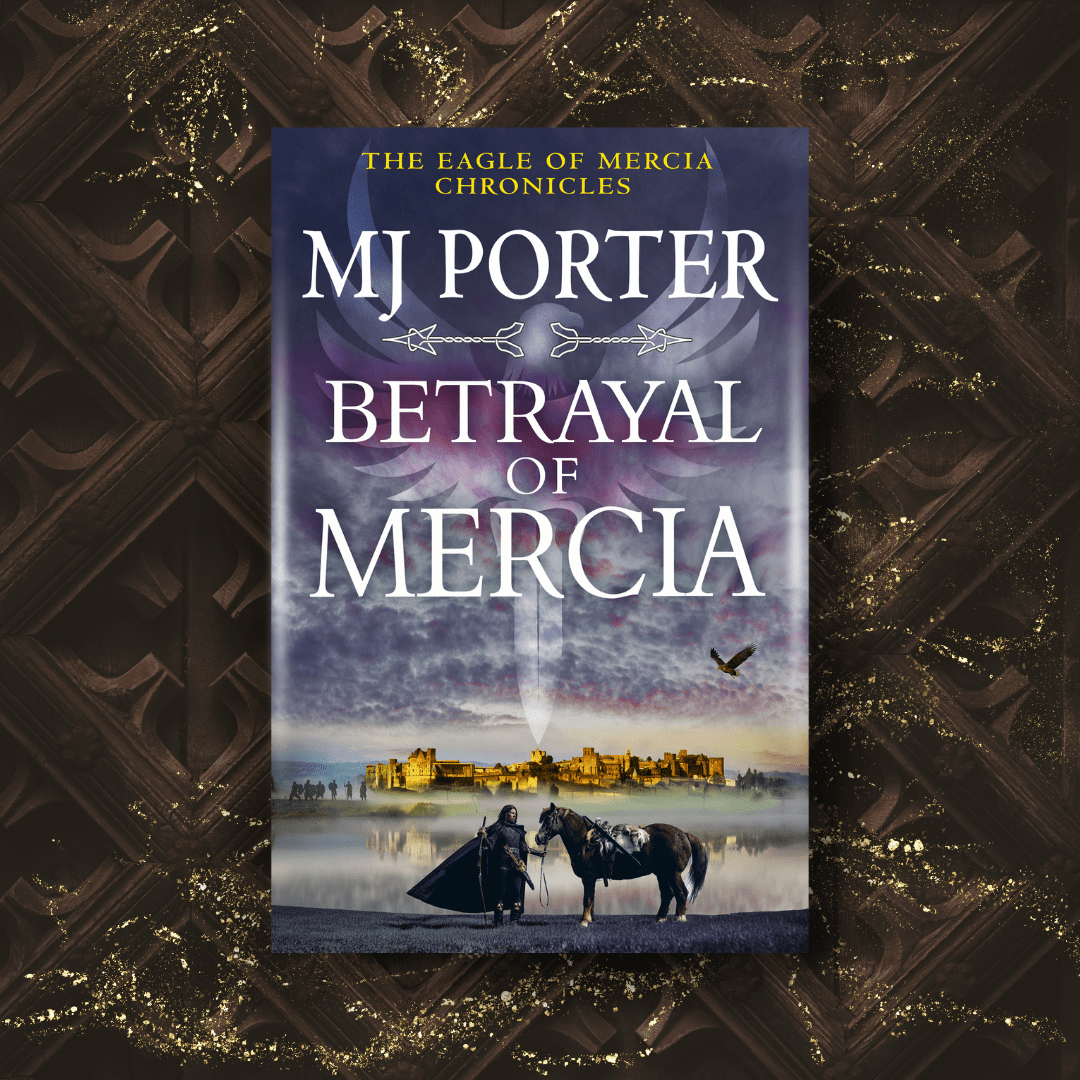
This identification of Coelwulf helps to explain why he was accepted as king following King Burgred’s abdication. He was no foolish king’s thegn. He was a member of a ruling dynasty, who, for one reason or another, were no longer the ruling family in Mercia in the 870’s. (And what was happening in Mercia before the 870’s is just as fascinating as what came after it – you can read about that in The Eagle of Mercia Chronicles).
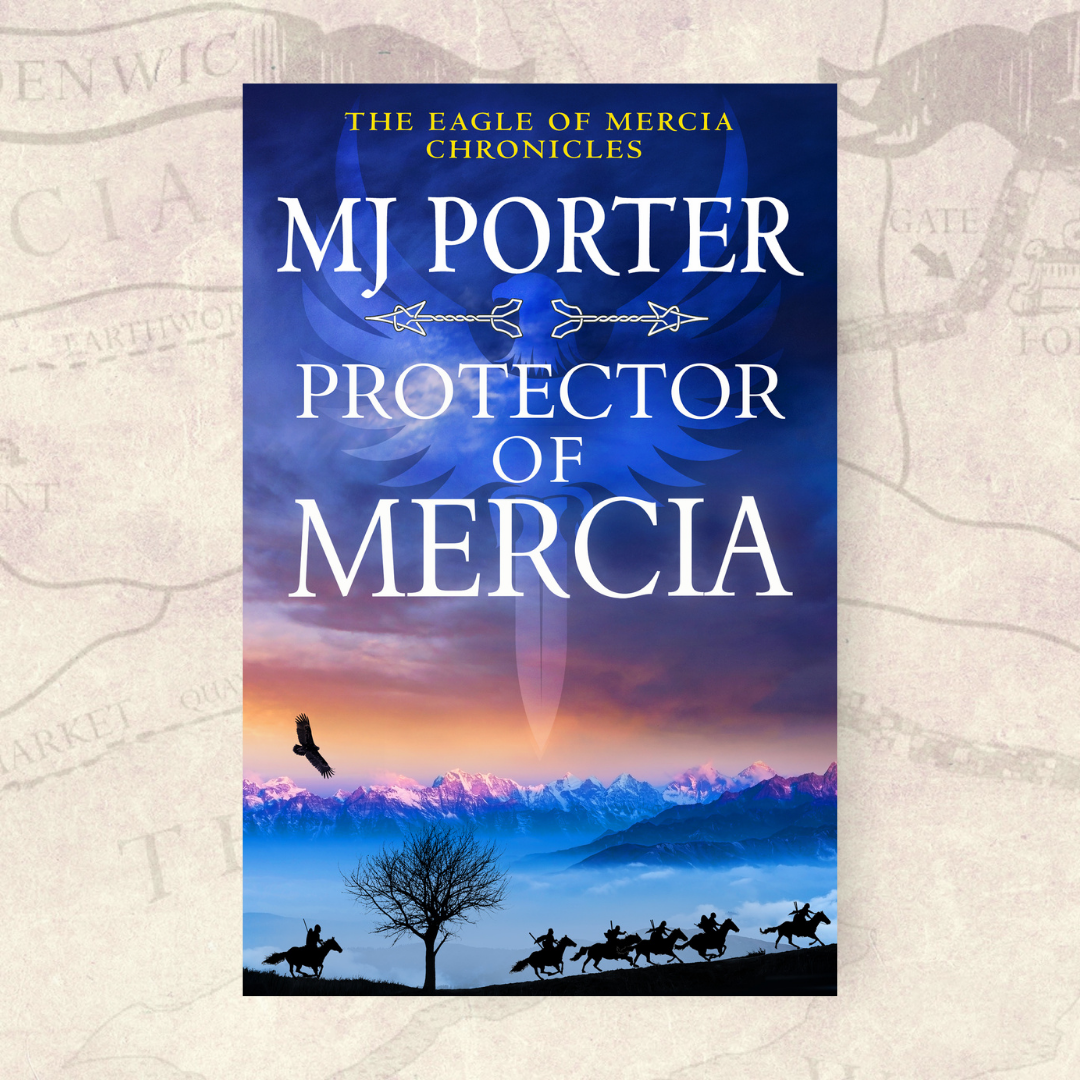
Welcome to my release day post for Protector of Mercia. I’m going to talk about the kings who preceded all the chaos of the series.
Readers of the Eagle of Mercia Chronicles will have encountered the names of kings Coenwulf and Coelwulf, although the kings in the first book, Son of Mercia, ruled after both Coenwulf and Coelwulf. But, having written about Coelwulf II in the Mercian Ninth Century books – which feature an older, and wiser Icel, I was eager to return to an equally unsettled period in Mercia’s history. And this, helped by the fact that Icel would just have been old enough at this period to be involved, very much helped set the scene. However, the aftermath of the reigns of these two men, brothers, are very much at the heart of political affairs during the Eagle of Mercia Chronicles.
So, who were Coenwulf and Coelwulf or Ceolwulf?
Coenwulf, the first and only of his name, was king of Mercia from 796 until his death in 821. He claimed descent, not from the previous king Offa (of Offa’s Dyke fame), and his son, but instead from Pybba, who is believed to have been the father of both Kings Penda and Eowa (read about them in my Gods and Kings trilogy) who ruled in the seventh century. You might have heard of Penda. Although the connection isn’t sound, he is often referenced when talking about the Staffordshire Hoard.
It does seem as though the crisis of the late 820s/830s and the slow decline of Mercian power have overshadowed all that King Coenwulf achieved, not helped by the fact that his son, who was to succeed him, died before his father (if he existed at all), so that on Coenwulf’s death, the kingship passed to his brother, Coelwulf, and he in turn was overthrown at some point in 823-826. The brother kings seem to have shared another brother as well, who may have been king of Kent, after Mercia annexed the kingdom to its own domain.
But Coenwulf was a successful ruler. He claimed the kingship after the death of Offa’s son, Ecgfrith, not long after his father’s death, (Offa is said to have been keen to eliminate all rivals to the kingship which is why, when his son died, the kingship had to pass to a more obscure branch of the ruling line), and while he suffered reverses in Kent and the kingdom of the East Angles, he does seem to have exercised control in both places, and was also aggressive against the Welsh kingdoms throughout his reign. Mercia, at this time, was NOT confined to the current English Midlands, it was a much vaster kingdom although it’s firm boundaries are difficult to establish.
Map design by Flintlock Covers
While the Anglo-Saxon Chronicle is sparse about our brother kings, that didn’t stop the later Norman writers, embellishing the story of them. But first, what do we hear about these kings from the Anglo-Saxon Chronicle?
‘Ceolwulf, king of Mercia, ravaged over the inhabitants of Kent as far as the Marsh, and [they] captured Præn, their king, and led him bound into Mercia.’ 796 [798[ (A)
´Here Coenwulf, king of Mercia, passed away, and Coelwulf succeeded to the kingdom.’ 819 [821] (A)
´Here Ceolwulf was deprived of his kingdom.’ 821 [823] (A)
´And the same year King Egbert and King Beornwulf fought at Ellendynm and Egbert took the victory; and a great slaughter was made there…. And that year the East Angles killed Beornwulf, king of the Mercians.’ 823 [825[ (A)
´Here Ludeca, king of Mercia, was killed, and his 5 ealdormen with him, and Wiglaf succeeded to the kingdom.’ 825 [827] (A)
´Here Wiglaf obtained the kingdom of Mercia again.’ 828 [830] (A)
Henry of Huntingdon, one of the Anglo-Norman author, writes of Cenwulf, our Coenwulf
‘Not long afterwards, Cenwulf, king of Mercia, beating and ravaging his way through the Kentish province, captured their king Præn, who could not match his strength and was lurking in the coverts and isolated places, and victoriously took him back in chains.’ p.259
Coenwulf’s brother, Coelwulf, succeeded him, but not for long, until he was usurped. Henry of Huntingdon in summarising affairs in Mercia adds.
‘Cenwulf reigned peacefully for twenty-six years, and died the common death.
Ceolwulf possessed the kingdom for three years, which the fierce Beornwulf then wrested from him.’ p.271
The Chronicle of John of Worcester adds similar details.
‘[821] Ceolwulf, king of the Mercians, was driven from his kingdom, and Beornwulf was raised to the kingship.’p241
There is some confusion regarding children born to either brother, and indeed, much that is known of that later Coelwulf II stems from the fact he shared a name with one of the two brothers, and as such, his connection with that ruling family can be supposed by experts in the field (not me). It appears that Coenwulf had a son and a daughter, the daughter well known as an abbess at a local nunnery, and possibly, two wives. King Coelwulf is known to have had one daughter, Ælflæd, who married Wigmund, the son of King Wiglaf. But there is a distinct lack of information regarding these individuals. We don’t know when the usurped King Coelwulf died. We don’t know when his daughter died, for certain, and obviously, other children are unknown.
The Chronicle of John of Worcester, another Anglo-Norman writer, informs us that.
‘[819] St Cenwulf, king of the Mercians, after a life devoted to good deeds, passed over to the eternal blessedness which is in heaven, and left his 7-year-old son St Kenelm heir of his realm. But when a few months had passed, by the treachery of his own sister Cwenthryth, whose cruel spirit had been roused by an awful lust for power, he was secretly done to death with cruel outrage by Æscberht, his most bloodthirsty tutor, in the shade of a thorn tree in a deserted wood. But he who was slain with heaven alone as witness, was later revealed by heaven’s witness through a column of light. Kenelm’s head was cut off, milk-white in the beauty and innocence of birth, and from it a milky dove with golden wings soared to heaven. After his happy martyrdom, Ceolwulf received the kingdom of the Mercians.’ P239-241
Henry of Huntington adds. ‘At Winchcombe you will read of the secret martyrdom of Kenelm. He was the son of Cenwulf, the Mercia king, who died in the year of grace 819, having reigned for twenty-four years. The martyrdom of his son Kenelm was revealed from heaven to Pope Silvester II at Rome.’p691
However, Coenwulf and Coelwulf I do seem to have enjoyed military successes. Coelwulf’s attacks on Wales are mentioned in the Annales Cambriae.
‘818 Cenwulf [Coenwulf] devastated the Dyfed regio.
822 The fortress of Degannwy is destroyed by the Saxons and they took the kingdom of Powys into their own control.’ p48
The Anglo-Saxon Chronicle is not helpful about the reigns of either brother, other than referencing their accession and either death or deposing. We don’t know the date that Coelwulf I died, although he clearly lived after being deposed.
Increasingly, scholarship is looking at Mercia during this period – if the answers can’t be found in the surviving written sources they can be found elsewhere. When King Alfred began his revival in education, many of the scholars he turned to were Mercians, highlighting Mercia’s accomplishments in all spheres – and the correlation has been made that the same happened in Mercia after the end of Northumbria’s Golden Age. There is also a wealth of Mercian sculpture dated to this period which hints at the power and influence of the kingdom, perhaps even of artistic centres at the heart of certain designs.
This doesn’t yet help us truly appreciate the power these kings could wield – so often overshadowed by what happened after their reigns, but it certainly shows we should be wary of accepting this absence in the written sources as indicative of their failure. Indeed, we should be wary of any Wessex-centred source from later in the same century (the Anglo-Saxon Chronicle) that might not only suffer from Wessex-bias, but may also reveal a desire to overshadow Mercia in order to proclaim Wessex’s kings as the more powerful. This is something that is certainly at the heart of the revival in interest in the descendant of these two kings, King Coelwulf II, or Mercia’s last king, written about as a ‘foolish king’s thegn’ in the Anglo-Saxon Chronicle but clearly very far from being that.
It’s intriguing to realise that our Norman writers only had access to much the same information that we do in order to offer an account of what was happening in Mercia at this time. But they do seem to have enjoyed embellishing the words of the Anglo-Saxon Chronicle, and while arguments are often made that they may have had access to local sources not written about in the Anglo-Saxon Chronicle, especially for John of Worcester, who wrote at one of the most important Mercian centres, until their words can be entirely unpicked, we must be wary of using their additions as historical ‘fact,’ in much the same way that we need to be wary of the Anglo-Saxon Chronicle(s).
Quotations are taken from the following translations. Darlington, R.R. & McGurk, P. ed. The Chronicle of John of Worcester Volume II The Annals from 450 to 1066(Clarendon Press, 1995). Greenway, D. ed. and trans. Historia Anglorum, The History of the English People, Henry of Huntingdon, (Clarendon Press, 1996. Morris’ translation of Nennius and the Welsh Annals and Swanton’s The Anglo-Saxon Chronicles.
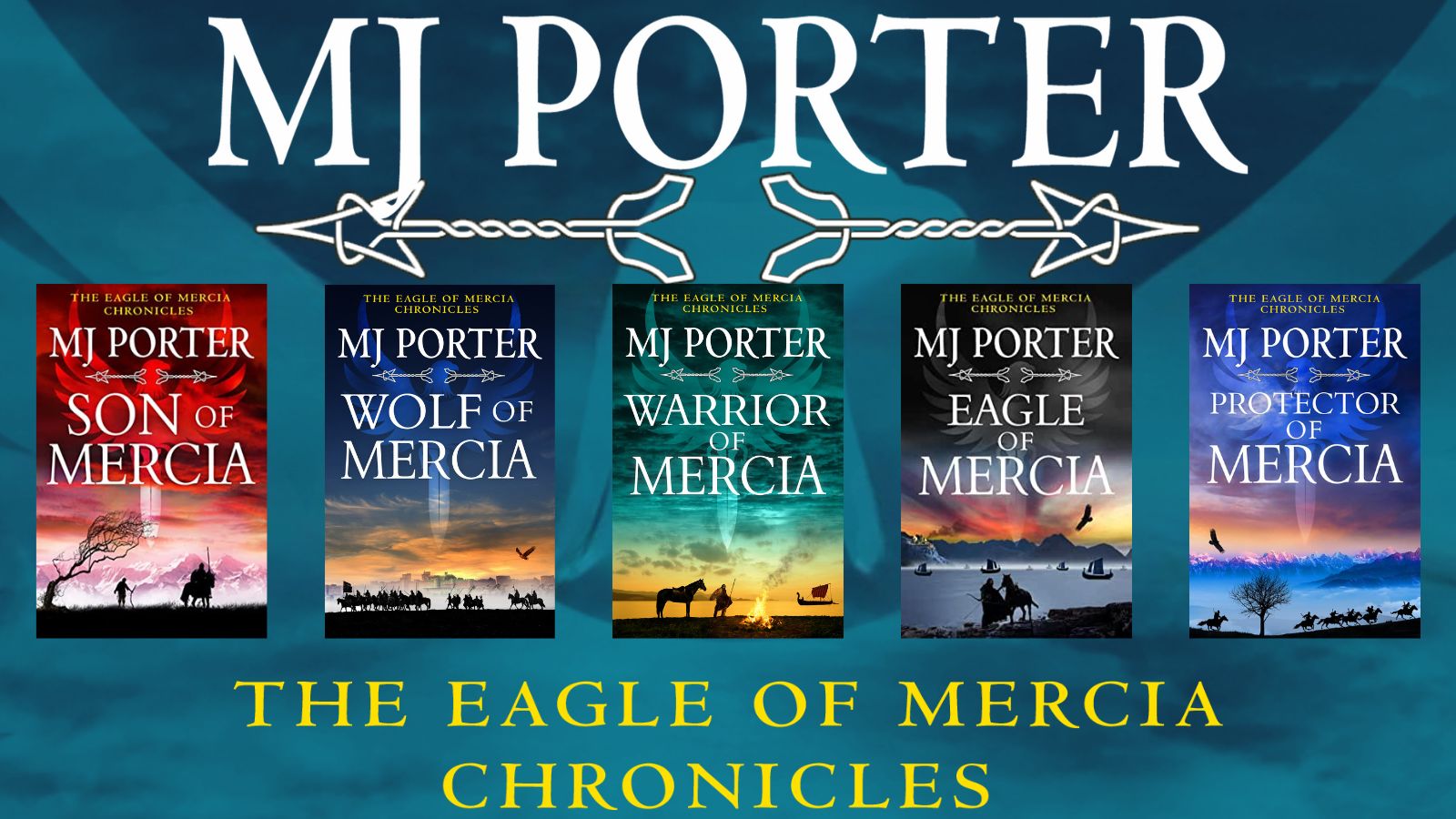
If you’ve not yet started The Eagle of Mercia Chronicles, then check out this introduction to the series.
Sign up to my monthly newsletter to learn more about my writing journey, new releases and special offers, and receive a free short story collection featuring many stories of Saxon England.