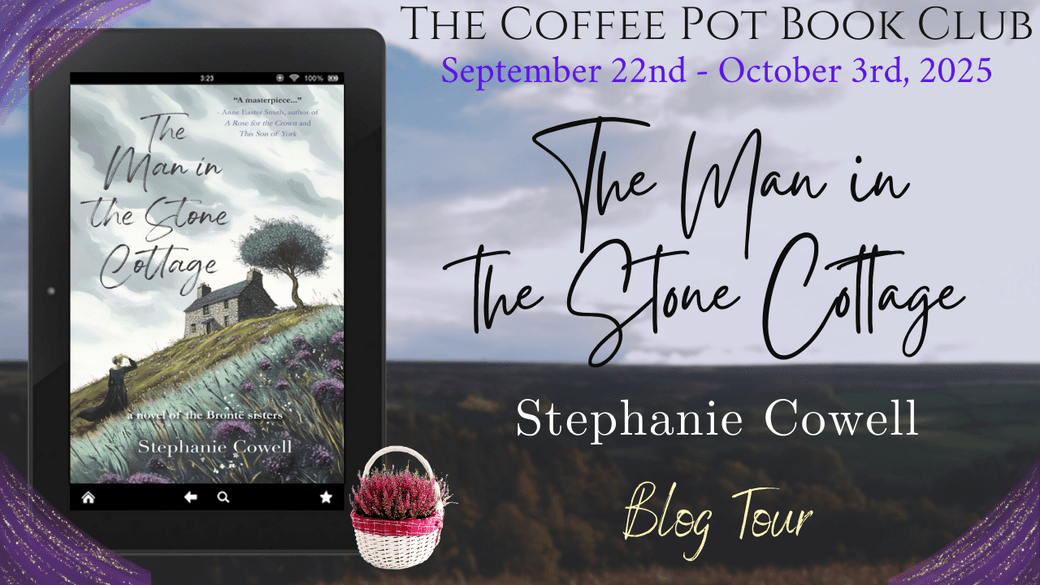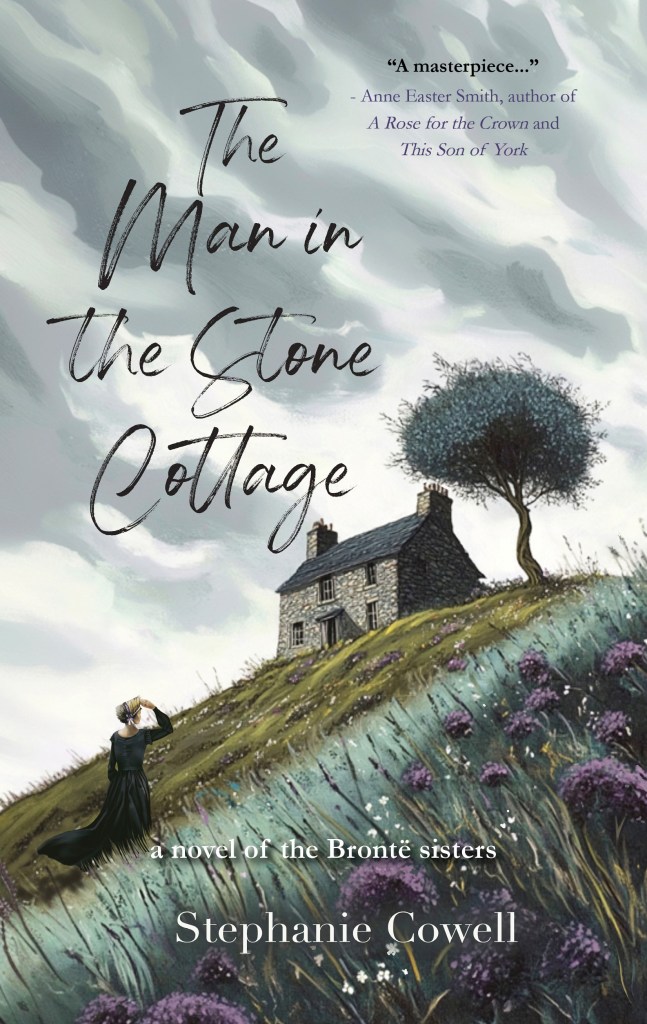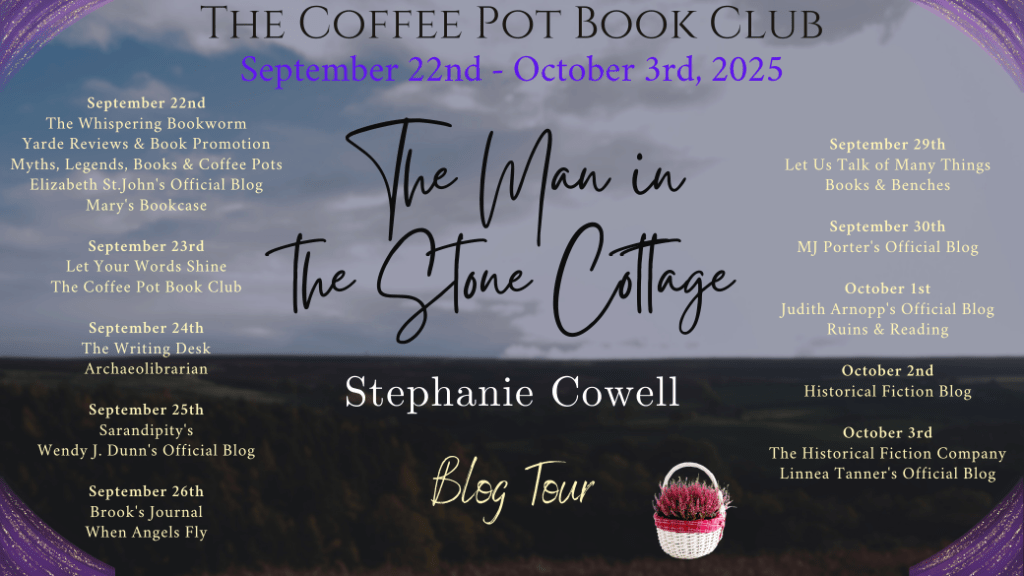
I’m welcoming Stephanie Cowell to the blog with a fascinating post about research for her new novel, The Man in the Stone Cottage: a novel of the Brontë sisters #Brontë #Yorkshire #Victorian #EnglishLiterature #WomenWriters #HistoricalFiction #TheCoffeePotBookClub #BlogTour 

I’m welcoming Stephanie Cowell to the blog with a fascinating post about research for her new novel, The Man in the Stone Cottage: a novel of the Brontë sisters #Brontë #Yorkshire #Victorian #EnglishLiterature #WomenWriters #HistoricalFiction @cathiedunn
@cowell.stephanie @thecoffeepotbookclub

Researching My Novel on the Brontë Sisters by Stephanie Cowell

I simply love research. The opportunity to know more about my beloved historical characters and their surroundings and daily world is thrilling. Researching Charlotte, Anne and Emily Brontë, I had a chance to go to their village in Yorkshire (Haworth) and to the Parsonage where they lived with their clergyman father and wrote their books and what is more thrilling than that?  I travelled there three times over many years.

In curated display cases, I could see the needles with which they sewed, the cup they drank from (imagine seeing Emily’s cup and knowing she might have paused in writing bits of Heathcliff to drink a sip of tea!), their clothing, their hand-written childhood magazines. I could walk around the house, climbing the steps they climbed every day. In the parlor/dining room, I marveled at the table where they wrote their books. (After a century or more of searching by scholars, the actual table was found in private hands and in 2015 it was brought back to the Parsonage. Someone has scratched “E” in the wood. Was it our Emily?) 

So, my first research was going to the Parsonage, but a great deal of research of course was from biographies and household advice books and letters which describes event and feelings and hopes and fears. They describe loneliness.

Letters are the best! Charlotte wrote the most. She wrote hundreds to her best friend Ellen, pouring out her frustration about working in a teaching job at a boarding school until exhausted. She wrote about her family. She wrote to her publisher’s reader about her sadness over her alcoholic brother who could not keep a job. She wrote her married Belgium professor of her adoration of him. We have these letters almost two hundred years. They are from the writer who penned Jane Eyre’s passionate words, “Do you think, because I am poor, obscure, plain and little, I am soulless and heartless?” 

Research! I have two bookshelves of biographies, literary analysis, life in Victorian England, books about the town of Haworth and the house, even a biography of the rather obscure man Charlotte eventually married. I just remembered that at one time my novel was not from the point of view of the two sisters, but only from his point of view. And like the larger part of stories I begin, it was not finished but eventually morphed into the final novel THE MAN IN THE STONE COTTAGE. 

I try to keep my research books together also in certain shelves but some wander over the house. When I was a beginning writer and rather poor, I used the library for everything. Now I am afraid I mostly use the internet to buy obscure second-hand books.

It was however in an actual bookshop one day that I glanced at a shelf and found THE book I wanted, THE book I must have. This was in the days before the internet. I gasped so that I am fortunate the salesperson did not come rushing over to see if I was okay. Perhaps he was used to having people gasp over discovered books. 

There is a problem with biographies. I went to a bookshop reading of one of Charlotte’s biographers, and someone asked her, “Have you written the definitive biography?” and she replied, “Oh no, I hope not. Every biographer sees her in a different way!” And that is true. Charlotte’s first biographer Mrs. Gaskell made Charlotte into a near saint.  Others have emphasized the prickly side of her personality. Who would not be prickly with all her losses and griefs and hardships? 

Emily and Anne have several biographies each, but less is known about them. These two sisters were more private and did not pour their heart out on paper, or perhaps fewer paper were kept.

Even when a novel is long finished and gone into the hands of readers, I love and long for the worlds where my beloved characters have walked. So, I go to wander in the streets of York or Paris or Florence, and if I wait, I will see one of my characters coming toward me. And likely he or she will smile and say, “There you are! Welcome back! We’ve been waiting for you!”

Here’s the blurb

“A haunting and atmospheric historical novel.” – Library Journal

In 1846 Yorkshire, the Brontë sisters— Charlotte, Anne, and Emily— navigate precarious lives marked by heartbreak and struggle.

Charlotte faces rejection from the man she loves, while their blind father and troubled brother add to their burdens. Despite their immense talent, no one will publish their poetry or novels. 

Amidst this turmoil, Emily encounters a charming shepherd during her solitary walks on the moors, yet he remains unseen by anyone else. 

After Emily’ s untimely death, Charlotte— now a successful author with Jane Eyre— stumbles upon hidden letters and a mysterious map. As she stands on the brink of her own marriage, Charlotte is determined to uncover the truth about her sister’ s secret relationship. 

The Man in the Stone Cottage is a poignant exploration of sisterly bonds and the complexities of perception, asking whether what feels real to one person can truly be real to another.

Praise for The Man in the Stone Cottage:

“A mesmerizing and heartrending novel of sisterhood, love, and loss in Victorian England.” – Heather Webb, USA Today bestselling author of Queens of London

“Stephanie Cowell has written a masterpiece.” – Anne Easter Smith, author of This Son of York

“With The Man in the Stone Cottage, Stephanie Cowell asks what is real and what is imagined and then masterfully guides her readers on a journey of deciding for themselves.” – Cathy Marie Buchanan, author of The Painted Girls

“The Brontës come alive in this beautiful, poignant, elegant and so very readable tale. Just exquisite.” – NYT bestseller, M.J. Rose

“Cowell’s ability to take readers to time and place is truly wonderful and absorbing.” – Stephanie H. (Netgalley)

“Such a lovely, lovely book!” – Books by Dorothea (Netgalley)

Purchase Link

https://books2read.com/u/mqLV2d

Meet the author

Stephanie Cowell has been an opera singer, balladeer, founder of Strawberry Opera and other arts venues including a Renaissance festival in NYC.

She is the author of seven novels including Marrying MozartClaude & Camille: a novel of Monet, The Boy in the Rain and The Man in the Stone Cottage. Her work has been translated into several languages and adapted into an opera. Stephanie is the recipient of an American Book Award. 

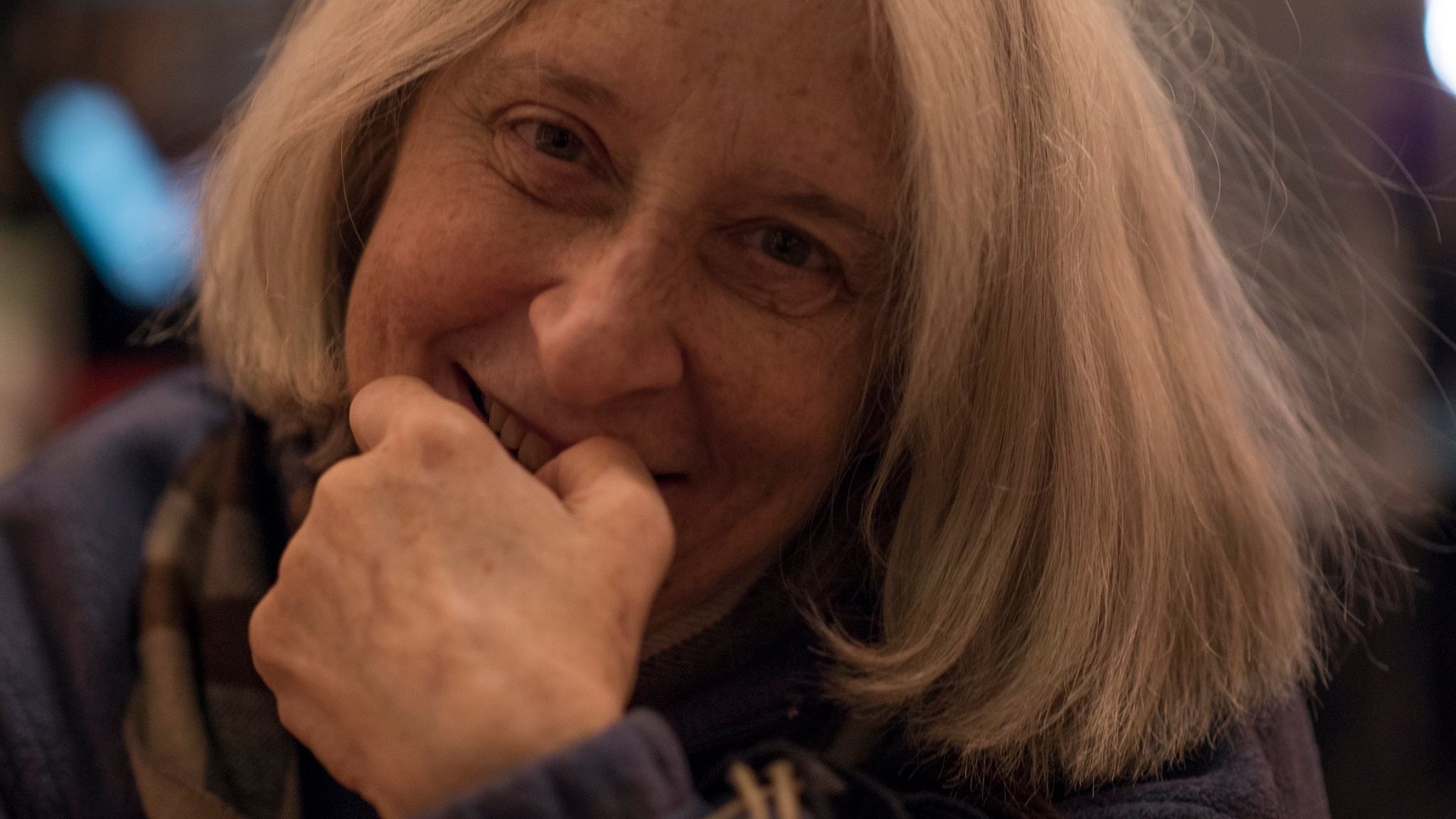
Author Stephanie Cowell

Connect with the author

Follow The Man in the Stone Cottage blog tour with The Coffee Pot Book Club

Posts

A Conspiracy of Kings – a little bit of history #histfic #TheTenthCenturyRoyalWomen #nonfiction

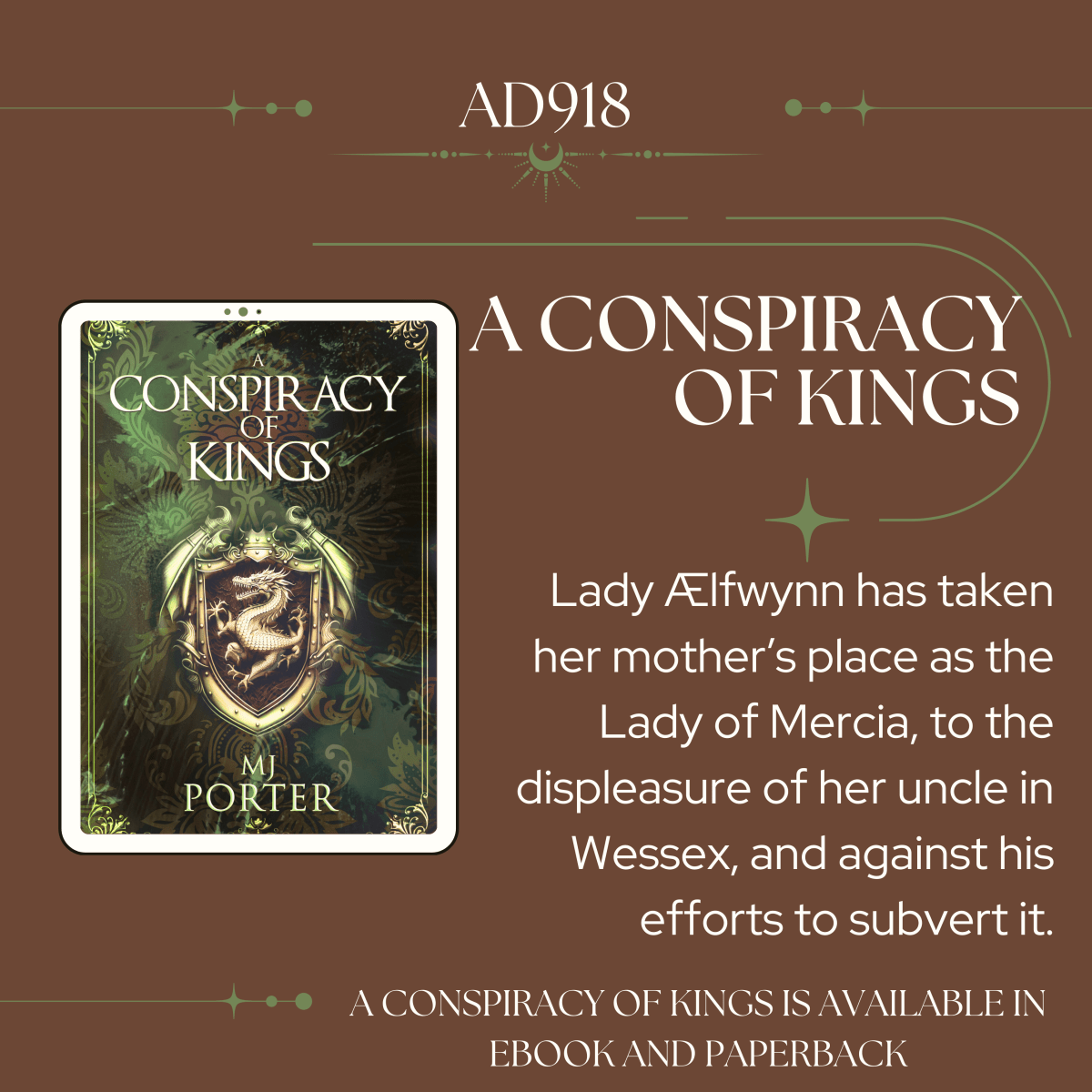
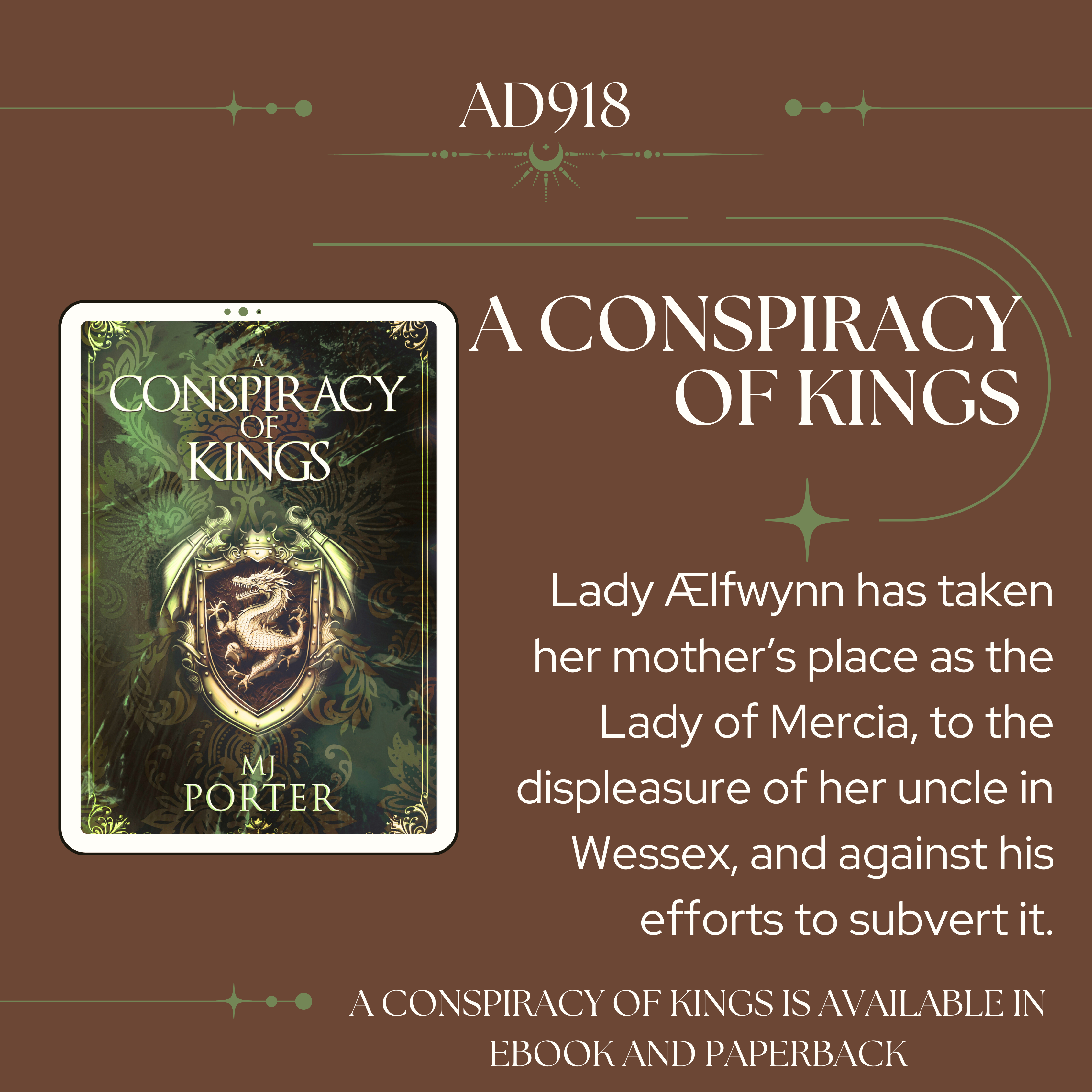
A Conspiracy of Kings – a little bit of history (may contain spoilers for my fictional recreation of Lady Ælfwynn

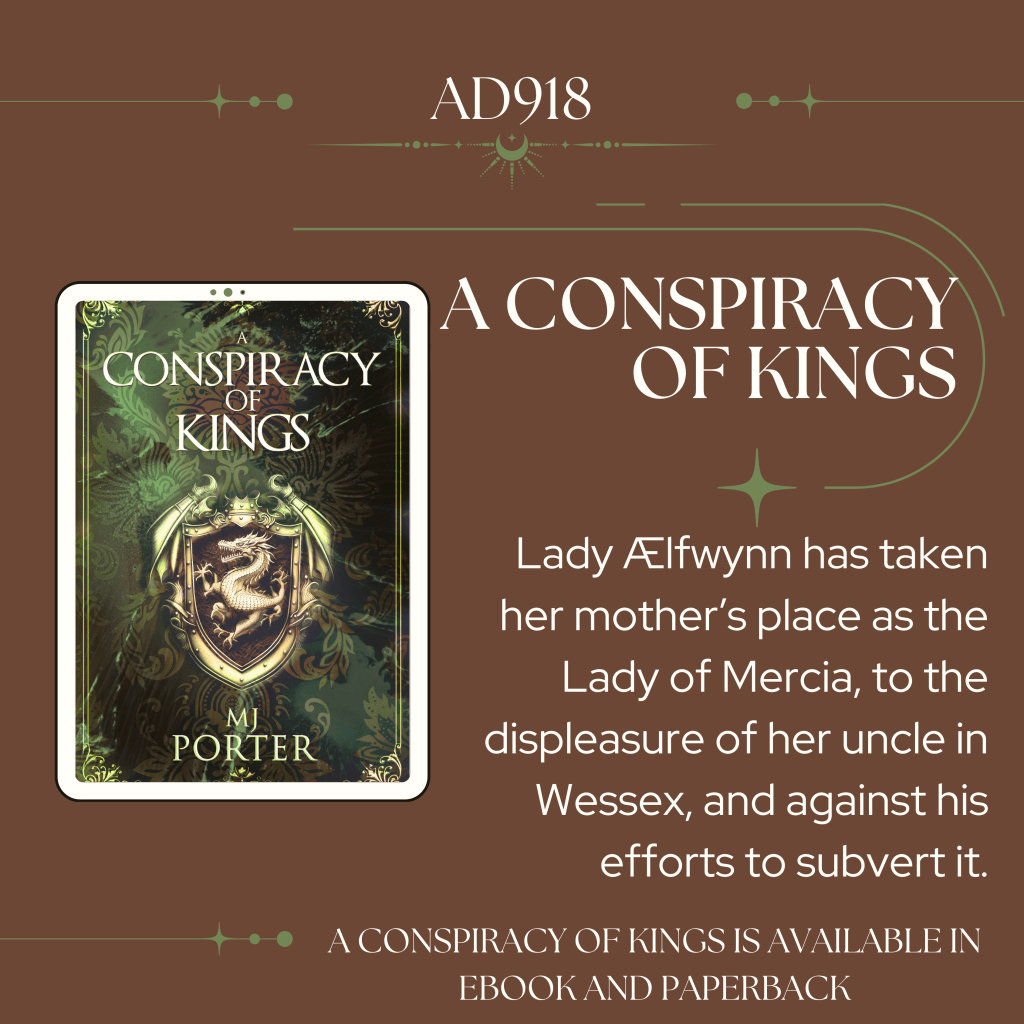
In the sequel to The Lady of Mercia’s Daughter, the story of Lady Ælfwynn continues. She is The Second Lady of Mercia, but everything isn’t as it seems. In the various recensions of The Anglo-Saxon Chronicles, an attempt can be made to piece together what befalls her.

The Anglo-Saxon Chronicle A version doesn’t mention Ælfwynn at all but instead has King Edward of Wessex/the Anglo-Saxons taking control of Tamworth as soon as his sister dies in June 918. 

The Anglo-Saxon Chronicle E only mentions Lady Æthelflæd’s death in 918 and not what happens immediately after in Mercia. Lady Ælfwynn’s fate, however, is recorded in The Anglo-Saxon Chronicle C. We’re told that she was deprived of all power and ‘led into Wessex three weeks before Christmas.’ This entry is dated 919, although it’s normally taken to mean 918 due to a disparity between the dating in this part of The Anglo-Saxon Chronicle – known as the Mercian Register – where a new year starts in December as opposed to in the Winchester version of The Anglo-Saxon Chronicle where the new year starts in September. 

These details are stark, offering nothing further. What then actually happened to Lady Ælfwynn? Was she deprived of her power? Was she deemed unsuitable to rule?

What adds to the confusion surrounding Lady Ælfwynn is that other than this reference in The Anglo-Saxon Chronicle, she doesn’t appear in any of the later sources. It’s as though she simply ceased to exist.

Two intriguing suggestions have been put forward to explain what happened to Lady Ælfwynn, both with some tenous corroboration.

Did she become a nun or, perhaps, a religious woman?

A later charter dated to 948 and promulgated by King Eadred is to an ‘Ælfwyn, a religious woman,’ and shows land being exchanged in Kent for two pounds of purest gold. (S535) There’s no indication that this Ælfwyn is related to our Ælfwynn or even to King Eadred. But, there remains the possibility that it might just have been the same woman, after all, Eadred would have been Ælfwynn’s cousin. Charter S535 survives in only one manuscript.

Alternatively, and based on a later source, Ramsey Abbey’s Book of Benefactors, we learn the following:

‘he [Athelstan Half-King] bestowed marriage upon a wife, one Ælfwynn by name, suitable for his marriage bed as much as by the nobility of her birth as by the grace of her unchurlish appearance. Afterwards she nursed and brought up with maternal devotion the glorious King Edgar, a tender boy as yet in the cradle. When Edgar afterwards attained the rule of all England, which was due to him by hereditary destiny, he was not ungrateful for the benefits he had received from his nurse. He bestowed on her, with regal munificence, the manor of Weston, which her son, the Ealdorman, afterwards granted to the church of Ramsey in perpetual alms for her soul, when his mother was taken from our midst in the natural course of events.’[i]

Which alternative is it?

There are only eight women named Ælfwynn listed in the Prosopography of Anglo-Saxon England (PASE), a fabulous online database. Of these, one is certainly Ælfwynn, the second lady of the Mercians, and one is undoubtedly the religious woman named in the charter from 948. (When the identification is not guaranteed, multiple entries are made in this invaluable online database). The other five women were alive much later than the known years Ælfwynn lived. One of the entries might possibly relate to her, but that’s all the information known about her. 

And this is far from unusual for many of the women of the House of Wessex. Some women are ‘lost’ on the Continent. Some are ‘lost’ in England.

‘Were it not for the prologue to Æthelweard’s Latin translation of an Anglo-Saxon Chronicle, we would know of only six tenth-century royal daughters or sisters from early English sources and the names of only four of them. Three of these named ones are nuns or abbesses. Only Ælfwynn, the daughter of Æthelflæd and Æthelred of Mercia, and the two daughters of Edward/sisters of Athelstan who married Otto I and Sihtric of York, appear in the witness lists of charters, though Eadburh, daughter of Edward the Elder, is a grantee of a charter of her brother Athelstan.’[ii]

Reconstructing a ‘possible’ life for Lady Ælfwynn was the inspiration for both The Lady of Mercia’s Daughter and A Conspiracy of Kings, and the potential for family betrayal, politicking, and war with the Viking raiders was just too good an opportunity to miss. 


[i] Edington, S and Others, Ramsey Abbey’s Book of Benefactors Part One: The Abbey’s Foundation, (Hakedes, 1998) pp.9-10

[ii] Stafford, P. Fathers and Daughters: The Case of Æthelred II in Writing, Kingship and Power in Anglo-Saxon England, (Cambridge University Press, 2018) p.142

https://amzn.to/46DvlA6

Find out more about who the historical Ælfwynn was here.

Visit The Tenth Century Royal Women page here.

Visit the Royal Women of The Tenth Century non-fiction page here

Posts

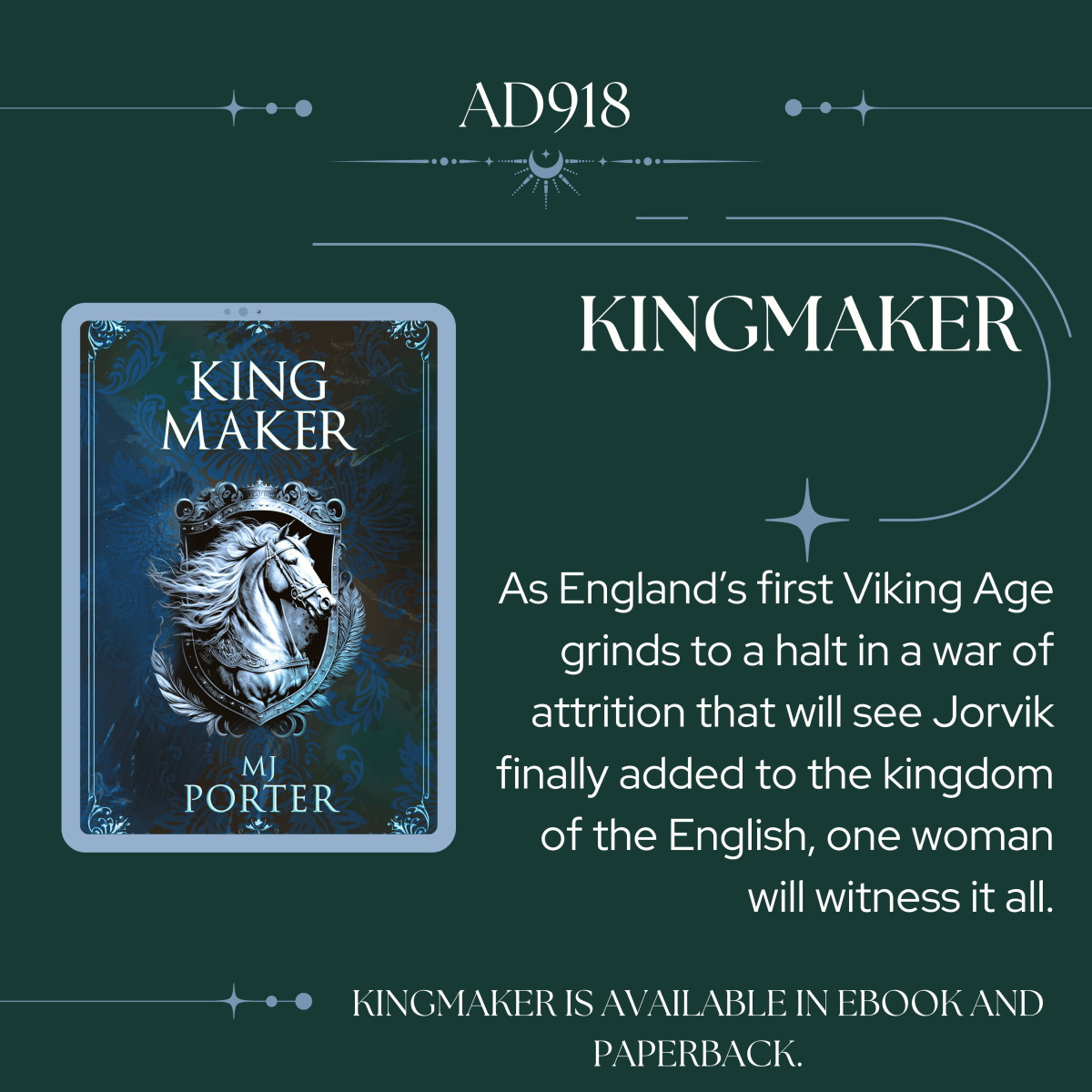
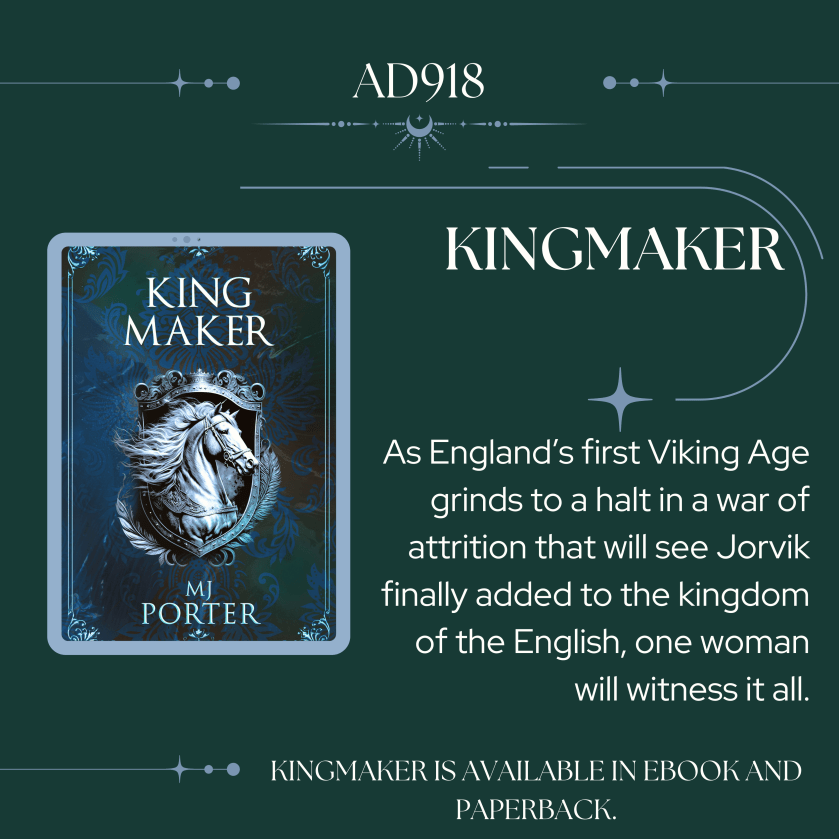
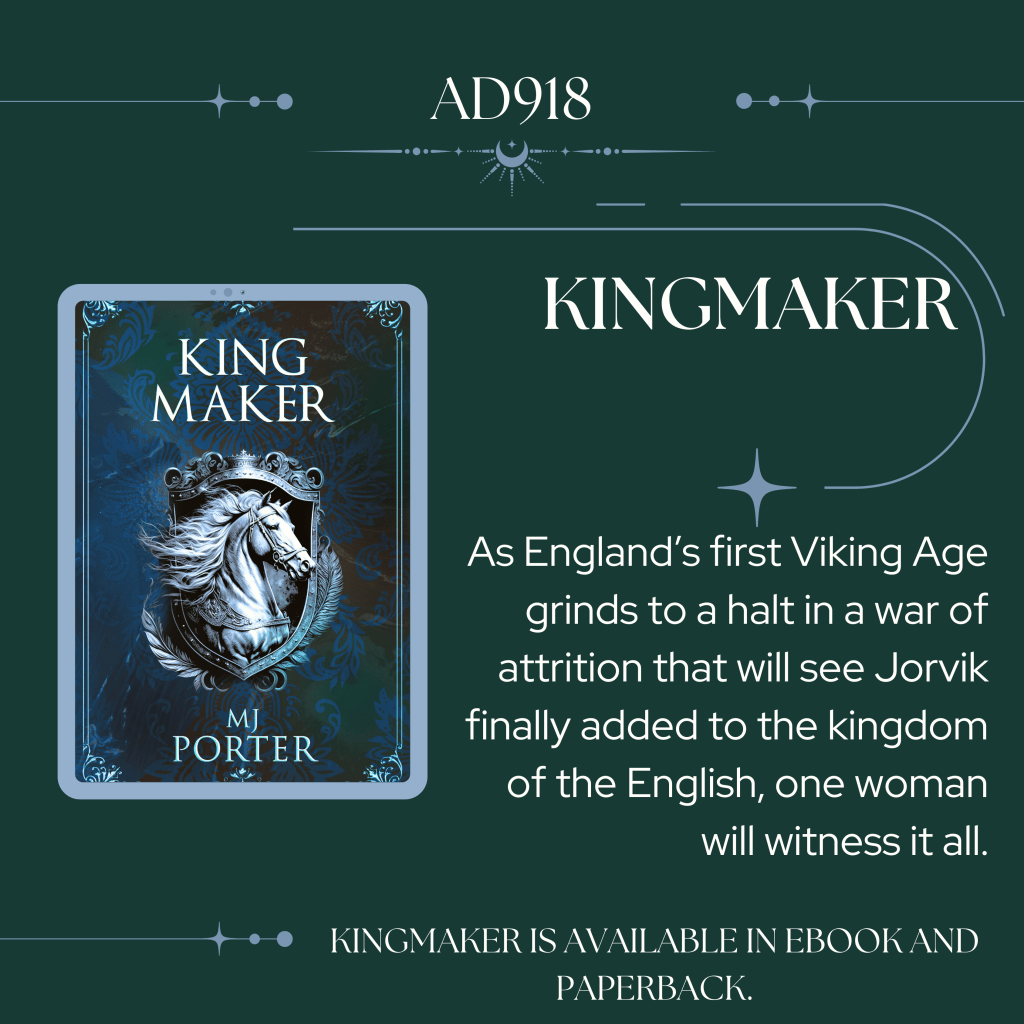
Why did I write about Lady Eadgifu, the main character in Kingmaker? #histfic #authorinspiration

Why did I write about Lady Eadgifu, the main character in Kingmaker? #histfic #authorinspiration

I don’t really know when I became a fan of historical fiction but I can take a good guess at who, and what, was to blame.

William Shakespeare and Macbeth.

When I was at school, we didn’t get ‘bogged’ down with grammar and spelling in English lessons, oh no, we studied stories, plays, words, and also the ‘motivation’ behind the use of those stories and those words. And it was Macbeth that first opened my eyes to the world of historical fiction.

Yes, Macbeth is a blood thirsty play, and it might be cursed, but more importantly, it’s based on Holinshed’s Chronicle of England, Scotland and Ireland.

Macbeth is nothing better than the first work of historical fiction that I truly read, and understood to be as such. And what a delight it was.

I remember less the story of Macbeth as presented by Shakespeare (aside from the three witches – “when shall we three meet again?” “well I can do next Wednesday,’ (thank you Terry Pratchett for that addition), than working out ‘fact’ from ‘fiction’ in his retelling of the story. And hence, my love of historical fiction was slowly born, and from that, stems my love of telling stories about ‘real’ people and the way that they lived their lives, looking at the wider events taking place, and trying to decide how these might, or might not, have influenced these people. 

Shakespeare chose the story of a little-known ‘Scottish’ monarch for his historical fiction; my latest subject is the third wife of King Edward the Elder, again someone that few people have heard of, but whose relative, many years in the future, would have interacted with Macbeth, or rather with Mac Bethad mac Findlaích.

Lady Eadgifu, the Lady of Wessex, lived through a tumultuous time.

Many people studying Saxon England know of King Alfred (died AD899), and they know of his grandson, Æthelred II (born c.AD 968), known as ‘the unready’. But the intervening period is little known about, and that is a true shame.

Lady Eadgifu, just about singlehandedly fills this gap. Born sometime before c.AD903 (at the latest), her death occurred in c.AD964/6. As such, she probably missed Alfred by up to 4 years, and her grandson, King Æthelred by about the same margin.

But what she did witness was the emergence of ‘England’ and the ‘kingdom of the English’ as we know it. And it wasn’t a smooth process, and it was not always assured, and it was certainly never, at any point, guaranteed that England would emerge ‘whole’ from the First Viking Age. 

And more importantly, rather than being one of the kings who ruled during this period, Lady Eadgifu was the king’s wife, the king’s mother, or even the king’s grandmother. She would have witnessed England as it expanded and contracted, she would have known what went before, and she would have hoped for what would come after her life. (I think in this, I was very much aware of my great-grandmother who lived throughout almost the entire twentieth century – just think what she would have witnessed).

Lady Eadgifu was simply too good a character to allow to lie dormant under the one event that might well be known about from the tenth century – the battle of Brunanburh. She does also appear in my Brunanburh Series.

So, for those fans of Bernard Cornwell’s ‘Uhtred’ and for those fans of Lady Elfrida at the end of the tenth century, I hope you will enjoy Lady Eadgifu. She was a woman, in a man’s world, and because she was a woman, she survived when men did not. 

The family of Alfred the Great

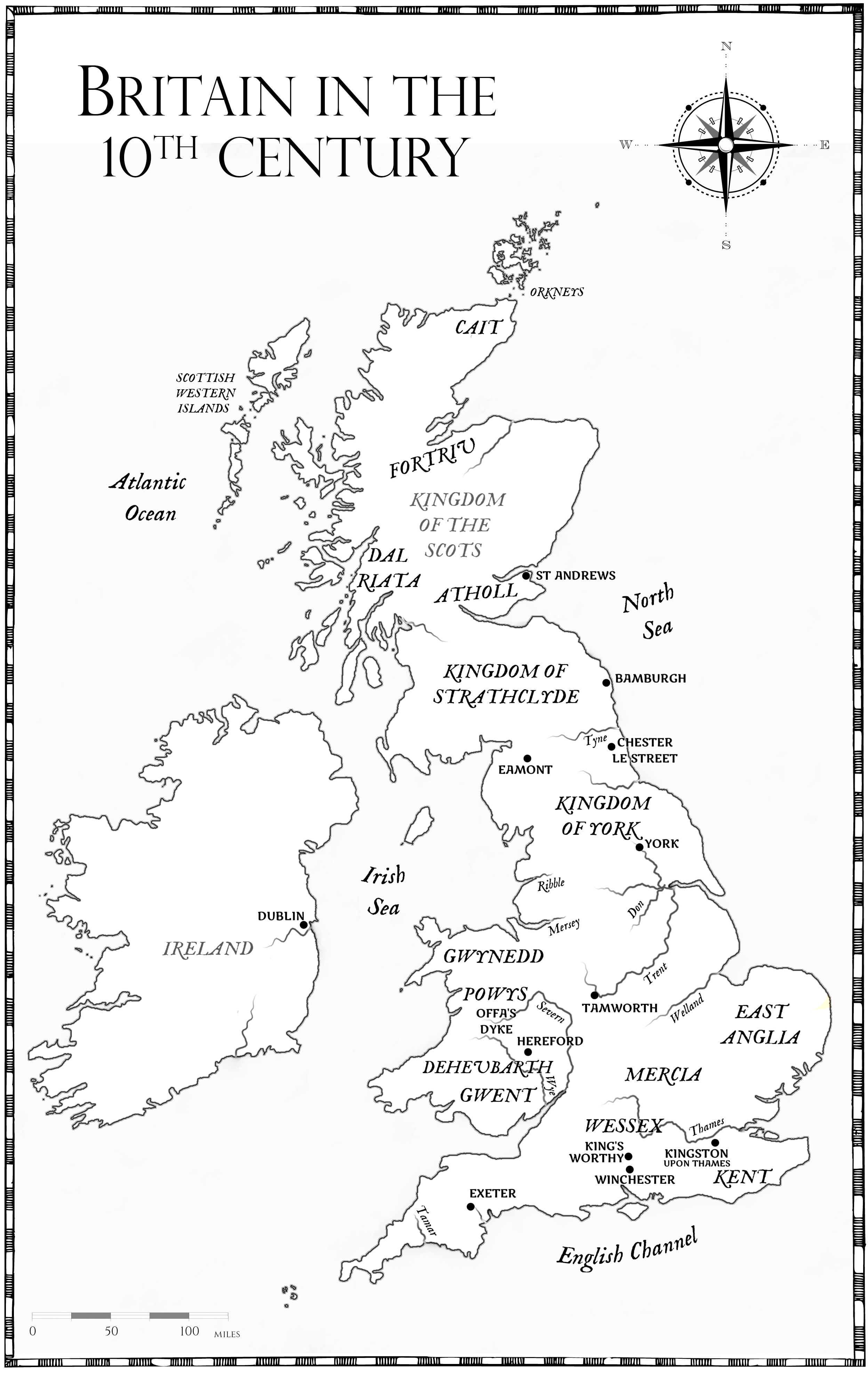
Map design by Shaun at Flintlock Covers

Check out The Tenth Century Royal Women page on the blog and this post about who the ‘real’ Lady Eadgifu was.

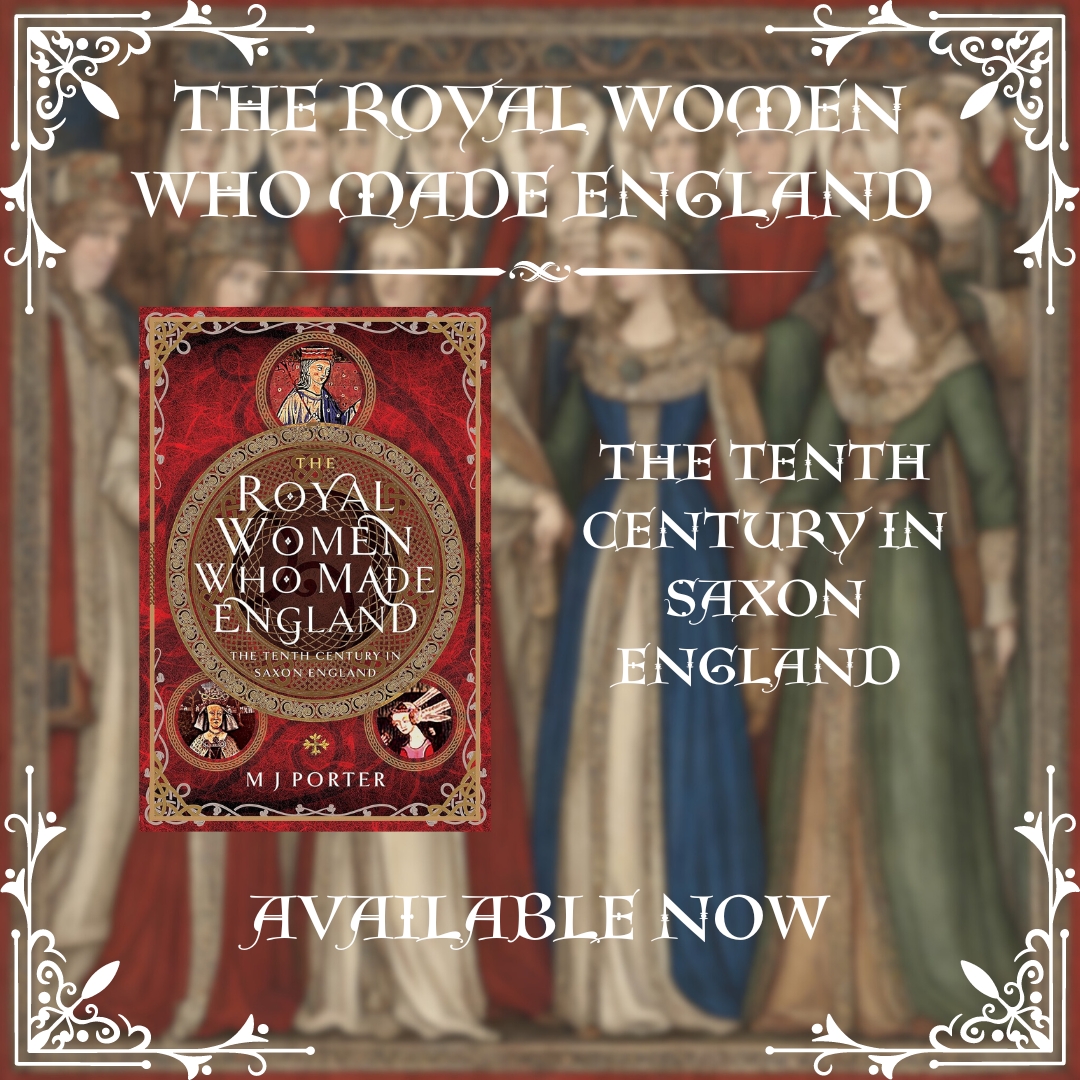
Curious? Read about the Royal Women of The Tenth Century in my nonfiction title.

The Royal Women Who Made England cover

Posts

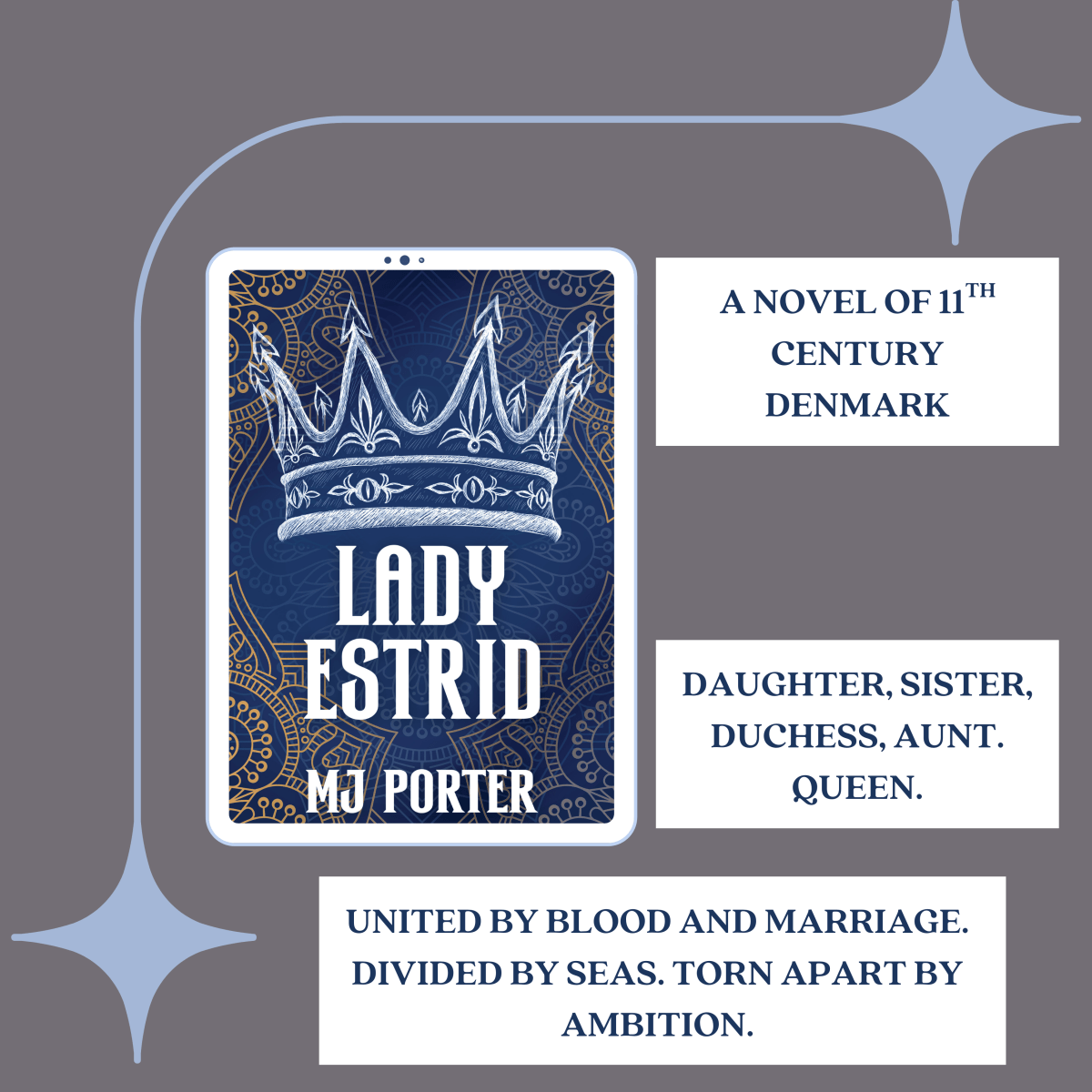
I’m resharing an interview I gave when I’d finished writing Lady Estrid, a novel of eleventh century Denmark #histfic #writingadvice #authorinterview

I’m resharing an interview I gave when I’d finished writing Lady Estrid, a novel of eleventh century Denmark #histfic #writingadvice #authorinterview

Why did you decide to write about Lady Estrid?

Lady Estrid has been a character that’s long fascinated me. She crops up as a ‘bit part’ character in another series I write, but as time has gone on, I’ve realised that she offers a lot more than I’ve been allowing her so far. And so, I hope at a suitable point in the other series, I decided to explore Lady Estrid for herself. It involves stepping away from my comfort zone of pre-Conquest England in the eleventh century, and allows me to write about Scandinavia at this time period, which has always been a huge area of interest for me.

I’ve written a few long story arcs before, but only two other books which cover such a huge amount of time (about four decades). Such a project allows me to focus on the bigger picture and to put historical characters into a much wider story-arc than writing just about them would allow.

By necessity, Lady Estrid must be a strong woman, able to manipulate the politics taking place around her. I think that there’s a huge and growing interest in such women, and of course, Denmark (and Scandinavia as a whole) at this time, isn’t something that I believe has been tackled before, potentially because of the lack of English Language books about the era. 

What drew you towards the Early Medieval era in which you set your book?

I’m fascinated by everything pre-1066 in England, but also wider afield. It’s impossible to tell the story of just one of these later countries, inhabited by Northmen or Norsemen, without looking to what’s happening elsewhere. These characters didn’t abide by our current national boundaries.

What were the challenges you faced in researching this period of history and were there any unexpected surprises?

The biggest problem with writing about this time period is the sources. I’m not as familiar with the Saga material and the works of Adam of Bremen and Saxon Gramaticus, as I’d like to be. As such, I rely much more on secondary sources than I might when writing about the Early English period. And of course, it’s a period where written sources are quite scarce anyway. Not only is it difficult to ‘find’ Lady Estrid, but, as you might have noticed, many of the character share the same names – there are no ends of Swein/Svein/Sven’s and equally, just as many Gytha’s and Gunnhild’s.

I was surprised by just how little the women of the Danish royal family are mentioned in any secondary sources. I’ve recently been on a book buying spree, and even in a new monograph on Cnut, Lady Estrith is only cited in the index seven times, and in a 798-page book, she has about 3 words! 

What do you think is the most challenging aspect of writing Historical Fiction?

I think this depends on how much history you want to put in your book. I’ve just written three books in The Ninth Century Series, and while they’re historical in nature, much of the day-to-day activity is actually fighting and swearing. Lady Estrid has a much weightier content. It has a cast of many more people; they all have to be placed in the right time period and at the right events, and there is not as much information about any of them as I’d like there to be. Obviously, The Ninth Century Series was easier to write once the time period was set. Lady Estrid was an altogether different project. It took much longer, and was more frustrating because I was trying to ensure it didn’t conflict with previous stories I’ve written, which have a very ‘Early English’ basis.

What advice do you have for aspiring Historical Fiction authors?

Know the time period you’re writing about, and not just what happens during it, but also what happens both before, and after, and in neighbouring countries as well. And, be aware of what ‘might have happened’ if certain events – normally births, deaths or wars – hadn’t happened. Remember, your characters don’t have the benefit of hindsight that you have as a writer. Everything to them would have been immediate, imminent and happening to them. Don’t fall into the trap of presenting everything as a fait accompli.

And, be prepared to be frustrated. There’s always some niggly little fact that is just not mentioned anywhere. The decision then has to be made as to whether to ‘make it up’ or write around it, and readers will somehow always know if you make it up.

And on a final note, be prepared to do something a little bit ‘different,’ be bold, be creative, do whatever has to be done to engage an audience with the time period. 

Posts

Who was Lady Estrid, and why did I write about her life? #histfic #TheEleventhCentury #England #Denmark #non-fiction

Who was Lady Estrid, and why did I write about her life? #histfic #TheEleventhCentury #England #Denmark #non-fiction

Lady Estrid, or Edith or even Margaret, daughter of King Swein Forkbeard of Denmark (and briefly England) is one of those beguiling characters who lived through momentous change. 

I’ve long been drawn to her, and used her as a ‘bit’ part character in my The Earls of Mercia series, but I wanted to dedicate both more time to Lady Estrid, and also to Denmark. Even when I’ve written about Cnut, who was king of England and Denmark, much of the action has taken place in England. There’s simply not enough ‘space’ to fit everything in.

Lady Estrid, like similar royal women (Queen Eadgifu of England and Lady Elfrida in the tenth century), had the advantage of living a much longer life than many of her male family members (check out the family trees here). She was the ‘glue’ that held together the narrative of what was happening in Denmark. And because of her vast family, it also allowed me to weave the story of not just Denmark, but also Norway, Sweden, England, and Normandy, into the narrative.

She was the daughter of a king, the sister of three kings, the aunt of four kings, the mother of one king, and in time, the grandmother of three further kings. 

Having written about Queen Eadgifu, Lady Elfrida, and King Edward the Elder’s daughters (in tenth century England), I wanted a new ‘woman’ to bring to life. I could have chosen Queen Emma, or even Queen Edith of England, but their stories are more well-known. I’ve long been fascinated by the Scandinavian countries during the Viking Age, and Lady Estrid was just too good a character to leave in her ‘bit’ part without adding anything further.

For all Lady Estrid’s claims as mother, aunt, sister and daughter, there’s very little that can be said about her, not even the order of her three marriages, if they occurred, can be confirmed. It’s only possible to say that her marriage to Jarl Úlfr took place because of the survival of her children. It’s the lack of ‘hard facts’ about her, and the potential to weave a story that includes so many of the other well-known women and men of the period, that made Lady Estrid so irresistible. When stories focus on Earl Godwine, or King Cnut, or even on King Harald Hardrada, it’s possible to lose sight of the bigger picture, and Lady Estrid certainly provides the potential to show the overarching events that occurred from AD1013-1050 within Denmark and England.

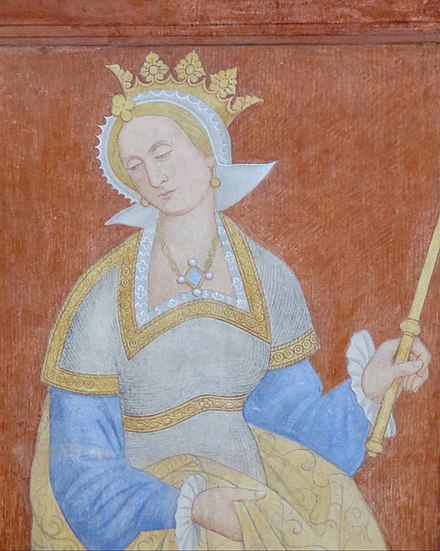
An image of Lady Estrid from Wikipedia

Check out the Lady Estrid page for more information about my novelisation of her life, and the historical details available for her.

Posts

On the 1100th anniversary of King Athelstan’s coronation #histfic #OnThisDayInHistory #non-fiction

On the 1100th anniversary of King Athelstan’s coronation #histfic #OnThisDayInHistory #non-fiction

Who was Athelstan?

He was the oldest son of Edward the Elder, but who was his mother?

It’s been suggested his mother might have been Mercian, and this also made him acceptable for the Mercians to declare him as king- but it’s impossible to determine more about her. We don’t even know her name, although it’s suggested that it was Ecgwynn. She was soon replaced, either because of her death or because Edward, on becoming king of Wessex, needed to cement his position through marriage with a powerful ealdormanic family. Lady Ælfflæd was Edward’s second wife.

Later discussions abound about Athelstan’s suitability to become king of Wessex, with many casting doubt on the union, but it is evident that Alfred believed the union was a lawful one, and his grandson would one day become king, although of where, we don’t know.

Equally, we don’t actually know when Edward’s second marriage occurred, was it before or after his father’s death?

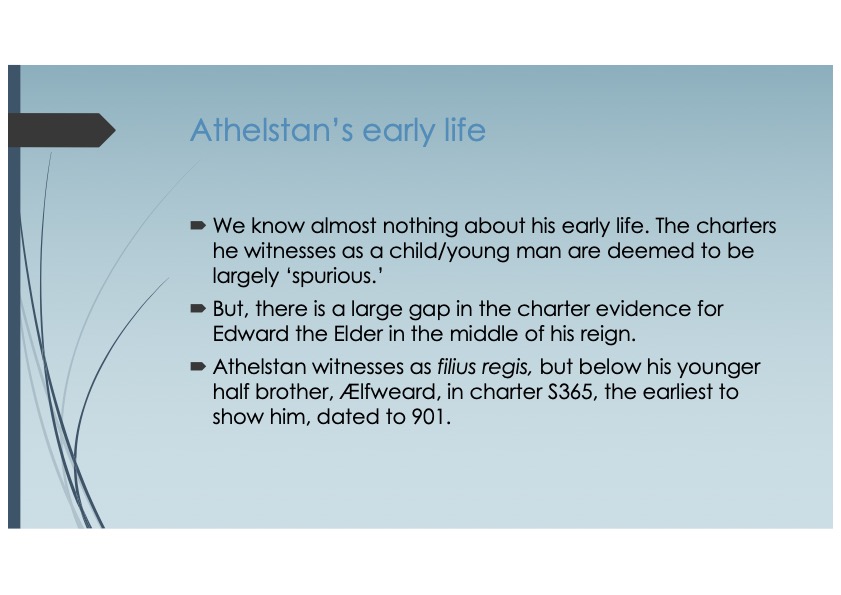
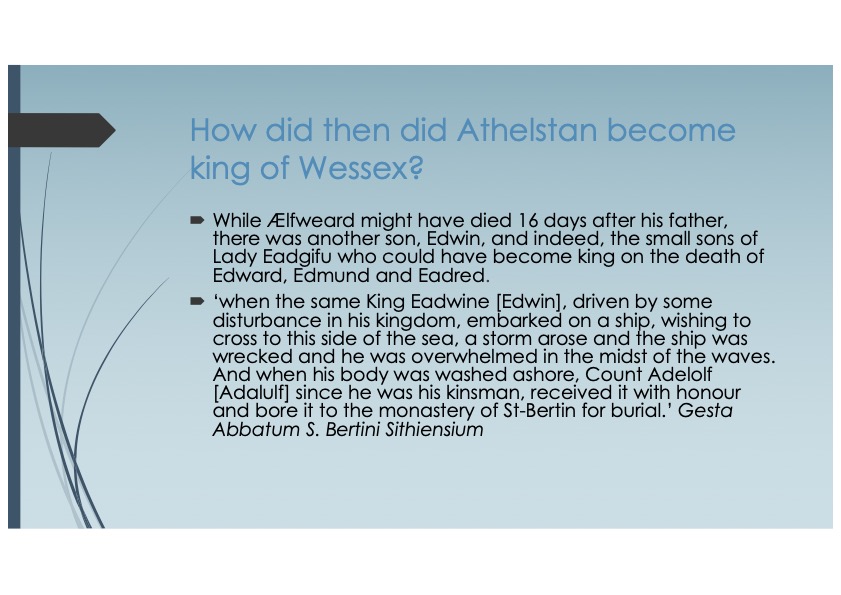
Powerpoint slide showing some quotes about Athelstan's early life.

Athelstan’s early life

Athelstan and his younger half-brother, Ælfweard, who we must assume was the oldest son born to Edward and his second wife, begin to attest charters in 901 both as filius regis although Ælfweard is named above Athelstan despite being younger. 

Athelstan attests eleven of his father’s charters (Sawyer, P.H. (ed.), Anglo-Saxon charters: An annotated list and bibliography, rev. Kelly, S.E., Rushforth, R., (2022). http://www.esawyer.org.uk/ S365, S366, S371, S375, S376, S377, S378, S379, S381, S382, S383), Ælfweard only eight, but again, the number is still small and so may not be representative – in 901, Athelstan witnesses 2 charters, but Ælfweard only one.

Only three of the eleven charters that Athelstan witnesses under his father are deemed to be authentic, and only one of those witnessed by Ælfweard and Athelstan together which is dated to 901, when they were both young children. This would have been very early in Edward’s reign, when his cousin, Æthelwold, was still alive and contesting the rulership of Wessex, something that wasn’t resolved until the decisive Battle of the Holme, in either 901 or 902. Edward may have wanted to labour the point that he was the father to two potential male heirs, or æthelings. (His brother, Æthelweard is also termed filius regis, and so Edward might have been highlighting that if something did befall him, he had a brother who could also succeed him, as opposed to two young children.)

However, there is a large gap in the charter evidence for Edward the Elder in the middle of his reign, and so it is difficult to track any developments. 

But with all that said, I don’t find Athelstan’s charter witnessing very helpful when trying to determine his place at the Wessex royal court at this time, his position as a young man or even how he got on with his father’s second wife (as well as his third wife) and her many, many children, who would bedevil him when he became king. 

Was Athelstan raised in Mercia by his aunt and uncle?

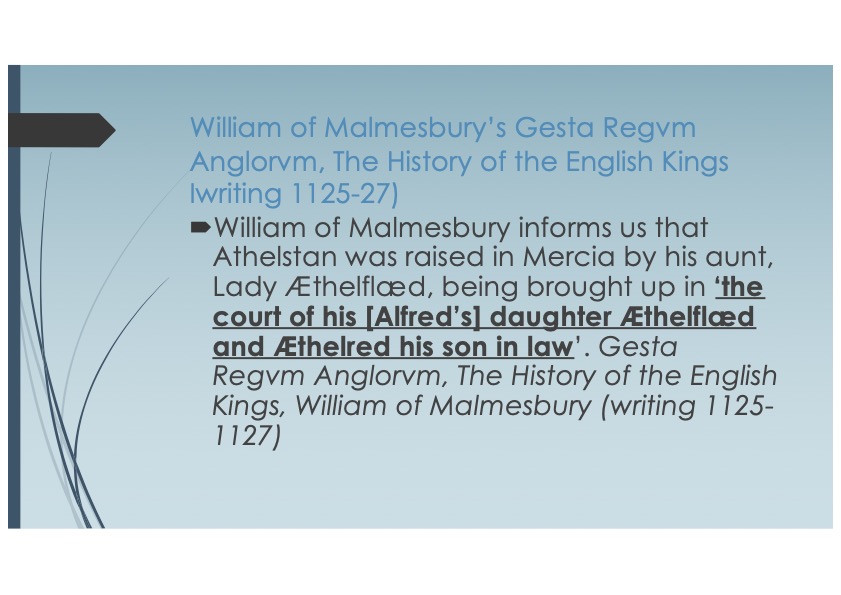
Quote from William of Malmesbury about Athelstan being raised in Mercia.

The fact Athelstan was declared king of Mercia does seem to corroborate a statement made by William of Malmesbury, in the later Gesta Regum Anglorum, or The History of the English Kings, that Athelstan was raised in Mercia by his aunt and uncle, alongside his full birth sister, who may have been called Edith.

Or, it could be that his mother was Mercian. It’s frustratingly difficult to find explanations when events are merely told us as supposed ‘fact,’ and William of Malmesbury’s assertion has been little questioned, other than by historian David Dumville, even though it dates to two centuries after the events. It seems to be the ‘easy’ explanation as to why Athelstan became king of Mercia after his father’s death.

What was happening in Wessex?

Ælfweard, his younger half-brother, was declared king, until his death, 16 days after his father.

How did Athelstan become king of Wessex?

Quote from the Gesta Abbatum S Bertii Sithiensium marking the death of Edwin.

So, once he was chosen as Mercia’s king, how did he then become king of Wessex on the death of Ælfweard so soon after that of Edward?

This period is as equally hazy as what happened to make Athelstan king of Mercia.

But, after Ælfweard’s death, there is another son of Edward’s second marriage who could have become king, Edwin. As could the sons of Edward’s third wife, Lady Eadgifu, who were very young at the time, perhaps no more than one and three years old. 

Why Athelstan was chosen is difficult to rationalise, especially if the Wessex witan were so uneasy with him. Some suggest he reached an agreement with Lady Eadgifu (his father’s third wife) that her sons would be his heirs. Others think there was a period of unease where Wessex was kingless. We have no explanation for Edwin being overlooked, and certainly, it seems he went on to cause his older half-brother problems. We have reports of Edwin’s death in 933 – apparently from drowning, but it seems likely, it was some sort of rebellion against his half brother, the king. The Gesta Abbatum S. Bertini Sithiensium, reports his burial by his cousin in Flanders. 

I find this period quite interesting as by now, another Eadgifu, a half sister of Athelstan, who had been married to King Charles III of the West Franks, might have been in Wessex. She had a young son, Louis, but Charles had been usurped and imprisoned and certainly Louis was at the Wessex court when his grandfather died. It’s possible Eadgifu was as well. Would she not have supported her full brother against Athelstan claiming the kingship? Equally, we don’t know if Edwin’s mother was still alive. It is all very perplexing.

What we do know is that Athelstan underwent his coronation in September 925, so over a year after his father’s and half-brother’s death. The coronation took place at Kingston upon Thames. This delay has been interpreted as showing he met resistance in Wessex to his rule, but it might not have been that unusual. His father’s coronation was not immediate, although, admittedly, his father was faced with the rebellion of Æthelwold, his cousin and the surviving son of Alfred’s older brother, Æthelred I. Alfred and his brother seem to have reached an accord about the succession before Æthelred I’s death, and Alfred then rode roughshod over it. 

A coronation with a crown?

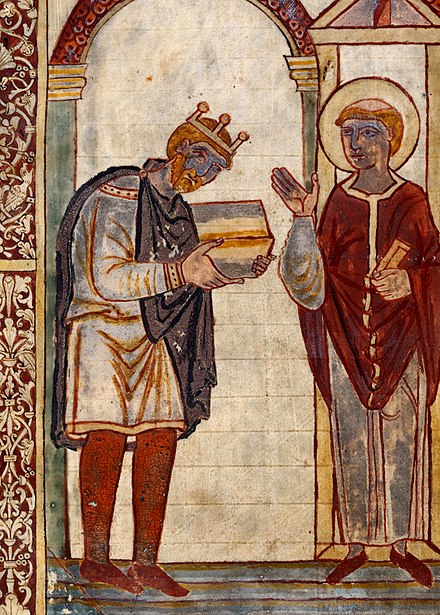
There is some discussion about whether the surviving Coronation ordo (ceremony) was devised for Athelstan or not, but he was crowned with a crown and not a helmet, as earlier kings had been. We have a famous image of Athelstan, (we only have two contemporary/near-contemporary images of the tenth century kings) presenting a book to St Cuthbert, and in this image, he is shown wearing a crown. This was a departure from earlier ceremonies.


An image of King Athelstan presenting a book to St Cuthbert
Frontispiece of Bede’s Life of St Cuthbert, showing King Æthelstan (924–39) presenting a copy of the book to the saint himself. Public domain, via Wikimedia Commons

For more suggestions, and my fictional recreation of how Athelstan became king of Mercia, Wessex and the English, do check out my books, Kingmaker (the story of Lady Eadgifu), and King of Kings (which begins with the coronation of King Athelstan on 4th September 925).

Anglo-Saxon Chronicle quotations from M Swanton, The Anglo-Saxon Chronicles.

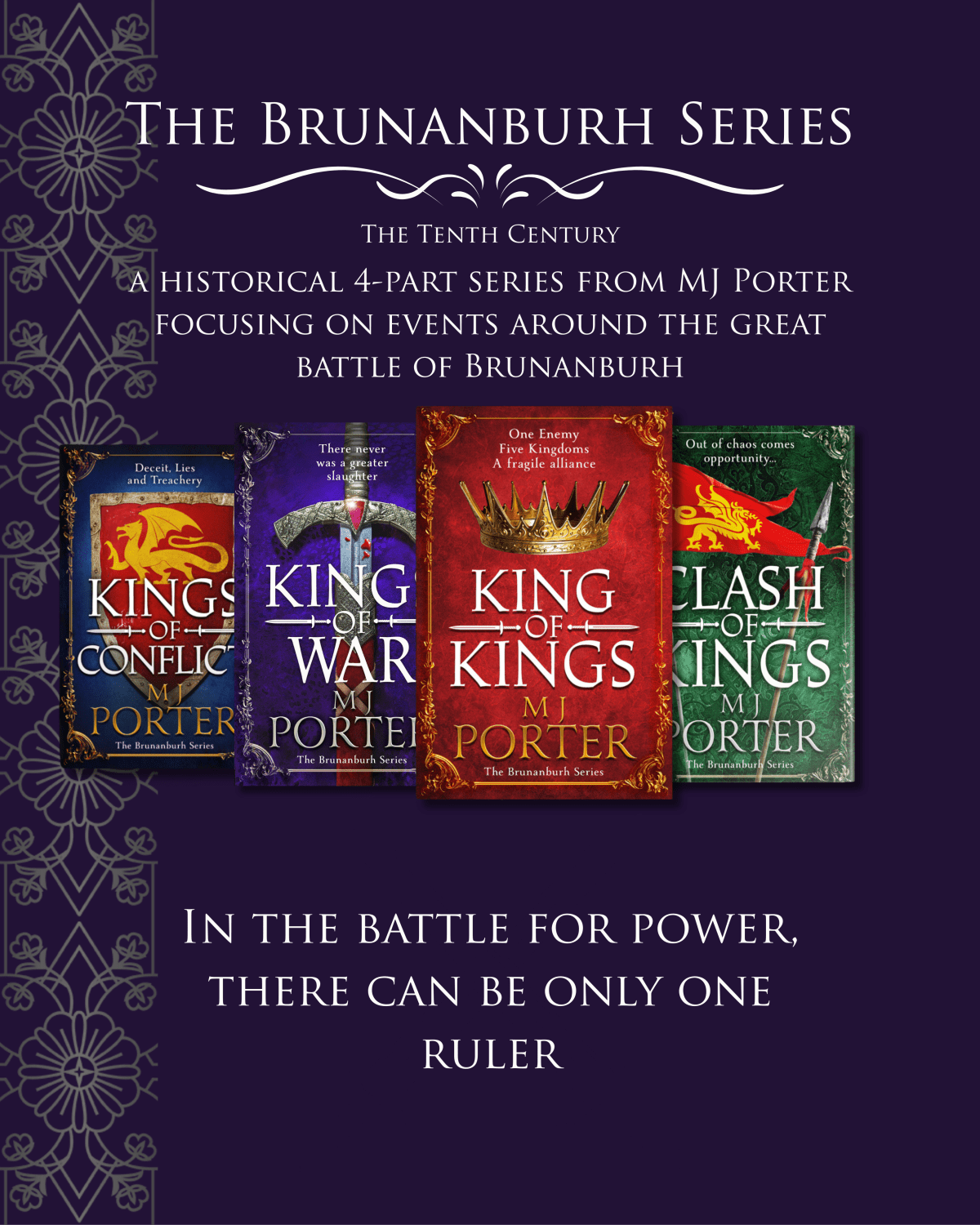
Check out the Brunanburh Series page on my blog for more information.

Posts

The Lady of Mercia’s Daughter turns 8 years old #bookbirthday #Mercia

Another book birthday

I feel like these are coming thick and fast this year, but then I suppose I’ve written a lot of books.

To celebrate The Lady of Mercia’s Daughter turning 8, yes 8, today, I thought I’d share why I wrote about Lady Ælfwynn, and not her more famous mother, Lady Æthelflæd.

My first historical fiction story (that of Ealdorman Leofwine) was inspired by the fact that I realised he’d been almost written out of the history of the period. I’d read many, many books about the end of Saxon England, and few of them mentioned the Earls of Mercia at all, apart from his descendants, Edwin, Morcar and Eadgyth. This has often been the way. I find a character who’s been forgotten about (because most historical individuals have been forgotten about) and I reimagine their lives and endeavour to either rehabilitate them, or at least shine a light on them. The same can be said for Lady Ælfwynn, the Lady of Mercia’s Daughter, and the Second Lady of the Mercians in her own right.

Even though she attests a number of charters, and is named in the Anglo-Saxon Chronicle (which is very rare for the women of the tenth century) no one had heard of her. I was determined to put that right, largely helped by an academic paper I read about her which got my brain firing with ideas.

Piecing together the scant information available (and possibly known) about her, I created The Lady of Mercia’s Daughter, and subsequently, the sequel, A Conspiracy of Kings. In doing so I don’t suggest at all that this is a recreation of the life she led, but it certainly presents a possible life for her, and one that is a little more exciting than the often cited ‘she became a nun,’ argument to explain why she disappears from the historical record so quickly. It also allowed me to try my hand at family politics, which so often came into play during the era. And, for fans of King Coelwulf II and The Last King books, I can certainly ‘see’ a lot of his later creation in the pages of The Lady of Mercia’s Daughter.

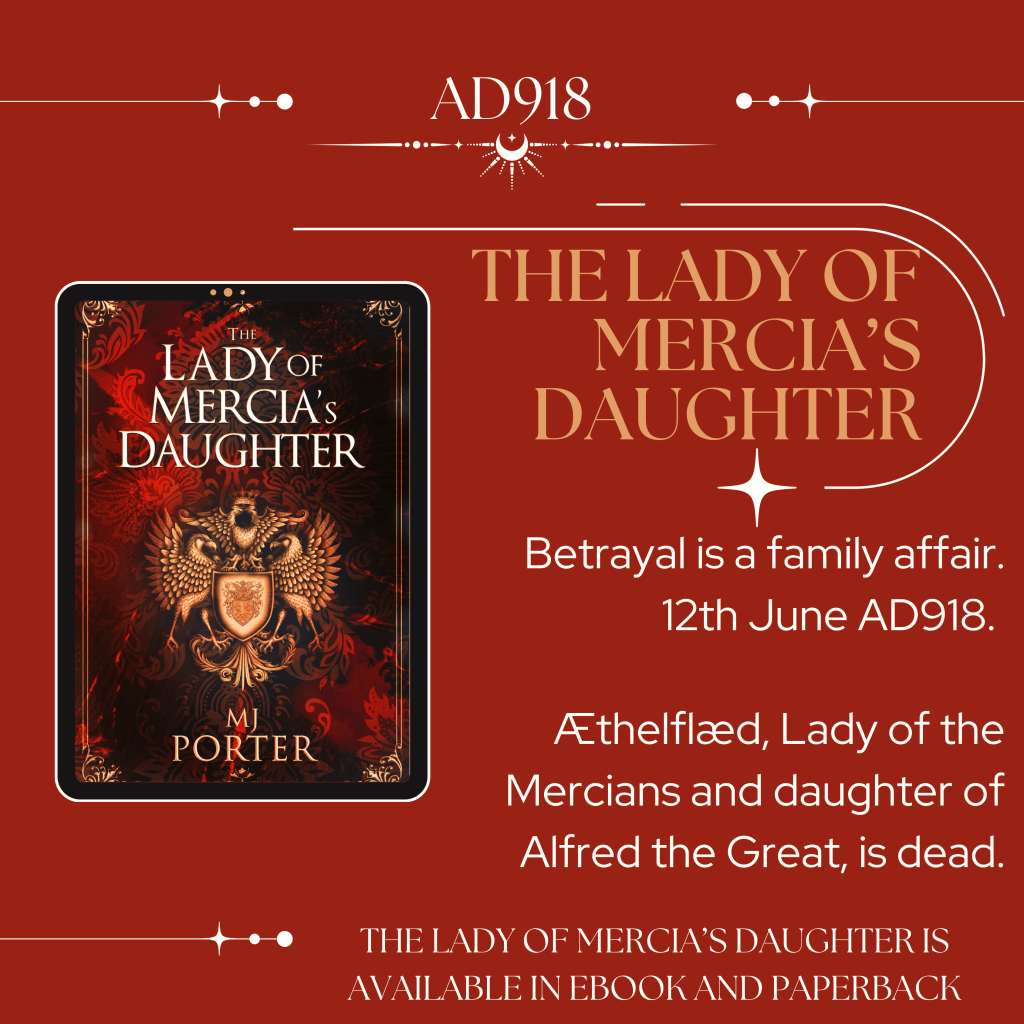
Here’s the blurb

Betrayal is a family affair.

12th June AD918. 

Æthelflæd, Lady of the Mercians and daughter of Alfred the Great, is dead.

Ælfwynn, the niece of Edward, King of Wessex, has been bequeathed her mother’s power and status by the men of the Mercian witan. But she knows Mercia is vulnerable to the north, exposed to the retreating world of the Viking raiders from her mother’s generation.

With her cousin Athelstan, Ealdorman Æthelfrith and his sons, Archbishop Plegmund and her band of trusted warriors, Ælfwynn must act decisively to subvert the threat from the Norse. Led by Lord Rognavaldr, the grandson of the infamous Viking raider, Ivarr of Dublin, they’ve turned their gaze toward the desolate lands of northern Saxon England and the jewel of York.

Inexplicably she’s also exposed to the south, where her detested cousin, Ælfweard, and uncle, King Edward, eye her position covetously, their ambitions clear to see.

This is the unknown story of Ælfwynn, the daughter of the Lady of the Mercians and the startling events of late 918 when family loyalty and betrayal marched hand in hand across lands only recently reclaimed by the Mercians. Kingdoms could be won or lost through treachery and fidelity, and there was little love and even less honesty. And the words of a sword were heard far more loudly than those of a king or churchman, noble lady’s daughter or Viking raider.

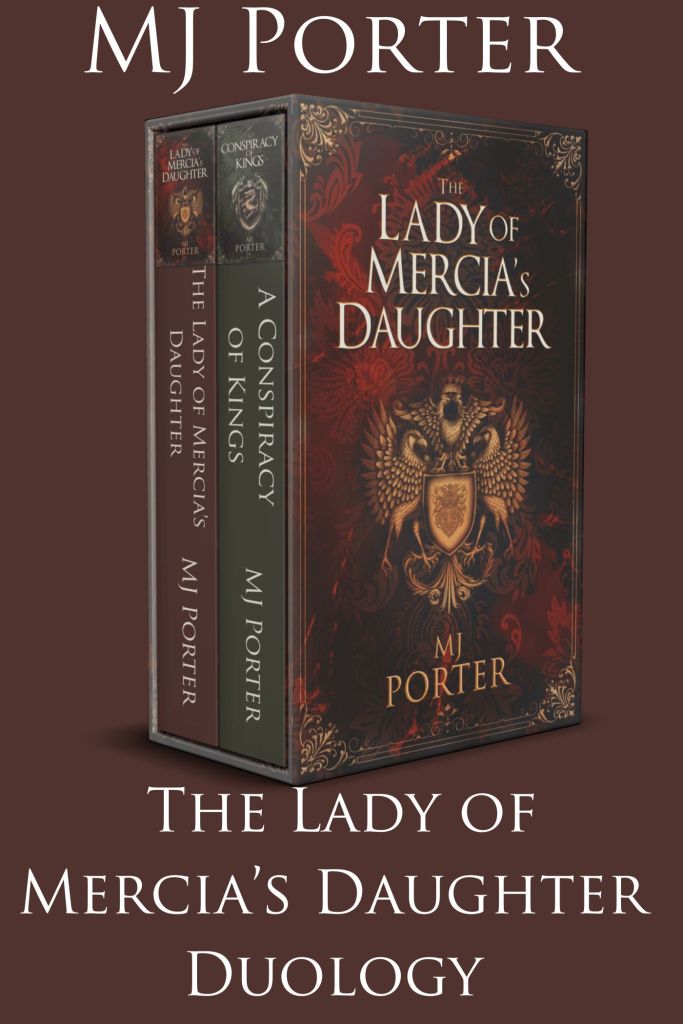
You can now grab The Lady of Mercia’s Daughter duology, containing both books featuring Lady Ælfwynn

Check out the series page for The Tenth Century Royal Women.

Posts

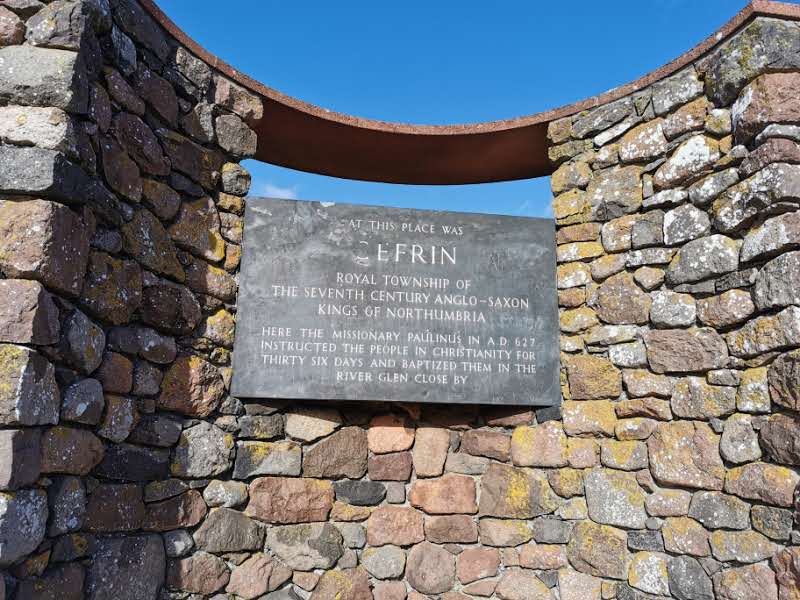
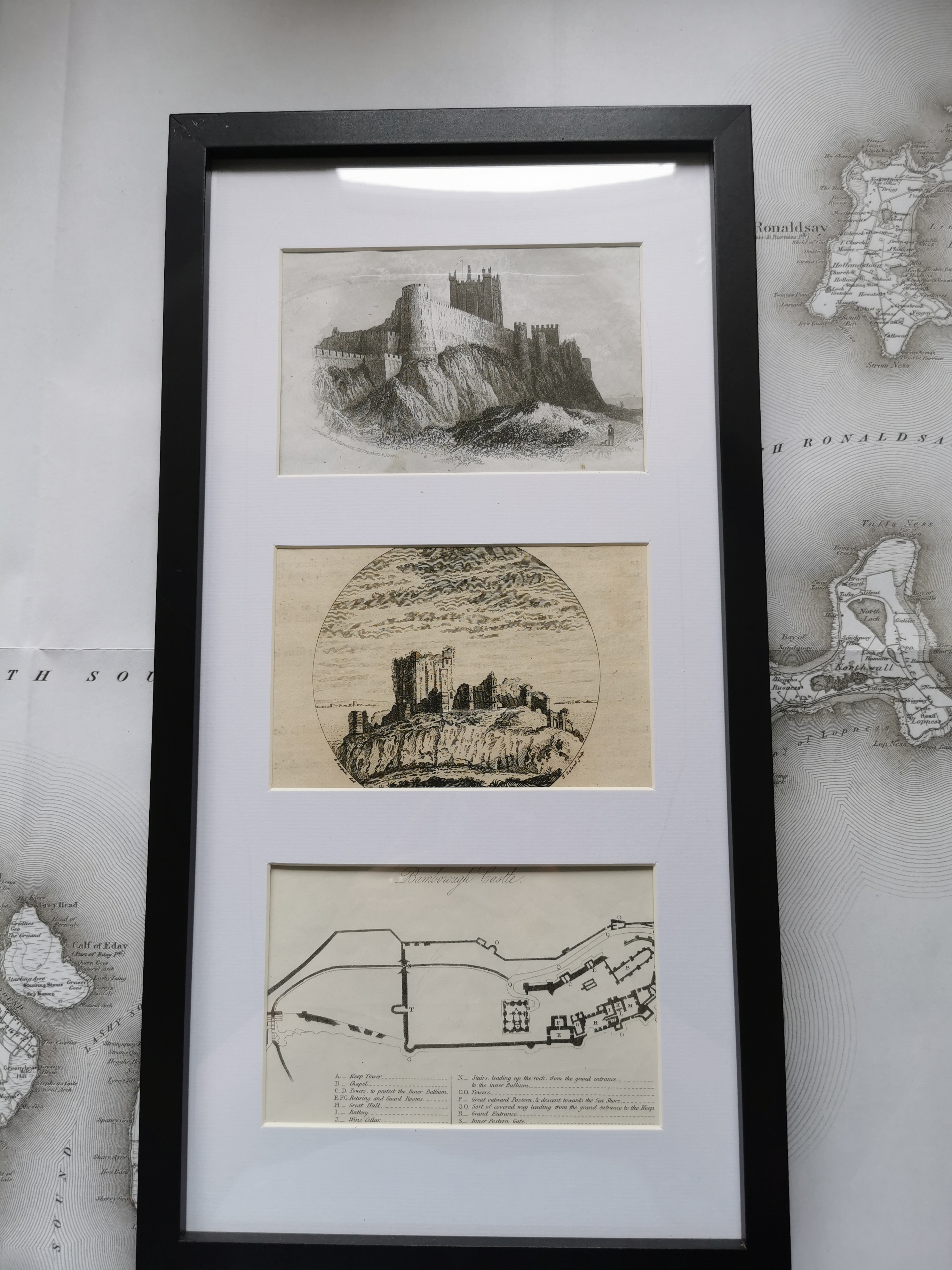
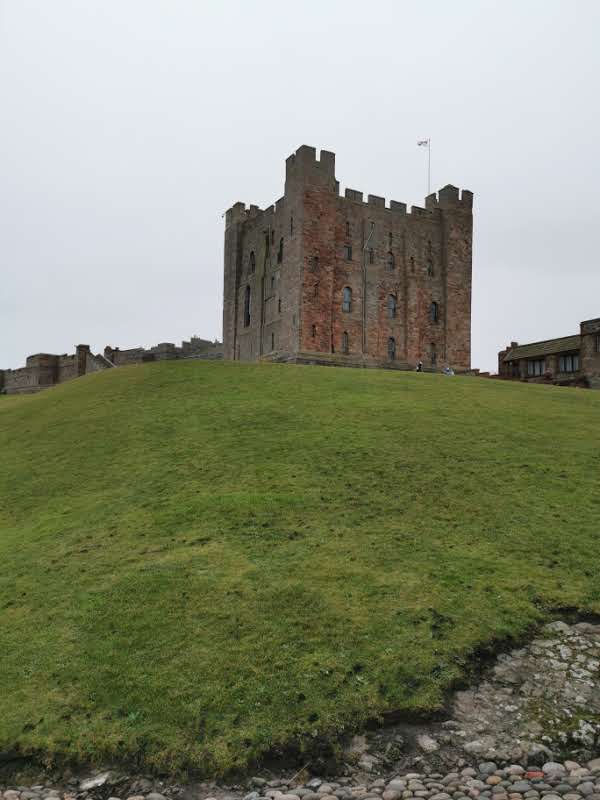
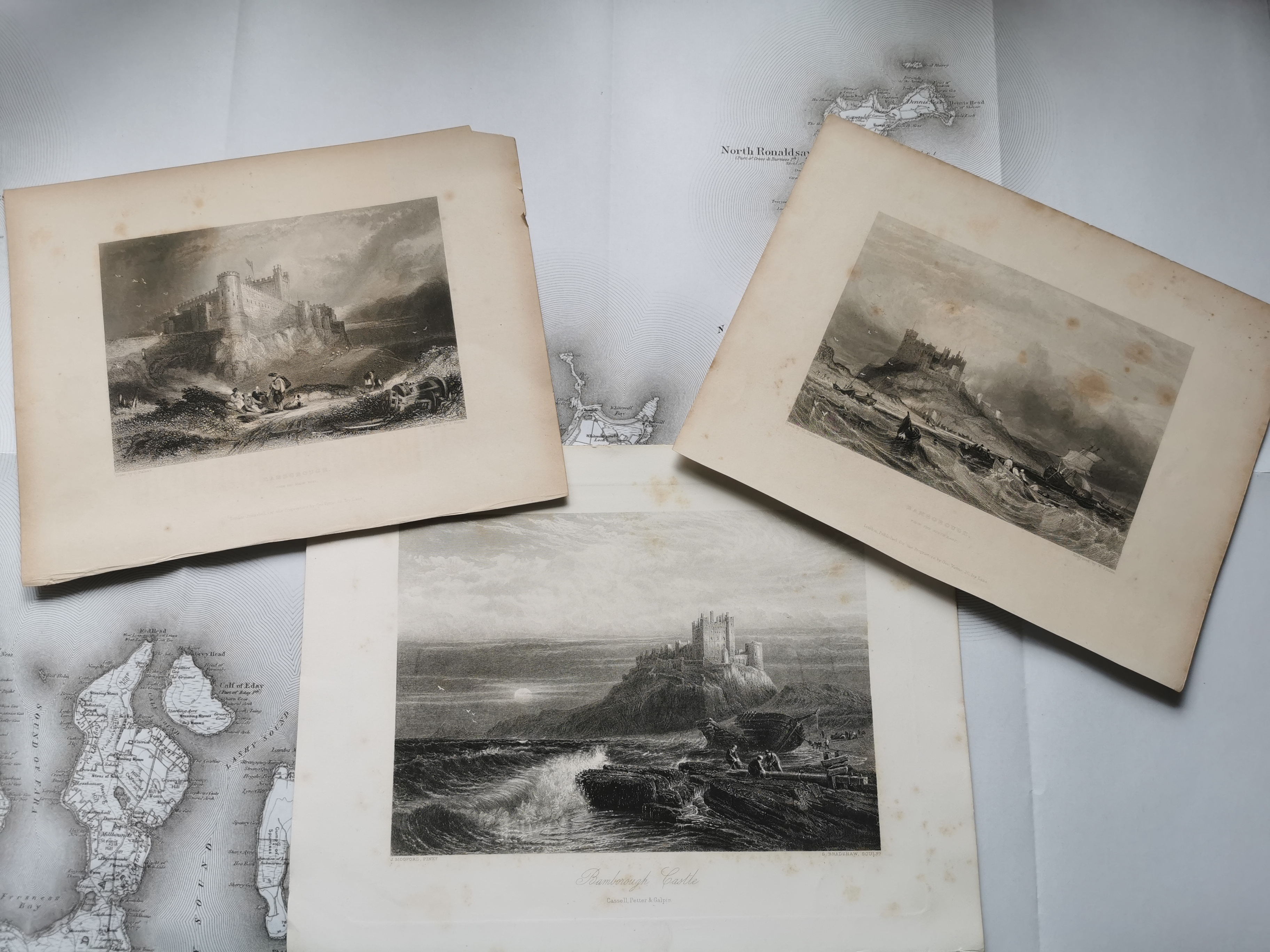
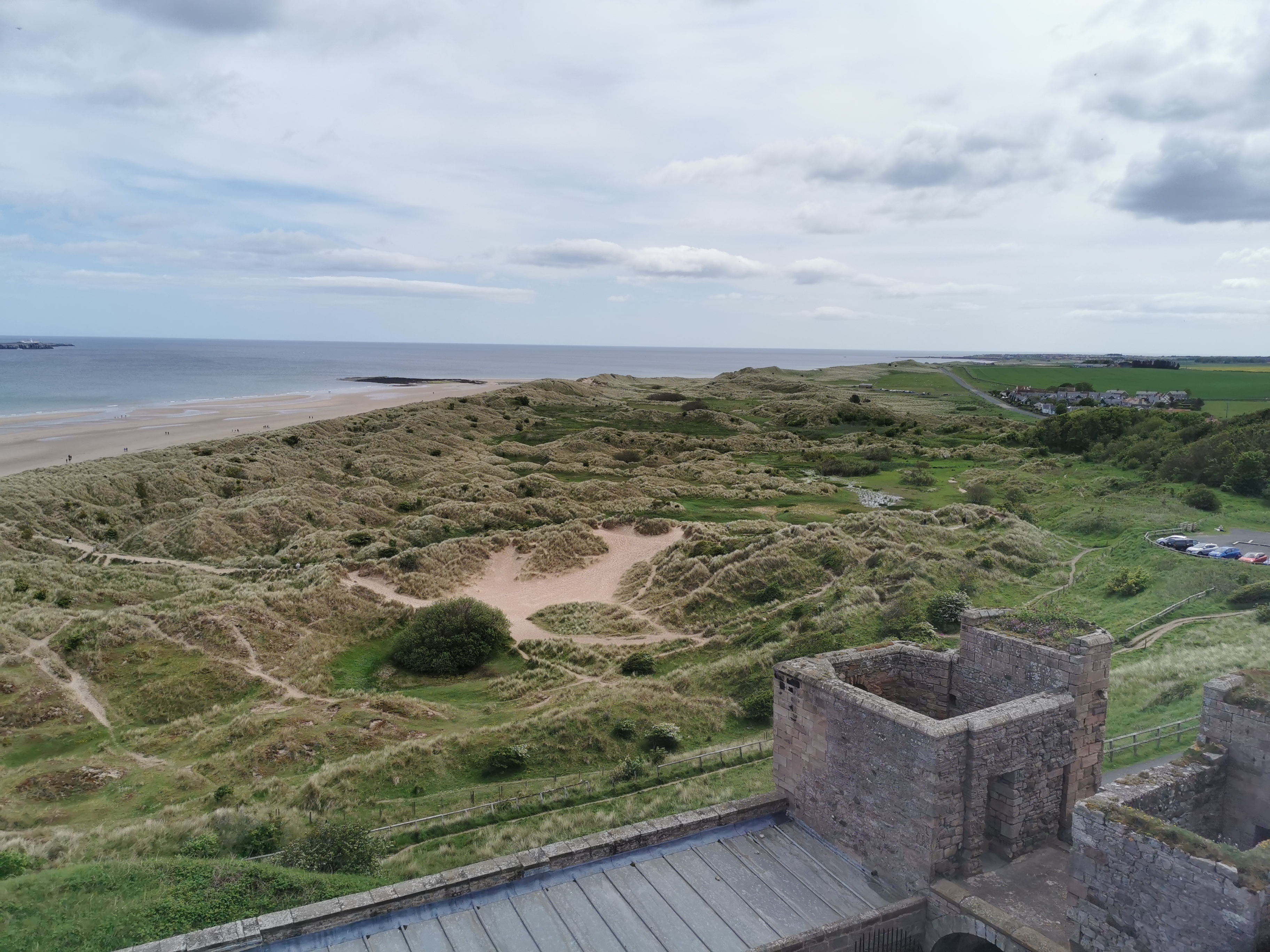
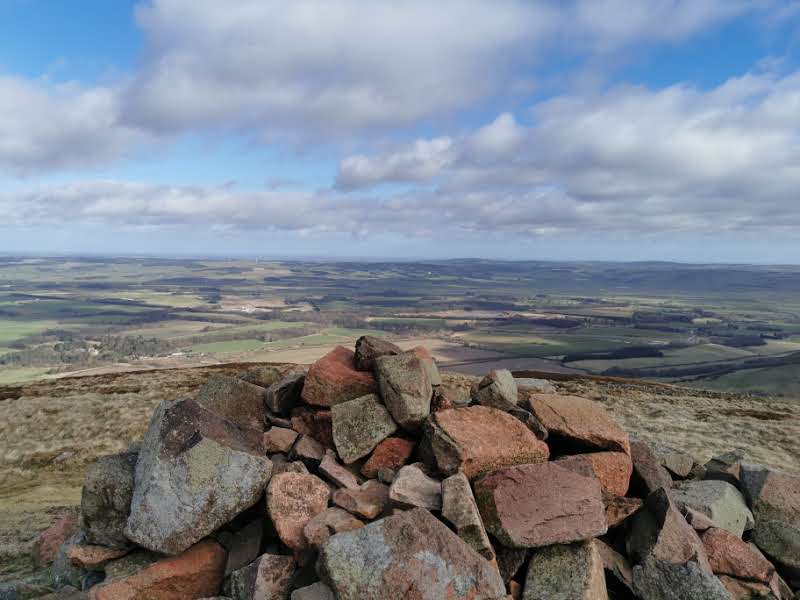
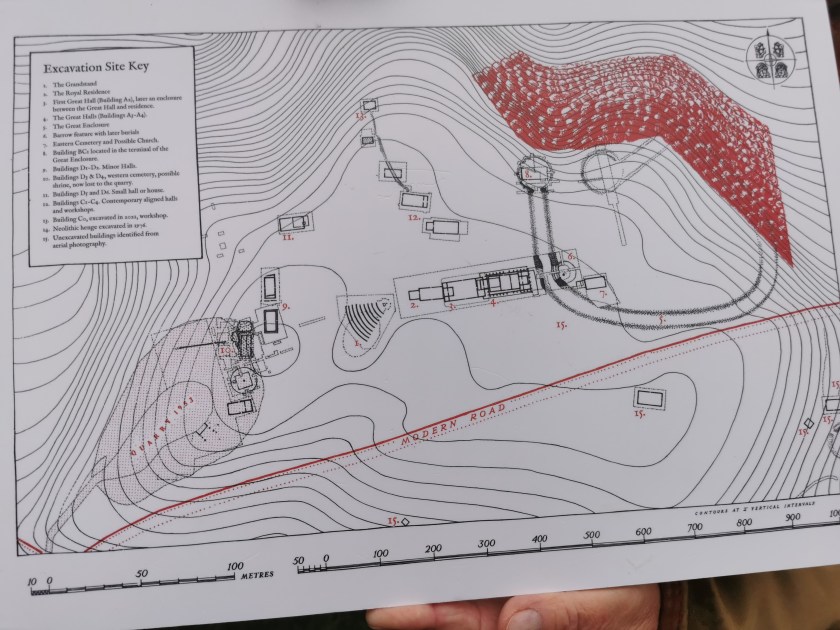
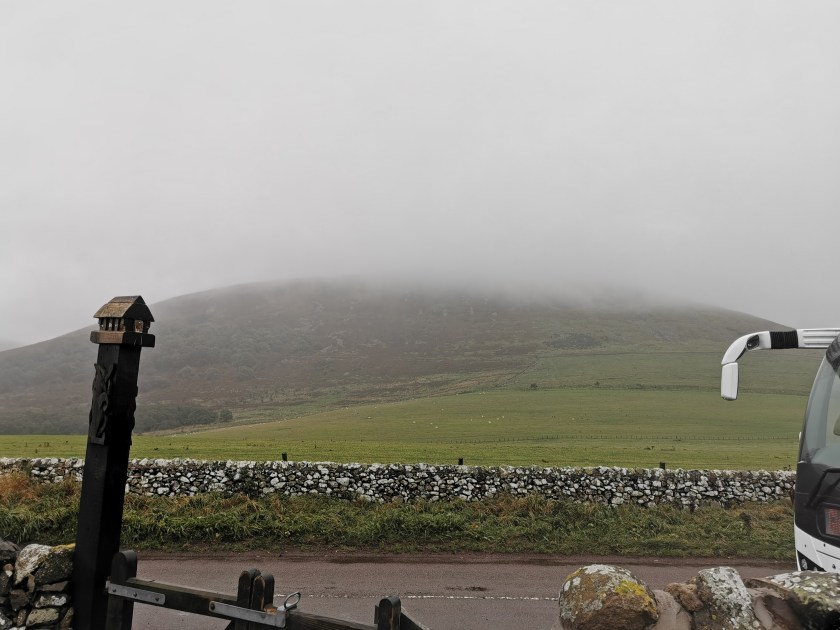
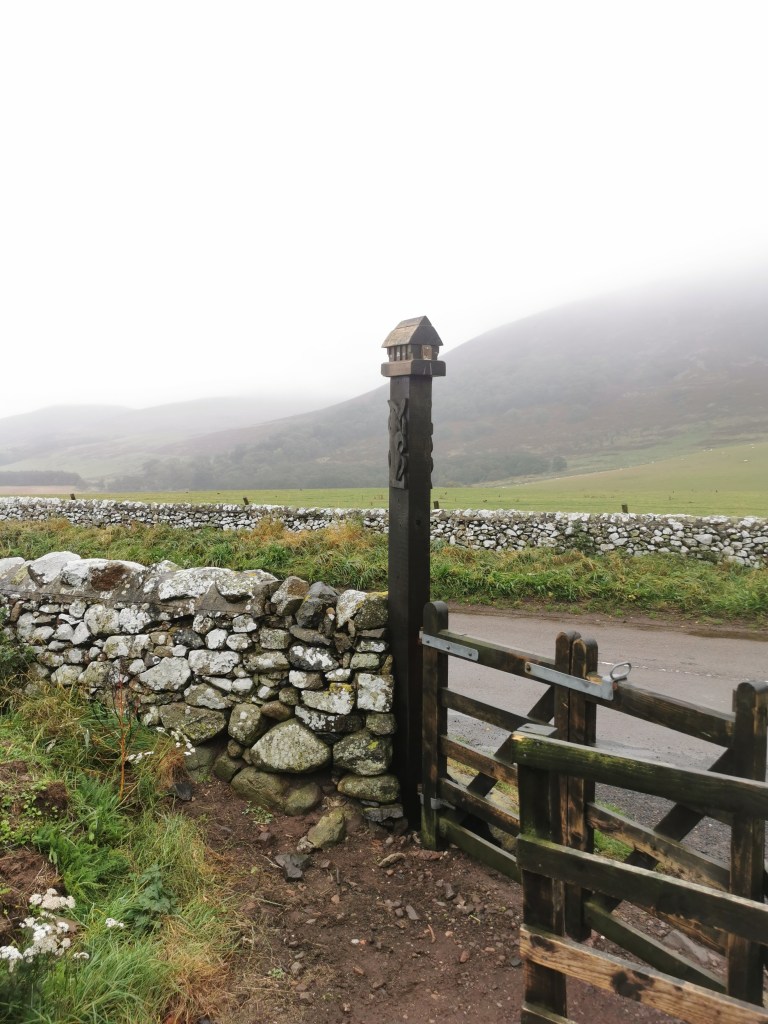
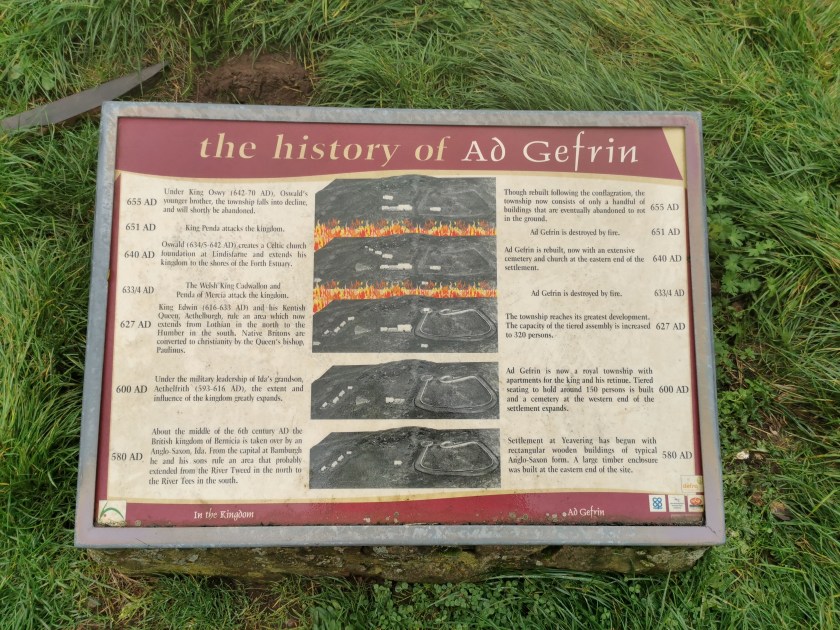
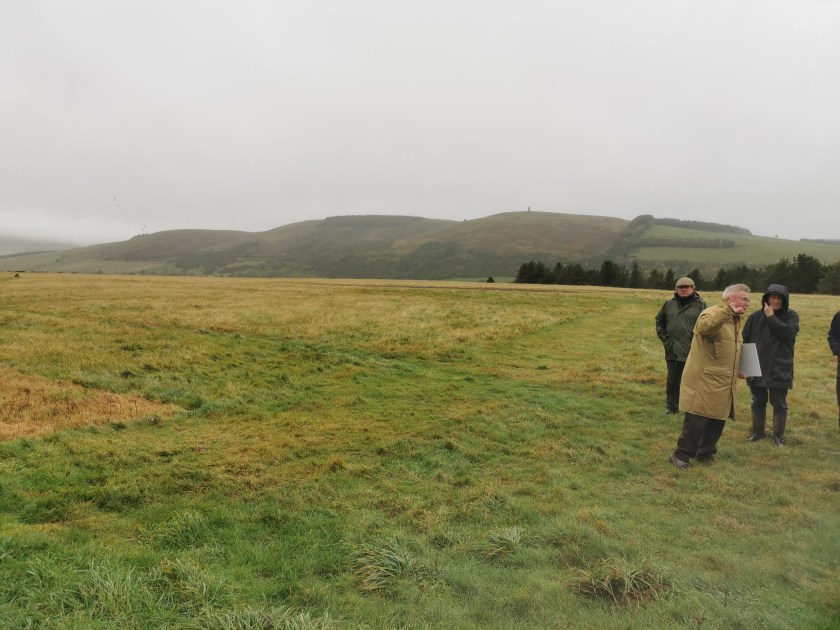
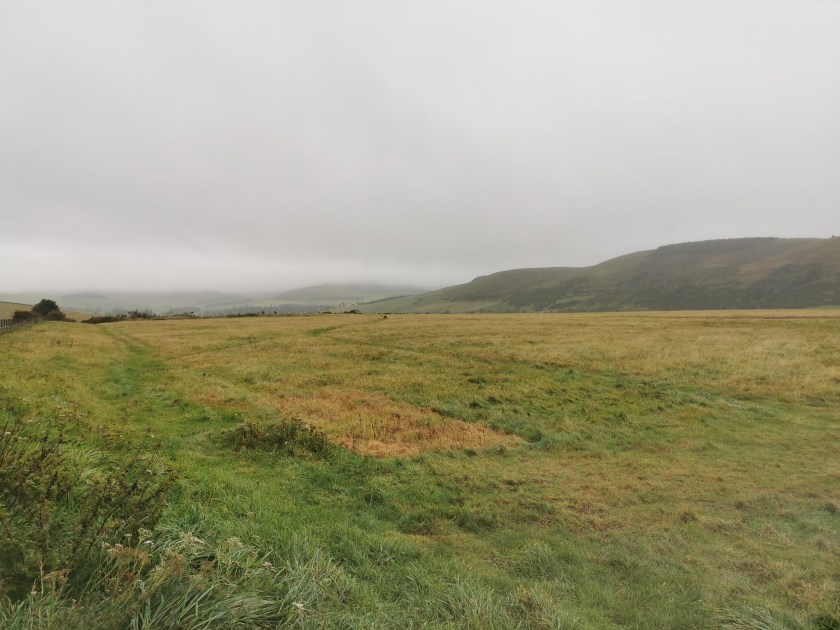
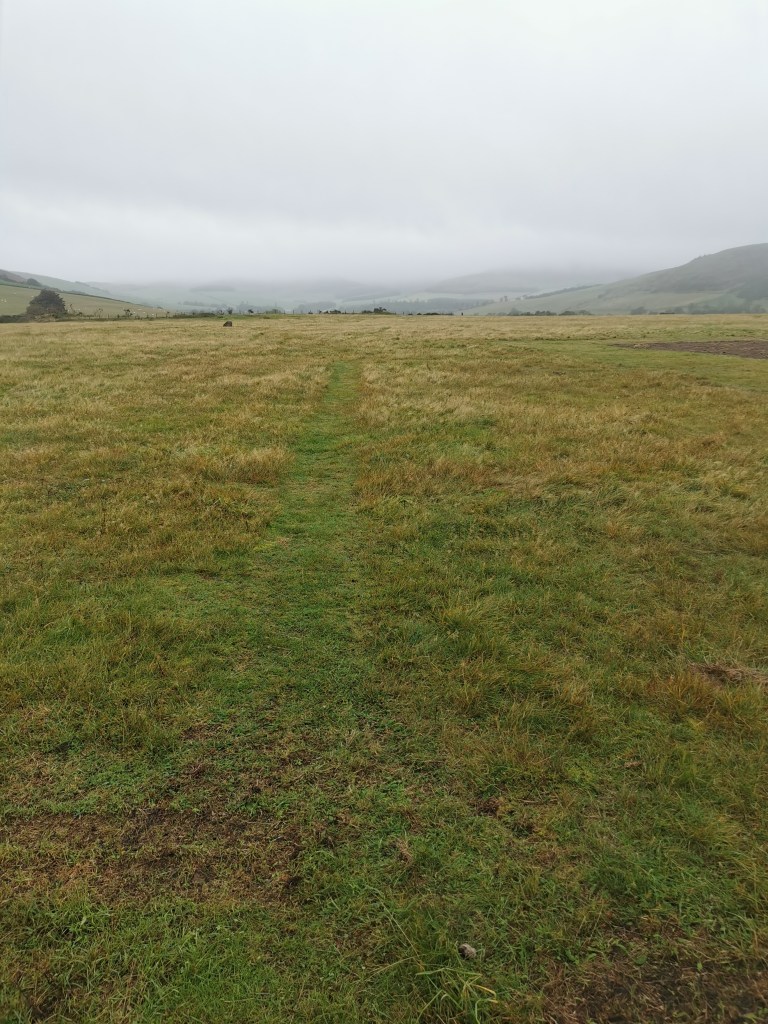
On this day in history, the anniversary of the battle of Maserfeld in either 641 or 642. I thought I’d share some photos of Ad Gefrin, Yeavering Bell and Bamburgh castle as well as some book recommendations

On this day in history, the anniversary of the battle of Maserfeld in either 641 or 642. I thought I’d share some photos and book recommendations

It’s the anniversary of the Battle of Maserfeld on August 5th (641 or 642), fought between Penda of Mercia (go Penda) and his allies, and Oswald of Northumbria and his allies, so I thought I’d reshare some photos I took while writing the Gods and Kings trilogy of Bamburgh Castle and Northumberland in general, which was the home of Oswald of Northumbria. Admittedly, the battle of Maserfeld is said to have taken place at Oswestry on the Welsh border with Mercia, but I didn’t go there, although I certainly visited as a child.

‘A.D. 641/642.  This year Oswald, king of the Northumbrians, was slain by Penda, king of the Southumbrians, at Mirfield, on the fifth day of August; and his body was buried at Bardney.  His holiness and miracles were afterwards displayed on manifold occasions throughout this island; and his hands remain still uncorrupted at Barnburgh.  The same year in which Oswald was slain, Oswy his brother succeeded to the government of the Northumbrians, and reigned two less than thirty years.’

(Taken from the online version of the Anglo Saxon Chronicle, a ninth century creation so, not very contemporary).

  • Views of Ad Gefrin from a visit in October 2023 to hear about the 2023 excavation

You can hear the archaeologist, Sarah Semple, talking about the recent excavations at Ad Gefrin in this Society of Antiquaries Lecture. https://www.youtube.com/watch?v=0A7eRTvajtA

You can also visit the Ad Gefrin trust website here.

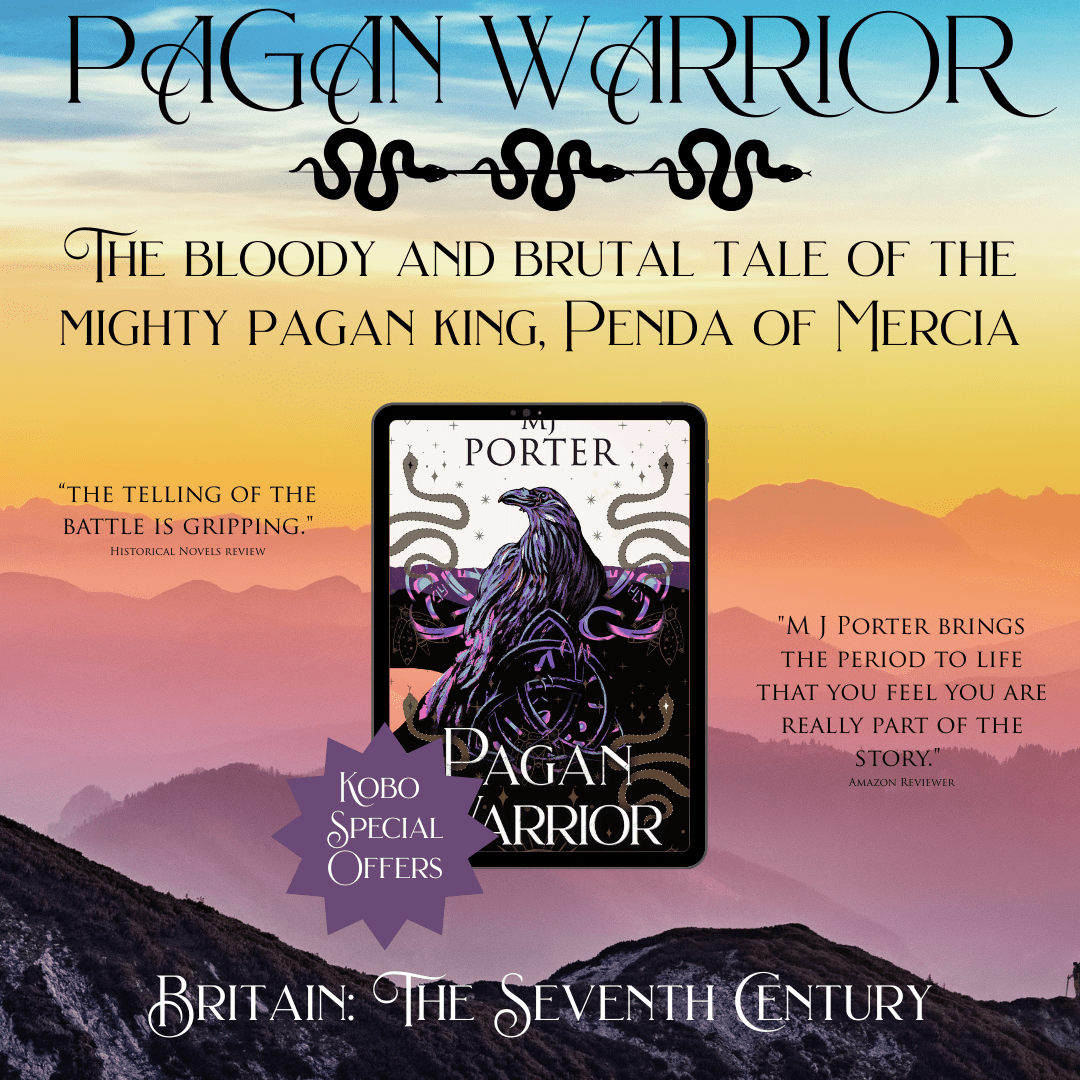
The battle of Maserfeld is the book Pagan King follows in my Gods and Kings Trilogy (the second book in the trilogy). I had a lot of fun writing it, making use of locations I visited as a child to make them come alive, and even setting one of the fictional battles in the lead up to the clash at Maserfeld, close to where I used to live.

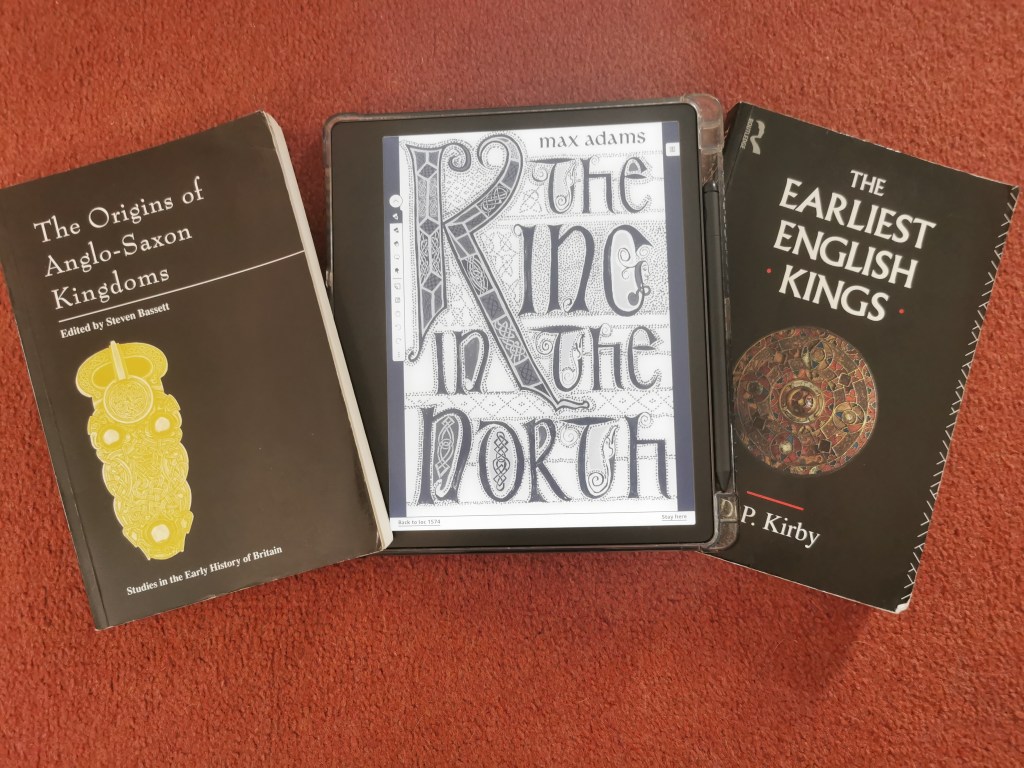
If you’re curious about the period, I highly recommend these non-fiction titles. Perhaps start with Max Adams’ The King in the North. It’s also the most modern of the three. The other two were texts I read while at university (so yes, decades ago:))

books2read.com/PaganKing

Check out the Gods and Kings trilogy page on the blog.

Posts

I’m delighted to share my review for Mary Tudor: The French Queen by Amy McElroy #non-fiction #TheTudors

Here’s the blurb

Mary Tudor, Henry VIII’s sister, lived a remarkable life. A princess, duchess and queen, she was known as the English Rose for her beauty. Mary Tudor, Queen of France, aims to explore the life of one of the few who stood up to Henry VIII and lived to tell the tale.

Henry VIII is well known, but his larger-than-life character often overshadows that of his sisters. Mary Tudor was born a princess, married a king and then a duke, and lived an extraordinary life. This book focuses on Mary’s life, her childhood, her relationship with Henry, her marriages and her relationship with her husbands.

Mary grew up in close proximity to Henry, becoming his favourite sister, and later, after her marriage to the French king, she married his best friend, Charles Brandon, 1st Duke of Suffolk. The events impacting the siblings will be reviewed to examine how they may have changed and shaped their relationship.

Purchase Links

Pen and Sword (publisher)

Amazon

My Review

Mary Tudor by Amy McElroy is a fascinating biographical account of the life of Mary, Henry VIII’s sister, and not to be confused with his daughter.

The story is quite remarkable, and while I knew something about her, I didn’t know everything. The chapters, which follow her through the 3 marriage proposals she receives, which result in 2 marriages, are quite astounding. So much time and effort went into trying to wed her to Prince Charles (later Emperor Charles), and then all of a sudden, she married Louis XII of France. I found it most fascinating. If anything, her 2nd marriage seems almost anticlimatic, even though it evidently wasn’t at the time. And, with all we know about Henry and his marital difficulties, Mary appears to have been somewhat serene about everything. I imagine she perhaps had a happier life, if one often troubled by the terrible debt her brother placed upon her (families!).


I really appreciated the author’s desire to keep this narrative to Mary and not to her children and grandchildren. It seems fitting to have a title devoted exclusively to her.

A fine portrayal of Mary’s eventful, if short life, with a lovely writing style.

Meet the author

Amy was born and bred in Liverpool before moving to the Midlands to study criminal justice and eventually becoming a civil servant. She has long been interested in history, reading as much and as often as she could. Her writing journey began with her blog, sharing thoughts on books she had read before developing to writing reviews for Aspects of History. The Lives of Women in the Tudor Era is Amy’s second book. Her first, Educating the Tudors, focused on the educational opportunities of all classes, those who taught them and the pastimes enjoyed by all.

I visited the ruins of Shaftesbury Abbey in a torrential downpour but it was still beautiful

Shaftebury Abbey is a ruin, in private hands and run by a charity, and I was desperate to visit because it’s where King Alfred’s daughter, Æthelgifu, was an abbess, and where King Edmund’s first wife, Ælfgifu, was buried, (the mother of Eadwig and Eadgar/Edgar) and where the body of King Edward the Martyr was moved to after his murder (the oldest son of Eadgar/Edgar). You can read about these women in my The Royal Women Who Made England non-fiction title. And I’ve fictionalised many of them as well, especially Lady Elfrida, accused of murdering her stepston.

However, I was there on a day so biblically wet a few weeks ago, that sadly, they had to close (i.e. this is the first time I’ve been kicked out of a historical monument), but the volunteers were absolutely lovely and I’m grateful they let me look for as long as possible before making sure they got home safely on roads that were very, very wet. And, it made the whole experience very atmospheric. If you pop over to their website, there are fab images of it being sunny. https://www.shaftesburyabbey.org.uk I hope to be able to return on day when it’s not raining.

The lettering by the monument to Edward the Martyr
From memory, this is where it’s believed Edward the Martyr was originally buried when the abbey was in use