It’s happy release day to Betrayal of Mercia, so I’m sharing a post about the maps in the book (and the maps)
Here’s the blurb

A King in crisis, a Queen on trial, a Kingdom’s survival hangs in the balance.

Londonia, AD835
The deadly conspiracy against the children of Ealdorman Coenwulf is to be resolved. Those involved have been unmasked and arrested. But will justice prevail?

While the court convenes to determine the conspirator’s fate, King Wiglaf’s position is precarious. His wife, Queen Cynethryth, has been implicated in the plot and while Wiglaf must remain impartial, enemies of the Mercia still conspire to prevent the full truth from ever being known.

As Merica weeps from the betrayal of those close to the King, the greedy eyes of Lord Æthelwulf, King Ecgberht of Wessex’s son, pivot once more towards Mercia. He will stop at nothing to accomplish his goal of ending Mercia’s ruling bloodline.

Mercia once more stands poised to be invaded, but this time not by the Viking raiders they so fear.

Can Icel and his fellow warriors’ triumph as Mercia once more faces betrayal from within?

An action packed, thrilling historical adventure perfect for the fans of Bernard Cornwell and Matthew Harffy

Image showing the cover for Betrayal of Mercia with a sword in the background

Here’s the purchase link (ebook, paperback, hardback and audio)

books2read.com/BetrayalofMercia

Maps

Throughout the series I’ve taken young Icel to some interesting locations, and that means I’ve had to make use of many maps which are recreations of the era, because, alas, we have none from the period. Both maps I’ve had made are relevant to Betrayal of Mercia which largely takes place in London, or Londonia, or Londinium and Lundenwic.

The map of Lundenwic and Londinium, shortened in the books to Londonia, a term more accurately applied to the eighth century and not the ninth, is much simplified and largely shows locations relevant to me and which I need to remember when writing the books. Although, I must confess, I did forget about it in the drafting process and when I found it, I was relieved to discover I hadn’t made THAT many mistakes.

The most important elements to understand are that ‘London’ as we know it didn’t exist at this time. Instead, there were two very distinctive settlements, and they were seperated by the River Fleet, one of London’s ‘lost’ rivers because it’s now subterranean. I think, for me, not being very familiar with London as it is today actually helped. Rather than trying to orientate myself as to what’s there now, I can work the other way round. I sort of know what was and wasn’t there in the ninth century, and then I can try and work out what’s there now:) Honestly, it makes sense to me.

It also helps to remember that despite London now being the capital of England, it wasn’t in the ninth century. Far from it, in fact. There are many good books on London in it’s earliest manifestations. If you’re interested, they are very worth checking out.

Map of Lundenwic and Londonium in the ninth century,

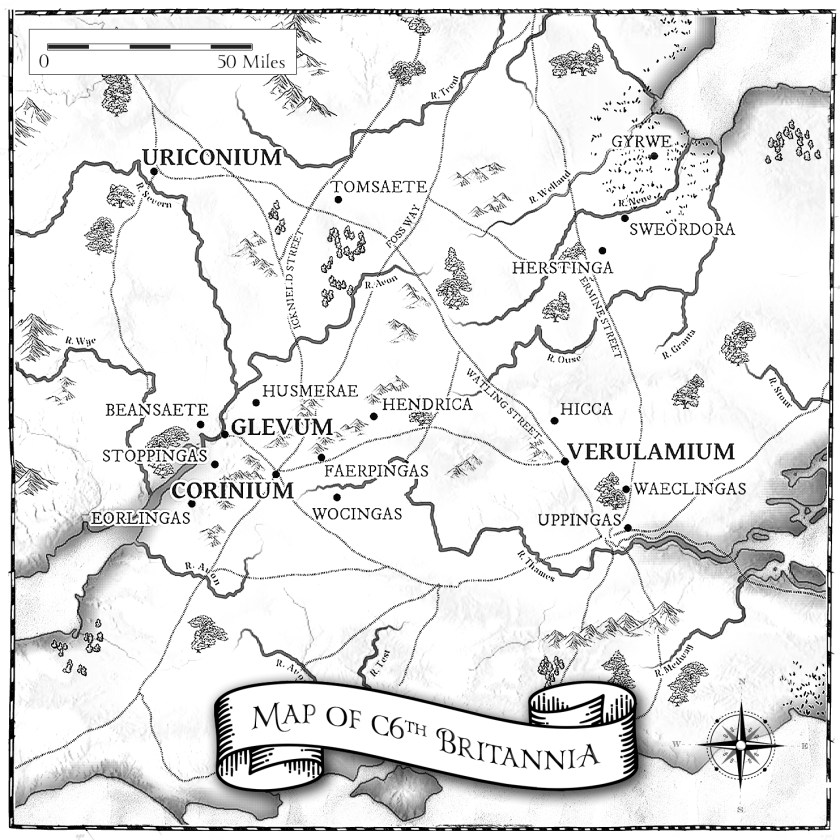
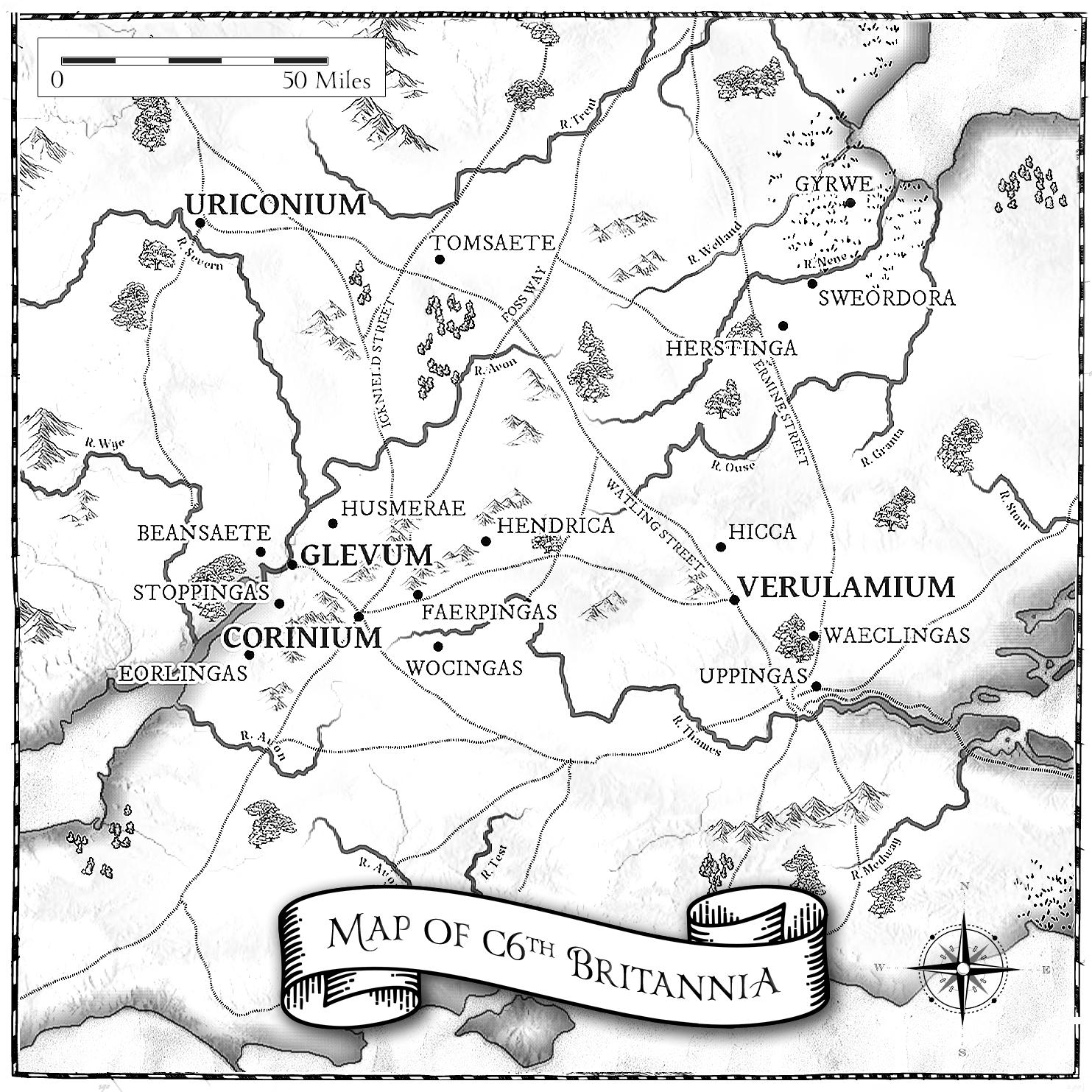
I also have a map of England at this time. This is to help readers (and me) try and get an idea of what settlements were and weren’t there at the time. As I’ve learned, it can be far too easy to just assume the longevity of a location, and then discover it wasn’t there at all, was bigger or even, much smaller than it is now. One of those locations is Wall, close to Lichfield, which was very important during the Roman occupation of Britain, but is now little more than ruins. And it’s far from alone in that.

Map of Early England.

I’ll also be sharing more posts, including one on Mercia’s ‘Bad Queens,’ and one on Crime and Punishment in Saxon England.


Not started the series yet? Check out the series page on my blog.


Check out the blog tour for Betrayal of Mercia

A huge thank you to all the book bloggers and Rachel at Rachel’s Random Resources for organising.

It’s happy release day to Betrayal of Mercia, so I’m sharing a post about Crime and Punishment in Saxon England

Here’s the blurb

A King in crisis, a Queen on trial, a Kingdom’s survival hangs in the balance.

Londonia, AD835
The deadly conspiracy against the children of Ealdorman Coenwulf is to be resolved. Those involved have been unmasked and arrested. But will justice prevail?

While the court convenes to determine the conspirator’s fate, King Wiglaf’s position is precarious. His wife, Queen Cynethryth, has been implicated in the plot and while Wiglaf must remain impartial, enemies of the Mercia still conspire to prevent the full truth from ever being known.

As Merica weeps from the betrayal of those close to the King, the greedy eyes of Lord Æthelwulf, King Ecgberht of Wessex’s son, pivot once more towards Mercia. He will stop at nothing to accomplish his goal of ending Mercia’s ruling bloodline.

Mercia once more stands poised to be invaded, but this time not by the Viking raiders they so fear.

Can Icel and his fellow warriors’ triumph as Mercia once more faces betrayal from within?

An action packed, thrilling historical adventure perfect for the fans of Bernard Cornwell and Matthew Harffy

Image showing the cover for Betrayal of Mercia with a sword in the background

Here’s the purchase link (ebook, paperback, hardback and audio)

books2read.com/BetrayalofMercia

Crime and Punishment in Saxon England

In Betrayal of Mercia, the seventh book in the Eagle of Mercia Chronicles featuring young Icel, I’ve done something that I don’t ‘think’ anyone else has done before. I’ve staged a criminal trial, making Betrayal part court-room drama and part action-thriller (you know Icel is always going to end up in a fight at some point). However, there are odd things about Saxon England that we have no information about – one of them is how often people actually went to church once Christianised, another is exactly how the law was enacted.

This might seem like an odd thing to say. Everyone knows there are surviving law codes from the era, especially from the eleventh century, with the inspiring names of Æthelred I or Cnut II, and indeed, the earliest law code dates back to Ine, in the seventh century, from which we can glean such titles as Wealas or foreigner, but applied to the Welsh, who had different wergild payments and punishment from the Saxons. But, there has long been an argument about how much these law codes reflect practise as opposed to an ideal. And some of the elements we ‘think we know’ turn out to be on much less steady ground. And, at the heart of all this is a problem with our current perceptions of ‘right,’ ‘wrong,’ and ‘justice.’ We ‘appear’ to look at these elements of our current legal system in a way very different to the era. 

When studying what records we do have, we’re greeted with some interesting terms. ‘Thereafter there would be no friendship,’ appears in a charter detailing a land dispute in the later tenth century – between Wynflæd and Leofwine (S1454 from 990 to 992). In this, despite whoever was in the wrong or the right, the decision was made which was something of a compromise – both injured parties had to make concessions. No one truly ‘won’, even though Wynflæd had many who would speak on her behalf, including the king’s mother, and the Archbishop of York, and had appealed directly to the king, Æthelred II, for assistance, only for Leofwine to refuse to attend his summons saying that royal appeals couldn’t precede a regional judgement on the matter.

In the famous case of Lady Eadgifu of Wessex (recorded in charter S1211), the mother of Kings Edmund and Eadwig (who features in the Brunanburh series), her landholdings at Cooling required the intervention of her husband, stepson, son and grandson, in a long-running debacle which was never really resolved until her grandson intervened close to the end of her life. Even though she appears to have held the ‘landboc’ – the title deed for the land – and was a highly regarded member of the royal family, this wasn’t enough to stop counterclaims. In the end, she assigned the land to the Christ Church religious community, and that way, no one actually benefitted apart from the church.

These cases both refer to land disputes, which are one of the larger areas of document survival, along with wills. But what about crimes visited against the king’s mund (both his physical person and his physical kingdom)? Here, we’re again confronted with little knowledge. We know of ealdormen being banished (under Æthelred II) and this attests to another element of the practise of law which is perhaps surprising. There does seem to have been an aversion to capital punishment (as Rabin details in his book mentioned below). And there was also a concern that the right sentence was handed to individuals – it was as bad to incorrectly punish as it was to have committed the crime.

In trying to stage a trial set in the Saxon period (which I now realise was a bit bonkers), I’ve relied heavily on a very short book, Crime and Punishment in Anglo-Saxon England by Andrew Rabin, and also his translations of the Old English Legal Writings by (Archbishop) Wulfstan (from the 1000s), from which I’ve determined how many oath-helpers people must have based on the Mercian Wergild listed within the source documents. This suggests the value placed on individuals – the king, of course, being at the top. Each individual had a wergild value and equally, each individual had a required value for the number of oath-helpers who would stand as surety for them if asked to detail what they had ‘seen and heard’ in a trial situation. The implication being that those who needed the least oath-helpers were more trustworthy than those who needed many – so a king might need no one, after all, he was the king, whereas a warrior might need a few, and a ‘normal’ person might need many.

This feels like a very different world to the one we ‘know,’ where transgressions are punished by custodial sentences and fines and where the burden of proof rests on the shoulders of those prosecuting the alleged offenders.

It has certainly been an interesting experiment, and one I hope readers will enjoy, and more importantly, one which I’ve managed to convey largely ‘correctly.’


I’ll also be sharing more posts, including one on Mercia’s ‘Bad Queens,’ and one on the maps in the books.


Not started the series yet? Check out the series page on my blog.


Check out the blog tour for Betrayal of Mercia

A huge thank you to all the book bloggers and Rachel at Rachel’s Random Resources for organising.

It’s happy release day to Betrayal of Mercia, so I’m sharing a post about Mercia’s alleged ‘Bad Queens.’

Here’s the blurb

A King in crisis, a Queen on trial, a Kingdom’s survival hangs in the balance.

Londonia, AD835
The deadly conspiracy against the children of Ealdorman Coenwulf is to be resolved. Those involved have been unmasked and arrested. But will justice prevail?

While the court convenes to determine the conspirator’s fate, King Wiglaf’s position is precarious. His wife, Queen Cynethryth, has been implicated in the plot and while Wiglaf must remain impartial, enemies of the Mercia still conspire to prevent the full truth from ever being known.

As Merica weeps from the betrayal of those close to the King, the greedy eyes of Lord Æthelwulf, King Ecgberht of Wessex’s son, pivot once more towards Mercia. He will stop at nothing to accomplish his goal of ending Mercia’s ruling bloodline.

Mercia once more stands poised to be invaded, but this time not by the Viking raiders they so fear.

Can Icel and his fellow warriors’ triumph as Mercia once more faces betrayal from within?

An action packed, thrilling historical adventure perfect for the fans of Bernard Cornwell and Matthew Harffy

Image showing the cover for Betrayal of Mercia with a sword in the background

Here’s the purchase link (ebook, paperback, large print, hardback and audio)

books2read.com/BetrayalofMercia

Mercia’s ‘Bad Queens’

There is a scene in Betrayal of Mercia where our favourite healer, Wynflæd, speaks to young Icel about her experiences of ‘bad queens,’ referencing three women in almost living memory deemed as ‘bad’, certainly many years after their deaths, if not quite by the 830s, when the scene takes place. These women were the wife of King Offa, his daughter, Eadburh, and the daughter of King Coenwulf (796-821), Cwenthryth. Indeed, this collection of bad queens, especially the sister of Queen Cynethryth, have been cited as the reason why Wessex was so slow to adopt the term. But, was everything as it appears, or are these reputations a later tradition?

The daughter of King Offa (757-796), Eadburh was married to the king of the West Saxons, Beorhtric. In the words of the later Asser, who wrote at the end of the 890s, she’s accused of poisoning her husband to death while trying to actually poison one of his disloyal followers. Interestingly, the man who became king after Beorhtric was King Ecgberht of Wessex, who features in the Icel stories, and in turn, it was his grandson who commissioned Asser to write his life which tarnishes the reputation of Eadburh. 

Cynethryth, the wife of King Offa, was a powerful woman in her own right, and the only preconquest queen known to have minted coin showing her own name. In later centuries, her name became associated with the murder of a king of the East Angles, and she was involved in a long-running land dispute with the archbishop of Canterbury.

A penny depicting Cynethryth, the wife of King Offa
Classical Numismatic Group, Inc. http://www.cngcoins.com, CC BY-SA 3.0 http://creativecommons.org/licenses/by-sa/3.0/, via Wikimedia Commons

Cwenthryth, the daughter of King Coenwulf, became associated with the murder of her brother, Cynehelm/Kenelm. The later, Anglo-Norman histories inform that.

‘At Winchcombe you will read of the secret martyrdom of Kenelm. He was the son of Cenwulf, [Coenwulf] the Mercia king, who died in the year of grace 819, having reigned for twenty-four years. The martyrdom of his son Kenelm was revealed from heaven to Pope Silvester II at Rome.’p691 Henry, Archdeacon of Huntingdon, Historia Anglorum, The History of the English People

While The Chronicle of John of Worcester extends this recording for  the year, ‘[819] St Cenwulf, king of the Mercians, after a life devoted to good deeds, passed over to the eternal blessedness which is in heaven, and left his 7-year-old son St Kenelm heir of his realm. But when a few months had passed, by the treachery of his own sister Cwenthryth, whose cruel spirit had been roused by an awful lust for power, he was secretly done to death with cruel outrage by Æscberht, his most bloodthirsty tutor, in the shade of a thorn tree in a deserted wood.’ P239-241

Winchcombe Nunnery was founded by Cwenthryth’s father, and the family were therefore invested in the religious establishment, although whether enough to kill one of their own to have him venerated as a saint, does seem doubtful. The identity of St Kenelm is very much contested, although it is believed that Cynehelm did live, and died before his father, which led to Coelwulf, the first of his name, and Coenwulf’s brother, becoming King of Mercia when his brother died..

This is the scene from Betrayal, where Wynflæd shares the gory knowledge she knows, and perhaps, hints at her approval for such strong-minded women that they could become associated with such dark deeds. 

‘Mercia hasn’t fared well with the women wed to their kings.’ A soft cackle. ‘Or the children born between a king and a queen. Wigmund’s merely the most current of many disappointments. Lord Coenwulf there, his father became king because his brother’s daughter killed her brother.’

‘I thought that was a lie,’ I countered.

‘That’s how King Coenwulf had it reported. It was all true though. I didn’t witness it, but I know of others who did.’

‘What, watched her kill her brother?’

‘No, witnessed the king speak of it, to a select few. And before her, Offa’s wife also had blood on her hands, as did Offa’s sister.’

I shuddered at the thought. ‘Why?’

‘A woman must live by her wits, and safeguard her future, for fear she’ll be locked up tight in a nunnery, with no means of engaging with the world at large. Think of Lady Cynehild.’ Wynflæd met my searching gaze then. ‘She remarried, and meddled where she shouldn’t have done. Admittedly, she stopped far short of murdering anyone.’

‘So, the king should have expected this then?’ I was astounded.

‘Maybe. He married her.’ Wynflæd cackled softly. ‘A man may wed a woman for her title, and lands. A woman may divorce a man. But better to have him dead, and then take his place. A grieving woman will have the sympathy of others. A widow has more freedom than a wife.’

‘You almost sound like you approve.’

‘I do not,’ she countered, but her eyes glittered.


Wynflæd is a stalwart of the series, and I was recently inspired to write a short story from her point of view regarding Mercia’s alleged ‘bad queens.’ If you’d like to read it, sign up for my newsletter and I’ll send you a link to download the story. And, you automatically receive a free short story collection as well.


I’ll also be sharing more posts, including one on Saxon Crime and Punishment and one on the maps in the books.


Check out the blog tour for Betrayal of Mercia

A huge thank you to all the book bloggers and Rachel at Rachel’s Random Resources for organising. Some of these amazing people have been with Young Icel throughout the entire series, and I am so grateful they are so keen to read, they sign up for the blog tour:)

Check out the reviews for Betrayal of Mercia

Bookish Jottings

Sharon Beyond the Books

Storied Conversation

David’s Book Blurg

Banner showing3 blogger review quotes from the Betrayal of Mercia blog tour.

Novel Kicks

Ruins & Reading

The Strawberry Post

Aibibyreads

Book banner showing review quotes from the blog tour for Betrayal of Mercia organised by Rachel's Random Resources.

Listen to the audiobook, narrated by Sean Barrett.

Posts

I’m welcoming Soulla Christodoulou and her new novel, The Magic of Miramare to the blog #blogtour #romance

This is the first morning at the resort and Stella and the other two couples enjoy breakfast together.

Within ten minutes, Prodromos and Yiannis came out carrying two huge trays, visibly trembling under the weight of all the food. They settled the trays onto two tables next to their guests who were now chatting amiably, becoming acquainted with each other, their conversation punctuated with booming laughter and whoops of joy.

‘This is wonderful. Thank you Prodromos,’ said Stella. ‘And what beautiful music.’ Prodromos froze for a few seconds, a stillness rendering him speechless. ‘Where’s it coming from?’ asked Stella, the others busy tucking in.

‘The music can always be heard by those who are in tune with their souls, be heard by those who welcome its energy,’ Prodromos answered eventually, avoiding Stella’s eye.

Stella waited for a further explanation, but he offered none. ‘It makes you feel alive. Who’s playing it?’ Stella insisted, but the blank faces around the mishmash of tables revealed no-one had heard it or tuned into it. Maybe their chatter was drowning the sound. She felt a little tingle run along her spine and instead of shaking it off, she welcomed it, leaned into it, smiling to herself, though a little embarrassed. Was she hearing things? She looked expectantly at Prodromos. Prodromos concurred knowingly as he continued to load the table with abundantly filled hand-painted plates and blue-glazed bowls and lop-sided baskets.

Stella observed him. He can hear it too; she surmised but decided not to mention it again. Something magical, unexplained yet present in the air, danced and played out here in Miramare and she hoped it would inspire her, fill her up with an abundance of creativity. Breakfast was a tantalising, colourful banquet: fresh figs, fleshy and dark purple, glistened in a round basket lined with a crocheted napkin, thickly sliced bread and sesame coated bread sticks as well as darker rye rolls the size of small dough balls filled an oval basket and wrinkled black olives and fresh tomatoes over-filled miniature scallop-edged bowls.

‘Good enough for the Gods,’ said Dean.

‘Looks so enticing,’ said Eliana.

‘Ambrosia,’ said Dean.

‘What?’ said Eliana.

‘Ambrosia. Food of the gods.’

‘Yes, you are right,’ said Prodromos. ‘Believed to bring long life and immortality to anyone who consumed it.’

‘I’m sure the scientists will find a way to make immortality a reality one day,’ said Dean. ‘But not in our lifetime.’

‘Love makes us immortal,’ said Prodromos, a fleeting wistfulness crossing his face. ‘Now eat.’

‘You don’t have to ask me twice. I’m starving,’ said Dean, giving Eliana a cocky grin. He rubbed his rotund belly in exaggerated circular motions and reached out for not one but two thick hunks of warm bread. ‘Still hot.’

‘Those tomatoes. Nothing like home grown is there?’ said Stella, pushing the tomato up to her nose and breathing in deeply.

‘These smell way better than ours. The dirt must be different out here,’ said Dean.

‘You mean the soil, Dean. The dirt. What does the dirt even mean, babe?’ Eliana smiled, pretending she was only teasing, but Stella could see how annoyed she had become and couldn’t understand why she reacted to Dean the way she did. Impatient. Dismissive.

‘You grow your own?’ asked Luke, breaking the atmosphere.

‘My dad and I started an allotment together. Now it’s just me: green beans, potatoes, lettuce, carrots, garlic. I give it a go and rotate year on year, but it’s hit and miss really. It’s only a small allotment but it keeps me busy when the pain in my knee’s not too much,’ said Dean.

‘Bet it does. Good for you,’ said Stella, and leaning across the table plucked a tomato, bit into it.

‘Nothing like that earthy smell of home-grown, organic veggies. It’s something we don’t often experience at home. Those so-called vine-grown tomatoes you get in the supermarket never taste this good.’

‘Good to see someone appreciating the merits of organic veg,’ said Dean.

Prodromos re-arranged the dishes to fit in plates of boiled eggs and salami. Yiannis appeared with a platter of thick-cut wedges of watermelon and slender slices of honey melon. He placed it down opposite Stella, sucked on his finger, dripping with the pink juice of the watermelon, all the while holding Stella’s gaze. Stella suddenly didn’t feel like eating, it was as if Yiannis had swallowed her appetite whole and she fought against a flutter tickling her insides.

‘You enjoy breakfast the Greek way, my friends,’ said Prodromos.

Cover image for The Magic of Miramare by Soulla Christodoulou

Here’s the blurb

Three women meet on holiday in Kefalonia. Each is secretly filled with turmoil.

Stella must decide on whether her twenty-year affair with Anton has reached the end.

Melody must find a way to go back to the love she knows she has with Luke.

Eliana must overcome her own complicated relationship with love to find harmony with Dean. 

Against the backdrop of the beautiful Miramare resort, the women quickly build a friendship and share their stories and deepest secrets, subconsciously guided by the magic of the Ionian Island.

With azure seas and clear blue skies, the women, and their partners, must find a way to nurture themselves before they can salvage their own relationships while navigating their attitudes to love. But can they find their way to a kinder, better place within themselves.

The Greeks have so many words for love, that they are guided and find a way through their own turmoil, to find the real happiness, love, and magic that exists within us all.

Follow strong, authentic female characters who have drive, sass, and attitude in this  poetic narrative with a stunningly slow simmer. It’s a story that will capture your heart. Disappear into a world of love. Into The Magic of Miramare.

Purchase Links

https://www.amazon.co.uk/Magic-Miramare-Soulla-Christodoulou-ebook/dp/B0DHTZZLV3/

https://www.amazon.com/Magic-Miramare-Soulla-Christodoulou-ebook/dp/B0DHTZZLV3/

Meet the author

Born in London to Greek Cypriot parents, Soulla Christodoulou was the first in her family to go to university and later retrained to become a teacher. She has been writing since 2015 and has many more books in her.

 Her novels, Broken Pieces of TomorrowThe Summer Will Come, The Village House and A Palette of Magpies are available on Amazon alongside Alexander and Maria which was nominated for the RSL Ondaatje Prize 2021.

The Summer Will Come, a book club read in the Year of Learning Festival 2019, London Borough of Barnet Libraries, has been translated into Greek and is currently being queried with Greek and Greek Cypriot publishers.

Soulla is working on her next novel, The Pastry Girl of Malta and writing her first non-fiction book on the craft and magic of writing. She is consulting on a movie project inspired by one of her books and is learning a lot about the world of filmmaking. She is happiest writing and reading in her pretty garden Writing Room while drinking tea infused with cinnamon sticks and cloves.

Author Soulla Christodoulou image

Connect with the author

Website Newsletter Facebook Group

I’m sharing an excerpt from Susan Buchanan’s A Little Christmas Spirit #romance #blogtour #newrelease

Bella and Amy, two of the teachers in the story, are trying to find a soloist for A Carol for Christmas, until now without success.

Bella’s heart lifted. The kids had been practising their little hearts out for A Carol for Christmas, where the children from Heatherwood and the five neighbouring primary schools took part in a sing-off to see which school choir would be crowned the area’s champion. They were singing so well, together, but she still didn’t have anyone to sing the solo. No one voice out of the whole choir, or at least those who had volunteered to do it, seemed able to cope with it.

Perhaps she and Amy should rethink the solo. ‘O Holy Night’ was, after all, widely known as a difficult carol to sing for a soloist, with the breadth of vocal range involved and those high notes to hit.

As she listened to the children’s sweet voices singing ‘O Little Town of Bethlehem’, she tried to focus in on the sound of each child’s voice individually.

When the carol finished, she beckoned Amy over. ‘Have a drink, everyone. We’re going to need those voices again in a second.’

‘What’s up?’ Amy asked as she approached.

Bella pulled on her bottom lip as she thought. ‘How about we play a little game?’

‘What were you thinking?’

‘Well, we’re no closer to finding a soloist, and we only have two weeks until the finals, so I’m wondering if we can smoke out this soloist by having each child sing a line of a song, or a couple of lines, and see how they get on with it.’

Amy pursed her lips. ‘That might just work.’

‘Good. Can you think of a fun way to make this into a game for them?’

‘Give me five minutes,’ Amy said, walking backwards towards the stage again and holding her hands up in a double thumbs-up sign.

Once she’d got the children’s attention, Amy said, ‘Right, can everyone go and grab a chair and put it in the middle of the room? I need them back to back to form two rows.’

The children dashed to the left side of the room, lifting, dragging and screeching the chairs, which they and the children in the lower years had adorned with covers featuring snowmen, reindeer, snowflakes and Christmas trees as part of the school’s attempt to make it the most Christmassy year ever at Heatherwood.

Once everything was in place, Amy said, ‘Right, we’re going to play a game of musical chairs. If you’re out, I want you to sing the next two lines in the carol. Got it?’

Fifty nodding heads later, Bella was applauding her friend on her genius. As the opening chords of ‘O Come All Ye Faithful’ rang out, Bella looked on whilst Amy instructed the children to walk round the chairs until the music stopped.

When it did, Eva Morrison was the first ‘unlucky’ child, but she took it with good grace and sang the next two lines in the carol exceptionally well. Amy restarted the process and the children giggled and chatted as time and again they had to find a seat once the music stopped.

Naturally, some jostling ensued and the occasional non-festive shove happened, but mainly the children got in the Christmas spirit and adapted.

After ‘O Come All Ye Faithful’, Amy played ‘Silent Night’ and Bella’s heart faltered as Niamh Fallon sang the lines. Her voice was achingly beautiful, and suited that carol perfectly. Having decided they would indeed change the carol to ‘Silent Night’ and have Niamh sing it, Bella tried to signal to Amy that they were good and didn’t need any more musical chairs, but Amy didn’t see her, and started another round, this time with ‘O Holy Night’.

As first Calum then Gregory didn’t manage to hit the notes, Bella’s frustration grew. We should just knock this on the head now and let Niamh sing ‘Silent Night’.

But then Lara didn’t get to a chair before Ed, and as she began to sing, a hush fell over everyone as her pure, strong, yet melodic voice floated through the games hall. Bella gulped, the hairs on her arms stood up, and she felt such a profound ache in her chest she thought she might start crying. In fact, she was crying. Oh my goodness, they’d found their soloist. Lara’s voice was incredible. How had she managed to keep that hidden, and why?

Here’s the blurb

Can a sprinkle of magic heal broken hearts this Christmas?

With Jacob now at the helm at the cosy Sugar and Spice café, it’s the perfect opportunity for Christmas Spirit Lara to weave her magic.

Fraser is floundering in his new role as headteacher as he grapples with guilt over having to place his beloved mother in a care home, leaving him feeling lost and alone during what should be a joyful time. 

Meanwhile, school janitor Paul is torn between his desire to feel needed and the pressure from his wife to retire, dimming the season’s sparkle. 

Valerie, overwhelmed by the demands of newborn twins, feels she’s not giving her other daughter enough attention. She needs a bit of me time and for her husband to realise the responsibility for the kids falls to both of them.

And Bella, heartbroken after her husband’s shocking request for a separation just a year into their marriage, longs to escape the memories of last year’s perfect Christmas.

Can Lara help them rediscover joy, connection, and the true spirit of the season? 

A heartwarming journey filled with friendship, community, and a dash of holiday magic that promises to transform the lives of those in need of hope this Christmas.

Cover image for A Little Christmas Spirit y Susan Buchanan

Purchase Link

https://books2read.com/u/bMBNNv

Meet the author

Susan Buchanan writes contemporary romance and women’s fiction, usually featuring travel, food, family, friendship and community.

Her books are Sign of the Times, The Dating Game, The Christmas Spirit, Return of the Christmas Spirit and Just One Day – Winter, Spring, Summer and Autumn.

As a freelance developmental editor, copyeditor and proofreader, if she’s not reading, editing or writing, she’s thinking about it.  

She is a member of the Romantic Novelists’ Association, the Society of Authors and the Alliance of Independent Authors. 

She lives near Glasgow with her husband, two children and a crazy Labrador. 

When she’s not editing, writing, reading or caring for her two delightful cherubs, she likes going to the theatre, playing board games, watching quiz shows and eating out, and she has recently discovered a love of writing retreats.

Author image of Susan Buchanan

Connect with the author

Website

Giveaway to Win a Signed copy of The Christmas Spirit and bookmark (Open to UK Only)

*Terms and Conditions –UK entries welcome.  Please enter using the Rafflecopter box below.  The winner will be selected at random via Rafflecopter from all valid entries and will be notified by Twitter and/or email. If no response is received within 7 days then Rachel’s Random Resources reserves the right to select an alternative winner. Open to all entrants aged 18 or over.  Any personal data given as part of the competition entry is used for this purpose only and will not be shared with third parties, with the exception of the winners’ information. This will passed to the giveaway organiser and used only for fulfilment of the prize, after which time Rachel’s Random Resources will delete the data.  I am not responsible for despatch or delivery of the prize.

http://www.rafflecopter.com/rafl/display/33c69494602/?

I’m sharing a fab post from crime novelist Ian Mcfadyen about his writing routine to celebrate the release of Blood Matters #blogtour

Welcome to the blog. I love hearing about author’s writing routines.

My approach to writing

I’m often asked about the process I follow when writing. It isn’t always the same, but the overall approach does tend to follow a similar route. Hopefully by breaking it down into bite sized chunks you’ll get the general idea of how I work – if it’s of interest to you. 

  1. The starting gun!

With my books being Murder Mysteries the catalyst for a new book is always the twist or what I refer to as the kernel of the book. When that idea arrives the whole process starts, with next the creation of new main characters and then the main plot; all manufactured to take the reader along a journey that arrives at the twist/kernel.  

  • Thinking time.

In all, I probably spend 90% of the time I devote to the process when I’m working on a Carmichael book, simply thinking about the plot and working out in my head when I’ll introduce new characters, new clues and red herrings to my reader. As the book nears its conclusion my thoughts start to turn towards how the reader will be told who committed the crime, how they did it (if it’s not obvious) and why. This is a critical phase as it’s the time I decide how I’m going to pull together all the loose ends and the false trails I’ve laid in the previous chapters.  

I may go for days or even weeks without writing, after the book has been started, but I’m almost always thinking about it.

  • When and where I write.

Peace and quiet are essential for me when I’m writing. Also being able to gaze aimlessly out of the window at the world while I write is key, too. For that reason, there are just two places I write from, my home office, or a quiet table overlooking our garden in my Norfolk bolt hole. Both are my creative heavens. 

  • Writing sessions.

People are quite shocked when I tell them that I don’t write every day. They are equally surprised when I tell them that I rarely write more than 1000 words in one session: often as little as just 500. 

I’m an early bird so I only write in the mornings. It’s my productive time. I can start as early as 5am when I have the urge to write, but by about 1pm I find I’ve had enough of tapping away on my keyboard – so I stop.  I keep thinking about the story, though, and what I’ll be writing in the next writing session.

  • Time it takes to produce a book.

This varies, but on average it takes about 9 -12 months to write the first draft and about 3-6 months to check, proofread and generally hone the novel into its final shape.  

  • Proof reading and checking.

This is a key stage in the writing process but, if I’m honest, the least interesting part of writing for me. But it’s essential. Apart from the obvious need to look for grammatical and spelling mistakes, this is a time for making subtle changes to the work to accomplish as good a novel as I can. I solicit help at this stage as I find a fresh pair of eyes invaluable. They always spot errors I’ve missed and may well continue to overlook, however many times I re-read the book.   

  • When to stop.  

This may seem a strange thing to include, but in my view it’s as important as any other stage. A book is the same as a painting or a piece of music. If you so desire, you can carry on forever rewording parts and finely modifying small details. However, there must come a point where you must tell yourself that you’ve polished and honed the work enough and it’s time to publish and let it out into the wide world. Having my next book starting to take over my thoughts is also an excellent sign for me to accept it’s now time to move on.

I hope you’ve found my mini summary of some interest. If not, it’s probably time for you to call time and move on from my ramblings 😊

Here’s the blurb

When the body of Doug Pritchard, an aging music journalist with a history of sensational scoops, is found face down in a dark roadside ditch, DCI Carmichael and his team embark on an investigation that takes them in several directions.
What did Pritchard uncover?
Did that secret bring about his violent demise?
And do the tragic deaths of two local pop idols, twenty years before, have any relevance to his murder?  
As DCI Carmichael delves deeper into the case it becomes clear that, despite the outwardly close connections of the residents of the small hamlet of High Maudsey, neither long term friendships nor family ties should be taken at face value.
This the tenth in his series of well-honed detective novels by Ian McFadyen featuring DCI Carmichael, leads the detective and his team through as many twists and turns as the quiet country lane where Doug Pritchard’s body was discovered
As with all McFadyen’s Carmichael novels, this book is packed with a host of intriguing characters and an expertly crafted plot; and once again the author displays his skill as a writer in the great tradition of English crime novels.

Purchase Link

https://www.amazon.co.uk/Blood-Matters-Ian-McFadyen-ebook/dp/B0DJWGXTSX/

https://www.amazon.com/Blood-Matters-Ian-McFadyen-ebook/dp/B0DJWGXTSX/

Meet the author

Ian McFadyen was born in Liverpool and enjoyed a successful career in marketing before becoming a writer. He lives in Hertfordshire with his wife but spends a great deal of his time writing in his bolthole retreat on the Norfolk / Suffolk border. Blood Matters is the tenth in a series featuring DCI Carmichael.

Author image for Ian 
McFadyen

I’m delighted to welcome Francesca Capaldi and her new book, Love and Loss at the Beach Hotel to the blog. Francesca is sharing a fabulous post about the historical setting #blogtour #histfic

Historical Setting for the Beach Hotel Series

When I came to the end of my Wartime in the Valleys series, I had to consider whether to carry on with the South Wales setting, where my mum had come from, or pick a different location for a new series. A couple of years before, I’d had an idea for a World War One series set in Littlehampton, at the luxury Beach Hotel, and now seemed like a good time to write it.

Why Littlehampton, a seaside town in West Sussex? Because that’s where I was brought up. I was born just up the coast in Worthing, which gets a couple of guest appearances in the series, including in Love and Loss at the Beach Hotel. We moved to Littlehampton when I was three. My dad had a café on Pier Road, opposite the River Arun, so I was often in that part of town, especially as a teenager when I worked as a waitress there. In the evenings, my friends and I would often go to the Butlin’s funfair, between the café and the beach. 

The grass common, beyond Butlins, was huge, and taking pride of place on it was the magnificent Beach Hotel. I never stepped inside it, so when it came to writing the first book, I had no idea how it would have been set out. This is where a vivid imagination comes in handy. Looking at where the windows and doors were situated on the various photographs I found, I made a plan of my own version of the interior, which I still use now. 

Downstairs, I’ve placed a smart foyer, a lounge for guests and a glorious ballroom. There’s a large dining room next door to a conservatory, both of which overlook the extensive garden. On the photographs, the left side of the hotel looks functional, so this is where I placed the staff rooms and quarters, including the kitchen, storerooms, scullery, stillroom and staff dining room, 

The characters from the series are often by the beach, on the riverside, or in town. A combination of old photographs and my own memories enabled me to build up a distinct picture of what the town would have looked like then. Having visited Littlehampton many times since I left at eighteen, I am convinced that the town of my youth was much more like the town of World War One than the town of today, even though there had been many changes even by then.

Butlin’s funfair, which I mentioned earlier, wasn’t there in the time the series is set, but instead the area consisted of two rows of coastguards’ cottages, a windmill and the Casino Theatre. These were all dispensed with in the early 1930s, when Butlins was built. Next to this, the path used to run alongside the River Arun, but this was built up at the same time, so you could no longer walk to the water’s edge. The buildings have changed again in the last twenty years, and all that remains that my characters would recognise now is the old battery mound (from the Napoleonic Wars) and the pier (the place of many trysts in the novels).

Back then the quay, between Pier Road and River Road, was full of workshops and warehouses. Many of these were for shipbuilding. This is where Victor Perryman’s flying boat workshop, Humphrey Wilmot’s, was situated in Love and Loss at the Beach Hotel, though in real life it was called Hubert Williams. All of these have gone, as has the Britannia Public House. The green swing bridge at the end of River Road, occasionally crossed by my characters, has also gone. These were all still there in my youth, so I can at least picture them.

South Terrace, several long terraces of grand houses on the opposite side of the street to the hotel, is still there, almost in its entirety, I’m glad to say. This is where various day guests who visit the hotel live, including the rather prim and disapproving Lady Blackmore. Surrey Cottage, the home of Victor Perryman and his family, still sits at the eastern end of South Terrace, though it has now been separated into flats.

What of the hotel itself? Sadly, it sustained damage in the storm of 1987 and was pulled down in the early 1990s. In its place was built a much less elegant curve of flats called Beach Crescent. The only thing that still exists is part of the original garden wall. I’m just glad that, in my books, I’m able to bring the hotel back to life once more. 

Aerial of Littlehampton around the time of the books. Beach Hotel is on the common towards the left

Here’s the blurb

Can true love win the day?

Hetty Affleck is working as a maid at the prestigious Beach Hotel in Littlehampton. Her beau, Lorcan, is away at war and has recently stopped replying to her letters but she is determined to keep her spirits up. When she meets wealthy shipbuilder’s son Victor Perryman, they pass the time of day and they both feel a connection but she can’t allow herself to think anything more of it – not only does she have Lorcan to think of, but she and Victor are divided by wealth and class.

Yet they meet again and Hetty is charmed and intrigued by Victor and his openness towards her. It becomes harder to ignore the attachment growing between them.

When Lorcan comes back on leave, Hetty is forced to face her true feelings. Who does she really love, and can that love conquer everything in its path?

Cover image forLove and Loss at the Beach Hotel by Francesca Capaldi

Purchase Links

Amazon Kobo Apple Waterstones

Meet the author

Francesca has enjoyed writing since she was a child. Born in Worthing and brought up in Littlehampton in Sussex, she was largely influenced by a Welsh mother who loved to tell improvised stories. A history graduate and qualified teacher, she decided to turn her writing hobby into something more in 2006, when she joined a writing class.

Writing as both Francesca Capaldi and Francesca Burgess, she has had many short stories published in magazines in the UK and abroad, along with several pocket novels published by DC Thomson.

Her Welsh World War 1 sagas were inspired by the discovery of the war record of her great grandfather, a miner in South Wales. Heartbreak in the Valleys was a finalist in the Historical Romance category of the Romantic Novelists’ Association Awards (RoNAs) in 2021. Her latest series, The Beach Hotel, is set in her own childhood town, where her Italian father had a café on the riverside. The first in that series, A New Start at the Beach Hotel, won the Romantic Saga Award in the RoNAs in 2024.

Francesca is a member of the Romantic Novelists’ Association and the Society of Women Writers and Journalists. She currently lives on the North Downs in Kent with her family and a cat called Lando Calrission.

Author photo for Francesca Capaldi/Burgess

Website & Blog

Happy publication day to Carla Luna and her festive read, Santa Maybe. #blogtour #romance

Here’s the blurb

Have yourself a merry little fauxmance—with a dashing Santa who just might make it real.

Rosie Gonzalez isn’t having a wonderful Christmas time. Not when she’s at risk of losing her job as assistant manager of the Duchess—Victoria’s oldest boutique hotel. If she and her team can’t bring in more guests by the end of December, she’ll be let go. Adding to her stress is a calendar filled with family gatherings where her mom will inevitably nag her for still being single. 

Drew Richardson isn’t faring much better. As if working alongside his ex at Northlife Fitness wasn’t bad enough, now she’s invited him to her December wedding. And since all his coworkers will be there, bailing isn’t an option. To get through it, he’ll need a plus-one for moral support. 

So, when Rosie recruits him to play Santa for her hotel’s activities, he also proposes a fake-dating scheme to benefit them both. Just for the holidays—nothing more. But as things between them turn from nice to naughty, they’ll have to decide whether a real relationship could be the best Christmas gift of all.

Cover image for Santa Maybe by Carla Luna

Purchase Link

 https://books2read.com/u/bMB0Z8

Meet the author

Carla Luna writes contemporary romance with a dollop of humor and a pinch of spice. A former archaeologist, she still dreams of traveling to far-off places and channels that wanderlust into the settings of her stories. Her books have been called “escape reads,” ideal for perusing during a beachside vacation, a long flight, or a relaxing weekend at the lake.  When she’s not writing, she spends her time reading, baking, and taking long walks while listening to pop culture podcasts. Though she has roots in Los Angeles and Vancouver Island, she currently resides in Wisconsin with her family and her feisty Siberian cat.

Author image for Carla Luna

Website 

BookBub Page

I’m reviewing Afua by Karl Drinkwater and Christoffer Petersen #blogtour #scifi #newrelease

Here’s the blurb

Afua is a promising acolyte of the Shanta Order, on the densely forested planet of Nuafri.

She volunteers to educate orphans – her lively ophanti – every ninth day. When one of her wards goes missing in a dangerous area full of sinkholes and deadly fauna, Afua knows the authorities won’t do anything about a single lost child.

Luckily for the orphan, Afua will.

She is armed only with her knowledge of wildlife, and implanted augmentations that can sometimes deter attacks. But she is not alone. The sentient, insect-like Dooga she has bonded with, named Akalie, will follow her anywhere, despite being heavily pregnant.

An unforgettable Amazofuturist adventure about compassion, courage, and finding your way in life.

Cover image for Afua by Karl Drinkwater and Christopher Petersen

Purchase Links

https://books2read.com/b/Afua

https://www.thegreatbritishbookshop.co.uk/collections/vendors?q=Organic%20Apocalypse

My Review

Afua is a fabulous sci fi tale set in the Lost Solace universe. The reader is treated to a strange new world in dazzling glory, and to a strong-willed and determined main character in Afua.

While a novella length story, this is deeply engrossing and I was disappointed to reach the end. It certainly made me want to know more about the Lost Solace universe (I’ve read the first book. Check out my review here). Much is hinted at, and some things are made very clear to the reader. It really does feel as though I’ve stepped into a fully-formed and functioning location. It is enthralling, and not a little ‘weird.’

I thoroughly enjoyed Afua and look forward to reading more of the Lost Solace books.

About Karl Drinkwater

Karl Drinkwater writes dystopian space opera, dark suspense and diverse social fiction. If you want compelling stories and characters worth caring about, then you’re in the right place.

Karl lives in Scotland and owns two kilts. He has degrees in librarianship, literature and classics, but also studied astronomy and philosophy. Dolly the cat helps him finish books by sleeping on his lap so he can’t leave the desk. When he isn’t writing he loves music, nature, games and vegan cake.

Author image for Karl Drinkwater

Website / Newsletter

About Christoffer Petersen

Christoffer Petersen lives in a small forest in Jutland, in southern Denmark. He hasn’t always been Danish; in fact, he borrowed his pseudonym surname from his Danish wife, Jane. Chris writes all kinds of stories in different genres, but is best known for his crime books and thrillers set in Greenland.

While living in Greenland, Chris studied for a Master of Arts in Professional Writing from Falmouth University. Chris graduated with a distinction in 2015. He has been writing full-time since January 2018.

Author image for Christoffer Petersen

Website / Newsletter

I’m reviewing the fabulous Arden by GD Harper, an intriguing story of Shakespeare’s earliest years #blogtour #histfic #newrelease

Here’s the blurb

Alice Arden, idealistic and wealthy beauty, burnt at the stake for killing her husband, the former mayor of Faversham in Kent. But was she really the one responsible for the most scandalous murder of the sixteenth century?

William Shakespeare, England’s greatest playwright, born thirteen years after Alice’s execution. Why does his first-ever play, written about this murder, not bear his name?

This is a story of two people – one reviled, one revered – whose fates become linked in a tale of corruption, collusion and conspiracy. Based on historical documents and recently published academic research, Arden unveils shocking new evidence about the murder of Thomas Arden and reveals, for the first time, a remarkable new theory about Shakespeare’s early years.

Book cover for Arden by GD Harper

Purchase Links

https://www.amazon.co.uk/Arden-astonishing-untold-story-Shakespeares-ebook/dp/B0DFBV9YSB

https://www.amazon.com/Arden-astonishing-untold-story-Shakespeares-ebook/dp/B0DFBV9YSB

My Review

Arden by GD Harper is a beautifully crafted tale of two individuals, separated by forty years, with the one entirely unaware of the other, that reimagines the hows, whats and ifs of Shakespeare’s earliest efforts to become a playwright and the story that ‘called’ to him to enable him to do so.

Offering us two points of view, that of Alice Arden, and Shakespeare himself, we travel through the years that lead to Alice’s crisis and see how Shakespeare was himself plagued by her story. To begin with, Alice is the most likeable character. Young, bright, and vivacious, she pulls the reader along through the years when Shakespeare is not at all the man we might expect him to be. His life is difficult (perhaps because he makes it so, to be honest), but soon his dreams of being an actor and writing plays becomes his driving force. At the same time, Alice’s life is blighted by her marriage to a man of ambition but no regard for the life of his wife, who is deeply unhappy. Shakespeare’s life improves as events rumble towards their awful conclusion for Alice. But he is still somewhat haunted by the tale of Alice Arden, and I adored how her final narrative is teased from those who have knowledge of it that isn’t known by all. It is horrific.

This was such an engaging narrative. I liked neither character at points, but they both had endearing qualities that made it a joy to read this fictionalised account of what might have been. 

It’s a fabulous story.

Check out my review for The Maids of Biddenden.

Meet the author

I have written four novels in the last eight years under the penname GD Harper. 

My last novel, The Maids of Biddenden, the imagined biography of real-life conjoined twins born in 12th-century Kent, was featured on BBC TV News and was the winner of the Next Generation Indie Book Awards in the historical fiction category, shortlisted for the 2022 Selfie Award at the London Book Fair, and shortlisted or longlisted for five other awards. 

It has over a thousand ratings on Amazon UK and Goodreads, with an average score of 4.3. Across the major Amazon markets, it reached number sixteen in overall paid-for e-book sales, number two in historical fiction and number one in medieval historical fiction. 

Author GD Harper
Blog banner for the Arden by GD Harper blog tour