Blog Posts from MJ Porter, author and reviewer

I’m welcoming Stephanie Cowell to the blog with a fascinating post about research for her new novel, The Man in the Stone Cottage: a novel of the Brontë sisters #Brontë #Yorkshire #Victorian #EnglishLiterature #WomenWriters #HistoricalFiction #TheCoffeePotBookClub #BlogTour 

I’m welcoming Stephanie Cowell to the blog with a fascinating post about research for her new novel, The Man in the Stone Cottage: a novel of the Brontë sisters #Brontë #Yorkshire #Victorian #EnglishLiterature #WomenWriters #HistoricalFiction @cathiedunn
@cowell.stephanie @thecoffeepotbookclub

Researching My Novel on the Brontë Sisters by Stephanie Cowell

I simply love research. The opportunity to know more about my beloved historical characters and their surroundings and daily world is thrilling. Researching Charlotte, Anne and Emily Brontë, I had a chance to go to their village in Yorkshire (Haworth) and to the Parsonage where they lived with their clergyman father and wrote their books and what is more thrilling than that?  I travelled there three times over many years.

In curated display cases, I could see the needles with which they sewed, the cup they drank from (imagine seeing Emily’s cup and knowing she might have paused in writing bits of Heathcliff to drink a sip of tea!), their clothing, their hand-written childhood magazines. I could walk around the house, climbing the steps they climbed every day. In the parlor/dining room, I marveled at the table where they wrote their books. (After a century or more of searching by scholars, the actual table was found in private hands and in 2015 it was brought back to the Parsonage. Someone has scratched “E” in the wood. Was it our Emily?) 

So, my first research was going to the Parsonage, but a great deal of research of course was from biographies and household advice books and letters which describes event and feelings and hopes and fears. They describe loneliness.

Letters are the best! Charlotte wrote the most. She wrote hundreds to her best friend Ellen, pouring out her frustration about working in a teaching job at a boarding school until exhausted. She wrote about her family. She wrote to her publisher’s reader about her sadness over her alcoholic brother who could not keep a job. She wrote her married Belgium professor of her adoration of him. We have these letters almost two hundred years. They are from the writer who penned Jane Eyre’s passionate words, “Do you think, because I am poor, obscure, plain and little, I am soulless and heartless?” 

Research! I have two bookshelves of biographies, literary analysis, life in Victorian England, books about the town of Haworth and the house, even a biography of the rather obscure man Charlotte eventually married. I just remembered that at one time my novel was not from the point of view of the two sisters, but only from his point of view. And like the larger part of stories I begin, it was not finished but eventually morphed into the final novel THE MAN IN THE STONE COTTAGE. 

I try to keep my research books together also in certain shelves but some wander over the house. When I was a beginning writer and rather poor, I used the library for everything. Now I am afraid I mostly use the internet to buy obscure second-hand books.

It was however in an actual bookshop one day that I glanced at a shelf and found THE book I wanted, THE book I must have. This was in the days before the internet. I gasped so that I am fortunate the salesperson did not come rushing over to see if I was okay. Perhaps he was used to having people gasp over discovered books. 

There is a problem with biographies. I went to a bookshop reading of one of Charlotte’s biographers, and someone asked her, “Have you written the definitive biography?” and she replied, “Oh no, I hope not. Every biographer sees her in a different way!” And that is true. Charlotte’s first biographer Mrs. Gaskell made Charlotte into a near saint.  Others have emphasized the prickly side of her personality. Who would not be prickly with all her losses and griefs and hardships? 

Emily and Anne have several biographies each, but less is known about them. These two sisters were more private and did not pour their heart out on paper, or perhaps fewer paper were kept.

Even when a novel is long finished and gone into the hands of readers, I love and long for the worlds where my beloved characters have walked. So, I go to wander in the streets of York or Paris or Florence, and if I wait, I will see one of my characters coming toward me. And likely he or she will smile and say, “There you are! Welcome back! We’ve been waiting for you!”

Here’s the blurb

“A haunting and atmospheric historical novel.” – Library Journal

In 1846 Yorkshire, the Brontë sisters— Charlotte, Anne, and Emily— navigate precarious lives marked by heartbreak and struggle.

Charlotte faces rejection from the man she loves, while their blind father and troubled brother add to their burdens. Despite their immense talent, no one will publish their poetry or novels. 

Amidst this turmoil, Emily encounters a charming shepherd during her solitary walks on the moors, yet he remains unseen by anyone else. 

After Emily’ s untimely death, Charlotte— now a successful author with Jane Eyre— stumbles upon hidden letters and a mysterious map. As she stands on the brink of her own marriage, Charlotte is determined to uncover the truth about her sister’ s secret relationship. 

The Man in the Stone Cottage is a poignant exploration of sisterly bonds and the complexities of perception, asking whether what feels real to one person can truly be real to another.

Praise for The Man in the Stone Cottage:

“A mesmerizing and heartrending novel of sisterhood, love, and loss in Victorian England.” – Heather Webb, USA Today bestselling author of Queens of London

“Stephanie Cowell has written a masterpiece.” – Anne Easter Smith, author of This Son of York

“With The Man in the Stone Cottage, Stephanie Cowell asks what is real and what is imagined and then masterfully guides her readers on a journey of deciding for themselves.” – Cathy Marie Buchanan, author of The Painted Girls

“The Brontës come alive in this beautiful, poignant, elegant and so very readable tale. Just exquisite.” – NYT bestseller, M.J. Rose

“Cowell’s ability to take readers to time and place is truly wonderful and absorbing.” – Stephanie H. (Netgalley)

“Such a lovely, lovely book!” – Books by Dorothea (Netgalley)

Purchase Link

https://books2read.com/u/mqLV2d

Meet the author

Stephanie Cowell has been an opera singer, balladeer, founder of Strawberry Opera and other arts venues including a Renaissance festival in NYC.

She is the author of seven novels including Marrying MozartClaude & Camille: a novel of Monet, The Boy in the Rain and The Man in the Stone Cottage. Her work has been translated into several languages and adapted into an opera. Stephanie is the recipient of an American Book Award. 

Author Stephanie Cowell

Connect with the author

Follow The Man in the Stone Cottage blog tour with The Coffee Pot Book Club

Posts

Why did I write about Lady Elfrida? Saxon England’s first crowned queen? #nonfiction #authorinspiration

Why did I write about Lady Elfrida? Saxon England’s first crowned queen? #nonfiction #authorinspiration

Why did I write about Lady Elfrida?

Lady Elfrida could have been Anne Boleyn, marrying for love, only she outlived her husband. She could have been Eleanor of Aquitaine, only she only had one son who lived to adulthood. She could have been Isabella, the She-Wolf of France. No woman before her had ever held so must power in England, and lost it, at the hands of her son.

The delight in Lady Elfrida’s story is playing with the ‘what ifs’ and the ‘possibilities.’ This is why she is a perfect character to explore through fiction, because her life is long and varied, and there’s a great deal to untangle from the historical record.

Elfrida was, officially, the first crowned Queen of Saxon England. Of Saxon England. Before her, there had been queens of Wessex (not as many as you think), Mercia (more), Northumbria, Kent, East Anglia, and even of the Anglo-Saxons, but never of the English. 

‘Twice a Queen’ Emma, who married Elfrida’s son, Æthelred II, and the Cnut, would have walked in only recently relinquished footsteps when she married. Equally, Elfrida replaced Lady Eadgifu, a woman not known to have been acknowledged queen, but who just might have known Elfrida before her death, and who had certainly played her own part as a kingmaker following the death of her husband, her stepsons, her sons, and then older grandson.

I confess, the idea of a married king falling passionately in love with Lady Elfrida was almost more than enough to want to write about her, and I did include this in the first novel, much more a romantic historical novel than the subsequent books, but it was what came after that struck me.

A woman of considerable power and influence

But Lady Elfrida was a woman of considerable power, not just a love interest for the king – take a look at the charters issued throughout her second husband’s and second son’s life, and she’s there, named. Not always at the top of the list of attestations, but clearly in evidence, apart from when she and her son seem to have fallen out in about 985 until 993, when she reappears until her death. Lady Elfrida was a ‘mover and shaker’ at the Saxon English Court. 

She was the ‘queen’ alongside her husband as king, she was mother to his third and fourth children – two sons. 

As queen, she was involved in the Benedictine Reformation, then sweeping England – alongside such political heavyweights as Archbishop Dunstan and Oswald and Bishop Æthelwold, and her husband gave her command over the nunneries of England (which meant their wealth and assets as well as their spiritual needs).

Under her step-son, Edmund the Martyr, Lady Elfrida, was absent from Court, no doubt plotting her son’s return, or, just acknowledging that she had no part to play as her son had been excluded from the succession. 

Lady Elfrida returned to Court with her son’s accession. A regency council was formed, and of course Elfrida was included, and this seems to be where Elfrida reached her peak of influence.

It’s worthwhile pausing to consider this outcome. Æthelred was no more than ten, possibly eleven, when he came to the throne. He was a minor. He was a child. And yet he became king of England, his coronation taking place in April 978 or 979, either with unseemly haste after his half-brother’s murder, or with a year of ‘arm twisting’ in between.

He was a minor. He was not a warrior.

A hundred years before Æthelred’s reign, the Alfred-Guthrum treaty had been signed, dividing England between the Danes and the ‘English’ (as they weren’t yet really known). ‘England’ (still not a distinct entity) had nearly been overrun by the Vikings. Fast-forward a hundred years, and ‘England’ has formed and there’s a minor on the throne. This, in any eyes, must be hailed as the greatest victory for Lady Elfrida.

Examining Lady Elfrida’s life with a rational approach and half an eye to the charter evidence for the period, and half an eye on what would happen after her death to smear her image, it‘s difficult not to say that she was not the first truly influential and powerful queen to ever stand close to England’s throne – a queen as well as a wife, the king’s mother, and, in time, the grandmother to a future generation – she deserves much more than her attribution (which formed quite quickly after her death and only grew after the Norman Conquest) of ‘whore’ and ‘murderer’.

The First Queen Trilogy charts Lady Elfrida’s marriage.

The King’s Mother, the first in a second trilogy, charts Lady Elfrida’s role, as well, the King’s Mother. Her story can be read from here. 

If you’d like to know more about the historical Elfrida, she features in my first non-fiction title, below (as does Lady Eadgifu).

The Royal Women Who Made England cover

I’ve written extensively about Lady Elfrida, and she also features in the first Earls of Mercia book, The Earl of Mercia’s Father. You can find out more about Elfrida on her page.

Posts

I’m delighted to share my review for Murder in Trafalgar Square by Michelle Salter, the first book in a new historical mystery series #historicalmystery #cosycrime #highlyrecommended

I’m delighted to share my review for Murder in Trafalgar Square by Michelle Salter, the first book in a new historical mystery series #historicalmystery #cosycrime #highlyrecommended
#BoldwoodBloggers @BoldwoodBools #MurderInTragalgarSquare @rararesources @bookandtonic

Here’s the blurb

Discover a BRAND NEW page-turning cosy mystery series from Michelle Salter A murdered suffragette. A missing politician. A stolen artwork.

London, 1910

Coral Fairbanks is a contradiction. As well as a suffragette, she’s a bit-part actress and nude model, earning her the disapproval of her fellow suffragettes.

Guy Flynn is an artist. He’s also a detective inspector at Scotland Yard, who doesn’t always see eye to eye with fellow officers in the Metropolitan Police.

When Home Secretary Winston Churchill orders the police to terrorise the suffragettes during an afternoon of violence that becomes known as Black Friday, the battlelines are drawn – and Coral Fairbanks and Guy Flynn are on different sides.

But when a young suffragette is found murdered in the National Portrait Gallery and one of their paintings is stolen – Fairbanks and Flynn must put their differences aside and combine their knowledge to track down the killer.

Introducing an iconic detective duo in Fairbanks and Flynn, this is an exciting and gripping historical mystery, which will delight fans of Agatha Christie, Benedict Brown and T. E. Kinsey

 Purchase Link

https://mybook.to/MurderTrafalgarSquare

My Review

Murder in Trafalgar Square is the first book in Michelle Salter’s new mystery series, set in 1910, and what a fabulous first entry into a series it is.

For this series we have two main characters, Cora, a young widow who is a suffragette, works in a gallery and has also been an actress but is currently deemed, at 36, to be too old to play the ingenue on stage, and too young to be a harridan. (I sense we’re still not really that far beyond that even now). 

Guy Flynn, our detective inspector, is equally a many layered individual, also a widower with a daughter to raise alone, and he’s a painter too. The pair have some lovely facets to their characters and they make for an intriguing duo as we read chapters from alternative points of view. They’re flung together when a body is found at the National Gallery and it makes all the headlines, as opposed to the suffragette stunt with a most amusing painting (I’m not spoiling it).

The mystery unfolds at a good pace, as Cora and Guy endeavour to unpick the information they gain, while endeavouring to stay on the right side of the government.

This is such a fabulous new book, and I’m so excited to read more of Cora and Guy. I love the Iris Woodmore series by the author, but it’s possible I might love this one even more.

Check out my reviews for Death at Crookham Hall, Murder at Waldenmere Lake, The Body at Carnival Bridge, A Killing At Smugglers Cove, A Corpse in Christmas Close, and Murder at Mill Ponds House.

Meet the author

Michelle Salter writes historical cosy crime set in Hampshire, where she lives, and inspired by real-life events in 1920s Britain. Her Iris Woodmore 

Connect with Michelle 

Bookbub profile

Newsletter Sign Up

Posts

A Conspiracy of Kings – a little bit of history #histfic #TheTenthCenturyRoyalWomen #nonfiction

A Conspiracy of Kings – a little bit of history (may contain spoilers for my fictional recreation of Lady Ælfwynn

In the sequel to The Lady of Mercia’s Daughter, the story of Lady Ælfwynn continues. She is The Second Lady of Mercia, but everything isn’t as it seems. In the various recensions of The Anglo-Saxon Chronicles, an attempt can be made to piece together what befalls her.

The Anglo-Saxon Chronicle A version doesn’t mention Ælfwynn at all but instead has King Edward of Wessex/the Anglo-Saxons taking control of Tamworth as soon as his sister dies in June 918. 

The Anglo-Saxon Chronicle E only mentions Lady Æthelflæd’s death in 918 and not what happens immediately after in Mercia. Lady Ælfwynn’s fate, however, is recorded in The Anglo-Saxon Chronicle C. We’re told that she was deprived of all power and ‘led into Wessex three weeks before Christmas.’ This entry is dated 919, although it’s normally taken to mean 918 due to a disparity between the dating in this part of The Anglo-Saxon Chronicle – known as the Mercian Register – where a new year starts in December as opposed to in the Winchester version of The Anglo-Saxon Chronicle where the new year starts in September. 

These details are stark, offering nothing further. What then actually happened to Lady Ælfwynn? Was she deprived of her power? Was she deemed unsuitable to rule?

What adds to the confusion surrounding Lady Ælfwynn is that other than this reference in The Anglo-Saxon Chronicle, she doesn’t appear in any of the later sources. It’s as though she simply ceased to exist.

Two intriguing suggestions have been put forward to explain what happened to Lady Ælfwynn, both with some tenous corroboration.

Did she become a nun or, perhaps, a religious woman?

A later charter dated to 948 and promulgated by King Eadred is to an ‘Ælfwyn, a religious woman,’ and shows land being exchanged in Kent for two pounds of purest gold. (S535) There’s no indication that this Ælfwyn is related to our Ælfwynn or even to King Eadred. But, there remains the possibility that it might just have been the same woman, after all, Eadred would have been Ælfwynn’s cousin. Charter S535 survives in only one manuscript.

Alternatively, and based on a later source, Ramsey Abbey’s Book of Benefactors, we learn the following:

‘he [Athelstan Half-King] bestowed marriage upon a wife, one Ælfwynn by name, suitable for his marriage bed as much as by the nobility of her birth as by the grace of her unchurlish appearance. Afterwards she nursed and brought up with maternal devotion the glorious King Edgar, a tender boy as yet in the cradle. When Edgar afterwards attained the rule of all England, which was due to him by hereditary destiny, he was not ungrateful for the benefits he had received from his nurse. He bestowed on her, with regal munificence, the manor of Weston, which her son, the Ealdorman, afterwards granted to the church of Ramsey in perpetual alms for her soul, when his mother was taken from our midst in the natural course of events.’[i]

Which alternative is it?

There are only eight women named Ælfwynn listed in the Prosopography of Anglo-Saxon England (PASE), a fabulous online database. Of these, one is certainly Ælfwynn, the second lady of the Mercians, and one is undoubtedly the religious woman named in the charter from 948. (When the identification is not guaranteed, multiple entries are made in this invaluable online database). The other five women were alive much later than the known years Ælfwynn lived. One of the entries might possibly relate to her, but that’s all the information known about her. 

And this is far from unusual for many of the women of the House of Wessex. Some women are ‘lost’ on the Continent. Some are ‘lost’ in England.

‘Were it not for the prologue to Æthelweard’s Latin translation of an Anglo-Saxon Chronicle, we would know of only six tenth-century royal daughters or sisters from early English sources and the names of only four of them. Three of these named ones are nuns or abbesses. Only Ælfwynn, the daughter of Æthelflæd and Æthelred of Mercia, and the two daughters of Edward/sisters of Athelstan who married Otto I and Sihtric of York, appear in the witness lists of charters, though Eadburh, daughter of Edward the Elder, is a grantee of a charter of her brother Athelstan.’[ii]

Reconstructing a ‘possible’ life for Lady Ælfwynn was the inspiration for both The Lady of Mercia’s Daughter and A Conspiracy of Kings, and the potential for family betrayal, politicking, and war with the Viking raiders was just too good an opportunity to miss. 


[i] Edington, S and Others, Ramsey Abbey’s Book of Benefactors Part One: The Abbey’s Foundation, (Hakedes, 1998) pp.9-10

[ii] Stafford, P. Fathers and Daughters: The Case of Æthelred II in Writing, Kingship and Power in Anglo-Saxon England, (Cambridge University Press, 2018) p.142

https://amzn.to/46DvlA6

Find out more about who the historical Ælfwynn was here.

Visit The Tenth Century Royal Women page here.

Visit the Royal Women of The Tenth Century non-fiction page here

Posts

I’m welcoming Then Came The Summer Snow by Trisha T Pritikin to the blog #HistoricalFiction #Downwinders #AtomicJustice #1950s #BlogTour #TheCoffeePotBookClub 

I’m welcoming Then Came The Summer Snow by Trisha T Pritikin to the blog #HistoricalFiction #Downwinders #AtomicJustice #1950s #BlogTour #TheCoffeePotBookClub 

Here’s the blurb

In 1958, Edith Higgenbothum, a housewife in Richland, Washington, downwind of the massive Hanford nuclear weapons production site, discovers that the milk her young son Herbie drinks contains radioactive iodine from Hanford’s secret fallout releases. Radioactive iodine can damage the thyroid, especially in children.

When Herbie is diagnosed with aggressive thyroid cancer, Edith allies with mothers of children with thyroid cancer and leukemia in communities blanketed by fallout from Nevada Test Site A-bomb tests on a true atomic age hero’s journey to save the children.

Praise for Then Came the Summer Snow:

“In Trisha Pritikin’s crisp and sweeping novel, the Cold War comes home to live with a family in Richland, Washington. Not the Cold War of ideologies, but the one that included 2,000+ nuclear tests, and the production of hundreds of tons of plutonium; that contaminated our homes, food and communities; that actually took family members.” 

~ Robert “Bo” Jacobs, Emeritus Professor of History at the Hiroshima Peace Institute and Hiroshima City University, author of Nuclear Bodies: The Global Hibakusha (Yale 2022).

Then Came the Summer Snow is like an unexpected gift in its surprise and freshness.  Absurdity informs its realism, its poignancy, and its humor. A troubling, hilarious, weird, and wonderful novel.”

~ Mark Spencer, author of An Untimely Frost

Triggers: misogynist culture of 1950s; no violence, but cancers in children are a focus, and thyroid cancer treatment.

Purchase Links

https://books2read.com/u/bOOqKE

This title is available to read on #KindleUnlimited.

Meet the author

Trisha is an internationally known advocate for fallout-exposed populations downwind of nuclear weapons production and testing sites. She is an attorney and former occupational therapist.

Trisha was born and raised in Richland, the government-owned atomic town closest to the Hanford nuclear weapons production facility in southeastern Washington State. Hanford manufactured the plutonium used in the Trinity Test, the world’s first test of an atomic bomb, detonated July 16,1945 at Alamogordo, NM, and for Fat Man, the plutonium bomb that decimated Nagasaki on August 9, 1945.  Beginning in late 1944, and for more than forty years thereafter, Hanford operators secretly released millions of curies of radioactive byproducts into the air and to the waters of the Columbia River, exposing civilians downwind and downriver. Hanford’s airborne radiation spread across eastern Washington, northern Oregon, Idaho, Western Montana, and entered British Columbia.

Trisha suffers from significant thyroid damage, hypoparathyroidism, and other disabling health issues caused by exposure to Hanford’s fallout in utero and during childhood. Infants and children are especially susceptible to the damaging effects of radiation exposure. 

Trisha’s first book, The Hanford Plaintiffs: Voices from the Fight for Atomic Justice,  published in 2020 by the University Press of Kansas, has won multiple awards, including San Francisco Book Festival, 1st place (history); Nautilus Silver award (journalism and investigative reporting); American Book Fest Book Awards Finalist (US History); Eric Hoffer Awards, Shortlist Grand Prize Finalist; and Chanticleer International Book Awards, 1st Place, (longform journalism). The Hanford Plaintiffs was released in Japanese in 2023 by Akashi Shoten Publishing House, Tokyo. 

Author photo for Trisha Pritikin

Connect with the author

Follow the Then Came The Summer Snow blog tour with The Coffee Pot Book Club

Posts

I’m sharing my review for Murder in the Soho Graveyard, a Victorian mystery #histfic #bookreview (as well as reviews for the 1st two books in the series) #mystery

I’m sharing my review for Murder in the Soho Graveyard, a Victorian mystery #histfic #bookreview (as well as reviews for the 1st two books in the series) #mystery

Here’s the blurb

A churchyard discovery. A shocking secret. A deadly confrontation.

London, 1890. When the body of a wealthy widow is found in the neglected graveyard of St Anne’s Church, Soho, Emma Langley and Penny Green soon discover her respectable façade concealed a web of bitter enemies.

From a disgraced doctor stripped of his livelihood to a governess whose reputation was destroyed by lies, the victim, Mrs Melbourne, left a trail of devastation in her wake.

Then Mrs Melbourne’s Belgravia mansion is consumed by a mysterious fire. Emma and Penny must race to decipher water-damaged papers salvaged from the ruins that could hold the key to the truth.

But as anonymous threatening letters arrive warning them to abandon their investigation, the friends realise they’re hunting someone who will kill again to protect their secret. In the shadow-filled streets of Victorian London, can Emma and Penny expose the murderer before they become the next victims?

An atmospheric Victorian mystery that takes you from the crumbling graveyards of Soho to the grand squares of Belgravia – and will keep you reading late into the night.

Purchase Link

https://amzn.to/47YWZtt

My Review

Murder in the Soho Graveyard is the third book in the Emma Langley Victorian Mystery series. I have read the previous two books in the series (see the reviews lower down the page).

Our two main characters once more find themselves involved in an unexpected mystery, while our cast of regular extras is expanding once more.  When Emma comes upon the forlorn figure of a woman sitting on a bench she can’t help but ask if she’s well, and from then, Emma and Penny are determined to help her clear her name of any involvement in the murder of a rather nasty individual, masquerading as an unpright, wealthy Victorian lady while at heart, she’s manipulative and really quite horrible.

There are several suspects, all of them with their own particular axe to grind and the reveal, when it comes, wasn’t at all what I thought it would be.

Murder in the Soho Graveyard is another well-paced and well-plotted Victorian mystery featuring our two amateur sleuths.


If you want to start at the beginning of the series… (which you should!)

The Whitechapel Widow

London hunts the Ripper. A widow hunts her husband’s killer.

London, 1888. While Jack the Ripper’s reign of terror grips the city, Emma Langley’s world shatters when her husband is found murdered in Whitechapel. But grief is quickly overshadowed by a startling discovery: William Langley was not the man she thought she knew.

As panic fills London’s streets, Emma delves into her husband’s secret life, uncovering a web of lies that stretches from glittering society drawing rooms to the seedy gambling dens of the East End. Aided by Penny Green, a former reporter with a nose for trouble, Emma follows a trail of blackmail and corruption.

But exposing her husband’s killer could make her the next victim and in the shadows of gaslit streets, a murderer waits, ready to strike again…

Purchase Link

https://amzn.to/4gAtFvA

My Review

The Whitechapel Widow is a very well-plotted historical mystery set at the time of the attacks by Jack the Ripper in London. The author does a fabulous job of weaving the narrative through known events, and I really enjoyed the mystery elements. Emma is a great new main character, but I also enjoyed the inclusion of Emily’s heroine, Penny Green.

I will certainly be reading more of the series.


The Poison Puzzle

A secret society. A suspicious death. A trail of deadly clues.

London, 1889. When Emma Langley discovers a mysterious symbol in her late husband’s diary, she uncovers a connection to a secretive treasure-hunting group with powerful members. Her investigation takes an unexpected turn when Lord Charles Harpole, a society member, is found dying in his hotel room.

The authorities rule it suicide, but Emma and her friend Penny Green aren’t convinced. As they follow a trail of cryptic clues leading from St. Paul’s Cathedral to Hampton Court, they find themselves caught in a deadly game.

With suspects ranging from the lord’s grieving fiancée to his ambitious brother, Emma must solve the puzzle before the killer claims another victim. But in the fog-shrouded streets of Victorian London, someone will stop at nothing to keep the society’s secrets buried…

Emma Langley returns in this gripping Victorian mystery that weaves historical detail with page-turning suspense.

Purchase Link

https://amzn.to/46jQArD

My Review

I very much enjoyed The Poison Puzzle, the second book in the Emma Langley Historical Mystery series, but I must admit, I felt the buildup was somewhat better than the eventual resolution, which fell a little flat for me. That said, I will be continuing the series, as I do adore all the period detail for the books, and I certainly appreciated the research that went into making the treasure hunt feel very authentic.

Posts

I’m welcoming SR Perricone to the blog with Cobblestones #HistoricalFiction #NewOrleans #TrueEvents #TheCoffeePotBookClub #BlogTour

I’m welcoming SR Perricone to the blog with Cobblestones #HistoricalFiction #NewOrleans #TrueEvents #TheCoffeePotBookClub #BlogTour @cathiedunn
@thecoffeepotbookclub

Excerpt

An editorial from the newspaper introduced the letter. It read:

THE PROVENZANO-MATRANGA CASE.

We have very much pleasure in publishing the letter which here follows. In the first place, such a document, with such names attached to it, holds out a strong prospect that, as the frequent undetected assassinations among the Italian community in New Orleans find no manner of sympathy with a large portion of that community, they will in the course of a few years be stamped out altogether for want of moral support. And in the next place, the contents of the letter are calculated to strengthen the hands of the prosecution, and to stiffen the backbone of the witnesses who will be called to give evidence in the Provenzano-Matranga case, which opens today. This is the letter:

                                                            New Orleans, July 14, 1890

To the Editor of the Times-Democrat:

For a reason appreciated by the entire community we have heretofore been reticent with respect to the numerous assassinations charged to our countrymen. But we trust that, with the help of the intelligent and independent press of this city, we may be able to stamp out forever the horrible scenes of cold-blooded murder which are charged against our entire people, under the delusion that we all favor a settlement of troubles through the vendetta.

We desire to place ourselves on record as friends of peace and order, and without meaning to prejudice the case now on trial we trust sincerely that the witnesses will speak, and that those, whoever they many be, who have taken part in this midnight assassination may be tried and, after legal conviction, sternly punished.

Here’s the blurb

The turbulent history of Post-Reconstruction New Orleans collides with the plight of Sicilian immigrants seeking refuge in America.

Antonio, a young man fleeing Sicily after avenging his father’s murder, embarks on a harrowing journey to New Orleans with the help of Jesuit priests expelled from his homeland. However, the promise of a fresh start quickly sours as Antonio becomes entangled in a volatile clash of cultures, corruption, and crime.

In the late 19th century, Italian immigrants in New Orleans faced hostility, exploitation, and a brutal system of indentured servitude. Antonio becomes a witness to history as a bitter feud over the docks spirals into violence, culminating in the assassination of Irish police chief David C. Hennessy. The ensuing trial of nine Italians and the shocking lynching of eleven innocent men ignited international outrage, threatening to sever ties between the United States and Italy.

Caught in the crossfire of prejudice and power struggles, Antonio fights to survive while grappling with his own past and future. His journey weaves a gripping tale of resilience, betrayal, and the enduring hope for justice. Cobblestones: A New Orleans Tragedy is a poignant reminder of the human cost of intolerance and the courage it takes to rebuild a life from ashes.

“A phenomenal epic account of a forgotten slice of New Orleans history for fans of Scorsese / Coppola-type cinematic dramas such as Midnight Vendetta and The Godfather!”
~ HFC Reviews

Buy Link

https://books2read.com/u/mdOKMd

Meet the author

Sal Perricone, a graduate of Loyola University of New Orleans with a BA (1975) and JD (1979), has dedicated his career to law enforcement, legal practice, and public service. Beginning as a sergeant with the Jefferson Parish Sheriff’s Department, he progressed to detective with the New Orleans Police Department before practicing law privately in New Orleans. In 1985, he joined the Federal Bureau of Investigation as a Supervisory Special Agent, specializing in financial crime investigations and organized crime.

In 1991, Sal Perricone transitioned to the U.S. Attorney’s Office for the Eastern District of Louisiana, where he served as Chief of the Organized Crime Strike Force and Senior Litigation Counsel until retiring in 2012. Over his illustrious career, he prosecuted significant cases involving La Cosa Nostra, public corruption, and white-collar crime. He earned numerous accolades, including multiple Director’s Awards and the Attorney General’s Award for his role in establishing the Katrina Fraud Task Force.

An adjunct professor at Tulane University and the University of New Orleans, Sal Perricone has trained law enforcement professionals across the nation. Post-retirement, he has authored two novels with positive Catholic themes, Blue Steel Crucifix and The Shadows of Nazareth. A Brother Martin alumnus, he continues to inspire with his dedication to justice and ethics.

Connect with the author

Follow the Cobblestones blog tour with The Coffee Pot Book Club

Posts

Why did I write about Lady Eadgifu, the main character in Kingmaker? #histfic #authorinspiration

Why did I write about Lady Eadgifu, the main character in Kingmaker? #histfic #authorinspiration

I don’t really know when I became a fan of historical fiction but I can take a good guess at who, and what, was to blame.

William Shakespeare and Macbeth.

When I was at school, we didn’t get ‘bogged’ down with grammar and spelling in English lessons, oh no, we studied stories, plays, words, and also the ‘motivation’ behind the use of those stories and those words. And it was Macbeth that first opened my eyes to the world of historical fiction.

Yes, Macbeth is a blood thirsty play, and it might be cursed, but more importantly, it’s based on Holinshed’s Chronicle of England, Scotland and Ireland.

Macbeth is nothing better than the first work of historical fiction that I truly read, and understood to be as such. And what a delight it was.

I remember less the story of Macbeth as presented by Shakespeare (aside from the three witches – “when shall we three meet again?” “well I can do next Wednesday,’ (thank you Terry Pratchett for that addition), than working out ‘fact’ from ‘fiction’ in his retelling of the story. And hence, my love of historical fiction was slowly born, and from that, stems my love of telling stories about ‘real’ people and the way that they lived their lives, looking at the wider events taking place, and trying to decide how these might, or might not, have influenced these people. 

Shakespeare chose the story of a little-known ‘Scottish’ monarch for his historical fiction; my latest subject is the third wife of King Edward the Elder, again someone that few people have heard of, but whose relative, many years in the future, would have interacted with Macbeth, or rather with Mac Bethad mac Findlaích.

Lady Eadgifu, the Lady of Wessex, lived through a tumultuous time.

Many people studying Saxon England know of King Alfred (died AD899), and they know of his grandson, Æthelred II (born c.AD 968), known as ‘the unready’. But the intervening period is little known about, and that is a true shame.

Lady Eadgifu, just about singlehandedly fills this gap. Born sometime before c.AD903 (at the latest), her death occurred in c.AD964/6. As such, she probably missed Alfred by up to 4 years, and her grandson, King Æthelred by about the same margin.

But what she did witness was the emergence of ‘England’ and the ‘kingdom of the English’ as we know it. And it wasn’t a smooth process, and it was not always assured, and it was certainly never, at any point, guaranteed that England would emerge ‘whole’ from the First Viking Age. 

And more importantly, rather than being one of the kings who ruled during this period, Lady Eadgifu was the king’s wife, the king’s mother, or even the king’s grandmother. She would have witnessed England as it expanded and contracted, she would have known what went before, and she would have hoped for what would come after her life. (I think in this, I was very much aware of my great-grandmother who lived throughout almost the entire twentieth century – just think what she would have witnessed).

Lady Eadgifu was simply too good a character to allow to lie dormant under the one event that might well be known about from the tenth century – the battle of Brunanburh. She does also appear in my Brunanburh Series.

So, for those fans of Bernard Cornwell’s ‘Uhtred’ and for those fans of Lady Elfrida at the end of the tenth century, I hope you will enjoy Lady Eadgifu. She was a woman, in a man’s world, and because she was a woman, she survived when men did not. 

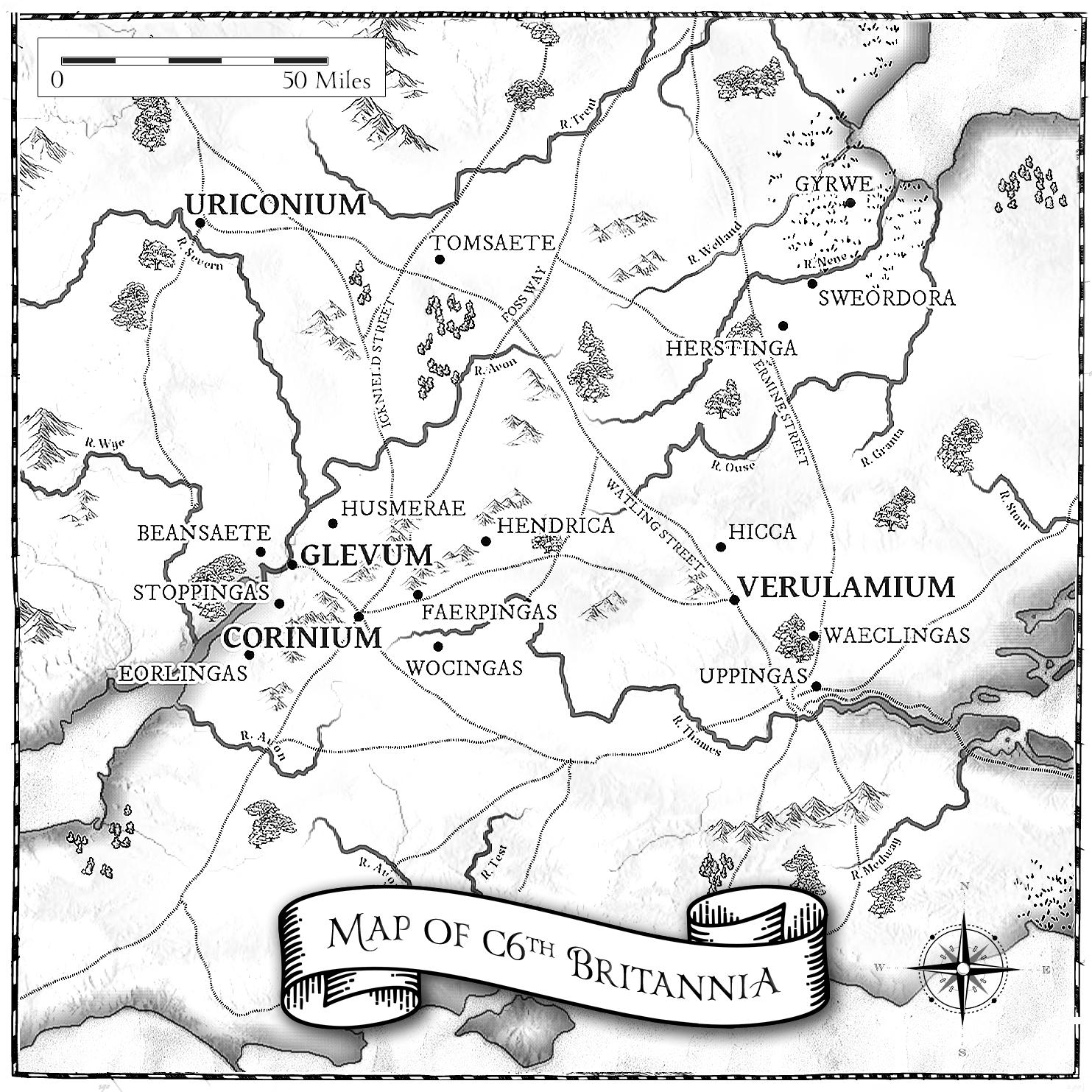
The family of Alfred the Great

Map design by Shaun at Flintlock Covers

Check out The Tenth Century Royal Women page on the blog and this post about who the ‘real’ Lady Eadgifu was.

Curious? Read about the Royal Women of The Tenth Century in my nonfiction title.

The Royal Women Who Made England cover

Posts

Come with me to Great Witcombe Roman Villa #locations #newrelease #MenOfIron #WarriorsOfIron #histfic #nonfiction

Come with me to Great Witcombe #newrelease #MenOfIron #WarriorsOfIron #histfic

Great Witcombe Roman Villa

Great Witcombe Roman Villa is no longer open to the public, but it is managed by English Heritage, and it’s possible to get a glimpse of it, although you do need to be careful. I think it’s currently closed due to safety concerns, so be mindful, and stay behind all the barriers, especially as the location is pretty remote.

From what I could see of the remains of Great Witcombe Roman Villa, it does seem to have been set in a beautiful place, and it quite appealed to me. I relied heavily on the idea of the location when devising the home for one of the tribes that features in the Dark Age Chronicles. (It probably helped that I visited on a lovely sunny day.)

Listen to the beginning of Warriors of Iron

Curious about the trilogy? Check out the Dark Age Chronicles page or the blog posts below.

Blog links

Image shows a map of Early England showing the places mentioned in the text of the book
The Dark Age Chronicles Map

Purchase Links (click on the images)


Posts

Letter writing in the Eleventh Century, how I recreated Lady Estrid’s connections with her vast family. #non-fiction #histfic

Letter writing in the Eleventh Century, how I recreated Lady Estrid’s connections with her vast family. #non-fiction #histfic

In trying to bring together the narrative for Lady Estrid, I faced a bit of a problem: the vast distances involved. Lady Estrid had family in England, Denmark, Sweden and Norway, many of them she may never have met in person.

Today, we might pick up the phone, or have a quick look on the internet, but in the eleventh century, how would people have communicated?

And so to letter writing. There are two surviving letters from the eleventh-century that were sent by King Cnut, Estrid’s brother, to the English, when he was absent from his newly conquered country, in AD1020 and AD1027. I give a small example below. 

;Be it known therefore to all of you, that I have humbly vowed to the Almighty God himself henceforward to amend my life in all respects, and to rule the kingdoms and the people subject to me with justice and clemency, giving equitable judgments in all matters; and if, through the intemperance of my youth or negligence, I have hitherto exceeded the bounds of justice in any of my acts, I intend by God’s aid to make an entire change for the better.’  From Cnut’s letter to the English from AD1027.

These might well have been an exercise for Cnut in asserting his authority over the English, and giving his regents a little bit of extra support, but they open up the possibility of just who else was busy writing and sending letters to one another. 

There’s always the assumption that unless you were a holy man, you perhaps couldn’t read or write, and in fact, in one of the books I referenced for Lady Estrid, I found a fascinating chart detailing people who are known to have been used by the ruling family of Normandy as messengers, another way that messages could be sent between people. But surely, sometimes, it was just better to write everything down, that way nothing could be lost in translation. 

Without the possibility of Lady Estrid ever meeting some members of her family, using letter writing allowed me to artificially create conversations between the characters, and while it might not have been the ‘norm’ it was certainly something that happened. Indeed, three centuries earlier, there’s a great wealth of information to be found in the letters of Alcuin of York (c735-804), so it wasn’t as though it was a new thing. With Denmark’s conversion to Christianity, there would have been a ready selection of scribes just waiting to note down Lady Estrid’s frustrations and complaints, even if she didn’t pen them herself.

Here’s an example of one of Estrid’s letters I create in the book.

Dearest Mother, Lady Sigrid. Queen of Denmark.’

‘This marriage doesn’t agree with me. How could you agree to it? I trusted you more than any other to understand how difficult it would be to be forced to live amongst strangers. I relied on you to argue with my father about the necessity of the union.’ 

And don’t tell me I will one day be the queen of the Rus, as my father planned. Prince Ilja is not a strong man. I don’t foresee him living long. Not at all. The poor man. He has barely been able to consummate our union. I hope I will not carry his child. It will be weak and feeble, and I will not tolerate such.’ 

My children will be strong and powerful. One day, it is they who will be kings and queens. But these children will not be shared with Prince Ilja. I am sure of it.’

And even if he were to survive, his brothers are a treasonous coven. None of them wishes the other to succeed at their expense. I foresee only bloodshed and paranoia when Ilja’s father is dead.’

Frida is my only friend and ally, reminding me of home. I hope to return to Denmark one day. I never imagined leaving her. I miss her. The kingdom of the Rus is not the same. Not at all.’

Send me news of my father and brothers. I wish to know if my father has finally triumphed in England over King Æthelred. I should like to know that he didn’t callously send me away without so much as seeing me in person for no good reason, because he was absent, in England, as so often the case. If he fails in England again, I will never forgive him for his actions towards me.’

Your despairing daughter, Lady Estrid Sweinsdottir, from Kiev.’

Grab Lady Estrid now to read on.

Check out the Lady Estrid page on the blog for more information.

Click on the image to check out Lady Estrid.

Posts

MJ Porter

Author of Saxon historical fiction, 20th-century historical mysteries, and Saxon historical non-fiction. Book reviewer and blog host.

Skip to content ↓