For Sophie it’s a trip home and for Hector it’s time to meet Sophie’s parents… Though their trip has village tongues wagging about a stop at Scotland’s notorious elopement spot, Gretna Green.
No matter what, it’ll make a nice break from the murder and mayhem that has been plaguing their beautiful Cotswolds village. But Sophie and Hector are barely on the road before they’re being hassled by reckless drivers and at their first rest stop a body is discovered.
Then comes a series of ‘accidents’ that leave poor Hector a little worse for wear. Is someone after Hector? Who could even know he was in the Highlands?
Accidents or not, can they find some way to keep Hector safe?
Murder in the Highlands is the latest book in the Sophie Sayers cosy crime series, usually set in a small Cotswold village, but not on this occasion. Sophie and Hector (who isn’t Scottish) are off to Inverness for a well-deserved holiday with her mother and father.
But as ever, dark going-ons and strange occurrences follow them on the long journey north, and Sophie is left feeling that there’s a mystery to solve, but unsure what it can be about, and even worse, that it somehow involves Hector.
I really enjoy this series of books – Sophie is a fun character, if troubled with an overactive imagination – as a writer, and her character is a writer, I’m right there with her. Hector is usually the more grounded of the two, but this time, even he’s starting to worry about what’s happening.
While there is no sighting of the Loch Ness monster, this is a fun mystery firmly rooted in Inverness, which the author has visited extensively, and the mystery is one of the stronger ones in the series that plays out, perhaps, in a more conventional way to earlier books in the series.
A great addition to the cosy crime series, which is going from strength to strength.
Meet the Author
Debbie Young is the much-loved author of the Sophie Sayers and St Brides cosy crime mysteries. She lives in a Cotswold village where she runs the local literary festival, and has worked at Westonbirt School, both of which provide inspiration for her writing. She is bringing both her series to Boldwood in a 13-book contract. They will be publishing several new titles in each series and republishing the backlist, starting in September 2022.
Love, Loss and Life In Between is a really lovely collection of short stories focusing on acceptance, moving on and recovery. I confess, I feared the stories might be upsetting, but they really weren’t. I was lucky enough to read the ebook last year, but now I’ve listened to the brand new audio as well. I really enjoy the option to listen as well as read books, especially ones I’ve read before.
Garden Therapy, with its slight otherworldliness was delightful, and A Mermaid’s Tale was a beautiful account of a young girl coming to terms with the loss of her mother, whereas Catalyst was quite edgy. Not Just for Christmas is a tale many pet owners with feel resonates with them.
This really was a delightful collection of short stories. The author has a lovely turn of phrase and manages to evoke strong feelings in her characters which make them believable, so that in only a few words the reader is already rooting for them.
Highly recommended, as was the author’s previous short story collection, of which you can find the review here.
The audio adds a delightful new dimension to these short stories. The narrator, Sandie Keane, has a lovely warm tone, and manages these uplifting and sorrowful tales with real compassion and understanding. Highly enjoyable.
Meet the author
Suzanne lives in Middlesex, England with her husband, two teenagers, a crazy cocker spaniel and an adopted cat that thinks she’s the boss.
Suzanne’s writing journey began at the age of twelve when she completed her first novel. She discovered the fantasy genre in her late teens and has never looked back. Giving up work to raise a family gave her the impetus to take her attempts at novel writing beyond the first draft, and she is lucky enough to have a husband who supports her dream – even if he does occasionally hint that she might think about getting a proper job one day.
Now an author of four novels including the Silent Sea Chronicles trilogy and her debut, Visions of Zarua, Suzanne hopes the dreaded ‘W’ word will never rear its ugly head again!
She loves gardening and has a Hebe (shrub) fetish. She enjoys cooking with ingredients from the garden and regularly feeds unsuspecting guests vegetable-based cakes.
She collects books, is interested in history and enjoys wandering around castles and old ruins whilst being immersed in the past. She likes to combine her love of nature and photography on family walks, but most of all she loves to escape with a great film, binge watch TV shows, or soak in a hot bubble bath with an ice cream and a book.
Having attended Drama school in Liverpool as a teenager Sandie moved into a variety of jobs varying from Hotel Management/Merseyside Police/Motherhood to name just a few but for 25 years she taught worldwide as a Pilates Tutor Trainer.
During lockdown Sandie’s interest turned to Audiobooks and it was from there she embarked on her own journey as an Audiobook Narrator.
The Scots of Dalriada takes place in 5th century Ireland and Scotland and tells the fictional story of the legendary king Fergus Mór. Recorded Irish history begins with the introduction of Christianity and Latin literacy, beginning in the 5th century. Most of my research however, relied on sources written much later. First and foremost, Studies in the History of Dalriada by John Bannerman.
Published in 1974 this book is no longer in print but can be purchased second-hand.
My research of the Dalriada began fifteen years ago when I discovered that my ancestors descended from the Dalriada. History is compelling, especially when your own ancestors are involved, and the stories around the Dalriada didn’t let me go. I had to wait three years to obtain a copy of this book but it was definitely worth it, as it is much more comprehensive and detailed than anything to be found on the net.
It amazed me that St. Patrick was kidnapped as a teenager and sold to the Dalriada. He stayed with them, working as a shepherd on the exposed hills of Slemish until he miraculously escaped. When he returned to Ireland in his role as missionary, his first self-imposed duty was to convert the Dalriadians, despite bitter opposition from the druids.
See my first book from this period about the life of St.Patrick, Patron Saint of Ireland.
The Missionary
Although both books take place in 5th century Ireland, they are entirely independent of each other.
5th century Ireland and Scotland is at the end of the Iron Age and beginning of the early Medieval Age. This period includes an expansion of the Dalriada clan to Western Scotland. Ireland, at the time, was divided into many small baronies, each ruled by an underking. Life was dominated by a myriad of petty wars, neighbouring clans were constantly under attack from each other, stealing cattle and crop and encroaching upon each other’s land.
The Dalriada was situated in the utmost North East of Ireland, composed of much that is presently known as Antrim. To the North and East their territory was bordered by the North Channel and the Irish Sea. To the South and West, by the aggressive tribes of the Northern Uí Néill, the Dál Fiatach and the Dál nAraide, who continually attacked the Dalriada. So it was only natural that the Dalriada sought to expand their kingdom across the North Channel.
These background facts form the setting for my, mainly fictional, novel about Fergus. The book covers his life from roughly 440 to 501 AD, when his ship is sea wrecked, and he is succeeded by his son Domangart.
By that time the Dalriada have conquered Argyll (“Coast of the Gaels”) and built their chief stronghold and trading centre at Dunadd. The hillfort of Dunadd is believed to have been their capital. Other royal forts included Dunollie, Dunaverty and Dunseverick. Within Dalriada was the important monastery of Iona, which played a key role in the spread of Celtic Christianity throughout northern Britain, and in the development of insular art. Iona was a centre of learning and produced many important manuscripts. Dalriada had a strong seafaring culture and a large naval fleet.
Scotland is said to have been founded by the legendary king Fergus Mór (Fergus the Great) in the 5th century. Heavy onslaughts from the Picts checked the Dalriada on the Scottish mainland. In the 8th century the Dalriada gradually declined; and after the Viking invasions early in the 9th century, it lost all political identity. In the mid-9th century its king Kenneth I MacAlpin brought the Picts and Scoti (the Roman name for the Irish Gaels) permanently together, and thereafter the whole country was known as Scotland.
More books that I read to complement my research:
A Brief History of Ireland by Richard Killeen
Ireland’s Forgotten Past: A History of the Overlooked and Disremembered by Turtle Bunbury
A History of Scotland by Neil Oliver
Scotland: History of a Nation by David Ross
The Book of Celtic Myths: From the Mystic Might of the Celtic Warriors to the Magic of the Fey Folk, the Storied History and Folklore of Ireland, Scotland, Brittany, and Wales by Adams Media
Satellite image of Scotland and Northern Ireland showing the approximate greatest extent of Dál Riata (shaded). The mountainous spine which separates the east and west coasts of Scotland can be seen.
Ancient hill fort at Dunadd
Here’s the blurb
THREE BROTHERS Fergus, Loarn and Angus, Princes of the Dalriada, are forced into exile by their scheming half-brother and the druidess Birga One-tooth.
THREE FATES Fergus conceals himself as a stable lad on Aran and falls helplessly in love with a Scottish princess, already promised to someone else. Loarn crosses swords against the Picts. Angus designs longboats.
TOGETHER A MIGHTY POWER Always on the run the brothers must attempt to outride their adversaries by gaining power themselves. Together they achieve more than they could possibly dream of. Fergus Mór (The Great) is widely recognised as the first King of Scotland, giving Scotland its name and its language. Rulers of Scotland and England from Kenneth mac Alpín until the present time claim descent from Fergus Mór.
Full of unexpected twists and turns, this is a tale of heart-breaking love amidst treachery, deceit and murder.
Rowena Kinread grew up in Ripon, Yorkshire with her large family and a horde of pets. Keen on travelling, her first job was with Lufthansa in Germany.
She began writing in the nineties. Her special area of interest is history. After researching her ancestry and finding family roots in Ireland with the Dalriada clan, particularly this era.
Her debut fiction novel titled “The Missionary” is a historical novel about the dramatic life of St. Patrick. It was published by Pegasus Publishers on Apr.29th, 2021 and has been highly appraised by The Scotsman, The Yorkshire Post and the Irish Times.
Her second novel “The Scots of Dalriada” centres around Fergus Mór, the founder father of Scotland and takes place in 5th century Ireland and Scotland. It is due to be published by Pegasus Publishers on Jan.26th, 2023.
The author lives with her husband in Bodman-Ludwigshafen, Lake Constance, Germany. They have three children and six grandchildren.
The fight for a torn kingdom rests in the hands of a few brave men…
990AD.
King Aethelred II, who men will one day call The Unready, rules over a land divided by the shadowy spin of his mother Queen Ælfthryth and the sprawling power of the Church.
The Viking Warlord, Olaf Tryggvason smelling the Kingdoms weakness brings the vicious Jomsvikings to the Saxon coastline ravenous for war and plunder.
Together Lord Byrthnoth, Ealdorman of the East Saxons and Beornoth his Saxon Thegn lead a force of oath sworn Viking killers, every bit as brutal and war-skilled as the Norse invaders to protect the Kingdom against enemies both from within, and from the cruel seas. They are pushed to the very limits of their bravery and endurance in a desperate fight for the very existence of the Saxon Kingdom.
In a riveting story of trachery, betrayal, vengeance and war, can Beornoth defeat his enemies and protect the Kingdom from destruction?
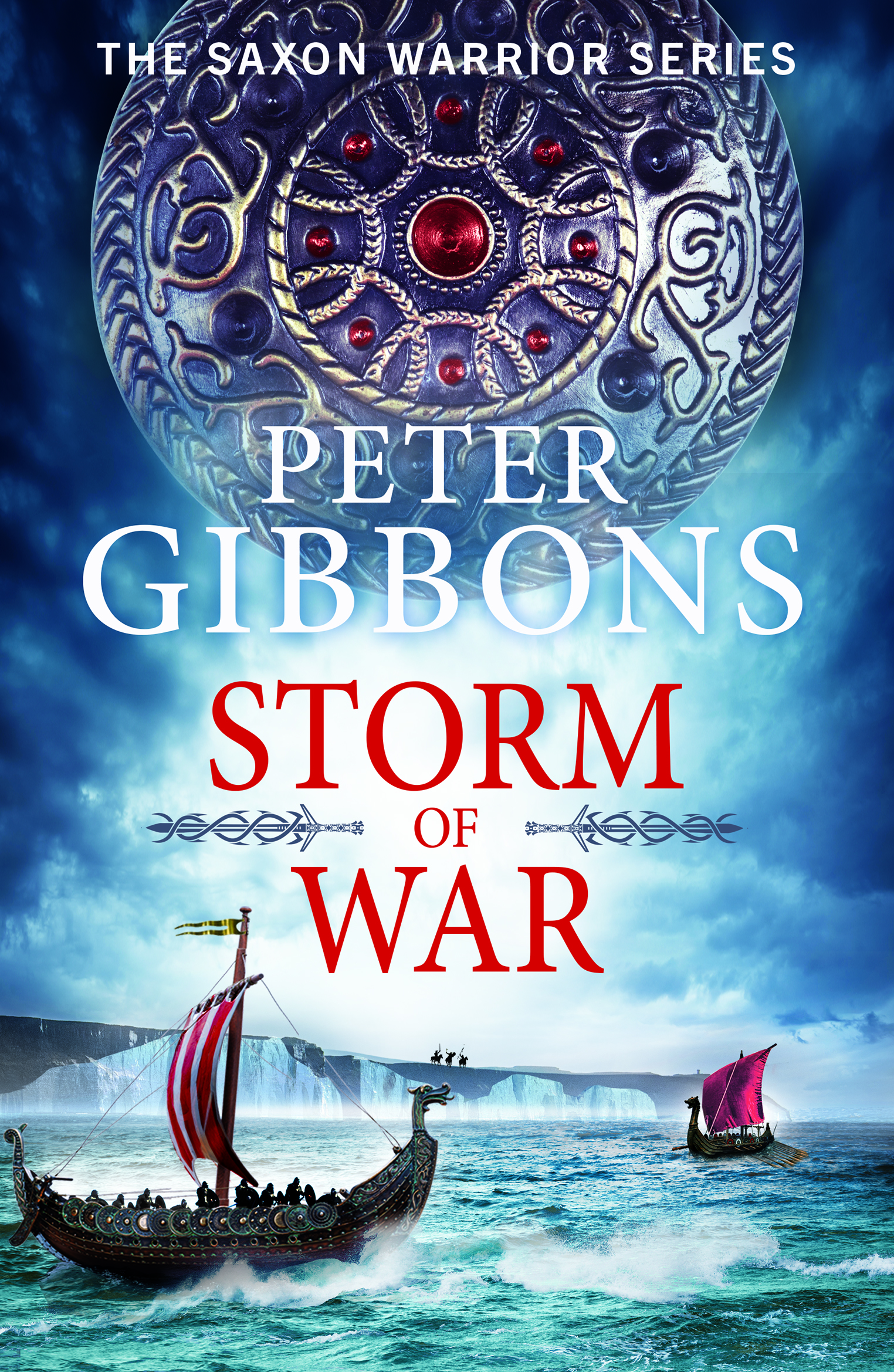
Storm of War is the second book in the Saxon Warrior Series, which began with Warrior and Protector, set during the early 990s in Saxon England. Æthelred II is the king of the English, but the Viking raiders, quiet throughout the reign of his father, known as Edgar the Peaceable, have begun to turn their eyes once more to the riches that England has to offer.
Beornoth is a thegn once more, connected to Ealdorman Byrhtnoth, a man who has long-supported the claim of others than the current king to rule England, firstly, Eadwig, the uncle of Æthelred II, to whom he owed his elevation to the ealdordom, and also, Edward the Martyr, Æthelred’s stepbrother. Often brought into conflict with the queen, Lady Elfrida, or Ælfthryth, as she is called in the book, Byrhtnoth is not the easiest of allies for the king and his mother, and Beornoth, a warrior like the ealdorman, is needed for his warrior-prowess but perhaps distrusted for the very same reason.
The book opens with a battle at Watchet in which we encounter the Viking raider, Olaf Tryggvason, for the first time, soon to be a bane to England, and while Beornoth and his quick thinking, alongside Ealdorman Byrhtnoth, are victorious on that occasion, there is a fear that Olaf will attack once more.
Yet, Beornoth and his allies soon find themselves heading north to counter a problem amongst the ruling elite of the northern parts of the kingdom, on the commands of the king’s mother, if perhaps not the king.
We begin to encounter more of the men who will one day be famously remembered in the Battle of Malden poem as the story continues, Ælfwine perhaps of most relevance to me (as he might, or might not, have been the father of Ealdorman Leofwine of the Twice). Beornoth is still an angry man, eager to kill the enemy who destroyed his family but he is involved in a dangerous game with enemies surrounding him while he fears that Olaf will attack once more.
A tale of Saxon England on the cusp of the Second Viking Age sure to thrill fans of the era.
Meet the Author
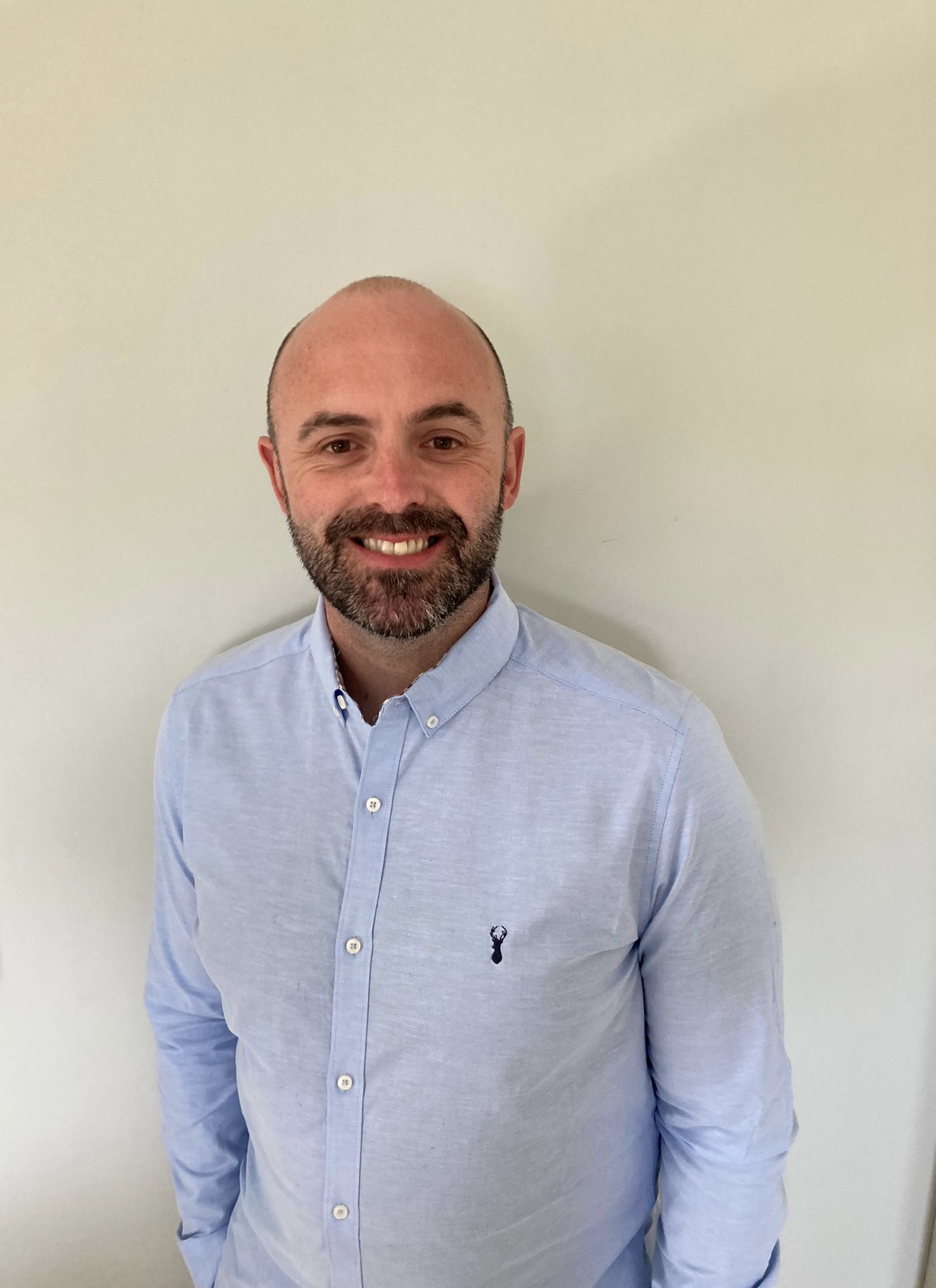
Peter Gibbons is a financial advisor and author of the highly acclaimed Viking Blood and Blade trilogy. He comes to Boldwood with his new Saxon Warrior series, set around the 900 AD Viking invasion during the reign of King Athelred the Unready. The first title of the new series, Warrior and Protector, will be published in October 2022. He originates from Liverpool and now lives with his family in County Kildare.
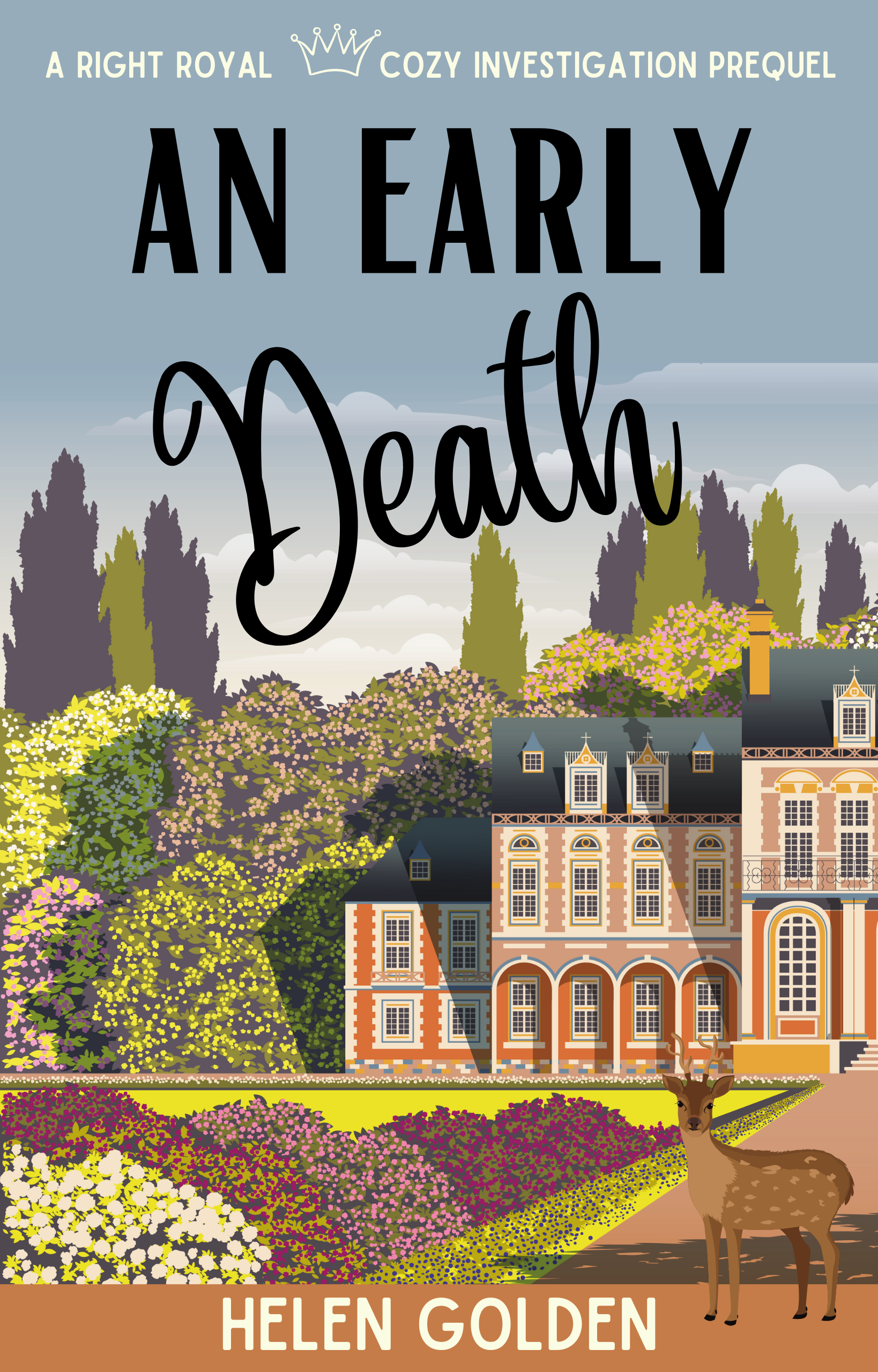
BREAKING NEWS Mystery Woman was in the Earl of Rossex’s car when it crashed
Reports are coming in that an unidentified woman was in the car that killed James Wilshire (24), the Earl of Rossex, when it crashed in Fenshire late on Tuesday evening and died from her injuries later in hospital. The police have not named the woman, but sources at Francis Court, where the earl lived with his wife Lady Beatrice (21) claim the dead woman was the wife of a member of staff.
The impertinence of the man! Who does this Detective Sergeant Richard Fitzwilliam think he is asking personal questions about the state of her marriage and insinuating that James was having an affair with the estate manager’s wife? Of course he wasn’t! She knew her husband and he wouldn’t do that to her. But what was James doing back in Fenshire on that fateful night when he’d told her he would be London? And why was Gill Sterling in the car with him when they barely knew each other? Unless, of course, she didn’t know her husband as well as she thought she did…
PLEASE NOTE: This is a prequel in the A Right Royal Cozy Investigation series and is not intended to be read as a standalone.
A Right Royal Cozy Investigation series is fast becoming one of my favourites, and An Early Death is a fabulous prequel novel, answering so many questions and leaving much more unanswered for those readers enjoying the series, which begins about a decade after the events of An Early Death.
I really, really can’t wait for the next book, A Dead Herring, which I hope might finally contain all the answers fans of the series are after.
The author makes it very clear the prequel shouldn’t be read until after reading the first three books in the series, and I echo this. Don’t spoil it for yourself:) Check out my reviews for the first three books below.
Hello. I’m Helen Golden. I write British contemporary cozy whodunnits with a hint of humour. I live in small village in Lincolnshire in the UK with my husband, my step-daughter, her two cats, our two dogs, sometimes my step-son, and our tortoise.
I used to work in senior management, but after my recent job came to a natural end I had the opportunity to follow my dreams and start writing. It’s very early in my life as an author, but so far I’m loving it.
It’s crazy busy at our house, so when I’m writing I retreat to our caravan (an impulsive lockdown purchase) which is mostly parked on our drive. When I really need total peace and quiet, I take it to a lovely site about 15 minutes away and hide there until my family runs out of food or clean clothes
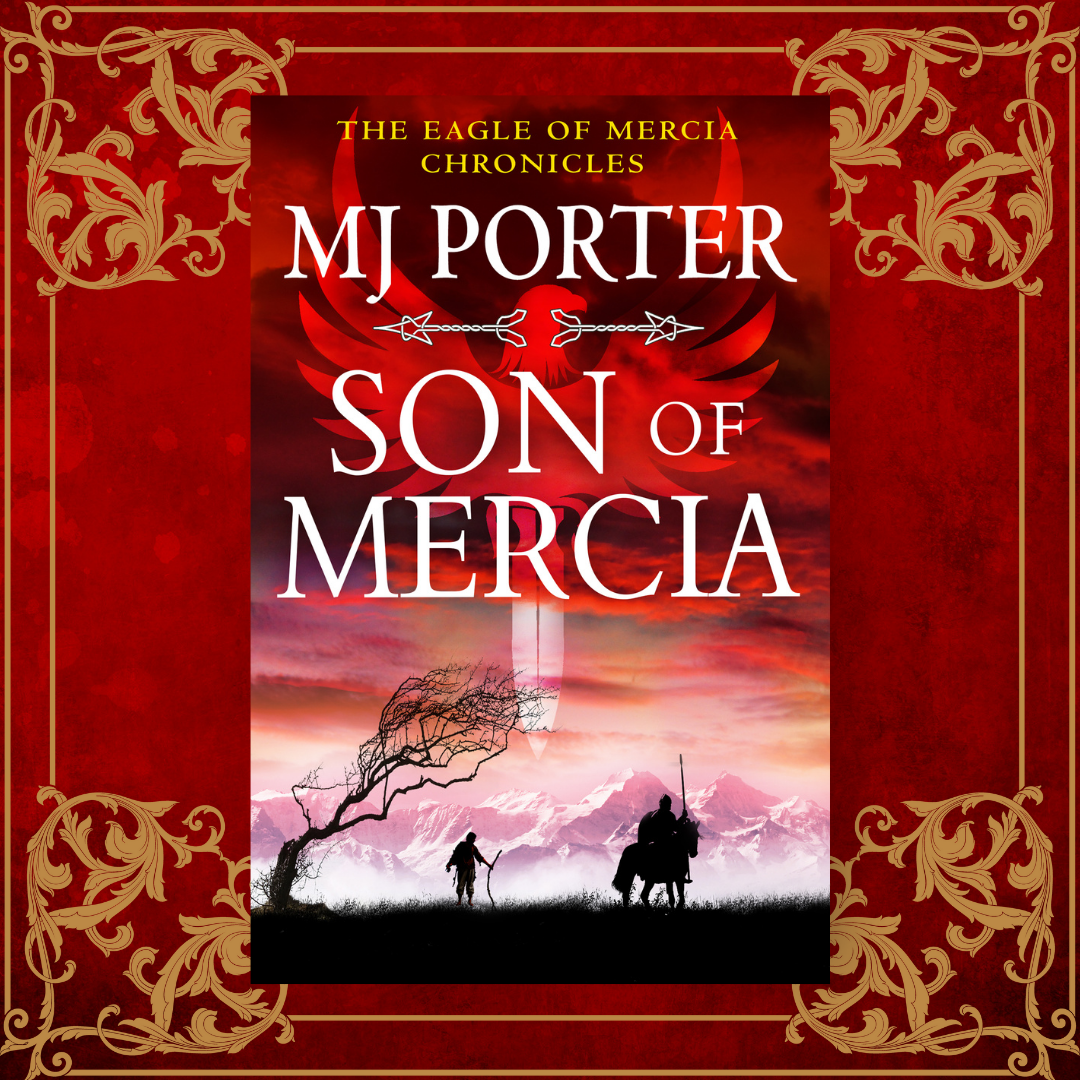
Happy book birthday to the wonderful Son of Mercia, the first book telling the story of young Icel in early ninth-century Mercia (fans of The Last King will have met Icel before, but it’s not necessary to enjoy Son of Mercia).
The series is now a massive four books long, and I’m busy working on book 5, which doesn’t have a title just yet (or does it?)
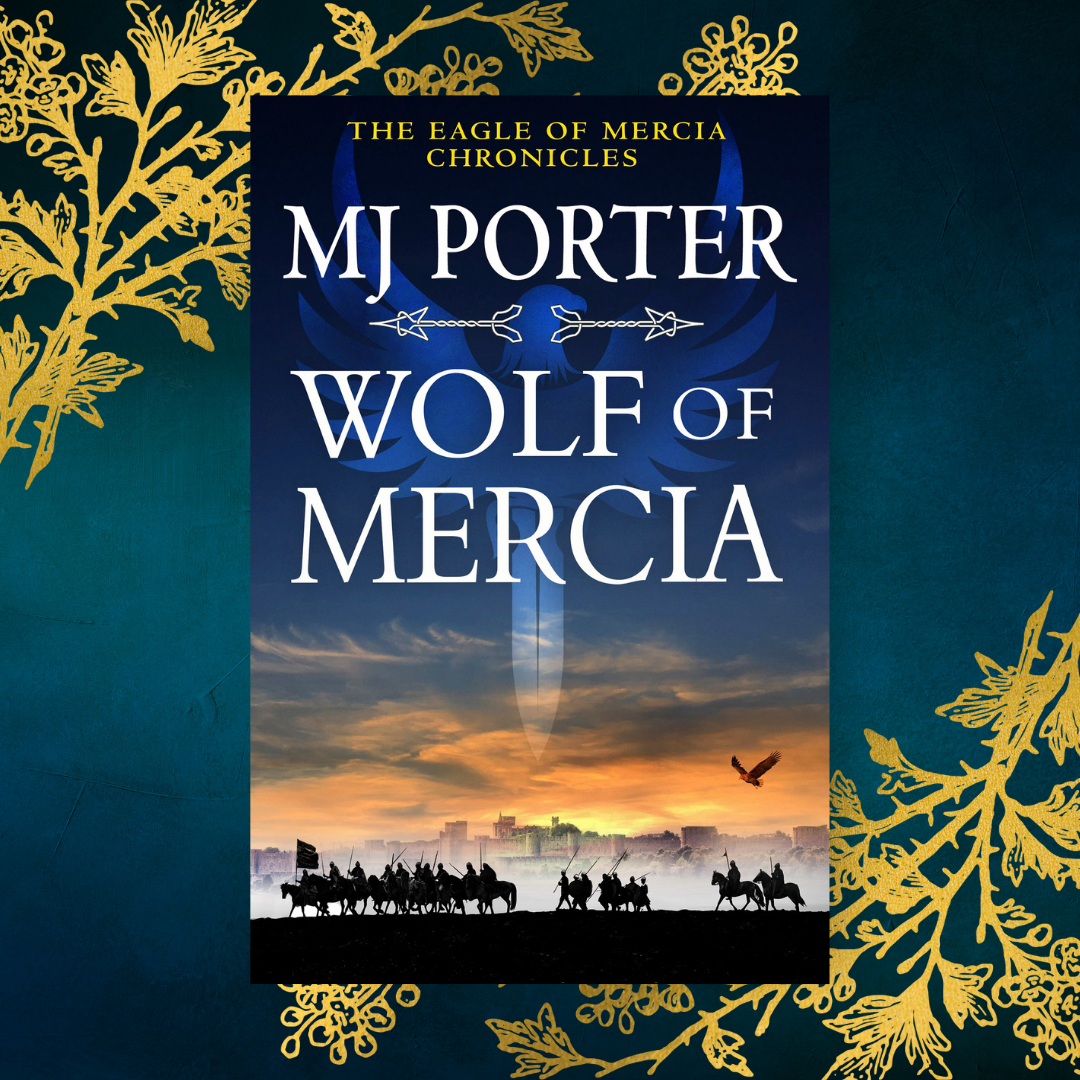
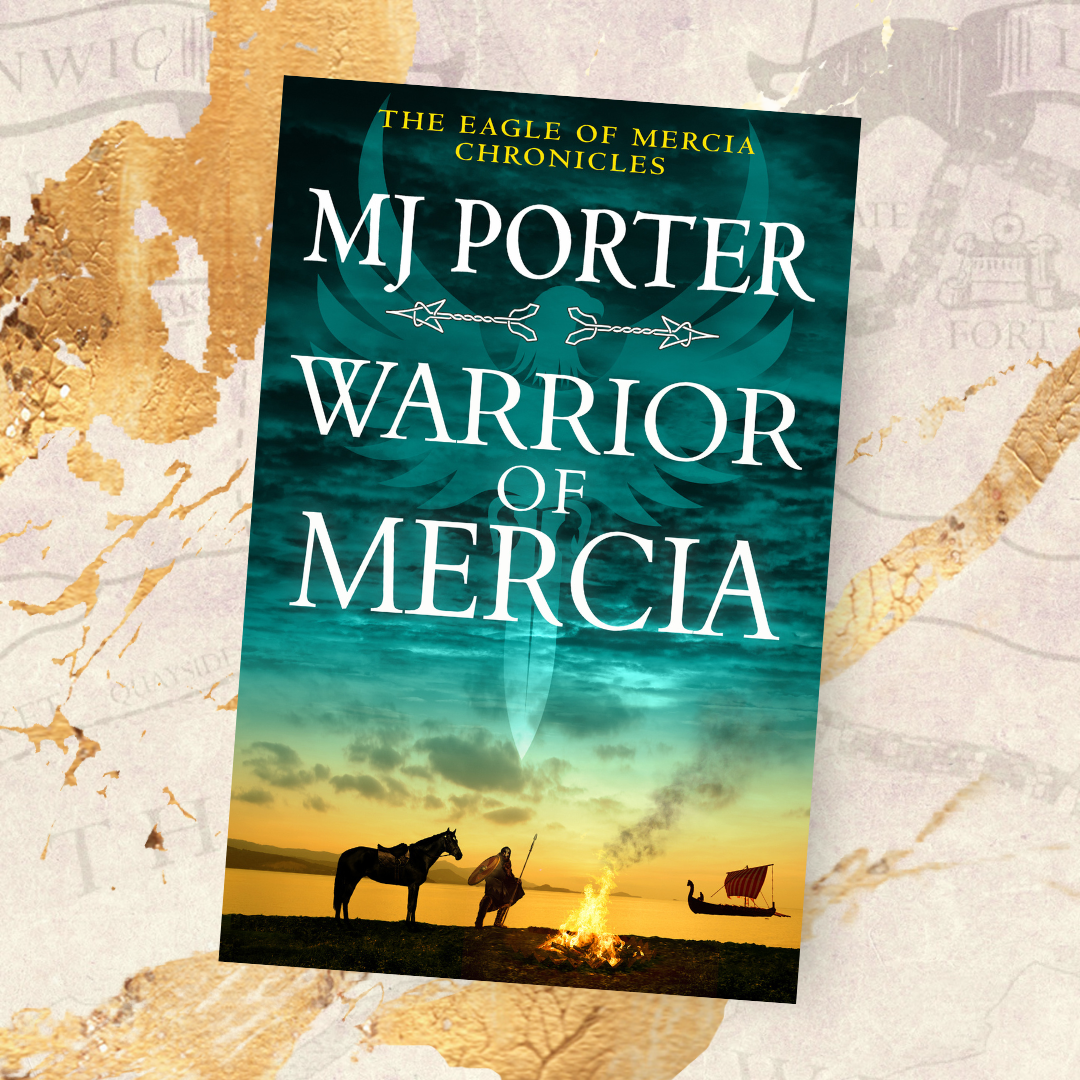
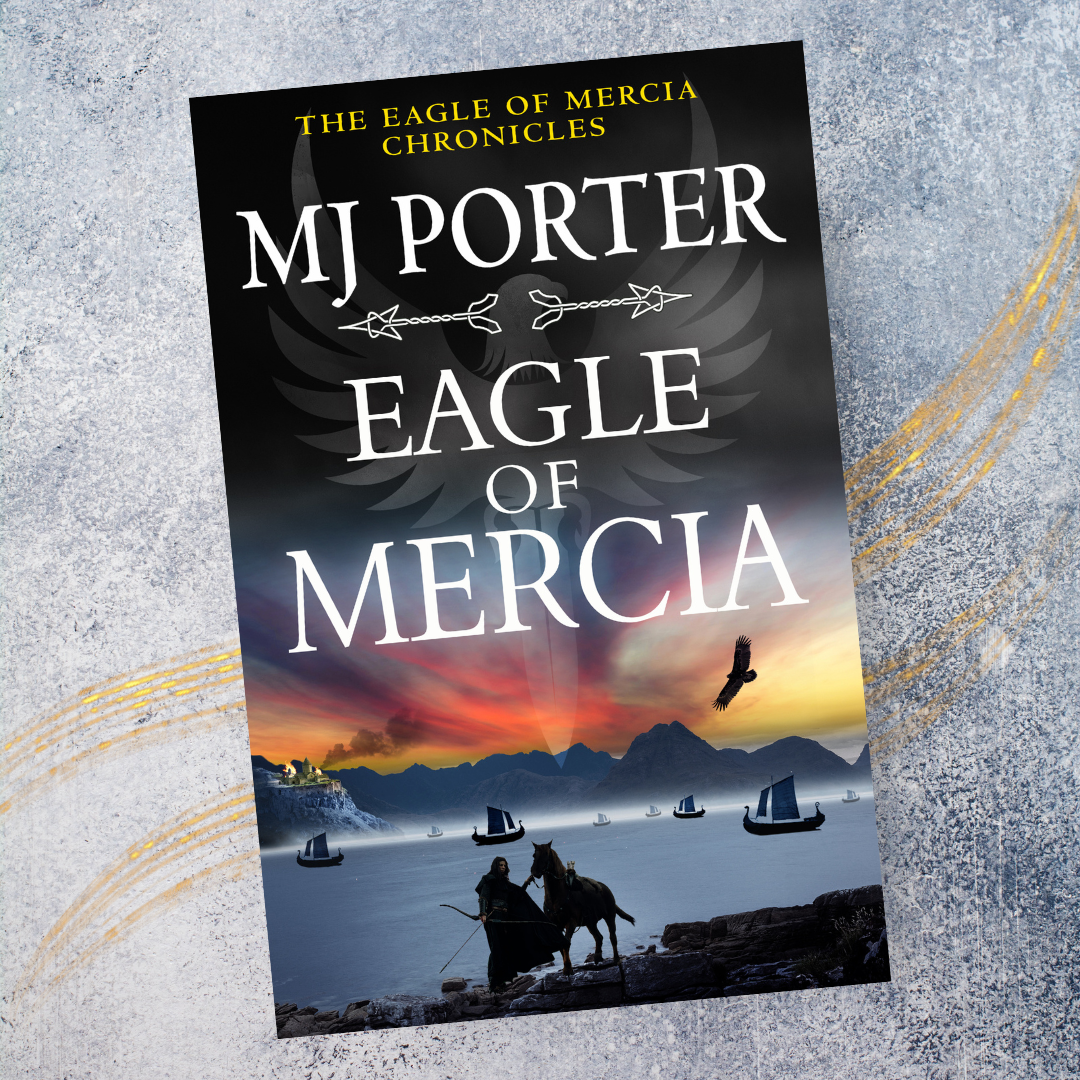
I thought today would be a great day to shine a light on all four books, and don’t worry if you’ve not read book 4 yet, Eagle of Mercia is releasing in May 2023. So here goes.
Tamworth, Mercia AD825.
The once-mighty kingdom of Mercia is in perilous danger.
Their King, Beornwulf lies dead and years of bitter in-fighting between the nobles, and cross border wars have left Mercia exposed to her enemies.
King Ecgberht of Wessex senses now is the time for his warriors to strike and exact his long-awaited bloody revenge on Mercia.
King Wiglaf, has claimed his right to rule Mercia, but can he unite a disparate Kingdom against the might of Wessex who are braying for blood and land?
Can King Wiglaf keep the dragons at bay or is Mercia doomed to disappear beneath the wings of the Wessex wyvern?
Icel is becoming a warrior of Mercia, but King Ecgberht of Wessex still holds the Mercian settlement of Londonia and its valuable mint.
King Wiglaf of Mercia is determined that the last bulwark be reclaimed from his sworn enemy to complete his rehabilitation as Mercia’s rightful ruler.
In the heart of the shield wall, Icel suddenly finds himself on the wrong side of the battle and thrust into the retreating enemy stronghold where he must take on the pretence of a Wessex warrior to survive and exact a cunning plan to bring down the Wessex force cowering behind the ancient walls.
His allegiances are tested and the temptation to make new allies is overwhelming but Icel must succeed if he’s ever to see Tamworth again and bring about King Wiglaf’s victory, or will he be forced to join the enemy?
Oath sworn to Wiglaf, King of Mercia and acknowledged as a member of Ealdorman Ælfstan’s warrior band, Icel continues to forge his own destiny on the path to becoming the Warrior of Mercia.
With King Ecgberht of Wessex defeated and Londonium back under Mercian control, the Wessex invasion of Mercia is over.
But the Wessex king was never Mercia’s only enemy. An unknown danger lurks in the form of merciless Viking raiders, who set their sights on infiltrating the waterways of the traitorous breakaway kingdom of the East Angles, within touching distance of Mercia’s eastern borders.
Icel must journey to the kingdom of the East Angles and unite against a common enemy to ensure Mercia’s hard-won freedom prevails.
A mercy mission in the heart of Wessex is beset with deadly, bloody dangers.
Tamworth AD831
Icel’s profile continues to rise. Lord of Budworth and warrior of Mercia, he’s acknowledged by King Wiglaf and his comrades to keep Mercia safe from the ravages of Wessex, the king-slayer of the East Angles, and the Viking raiders. But, danger looms. Alongside Spring’s arrival comes the almost certain threat of the Viking raiders return.
When Lord Coenwulf of Kingsholm is apprehended by a Viking and held captive on the Isle of Sheppey in Wessex held Kent, Icel is implored by Lady Cynehild to rescue her husband.
To rescue Lord Coenwulf, Icel and his fellow warriors must risk themselves twice over, for not only must they overpower the Viking raiders, they must also counter the threat of Mercia’s ancient enemy, the kingdom of Wessex as they travel through their lands.
Far from home and threatened on all sides, have Icel and his fellow warriors sworn to carry out an impossible duty
Set in the troubled years at the end of the Mercian supremacy, with the advent of the true First Viking Age just around the corner, The Eagle of Mercia Chronicles allow me to explore the kingdoms of Saxon England at the time, while ensuring my focus remains on Mercia, the kingdom in the’Midlands’ of England, with which I’m quite obsessed.
And choosing to write about a very strong character from my The Last King series, also allows me to play with my readers expectations. Icel is a fabulous creation, and one I’m incredibly proud of and pleased that my readers love so much.
Yes, these are bloody and brutal tales, but at the heart of them is a ‘coming of age’ story as young Icel learns about himself, as well as the truth of his heritage and birth.
If you’ve not yet tried The Eagle of Mercia Chronicles, then now is the perfect opportunity. Enjoy.
To win a set of the first three books in paperback – signed and dedicated as you would like, please sign up for my newsletter, or my newsletter with Boldwood Books. (Competition ends on 24th Feb). I send a monthly email. I will contact the winner and arrange postage – I will post worldwide. If you are signed up for both already, then drop me a quick email, and I will enter you into the competition. Good luck.
Easier to split the sky, than part a soldier from his blade.
386 AD. The Eastern Roman Empire faces a trident of threats. The Gothic truce grows unstable. The standoff with Persia escalates. And the ambitions of the usurper on the Western throne grow dangerously unchecked.
Pavo, a broken veteran of the legions, cares for none of these things. His life is one of pastoral seclusion on his Thracian farm. A life of love, of peace. His wife and young son are his world. Still, every so often, things seen and done in his old life haunt him, like a cold and unwelcome breeze. But that is all they are, echoes of the past…
…until the past rises, like a shade, to rip his world and the Roman Empire apart.
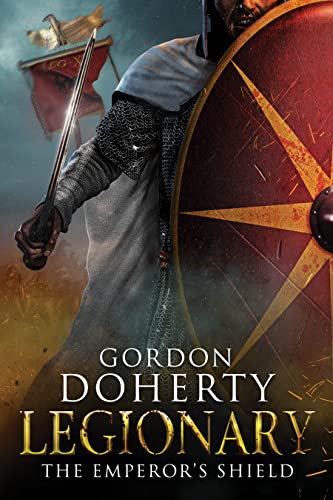
The Emperor’s Shield by Gordon Doherty is the ninth book in the Legionary series, and you guessed it, it’s the first book in the series that I’ve read:) (This is somewhat of a theme for me).
That said, I had no problem being gripped by the story. Pavo is a wonderful character, and while to begin with I did think this was ‘his’ story, more characters were quickly introduced, and the world of the late 300s of the Roman Empire sharply come into focus. This isn’t a period I know a great deal about – especially not in the Eastern Empire, but Pavo, his wife, son and Frugilo, make the period come alive. The camaraderie between Pavo and his old friends, add the human touch to the story, which is a complex web of lies and misdirection taking place over vast distances.
This is truly a story on an epic scale. It probably has a cast of thousands, although not all of them are named. There are warriors from all corners of the Roman Empire, East and West, and Pavo is in the thick of it all, as one of the Eastern Emperor’s elite bodyguard.
The tension throughout the final 25% of the book ramps up spectacularly, and I had to stop myself from googling the period to find out what actually happened, before I got to the end.
A thrilling tale of empire and conspiracy, that certainly leaves the reader desperate to go back to book 1, or eagerly waiting for book 10. A true triumph of the genre.
Meet the author
Gordon Doherty is the author of the Legionary and Strategos series, and wrote the Assassin’s Creed tie-in novel Odyssey. He is based in Scotland.
I’m aware that there’s been a bit of a delay in getting everything shipshape over on Amazon, but everything is now where it should be – the ebook, paperback, audio, and hardback, all linked together. Whoo hoo. You can find them with the link below, which also includes other retailers, with links to the large print version.
So, I thought it would be the perfect opportunity to share a few things with you that have happened since release.
As I can’t upload the video here, I’ve done my ‘unboxing’ video and popped it over on TikTok – which I’m trying to learn. You can find it here. The paperback looks amazing:) It’s very smart and the family tree and map are also included. If you’re on TikTok give me a follow, as I’m looking for more content to help me get to grips with it.
I’m also going to share a link for the audiobook, read by the fabulous Matt Coles, which you can also find here, on my website, not my blog. (I can’t upload videos to my blog – who knew).
And, if you missed my blog post yesterday on Historia, you can read it here. It’s an introduction, quite a swift one, into what was happening in the Saxon kingdoms just before the events of King of Kings. And, it’s got some amazing images to go with it. I’m always in awe of someone who knows how all the rules work regarding sharing images on the web. Thank you. (I’ve just been trying to work some of this out for myself, with British Library images – it made my head hurt).
My new book, King of Kings, is a multi-viewpoint novel telling the story of events in Britain from 925-934. I thought it would be good to share details of the historical people my main characters are based on.
Owain of Strathclyde is perhaps the most difficult character in King of Kings to find in the historical record. Indeed, his place in the story is contested by historians, as we don’t know if the scribe of the Anglo-Saxon Chronicle of the time meant Owain of Strathclyde, or an Owain of one of the Welsh kingdoms. I decided to adopt the Owain of Strathclyde, but who exactly was he, and what was Strathclyde?
The kingdom of Strathclyde is also known by another name, that of Cumbria, and there is confusion in the sources and amongst historians about where it is and what it was. Alex Woolf suggests that by the events of 927, Strathclyde/Cumbria encompassed, ‘most of part of Lanarkshire, Dunbartonshire, Renfrewshire, Stirlingshire, Peebleshire, West and Mid-Lothian, eastern Dumfriesshire and Cumberland.’ (Woolf, A. From Pictland to Alba, 789-1070, Edinburgh University Press, 2007) p.155)
So who then were it’s kings? This again is far from as easy to state as might be thought. It’s believed that Owain of Strathclyde, succeeded his father, Donald II, to become king of Strathclyde, and in turn was succeeded by his son.
In 924, we are told that ‘the king of the Strathclyde Britons and all the Strathclyde Britons,’ (Swanton p.104) joined the king of Wessex, Edward the Elder’s alliance by the Anglo-Saxon Chronicle, but Owain isn’t named. Indeed, and as said above, when we do get mention of Owain in the Anglo-Saxon Chronicle, he’s named as ‘king of Gwent,’ (Swanton, M. trans and edit The Anglo-Saxon Chronicles, (Orion Publishing Group, 2000) p.107) even though there was no Welsh king of Gwent named as Owain at the time. It’s therefore difficult to get a feel for who he was, and what he did, but that didn’t mean I couldn’t include him in King of Kings. If anything, it made it all the more intriguing.
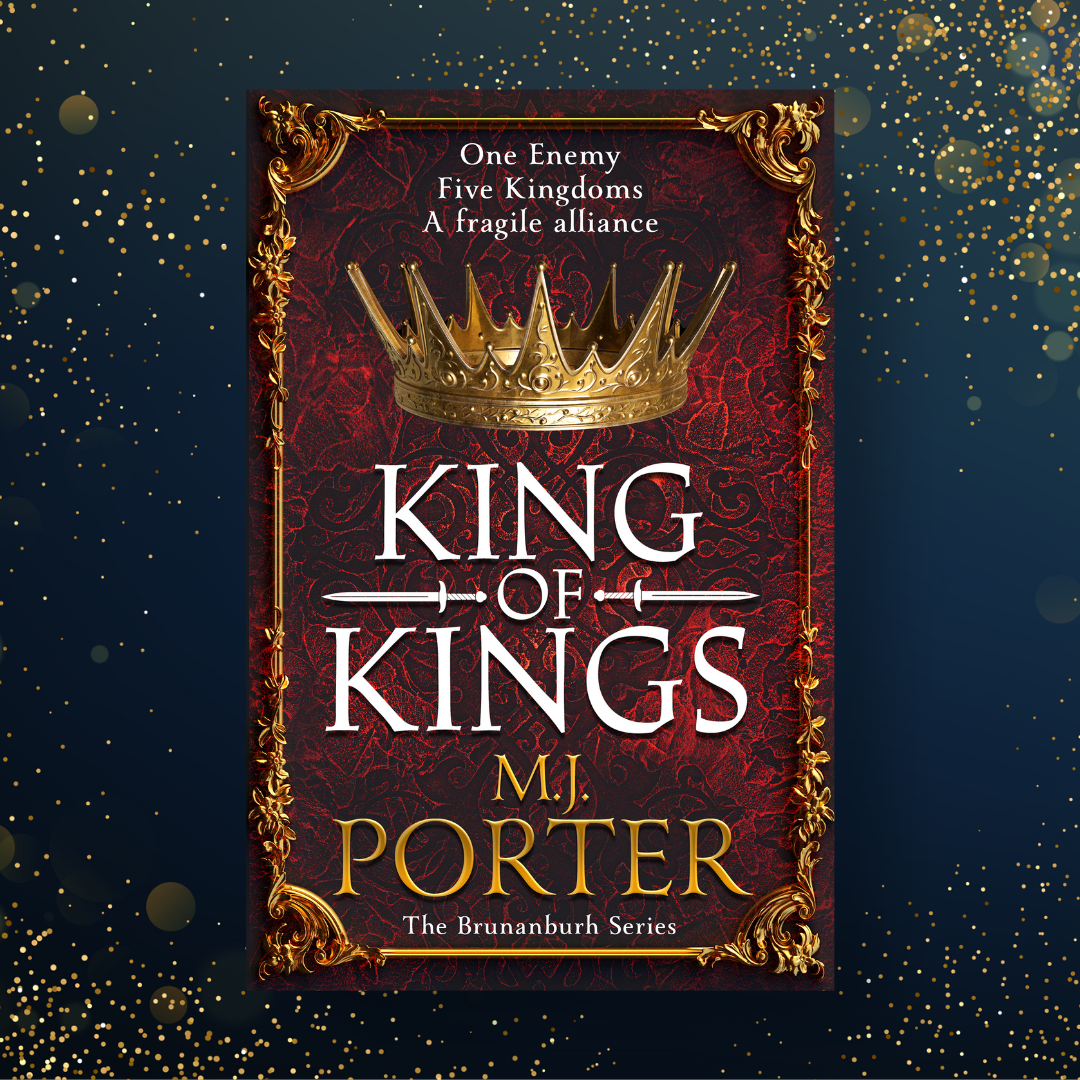
I’m so excited about the release today of King of Kings. This story, the first part in the retelling of the greatest battle on British soil that many have never heard of, Brunanburh, has been long in the making. Building on the original series, begun in 2014, King of Kings is entirely reworked, and it’s so much better:) (I honestly can’t believe how much better it is.)
Here’s the blurb
‘An epic tale of the birth of a nation. Truly mesmerising. Game of Thrones meets The Last Kingdom’ – Gordon Doherty
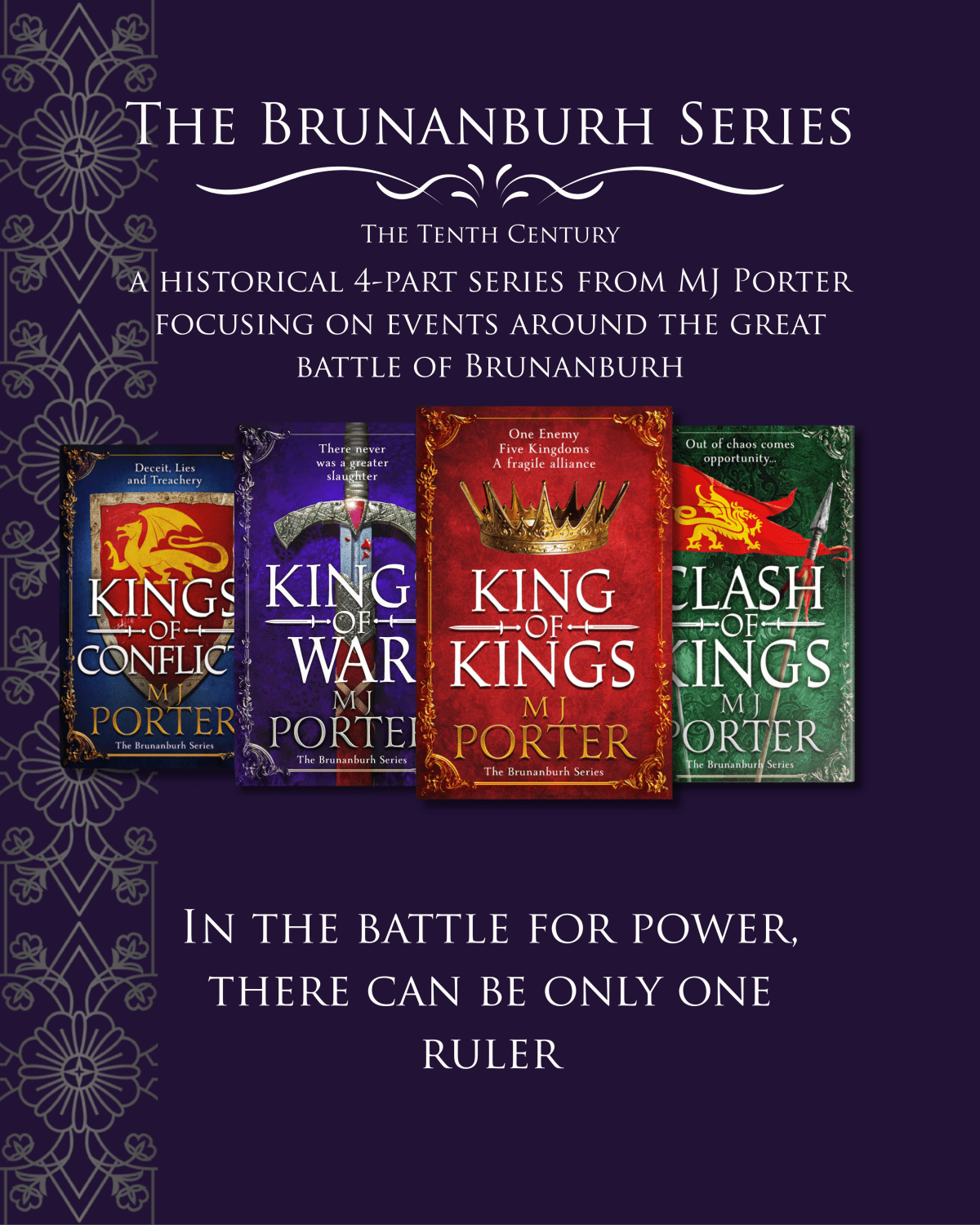
In the battle for power, there can be only one ruler.
AD925
Athelstan is the king of the English, uniting the petty kingdoms of Wessex, Mercia, the Danish-held Five Boroughs and York following the sudden death of his father, King Edward.
His vision is to unite the realms of the Scots and the Welsh in a peace accord that will protect their borders from the marauding threat of the Norse Vikings.
Whilst seemingly craving peace and demanding loyalty with an imperium over every kingdom, Athelstan could dream of a much bigger prize.
But danger and betrayal surround his best intentions, namely from his overlooked stepbrother, Edwin, who conspires and vies for what he deems is his rightful place as England’s king.
As ever, powerful men who wish to rule do not wish to be ruled, and Constantin of the Scots, Owain of Strathclyde, and Ealdred of Bamburgh plot their revenge against the upstart English king, using any means necessary.
An epic story of kingsmanship that will set in motion the pivotal, bloody Battle of Brunanburh where allies have to be chosen wisely…
(available in ebook, paperback, hardback and audio, narrated by the wonderful Matt Coles).
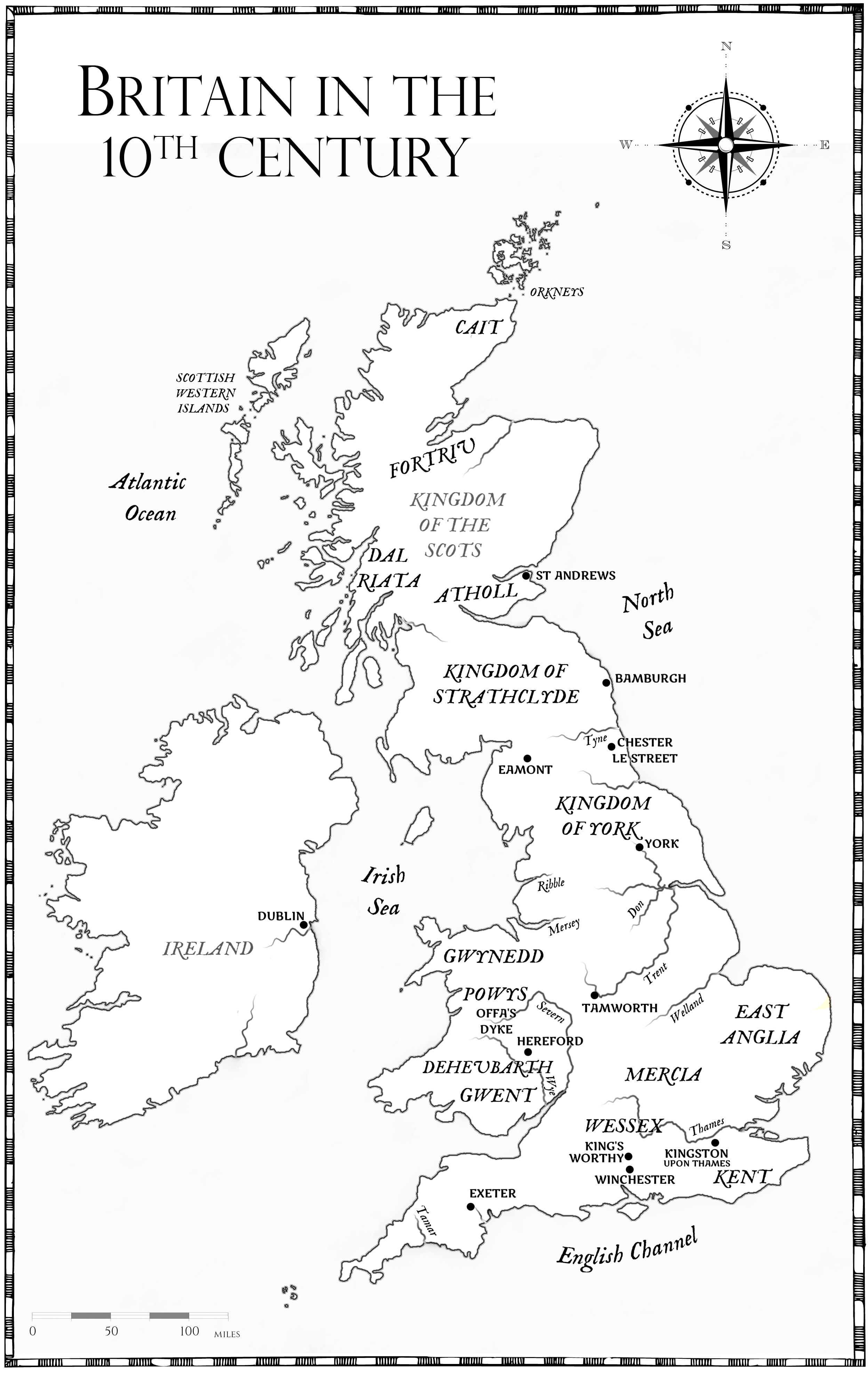
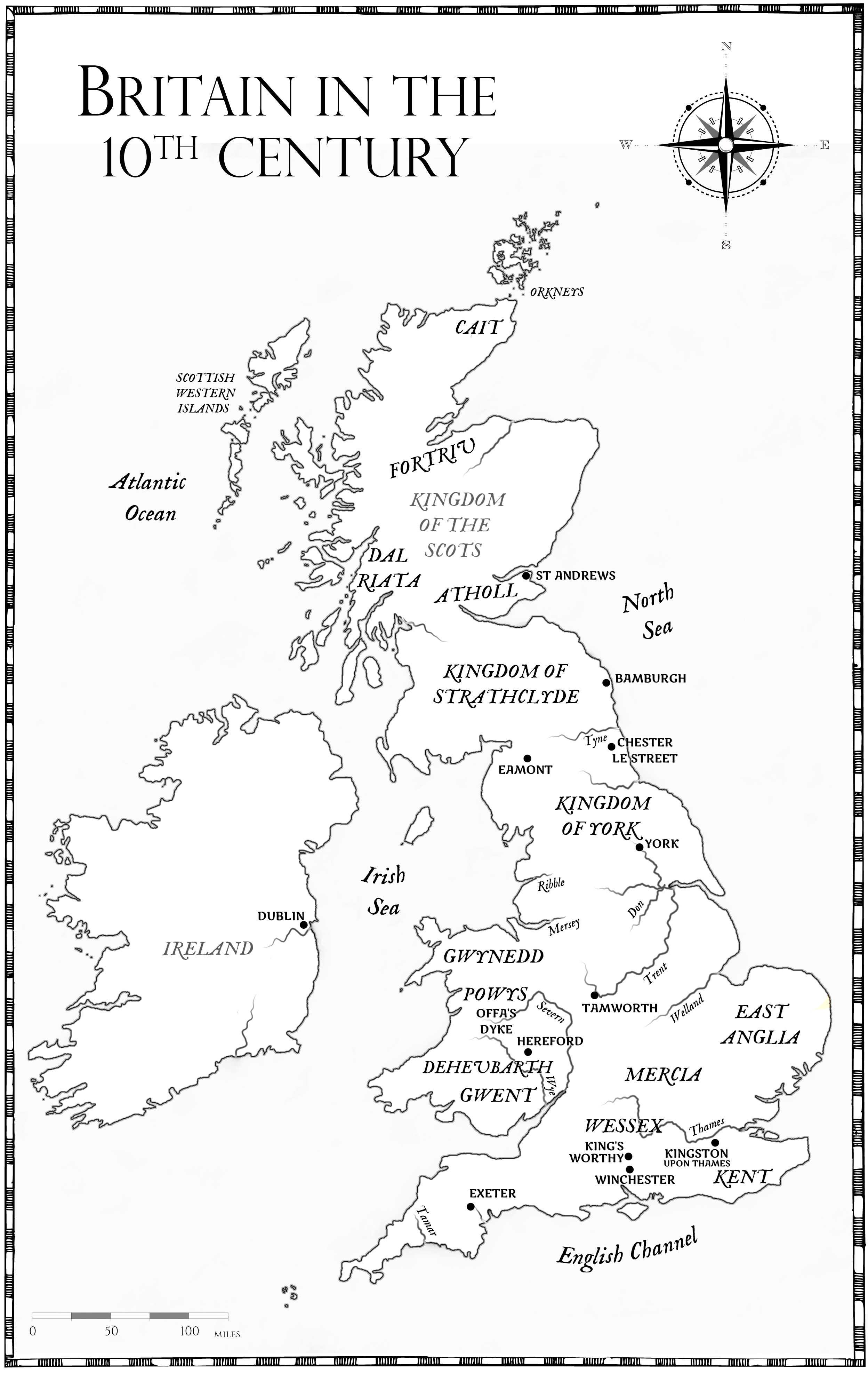
King of Kings. with its five kingdoms, and one alliance, might need some explanation. To help my readers understand who everyone is, and importantly, where everyone is, King of Kings has a map and a genealogical table, as well as a cast of characters.
Map designed by Shaun at Flintlock Covers
And because the family of King Alfred is so important to the story, I also have a genealogical table to share with my readers.
Design by Boldwood Books
I’ve written some brief introductions for the main cast of characters.
And for those who are falling in love with the period as much as I am, I wanted to share some non-fiction recommendations, and cautions.
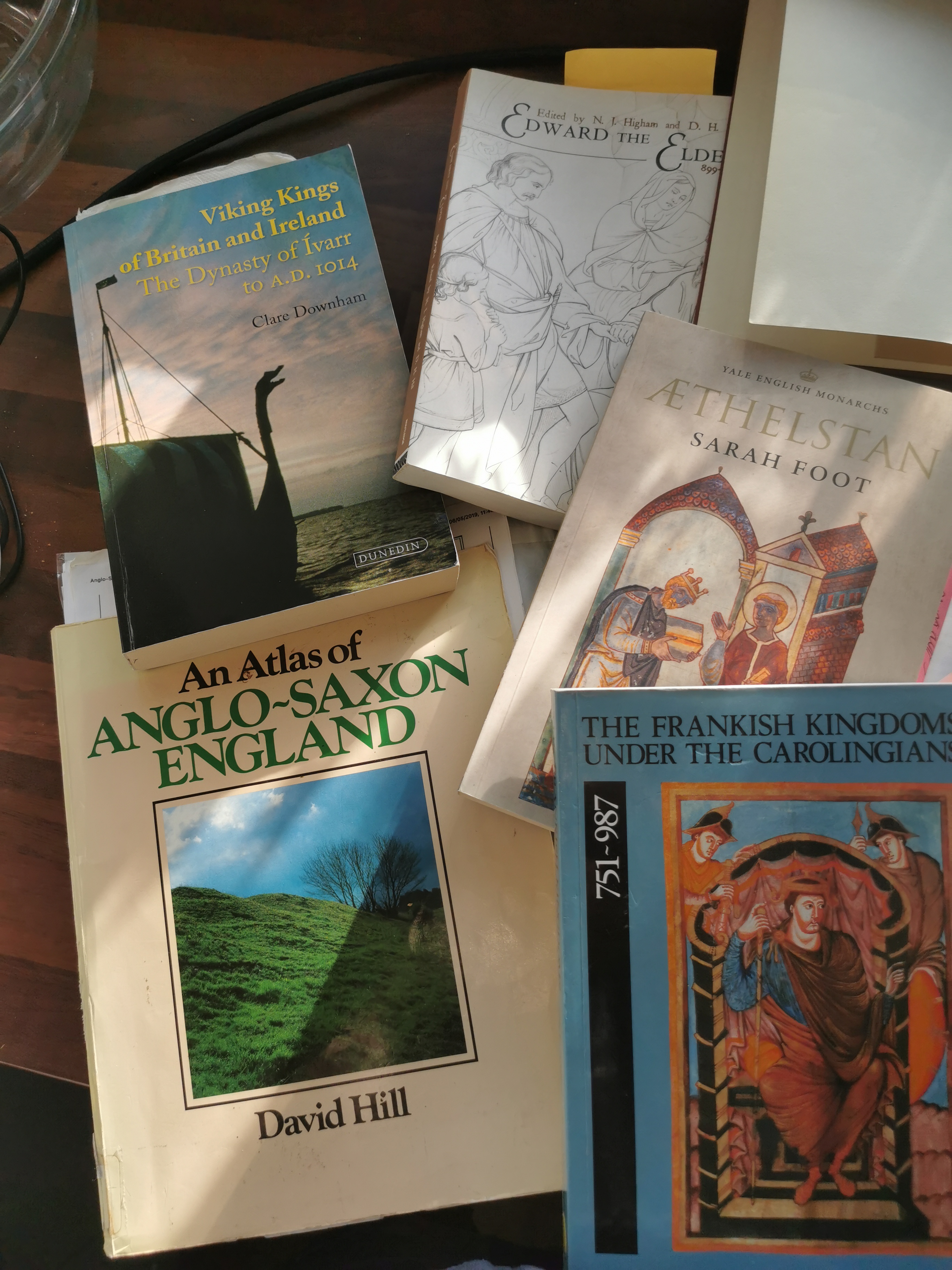
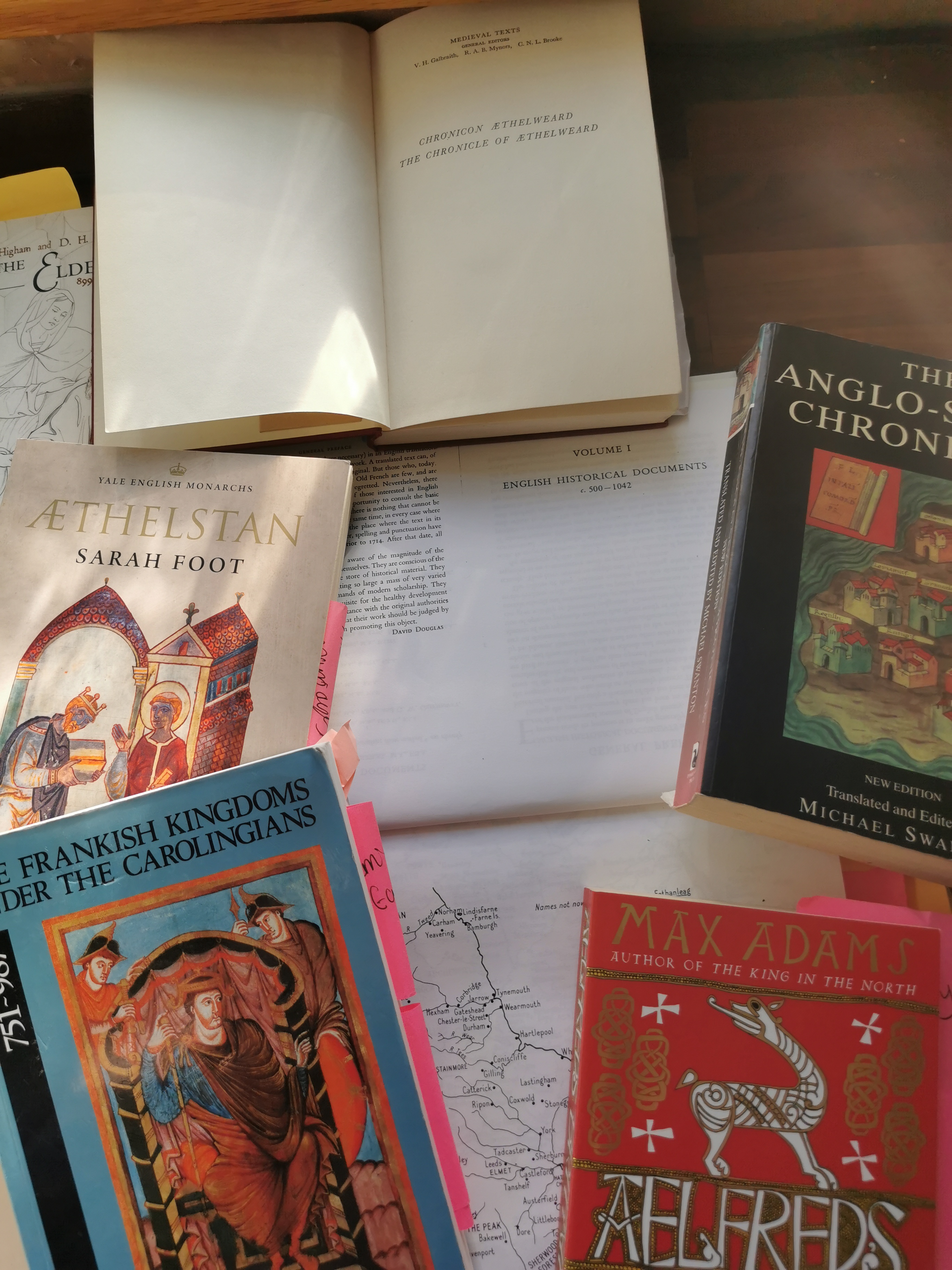
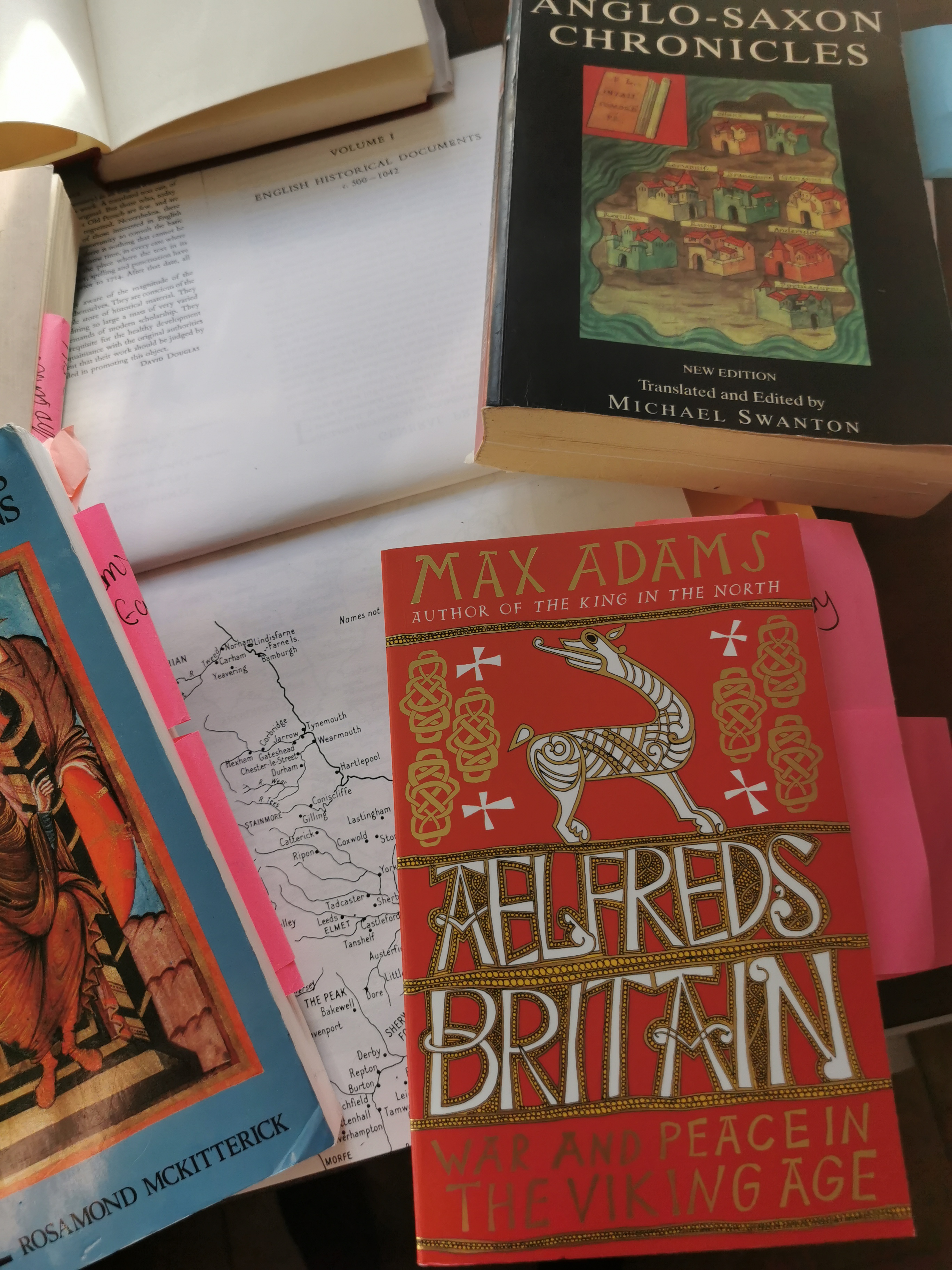
There is no one book that will adequately cover this period (that was one of the reasons that I fictionalised it) but these books (see photos below), along with Dr. Kari Maund’s The Welsh Kings, which I have in ebook, will give you a good grounding of events in Britain and Ireland. So, these are
Alfred’s Britain by Max Adams
Athelstan by Sarah Foot
The Anglo-Saxon Chronicles ed and trans. Michael Swanton (other versions available – I like the formatting of this one -with the different recensions)
The Welsh Kings by Kari Maund
An Atlas of Anglo-Saxon England by David Hill (don’t be put off by the fact this book is from the 1970s – it is invaluable)
From Pictland to Alba 789-1070 by Alex Woolf
Viking Kings of Britain and Ireland by Claire Downham
English Historical Documents ed and trans by Dorothy Whitelock
The Frankish Kingdom under the Carolingians by R McKitterick
Edward the Elder ed. Higham and Hill (not a narrative account, but historians writing papers about their area of interest and expertise).
There are also two very important online resources.

































 MJ Porter