Author of Saxon historical fiction and non-fiction, 20th-century historical mysteries, and Norse-inspired historical romantasy. Book reviewer and blog host.
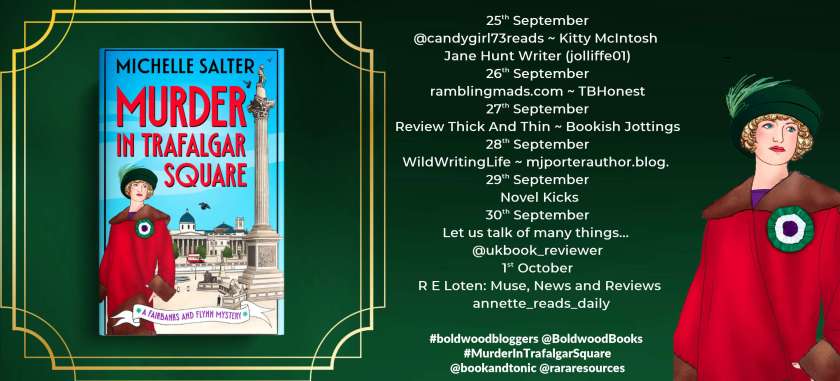
I’m delighted to share my review for Murder in Trafalgar Square by Michelle Salter, the first book in a new historical mystery series #historicalmystery #cosycrime #highlyrecommended
#BoldwoodBloggers @BoldwoodBools #MurderInTragalgarSquare @rararesources @bookandtonic
Here’s the blurb
Discover a BRAND NEW page-turning cosy mystery series from Michelle Salter A murdered suffragette. A missing politician. A stolen artwork.
London, 1910
Coral Fairbanks is a contradiction. As well as a suffragette, she’s a bit-part actress and nude model, earning her the disapproval of her fellow suffragettes.
Guy Flynn is an artist. He’s also a detective inspector at Scotland Yard, who doesn’t always see eye to eye with fellow officers in the Metropolitan Police.
When Home Secretary Winston Churchill orders the police to terrorise the suffragettes during an afternoon of violence that becomes known as Black Friday, the battlelines are drawn – and Coral Fairbanks and Guy Flynn are on different sides.
But when a young suffragette is found murdered in the National Portrait Gallery and one of their paintings is stolen – Fairbanks and Flynn must put their differences aside and combine their knowledge to track down the killer.
Introducing an iconic detective duo in Fairbanks and Flynn, this is an exciting and gripping historical mystery, which will delight fans of Agatha Christie, Benedict Brown and T. E. Kinsey
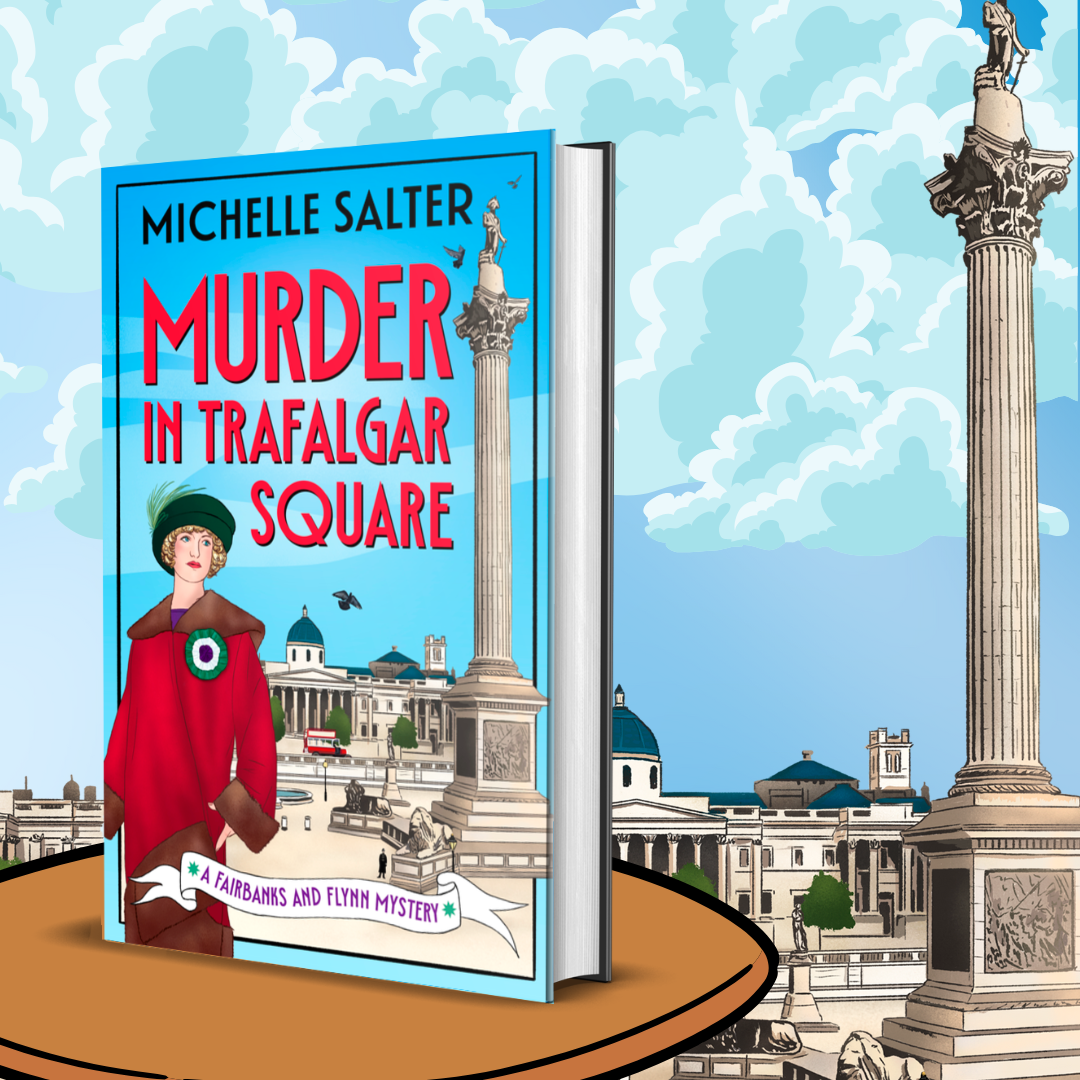
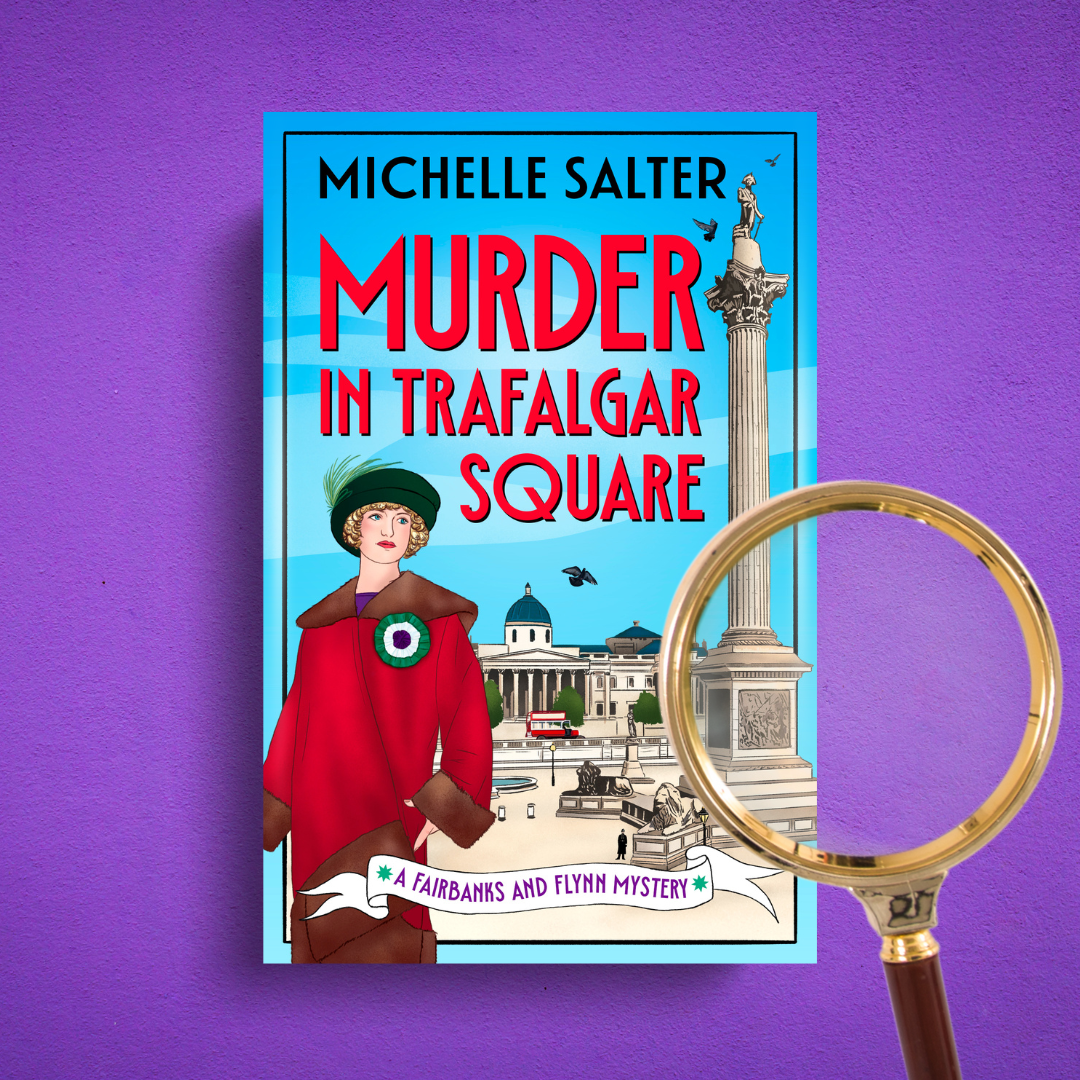
Murder in Trafalgar Square is the first book in Michelle Salter’s new mystery series, set in 1910, and what a fabulous first entry into a series it is.
For this series we have two main characters, Cora, a young widow who is a suffragette, works in a gallery and has also been an actress but is currently deemed, at 36, to be too old to play the ingenue on stage, and too young to be a harridan. (I sense we’re still not really that far beyond that even now).
Guy Flynn, our detective inspector, is equally a many layered individual, also a widower with a daughter to raise alone, and he’s a painter too. The pair have some lovely facets to their characters and they make for an intriguing duo as we read chapters from alternative points of view. They’re flung together when a body is found at the National Gallery and it makes all the headlines, as opposed to the suffragette stunt with a most amusing painting (I’m not spoiling it).
The mystery unfolds at a good pace, as Cora and Guy endeavour to unpick the information they gain, while endeavouring to stay on the right side of the government.
This is such a fabulous new book, and I’m so excited to read more of Cora and Guy. I love the Iris Woodmore series by the author, but it’s possible I might love this one even more.
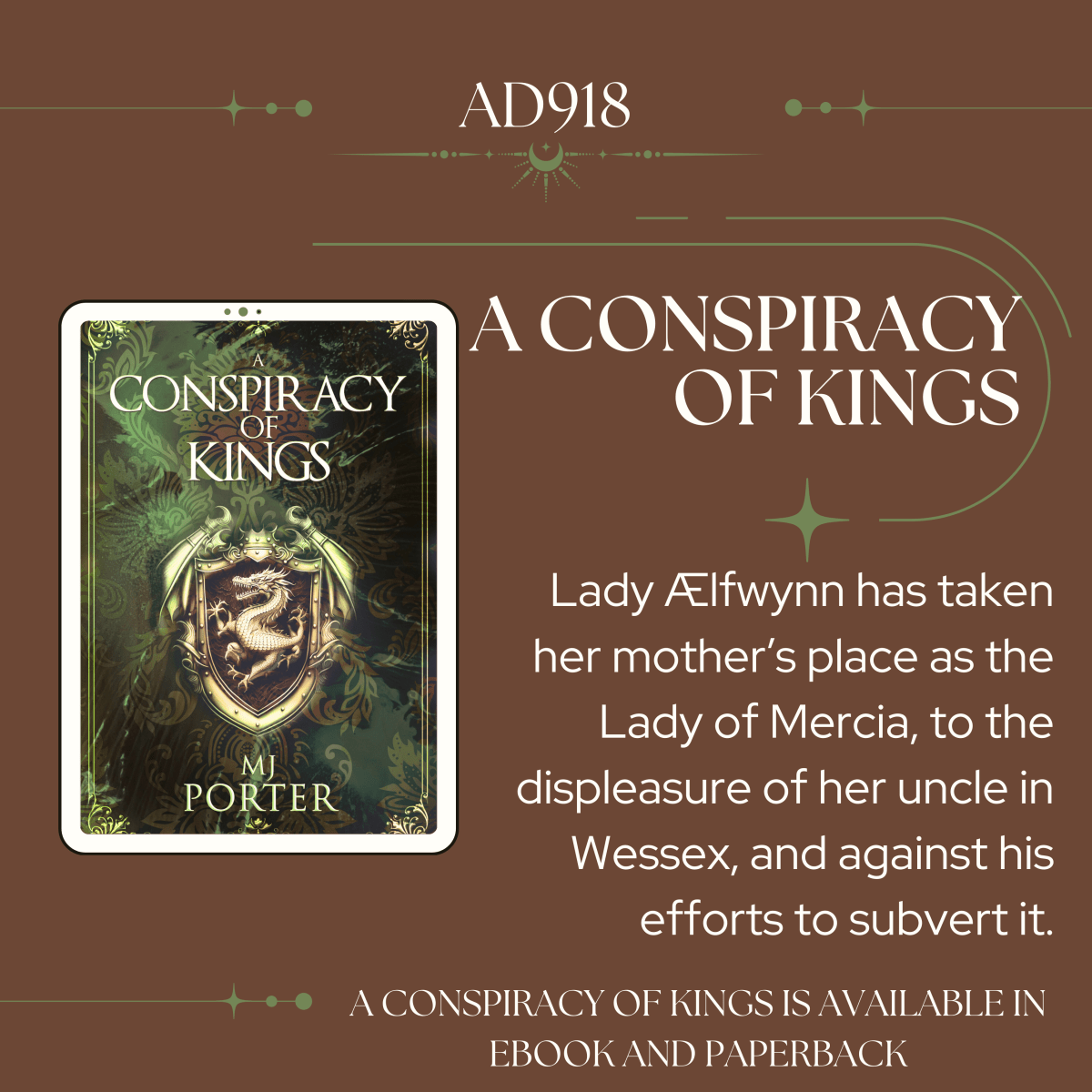
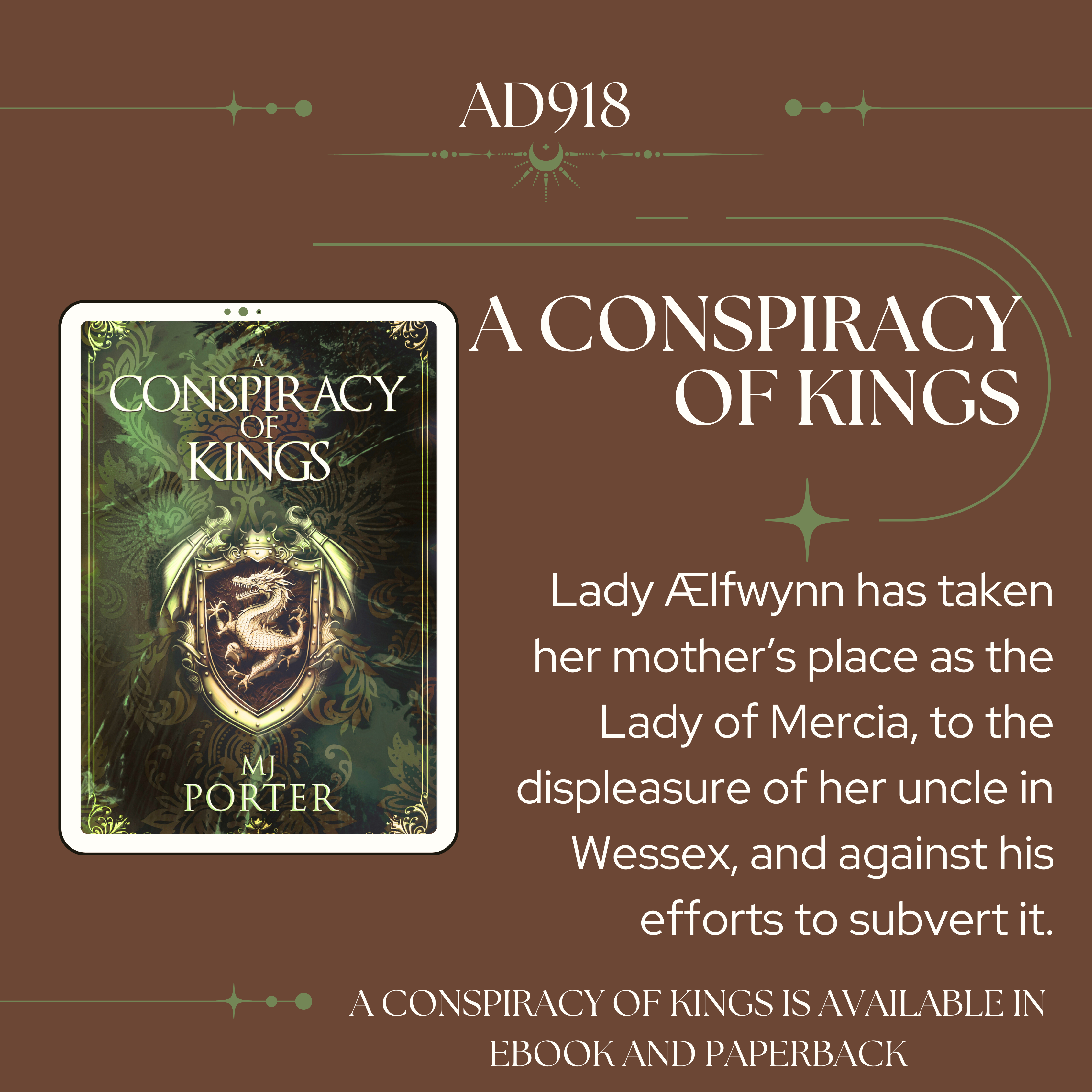
A Conspiracy of Kings – a little bit of history (may contain spoilers for my fictional recreation of Lady Ælfwynn
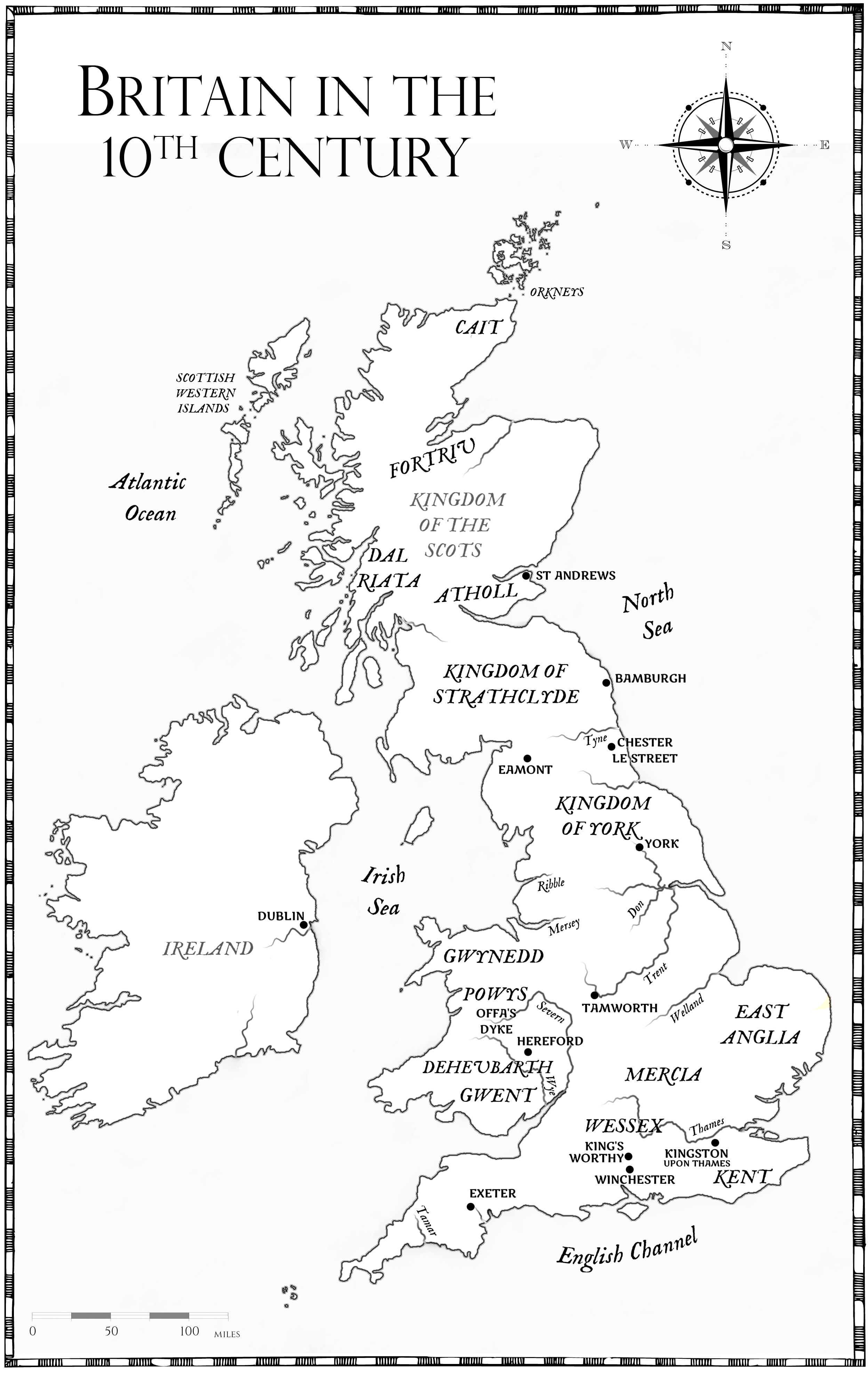
In the sequel to The Lady of Mercia’s Daughter, the story of Lady Ælfwynn continues. She is The Second Lady of Mercia, but everything isn’t as it seems. In the various recensions of The Anglo-Saxon Chronicles, an attempt can be made to piece together what befalls her.
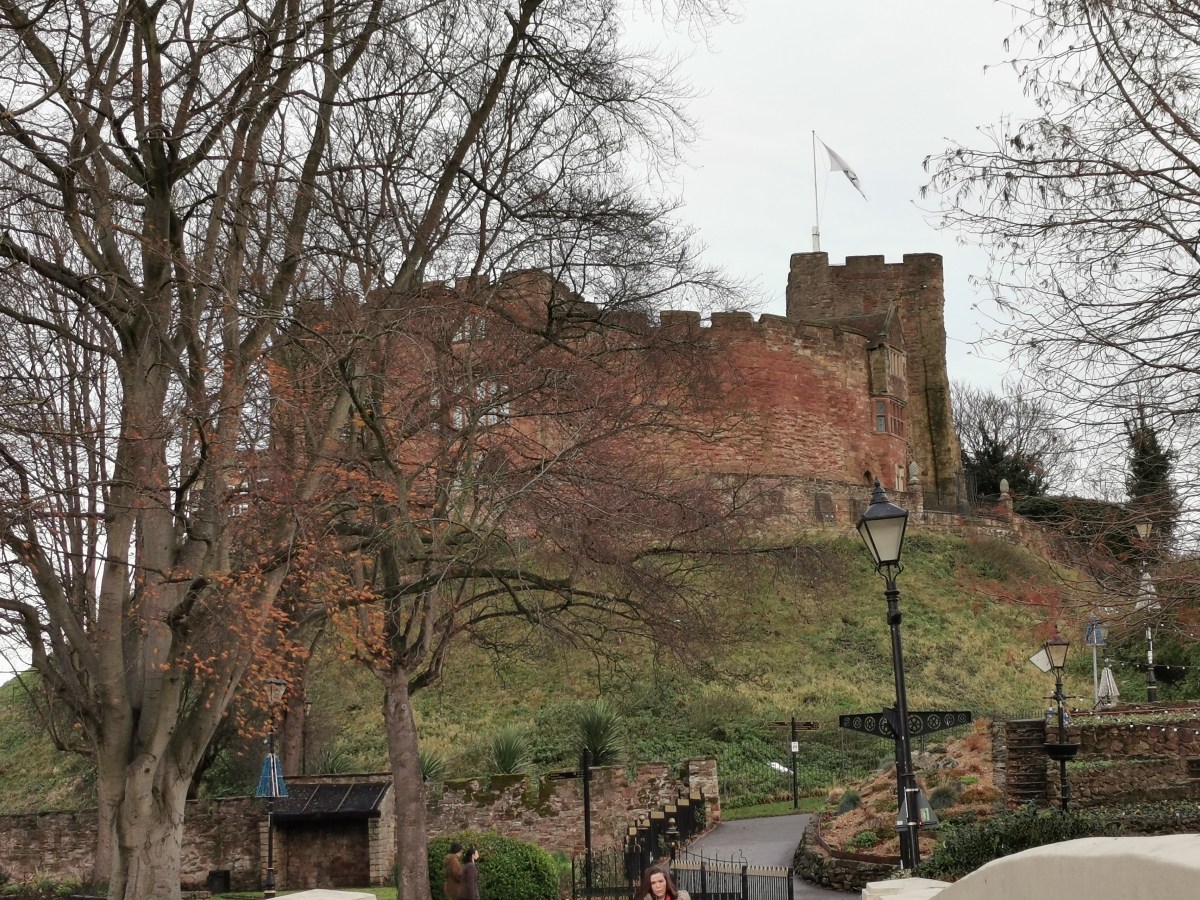
The Anglo-Saxon Chronicle A version doesn’t mention Ælfwynn at all but instead has King Edward of Wessex/the Anglo-Saxons taking control of Tamworth as soon as his sister dies in June 918.
The Anglo-Saxon Chronicle E only mentions Lady Æthelflæd’s death in 918 and not what happens immediately after in Mercia. Lady Ælfwynn’s fate, however, is recorded in The Anglo-Saxon Chronicle C. We’re told that she was deprived of all power and ‘led into Wessex three weeks before Christmas.’ This entry is dated 919, although it’s normally taken to mean 918 due to a disparity between the dating in this part of The Anglo-Saxon Chronicle – known as the Mercian Register – where a new year starts in December as opposed to in the Winchester version of The Anglo-Saxon Chronicle where the new year starts in September.
These details are stark, offering nothing further. What then actually happened to Lady Ælfwynn? Was she deprived of her power? Was she deemed unsuitable to rule?
What adds to the confusion surrounding Lady Ælfwynn is that other than this reference in The Anglo-Saxon Chronicle, she doesn’t appear in any of the later sources. It’s as though she simply ceased to exist.
Two intriguing suggestions have been put forward to explain what happened to Lady Ælfwynn, both with some tenous corroboration.
Did she become a nun or, perhaps, a religious woman?
A later charter dated to 948 and promulgated by King Eadred is to an ‘Ælfwyn, a religious woman,’ and shows land being exchanged in Kent for two pounds of purest gold. (S535) There’s no indication that this Ælfwyn is related to our Ælfwynn or even to King Eadred. But, there remains the possibility that it might just have been the same woman, after all, Eadred would have been Ælfwynn’s cousin. Charter S535 survives in only one manuscript.
Alternatively, and based on a later source, Ramsey Abbey’s Book of Benefactors, we learn the following:
‘he [Athelstan Half-King] bestowed marriage upon a wife, one Ælfwynn by name, suitable for his marriage bed as much as by the nobility of her birth as by the grace of her unchurlish appearance. Afterwards she nursed and brought up with maternal devotion the glorious King Edgar, a tender boy as yet in the cradle. When Edgar afterwards attained the rule of all England, which was due to him by hereditary destiny, he was not ungrateful for the benefits he had received from his nurse. He bestowed on her, with regal munificence, the manor of Weston, which her son, the Ealdorman, afterwards granted to the church of Ramsey in perpetual alms for her soul, when his mother was taken from our midst in the natural course of events.’[i]
Which alternative is it?
There are only eight women named Ælfwynn listed in the Prosopography of Anglo-Saxon England (PASE), a fabulous online database. Of these, one is certainly Ælfwynn, the second lady of the Mercians, and one is undoubtedly the religious woman named in the charter from 948. (When the identification is not guaranteed, multiple entries are made in this invaluable online database). The other five women were alive much later than the known years Ælfwynn lived. One of the entries might possibly relate to her, but that’s all the information known about her.
And this is far from unusual for many of the women of the House of Wessex. Some women are ‘lost’ on the Continent. Some are ‘lost’ in England.
‘Were it not for the prologue to Æthelweard’s Latin translation of an Anglo-Saxon Chronicle, we would know of only six tenth-century royal daughters or sisters from early English sources and the names of only four of them. Three of these named ones are nuns or abbesses. Only Ælfwynn, the daughter of Æthelflæd and Æthelred of Mercia, and the two daughters of Edward/sisters of Athelstan who married Otto I and Sihtric of York, appear in the witness lists of charters, though Eadburh, daughter of Edward the Elder, is a grantee of a charter of her brother Athelstan.’[ii]
Reconstructing a ‘possible’ life for Lady Ælfwynn was the inspiration for both The Lady of Mercia’s Daughter and A Conspiracy of Kings, and the potential for family betrayal, politicking, and war with the Viking raiders was just too good an opportunity to miss.
[i] Edington, S and Others, Ramsey Abbey’s Book of Benefactors Part One: The Abbey’s Foundation, (Hakedes, 1998) pp.9-10
[ii] Stafford, P. Fathers and Daughters: The Case of Æthelred II in Writing, Kingship and Power in Anglo-Saxon England, (Cambridge University Press, 2018) p.142
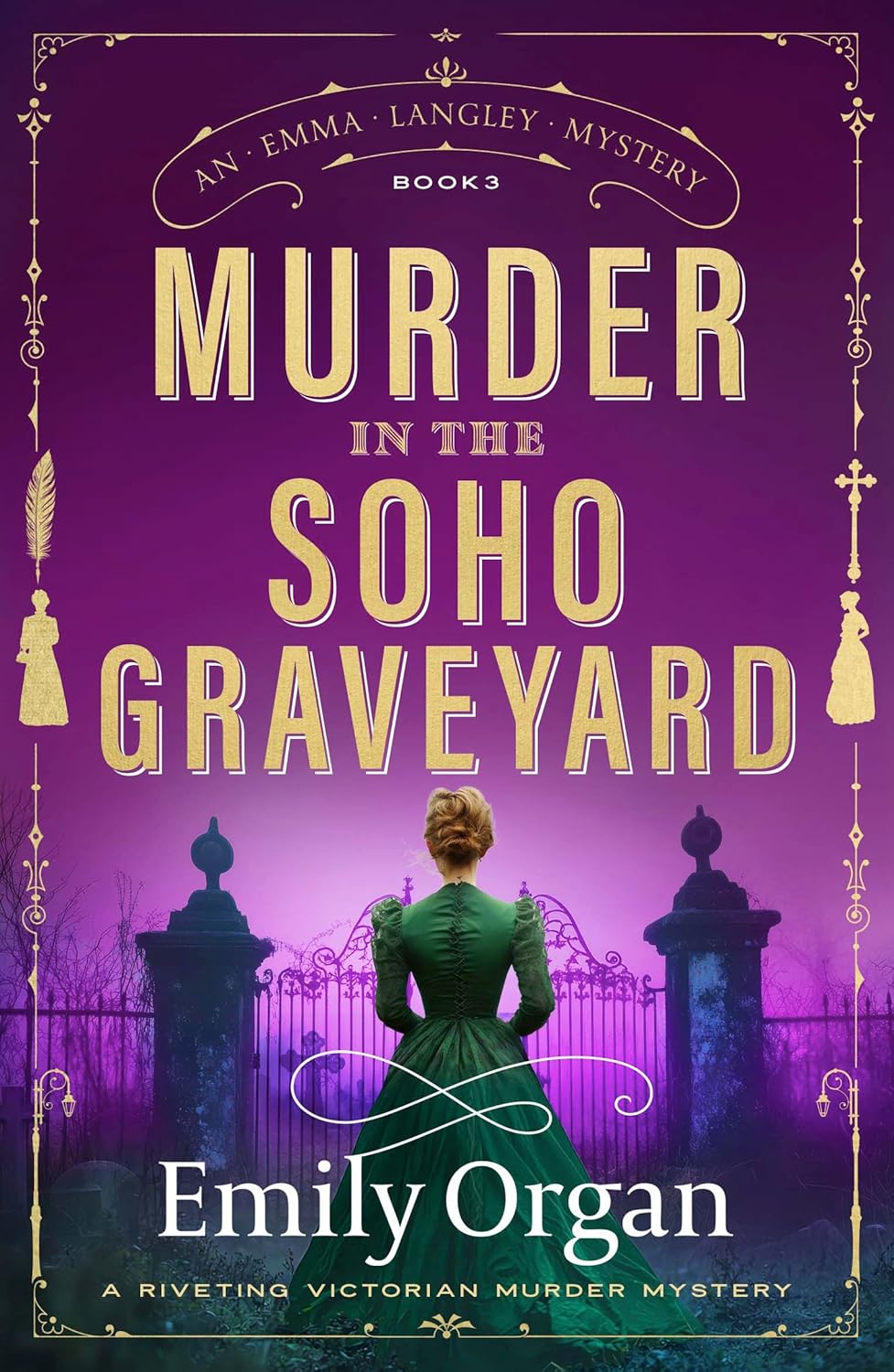
I’m sharing my review for Murder in the Soho Graveyard, a Victorian mystery #histfic #bookreview (as well as reviews for the 1st two books in the series) #mystery
Here’s the blurb
A churchyard discovery. A shocking secret. A deadly confrontation.
London, 1890. When the body of a wealthy widow is found in the neglected graveyard of St Anne’s Church, Soho, Emma Langley and Penny Green soon discover her respectable façade concealed a web of bitter enemies.
From a disgraced doctor stripped of his livelihood to a governess whose reputation was destroyed by lies, the victim, Mrs Melbourne, left a trail of devastation in her wake.
Then Mrs Melbourne’s Belgravia mansion is consumed by a mysterious fire. Emma and Penny must race to decipher water-damaged papers salvaged from the ruins that could hold the key to the truth.
But as anonymous threatening letters arrive warning them to abandon their investigation, the friends realise they’re hunting someone who will kill again to protect their secret. In the shadow-filled streets of Victorian London, can Emma and Penny expose the murderer before they become the next victims?
An atmospheric Victorian mystery that takes you from the crumbling graveyards of Soho to the grand squares of Belgravia – and will keep you reading late into the night.
Murder in the Soho Graveyard is the third book in the Emma Langley Victorian Mystery series. I have read the previous two books in the series (see the reviews lower down the page).
Our two main characters once more find themselves involved in an unexpected mystery, while our cast of regular extras is expanding once more. When Emma comes upon the forlorn figure of a woman sitting on a bench she can’t help but ask if she’s well, and from then, Emma and Penny are determined to help her clear her name of any involvement in the murder of a rather nasty individual, masquerading as an unpright, wealthy Victorian lady while at heart, she’s manipulative and really quite horrible.
There are several suspects, all of them with their own particular axe to grind and the reveal, when it comes, wasn’t at all what I thought it would be.
Murder in the Soho Graveyard is another well-paced and well-plotted Victorian mystery featuring our two amateur sleuths.
If you want to start at the beginning of the series… (which you should!)
The Whitechapel Widow
London hunts the Ripper. A widow hunts her husband’s killer.
London, 1888. While Jack the Ripper’s reign of terror grips the city, Emma Langley’s world shatters when her husband is found murdered in Whitechapel. But grief is quickly overshadowed by a startling discovery: William Langley was not the man she thought she knew.
As panic fills London’s streets, Emma delves into her husband’s secret life, uncovering a web of lies that stretches from glittering society drawing rooms to the seedy gambling dens of the East End. Aided by Penny Green, a former reporter with a nose for trouble, Emma follows a trail of blackmail and corruption.
But exposing her husband’s killer could make her the next victim and in the shadows of gaslit streets, a murderer waits, ready to strike again…
The Whitechapel Widow is a very well-plotted historical mystery set at the time of the attacks by Jack the Ripper in London. The author does a fabulous job of weaving the narrative through known events, and I really enjoyed the mystery elements. Emma is a great new main character, but I also enjoyed the inclusion of Emily’s heroine, Penny Green.
I will certainly be reading more of the series.
The Poison Puzzle
A secret society. A suspicious death. A trail of deadly clues.
London, 1889. When Emma Langley discovers a mysterious symbol in her late husband’s diary, she uncovers a connection to a secretive treasure-hunting group with powerful members. Her investigation takes an unexpected turn when Lord Charles Harpole, a society member, is found dying in his hotel room.
The authorities rule it suicide, but Emma and her friend Penny Green aren’t convinced. As they follow a trail of cryptic clues leading from St. Paul’s Cathedral to Hampton Court, they find themselves caught in a deadly game.
With suspects ranging from the lord’s grieving fiancée to his ambitious brother, Emma must solve the puzzle before the killer claims another victim. But in the fog-shrouded streets of Victorian London, someone will stop at nothing to keep the society’s secrets buried…
Emma Langley returns in this gripping Victorian mystery that weaves historical detail with page-turning suspense.
I very much enjoyed The Poison Puzzle, the second book in the Emma Langley Historical Mystery series, but I must admit, I felt the buildup was somewhat better than the eventual resolution, which fell a little flat for me. That said, I will be continuing the series, as I do adore all the period detail for the books, and I certainly appreciated the research that went into making the treasure hunt feel very authentic.
Why did I write about Lady Eadgifu, the main character in Kingmaker? #histfic #authorinspiration
I don’t really know when I became a fan of historical fiction but I can take a good guess at who, and what, was to blame.
William Shakespeare and Macbeth.
When I was at school, we didn’t get ‘bogged’ down with grammar and spelling in English lessons, oh no, we studied stories, plays, words, and also the ‘motivation’ behind the use of those stories and those words. And it was Macbeth that first opened my eyes to the world of historical fiction.
Yes, Macbeth is a blood thirsty play, and it might be cursed, but more importantly, it’s based on Holinshed’s Chronicle of England, Scotland and Ireland.
Macbeth is nothing better than the first work of historical fiction that I truly read, and understood to be as such. And what a delight it was.
I remember less the story of Macbeth as presented by Shakespeare (aside from the three witches – “when shall we three meet again?” “well I can do next Wednesday,’ (thank you Terry Pratchett for that addition), than working out ‘fact’ from ‘fiction’ in his retelling of the story. And hence, my love of historical fiction was slowly born, and from that, stems my love of telling stories about ‘real’ people and the way that they lived their lives, looking at the wider events taking place, and trying to decide how these might, or might not, have influenced these people.
Shakespeare chose the story of a little-known ‘Scottish’ monarch for his historical fiction; my latest subject is the third wife of King Edward the Elder, again someone that few people have heard of, but whose relative, many years in the future, would have interacted with Macbeth, or rather with Mac Bethad mac Findlaích.
Lady Eadgifu, the Lady of Wessex, lived through a tumultuous time.
Many people studying Saxon England know of King Alfred (died AD899), and they know of his grandson, Æthelred II (born c.AD 968), known as ‘the unready’. But the intervening period is little known about, and that is a true shame.
Lady Eadgifu, just about singlehandedly fills this gap. Born sometime before c.AD903 (at the latest), her death occurred in c.AD964/6. As such, she probably missed Alfred by up to 4 years, and her grandson, King Æthelred by about the same margin.
But what she did witness was the emergence of ‘England’ and the ‘kingdom of the English’ as we know it. And it wasn’t a smooth process, and it was not always assured, and it was certainly never, at any point, guaranteed that England would emerge ‘whole’ from the First Viking Age.
And more importantly, rather than being one of the kings who ruled during this period, Lady Eadgifu was the king’s wife, the king’s mother, or even the king’s grandmother. She would have witnessed England as it expanded and contracted, she would have known what went before, and she would have hoped for what would come after her life. (I think in this, I was very much aware of my great-grandmother who lived throughout almost the entire twentieth century – just think what she would have witnessed).
Lady Eadgifu was simply too good a character to allow to lie dormant under the one event that might well be known about from the tenth century – the battle of Brunanburh. She does also appear in my Brunanburh Series.
So, for those fans of Bernard Cornwell’s ‘Uhtred’ and for those fans of Lady Elfrida at the end of the tenth century, I hope you will enjoy Lady Eadgifu. She was a woman, in a man’s world, and because she was a woman, she survived when men did not.
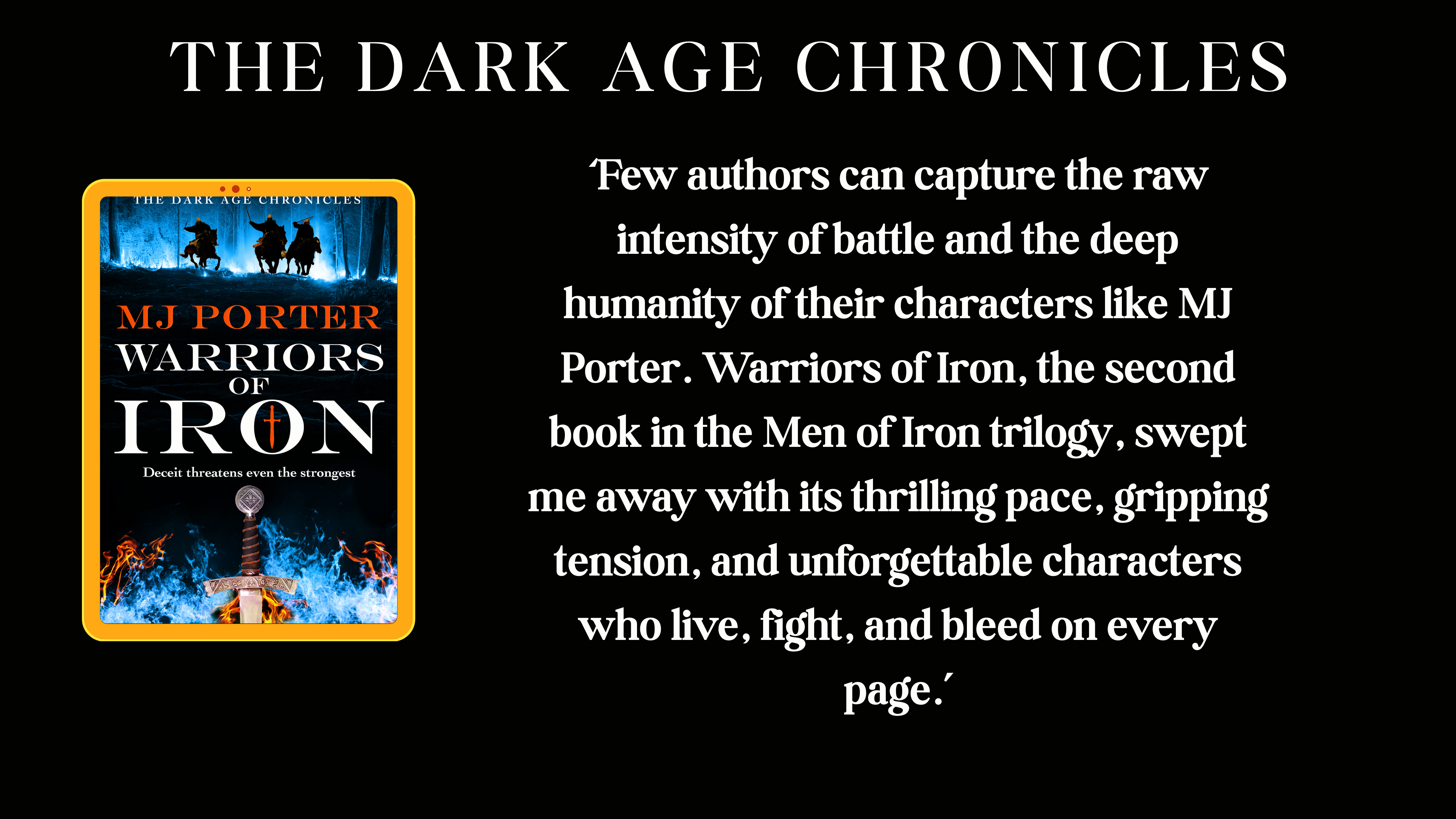
Come with me to Great Witcombe #newrelease #MenOfIron #WarriorsOfIron #histfic
Great Witcombe Roman Villa
Great Witcombe Roman Villa is no longer open to the public, but it is managed by English Heritage, and it’s possible to get a glimpse of it, although you do need to be careful. I think it’s currently closed due to safety concerns, so be mindful, and stay behind all the barriers, especially as the location is pretty remote.
From what I could see of the remains of Great Witcombe Roman Villa, it does seem to have been set in a beautiful place, and it quite appealed to me. I relied heavily on the idea of the location when devising the home for one of the tribes that features in the Dark Age Chronicles. (It probably helped that I visited on a lovely sunny day.)
Letter writing in the Eleventh Century, how I recreated Lady Estrid’s connections with her vast family. #non-fiction #histfic
In trying to bring together the narrative for Lady Estrid, I faced a bit of a problem: the vast distances involved. Lady Estrid had family in England, Denmark, Sweden and Norway, many of them she may never have met in person.
Today, we might pick up the phone, or have a quick look on the internet, but in the eleventh century, how would people have communicated?
And so to letter writing. There are two surviving letters from the eleventh-century that were sent by King Cnut, Estrid’s brother, to the English, when he was absent from his newly conquered country, in AD1020 and AD1027. I give a small example below.
;Be it known therefore to all of you, that I have humbly vowed to the Almighty God himself henceforward to amend my life in all respects, and to rule the kingdoms and the people subject to me with justice and clemency, giving equitable judgments in all matters; and if, through the intemperance of my youth or negligence, I have hitherto exceeded the bounds of justice in any of my acts, I intend by God’s aid to make an entire change for the better.’ From Cnut’s letter to the English from AD1027.
These might well have been an exercise for Cnut in asserting his authority over the English, and giving his regents a little bit of extra support, but they open up the possibility of just who else was busy writing and sending letters to one another.
There’s always the assumption that unless you were a holy man, you perhaps couldn’t read or write, and in fact, in one of the books I referenced for Lady Estrid, I found a fascinating chart detailing people who are known to have been used by the ruling family of Normandy as messengers, another way that messages could be sent between people. But surely, sometimes, it was just better to write everything down, that way nothing could be lost in translation.
Without the possibility of Lady Estrid ever meeting some members of her family, using letter writing allowed me to artificially create conversations between the characters, and while it might not have been the ‘norm’ it was certainly something that happened. Indeed, three centuries earlier, there’s a great wealth of information to be found in the letters of Alcuin of York (c735-804), so it wasn’t as though it was a new thing. With Denmark’s conversion to Christianity, there would have been a ready selection of scribes just waiting to note down Lady Estrid’s frustrations and complaints, even if she didn’t pen them herself.
Here’s an example of one of Estrid’s letters I create in the book.
Dearest Mother, Lady Sigrid. Queen of Denmark.’
‘This marriage doesn’t agree with me. How could you agree to it? I trusted you more than any other to understand how difficult it would be to be forced to live amongst strangers. I relied on you to argue with my father about the necessity of the union.’
And don’t tell me I will one day be the queen of the Rus, as my father planned. Prince Ilja is not a strong man. I don’t foresee him living long. Not at all. The poor man. He has barely been able to consummate our union. I hope I will not carry his child. It will be weak and feeble, and I will not tolerate such.’
My children will be strong and powerful. One day, it is they who will be kings and queens. But these children will not be shared with Prince Ilja. I am sure of it.’
And even if he were to survive, his brothers are a treasonous coven. None of them wishes the other to succeed at their expense. I foresee only bloodshed and paranoia when Ilja’s father is dead.’
Frida is my only friend and ally, reminding me of home. I hope to return to Denmark one day. I never imagined leaving her. I miss her. The kingdom of the Rus is not the same. Not at all.’
Send me news of my father and brothers. I wish to know if my father has finally triumphed in England over King Æthelred. I should like to know that he didn’t callously send me away without so much as seeing me in person for no good reason, because he was absent, in England, as so often the case. If he fails in England again, I will never forgive him for his actions towards me.’
Your despairing daughter, Lady Estrid Sweinsdottir, from Kiev.’
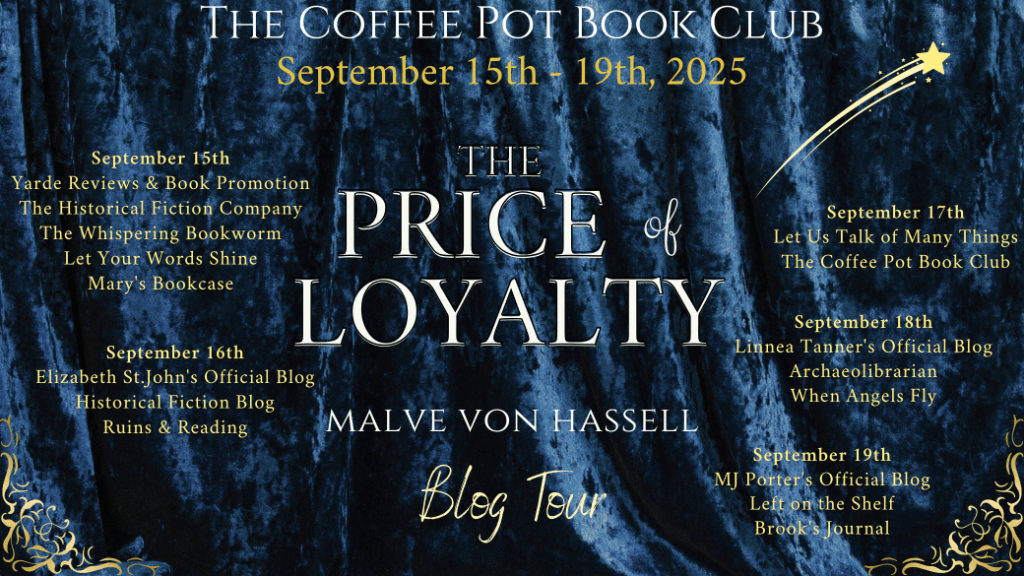
I’m delighted to welcome Malve von Hassell and her new book, The Price of Loyalty, to the blog #HistoricalFiction #medieval #France #crusades #AdelaofBlois #WilliamtheConqueror #StephenHenrydeBlois #BlogTour #TheCoffeePotBookClub
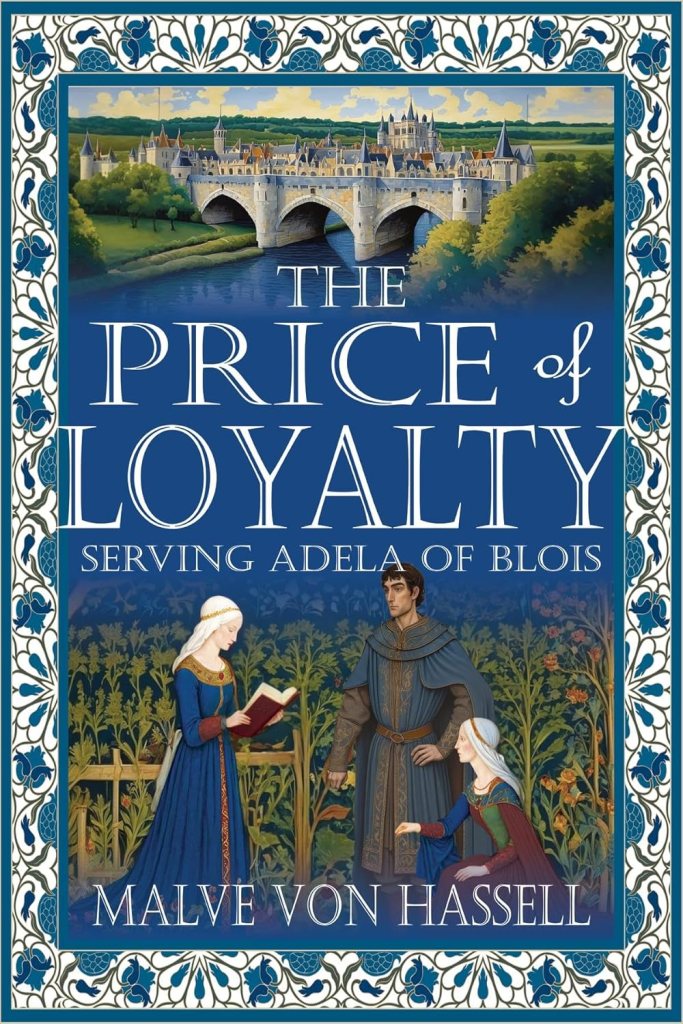
I’m delighted to welcome Malve Von Hassell and her new book, The Price of Loyalty: Serving Adela Bois, to the blog with an excerpt.
Excerpt
Caught In The Snare
1103 Caen
“But, my lady, any of your knights could do this.”
Cerdic had never yet been so frustrated and angry. Adela wanted him to take her son Theobald to her brother-in-law Hugh of Troyes. And she had mentioned another unspecified task. Certainly, she was a widow, and she needed friends around her whom she could trust. But she had other advisors, and for an errand like this, she surely could find someone else. Was he going to be at her back and call indefinitely?
“Theobald has known you all his life. It would be good for him to spend time with you. It has not been easy for him and his brothers.” Adela avoided his eyes. “My brother-in-law is a good man and the right person to take charge of a growing boy, especially now that he has lost his father. Moreover, Hugh and his wife Constance haven’t been blessed with children. Theobald is his heir designate. It is time that Theobald learns everything he needs to know for his future station and duties in life.”
Cerdic stared at her, at a loss for words.
“I can’t and don’t want to ask anybody else. I trust you.”
Cerdic bowed. In truth, he could hardly go on protesting.
Several weeks later, he was back on the road in the company of a surly twelve-year-old boy. For the first hour, they rode in silence. It was early December, and the first hoar frost had turned everything dull and brown. They had to ride north and west toward Troyes; Champagne was a large county, and it would take them about two days.
Theobald had bowed to his mother and ducked out of her embrace. He had mounted his horse without acknowledging Cerdic. He was slender and fine-boned; it didn’t look as if he would have his father’s sturdy build as an adult. His curly hair peeking out underneath his woolen cap was dark brown, not the reddish hue of his grandfather and his uncles. He rode with his head bent and his shoulders hunched.
Guisbert was ten, Cerdic thought with a pang, not much younger than this boy. Would he even recognize his father?
The first words they exchanged were when Cerdic’s horse started limping, and Cerdic had to stop to check the hooves. A stone had worked its way underneath one shoe. Fortunately, Cerdic could pick it out.
“Tell you what.” Cerdic straightened up. The boy’s expression was sullen and slightly hostile. “I don’t trust this shoe, and I don’t want the bay to go lame on me. Let’s walk for a bit. The next village isn’t too far from here, and we’ll find a blacksmith there.”
So they walked, leading the horses. “What are the roads like in the Holy Land?” Theobald asked after a while.
Cerdic didn’t think that the boy really cared about the roads, but it was an opening. “Would you believe it? Some are a lot better than the roads here. Others again are nothing but sand and rocks.”
Theobald was silent. They continued walking.
Then Theobald cleared his throat. “You were with my father, weren’t you?”
“Yes, I was,” Cerdic responded cautiously. “What did your mother tell you?”
“Nothing.” The boy jerked on his horse’s rein so that the surprised animal flung his head up and snorted. “Sorry,” Theobald whispered to the horse. “My mother told me nothing other than that he’s dead. I can’t talk to her about it.”
Cerdic frowned, inwardly cursing Adela. So, that’s why she sent him on this journey.
Here’s the Blurb
In a time of kingdoms and crusades, one man’s heart is the battlefield.
Cerdic, a Saxon knight, serves Count Stephen-Henry of Blois with unwavering loyalty-yet his soul remains divided. Haunted by memories of England, the land of his childhood, and bound by duty to King William, the conqueror who once showed him mercy, Cerdic walks a dangerous line between past and present, longing and loyalty.
At the center of his turmoil stands Adela-daughter of a king, wife of a count, and the first to offer him friendship in a foreign land. But when a political marriage binds him to the spirited and determined Giselle, Cerdic’s world turns again. Giselle, fiercely in love with her stoic husband, follows him across sea and sand to the holy land, hoping to win the heart that still lingers elsewhere.
As the clash of empires looms and a crusade threatens to tear everything apart, Cerdic must confront the deepest truth of all-where does his loyalty lie, and whom does his heart truly belong to?
Malve von Hassell is a freelance writer, researcher, and translator. She holds a Ph.D. in anthropology from the New School for Social Research. Working as an independent scholar, she published The Struggle for Eden: Community Gardens in New York City (Bergin & Garvey 2002) and Homesteading in New York City 1978-1993: The Divided Heart of Loisaida (Bergin & Garvey 1996). She has also edited her grandfather Ulrich von Hassell’s memoirs written in prison in 1944, Der Kreis schließt sich – Aufzeichnungen aus der Haft 1944 (Propylaen Verlag 1994).
Malve has taught at Queens College, Baruch College, Pace University, and Suffolk County Community College, while continuing her work as a translator and writer. She has published two children’s picture books, Tooth Fairy (Amazon KDP 2012 / 2020), and Turtle Crossing (Amazon KDP 2023), and her translation and annotation of a German children’s classic by Tamara Ramsay, Rennefarre: Dott’s Wonderful Travels and Adventures (Two Harbors Press, 2012).
The Falconer’s Apprentice (namelos, 2015 / KDP 2024) was her first historical fiction novel for young adults. She has published Alina: A Song for the Telling (BHC Press, 2020), set in Jerusalem in the time of the crusades, and The Amber Crane (Odyssey Books, 2021), set in Germany in 1645 and 1945, as well as a biographical work about a woman coming of age in Nazi Germany, Tapestryof My Mother’s Life: Stories, Fragments, and Silences (Next Chapter Publishing, 2021), also available in German, Bildteppich Eines Lebens: Erzählungen Meiner Mutter, Fragmente Und Schweigen (Next Chapter Publishing, 2022).
Her latest publication is the historical fiction novel, The Price of Loyalty: Serving Adela of Blois (Historium Press, 2025).
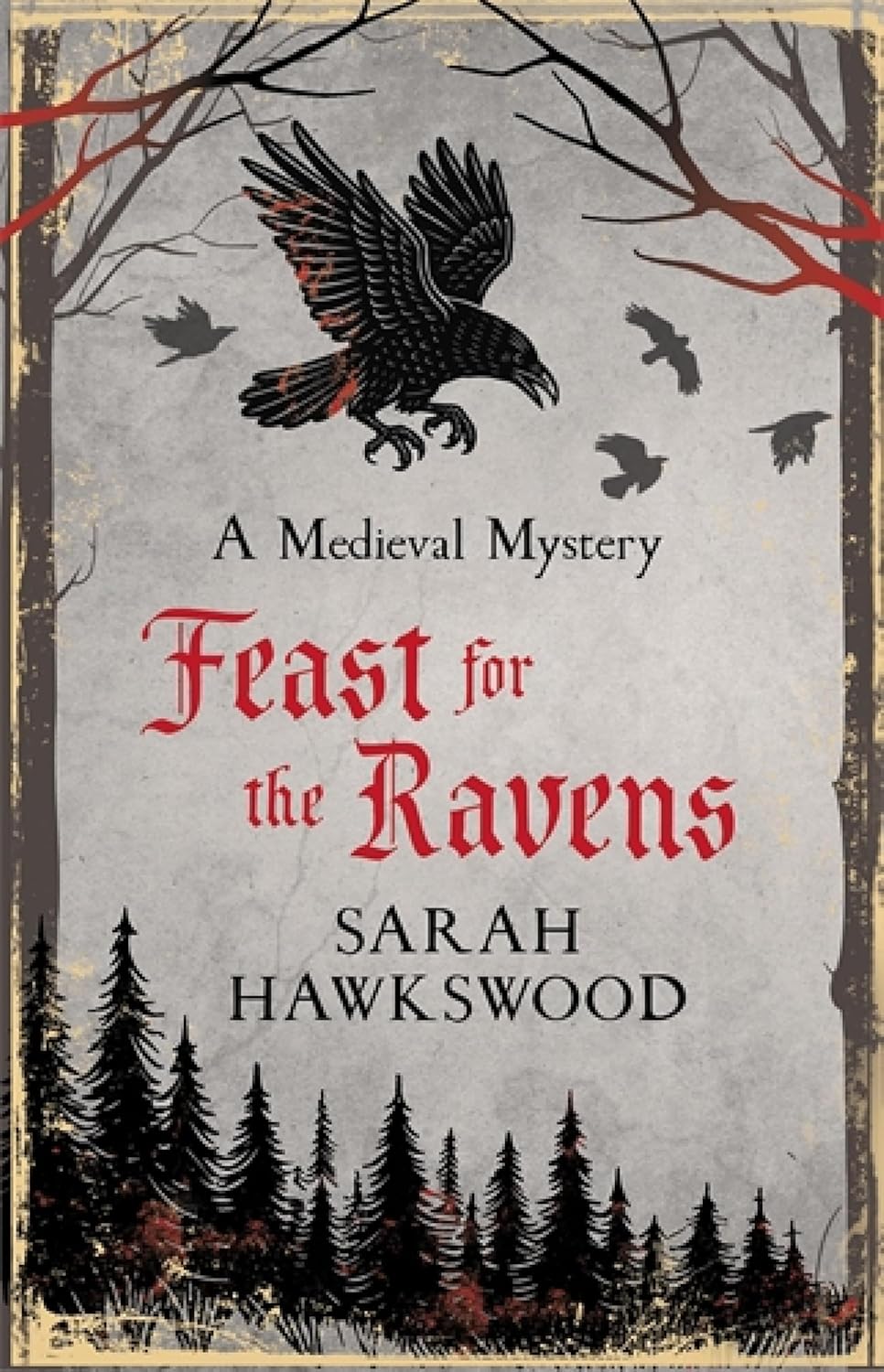
It’s time for a new Bradecote and Catchpoll historical mystery. I’m reviewing Feast for the Ravens by Sarah Hawkswood #historicalmystery #bookreview
Here’s the blurb
Worcestershire, September 1145: A Templar knight is found dead in the Forest of Wyre, clutching a bloodstained document naming a traitor. Undersheriff Hugh Bradecote, Serjeant Catchpoll, and Underserjeant Walkelin must uncover whether the killing was personal, political, or the work of outlaws. They are surprised to find that the locals believe the killer to be the Raven Woman, a mythical shape-shifter said to haunt the woods. Then the knight is identified as Ivo de Mitton – believed to have long ago murdered his own kin – and the mystery deepens.
As the trio dig through legend and lies, they must determine the truth and bring a cunning killer to justice.
Sarah Hawkswood’s medieval mysteries are some of my favourite books. I wish I could savour them when they’re released once a year, but I find myself reading far too quickly.
Her main characters, Bradecote, Catchpoll and Wakelin are determined and intrepid in their desire to solve each mystery presented to them, and the same applies for Feast for the Ravens.
When our dead man is found in the woodlands, it seems impossible that any will recognise him, but slowly a devastating tale of treachery, revenge and cunning is revealed as our intrepid investigative trio work hard to determine who is being truthful, and who less so. The tale quickly turns quite dark and is filled with peril, although not, thankfully, for our sleuthing threesome. All the usual characters benefit from a brief mention, and this tale is firmly grounded in the political conspiracy of the reign of King Stephen and Empress Matilda. A great deal is at stake if the truth is not discovered.
I adore this series. I have long grown used to the author’s decision to have her characters speak and think in ‘ye olde worlde’ way, and it enhances the atmosphere of these books.
If you’ve not started the series, then you can start with this book, but I would highly recommend stepping back a few titles, if not to the very beginning of the series (which I think you can enjoy when you know the characters better) to fully immerse yourself in this twisty, dark and perilous medieval mystery.
Check out my reviews for other books in the series (I have read them all)
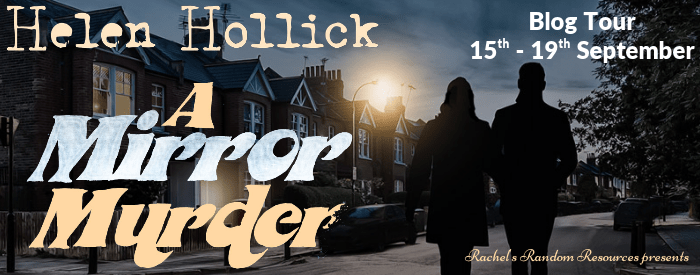
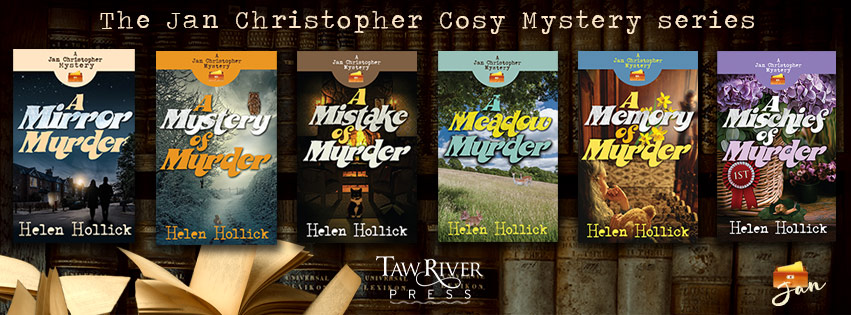
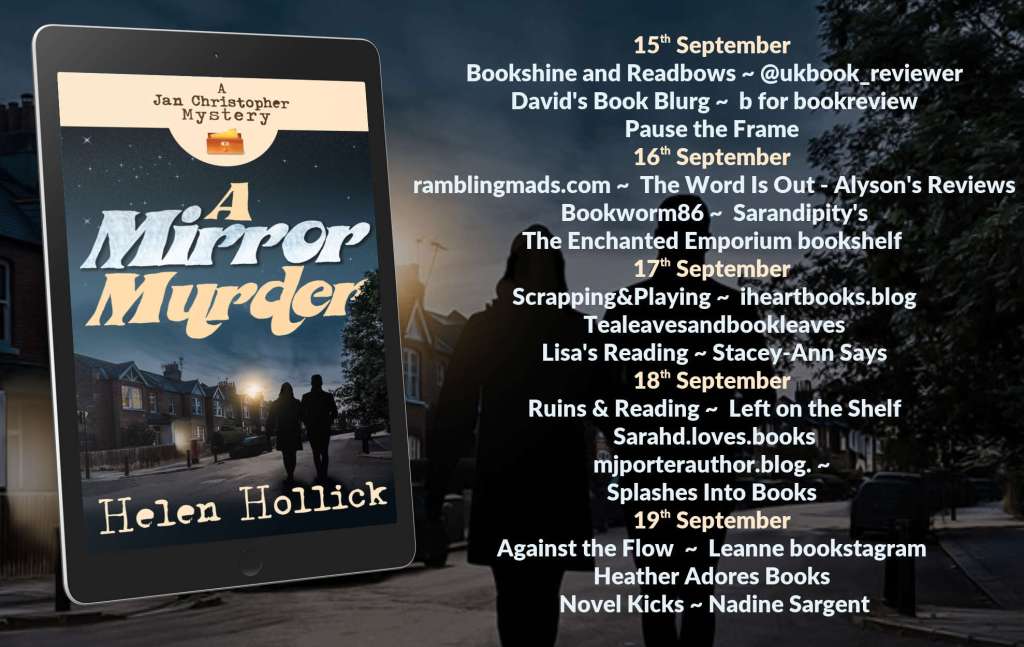
I’m sharing my review for A Mirror Murder, the first book in a delightful 1970s cozy mystery series by Helen Hollick #bookreview #mystery #blogtour
Here’s the blurb
A Mirror Murder – First In The Jan Christopher Cozy Mystery Series
The first in a series of quick-read, cozy mysteries set during the 1970s in North East London and North Devon, featuring the characters of Jan Christopher, her Aunt Madge, her uncle, DCI Toby Christopher and romantic interest DC Lawrence Walker – plus several other endearing, regular characters.
The background of Jan’s career as a library assistant is based on the author’s own library years during the 1970s, using many borrowed (often hilarious!) anecdotes, her life in suburban north east London on the edge of Epping Forest, and her present life in rural North Devon…
July 1971 Eighteen-year-old library assistant Jan Christopher’s life is to change on a rainy evening, when her legal guardian and uncle, DCI Toby Christopher, gives her a lift home after work. Driving the car, is her uncle’s new Detective Constable, Lawrence Walker – and it is love at first sight for the young couple. But romance is soon to take a back seat when a baby boy is taken from his pram, a naked man is scaring young ladies in nearby Epping Forest, and an elderly lady is found, brutally murdered… Are the events related? How will they affect the staff and public of the local library where Jan works – will romance survive and blossom between library assistant Jan Christopher and DC Walker? Or will a brutal murder intervene?
“I sank into this gentle cosy mystery story with the same enthusiasm and relish as I approach a hot bubble bath, (in fact this would be a great book to relax in the bath with!), and really enjoyed getting to know the central character…” Debbie Young (bestselling cozy mystery author)
“Jan is a charming heroine. You feel you get to know her and her love of books and her interest in the people in the library where she works. She’s also funny, and her Aunt Madge bursts with character – the sort of aunt I would love to have had. I remember the 70s very well and Ms Hollick certainly gives a good flavour of the period.”Denise Barnes (bestselling romance author Molly Green)
“A delightful read about an unexpected murder in North East London. Told from the viewpoint of a young library assistant, the author draws on her own experience to weave an intriguing tale”Richard Ashen (South Chingford Community Library)
“Lots of nostalgic, well-researched, detail about life in the 1970s, which readers of a certain age will lap up; plus some wonderful, and occasionally hilarious, ‘behind the counter’ scenes of working in a public library, which any previous or present-day library assistant will recognise!”Reader’s Review
I do love a cozy crime series, and Helen Hollick’s Jan Christopher stories are fabulous.
As I so often do, I have read the series slightly out of order, and all you sensible people will start with A Mirror Murder, and you are in for a real treat as you read your way through the entire series.
The first book, A Mirror Murder, sets the scene for the series and introduces us to the cast. As someone who loves a really well-written and tightly plotted cosy mystery, I adored this book.
Perfectly evoking the early 1970s, with reference to newspaper events and Jackie magazine, including the cost of chocolate and a bus ticket, as well as some evocative pre-electronic library administration, I thoroughly enjoyed this mystery. It did bring back memories of my school days when I was forced to volunteer in the local library, and they sent us to the depths of the library and let us loose on the card filing system.
South Chingford Library Copyright A Morton.
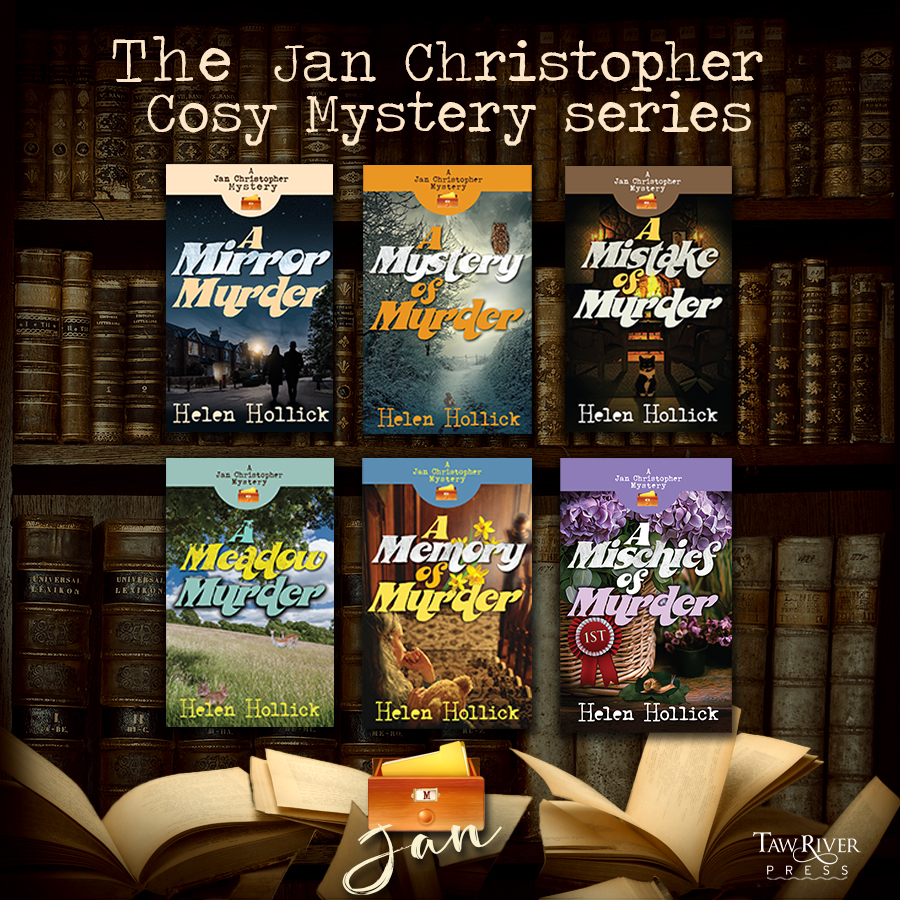
Episode 2: A MYSTERY OF MURDER
set in rural Devon, Christmas 1971
Library Assistant Jan Christopher is to spend Christmas in Devon with her boyfriend, DS Laurie Walker and his family, but when a murder is discovered, followed by a not very accidental accident, the traditional Christmas spirit is somewhat marred…What happened to Laurie’s ex-girlfriend? Where is the vicar’s wife? Who took those old photographs? And will the farmer up the lane ever mend those broken fences?
“There are lots of things to enjoy in the second in the Jan Christopher cosy mystery series” Best-selling cozy mystery author Debbie Young
“A laid back sort of novel, the kind that you can relax while reading, and simply let the story happen. This author has a particularly unique style of writing… this book wasn’t simply a story, but an experience. You almost have the feeling that the author is reading the book to you, and is adding in her own little quips every now and again. I loved every second… The whole mystery is well thought out… utterly amazing!” Review: I Got Lost In A Book Blog
“The pace is gently cosy, despite the murder… Jan is a wonderful character; young, naïve, but also savvy when needed. And Laurie is a gem. All the characters and their foibles and actions stay true to the era… a lovely, warm story.” Review: Ruins & Reading
More in the series:
Episode 3 A MISTAKE OF MURDER
Was murder deliberate – or a tragic mistake?
Episode 4 A MEADOW MURDER
Make hay while the sun shines? But what happens when a murder is discovered, and country life is disrupted?
Episode 5 A MEMORY OF MURDER
A missing girl, annoying decorators, circus performers and a wanna-be rock star to deal with. But who remembers the brutal, cold case murder of a policeman?
Episode 6 A MISCHIEF OF MURDER
The village Flower and Veg Show should be a fun annual event – but who added mischief and murder to the traditional schedule?
Known for her captivating storytelling and rich attention to historical detail, Helen’s historical fiction, nautical adventure series, cosy mysteries – and her short stories – skilfully invite readers to step into worlds where the boundaries between fact and fiction blend together.
Helen started writing as a teenager, but after discovering a passion for history, was initially published in 1993 in the UK with her Arthurian Pendragon’s Banner Trilogy and two Anglo-Saxon novels about the events that led to the 1066 Battle of Hastings, one of which, The Forever Queen (USA title – A Hollow Crown in the UK) became a USA Today best-seller. Her Sea Witch Voyages are nautical-based adventures inspired by the Golden Age of Piracy. She also writes the Jan Christopher cosy mystery series set during the 1970s, and based around her, sometimes hilarious, years of working as a North London library assistant. Her 2025 release is Ghost Encounters, a book about the ghosts of North Devon – even if you don’t believe in ghosts you might enjoy the snippets of interesting history and the many location photograhs.
Helen and her family moved from London to Devon after a Lottery win on the opening night of the London Olympics, 2012. She spends her time glowering at the overgrown garden, fending off the geese, chasing the peacocks away from her roses, helping with the horses and wishing the friendly, resident ghosts would occasionally help with the housework…
What languages were being spoken in Post-Roman Britain? #newrelease #MenOfIron #WarriorsOfIron #histfic
What languages were being spoken in Post-Roman Britain?
As with everything to do with this period of the ‘Dark Ages,’ much was in flux. It’s believed that many languages were spoken by the inhabitants of the island of Britain. From the native Brythonic (also often termed British) who would have spoken a version of Welsh, to the Latin of the Christians, the Old Norse (or even older versions of Old Norse) being spoken by those emigrating to Britannia, as well as Pictish, and potentially other languages as well.
Our only written source commonly believed to be from this period, that of Gildas’ On The Ruin of Britain, was written in Latin, but then, he’s said to have been an educated Christian, raised in the ways of both Rome and Christianity. If he spoke Latin on a day to day basis, I’m unsure. I know scholars complain about his grasp of the written Latin language being somewhat convoluted, but whether that’s due to him, or the way his writings have been transmitted to us through the years, I’m unsure.
How then might these people have communicated with one another if so many different languages were being spoken? There must have been translators who could facilitate trade between the tribes. It would be amazing to discover one of these individuals in the archaeological record, but it seems unlikely.
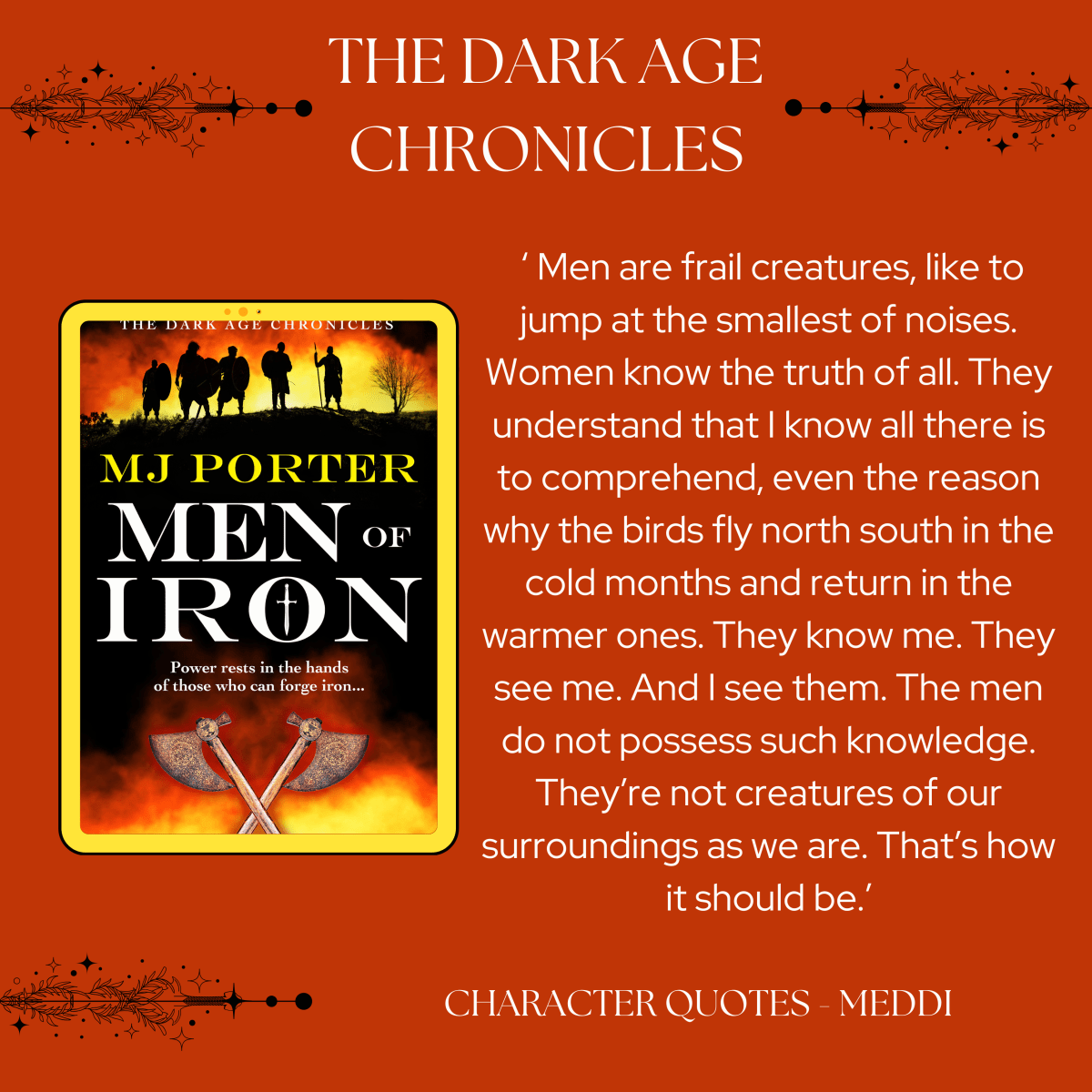
I’ve worked hard to find names for my characters which feel authentic for the period. The Eorlingas have Brythonic names, Meddi has been shortened from Meddiwysti for fear it was impossible to pronounce, whereas Wærmund and his warriors, while having names that feel very Saxon, are, I hope, ones I’ve not used before, and according to the resource I used, are deemed as ‘early’ Saxon names. Other characters also have Latin names, and some have slightly made-up Latinised names i.e. Terricus who was named after one of my readers, who wanted to be a warrior, but became a blacksmith instead. I think he’s still one of my readers:)
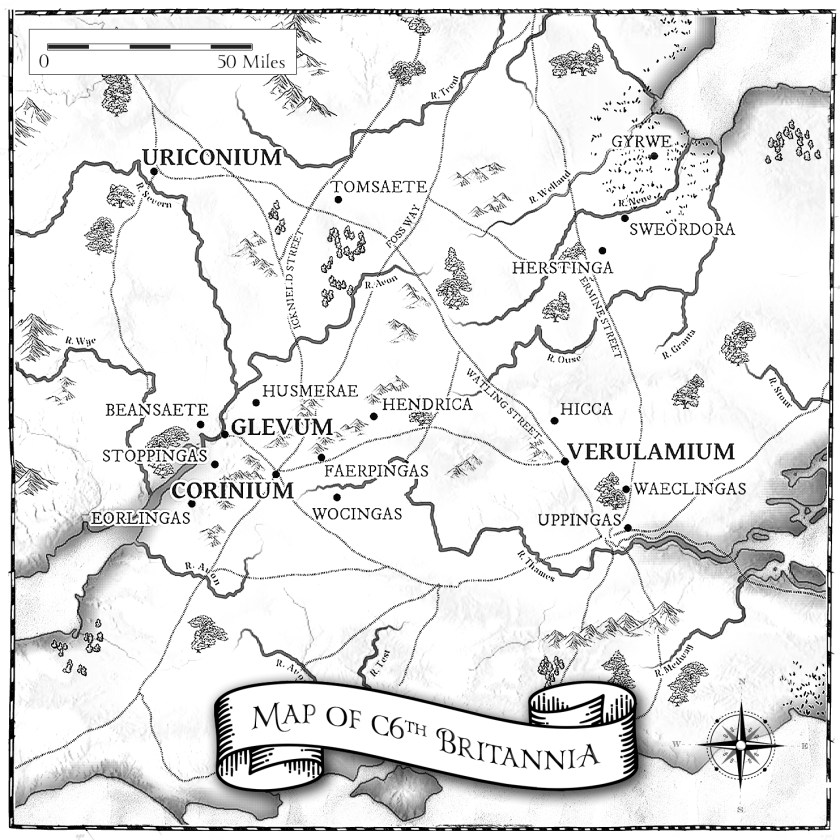
I’ve also used different names for the settlements, again to reflect the mix in language. The Eorlingas, Gyrwe and other tribal names are from the Tribal Hidage a contentious (later and difficult to date) source but one believed to document the very small tribal affiliations that might have existed at this time. Uriconium/Viriconium has its Latin name, although I used a version of the name I found that’s not the most commonly used one. Corinium (Cirencester), Glevum (Gloucester) and Verulamium (St Albans) have their Roman-era names. The River Severn, has its Old Welsh name, Habren, and so, as I was writing the trilogy I was being mindful of reflecting the hodgepodge of names and languages my characters might have known and heard being spoken.
It also added to the drama to make it difficult for my characters to easily communicate with one another.