Author of Saxon historical fiction and non-fiction, 20th-century historical mysteries, and Norse-inspired historical romantasy. Book reviewer and blog host.
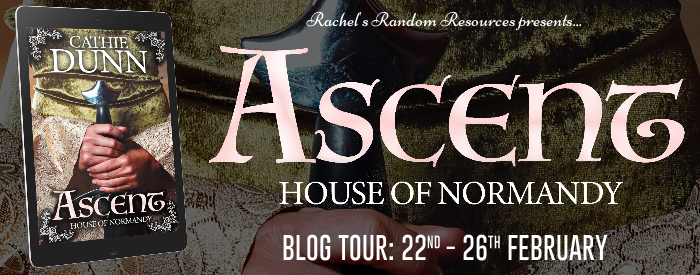
I’m delighted to be reviewing Ascent by Cathie Dunn, #histfic #BookReview #Normandy
Here’s the blurb
A brutal Viking raid heralds the dawn of a new, powerful dynasty – the House of Normandy
Neustria, Kingdom of the West Franks AD 890
Fourteen-year-old Poppa’s life changes when Northmen land near Bayeux. Count Bérengar, her father, submits to them, and she is handfasted to Hrólfr, the Northmen’s heathen leader, as part of their agreement.
To her relief, Hrólfr leaves immediately in search of further conquest, only returning to claim her years later. In the face of retaliating Franks, they flee to East Anglia, where she gives birth to their son and daughter.
When Hrólfr and Poppa return to reclaim Bayeux, his new campaign strikes at the heart of Frankish power, and King Charles of the West Franks offers him a pact he cannot refuse. In exchange for vast tracts of land in Neustria, Hrólfr must convert to Christianity and accept marriage to Gisela, the king’s illegitimate daughter.
Poppa’s world shatters. She remains in Bayeux, with her daughter, Adela. When Gisela arrives one day, demanding she hand over Adela, to be raised in Rouen, Poppa’s patience is at an end. But Gisela makes for a dangerous enemy, and only one woman will survive their confrontation high up on the cliffs.
Will Poppa live to witness the dawn of a new era?
ASCENT is the first in a new series about the early women of the House of Normandy – women whose stories have been forgotten through time.
Until now!
Readers of Viking and medieval fiction will enjoy ASCENT, a fictional account of the life of Poppa of Bayeux, handfasted wife of Rollo the Viking.
Trigger warning: Loss of a child. Some battle and fighting scenes.
Ascent tells the story of how the Duchy of Normandy formed, through the eyes of both Poppa, wed to the man many of us will know as Rollo and Rollo himself.
This is a fascinating period, at the end of the ninth century and the beginning of the tenth, when the focus of the Viking raiders had shifted from just trying to plunder, kill and steal to wanting to find new homes for themselves. While some of the story takes places in England, the focus is on the West Frankish lands, and there are familiar names here, Charles III, the king of the West Franks, the most well-known of them all.
Poppa is a strong-willed woman, but her life isn’t without hardship and suffering. Rollo, or Hrolfr, is a Viking raider, but with an eye to the future and ambition to match it. The evolving story is well portrayed, focusing on several life-changing moments as the tale progresses as it covers their entire lives after meeting.
I feel the book really comes into its own from about halfway through, and I powered through the remainder of the story. Poppa and Hrolfr are both ambitious and strong-willed, with an eye to the future, and such ambition is well portrayed without us disliking either of them. Their friends and allies also provide moments of intense sorrow and triumph as Dunn weaves a tale of the era, bringing in far-flung places, such as Orkney, which were all closely interconnected to men and women of the sea.
Constructed using incredibly scarce surviving sources (I know, I’ve studied this period, and it is mind-glowingly confusing), Ascent, the first book in the stories of Normandy, is sure to appeal to those interested in tales of historically strong women, in the formation of Normandy and also in this turbulent period when the Viking raiders – or the Normans as they came to be known – claimed a toe-hold on Frankish soil which was to have far-reaching consequences. I look forward to book 2.
Meet the author
Cathie Dunn is an award-winning author of historical fiction, mystery, and romance. The focus of her historical fiction novels is on strong women through time.
Cathie has been writing for over twenty years. She studied Creative Writing online, with a focus on novel writing, which she also taught in the south of France. She loves researching for her novels, delving into history books, and visiting castles and historic sites. A voracious reader, primarily of historical fiction / romance, she often reviews books on her blog, Ruins & Reading.
Cathie is a member of the Historical Novel Society, the Richard III Society, and the Alliance of Independent Authors.
After many years in Scotland, Cathie now lives in south of France with her husband, and rescued Charlie Cat and Ellie Dog. Discover more about Cathie at http://www.cathiedunn.com!
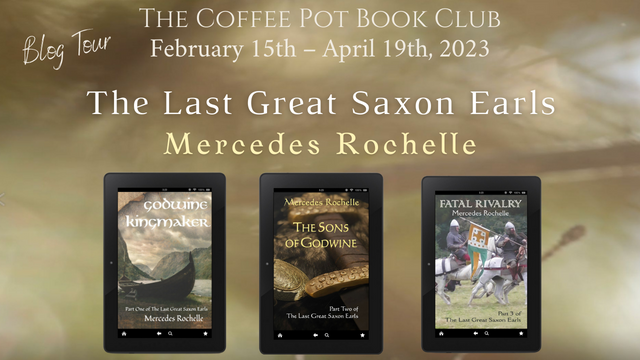
I can never miss an opportunity to ask a fellow Saxon author questions about why they write about the same period as me. My thanks to Mercedes for answering them.
What drew you to the character of Godwine and his wife and children?
While I was writing my first book, Heir To A Prophecy, I introduced my protagonist Walter into London on the day Godwine came back from exile. It was a plot device to introduce him to Harold Godwineson (Walter took out one of the Normans fleeing through the crowd). I didn’t know who Godwine was, but I couldn’t shake him loose! I went back fifty years and discovered a great story.
Naturally, very little is known about these historical characters, and I had two challenges that dovetailed nicely. Both had to do with not wanting to fall into that old predictable trap concerning characters. First of all, the love interest. There are so many love stories that seem formulaic. I didn’t want that same old theme: disliking each other first, then falling in love (and all the variations thereof). On the other hand, I understand that there needs to be some kind of stress in the romance to make a good story. It was obvious that Godwine had a happy marriage (or at least a productive one) since they had so many children. I was really intrigued by the discrepancy of their social status. Godwine was a commoner, and Gytha was a noble (or the Danish equivalent). At the same time, I had a hard time figuring out why Swegn, the firstborn, turned into such a bad egg. I don’t believe a character should be all good or all bad. People just aren’t like that. Even wicked characters act that way for a reason; sometimes they have good qualities that get buried under their more powerful bad qualities. Finally I had an inspiration: if Godwine’s marriage started out in anger, or stress (Gytha was given to him in marriage, but she didn’t have to go willingly), perhaps the firstborn would be neglected and unloved. That would explain his subsequent behaviour. It took some doing to make that work, but I’m happy with the result.
What part of your research did you enjoy the most?
I love research; I actually prefer the research to the writing. I knew I was going to like Godwine. What surprised me was how fascinated I was with Canute. He was an incredibly complicated character. From the angry king-to-be that cut the noses off his 200 hostages after England rejected him in favour of Aethelred the Unready, he eventually became a very successful monarch. Most of all, I loved the single combat between him and Edmund Ironside, where he cleverly talked himself out of getting flattened by convincing Edmund to split the kingdom between them. This may well be apocryphal, but that’s the challenge of writing about events 1000 years ago. We have more legends than “history” to work with, and the legends are so good they stick.
Was there a resource that was invaluable?
I hate to admit this because it makes me sound so old, but when I was writing Godwine Kingmaker there was no internet. Back then, I was living in St. Louis, MO—a very nice town but far from the libraries I needed. If the book wasn’t in the card catalogue, it might as well not even exist. So, like any warm-blooded researcher who didn’t have a family to take care of, I pulled up stakes and moved to New York. The day I discovered the New York Public Library my life changed forever. I found authors I never knew about, and finally got my hands on my first copy of Edward A. Freeman’s “History of the Norman Conquest of England”. I thought I had gone to heaven! In six volumes he wrote about every aspect of Anglo-Saxon England I could possibly think of. (These days Freeman is somewhat out of fashion, but he’s still my go-to when I need to look something up; he has never failed me yet.) Copy machines were available for ten cents a page, but as much as I needed to copy, I’d be better off buying the books—if I could find them. No such luck until a couple of years later, when I went on a book-buying trip to England and discovered Hay-on-Wye. A breakthrough! Those were the days (the late ’80s) when old used hardbacks were still easy to find, and I discovered my very own set of Freeman which I gleefully brought home. That was the original basis of all my research. Those books are still my most precious possession, though now you can find them online (scanned, of course).
Did you learn anything that surprised you while writing the trilogy?
Back to Canute again. While delving into Harold’s relationship with Edith Swan-neck in THE SONS OF GODWINE, again I wanted to avoid the usual romantic formulas. First of all, I had to decide whether Edith was a luscious young thing or an attractive widow; both possibilities were referred to in the histories. By lucky chance, I stumbled across Canute’s Law Code of 1020, designed to smooth relations between the Danes and the Saxons. One section dealt with heriot (essentially an inheritance tax), not a new concept. But I found a reference to protecting widows. Canute gave a widow twelve months to pay her husband’s heriot. But she had to remain unmarried or she would lose both her morning-gift and all possessions from her former husband. If some unscrupulous man coveted her inheritance and forced her to marry him, all the possessions would pass on to the nearest kinsman. The king would lose the heriot tax if this were to happen, so it was also written into Canute’s law that a widow should never be forced to marry a man she dislikes. After all, the Crown had much to lose. So I decided to make Edith a recent widow trying to evade the attentions of an unwelcome suitor, while she and Harold conducted their relationship.
What is your personal opinion? Do you believe that William the Conqueror was justified in claiming England? Do you believe he had been promised it?
Apparently the whole justification came down to King Edward the Confessor’s promise to William when the duke visited England during Godwine’s exile. I think we can negate the assertion that Edward felt some sort of gratitude for having been sheltered there during his exile. When Edward left Normandy in 1041, William was only 13 years old and Edward was 38. With that age gap, it seems unlikely that the two of them would have developed a close relationship, so any alleged gratitude Edward might have owed probably belonged to William’s father Robert, dead by 1035.
Now, during Godwine’s exile in 1051, it’s far from certain that William even visited England. Some historians thought he would have been too busy putting down rebellions to leave his country even for a short time. If William did visit England and if Edward offered him the crown at this point, it’s curious why he would have done so. The king knew that it was up to the Witan to decide the succession. However, considering his antagonism toward the Godwines (he even put the queen in a nunnery while Godwine was in exile), perhaps he made this alleged promise out of spite.
However, it’s my belief that the blame can be placed upon Robert of Jumièges, former Archbishop of Canterbury and arch-enemy of Earl Godwine. Robert is one of the Normans who fled from London once it was clear that Godwine was back in control. He’s almost certainly the one who kidnapped the hostages, Godwine’s son Wulfnoth and grandson Hakon, and brought them to Normandy. In my interpretation, Jumièges acted on his own when he told William that Edward declared him heir to the English throne, and here are the hostages to guarantee his promise. What a great revenge on Godwine and all of England for kicking him out! Why wouldn’t William believe such an opportune offer?
Who is your personal favourite member of the House of Godwine?
When all is said and done, Earl Godwine still holds his place as my favourite. If it weren’t for him, there would be no Harold Godwineson Last Anglo-Saxon King. I think he helped smooth the relations between the conquering Danish king and his unhappy countrymen, then moved on to staunchly defend the Saxons against the hated Normans. His rise to power was unprecedented, and I think his fall was tragic, though not in the way we usually think of as a tragedy. Having sacrificed so much for the wrong son, he had nothing left to live for as he watched Harold take his place in the hearts of his people.
As you know, I write about the Earls of Mercia. What opinion did you form of the rivals to the House of Godwine while researching and writing your books?
I wondered if you’d ask that question! Of course, by the late Anglo-Saxon period, I think the Mercian earls had lost much of their lustre. Old Earl Leofric certainly held his own against Earl Godwine (with the help of Earl Siward of Northumbria). It seems the odds were against Leofric as Godwine’s sons were granted their own earldoms, shifting the balance of power in Godwine’s favour. At this stage, I always thought of them as bitter, unhappy competitors who could never regain their former glory. After King Edward died, Harold tried to join forces with the grandsons of Leofric, Edwin and Morcar, but I don’t think their association was ever successful. William the Conqueror certainly put an end to that.
Thank you for answering my questions with such insight. I hope you enjoy the blog tour.
Here’s the blurb:
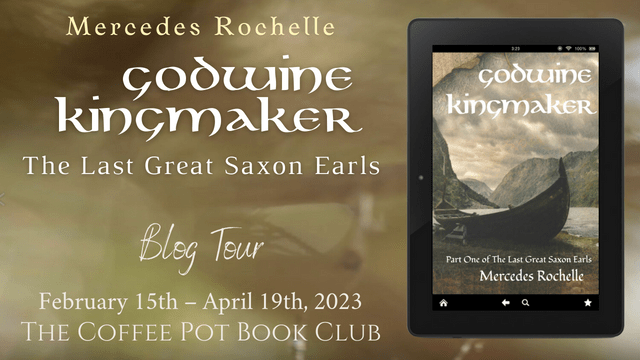
They showed so much promise. What happened to the Godwines? How did they lose their grip? Who was this Godwine anyway, first Earl of Wessex and known as the Kingmaker? Was he an unscrupulous schemer, using King and Witan to gain power? Or was he the greatest of all Saxon Earls, protector of the English against the hated Normans? The answer depends on who you ask.
He was befriended by the Danes, raised up by Canute the Great, given an Earldom and a wife from the highest Danish ranks. He sired nine children, among them four Earls, a Queen and a future King. Along with his power came a struggle to keep his enemies at bay, and Godwine’s best efforts were brought down by the misdeeds of his eldest son Swegn.
Although he became father-in-law to a reluctant Edward the Confessor, his fortunes dwindled as the Normans gained prominence at court. Driven into exile, Godwine regathered his forces and came back even stronger, only to discover that his second son Harold was destined to surpass him in renown and glory.
Mercedes Rochelle is an ardent lover of medieval history, and has channeled this interest into fiction writing. She believes that good Historical Fiction, or Faction as it’s coming to be known, is an excellent way to introduce the subject to curious readers. She also writes a blog: HistoricalBritainBlog.com to explore the history behind the story.
Born in St. Louis, MO, she received by BA in Literature at the Univ. of Missouri St.Louis in 1979 then moved to New York in 1982 while in her mid-20s to “see the world”. The search hasn’t ended!
Today she lives in Sergeantsville, NJ with her husband in a log home they had built themselves.
I’m sharing a fabulous post by Glen Craney below regarding the mistakes historical novelists must be wary of making.
Exposing History’s Cracks of Logic
Historical novelists are always prospecting for untapped veins in the strata of the past. Some of the richest lodes can be found in the lapses of logic and analysis that even the most astute of historians are at times prone to commit. Perhaps the best compilation of such errors in judgment and interpretation is Historians’ Fallacies, a treatise published in 1970 by Brandeis University professor David Hackett Fischer.
Readers of history will remember Fischer from Albion’s Seed, his exploration of the impact British folkways had on American society, and Washington’s Crossing, a study of George Washington’s leadership of the Continental Army.
Fischer’s impressive overview of historiography should be kept close at hand on the bookshelf of every historical novelist. Most of the miscalculations he skewers—exemplified by excerpts from the writings of his colleagues, many of whom no doubt chafed at being called to task—apply with equal force to the writing of historical fiction.
The best known of these gaffes gave its name to Fischer’s book: the historian’s fallacy. This refers to the error of assuming that the great leaders and decision-makers of the past possessed the same facts and perspective as we do in hindsight.
Fischer offered as an exhibit the popular claim that the Japanese attack on Pearl Harbor should have been foreseen from the numerous warning signs. He cautions historians against the tendency of sifting away evidence that, at the time, might have clouded one’s judgment or even supported a contrary opinion.
Likewise, historical novelists must be on their guard against attributing to their characters more knowledge of events than is warranted. It is easy enough for us to chastise Robert E. Lee for ordering Pickett’s charge. The task of both the historian and novelist is to recreate the fog of war at Gettysburg with such verisimilitude that the reader will come to understand why such a decision was rational on July 3, 1863.
The American Civil War seems to have served as the subject for every fallacy condemned by Fischer. Another infamous example castigated by Fischer is the discovery by Union scouts of the cigar-wrapped copies of Lee’s orders for the Antietam campaign. Every war buff has encountered the contention that this fortuitous (for the Union) incident set into motion a series of cascading events that eventually turned the tide of the war. Fischer dismisses this as a product of the reductive fallacy, which boils a complex soup of causal ingredients down into a single, simplified explanation.
In discussing another error, the fallacy of division (arguing that a quality shared by some in a group is shared by all), Fischer offers a faulty syllogism for our dissection:
Most Calvinists were theological determinists Most New England Puritans were Calvinists. Therefore, most New England Puritans were theological determinists.
Fischer observed that then-recent scholarship suggested the Puritans were not determinists, at least not as was commonly assumed. Here one finds a gold nugget, one of many available for the taking by the writer who will persist in combing these fallacies: A novel set in Puritan New England with a main character who believes in free will.
In The Da Vinci Code, Dan Brown made great use of yet another error that comes under special opprobrium from Fischer: the furtive fallacy. This is the assumption that certain events and facts of “special significance” are “dark and dirty things and that history itself is a story of causes mostly insidious and results mostly invidious.”
Of course, some of the best historical fiction would have to be tossed onto Savonarola’s bonfire if a ban on this fallacy were strictly enforced. Fischer doesn’t argue that conspiracies have never taken place. His criticism goes to a more fundamental paranoia that, if left unchallenged, can metastasize into a societal epidemic that weakens the very foundations of institutions.
It begins with the premise that reality is a sordid, secret thing; and that history happens on the back stairs a little after midnight, or else in a smoke-filled room, or a perfumed boudoir, or an executive penthouse or somewhere in the inner sanctum of the Vatican or the Kremlin, or the Reich Chancellery, or the Pentagon. It is something more, and something other than merely a conspiracy theory, though that form of causal reduction is a common component.
The furtive fallacy is a more profound error, which combines a naïve epistemological assumption that things are never what they seem to be, with a firm attachment to the doctrine of original sin.
Still, Professor Robert Langdon might remind his colleague Dr. Fischer that just because one is paranoid doesn’t mean they aren’t out to get you.
The historical novelist is not only free but compelled to adopt and exploit these rich fallacies to spin out a good story—so long as he does so consciously.
Thank you for sharing:)
Here’s the blurb
Two armies. One flag. No honor.
The most shocking day in American history.
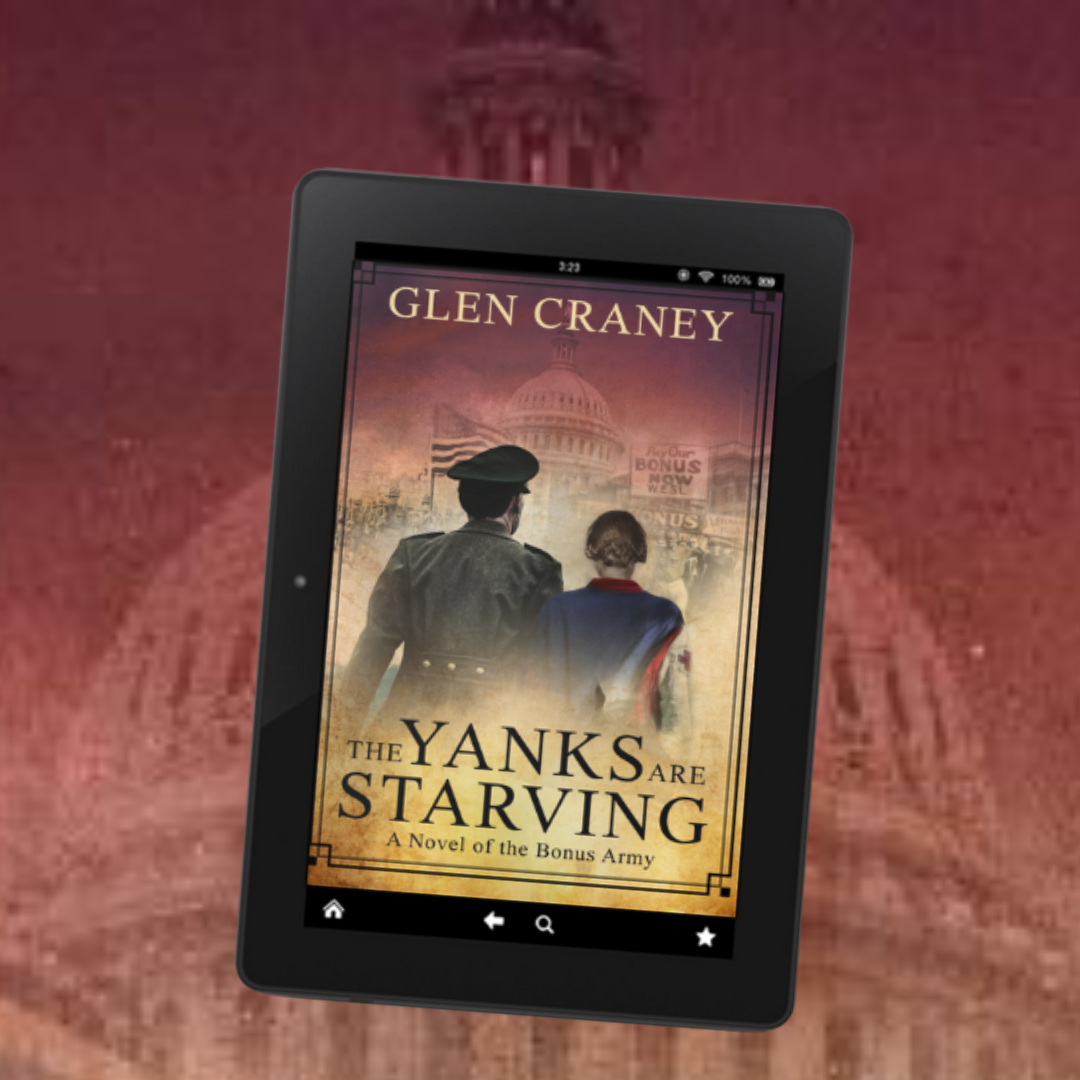
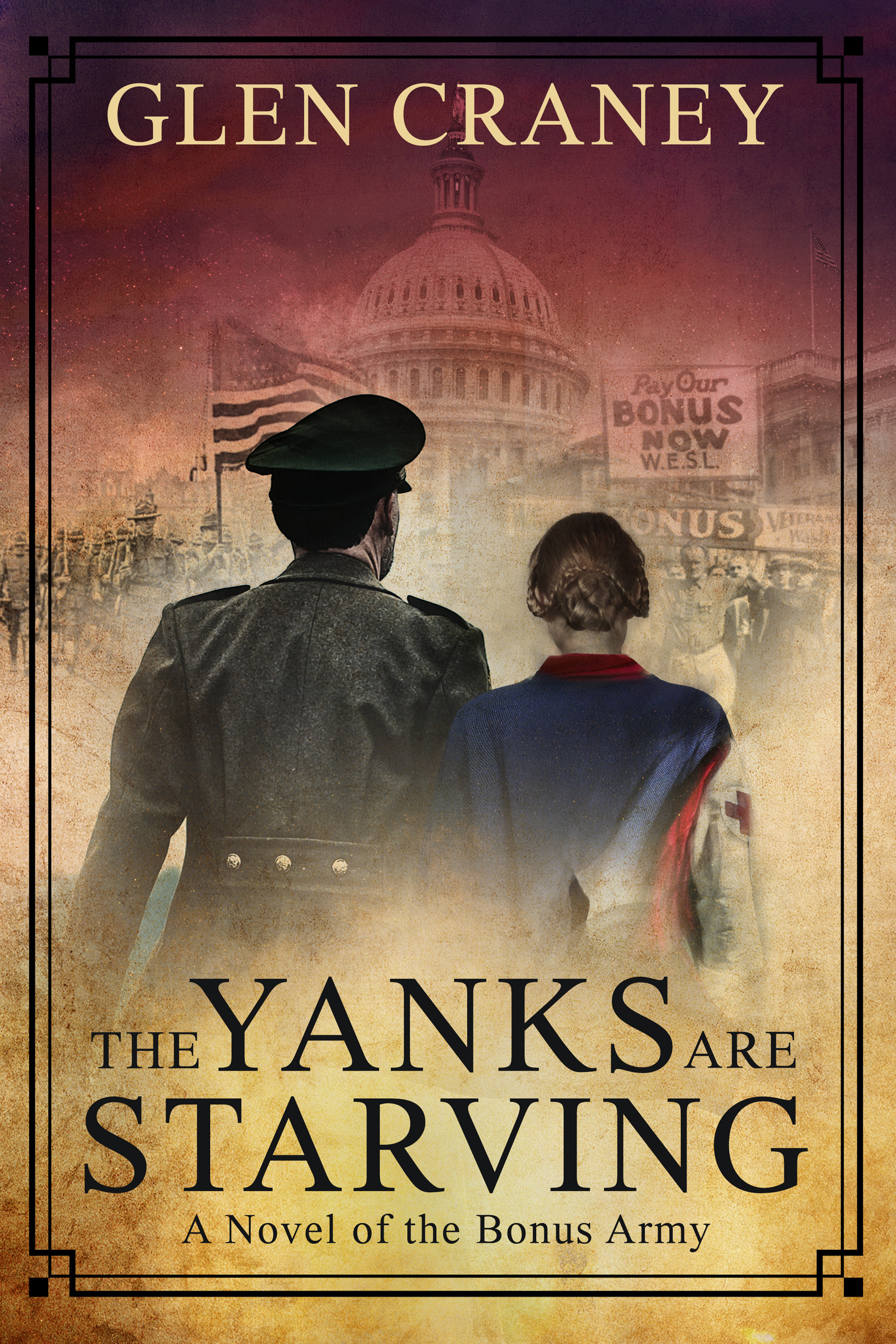
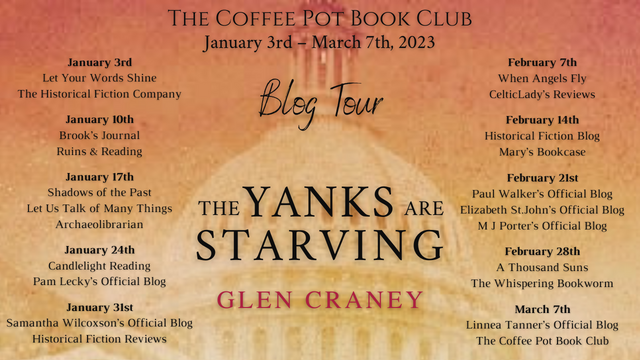
Former political journalist Glen Craney brings to life the little-known story of the Bonus March of 1932, which culminates in a bloody clash between homeless World War I veterans and U.S. Army regulars on the streets of Washington, D.C.
Mired in the Great Depression and on the brink of revolution, the nation holds its collective breath as a rail-riding hobo named Walter Waters leads 40,000 destitute men and their families to the steps of the U.S. Capitol on a desperate quest for economic justice.
This timely epic evokes the historical novels of Jeff Sharra as it sweeps across three decades following eight Americans who survive the fighting in France and come together fourteen years later to determine the fate of a country threatened by communism and fascism.
From the Boxer Rebellion in China to the Plain of West Point, from the persecution of conscientious objectors to the horrors of the Marne, from the Hoovervilles of the heartland to the pitiful Anacostia encampment, here is an unforgettable portrayal of the political intrigue and government betrayal that ignited the only violent conflict between two American armies.
“[A] wonderful source of historical fact wrapped in a compelling novel.” — Historical Novel Society Reviews
“[A] vivid picture of not only men being deprived of their veterans’ rights, but of their human rights as well.…Craney performs a valuable service by chronicling it in this admirable book.” — Military Writers Society of America
Glen Craney is an author, screenwriter, journalist, and lawyer. A graduate of Indiana University Law School and Columbia University Graduate School of Journalism, he is the recipient of the Nicholl Fellowship Prize from the Academy of Motion Pictures and the Chaucer and Laramie First-Place Awards for historical fiction. He is also a four-time indieBRAG Medallion winner, a Military Writers Society of America Gold Medalist, a four-time Foreword Magazine Book-of-the-Year Award Finalist, and an Historical Novel Society Reviews Editor’s Choice honoree. He lives in Malibu and has served as the president of the Southern California Chapter of the HNS.
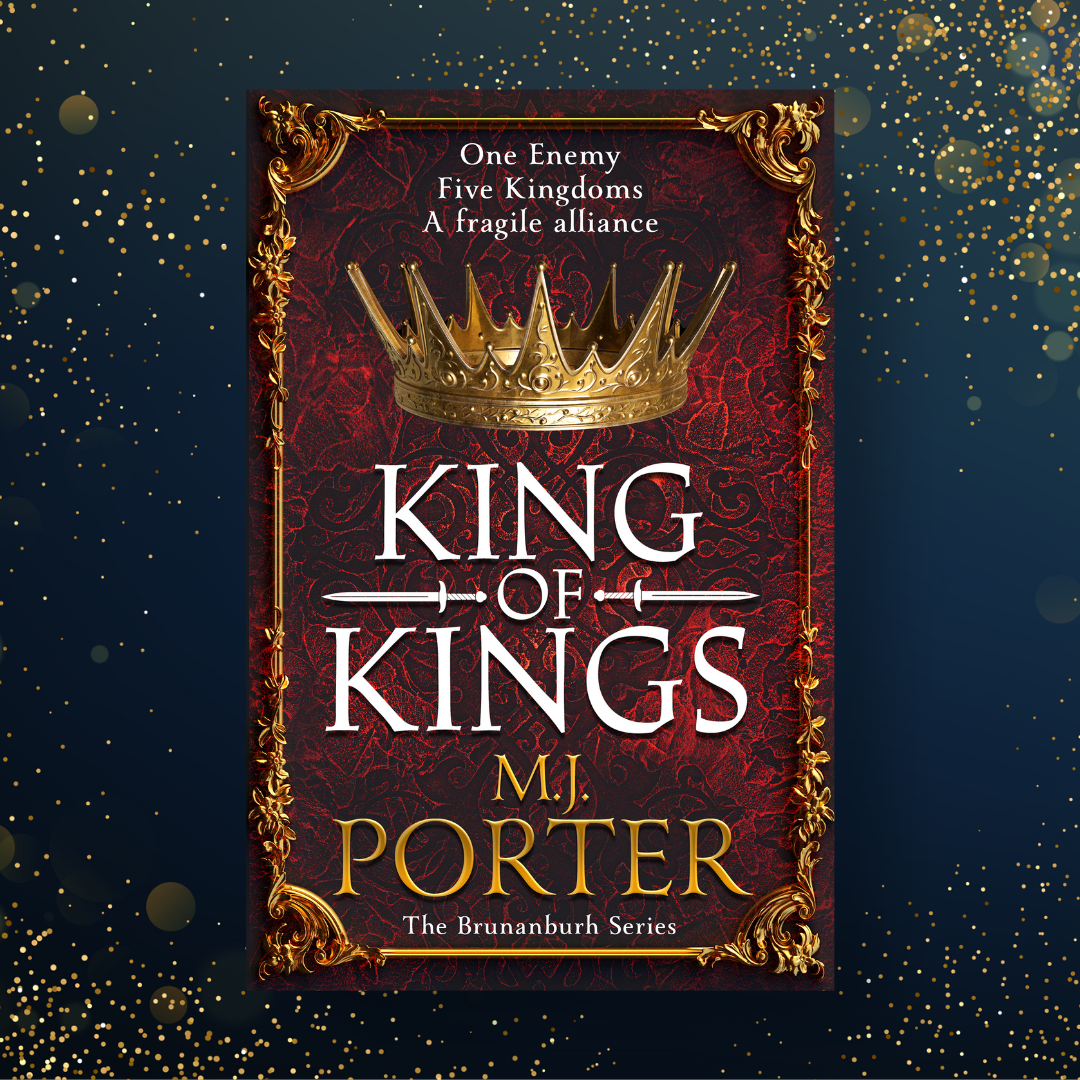
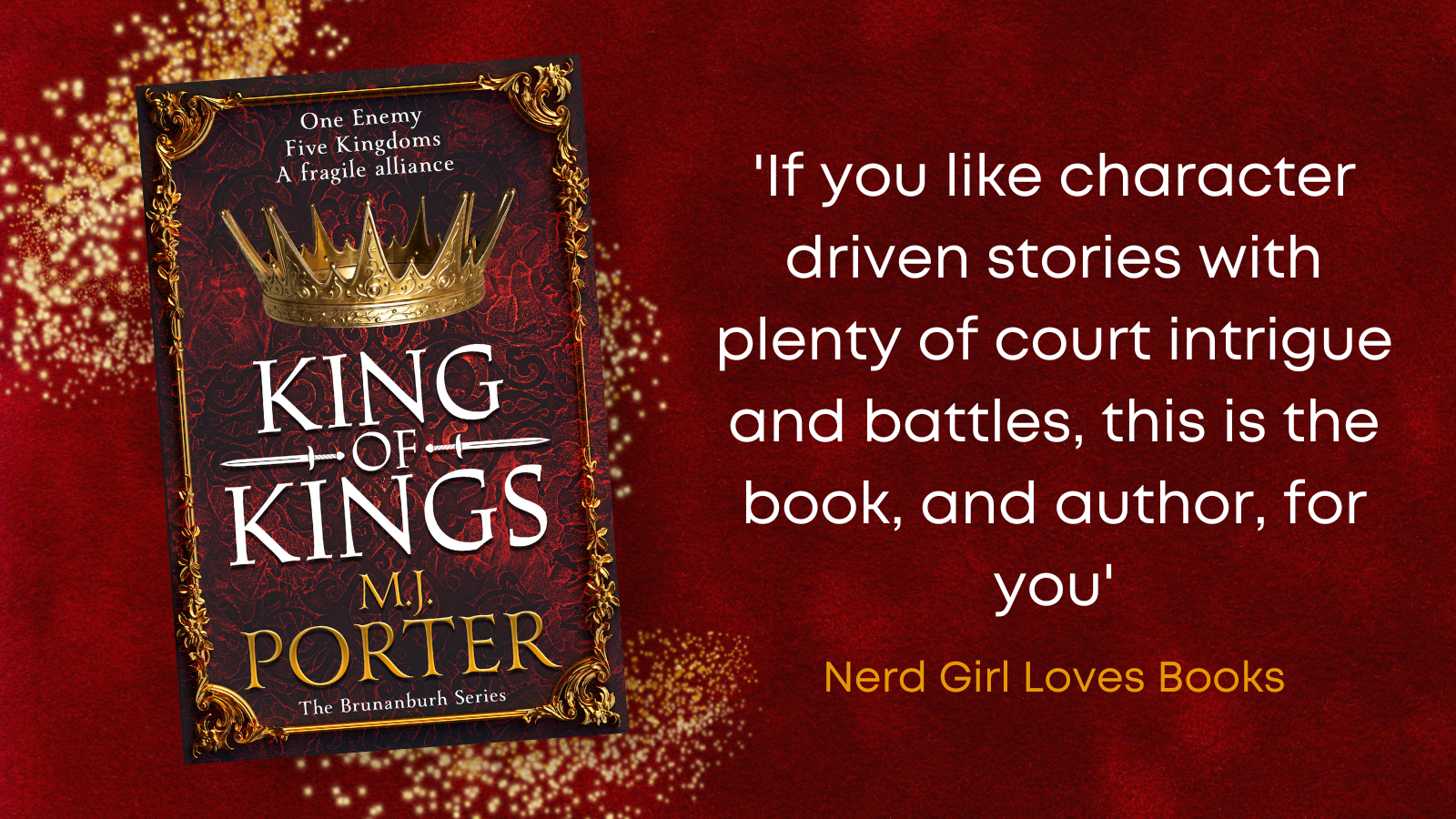
I’m so excited about the release today of King of Kings. This story, the first part in the retelling of the greatest battle on British soil that many have never heard of, Brunanburh, has been long in the making. Building on the original series, begun in 2014, King of Kings is entirely reworked, and it’s so much better:) (I honestly can’t believe how much better it is.)
Here’s the blurb
‘An epic tale of the birth of a nation. Truly mesmerising. Game of Thrones meets The Last Kingdom’ – Gordon Doherty
In the battle for power, there can be only one ruler.
AD925
Athelstan is the king of the English, uniting the petty kingdoms of Wessex, Mercia, the Danish-held Five Boroughs and York following the sudden death of his father, King Edward.
His vision is to unite the realms of the Scots and the Welsh in a peace accord that will protect their borders from the marauding threat of the Norse Vikings.
Whilst seemingly craving peace and demanding loyalty with an imperium over every kingdom, Athelstan could dream of a much bigger prize.
But danger and betrayal surround his best intentions, namely from his overlooked stepbrother, Edwin, who conspires and vies for what he deems is his rightful place as England’s king.
As ever, powerful men who wish to rule do not wish to be ruled, and Constantin of the Scots, Owain of Strathclyde, and Ealdred of Bamburgh plot their revenge against the upstart English king, using any means necessary.
An epic story of kingsmanship that will set in motion the pivotal, bloody Battle of Brunanburh where allies have to be chosen wisely…
(available in ebook, paperback, hardback and audio, narrated by the wonderful Matt Coles).
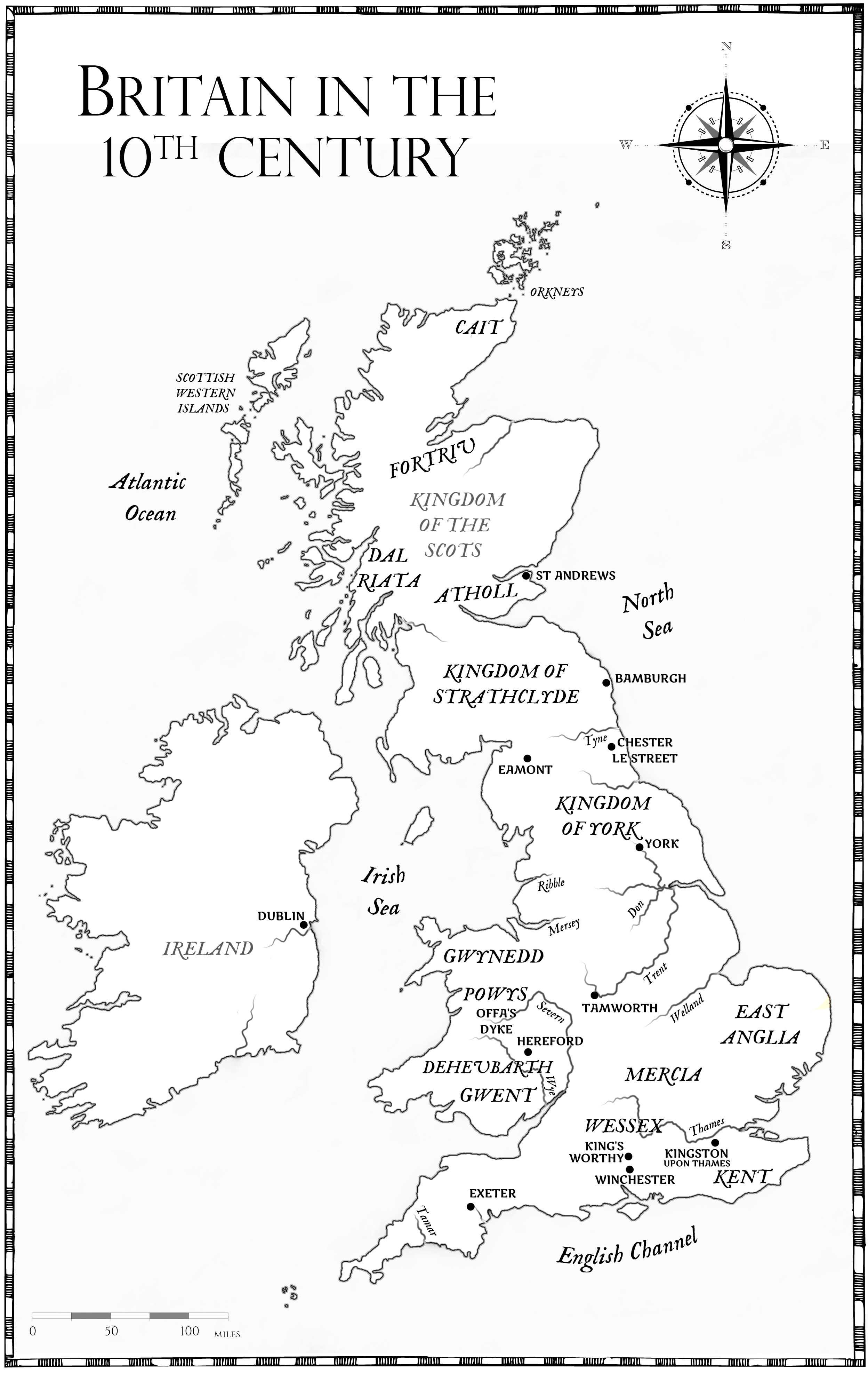
King of Kings. with its five kingdoms, and one alliance, might need some explanation. To help my readers understand who everyone is, and importantly, where everyone is, King of Kings has a map and a genealogical table, as well as a cast of characters.
Map designed by Shaun at Flintlock Covers
And because the family of King Alfred is so important to the story, I also have a genealogical table to share with my readers.
Design by Boldwood Books
I’ve written some brief introductions for the main cast of characters.
And for those who are falling in love with the period as much as I am, I wanted to share some non-fiction recommendations, and cautions.
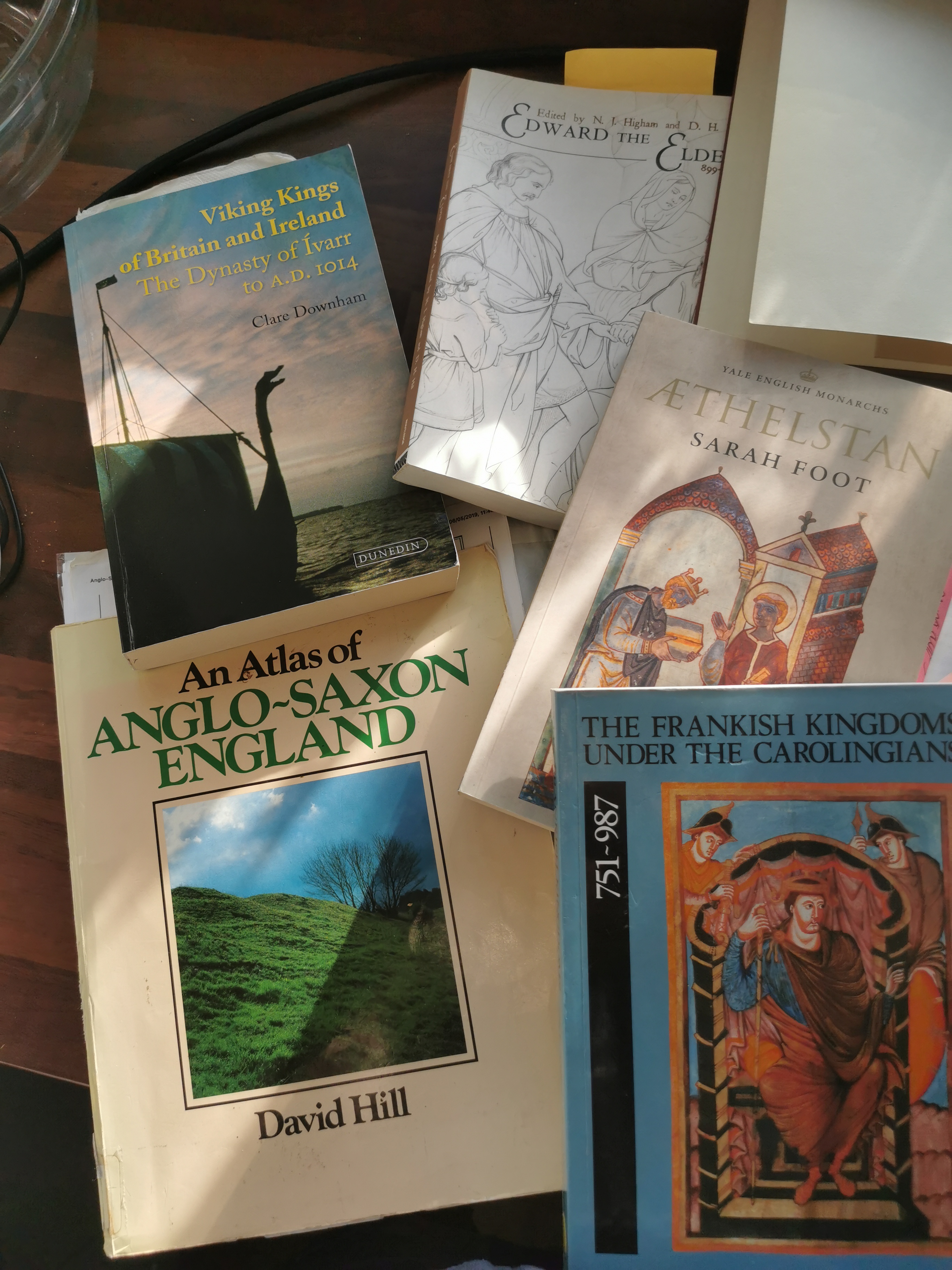
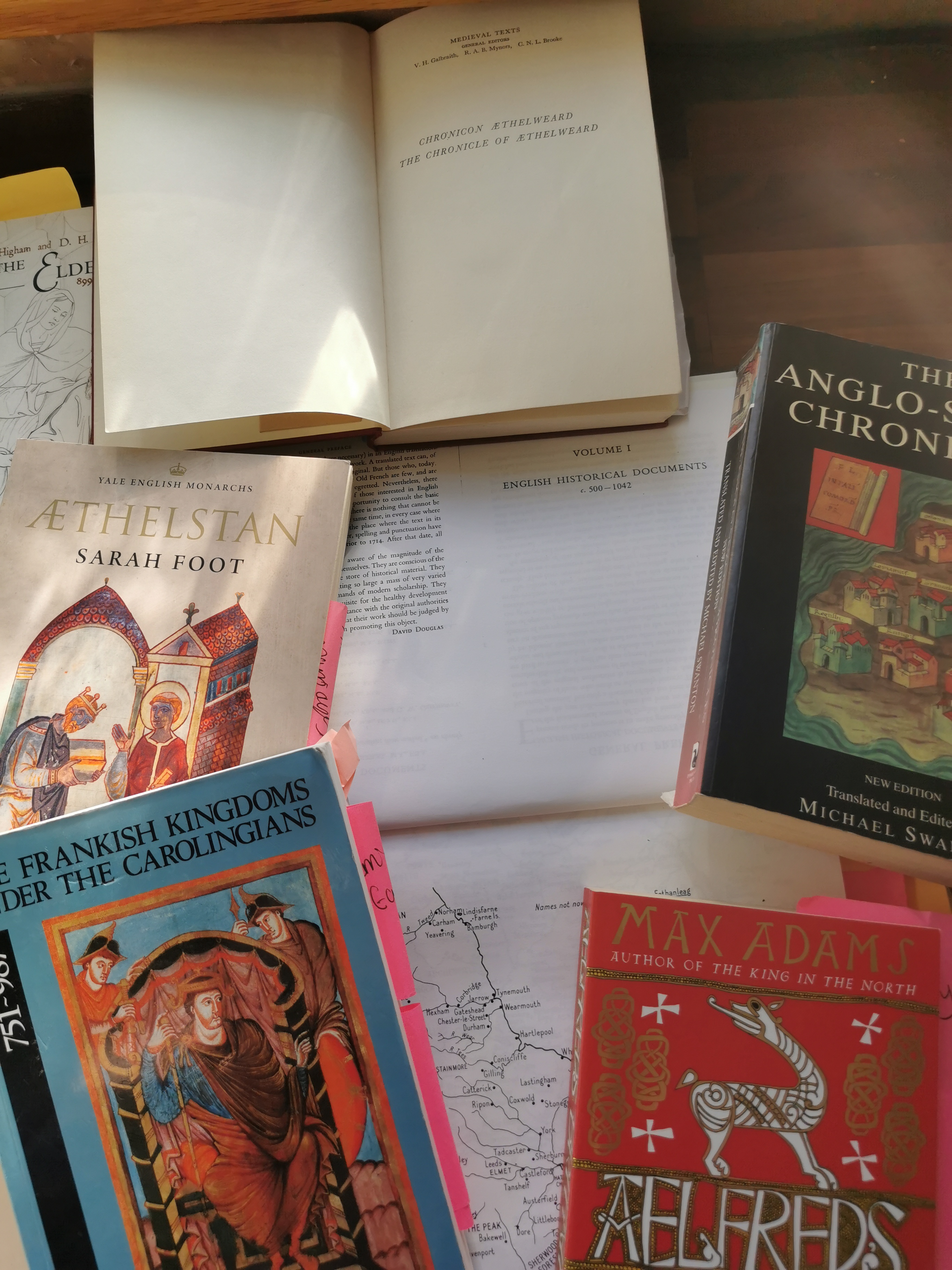
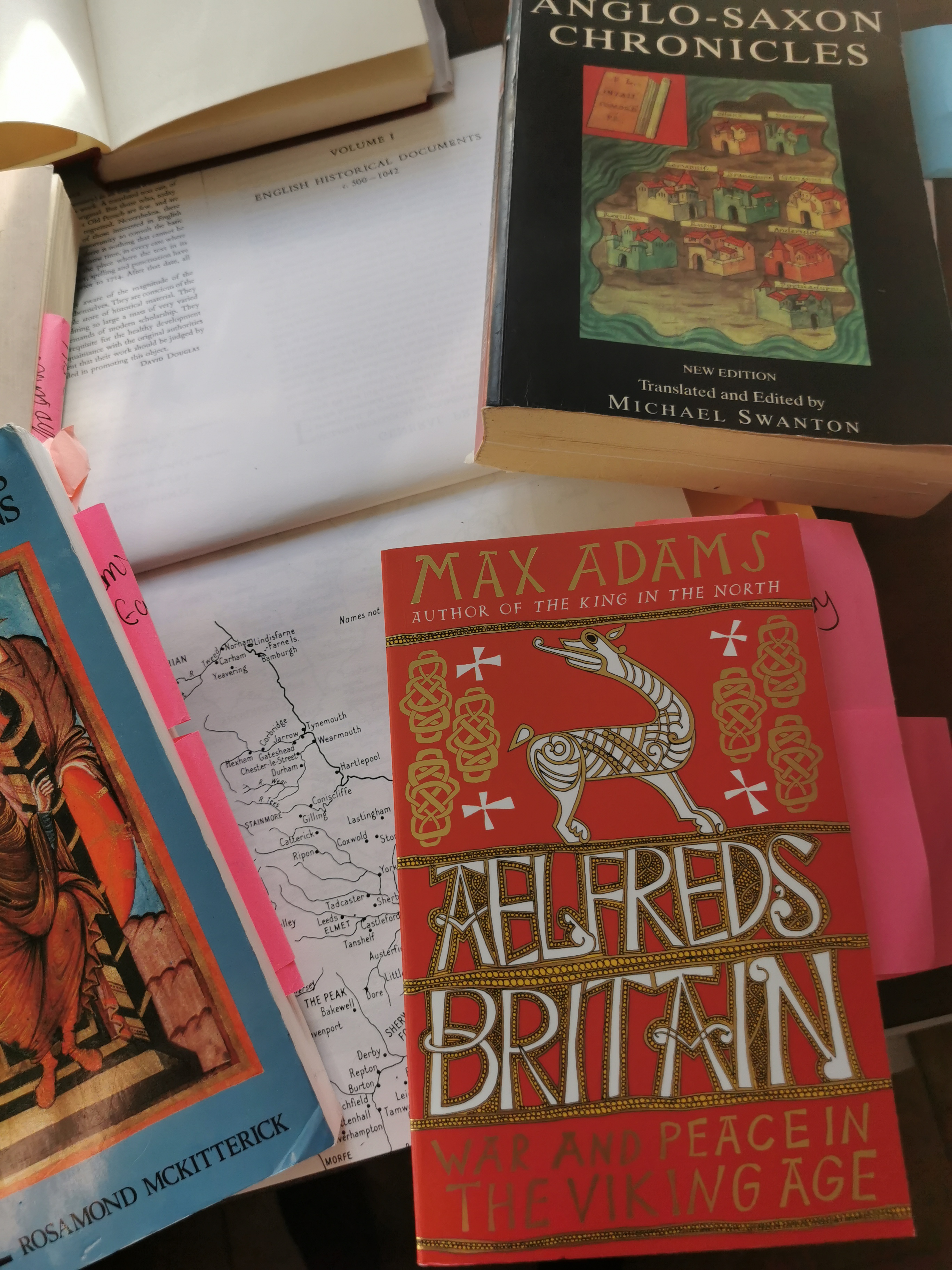
There is no one book that will adequately cover this period (that was one of the reasons that I fictionalised it) but these books (see photos below), along with Dr. Kari Maund’s The Welsh Kings, which I have in ebook, will give you a good grounding of events in Britain and Ireland. So, these are
Alfred’s Britain by Max Adams
Athelstan by Sarah Foot
The Anglo-Saxon Chronicles ed and trans. Michael Swanton (other versions available – I like the formatting of this one -with the different recensions)
The Welsh Kings by Kari Maund
An Atlas of Anglo-Saxon England by David Hill (don’t be put off by the fact this book is from the 1970s – it is invaluable)
From Pictland to Alba 789-1070 by Alex Woolf
Viking Kings of Britain and Ireland by Claire Downham
English Historical Documents ed and trans by Dorothy Whitelock
The Frankish Kingdom under the Carolingians by R McKitterick
Edward the Elder ed. Higham and Hill (not a narrative account, but historians writing papers about their area of interest and expertise).
There are also two very important online resources.
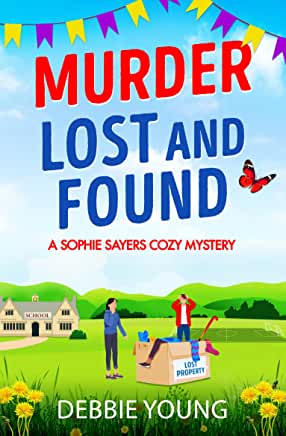
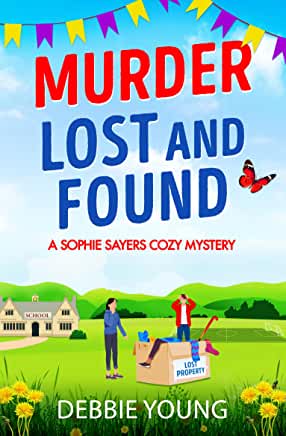
Sophie Sayers is ready for a glorious summer, but when a dead body is found in the village school’s lost property cupboard the summer holidays take an unexpected turn.
Even more shocking is when the body goes missing. Without a body, the police refuse to investigate. That’s just not good enough.
Sophie is determined to get to the bottom of the mystery. She needs to find out who has died and nab the culprit if she’s going to save the village school from the threat of closure.
My Review
Murder Lost and Found continues the Sophie Sayers Cosy Mysteries.
It’s the summer holidays, the school is empty of children, but while the caretaker and office manager try to ensure the school is prepared for the start of term, strange happenings take place.
I really enjoy this collection of stories. They’re light-hearted and a quick, pacy read, and I felt this one was particularly strong with the mystery of the lost property cupboard and the strange notes, making poor Sophie doubt herself, even while she contends with change at Horace’s bookshop.
A fun and entertaining read. Bring on book 8.
My thanks to Netgalley and the publisher for my review copy.
Debbie Young is the much-loved author of the Sophie Sayers and St Brides cosy crime mysteries. She lives in a Cotswold village where she runs the local literary festival, and has worked at Westonbirt School, both of which provide inspiration for her writing. She is bringing both her series to Boldwood in a 13-book contract. They will be publishing several new titles in each series and republishing the backlist, starting in September 2022.
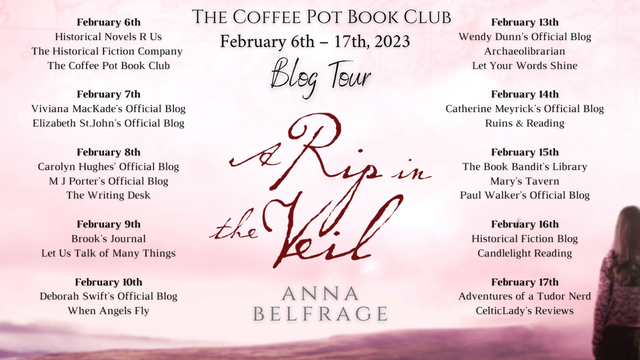
Today, I’m absolutely delighted to share a fabulous post from Anna Belfrage about dressing in the seventeenth century. It will make you giggle, I promise.
Dressing for success in the seventeenth century
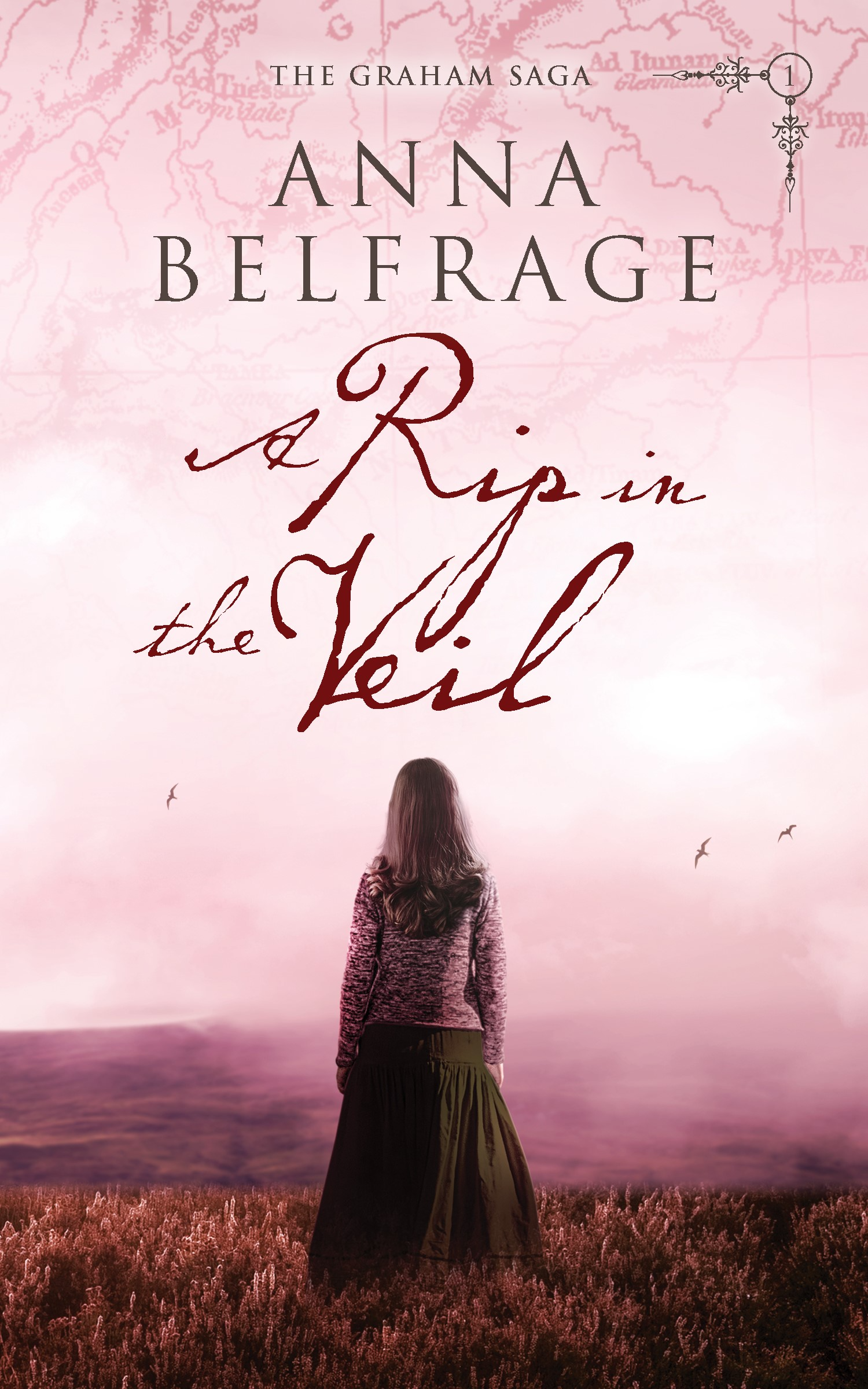
In a A Rip in the Veil—the first book in The Graham Saga—the unfortunate (or not, depending how one sees it) Alex Lind has the misfortune of falling three centuries backwards in time to land at the feet of Matthew Graham. Matthew Graham is a devout Presbyterian who has fought in the Commonwealth armies in the Civil War. To Alex, he is initially very strange. Heck, the entire situation is strange: no, wait—it’s impossible!
Matthew is as taken aback as Alex is—perhaps even more, as the only explanation to her sudden appearance in his life must be magic. Or? Besides, what is the woman wearing? Those tight, tight breeches she calls ‘djeens” showcase her every curve, as do her other garments. No, had she been his woman, he’d never have allowed her to set a foot outside dressed like that, all of her exposed, like.
Alex quickly realises that in this new time she has to adapt. ASAP. And one of the first things she must embrace is an entire new wardrobe. “Yay me,” she mutters as she shakes out shift and petticoats and heavy skirts and bodice and. . .
I must admit that I wasn’t entirely thrilled when Alex landed in 1658. The seventeenth century is not my sartorial favourite – especially when it comes to male fashion.
This period dress thing is difficult.
First of all, as the writer of historical fiction it is important to understand what people wore, who wore what and how it was worn. In some cases it’s straightforward: stockings cover your feet and the nether part of your legs no matter if you live in the twentieth century or the fifteenth. But take that rather ugly male adornment that Henry VIII was so proud of flaunting – the codpiece – and I am somewhat stumped. How did it work? ( Okay, so I’ve looked this up; strings, buttons or hooks kept this decorative little (hmm) flap of fabric in place.)
Secondly, it helps if the writer in question finds the period attire alluring in some way or other. It’s difficult to write convincingly about handsome men in codpieces and padded breeches when all you see in your head is something resembling a man in a huge diaper.
Finally, there must be a familiarity with how people dress and undress. “He told her to turn around and zipped up her gown,” is not a good description of the intimacy between man and wife in the fourteenth century. (BTW, the modern zipper owes a lot to Swedish inventor Gideon Sundback. It’s nice to know us Swedes have contributed to human development: dynamite, zippers, gauge blocks, the AGA cooker.) Having exploring male fingers encountering panties in the sixteenth century is also something of an anachronism, and should the dashing regency rake pulls down his boxers you’re not reading historical fiction, you’re reading about a masquerade.
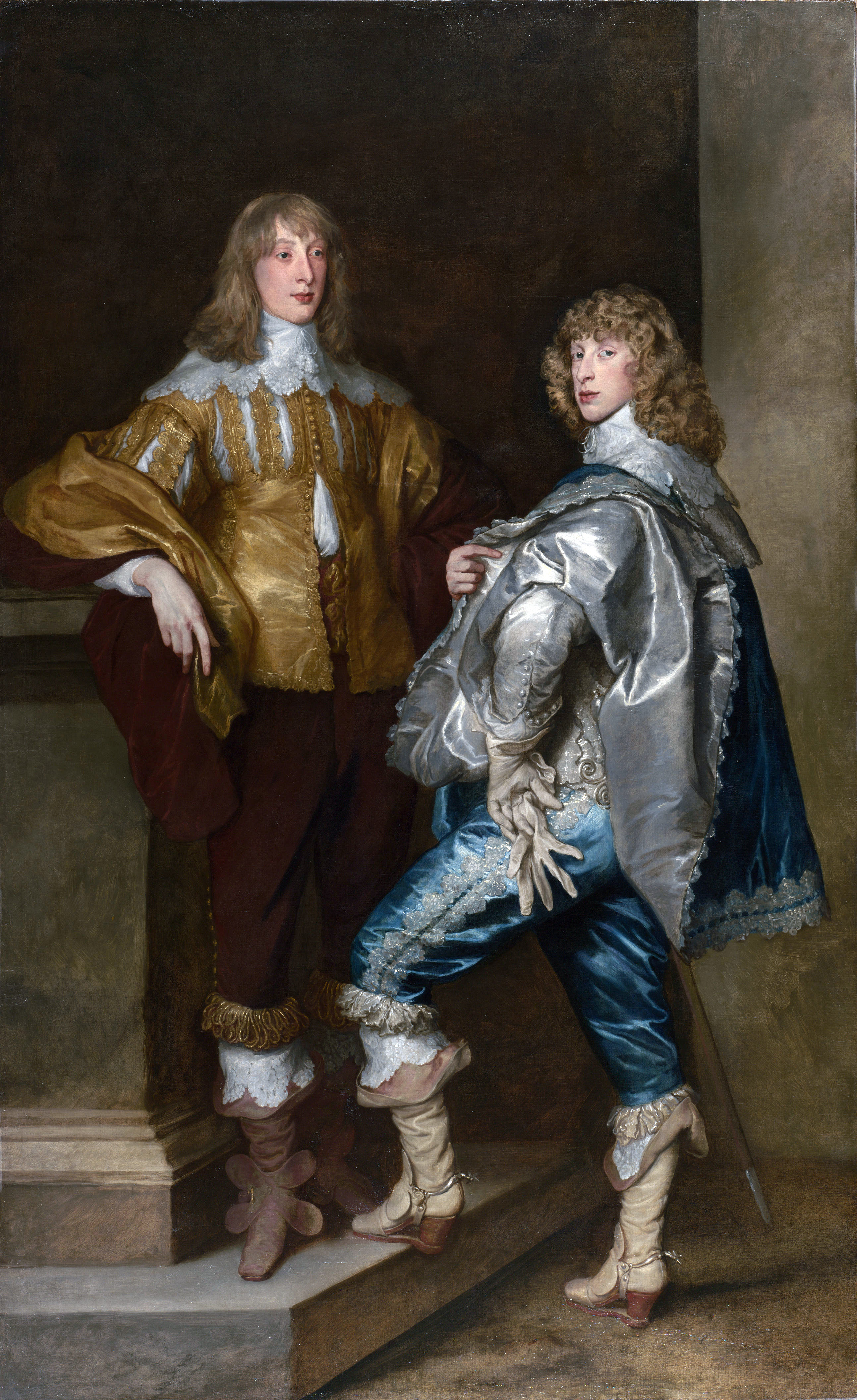
To avoid such gaffes, I’ve spent a lot of time researching the period and have accordingly done my fair share of staring at what few clothes survive from the seventeenth century—like James II’s elegant attire exhibited in the Victoria & Albert museum. Okay, so that is later in the century, but all that lace, all those embroideries, and that gigantic wig! Plus, the high heels on the shoes. . . Nope, not at all my cup of tea.
Earlier in the 1600s, men wore wide breeches, sashes, lace, ribbons—like these young and elegant Stuart brothers in Van Dyke’s portrait.
To the seventeenth century young girl, they were likely delectable. To Alex, not so much. She’d be hard put not to laugh her head off. So it is fortunate that when she first meets Matthew, he is in a ragged shirt and equally ragged breeches, fleeing from pursuing soldiers. It is also fortunate that Matthew would no more adorn himself with ribbons than he would dance attendance on the king—he is a man of Parliamentarian convictions. No, Matthew wears plain and well-made clothes, now and then adorned with a ruffled cuff or an elegant collar.
Obviously, Matthew expects this new female companion of his to dress sedately, which is how Alex finds herself obliged to re-learn just how to dress.
In the seventeenth century, there were no bras, no panties. Instead, the undergarment is a shapeless elongated linen shirt that comes to just below the knees. This shift is worn over stockings that come to just above the knee and are fastened by garters. “I can help you with those,” Matthew suggests, and there is a twinkle in his eyes as he helps Alex fasten the stockings with pink ribbons. Just because he doesn’t wear ribbons, it doesn’t mean she can’t, he says. In fact, he rather likes the fact that she is wearing them—and that he tied them into place. Over the shift—which also doubles as nightgown—Alex now dons a corset. “Ugh!” she groans as she tightens into place. The corset she has ties in front—only people who can afford a ladies maid have corsets that tie in the back. She has to struggle a bit to get it to sit right, and then there are the petticoats, tied into place at her waist and falling to mid-calf. Only the very, very rich have garments that fall all the way to the floor. Most women have skirts high enough to allow them to work and walk without dragging the hem in the dirt.
“Here.” Matthew hands her the heavy skirts. And yes, they are heavy, making it hard to, for example, run. Or jump a fence. Once Alex has stepped into them, he helps her tighten them into place. A bodice, a shawl to cover what may remain exposed of her chest and then Matthew holds out a cap. “No way!” She backs away, staring at the embroidered linen coif. “You must cover your hair,” he says. She refuses. There is a slight. . . er . . . argument. Things end in a compromise: she will not cover her hair indoors, but otherwise she will either wear a coif or a hat. Matthew would prefer both, but he is pragmatic enough to realise this isn’t a battle he will win. Besides, Alex is having to handle a lot of change as it is. “Tell me about it,” she mutters. She isn’t overly impressed with the food. Or the lack of chocolate. Or of tea. “I thought they had tea in the seventeenth century,” she groans. “They do,” I tell her, “but it is very, very expensive.” “Oh.” She gnaws her lip, her shoulders slumping. Which is probably why Matthew expends a ridiculous amount on a ridiculous small quantity of tea next time he goes to Edinburgh, pleased by the way she lights up from within when he hands the precious package over.
Over time, Alex will become accustomed to her new clothes, even if she will quite often think longingly of jeans and sweatshirts, of Converse and shop-bought socks. (She hates to knit)
But while she adapts to her new life on the outside, she remains a woman of modern conviction and outlook, which will now and then cause her quite some problems in her new time. It is fortunate that she has Matthew to guide her. On the other hand, there will be countless of occasions when Matthew will owe his life and sanity to her, the strange lass he found concussed and burned on an empty Scottish moor. Two halves made whole are my Alex and Matthew, no matter such details as sartorial arguments!
Thank you so much for such a fabulous post. I just can’t imagine all the lace:)
Here’s the blurb
On a muggy August day in 2002 Alex Lind disappears. On an equally stifling August day in 1658, Matthew Graham finds her on a Scottish moor. Life will never be the same for Alex – or for Matthew.
Alexandra Lind is thrown three centuries backwards in time to land at the feet of escaped convict Matthew Graham.
Matthew doesn’t know what to make of this strange woman who has seemingly fallen from the skies—what is she, a witch?
Alex is convinced the tall, gaunt man is some sort of hermit, an oddball, but she quickly realises the odd one out is she, not he.
Catapulted from a life of modern comfort, Alex grapples with her new existence, further complicated by the dawning realization that someone from her time has followed her here—and not exactly to extend a helping hand.
Potential compensation for this brutal shift in fate comes in the shape of Matthew, a man she should never have met, not when she was born three centuries after him. But Matthew comes with baggage of his own and on occasion his past threatens them both. At times Alex finds it all excessively exciting, longing for the structured life she used to have.
How will she ever get back? And more importantly, does she really want to?
Buy Links
This title is available to read on #KindleUnlimited.
Had Anna been allowed to choose, she’d have become a time-traveller. As this was impossible, she became a financial professional with two absorbing interests: history and writing. Anna has authored the acclaimed time travelling series The Graham Saga, set in 17th century Scotland and Maryland, as well as the equally acclaimed medieval series The King’s Greatest Enemy which is set in 14th century England.
Anna has also published The Wanderer, a fast-paced contemporary romantic suspense trilogy with paranormal and time-slip ingredients.
Her Castilian Heart is the third in her “Castilian” series, a stand-alone sequel to her September 2020 release, His Castilian Hawk. Set against the complications of Edward I’s invasion of Wales, His Castilian Hawk is a story of loyalty, integrity—and love. In the second instalment, The Castilian Pomegranate, we travel with the protagonists to the complex political world of medieval Spain. This latest release finds our protagonists back in England—not necessarily any safer than the wilds of Spain!
All of Anna’s books have been awarded the IndieBRAG Medallion, she has several Historical Novel Society Editor’s Choices, and one of her books won the HNS Indie Award in 2015. She is also the proud recipient of various Reader’s Favorite medals as well as having won various Gold, Silver and Bronze Coffee Pot Book Club awards.
Find out more about Anna, her books and enjoy her eclectic historical blog on her website, www.annabelfrage.com
‘It’s not a fair world I’m afraid. Beauty or fortune carries the day. You have the beauty and I the fortune, so there’s every chance we’ll succeed’
In Regency England, marriage is everything. For young widow Sybella Lovatt, the time has come to find a suitable husband for her sister and ward Lucie. Male suitors are scarce near their Wiltshire estate, so the sisters resolve to head to London in time for The Season to begin.
Once ensconced at the Mayfair home of Lady Godley, Lucie’s godmother, the whirl of balls, parties and promenades can begin. But the job of finding a husband is fraught with rules and tradition. Jostling for attention are the two lords – the charming and irresistible Freddie Lynwood and the preternaturally handsome Valentine Ravenell, their enigmatic neighbour from Shotten Hall, Mr Brabazon, and the dangerous libertine Lord Rockliffe, with whom the brooding Brabazon is locked in deadly rivalry.
Against the backdrop of glamorous Regency England, Sybella must settle Lucie’s future, protect her own reputation, and resist the disreputable rakes determined to seduce the beautiful widow. As the Season ends, will the sisters have found the rarest of things – a suitable marriage with a love story to match?
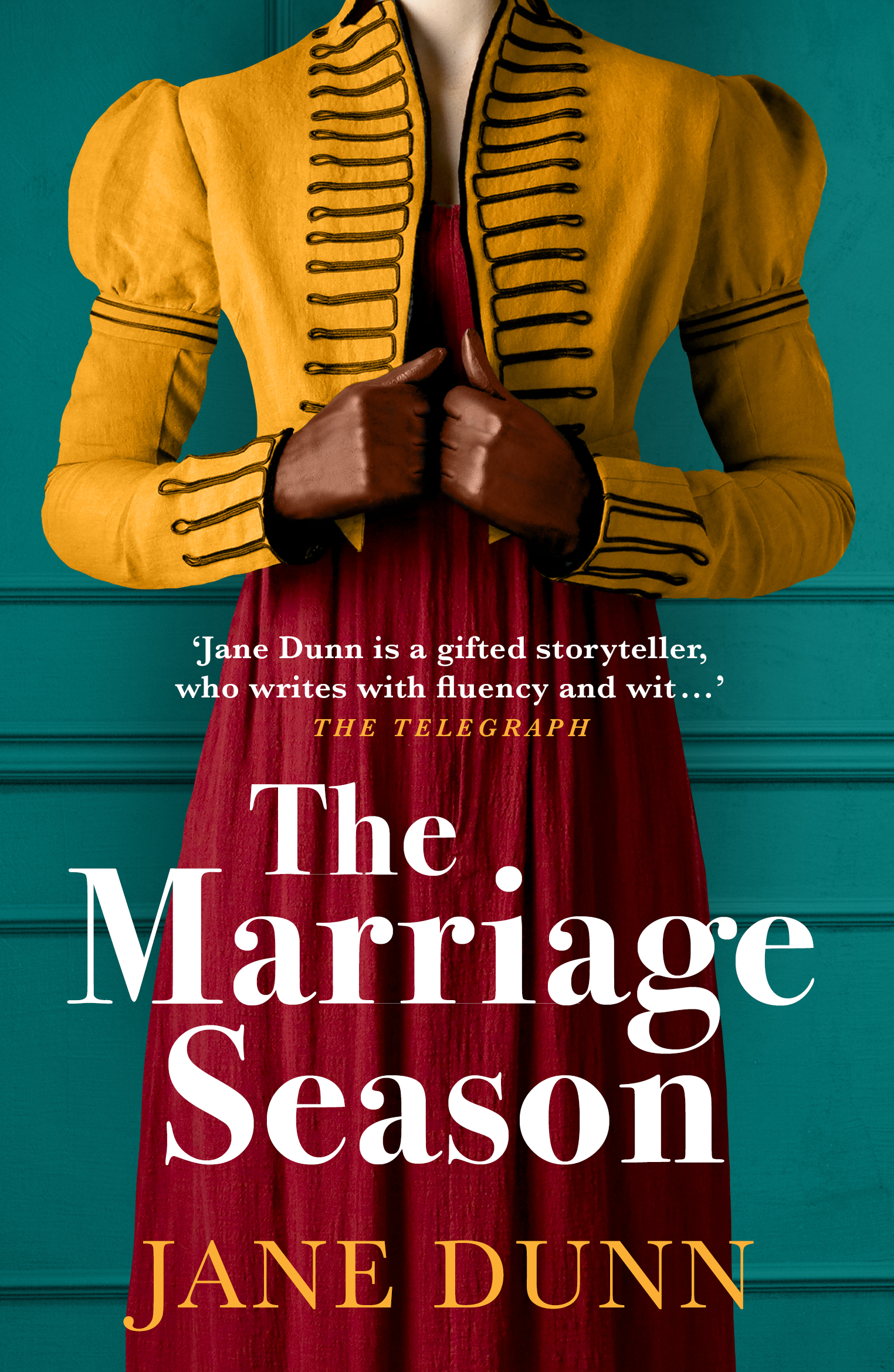
The Marriage Season by Jane Dunn is a delightful Regency romance that’s a little different to similar tales I’ve read, for the story is not just of a young woman trying to find a husband but of a widow deciding if she is perhaps prepared to love again, and her small son, James, or Jim as he likes to be called.
As much as Lucie and Sybella are fabulous creations, as are the men they encounter, it is little Jim and his love of ‘prancers’ that truly steals the show, and why not? That said, the story of Lucie and Sybella is delightful and well-told. Yes, it contains the twisting storylines we might expect, but the author has also littered the narrative with some delightful, period-specific words, which make the story really sparkle. And it’s not just young Jim and his roguish words that bring that charm.
I really adored The Marriage Season. Yes, it was fairly obvious what was going to happen, but that’s not truly the charm of the story but rather the detours the reader is taken on along the way, and of course, young Jim and his love of prancers is a true delight.
Meet the author
Jane Dunn is an historian and biographer and the author of seven acclaimed biographies, including Daphne du Maurier and her Sisters and the Sunday Times and NYT bestseller, Elizabeth & Mary: Cousins, Rivals, Queens. She comes to Boldwood with her first fiction outing – a trilogy of novels set in the Regency period, the first of which is to be published in January 2023. She lives in Berkshire with her husband, the linguist Nicholas Ostler.
A Notable Omissionis the seventh novel from Isabella Muir – all of them set during the 1960s and 1970s. Here Isabella Muir provides some insight into one particular resource that helped her set the story in this particular historical period…
Having fun with historical research
Online research is fun, of course, but right now I’m saying thank goodness for libraries! With all my novels being set during those iconic decades of the 1960s and 1970s I’ve built up a broad range of resources to support my research into all things ‘sixties’. And along the way, in my local library, I tracked down a fascinating book. The Neophiliacs was written by Christopher Booker and published in 1969. It turns out that it is now out of print and Amazon are asking over £100 for a copy! So, you can imagine my delight when my wonderful library managed to retrieve a copy from their ‘rare and out-of-print’ books.
Wanting to find out more about Christopher Booker, I did what many do nowadays in these times of instant ‘information’ – I Googled him. I discovered that back in 1961 he became the founder and one of the early editors of the satirical magazine Private Eye. He was the first jazz critic for the Sunday and Daily Telegraph and continued as a weekly columnist for the Telegraph right up to 2019, when he finally retired at the age of 81. As well as The Neophiliacs Booker has written a number of books studying British society, as well as commenting on wider issues, such as the European Union. Some of his views regarding climate change, health issues, such as the dangers of asbestos and cigarettes, have been controversial; he would appear to be someone who is not afraid to say what he thinks, even if it means going against the grain.
However, as much as Mr Booker and I do not see eye-to-eye over such issues as climate change, his insight into the long-term implications of social change during the 1950s and 1960s have really struck a chord with me.
This paragraph in particular made me sit up and think:
‘…the twentieth century has also provided two other factors to aggravate and to feed the general neurosis; the first being the image-conveying apparatus of films, radio, television, advertising, mass-circulation newspapers and magazines; the second the feverishly increased pace of life, from communications and transport to the bewildering speed of change and innovation, all of which has created a profound subconscious restlessness which neurotically demands to be assuaged by more speed and more change of every kind.’
From: THE NEOPHILIACS: A STUDY OF THE REVOLUTION IN ENGLISH LIFE IN THE FIFTIES AND SIXTIES BY CHRISTOPHER BOOKER
Of course, now in 2023 the desire for speed is all around us – from the need for ever faster broadband, to high-speed rail links and non-stop Transatlantic flights. Some will point out that the changes started when the Industrial Revolution resulted in horse-drawn carriages and ploughs being replaced with the engine and the first railways. Social change is ongoing, but it does appear that some eras are more significant than others.
What is fascinating is to realise that at least sixty or seventy years ago Booker was able to identify ‘restlessness’ as it was happening, knowing that people would need more of the same, on and on until we reach the present day addiction to online and social media, where we constantly flick through images to gratify our seemingly ever reducing attention span.
Sadly, when my loan period expired, I had to return The Neophiliacs to the library, but not before making copious notes. Notes that helped no end as I drafted A Notable Omission, and insights that I hope have helped to set the scene for the novel, transporting readers back to an era when the pace of life was a tad gentler than it is today.
Here’s the blurb
A 1970s debate on equality is overshadowed by a deadly secret…
Spring 1970. Sussex University is hosting a debate about equality for women. But when one of the debating group goes missing, attention turns away from social injustice to something more sinister.
It seems every one of the group has something to hide, and when a second tragedy occurs, two of the delegates – amateur sleuth Janie Juke, and reporter Libby Frobisher – are prepared to make themselves unpopular to flush out the truth. Who is lying and why?
Alongside the police investigation, Janie and Libby are determined to prise answers from the tight-lipped group, as they find themselves in a race against time to stop another victim being targeted.
In A Notable Omission we meet Janie at the start of a new decade. When we left Janie at the end of The Invisible Case she was enjoying her new found skills and success as an amateur sleuth. Here we meet her a few months later, stealing a few days away from being a wife and mother, attending a local conference on women’s liberation to do some soul-searching…
Isabella is never happier than when she is immersing herself in the sights, sounds and experiences of family life in southern England in past decades – specifically those years from the Second World War through to the early 1970s. Researching all aspects of life back then has formed the perfect launch pad for her works of fiction. It was during two happy years working on and completing her MA in Professional Writing when Isabella rekindled her love of writing fiction and since then she has gone on to publish seven novels, six novellas and two short story collections.
This latest novel, A Notable Omission, is the fourth book in her successful Sussex Crime Mystery series, featuring young librarian and amateur sleuth, Janie Juke. The early books in the series are set in the late 1960s in the fictional seaside town of Tamarisk Bay, where we meet Janie, who looks after the mobile library. She is an avid lover of Agatha Christie stories – in particular Hercule Poirot. Janie uses all she has learned from the Queen of Crime to help solve crimes and mysteries. This latest novel in the series is set along the south coast in Brighton in early 1970, a time when young people were finding their voice and using it to rail against social injustice.
As well as four novels, there are six novellas in the series, set during the Second World War, exploring some of the back story to the Tamarisk Bay characters.
Isabella’s love of Italy shines through all her work and, as she is half-Italian, she has enjoyed bringing all her crime novels to an Italian audience with Italian translations, which are very well received.
Isabella has also written a second series of Sussex Crimes, set in the sixties, featuring retired Italian detective, Giuseppe Bianchi, who is escaping from tragedy in Rome, only to arrive in the quiet seaside town of Bexhill-on-Sea, East Sussex, to come face-to-face with it once more.
Isabella’s standalone novel, The Forgotten Children, deals with the emotive subject of the child migrants who were sent to Australia – again focusing on family life in the 1960s, when the child migrant policy was still in force.
The brand new instalment in bestselling author T. A. Williams’ Armstrong and Oscar cozy mystery series!
A brand new cozy crime series set in gorgeous Tuscany…It’s murder in paradise!
Murder in broad daylight…
When millionaire magnate, Rex Hunter is found with his head bashed in on the eighth hole of his prestigious golf and country club in beautiful Chianti, it’s a clear case of murder. Hunter was rich and successful and the envy of many, so retired DCI Dan Armstrong thinks the case will be a hole in one to solve….
A despised victim…
But as Dan and his trusty sidekick Oscar begin to dig deeper into Hunter’s lifestyle, they discover a man despised by many. A renowned womaniser, ruthless boss and heartless family man, it seems no one is particularly sorry to see Hunter dead. And the list of possible suspects is endless…
A murderer covering their tracks.
Dan is determined to catch this clever killer, but it seems every new lead brings another dead end. Will this be one case Dan and his canine companion won’t solve?
Murder in Chianti is the second book in the Armstrong and Oscar series of cosy crime stories set in modern-day Italy.
I thoroughly enjoyed book 1, and book 2 is even better. Now that Dan is living in Tuscany and is known as someone the local police can call on for assistance, the story can focus much more on the mystery to be solved.
And what a mystery this one is. For ages, it seemed as though no resolution could ever be found. Everything Armstrong and Oscar uncovered contradicted something else they already knew, and wow, there are many characters that the reader could suspect of the foul deed. There were several ‘big reveal’ moments, and when the ‘big reveal’ moment finally arrived for real, I was annoyed that I’d not thought of it before. After all, and looking back, the clues were certainly there, but very well concealed.
A thoroughly entertaining and well-plotted cosy mystery. Highly recommended.
My thanks to Netgalley and the publisher for my review copy.
T A Williams is the author of over twenty bestselling romances for HQ and Canelo and is now turning his hand to cosy crime, set in his beloved Italy, for Boldwood. The series will introduce us to retired DCI Armstrong and his labrador Oscar and the first book, entitled Murder in Tuscany, will be published in October 2022. Trevor lives in Devon with his Italian wife.
“Go out and tell all those you meet, Caledon has risen. Caledon will be protected and defended. And to you who would cause her harm, be prepared. A new fight has come.”
After the destruction of the Jacobite forces at Culloden, Scotland is divided, vulnerable and leaderless, with survivors from both sides seeking to make sense of the battles they have fought against their fellow Scots.
James Og flees Drumossie, seeking the protection of his uncle’s house in Sutherland. It is here that James learns that the Northern Highlands hold a secret power only he can wield: Caledon. When Ensign John Mackay begins hunting Og’s family, James realises he must harness this power to defeat the enemies of Scotland.
But, as the ageless Caledon awakes, so too does an ancient evil. When it allies with Mackay, the small Clan of Caledon faces enemies at every turn, discovering that even those closest to them may seek to destroy them.
Caledon is an intriguing work of historical fantasy set in Scotland following the battle of Culloden.
The narrative revolves around six main characters, switching between points of view, and is centred around family loyalty, distrust and the war raging between the Hanoverians and the Stuarts. There are also a few star-crossed lovers, and sadly, not everyone will get the happy ending they deserve, even with the aid of the mysterious Caledon.
With its supernatural elements it offers something a little different as the Clan of Caledon learn to trust their abilities while all those around them seek their destruction.
An enjoyable read and one sure to appeal to those with a love of a Scottish setting.
Meet the author
Virginia grew up in Orkney, using the breath-taking scenery to fuel her imagination and the writing fire within her. Her favourite genres to write are fantasy and historical fiction, sometimes mixing the two together. She enjoys swashbuckling stories such as The Three Musketeers by Alexandre Dumas and is still waiting for a screen adaption that lives up to the book!
When she’s not writing, Virginia is usually to be found teaching music. She believes wholeheartedly in the power of music, especially as a tool of inspiration. She also helps out with the John o’ Groats Book Festival which is celebrating its 4th year.
She now lives in the far-flung corner of Scotland. A doting spaniel-owner to Orlando and Jess, Virginia soaks up in inspiration from the landscape as she ventures out with her canine companions.
She loves cheese, music, and films, but hates mushrooms.

























 MJ Porter