Author of Saxon historical fiction and non-fiction, 20th-century historical mysteries, and Norse-inspired historical romantasy. Book reviewer and blog host.
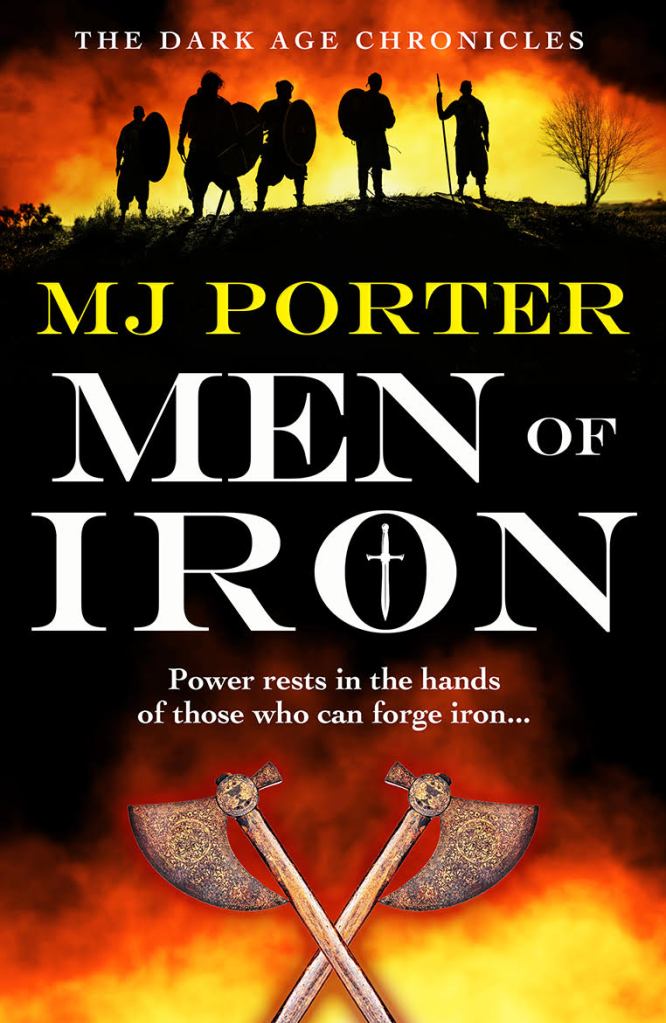
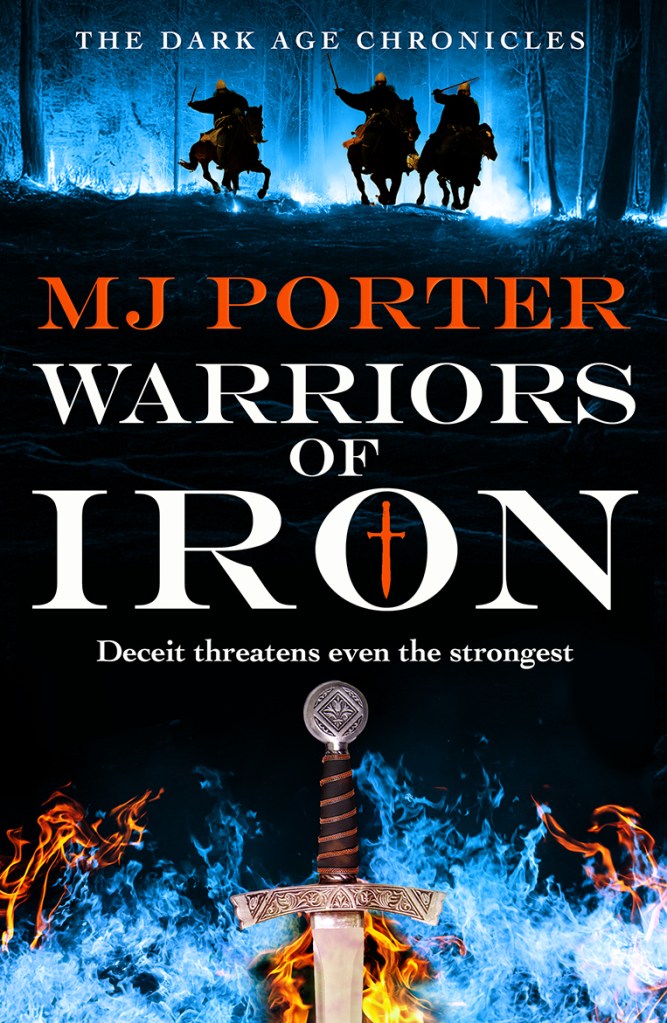
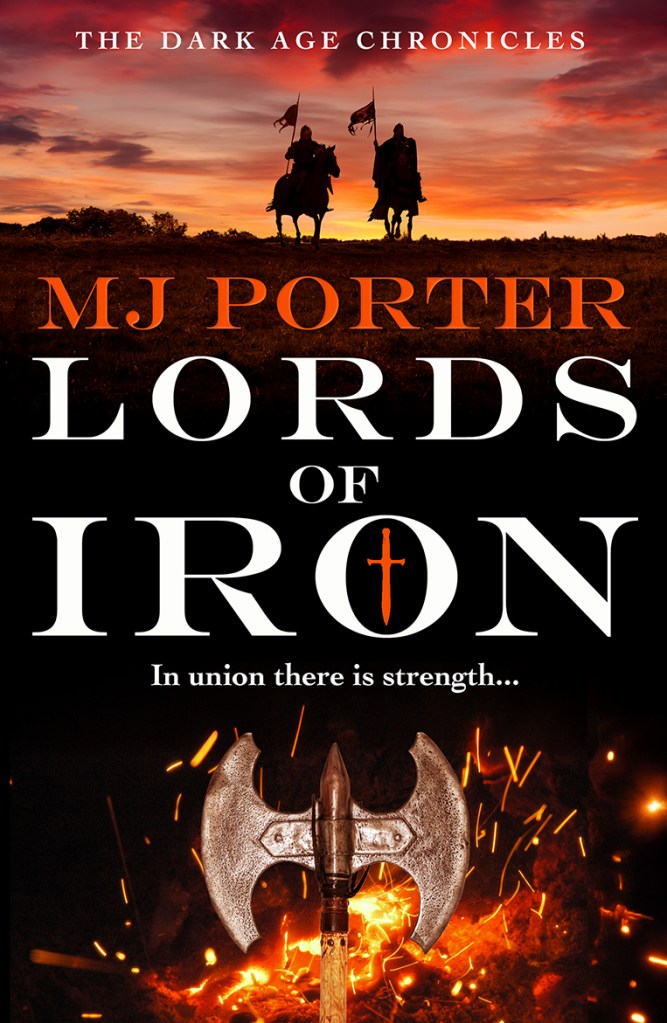
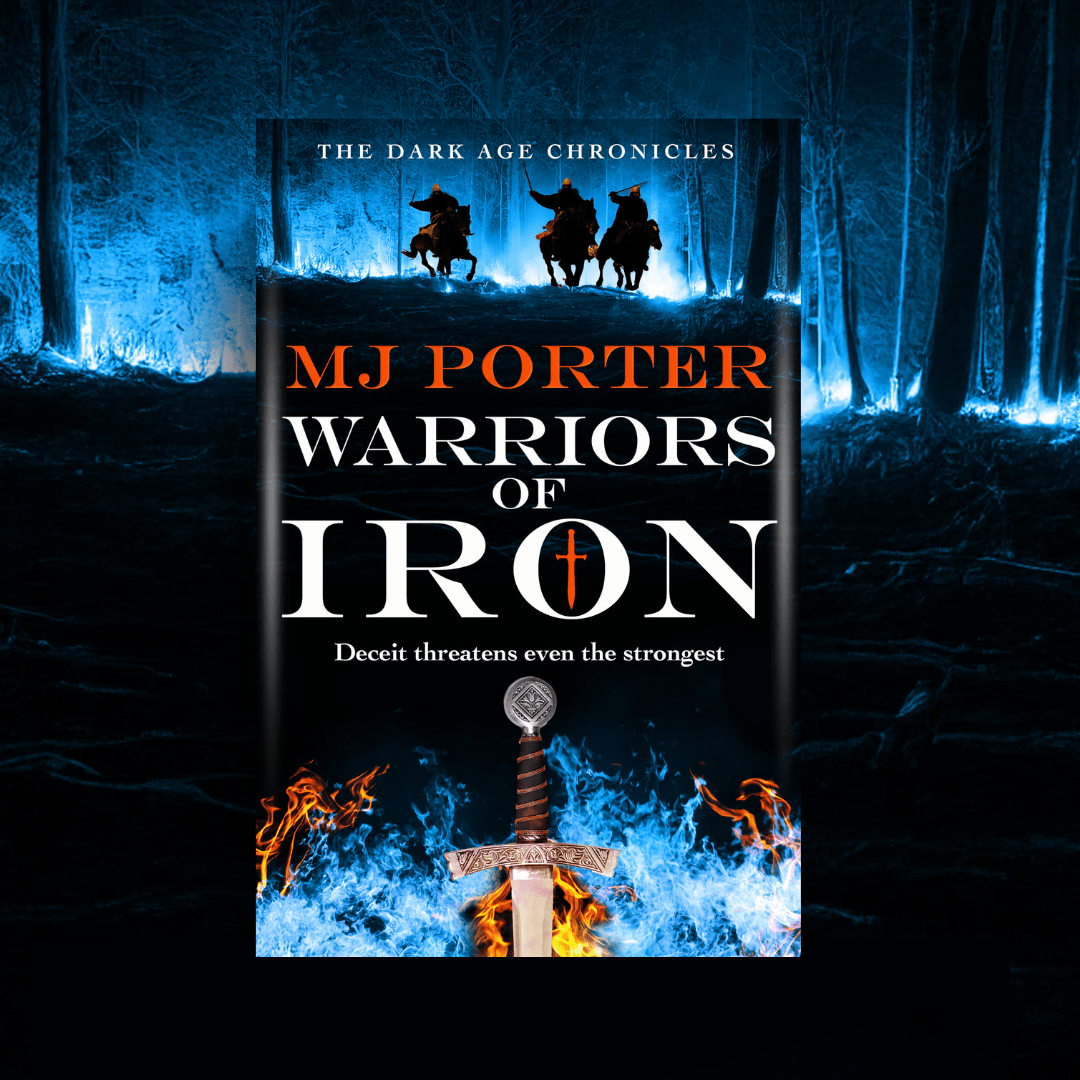
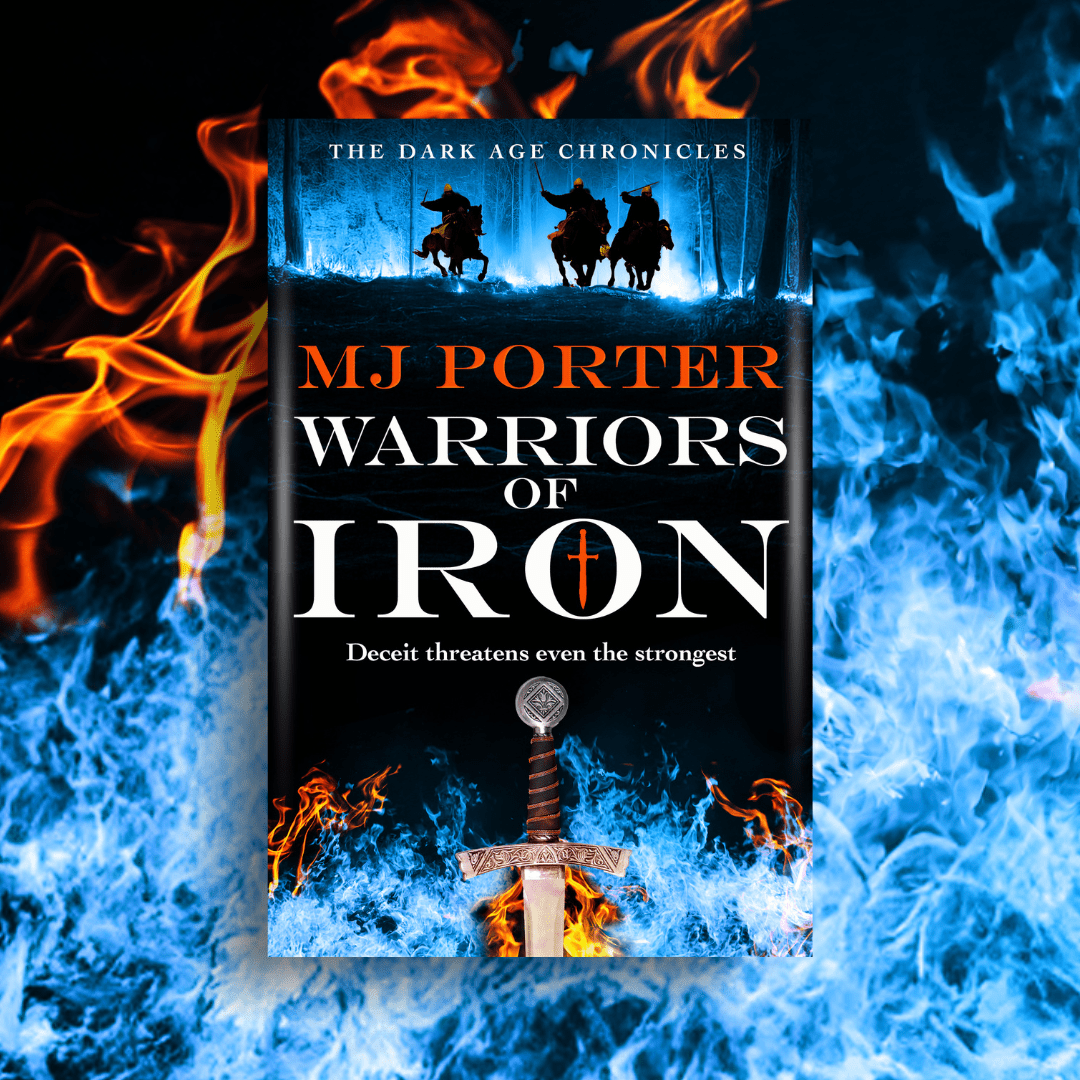
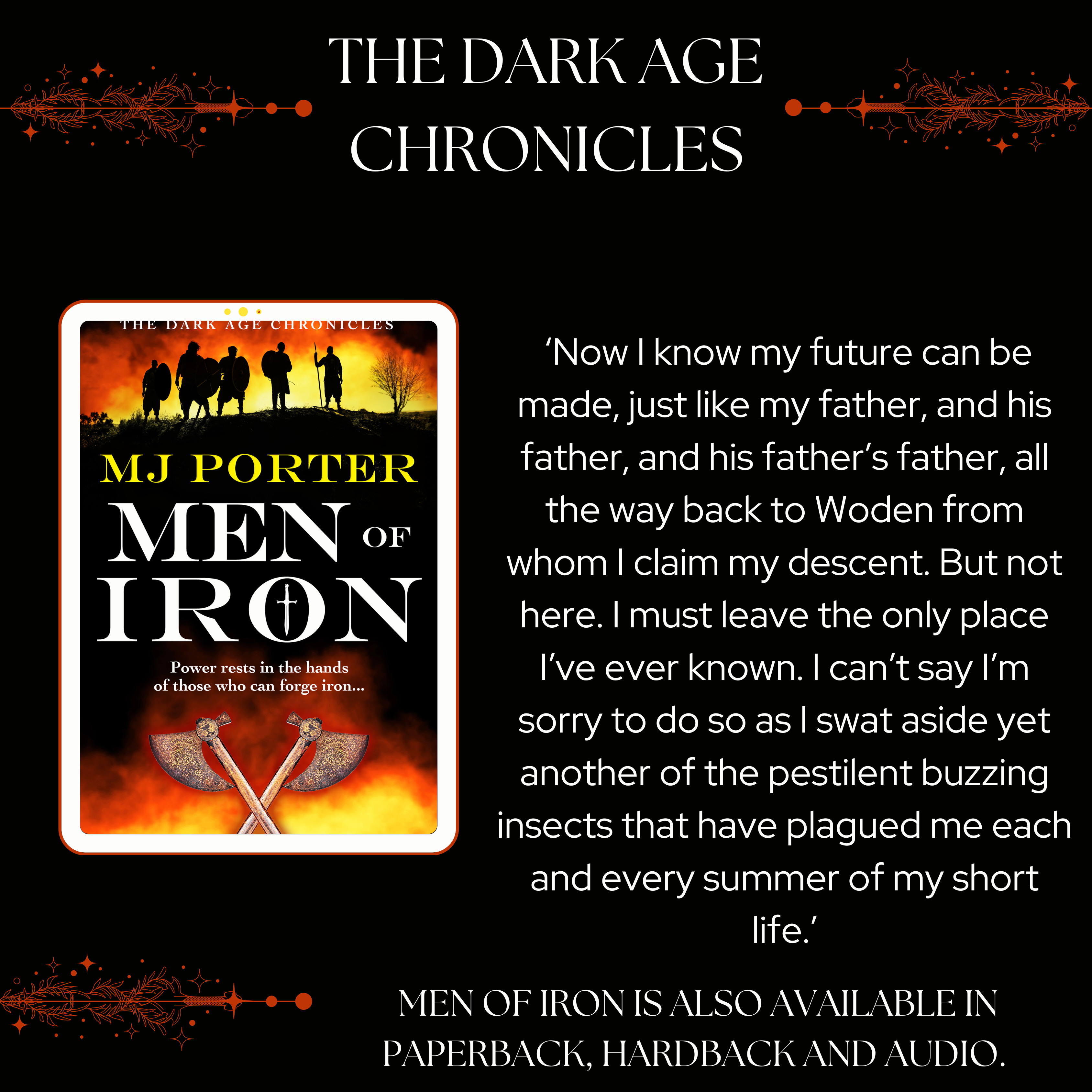
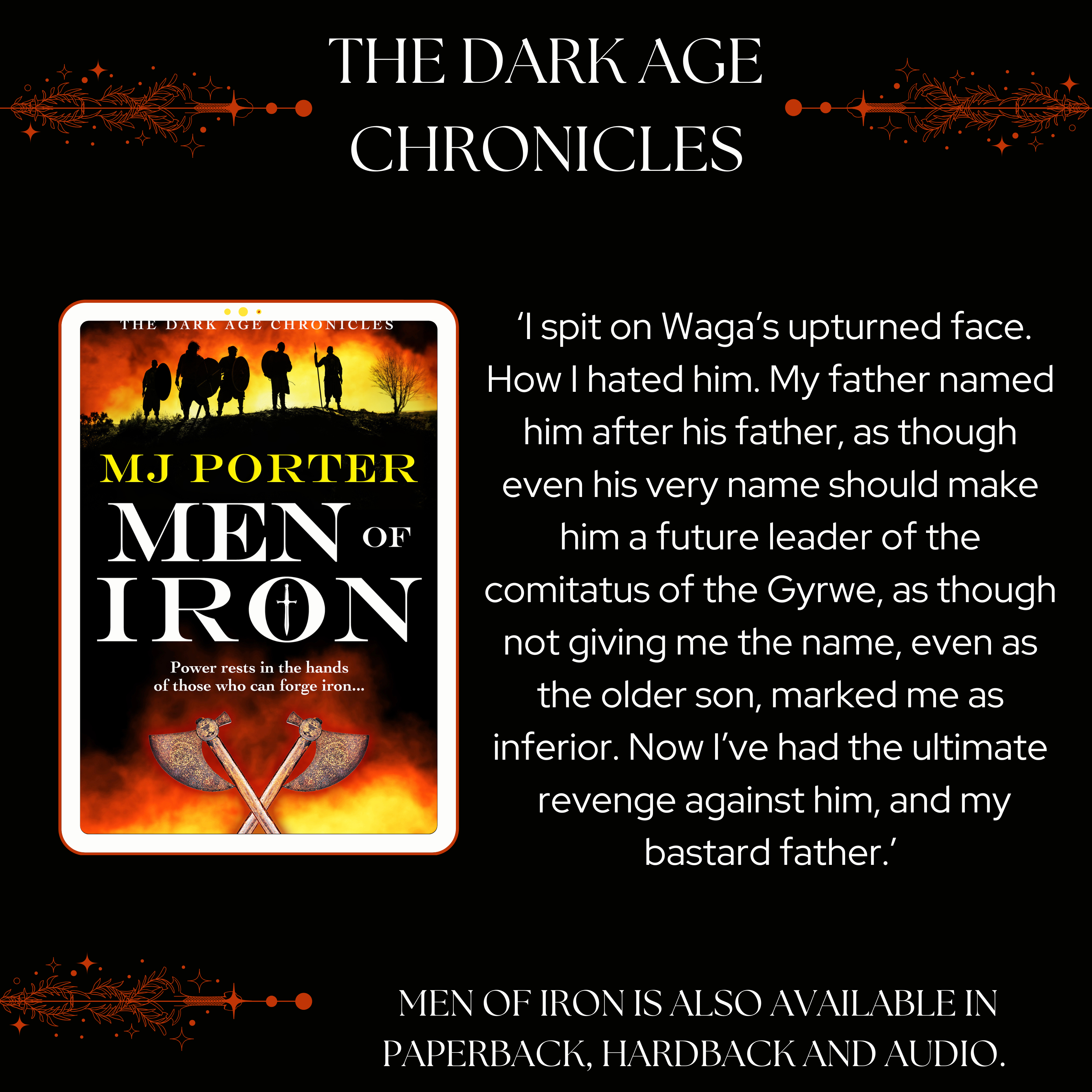
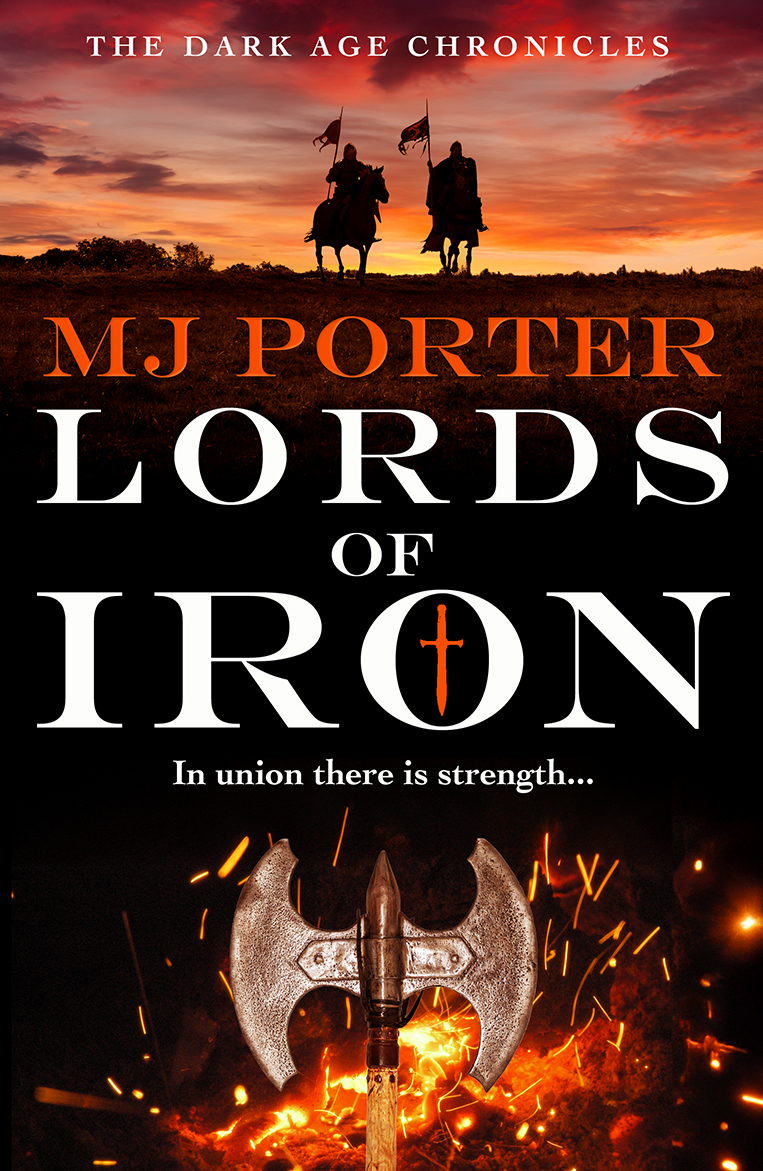
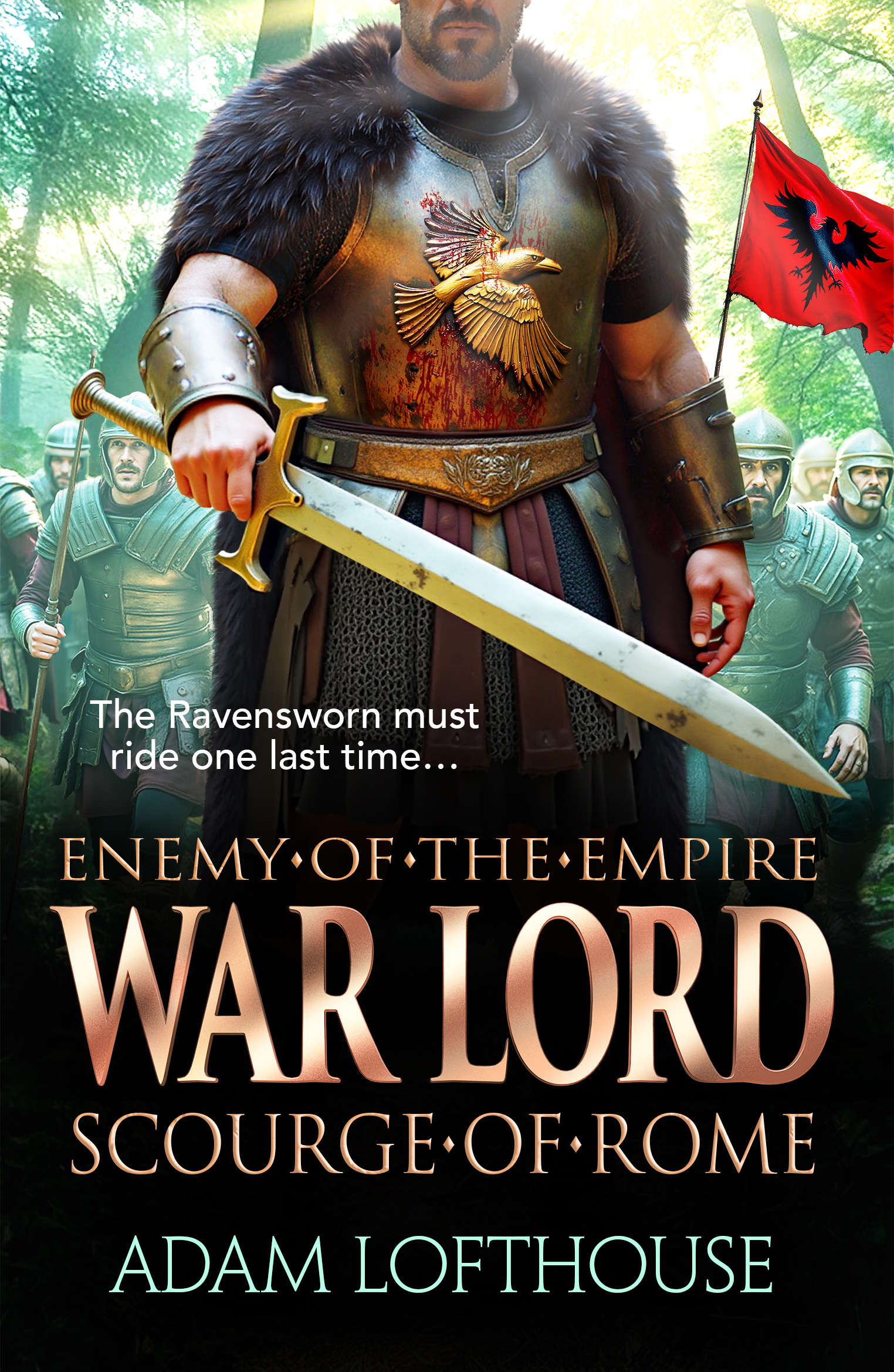
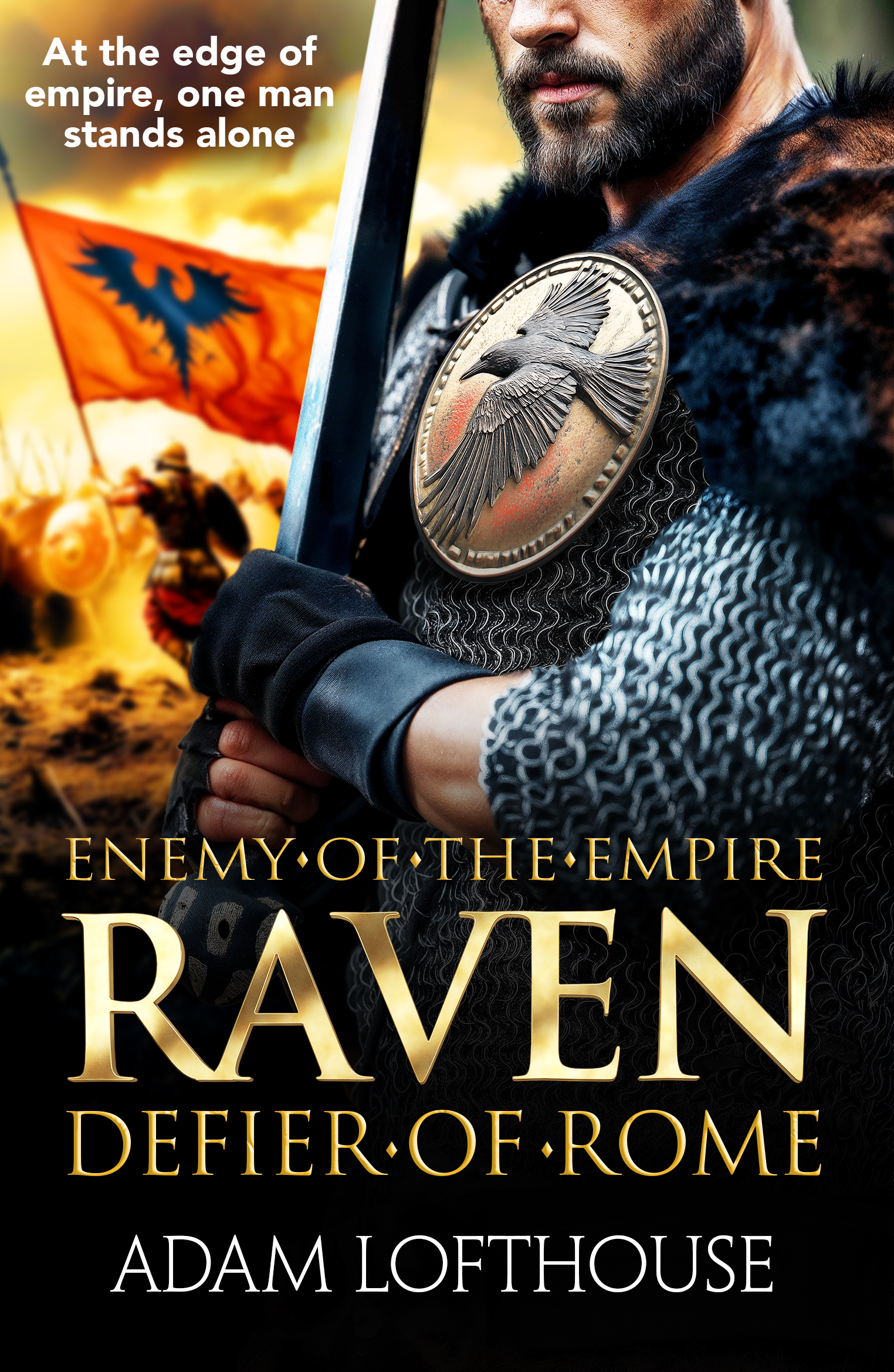
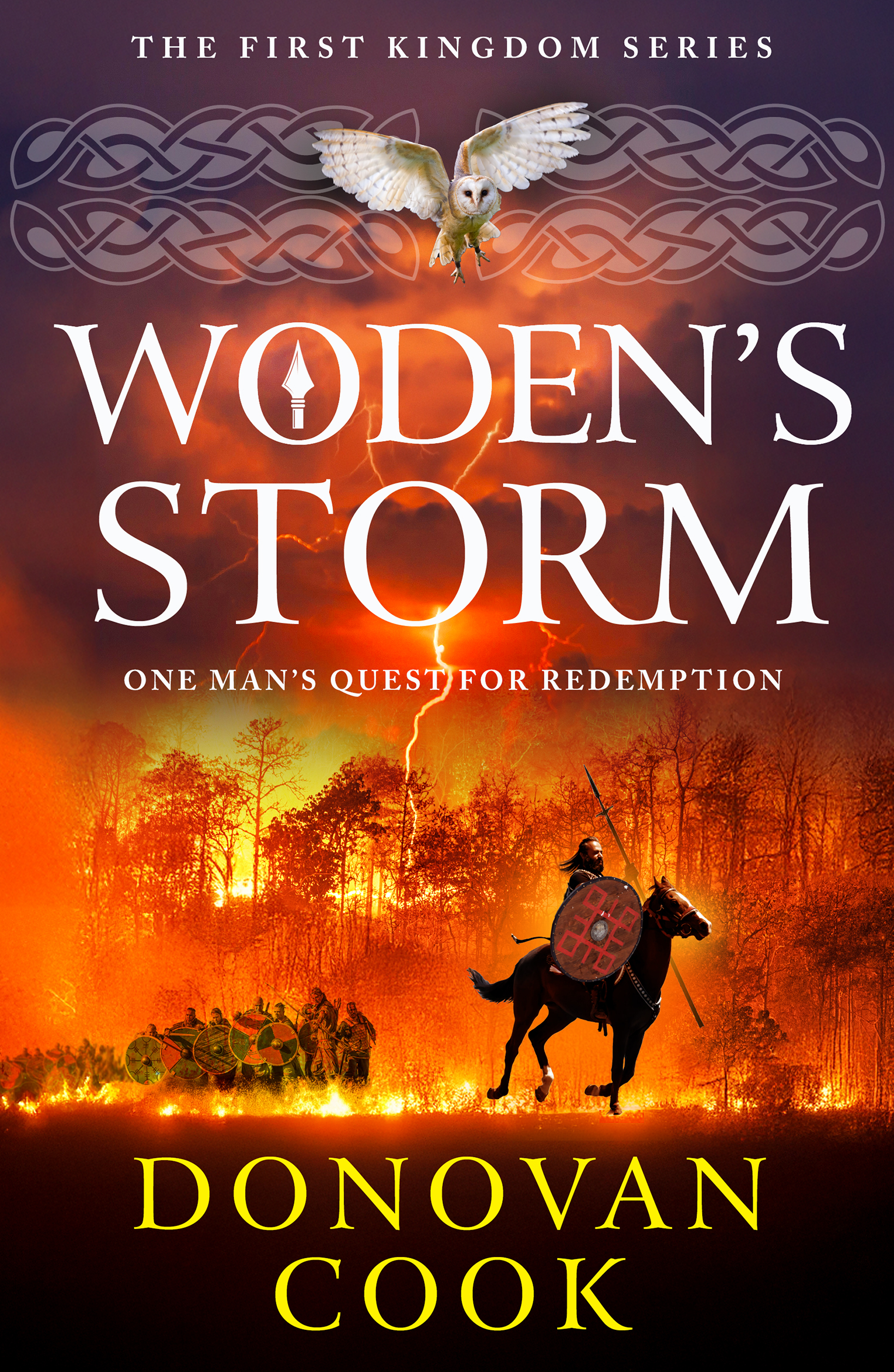
It’s happy release day to Lords of Iron, the third and concluding book in the Dark Age Chronicles Trilogy. Watch and listen to a short recording about the research books I used #newrelease #MenOfIron #WarriorsOfIron #LordsofIron #histfic
A whizz through the research books I used when writing the Dark Age Chronicles
Join my newsletter to follow my writing journey, get access to my exclusive Subscriber area on the blog, and receive a copy of Mercia – A Companion Guide to the Tales of Mercia.
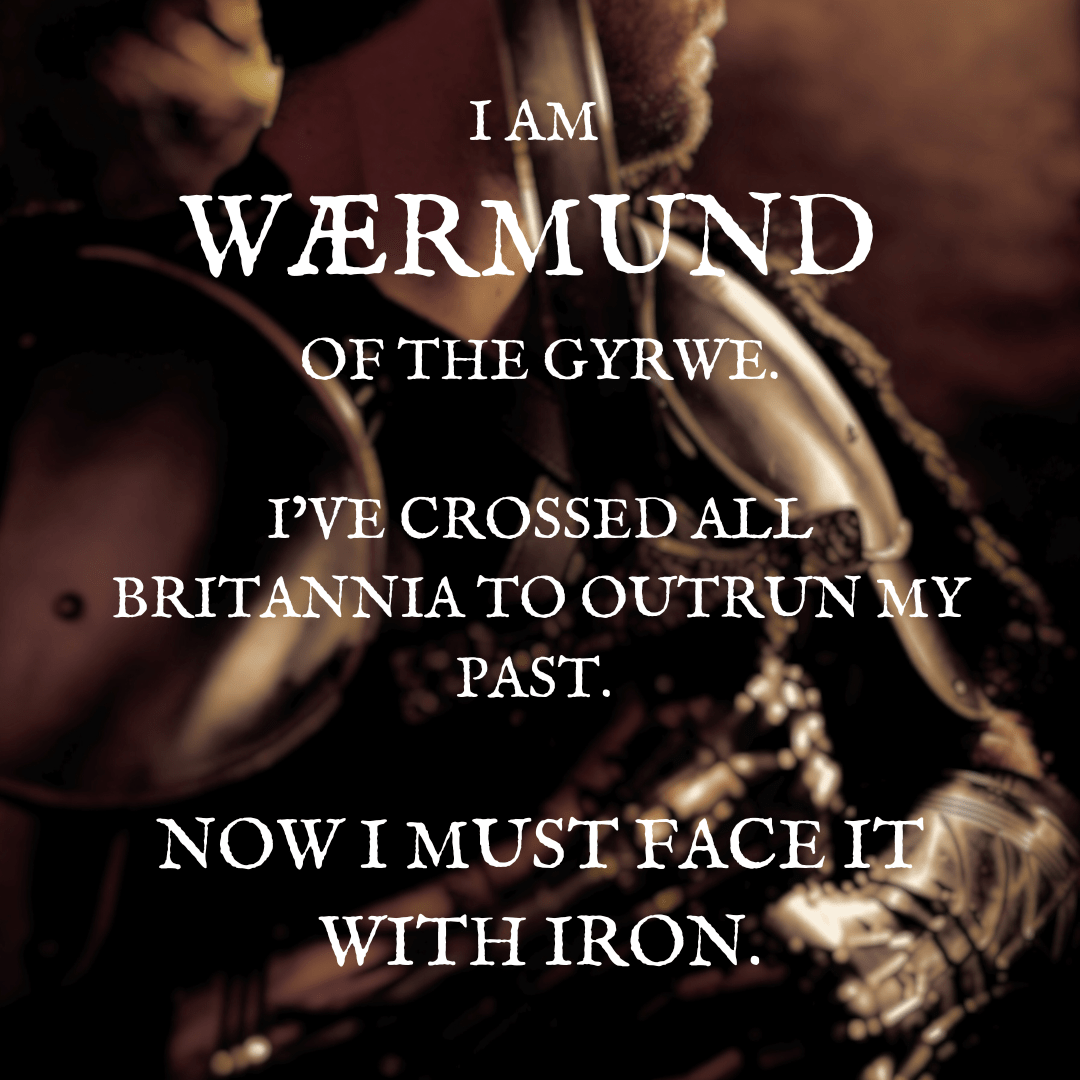
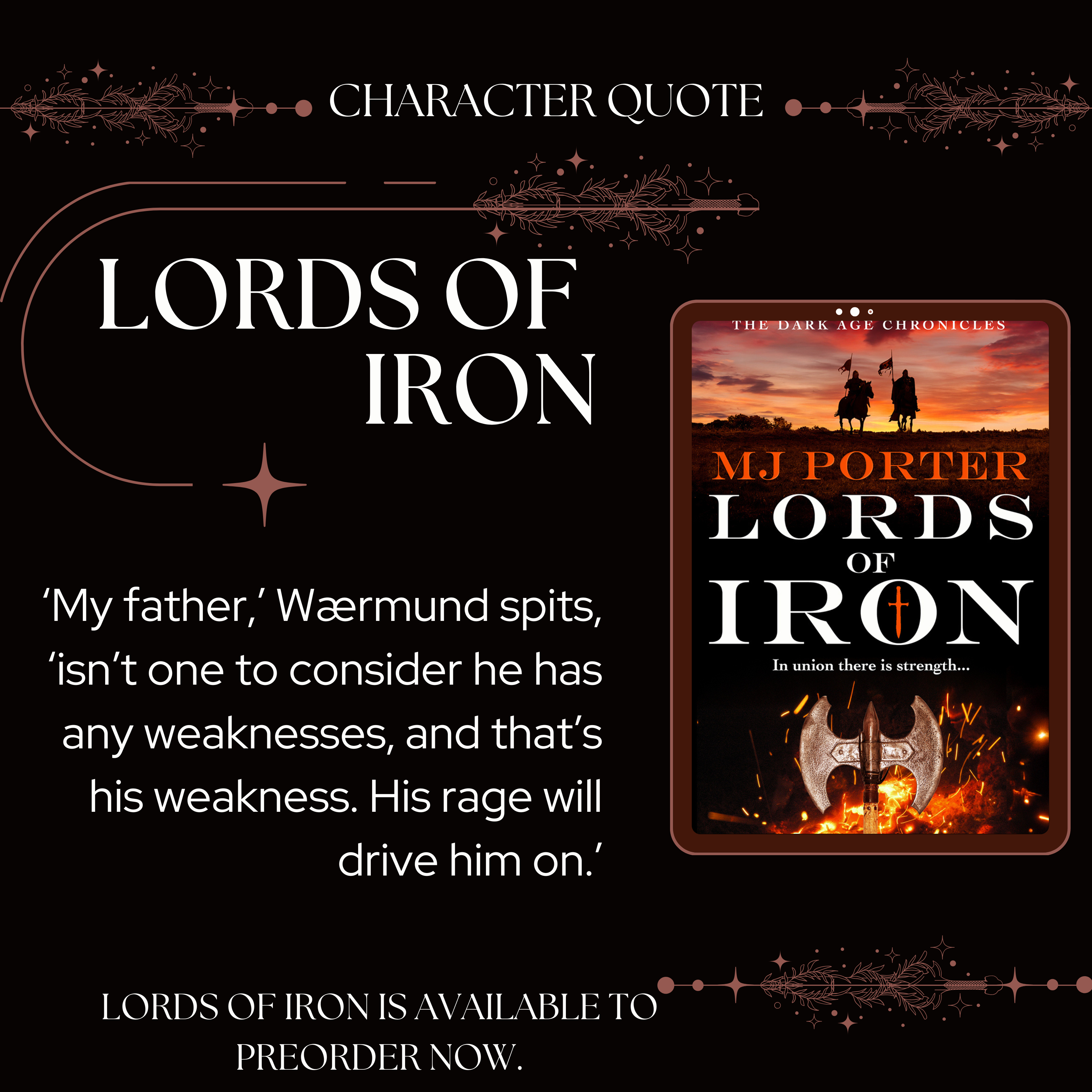
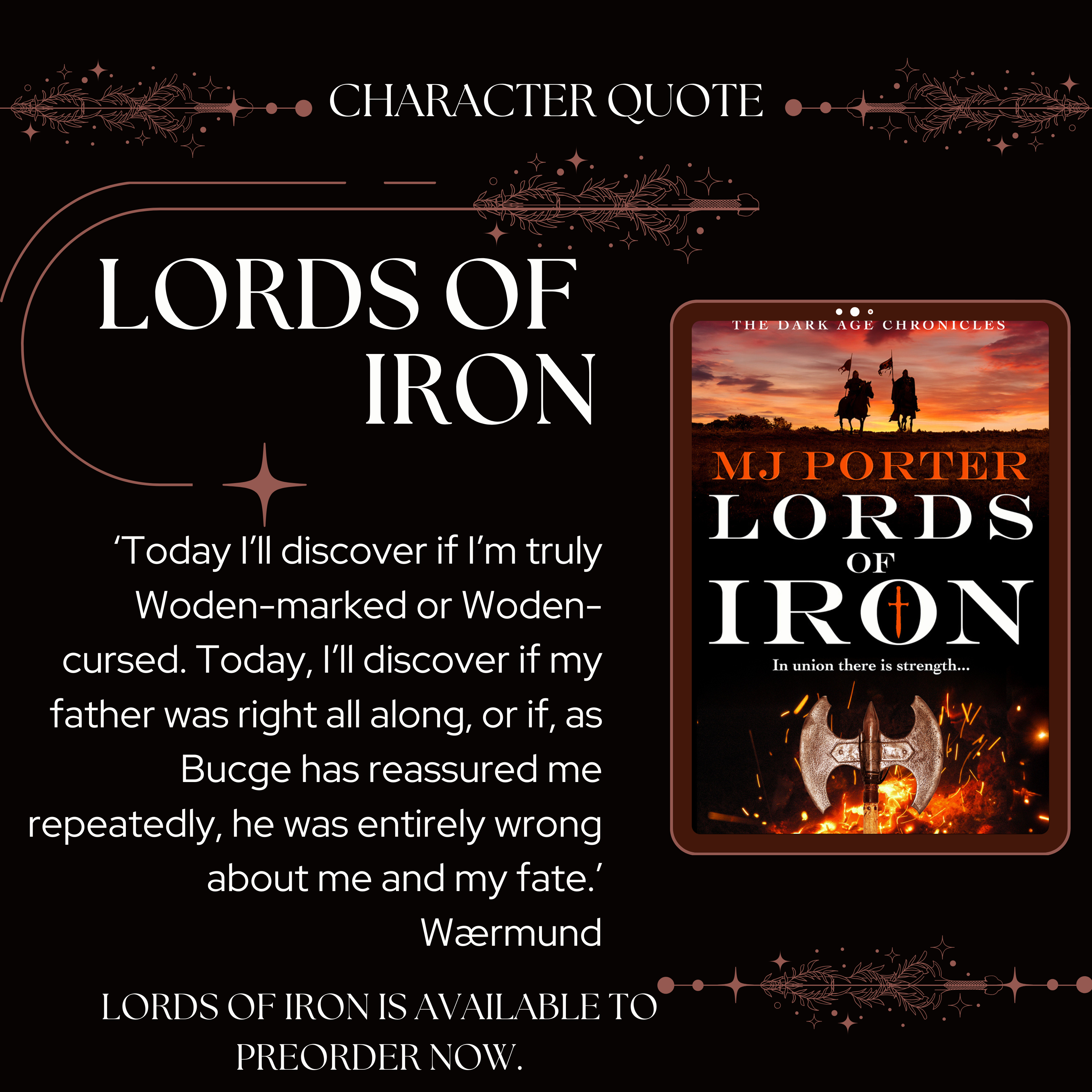
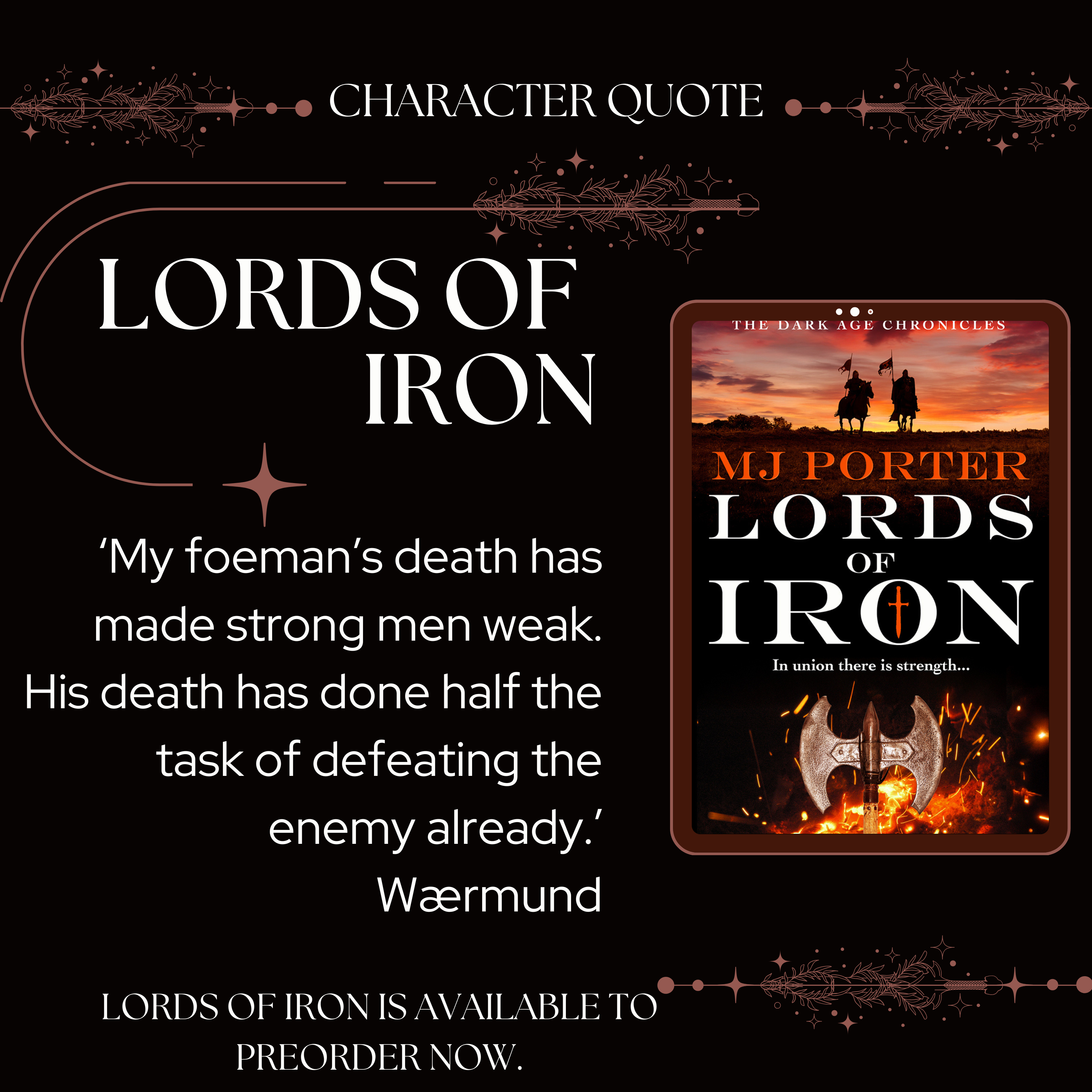
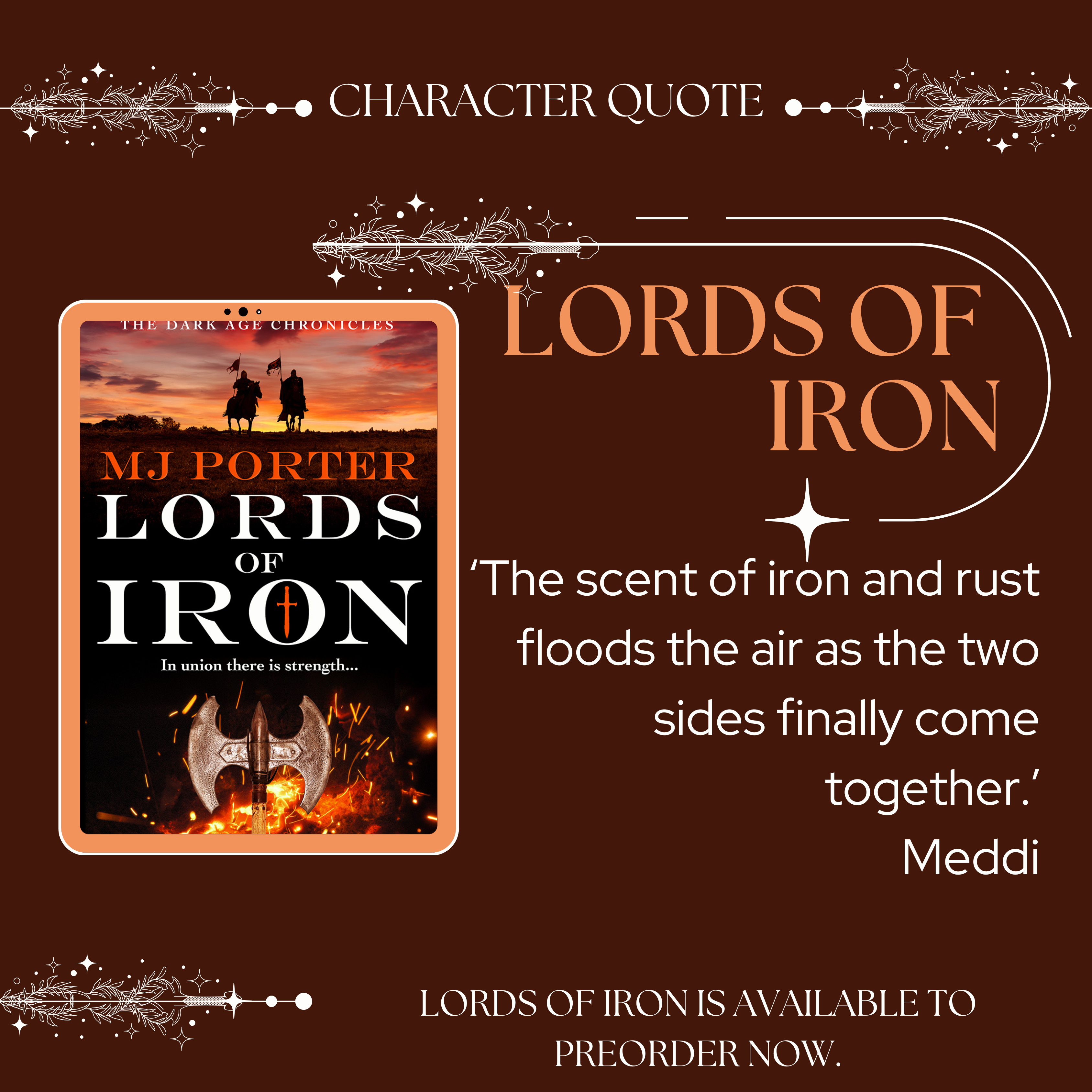
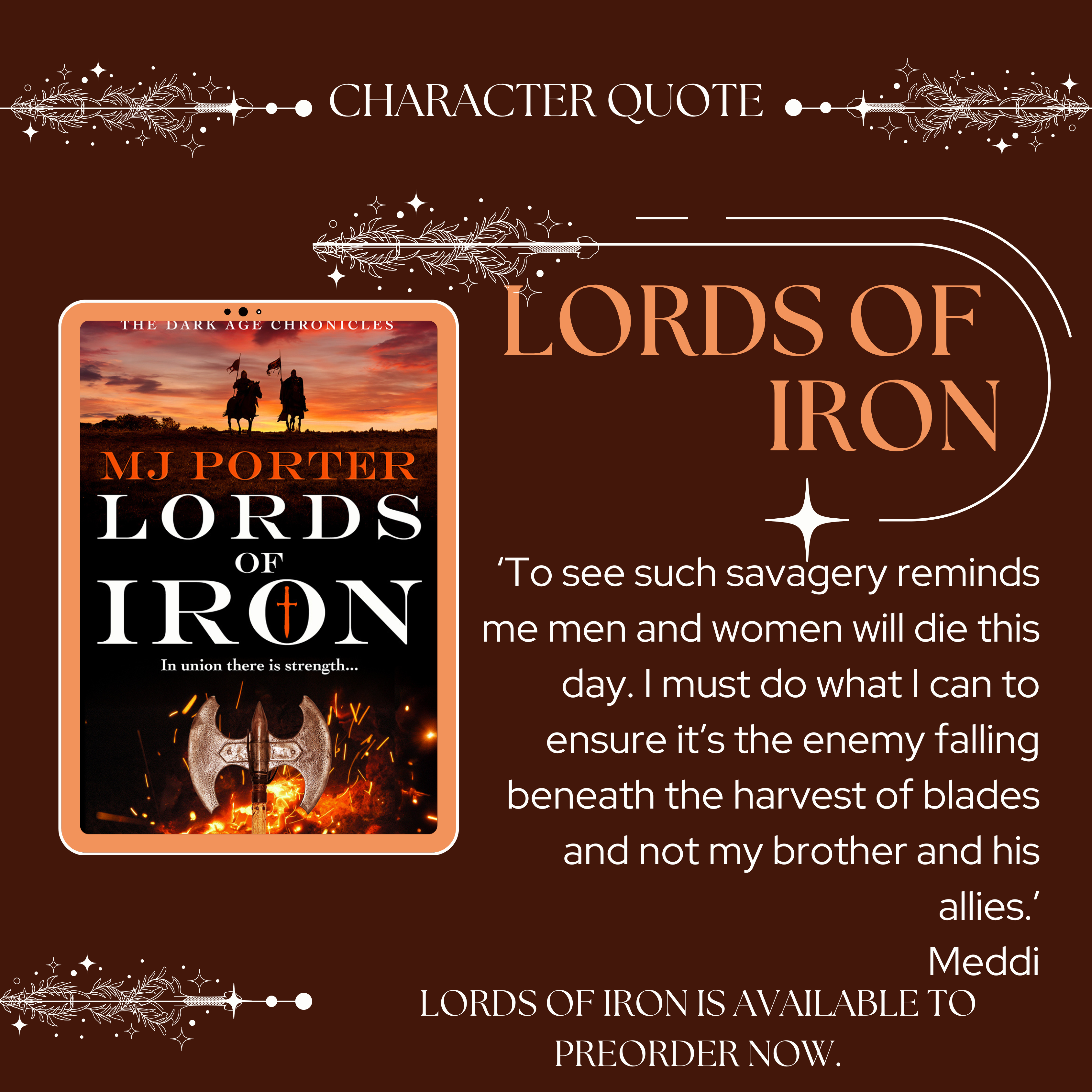
It’s nearly happy release day to Lords of Iron, the third and concluding book in the Dark Age Chronicles Trilogy. Let’s talk about Wærmund, warrior of the Gyrwe #newrelease #MenOfIron #WarriorsOfIron #LordsofIron #histfic
Wærmund, warrior of the Gyre
Wærmund, the lead male point of view in the Dark Age Chronicles, has come a long way since our first encounter with him, when he was young, angry, reckless and unable to assure himself of the loyalty of others. (I’m not saying he didn’t have cause to be angry).
While I’ve written novels in this era where the main male lead is strong and fiercesome (as well as treating everyone to young Icel), I’ve not really written a character like Wærmund before. One early reviewer complained he was ‘annoying’ and that was intentional. For him to become the character I needed him to become, he couldn’t start the novels ‘fully formed.’ I needed him to learn, grow, and become someone more thoughtful than his angry young self allowed.
Along the way, he’s had much cause to doubt himself, and really, it was Heafoc, his loyal warrior, who was the most fully formed of the warriors who pledged their often dubious loyalty to Wærmund. Heafoc, perhaps very much cast in the shadow of the rather wonderful Wulfstan from the Earls of Mercia series, and potentially, also the older Icel from The Last King books, was the epitome of a Saxon warrior, whereas Wærmund wasn’t. Indeed, in deciding to run away from his home, Wærmund hoped to outrun his past, which was never really going to be possible for him.
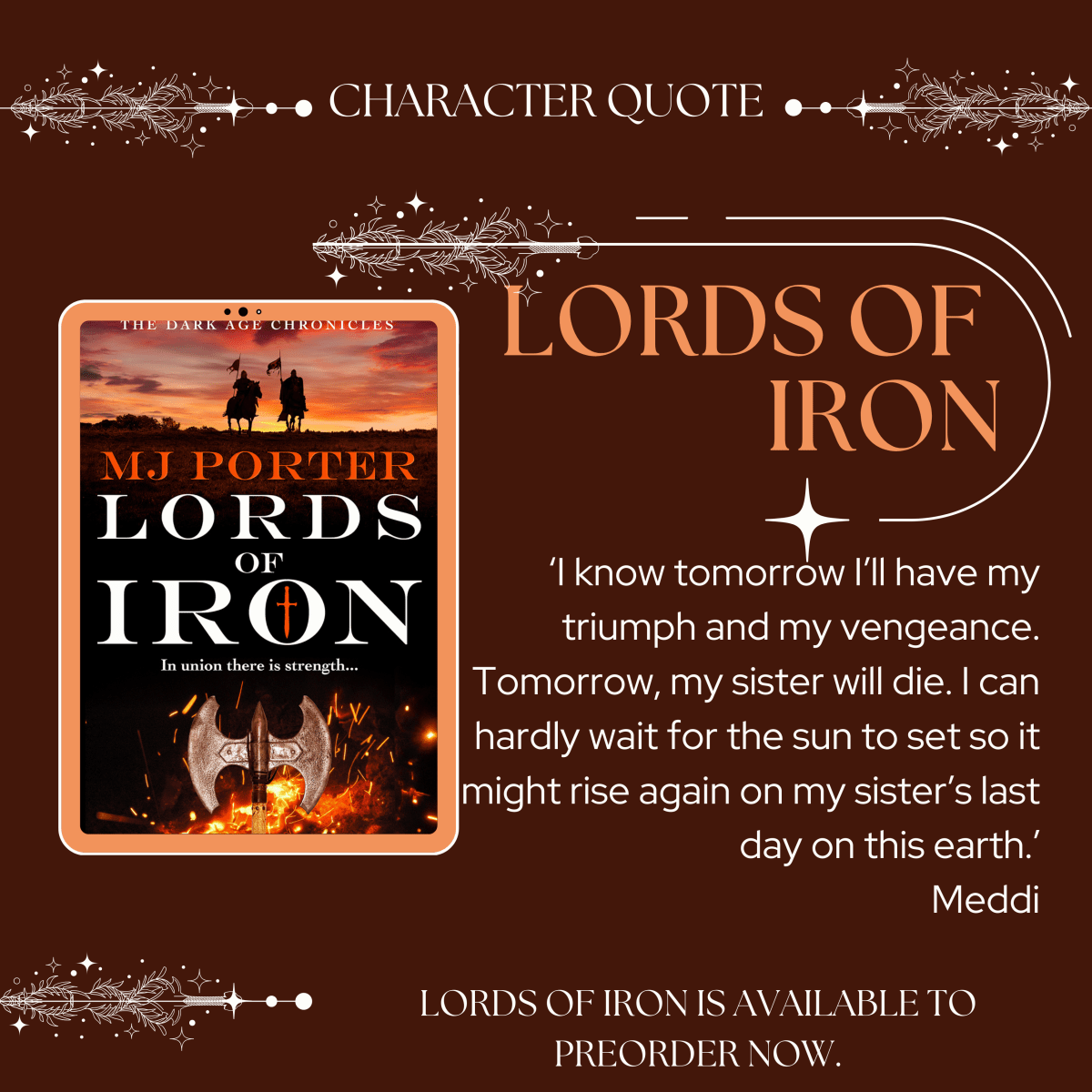
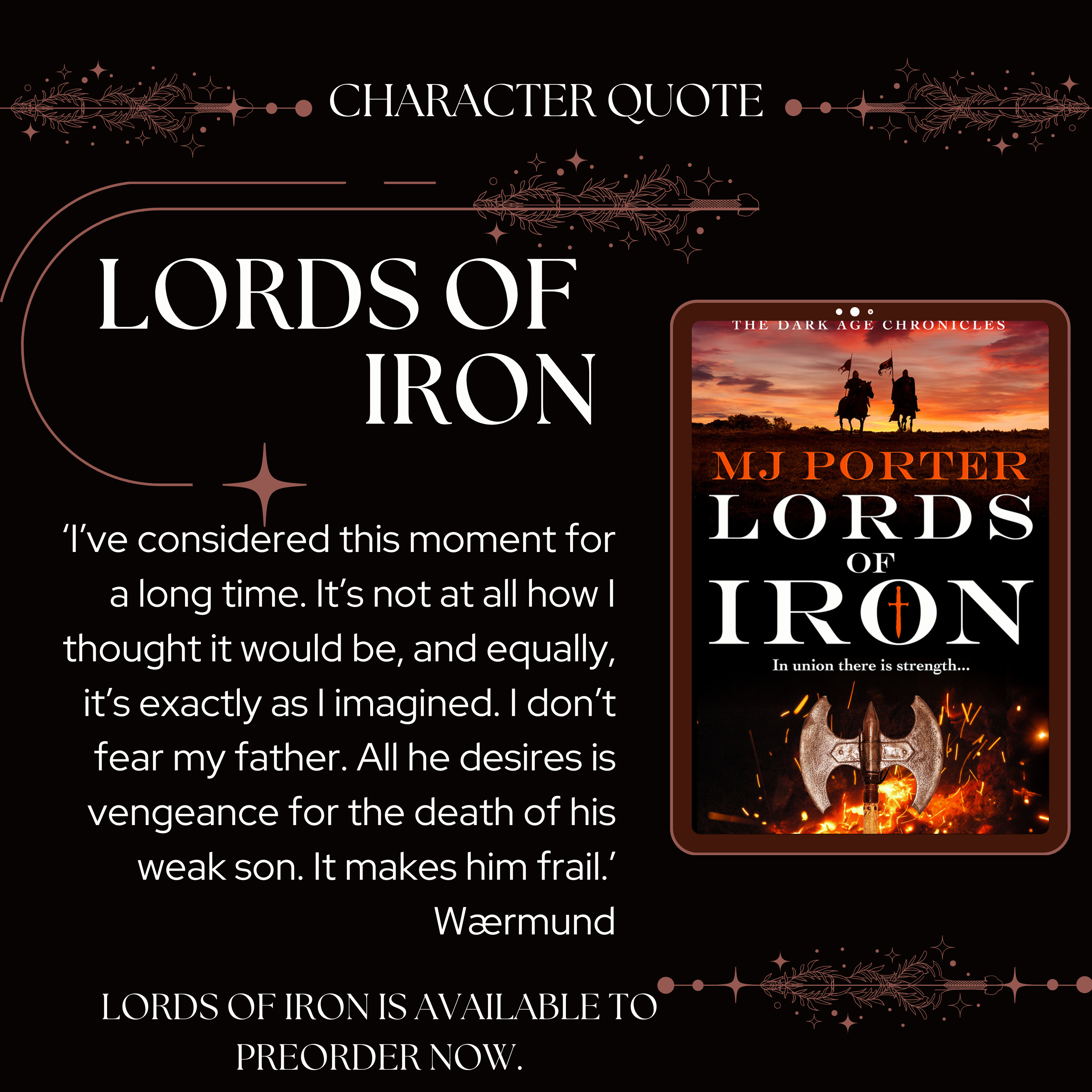
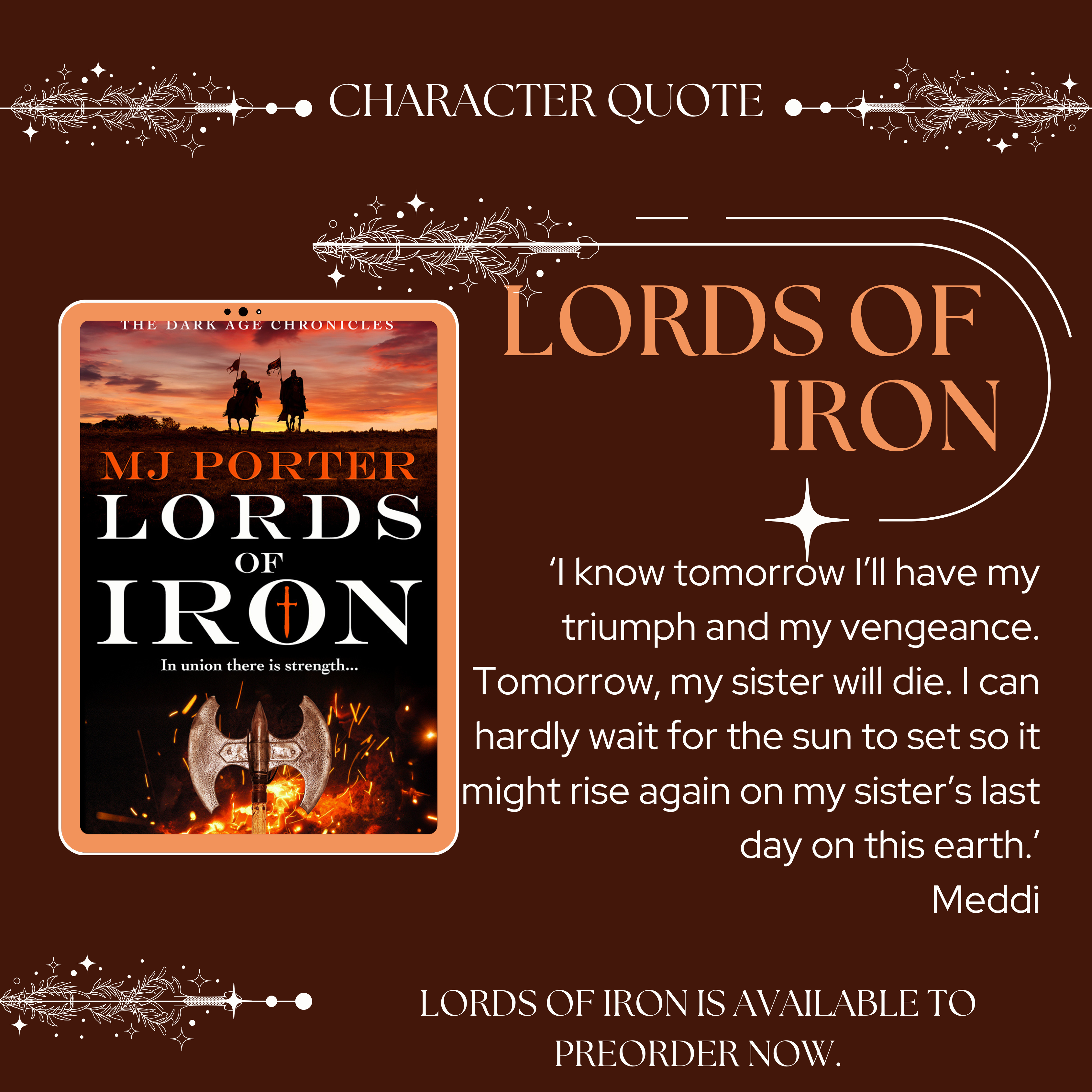
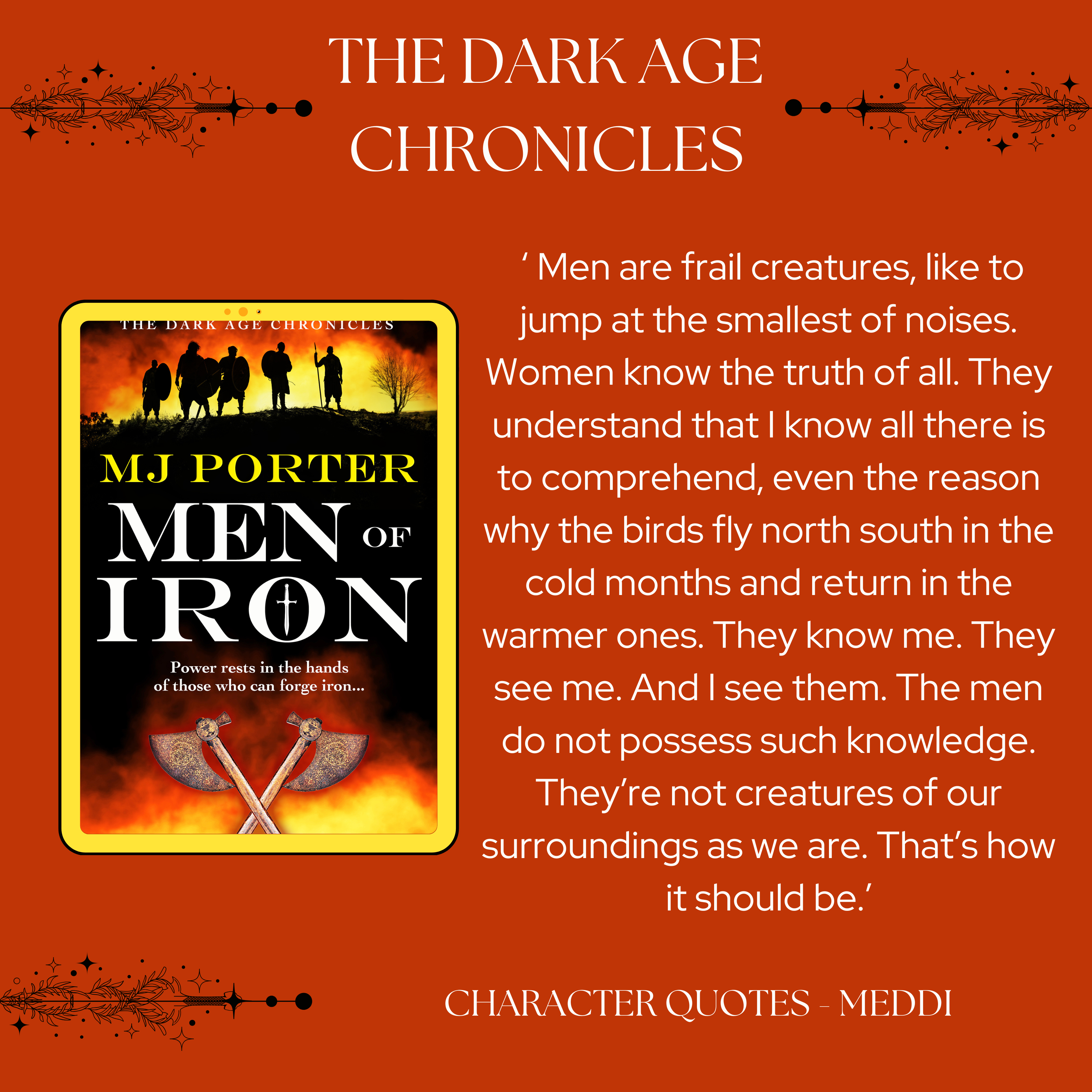
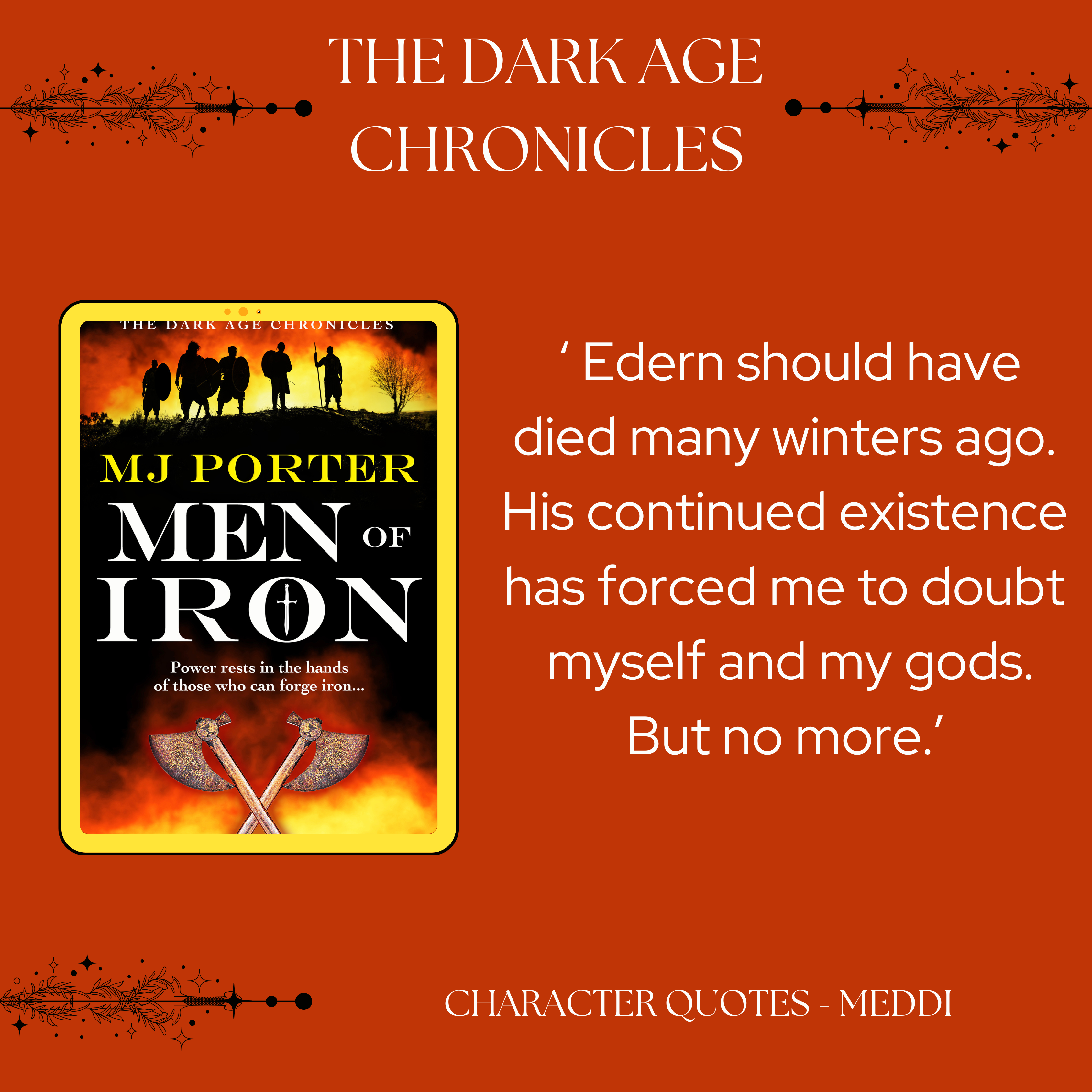
Now, as we turn to the concluding book in the trilogy, I feel Wærmund has come full circle. Is he, perhaps, now a better man than his father? Or, is he still driven by the desire to show his father he is the ‘better’ man? These are some of my favourite quotes from Wærmund in the final book.
You will need to read Lords of Iron (available from 5th January 2026) to discover whether Wærmund enacts his vengeance against his father. Enjoy.
Join my newsletter to follow my writing journey, get access to my exclusive Subscriber area on the blog, and receive a copy of Mercia – A Companion Guide to the Tales of Mercia.
It’s nearly happy release day to Lords of Iron, the third and concluding book in the Dark Age Chronicles Trilogy. Here are the original (very long) historical notes for Men of Iron #newrelease #MenOfIron #WarriorsOfIron #LordsofIron #histfic
The original historical notes for Men of Iron (they were so long I rewrote them)
This is not really a story of historical fiction, but rather archaeological fiction. Pick up any non-fiction history book on Britain at this time, and you’ll find very little written about what was happening, because we do not know what was going on, other than perhaps in the south and south-west (where there was more continuity from the earlier ‘Roman’ period). If it’s a book about Mercia, there’ll be even less until the seventh century. It’s impossible to write about the history of a kingdom when there are no written records. And so we must rely on archaeology.
The decision to write about these formative years in what would become Mercia has been a long time coming for me (and it is set mostly in what would become Mercia although the name never appears in the books).
All that can be said with any certainty about Mercia is that a narrative had formed by the eighth century which was an attempt by the rulers of that time to explain how they came to be in control of the heartland of Mercia. It also attempt to explain how they ruled the wider Mercian kingdom (which included many other tribal affiliations: from the North Mercians, South Mercians and Middle Mercians to the outlying areas – the kingdom of the Hwicce, alongside that of the Magonsæte, being two of the best known tribal areas which people have heard about, and the Hwicce the region where I’ve based the Eorlingas). Bede, writing his Ecclesiastical History of the English People, finished by 734, knew some of these details, although he really did not like Penda the pagan – one of the most powerful Mercians in the seventh century (who it’s believed may have been from the Hwiccan kingdom) – but did grudgingly admit that his contemporary ruler of Mercia, Æthelbald, was a powerful individual, eclipsing the kings in his homeland of Northumbria by the eighth century.
Barbara Yorke has written:
The surviving sources allow us to say with confidence little more than that the kingdom of Mercia was in existence by the end of the sixth century. p. 102, Kings and Kingdoms of Early Anglo-Saxon England
How that kingdom came about, we do not know. I’ve chosen the date of this series carefully. It falls between the Battle of Camlann, said to have taken place in 537 according to the Welsh Annals, a later written source, and a later battle between ‘kings’ which occurred in the 570s and is mentioned in the Anglo-Saxon Chronicle, written 300 years after these events.
It’s difficult to determine any cohesive narrative from what is truly the Dark Ages for the whole of Britain. Others might look to the stories of the legendary Arthur (no, I don’t believe he existed), and Hengist and Horsa and think that’s enough, but having read K. R. Dark’s fascinating look at Britain at this period, Civitas to Kingdom, many years ago, I realised that what happened elsewhere might not have happened in Mercia, and equally, that generalisations shouldn’t be used about what would become the Saxon kingdoms in any single part of it. It was an island of petty tribal chieftains. It was not a country or a kingdom. This is an attempt to make some sense of what archaeological findings have been made and devise something that ‘could’ have happened. These people did not exist as I have named them, although I have adopted tribal names that are recorded in a later document (see below).
Wærmund is a name taken from a Mercian genealogy found in the Welsh Annals. There are a number of different variants of a Mercian genealogy. This is the one I’ve used, below.
Woden begot Watholgeot, begot Waga, begot Wihtlæd begot Wæround, begot Offa, begot Angen[geot], begot Eomer, [begot Icel,begot Cnebba, begot Cynewald, begot Creoda], begot Pybba. Pybba had twelve sons, two of whom are better known to me than the others, namely Penda and Eobba. Aethelred was the son of Penda; Penda was the son of Pybba. Aethebald was son of Alweo, son of Eobba, [brother] of Penda, son of Pybba. Egferht son of Offa, son of Thingrith, son of Eanwulf, son of Osmond, son of Eobba, son of Pybba.
Other versions of a Mercian genealogy are found in the Anglo-Saxon Chronicle entry for the year 626 (A2 Version, also known as the G version) when discussing the later reign of Penda which lists many of the same names, but has Wihtlæd as the son of Woden. David Dumville has noted that this represents a West Saxon interpretation of Mercia (the ASC was conceived of and begun in Wessex) – as such, he stresses the ‘Anglian’ tradition of this source, i.e. possibly Mercians writing about Mercians.
I’ve chosen Wærmund’s name somewhat randomly, but with the idea that he wasn’t the first of his family – and that, indeed, he is originally from one of the Wash tribes for which we have details from the Tribal Hidage. Every time I write a new series, something clicks for me, and in this case it’s that whatever the genealogies represent, it needn’t be those who ruled Mercia as a kingdom as we recognise it, but those who ruled the ‘tribe’ beforehand. Yes, they did claim descent from the god, Woden, but most of the Saxon kingdoms did.
It’s believed that the kingdom of the Hwicce was perhaps a native British one and that they came to merge with the Saxons, or rather at this time, Anglian invaders, and then fell under the sway of the wider Mercian kingdom. (The terminology is complex to get right.)
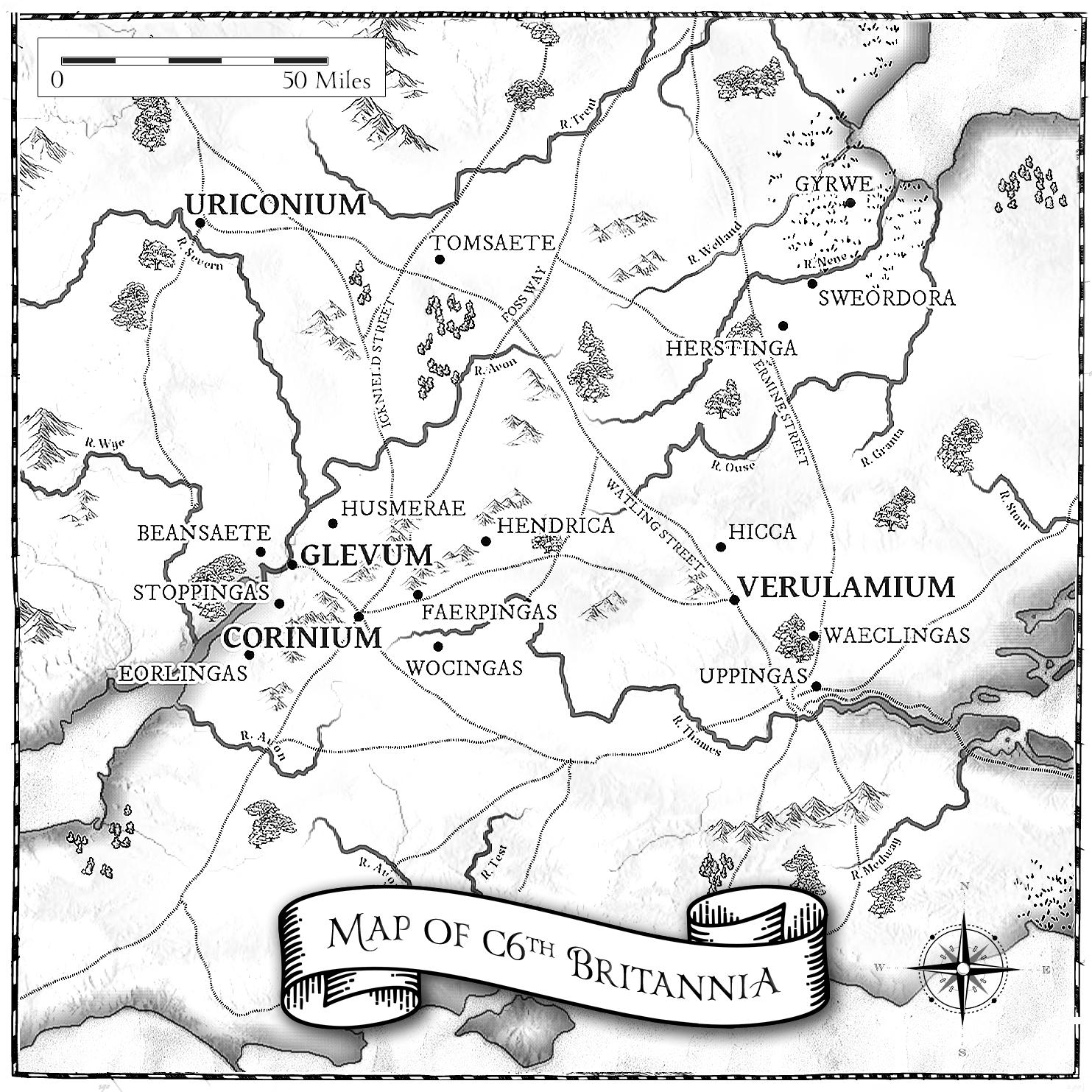
The names of the tribes come from the problematic and difficult-to-date Tribal Hidage, which survives in an eleventh-century document, but is believed to be a copy of an eighth-century document. It lists thirty-five kingdoms, which comprise ninety-five different tribal names believed to have amalgamated to form these thirty-five kingdoms, which were then further merged to form the six main Saxon kingdoms of the Heptarchy (the seventh, Northumbria, is not included in the Tribal Hidage). Feel free to go and try and make sense of the Tribal Hidage. Every non-fiction writers seems to use slightly different spellings and because some are so similar, it is incredibly confusing. Some of my tribes changed names repeatedly as I endeavoured to make them ‘fit’ the narrative and the journey my characters make. All mistakes are mine.
There are a wealth of Roman villas surviving in Gloucestershire, perhaps most famously Chedworth Roman Villa, and also many Roman mosaics, some of which are not available for public viewing as they have been covered up beneath the soil that has preserved them to ensure that continues. The tribe of the Eorlingas is associated with Arlingham, just below Gloucester, to the east of the River Severn. As far as I can tell, Frocester is the closest Roman villa ruin to have been discovered from nearby to where I wanted to base the Eorlingas, but with so many of them, it almost feels as though they might have been falling over them – there are fifty-two known Roman villas in Gloucestershire alone.
The idea of an economy dependent on iron had not really resonated with me before, but Robin Fleming’s comment that mining, metallurgy and smithing stood at the heart of the Roman economy made me reconsider this. She points out that from the late fourth century (which is traditionally deemed to be the end of Roman Britain – well, 410 is) there is a scarcity of traditional, crucial and once common everyday items – nails, evident in the lack of hobnail books and also coffins. She does, however, stress that the Romans had a successful ‘recycling’ scheme and that forging iron objects from these recycled elements may well have continued. However, pattern-wielded blades (which had largely come to dominate what we believe early Saxon/Anglian kings wielded in their battles) could not be made from recycled iron or from a single type of iron alloy, with at least four different iron alloys needed. Therefore, an age ‘without’ iron almost ensued. It is possible that these skills were lost and then needed to be rediscovered. Equally, it is possible that the evidence for such occupations as smelting have disappeared from the archaeological record in many places because of the transient nature of the process. I find the lack of nails in the archaeological record, however, very intriguing. It certainly points to something being lacking.
Languages in this era are, of course, impossible to reconstruct. It’s believed that English, Latin, British, Pictish and Irish would have been spoken. It must also be assumed that those coming to this island from Scandinavia and Germany would also have brought their languages with them. I’ve decided to use the terms Latin, Saxon, British and Brythonic in the text. (I had to make myself a chart to ensure I didn’t have people speaking to other people who didn’t share a language – it wasn’t pretty). There would potentially have been a vast number of local dialects as well, just as there are today.
The small iron-cast horse which Meddi has is based on a bronze object uncovered at Frocester. It is a fabulous piece, described in the site report as ‘crudely designed, with wide open mouth and large upstanding ears’. It is quite small, less than two inches in length, if I’ve understood the dimensions correctly, and shows the horse having reins but no stirrups. The horse was controlled by a bridle alone, and the horses were smaller, at twelve to fourteen hands, the equivalent of a hackney pony, or forty-eight to fifty-six inches tall (according to the internet). Stirrups were introduced by the Saxons.
I have struggled to find references to the religions at this time. Ronald Hutton’s Pagan Britain contains some useful passages. This somewhat leads into burial rites, which are often much of what we know of our ancestors. It does appear confusing – the magnificent ship burials at Sutton Hoo were preceded by burials beneath what is now the visitor centre (and which I think are more fascinating than the ship burials – or rather, the process of how they went from the one to the other within a generation.) Cremation and interment were somewhat haphazardly applied throughout Britain. My own distinctions between peoples are merely an attempt to highlight the differences between them. The depiction of the burial of Meddi’s daughter beneath inhabited buildings is a known phenomenon from this period, and written about by Robin Fleming in her chapter Living with Little Corpses in The Material Fall of Roman Britain 300-525CE.
For anyone affected by this storyline, or concerned by it, as someone who has experienced the loss of a child, I’m perhaps too comfortable including such story elements. To those who have also endured it, I extend my heartfelt sympathies and assure you, it does get easier. Eventually. (what follows below has been added at the end of the proofread for Lords of Iron).
This passage leads somewhat well to a thought by Meddi as she nears the end of book three.
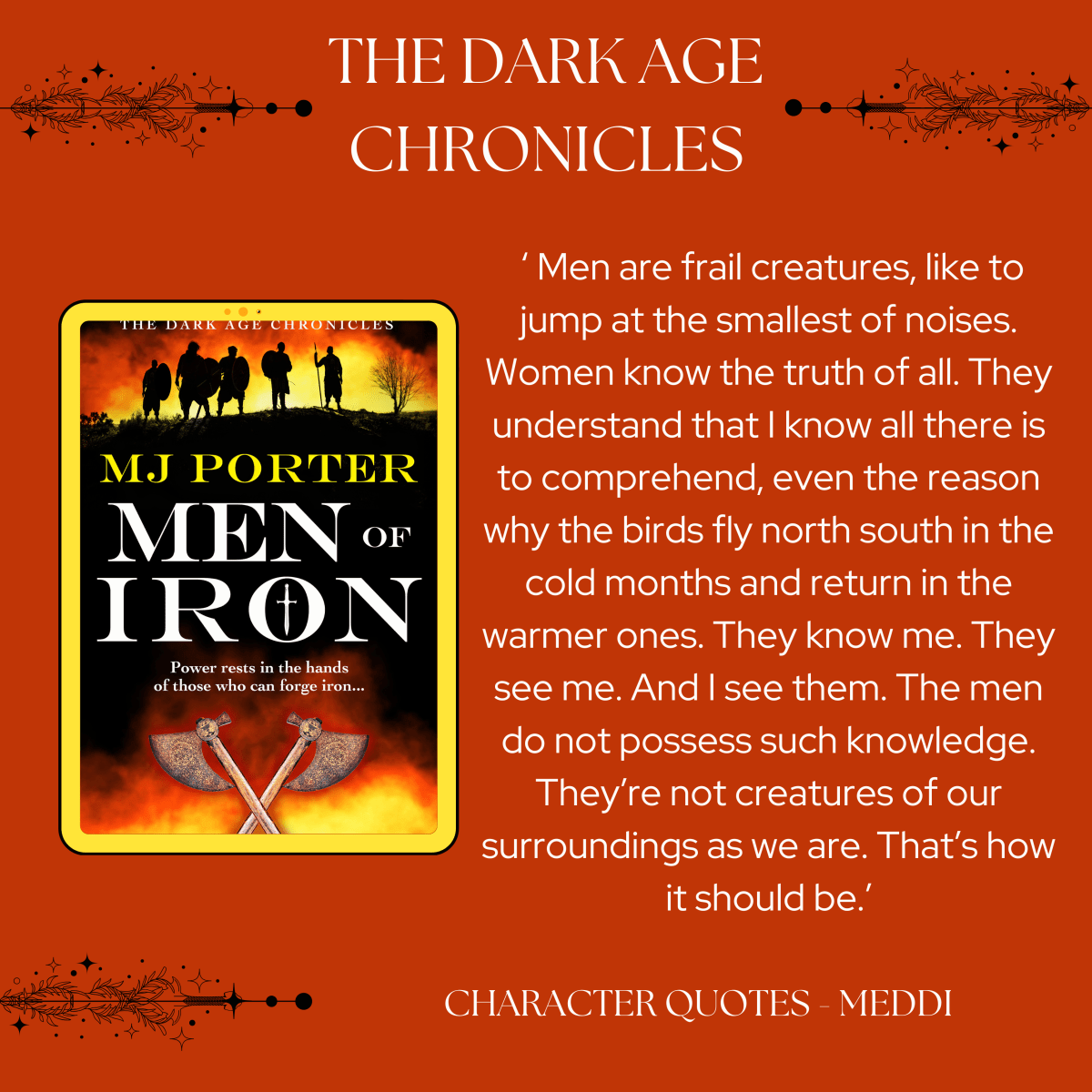
‘I’m Meddi, seeress of the Eorlingas. It’s been a long and troubled journey to reach this moment in my life when hatred has bled away to nothing but a dull ache where the life I thought I’d have has a child has failed to come to fruition. But I would change nothing, aside from the loss of my daughter.’
I think this is perhaps the most ‘me’ I’ve included in a novel (not that I’ve spent my lifetime filled with hatred, but I hope you understand the sentiment).
Perhaps, in the end, this trilogy has been as much for me, as it has been for my readers. Thank you.
Join my newsletter to follow my writing journey, get access to my exclusive Subscriber area on the blog, and receive a copy of Mercia – A Companion Guide to the Tales of Mercia.
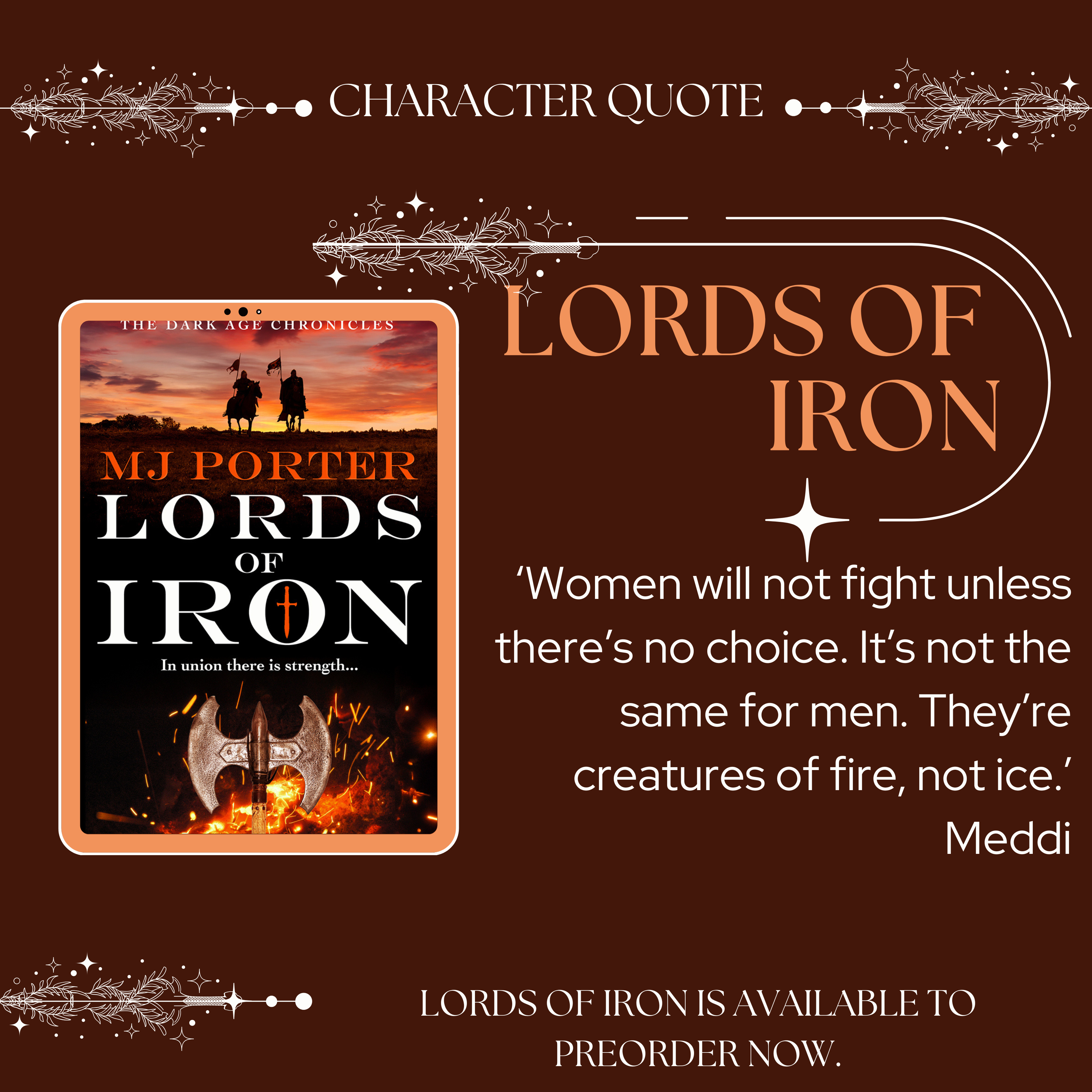
It’s nearly happy release day to Lords of Iron, the third and concluding book in the Dark Age Chronicles Trilogy. Let’s talk about Meddi , the seeress of the Eorlingas #newrelease #MenOfIron #WarriorsOfIron #LordsofIron #histfic
Meddi, the seeress of the Eorlingas
When I was thinking about writing this trilogy, set in the undocumented and little-understood ‘true’ Dark Ages, it was Meddi’s character that came to me most forcefully. I had thought she appeared pretty fully formed, but I’ve actually found a very early attempt which doesn’t mention her (it was only about 250 words, admittedly). After that, she evidently developed quite quickly in my mind. Of the two main points of view characters, Meddi and Wærmund, she is the one who was the most different to what I’ve written before, so I was surprised by how strongly she manifested and became ‘real’ to me. I ran a few elements of her character passed a number of trusted early readers. I wanted her to be strong and determined, but also broken and healing from a terrible trauma, a terrible trauma even I can only imagine. But I also didn’t want her to be stereotypical. I needed to make her realistic and both a product of what had happened to her, and also not. Don’t worry, it was a confusing mix for me, too.
Making her a seeress allowed me to give her an influential position amongst her people. But of course, it brought some problems. What sort of seeress should she be? What magiks should she possess? And how to make those more ‘fantastical’ elements work in what was intended as a piece of archaeological fiction (yes, historical, but so much is based on archaeological finds, it seems wrong to misname it).
I am, and no doubt, will always be a ‘pantser’ (someone who doesn’t plan their stories but just writes them – perhaps in many wats somewhat similar to Meddi when she reaches out to communicate with her ‘god’ only I’m reaching out for my muse and a story that plays out on the page). As such, some elements of Meddi’s personality just appeared for me, and others had to be worked at. I was also conscious of not making her too similar to the wonderful Wynflæd in The Eagle of Mercia Chronicles, or indeed, the Wolf Lady, who also features (both of them healers). Yet, a seeress would possess the abilities to tend to the sick. It was tricky to get it just right. It was really only when I heard her words brought to life by her fabulous narrator, Antonia Breamish, that I truly appreciated that Meddi was a creation I could be very satisfied with (you can listen to her below). I believe, and I hope my readers will agree, that she’s fully rounded, entirely understandable, and if she does things we wouldn’t, then we can be sympathetic to what drives her.
The symbolic adorning of her face and hair with chalk or charcoal as she conducts her magiks was based on little more than my imagination, and yet the imagery is stark. She is sometimes cast from shadow, and sometimes from light. She is a character who loves and hates with equal fierceness, and sometimes, her love shows itself in ways that are perhaps more akin to hatred. But she is certainly most critical of herself. She is driven by ambition, and in this final book, I think we see her at her most vulnerable and also at her strongest. Enjoy.
Join my newsletter to follow my writing journey, get access to my exclusive Subscriber area on the blog, and receive a copy of Mercia – A Companion Guide to the Tales of Mercia.
2025 has been a challenging reading year for me. I’ve failed to hit my reading target of 100 books (although I’m not worried about that because hey, it’s just a bit of fun to even set a target), and there have been a few months where I barely read anything at all because ‘life’ got in the way. I’ve also noticed this year that my reading preferences have changed, moving even more towards mysteries and away from my writing genre of action and adventure historical fiction. I have also, however, joined my local book club, and so I’m reading one book each month to discuss in the group, and this means I’m not necessarily always reading books I would usually choose. This has been a bit of an eye-opener. In our book club, we do read the books, and we do talk about them. If you can find a book club like that, then I highly recommend it. It’s a great experience.
Goodreads (and The Storygraph) tell me I’ve read 82 books this year (as a point of note, I don’t usually put my audiobooks on multiple times (I listen to the same few audiobooks at night to help me sleep and I am almost word perfect on some of them these days)). As last year, I’ve not included my own books in this, which get read repeatedly while writing and editing.
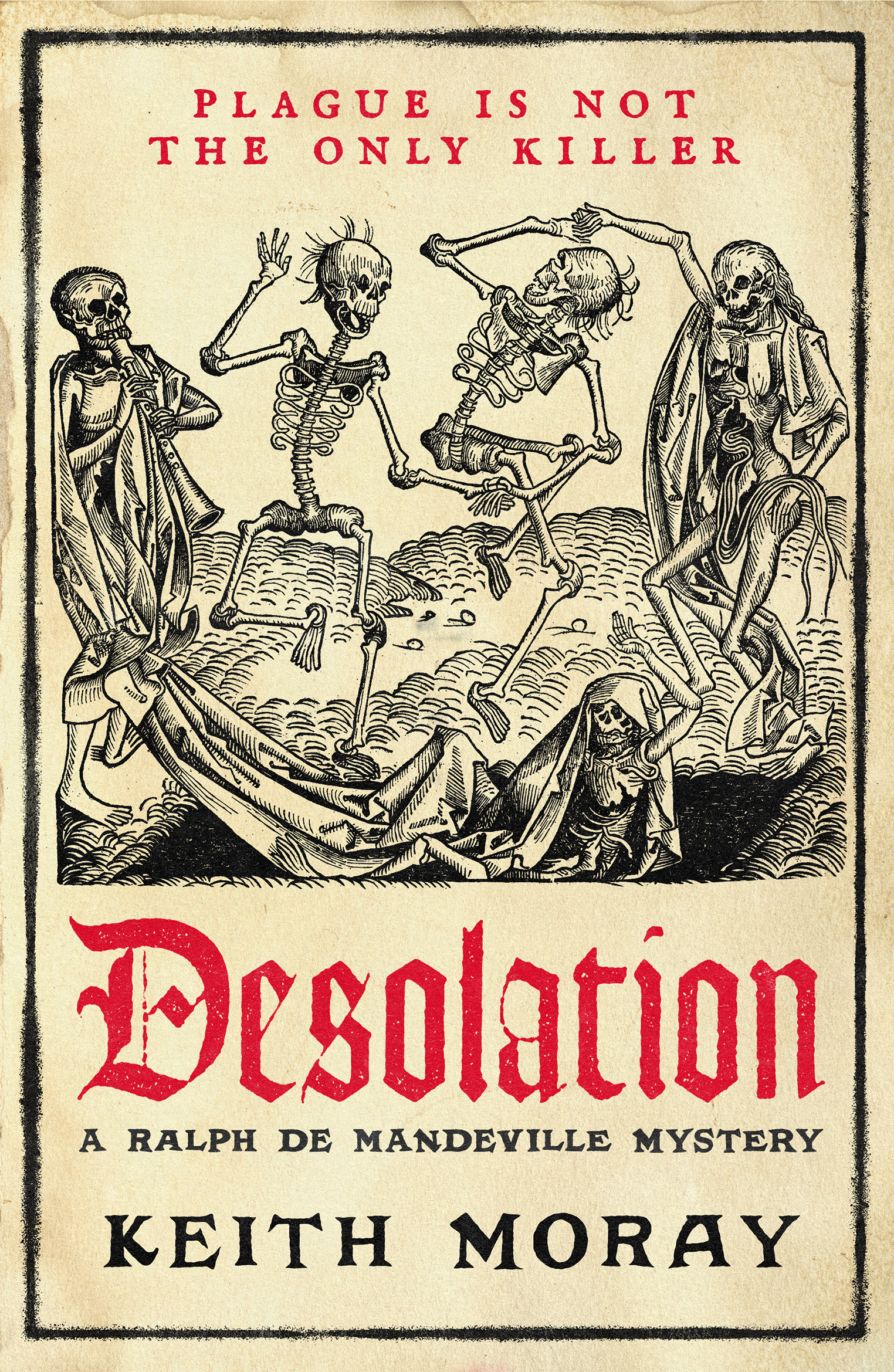
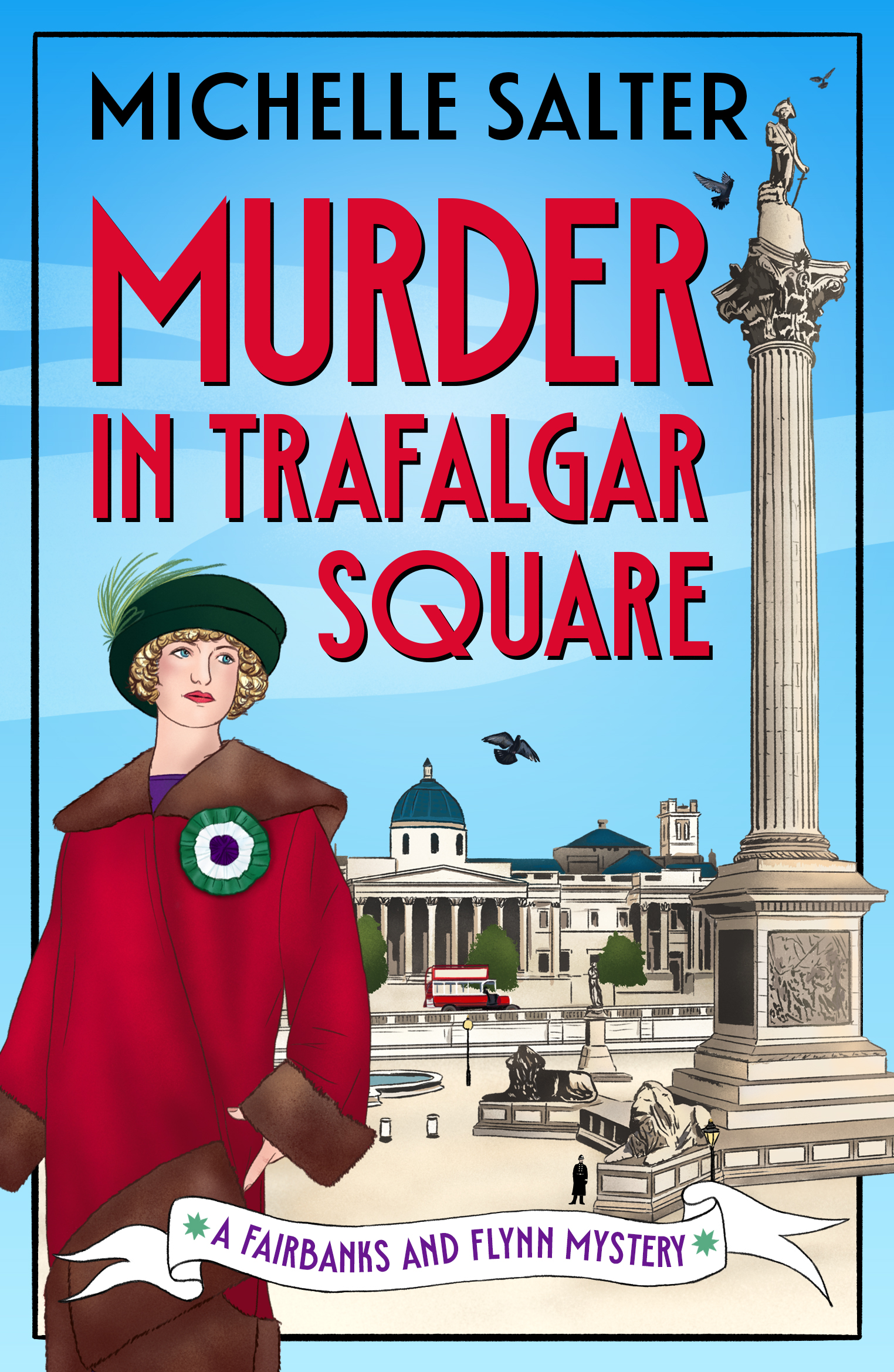
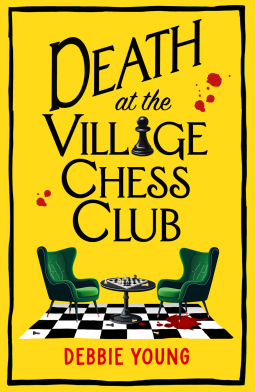
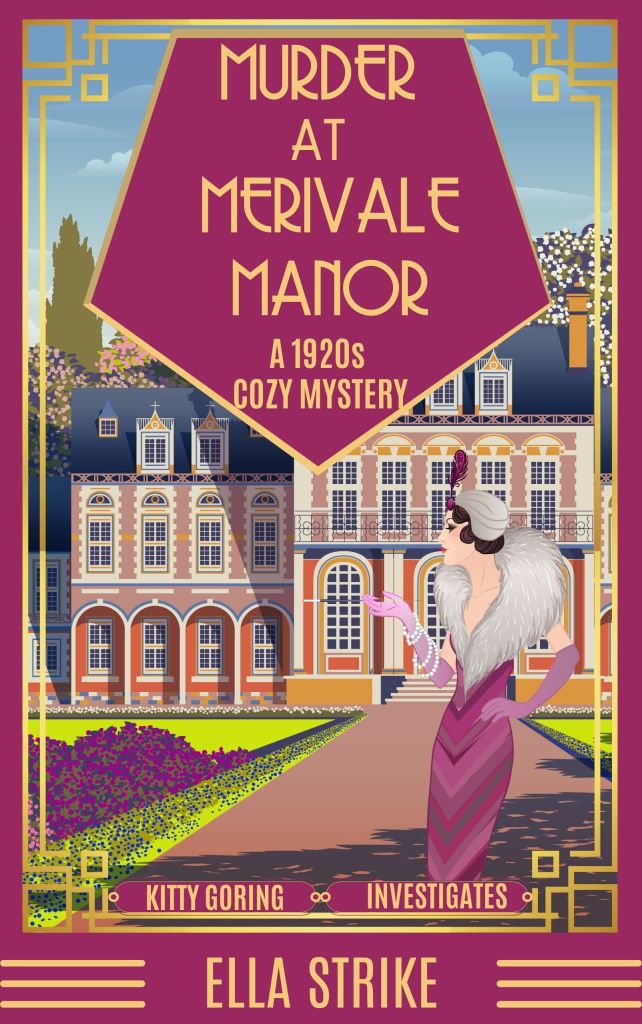
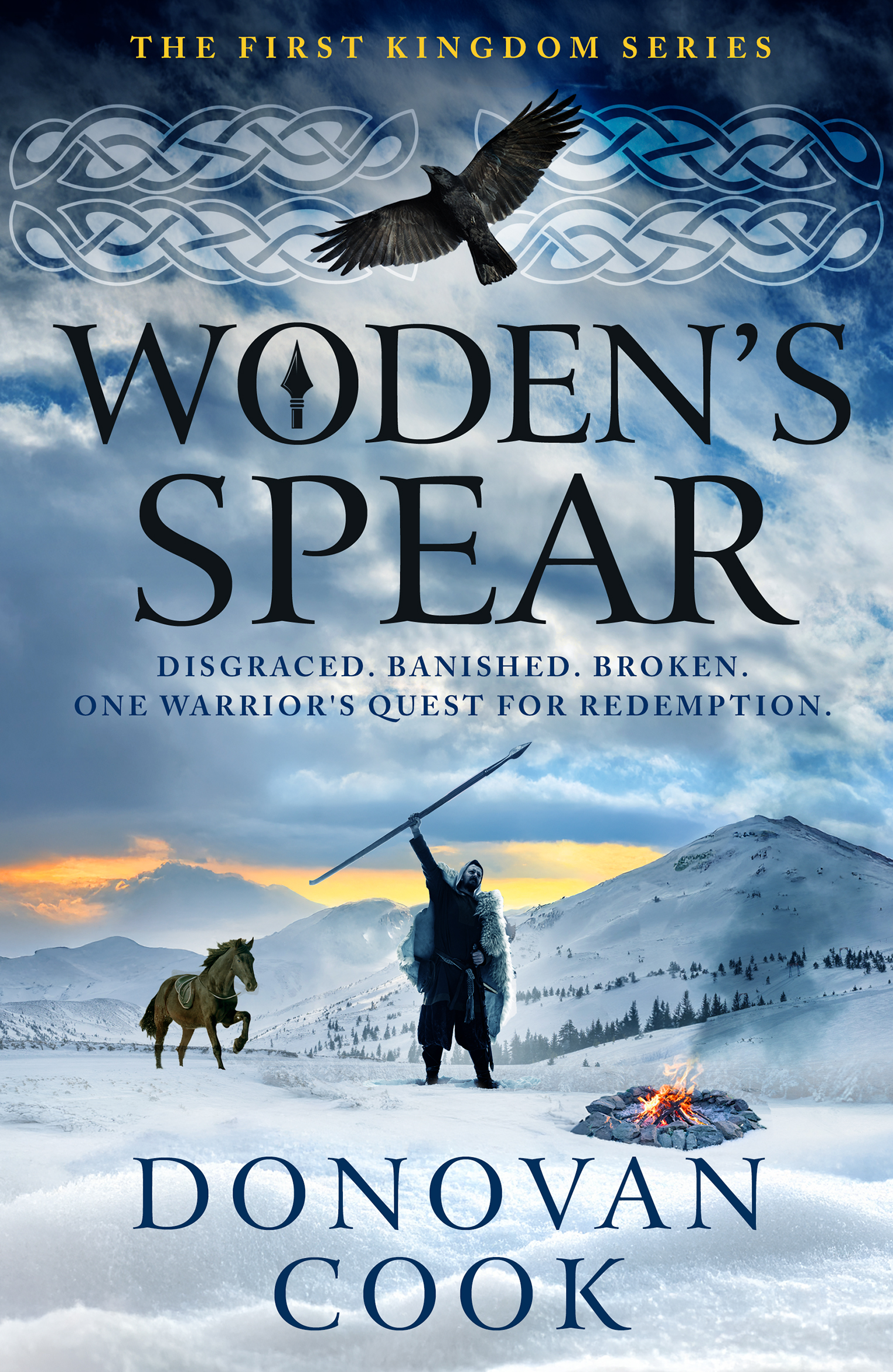
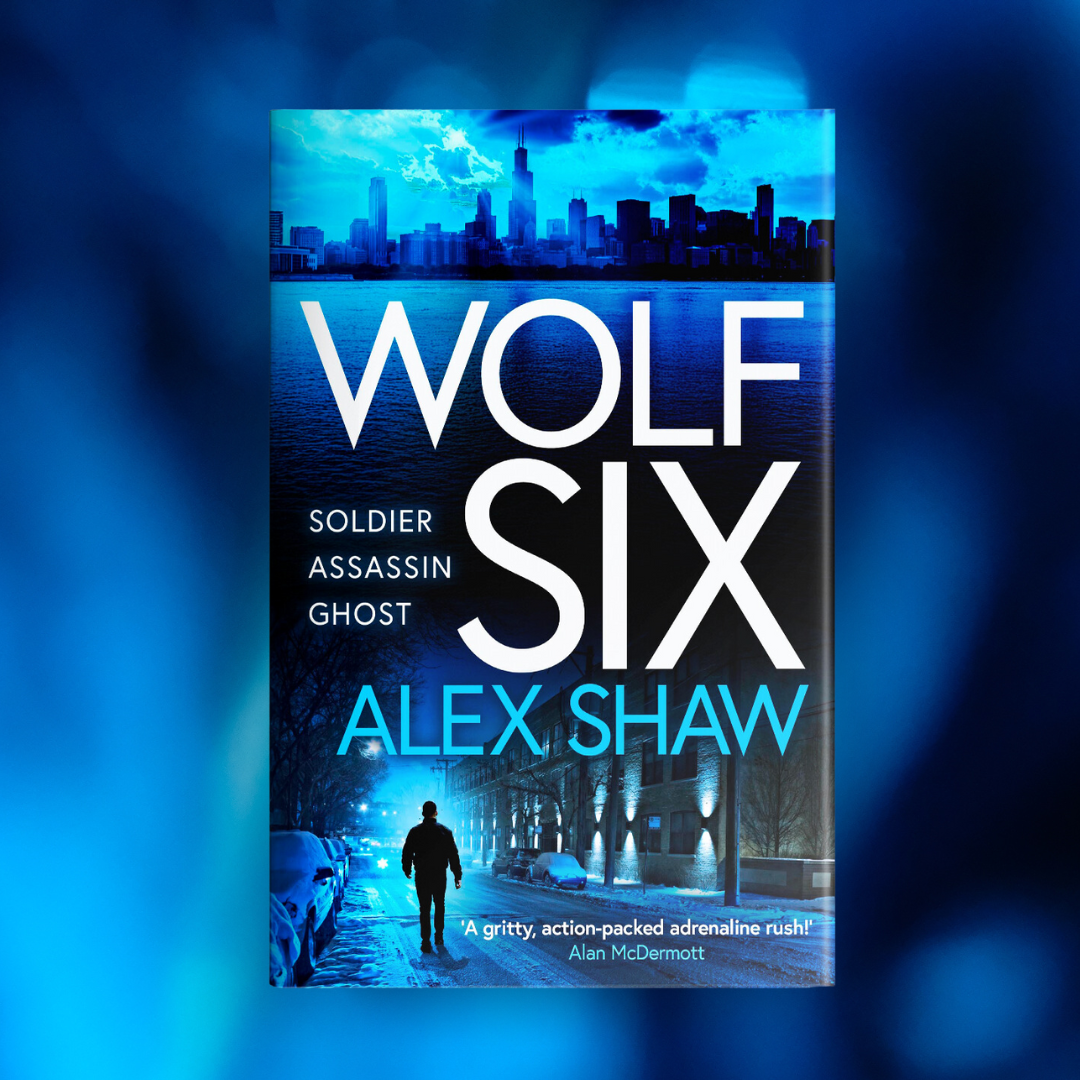
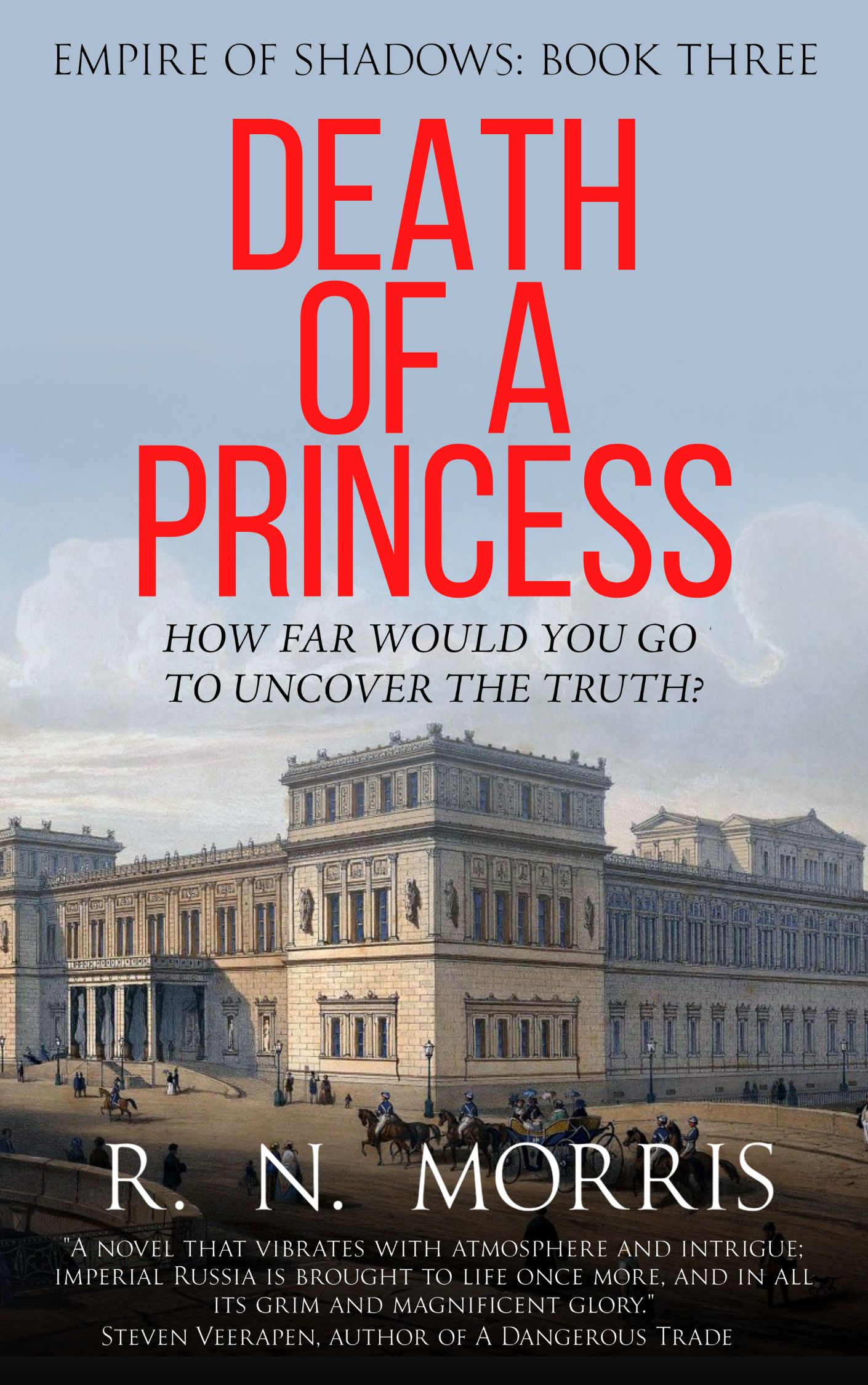
My most read category (a third of all books) has been historical mysteries – (some of these might also be classified as cosy). I’ve read anything from The Rush by Beth Lewis, about the dash to Dawson City to mine for gold at the end of the nineteenth century, to Desolation by Keith Moray (set in the 1300s) and Monstrous Murder by Elizabeth R Andersen (also set in the aftermath of the Black Death) to a huge collection of early twentieth century mysteries, including Michelle Salter’s new series, Murder in Trafalgar Square. I think my favourite (and most surprising read) was The Bookseller of Inverness by SG MacLean (our first book club read, and my recommendation (there were opinions about it – which was brilliant – and I would warn it certainly helps if you know something about the Battle of Culloden and its aftermath). Click on the images to visit the reviews (if I’ve reviewed on the blog).
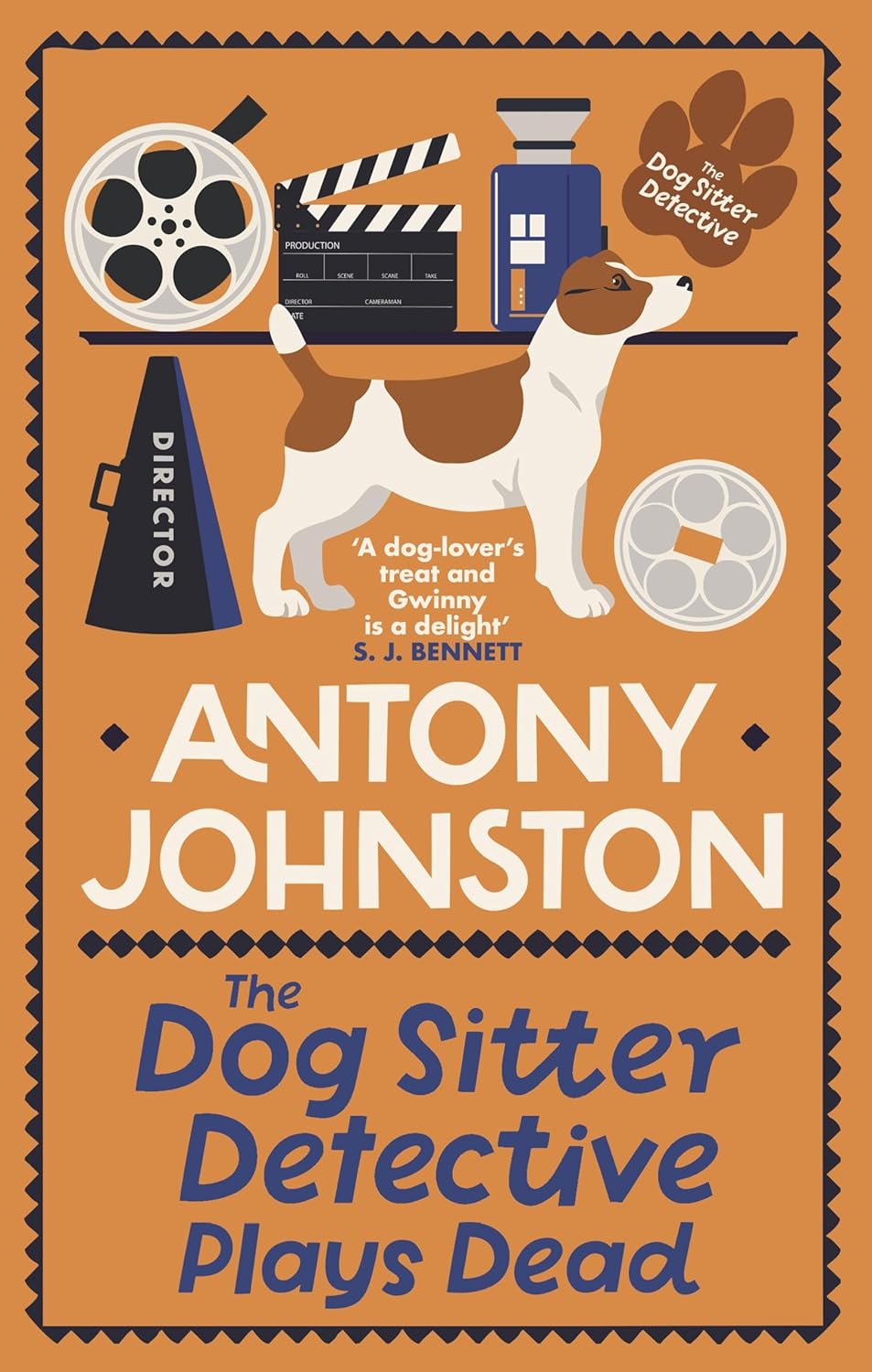
Behind historical mysteries in my reading year are just plain old contemporary mysteries. Again, some of these are also cozy reads. I don’t like my murder mysteries to be too graphic (when I was much younger, I read all the Scarpetta and Jonathan Kellerman novels and freaked myself out), and I’ve discovered that my preference is for a style known as ‘police procedural’ even when there are no police involved. I started the year with Death on Ice, which was a slow build but delightfully engaging, and ended with the equally brilliant The Retired Assassin’s Guide to Orchid Hunting – a fabulous New Zealand-based mystery (I’m going to read book 1 now), and Simon Whaley’s Flaming Murder (reviews to follow for these two books in Jan 2026). I also discovered Antony Johnston’s lovely Dog Sitter Detectives Series. These are such great books – quick reads but with compelling mysteries.
You can also check out my three favourite reads of 2025 over on Shepherd.
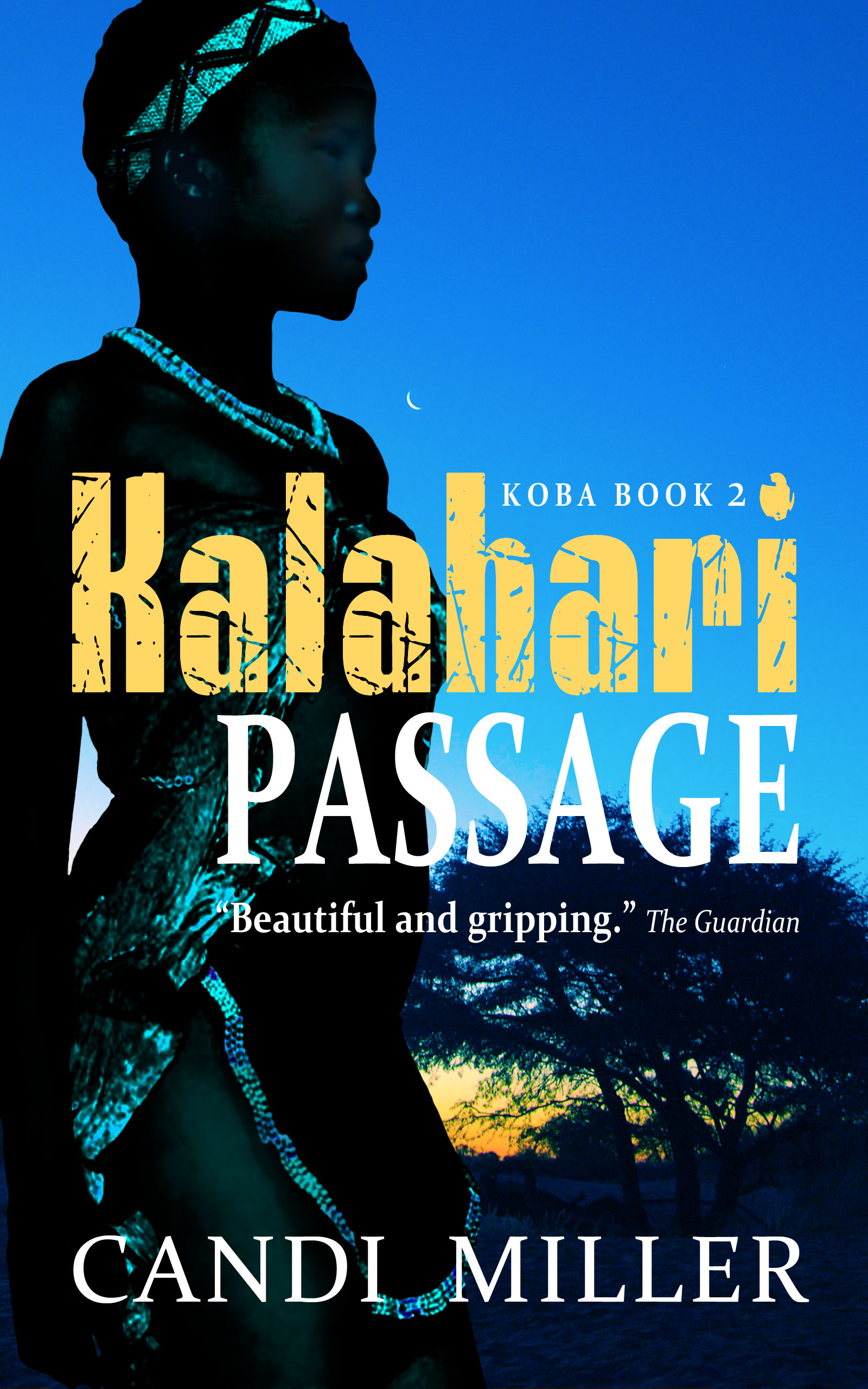
I do want to give a huge shout out to Kalahari Passage (which I’m classifying as historical fiction as its set in the 1960s (I think). This is a beautiful story, if sometimes a hard read. Do check it out.
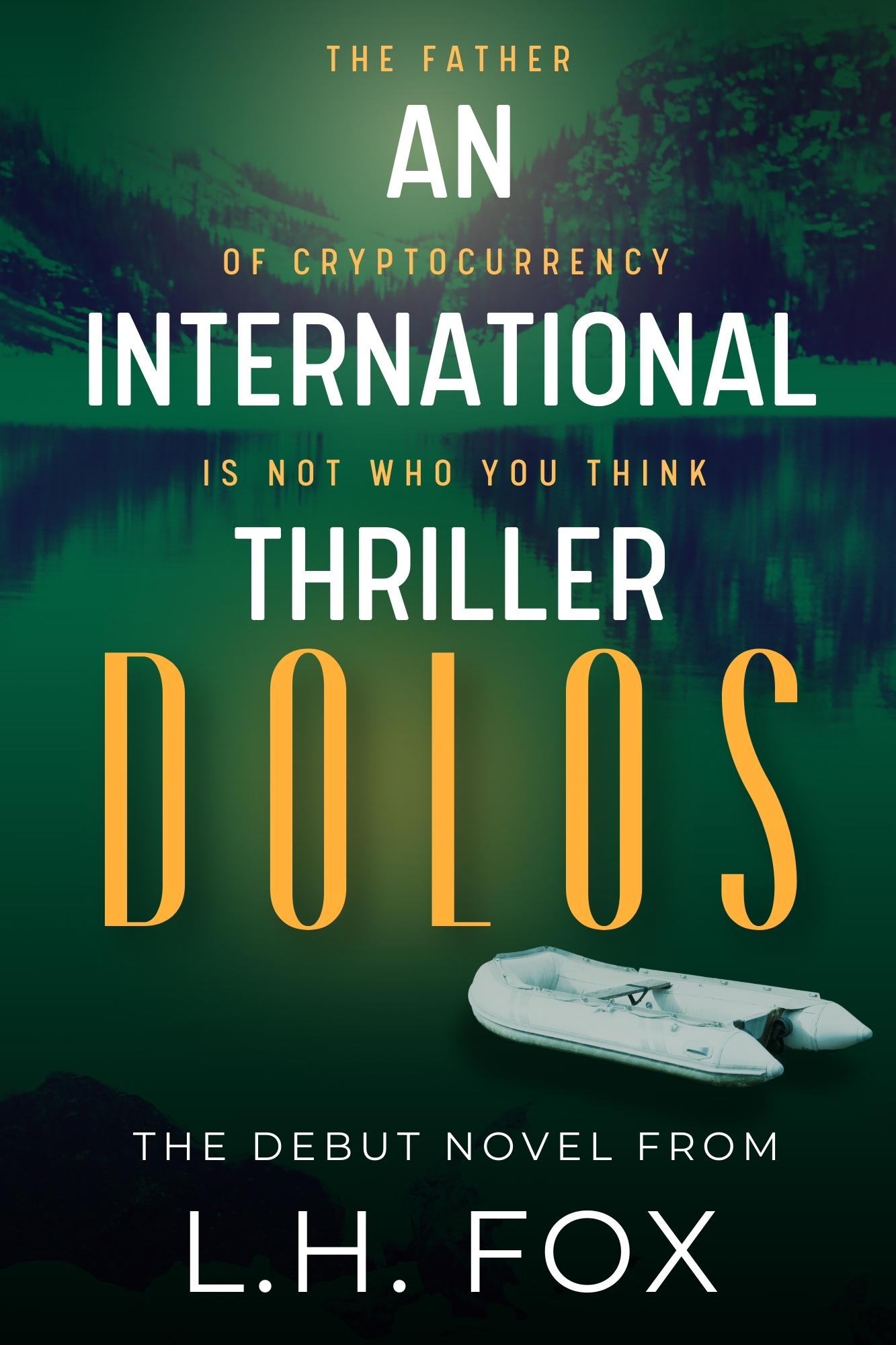
What I’m classifying as thrillers came next – from the new Harlan Coben to the rather brilliant Dolos by a debut author, LH Fox, which almost had me understanding how cryptocurrency works, and is also my most visited review on the blog.
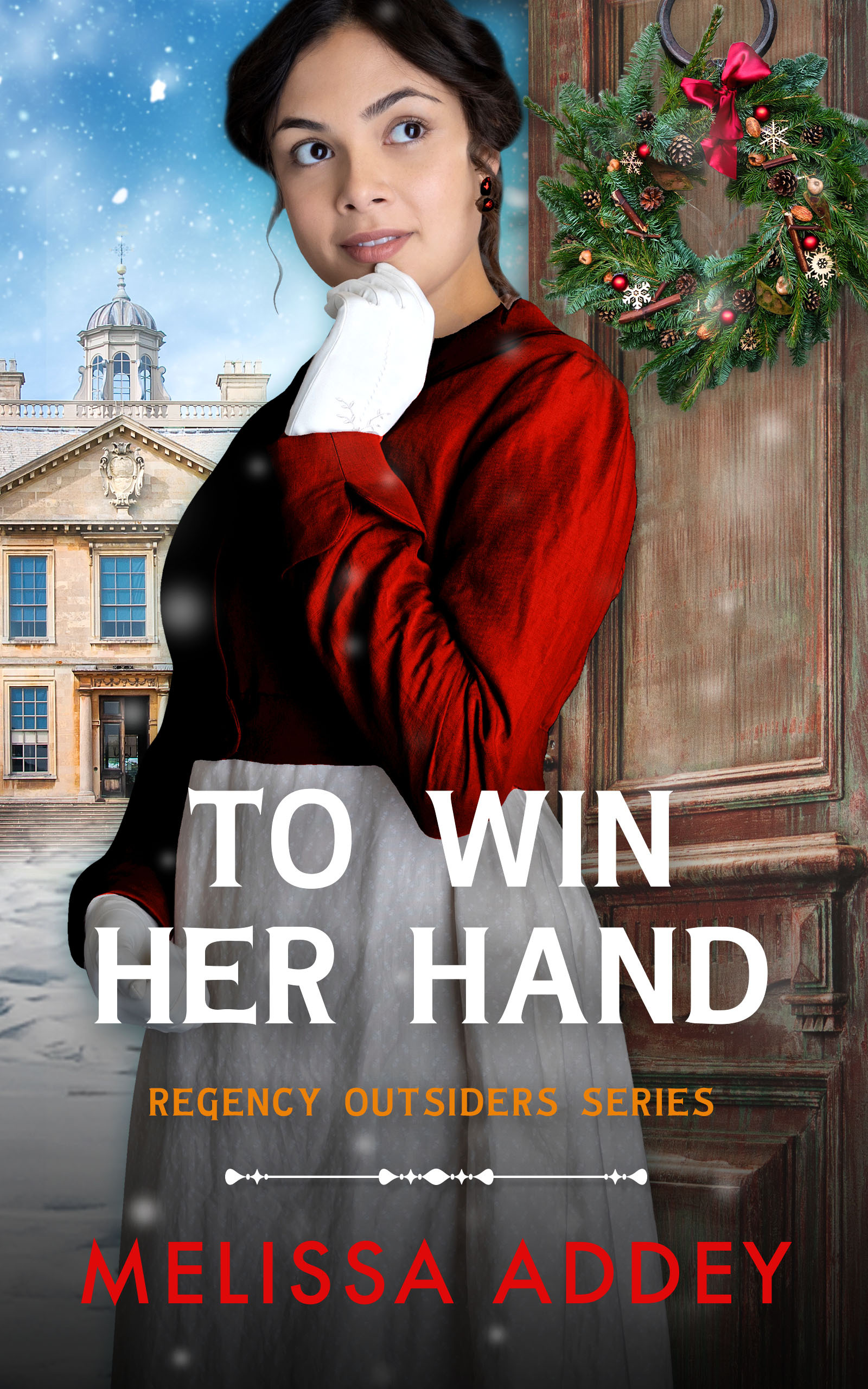
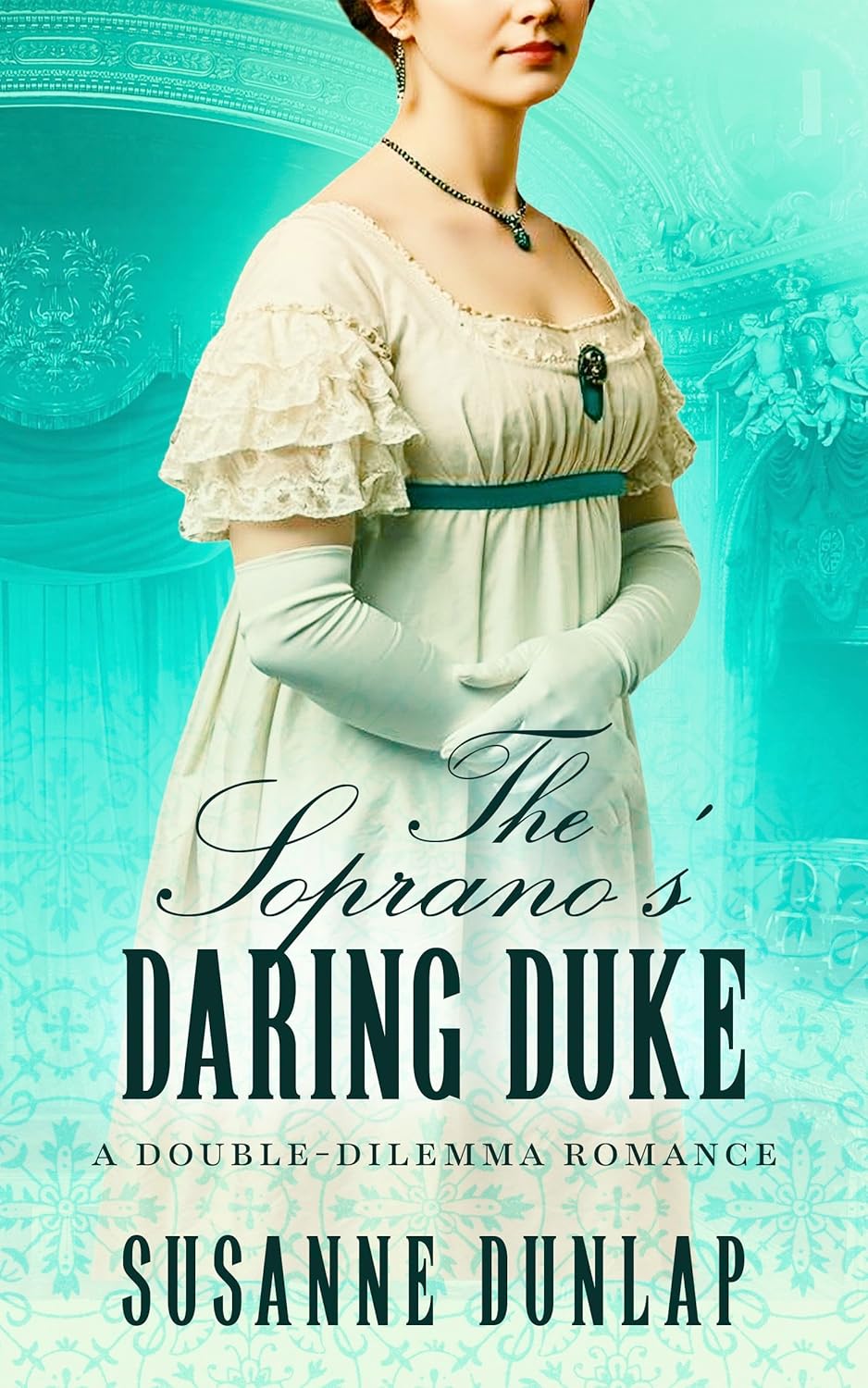
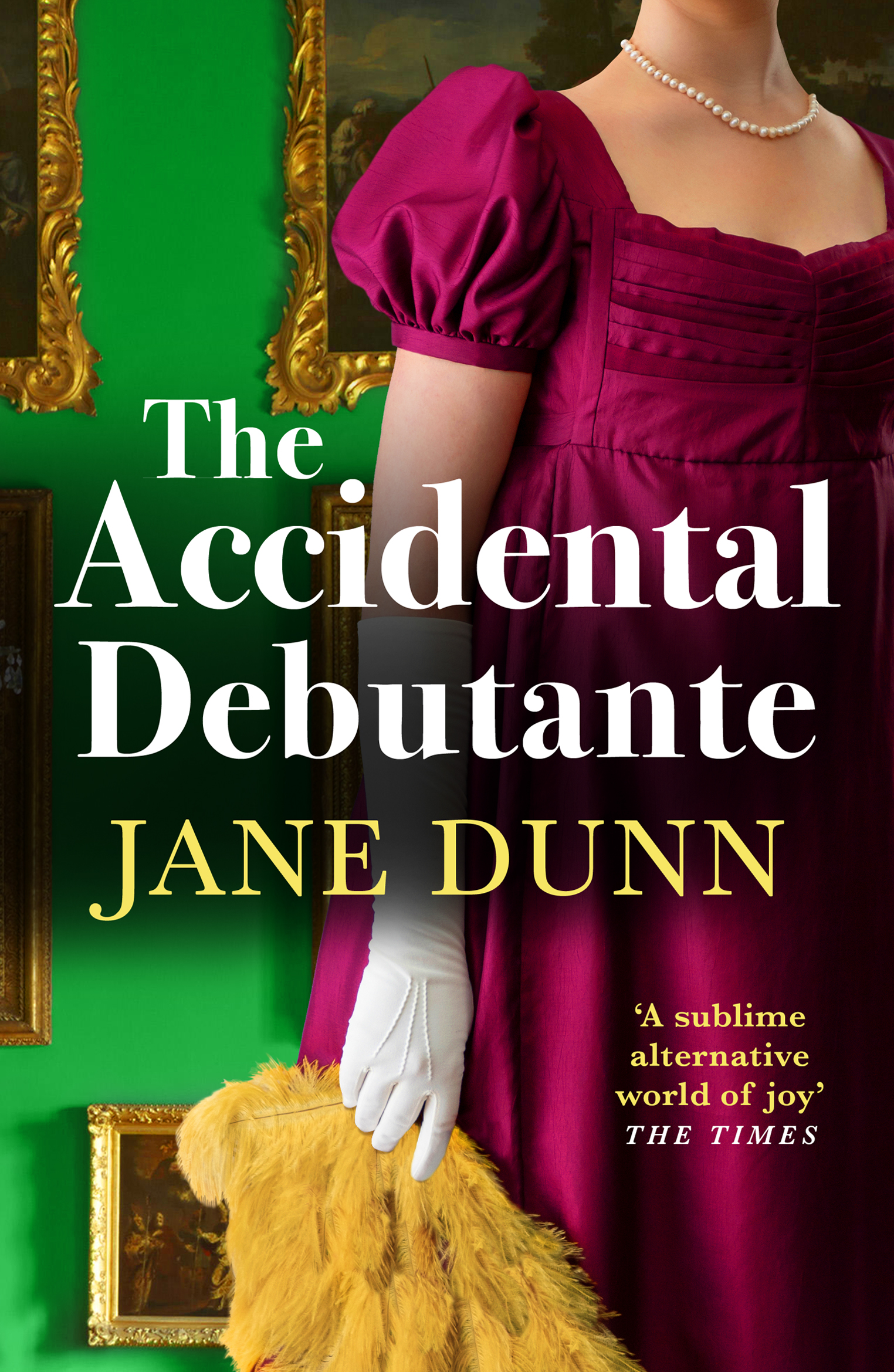
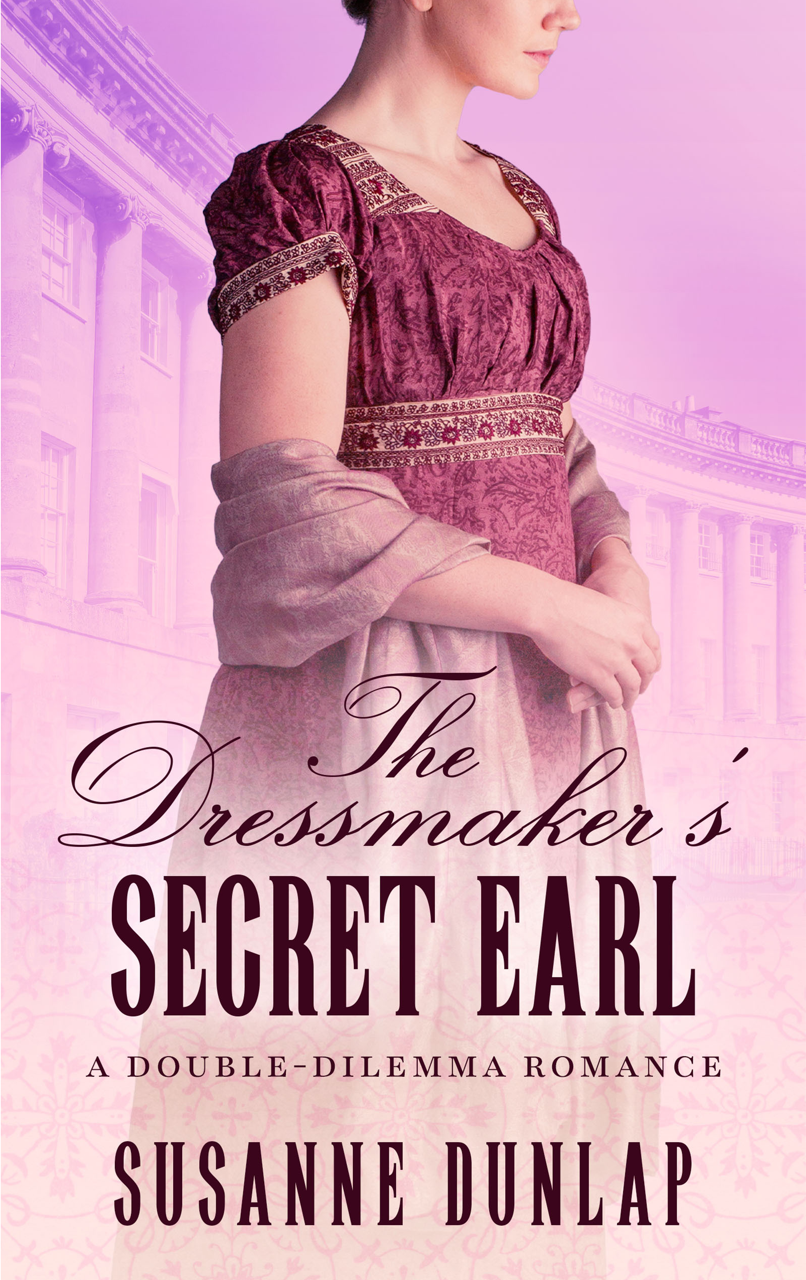
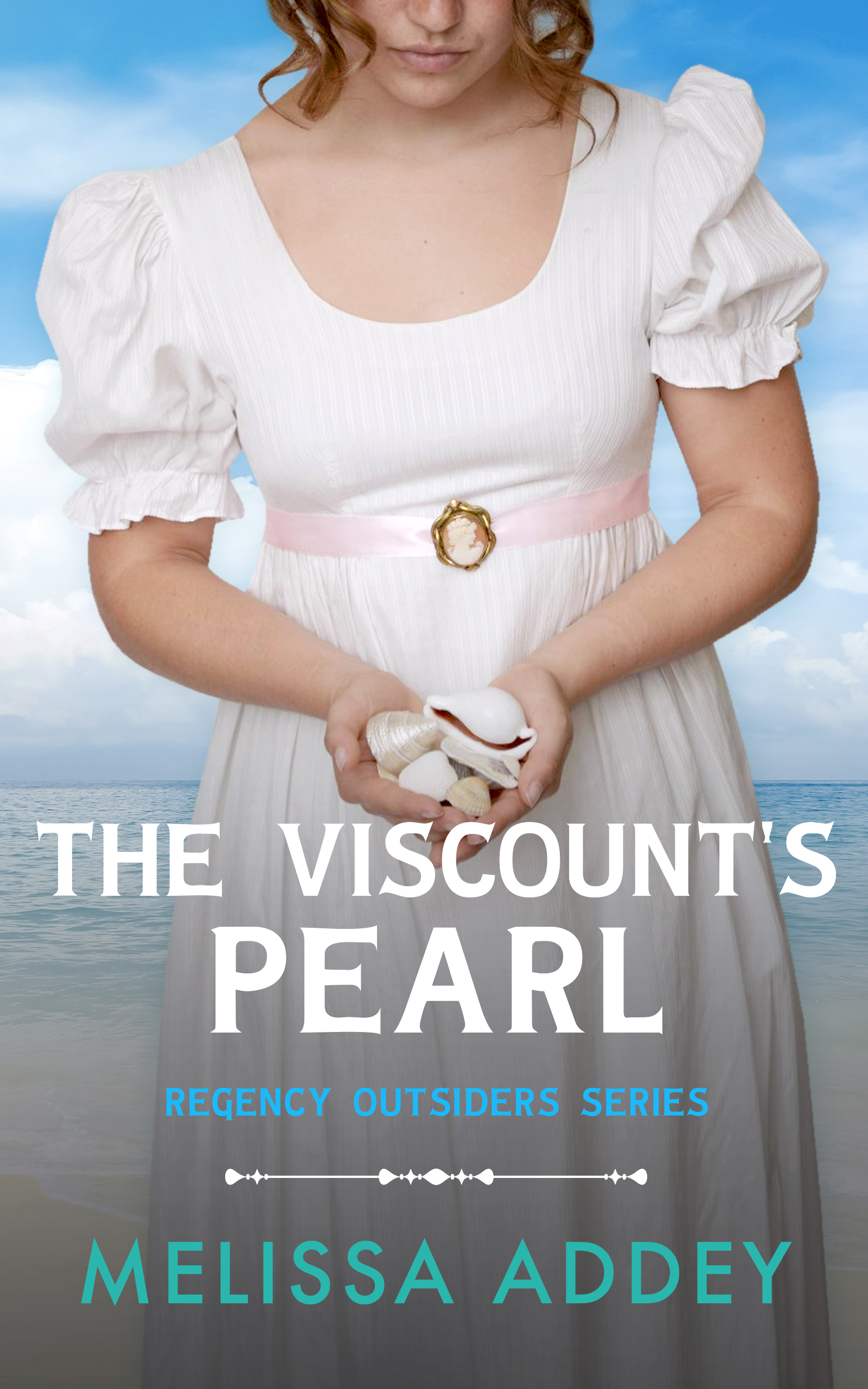
Six titles were historical romance. Jane Dunn, Melissa Addey and Susanna Dunlap all kept me entertained with their Regency romances, while The Ladies Road Guide to Utter Ruin could also be classified as a Regency romance, but I’ve popped it into the historical mystery category, as it certainly crosses over more into a mystery with the romance element in the background. (If you’ve not read Alison Goodman’s Dark Days Club books, then you’re missing a treat, my Regency fans – a hint of fantasy in the Regency era – what is not to love (still not convinced – I would compare it with Cassandra Claire’s Victorian trilogy).
I also read a couple of romance novels (one for Book Club) and certainly enjoyed some more than others:)
I didn’t read (or at least finish) many non-fiction titles in 2025 (I am still reading Max Adams’ Mercian Chronicles and I have his new title on Northumbria to read as well). My only complete historical non-fiction title for the year was that by Amy McElroy on Mary Tudor – a great depiction which I found very inspiring. Mary is so often overlooked.
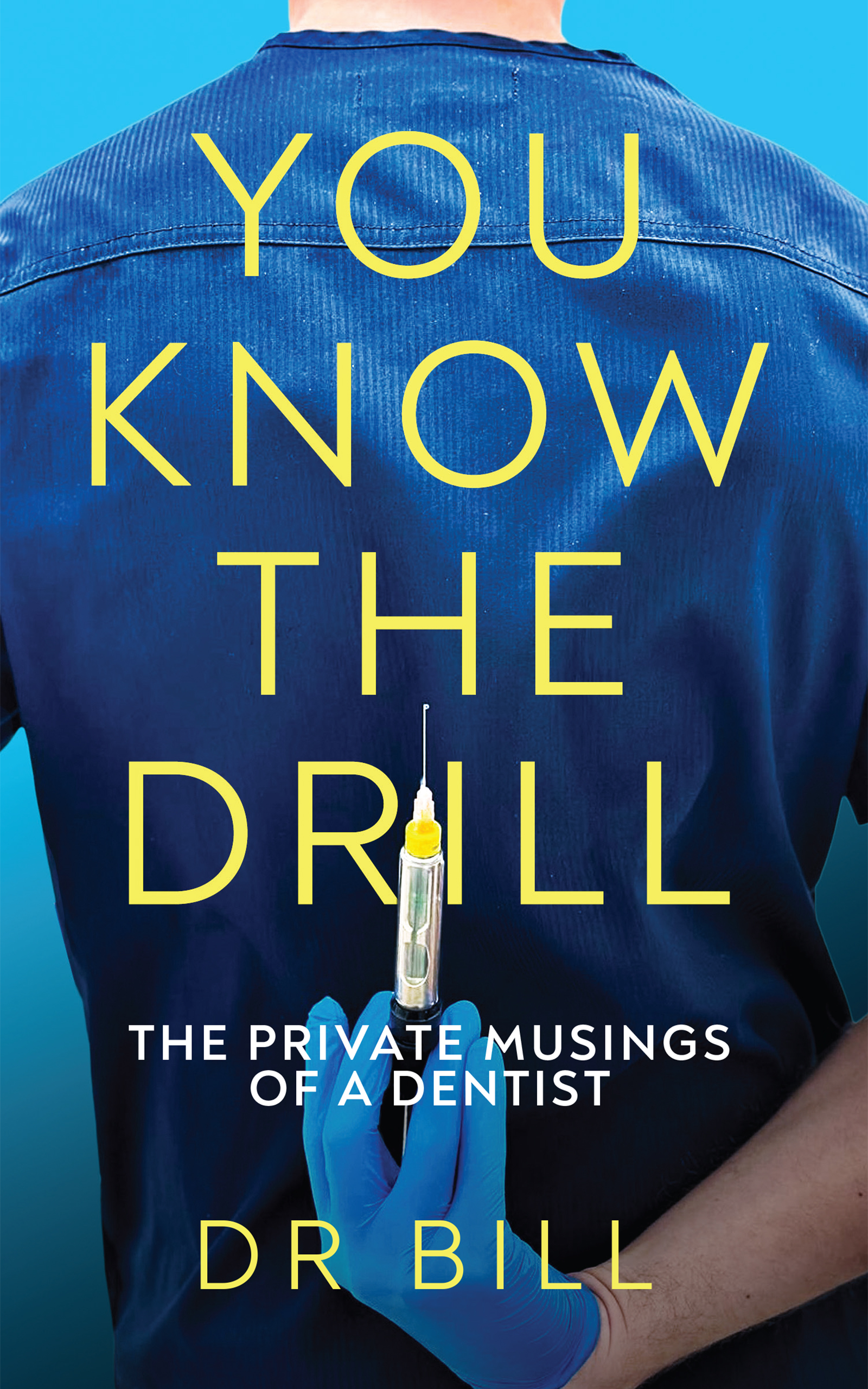
The title I enjoyed the most out of the other non-fiction reads was You Know the Drill, an account of a dentist’s life. I made myself read it because I’m so terrified of the dentist. Has it helped? Maybe.
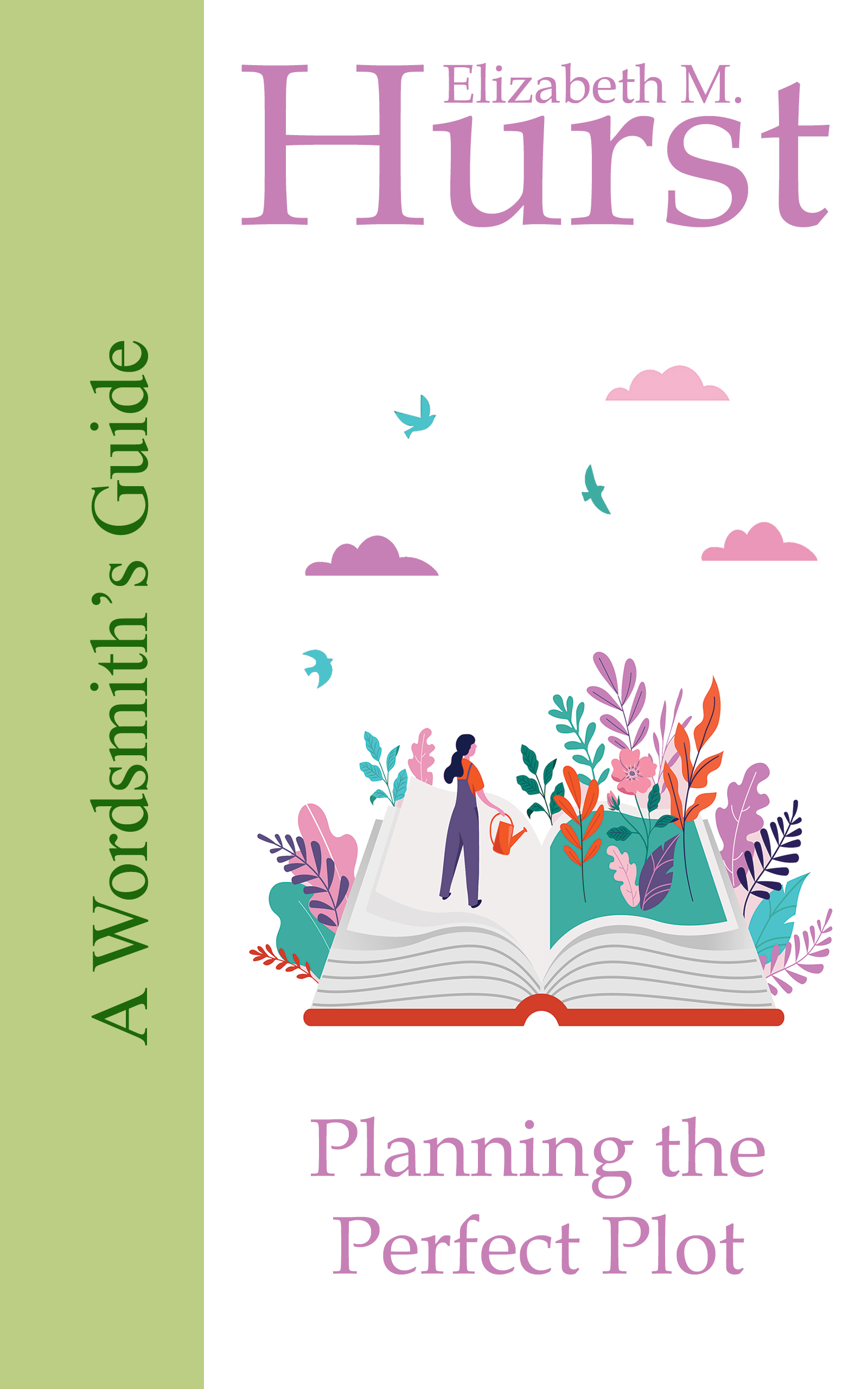
I also read a writing guide, which I enjoyed. It’s always intriguing to discover how other people write their stories. Check out Planning the Perfect Plot.
I’ve also half-read many other titles (apologies to those authors). Hopefully, I’ll get back to them when I have time in 2026. Every year I explain I’m a ‘mood’ reader, and if something isn’t working for me at that moment, it doesn’t mean I won’t come back to it when I fancy something different.
One genre I’ve really neglected is fantasy (aside from the Discworld audios), although I have managed a few short story collections (reviews to follow). I will need to get back to it. I have a few series I need to finish. Maybe the problem is, I don’t want to finish them. We shall see.
Our local book club started in August 2025, and so far we’ve read four very different titles. The Bookseller of Inverness was my choice, and I’m slowly gathering all of Shona’s other titles, including her new release for Feb 2026. Next, we tried Joanne Harris’ Five Quarters of the Orange (which I didn’t like for very different reasons to the ones I thought when I started reading). We then tried The Christmas Postcards by Karen Swan, and most agreed the one element of the story was much better than the other. We ended the year with Before I Go to Sleep by SJ Watson – a novel that was incredibly slow, with something of a predicatable ending (and no, I hadn’t seen the movie). I’m excited to see what we read in 2026. And as you can see, there’s a great variety of titles there. When it’s my turn to pick again I will be championing some of my fellow indie/Boldwood authors.
Here’s to 2026 and all the reading I hope to enjoy.
I read a lot of books by my fellow Boldwood authors, and I’m also a host for a couple of blog tour organisers. This means I often get to read books before everyone else. Yay.
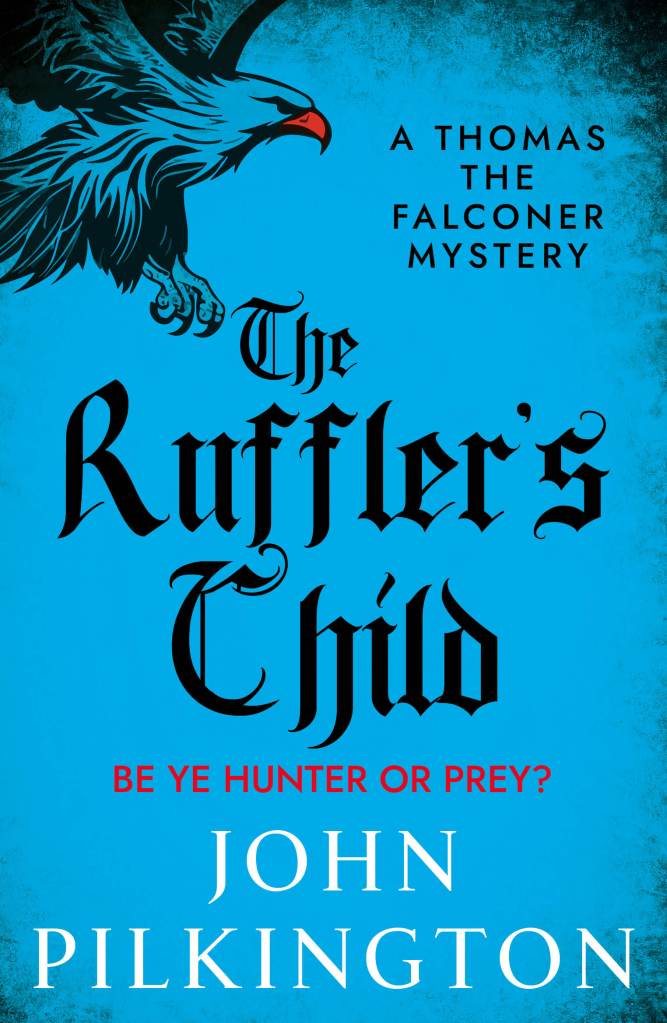
I’m sharing my review for Death of a Stranger, the first book in John Pilkington’s Elizabethan mysteries featuring Matthew Cutler #histfic #historicalmystery #bookreview #blogtour #TheRufflersChild #boldwoodbloggers @BoldwoodBooks @rararesources @theboldbookclub
Here’s the blurb
BE YE HUNTER OR PREY?
Introducing Thomas Finbow – falconer to Sir Robert Vicary and Lady Margaret of Petbury, Berkshire. He keeps his mind sharp and his body primed as he goes about his duties with the diligent confidence of one who once served Queen and country.
When Nathaniel Pickering, Lady Margaret’s older brother is found murdered, Thomas takes her away to London, in search of gryfalcons. Lady Margaret being a keen lover of the sport of falconry herself, Thomas hopes it will help distract his mistress from her grief, however once they reach the city it becomes apparent that much bigger things are at play – and the murder of Master Pickering was just the beginning…
Thomas’s astute mind is unable to ignore the clues, and in uncovering some dark secrets, he places himself – and his mistress – in grave danger. Now a target himself, Thomas must face some of London’s most notorious criminals, in a battle of both brain and brawn.
The Ruffler’s Child is an atmospheric Elizabethan mystery, set around the time of Mary Queen of Scots’ trial and subsequent execution. It is a time of unrest, and Thomas finds himself, a good country lad, thrust into the murk of a busy London. There are many unsavoury characters, and the mystery itself is quite complex, and not without peril for him.
I do love a good historical mystery and this one really intrigued me. Thomas and Lady Margaret have an unusual relationship, and he does seem to be trusted with a great deal of familiarity with the lords and gentry he comes into contact with, while also being just about able to hold his own in London’s Elizabethan underworld of crime, trugging houses and petty theft.
I really didn’t guess the resolution for this one, and very much enjoyed journeying along with Thomas as the elements of the mystery slowly clicked into place. The start of the series, I’m looking forward to reading my way through the books featuring Thomas the Falconer.
A writer for over forty years, John Pilkington was born in Lancashire and worked at many jobs including laboratory assistant, farm worker, weaver, shipping clerk, picture frame-maker and cabaret musician before taking a degree in Drama and English and finding his true 2 vocation. He has since written plays for radio and theatre, television scripts for a BBC soap, a short-lived children’s series and numerous works of historical fiction, concentrating now on the Tudor and Stuart eras. He also ventured into speculative fiction with his biography of Shakespeare’s famous jester, Yorick.
He now lives in a village on a tidal estuary in Devon with his long-term partner Elisabeth; they have a son who is a psychologist and musician. When not at the desk he walks, swims, listens to music and tinkers with d.i.y. projects, and is enjoying being a grandfather.
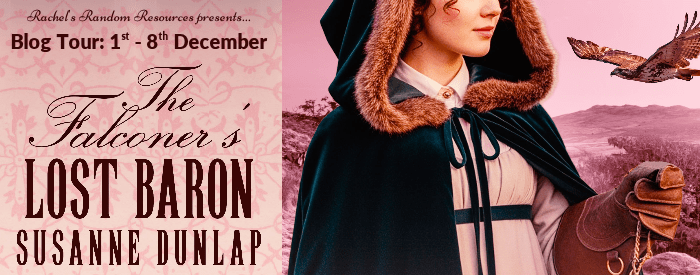
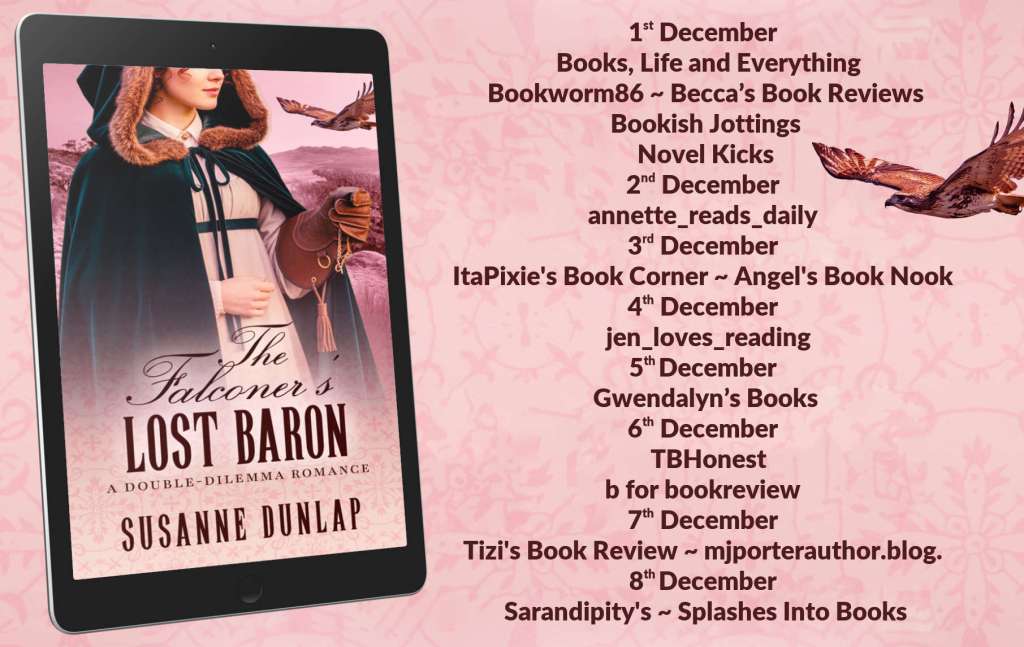
I’m welcoming The Falconer’s Lost Baron by Susanne Dunlap to the blog #blogtour #RegencyRomance #bookreview
Here’s the blurb
A sweeping Regency tale of identity, devotion, and unexpected romance.
Lady Antonella thought she knew who she was—until a shattering family secret strips her of her name, her place in society, and her future. Cast adrift in Cornwall, she finds an injured goshawk in a poacher’s net and begins to nurse it back to health. But the hawk belongs to the war-scarred Lord Atherleigh—a man haunted by loss, determined to dismantle his mews, and certainly not expecting a spirited young woman to upend his solitude.
In London, her twin sister Belinda—radiant, poised, and newly on the marriage market—has only one goal: to find a worthy match… for Antonella. But when Hector Gainesworth, a charming rogue with laughter in his eyes and secrets of his own, turns his attention to Belinda instead, her heart begins to spin in an altogether unexpected direction.
As the sisters navigate betrayal, desire, and the demands of their hearts, two men must decide whether to risk everything for love. And Antonella’s goshawk may be the wild, winged thread that binds their fates.
The Falconer’s Lost Baron is the third of Susanna Dunlap’s Regency romances I’ve read, and I’ve enjoyed all of them (see my reviews below for the previous two books). Every book offers something a little different, while still delivering on what we all expect from a Regency romance.
This new title will delight fans of the genre (there is no need to have read the previous two titles, although you will be missing a treat.)
Susanne Dunlap is the award-winning author of over a dozen historical novels, as well as an Author Accelerator Certified Book Coach in fiction, nonfiction, and memoir. Her love of history began in academia with a PhD in music history from Yale. Her novel THE PORTRAITIST won first prize in its category in the 2022 Eric Hoffer Book Awards, and was a finalist in the CIBA Goethe Awards and the Foreword Indies Awards. THE ADORED ONE: A NOVEL OF LILLIAN LORRAINE AND FLORENZ ZIEGFELD, won first place in its category in the 2023 CIBA Goethe Awards for Late Historical Fiction. Today, she lives, coaches, and writes in beautiful Biddeford, Maine.
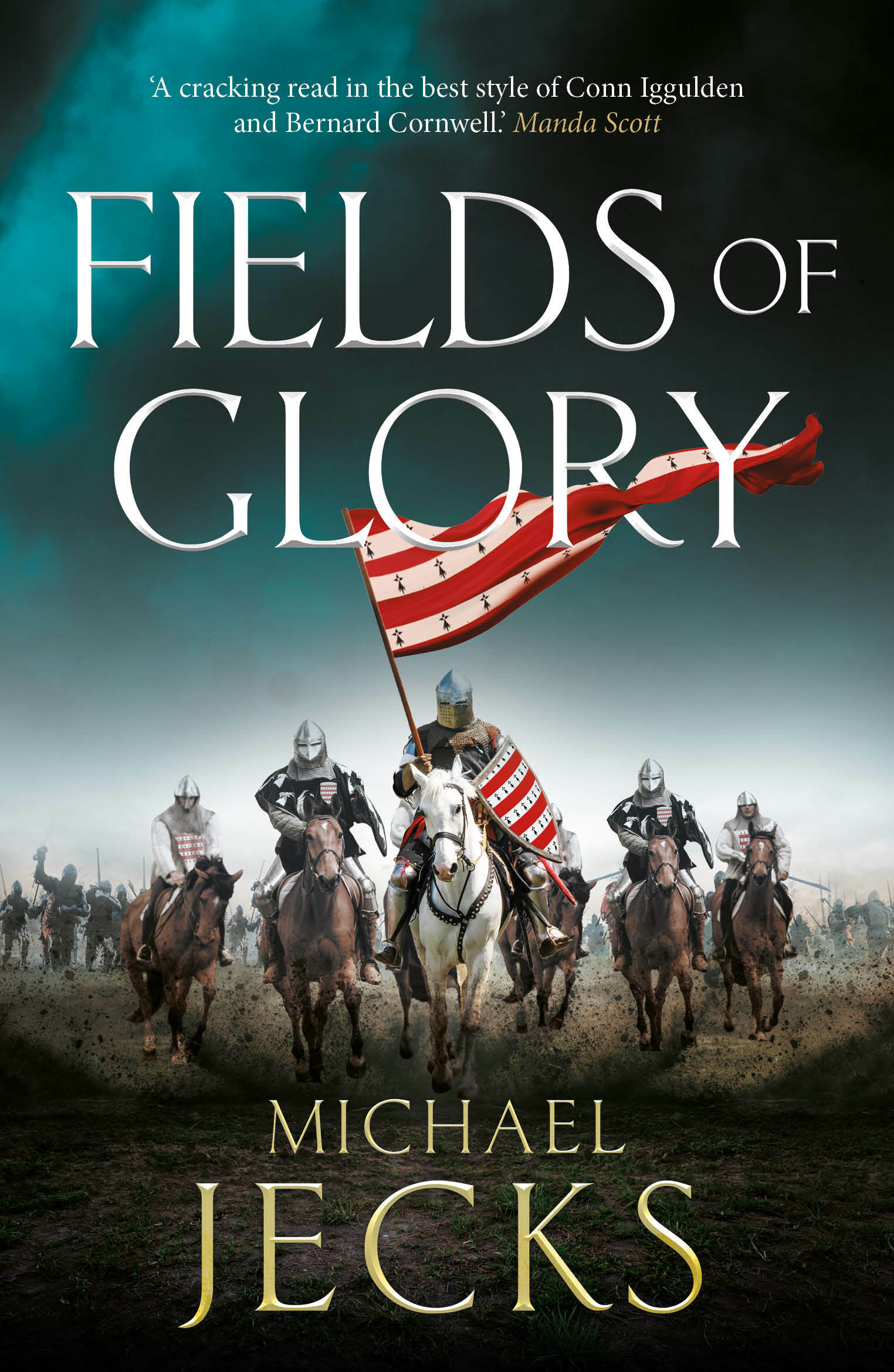
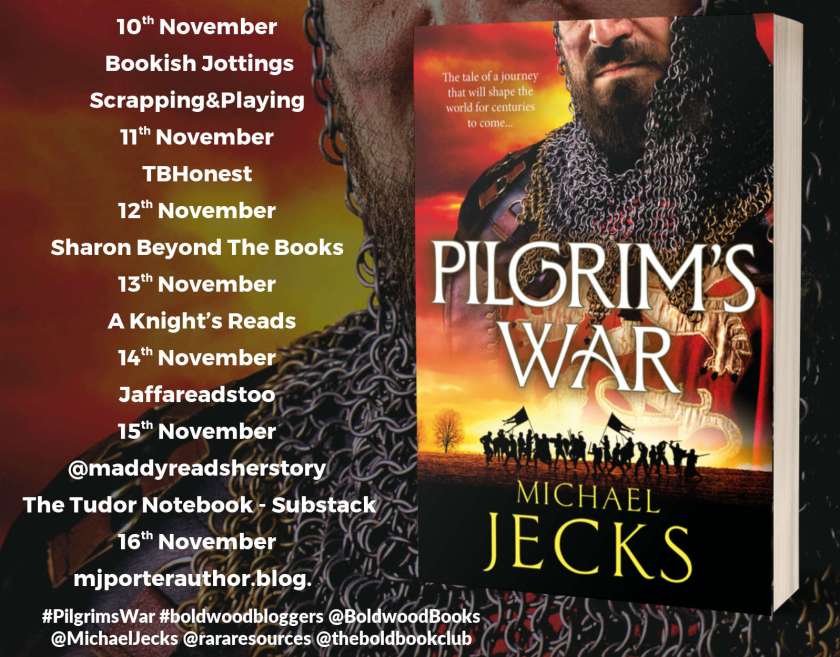
I’m sharing my review for Pilgrim’s War by Michael Jecks #newrelease #histfic #blogtour #bookreview
Here’s the blurb
The tale of a journey that will shape the world for centuries to come…
France, 1096. Crowds gather in Sens, Northern France, to hear the Hermit speak. He talks of a great pilgrimage to Jerusalem, a quest filled with promise for those Christian soldiers who march with him.
Sybill knows the perils of the road ahead, but follow it she must. Her husband is a reckless gambler, easily swayed by the Hermit’s words. For Odo, the pilgrimage provides the chance to demonstrate his unshakeable piety, while his brother Fulk craves adventure and excitement.
Jeanne and Guillemette have been mistreated by the men in their lives and are desperate for this chance of redemption and a brighter future – but for the two women alone on the journey, life on the road will be full of perils…
As the lines between love and hate, virtue and sin, good and evil become blurred, each must survive as best they can. Who will live to reach the holy city, and will the sacrifices they make to get there be worth the price they all must pay?
Pilgrim’s War is a multiple-character story of the First Crusade, told through the eyes of those seeking something on their journey to the Holy Land. Some are swept away with the promise of better things to come, some by the promise of redemption, others are simply leaves in the wind, taken on the way by events outside their control. Not many of them, admittedly, are actually ‘in it’ to serve their God. As a result of this, few of the characters are actually very ‘nice’. Indeed, quite a few of them are quite awful as the journey begins – but of course, if they’re to suffer any sort of epiphany, they need to be bad eggs from the beginning. The narrative doesn’t shy away from depicting the hatred between Christians and any other faith encountered on the journey to the Holy Land, and the hypocrisy of these seemingly ‘holy’ knights as they venture towards their destination.
Two main journeys are undertaken: one heading towards Rome, featuring a collection of knights, and another towards Byzantium, which follows Sybill, Odo, Jeanne, and Guillemette. That way lies peril. But so too is the route through Rome, where politics are once more at play. The cast is vast and from all reaches of society. It will not end well for them all.
The Crusades are far from an easy topic to cover, and the author is at pains to reveal the motivations behind the actions of those the story follows. It’s not always an easy read, or a particularly fast-flowing one with so many characters, but it shouldn’t be an easy read. I do appreciate the determination to show the event for what it was – a war perpetrated in the name of religion, but really, at the heart of it, something else altogether.
Meet the author
Michael Jecks is the author of over 50 novels inspired by history and legend. He is the founder of Medieval Murderers, and has served on the committees of the Historical Writers’ Association, the CWA and he Detection Club. He was International Guest of Honour at the Bloody Words festival in Toronto, and Grand Master of the first parade in the New Orleans Mardi Gras.
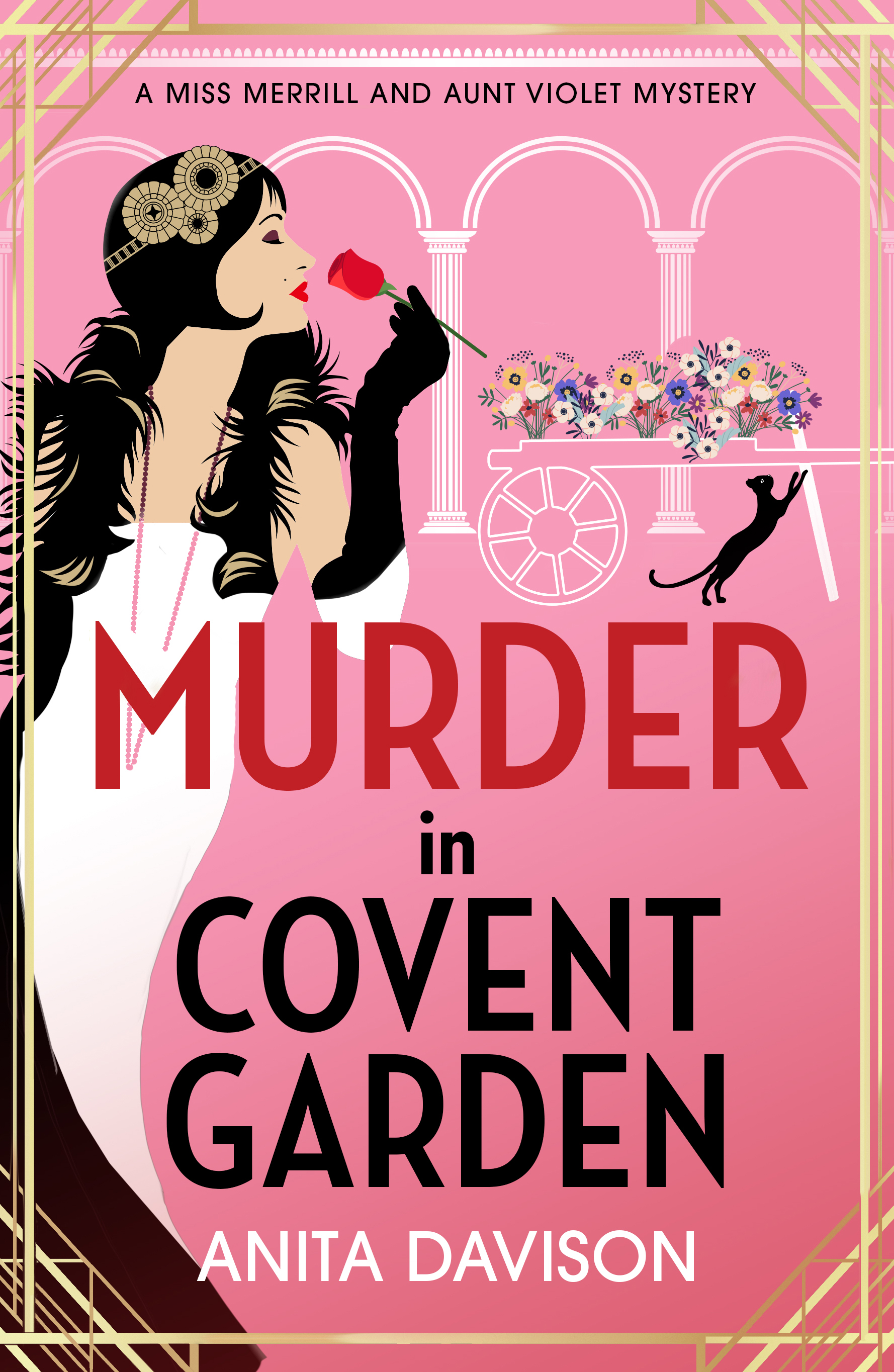
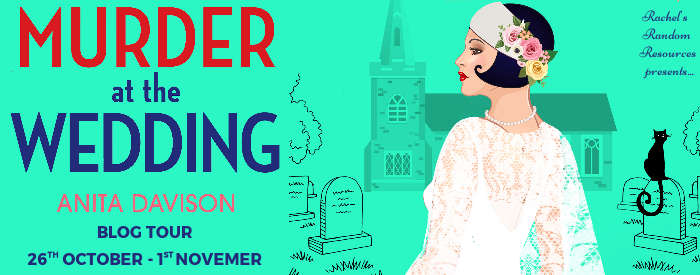
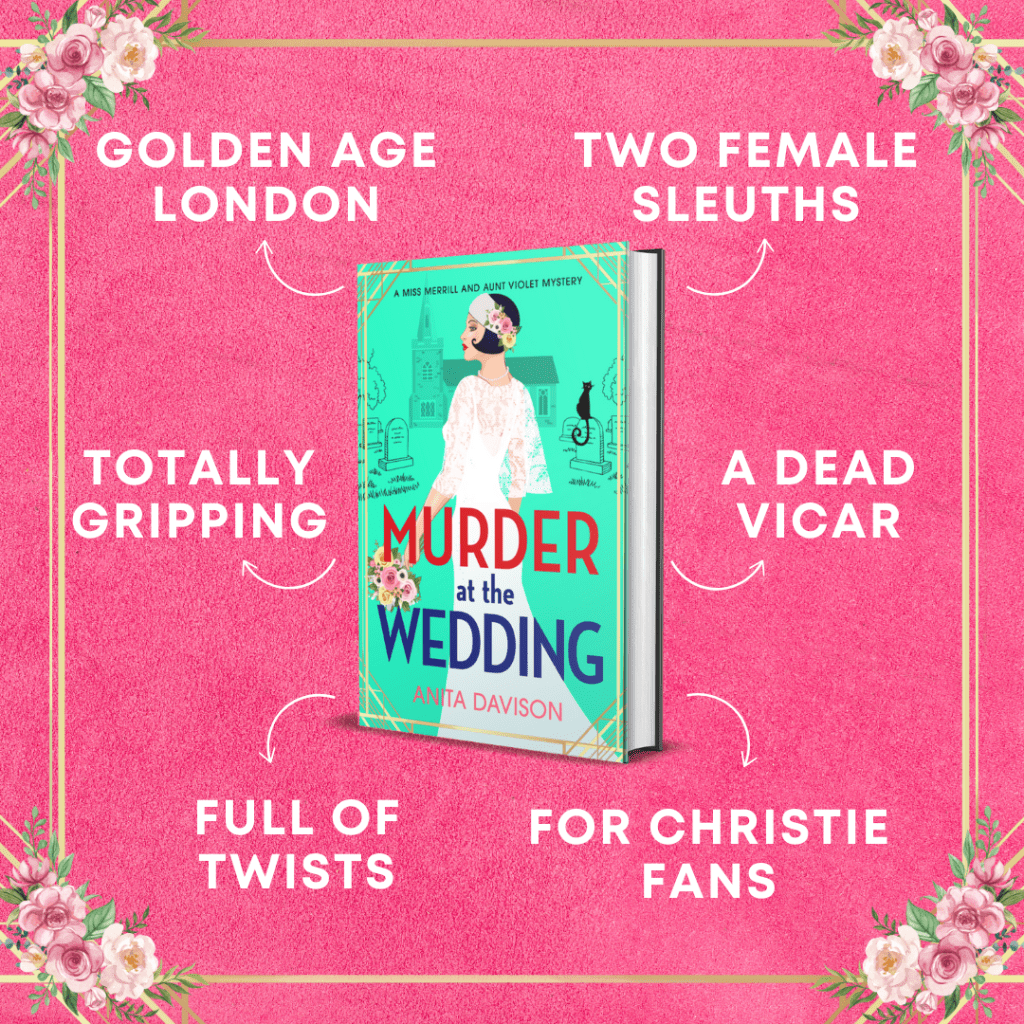
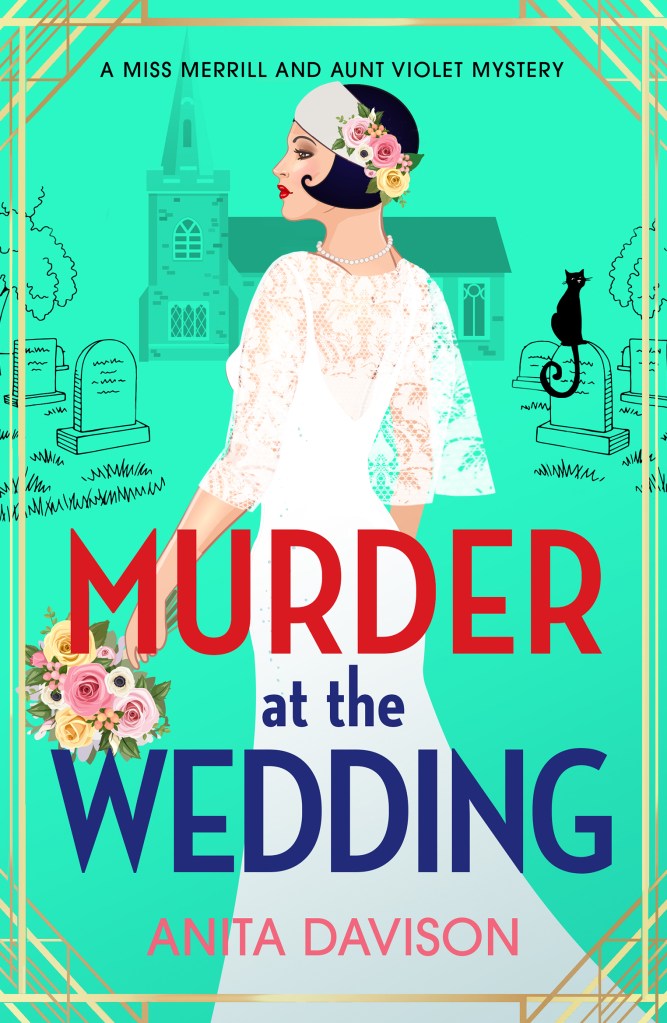
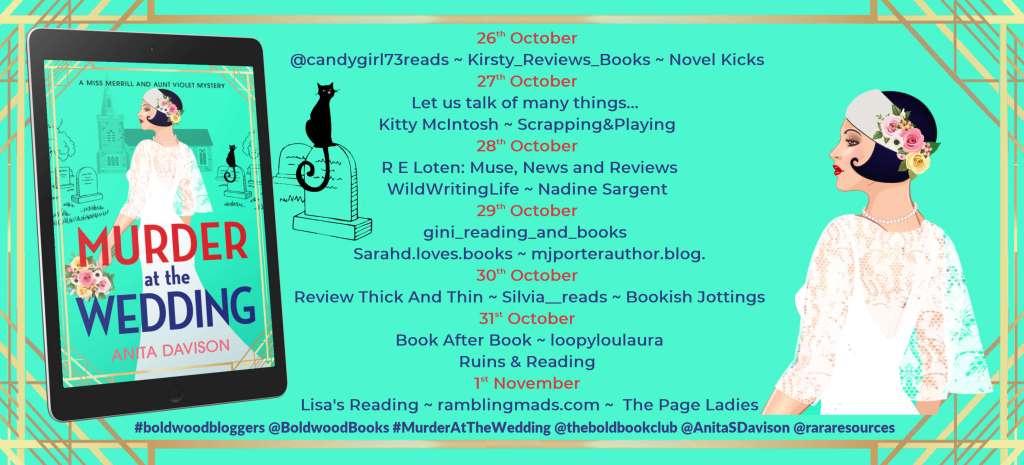
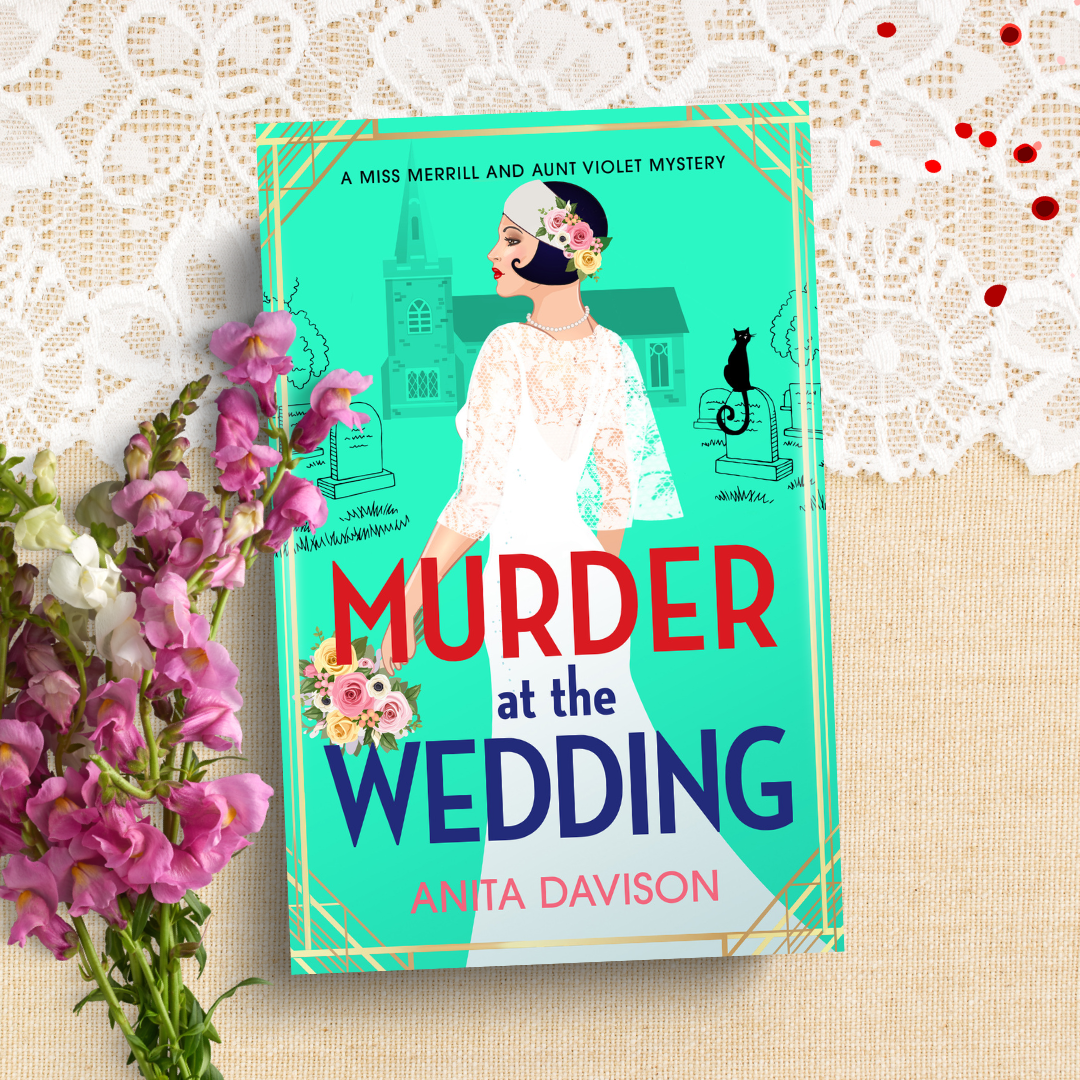
I’m delighted to share my review for Murder at the Wedding by Anita Davison #bookreview #blogtour #historicalmystery #newrelease
Here’s the blurb
Hannah Merrill is about to marry the love of her life…
The couple are determined their low-key celebration will go without a hitch, but there can’t be an ‘I do’ while the vicar is missing. And when he’s found dead – a victim of a poisoning – in the crypt behind the church, Hannah knows only she and Aunt Violet can find out who did it.
Hannah’s beloved thinks she shouldn’t interfere. But if he fails to remember that an independent woman in 1918 doesn’t do what she’s told to by a man, the dead vicar may be the least of his worries…
Then the vicar’s own fiancé appears on the scene, even though nobody knew he was engaged. And suddenly it becomes clear someone has a secret, one shocking enough to kill for.
Will the intrepid pair of amateur sleuths catch the murderer before they kill again? Or will it be til death parts them all?
Murder at the Wedding is a fabulous new mystery in the Miss Merill and Aunt Violet mystery series.
Hannah is finally married but no sooner has she said, ‘I do,’ than she finds a body. (What a horror on her wedding day). What they determine is a matter of suicide becomes something much worse as murder is soon suspected. Hannah and her aunt determine to find the solution because the new police inspector isn’t up to the task.
It’s good to see Hannah and Violet working together in this book. They’re a great team (I felt in the previous book that there wasn’t quite enough of Aunt Violet). The mystery is well structured, seemingly impossible to solve for much of the novel and I didn’t guess the resolution, which I always appreciate.
This is another enjoyable read in the on-going historical mystery series.
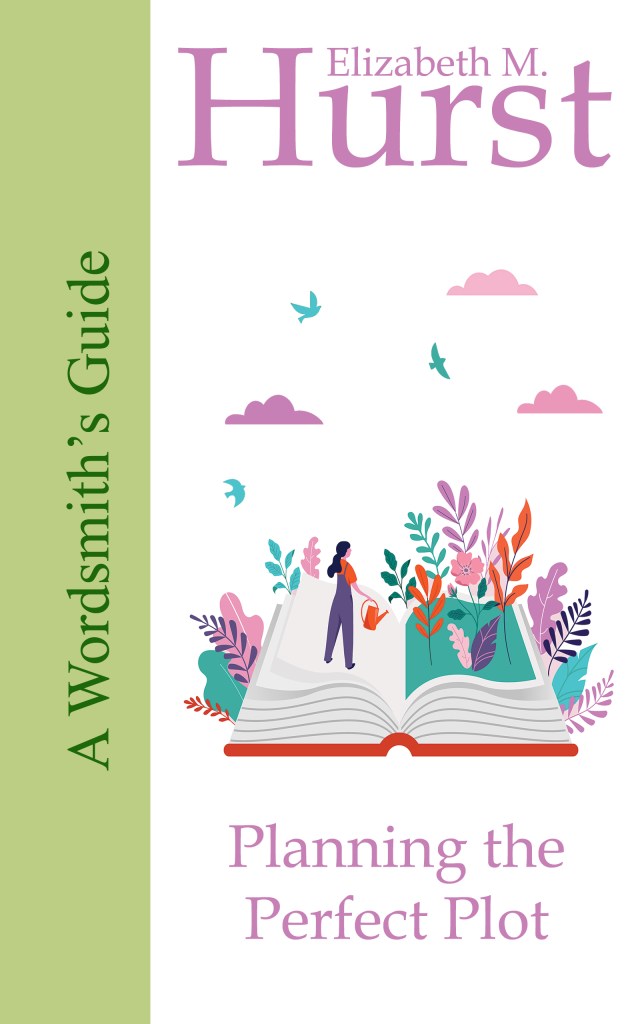
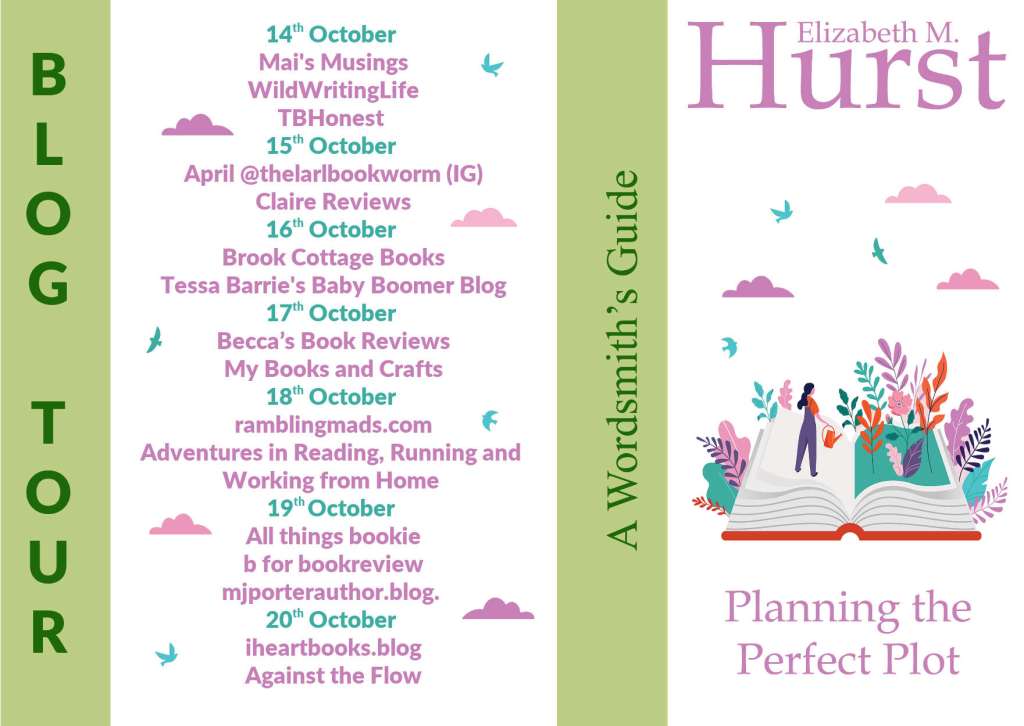
I’m sharing my review The Wordsmith’s Guide to Planning the Perfect Plot by Elizabeth M Hurst #blogtour #nonfiction #writingadvice
The Wordsmith’s Guide to Planning the Perfect Plot
* DO YOU STRUGGLE TO FINISH WRITING A NOVEL? * DO YOU RUN OUT OF MOMENTUM BECAUSE YOU DON’T KNOW WHERE YOUR STORY IS GOING?
The Wordsmith’s Guide to Planning the Perfect Plot is your trusted companion for turning story ideas into structured, compelling narratives. In this fourth instalment of the Wordsmith’s Guides series, Elizabeth M. Hurst takes you through popular plotting methods—including the Snowflake Method, Save the Cat Beat Sheet, and The Inside Outline—helping you choose the right approach for your writing style. You’ll also find practical advice on troubleshooting common pitfalls, crafting satisfying endings, and keeping your plan adaptable as your story evolves.
Inside, you’ll discover:
Clear explanations of proven plotting methods
Guidance on choosing the right structure for your novel
Tips for overcoming plot issues and staying on track
Advice on writing satisfying, well-rounded endings
A practical appendix full of tools and templates to support your planning process
Whether you’re a planner, a pantser, or somewhere in between, Planning the Perfect Plot will help you shape your novel with clarity and confidence.
Planning isn’t something I really do as a writer. But I was certainly curious to see how others might go about writing their stories. Elizabeth M Hurst gathers together many different techniques for planning a novel, and it is interesting to discover how I could be writing a novel, if my mind worked in that way. Mine, alas, does not. It thrives on the chaos. But, I do think the book is an excellent resource for those who plan before writing, and perhaps worry too much about sticking to their plan and the plot they thought they’d be writing when it goes awry and things starts to misbehave. I found it intriguing to read how people use ‘beats’ to craft their story as well as arcs and other techniques. I’m in awe of anyone who can think that far ahead:) I’m not a planner because I ‘feel’ my way through a story – but the author certainly nails my writing style in her explanations.
The author readily acknowledges that most people will use a variety of these techniques, and I was pleased to see that through it all, the delightful chaos of characters and plot misbehaving was never far from her thoughts.
The idea behind writing the novel, was, the author says, to encourage writers to finish their drafts using whatever techniques work for them. This is a worthy endeavour. Many people start writing a story and falter when things start to feel ‘off.’ This should provide opportunities to get writers writing again by thinking of their plot in different ways. I suspect it could be used as an effective diagnostic tool to discover where a plot is faltering, and once that’s been done, writers will learn what works and doesn’t work for them and in future, potentially, avoid the traps waiting to choke off the creativity.
A concise and interesting summary of the way writers write, providing suggestions for breaking free from processes that might not be working. I’m sure all writers will find their ‘type’ in the explanations.
Meet the author
Elizabeth was born and bred in the picturesque harbour town of Whitehaven in the northwest of England, where the long, wet winters moulded her into a voracious reader of fiction to escape the dismal weather.
She graduated with a degree in Business Studies and a string of jobs followed, after which she finally settled in the automotive industry, where she spent twelve happy years.
Having already started writing around the age of 40, she had begun to dream of a more creative lifestyle and set about creating her freelance editing and proofreading business, EMH Editorial Services. In 2018, she quit the corporate world and concentrated her energy full-time towards her love of the written word.
Elizabeth now lives with her husband in the warm and sunny south of France, where the wine is cheaper than the water, and the cats spend their days hunting lizards and dreaming of the birds that roost on the roof.