Author of Saxon historical fiction and non-fiction, 20th-century historical mysteries, and Norse-inspired historical romantasy. Book reviewer and blog host.
Witness the rise of the Tudors in the stunning conclusion to Conn Iggulden’s powerful retelling of the Wars of the Roses. ‘An utterly compelling page-turner full of historical facts. A fascinating read’ Sun
England, 1470. A divided kingdom cannot stand.
King Edward of York has been driven out of England. Queen Elizabeth and her children tremble in sanctuary at Westminster Abbey. The House of Lancaster has won the crown, but York will not go quietly.
Desperate to reclaim his throne, Edward lands at Ravenspur with a half-drowned army and his brother Richard at his side. Every hand is against them, every city gate is shut, yet the brothers York go on the attack.
But neither sees that their true enemy is Henry Tudor, now grown into a man. As the Red Dragon – ‘the man of destiny’ – his claim to the throne leads to Bosworth Field and a battle that will call an end to the Wars of the Roses . . .
My Review
Ravenspur, by Conn Iggulden, the fourth book in a series about the Rise of the Tudors, suffers, from the very beginning, with pacing issues and an apparent unease from the author to actually tell the story of the battles of the War of the Roses, even though this novel ‘hooks’ itself onto the important battles of the period, ending with the Battle of Bosworth Field. The author goes to a great deal of trouble to set up each and every battle, and the reader is left wanting greater details of the battle, only for the author to almost gloss over the entire thing and move onto the next chapter in the long-running civil war.
Furthermore, the desire of the author to get to the Battle of Bosworth in this novel means that the novel is uneven – 80% of the novel takes place over the space of a single year, and to all intents and purposes, looks as though it will stop there, only for it to leap forward eleven or twelve years and continue telling its story. It would perhaps have been better to split this novel into two books and allow Richard III a little more time on the throne.
The characters of the period are told with little flare and with absolutely no sympathy for their plight. The main women in the story – Margaret of Anjou and Elizabeth Woodville barely have any pages to themselves and when they do appear it is more often that not only as objects for the male characters of the story to complain about or belittle. And this continues with Richard III’s poor wife.
The male characters of the story are equally presented with little or no understanding of their characters and not a single one of them elicited any sort of emotional response. Edward IV is a swaggering idiot (and fat for quite a bit of it), Earl Warwick is indecisive and stupid, Richard III (or Gloucester) is a simpleton following his brother where ever he takes him and then turning into some sort of possessed maniac, and poor old Edward, son of Margaret of Anjou, just gets to look pretty and make a fool of himself in battle.
Overall, the story moves very slowly, and without any emotional connection with the characters, it is a slog to get to the end, which many will already know. And that’s another problem. With good historical fiction, even the inevitable conclusion is often presented as only one possible outcome, with this novel there is never any (apart from briefly before the Battle of Barnet) moment where I wondered if the author had managed to present a possible alternative, which would ultimately fail, but would still give a little bit of hope to the reader and the characters in the story both. Sadly, I was disappointed with such a drab retelling of the end of the War of the Roses.
(I’m re-sharing an old post, which I’ve amended slightly and added some new graphics).
England, Wales, Scotland, the smaller kingdoms of Mercia, Wessex, Northumbria, East Anglia, Kent, Powys, Gwynedd, Dal Riada – for the uninitiated (including myself) the sheer number of kingdoms and kings that peopled the period in British history before 1066 can appear as a bewildering display of names, places, times and events, and perhaps never more so than when a historian is trying to sell a book and so makes a statement in their title that applies to that particular king.
Map designed by Flintlock Covers
Phrases such ‘the Golden Age of Northumbria’, ‘the Mercian hegemony’, ‘the rise of Wessex’, they all mask so many events that I find the phrases very unhelpful and perhaps worse, misleading.
I think that Athelstan and his younger half brother, Edmund, probably deserve their titles as Kings of the English. And it’s not just my opinion either. There was, according to Sarah Foot in her book on Athelstan, a concerted effort by the king and his bishops to have him stand apart from his predecessors – to be something ‘different’ to them. They named him king of the English, not king of Mercia (a post he held briefly before another of his younger brothers died) and not king of Wessex, for all that he was both of those things.
They changed his title, they crowned him with a crown, not a helmet. They wanted Athelstan to be something other than his grandfather, King Alfred, and his father, King Edward. It was a bold statement to make, and one they continued when Athelstan died too young and his half-brother, Edmund replaced him. He too was crowned using, it must be supposed, the same Coronation service. (For full details have a peek at Sarah Foot’s book on Athelstan – or read the first few chapters of King of Kings as the service appears in it as well).
So why the change? Essentially the old Saxon kingdoms, for all that they were preserved in the naming of the earls/ealdormens designations, had been swept aside by the Viking raiders. The old kingdoms had become a handy label to apply to certain geographic areas, and the kings of Wessex, whilst keen to hold onto their hereditary titles because of the permanence their own royal line had managed to acquire, were equally as keen to do away with regional boundaries. There was, it can’t be denied, a concerted and almost unrelenting urge to drive any Viking raider or Dane or Norwegian (the Norse) from British soil, and this is what Athelstan and then Edmund were tasked with doing.
Yet the idea of ‘English’ wasn’t a new concept. Why else would Bede have called his great piece of religious historical writing “The Ecclesiastical History of the English people’, if there hadn’t been a shared consciousness that the people in England, all be it in their separate kingdoms, didn’t have a shared heritage? Why the idea suddenly took flight under King Athelstan could be attributed to a new sense of confidence in Wessex and Mercia at the time. They were confident that they could beat the Viking raiders and they were convinced that England belonged to them.
Or perhaps it was more than that? The destruction wrought by the Viking raiders on the separate kingdoms must have been a stark reminder of just how insular the kingdoms had become, and the Viking raiders showed everyone just how easy it was to run roughshod over the individual kingdoms. Only in unity could the Saxon kingdoms of England survive another onslaught; only with unity could the Saxons hold onto their kingdoms they’d claimed about 500 years before.
It was a message that was learned quickly and taken to heart. Athelstan worked to reunite more of the Saxon kingdoms with the growing ‘England’, and he tried to do so by both diplomacy and through war. Yet, the Viking raiders hadn’t finished with England, and nor were they her only enemies. This also lies at the heart of Athelstan’s ‘masterplan’ his treaty of Eamont (if it truly happened – Benjamin Hudson in his Celtic Scotland is not convinced). Athelstan wanted to be a mighty king, but he also wanted England, and the wider Britain (also a concept already understood otherwise why else would that cantankerous monk – Gildas – have called his even earlier work than Bede’s “On the Ruin of Britain?”) to be united in their attempts to repel the Viking raiders. He was a man with a keen vision of the future and it was a vision that his brother continued, with slightly different direction and results.
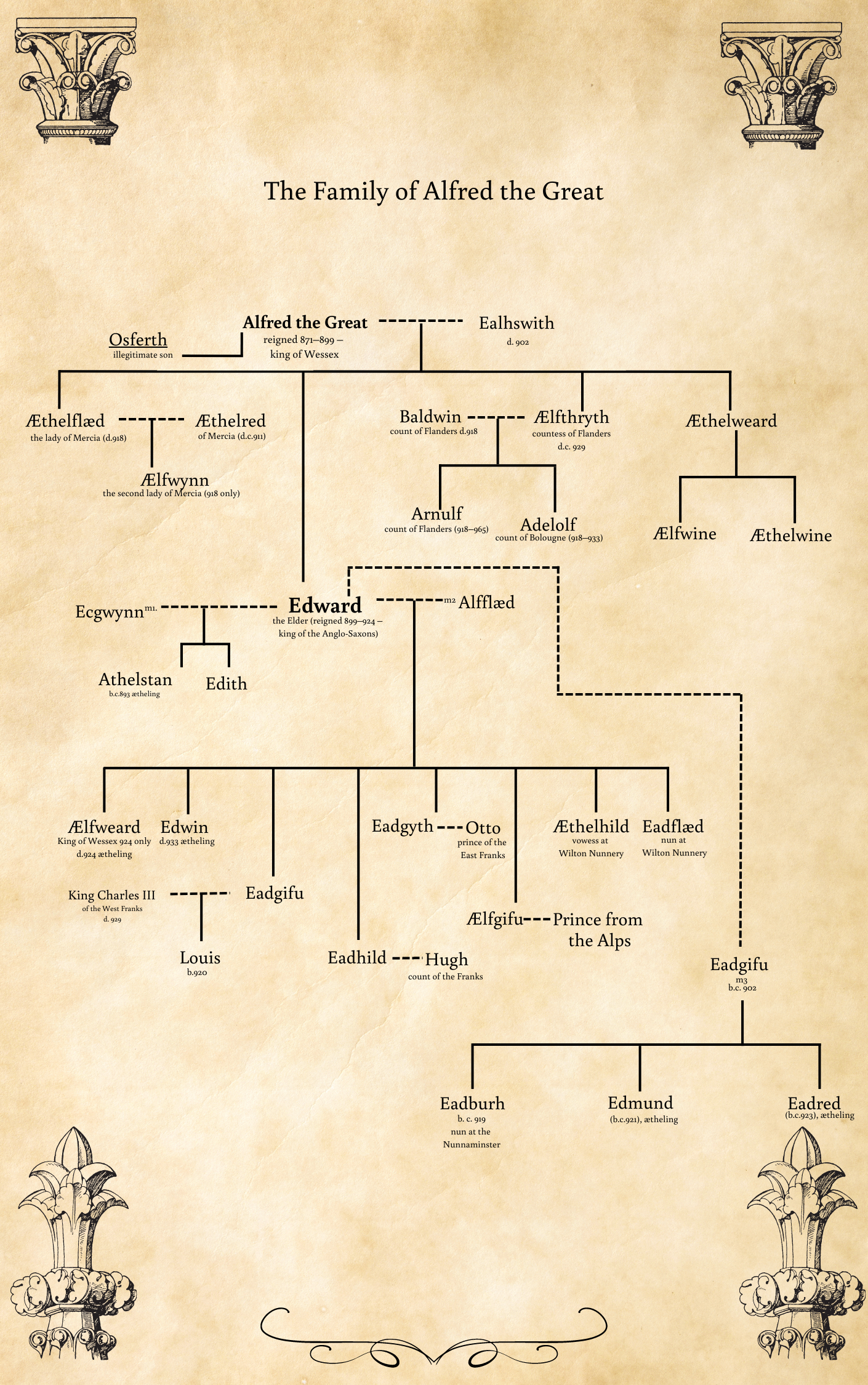
Family Tree designed by Boldwood Books
The ‘English Kings” saw safety in unity, and of course, an increase in the power they held went hand-in-hand with that.
Yet at no point during the Saxon period can it be said that the emergence of ‘England’ as we know it, was a given certainty. Throughout the period other great kings had tried to claim sovereignty over other kingdoms, but never with any permanence. The earlier, regional kings, were powerful within their own lifetimes and within their own regions. Few, if any, were able to pass on their patrimony complete upon their death. This was a time of personal kingship, and it was only under Athelstan and Edmund that the leap was taken away from this to a more permanent power base.
Not that it was a smooth transition and it did have the side-effect of allowing other men, those not related to the royal family, to evolve their own individual power bases in the old Saxon kingdoms. The ‘English’ kings had to do more than just rule their own kingdom, they had to rule their ealdormen and earls, their warriors, bishops and archbishops. The number of names of kings might start to deplete in the after math of Athelstan and Edmund’s kingship, but in their place spring up more and more powerful men, men that these English kings had to rely on.
Becoming King of the English was very much a mixed blessing, bringing with it new and greater responsibilities and more, it brought with it the need to expand personal government further, to have a greater persona to broadcast.
Primary sources are never without problems. They hold bias, they hold perceived bias, but they are, more often than not, an insight into how people perceived an event as soon after it as details are available to the modern historian.
The Anglo-Saxon Chronicle, with it’s many recensions is a fantastic source, but riddled with problems which can, quite often be clearly seen precisely because it survives in different versions.
For the true student, it’s worth investigating the bias of the different ASCs and taking note of them. Over the years a number of approaches have been taken to the ASC starting from when it was just accepted as the source for Saxon England. This means that for a time all the different recensions were amalgamated. Now, the individuality of each recension is truly appreciated, because as with all early sources, quite often, what isn’t said is just as important as what is said.
(The Anglo-Saxon Chronicle also benefits from a latinised version that was written by Ealdorman Æthelweard at the end of the tenth century and this can likewise be used in a similar way as the Old English recensions.)
Yet, for the sake of not infringing anyone’s copyright, when publishing my books and listing information on my websites, I have to rely on the older translations of the ASC as these are the ones I can use freely. Whilst this isn’t ideal, it does allow me to still make a very valid point, and that is this, the entry for the year 1016 (the year Cnut claimed the English kingdom) is vast, and I mean vast. Compared to previous year’s, 1016 is massive. (I’ve copied it below from http://omacl.org/Anglo/part4.html, but this resource seems to have disappeared, but there is another version available here: https://archive.org/stream/anglosaxonchroni00gile/anglosaxonchroni00gile_djvu.txt) if you want to take a look. I am not sure, as I look at this in 2023, which text this refers to, but possible A). Not until 1023 does an entry even half as long as this appear, and I’m starting to consider if this was all a lot of political rhetoric and whether, the entries for previous years have been purposefully shortened, or amended to show the inevitability of Cnut’s accession to the kingdom of the English. I need to do far more research, but as 2015 roles round to 2016, I can’t see a better time to more fully study the time period and this I plan to do next year.
A.D. 1016. This year came King Knute with a marine force of one hundred and sixty ships, and Alderman Edric with him, over the Thames into Mercia at Cricklade; whence they proceeded to Warwickshire, during the middle of the winter, and plundered therein, and burned, and slew all they met. Then began Edmund the etheling to gather an army, which, when it was collected, could avail him nothing, unless the king were there and they had the assistance of the citizens of London. The expedition therefore was frustrated, and each man betook himself home. After this. an army was again ordered, under full penalties, that every person, however distant, should go forth; and they sent to the king in London, and besought him to come to meet the army with the aid that he could collect. When they were all assembled, it succeeded nothing better than it often did before; and, when it was told the king, that those persons would betray him who ought to assist him, then forsook he the army, and returned again to London. Then rode Edmund the etheling to Earl Utred in Northumbria; and every man supposed that they would collect an army King Knute; but they went into Stafforddhire, and to Shrewsbury, and to Chester; and they plundered on their parts, and Knute on his. He went out through Buckinghamshire to Bedfordshire; thence to Huntingdonshire, and so into Northamptonshire along the fens to Stamford. Thence into Lincolnshire. Thence to Nottinghamshire; and so into Northumbria toward York. When Utred understood this, he ceased from plundering, and hastened northward, and submitted for need, and all the Northumbrians with him; but, though he gave hostages, he was nevertheless slain by the advice of Alderman Edric, and Thurkytel, the son of Nafan, with him. After this, King Knute appointed Eric earl over Northumbria, as Utred was; and then went southward another way, all by west, till the whole army came, before Easter, to the ships. Meantime Edmund Etheling went to London to his father: and after Easter went King Knute with all his ships toward London; but it happened that King Ethelred died ere the ships came. He ended his days on St. George’s day; having held his kingdom in much tribulation and difficulty as long as his life continued. After his decease, all the peers that were in London, and the citizens, chose Edmund king; who bravely defended his kingdom while his time was. Then came the ships to Greenwich, about the gang-days, and within a short interval went to London; where they sunk a deep ditch on the south side, and dragged their ships to the west side of the bridge. Afterwards they trenched the city without, so that no man could go in or out, and often fought against it: but the citizens bravely withstood them. King Edmund had ere this gone out, and invaded the West-Saxons, who all submitted to him; and soon afterward he fought with the enemy at Pen near Gillingham. A second battle he fought, after midsummer, at Sherston; where much slaughter was made on either side, and the leaders themselves came together in the fight. Alderman Edric and Aylmer the darling were assisting the army against King Edmund. Then collected he his force the third time, and went to London, all by north of the Thames, and so out through Clayhanger, and relieved the citizens, driving the enemy to their ships. It was within two nights after that the king went over at Brentford; where he fought with the enemy, and put them to flight: but there many of the English were drowned, from their own carelessness; who went before the main army with a design to plunder. After this the king went into Wessex, and collected his army; but the enemy soon returned to London, and beset the city without, and fought strongly against it both by water and land. But the almighty God delivered them. The enemy went afterward from London with their ships into the Orwell; where they went up and proceeded into Mercia, slaying and burning whatsoever they overtook, as their custom is; and, having provided themselves with meat, they drove their ships and their herds into the Medway. Then assembled King Edmund the fourth time all the English nation, and forded over the Thames at Brentford; whence he proceeded into Kent. The enemy fled before him with their horses into the Isle of Shepey; and the king slew as many of them as he could overtake. Alderman Edric then went to meet the king at Aylesford; than which no measure could be more ill-advised. The enemy, meanwhile, returned into Essex, and advanced into Mercia, destroying all that he overtook. When the king understood that the army was up, then collected he the fifth time all the English nation, and went behind them, and overtook them in Essex, on the down called Assingdon; where they fiercely came together. Then did Alderman Edric as he often did before — he first began the flight with the Maisevethians, and so betrayed his natural lord and all the people of England. There had Knute the victory, though all England fought against him! There was then slain Bishop Ednoth, and Abbot Wulsy, and Alderman Elfric, and Alderman Godwin of Lindsey, and Ulfkytel of East-Anglia, and Ethelward, the son of Alderman Ethelsy (59). And all the nobility of the English nation was there undone! After this fight went King Knute up with his army into Glocestershire, where he heard say that King Edmund was. Then advised Alderman Edric, and the counsellors that were there assembled, that the kings should make peace with each other, and produce hostages. Then both the kings met together at Olney, south of Deerhurst, and became allies and sworn brothers. There they confirmed their friendship both with pledges and with oaths, and settled the pay of the army. With this covenant they parted: King Edmund took to Wessex, and Knute to Mercia and the northern district. The army then went to their ships with the things they had taken; and the people of London made peace with them, and purchased their security, whereupon they brought their ships to London, and provided themselves winter-quarters therein. On the feast of St. Andrew died King Edmund; and he is buried with his grandfather Edgar at Gastonbury. In the same year died Wulfgar, Abbot of Abingdon; and Ethelsy took to the abbacy.
It could be as simple as many events taking place in one year but I harbour the feeling that Cnut might have wanted to portray Edmund as a great warrior to make his own triumphs that little bit greater. After all, Æthelred II receives no treatment as detailed as Edmund throughout his 30 years on the throne and Edmund ruled for a matter of months. While Edmund is still shown as being unable to take decisive military action against Cnut, he fares much better than poor old Æthelred (according to the Anglo-Saxon Chronicle)! Perhaps I should count the words Edmund receives compared to Cnut as a really basic indicator of the bias of the entry?
There are many events planned for the anniversary of Cnut’s accession to the English kingdom, and I know that much will be said and written about the event. Maybe by this time next year, there might be many, many theories abounding about the ASC but for now, I’m happy to be questioning the information I have, or don’t have, and raising the interesting questions of just how much the people of Anglo-Saxon/Anglo-Danish England used propaganda? It’s certainly not a new tool and it’s one the people of England understood a thousand year’s ago just as well as they do now. Cnut’s Queen, Emma/Ælfgifu had a book commissioned about Cnut shortly after his death, and the latinised version of the ASC that I mentioned above, was also a political statement by it’s author, thought to be an ealdorman, and so a member of the nobility.
Be wary of what is accepted as fact, just because someone took the time to a) write it down and b) ensure it survived to modern times!
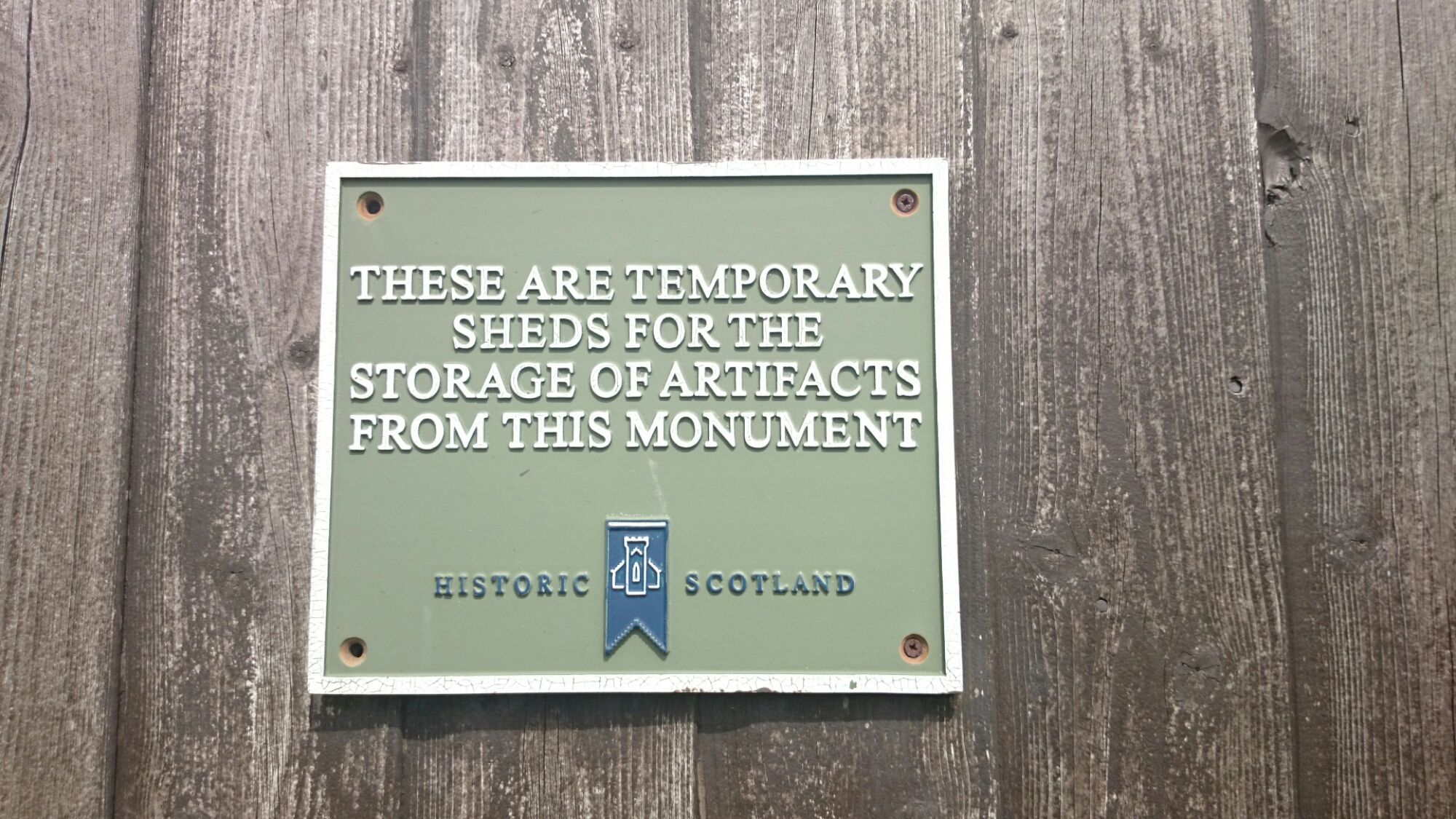
This sign today really made me chuckle and wonder just how long the temporary sheltering of the artifacts on this Historic Scotland site has been going on. Now I’m sure that the sign has been left on purpose to explain the now permanent feature of the series of sheds at Hackness Battery on Hoy, but it was a poignant reminder of just how quickly historic sites can be changed by modern inhabitants, and this one is only a mere two hundred years old. Just think what could happen in half a millenia or longer!
But for now, I’m going to enjoy the sign and hope I’ve not offended, because I really had no intention of doing so.
It’s been pointed out to me via another blog post that today is the 999th anniversary of King Æthelred II of England’s death, which means that really something big should be planned for next year when it’s a 1000 years, but poor old Æthelred II, like the much maligned Richard III, is very short of supporters. And here the similarities will, for the time being remain.
Richard III, like Æthelred II, was the last king in a royal line (let’s ignore for the moment the fact that Æthelred’s children did eventually succeed him after the death of Cnut and his own sons) and he was the victim of many scurrilous rumours and of course, the quill of Shakespeare didn’t help him out at all. Whilst I’m not a great fan of Richard III, I want to at least do him the courtesy of considering what we KNOW about him and what we SUSPECT about him and make my own decision. The power of negative publicity is far greater than good publicity.
Yet, the same rules have never been applied to Æthelred II. He’s been derided by many, and he earned the epitaph of ‘The Unready,’ and few seem to want to look behind the fiction to see the facts. It’s also worth remembering that not only did Æthelred II’s death allow (alright, maybe allow isn’t the right word there, but I think you know what I mean) Cnut of Denmark to claim the throne, the later death of his son, Edward the Confessor, allowed William the Bastard to ‘steal’ the throne of England. Effectively, the history of Æthelred II hadTWICE within fifty years, been rewritten and that’s before anyone else turned their attention to him.
This is an important fact to remember. Almost all that is known about Æthelred II is retrospective, and sadly, historians and fiction writer alike, tend to forget this and rely on any snippet of information they can find out about him in order to build their story. That’s not necessarily a bad thing, the attitudes of people who lived close to the men and women in history I strive to research are an excellent source of information, but often it’s what they DON’T tell us that’s important, and often it’s what they DO tell us within the context of events affecting them that’s important. ‘Histories’ and Saints Lives, which have survived nearly a millennia, often reveal more about the society that created them than it does about the people they purport to be about.
So, what’s the main issue with Æthelred? 1) he murdered his brother to become king (um – he was only ten or twelve at the time of his brother’s death, and he was never implicated in his own lifetime, and nor, more interestingly, was his mother who also takes the blame for this. His brother, a youth of only 18 at the time of his death, was a political pawn in a game between the great ealdormen of England at the time. Who knows what really happened.) 2)He never went to war, and he let the Viking raiders rape England and then paid them to leave and crippled his people with heavy taxation! No, no and yes. He did go to war – in the year 1000 there was the Battle of Strathclyde and it was a victory (I think – the Anglo Saxon Chronicle (ASC) is very anti-Æthelred and can’t seem to record anything worthwhile about him without a big BUT at the end of it.) As to the Viking raiders, yes, they attacked England A LOT during his reign, but even according to the ASC it wasn’t Æthelred’s decision to pay them off – no that was taken by his churchmen and his councillors. Let’s not forget – England was a rich society – it had a sophisticated system of recalling and recasting money – Æthelred did this about every six to eight years throughout his reign. There were moneyers all over the place, and the design of the coins was changed each time the coins were recast. It was, on occasion, a way to make money by changing the weight of the coins, but it was also an unheard-of system amongst the Viking raiders.
I believe that England could well afford the money she paid to try and tempt the Viking raiders away. It’s simply unfortunate that in doing so, she roused the greed of the Viking raiders and they just kept coming back. A final point – if England hadn’t been so well endowed, why would Cnut, once he was king, have paid his men so much money? He wouldn’t have wanted to impoverish his new kingdom. He’d fought for maybe as long as a decade to claim the throne of England. I imagine he probably wanted to enjoy it when he finally got it. He could have rewarded his men with land or riches back in Denmark, or like William the Bastard, have doled out England’s land to his favoured followers. He didn’t do this. Some of his followers became Eearls (the name now changing from ealdormen) but he kept much of the governing structure and its people in place. 3) Æthelred ordered the massacre of the Danes on St Brice’s Day and earned himself Swein of Denmark as an enemy (Cnut’s father). Indeed the ASC mentions this – “all the Danish men among the English race were to be killed on St Brice’s Day because it was made known to the King that they wanted to ensnare his life,” but little is known about how many were killed on the king’s orders, and who exactly was meant by ‘all the Danish men,’ and neither can it be said with any certainty that this involved the killing of Swein of Denmark’s sister who was then living in England. This entire scenario is difficult to understand or explain, or offer any explanation to, but it could simply be a turn of phrase used by the scribe of the ASC AFTER Æthelred’s death to describe something far less catastrophic than the hastily flung words imply, when it just so happened that England had a Danish king, a very strong Danish king who understood the importance of the written word, as can be evidenced by his letters back to the English when he was overseas during his reign. Once more, it’s vital to look BEHIND the supposed ‘fact’ that is known about Æthelred.
Æthelred II is very much maligned in almost every written source available to modern readers, but a very careful study of the independent sources, can present Æthelred in a wholly different light. For those who are really keen please try and track down a copy of Simon Keynes, ‘The Diplomas of King Æthelred II’. It is a hugely intelligent piece of work and whilst you might not want to pour through the charters, at least read the way that he believes Æthelred II governed throughout the changeable years of his reign. Don’t forget, whatever else can be said about Æthelred, England was whole when it was passed onto Cnut. During the first Viking Age, the kingdoms of England; Northumbria, Wessex, Mercia and East Anglia, all fractured and fell apart under the onslaught of the Viking raiders. Æthelred, whatever his faults, (and he had many) had loyal men labouring to keep England safe and united. It would be interesting to know if Cnut ever realized that.
As a writer, my concern was actually with Ealdorman Leofwine, one of Æthelred’s longest serving supporters. He, like Æthelred, falls foul of the scribes of the ASC because he’s only mentioned, once, even though he held his position throughout the Viking raids (from 994 – 1023). The reasons he wasn’t included are intriguing (and not for today), but he serves as a wonderful example of the hit-and-miss nature of historical knowledge, and that might just be because his sons and grandsons were the arch rivals of the House of Godwins. But again, that’s not for today, and is just another angle to be factored in when talking about Æthelred II and Leofwine of the Hwicce.
I almost pity them their anonymity and their notoriety.
History, is not, and contrary to what people believe, a study of facts. It’s a study of the tantalising glimpses of information that have miraculously survived, and the greatest skill is in appreciating this and applying sound reasoning to what might have happened. It’s not, unfortunately, an excuse to decide who’s ‘good’ and who’s ‘bad’. History can teach many valuable lessons, but the first one, the most important one, is that no one writes down a piece of information without some bias. Find the bias.
(Please note this is a historic blog post, which I’ve left on the blog as I find it interesting. My opinions might well have changed since then a I’ve studied the period more thoroughly).
In order to locate the end of Roman Britain it is necessary to conduct a detailed and systematic critique of the available sources from the period that the end of Roman Britain is purported to have come about. This is not such an onerous task as might be expected as sources for the period are scant and offer piecemeal information. After this has been attempted it should be possible to determine if a date or event can be said to mark the end of Roman Britain. At the present time there is a wealth of theories given as to when Roman Britain ended. Dark in his ‘Civitas to Kingdom’ published in 1994 argues that
‘…. Eastern England passed out of Roman political domination in the course of the first decade of the fifth century and was re-defended by sub-Roman authorities in the early to mid fifth century. By the late fifth century, most of it was controlled by Anglo-Saxons,’[1]
whilst Higham in his 1994 book argues that
‘it is accepted by all sides that the year 441 represents the date at which Saxon rule within a large part of Britannia became known to a southern Gaulish chronicler,’[2]
and as such Roman Britain must have ended by that date at the latest. As these differing interpretations all rely wholly on the same written sources and so it is necessary to have a deep understanding of these sources before reaching any conclusions or agreeing with other historians interpretations of events.
Sources for the end of Roman Britain, which is taken to have occurred from the 5th century onwards, with a readily given date of 410 as the official date for the end of Roman Britain taken after Zosimus who stated that they
‘expelled their Roman rulers and set up their own governments as far as lay within their power’[3],
are few and nearly all continental. It must here be noted that even Zosimus is a later commentator so had the advantage of hindsight when writing his work.
Gildas’ De Excidio Britanniae (DEB)
The only native source is that of Gildas’ De Excidio Britanniae (DEB). This source is extremely problematic and needs to be considered with care and attention. For the purpose of this essay, the problems of ancient document transition to our own times will be only lightly touched on, yet it is essential to understand that only the information available to us can be interpreted, and if this can be shown to be incorrectly transcribed, then the reliance on the source is extremely problematic.
There is still no consensus amongst historians as to when the DEB was actually written. Convincing arguments have been postulated by Higham for a date in 480,
‘he was apparently writing in or about AD480 from the comparative safety (in this context) of a British community between the Thames and the Channel which was under indigenous rule but subject to the ultimate protection of the Saxons.’
Gildas himself comments that the siege of Badon Hill
‘was the year of my birth: as I know one month of the forty-fourth year since then has already passed,’[5]
but gives no further details about the year of Badon Hill. This has led to a debate about when Badon Hill took place. This must be seen to be a worthwhile debate as it does mark the only datable event in the entire DEB. Lapidge has further argued for an early sixth century date for Gildas’s writing, whilst admitting that
‘to think in such terms is to imply that much more of the fabric of Roman civilisation was still visible in sixth-century Britain than has hitherto been assumed.’[6]
Coupled with the problems in dating the DEB there is also the difficulty of placing where the DEB was written. Whilst Higham above postulates that it was written in the south of the country, there have been equally convincing arguments that he was writing in the north of the country (Miller) and also that he may have been writing in Wales. The only compelling reason to discredit the northern association with Gildas comes from his confusion over the purpose and building of Hadrian’s Wall which has been taken to show that he was not a native northerner, as does his confusion about the home of the Picts. The geographical location of Gildas has also been assumed to lie outside that of the five tyrants he berated,
‘…. the assumption that he necessarily lived and worked outside their orbit merely because he attacked them so openly is far from conclusive.’[7]
This carries with it the assumption that we can correctly place the five tyrants and this is not always the case. Surely for an assumption to be based on the available information, that information must be seen to be above reinterpretation!
It is also important to understand the motives behind Gildas’s DEB. Certainly it is no dry chronicle with a list of consular dates and appropriate happenings. Gildas was writing at a time when he feared for the spiritual welfare of the people of Britain. His intention was not to provide as concise and accurate history of Britain as he could write. Instead it was to highlight the plight he felt the Britons to be in. As such his emphasis was not on the facts that historians would find most useful in determining the end of Roman Britain but in finding facts that fit his intended template – that Britons could find respite from the evils that had befallen them by seeing to their own spiritual welfare. As Higham states,
‘Gildas was not writing an objective, historical account of British history but a piece of dialectic which utilised the past to establish a system of causality appropriate to the present.’[8]
‘Gildas’s business was with examples and anecdotes, not the continuous warp of history and his case might well have been weakened by reference to more than a single exemplar of each sort.’[9]
So what does Gildas actually tell the reader about the state of Britain at this time? Again, this is not a simple question to answer. Regardless of where Gildas wrote his work his view of Britain at that time was differentiated by the Roman view of Britain,
‘his Britannia was … close kin to the Britanniae – the provinces of the late Roman British diocese. He may even have been ignorant of the survival of free indigenous communities in the far north throughout the Roman period, if he ever considered the question.’[10]
This means that his work informs about the areas of Britain which were Romanised – that is the lowland areas of Britain, namely the south of Britain, whilst his tyrants are thought to have lived in what is now Cornwall and Wales (Higham). The content of his work also informs that,
‘the most frightening feature …. is not the destruction of city life in Britain, or the breakup of the imperial system with its guarantee of peaceful life, but rather the destruction of knowledge itself – knowledge of the outside world and knowledge of the past had been wiped out of men’s minds.’[11]
With specific reference to events in Britain at this time Gildas informs of the career of the usurper Maximus; of him taking troops away from Britain when he left; of the invasions of Scots and Picts at this time and the request that was sent to Rome to ask for aid. He tells how they did receive some aid but that the troops quickly returned home and that the Scots and Picts quickly reasserted themselves, and that when Rome was again appealed to for help, Britain was told to defend itself although Rome did offer advice on how this should be done. However the Scots and Picts again returned and the people of Britain sent a letter to Aetius asking for assistance but received none. In the meantime Britain was devastated by famine, and attacks from the Irish, whilst the Picts stayed home for once. During this time the people recovered and the island became wealthy and turned away from their Christianity.
Gildas then goes on to detail some of the kings who have ruled in Britain, naming five of them and giving them all various crimes against God. Those listed are Constantine, Aurelius Caninus, Vortipor, Cuneglasus and Maglocunus, with the implication that there was a further sixth Saxon king,
‘Gildas offers a vision of a contemporary Britain which was unevenly divided between the five British tyrants in the west and a powerful, but shadowy, Saxon king ruling the remainder.’
Thus, Gildas is actually incredibly informed about events in Britain at this time, or at least what was the former Roman province. The impression given is of an island in constant flux and constant danger of invasion, which is ultimately abandoned by its Roman overseers. However, the lack of dates makes the whole narrative extremely difficult to piece together with any amount of precision. From Gildas it is fair to say that he presents a picture of the province of Britanniae which is constantly changing, and of course for Gildas, in mortal peril of losing its place under the watchful eye of God.
So what else can be implied about Britain at this time from the words of Gildas? Britain was by this time, obviously, open to the ideas of Christianity. It has been argued persuasively by both Dark and Thompson that Britain at the end of the Roman age was becoming increasingly Christian – either from the bottom up – that is from the lower classes (Dark) or from the top down – that is from the upper classes(Thompson). Whichever viewpoint is taken it is important to remember that the Roman Empire had only relatively recently adopted Christianity as its main religion, displacing the pagan gods. As such Britain had been influenced enough by the time of Gildas’s writing that he could safely assume that his intended audience would understand his biblical references and his desire for spiritual reform.
It could be said that the person of Gildas himself is more important than his writing. The fact that he wrote in Latin, the language of the Roman aristocracy and administration points to an education received in Latin; the fact that he wrote about Britain in mainly biblical terms which he believed his audience would understand; the fact that he used as his base earlier Latin texts; and the fact that it can be argued that his writing was actually intended as a sermon points very much to the culture of Rome still being current and immediate when he produced his DEB. This could be said to show a continuing Roman culture when the Romans should have already left British shores, and so perhaps pushing the end of Roman Britain further back than the year 410. As Higham argues,
‘Gildas’s own education in grammar and rhetoric may imply that the law courts and magistracies, which had provided the normal career path of the aristocracy in the Roman provinces, were still functioning, or at least expected to resume functioning, when his parents were considering his educational needs, some thirty years before the date of composition.’[15]
He also asserts that,
‘perhaps it was his own (Gildas’s) generation which was the first to witness the final separation of civil government and jurisdiction from its traditional urban setting.’[16]
Gildas offers something more than a narrative of the end of Roman Britain as he in a sense embodies the end of Roman Britain. If it can be said with confidence that Gildas was a product of the last generation of Romanised gentry in Britain then he presided over the final severance of Britain from Rome, whenever that happened.
Continental Sources
The writings contained in the other sources purporting to date from the fifth century are less detailed and yet the work of disentangling the author from his background is just as relevant if the work is to be correctly interpreted.
The work of Constantius of Lyon on St Germanus of Auxerre was written circa 480-490 and before 494, according to Thompson, and so could be said to have been written at the same that Gildas was writing, if we accept Higham’s view on dating. It is a work of hagiography and as such does not have as its basis a historically accurate account of St Germanus, and indeed contains no dates. It was written up to 60 years after events which are mentioned in it, and it is important to bear in mind this time discrepancy between its characters and its author. The only datable moment stems from a notice in Prosper’s Chronicle which dates Germanus’ visit to Britain to 429. However, is it prudent to rely on another ancient text to verify an entry in an equally ancient text?
The purpose of the work is always to show St Germanus in as good a light as possible, possibly to the detriment of then known facts, which can now no longer be independently verified. As Thompson argues,
‘we must not be over-optimistic about our chances of learning much about the history of fifth century Britain from his pages.’[17]
However, it behoves the historian to try for the simple reason that it is a contemporary source,
‘we cannot afford to ignore any ancient author who speaks at some length about Britain.’[18]
This work can be placed geographically and the author is well known, an advantage over the work of Gildas. With this work it is possible to interpret the author’s bias and also account for information contained or omitted within its text.
Constantius’ text relating to Britain concerns the visit of St Germanus to Britain to counter the Pelagian threat. There is much debate as to whether or not he visited Britain once, or twice and when these visits took place. As mentioned above, the first visit has been dated to 429 through correlation with Prosper’s Chronicles. Whether it is a correct assumption to marry the two sources together or not, is certainly open to debate and needs to be borne in mind when discussing the validity of either text to the debate on the state of Britain in the fifth century. However the text is relevant and informative about certain aspects of Britain at this time, and must be explored in depth for this information. Thompson has written at great length on this work and has made a number of valuable comments about what the Pelagian controversy in Britain meant about the state of Romanisation in Britain at this time. The fact that the controversy spread so quickly and was so popular has lead Thompson to argue that this,
‘was perhaps only possible in a land where the Emperor’s power could no longer be felt’.[19]
When on his second visit to Britain Constantius informs that the Pelagians were sent into exile by the Church congregation Thompson argues,
‘where else in the Roman world, or in what had until recently been the Roman world, could a preacher’s congregation send men into exile?’[20]
Following this argument forward, Thompson wonders if this action could have been taken as a result of knowledge of the law enacted by Honorius on 30/4/418 which decreed that anyone found discussing Pelagianism were liable to be arrested by anyone and condemned to inexorable exile. If this were the case then it would show that Roman law still had some validity in Britain in the 430s onwards. However this argument is slightly laboured and Thompson is quick to comment that,
‘it would be a bold man who would assert that Roman legislation of 418 could have been enforced in Britain in the 430s or 440s’.[21]
Again this may simply be a matter of Constantius being aware of this legislation when he wrote in the 480s and using it to make Germanus appear in as Christian light as possible. Indeed the very incident has doubt cast on it by a source written by Prosper which states that the Pope was responsible for removing the Pelagians from Britain.
‘All in all, these events suggest that Britain was still subject to the Roman Church if not to the Emperor and that papal policy was being pursued with confidence on the fringes of the world’. [22]
What does the fact that Constantius allows the congregation to remove the threat of heresy from Britain say about those who were in power at this time? Constantius has very sparse detail about Britain and mentions only one British name and gives no indication of political authority at the time.
‘What the Vita describes seems to be a land from which the Roman administration has wholly disappeared and in which, apart from the indifferent man of tribunician power, nothing very obvious has taken its place’.[23]
This cannot be taken to mean that there was none. Constantius is ill informed about Britain. In contrasting his work with Proper’s he also states that,
‘Prosper gives us in five lines of the printed text more ‘hard’ information about the ecclesiastical position in Britain than Constantius is able to convey, or choose to convey, in many pages’.[24]
Perhaps in view of all these difficulties it would be better to disregard anything that Constantius writes about Britain at this time as many of his comments simply invite more questions than they answer? Perhaps as with Gildas, it would be better to look at the person of Constantius himself and make comments based on what he himself embodies? In which case it would be that those on the Continent, even those within the church hierarchy, were ill informed about events in Britain at this time.
Yet there are other sources which show that this may not have been the case. Prosper of Aquitaine and the anonymous author of the Chronicle of 452 were also working on the Continent and whilst constrained by the style they wrote in, that of continuators of Jerome’s Chronicles, they do make some mention of Britain during the fifth century. Prosper first added to Jerome’s Chronicles in 433 and then, according to Muhlberger, returned to the Chronicles again on numerous occasions between 433 and 455. He produced at least 4 versions of his text, and the best informed versions are those of 445 and 455 – there are no complete copies of the 451 edition, and that of 433 can only be detected by a close examination of the later editions. This is important to note. Prosper had 22 years to think about events he transcribes, and it is possible that his viewpoints may have changed during this time, and revisions might have been made dependent on later consequences of the actions commented upon. Prosper seems to have come from Aquitaine and then moved to Provence and finally onto Rome and seems to have been born around 390. His chronicle was,
‘immediately popular, finding readers during his lifetime not only in Rome but also in Africa’.
Prosper records the first expedition of Germanus to Britain in Chapter 1301, which has been used to collaborate the work of Constantius.
‘It is one of the few notices of British affairs after 410 by any fifth century author’ [26]
but as Muhlberger comments,
‘he had no more intrinsic interest in Britain than the majority of his contemporaries … the story was included to commemorate another victory for the orthodox over the Pelagians, and even more to demonstrate the leading part taken by the Roman church in the fight for the true faith, even in remote corners of the world’.[27]
As such, once again, the information available now is tempered with the bias of the author and his overwhelming concern with glorifying the Christian church.
A further source is that of the anonymous Chronicler of 452. This source has recently undergone a revival and historians are now more readily accepting of the information contained within it. However, the fact that it is anonymous presents problems akin to the work of Gildas. It is not possible to determine who the author was and what his bias was. It is necessary to allude this information from that given in the text and also from the manuscript tradition. What can be said with some certainty is that,
‘he was, like Prosper, a devout Christian of an ascetic bent, he even seems to have lived in Marseille, where Prosper resided in the 420s and 430s’.[28]
Yet Muhlberger makes the point that ‘the two men were not in sympathy’[29]. Whilst it can be argued that both men were writing at a similar time they both have completely different outlooks on events at this time and the anonymous author of 452 ‘saw decline and defeat affecting both church and state.’[30]
So what does the author inform of events in Britain at this time? In Chapter 62 he stated,
‘The British provinces were laid waste by an invasion of Saxons’
and in chapter 126
‘The British provinces, which up to this time had suffered various defeats and catastrophes, were reduced to Saxon rule.’
This entry has been dated to 440-441. Yet,
‘he had no profound interest in Britain and possessed few details about conditions there. He simply invoked the name of Britain to supplement his pictures of a defeated empire in the process of disintegration.’[31]
Still, he provides information that no other sources does – the victories that Magnus Maximus won over the Picts and Scots before he went to Gaul. Muhlberger has compared the works of the Chronicler of 452 with the work of Narration De Imperatorbis Domnus Valentinianae et Theodosianae and has concluded from this work that the Chronicler of 452 viewed events differently in Britain and that,
‘something occurred about a decade before the Chronicler wrote that appeared to mark the transition between a Britain harassed by enemies and suffering from disaster, and a Britain finally subjugated by the Saxons.’[32]
His source viewed this as happening under the reign of Honorius when,
‘Britain was forever removed from the Roman name’[33]
whereas the 452 Chronicler viewed this as happening in 440-441, thirty years later. It must be borne in mind that the Chronicler,
‘was preoccupied with events that might seem unimportant to us … but which to him were near and threatening.’
An examination of the main ‘historical’ sources for the fifth century in Britain leaves a gaping hole where knowledge has been forever lost. However it would be wrong to discredit all these sources on the grounds mentioned above – be they bias or inability to place adequately in time and place,
As Muhlberger comments,
‘the words of the fifth century chronicles have been preserved for us not because of their individual brilliance, but because they took part in a collective enterprise … they were contributing to the continuing history of the church, in the hope that their part in it would be useful and instructive for those who followed them.’[36]
This can also be applied to Gildas, although Muhlberger was mainly writing with the continental fifth century chronicles of Prosper, 452 and Hydatius in mind. As such what is left to the historian is the preoccupation of Christian men to a world that appeared to be fracturing and for which the only salvation that could be found was in the words of God and works to the glory of God. Any other information provided is purely secondary to the primary purpose.
It would be wrong to pick and choose which information was most relevant from these sources and this is something that historians needs to desist from doing. The work of the chroniclers was relevant and immediate to the time they were written. It was history in the making and needs to be considered as a whole, whilst understanding its limitations. All sources agree that at some point in the fifth century the idea of a Roman Britain came to an end – that is the physical presence of Romans in Britain appeared to come to an end. That’s not the same thing as saying that Roman Britain ended. The administration and physical structure of Britain remained to a greater or lesser degree for much of this time, and depending on when Gildas’s work is dated to, can be seen to be embodied in the very presence of Gildas himself. It would also be incorrect to assume that just because generals and troops failed to come to Britain during this time that Roman involvement ended. Certainly, the church was involved in Britain as the works of Constantinus, Prosper and the anonymous work of 452 are at pains to show. The Saxons may have arrived, and they may have taken over the government of much of the old Britannia. How they did so is open to debate, but it would be safe to assume that after the rape and pillaging had taken place, they took advantage of the superstructure already in place and more than likely, benefited from it.
The 1600th anniversary of the ‘end’ of Roman Britain?
The year 2010 will give historians and archaeologists alike the opportunity to use the 1600 year anniversary of the supposed exit of the Romans from Britain to question accepted beliefs and to look a little further than the written sources available from the time that Roman Britain can be said to have ended. As archaeology is constantly finding new fifth-century sites, and especially coins, it has become understandable that the standardised interpretation of the beginning and end of Roman Britain can no longer be sustained. Archaeologists and historians need to work together, with other specialists, such as numismatics to clearly define when Roman Britain ended, if it did at all. Surely it would be far more helpful to see Roman Britain merging into sub-Roman Britain before again merging into Saxon England. Perhaps the continuity needs to be stressed instead of the break.
Britain was not unified before the Romans came, during the Roman ‘occupation’, or after the Romans had left. As such, the idea of a ‘Roman’ Britain is erroneous to start with. There are several problems, the most fundamental of which is that there needs to be a coherent and agreed-upon definition of what Roman Britain was, what came before it, and what came after. Only then can it be even remotely possible to determine if it ended and when that end came about? None of these concepts is easy to define, because when the available evidence for the entire 500 or so years, which encompasses Britain before the Romans, after the Romans, and also during the Romans, is examined, the sources available are slight, and archaeology, linguistics and science must be used to supplement the scanty sources available. These historical sources need to be examined within the context that they were written and analysed for the information that they can provide, not for the information that it is beyond their powers to supply. What can be said with certainty is that the answer cannot yet be definitively defined, as Sam Moorhead says in the March/April 2010 edition of British Archaeology when discussing the 1600-year anniversary of the ‘end of Roman Britain,’
‘by the end of 2010 …. we will know much more about the end of Roman Britain. But we will probably all still disagree when it ended!’
The historians of the fifth century all disagreed on when Roman Britain ended, and Wood gives a valuable argument as to why this was so,
‘there is nothing to suggest that the people of Britain were worried by these developments; already they had passed out of the Imperial orbit, but they had done so slowly and without any clear awareness of the significance of the changes taking place.’[38]
‘Ultimately the end of Roman Britain is the history of fifth and sixth century opinion and, because of the nature of our sources, Continental opinion at that,’[39]
as such it is not our place to say when Roman Britain ended – we need to look back to the commentators of the day and accept their opinions and view on what was happening. Hindsight cannot play a part because it is too easy to adopt our own biases and inflict them on the past. As such all that can be said with confidence is that at some point in the fifth century, Romanised Britain ceased to be a part of the Roman Empire in the physical sense of belonging, and nothing further than that can be confidently asserted.
[1] K. R Dark, Civitas to Kingdom – British Political Continuity 300-800’(Leicester, 1994) Pg 54
[2] N Higham The English Conquest: Gildas and Britain in the Fifth Century (Manchester, 1994)Pg 121
[3] S. Ireland Roman Britain, A Sourcebook (New York, 1986) pg 168-9
[4]N. Higham The English Conquest: Gildas and Britain in the Fifth Century (Manchester, 1994) Pg 176
[5] M. Winterbottom, (ed. And trans), Gildas: The Ruin of Britain and Other Documents. Arthurian Periiod Sources Vol 7 (Chichester, 1978)Pg 28
[6] M. Lapidge., ‘Gildas’s Education and the Latin Culture of Sub Roman Britain’ in M.Lapidge and D.N. Dumville (eds), Gildas: New Approaches (Woodbridge, 1984), pp27-50 pg 50
[7] N. Higham The English Conquest: Gildas and Britain in the Fifth Century (Manchester, 1994)Pg 97
[8] N Higham ‘The English Conquest: Gildas and Britain in the Fifth Century’ (Manchester, 1994)Pg 21
[9] N Higham ‘The English Conquest: Gildas and Britain in the Fifth Century’ (Manchester, 1994)Pg 21
[10] N Higham ‘The English Conquest: Gildas and Britain in the Fifth Century’ (Manchester, 1994)Pg 90
[11] E A Thompson., Germanus of Auxerre and the End of Roman Britain (Woodbridge, 1984) pg 115
[12] M. Winterbottom, (ed. And trans), Gildas: The Ruin of Britain and Other Documents. Arthurian Period Sources Vol 7 (Chichester, 1978)Pg 25
[13] M. Winterbottom, (ed. And trans), Gildas: The Ruin of Britain and Other Documents. Arthurian Period Sources Vol 7 (Chichester, 1978)Pg 27
[14] N Higham The English Conquest: Gildas and Britain in the Fifth Century (Manchester, 1994)Pg 166
[15] N Higham The English Conquest: Gildas and Britain in the Fifth Century (Manchester, 1994)Pg 158
[16] N Higham TheEnglish Conquest: Gildas and Britain in the Fifth Century (Manchester, 1994)Pg 158
[17] E A Thompson., Germanus of Auxerre and the End of Roman Britain (Woodbridge, 1984) pg 14
[18] E A Thompson., Germanus of Auxerre and the End of Roman Britain (Woodbridge, 1984) pg ix
[19] E A Thompson., Germanus of Auxerre and the End of Roman Britain (Woodbridge, 1984) Pg 22
[20] E A Thompson., Germanus of Auxerre and the End of Roman Britain (Woodbridge, 1984) Pg 28
[21] E A Thompson., Germanus of Auxerre and the End of Roman Britain (Woodbridge, 1984) Pg 29
[22] I Wood., The End of Roman Britain: Continental Evidence and Parallels’ in M Lapidge and D.N. Dumville (eds) Gildas: New Approaches (Woodbridge, 1984) 1-25 Pg14
[23] E A Thompson., Germanus of Auxerre and the End of Roman Britain (Woodbridge, 1984) Pg 32
[24] E A Thompson., Germanus of Auxerre and the End of Roman Britain (Woodbridge, 1984) Pg 23
[25] S Muhlberger The Fifth Century Chroniclers. Prosper, Hydatius and the Gallic Chronicler of 452 (Leeds, 1990) Pg 55
[26] S Muhlberger The Fifth Century Chroniclers. Prosper, Hydatius and the Gallic Chronicler of 452 (Leeds, 1990) Pg 84
[27] S Muhlberger The Fifth Century Chroniclers. Prosper, Hydatius and the Gallic Chronicler of 452 (Leeds, 1990) Pg 85
[28]S Muhlberger The Fifth Century Chroniclers. Prosper, Hydatius and the Gallic Chronicler of 452 (Leeds, 1990) Pg 136
[29] S Muhlberger The Fifth Century Chroniclers. Prosper, Hydatius and the Gallic Chronicler of 452 (Leeds, 1990) Pg 136
[30] S Muhlberger The Fifth Century Chroniclers. Prosper, Hydatius and the Gallic Chronicler of 452 (Leeds, 1990) Pg 136
[31] S Muhlberger The Fifth Century Chroniclers. Prosper, Hydatius and the Gallic Chronicler of 452 (Leeds, 1990) Pg 179
[32] S Muhlberger The Fifth Century Chroniclers. Prosper, Hydatius and the Gallic Chronicler of 452 (Leeds, 1990) Pg 179
[33] S Muhlberger The Fifth Century Chroniclers. Prosper, Hydatius and the Gallic Chronicler of 452 (Leeds, 1990)Pg 179
[34] S Muhlberger The Fifth Century Chroniclers. Prosper, Hydatius and the Gallic Chronicler of 452 (Leeds, 1990) Pg 179
[35] E.A Thompson, Germanus of Auxerre and the End of Roman Britain pg 6
[36] S Muhlberger The Fifth Century Chroniclers. Prosper, Hydatius and the Gallic Chronicler of 452 (Leeds, 1990) Pg 278
[37] Sam Moorhead, British Archaeology March/April 2010 pg 21
[38] I Wood, ;The End of Roman Britain: Continental Evidence and Parallels’ in M Lapidge and D.N. Dumville (eds) Gildas: New Approaches (Woodbridge, 1984) 1-25 Pg1-2 Ian Wood Pg 25
[39] I Wood, ;The End of Roman Britain: Continental Evidence and Parallels’ in M Lapidge and D.N. Dumville (eds) Gildas: New Approaches (Woodbridge, 1984) 1-25 Pg1-2 Ian Wood
(Please note this is a historic blog post based on an essay I wrote as part of my MA in 2010. I have left it in place, as it remains interesting and relevant to my new trilogy.)
Now, I’ve made no secret of the fact that I think historical fiction writers have a duty to portray history as accurately as possible and I think this should be the most up to date interpretations of the past, and not what people were taught in the classroom at school, often quite some time ago, or what’s to be found in popular ‘history’ books often written by presenters from the TV who simply regurgitate the same old supposed facts.
History, contrary to popular opinion, is not an old, dead, subject. In fact it can be very current (I’m just reading about a new copy of the Magna Carta that’s been found abandoned in an old scrapbook) and it changes as more and more information is unearthed or rethought.
Now, this problem doesn’t only affect historical fiction authors, but often those who are eminent scholars in other fields who want to cross-reference with history. Archaeology is only the most obvious of these. Archaeologists aren’t historians, and vice-versa, and as close as the two subjects are, their cross over points can be poles apart. Archaeologists and historians both use each others research to ‘prove’ their arguments but they often rely on outdated interpretations and aren’t always aware of the most up to date research. This can cause huge problems, and I think that all scholars have a duty to seek out experts who can provide the correct current thinking, even if they ultimately question it and offer an alternative.
And in fiction
So what of historical fiction writers? Too often I see old stereotypes being portrayed and no efforts being made to write something that’s factually accurate but different to the accepted norm and this means that time and time again, outdated ideas and even completely incorrect stories are being written about historical figures and being accepted by a huge majority of people because it says it in a book.
Not only does it stifle historical research because it means that readers don’t question the story, but it also means that incorrect historical ideas are constantly being reinforced. As a historian, I’ve been taught never to really accept what’s written, to look for the bias, look for who gains from a certain take on events, and to look at why things are written just as much as what’s actually written. I take this as normal behaviour, but I’m starting to think I might be wrong and that worries me. What if people really think that Elizabeth I did have an affair with Dudley? What if people really do think that Henry VIII was just a dirty old man who went through six wives in seemingly rapid succession (forgetting all together that he was ‘happily’ married for nearly 20 years before all that kicked off)?
If you’re a historical fiction writer, think about why you use the information that you do, and more importantly, if you’re a reader, please think about how the characters are used and why and if you can, dig a little deeper, look for the ‘truth’ because it’s more than likely very, very different from what’s being portrayed. Even seemingly small touches can damn an entire book or TV show. Find the reason, and then, hopefully, the ‘facts’ might make themselves a little clearer.
(Please note this is a historic blog post from 2015, but I’ve left it on the blog during a recent refresh as it is quite interesting to see (at least for me) how my ideas about these concerns have developed over time).
Sometimes, sometimes, I wonder why I make my life so difficult!
Let me explain.
So, for my dissertation, I was going to study the early years of Iceland and compare them with the developments in the Danelaw, only then I got sidetracked by Leofwine, Ealdorman of the Hwicce, and from him grew both my dissertation and The Earls of Mercia series following the Ealdorman through the years from 994-1067 (eventually). And I should have been happy. Only, someone mentioned that they really wanted to know what happened between Alfred and Æthelred II and so the Brunanburh series was born.
King Penda of Mercia
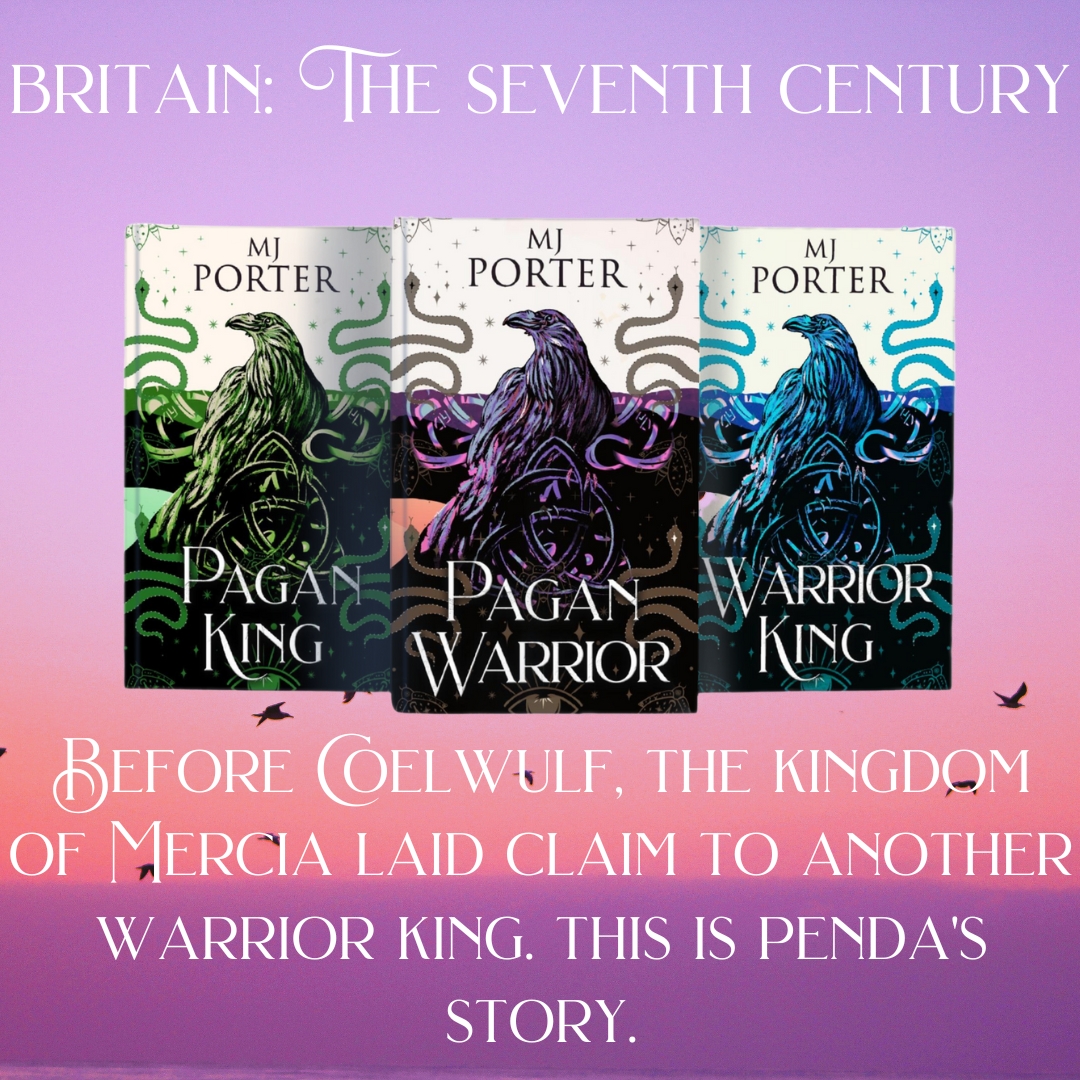
Now, I have no one to blame for my next project, Hædfeld (now Pagan Warrior), because it was my idea but, but, well the battle of Hædfeld was entirely my own idea but it takes place in 632/3 and that brings a whole load of new problems. I know the time period vaguely, and I’ve studied the old Northumbrian Supremacy, Mercian Supremacy and finally, the Wessex Supremacy, but I feel as though I’ve wandered into an entirely different minefield of pseudo-facts and facts. I know I only have myself to blame, but it’s made me realise how easy it is to forget the great period that the Saxon period covers. Starting somewhere in the fifth century and running to the eleventh, that’s nearly 600 years.
Now, put it into context, if I was trying to do that with this year, I’d be going all the way back to the 1400s and the War of the Roses and the end of the Hundred Years War. That’s a huge period! Think of all the facts and pseudo-facts we know about that huge chunk of time.
Still, I can’t deny that I’m very excited about bringing the rascally Penda to life, and maybe one day, I’ll turn my attention to that Offa as well. Time will tell.
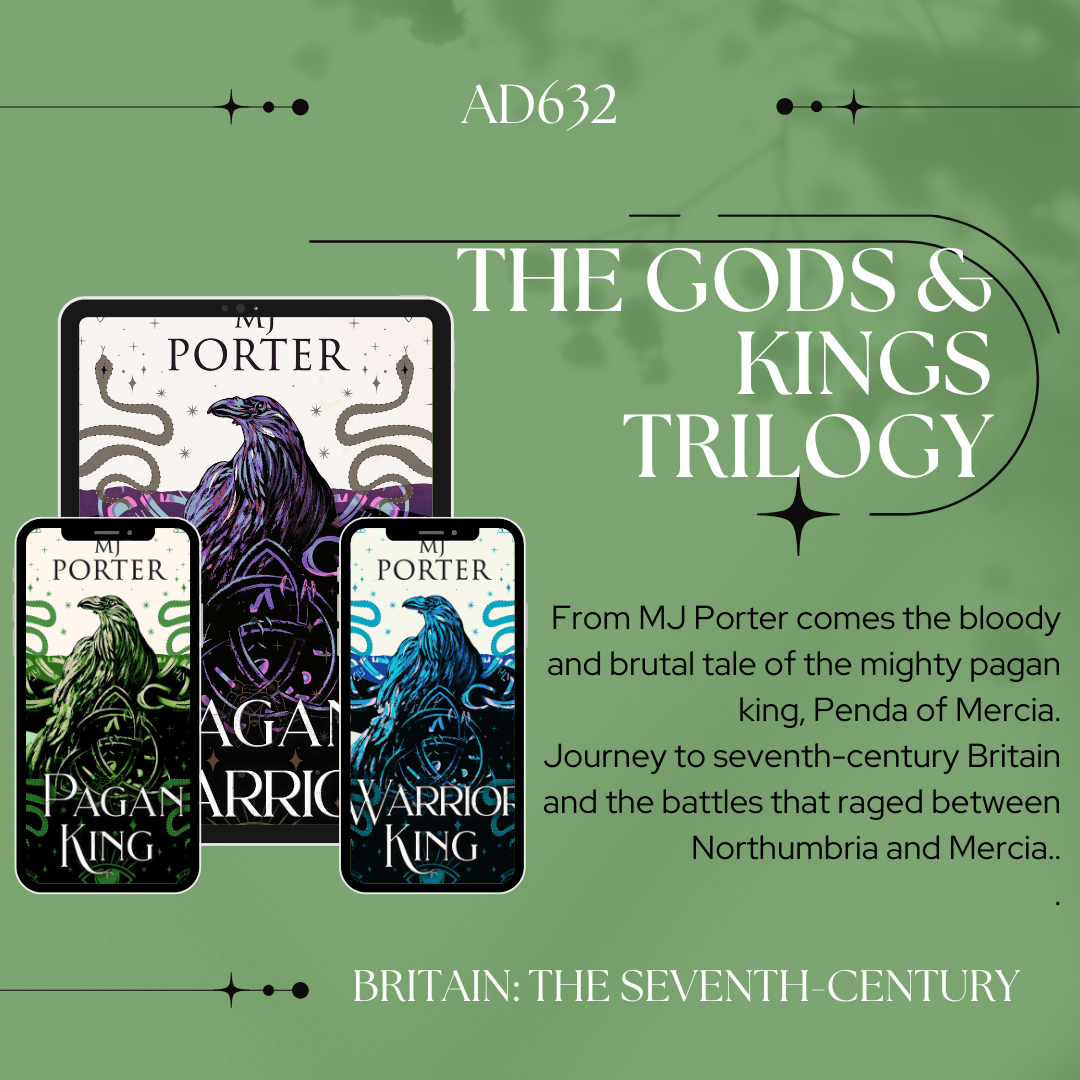
(Please note this is a historic blog post that I’ve left on the blog for information. It’s interesting to see how I felt about the trilogy now known as the Gods and Kings trilogy and featuring Penda the pagan, when I first started it).
Curious about how the trilogy developed then check out the Gods and Kings series page on the blog.
There are only 8 surviving charters for this period in history. They are from 1007, 1009, 1012 and 1013. It’s said that the missing years are due to interruptions caused by invasions of ‘Viking raiders’. This certainly applies to 1010-11 and 1006 when the Anglo-Saxon Chronicle recounts tales of Viking incursions.
As is so often the case, this lack is frustrating because something monumental seems to happen at the King Æthelred’s court between 1009-1012. For a start, the number of ealdormen begins to increase, and second, the, until then, rigidly enforced precedence of the ealdormen crumbles away, and one ealdorman, Eadric of Mercia, comes out on top and Ælfric of Hampshire (who I imagine as a little doddery by now – but I may be doing him a disservice) seems to fall down the rankings, as does Leofwine of Mercia.
By this stage, it’s assumed that both Eadric and Uhtred of Northumbria (the other ealdorman who rises in precedence during this period) are related to Æthelred as they’ve both married one of his daughters.
But there seems an inherent contradiction in this because whilst the ling may be seen to be rewarding his ealdormen with marriage into his family, his own sons from his first marriage don’t seem to be getting any additional authority. This is slightly speculation on my part, but it seems clear to me that Æthelred preferred his sons-in-law to his own sons. Obviously, he now had two sons by his new wife, Emma of Normandy, and although they were only very young, he may have been trying to ensure their inheritance of the throne over and above their older half-brothers.
I appreciate that this is all speculation from only a handful of charters, but it provides a fascinating insight into the character of Æthelred if he really was so unprepared to give his sons any formal authority. Surely, in his times of trouble, when the Viking raiders attacked relentlessly and he was growing steadily older, it would have been an acceptable use of his older sons to use them as battle commanders?
Certainly, later in the 1010s the sons seem to come into their own, and must have had command and fighting experience somewhere. The king proved to be very resistant to leading his own men into battle (apart from the Battle of Chester in 1000) so I wonder why he wouldn’t chose his elder sons who he hoped would never inherit?
But that’s just my ponderings and something I’m going to explore in The Earls of Mercia Book 3.