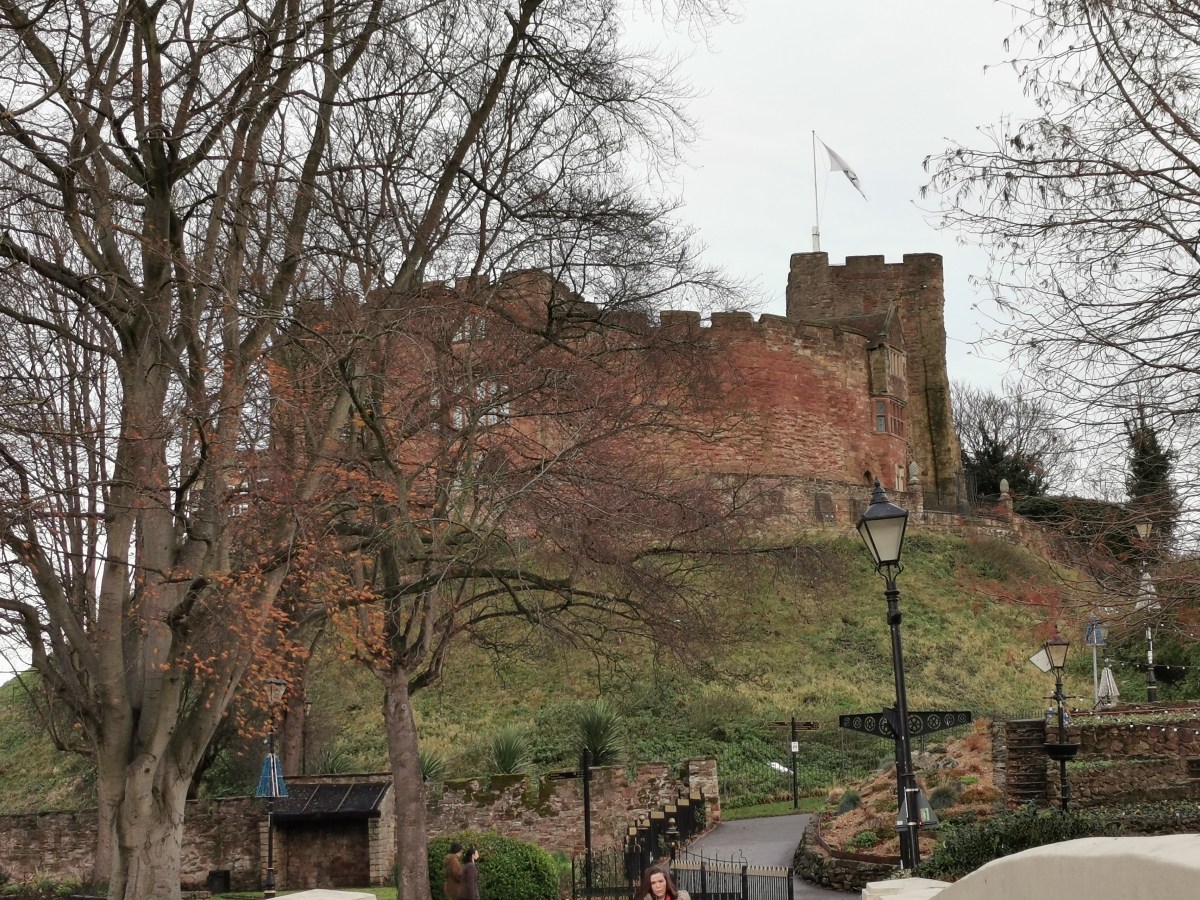
Much of the action in a few of The Last King/The Mercian Ninth Century series takes place in my recreated Northampton.
‘There’s a large hall, visible above another row of low-roofed buildings, and the sides of the ancient rampart can be glimpsed behind the buildings, but not so close that I feel confined.
It seems the Raiders, when they came here twenty-five years ago, planned on keeping a vast area safe behind the rampart. The space is at least double that at Repton, if not treble, and a feeling of unease flickers down my back.
To the front of Northampton, out of sight, the rampart now runs to the water’s edge, and again, a ditch is once more deep enough to prevent easy access. If people want to take a ship along the Nene to reach Northampton, they’ll find no easy places to climb ashore. Even the wooden bridge has been reinforced. Ealdorman Ælhun’s men will guard it from the side of Northampton, a thick gateway nestling there now, only to be opened when sure of the person asking for admittance. Along the length of the bridge, a few surprises have been placed that few know.’
So, how did I create or recreate this image of Northampton? As so often the case, I turned to antique maps. And here, I was certainly helped by the work of John Speed, a cartographer working in the early 1600s. (The only earlier maps are by Saxton).
As you can see below, Speed’s maps, this one is of Northamptonshire, are highly decorative and a bit of a joy to explore. While we might turn to Google Maps these days, I find it easier to look at the older maps to see what was included. It helps me to try and get the ‘landscape’ of the era. (I also adopted the same approach when writing my twentieth-century mysteries – and there, it’s easier as you can still get your hands on maps from that era – via eBay or second-hand bookshops).
John Speed’s Northamptonshire (Map in my possession)
Close up of Northampton
Speed also added detailed maps of two of the county towns to his county maps. So, above is Northampton. Admittedly, I did need to pretend the later castle wasn’t there. But, it certainly provides an idea of how the settlement might have appeared over seven hundred years earlier, although I think, from memory, that I had to use it turned on its side.
“As delicious as a Devon Cream Tea!” ~ author Elizabeth St John
“Every sentence pulls you back into the early 1970s… The Darling Buds of May, only not Kent, but Devon. The countryside itself is a character and Hollick imbues it with plenty of emotion” ~ author Alison Morton
***
Make hay while the sun shines? But what happens when a murder is discovered, and country life is disrupted?
Summer 1972. Young library assistant Jan Christopher and her fiancé, DS Lawrence Walker, are on holiday in North Devon. There are country walks and a day at the races to enjoy, along with Sunday lunch at the village pub, and the hay to help bring in for the neighbouring farmer.
But when a body is found the holiday plans are to change into an investigation of murder, hampered by a resting actor, a woman convinced she’s met a leprechaun and a scarecrow on walkabout…
Buy Links
This title is available to read on #KindleUnlimited.
First accepted for traditional publication in 1993, Helen became a USA Today Bestseller with her historical novel, THE FOREVER QUEEN (titled A HOLLOW CROWN in the UK) with the sequel, HAROLD THE KING (US: I AM THE CHOSEN KING) being novels that explore the events that led to the Battle of Hastings in 1066.
Her PENDRAGON’S BANNER TRILOGY is a fifth-century version of the Arthurian legend, and she writes a nautical adventure/fantasy series, THE SEA WITCH VOYAGES.
She has also branched out into the quick read novella, ‘Cosy Mystery’ genre with her JAN CHRISTOPHER MURDER MYSTERIES, set in the 1970s, with the first in the series, A MIRROR MURDER incorporating her, often hilarious, memories of working as a library assistant. The front cover of episode #4 A MEADOW MURDER is Helen’s actual hay meadow on her Devon farm.
Her non-fiction books are Pirates: Truth and Talesand Life of A Smuggler. She lives with her family in an eighteenth-century farmhouse in North Devon and occasionally gets time to write…
I’m delighted to welcome Catherine Kullmann to the blog with a post about her historical fiction research.
Writing Historical Fiction—The Research
Whether we talk about fictionalised history or fictional biography where the story of real-life characters is told, or genre fiction such as historical romance or historical mystery where fictional characters are placed in an historical setting, the onus is on the author to transport the reader to an unfamiliar society recreated partly from familiar facts and partly from a myriad of tiny, new details so that it seems as real as the world of today. The setting must ring true and the characters’ actions must be determined by the laws, mores and ethics of their time, not ours. Sometimes this may horrify us; at other times we find it liberating and long for more romantic, more adventurous, perhaps simpler bygone days.
Except where a real-life character such as one of the patronesses of Almack’s is introduced for authenticity, my Regency novels are pure fiction. I create the characters and the story arc but to make them and their world come to life, I must know the period inside out; not only the main facts and important dates but also the minor ones and the trivia of daily life. It is essential that I know the social structures, ethics, mores and beliefs of the period, constraints which add conflict and tension to the story and enable readers to step into the setting as easily as they step out of their front doors,
But where do I get this information? Primarily by reading. I have a large research library and a huge database of historical facts and trivia. Everything is grist to my mill—contemporary memoirs, diaries, letters, novels, plays, poetry, newspapers and magazines, etiquette and letter-writing manuals, cookery books, etc. etc. These all help me absorb peoples’ thoughts, attitudes, vocabulary and phrasing, as well as informing me first-hand about the way they lived.
Apart from the written legacy, the Regency has left us a rich legacy of images—paintings, portraits, engravings, cartoons, caricatures, fashion prints, book illustrations. I was amazed at the wealth of contemporary, hand-coloured engravings that can still be purchased at reasonable prices and that show rather than tell what Regency society was like. And finally, buildings, furniture and fittings, sculptures, gravestones and church and other monuments bear living witness to the past.
As an author, you must ask yourself constantly, if we do it this way today, how was it done in the past? You must read widely, covering every aspect of life at the time and take every opportunity to visit museums and period houses. Keep your eyes open everywhere you go to identify what was there then. I live in Dublin which is very much a Georgian city; I went to school in Georgian houses and later worked in many of them so you could say the city architecture of the time is in my bones. Remember too that then as now, older buildings will have co-existed with new one. Guidebooks from the period are very useful as they describe places as your characters will have seen them, and frequently have maps and other illustrations that will help you plan your character’s journeys.
Image of author’s desk and bookshelves. Private photo
All this is general research that feeds into your descriptive writing without your really being aware of it. Over and above this, there is the particular research that every new work calls for. The very first thing I do is create a public time-line for the years in which a new book is set. Here I enter every date and event I find including those of Easter, university, school and law terms, parliamentary sessions, the queen’s drawing-rooms, theatre and concert dates, publication dates of new works, and any notable public events, scandals or anything else newsworthy. These are the things that shape my characters’ lives, that they talk about. They help add verisimilitude and also frequently inspire plot twists.
I start this research on the internet. Frequently I get the information I want there and sometimes it points me in the right direction e.g. to little known diaries that help me flesh out my narrative. In Lady Loring’s Dilemma, I wanted to base my main characters in Paris and Nice in 1814/15 and was delighted to discover the Diary of the Times of George the Fourth, published in 1838 by an anonymous lady who had been in Paris and Nice at just those times. Lady Loring’s Dilemma opens in Harrogate, a well-known spa at the time, and I was thrilled to find a contemporary guide to taking the waters there which included a description of the sights in the surrounding area.
Don’t be afraid to ask the experts. For The Husband Criteria, I discovered that the Royal Academy provides a lot of information online about the years the Academy was based at Somerset House where its annual exhibition was a highlight of the Season. When I needed further information, I emailed the RA and received a prompt and helpful reply from the librarian. Similarly, when I need details of the laws of Cricket in 1814 for A Suggestion of Scandal, a query to the Marylebone Cricket Club was answered immediately and in detail by their Research Officer.
I trawl antique fairs, charity shops, second-hand book sales and flea markets for research material, whether it is books, newspapers, or old prints and engravings. As well as being a source of inspiration, I use antique prints and engravings from my collection for the covers of my books. This is generally cheaper than paying a licence fee for a stock image, it saves me hours of searching for just the right one and I have the freedom to use the image without restrictions.
All this sounds like a lot of work, but I love it. I started writing about the Regency because the period fascinates me and it still does. There is still so much to learn, I love the thrill of the hunt when I find just the right piece of trivia to spur me on.
Thank you so much for sharing. Good luck with your new book.
Here’s the blurb
London 1817
The primary aim of every young lady embarking on the Spring frenzy that is the Season must be to make a good match. Or must it? And what is a good match? For cousins Cynthia, Chloe and Ann, well aware that the society preux chevalier may prove to be a domestic tyrant, these are vital questions. How can they discover their suitors’ true character when all their encounters must be confined to the highly ritualised round of balls, parties and drives in the park?
As they define and refine their Husband Criteria, Cynthia finds herself unwillingly attracted to aloof Rafe Marfield, heir to an earldom, while Chloe is pleased to find that Thomas Musgrave, the vicar’s son from home, is also in London. And Ann must decide what is more important to her, music or marriage.
And what of the gentlemen who consider the marriage mart to be their hunting grounds? How will they react if they realise how rigorously they are being assessed?
A light-hearted, entertaining look behind the scenes of a Season that takes a different course with unexpected consequences for all concerned.
Catherine Kullmann was born and educated in Dublin. Following a three-year courtship conducted mostly by letter, she moved to Germany where she lived for twenty-five years before returning to Ireland. She has worked in the Irish and New Zealand public services and in the private sector. Widowed, she has three adult sons and two grandchildren.
Catherine has always been interested in the extended Regency period, a time when the foundations of our modern world were laid. She loves writing and is particularly interested in what happens after the first happy end—how life goes on for the protagonists and sometimes catches up with them. Her books are set against a background of the offstage, Napoleonic wars and consider in particular the situation of women trapped in a patriarchal society.
Catherine also blogs about historical facts and trivia related to this era. You can find out more about her books and read her blog (My Scrap Album) at her website. You can contact her via her Facebook page or on Twitter.
Why did I decide to tell the story of King Coelwulf II of Mercia?
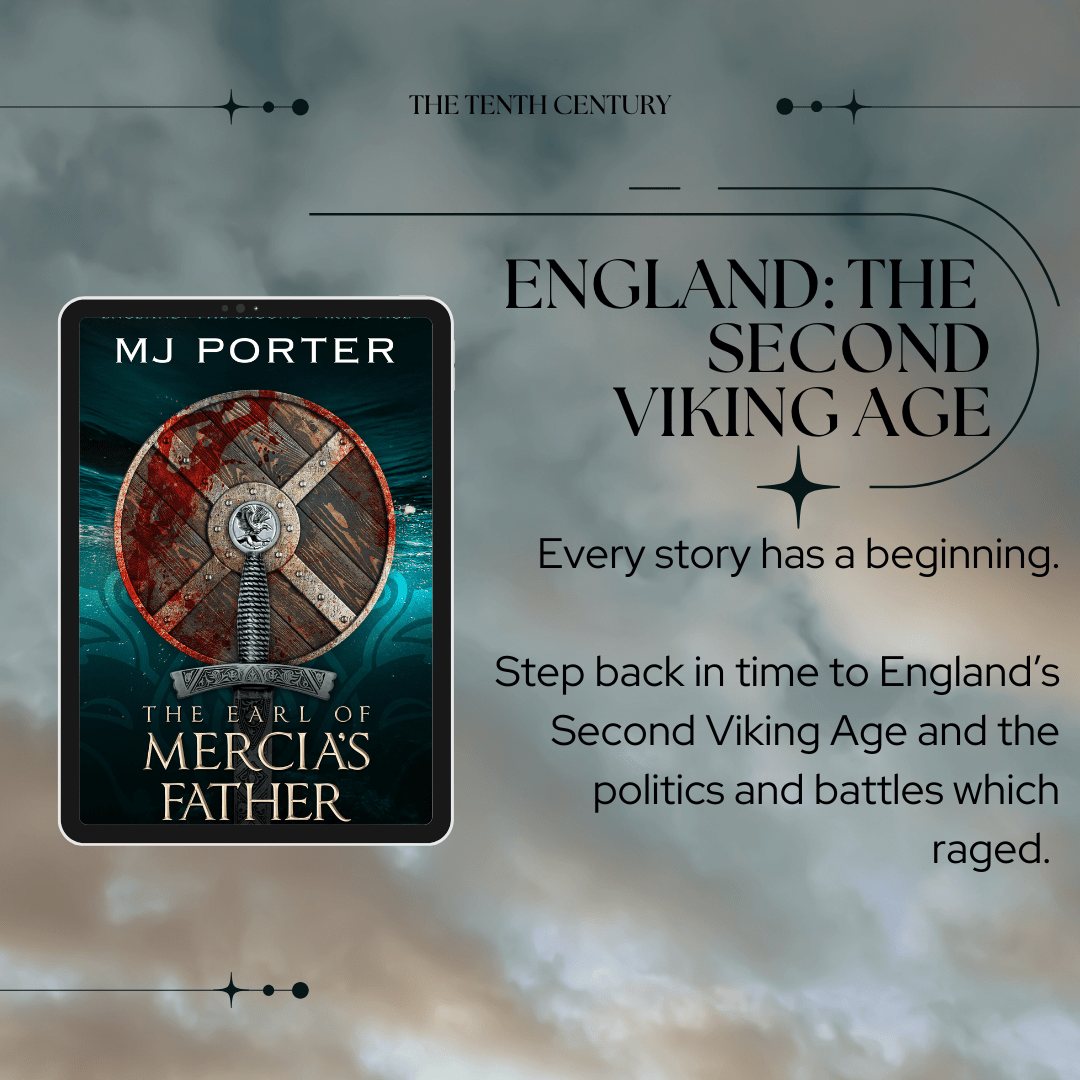
The Last King is set in Mercia in the Ninth Century, one of the ancient kingdoms of England. Mercia, at that time, is perceived as being on the decline – no more the mighty King Penda of the seventh century (who I’ve written about in Pagan Warrior) or King Offa of the eighth century (who I do want to write about), but instead Wessex, on Mercia’s southern border, just waiting to pounce when Mercia is already weak and further destabilised by the Vikings of the Great Heathen Army. It seems inevitable that Mercia will be subsumed by Wessex.
Mercia’s king in the early 870’s was Burgred, brother by marriage to King Alfred and with King Alfred himself married to a Mercian, I think we can all decipher the intentions of the House of Wessex towards Mercia. This alliance seems to have been powerful, persuasive, and long lasting, until abruptly, Wessex gave up on Mercia, and refused to assist in the battle against the Vikings. It is this Mercia that Coelwulf lived in, and lived through.
The historical Coelwulf was allegedly a member of a family who had ruled as kings in the early 800’s. King Coelwulf II (as he was known) was accepted by the Mercians as their king. This is ‘proved’ by the few charters which survive from the time period, which are ‘witnessed’ by the three bishops of Mercia, and her ealdormen as well. In the past, these documents have been taken to show that all of the Mercian nobility bowed down before the Vikings and accepted them as their ‘overlords.’ This view is only now being challenged, and I’m enjoying challenging it.
Mercia, unlike the kingdoms of Northumbria and Wessex, had no one who wrote propaganda for her. Northumbria had the Venerable Bede, Wessex had the Anglo-Saxon Chronicle, but for Mercia, there is a dearth of information. Perhaps there was a record, it is hinted at in something known as the Mercian Register incorporated in one version of the Anglo-Saxon Chronicle, but it is presumed that much of the record was burned by the Vikings.
I’m thriving on looking at the possibilities for what might have happened in Mercia. There are surprising omissions in the Anglo-Saxon Chronicle, a few things that don’t make too much sense when you examine them further, and so ‘my’ version of the time period is a little bit different to anything people might read about in older books. It doesn’t make it right, but, and this is what is so appealing about the time period, it also doesn’t make it wrong.
1915, London: Working in the dusty bookshop that her Aunt Violet mysteriously inherited, Hannah Merrill is accustomed to finding twists in every tale. But discovering her beloved best friend Lily-Anne – with a paperknife through her heart – in the middle of the bookshop, is not a plotline she saw coming.
The case is anything but textbook. With the discovery of a coded German message, and Hannah’s instinct that Lily-Anne’s husband is keeping secrets, she determines to get to the bottom of it.
She can’t do it alone though. To crack this case, Hannah will need to enlist the help of her outrageous, opinionated, only-occasionally-objectionable Aunt Violet.
They think they’re making progress until one of their chief suspects is found dead. And Hannah realises that she is herself now in the murderer’s sights. Will the final chapter be the ending of a killer… or just a killer ending?
A totally addictive, WW1-set cozy mystery, perfect for fans of Verity Bright, T.E. Kinsey, and Agatha Christie.
My Review
Murder in the Bookshop is a cosy historical fiction story set in 1915 in London, England.
Well grounded in the events of the day – the Great War hasn’t been as easy to win as all believed – there are fears of bombs being dropped by the Germans via Zeppelin – the realities of the war are starting to make themselves known with food shortages – this is a really well-envisioned study of the period. Added to which, we have a Murder in the Bookshop.
Our main character is Hannah, who having lost her fiance during the war, now lives with her aunt and helps her run a bookshop. She’s a fiesty character, very much a woman of her day. Aunt Violet is a suffragette and that’s just the beginning of the scandals that surround her. Hannah’s mother wants her to marry, but Hannah isn’t at all interested in doing what her mother wants, and indeed, her mother never actually makes an appearance in the story – which is probably for the best.
Instead, Hannah finds herself determined to discover the culprit behind the murder, and this forces her to come to terms with some truths she’s never known about her friends.
What follows is a really well-constructed story of murder, conspiracy, suspicion and indeed, some peril for our main characters as well.
I read this book in about 2 sittings. I thoroughly enjoyed the setting, the mystery and the resolution, which I didn’t guess at all.
A fabulous war-time mystery sure to thrill fans of the historical mystery genre.
Meet the author
Anita Davison is the author of the successful Flora Maguire historical mystery series. Previously published by Aria, she is writing a new cosy mystery series for Boldwood, the first title of which, Murder in the Bookshop, will be published in August 2023.
Former New York darling turned amateur sleuth Madeline Vaughn-Alwin is once again thrown into a colourful yet deadly web of secrets, lies and soirees to die for!
It’s the week of Fiesta in Santa Fe and Maddie is looking forward to enjoying the celebrations. But as ‘Old Man Gloom’ Zozobra goes up in flames, so too do Maddie’s hopes for a carefree life . . . Human remains are found in the dying embers of Zozobra, and then Maddie and her dashing beau Dr David Cole find a body washed up in the arroyo at the edge of town.
Soon identified as Ricardo Montoya, a wealthy businessman and head of one of the most affluent families in Santa Fe . . . the plot starts to thicken. While his beautiful wife Catalina and her complicated children seem less than heartbroken at his untimely demise, and with many disgruntled locals crawling out of the woodwork, Maddie is surrounded by suspects.
With the celebrations of Fiesta continuing around them, Maddie and her ‘Detection Posse’ get busy infiltrating the best parties and hobnobbing with old and new faces – but can they bring the murderer to justice before they strike again?
Death Comes to Santa Fe offers a detailed and descriptive view of life in Santa Fe in the 1920s, with its speakeasies, artists’ circle and of course, Fiesta. As the third book in a series, it took me a while to get into the novel and the characters, and it also took some time for our ‘body’ to appear. However, once the murder had actually occurred the flow of the novel improved, and the resolution of the mystery was well brought about, and it kept me guessing until the final ‘big reveal.’
Our main character, Maddie, is an interesting woman, if perhaps a bit too likely to wax lyrical about converting every view she sees into a painting. She divides her time between dancing, drinking, painting, and generally having a good time while slowly falling in love with Dr. David and determining to solve this new murder that’s rocked her town. The supporting cast is equally colourful and offers a lovely depth to the story.
A charming historical mystery stuffed with historical details.
Meet the author
Amanda wrote her first romance at the age of sixteen–a vast historical epic starring all her friends as the characters, written secretly during algebra class (and her parents wondered why math was not her strongest subject…)
She’s never since used algebra, but her books have been nominated for many awards, including the RITA Award, the Romantic Times BOOKReviews Reviewers’ Choice Award, the Booksellers Best, the National Readers Choice Award, and the Holt Medallion. She lives in Santa Fe with two rescue dogs, a wonderful husband, and far too many books and royal memorabilia collections.
When not writing or reading, she loves taking dance classes, collecting cheesy travel souvenirs, and watching the Food Network–even though she doesn’t cook.
It’s 1965, and 18 year old Jess escapes her stifling English home for a gap year in Ghana, West Africa. But it’s a time of political turbulence across the region. Fighting to keep her young love who waits back in England, she’s thrown into the physical and emotional dangers of civil war, tragedy and the conflict of a disturbing new relationship. And why do the drumbeats haunt her dreams?
This is a rite of passage story which takes the reader hand in hand with Jess on her journey towards the complexities and mysteries of a disconcerting adult world.
This is the first novel in the acclaimed Drumbeats trilogy: Drumbeats, Walking in the Rain, Finding Jess.
For fans of Dinah Jefferies, Kate Morton, Rachel Hore, Jenny Ashcroft
Jess happily marries the love of her life. She wants to feel safe, secure and loved. But gradually it becomes clear that her beloved husband is not the man she thought him to be.
She survived war and injury in Africa, but can she now survive the biggest challenge of her life?
On the brink of losing everything, and still haunted by her past and the Ghanaian drumbeats that haunt her life, Jess feels that she can no longer trust anyone but herself. Then she’s mysteriously sent a newspaper clipping of a temporary job in Ghana. Could this be her lifeline? Can she turn back time and find herself again? And what, exactly, will she find?
Finding Jess is a passionate study of love and betrayal – and one woman’s bid to reclaim her self-belief and trust. It’s a feel-good story of a woman’s strength and spirit rising above adversity.
Award-winning author Julia Ibbotson herself spent an exciting time in Ghana, West Africa, teaching and nursing (like Jess in her books), and always vowed to write about the country and its past. And so, the Drumbeats Trilogy was born. She’s also fascinated by history, especially by the medieval world, and concepts of time travel, and has written haunting time-slips of romance and mystery partly set in the Anglo-Saxon period. She studied English at Keele University, England, specialising in medieval language, literature and history, and has a PhD in linguistics. She wrote her first novel at age 10, but became a school teacher, then university lecturer and researcher. Her love of writing never left her and to date she’s written 9 books, with a 10th on the way. She’s a member of the Romantic Novelists Association, Society of Authors and the Historical Novel Society.
I’m delighted to welcome Stella Riley and her new book, The Shadow Earl to the blog. Read on for an excerpt.
An incident between Messrs Selwyn & Shelbourne at the Cocoa Tree Club
Daniel immediately noticed two things. Basil Selwyn and his idiotic friends sitting near the Hazard table … and a footman about to serve them a steaming bowl of punch. Opportunity and temptation coincided. One very slight movement was all it took. The footman tripped, lurched, fumbled with the bowl … and a couple of pints of rum punch cascaded over Mr Selwyn.
‘What the – ?’ Basil leapt from his seat in a sticky shower, whirled to deliver a blistering tirade … saw Daniel and froze.
‘You!’ he spat. ‘You did that, you bastard.’
Several gentlemen at the Hazard table stopped playing to watch.
‘What?’ asked Daniel. ‘Don’t be ridiculous. The poor fellow tripped, that’s all.’
‘Not without help,’ raged Basil, dripping and trying to drag off his ruined coat. ‘You tripped him. Deliberately.’
‘And risk the stuff being spilled over me? Hardly. Dare I mention that you have a slice of lemon in your hair?’
Basil hurled his coat aside, groped blindly for the lemon and glared at the footman. ‘You. Tell me the truth. He tripped you, didn’t he?’
The poor man hesitated, swallowed and stammered that it had been an accident.
‘Calm down, Selwyn,’ advised Daniel as the footman fled. ‘Your imagination is running away with you. It’s been doing that a lot recently, hasn’t it?’
More heads turned, somebody sniggered and play at the Hazard table ceased.
Ignoring this, Basil growled, ‘I know what you did!’
‘You don’t because I didn’t.’ Daniel smiled sympathetically, ‘You should try Mrs Baxter’s Elixir. My great-aunt swears by it when her nerves are – ’
‘There’s nothing wrong with my nerves, damn you! You tripped the footman. Admit it!’ And when Daniel shook his head, ‘Then you’re a bloody liar!’
The gasp of shock that rippled through his audience was lost on Basil, as was the voice advising, ‘Take that back while you still can, Selwyn.’
Here’s the blurb
At the end of his Grand Tour, somewhere between Athens and Constantinople, Christian Selwyn, the young Earl of Hazelmere, vanished – seemingly without a trace.
Time passes. In London, his uncle and cousin move into his home … while his unofficial fiancée, Sophia, is left desolate and in limbo. Finally, his friends – loyal and close as brothers – set out to search in person.
Christian’s startling re-appearance at a grand ball takes society by storm and fuels endless speculation. Where has he been during these three missing years? What happened to him?
And more importantly, how did it happen?
Only one thing is clear. The earl who left England five years ago, has returned a changed man. A man with secrets.
Winner of four gold medals for historical romance (Readers’ Favourite in 2019, Book Excellence Awards in 2020, Global Book Awards in 2022 and Book Excellence Award in 2023) and fifteen B.R.A.G. Medallions, Stella Riley lives in the beautiful medieval town of Sandwich in Kent.
She is fascinated by the English Civil Wars and has written six books set in that period. These, like the 7 book Rockliffe series (recommended in The Times newspaper!) and the Brandon Brothers trilogy, are all available in audio, narrated by Alex Wyndham.
Stella enjoys travel, reading, theatre, Baroque music and playing the harpsichord. She also has a fondness for men with long hair – hence her 17th and 18th century heroes.
Warrior King is now live on many audio channels, and slowly making its way onto more and more. Right now, I know it’s available on Spotify, Kobo, Nook, Chirp, Scribd, Bingebooks. Other platforms will be coming live in the coming days and weeks.
Warrior King sample, narrated by the fabulous Matt Coles
With Warrior King, the trilogy, Gods and Kings, is now complete in audio and readers can enjoy listening and reading to the tale of Penda, Mercia and the events of the middle of the seventh century in Saxon England. I hope you’ll enjoy, and I want to say huge thanks to Matt Coles who had this trilogy thrust upon him when a previous narrator was unable to continue, and has done an amazing job of bringing the era to life. When he narrates, I hear my characters as I first visualised them. It’s an amazing experience.
If you’d like a code to download Warrior King from Spotify, please send me an email, and tell me why you want to listen, and I’ll send you a code and instructions about how to use them, or find me on one of my social channels – perhaps not Facebook as I get a bit lost with messages on there.
I’m really excited to share a fabulous blog post about his new book, Usurpers, from Robb Pritchard. I do love a story that uses ancient sources and historical ‘fact.’
Man and myth. Apart from King Arthur, of course, there is another man in British history who is known in myth just as much as the historical record. Immortalised as Macsen Wledig in one of Wales’ most important ancient works of literature, the Mabinogion, Magnus Maximus was also a real general, and later, a usurping emperor.
Relatively speaking, the three centuries of Roman rule in Britannia was a rather secure time for the Romanised inhabitants. After Boudica’s revolt in AD 61 the four provinces that divided the island enjoyed an extended period of peace, which it has rarely experienced in the subsequent 1700 years. But towards the end of the fourth century, the security of the social fabric was beginning to unravel. And Magnus played an important role in that.
In 367 Britannia was almost completely overrun by a horde of barbarians, a seemingly coordinated mix of Picts, Scotti and Saxons. It was only saved by the efforts of a General Theodosius, who was supported by his son and nephew, the future emperors Theodosius the Younger and Magnus Maximus. And thus, Magnus’ story in Britannia begins.
Some fifteen years later, the Elder Theodosius has been murdered by factions of either the court of Gratian, or the toddler emperor, the young son of Valentinian I. Theodosius has been raised to Eastern Emperor, but Magnus is languishing in Rome unable to use his military expertise to help the Empire recover after the crushing disaster of Adrianople, al lost battle against the Goths in which a good percentage of the Roman army was wiped out.
It wouldn’t have been much of a surprise for him to end at the end of an assassin’s blade, the same way as his uncle, but instead, he found himself promoted to the enviable position of Dux Britanniarum, in charge of bolstering the islands’ defences. Perhaps he was given the position to keep him safely away from the circles of power in the imperial cities of Rome, Trier and Milan where a former general with his reputation could be a threat, but it ended up leading to the opposite outcome. Instead of being kept busy in a distant province, he used his position to build support for himself over a couple of years, before launching a successful bid for the ‘purple’. He ruled the Western Empire from Trier for five years.
His reign, and life, ended on the 28th of August 388, ignominiously, in a roadside ditch somewhere in present-day Slovenia, but his connection to Wales still endures to this day. Several royal dynasties which came to prominence in the early medieval period claimed descent from him, finding both pride and authority in the connection to Rome. He was evidently popular enough in popular culture that people spoke about him around fires in their halls as when the Red Book of Hergest was written, some thousand years after his death, they wrote the Dream of Macsen Wledig about him.
For Book 2 of the Foundation of the Dragon series, this is the story I chose to write. But it wasn’t quite as easy as simply collecting all the known facts and weaving them onto a narrative. Magnus is equally well known, perhaps more so, from the Dream of Macsen Wledig, than as a real person, but the story bears no resemblance to the real one. With the resurgence of interest in Welsh culture and heritage, I wanted to include the Mabignion dream story.
How to connect the myth of Macsen Wledig of the Mabinogion with the factual Roman Dux Britanniarum and emperor into a coherent and believable story took quite a while, and a few failed attempts, but I think it turned out quite well. I am terribly self-critical when it comes to my writing, so a couple of weeks out from publication, I am as nervous as perhaps Magnus was as he sailed over to Gaul in 383.
Usurpers covers the period of Magnus’s life from outcast to the moment he is proclaimed as Augustus by the soldiers of Britannia. Book 3 will follow the story of his years ruling from Trier and the ill-fated war against his cousin. If all goes to plan, Book 4 will be about Vortigen in the years of upheaval during Rome’s withdrawal from Britannia, which should be out in the second half of 2024.
Usurpers, Book 2 of the Foundation of the Dragon series is out on the 28th of August. Pre-orders are available now.