
The historical background to King of Kings: ‘England’ in the 10th Century

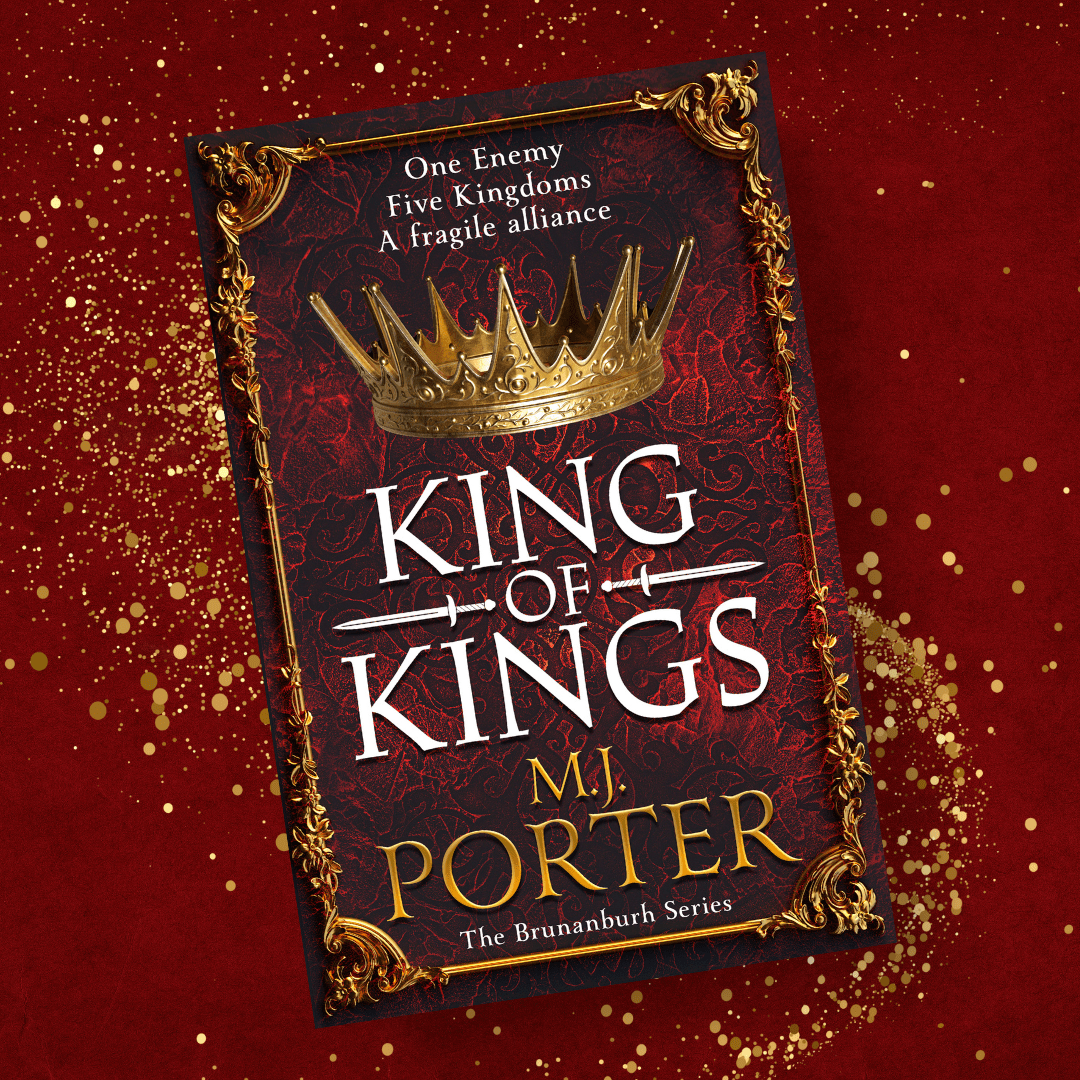
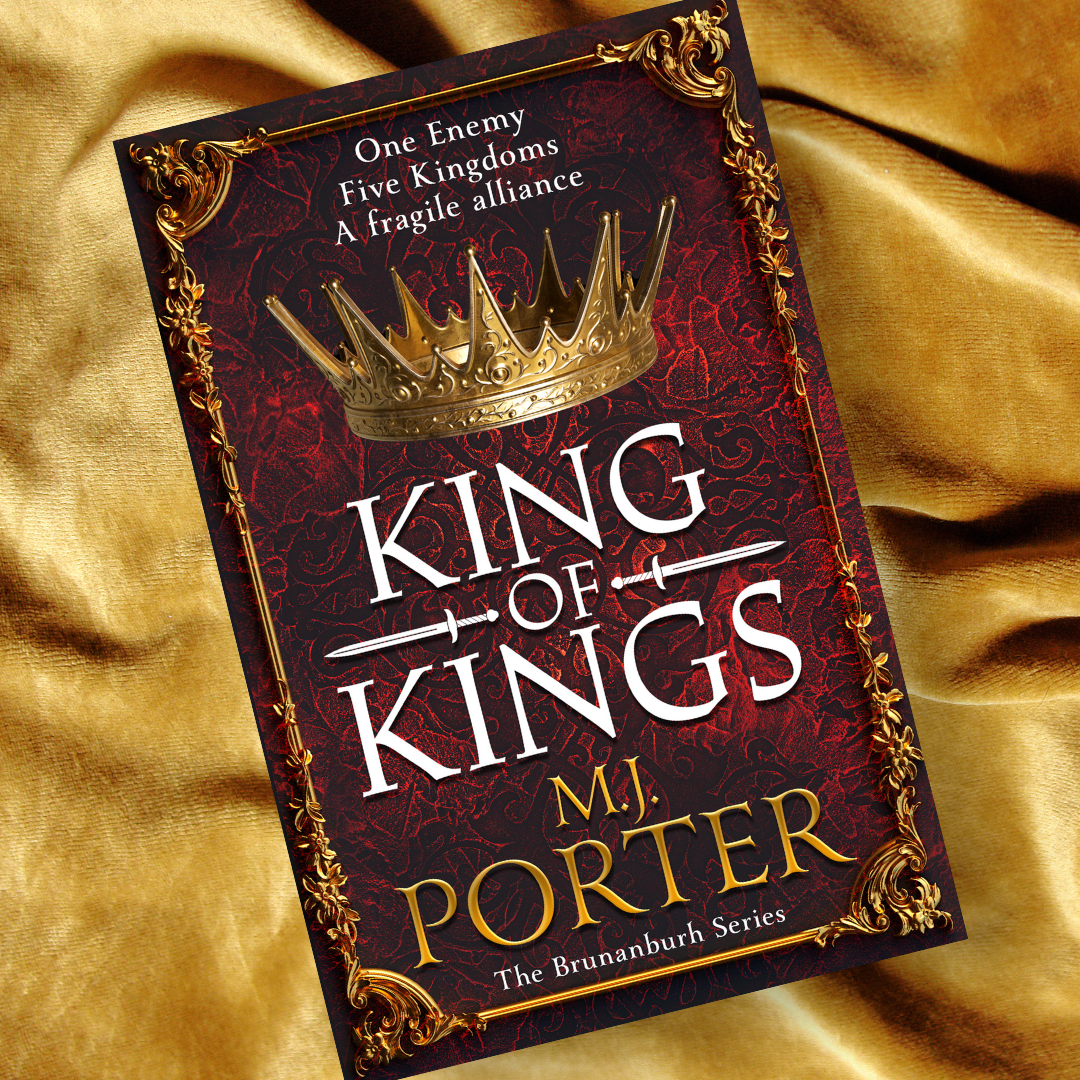
My latest release, King of Kings, is a tale of five kings, and one enemy. But what was the background in what we would now know as England?

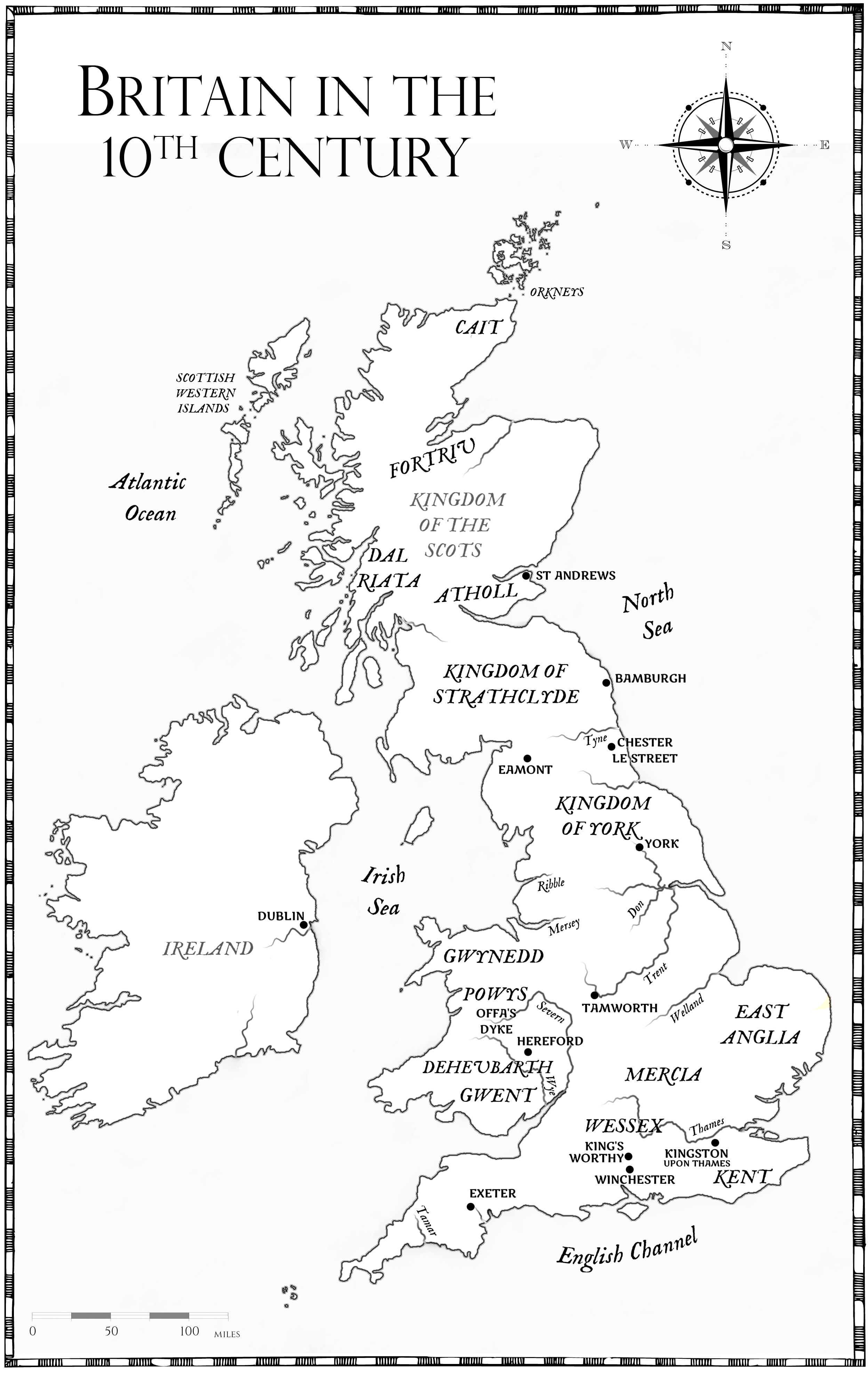
The tenth-century sees the creation of what we would recognise as ‘England’ – the combining of Wessex with Mercia, with the additions of Kent, the kingdom of the East Angles, the Danish Five Boroughs, and the kingdom of York, and also the independent kingdom of Bamburgh. But telling this story is complex. When people think of England, they might not know all these smaller kingdoms. They might not know, particularly, what the Danish Five Boroughs (Leicester, Nottingham, Lincoln, Stamford and Derby), were because if you google the Five Boroughs, you’ll be told about New York (this has happened to me). 

Everybody knows about King Alfred of Wessex holding back the tide of the advancing Viking raiders throughout his reign from 874-899. And if everybody didn’t know before, then Uhtred, Bernard Cornwell’s Saxon warrior, has done much to ensure we know about it now. 

But again, it’s not quite so simple. The Saxon kingdoms of the seventh century onwards numbered seven, alongside Wessex, there was also Kent, Mercia, the kingdom of the East Angles, Northumbria, Essex and Sussex. These kingdoms eventually merged to give us just Wessex, Mercia, Kent, the kingdom of the East Angles and Northumbria (which itself comprised of two kingdoms, Deira centred on York, and Bernicia, centred on Bamburgh). So, all seems clear there? But no.

When the Viking raiders began their concerted attacks on Britain in the late ninth century, Alfred of Wessex promulgated a treaty with one of their leaders, Guthrum, forging an independent kingdom of the Viking raiders, which stretched along something known as the Alfred-Guthrum line. Loosely, this meant that land to the east was in the control of the Viking raiders. All that survived of those kingdoms south of the Humber was Wessex and the western part of Mercia. The Viking raiders had already overrun Northumbria. The kingdom of Jorvik, centred on York, was part of a Dublin/York kingship, where the kings of York/Jorvik had often already been the king of Dublin, and this kingship was firmly in the hands of a family claiming descent from Ivarr (the Boneless), one of the men who’d led the concerted Viking raider attacks of the 860s and 870s which we might find termed The Great Heathen Army. 
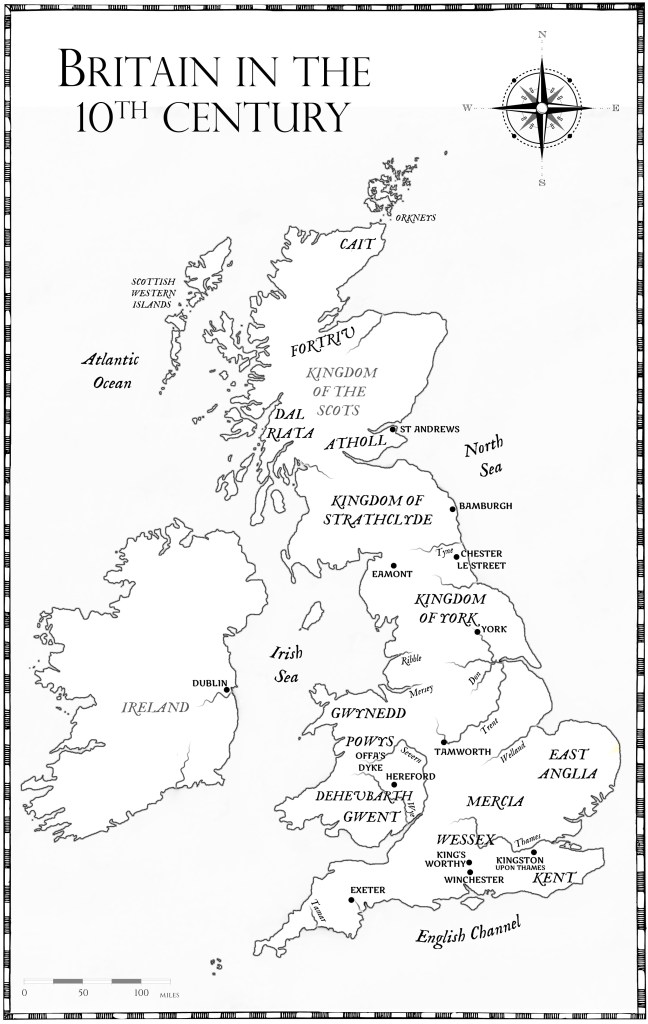
Map designed by Flintlock Covers

This, then, reimagined what we think of as England and these Saxon kingdoms weren’t the only ones to face attack from the Viking raiders. The many Welsh kingdoms shared sea borders with the Dublin Norse, and the small kingdom of Manx (the Isle of Man) became incredibly important, as did all of the islands that surround western and northern Scotland. Orkney, at this time, was settled by the Norse. 

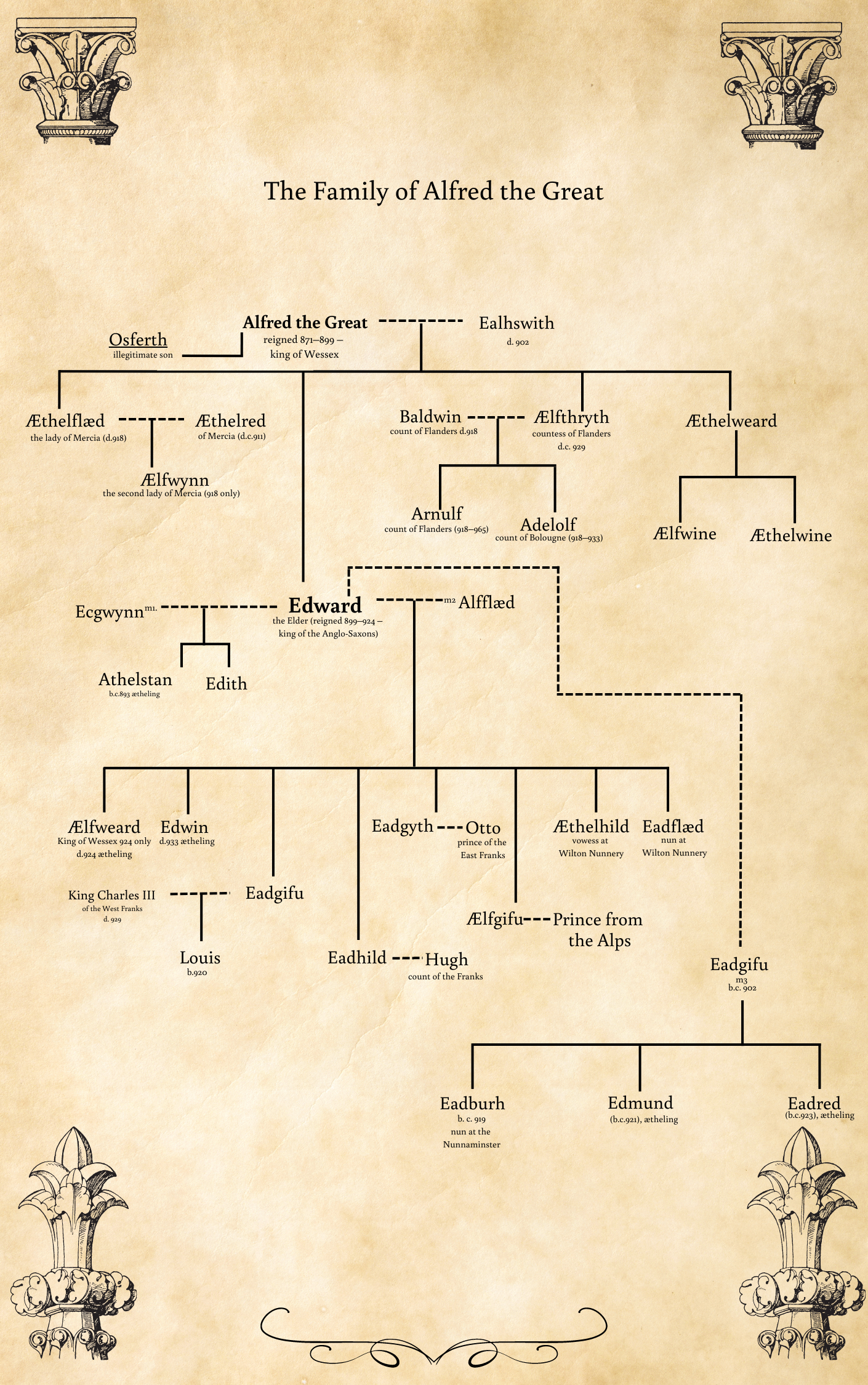
When Alfred died in 899, he was king of Wessex. His son, Edward, would become king of the Anglo-Saxons, ruling over Wessex and Kent, and then after the death of his sister, Æthelflæd, the Lady of Mercia, staking his claim to western Mercia as well as those parts of the Five Boroughs, essentially Norse held lands, known as the Danelaw, which Æthelflæd had ‘won’ back for Mercia.

‘Here in the early part of this year, with God’s help, she [Æthelflæd] peaceably got in her control the stronghold at Leicester and the most part of the raiding-armies that belonged to it were subjected. And also the York-folk had promised her – and some of them granted so by pledge, some confirmed with oaths – that they would be at her disposition.’[i]  

This was a time of intense unease, almost constant warfare. And not everyone was happy about the advances the surviving Wessex royal family made. Edward died at Farndon, in Mercia, perhaps putting down a Mercian rebellion or, a Welsh one. Farndon wasn’t far from the border with the Welsh kingdoms. 

But Edward’s death, and the subsequent death of his son Ælfweard only sixteen days later, brought about a sea change. Ælfweard wasn’t Edward’s oldest son; that was Athelstan, a youth seemingly banished to live with his aunt in Mercia when Edward remarried (if the later pseudo-historian, William of Malmesbury is to be believed who makes the claim that it was Alfred’s wish that Athelstan be brought up in ‘the court of his daughter Æthelflæd and Æthelred his son in law.’[ii]

Athelstan was immediately recognised as the king of Mercia. Not long afterwards, he also became king of Wessex. And his ambitions didn’t stop there.

‘Here King Edward died at Farndon in Mercia; and very soon, 16 days after, his son Ælfweard died at Oxford; and their bodies lie at Winchester. And Athelstan was chosen as king by the Mercians and consecrated at Kingston.’[iii]

It’s difficult to imagine that Athelstan wasn’t a warrior of fierce renown. His aunt and uncle, the lord and lady of Mercia, had spent much of their rule, both together, and then after Æthelred’s death, Æthelflæd had continued alone, driving back the incursion of the Viking raiders, or the Norse as it might be easier to term them. Athelstan must surely have taken his place in these battles. And yet, while he was eager to hold tightly to the kingdoms of Mercia, Kent and Wessex, he was also prepared to unite people through peace, and this is where the story, King of Kings, begins. With Athelstan, the first crowned king of the English. 


[i] Swanton, M. trans and edit The Anglo-Saxon Chronicles, (Orion Publishing Group, 2000), p.105

[ii] Mynors, R.A.B. ed and trans, completed by Thomson, R.M. and Winterbottom, M. Gesta Regvm AnglorvmThe History of the English Kings, William of Malmesbury, (Clarendon Press, 1998), p.211

[iii] Swanton, M. trans and edit The Anglo-Saxon Chronicles, (Orion Publishing Group, 2000), D text p.105
books2read.com/King-of-Kings

I’ve also written about the kings (and an almost queen) of these kingdoms in Britain at the time.

Meet Athelstan, king of the English

Meet Constantin, king of the Scots

Meet Hywel, king of the West Welsh

Meet Ealdred, king of Bamburgh

Meet Owain, king of Strathclyde

Meet Eadgifu, the lady of Wessex
Posts

The first kings of the ‘English’ – Athelstan and Edmund

(I’m re-sharing an old post which I’ve amended slightly, and added some new graphics).

England, Wales, Scotland, the smaller kingdoms of Mercia, Wessex, Northumbria, East Anglia, Kent, Powys, Gwynedd, Dal Riada – for the uninitiated (including myself) the sheer number of kingdoms and kings that peopled the period in British history before 1066 can appear as a bewildering display of names, places, times and events, and perhaps never more so than when a historian is trying to sell a book and so makes a statement in their title that applies to that particular king.

Map designed by Flintlock Covers

Phrases such ‘the Golden Age of Northumbria’, ‘the Mercian hegemony’, ‘the rise of Wessex’, they all mask so many events that I find the phrases very unhelpful and perhaps worse, misleading.

I think that Athelstan and his younger half brother, Edmund, probably deserve their titles as Kings of the English. And it’s not just my opinion either. There was, according to Sarah Foot in her book on Athelstan, a concerted effort by the king and his bishops to have him stand apart from his predecessors – to be something ‘different’ to them. They named him king of the English, not king of Mercia (a post he held briefly before another of his younger brothers died) and not king of Wessex, for all that he was both of those things.

They changed his title, they crowned him with a crown, not a helmet. They wanted Athelstan to be something other than his grandfather, King Alfred, and his father, King Edward. It was a bold statement to make, and one they continued when Athelstan died too young and his half-brother, Edmund replaced him. He too was crowned using, it must be supposed, the same Coronation service. (For full details have a peek at Sarah Foot’s book on Athelstan – or read the first few chapters of King of Kings as the service appears in it as well).

So why the change? Essentially the old Saxon kingdoms, for all that they were preserved in the naming of the earls/ealdormens designations, had been swept aside by the Viking raiders. The old kingdoms had become a handy label to apply to certain geographic areas, and the kings of Wessex, whilst keen to hold onto their hereditary titles because of the permanence their own royal line had managed to acquire, were equally as keen to do away with regional boundaries. There was, it can’t be denied, a concerted and almost unrelenting urge to drive any Viking raider or Dane or Norwegian (the Norse) from British soil, and this is what Athelstan and then Edmund were tasked with doing.

Yet the idea of ‘English’ wasn’t a new concept. Why else would Bede have called his great piece of religious historical writing “The Ecclesiastical History of the English people’, if there hadn’t been a shared consciousness that the people in England, all be it in their separate kingdoms, didn’t have a shared heritage? Why the idea suddenly took flight under King Athelstan could be attributed to a new sense of confidence in Wessex and Mercia at the time. They were confident that they could beat the Viking raiders and they were convinced that England belonged to them.

Or perhaps it was more than that? The destruction wrought by the Viking raiders on the separate kingdoms must have been a stark reminder of just how insular the kingdoms had become, and the Viking raiders showed everyone just how easy it was to run roughshod over the individual kingdoms. Only in unity could the Saxon kingdoms of England survive another onslaught; only with unity could the Saxons hold onto their kingdoms they’d claimed about 500 years before.

It was a message that was learned quickly and taken to heart. Athelstan worked to reunite more of the Saxon kingdoms with the growing ‘England’, and he tried to do so by both diplomacy and through war. Yet, the Viking raiders hadn’t finished with England, and nor were they her only enemies. This also lies at the heart of Athelstan’s ‘masterplan’ his treaty of Eamont (if it truly happened – Benjamin Hudson in his Celtic Scotland is not convinced). Athelstan wanted to be a mighty king, but he also wanted England, and the wider Britain (also a concept already understood otherwise why else would that cantankerous monk – Gildas – have called his even earlier work than Bede’s “On the Ruin of Britain?”) to be united in their attempts to repel the Viking raiders. He was a man with a keen vision of the future and it was a vision that his brother continued, with slightly different direction and results.

Family Tree designed by Boldwood Books

The ‘English Kings” saw safety in unity, and of course, an increase in the power they held went hand-in-hand with that.

Yet at no point during the Saxon period can it be said that the emergence of ‘England’ as we know it, was a given certainty. Throughout the period other great kings had tried to claim sovereignty over other kingdoms, but never with any permanence. The earlier, regional kings, were powerful within their own lifetimes and within their own regions. Few, if any, were able to pass on their patrimony complete upon their death. This was a time of personal kingship, and it was only under Athelstan and Edmund that the leap was taken away from this to a more permanent power base.

Not that it was a smooth transition and it did have the side-effect of allowing other men, those not related to the royal family, to evolve their own individual power bases in the old Saxon kingdoms. The ‘English’ kings had to do more than just rule their own kingdom, they had to rule their ealdormen and earls, their warriors, bishops and archbishops. The number of names of kings might start to deplete in the after math of Athelstan and Edmund’s kingship, but in their place spring up more and more powerful men, men that these English kings  had to rely on.

Becoming King of the English was very much a mixed blessing, bringing with it new and greater responsibilities and more, it brought with it the need to expand personal government further, to have a greater persona to broadcast.

King of Kings is available now, and Kings of War is coming in July 2023.

Today, I’m excited to share my review for the BRAND NEW book in the Sophie Sayers series, Murder in the Highlands by Debbie Young #blogtour

Here’s the blurb:

Sophie and Hector are heading to the Highlands.

For Sophie it’s a trip home and for Hector it’s time to meet Sophie’s parents… Though their trip has village tongues wagging about a stop at Scotland’s notorious elopement spot, Gretna Green.

No matter what, it’ll make a nice break from the murder and mayhem that has been plaguing their beautiful Cotswolds village. But Sophie and Hector are barely on the road before they’re being hassled by reckless drivers and at their first rest stop a body is discovered.

Then comes a series of ‘accidents’ that leave poor Hector a little worse for wear. Is someone after Hector? Who could even know he was in the Highlands?

Accidents or not, can they find some way to keep Hector safe?

Purchase Link

https://amzn.to/3CmKCa4

My Review

Murder in the Highlands is the latest book in the Sophie Sayers cosy crime series, usually set in a small Cotswold village, but not on this occasion. Sophie and Hector (who isn’t Scottish) are off to Inverness for a well-deserved holiday with her mother and father.

But as ever, dark going-ons and strange occurrences follow them on the long journey north, and Sophie is left feeling that there’s a mystery to solve, but unsure what it can be about, and even worse, that it somehow involves Hector.

I really enjoy this series of books – Sophie is a fun character, if troubled with an overactive imagination – as a writer, and her character is a writer, I’m right there with her. Hector is usually the more grounded of the two, but this time, even he’s starting to worry about what’s happening.

While there is no sighting of the Loch Ness monster, this is a fun mystery firmly rooted in Inverness, which the author has visited extensively, and the mystery is one of the stronger ones in the series that plays out, perhaps, in a more conventional way to earlier books in the series.

A great addition to the cosy crime series, which is going from strength to strength.

Meet the Author

Debbie Young is the much-loved author of the Sophie Sayers and St Brides cosy crime mysteries. She lives in a Cotswold village where she runs the local literary festival, and has worked at Westonbirt School, both of which provide inspiration for her writing. She is bringing both her series to Boldwood in a 13-book contract. They will be publishing several new titles in each series and republishing the backlist, starting in September 2022.

Debbie Young

Connect with Debbie  

Facebook https://www.facebook.com/AuthorDebbieYoung

Twitter https://twitter.com/DebbieYoungBN

Instagram https://www.instagram.com/debbieyoungauthor/  

Newsletter Sign Up: https://bit.ly/DebbieYoungNews

Bookbub profile: https://www.bookbub.com/authors/debbie-young

Check out my previous reviews for Debbie’s books.

St Brides

Sophie Sayers

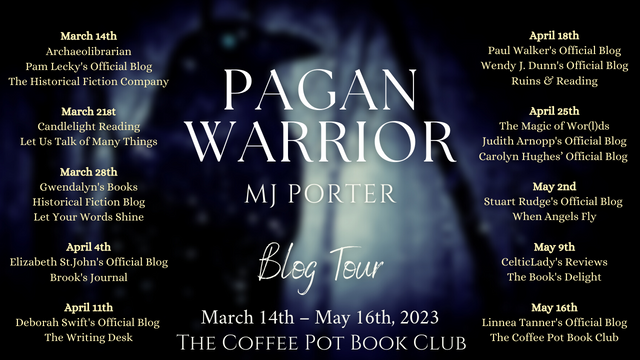
Pagan Warrior is on blog tour with The Coffee Pot Book Club #blogtour

I’m really excited to share the details of the Pagan Warrior blog tour with The Coffee Pot Book Club.

Pagan Warrior is the story of the battle of Hædfeld, fought in the seventh century between the Northumbrians, and you got it, the Mercians – or rather, Cadwallon of Gwynedd but with Penda of Mercia as his firm ally. You can find more details here.

I might have written this book many years ago, but it’s had a refresh, and is now available in audio, narrated by the fabulous, Matt Coles, as is the second book, Pagan King. Warrior King will be coming later this year in audio. For this first week, 13th March-19th March, the ebook of Pagan Warrior is reduced globally. Follow the link below.

books2read.com/PaganWarrior

You can follow the blog tour, and I’ll be sharing posts here as well. A quick shout out to thank all the blog hosts and Cathie at The Coffee Pot Book Club for organising.

For today, March 14th, check out my author interview over on Archaeolibrarian.

Archaeolibrarian

I’m sharing an excerpt over on The Historical Fiction Company.

The Historical Fiction Company

I’ve written a piece about the historical background on Pam Lecky’s official blog.

Pam Lecky’s Official Blog

Today, I’m sharing a fab blog post by Glen Craney about his new novel, The Yanks are Starving, on the blog historicalfiction #BlogTour #TheCoffeePotBookClub

I’m sharing a fabulous post by Glen Craney below regarding the mistakes historical novelists must be wary of making.

Exposing History’s Cracks of Logic

Historical novelists are always prospecting for untapped veins in the strata of the past. Some of the richest lodes can be found in the lapses of logic and analysis that even the most astute of historians are at times prone to commit. Perhaps the best compilation of such errors in judgment and interpretation is Historians’ Fallacies, a treatise published in 1970 by Brandeis University professor David Hackett Fischer.

Readers of history will remember Fischer from Albion’s Seed, his exploration of the impact British folkways had on American society, and Washington’s Crossing, a study of George Washington’s leadership of the Continental Army.

Fischer’s impressive overview of historiography should be kept close at hand on the bookshelf of every historical novelist. Most of the miscalculations he skewers—exemplified by excerpts from the writings of his colleagues, many of whom no doubt chafed at being called to task—apply with equal force to the writing of historical fiction.

The best known of these gaffes gave its name to Fischer’s book: the historian’s fallacy. This refers to the error of assuming that the great leaders and decision-makers of the past possessed the same facts and perspective as we do in hindsight. 

Fischer offered as an exhibit the popular claim that the Japanese attack on Pearl Harbor should have been foreseen from the numerous warning signs. He cautions historians against the tendency of sifting away evidence that, at the time, might have clouded one’s judgment or even supported a contrary opinion.

Likewise, historical novelists must be on their guard against attributing to their characters more knowledge of events than is warranted. It is easy enough for us to chastise Robert E. Lee for ordering Pickett’s charge. The task of both the historian and novelist is to recreate the fog of war at Gettysburg with such verisimilitude that the reader will come to understand why such a decision was rational on July 3, 1863.  

The American Civil War seems to have served as the subject for every fallacy condemned by Fischer. Another infamous example castigated by Fischer is the discovery by Union scouts of the cigar-wrapped copies of Lee’s orders for the Antietam campaign. Every war buff has encountered the contention that this fortuitous (for the Union) incident set into motion a series of cascading events that eventually turned the tide of the war. Fischer dismisses this as a product of the reductive fallacy, which boils a complex soup of causal ingredients down into a single, simplified explanation.

In discussing another error, the fallacy of division (arguing that a quality shared by some in a group is shared by all), Fischer offers a faulty syllogism for our dissection:

Most Calvinists were theological determinists
Most New England Puritans were Calvinists.
Therefore, most New England Puritans were theological determinists.

Fischer observed that then-recent scholarship suggested the Puritans were not determinists, at least not as was commonly assumed. Here one finds a gold nugget, one of many available for the taking by the writer who will persist in combing these fallacies: A novel set in Puritan New England with a main character who believes in free will.

In The Da Vinci Code, Dan Brown made great use of yet another error that comes under special opprobrium from Fischer: the furtive fallacy. This is the assumption that certain events and facts of “special significance” are “dark and dirty things and that history itself is a story of causes mostly insidious and results mostly invidious.”

Of course, some of the best historical fiction would have to be tossed onto Savonarola’s bonfire if a ban on this fallacy were strictly enforced. Fischer doesn’t argue that conspiracies have never taken place. His criticism goes to a more fundamental paranoia that, if left unchallenged, can metastasize into a societal epidemic that weakens the very foundations of institutions.

It begins with the premise that reality is a sordid, secret thing; and that history happens on the back stairs a little after midnight, or else in a smoke-filled room, or a perfumed boudoir, or an executive penthouse or somewhere in the inner sanctum of the Vatican or the Kremlin, or the Reich Chancellery, or the Pentagon. It is something more, and something other than merely a conspiracy theory, though that form of causal reduction is a common component. 

The furtive fallacy is a more profound error, which combines a naïve epistemological assumption that things are never what they seem to be, with a firm attachment to the doctrine of original sin.

Still, Professor Robert Langdon might remind his colleague Dr. Fischer that just because one is paranoid doesn’t mean they aren’t out to get you.

The historical novelist is not only free but compelled to adopt and exploit these rich fallacies to spin out a good story—so long as he does so consciously.

Thank you for sharing:)

Here’s the blurb

Two armies. One flag. No honor.

The most shocking day in American history.

Former political journalist Glen Craney brings to life the little-known story of the Bonus March of 1932, which culminates in a bloody clash between homeless World War I veterans and U.S. Army regulars on the streets of Washington, D.C.

Mired in the Great Depression and on the brink of revolution, the nation holds its collective breath as a rail-riding hobo named Walter Waters leads 40,000 destitute men and their families to the steps of the U.S. Capitol on a desperate quest for economic justice.

This timely epic evokes the historical novels of Jeff Sharra as it sweeps across three decades following eight Americans who survive the fighting in France and come together fourteen years later to determine the fate of a country threatened by communism and fascism.

From the Boxer Rebellion in China to the Plain of West Point, from the persecution of conscientious objectors to the horrors of the Marne, from the Hoovervilles of the heartland to the pitiful Anacostia encampment, here is an unforgettable portrayal of the political intrigue and government betrayal that ignited the only violent conflict between two American armies.

Awards

Foreword Magazine Book-of-the-Year Finalist
Chaucer Award Book-of-the-Year Finalist
indieBRAG Medallion Honoree

Praise for The Yanks are Starving

“[A] wonderful source of historical fact wrapped in a compelling novel.” — Historical Novel Society Reviews

“[A] vivid picture of not only men being deprived of their veterans’ rights, but of their human rights as well.…Craney performs a valuable service by chronicling it in this admirable book.” — Military Writers Society of America

Buy Links

Universal Link:  

Amazon USAmazon UKAmazon CAAmazon AU
Barnes and NobleKoboiBooks

Meet the Author

Glen Craney is an author, screenwriter, journalist, and lawyer. A graduate of Indiana University Law School and Columbia University Graduate School of Journalism, he is the recipient of the Nicholl Fellowship Prize from the Academy of Motion Pictures and the Chaucer and Laramie First-Place Awards for historical fiction. He is also a four-time indieBRAG Medallion winner, a Military Writers Society of America Gold Medalist, a four-time Foreword Magazine Book-of-the-Year Award Finalist, and an Historical Novel Society Reviews Editor’s Choice honoree. He lives in Malibu and has served as the president of the Southern California Chapter of the HNS.

Connect with Glen

WebsiteTwitter

FacebookLinkedInPinterest

BookBubAmazon Author PageGoodreads

Follow The Yanks Are Starving Blog Tour with The Coffee Pot Book Club

Check our Glen’s other visits to the blog.

The Cotillion Brigade

The Virgin of the Wind Rose

A Conspiracy of Kings turns 3 today. #bookbirthday #TheRoyalWomen

It’s a week of book birthdays! Today, it’s the turn of A Conspiracy of Kings, the sequel to The Lady of Mercia’s Daughter.

Here’s the blurb

Mercia, 918.

Lady Ælfwynn has taken her mother’s place as the Lady of Mercia, to the displeasure of her uncle in Wessex, and against his efforts to subvert it.

King Edward, casts his eye longingly over Mercia, and finds a willing accomplice where none should exist. This time, the threat to Lady Ælfwynn is not as easy to defeat.

This is the continuing story of Lady Ælfwynn, the granddaughter of King Alfred, begun in The Lady of Mercia’s Daughter.

It is intended that The Lady of Mercia’s Daughter should be read before A Conspiracy of Kings.

https://amzn.to/421LHRq

https://amzn.to/46DvlA6

A Conspiracy of Kings was the book I wrote immediately before starting the stories of King Coelwulf, Mercia’s last king. If not for these two books, I’d never have wanted to write about Coelwulf, so I feel I owe this book a lot, and indeed, having just reread it, I can see a lot of details that resonate with me.

If you’ve not thought of reading these two books, then please do. I can assure you, my incarnation of Lady Ælfwynn is a bit bad ass. The new covers are also available in paperback.

These two books are part of my Tales of Mercia series of standalone stories charting the rise and fall of the Saxon kingdom of Mercia.

Check out my post on visiting Gloucester, where Lady Ælfwynn’s mother, Lady Æthelflæd, the lady of Mercia, was buried.

Visit The Tenth Century Royal Women Page.

Posts

Happy Book Birthday to Son of Mercia, which turns 1 today. Enter the competition to win a set of signed copies of the first 3 books in the series.

Happy book birthday to the wonderful Son of Mercia, the first book telling the story of young Icel in early ninth-century Mercia (fans of The Last King will have met Icel before, but it’s not necessary to enjoy Son of Mercia).

The series is now a massive four books long, and I’m busy working on book 5, which doesn’t have a title just yet (or does it?)

I thought today would be a great day to shine a light on all four books, and don’t worry if you’ve not read book 4 yet, Eagle of Mercia is releasing in May 2023. So here goes.

Tamworth, Mercia AD825.

The once-mighty kingdom of Mercia is in perilous danger.

Their King, Beornwulf lies dead and years of bitter in-fighting between the nobles, and cross border wars have left Mercia exposed to her enemies.

King Ecgberht of Wessex senses now is the time for his warriors to strike and exact his long-awaited bloody revenge on Mercia.
King Wiglaf, has claimed his right to rule Mercia, but can he unite a disparate Kingdom against the might of Wessex who are braying for blood and land?
Can King Wiglaf keep the dragons at bay or is Mercia doomed to disappear beneath the wings of the Wessex wyvern?

Can anyone save Mercia from destruction?

books2read.com/u/3R6x7x

Icel is becoming a warrior of Mercia, but King Ecgberht of Wessex still holds the Mercian settlement of Londonia and its valuable mint.

King Wiglaf of Mercia is determined that the last bulwark be reclaimed from his sworn enemy to complete his rehabilitation as Mercia’s rightful ruler.

In the heart of the shield wall, Icel suddenly finds himself on the wrong side of the battle and thrust into the retreating enemy stronghold where he must take on the pretence of a Wessex warrior to survive and exact a cunning plan to bring down the Wessex force cowering behind the ancient walls.
His allegiances are tested and the temptation to make new allies is overwhelming but Icel must succeed if he’s ever to see Tamworth again and bring about King Wiglaf’s victory, or will he be forced to join the enemy?

books2read.com/Wolf-of-Mercia

Icel is a lone wolf no more…

Oath sworn to Wiglaf, King of Mercia and acknowledged as a member of Ealdorman Ælfstan’s warrior band, Icel
continues to forge his own destiny on the path to becoming the Warrior of Mercia.

With King Ecgberht of Wessex defeated and Londonium back under Mercian control, the Wessex invasion of Mercia is over. 
But the Wessex king was never Mercia’s only enemy. An unknown danger lurks in the form of merciless Viking raiders, who set their sights on infiltrating the waterways of the traitorous breakaway kingdom of the East Angles, within touching distance of Mercia’s eastern borders.

Icel must journey to the kingdom of the East Angles and unite against a common enemy to ensure Mercia’s hard-won freedom prevails.

books2read.com/WarriorofMercia

A mercy mission in the heart of Wessex is beset with deadly, bloody dangers.
Tamworth AD831

Icel’s profile continues to rise. Lord of Budworth and warrior of Mercia, he’s acknowledged by King Wiglaf and his comrades to keep Mercia safe from the ravages of Wessex, the king-slayer of the East Angles, and the Viking raiders.
But, danger looms.  Alongside Spring’s arrival comes the almost certain threat of the Viking raiders return. 

When Lord Coenwulf of Kingsholm is apprehended by a Viking and held captive on the Isle of Sheppey in Wessex held Kent, Icel is implored by Lady Cynehild to rescue her husband.
To rescue Lord Coenwulf, Icel and his fellow warriors must risk themselves twice over, for not only must they overpower the Viking raiders, they must also counter the threat of Mercia’s ancient enemy, the kingdom of Wessex as they travel through their lands.

Far from home and threatened on all sides, have Icel and his fellow warriors sworn to carry out an impossible duty

books2read.com/EagleofMercia

Set in the troubled years at the end of the Mercian supremacy, with the advent of the true First Viking Age just around the corner, The Eagle of Mercia Chronicles allow me to explore the kingdoms of Saxon England at the time, while ensuring my focus remains on Mercia, the kingdom in the’Midlands’ of England, with which I’m quite obsessed.

And choosing to write about a very strong character from my The Last King series, also allows me to play with my readers expectations. Icel is a fabulous creation, and one I’m incredibly proud of and pleased that my readers love so much.

Yes, these are bloody and brutal tales, but at the heart of them is a ‘coming of age’ story as young Icel learns about himself, as well as the truth of his heritage and birth.

If you’ve not yet tried The Eagle of Mercia Chronicles, then now is the perfect opportunity. Enjoy.


To win a set of the first three books in paperback – signed and dedicated as you would like, please sign up for my newsletter, or my newsletter with Boldwood Books. (Competition ends on 24th Feb). I send a monthly email. I will contact the winner and arrange postage – I will post worldwide. If you are signed up for both already, then drop me a quick email, and I will enter you into the competition. Good luck.

King of Kings, the audio is now available, and the large print version too

I’m aware that there’s been a bit of a delay in getting everything shipshape over on Amazon, but everything is now where it should be – the ebook, paperback, audio, and hardback, all linked together. Whoo hoo. You can find them with the link below, which also includes other retailers, with links to the large print version.

books2read.com/King-of-Kings

So, I thought it would be the perfect opportunity to share a few things with you that have happened since release.

As I can’t upload the video here, I’ve done my ‘unboxing’ video and popped it over on TikTok – which I’m trying to learn. You can find it here. The paperback looks amazing:) It’s very smart and the family tree and map are also included. If you’re on TikTok give me a follow, as I’m looking for more content to help me get to grips with it.

I’m also going to share a link for the audiobook, read by the fabulous Matt Coles, which you can also find here, on my website, not my blog. (I can’t upload videos to my blog – who knew).

And, if you missed my blog post yesterday on Historia, you can read it here. It’s an introduction, quite a swift one, into what was happening in the Saxon kingdoms just before the events of King of Kings. And, it’s got some amazing images to go with it. I’m always in awe of someone who knows how all the rules work regarding sharing images on the web. Thank you. (I’ve just been trying to work some of this out for myself, with British Library images – it made my head hurt).

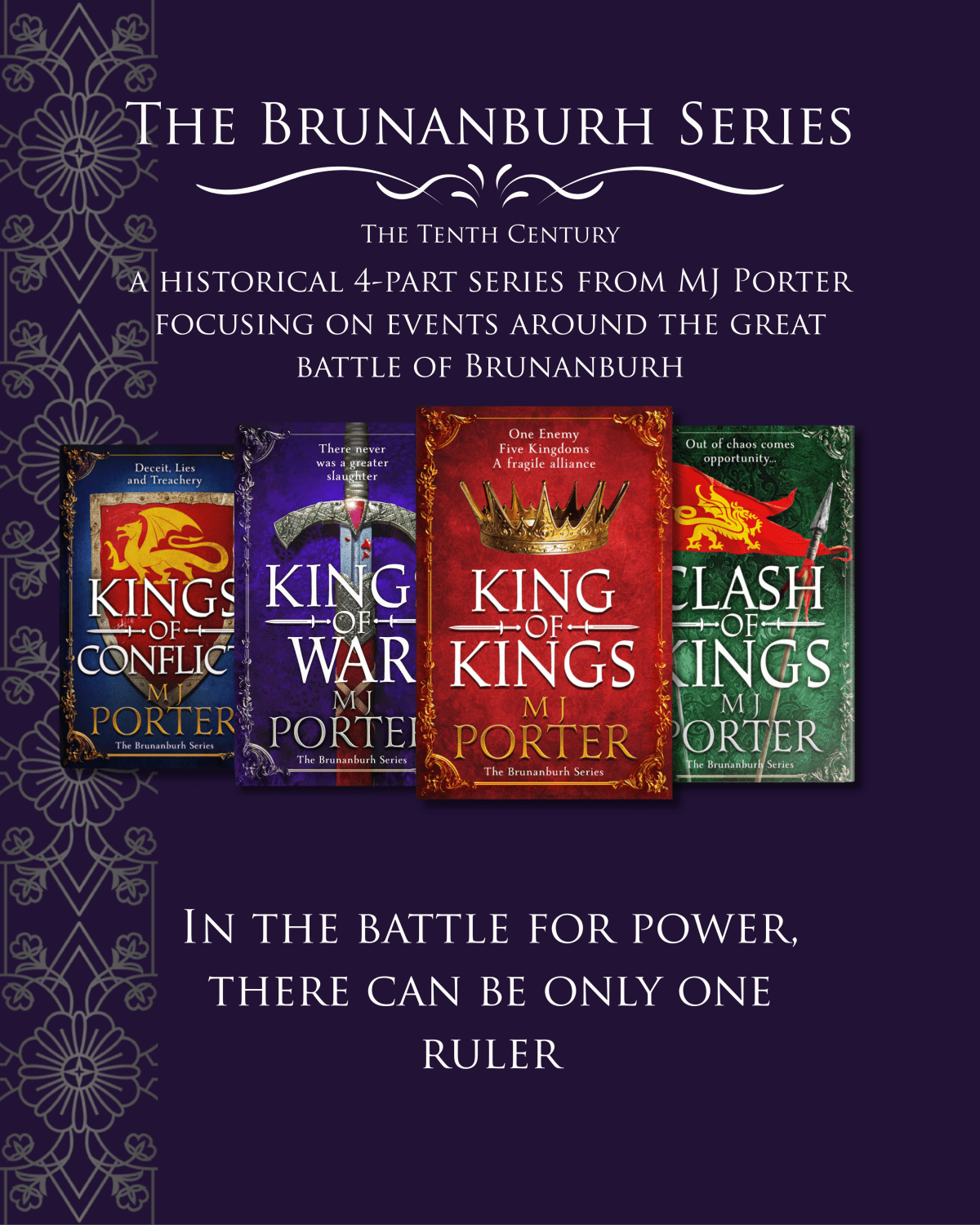
Check out the Brunanburh Series Page for more details.

Posts

MJ Porter went to Gloucester, and it didn’t rain

Why, I hear you cry? Well, I was on the trail of the Lady of Mercia, Æthelflæd, and her daughter Ælfwynn. Æthelflæd and her husband were buried in Gloucester, at St Oswald’s Priory, and I’m always writing about Gloucester, and Kingsholm, so I thought it was time I actually visited. Not that St Oswald Priory survives as anything more than a ruin these days.

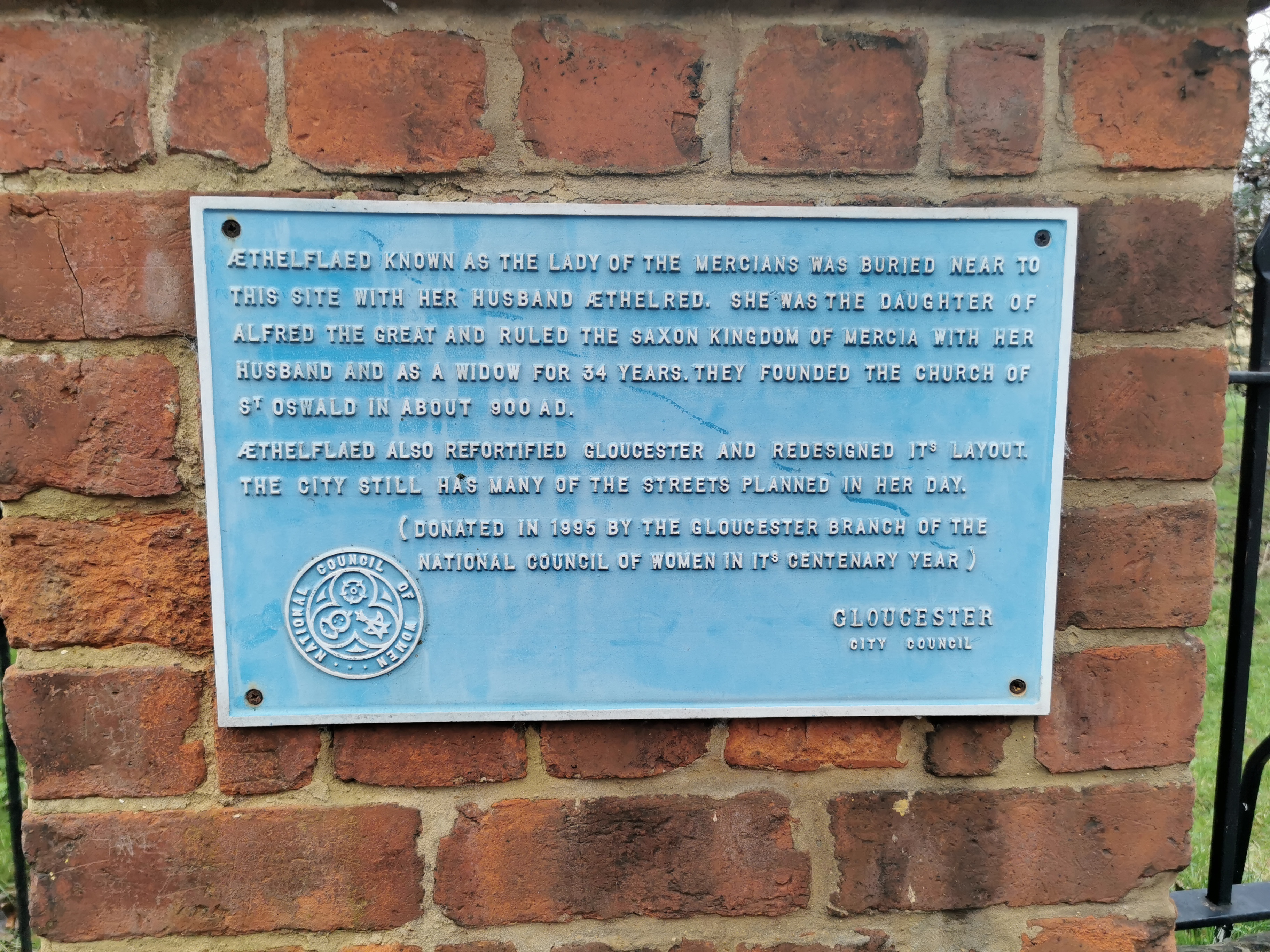
The plaque telling visitors all about the ruins (I do love an old plaque. They just add to the story of a ruin).
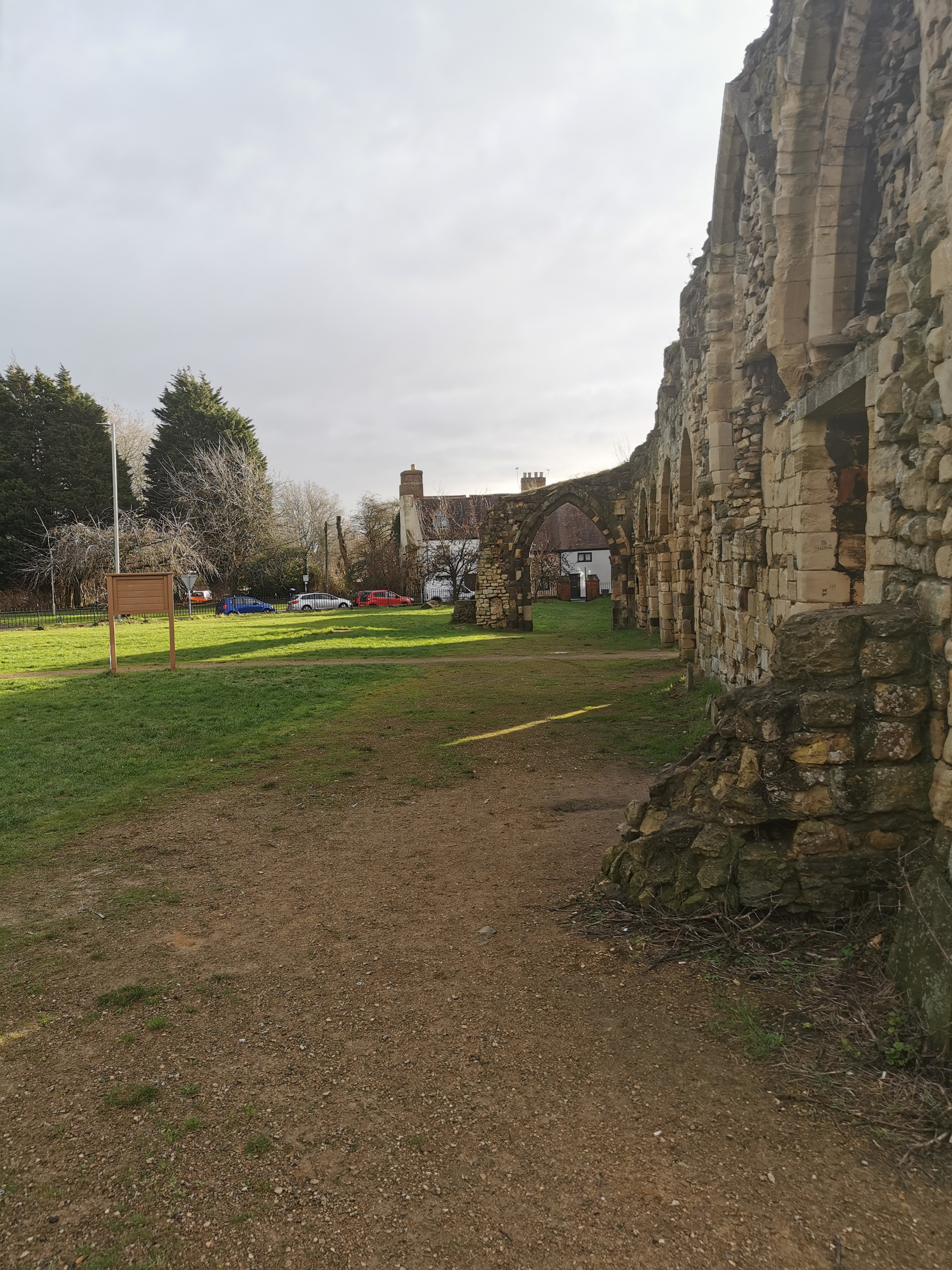
Part of the ruins, with Gloucester Cathedral in the background.
Trying to capture as much of the ruin as possible in one photo.
View of the cathedral through the ruin (a pity about the garden shed)

I also visited the Cathedral, and really wish I’d done a bit more research about what they offer, as I didn’t factor in all the fabulous tours they do, including one up the tower to get a view of Gloucester. Maybe next time. But, I did find this delightful pearl, which must remind us all to make sure our notes are up to the task at hand.

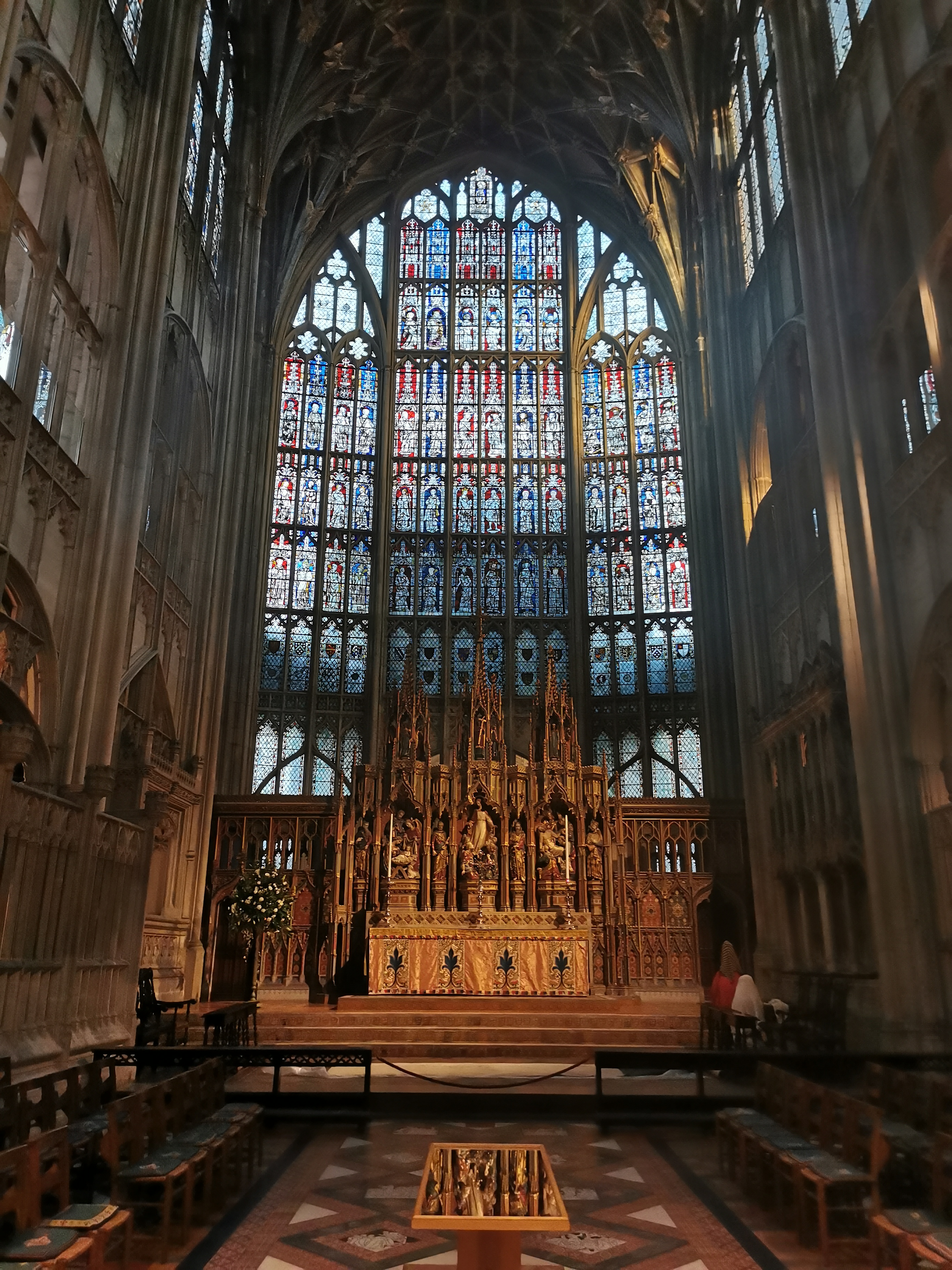
The great window in Gloucester Cathedral

Can you imagine trying to put all those pieces back together after they took them down during WW2? Wow. Well done to those who accomplished the task. If you’re not sure of scale, it’s as big as a tennis court.

But to return to the priory. For those who know their history of the period, we might wonder why we have a St Oswald in Gloucester, which would have been very much in the heart of Mercia. Oswald, of course, was a king of Northumbria, a most Christian king, killed in battle against the might of the famous pagan king, Penda. The story goes that after his death, a band of brave Northumbrians retrieved their dead king, and returned him to Northumbria, where he was buried and revered. Why then would a Northumbrian saint, killed in the seventh century, become so closely associated with the Mercian ruling family?

I find this fascinating, and indeed, some years ago, attended a conference where I asked this question. The answer was enlightening. The Mercians, still facing the threat of the Viking raiders, needed a rallying cry. They needed a sainted figure whose cult they could effectively ‘steal’ or align with themselves, or so I was told, and St Oswald was that man, or rather that body, and so they stole him away from Bardney and took his to Gloucester, where his cult continued, and where Lady Æthelflæd and her husband, Ethelred, were later buried.

I’ve written about Oswald while he was alive, and of course, I’ve written about Mercia, Gloucester, Kingsholm, and Lady Ælfwynn. It was inspiring to finally see where the church once was, even if little remains of it, at least something does remain.

books2read.com/PaganWarrior

books2read.com/u/31RBva

books2read.com/TheLadyMercia

My new book, King of Kings, has a number of main characters. Meet Owain, the king of Strathclyde.

My new book, King of Kings, is a multi-viewpoint novel telling the story of events in Britain from 925-934. I thought it would be good to share details of the historical people my main characters are based on.

Owain of Strathclyde is perhaps the most difficult character in King of Kings to find in the historical record. Indeed, his place in the story is contested by historians, as we don’t know if the scribe of the Anglo-Saxon Chronicle of the time meant Owain of Strathclyde, or an Owain of one of the Welsh kingdoms. I decided to adopt the Owain of Strathclyde, but who exactly was he, and what was Strathclyde?

The kingdom of Strathclyde is also known by another name, that of Cumbria, and there is confusion in the sources and amongst historians about where it is and what it was. Alex Woolf suggests that by the events of 927, Strathclyde/Cumbria encompassed, ‘most of part of Lanarkshire, Dunbartonshire, Renfrewshire, Stirlingshire, Peebleshire, West and Mid-Lothian, eastern Dumfriesshire and Cumberland.’ (Woolf, A. From Pictland to Alba, 789-1070, Edinburgh University Press, 2007) p.155)

So who then were it’s kings? This again is far from as easy to state as might be thought. It’s believed that Owain of Strathclyde, succeeded his father, Donald II, to become king of Strathclyde, and in turn was succeeded by his son.

In 924, we are told that ‘the king of the Strathclyde Britons and all the Strathclyde Britons,’ (Swanton p.104) joined the king of Wessex, Edward the Elder’s alliance by the Anglo-Saxon Chronicle, but Owain isn’t named. Indeed, and as said above, when we do get mention of Owain in the Anglo-Saxon Chronicle, he’s named as ‘king of Gwent,’ (Swanton, M. trans and edit The Anglo-Saxon Chronicles, (Orion Publishing Group, 2000) p.107) even though there was no Welsh king of Gwent named as Owain at the time. It’s therefore difficult to get a feel for who he was, and what he did, but that didn’t mean I couldn’t include him in King of Kings. If anything, it made it all the more intriguing.

Map design by Shaun at Flintlock Covers

Preorder King of Kings

(released 10th February 2023)

books2read.com/King-of-Kings

Meet the Characters from King of Kings

Athelstan, king of the English

Constantin, king of the Scots

Hywel, king of the West Welsh

Ealdred, king of Bamburgh

Lady Eadgifu, wife of Edward the Elder