Author of Saxon historical fiction and non-fiction, 20th-century historical mysteries, and Norse-inspired historical romantasy. Book reviewer and blog host.
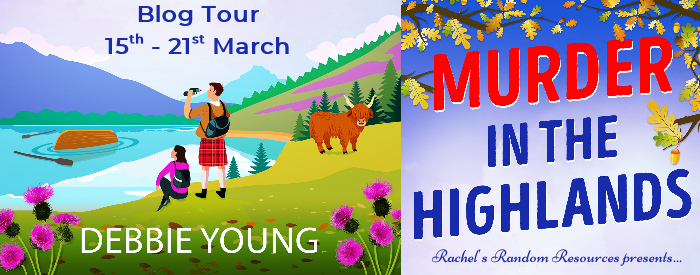
For Sophie it’s a trip home and for Hector it’s time to meet Sophie’s parents… Though their trip has village tongues wagging about a stop at Scotland’s notorious elopement spot, Gretna Green.
No matter what, it’ll make a nice break from the murder and mayhem that has been plaguing their beautiful Cotswolds village. But Sophie and Hector are barely on the road before they’re being hassled by reckless drivers and at their first rest stop a body is discovered.
Then comes a series of ‘accidents’ that leave poor Hector a little worse for wear. Is someone after Hector? Who could even know he was in the Highlands?
Accidents or not, can they find some way to keep Hector safe?
Murder in the Highlands is the latest book in the Sophie Sayers cosy crime series, usually set in a small Cotswold village, but not on this occasion. Sophie and Hector (who isn’t Scottish) are off to Inverness for a well-deserved holiday with her mother and father.
But as ever, dark going-ons and strange occurrences follow them on the long journey north, and Sophie is left feeling that there’s a mystery to solve, but unsure what it can be about, and even worse, that it somehow involves Hector.
I really enjoy this series of books – Sophie is a fun character, if troubled with an overactive imagination – as a writer, and her character is a writer, I’m right there with her. Hector is usually the more grounded of the two, but this time, even he’s starting to worry about what’s happening.
While there is no sighting of the Loch Ness monster, this is a fun mystery firmly rooted in Inverness, which the author has visited extensively, and the mystery is one of the stronger ones in the series that plays out, perhaps, in a more conventional way to earlier books in the series.
A great addition to the cosy crime series, which is going from strength to strength.
Meet the Author
Debbie Young is the much-loved author of the Sophie Sayers and St Brides cosy crime mysteries. She lives in a Cotswold village where she runs the local literary festival, and has worked at Westonbirt School, both of which provide inspiration for her writing. She is bringing both her series to Boldwood in a 13-book contract. They will be publishing several new titles in each series and republishing the backlist, starting in September 2022.
Love, Loss and Life In Between is a really lovely collection of short stories focusing on acceptance, moving on and recovery. I confess, I feared the stories might be upsetting, but they really weren’t. I was lucky enough to read the ebook last year, but now I’ve listened to the brand new audio as well. I really enjoy the option to listen as well as read books, especially ones I’ve read before.
Garden Therapy, with its slight otherworldliness was delightful, and A Mermaid’s Tale was a beautiful account of a young girl coming to terms with the loss of her mother, whereas Catalyst was quite edgy. Not Just for Christmas is a tale many pet owners with feel resonates with them.
This really was a delightful collection of short stories. The author has a lovely turn of phrase and manages to evoke strong feelings in her characters which make them believable, so that in only a few words the reader is already rooting for them.
Highly recommended, as was the author’s previous short story collection, of which you can find the review here.
The audio adds a delightful new dimension to these short stories. The narrator, Sandie Keane, has a lovely warm tone, and manages these uplifting and sorrowful tales with real compassion and understanding. Highly enjoyable.
Meet the author
Suzanne lives in Middlesex, England with her husband, two teenagers, a crazy cocker spaniel and an adopted cat that thinks she’s the boss.
Suzanne’s writing journey began at the age of twelve when she completed her first novel. She discovered the fantasy genre in her late teens and has never looked back. Giving up work to raise a family gave her the impetus to take her attempts at novel writing beyond the first draft, and she is lucky enough to have a husband who supports her dream – even if he does occasionally hint that she might think about getting a proper job one day.
Now an author of four novels including the Silent Sea Chronicles trilogy and her debut, Visions of Zarua, Suzanne hopes the dreaded ‘W’ word will never rear its ugly head again!
She loves gardening and has a Hebe (shrub) fetish. She enjoys cooking with ingredients from the garden and regularly feeds unsuspecting guests vegetable-based cakes.
She collects books, is interested in history and enjoys wandering around castles and old ruins whilst being immersed in the past. She likes to combine her love of nature and photography on family walks, but most of all she loves to escape with a great film, binge watch TV shows, or soak in a hot bubble bath with an ice cream and a book.
Having attended Drama school in Liverpool as a teenager Sandie moved into a variety of jobs varying from Hotel Management/Merseyside Police/Motherhood to name just a few but for 25 years she taught worldwide as a Pilates Tutor Trainer.
During lockdown Sandie’s interest turned to Audiobooks and it was from there she embarked on her own journey as an Audiobook Narrator.
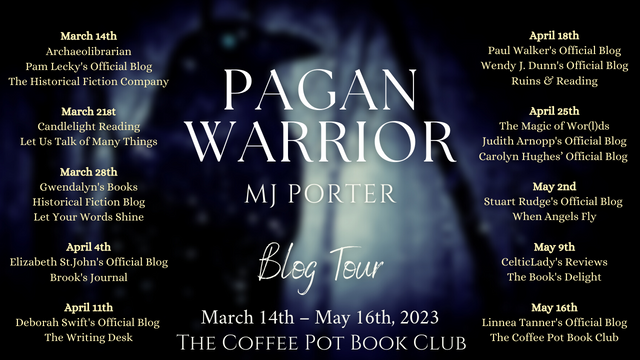
I’m really excited to share the details of the Pagan Warrior blog tour with The Coffee Pot Book Club.
Pagan Warrior is the story of the battle of Hædfeld, fought in the seventh century between the Northumbrians, and you got it, the Mercians – or rather, Cadwallon of Gwynedd but with Penda of Mercia as his firm ally. You can find more details here.
I might have written this book many years ago, but it’s had a refresh, and is now available in audio, narrated by the fabulous, Matt Coles, as is the second book, Pagan King. Warrior King will be coming later this year in audio. For this first week, 13th March-19th March, the ebook of Pagan Warrior is reduced globally. Follow the link below.
You can follow the blog tour, and I’ll be sharing posts here as well. A quick shout out to thank all the blog hosts and Cathie at The Coffee Pot Book Club for organising.
For today, March 14th, check out my author interview over on Archaeolibrarian.
The Scots of Dalriada takes place in 5th century Ireland and Scotland and tells the fictional story of the legendary king Fergus Mór. Recorded Irish history begins with the introduction of Christianity and Latin literacy, beginning in the 5th century. Most of my research however, relied on sources written much later. First and foremost, Studies in the History of Dalriada by John Bannerman.
Published in 1974 this book is no longer in print but can be purchased second-hand.
My research of the Dalriada began fifteen years ago when I discovered that my ancestors descended from the Dalriada. History is compelling, especially when your own ancestors are involved, and the stories around the Dalriada didn’t let me go. I had to wait three years to obtain a copy of this book but it was definitely worth it, as it is much more comprehensive and detailed than anything to be found on the net.
It amazed me that St. Patrick was kidnapped as a teenager and sold to the Dalriada. He stayed with them, working as a shepherd on the exposed hills of Slemish until he miraculously escaped. When he returned to Ireland in his role as missionary, his first self-imposed duty was to convert the Dalriadians, despite bitter opposition from the druids.
See my first book from this period about the life of St.Patrick, Patron Saint of Ireland.
The Missionary
Although both books take place in 5th century Ireland, they are entirely independent of each other.
5th century Ireland and Scotland is at the end of the Iron Age and beginning of the early Medieval Age. This period includes an expansion of the Dalriada clan to Western Scotland. Ireland, at the time, was divided into many small baronies, each ruled by an underking. Life was dominated by a myriad of petty wars, neighbouring clans were constantly under attack from each other, stealing cattle and crop and encroaching upon each other’s land.
The Dalriada was situated in the utmost North East of Ireland, composed of much that is presently known as Antrim. To the North and East their territory was bordered by the North Channel and the Irish Sea. To the South and West, by the aggressive tribes of the Northern Uí Néill, the Dál Fiatach and the Dál nAraide, who continually attacked the Dalriada. So it was only natural that the Dalriada sought to expand their kingdom across the North Channel.
These background facts form the setting for my, mainly fictional, novel about Fergus. The book covers his life from roughly 440 to 501 AD, when his ship is sea wrecked, and he is succeeded by his son Domangart.
By that time the Dalriada have conquered Argyll (“Coast of the Gaels”) and built their chief stronghold and trading centre at Dunadd. The hillfort of Dunadd is believed to have been their capital. Other royal forts included Dunollie, Dunaverty and Dunseverick. Within Dalriada was the important monastery of Iona, which played a key role in the spread of Celtic Christianity throughout northern Britain, and in the development of insular art. Iona was a centre of learning and produced many important manuscripts. Dalriada had a strong seafaring culture and a large naval fleet.
Scotland is said to have been founded by the legendary king Fergus Mór (Fergus the Great) in the 5th century. Heavy onslaughts from the Picts checked the Dalriada on the Scottish mainland. In the 8th century the Dalriada gradually declined; and after the Viking invasions early in the 9th century, it lost all political identity. In the mid-9th century its king Kenneth I MacAlpin brought the Picts and Scoti (the Roman name for the Irish Gaels) permanently together, and thereafter the whole country was known as Scotland.
More books that I read to complement my research:
A Brief History of Ireland by Richard Killeen
Ireland’s Forgotten Past: A History of the Overlooked and Disremembered by Turtle Bunbury
A History of Scotland by Neil Oliver
Scotland: History of a Nation by David Ross
The Book of Celtic Myths: From the Mystic Might of the Celtic Warriors to the Magic of the Fey Folk, the Storied History and Folklore of Ireland, Scotland, Brittany, and Wales by Adams Media
Satellite image of Scotland and Northern Ireland showing the approximate greatest extent of Dál Riata (shaded). The mountainous spine which separates the east and west coasts of Scotland can be seen.
Ancient hill fort at Dunadd
Here’s the blurb
THREE BROTHERS Fergus, Loarn and Angus, Princes of the Dalriada, are forced into exile by their scheming half-brother and the druidess Birga One-tooth.
THREE FATES Fergus conceals himself as a stable lad on Aran and falls helplessly in love with a Scottish princess, already promised to someone else. Loarn crosses swords against the Picts. Angus designs longboats.
TOGETHER A MIGHTY POWER Always on the run the brothers must attempt to outride their adversaries by gaining power themselves. Together they achieve more than they could possibly dream of. Fergus Mór (The Great) is widely recognised as the first King of Scotland, giving Scotland its name and its language. Rulers of Scotland and England from Kenneth mac Alpín until the present time claim descent from Fergus Mór.
Full of unexpected twists and turns, this is a tale of heart-breaking love amidst treachery, deceit and murder.
Rowena Kinread grew up in Ripon, Yorkshire with her large family and a horde of pets. Keen on travelling, her first job was with Lufthansa in Germany.
She began writing in the nineties. Her special area of interest is history. After researching her ancestry and finding family roots in Ireland with the Dalriada clan, particularly this era.
Her debut fiction novel titled “The Missionary” is a historical novel about the dramatic life of St. Patrick. It was published by Pegasus Publishers on Apr.29th, 2021 and has been highly appraised by The Scotsman, The Yorkshire Post and the Irish Times.
Her second novel “The Scots of Dalriada” centres around Fergus Mór, the founder father of Scotland and takes place in 5th century Ireland and Scotland. It is due to be published by Pegasus Publishers on Jan.26th, 2023.
The author lives with her husband in Bodman-Ludwigshafen, Lake Constance, Germany. They have three children and six grandchildren.
The fight for a torn kingdom rests in the hands of a few brave men…
990AD.
King Aethelred II, who men will one day call The Unready, rules over a land divided by the shadowy spin of his mother Queen Ælfthryth and the sprawling power of the Church.
The Viking Warlord, Olaf Tryggvason smelling the Kingdoms weakness brings the vicious Jomsvikings to the Saxon coastline ravenous for war and plunder.
Together Lord Byrthnoth, Ealdorman of the East Saxons and Beornoth his Saxon Thegn lead a force of oath sworn Viking killers, every bit as brutal and war-skilled as the Norse invaders to protect the Kingdom against enemies both from within, and from the cruel seas. They are pushed to the very limits of their bravery and endurance in a desperate fight for the very existence of the Saxon Kingdom.
In a riveting story of trachery, betrayal, vengeance and war, can Beornoth defeat his enemies and protect the Kingdom from destruction?
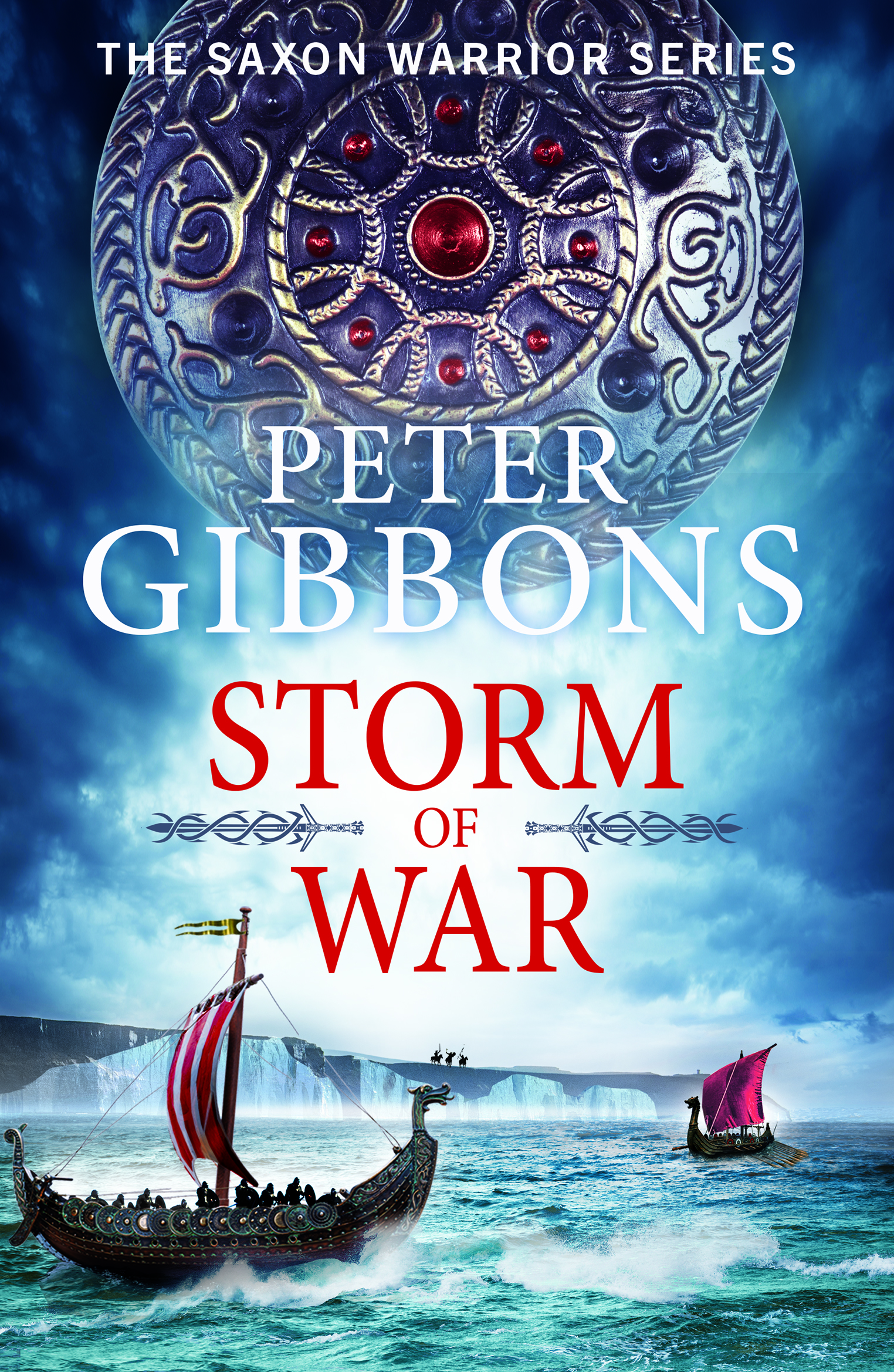
Storm of War is the second book in the Saxon Warrior Series, which began with Warrior and Protector, set during the early 990s in Saxon England. Æthelred II is the king of the English, but the Viking raiders, quiet throughout the reign of his father, known as Edgar the Peaceable, have begun to turn their eyes once more to the riches that England has to offer.
Beornoth is a thegn once more, connected to Ealdorman Byrhtnoth, a man who has long-supported the claim of others than the current king to rule England, firstly, Eadwig, the uncle of Æthelred II, to whom he owed his elevation to the ealdordom, and also, Edward the Martyr, Æthelred’s stepbrother. Often brought into conflict with the queen, Lady Elfrida, or Ælfthryth, as she is called in the book, Byrhtnoth is not the easiest of allies for the king and his mother, and Beornoth, a warrior like the ealdorman, is needed for his warrior-prowess but perhaps distrusted for the very same reason.
The book opens with a battle at Watchet in which we encounter the Viking raider, Olaf Tryggvason, for the first time, soon to be a bane to England, and while Beornoth and his quick thinking, alongside Ealdorman Byrhtnoth, are victorious on that occasion, there is a fear that Olaf will attack once more.
Yet, Beornoth and his allies soon find themselves heading north to counter a problem amongst the ruling elite of the northern parts of the kingdom, on the commands of the king’s mother, if perhaps not the king.
We begin to encounter more of the men who will one day be famously remembered in the Battle of Malden poem as the story continues, Ælfwine perhaps of most relevance to me (as he might, or might not, have been the father of Ealdorman Leofwine of the Twice). Beornoth is still an angry man, eager to kill the enemy who destroyed his family but he is involved in a dangerous game with enemies surrounding him while he fears that Olaf will attack once more.
A tale of Saxon England on the cusp of the Second Viking Age sure to thrill fans of the era.
Meet the Author
Peter Gibbons is a financial advisor and author of the highly acclaimed Viking Blood and Blade trilogy. He comes to Boldwood with his new Saxon Warrior series, set around the 900 AD Viking invasion during the reign of King Athelred the Unready. The first title of the new series, Warrior and Protector, will be published in October 2022. He originates from Liverpool and now lives with his family in County Kildare.
I’m delighted to welcome Trish MacEnulty to the blog with a guest post about her books.
Lesbians in the Early 20th Century — Branded as Deviants and Sometimes Jailed!
In my series, the Delafield & Malloy Investigations, one of my main characters — Ellen Malloy, an Irish immigrant — is a lesbian. As soon as she appeared on the page, she let me know in no uncertain terms that the expectation of marriage was the main reason she had left Ireland to become a servant for a wealthy family in Manhattan. Well, that didn’t work out either, but eventually she found her way and fell in love with a suffragist.
What would life be like for a lesbian in New York in 1913? I had no idea. The lives of gay men and the indignities they suffered in the late 19th and early 20th centuries has been widely documented — Oscar Wilde made sure of that! All the while, lesbians unobtrusively managed to find love and companionship in spite of the fact that their existence was rarely acknowledged.
In her fascinating academic tome, A Novel Approach to Lesbian History, Linda Garber writes “The historical records, if they exist at all, frustrate as often as they inform. Spotty, written by men, open to multiple interpretations—traces of a recognizably lesbian past run aground on the rocky shoals of the history of sexuality itself.” (3)
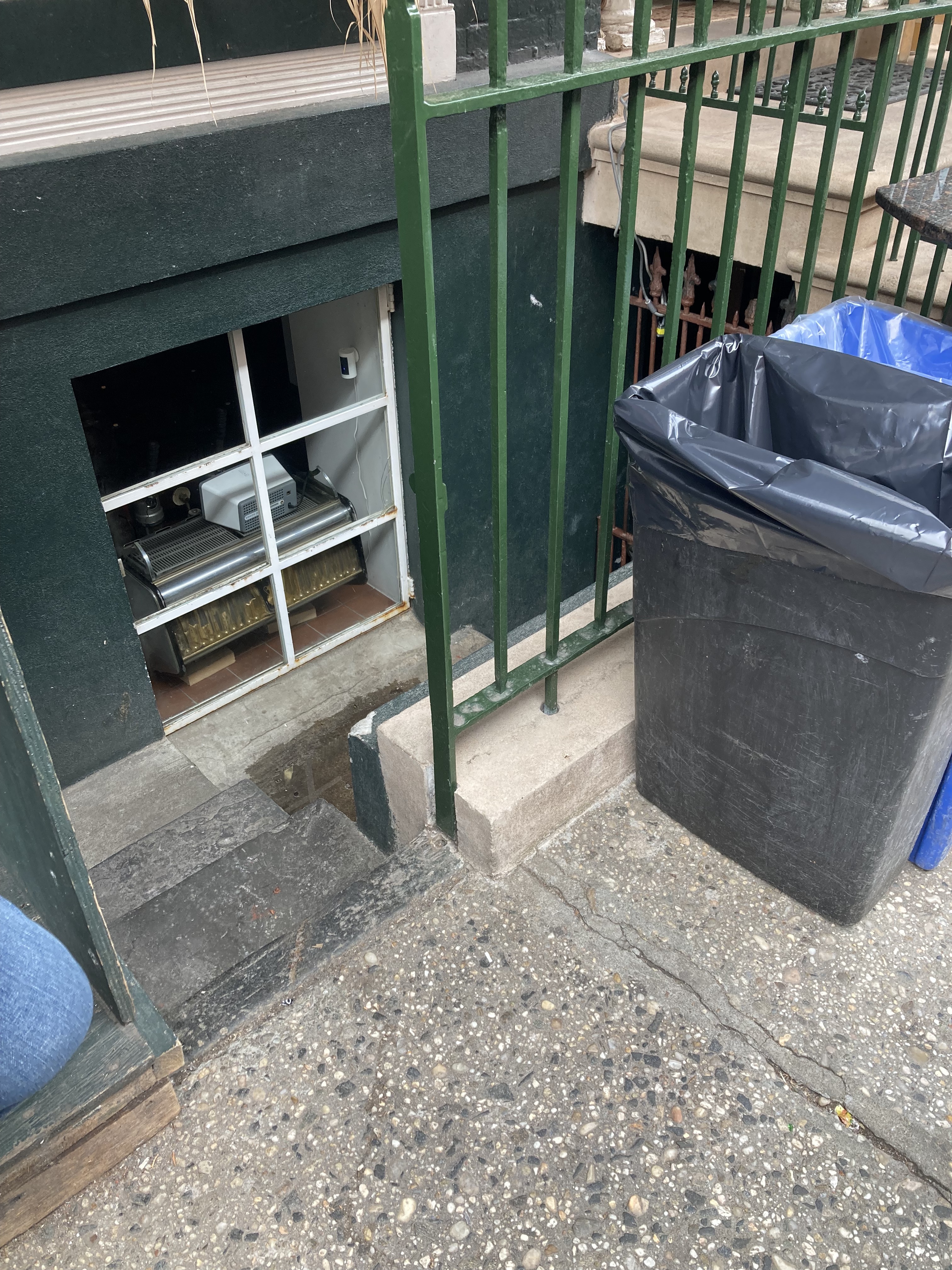
Fortunately, in the early 20th Century, the Bohemians of Greenwich Village had the freedom to live ‘unconventional’ lifestyles somewhat openly. In the Village, tea rooms provided space for women to meet each other away from the disapproving eye of society. On a recent tour of Greenwich Village with the Bowery Boys, I was shown one of the basement entrances for a former tea room. In those days, according to legend, it bore a sign that read, “Men are admitted but not welcome.”
Picture of basement, photo by me
Of course, the police knew about these places. In her autobiography, Mary Sullivan, one of the first police matrons to do actual police work, wrote, “A few tearooms run by women with a fondness for college girl patronage really were a menace…”
She added, “One of the most difficult types of degenerate with whom we have to deal is the woman with homosexual tendencies.” The police department received a complaint about “indecent literature” on sale in one of the tea rooms and a proprietess who “tried to entice girl students from a nearby college.” So Sullivan and one of her female colleagues set out to entrap the proprietess.
They visited the tea room, and the other police woman accepted a date from the proprietess, a woman named Billie. After trying to kiss the woman while on their date, Billie was arrested and then convicted of “disorderly conduct and distributing obscene literature.” She was sentenced to six months in the workhouse. Her tea room was closed. (Interestingly, this is the same scenario which happened later to activist Eve Adams; it may be the stories are conflated.)
Sullivan didn’t think jailing women with “homosexual tendencies” was the solution, however. “There is no doubt in my mind that they should be treated primarily as medical and psychiatric cases, though we still have to learn about the method of treatment.” Well, we all know where that eventually led: the horrors of conversion therapy!
picture of Sullivan’s book, photo by me
Not all lesbians kept quiet or hid their preferences. Polish-born Eve Adams arrived in New York in 1912 when she was twenty years old. In 1925, she wrote and published a book called Lesbian Love “for private circulation only.” Two years later she was arrested for obscenity and disorderly conduct and deported.
There’s an excellent book about Adams, titled The Daring Life and Dangerous Times of Eve Adams by Jonathan Ned Katz. In 1912, according to Katz, the term lesbian did not always signify a sexual relationship between women. It could simply refer to a community of women. For example, a women’s college newspaper in Maryland was called the Lesbian Herald. From everything I’ve read, the common term, at the time, for gays and lesbians was “invert.”
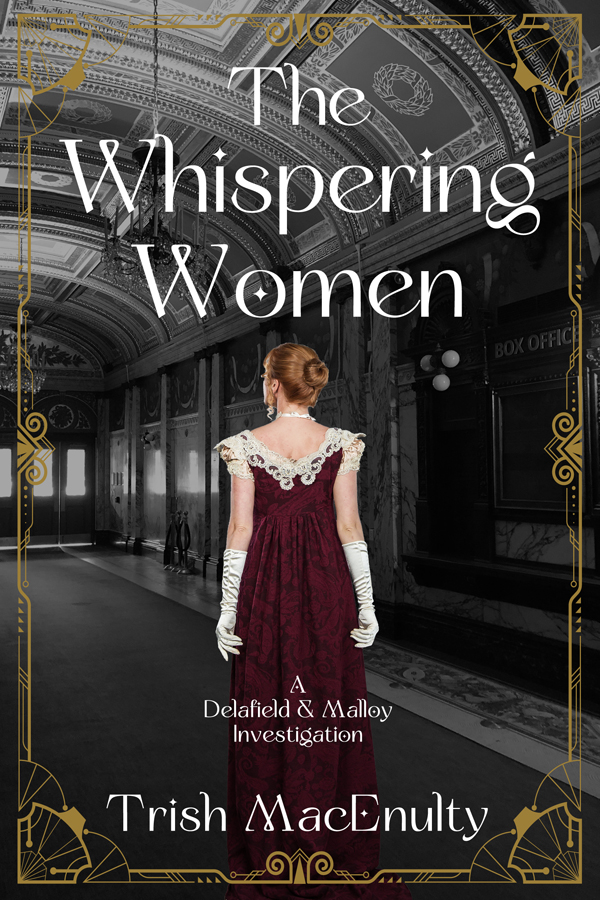
With this and other research in hand, I felt I could do justice to Ellen’s story in her quest for love and fulfillment. This scene is the moment Ellen first sees the women with whom she later falls in love in The Whispering Women as she is looking through the window of a teahouse in Greenwich Village:
“The tables were occupied by women of various ages and classes who seemed engrossed in conversations. One woman in particular caught her eye. She looked to be in her late twenties, big boned with a narrow face, an affable smile, and big brown eyes under thick eyebrows. Ellen could tell by her tailored gray jacket she had money, but she wasn’t showy. A strand of pearls hung carelessly around her neck. A feeling swept over Ellen like a dull ache — the kind of ache you don’t want to stop. The woman laughed at something her companion said. Ellen swiveled her head to look at the companion. Small, blond, and delicately holding her tea cup. When the woman with the pearls got up to get some more tea, Ellen saw the blond woman glance out the window and wave a handkerchief. Curiously, Ellen looked around. Two men stood across the street, smoking cigarettes with their eyes fixed on the window of the tea shop. Police, Ellen knew immediately.”
Thank you for sharing such a fascinating post. Good luck with your series.
Blurb:
“Richly drawn characters, the vibrant historical setting, and a suspenseful mystery create a strong current that pulls readers into this delightful novel. But it’s the women’s issues—as relevant today as they were in the early 1900s—that will linger long after the last page.”
— Donna S. Meredith, The Southern Literary Review
Can two women get the lowdown on high society?
“Two powerless young women must navigate a soul-crushing class system and find the levers of power they wield when they combine their strengths. These women may have been taught to whisper, but when their time comes, they will roar.”
– 5 Star Amazon Review
Louisa Delafield and Ellen Malloy didn’t ask to be thrown together to bring the truth to light. But after Ellen witnesses the death of a fellow servant during an illegal abortion, Louisa, a society columnist, vows to help her find the truth and turn her journalistic talent to a greater purpose.
Together, these unlikely allies battle to get the truth out, and to avenge the wrongful death of a friend.
What will our heroes do when their closest allies and those they trust turn out to be the very forces working to keep their story in the dark? They’ll face an abortionist, a sex trafficking ring, and a corrupt system determined to keep the truth at bay.
“If you like historical fiction and if you like mysteries, this one is for you!”
– 5 Star Amazon Review
Was change possible in 1913?
To find out, read THE WHISPERING WOMEN today!
Buy Links:
The books in this series are available to read on Kindle Unlimited.
Trish MacEnulty is a bestselling novelist. In addition to her historical fiction, she has published novels, a short story collection, and a memoir. A former Professor of English, she currently lives in Florida with her husband, two dogs, and one cat. She writes book reviews and feature articles for the Historical Novel Review. She loves reading, writing, walking with her dogs, streaming historical series, cooking, and dancing.
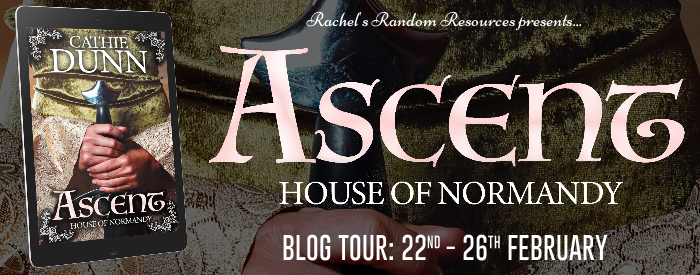
I’m delighted to be reviewing Ascent by Cathie Dunn, #histfic #BookReview #Normandy
Here’s the blurb
A brutal Viking raid heralds the dawn of a new, powerful dynasty – the House of Normandy
Neustria, Kingdom of the West Franks AD 890
Fourteen-year-old Poppa’s life changes when Northmen land near Bayeux. Count Bérengar, her father, submits to them, and she is handfasted to Hrólfr, the Northmen’s heathen leader, as part of their agreement.
To her relief, Hrólfr leaves immediately in search of further conquest, only returning to claim her years later. In the face of retaliating Franks, they flee to East Anglia, where she gives birth to their son and daughter.
When Hrólfr and Poppa return to reclaim Bayeux, his new campaign strikes at the heart of Frankish power, and King Charles of the West Franks offers him a pact he cannot refuse. In exchange for vast tracts of land in Neustria, Hrólfr must convert to Christianity and accept marriage to Gisela, the king’s illegitimate daughter.
Poppa’s world shatters. She remains in Bayeux, with her daughter, Adela. When Gisela arrives one day, demanding she hand over Adela, to be raised in Rouen, Poppa’s patience is at an end. But Gisela makes for a dangerous enemy, and only one woman will survive their confrontation high up on the cliffs.
Will Poppa live to witness the dawn of a new era?
ASCENT is the first in a new series about the early women of the House of Normandy – women whose stories have been forgotten through time.
Until now!
Readers of Viking and medieval fiction will enjoy ASCENT, a fictional account of the life of Poppa of Bayeux, handfasted wife of Rollo the Viking.
Trigger warning: Loss of a child. Some battle and fighting scenes.
Ascent tells the story of how the Duchy of Normandy formed, through the eyes of both Poppa, wed to the man many of us will know as Rollo and Rollo himself.
This is a fascinating period, at the end of the ninth century and the beginning of the tenth, when the focus of the Viking raiders had shifted from just trying to plunder, kill and steal to wanting to find new homes for themselves. While some of the story takes places in England, the focus is on the West Frankish lands, and there are familiar names here, Charles III, the king of the West Franks, the most well-known of them all.
Poppa is a strong-willed woman, but her life isn’t without hardship and suffering. Rollo, or Hrolfr, is a Viking raider, but with an eye to the future and ambition to match it. The evolving story is well portrayed, focusing on several life-changing moments as the tale progresses as it covers their entire lives after meeting.
I feel the book really comes into its own from about halfway through, and I powered through the remainder of the story. Poppa and Hrolfr are both ambitious and strong-willed, with an eye to the future, and such ambition is well portrayed without us disliking either of them. Their friends and allies also provide moments of intense sorrow and triumph as Dunn weaves a tale of the era, bringing in far-flung places, such as Orkney, which were all closely interconnected to men and women of the sea.
Constructed using incredibly scarce surviving sources (I know, I’ve studied this period, and it is mind-glowingly confusing), Ascent, the first book in the stories of Normandy, is sure to appeal to those interested in tales of historically strong women, in the formation of Normandy and also in this turbulent period when the Viking raiders – or the Normans as they came to be known – claimed a toe-hold on Frankish soil which was to have far-reaching consequences. I look forward to book 2.
Meet the author
Cathie Dunn is an award-winning author of historical fiction, mystery, and romance. The focus of her historical fiction novels is on strong women through time.
Cathie has been writing for over twenty years. She studied Creative Writing online, with a focus on novel writing, which she also taught in the south of France. She loves researching for her novels, delving into history books, and visiting castles and historic sites. A voracious reader, primarily of historical fiction / romance, she often reviews books on her blog, Ruins & Reading.
Cathie is a member of the Historical Novel Society, the Richard III Society, and the Alliance of Independent Authors.
After many years in Scotland, Cathie now lives in south of France with her husband, and rescued Charlie Cat and Ellie Dog. Discover more about Cathie at http://www.cathiedunn.com!
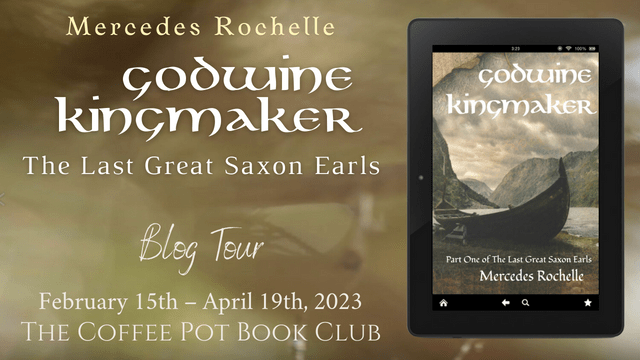
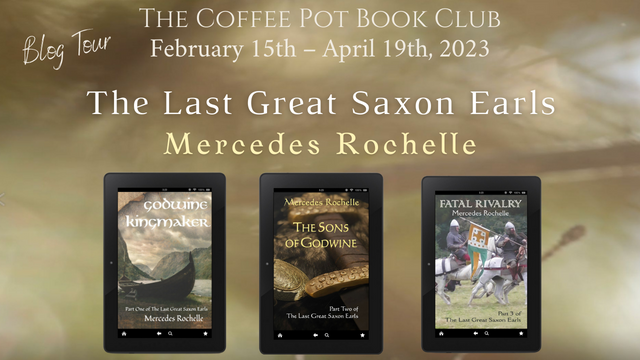
I can never miss an opportunity to ask a fellow Saxon author questions about why they write about the same period as me. My thanks to Mercedes for answering them.
What drew you to the character of Godwine and his wife and children?
While I was writing my first book, Heir To A Prophecy, I introduced my protagonist Walter into London on the day Godwine came back from exile. It was a plot device to introduce him to Harold Godwineson (Walter took out one of the Normans fleeing through the crowd). I didn’t know who Godwine was, but I couldn’t shake him loose! I went back fifty years and discovered a great story.
Naturally, very little is known about these historical characters, and I had two challenges that dovetailed nicely. Both had to do with not wanting to fall into that old predictable trap concerning characters. First of all, the love interest. There are so many love stories that seem formulaic. I didn’t want that same old theme: disliking each other first, then falling in love (and all the variations thereof). On the other hand, I understand that there needs to be some kind of stress in the romance to make a good story. It was obvious that Godwine had a happy marriage (or at least a productive one) since they had so many children. I was really intrigued by the discrepancy of their social status. Godwine was a commoner, and Gytha was a noble (or the Danish equivalent). At the same time, I had a hard time figuring out why Swegn, the firstborn, turned into such a bad egg. I don’t believe a character should be all good or all bad. People just aren’t like that. Even wicked characters act that way for a reason; sometimes they have good qualities that get buried under their more powerful bad qualities. Finally I had an inspiration: if Godwine’s marriage started out in anger, or stress (Gytha was given to him in marriage, but she didn’t have to go willingly), perhaps the firstborn would be neglected and unloved. That would explain his subsequent behaviour. It took some doing to make that work, but I’m happy with the result.
What part of your research did you enjoy the most?
I love research; I actually prefer the research to the writing. I knew I was going to like Godwine. What surprised me was how fascinated I was with Canute. He was an incredibly complicated character. From the angry king-to-be that cut the noses off his 200 hostages after England rejected him in favour of Aethelred the Unready, he eventually became a very successful monarch. Most of all, I loved the single combat between him and Edmund Ironside, where he cleverly talked himself out of getting flattened by convincing Edmund to split the kingdom between them. This may well be apocryphal, but that’s the challenge of writing about events 1000 years ago. We have more legends than “history” to work with, and the legends are so good they stick.
Was there a resource that was invaluable?
I hate to admit this because it makes me sound so old, but when I was writing Godwine Kingmaker there was no internet. Back then, I was living in St. Louis, MO—a very nice town but far from the libraries I needed. If the book wasn’t in the card catalogue, it might as well not even exist. So, like any warm-blooded researcher who didn’t have a family to take care of, I pulled up stakes and moved to New York. The day I discovered the New York Public Library my life changed forever. I found authors I never knew about, and finally got my hands on my first copy of Edward A. Freeman’s “History of the Norman Conquest of England”. I thought I had gone to heaven! In six volumes he wrote about every aspect of Anglo-Saxon England I could possibly think of. (These days Freeman is somewhat out of fashion, but he’s still my go-to when I need to look something up; he has never failed me yet.) Copy machines were available for ten cents a page, but as much as I needed to copy, I’d be better off buying the books—if I could find them. No such luck until a couple of years later, when I went on a book-buying trip to England and discovered Hay-on-Wye. A breakthrough! Those were the days (the late ’80s) when old used hardbacks were still easy to find, and I discovered my very own set of Freeman which I gleefully brought home. That was the original basis of all my research. Those books are still my most precious possession, though now you can find them online (scanned, of course).
Did you learn anything that surprised you while writing the trilogy?
Back to Canute again. While delving into Harold’s relationship with Edith Swan-neck in THE SONS OF GODWINE, again I wanted to avoid the usual romantic formulas. First of all, I had to decide whether Edith was a luscious young thing or an attractive widow; both possibilities were referred to in the histories. By lucky chance, I stumbled across Canute’s Law Code of 1020, designed to smooth relations between the Danes and the Saxons. One section dealt with heriot (essentially an inheritance tax), not a new concept. But I found a reference to protecting widows. Canute gave a widow twelve months to pay her husband’s heriot. But she had to remain unmarried or she would lose both her morning-gift and all possessions from her former husband. If some unscrupulous man coveted her inheritance and forced her to marry him, all the possessions would pass on to the nearest kinsman. The king would lose the heriot tax if this were to happen, so it was also written into Canute’s law that a widow should never be forced to marry a man she dislikes. After all, the Crown had much to lose. So I decided to make Edith a recent widow trying to evade the attentions of an unwelcome suitor, while she and Harold conducted their relationship.
What is your personal opinion? Do you believe that William the Conqueror was justified in claiming England? Do you believe he had been promised it?
Apparently the whole justification came down to King Edward the Confessor’s promise to William when the duke visited England during Godwine’s exile. I think we can negate the assertion that Edward felt some sort of gratitude for having been sheltered there during his exile. When Edward left Normandy in 1041, William was only 13 years old and Edward was 38. With that age gap, it seems unlikely that the two of them would have developed a close relationship, so any alleged gratitude Edward might have owed probably belonged to William’s father Robert, dead by 1035.
Now, during Godwine’s exile in 1051, it’s far from certain that William even visited England. Some historians thought he would have been too busy putting down rebellions to leave his country even for a short time. If William did visit England and if Edward offered him the crown at this point, it’s curious why he would have done so. The king knew that it was up to the Witan to decide the succession. However, considering his antagonism toward the Godwines (he even put the queen in a nunnery while Godwine was in exile), perhaps he made this alleged promise out of spite.
However, it’s my belief that the blame can be placed upon Robert of Jumièges, former Archbishop of Canterbury and arch-enemy of Earl Godwine. Robert is one of the Normans who fled from London once it was clear that Godwine was back in control. He’s almost certainly the one who kidnapped the hostages, Godwine’s son Wulfnoth and grandson Hakon, and brought them to Normandy. In my interpretation, Jumièges acted on his own when he told William that Edward declared him heir to the English throne, and here are the hostages to guarantee his promise. What a great revenge on Godwine and all of England for kicking him out! Why wouldn’t William believe such an opportune offer?
Who is your personal favourite member of the House of Godwine?
When all is said and done, Earl Godwine still holds his place as my favourite. If it weren’t for him, there would be no Harold Godwineson Last Anglo-Saxon King. I think he helped smooth the relations between the conquering Danish king and his unhappy countrymen, then moved on to staunchly defend the Saxons against the hated Normans. His rise to power was unprecedented, and I think his fall was tragic, though not in the way we usually think of as a tragedy. Having sacrificed so much for the wrong son, he had nothing left to live for as he watched Harold take his place in the hearts of his people.
As you know, I write about the Earls of Mercia. What opinion did you form of the rivals to the House of Godwine while researching and writing your books?
I wondered if you’d ask that question! Of course, by the late Anglo-Saxon period, I think the Mercian earls had lost much of their lustre. Old Earl Leofric certainly held his own against Earl Godwine (with the help of Earl Siward of Northumbria). It seems the odds were against Leofric as Godwine’s sons were granted their own earldoms, shifting the balance of power in Godwine’s favour. At this stage, I always thought of them as bitter, unhappy competitors who could never regain their former glory. After King Edward died, Harold tried to join forces with the grandsons of Leofric, Edwin and Morcar, but I don’t think their association was ever successful. William the Conqueror certainly put an end to that.
Thank you for answering my questions with such insight. I hope you enjoy the blog tour.
Here’s the blurb:
They showed so much promise. What happened to the Godwines? How did they lose their grip? Who was this Godwine anyway, first Earl of Wessex and known as the Kingmaker? Was he an unscrupulous schemer, using King and Witan to gain power? Or was he the greatest of all Saxon Earls, protector of the English against the hated Normans? The answer depends on who you ask.
He was befriended by the Danes, raised up by Canute the Great, given an Earldom and a wife from the highest Danish ranks. He sired nine children, among them four Earls, a Queen and a future King. Along with his power came a struggle to keep his enemies at bay, and Godwine’s best efforts were brought down by the misdeeds of his eldest son Swegn.
Although he became father-in-law to a reluctant Edward the Confessor, his fortunes dwindled as the Normans gained prominence at court. Driven into exile, Godwine regathered his forces and came back even stronger, only to discover that his second son Harold was destined to surpass him in renown and glory.
Mercedes Rochelle is an ardent lover of medieval history, and has channeled this interest into fiction writing. She believes that good Historical Fiction, or Faction as it’s coming to be known, is an excellent way to introduce the subject to curious readers. She also writes a blog: HistoricalBritainBlog.com to explore the history behind the story.
Born in St. Louis, MO, she received by BA in Literature at the Univ. of Missouri St.Louis in 1979 then moved to New York in 1982 while in her mid-20s to “see the world”. The search hasn’t ended!
Today she lives in Sergeantsville, NJ with her husband in a log home they had built themselves.
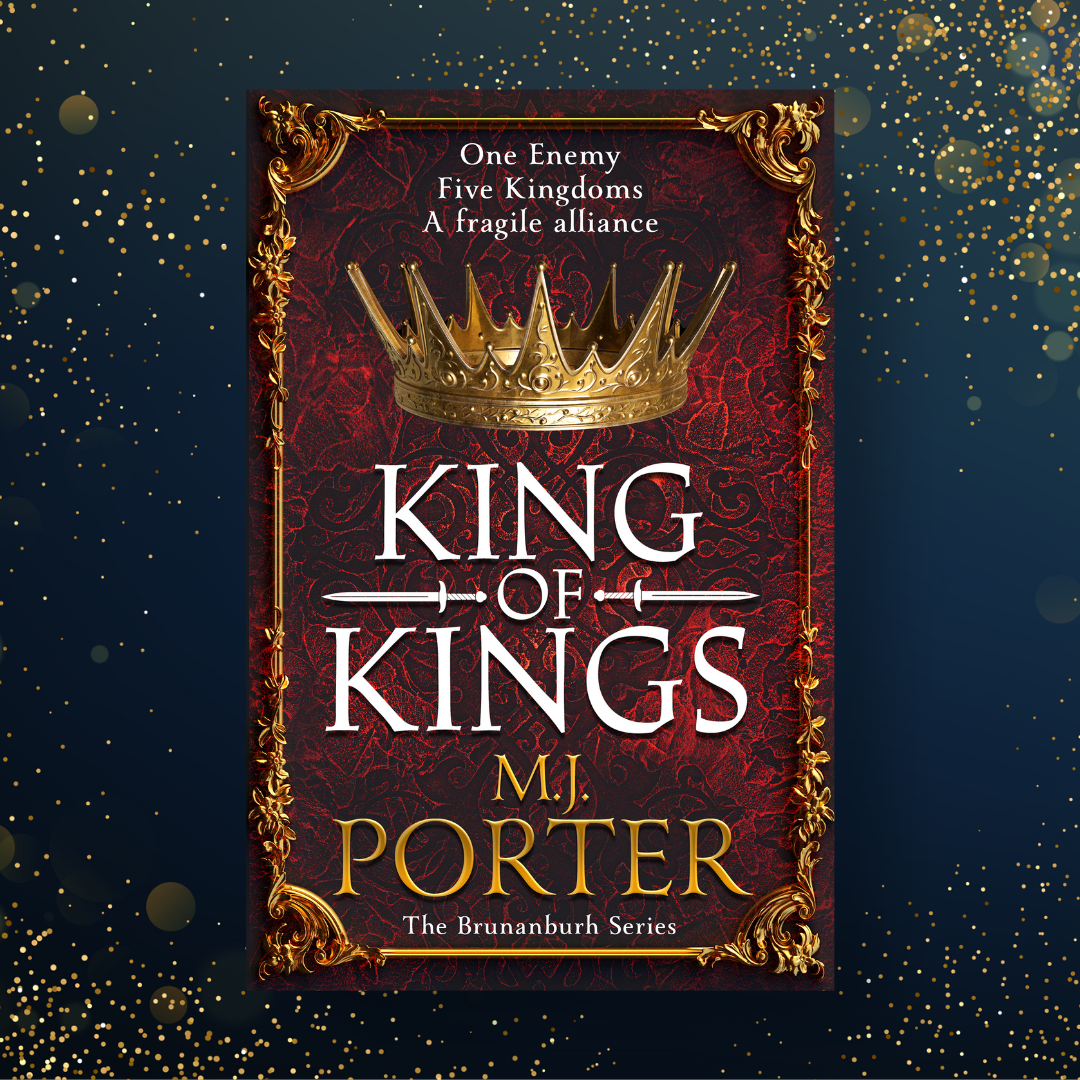
I’m so excited about the release today of King of Kings. This story, the first part in the retelling of the greatest battle on British soil that many have never heard of, Brunanburh, has been long in the making. Building on the original series, begun in 2014, King of Kings is entirely reworked, and it’s so much better:) (I honestly can’t believe how much better it is.)
Here’s the blurb
‘An epic tale of the birth of a nation. Truly mesmerising. Game of Thrones meets The Last Kingdom’ – Gordon Doherty
In the battle for power, there can be only one ruler.
AD925
Athelstan is the king of the English, uniting the petty kingdoms of Wessex, Mercia, the Danish-held Five Boroughs and York following the sudden death of his father, King Edward.
His vision is to unite the realms of the Scots and the Welsh in a peace accord that will protect their borders from the marauding threat of the Norse Vikings.
Whilst seemingly craving peace and demanding loyalty with an imperium over every kingdom, Athelstan could dream of a much bigger prize.
But danger and betrayal surround his best intentions, namely from his overlooked stepbrother, Edwin, who conspires and vies for what he deems is his rightful place as England’s king.
As ever, powerful men who wish to rule do not wish to be ruled, and Constantin of the Scots, Owain of Strathclyde, and Ealdred of Bamburgh plot their revenge against the upstart English king, using any means necessary.
An epic story of kingsmanship that will set in motion the pivotal, bloody Battle of Brunanburh where allies have to be chosen wisely…
(available in ebook, paperback, hardback and audio, narrated by the wonderful Matt Coles).
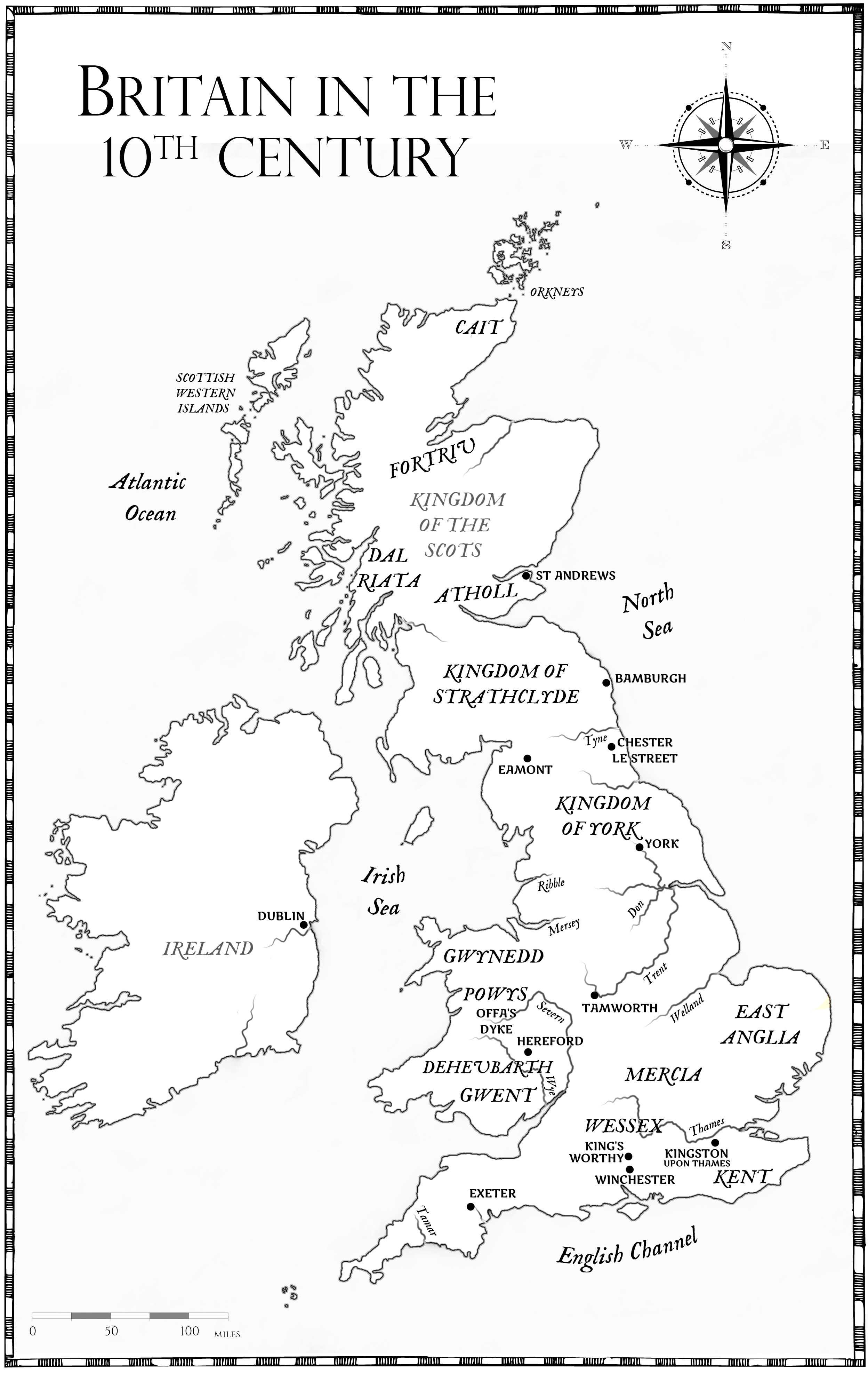
King of Kings. with its five kingdoms, and one alliance, might need some explanation. To help my readers understand who everyone is, and importantly, where everyone is, King of Kings has a map and a genealogical table, as well as a cast of characters.
Map designed by Shaun at Flintlock Covers
And because the family of King Alfred is so important to the story, I also have a genealogical table to share with my readers.
Design by Boldwood Books
I’ve written some brief introductions for the main cast of characters.
And for those who are falling in love with the period as much as I am, I wanted to share some non-fiction recommendations, and cautions.
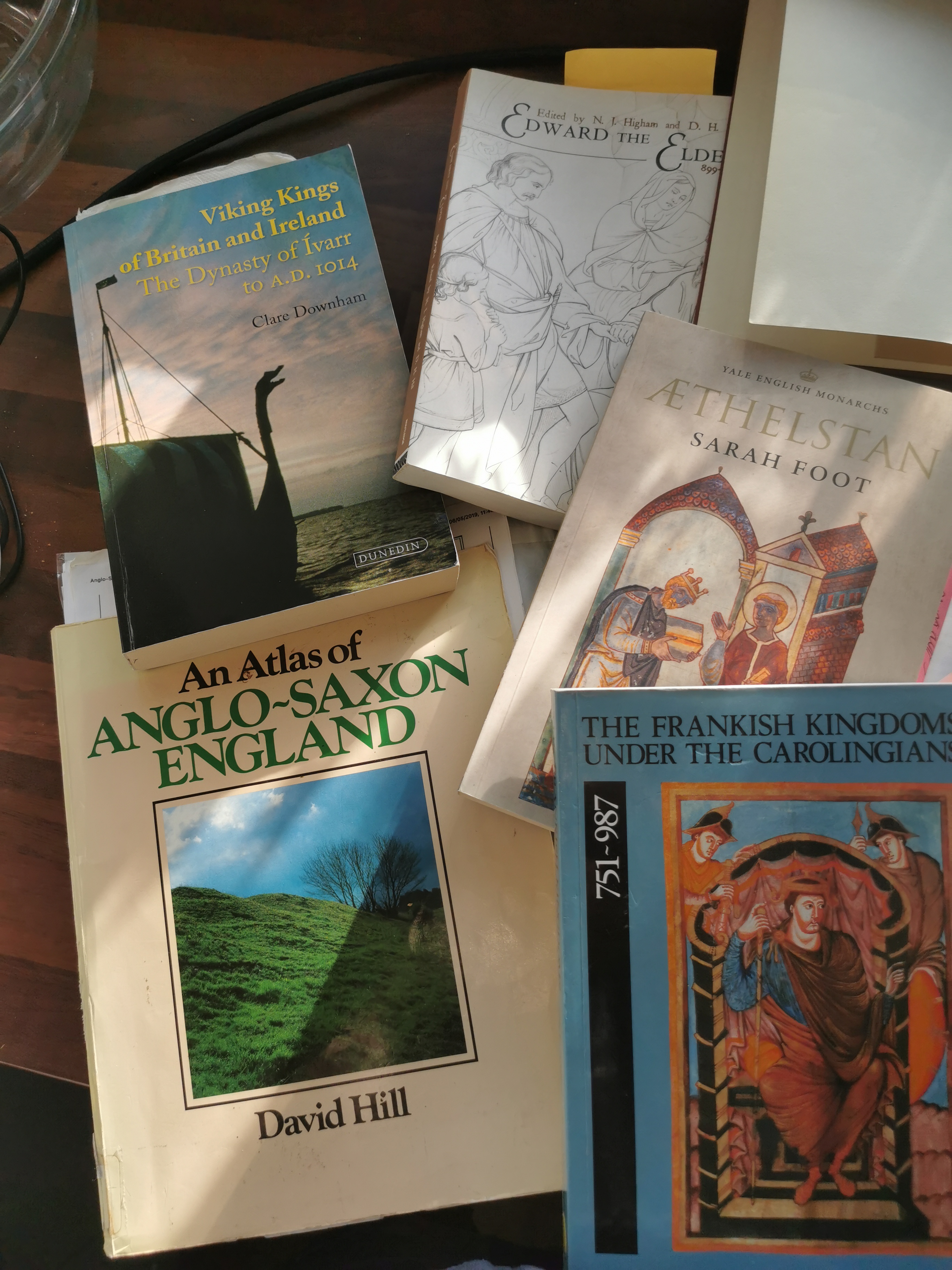
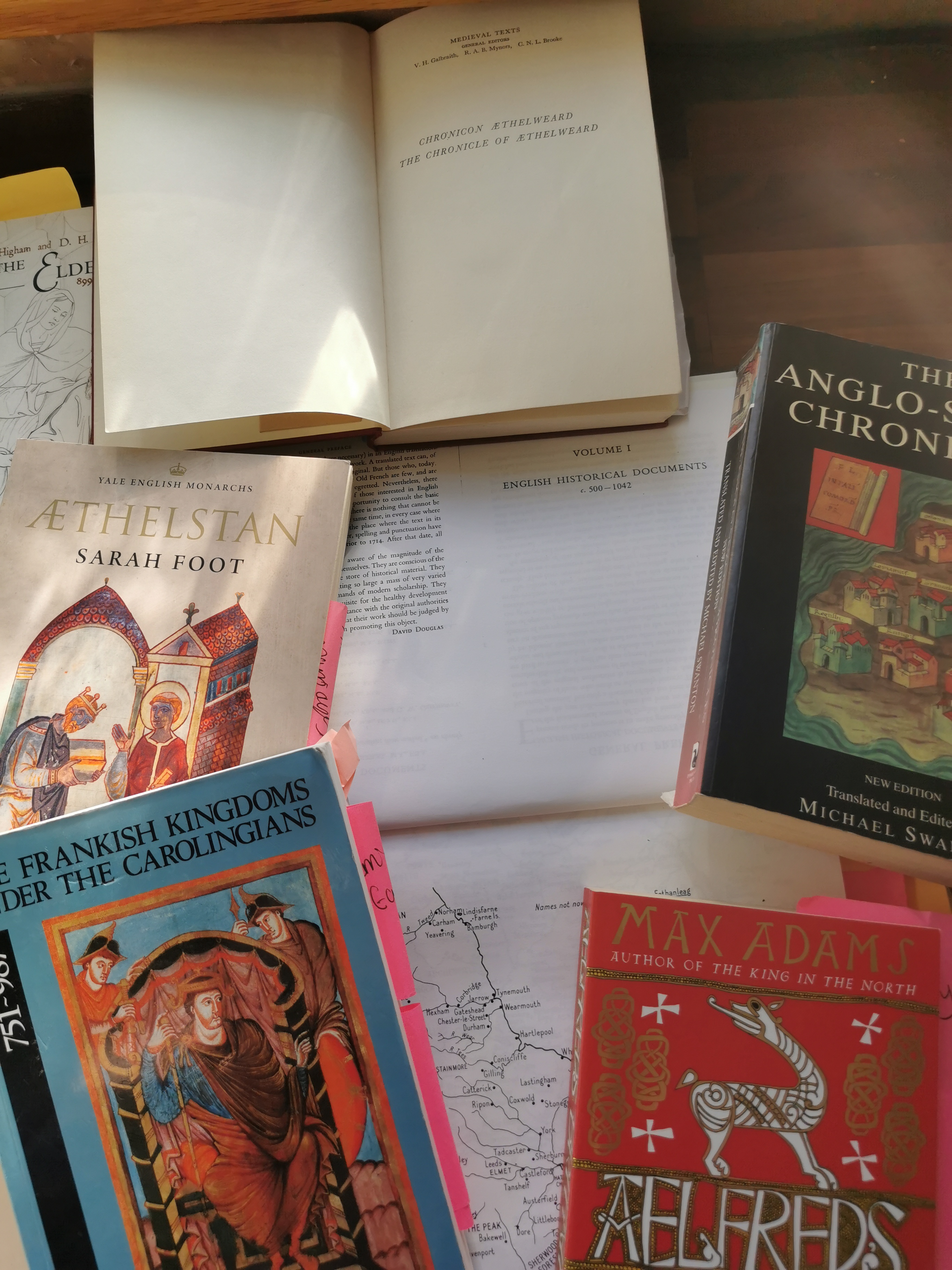
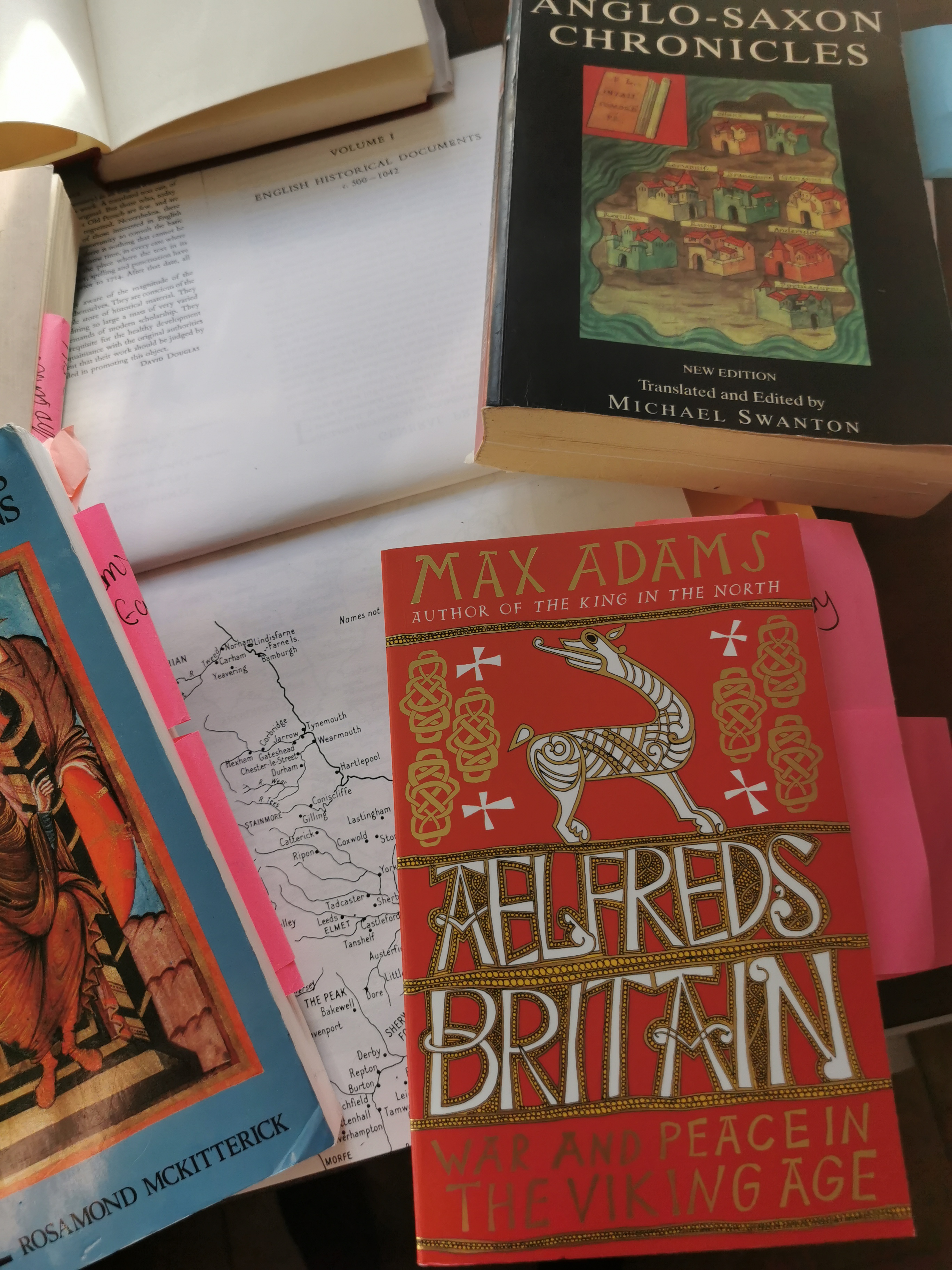
There is no one book that will adequately cover this period (that was one of the reasons that I fictionalised it) but these books (see photos below), along with Dr. Kari Maund’s The Welsh Kings, which I have in ebook, will give you a good grounding of events in Britain and Ireland. So, these are
Alfred’s Britain by Max Adams
Athelstan by Sarah Foot
The Anglo-Saxon Chronicles ed and trans. Michael Swanton (other versions available – I like the formatting of this one -with the different recensions)
The Welsh Kings by Kari Maund
An Atlas of Anglo-Saxon England by David Hill (don’t be put off by the fact this book is from the 1970s – it is invaluable)
From Pictland to Alba 789-1070 by Alex Woolf
Viking Kings of Britain and Ireland by Claire Downham
English Historical Documents ed and trans by Dorothy Whitelock
The Frankish Kingdom under the Carolingians by R McKitterick
Edward the Elder ed. Higham and Hill (not a narrative account, but historians writing papers about their area of interest and expertise).
There are also two very important online resources.
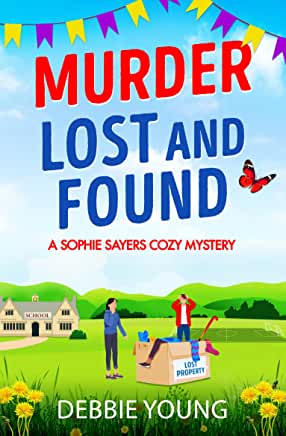
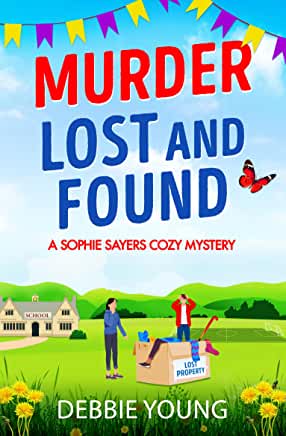
Sophie Sayers is ready for a glorious summer, but when a dead body is found in the village school’s lost property cupboard the summer holidays take an unexpected turn.
Even more shocking is when the body goes missing. Without a body, the police refuse to investigate. That’s just not good enough.
Sophie is determined to get to the bottom of the mystery. She needs to find out who has died and nab the culprit if she’s going to save the village school from the threat of closure.
My Review
Murder Lost and Found continues the Sophie Sayers Cosy Mysteries.
It’s the summer holidays, the school is empty of children, but while the caretaker and office manager try to ensure the school is prepared for the start of term, strange happenings take place.
I really enjoy this collection of stories. They’re light-hearted and a quick, pacy read, and I felt this one was particularly strong with the mystery of the lost property cupboard and the strange notes, making poor Sophie doubt herself, even while she contends with change at Horace’s bookshop.
A fun and entertaining read. Bring on book 8.
My thanks to Netgalley and the publisher for my review copy.
Debbie Young is the much-loved author of the Sophie Sayers and St Brides cosy crime mysteries. She lives in a Cotswold village where she runs the local literary festival, and has worked at Westonbirt School, both of which provide inspiration for her writing. She is bringing both her series to Boldwood in a 13-book contract. They will be publishing several new titles in each series and republishing the backlist, starting in September 2022.