I’m delighted to welcome Deborah Swift and her new book, Last Train to Freedom, to the blog #WW2 #TransSiberian #Russia #Japan #WomensFiction #Spies #BlogTour #TheCoffeePotBookClub

I’m delighted to welcome Deborah Swift and her new book, Last Train to Freedom, to the blog with Researching Last Train to Freedom and the Sugihara Story.

Researching Last Train to Freedom and the Sugihara Story

Last Train to Freedom is set in WW2 during the Soviet occupation of Lithuania, and with the threat of the Nazis over the border. The parallels to today’s political situation in Ukraine could not be clearer.

The book tells the story of Jewish refugees fleeing from Nazi and Soviet oppression. Because of the current situation, although I was fascinated by the Trans-Siberian Express, I was not about to go and take the journey myself. My initial research was largely based around websites such as the Holocaust Encyclopedia and then books and papers found via JStor and other trustworthy academic websites.

The main story is about how Japanese Consul Sugihara enabled the escape of thousands of Jews by giving them visas – against the wishes of his government. One man held the fate of so many lives in his hands. The best overview I found of events was In Search of Sugihara by Ellel Levine.

Pic of book In Search of Sugihara

Sughara’s wife Yukiko wrote a memoir about the events called No Visa (Rokusen-nin no Inochi) which is widely available, and tells the inside story of her husband’s frantic signing of visas before the consulate was shut down by the Soviets. Being aware that applicants were in life-threatening danger, Sugihara ignored his superiors’ orders and, from July 18 to August 28, 1940, he issued over 2100 life-saving transit visas.

‘My husband and I talked about the visas before he issued them. We understood that both the Japanese and German governments disagreed with our ideas, but we went ahead anyhow.’

Sugihara spoke to Soviet officials who agreed to let the Jews travel through the country via the Trans-Siberian Railway. I used detailed maps of the journey and researched each of the stops along the way to get a sense of where events might take place along the journey. Finding out about Russian trains of the 1940’s was quite a journey in itself – how did the doors open? What were the carriages like?

Pic of map of Trans-Siberian Railway

I gleaned much of the information from trawling through memoirs looking for telling detail. The escape on the Trans-Siberian Express was recorded by many in their memoirs, most notably I Have My Mother’s Eyes (A Holocaust Memoir Across Generations by Barbara Ruth Bluman, Light One Candle: A Survivor’s Tale from Lithuania to Jerusalem by Solly Ganor and One More Border: The True Story of One Family’s Escape from War-Torn Europe by William Kaplan. There are also several recordings on YouTube which tell the story, for example this one about the Lermer family.

The story takes place in three geographical locations – Lithuania, Moscow, and Japan, and all needed research, not to mention the journey across 6000 miles of Siberian wilderness! About half way through I wondered, have I bitten off more than I can chew here? But by then I was hooked on the story and just ploughed on, my huge collection of books and papers growing all the time.

I used many other books to give me a sense of the culture and background, especially to grasp an idea of the Russian mindset, and also the culture of Japan for when my fictional refugees eventually arrive in Kobe.

Trains, trains, trains! I watched an awful lot of old steam train videos to get a sense of how steam was built up to power the engine, what sort of noise it might make and how it might behave in snow. I became a train buff for about six months, visiting the National Railway Museum to get a sense of the sheer weight and size of these old trains.

I hope that anyone reading the book will feel, as I did when researching, that they have really been through the middle of Siberia, and I hope they will enjoy the journey.

Last Train to Freedom is out in ebook, paperback and audio.

Here’s the Blurb

‘Taut, compelling and beautifully written – I loved it!’ ~ DAISY WOOD

‘Tense and thought-provoking’ ~ CATHERINE LAW

1940. As Soviet forces storm Lithuania, Zofia and her brother Jacek must flee to survive.

A lifeline appears when Japanese consul Sugihara offers them visas on one condition: they must deliver a parcel to Tokyo. Inside lies intelligence on Nazi atrocities, evidence so explosive that Nazi and Soviet agents will stop at nothing to possess it.

Pursued across Siberia on the Trans-Siberian Express, Zofia faces danger at every turn, racing to expose the truth as Japan edges closer to allying with the Nazis. With the fate of countless lives hanging in the balance, can she complete her mission before time runs out?

‘Such an interesting and original book…. Informative, full of suspense and thrills.’

~ Netgalley Review

Buy Link

Universal Link:

Meet the Author

Deborah Swift is the English author of twenty historical novels, including Millennium Award winner Past Encounters, and The Poison Keeper the novel based around the life of the legendary poisoner Giulia Tofana. The Poison Keeper won the Wishing Shelf Readers Award for Book of the Decade. Recently she has completed a secret agent series set in WW2, the first in the series being The Silk Code.

Deborah used to work as a set and costume designer for theatre and TV and enjoys the research aspect of creating historical fiction, something she loved doing as a scenographer. She likes to write about extraordinary characters set against a background of real historical events. Deborah lives in England on the edge of the Lake District, an area made famous by the Romantic Poets such as Wordsworth and Coleridge.

Connect with the Author

Follow the Last Train to Freedom blog tour with The Coffee Pot Book Club

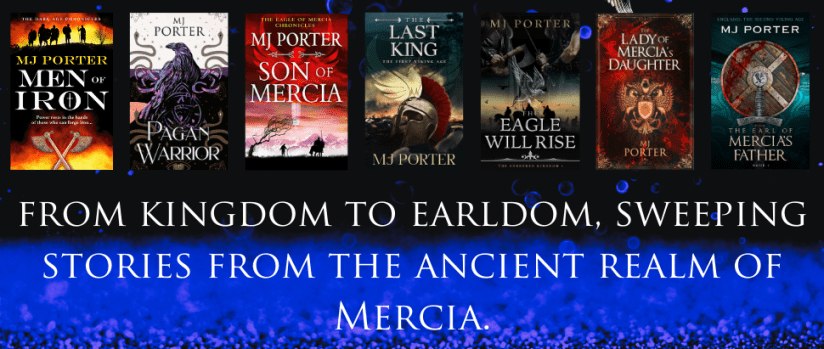
I’m excited to share the cover for Warriors of Iron, the second book in the Dark Age Chronicles Trilogy #newrelease #WarriorsOfIron #histfic

It’s happy release day to Men of Iron, the first book in the Dark Age Chronicles Trilogy #newrelease #MenOfIron #histfic

Listen to me waffle about it.

Here’s the beauty

Image shows the book cover for Warriors of Iron by hstorical fiction author MJ Porter

Preorder Link (releases 13th July)

books2read.com/WarriorsofIron

Here’s the blurb

During Britannia’s tribal age only the strongest prevail…

Britain AD541

Seeress Meddi has been restored to her rightful position of influence within the Eorlingas tribe. But a heavy cloud hangs over the tribe’s survival with the escape of the treacherous Elen who seeks to exact a bloody vengeance following Meddi’s reinstatement and her downfall.

Meddi knows Elen will return to settle the blood feud and the tribe must be ready to face this deadly threat with iron. They must toil day and night to harness the power of the lost magiks to make the weapons needed to overpower Elen.

Meanwhile, Wærmund, a warrior of Saxon descent, has escaped his enforced captivity and vows vengeance against his captors. He too hungers for the promise of sharp blades and travels West to find those who can fashion iron into blades sharp enough to kill. But when a lone woman befriends the band of warriors, promising him even more than that, he’s beguiled by her tale of deceit amongst her own tribe, so reminiscent of his own.

Unbeknown, Meddi and Wærmund share a common enemy and one who is just as belligerent as they are…

Curious about the trilogy? Check out my blog post for more details below

Blog links

https://mjporterauthor.blog/2015/03/28/a-discussion-of-early-anglo-saxon-sources/

Image shows a map of Early England showing the places mentioned in the text of the book
The Dark Age Chronicles Map

Purchase Link for Men of Iron, the first book in the trilogy

books2read.com/Men-of-Iron


Posts

I’m delighted to welcome Paul Bernardi and his new book, Uprising, to the blog #Uprising #HistoricalFiction #AngloSaxon #BlogTour #TheCoffeePotBookClub

I’m delighted to welcome Paul Bernardi and his new book, Uprising, book 2 of the Rebellion series, to the blog.

Here’s the Blurb

Summer 1067.
Northumbria.

Oslac, thegn of the village of Acum, feels cheated – having been robbed of the chance to kill his enemy by his own kinsman.

Instead, Gundulf, the erstwhile Lord of Hexham and murderer of Acum’s villagers, is now awaiting justice for his crimes in Bebbanburh, Earl Oswulf’s fortress capital far to the north.

But when Oslac narrowly escapes death at the hands of Gundulf’s assassin, he realises he will never be safe while the Dane lives. Summoning his closest companions, Oslac heads north to demand Oswulf put an end to Gundulf’s life – only to find the prisoner has escaped.

Tracking the fugitive into the wild hills and dales of Northumbria – places far beyond the reach of Oswulf’s power – Oslac falls into Gundulf’s trap when the earl’s warband is ambushed with catastrophic consequences.

Elsewhere, unrest in the north of England is growing. Impotent in the face of Norman avaricious brutality, the Saxon nobility can do nothing to prevent their ancestral lands being passed to foreign invaders. It can only be endured for so long, and a reckoning is coming.

Once again, Oslac must put aside his personal vendetta to join with the few remaining great lords of Anglo-Saxon England in what may prove to be the final, climactic stand against their Norman overlords.

The song of swords will echo across the land once more.

Buy Link

Universal Link:

This title is available on #KindleUnlimited

Meet the Author

Paul Bernardi studied Anglo-Saxon and Medieval history at the University of Leeds more years ago than he cares to remember. He has been an author of historical fiction since his first novel (a second world war drama) was published in 2017. Since then, he has reverted to his favoured period, publishing six more novels (so far) set in 11th century England, mainly around the time of the Norman Conquest.

Paul Bernardi’s books are published by Sharp Books.

Connect with the Author

Follow the Uprising blog tour with The Coffee Pot Book Club

I’m delighted to spotlight Metropolis by Colin Garrow, a historical crime novel set in Edinburgh #blogtour #histfic

Here’s the blurb

Edinburgh, 1936. People are disappearing. The police are clueless. Can Finlay MacBeth track down the perpetrator before someone else goes missing?

Haunted by his recent past, Professor Finlay MacBeth returns to his home town to take up a new post at the university. Within hours, his reputation for solving the occasional murder prompts the police to ask for his help. Four men—seemingly unconnected—have vanished into thin air. MacBeth must find whatever it is that links the men before the kidnapper strikes again. 

But the police aren’t the only ones interested in MacBeth’s activities, and the amateur sleuth soon discovers that finding the missing men is the least of his problems…

In this thriller series set in Edinburgh, Metropolis is book #1 in the Finlay MacBeth Thriller series.

Book cover for Metropolis by Colin Garrow

Purchase Link

https://geni.us/ps3XiW

Meet the author

Colin Garrow grew up in a former mining town in Northumberland. He has worked in a plethora of professions including taxi driver, antiques dealer, drama facilitator, theatre director and fish processor, and has occasionally masqueraded as a pirate. 

He has published more than thirty books, and his short stories have appeared in several literary mags, most recently in Witcraft, and Flash Fiction North. Colin lives in a humble cottage in Northeast Scotland where he writes novels, stories, poems and the occasional song.

He also plays several musical instruments and makes rather nice vegan cakes.

Author Colin Garrow

Connect with Colin

Check out my reviews for Colin’s other books

Terminal Black

Crucial Black

The Watson Letters

Blood on the Tyne

I’m sharing an excerpt from Tangled in Water by Pam Records HistoricalFiction #Prohibition #Mermaid #BlogTour #TheCoffeePotBookClub 

Excerpt

“Hello there, Nattie, honey,” called Mimi in her honey-sweet voice as she popped out of the door behind the curtains. 

Mimi wasn’t much older than the chorus line girls. She was like a big sister, looking out for them, scolding and nagging, doing her part to make the performances alluring. Mimi liked to say “alluring,” and then she would do a mouth pucker and put one hand on her hip and the other in the air with her wrist cocked like she was holding a bunch of potatoes. Nattie only made the mistake of mocking her once. 

Mimi had been a model when she was very young, or so she said. That was hard to imagine. She walked like a penguin on stubby short legs. And she wore glasses, big round frames that made her look like an owl. If Antonio was around, she took them off, an interesting fact to ponder. Just like the come-and-go French accent. Mimi lack conviction. 

The game’s exhausting, isn’t it, Mimi? You have to breathe it, Mimi. Be it. Look at me. I bleed turquoise. Piss magenta. Fart like a flounder.    

Today, Mimi was carrying a stack of costumes over her arm, all neatly repaired, booze stains laundered, ready to be delivered backstage. Nattie could see long white gloves with buttons and black lace and see-through fabrics with tassels and snaps for flinging off and dropping on the stage. 

Ba-da-boom. Hey, baby. 

Sometimes the girls ripped too hard. Or the men.

Ba-da-boom. Take it off, baby.

Snaps had to be reattached, tears stitched up or patched. Mimi, the penguin seamstress, made the inconvenient flaws go away so they could come back again. And again. Maybe she needed stronger thread, maybe wires reinforced with defiance. Or electricity. Wouldn’t that be a hot, sizzling hoot?

“Nattie, have you brushed that hair of yours this week?” asked Mimi, hand on hip, her mouth all puckered. “My God. And to think I have a new crown for you to wear. A gift. Real jewels. And I have to bobby pin it to that rat’s nest?” The woman shook her head. No accent needed for that. 

Here’s the blurb

1932. Natalia is 16 and a bootlegger’s daughter, playing the mermaid mascot on a rundown paddlewheel used to entertain brewers and distributors. 

A sequined costume hides her scarred and misshaped legs, but it can’t cover up the painful memories and suspicions that haunt her. An eccentric healer who treats patients with Old Country tonics, tries to patch wounds, but only adds to the heartache. A fierce storm threatens to destroy everything, including a stash of stolen jewels. 

1941. Prohibition is over, but the same henchmen still run the show. Nattie’s new mermaid act is more revealing, with more at risk. When the dry-docked paddlewheel is bought by the US Navy for training exercises, the pressure escalates further. 

Can Nattie entice a cocky US Navy officer to help her gain access to the ship for one last chance to confront her past, settle scores, and retrieve the hidden loot? Is there a new course ahead?

Buy Links

Ebook

Paperback

Hardcover

Meet the author

Pam and her husband, Mark, recently uprooted from the Midwest to move to Savannah, Georgia, the perfect place for enjoying the beach, historic architecture and Spanish moss. 

She’s recently retired from writing content for software companies and now focuses on writing fiction, camping, and exploring historic cities.

Pam is the author of three historic novels. 

Connect with the author

Follow the Tangled in Water by Pam Records blog tour with The Coffee Pot Book Club

Posts

I’m welcoming the Boy with Wings by Mark Mustian to the blog, with a fab post about historical research LiteraryFiction #HistoricalFiction #BlogTour #TheCoffeePotBookClub

Historical research for BOY WITH WINGS

Boy With Wings is set mostly in northern Florida, where I’ve lived all my life, and as such I had some familiarity with the historical predicate of the story, but not all of it. I knew almost nothing about sideshows, or “freaks,” which necessitated quite a bit of research on the subjects.

People have asked where the idea to write the book came from, and I tell them that perhaps it was from attending the North Florida Fair as a child and seeing “The World’s Smallest Horse” or the “Wild Man from Borneo.” Somewhere along the way I saw the 1932 Tod Browning movie “Freaks,” and this spawned more interest. When I told my agent I was thinking of writing a novel that delved into this area, he asked if I’d read the novel Geek Love, which I hadn’t, and did. This spawned more research.

There are a number of books cataloguing human oddities that were helpful to bring an understanding of this arena, including Freak Babylon by Jack Hunter and American Sideshow by Marc Hartzman. Eventually I found the book Truevine, by Beth Macy, which sets forth the story of the albino brothers sold into the circus who became known as Eko and Iko, billed as sheep-headed wonders from Mars. I learned a lot from these books, including the fact that for some, including Eko and Iko, their lives became perhaps better than if they’d remained at home.

I also discovered the book Freaks, by Leslie Fiedler, an examination of what attracts us psychologically to human oddities, and the documentary “Sideshow: Alive on the Inside,” by Lynn Dougherty. One of the most insightful finds, though, was a biography of a gentleman named Ward Hall, who for fifty years ran sideshows across the United States. After my book was published, I did several appearances with the current sideshow performer Short E. Dangerously, who paid me one of the highest compliments a historical fiction writer can receive when he told me that I “nailed what it was like to be in a sideshow” and asked me about my research. When I told him about the Ward Hall book, he exclaimed: “I knew it! I was in a Ward Hall show for several years!”

I had a little general knowledge of turpentine camps, as I remember as a child passing rows of pine trees with little tin pans affixed to their trunks. The research in this area involved locating pamphlets and books describing such operations, and a visit to the Florida Forest Capital Museum State Park in Perry, Florida, where displays show how turpentine is extracted from trees and distilled.

Some have asked why I set the novel in the 1930s, and what I research I conducted regarding the Great Depression. I wanted the story to take place at a time things were changing, in some ways for the better and others ways not. By the 1930s, sideshows had seen their heyday and were starting to phase out. The South was still segregated, but cracks were beginning to show in that, too. In the book, I have the show admitting Blacks for the first time in an attempt to garner more revenue. I did quite a bit of research on places, events and language of the time, as I wanted the reader to feel like she or he was there, reading old newspapers, seeing small towns and their quaintness and prejudices, experiencing the people and their foibles that are in some ways not unlike those today. That’s to me what the best historical fiction accomplishes, and I hope I’ve come close to achieving it. 

Here’s the blurb

 “A brilliant fever dream of a novel, a haunting coming of age story reminiscent of both Franz Kafka and Charles Dickens.”

~ Chris Bohjalian, #1 New York Times Bestselling Author of The Jackal’s Mistress

*Next Generation Indie Book Awards 2025 First Place Winner*

What does it mean to be different? 

When Johnny Cruel is born with strange appendages on his back in the 1930s South, the locals think he’s a devil. Determined to protect him, his mother fakes his death, and they flee. Thus begins Johnny’s yearslong struggle to find a place he belongs. 

From a turpentine camp of former slaves to a freak show run by a dwarf who calls herself Tiny Tot and on to the Florida capitol building, Johnny finds himself working alongside other outcasts, struggling to answer the question of his existence. Is he a horror, a wonder, or an angel? Should he hide himself to live his life? 

Following Johnny’s journey through love, betrayal, heartbreak, and several murders, Boy With Wings is a story of the sacrifices and freedom inherent in making one’s own special way-and of love and the miracles that give our lives meaning.

Buy Link

https://books2read.com/u/mdxEoR

Meet the author

Mark Mustian is the author of the novels “The Return” and “The Gendarme,” the latter a finalist for the Dayton International Literary Peace Prize and shortlisted for the Saroyan International Award for Writing. It won the Florida Gold Book Award for Fiction and has been published in ten languages. 

The founder of the Word of South Festival of Literature and Music in Tallahassee, Florida, his new novel, “Boy With Wings,” is out in 2025.

Connect with the author

Follow the Boy with Wings Blog Tour with The Coffee Pot Book Club

Posts

I’m delighted to welcome Janet Wertman and her new book, Nothing Proved, to the blog #HistoricalFiction #TudorFiction #ElizabethTudor #BlogTour #TheCoffeePotBookClub

I’m delighted to welcome Janet Wertman and her new book, Nothing Proved, to the blog with a guest post.

Guest Post

Thank you for having me on your blog to talk about my historical research, though I feel a little guilty given how much more information I have available to me than you do! The Tudor Era really marks the beginning of careful documentation of the historical record – and it’s all carefully indexed. The touch of a button opens the records of the Privy Council, writings of ambassadors, details of state trials. I can examine floorplans of castles and paintings of gardens long gone, I can watch videos of hawking parties and court dances, listen to period music played on antique instruments. But that much bounty can actually be overwhelming, so I focus my research in predictable thematic waves to get the narrative where it needs to be.  

As my very first step with a new story, I start with books, or rather, I have always started with books and I am working on a way to do so again. I lost some amazing volumes in the January fires – things like The Social History of Lighting, Lady Hoby’s Diary, Conyers Read’s two-volume biography of William Cecil, and a host of other biographies, all of which told slightly different versions of the history. That’s the toughest part about researching: the inconsistent reports, the unreliable biographers. Of course, that can also be a bit of a hall pass for an author!

Anyway, once I have an idea what my story will be, I start to assemble dates into a detailed timeline, cherry-picking the ones I intend to use or need to keep in mind, and jotting down notes. From that, I outline the actual novel, date-stamped to keep me honest. Then the writing, which sends me down mid-course rabbit holes for scene-level information: the where, the why, the time of day – and an understanding of the relevant political context: that’s where letters come in. Any letter will have something to recommend it, but ambassadors’ letters are usually a goldmine. When I was writing The Boy King, I happened upon one relating how Edward VI plucked a dead falcon as a warning to his Council…yes I used that. Did I know that a similar rumor once surrounded Charles V? Yes, but again, the source gave me a hall pass…

Beyond that comes the truly granular part of the research, taking me back to books and websites and everything in between. The descriptions of Elizabeth’s clothes and dresses were helped along by Queen Elizabeth’s Wardrobe Unlock’d, an amazing resource that assembles inventories of the Wardrobe of the Robes, descriptions of the royal artificers, the different fashion styles and fads, and so much more. Descriptions of small household furnishings were invented with reference to the New Year’s Gift Exchanges 1559-1603, another rabbit hole to mine. Of course, sometimes the warrens are empty. Back in The Path to Somerset, I needed to show Henry closeted at Oatlands after learning about Catherine Howard’s infidelities. I wanted to find the period equivalent of him sitting in his bathrobe eating ice cream from the tub. It was easy enough to find the sumptuary laws that justified a silk night robe with a black jennet lining…but apparently he would have been scooping whale blubber and that would have required too much explanation to use. Instead, I had to simply give him empty wine goblets and a tray of half-eaten food.

I will say, for the early part of Nothing Proved, I run into a bit of your problem (and the problem of any other writer of Saxon England): few sources that mention my main character, and none that really show her interacting with her closest friends…so my initial task was to cross-reference the official records of Elizabeth’s doings with those of the other people in her orbit and come up with the intersections that the story required.  I knew that Robert Dudley was keeper of Somerset House while it was in her use, I knew that William Cecil began to work for her just a month after a significant wedding they both would have attended, and so I was able to capture the depth of their respective relationships. In the end, big and small all come together. That is the beauty of research done right.

Here’s the Blurb

Danger lined her path, but destiny led her to glory…

Elizabeth Tudor learned resilience young. Declared illegitimate after the execution of her mother Anne Boleyn, she bore her precarious position with unshakable grace. But upon the death of her father, King Henry VIII, the vulnerable fourteen-year-old must learn to navigate a world of shifting loyalties, power plays, and betrayal.

After narrowly escaping entanglement in Thomas Seymour’s treason, Elizabeth rebuilds her reputation as the perfect Protestant princess – which puts her in mortal danger when her half-sister Mary becomes Queen and imposes Catholicism on a reluctant land. Elizabeth escapes execution, clawing her way from a Tower cell to exoneration. But even a semblance of favor comes with attempts to exclude her from the throne or steal her rights to it through a forced marriage. 

Elizabeth must outwit her enemies time and again to prove herself worthy of power. The making of one of history’s most iconic monarchs is a gripping tale of survival, fortune, and triumph.

Buy Link

Universal Link:

Meet the Author

By day, Janet Wertman is a freelance grantwriter for impactful nonprofits. By night, she writes critically acclaimed, character-driven historical fiction – indulging a passion for the Tudor era she had harbored since she was eight years old and her parents let her stay up late to watch The Six Wives of Henry VIII and Elizabeth R.

Her Seymour Saga trilogy (Jane the Quene, The Path to Somerset, The Boy King) took her deep into one of the era’s central families – and now her follow-up Regina series explores Elizabeth’s journey from bastard to icon.

Janet also runs a blog (www.janetwertman.com) where she posts interesting takes on the Tudors and what it’s like to write about them.

Connect with the Author

Follow the Nothing Proved blog tour with The Coffee Pot Book Club

I’m delighted to spotlight This Ruined Place by Michael Lawrence #blogtour #histfic #WW2

Here’s the blurb

Evy Miller thinks a summer with her grandparents in sleepy Dorset will be painfully dull. Her suspicions are confirmed when Juby, a wild-haired, lanky old man, strolls through her grandparents’ doorway. At first, she thinks he’s nothing more than an odd duck who charms her grandmother and annoys her grandfather. The last thing she expects is to become his companion on visits to the small village of Rouklye, whose entire population was evicted during WWII. 
She has no idea that the reason for Juby’s visits will become a defining moment in her life and change her understanding of history and her own family forever.

 Purchase Link 

https://books2read.com/u/bwBNZy

Meet the author

MICHAEL LAWRENCE has written and published a great many books, but he’s done a few other too. For instance, after leaving art school he began training as a graphic designer in a London studio before morphing into a photographer. As a photographer he took pictures for advertising agencies, publishers and newspapers, of pop stars and politicians, of fashion models and underwear, and many other kinds of people and things besides. He also worked in a travelling circus for a little while, and has been an antiques dealer, co-owned two art galleries, and made hundreds of paintings, drawings and experimental digital images. One of his private joys is recording songs (many of which he’s written) under the alias Aldous U.

As a writer he’s won the odd award, had books translated into twenty or so languages (one of which – ‘Young Dracula’ – was the inspiration for five BBC-TV series), has shuffled onto stages at literary festivals, and been interviewed on TV and radio. ‘There’s more,’ he says, ‘but I don’t want to bore you. There’s a lot of me in the Rainey novels, but I’m not saying which bits.’

Connect with the author

Posts

I’m spotlighting Troubled Times for Tilly by Kay Seeley #histfic #saga #blogtour #competition

Here’s the blurb

A gripping saga of courage, resilience and fractured dreams, set in Victorian London.

Life on the river has never been easy for Tilly and Sam, but through hard work and determination, they’ve built a home filled with love. Joey, Tilly’s eldest son, has lived between two worlds—cherished as her child but granted privileges, denied to her other children, through his wealthy birth father’s family. It’s a fine balance that has always held… until an incident at a glittering Celebration Ball shatters the fragile harmony.

Tilly fears the consequences, especially when her spirited, headstrong daughter Martha is involved. Martha has ideas of her own. How will she fare when she faces Joey’s entitled friends and their easy lives?

Disaster strikes Sam’s business, shaking the family’s foundation. Tilly’s worst fears come to life when Joey’s affluent relatives start making plans to reclaim him. Tilly is torn between fighting for her son and respecting his dreams.

As old wounds reopen and new temptations arise, Tilly must summon all her strength to keep her family together. But will love and loyalty be enough, or will the promise of wealth and comfort lure her children away forever?

A Powerful follow-up to The Water Gypsy.  Perfect for fans of Anna Jacobs and Dilly Court

Purchase Link

https://mybook.to/TTfT

Meet the author

Kay Seeley is a talented storyteller and bestselling author. Her short stories have been published in women’s magazines and short-listed in competitions. Her novels had been finalists in The Wishing Shelf Book Awards. She lives in London and loves its history. Her stories are well researched and beautifully written with compelling characters where love triumphs over adversity.  Kay writes stories that will capture your heart and leave you wanting more. Often heart-wrenching but always satisfyingly uplifting, her books are perfect for fans of Anna Jacobs, Lesley Pearse and Josephine Cox. 

Kay is a Member of The Alliance of Indie Authors and The Society of Women Writers and Journalists. 

All her novels are available for Kindle, in paperback, audio and in Large Print

Connect with the author

Giveaway to Win 3 x paperback copies of Troubled Times for Tilly by Kay Seeley (Open to UK only)

*Terms and Conditions –UK entries welcome.  Please enter using the Rafflecopter box below.  The winner will be selected at random via Rafflecopter from all valid entries and will be notified by Twitter and/or email. If no response is received within 7 days then Rachel’s Random Resources reserves the right to select an alternative winner. Open to all entrants aged 18 or over.  Any personal data given as part of the competition entry is used for this purpose only and will not be shared with third parties, with the exception of the winners’ information. This will passed to the giveaway organiser and used only for fulfilment of the prize, after which time Rachel’s Random Resources will delete the data.  I am not responsible for despatch or delivery of the prize.

http://www.rafflecopter.com/rafl/display/33c69494614/?

Posts

I’m delighted to welcome Wendy J.Dunn and her new book, Falling Pomegranate Seeds: The Katherine of Aragon Story, to the blog #HistoricalFiction #TudorFiction #KatherineOfAragon #Duology #BlogTour #TheCoffeePotBookClub

I’m delighted to welcome Wendy J.Dunn and her new book, Falling Pomegranate Seeds: The Katherine of Aragon Story, to the blog with a snippet.

Snippet

Furious, Ahmed bounded up from the cushions and stood over her. “Why doesn’t she write and tell me that now? My father writes to me but my mother, never.”

Beatriz bent towards him. “My prince, your father always writes a message from your mother.”

Sitting again beside her, Ahmed’s lower lip trembled. “A few words – that the king, my father, includes for her.”

Gathering her thoughts, Beatriz gazed at the book on her lap before eyeing Ahmed again. “Your mother would write if she was able. Do not fall into the mistake of believing what you see at Queen Isabel’s court is the same elsewhere. Dear prince, not all women know how to write.”

From The Duty of Daughters

Here’s the Blurb

In the Falling Pomegranate Seeds Duology, readers are transported to the rich historical tapestry of 15th and 16th-century Europe, where the lives of remarkable women unfold against the backdrop of political upheaval and personal struggles.

In the first book, beginning in 1490 Castile, Doña Beatriz Galindo, a passionate and respected scholar, serves as an advisor to Queen Isabel of Castile. Beatriz yearns for a life beyond the constraints imposed on women, desiring to control her own destiny. As she witnesses the Holy War led by Queen Isabel and her husband, King Ferdinand of Aragon, Beatriz dedicates herself to guiding Queen Isabel’s youngest child, Catalina of Aragon, on her own path. Beatriz’s role as a tutor and advisor becomes instrumental in shaping Catalina’s future as she prepares to become England’s queen.

Fast forward to the winter of 1539 in the second book, where María de Salinas, a dear friend and cousin of Catalina (now known as Katherine of Aragon), pens a heartfelt letter to her daughter, the Duchess of Suffolk. Unable to make the journey from her London home due to illness, María shares her life story, intricately woven with her experiences alongside Catalina. Their friendship has endured through exile and tumultuous times. María seeks to shed light for her daughter on the choices she has made in a story exploring themes of friendship, betrayal, hatred, and forgiveness. Through María’s narrative, the eternal question Will love ultimately triumph?

Buy Link

Universal Link

Meet the Author

Wendy J. Dunn is an award-winning Australian writer fascinated by Tudor history – so much so she was not surprised to discover a family connection to the Tudors, not long after the publication of her first Anne Boleyn novel, which narrated the Anne Boleyn story through the eyes of Sir Thomas Wyatt, the elder.

Her family tree reveals the intriguing fact that one of her ancestral families – possibly over three generations – had purchased land from both the Boleyn and Wyatt families to build up their own holdings. It seems very likely Wendy’s ancestors knew the Wyatts and Boleyns personally.

Connect with the Author

Follow the Falling Pomegranate Seeds blog tour with The Coffee Pot Book Club
Posts