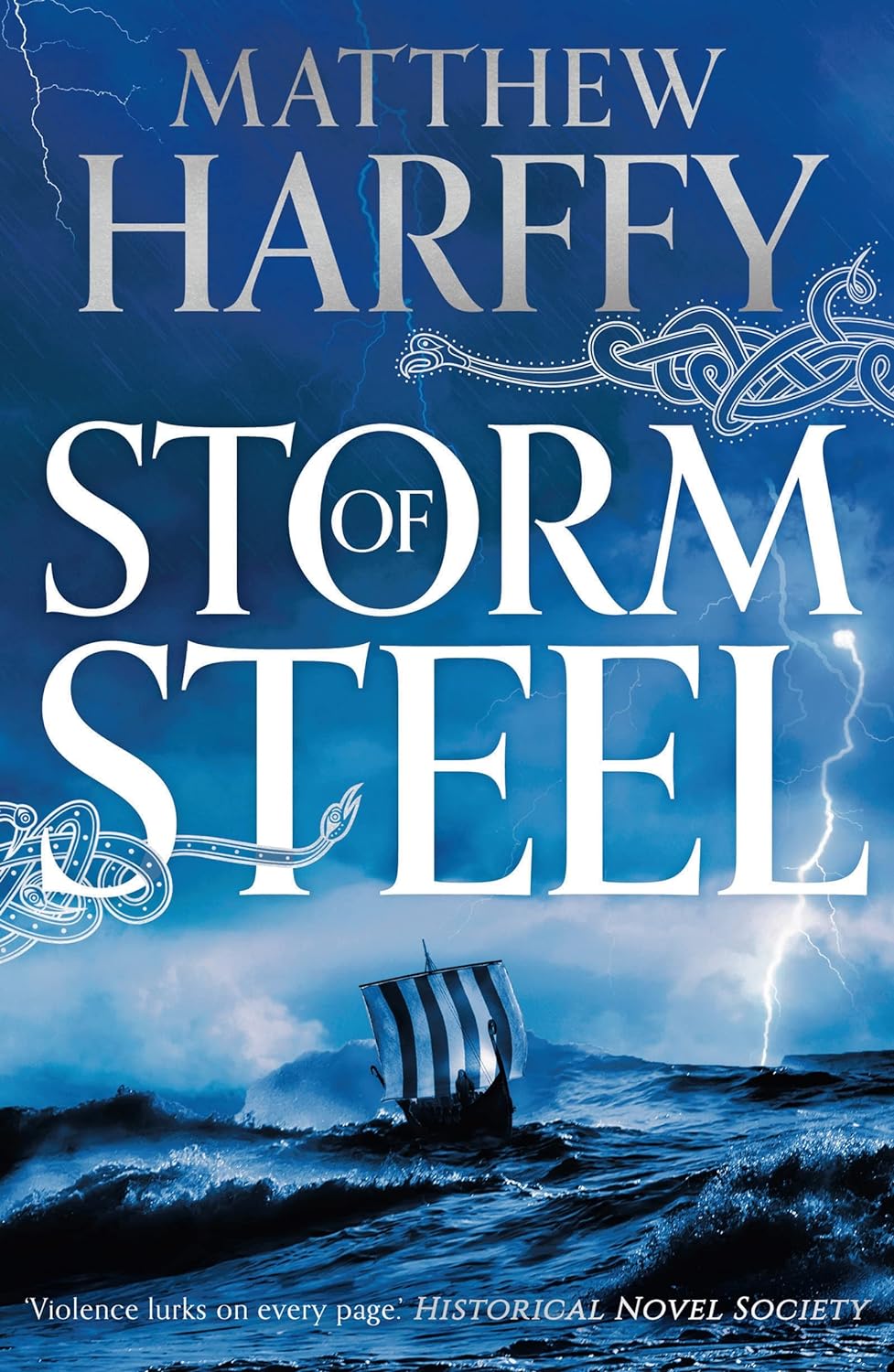
Book Review – Kin of Cain by Matthew Harffy

Here’s the blurb;

“630 AD. Anglo-Saxon Britain. A gripping, action-packed historical novella set in the world of The Bernicia Chronicles. Perfect for fans of Bernard Cornwell. 

Winter grips the land in its icy fist. Terror stalks the hills, moors and marshes of Bernicia. Livestock and men have been found ripped asunder, their bones gnawed, flesh gorged upon. People cower in their halls in fear of the monster that prowls the night.

King Edwin sends his champion, Bassus, with a band of trusted thegns, to hunt down the beast and to rid his people of this evil.

Bassus leads the warriors into the chill wastes of the northern winter, and they soon question whether they are the hunters or the prey. Death follows them as they head deeper into the ice-rimed marshes, and there is ever only one ending for the mission: a welter of blood that will sow the seeds of a tale that will echo down through the ages.”

I received a free E-Arc from Netgalley.

Kin of Cain is a short story written in the same ‘universe’ as the Bernicia Tales. However, it is set some time previous to the first novel (I think 2 or 3 years) and this, for me is a very good thing because (spoiler ahead) it means that grumpy Beobrand has not yet made an appearance and instead the story focuses on his brother and a few of the other main characters, most notably Bassus. As such, it is much lighter in tone than the Bernician Chronicles and a far easier read. The story flows very well and if I’m slightly perplexed about where the ‘marsh’ and the ‘cliff face’ is in North Northumberland, I’m sure that someone will let me know soon enough. I do have a thing about only visiting sandy beaches for my walks and this might be my own oversight. (I’ve now been told it’s Dunstanburgh not Bamburgh area and this makes a whole lot more sense as there are massive cliffs at Dunstanburgh populated by a whole flock of seabirds).

The ‘monster’ is well portrayed as is the solving of the mystery of where it is and what it is.

I hadn’t realised that the author was offering a possible retelling of a very famous Anglo-Saxon story until the very end when it was made abundantly clear, as I think the story works very well on its own.

I’m sure fans of the Bernicia Chronicles will enjoy the story. I certainly did, and I do hope that the author considers more side-stories that focus on the other characters of his ”universe’ as opposed to Beobrand (hint hint, pretty please).

Book Review -The Riviera Express by T.P. Fielden

Here’s the blurb;

“Murder on the Riviera Express

Gerald Hennessey – silver screen star and much-loved heart-throb – never quite makes it to Temple Regis, the quaint Devonshire seaside town on the English Riviera. Murdered on the 4.30 from Paddington, the loss of this great man throws Temple Regis’ community into disarray.

Not least Miss Judy Dimont –corkscrewed hair reporter for the local rag, The Riviera Express. Investigating Gerald’s death, she’s quickly called to the scene of a second murder – setting off on her trusty moped, Herbert, she finds Arthur Shrimsley in an apparent suicide on the clifftops above the town beach.

Miss Dimont must prevail – for why was a man like Gerald coming to Temple Regis anyway? And what is the connection between him and Arthur? And just how will she get the answers she wants whilst under the watchful and mocking eyes of her infamously cantankerous Editor, Rudyard Rhys?”

I received a free E-Arc from Netgalley.

The Riviera Express is, quite simply, a very good read. The author does have a particular writing style which initially threw me and I worried that the novel would be a hard read, however, after only a few pages, I was used to the writing style, and while many might not appreciate the ‘wordiness’ the author choices to use, I found it fit very well with the novel.

The characters are nuanced and a little stereotypical, but then, that really is the point. It is Miss Dimont who is the star of the show and she receives the most back-story and is the least stereotyped, shortly followed by her fellow newspaper colleagues – the photographer, Terry, and her main rival/friend at the newspaper, Betty. The author also captures the essence of a 1950’s seaside town – the busy-bodies, the small mindedness, the general nosyness of everyone knowing everyone else’s business and the stresses and strains of keeping everyone happy within the small community that wants a localnewspaper but only if everyone is presented in their best light.

And yet into all this comes a little bit of glamour provided by one of the murder victims and his entourage. The author does a very good job of presenting the actors as actors – ensuring that their dramatic moments are always referenced to the film/play that they’ve stolen their lines from and juxtaposing the strange and magical world of actors to the more mundane events of life in a seaside town where the summer season has just ended.

The mystery that Miss Dimont finds herself unravelling, earns as much ‘spread’ as the development of the characters and the venue, which I’m sure will feature in more books in the future, and ends rather well with not so much a twist, as an unlooked for answer to all the questions.

Overall I would recommend this to anyone who enjoys a historical novel with the added bonus of intrigue.

(I am a fan of historical who-dun-its be it Sherlock Holmes, Marple, Poirot, or my latest find – The Phryne Fisher books).

And you can buy the book from 23rd February from here:

I’m reviewing the Dark Days Pacts by Alison Goodman (Book 2 in the Dark Days Club) #histfic #historicalfantasy #bookreview #YA

Here’s the blurb

“June 1812. Just weeks after her catastrophic coming-out ball, Lady Helen Wrexhall—now disowned by her uncle—is a full member of the demon-hunting Dark Days Club. Her mentor, Lord Carlston, has arranged for Helen to spend the summer season in Brighton so that he can train her new Reclaimer powers. However, the long-term effects of Carlston’s Reclaimer work have taken hold, and his sanity is beginning to slip. At the same time, Carlston’s Dark Days Club colleague and nemesis will stop at nothing to bring Helen over to his side—and the Duke of Selburn is determined to marry her. The stakes are even higher for Helen as she struggles to become the warrior that everyone expects her to be.”

Cover image for The Dark Days Pact by historical fiction author Alison Goodman

My Review

The Dark Days Pact doesn’t suffer from a lack of intrigue and action. Far from it. Whereas The Dark Days Club was a little slow to get going – the author needing to show just how constrained society was for women at this period – Book 2 neatly sidesteps the problem by having Lady Helen learning to walk and talk just like a man. Indeed the descriptions of her being dressed as both a man and a woman, highlight just how ridiculous fashion was during the Georgian period.


As soon as that’s been accomplished, Lady Helen finds herself caught in the middle of a number of different intrigues as she tries to please everyone, and initially, fails quite magnificently.
If anything, my only slight problem with the novel is the Duke of Selburn, who quite simply, gets in the way time and time again. As others have mentioned – you can’t help wondering if he is The Great Deceiver but that is not answered in this novel, and possibly won’t be for a good few to go.
Bring on Book 3!

This is a Young Adult book, but I was drawn to the first novel because of its historical setting – the early 1810s. The author provides a fascinating glimpse of high society at the time and manages to weave contemporary events into the story in a deft fashion. I hoped it would amuse my own Young Adult in the family who is a huge fan of the Shadowhunters series (I prefer the series set in Victorian London), and it worked its magic, so much so, that Pride and Prejudice and Zombies is now being read. As such, I think it appeals to those who like historical fiction with a slight twist, and also the younger generation, although some of the words are a little strange, and I did have to point out that there was a dictionary on the Kindle to look up what the words meant. Some of the storyline is also a little risque for the younger of the young adults but on another level, it works to highlight how much has changed in society in the last two hundred years and how much more accepting today’s world is of, well, almost everyone!

You can buy it here, but read Book 1 first!

I’m reviewing Ruddy Gore by Kerry Greenwood, a Phyrne Fisher mystery #histfic #bookreview #mystery

Here’s the blurb

“Running late to a gala performance of Gilbert and Sullivan’s Ruddigore, Phryne Fisher meets some thugs in dark alley and handles them convincingly before they can ruin her silver dress. She then finds that she has rescued the handsome Lin Chung, and his grandmother, who briefly mistake her for a deity.
Denying divinity but accepting cognac, she later continues safely to the theatre where her night is again interrupted by a bizarre death onstage.

What links can Phryne find between the ridiculously entertaining plot of Ruddigore, the Chinese community of Little Bourke St., or the actors treading the boards of His Majestys Theatre?”

Cover image for Ruddy Gore by Kerry Greenwood, a Phryne Fisher mystery

My Review

Netflix keeps suggesting that I watch the TV series of these books and so I was pleased to be offered the opportunity to read a free E-Arc in exchange for a review from Netgalley.

So, I knew that this was a period piece and I do love a good mystery and I wasn’t disappointed. The writing style is light and infectious (if occasionally a little muddled with Gilbert and Sullivan quotes – something I’m not very familiar with), and the characterisation of Miss Fisher is excellent. It didn’t matter that this was book 7 and the first one I was reading.

I very much enjoyed the attention to detail of both being in a theatre and the 1920’s in Australia, as well as the back story in London, and I might just listen to Netflix and give the TV series a view as well.

Would recommend it to all those who like a good period piece who have done it.

Check out my review for Blood and Circuses.


I’m reviewing Blood and Circuses by Kerry Greenwood, a Phyrne Fisher mystery #histfic #mystery #bookreview

Here’s the blurb

“Phryne Fisher is bored. Life appears to be too easy, too perfect. Her household is ordered, her love life is pleasant, the weather is fine. And then a man from her past arrives at the door. It is Alan Lee from the carnival. Alan and his friends want her to investigate strange happenings at Farrells Circus, where animals have been poisoned and ropes sabotaged. Mr. Christopher has been found with his throat cut in Mrs. Witherspoon s irreproachable boarding house and Miss Parkes, an ex-performer, is charged with his murder.Phryne must go undercover deeper than ever to solve the circus malaise. She must abandon her name, her title, her protection, her comfort, even her clothes. She must fall off a horse twice a day until she can stay on. She must sleep in a girls tent and dine on mutton stew. And she must find some allies.Meanwhile, in Melbourne, the young and fresh-faced policeman Tommy Harris has to solve his own mysteries with the help of the foul-spoken harridan Lizard Elsie, or Miss Parkes will certainly hang. Can Phyrne uncover the truth without losing her life?”

Book cover for Blood and Circuses by Kerry Goodwood, a Phryne Fisher mystery

My Review

This is the second Phryne Fisher book I’ve read (and I’m now addicted to the TV series as well), and I found I enjoyed it much more than the first. This is probably because I’m used to the characters from the TV series. That said, I also think it’s an easier read than the first book I read, which was Ruddy Gore.

The book flows well, although I did notice that by the time the real work of solving the mystery was underway, I was 80% through the novel, and as such, it seems that solving the mystery is of secondary importance to the story of the circus and the attendant ‘hanger-on’s’. A fair portion of the novel is also concerned with the investigation taking place by the police and concerned with the gang warfare – and this rounds out the story nicely, but means that we spend less time with Phryne than you might expect.

Overall – an enjoyable jaunt set in the late 1920s in Australia.

For those who’ve not watched the TV series, or read one of the books, a little more information. Phyrne Fisher is a very elegant lady of the 1920s, but with a penchant to get involved in some quite grizzly murders that the Police can’t solve without her help. She is a confident woman, not the youngest, but because she came into her money later in life, she both appreciates it and flaunts it to equal measure. That being said, it’s difficult not to find her no-nonsense approach to everything life can throw at her invigorating and to enjoy reading about Australia at the same time.

I’ve long been a fan of a really good period piece who done it. I’m never happier than with a good Marple or my firm favourite, Poirot, and I can’t help wondering what the esteemed gentleman would think of the slightly more risque Phryne Fisher. (If you decide not to read the books, please give the TV series a chance – it’s a grower and slightly addictive).


I’m reviewing Blood and Blade by Matthew Harffy #histfic #bookreview

Here’s the blurb

“635AD. Anglo-Saxon Britain. A gripping, action-packed historical thriller and the third instalment in The Bernicia Chronicles. Perfect for fans of Bernard Cornwell. 

Oswald is now King of Northumbria. However, his plans for further alliances and conquests are quickly thrown into disarray when his wedding to a princess of Wessex is interrupted by news of a Pictish uprising.

Rushing north, Oswald leaves Beobrand to escort the young queen to her new home. Their path is fraught with danger and uncertainty, Beobrand must try to unravel secrets and lies if they are to survive.

Meanwhile, old enemies are closing in, seeking brutal revenge. Beobrand will give his blood and blade in service to his king, but will that be enough to avert disaster and save his kith and kin from the evil forces that surround them?”

Cover image for Blood and Blade by historical fiction author Matthew Harffy

My Review

Blood and Blade by Matthew Harffy is the third book in his Bernicia Chronicles following the exploits of his, quite frankly, bad-tempered warrior, Beobrand. He’s no hero – he’s too self-involved, grumpy and lacks any likeable characteristics, even though the author is at pains to explain this away due to the tragedies that have befallen him in Book 2.

However, these do not excuse the foul natured monster that Beobrand has become, and I did struggle to understand why any man, or woman, would want to spend any time with him or rely on him in his guise as a warrior or a lover. He is, quite simply, lacking in any likeable qualities, without even the spark of any humour to soften his harshness, no matter how often Athelstan tries to recount his exploits in the mead hall and make them appear heroic, it simply does not work for me.

The constant shifts in point of view in chapters is annoying, but this is something that I personally don’t understand or like in any novel so it’s not a particular complaint about this author. I’m always left feeling that if the chapter needs a shift in POV then it’s either not a chapter and needs splitting, or the author needs to approach this part of the novel in a different way – give the voice of the story to a different member of the cast.

The storyline of Blood and Blade is somewhat simplistic, and you do reach a certain part of the novel and know exactly what has to happen before it reaches its end. Nothing unexpected happens to bring the novel to its conclusion. This is somewhat of a shame. I would have liked even the idea of a different ending.

The author is at pains to show society, as he perceives it, at this time, and the insistence on the small details is repetitive, as is the constant recounting of Beobrand’s aches and pains, recovering wounds and new ones that he receives.

I would reiterate that Beobrand is no hero, but neither is he an antihero. He’s been thrust into a very exciting time in history, and yet it seems that, with his constant moaning and complaining, he has no appreciation of this and is never likely to. For a young man, he often appears to be about 100 years old.

On a final note. I still do not like the way the author treats women of this period. They are either witches, bed companions, or someone else’s bed companions and are presented as petty and mean to each other. This might be a novel about a (very) grumpy warrior, but Saxon women were and should be given the place in society that they earned and deserved. Much of this is, obviously, to do with the author’s interpretation of this period, and I suppose, it is worth remembering that it is a work of fiction and not fact. Still, this is also a shame and I hope, something, that is corrected in later books to allow the author to reach a wider fan base.

Overall, the novel was enjoyable to read.


Check out my book review for Ravenspur by Conn Iggulden #histfic #bookreview

Here’s the blurb

Witness the rise of the Tudors in the stunning conclusion to Conn Iggulden’s powerful retelling of the Wars of the Roses. 

‘An utterly compelling page-turner full of historical facts. A fascinating read’ Sun

England, 1470. A divided kingdom cannot stand.


King Edward of York has been driven out of England. Queen Elizabeth and her children tremble in sanctuary at Westminster Abbey. The House of Lancaster has won the crown, but York will not go quietly.

Desperate to reclaim his throne, Edward lands at Ravenspur with a half-drowned army and his brother Richard at his side. Every hand is against them, every city gate is shut, yet the brothers York go on the attack. 

But neither sees that their true enemy is Henry Tudor, now grown into a man. As the Red Dragon – ‘the man of destiny’ – his claim to the throne leads to Bosworth Field and a battle that will call an end to the Wars of the Roses . . .

Cover image for Ravenspur by Conn Iggulden

My Review

Ravenspur, by Conn Iggulden, the fourth book in a series about the Rise of the Tudors, suffers, from the very beginning, with pacing issues and an apparent unease from the author to actually tell the story of the battles of the War of the Roses, even though this novel ‘hooks’ itself onto the important battles of the period, ending with the Battle of Bosworth Field. The author goes to a great deal of trouble to set up each and every battle, and the reader is left wanting greater details of the battle, only for the author to almost gloss over the entire thing and move onto the next chapter in the long-running civil war.

Furthermore, the desire of the author to get to the Battle of Bosworth in this novel means that the novel is uneven – 80% of the novel takes place over the space of a single year, and to all intents and purposes, looks as though it will stop there, only for it to leap forward eleven or twelve years and continue telling its story. It would perhaps have been better to split this novel into two books and allow Richard III a little more time on the throne.

The characters of the period are told with little flare and with absolutely no sympathy for their plight. The main women in the story – Margaret of Anjou and Elizabeth Woodville barely have any pages to themselves and when they do appear it is more often that not only as objects for the male characters of the story to complain about or belittle. And this continues with Richard III’s poor wife.

The male characters of the story are equally presented with little or no understanding of their characters and not a single one of them elicited any sort of emotional response. Edward IV is a swaggering idiot (and fat for quite a bit of it), Earl Warwick is indecisive and stupid, Richard III (or Gloucester) is a simpleton following his brother where ever he takes him and then turning into some sort of possessed maniac, and poor old Edward, son of Margaret of Anjou, just gets to look pretty and make a fool of himself in battle.

Overall, the story moves very slowly, and without any emotional connection with the characters, it is a slog to get to the end, which many will already know. And that’s another problem. With good historical fiction, even the inevitable conclusion is often presented as only one possible outcome, with this novel there is never any (apart from briefly before the Battle of Barnet) moment where I wondered if the author had managed to present a possible alternative, which would ultimately fail, but would still give a little bit of hope to the reader and the characters in the story both. Sadly, I was disappointed with such a drab retelling of the end of the War of the Roses.

The first kings of the ‘English’ – Kings Athelstan and Edmund (924-946) #histfic #non-fiction #Brunanburh

(I’m re-sharing an old post, which I’ve amended slightly and added some new graphics).

England, Wales, Scotland, the smaller kingdoms of Mercia, Wessex, Northumbria, East Anglia, Kent, Powys, Gwynedd, Dal Riada – for the uninitiated (including myself) the sheer number of kingdoms and kings that peopled the period in British history before 1066 can appear as a bewildering display of names, places, times and events, and perhaps never more so than when a historian is trying to sell a book and so makes a statement in their title that applies to that particular king.

Map designed by Flintlock Covers

Phrases such ‘the Golden Age of Northumbria’, ‘the Mercian hegemony’, ‘the rise of Wessex’, they all mask so many events that I find the phrases very unhelpful and perhaps worse, misleading.

I think that Athelstan and his younger half brother, Edmund, probably deserve their titles as Kings of the English. And it’s not just my opinion either. There was, according to Sarah Foot in her book on Athelstan, a concerted effort by the king and his bishops to have him stand apart from his predecessors – to be something ‘different’ to them. They named him king of the English, not king of Mercia (a post he held briefly before another of his younger brothers died) and not king of Wessex, for all that he was both of those things.

They changed his title, they crowned him with a crown, not a helmet. They wanted Athelstan to be something other than his grandfather, King Alfred, and his father, King Edward. It was a bold statement to make, and one they continued when Athelstan died too young and his half-brother, Edmund replaced him. He too was crowned using, it must be supposed, the same Coronation service. (For full details have a peek at Sarah Foot’s book on Athelstan – or read the first few chapters of King of Kings as the service appears in it as well).

So why the change? Essentially the old Saxon kingdoms, for all that they were preserved in the naming of the earls/ealdormens designations, had been swept aside by the Viking raiders. The old kingdoms had become a handy label to apply to certain geographic areas, and the kings of Wessex, whilst keen to hold onto their hereditary titles because of the permanence their own royal line had managed to acquire, were equally as keen to do away with regional boundaries. There was, it can’t be denied, a concerted and almost unrelenting urge to drive any Viking raider or Dane or Norwegian (the Norse) from British soil, and this is what Athelstan and then Edmund were tasked with doing.

Image showing all 4 book covers in The Brunanburh Series

Yet the idea of ‘English’ wasn’t a new concept. Why else would Bede have called his great piece of religious historical writing “The Ecclesiastical History of the English people’, if there hadn’t been a shared consciousness that the people in England, all be it in their separate kingdoms, didn’t have a shared heritage? Why the idea suddenly took flight under King Athelstan could be attributed to a new sense of confidence in Wessex and Mercia at the time. They were confident that they could beat the Viking raiders and they were convinced that England belonged to them.

Or perhaps it was more than that? The destruction wrought by the Viking raiders on the separate kingdoms must have been a stark reminder of just how insular the kingdoms had become, and the Viking raiders showed everyone just how easy it was to run roughshod over the individual kingdoms. Only in unity could the Saxon kingdoms of England survive another onslaught; only with unity could the Saxons hold onto their kingdoms they’d claimed about 500 years before.

It was a message that was learned quickly and taken to heart. Athelstan worked to reunite more of the Saxon kingdoms with the growing ‘England’, and he tried to do so by both diplomacy and through war. Yet, the Viking raiders hadn’t finished with England, and nor were they her only enemies. This also lies at the heart of Athelstan’s ‘masterplan’ his treaty of Eamont (if it truly happened – Benjamin Hudson in his Celtic Scotland is not convinced). Athelstan wanted to be a mighty king, but he also wanted England, and the wider Britain (also a concept already understood otherwise why else would that cantankerous monk – Gildas – have called his even earlier work than Bede’s “On the Ruin of Britain?”) to be united in their attempts to repel the Viking raiders. He was a man with a keen vision of the future and it was a vision that his brother continued, with slightly different direction and results.

Family Tree designed by Boldwood Books

The ‘English Kings” saw safety in unity, and of course, an increase in the power they held went hand-in-hand with that.

Yet at no point during the Saxon period can it be said that the emergence of ‘England’ as we know it, was a given certainty. Throughout the period other great kings had tried to claim sovereignty over other kingdoms, but never with any permanence. The earlier, regional kings, were powerful within their own lifetimes and within their own regions. Few, if any, were able to pass on their patrimony complete upon their death. This was a time of personal kingship, and it was only under Athelstan and Edmund that the leap was taken away from this to a more permanent power base.

Not that it was a smooth transition and it did have the side-effect of allowing other men, those not related to the royal family, to evolve their own individual power bases in the old Saxon kingdoms. The ‘English’ kings had to do more than just rule their own kingdom, they had to rule their ealdormen and earls, their warriors, bishops and archbishops. The number of names of kings might start to deplete in the after math of Athelstan and Edmund’s kingship, but in their place spring up more and more powerful men, men that these English kings  had to rely on.

Becoming King of the English was very much a mixed blessing, bringing with it new and greater responsibilities and more, it brought with it the need to expand personal government further, to have a greater persona to broadcast.

Check out The Brunanburh Series page for more details.

The Anglo Saxon Chronicle Entry for 1016 – the beginning of Cnut’s reign

Primary sources are never without problems. They hold bias, they hold perceived bias, but they are, more often than not, an insight into how people perceived an event as soon after it as details are available to the modern historian.

The Anglo-Saxon Chronicle, with it’s many recensions is a fantastic source, but riddled with problems which can, quite often be clearly seen precisely because it survives in different versions.

For the true student, it’s worth investigating the bias of the different ASCs and taking note of them. Over the years a number of approaches have been taken to the ASC starting from when it was just accepted as the source for Saxon England. This means that for a time all the different recensions were amalgamated. Now, the individuality of each recension is truly appreciated, because as with all early sources, quite often, what isn’t said is just as important as what is said.

(The Anglo-Saxon Chronicle also benefits from a latinised version that was written by Ealdorman Æthelweard at the end of the tenth century and this can likewise be used in a similar way as the Old English recensions.)

Yet, for the sake of not infringing anyone’s copyright, when publishing my books and listing information on my websites, I have to rely on the older translations of the ASC as these are the ones I can use freely. Whilst this isn’t ideal, it does allow me to still make a very valid point, and that is this, the entry for the year 1016 (the year Cnut claimed the English kingdom) is vast, and I mean vast. Compared to previous year’s, 1016 is massive. (I’ve copied it below from http://omacl.org/Anglo/part4.html, but this resource seems to have disappeared, but there is another version available here: https://archive.org/stream/anglosaxonchroni00gile/anglosaxonchroni00gile_djvu.txt) if you want to take a look. I am not sure, as I look at this in 2023, which text this refers to, but possible A). Not until 1023 does an entry even half as long as this appear, and I’m starting to consider if this was all a lot of political rhetoric and whether, the entries for previous years have been purposefully shortened, or amended to show the inevitability of Cnut’s accession to the kingdom of the English. I need to do far more research, but as 2015 roles round to 2016, I can’t see a better time to more fully study the time period and this I plan to do next year.

A.D. 1016. This year came King Knute with a marine force of one hundred and sixty ships, and Alderman Edric with him, over the Thames into Mercia at Cricklade; whence they proceeded to Warwickshire, during the middle of the winter, and plundered therein, and burned, and slew all they met. Then began Edmund the etheling to gather an army, which, when it was collected, could avail him nothing, unless the king were there and they had the assistance of the citizens of London. The expedition therefore was frustrated, and each man betook himself home. After this. an army was again ordered, under full penalties, that every person, however distant, should go forth; and they sent to the king in London, and besought him to come to meet the army with the aid that he could collect. When they were all assembled, it succeeded nothing better than it often did before; and, when it was told the king, that those persons would betray him who ought to assist him, then forsook he the army, and returned again to London. Then rode Edmund the etheling to Earl Utred in Northumbria; and every man supposed that they would collect an army King Knute; but they went into Stafforddhire, and to Shrewsbury, and to Chester; and they plundered on their parts, and Knute on his. He went out through Buckinghamshire to Bedfordshire; thence to Huntingdonshire, and so into Northamptonshire along the fens to Stamford. Thence into Lincolnshire. Thence to Nottinghamshire; and so into Northumbria toward York. When Utred understood this, he ceased from plundering, and hastened northward, and submitted for need, and all the Northumbrians with him; but, though he gave hostages, he was nevertheless slain by the advice of Alderman Edric, and Thurkytel, the son of Nafan, with him. After this, King Knute appointed Eric earl over Northumbria, as Utred was; and then went southward another way, all by west, till the whole army came, before Easter, to the ships. Meantime Edmund Etheling went to London to his father: and after Easter went King Knute with all his ships toward London; but it happened that King Ethelred died ere the ships came. He ended his days on St. George’s day; having held his kingdom in much tribulation and difficulty as long as his life continued. After his decease, all the peers that were in London, and the citizens, chose Edmund king; who bravely defended his kingdom while his time was. Then came the ships to Greenwich, about the gang-days, and within a short interval went to London; where they sunk a deep ditch on the south side, and dragged their ships to the west side of the bridge. Afterwards they trenched the city without, so that no man could go in or out, and often fought against it: but the citizens bravely withstood them. King Edmund had ere this gone out, and invaded the West-Saxons, who all submitted to him; and soon afterward he fought with the enemy at Pen near Gillingham. A second battle he fought, after midsummer, at Sherston; where much slaughter was made on either side, and the leaders themselves came together in the fight. Alderman Edric and Aylmer the darling were assisting the army against King Edmund. Then collected he his force the third time, and went to London, all by north of the Thames, and so out through Clayhanger, and relieved the citizens, driving the enemy to their ships. It was within two nights after that the king went over at Brentford; where he fought with the enemy, and put them to flight: but there many of the English were drowned, from their own carelessness; who went before the main army with a design to plunder. After this the king went into Wessex, and collected his army; but the enemy soon returned to London, and beset the city without, and fought strongly against it both by water and land. But the almighty God delivered them. The enemy went afterward from London with their ships into the Orwell; where they went up and proceeded into Mercia, slaying and burning whatsoever they overtook, as their custom is; and, having provided themselves with meat, they drove their ships and their herds into the Medway. Then assembled King Edmund the fourth time all the English nation, and forded over the Thames at Brentford; whence he proceeded into Kent. The enemy fled before him with their horses into the Isle of Shepey; and the king slew as many of them as he could overtake. Alderman Edric then went to meet the king at Aylesford; than which no measure could be more ill-advised. The enemy, meanwhile, returned into Essex, and advanced into Mercia, destroying all that he overtook. When the king understood that the army was up, then collected he the fifth time all the English nation, and went behind them, and overtook them in Essex, on the down called Assingdon; where they fiercely came together. Then did Alderman Edric as he often did before — he first began the flight with the Maisevethians, and so betrayed his natural lord and all the people of England. There had Knute the victory, though all England fought against him! There was then slain Bishop Ednoth, and Abbot Wulsy, and Alderman Elfric, and Alderman Godwin of Lindsey, and Ulfkytel of East-Anglia, and Ethelward, the son of Alderman Ethelsy (59). And all the nobility of the English nation was there undone! After this fight went King Knute up with his army into Glocestershire, where he heard say that King Edmund was. Then advised Alderman Edric, and the counsellors that were there assembled, that the kings should make peace with each other, and produce hostages. Then both the kings met together at Olney, south of Deerhurst, and became allies and sworn brothers. There they confirmed their friendship both with pledges and with oaths, and settled the pay of the army. With this covenant they parted: King Edmund took to Wessex, and Knute to Mercia and the northern district. The army then went to their ships with the things they had taken; and the people of London made peace with them, and purchased their security, whereupon they brought their ships to London, and provided themselves winter-quarters therein. On the feast of St. Andrew died King Edmund; and he is buried with his grandfather Edgar at Gastonbury. In the same year died Wulfgar, Abbot of Abingdon; and Ethelsy took to the abbacy.

It could be as simple as many events taking place in one year but I harbour the feeling that Cnut might have wanted to portray Edmund as a great warrior to make his own triumphs that little bit greater. After all, Æthelred II receives no treatment as detailed as Edmund throughout his 30 years on the throne and Edmund ruled for a matter of months. While Edmund is still shown as being unable to take decisive military action against Cnut, he fares much better than poor old Æthelred (according to the Anglo-Saxon Chronicle)! Perhaps I should count the words Edmund receives compared to Cnut as a really basic indicator of the bias of the entry?

There are many events planned for the anniversary of Cnut’s accession to the English kingdom, and I know that much will be said and written about the event. Maybe by this time next year, there might be many, many theories abounding about the ASC but for now, I’m happy to be questioning the information I have, or don’t have, and raising the interesting questions of just how much the people of Anglo-Saxon/Anglo-Danish England used propaganda? It’s certainly not a new tool and it’s one the people of England understood a thousand year’s ago just as well as they do now. Cnut’s Queen, Emma/Ælfgifu had a book commissioned about Cnut shortly after his death, and the latinised version of the ASC that I mentioned above, was also a political statement by it’s author, thought to be an ealdorman, and so a member of the nobility.

Be wary of what is accepted as fact, just because someone took the time to a) write it down and b) ensure it survived to modern times!

Posts

The death of King Æthelred II – on this day in history 999 years ago (a blog post from 2015) #non-fiction

It’s been pointed out to me via another blog post that today is the 999th anniversary of King Æthelred II of England’s death, which means that really something big should be planned for next year when it’s a 1000 years, but poor old Æthelred II, like the much maligned Richard III, is very short of supporters. And here the similarities will, for the time being remain.


Richard III, like Æthelred II, was the last king in a royal line (let’s ignore for the moment the fact that Æthelred’s children did eventually succeed him after the death of Cnut and his own sons) and he was the victim of many scurrilous rumours and of course, the quill of Shakespeare didn’t help him out at all. Whilst I’m not a great fan of Richard III, I want to at least do him the courtesy of considering what we KNOW about him and what we SUSPECT about him and make my own decision. The power of negative publicity is far greater than good publicity.

Yet, the same rules have never been applied to Æthelred II. He’s been derided by many, and he earned the epitaph of ‘The Unready,’ and few seem to want to look behind the fiction to see the facts. It’s also worth remembering that not only did Æthelred II’s death allow (alright, maybe allow isn’t the right word there, but I think you know what I mean) Cnut of Denmark to claim the throne, the later death of his son, Edward the Confessor, allowed William the Bastard to ‘steal’ the throne of England. Effectively, the history of Æthelred II hadTWICE within fifty years, been rewritten and that’s before anyone else turned their attention to him.

This is an important fact to remember. Almost all that is known about Æthelred II is retrospective, and sadly, historians and fiction writer alike, tend to forget this and rely on any snippet of information they can find out about him in order to build their story. That’s not necessarily a bad thing, the attitudes of people who lived close to the men and women in history I strive to research are an excellent source of information, but often it’s what they DON’T tell us that’s important, and often it’s what they DO tell us within the context of events affecting them that’s important. ‘Histories’ and Saints Lives, which have survived nearly a millennia, often reveal more about the society that created them than it does about the people they purport to be about.

So, what’s the main issue with Æthelred?
1) he murdered his brother to become king
(um – he was only ten or twelve at the time of his brother’s death, and he was never implicated in his own lifetime, and nor, more interestingly, was his mother who also takes the blame for this. His brother, a youth of only 18 at the time of his death, was a political pawn in a game between the great ealdormen of England at the time. Who knows what really happened.)
2)He never went to war, and he let the Viking raiders rape England and then paid them to leave and crippled his people with heavy taxation!
No, no and yes. He did go to war – in the year 1000 there was the Battle of Strathclyde and it was a victory (I think – the Anglo Saxon Chronicle (ASC) is very anti-Æthelred and can’t seem to record anything worthwhile about him without a big BUT at the end of it.)
As to the Viking raiders, yes, they attacked England A LOT during his reign, but even according to the ASC it wasn’t Æthelred’s decision to pay them off – no that was taken by his churchmen and his councillors. Let’s not forget – England was a rich society – it had a sophisticated system of recalling and recasting money – Æthelred did this about every six to eight years throughout his reign. There were moneyers all over the place, and the design of the coins was changed each time the coins were recast. It was, on occasion, a way to make money by changing the weight of the coins, but it was also an unheard-of system amongst the Viking raiders.

I believe that England could well afford the money she paid to try and tempt the Viking raiders away. It’s simply unfortunate that in doing so, she roused the greed of the Viking raiders and they just kept coming back. A final point – if England hadn’t been so well endowed, why would Cnut, once he was king, have paid his men so much money? He wouldn’t have wanted to impoverish his new kingdom. He’d fought for maybe as long as a decade to claim the throne of England. I imagine he probably wanted to enjoy it when he finally got it. He could have rewarded his men with land or riches back in Denmark, or like William the Bastard, have doled out England’s land to his favoured followers. He didn’t do this. Some of his followers became Eearls (the name now changing from ealdormen) but he kept much of the governing structure and its people in place.
3) Æthelred ordered the massacre of the Danes on St Brice’s Day and earned himself Swein of Denmark as an enemy (Cnut’s father).
Indeed the ASC mentions this – “all the Danish men among the English race were to be killed on St Brice’s Day because it was made known to the King that they wanted to ensnare his life,” but little is known about how many were killed on the king’s orders, and who exactly was meant by ‘all the Danish men,’ and neither can it be said with any certainty that this involved the killing of Swein of Denmark’s sister who was then living in England. This entire scenario is difficult to understand or explain, or offer any explanation to, but it could simply be a turn of phrase used by the scribe of the ASC AFTER Æthelred’s death to describe something far less catastrophic than the hastily flung words imply, when it just so happened that England had a Danish king, a very strong Danish king who understood the importance of the written word, as can be evidenced by his letters back to the English when he was overseas during his reign. Once more, it’s vital to look BEHIND the supposed ‘fact’ that is known about Æthelred.

Æthelred II is very much maligned in almost every written source available to modern readers, but a very careful study of the independent sources, can present Æthelred in a wholly different light. For those who are really keen please try and track down a copy of Simon Keynes, ‘The Diplomas of King Æthelred II’. It is a hugely intelligent piece of work and whilst you might not want to pour through the charters, at least read the way that he believes Æthelred II governed throughout the changeable years of his reign. Don’t forget, whatever else can be said about Æthelred, England was whole when it was passed onto Cnut. During the first Viking Age, the kingdoms of England; Northumbria, Wessex, Mercia and East Anglia, all fractured and fell apart under the onslaught of the Viking raiders. Æthelred, whatever his faults, (and he had many) had loyal men labouring to keep England safe and united. It would be interesting to know if Cnut ever realized that.

As a writer, my concern was actually with Ealdorman Leofwine, one of Æthelred’s longest serving supporters. He, like Æthelred, falls foul of the scribes of the ASC because he’s only mentioned, once, even though he held his position throughout the Viking raids (from 994 – 1023). The reasons he wasn’t included are intriguing (and not for today), but he serves as a wonderful example of the hit-and-miss nature of historical knowledge, and that might just be because his sons and grandsons were the arch rivals of the House of Godwins. But again, that’s not for today, and is just another angle to be factored in when talking about Æthelred II and Leofwine of the Hwicce.

I almost pity them their anonymity and their notoriety.

History, is not, and contrary to what people believe, a study of facts. It’s a study of the tantalising glimpses of information that have miraculously survived, and the greatest skill is in appreciating this and applying sound reasoning to what might have happened. It’s not, unfortunately, an excuse to decide who’s ‘good’ and who’s ‘bad’. History can teach many valuable lessons, but the first one, the most important one, is that no one writes down a piece of information without some bias. Find the bias.

(Please note this is a historic blog post, which I’ve left on the blog as I find it interesting. My opinions might well have changed since then a I’ve studied the period more thoroughly).

Check out The Earls of Mercia series, in which Æthelred II is a character.

Posts