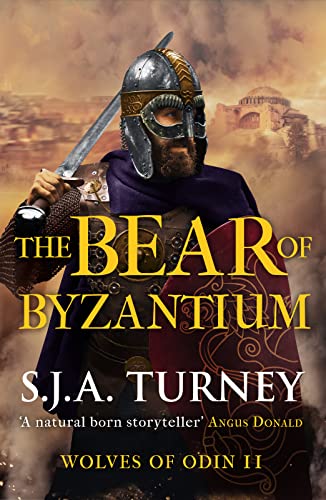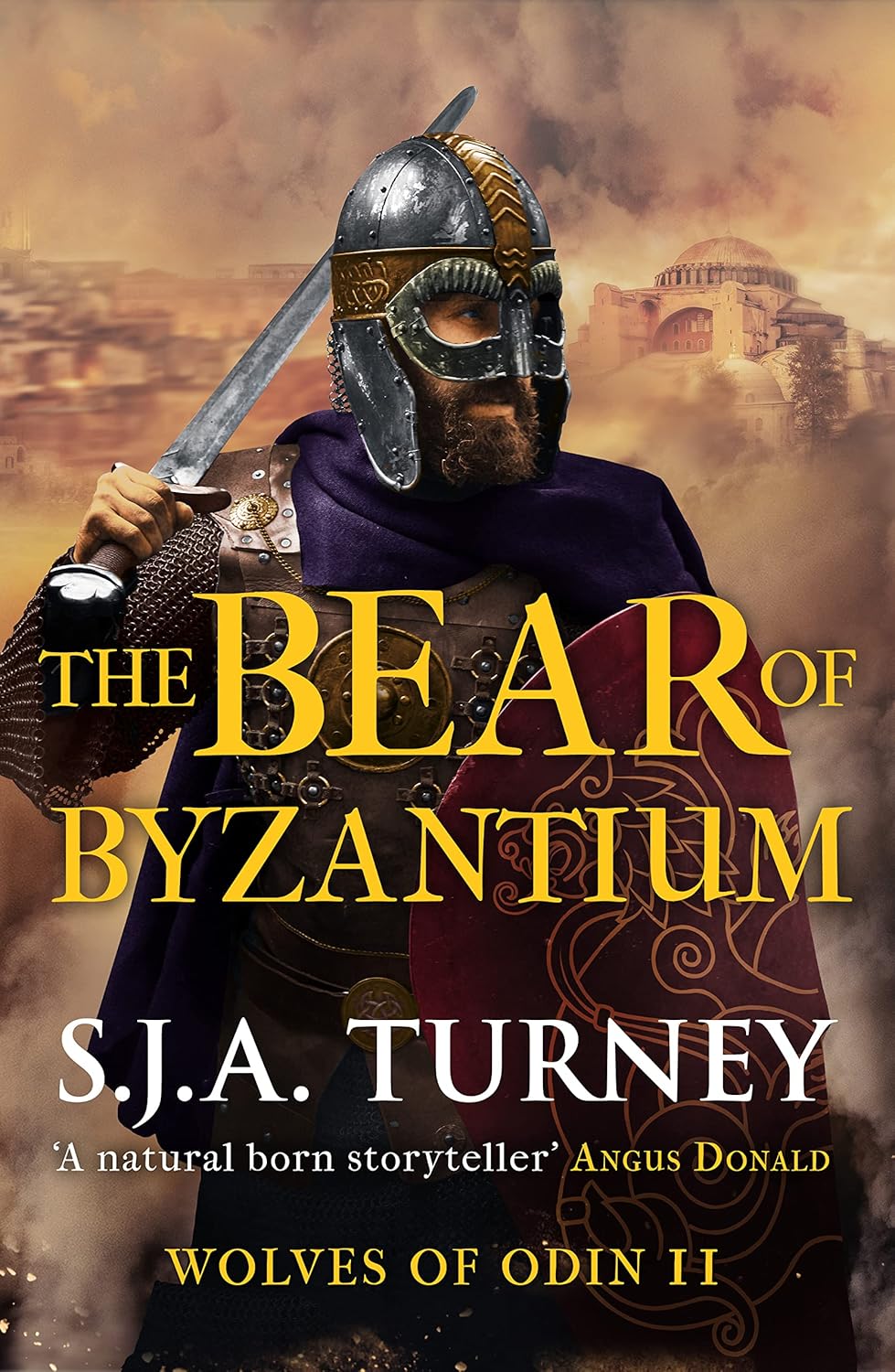
The wolves of Odin sail to the centre of the world: Constantinople.
AD 1041. After successfully avenging the death of his father, Halfdan and the crew of the Sea Wolf seek adventure in strange new lands, far from their Scandinavian home.
They join the fleet of Harald Hardrada, the legendary Viking commander, sailing back to Constantinople from the battlefields of Georgia. There they join the Varangians, the personal bodyguard of the Byzantine Emperors populated almost exclusively by Viking warriors. But Constantinople has changed during Hardrada’s long absence.
The Emperor, Michael IV, is ailing visibly, and powerful factions in his court are setting their plans in motion ahead of his inevitable demise. While courtiers scheme, elements even within the Varangian Guard are picking sides.
Gunnhild, the seer among the Sea Wolf crew, has struck out on her own in the big city. Unable to join the all-male Guard alongside her friends, she establishes herself in a small side-street near the port as a healer and soothsayer, offering cures to the sick and glimpses of the future to the desperate, or the conspiratorial. But in all her visions she sees a wolf, a boar and a golden bear fighting together to support the Byzantine throne. The Norns aren’t finished with them yet…
The epic second instalment in the Wolves of Odin series, taking us to the heart of power in Constantinople and the desperate machinations of the Byzantine emperors. Perfect for fans of Bernard Cornwell, Giles Kristian and Angus Donald.
My Review
The Bear of Byzantium is a fabulous book.
From the opening chapter, which focuses on Harald Hardrada, I knew this was my kind of book – if not just because of the occasional – and it is occasional for anyone who doesn’t appreciate it quite as much as me – use of a little bit of fruity language.
What follows is a journey through Constantinople at a particularly perilous time for emperors and impresses.
The two characters of Gunnhild and Halfdan, who are the main POV throughout the story, are intriguing and have very eventful stories, and the ending is exciting. I thoroughly enjoyed the way the author brought the city of Constantinople to life – something he’s extremely good at in his Roman-era books as well – as well as the customs, regulations, and also, all the paperwork (it’s much more exciting than it sounds:))
A firm favourite for me now and I look forward to continuing the story of Gunnhild and Halfdan – and I will assume Harald Hardrada at some point in the next few books in the series.
My thanks to the publisher and Netgalley for my review copy. The Bear of Byzantium is available now from Amazon and all good booksellers. Just a note that while this might be book 2, I haven’t read book 1, although I have it to read. If you want to jump right in, as I did, it won’t be a struggle to engage with the characters.
In the wild lands of Norway, Hunlaf must quell a vicious slave uprising in Matthew Harffy’s new historical adventure.
A wild land. A lethal fanatic. A violent revolt.
Northumbria, AD 794. Those who rule the seas, rule the land. None know the truth of this more than the Vikings. To compete with the seafaring raiders, the king of Northumbria orders the construction of his own longships under the command of oath-sworn Norseman, Runolf.
When the Vikings attack again, the king sends cleric turned warrior, Hunlaf, on a mission to persuade the king of Rogaland into an alliance. But Hunlaf and Runolf have other plans; kin to seek out, old scores to settle, and a heretical tome to find in the wild lands of the Norse.
Their voyage takes them into the centre of a violent uprising. A slave has broken free of his captors and, with religious fervour, is leading his fanatical followers on a rampage – burning all in his path. Hunlaf must brave the Norse wilderness, and overcome deadly foes, to stop this madman. Can he prevent a night of flames and slaughter?
Review
A Night of Flames returns fans to the world of Hunlaf and Runolf. While book 1 focused on the initial raids against Lindisfarne, book 2, eventually, takes the reader further away to seek out the home of the Raiders. An intriguing idea, and an interesting way of keeping with the same characters, when there’s such a huge historical gap between those first raids, and the later, more sustained ones.
Throughout the book, Hunlaf constantly questions himself – is he a warrior or is he a man of God? There are some illusions, through foreshadowing in the narrative, to possible future adventures for Hunlaf, far from the shores of Northumbria. But for now, we have Hunlaf’s accounting of the building of a ship to brave the Whale Road, and the journey he subsequently takes, via Orkney to Norway. It’s a slow burner. Not until nearly halfway through the book does Hunlaf reach his destination. And even there, his journey isn’t at an end, and nor are the perils he must face.
The author, admits, in the endnotes, that this book is big on the fiction. This is understandable. There’s so little information about events at this time, and I confess to feeling a little sorry for him having to pick a new thread for this story of the late eighth century. It would be ‘easier’ to choose a later period when more is known, and yet, equally, it allows for much wider scope. Hunlaf and his fellow warriors aren’t constrained by history to perform certain tasks.
Fans of the author are sure to enjoy book 2 in Hunlaf’s story. Book 3 promises to take readers even further afield, and I look forward to it.
A Night of Flames is released tomorrow, March 3rd 2022. Preorder now. Unless you’re reading this after March 3rd and then it will be available anyway:)
About the author
Matthew Harffy grew up in Northumberland where the rugged terrain, ruined castles and rocky coastline had a huge impact on him. He now lives in Wiltshire, England, with his wife and their two daughters.
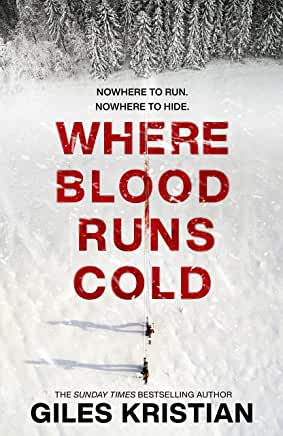
Erik Amdahl and his spirited daughter, Sofia, have embarked on a long-promised cross-country ski trip deep into Norway’s arctic circle. For Erik, it’s the chance to bond properly with his remaining daughter following a tragic accident. For Sofia, it’s the proof she needs that her father does care.
Then, far from home in this snowbound wilderness, with night falling and the mercury plummeting, an accident sends them in search of help – and shelter. Nearby is the home of a couple – members of Norway’s indigenous Sami people – who they’ve met before, and who welcome them in. Erik is relieved. He believes the worst is over. He thinks that Sofia is now safe. He could not be more wrong. He and Sofia are not the old couple’s only visitors that night – and soon he and Sofia will be running for their lives . . .
…and beneath the swirling light show of the Northern Lights, a desperate fight ensues – of man against man, of man against nature – a fight for survival that plays out across the snow and ice.
A story of endurance and of the desperate, instinctive will to survive, of a father’s love for his child, of knowing when to let go – and of a daughter’s determination to prove herself worthy of that love, Where Blood Runs Cold is a pulse-racing thriller from a master storyteller.
Review
Where Blood Runs Cold is a thrilling, snow-bound adventure set in northern Norway by Giles Kristian, an author I last encountered offering a retelling of some Arthurian Legends. Quite a sea-change to modern-day Norway,
I confess, the book starts a little awkwardly as there’s quite a bit going on for the main character, Erik, but I sat and read the first 25% in one setting, and the tension quickly ramps up and I was entirely hooked. It’s one of those books that draws you in and you’re immediately expecting all sorts of bad things to happen, and the author toys with the reader a little; some of your fears come true, and some of them don’t. But the reader is quickly rooting for the main character, and wondering how on earth anyone can survive outside when it’s so bitterly cold.
I particularly enjoyed the incorporation of the Sami into the narrative, and also the slightly otherworldly element. The brief discourses into how climate change is affecting the area are a sad reflection on how far it’s gone, and the effect it’s having on the local population.
The story built to an intriguing grand finale which was satisfying to the reader who’d been swept along, quite literally, by the raging winter storms and the compelling narrative.
I thoroughly enjoyed this book. It was a change to my normal read, just as it’s a change for the author, but it’s excellent. Thank you to the publisher and Netgalley for my review copy.
Where Blood Runs Cold is released today, 24th February, and is available from all good book sellers as well as Amazon.
The drive leads past the gate house and through the trees towards the big house, visible through the winter-bared branches. Its windows stare down at Harkin and the sea beyond . . .
January 1921. Though the Great War is over, in Ireland a new, civil war is raging. The once-grand Kilcolgan House, a crumbling bastion shrouded in sea-mist, lies half empty and filled with ghosts – both real and imagined – the Prendevilles, the noble family within, co-existing only as the balance of their secrets is kept.
Then, when an IRA ambush goes terribly wrong, Maud Prendeville, eldest daughter of Lord Kilcolgan, is killed, leaving the family reeling. Yet the IRA column insist they left her alive, that someone else must have been responsible for her terrible fate. Captain Tom Harkin, an IRA intelligence officer and Maud’s former fiancé, is sent to investigate, becoming an unwelcome guest in this strange, gloomy household.
Working undercover, Harkin must delve into the house’s secrets – and discover where, in this fractured, embattled town, each family member’s allegiances truly lie. But Harkin too is haunted by the ghosts of the past and by his terrible experiences on the battlefields. Can he find out the truth about Maud’s death before the past – and his strange, unnerving surroundings – overwhelm him?
A haunting, atmospheric mystery set against the raw Irish landscape in a country divided, The Winter Guest is the perfect chilling read.
The Winter Guest is my first W C Ryan book, but it won’t be my last.
The Winter Guest is a little awkward to get into. The first chapter could perhaps be better placed elsewhere or left out altogether, but once past that point, and as the reader meets Harkin, we’re quickly drawn into his world. A man suffering from PTSD following the Great War and involving himself in the IRA, is a man on the edge, inhabiting a world filled with suspicion and shadows, where things that seem real, are simply not.
He is a sympathetic character and the reader feels. a great deal of empathy for him.
The landscape he walks into is one bedevilled by atmospheric weather conditions – there is a great deal of attention spent on creating the image of a house on the cusp of ruin, a family in the midst of ruin and the weather conditions prevalent at the coastline. On occasion, it feels a little too much but the lack of electricity, the reliance on candles, ensures that the slightly other-worldly elements can never be forgotten. The flashback descriptions of life in the trenches of the Great War haunt the reader as well as Harkin,
You may have noticed that I thoroughly enjoyed this novel. I would put it on a par with last year’s The Glass Woman and The Quickening. A haunting story not to be missed. My thanks to Netgalley and the publisher for my review copy
Today, I’m pleased to share my review for Catherine Clarke’s fabulous book, The Only Living Lady Parachutist. I was lucky enough to read this in beta with The History Quill and I absolutely loved it. I’m so pleased it’s now available for everyone to enjoy.
Here’s the blurb:
To test her courage, daredevil Lillian risks her life for fame and fortune by parachuting from a hot air balloon throughout Australia and New Zealand. But in the competitive 1890s era of charlatans, showmen, and theatrical hucksters, is she brave enough to confront the truth about her past? A story of courage and ambition, and the consequences of secrets and lies.
I really loved The Only Living Lady Parachutist. The author told a magnificent story that sucked me in, and I read it in three evenings. I was enthralled by the story of Lillian and her daredevil approach to life, and also by the wonderful reimagining of Australia and New Zealand at the time. (I’d not long finished watching The Luminaries so it tied it perfectly). The fact it’s based on ‘real’ people, as I discovered at the end, only added to my enjoyment of it, and I can appreciate how much fun the writer had in piecing together the story (and perhaps, how much heartache as well.)
The Only Living Lady Parachutist is available now on Kindle.
Connect with Catherine at her website or follow on twitter.
Cor, I’ve loved all three of these books. But before I get to the nitty gritty of the review for book 3, here’s the blurb:
For one to rule, the other must die.
312 AD is a year of horrific and brutal warfare. Constantine’s northern army is a small force, plagued by religious rivalries, but seemingly unstoppable as they invade Maxentius’ Italian heartlands. These relentless clashes, incidents of treachery and twists of fortune see Maxentius’ armies driven back to Rome.
Constantine has his prize in sight, yet his army is diminished and on the verge of revolt. Maxentius meanwhile works to calm a restive and dissenting Roman populace. When the two forces clash in the Battle of the Milvian Bridge, there are factors at work beyond their control and soon they are left with carnage.
There is only one way Constantine and Maxentius’ rivalry will end. With one on a bloodied sword and the other the sole ruler of Rome . . .
My Review
Gods of Rome is a stunning climax to the Rise of Emperors trilogy. The reader has followed the lives of Maxentius and Constantine in the two previous books, through their childhood friendship and adult rivalries, which have resulted in them being firm enemies. In this non-stop and thrilling climax, there is all to play for, and don’t Doherty and Turney manage to ramp up the tension to unbearable heights.
I’m no expert on Roman history, and certainly not on the period leading up to AD312, but the authors manage to convey the chaos of the ruling elite without ever getting bogged down in the minutiae of all the internal power struggles. It’s a light touch that I certainly appreciate. The focus is on Constantine and Maxentius, and the men and women who stand at their side. And this is a particular strength of the book. It would be quite easy to forget about the men’s wives as the book focuses so much on warfare but Fausta and Valeria are given their own storylines, standing firm beside their men, even if they don’t always approve of what they’re doing, and not above some treachery themselves.
Maxentius and Constantine are two very different characters, grappling for the same thing, and the reader never tires of their internal monologues as they goad themselves onwards.
From about 50% through the book, I had to force myself not to turn to the back to read the historical notes, and to find out what ‘truth’ this story was based on.
I have adored this trilogy of books. It is my type of historical fiction – people who lived and breathed, brought to life and made to live their lives as opposed to authors focusing on the inevitability of what would happen, and presenting it as a fait accompli.
I can only hope that Simon Turney and Gordon Doherty are able to collaborate once more. After all, they have a lot of Roman era history they could delve into. (Hint, hint, nudge, nudge).
About the authors
Simon Turney is the author of the Marius’ Mules and Praetorian series, as well as The Damned Emperor series for Orion and Tales of the Empire series for Canelo. He is based in Yorkshire.
Gordon Doherty is the author of the Legionary and Strategos series, and wrote the Assassin’s Creed tie-in novel Odyssey. He is based in Scotland.
1 CONSTANTINE The Cottian Alpes, 27th January 312 ad
We moved through the mountains like winter wolves. The ferocious blizzard sped southwards with us, carried on the famous bora winds, singing a dire song. For days we marched through that driving snow, seeing nothing but great white-clad peaks either side of us; rugged, inhospitable highlands which in these frozen months soldiers were not meant to cross. All around me the gale screamed, boots crunched endlessly through the successively deeper drifts of white, men’s teeth chattered violently, mules brayed, exhausted. It felt at times as if we were wandering, snow-blind, to our deaths, but I knew what lay ahead… so close now.
I called upon my chosen men and a handful of their best soldiers – a group of thirty – and we roved ahead of the army like advance scouts. The blizzard raked through my bear cloak, the snow rattling like slingshot against my gemmed ridge helm and bronze scales as I scoured the valley route. Yet I refused to blink. When the speeding hail of white slowed and the murky grey ahead thinned a little, I saw them: a pair of stone and timber watchtowers, northern faces plastered in snow. Gateposts watching this passage between two realms. I dropped to my haunches behind the brow of a snowdrift and my chosen men hunkered down with me. I gazed over the drift’s brow, regarding the narrow gap between the towers and the valley route beyond, on through the winter-veined mountains. Thinking of the land that lay beyond these heights, my frozen lips moved soundlessly.
Italia…
Land of Roman forefathers. Home of the man I had once considered my friend… but that territory was rightfully mine. Mine! My surging anger scattered when I spotted movement atop one of the two towers: a freezing Maxentian scout blowing into his hands, oblivious to our presence. Then the blizzard fell treacherously slack, and the speeding veil of white cleared for a trice. I saw his ice-crusted eyebrows rise as he leaned forward, peering into the momentary clarity, right at us. His eyes bulged, mouth agog.
‘He is here!’ he screamed to be heard over the sudden return of the storm’s wrath. ‘Constantine is h—’
With a wet punch, an arrow whacked into the man’s chest and shuddered there. He spasmed then folded over the edge of the timber parapet and fell like a sack of gravel, crunching into a pillowy snowdrift at the turret’s foot. I glanced to my right, seeing my archer nock and draw again, shifting his bow to the heights of the other tower, his eyes narrowing within the shadow of his helm brow. He loosed, but the dark-skinned sentry up there ducked behind the parapet, screaming and tolling a warning bell. At once, three more Maxentians spilled from the door at the base of that rightmost tower, rushing south towards a simple, snow-topped stable twenty paces away, in the lee of a rocky overhang. This was one of the few gateways through the mountains – albeit the least favoured and most treacherous – and it was guarded by just five men? Instantly, suspicion and elation clashed like swords in my mind. We had no time to rake over the facts. These watchmen could not be allowed to ride south and warn the legions of Italia. They had to die.
Check out my other reviews for Simon Turney/SJA Turney’s books
Elizabeth has received a letter from an old colleague, a man with whom she has a long history. He’s made a big mistake, and he needs her help. His story involves stolen diamonds, a violent mobster, and a very real threat to his life.
As bodies start piling up, Elizabeth enlists Joyce, Ibrahim and Ron in the hunt for a ruthless murderer. And if they find the diamonds too? Well, wouldn’t that be a bonus?
But this time they are up against an enemy who wouldn’t bat an eyelid at knocking off four septuagenarians. Can the Thursday Murder Club find the killer (and the diamonds) before the killer finds them?
My Review
First things first, I’ve not read book 1, but I was curious to see what all the hype was about. It didn’t disappoint, but I did struggle to ‘get into’ the book. There’s some funny tenses and I don’t like books that haven’t decided what tense to write in:) I did get used to it, eventually, but I am curious to know if anyone else felt the same way I did.
The Man Who Died Twice is a well-told modern-day mystery featuring four friends in their 70s as they try and solve three interlinked mysteries surrounding some missing diamonds.
It is a good tale with characters that are well-drawn, although, on occasion, it is the ‘bit’ part players that speak more to the reader. (This may be because it’s a second book and everyone already knows them from book 1).
It is filled with twists and turns, although the reader does get to a part of the mystery long before the characters do, but with a nice little twist at the end.
The inspirational story of the Pastons, a family who rose from obscurity to the very heart of Court politics and intrigue during the Wars of the Roses.
England, 1444. Three women challenge the course of history…
King Henry VI’s grip on the crown hangs by a thread as the Wars of the Roses starts to tear England apart. And from the ashes of war, the House of Paston begins its rise to power.
Led by three visionary women, the Pastons are a family from humble peasant beginnings who rely upon cunning, raw ambition, and good fortune in order to survive.
Their ability to plot and scheme sees them overcome imprisonment, violence and betrayal, to eventually secure for their family a castle and a place at the heart of the Yorkist Court. But success breeds jealousy and brings them dangerous enemies…
An inspirational story of courage and resilience, The Royal Game charts the rise of three remarkable women from obscurity to the very heart of Court politics and intrigue.
My Review
Anne O’Brien is one of my favourite authors. Every year, I wait with high anticipation to read her newest book and to see which ‘new’ unknown woman of history she’s brought to life for her readers.
With The Royal Game, Anne O’Brien has chosen not a powerful royal/noblewoman but instead three women who hunger to be considered as such. The majority of the story is told from the viewpoint of Margaret Paston, wife to John Paston, as property disputes amongst their landed estates escalate and are resolved only to escalate once more. This might sound a bit boring, but believe me, it’s not. I was shocked, genuinely shocked, by the level of violence that could be brought to bear against rival claimants and the state of lawlessness in East Anglia at the time is flabbergasting. It acts as a perfect way of showing just what the uncertainty of the Wars of the Roses brought about for those lower ‘noble’ families with the ebb and flow of prestige and royal denouncement as in the background, great battles are won and lost, and rival kings fall and rise.
Margaret is a wonderfully independently minded woman, and yet constrained by her position in life, and her sex so she can only do so much when trouble strikes, but she will do it to her upmost.
Alongside Margaret, we meet her sister in law, Eliza, who struggles to find a husband and emerge from beneath her mother’s less than motherly love. She manages to do just that only to find herself facing a life as beset with lawsuits as her brother and sister by marriage.
Our third Paston woman is Anne Haute, a cousin to Elizabeth Woodville. Her voice is that of a noblewoman without the dowry needed to hook herself a wonderful marriage, but who can tout her family connections to gain one.
This book is a stunning read – and more, an easy read – despite the vast number of Johns in it (I’ll leave that for you to discover because wow – that’s a weird thing to have done). I had to force myself to slow down and stop reading because I didn’t want it to be over. Now I have to wait for next year to read the second part of the story.
I highly recommend this book. If you know about the Wars of the Roses, all the better, but if you don’t, it will not lessen your enjoyment of the story of the three Paston women and their troublesome and litigious family at a time of intense political unrest.
Rebellion?’ The word is a spark. They can start a fire with it, or smother it in their fingertips. She chooses to start a fire.
You are born high, but marry a traitor’s son. You bear him twelve children, carry his cause and bury his past.
You play the game, against enemies who wish you ashes. Slowly, you rise.
You are Cecily.
But when the king who governs you proves unfit, what then?
Loyalty or treason – death may follow both. The board is set. Time to make your first move.
My Review
Cecily, the story of Cecily Neville up to and including 1461, is a wonderful retelling of her story.
Having read Anne O’Brien’s The Queen’s Rival last year, which offers Cecily’s story from the late 1450s onwards, I feel that this unknown woman has now been brought to life in wonderful detail. (If you have only read one of these two books then do please try the other one – you won’t be disappointed.)
Cecily is told from Cecily’s point of view, as such, there are some things that she can’t know or witness, and the author manages this incredibly skillfully. We know what Cecily does, and we know other events when she knows them. It’s a perfect way to ensure the reader, even if they know the history of the time period, doesn’t get ahead of themselves.
Cecily is an engaging and headstrong woman. The author gives her a voice that we can understand, reflecting a quick intelligence and an ability to piece together events skillfully. Some scenes may feel rushed, and there is a refusal to dwell on the royal splendour of the court, but I think this added to the story. It is the interaction of the king, queen and the courtiers that’s important, not who was wearing what and eating what. This is absolutely my sort of historical fiction book.
1144. The body of Durand Wuduweard, the unpopular keeper of the King’s Forest of Feckenham, is discovered beside his hearth, his corpse rendered barely identifiable by sharp teeth. Hushed whispers of a man-wolf spread swiftly and Sheriff William de Beauchamp’s men, Bradecote and Catchpoll, have to find out who killed Durand and why, amidst superstitious villagers, raids upon manors and further grim deaths. Who commands the wolf, and where will its fangs strike next?
My Review
Wolf at the Door is my second Bradecote and Catchpoll book, and I was excited to receive an advanced copy of it. (I’m starting to collect the ‘back’ catalogue’ as well.)
This time, the pair, well the three of them including Wakelin, are sent to discover the truth about a particularly gruesome murder, where a wolf is suspected (hence the title). What follows is a tightly constructed story where the three follow leads, some dead ends, and interact with a deliciously mixed group of people living in Worcester and the environs in the 1100s.
I love the historical elements of the story, deeply rooted in the time, with King Stephen a spectre who could appear at any time, although he hasn’t, not yet. There is more from the Sheriff of Worcester, rather than the undersheriff than in the previous book I read, and he too is an excellent character. Hats off for the mixture of Old English and Norman names, aptly highlighting the split in society, and for deciding that ‘Foreign’ cursing isn’t quite as colourful as a bit of English cursing – (well, Catchpoll makes that observation).
An intriguing story, the mystery kept me intrigued and the ending was excellent. I look forward to the next in the series.