

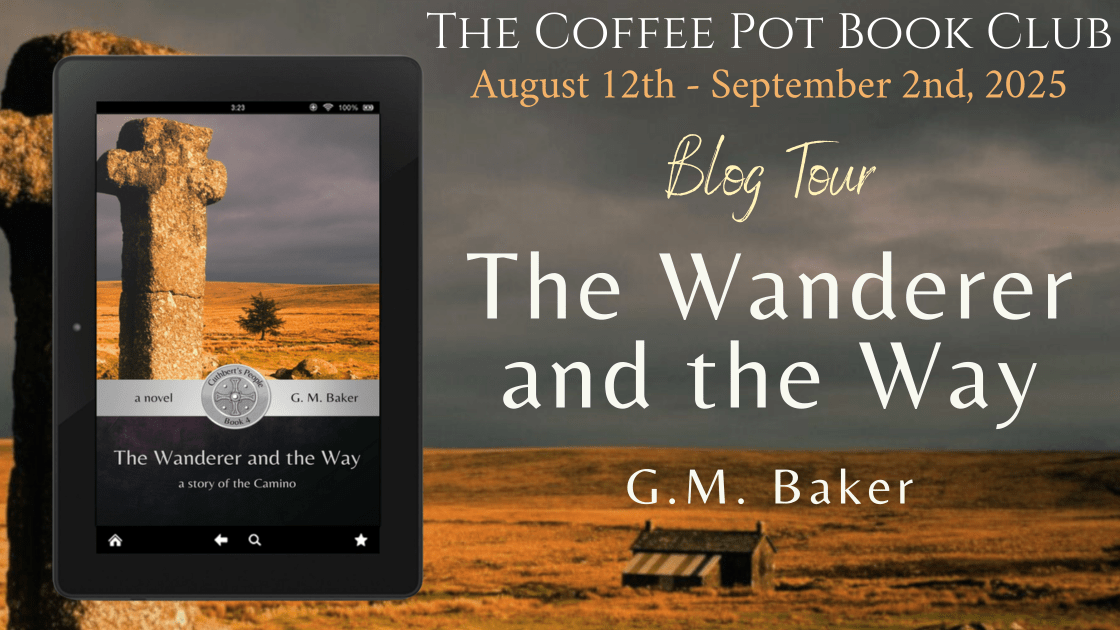
I’m delighted to welcome G.M. Baker and his book, The Wanderer and the Way, to the blog with a guest post.
Guest Post
Religion has always been a problem for historical fiction. It’s not just that many readers today are not religious and tend to shy away from religious characters or religious ideas. Readers who are religious tend not to recognize their own beliefs or their way of believing in the religious habits and practices of the past. And yet, if we want our historical fiction to be anything more than modern people in fancy dress, we have to deal with the religious lives of historical characters, almost all of whom would have professed one faith or another.
But I think that the religious opinions and practices of people in the past were not as different in character from the opinions and practices of modern people as they might seem at first. I think religious belief in, for example, the early medieval period in which my novel, The Wanderer and the Way, is set, was different in character from religious belief today, and in some ways closer in character, if not in content, to the beliefs of modern non-religious people.
What I mean is that there are certain beliefs that we hold unselfconsciously. These are the beliefs that we grew up with, the beliefs of our friends and our community. We learn these beliefs growing up and adopt them not because we have subjected them to rigorous philosophical examination, but because they are the beliefs shared by our community. We are a mimetic species, and so we tend to believe what everyone around us believes. This ensures that we are accepted by our society, by our tribe.
For most of the development of modern humans we lived in small bands of hunter-gatherers. Those members of the band held in the highest esteem earned a place close to the fire and the best cuts of the latest kill. Those who were quarrelsome and disruptive of the tribe were dangerous to its harmony and safety. If they were too disruptive, they were likely to be exiled from the tribe, which was tantamount to a sentence of death. Today, teenagers sometimes take their own lives because they have been bullied online by their peers. Though they have suffered no physical harm, the ostracism of the tribe is so traumatic that it can drive some to suicide. In our bones and in our genes we still have a profound fear of ostracism.
Thus humans of all periods, including our own, are strongly driven to believe what the tribe believes, including its religious beliefs, or its rejection of religious belief. Historically we can note that during the Reformation, when a prince became protestant, his people tended to become Protestant with him. If he remained Catholic, his people tended to remain Catholic with him. In each case, there were martyrs, people like Thomas More and Bishop Fisher, people who clung to their beliefs on principle and would not change them to go along with the tribe. People of this kind hold their beliefs in a self-conscious manner. They know that their beliefs are at odds with those of the tribe, and while they may not all be martyrs, the nature of their beliefs is very different from that of most people who hold a belief unselfconsciously.
In the late 8th century Europe, in which my Cuthbert’s People series is set, most people were Christians, but most of them would have been unselfconscious believers. They were Christian because their tribe was Christian. I don’t mean that their beliefs were insincere, any more than modern people are insincere in their unselfconscious beliefs. In some ways, unselfconscious beliefs can be fiercely held, since they are one of the threads that bind us to our tribe and earn us their fellowship and protection. What I do mean is that their method of belief was different from that of the modern religious believer, whose beliefs are almost always self-consciously held. The modern believer knows that their belief sets them apart from society at large. Thus modern religious fiction tends to be fiercely self-conscious in a way that appeals to the believer but repels the non-believer.
What I have tried to do in my Cuthbert’s People series, and in The Wanderer and the Way particularly, is to create a believable portrait of people who are unselfconsciously Christian. This is very different from modern books such as Brideshead Revisited or The Power and the Glory, where the characters are painfully self-conscious about their Catholic faith and how it sets them apart from their society.
Unselfconscious beliefs are not held lightly. They are the beliefs that we grew up with, things we have simply assumed to be true, and thus we hold to them very strongly and behave in accordance with them as far as we can. But they are not held defiantly or obstreperously by most people, who assume that all of the people around them believe as they do.
In The City of God, St. Augustine wrote that when the barbarians sacked Rome, those who fled to pagan temples were not spared, but those who fled to Christian churches were spared the wrath of the barbarians. It was therefore a bewildering shock to the people of Northumbria, and to the people of Europe, when the great Christian monastery of Lindisfarne was not spared in the great Viking raid of AD 793, the event that set in motion the wanderings of Elswyth of Twyford, the main character of my Cuthbert’s People series. The great scholar Alcuin, himself a son of Northumbria and a minister of Charlemagne, wrote a letter to the Christian people of Northumbria trying to reconcile this event with their belief that they were under the protection of God. That letter figures in The Wanderer and the Way.
Human beings tend not to trust people who do not share, and therefore challenge, their unselfconscious beliefs. Thus it is now, as it was in the 8th century, a fundamental element of diplomacy to demonstrate one’s orthodoxy on the issues of the day. In the period covered by The Wanderer and the Way, the Kingdom of Asturias in Northern Spain was the last major holdout against the Moorish invasion of the Iberian Peninsula. Alonso the Chaste, King of Asturias, sent several embassies to Charlemagne asking for recognition and aid against the Moors. I send my main character, Theodemir of Iria Flavia, as one of his ambassadors. There was at that time a controversy over the heresy of Adoptionism, originated by a Spanish bishop, which held that Christ acquired his divinity by adoption rather than being divine by nature. Thus I have Theodemir carefully instructed by Alonzo and Bishop Quendulf to demonstrate to Alcuin his knowledge of the controversy and his orthodoxy on the question.
In a book set today, I might have used a modern heresy, such as the rejection of vaccines or the denial of global warming, as an ideological purity test for an ambassador in the same way. Our fundamental tribalism and our insistence on adherence to orthodoxy as the basis for trusting one another has not changed much over the centuries, only what subjects we demand orthodoxy on.
This, I believe, is how historical fiction ought to treat religious belief in characters from the past, not by mocking it, nor by making an exemplary virtue of it, but by portraying it as the core unselfconscious belief that people of the past used to bind themselves together and explain themselves to themselves, in just the same way our unselfconscious beliefs bind us and help us explain ourselves to ourselves today. Whether such beliefs are true or false is, from an historical and fictional point of view, an entirely orthogonal question.

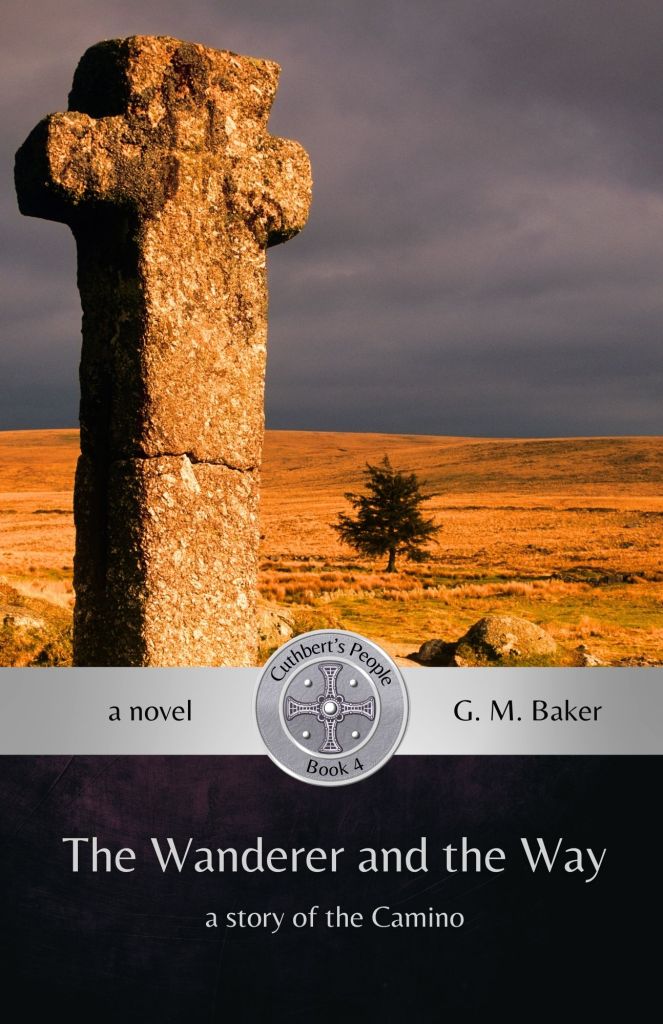
Here’s the Blurb
The Camino de Santiago de Compostela, now the most famous pilgrimage route in the world, was founded in the early ninth century, largely due to the efforts of Bishop Theodemir of Iria
Flavia. As with most people of this period, nothing seems to be known of his early years.
What follows, therefore, is pure invention.
Theodemir returns footsore and disillusioned to his uncle’s villa in Iria Flavia, where he meets Agnes, his uncle’s gatekeeper, a woman of extraordinary beauty. He falls immediately in love. But Agnes has a fierce, though absent, husband; a secret past; another name, Elswyth; and a broken heart.
Witteric, Theodemir’s cruel and lascivious uncle, has his own plans for Agnes. When the king of Asturias asks Theodemir to undertake an embassy on his behalf to Charles, King of the Franks, the future Charlemagne, Theodemir plans to take Agnes with him to keep her out of Witteric’s clutches.
But though Agnes understands her danger as well as anyone, she refuses to go. And Theodemir dares not leave without her.
Buy Link
Meet the Author
Born in England to a teamster’s son and a coal miner’s daughter, G. M. (Mark) Baker now lives in Nova Scotia with his wife, no dogs, no horses, and no chickens. He prefers driving to flying, desert vistas to pointy trees, and quiet towns to bustling cities.
As a reader and as a writer, he does not believe in confining himself to one genre. He writes about kind abbesses and melancholy kings, about elf maidens and ship wreckers and shy falconers, about great beauties and their plain sisters, about sinners and saints and ordinary eccentrics. In his newsletter Stories All the Way Down, he discusses history, literature, the nature of story, and how not to market a novel.

Connect with the Author

Posts






























Discover more from MJ Porter
Subscribe to get the latest posts sent to your email.


Thanks so much for hosting G. M. Baker today, with such an interesting historical post linked to his new novel, The Wanderer and the Way.
Take care,
Cathie xx
The Coffee Pot Book Club
LikeLiked by 1 person