


I’m welcoming Ann Bennett and her new book, The Fortune Teller of Kathmandu to the blog, and she’s sharing a fabulous post about the historical research she undertook for the book.
Historical Research for The Fortune Teller of Kathmandu
There are several different strands to my latest historical novel, The Fortune Teller of Kathmandu, all of which needed to be researched. But I ended up using a variety of sources for each and approaching the research in many different ways.
The story is about Lena, a young Eurasian (or Anglo-Indian) woman working as a teacher in a boarding school in Darjeeling in the early 1940s. It is the same school that she grew up in having been sent there at the age of three. All the girls at the school are the product of liaisons between British officers or civil servants and Indian women and whose presence the British in India would have preferred to forget. This was inspired by an article I read some years ago by a British journalist who had discovered a previously unknown relative who had been a Eurasian and brought up in such an establishment. That story really struck a chord with me, although I’ve been unable to track the article down again. However, I did find some really useful sources of research about the way Eurasians in India were seen as a problem by the British. For example, a thesis entitled The Eurasian Problem in Nineteenth Century India by Valerie Anderson of the School of African and Oriental Studies, London University which is available online.
I visited Darjeeling in 2019 as part of my research (I have set another novel there too as I found it an atmospheric place in an incredible setting. That book is The Lake Pavilion). I found the old villas and hotels that remain from British India, as well as the austere Victorian boarding schools there a fascinating glimpse into the past). I also studied old Youtube footage of old Darjeeling and photographs from the period. I found an interesting article by blogger Vikram Karve called Institutions of the British Raj, which outlines how Darjeeling developed as a place to send British children to school. Eurasian, or Anglo-Indian children were not welcome at the same establishments and separate establishments were developed for them. This underlines the discrimination Eurasians encountered in British India, which is one of the themes of the novel.
Secondly, I wanted to find out about the Nepalese Gurkhas and how soldiers were recruited from Nepal during the second world war by the British Army. I read as much as I could about this online, but my main source of information was a visit to the Gurkha museum in Pokhara. There I read details of how British recruitment officers would go into the hills and recruit young men from the villages. That museum also contains many first-hand stories of incredible bravery and loyalty of the Gurkha soldiers.
As part of that research, I trekked into the hills of the Annapurna range to experience the landscape and communities there first hand. The village life is timeless and I suspect has changed little since the era the novel was set. However, there are probably more people living in the mountains now because of the increase in foreign visitors and wealth. When my characters Lena and George visited in the early 1940s, I suspect those hill villages such as Ghorepani were sparsely populated.


Thirdly, I needed to research the Burma campaign during the second world war, in which the Allies attempted to retake Burma from the Japanese and to prevent them from invading India, “the Jewel in the Crown”. I read about the incredible Chindit regiments commanded by Colonel Orde Wingate, who flew in gliders behind enemy lines to set up strongholds there to disrupt enemy operations. I’d researched the Burma Campaign for a previous book , The Lake Palace about a young English woman who volunteers to follow General Slim’s 14th Army as an auxiliary nurse to run a field hospital. For both books, I read extensively about the Burma Campaign, in which men on both sides fought courageously in the toughest of jungle conditions. It is often overlooked, so much so that the 14th Army is sometimes called The Forgotten Army.
The books I found very helpful and informative were the following: Burma ’44: The Battle That Turned Britain’s War in the East by James Holland, The Road Past Mandalay (W&N Military) by John Masters, Burma Victory: Imphal and Kohima, March 1944 to May 1945 (The Crucible of Leadership Book 2), by David Rooney, The Burma Campaign: Disaster into Triumph 1942-45 by Frank McLynn and Road of Bones: the epic siege of kohima: The Epic Siege of Kohima 1944 by Feargal Keane.
Lastly, I researched the Wasbies – The Women’s Auxiliary Service (Burma) whose story is also little known. Lena, my main character volunteers to join the service in 1943. I stumbled across the Wasbies’ story when I was researching The Lake Palace. I came across a photograph of a group of women, operating a mobile canteen out of an old, converted Chevrolet lorry near the battle lines during the Burma campaign.
My main source of information about the Wasbies was a fabulous book, Front Line and Fortitude, by EJ Lockhart-Mure. It is the diary of a real-life Wasbie, Maria Pilbrow, and really brings home hardships those brave women went through. I read Chinthe Women – Women’s Auxiliary Service Burma 1942-1946 – Char and Wads on the frontline. The Chinthe is a mythical Burmese lion, which became the symbol of the Wasbies. This book contains a wealth of information and was written by Sally and Lucy Jaffe, granddaughters of Major Ninian Taylor, the leader of the Wasbies.
So my research for The Fortune Teller of Kathmandu involved reading history books, researching online sources and travelling to the region and experiencing the places I was writing about first hand.
Thank you so much for sharing your research with my readers. Such a fascinating story.
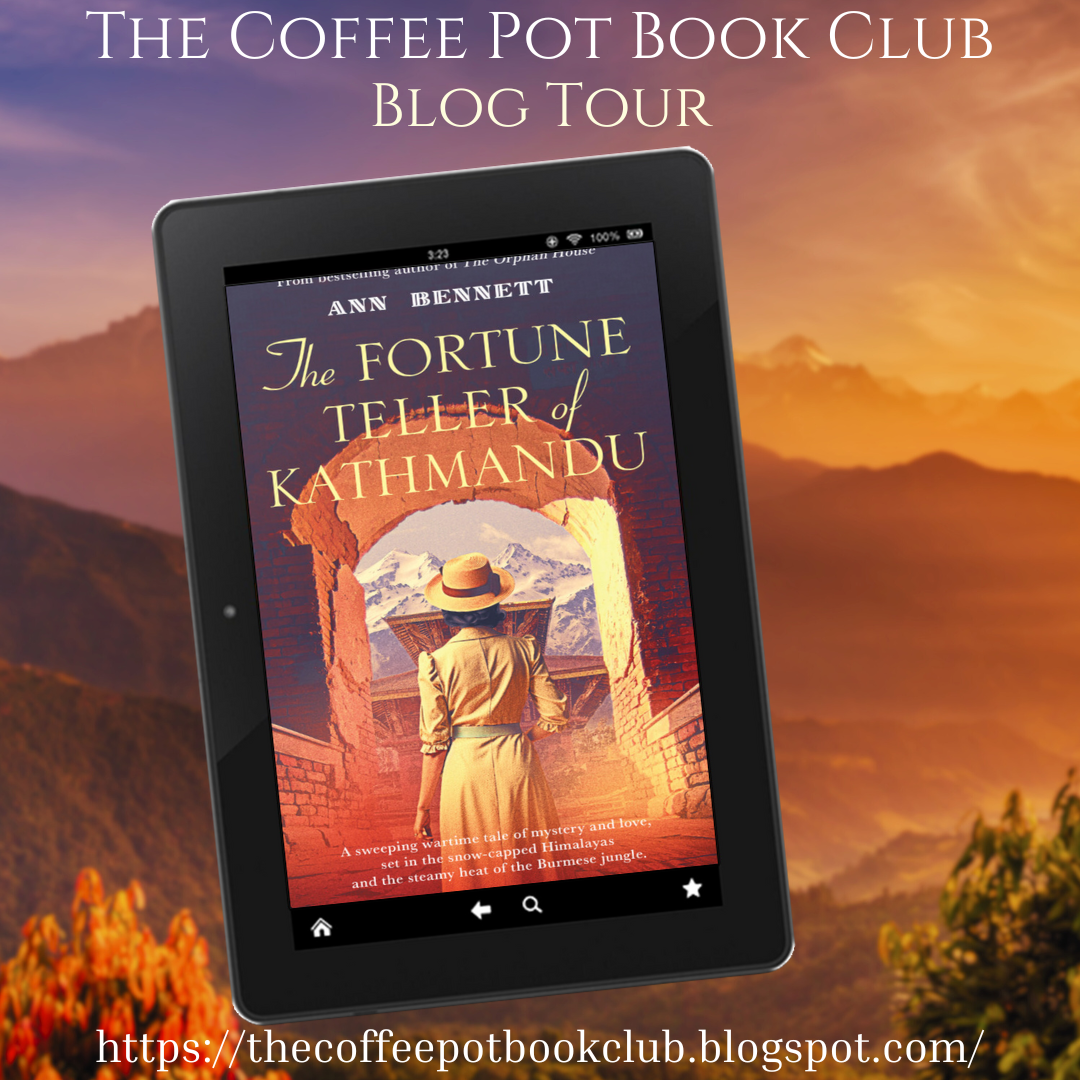
Here’s the blurb
A sweeping wartime tale of secrets and love, mystery and redemption, moving from the snow-capped Himalayas to the steamy heat of battle in the Burmese jungle.
Perfect for fans of Dinah Jeffries, Victoria Hislop and Rosie Thomas.
Hampshire, UK, 2015. When Chloe Harper’s beloved grandmother, Lena dies, a stranger hands her Lena’s wartime diary. Chloe sets out to uncover deep family secrets that Lena guarded to her grave.
Darjeeling, India, 1943, Lena Chatterjee leaves the confines of a strict boarding school to work as assistant to Lieutenant George Harper, an officer in the British Indian Army. She accompanies him to Nepal and deep into the Himalayas to recruit Gurkhas for the failing Burma Campaign. There, she discovers that Lieutenant Harper has a secret, which she vows never to reveal.
In Kathmandu, the prophesy of a mysterious fortune teller sets Lena on a dangerous course. She joins the Women’s Auxiliary Service Burma (the Wasbies), risking her life to follow the man she loves to the front line. What happens there changes the course of her life.
On her quest to uncover her grandmother’s hidden past, Chloe herself encounters mystery and romance. Helped by young Nepalese tour guide, Kiran Rai, she finds history repeating itself when she is swept up in events that spiral out of control…
“A great read” Advance Reader.
” Thank you so much for allowing me to read the advance copy. I could barely put it down!” Advance Reader,
“What a wonderful book… I loved it. The dual time lines were delineated to perfection… the settings were perfectly rendered..” Advance Reader.

Buy Links:
This title is available to read with #KindleUnlimited.
Universal Buy Link: https://mybook.to/tftok
Meet the author
Ann Bennett is a British author of historical fiction. She was born in Pury End, a small village in Northamptonshire, UK and now lives in Surrey. Her first book, Bamboo Heart: A Daughter’s Quest, was inspired by researching her father’s experience as a prisoner of war on the Thai-Burma Railway. Bamboo Island: The Planter’s Wife, A Daughter’s Promise and Bamboo Road:The Homecoming, The Tea Panter’s Club and The Amulet are also about the war in South East Asia, which together with The Fortune Teller of Kathmandu make up the Echoes of Empire Collection.
Ann is also author of The Runaway Sisters, bestselling The Orphan House, The Forgotten Children and The Child Without a Home, published by Bookouture.
The Lake Pavilion, The Lake Palace, both set in British India in the 1930s and WW2, and The Lake Pagoda and The Lake Villa, set in French Indochina during WW2, make up The Oriental Lake Collection.
Ann is married with three grown up sons and a granddaughter and works as a lawyer. For more details please visit www.annbennettauthor.com.

Connect with the author
Instagram: Amazon Author Page UK: Goodreads:
Discover more from MJ Porter
Subscribe to get the latest posts sent to your email.

 MJ Porter
Thank you so much for hosting Ann Bennett today, with such a fascinating post!
Take care,
Cathie xx
The Coffee Pot Book Club
LikeLiked by 1 person