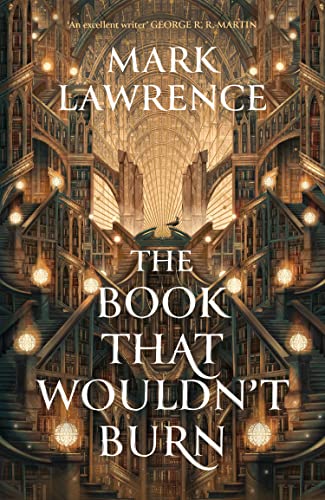
Happy Release day to The Book That Wouldn’t Burn by Mark Lawrence #fantasy #highlyrecommended

Here’s the blurb:

All books, no matter their binding, will fall to dust. The stories they carry may last longer. They might outlive the paper, the library, even the language in which they were first written.

The greatest story can reach the stars . . .

This is the start of an incredible new journey from the internationally bestselling author of Prince of Thorns, in which, though the pen may be mightier than the sword, blood will be spilled and cities burned…

Evar has lived his whole life trapped within a vast library, older than empires and larger than cities.

Livira has spent hers in a tiny settlement out on the Dust where nightmares stalk and no one goes.

The world has never noticed them.

That’s about to change.

As their stories spiral around each other, across worlds and time, each will unlock vast secrets about the world and themselves. This is a tale of truth and lies and hearts, and the blurring of one into another.
https://amzn.to/3LG2q3S

My Review

The Book That Wouldn’t Burn is the beginning of Mark Lawrence’s newest trilogy. Now, he’s said this isn’t related to the previous trilogies, which were all interconnected, but I’m not at all convinced, and perhaps neither will you be when you read some of the chapter headings – which are all taken from made-up books, and perhaps, written by characters from those previous books.

The Book That Wouldn’t Burn, like all Mark’s previous offerings, sucks the reader in almost immediately. It might not quite have Red Sister vibes ‘When killing a nun it’s important to ensure you have…’ but it’s not long before you can’t put the book down.

And yet, as with many of his stories, it can feel as though you’re not entirely sure why you’re enjoying the story so much, and so invested in the two main characters. This isn’t a complaint.

The narrative, skipping between two points of view, moves at odd intervals (again, not a complaint), and just when you might be considering putting the story down, there is a new development, and I warn you all now, without giving away any spoilers, there is one development that will have your jaw dropping in delicious delight.

As with all Mark Lawrence’s books, The Book that Wouldn’t Burn will leave you both satisfied and demanding more. It is a magnificent addition to his already magnificent collection of stories, and I can’t wait for the next instalment. It will also take you some time to reconcile what you’ve read. It’s taken me a good few months to write this review, because to begin with, all I could think was that my mind had been blown.

Thank you to the publisher and Netgalley for my review copy. I have ordered the limited edition hardback as well, and it will go, pride of place, next to my other Mark Lawrence editions.

Check out my previous reviews for Mark Lawrence.

Red Sister, Grey Sister, Holy Sister

The Girl and the Stars, The Girl and the Mountain, The Girl and the Moon

One Word Kill, Limited Wish

For those who don’t know, my obsession with Mark Lawrence’s books began when I was given a free copy of his first book when I preordered the last GRR Martin book in the Game of Thrones series. As of yet, I’ve not finished reading that book, because I want to wait for the next part, but I have read all of Mark Lawrence’s books since then.

Connect with Mark Lawrence

Mark Lawrence was born in Urbana–Champaign, Illinois, to British parents but moved to the UK at the age of one. He went back to the US after taking a PhD in mathematics at Imperial College to work on a variety of research projects including the ‘Star Wars’ missile defence programme. Returning to the UK, he has worked mainly on image processing and decision/reasoning theory. He says he never had any ambition to be a writer so was very surprised when a half-hearted attempt to find an agent turned into a global publishing deal overnight. His first trilogy, THE BROKEN EMPIRE, has been universally acclaimed as a ground-breaking work of fantasy. Following The Broken Empire is the related RED QUEEN’S WAR trilogy. THE BOOK OF THE ANCESTOR trilogy is set on a different world and is followed by the related BOOK OF THE ICE trilogy. There is also THE IMPOSSIBLE TIMES trilogy, a D&D/sci-fi work set in London in the 80s. All of these trilogies can be read in any order. Mark is married, with four children, and lives in Bristol.
Website

Twitter

Patreon

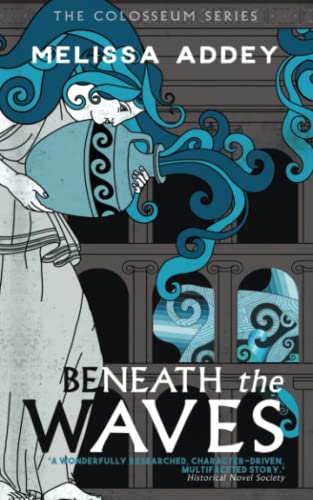
Today, I’m welcoming Melissa Addey and her novel, Beneath the Waves, to the blog #bookreview #historicalfiction #highlyrecommended

Here’s the blurb

The Colosseum is being flooded. And emotions are rising to the surface.
Rome, 80AD. The Emperor orders the Colosseum to be flooded. There must be vast battles, spectacular props and epic storytelling. Meanwhile Emperor Titus must somehow be persuaded to give up his love affair with the Jewish Queen, Berenice.

Marcus, manager of the amphitheatre, must face the dangers, mistakes and emotions of the watery depths as new members join his team. His scribe, Althea, must find out what she wants from life, now that she is a freedwoman, but a woman’s choices are not always free.

Words may be dangerous, but desires must be spoken out loud. As the backstage team takes on new challenges, a change is coming.

Beneath the Waves is the gripping second novel in the Colosseum historical fiction series. If you enjoy immersing yourself in the past and finding characters you care about, then join the Colosseum’s tough, loyal and quick-witted backstage team.

Trailer Link – https://youtu.be/CbM54gjiT20

Purchase Link 

https://amzn.to/44Fh43J

My Review

Beneath the Waves is the thrilling second part of The Colosseum series by Melissa Addey.

Picking up the tale of Althea, a Greek slave woman, from where we left her at the end of From the Ashes, this is the story of the ending of the 100 days of Games, begun in From the Ashes, and also takes the reader through to the second year in the life of the Colosseum.

Our much-loved characters reappear in Beneath the Waves, along with a few new additions. While From the Ashes focused very much on surviving the events of Vesuvius, the plague and the fire that our characters suffered, book 2 is perhaps less filled with huge peril for everyone, as instead, it focuses on the peril our main characters experience. Their humanity is very evident. They are people. They don’t always do the right thing. They are perhaps beset with irrational fears. And they also perhaps do what they’re supposed to do when we, as a modern audience, would demand alternatives. Althea and Marcus are characters of their time, which is one of the huge strengths of the novel.

I adore the descriptions of the Games and the minutiae of day-to-day life, and this second novel builds very much to an impressive and potentially dangerous ending for Marcus, Althea and their young charge.

I so look forward to book 3.

Read my review for From the Ashes here.

(And, if you’re a fan of Simon Turney as well, then reading this series alongside his Domitian, will ensure you know what’s happening to the toffs as well as the plebs.)

Meet the author

Melissa Addey writes historical fiction set in Ancient Rome, medieval Morocco and 18th century China. She is a full time self-published author and runs workshops for authors wanting to be entrepreneurial. Her books have been selected for Editor’s Choice by the Historical Novel Society and won the inaugural Novel London award. She has been the Leverhulme Trust Writer in Residence at the British Library, has a PhD in Creative Writing and works with the Alliance of Independent Authors on their campaigns. 

If you’d like to try her writing, visit http://www.melissaaddey.com to pick up a free novella, The Cup.

Connect with Melissa Addey 

www.melissaaddey.com where readers can get a free novella that starts another series (medieval Morocco).

https://www.facebook.com/MelissaAddeyAuthor

https://twitter.com/MelissaAddey

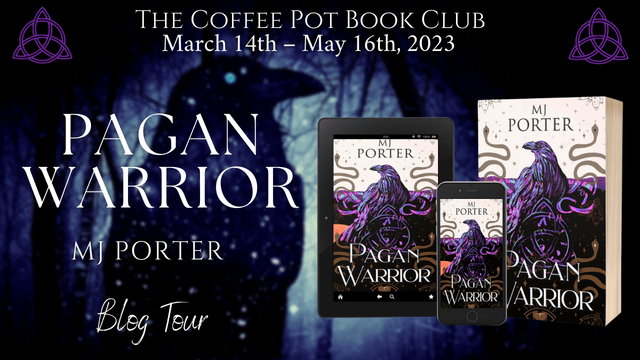
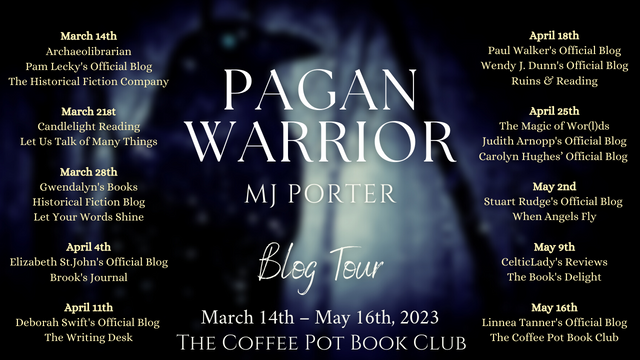
Pagan Warrior is on blog tour with The Coffee Pot Book Club #blogtour – check out the posts for day 9

I’m really excited to share the details of the Pagan Warrior blog tour with The Coffee Pot Book Club.

Pagan Warrior is the story of the battle of Hædfeld, fought in the seventh century between the Northumbrians, and you got it, the Mercians – or rather, Cadwallon of Gwynedd but with Penda of Mercia as his firm ally. You can find more details here.

I might have written this book many years ago, but it’s had a refresh, and is now available in audio, narrated by the fabulous, Matt Coles, as is the second book, Pagan King. Warrior King will be coming later this year in audio.

Now that all three books have been ‘refreshed’ you can read in ebook or paperback, and the books are available from all good ebook/paperback sellers. Check out my latest tiktok video to see Warrior King in paperback:)

You can follow the blog tour, and I’ll be sharing posts here as well. A quick shout out to thank all the blog hosts and Cathie at The Coffee Pot Book Club for organising. Next Tuesday is the final day, and I’m going to be running a competition so pop back and see what’s happening.

For May 9th, check out

The Book Delight

An excerpt on

The Celtic Lady Reviews

For May 2nd, check out the review on

Stuart Rudge’s Official Blog

And a guest post on who King Edwin of Northumbria was over on

When Angels Fly

For April 25th, check out a post about Penda of Mercia.

The Magic of Word(l)ds

Read an excerpt featuring Eowa, Penda’s brother on

Judith Arnopp’s Official Blog

And, read an excerpt featuring Penda on

Carolyn Hughes Official Blog

For April 18th, I answered Paul Walker’s questions on his blog

Paul Walker’s Official Blog

There’s an except over on Wendy J Dunn’s Official Blog featuring King Edwin

Wendy J Dunn’s Official Blog

And a fabulous review on Ruins and Readings

Ruins and Readings

For April 11th, read a guest post about how we know, what we know, about the seventh century.

Deborah Swift’s Official Blog

And a fabulous author interview over on

The Writing Desk

For April 4th, read an excerpt on

Elizabeth St John’s Official Blog

And read about warfare in the Saxon period on

Brook Allan’s Official Blog

For March 28th, check out a fabulous review on

https://gwendalynbooks.wordpress.com/2023/03/28/pagan-warrior/

A guest post about Mercia in the later eighth century on the Historical Fiction Blog.

https://historicalfictionblog.com/pagan-warrior-guest-post/

And, the post that perhaps gave me the most fear to begin will but which was fun when I remembered all the little details, five fun facts about writing the trilogy.

maryannbernal.blogspot.com

For March 21st check out a post about two of the royal residences of Bernicia at the time, Bamburgh and Ad Gefrin (Yeavering). (There are lots of photos, thank you to Helen Hollick for uploading them all).

Let Us Talk of Many Things

And a review from

Candlelight Reading

From March 14th, check out my author interview over on Archaeolibrarian.

Archaeolibrarian

I’m sharing an excerpt over on The Historical Fiction Company.

The Historical Fiction Company

I’ve written a piece about the historical background on Pam Lecky’s official blog.

Pam Lecky’s Official Blog

King of Kings, and the coronation of England’s first king

Athelstan, widely regarded as the first king of the ‘English’ or the first king of England, is one of the main characters in King of Kings. And indeed, the book opens with Athelstan undergoing his coronation. Before his reign, the ruling House of Wessex hadn’t been proclaimed as England’s kings. King Alfred (879-899), Athelstan’s grandfather, was termed the king of the Angles and Saxons (in a charter from 889 known as S346[I]). His son, Edward the Elder, was the king of the Anglo-Saxons, and whether this meant Wessex and Mercia combined has been much debated. But Athelstan was king of the English, (and this certainly included Wessex and Mercia, and parts of the Danelaw that had been reclaimed) and in a departure from earlier custom, was consecrated not with a warrior-helm, but instead with a crown.

Debate still rages as to whether the coronation ordo that has survived was written for Athelstan, his father, or even his nephew (Edgar (959-975), and indeed, whether it included provision for the king’s wife to be consecrated beside him, but for King of Kings, I made use of what is known about the service and reimagined the ceremony for my readers. I hope you enjoy it. Read on for a short extract.

‘This means that only a year after my father’s untimely death, the kingdoms of Mercia, those parts of the East Anglian kingdom that my father lately reclaimed, Wessex and Kent, are reunited again under one ruler. The Saxons, or rather, the English, have just one king. And this is my moment of divine glory, when, before the men and women of the Mercian and Wessex witan, I’ll be proclaimed as king over all.

A prayer is intoned by the archbishop of Canterbury, Athelm, appealing to God to endow me with the qualities of the Old Testament kings: Abraham, Moses, Joshua, David and Solomon. As such, I must be faithful, meek, and full of fortitude and humility while also possessing wisdom. I hope I’ll live up to these lofty expectations.

I’m anointed with the holy oil and then given a thick gold ring with a flashing ruby to prove that I accept my role as protector of the one true faith. A finely balanced sword is placed in my hands, the work of a master blacksmith, with which I’m to defend widows and orphans and through which I can restore things left desolated by my foes, and my foes are the Norse.’


[i]  http://www.esawyer.org.uk/,

books2read.com/King-of-Kings

King of Kings is currently available with Prime Reading.

Map design by Flintlock Covers

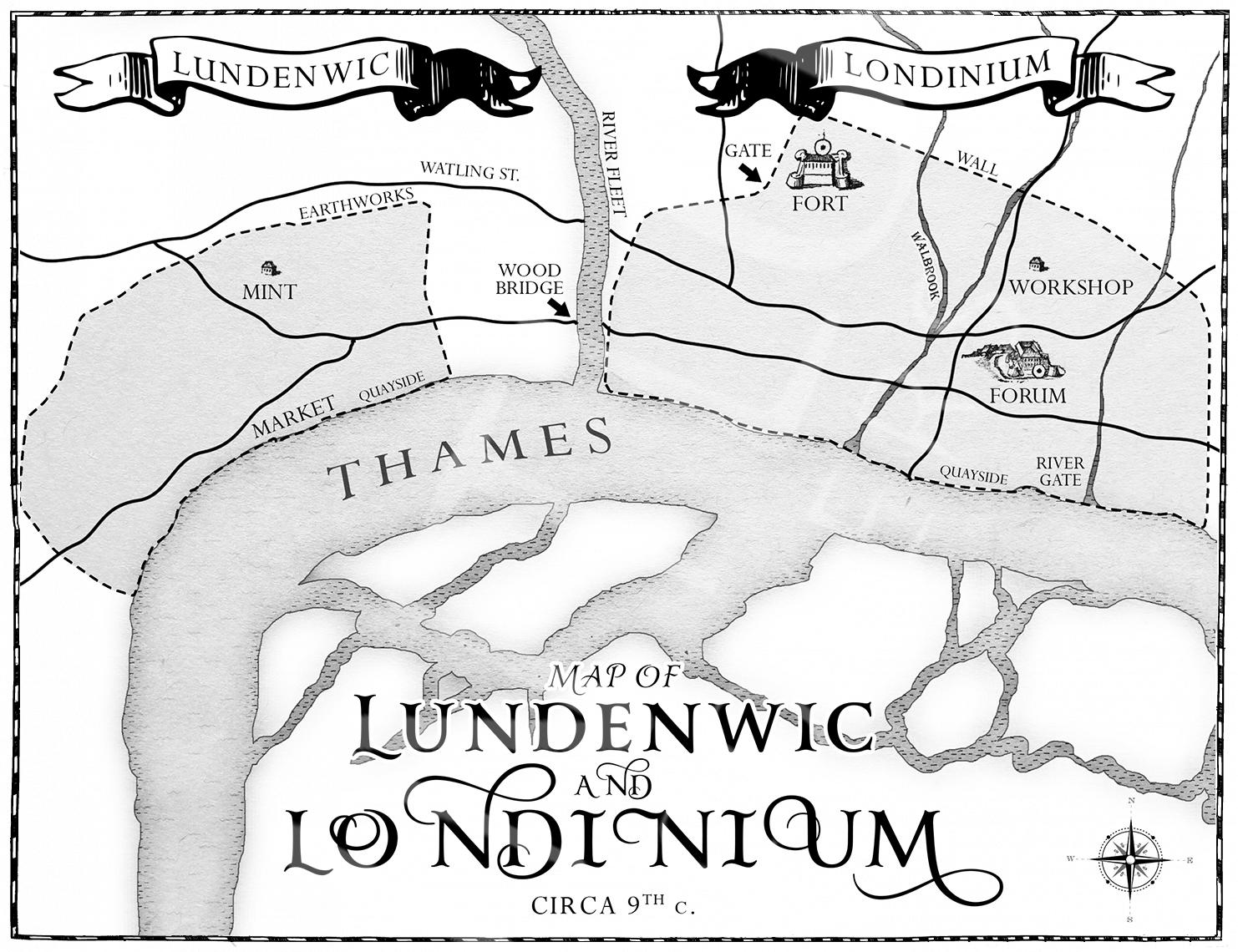
The River Thames in the Saxon period

In Eagle of Mercia, young Icel and his allies are busily guarding the River Thames against a potential Viking raider attack. The Viking raiders certainly made use of the many rivers running through England at the time (and throughout the British Isles), but the river was also significant as a very definitive and solid boundary between the Saxon kingdoms of Wessex and Mercia, which to the west, where the River Thames doesn’t flow, was continued by the earthworks known as the Wansdyke.

London, now the capital of the United Kingdom, wasn’t always as important as we might assume, and indeed, it wasn’t ever the capital of Wessex or Mercia. These two kingdoms fought most fiercely over the settlement. It wasn’t even overly important to the Romans, either. And this is why I’ve perhaps been remiss in not truly considering its significance. As rivers have changed their course over the years, so has the River Thames. And what’s most fascinating about the River Thames is that, seemingly for long periods during the Saxon era, it wasn’t navigable, as we might expect it to have been. 

Map of Early England by Flintlock Covers

‘During this period, as perhaps as other times, there may well have been a division between use of the Thames in its today reach and use of it above the tidal head. Paleoenvironmental evidence suggests that a relative drop in river levels during the Roman period meant that the tidal head was perhaps as low as Londinium itself, but that it (and thereby the range of easy navigability) generally moved upstream during the Anglo-Saxon period. This trend was not, however, uniform, and there were also brief periods (such as the late tenth to eleventh centuries) when the tidal reach shifted back downstream again.’ p. 271

It seems then, that when considering London, or Londinium/Lundenwic/Londonia, we also need to be mindful of the era in the Saxon period that we’re writing about. For the first Viking age,

‘A combination of the seasonal (and presumably climatic) unreliability of riverine travel and  the need on many occasions to travel upstream cannot have made it easy for the Vikings to use the Thames for shock offensives… and there is no clear example of a Viking force travelling by water up the Thames further than Fulham.’ p.278

Clues to how passable the River Thames might have been can be traced.

‘Without the construction of bridges, the river would have been impassable except by ferry, from its estuary as far as the lowest fording point, perhaps as low as Halliford near Shepperton, and between the various fording points. Even where the middle and upper stretches could be forded, such crossings were not guaranteed to be easy. Lechlade and Cricklade, two potentially treacherous upper Thames crossings, severely affected by flooding in winter were named Old English (ge)lad ‘difficult river crossing.’ p.279

As with all things, we should be wary of assuming that current conditions would have been prevalent in the past. The River Thames certainly falls into that category. So while, yes, it was certainly a decisive boundary between the Saxon kingdoms of Wessex and Mercia, on occasion, it wouldn’t have been as decisive as at others. This, I find fascinating, and just another of those ‘facts’ travellers to the Saxon era should be wary about. While we know (hopefully not a spoiler) that London was attacked in the 840s and 850s, prior to this, it might well have been impossible for the Viking raiders to attack in the way they were used to. This, perhaps, accounts for why they chose more coastal locations, such as the Isle of Sh.

Map by Flintlock Covers for Wolf of Mercia

(Quotes taken from Beyond the Burghal Hidage by Baker and Brookes)

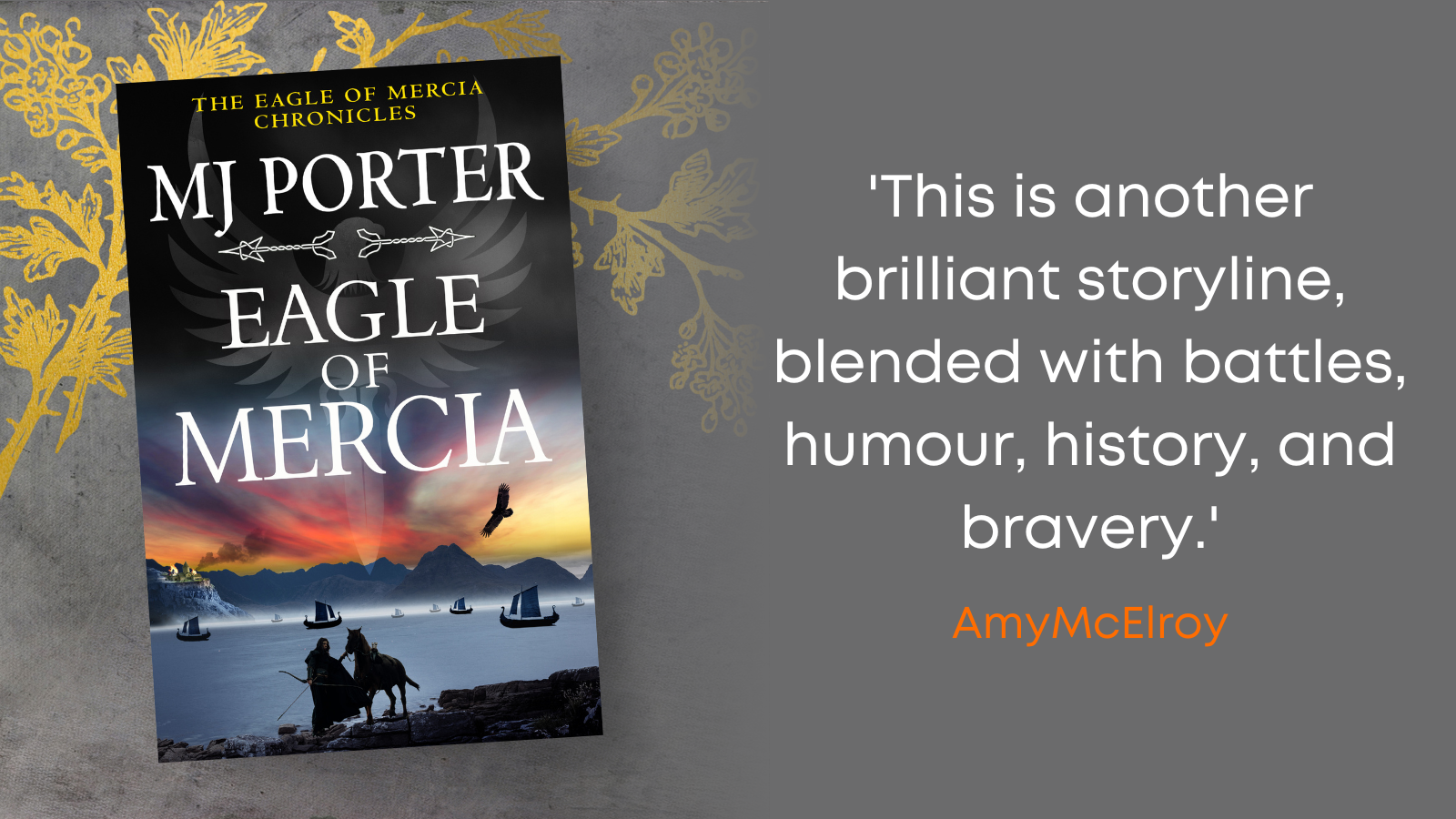
Read Eagle of Mercia now.

https://books2read.com/EagleofMercia

Happy Release Day to Eagle of Mercia

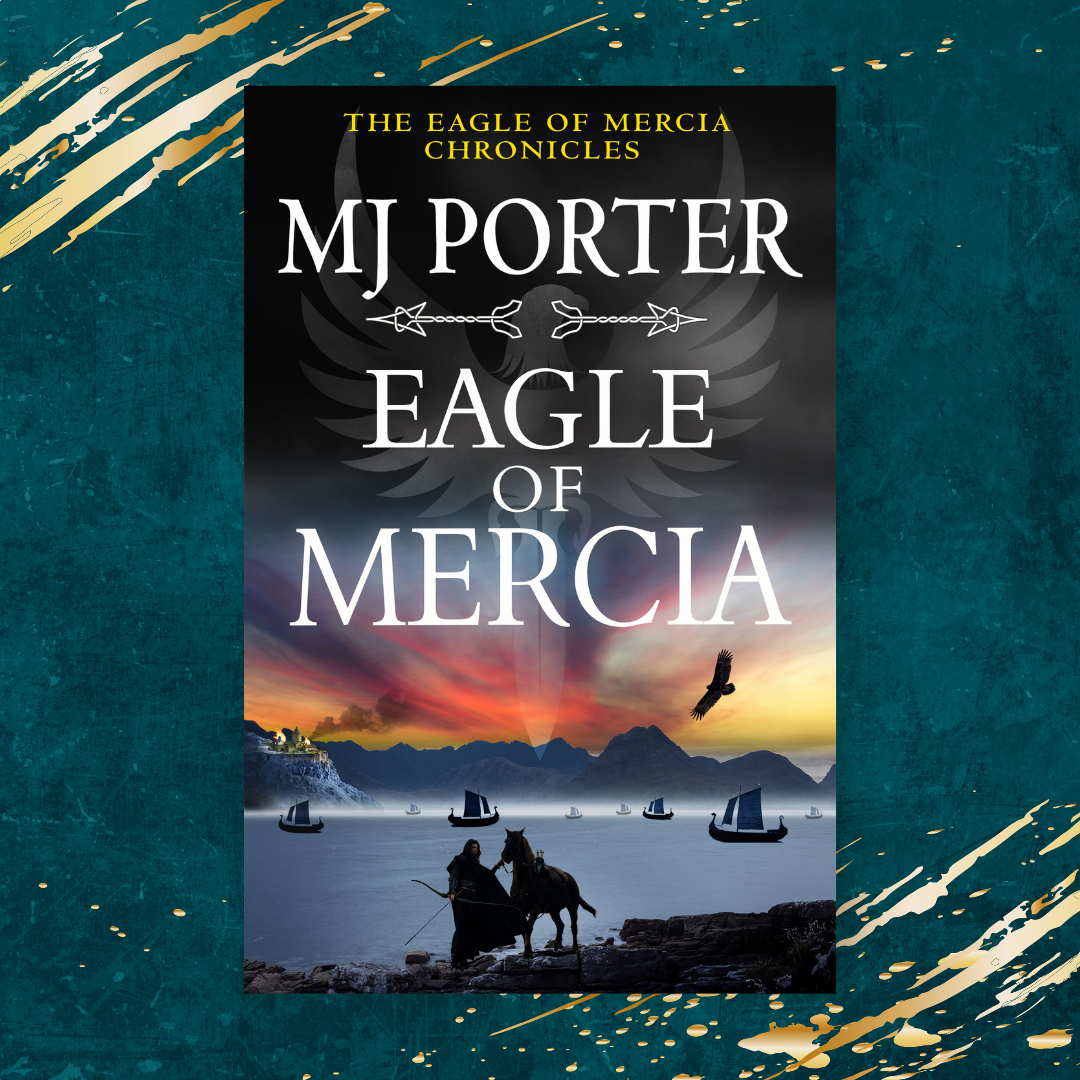
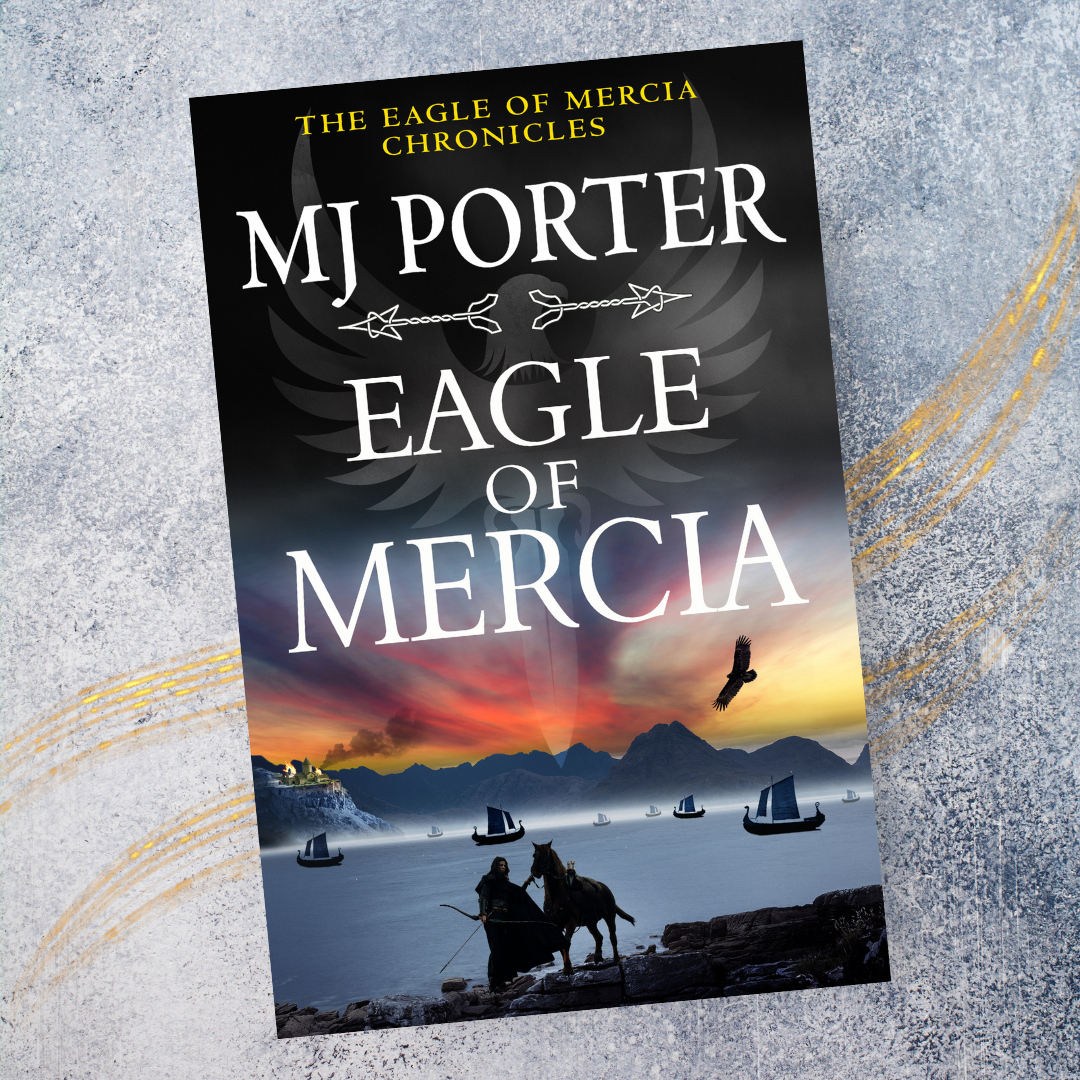
Today is the day, book 4 in The Eagle of Mercia Chronicles is released into the wild. I’m really excited about this one:) And I can’t believe we’re already onto book 4.

Here’s the blurb:

A mercy mission in the heart of Wessex is beset with deadly, bloody dangers.

Tamworth AD831

Icel’s profile continues to rise. Lord of Budworth and warrior of Mercia, he’s acknowledged by King Wiglaf and his comrades to keep Mercia safe from the ravages of Wessex, the king-slayer of the East Angles, and the Viking raiders.
But, danger looms.  Alongside Spring’s arrival comes the almost certain threat of the Viking raiders return. 

When Lord Coenwulf of Kingsholm is apprehended by a Viking and held captive on the Isle of Sheppey in Wessex held Kent, Icel is implored by Lady Cynehild to rescue her husband.

To rescue Lord Coenwulf, Icel and his fellow warriors must risk themselves twice over, for not only must they overpower the Viking raiders, they must also counter the threat of Mercia’s ancient enemy, the kingdom of Wessex as they travel through their lands.

Far from home and threatened on all sides, have Icel and his fellow warriors sworn to carry out an impossible duty?

books2read.com/EagleofMercia

Available now in ebook, paperback and audio, the hardback should be with us shortly.

Read my release day post about the River Thames.

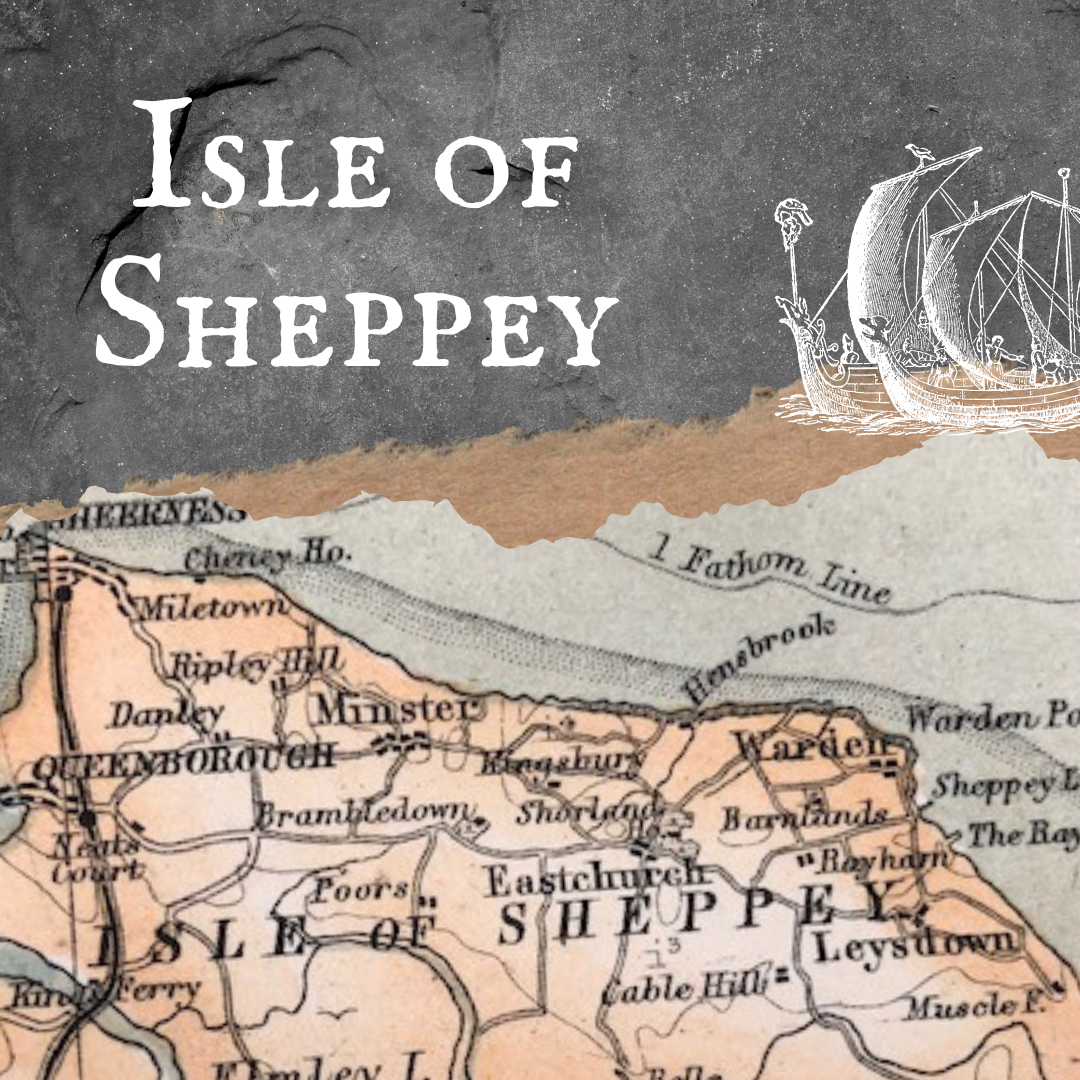
Read all about the Isle of Sheppey

Read my release day post on the Boldwood website about the Eagle of Mercia Chronicles.


I can let you know that book 5 is mostly written, and I know the title and I’ve seen the cover – I know, I’m such a tease. I will update when I can share more.


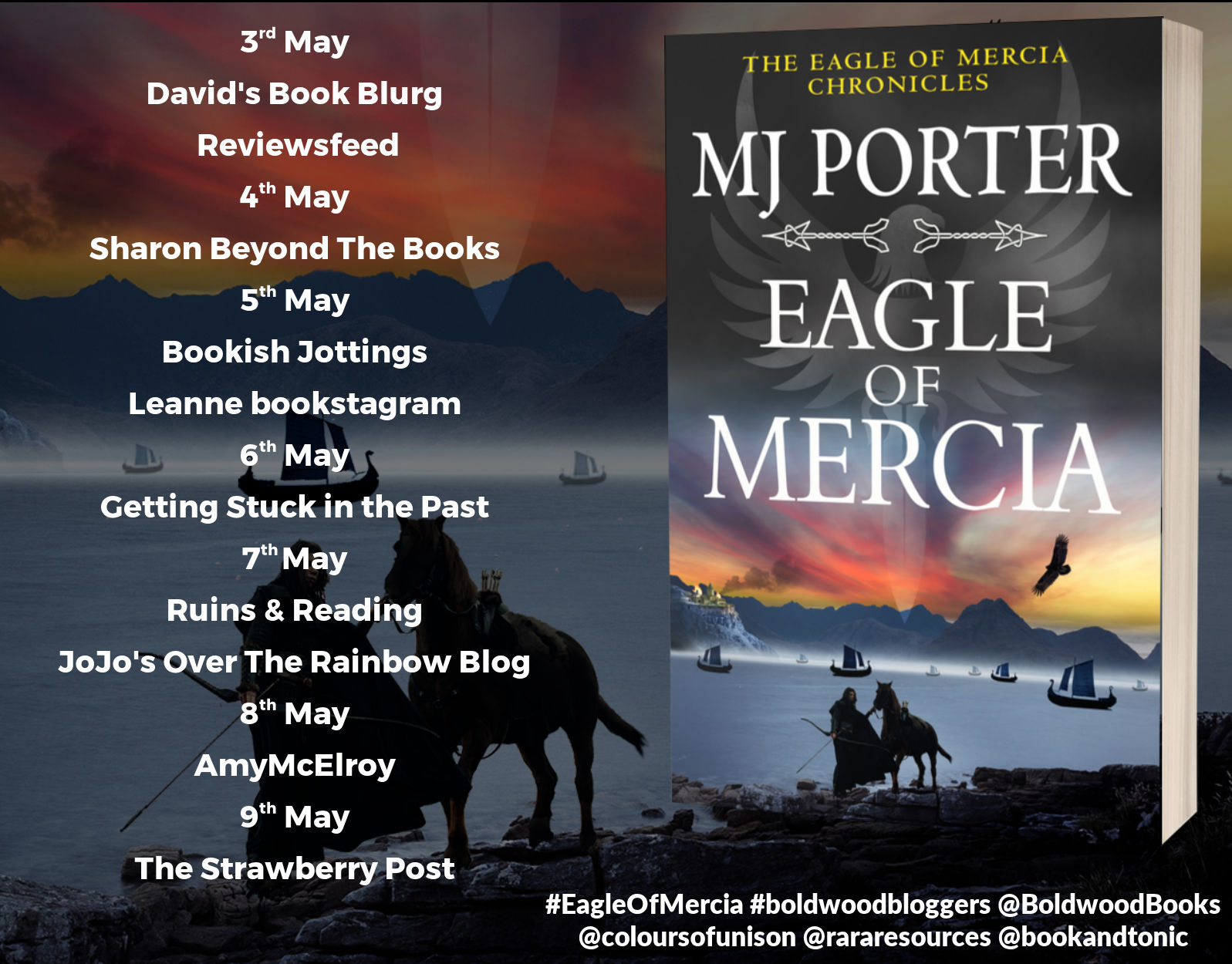
Check out the blog tour for Eagle of Mercia. My thanks to Rachel at Rachel’s Random Resources for organising and all the hosts for taking part. I will add the links each day. The initial reviews for Eagle are very positive, so I hope you’ll enjoy it too.

Reviewsfeed

David’s Book Blurg

Sharon Beyond the Books

Leanne Bookstagram

Bookish Jottings

Getting Stuck in the Past

Ruins and Reading

Amy McElroy

The Strawberry Post

Pagan Warrior is on blog tour with The Coffee Pot Book Club #blogtour – check out the posts for day 8

I’m really excited to share the details of the Pagan Warrior blog tour with The Coffee Pot Book Club.

Pagan Warrior is the story of the battle of Hædfeld, fought in the seventh century between the Northumbrians, and you got it, the Mercians – or rather, Cadwallon of Gwynedd but with Penda of Mercia as his firm ally. You can find more details here.

I might have written this book many years ago, but it’s had a refresh, and is now available in audio, narrated by the fabulous, Matt Coles, as is the second book, Pagan King. Warrior King will be coming later this year in audio.

Now that all three books have been ‘refreshed’ you can read in ebook or paperback, and the books are available from all good ebook/paperback sellers. Check out my latest tiktok video to see Warrior King in paperback:)

You can follow the blog tour, and I’ll be sharing posts here as well. A quick shout out to thank all the blog hosts and Cathie at The Coffee Pot Book Club for organising.

For May 2nd, check out the review on

Stuart Rudge’s Official Blog

And a guest post on who King Edwin of Northumbria was over on

When Angels Fly

For April 25th, check out a post about Penda of Mercia.

The Magic of Word(l)ds

Read an excerpt featuring Eowa, Penda’s brother on

Judith Arnopp’s Official Blog

And, read an excerpt featuring Penda on

Carolyn Hughes Official Blog

For April 18th, I answered Paul Walker’s questions on his blog

Paul Walker’s Official Blog

There’s an except over on Wendy J Dunn’s Official Blog featuring King Edwin

Wendy J Dunn’s Official Blog

And a fabulous review on Ruins and Readings

Ruins and Readings

For April 11th, read a guest post about how we know, what we know, about the seventh century.

Deborah Swift’s Official Blog

And a fabulous author interview over on

The Writing Desk

For April 4th, read an excerpt on

Elizabeth St John’s Official Blog

And read about warfare in the Saxon period on

Brook Allan’s Official Blog

For March 28th, check out a fabulous review on

https://gwendalynbooks.wordpress.com/2023/03/28/pagan-warrior/

A guest post about Mercia in the later eighth century on the Historical Fiction Blog.

https://historicalfictionblog.com/pagan-warrior-guest-post/

And, the post that perhaps gave me the most fear to begin will but which was fun when I remembered all the little details, five fun facts about writing the trilogy.

maryannbernal.blogspot.com

For March 21st check out a post about two of the royal residences of Bernicia at the time, Bamburgh and Ad Gefrin (Yeavering). (There are lots of photos, thank you to Helen Hollick for uploading them all).

Let Us Talk of Many Things

And a review from

Candlelight Reading

From March 14th, check out my author interview over on Archaeolibrarian.

Archaeolibrarian

I’m sharing an excerpt over on The Historical Fiction Company.

The Historical Fiction Company

I’ve written a piece about the historical background on Pam Lecky’s official blog.

Pam Lecky’s Official Blog

Happy publication day to Kelly Evans and Turning the World to Stone: The Life of Caterina Sforza #newrelease #lostwomenofhistory

I’m delighted to wish my fellow Medieval Maverick happy release day with her new book, Turning the World to Stone. It’s a goodie:)

Here’s the blurb

Vilified by history, Caterina Sforza learned early that her life was not her own. Married at age ten, she was a pawn in the ever-changing political environment of Renaissance Italy.

Resigned to her life as a fifteenth-century wife, Caterina adapted to the role she was expected to play: raising and educating her children, helping the poor in her new home, and turning a blind eye to her husband’s increasingly shameful behaviour. But Fate had other plans for her, and soon Caterina’s path would be plagued by murder, betrayal, and heartbreak.

“Could I write all, the world would turn to stone.”

Buy on Amazon

UK US

Meet the author

I started writing in high school and have always been fascinated by history, eventually earning a degree in the subject. The merging of the two came naturally when I started writing full time a few years ago.

In my alternate identity as Lady Matilda, I post satirical articles on managing your medieval manor during the Black Death. 

I’ve just released my new historical fiction novel, Unfinished: The Inspired Life of Elisabetta Sirani, the tragic story of Maestra Sirani, a Seventeenth-Century artist who died young of a mysterious illness. I’m currently researching the life of Caterina Sforza for my next book.

https://kellyaevans.com

Read an excerpt on Kelly’s website

https://linktr.ee/kellyevansauthor