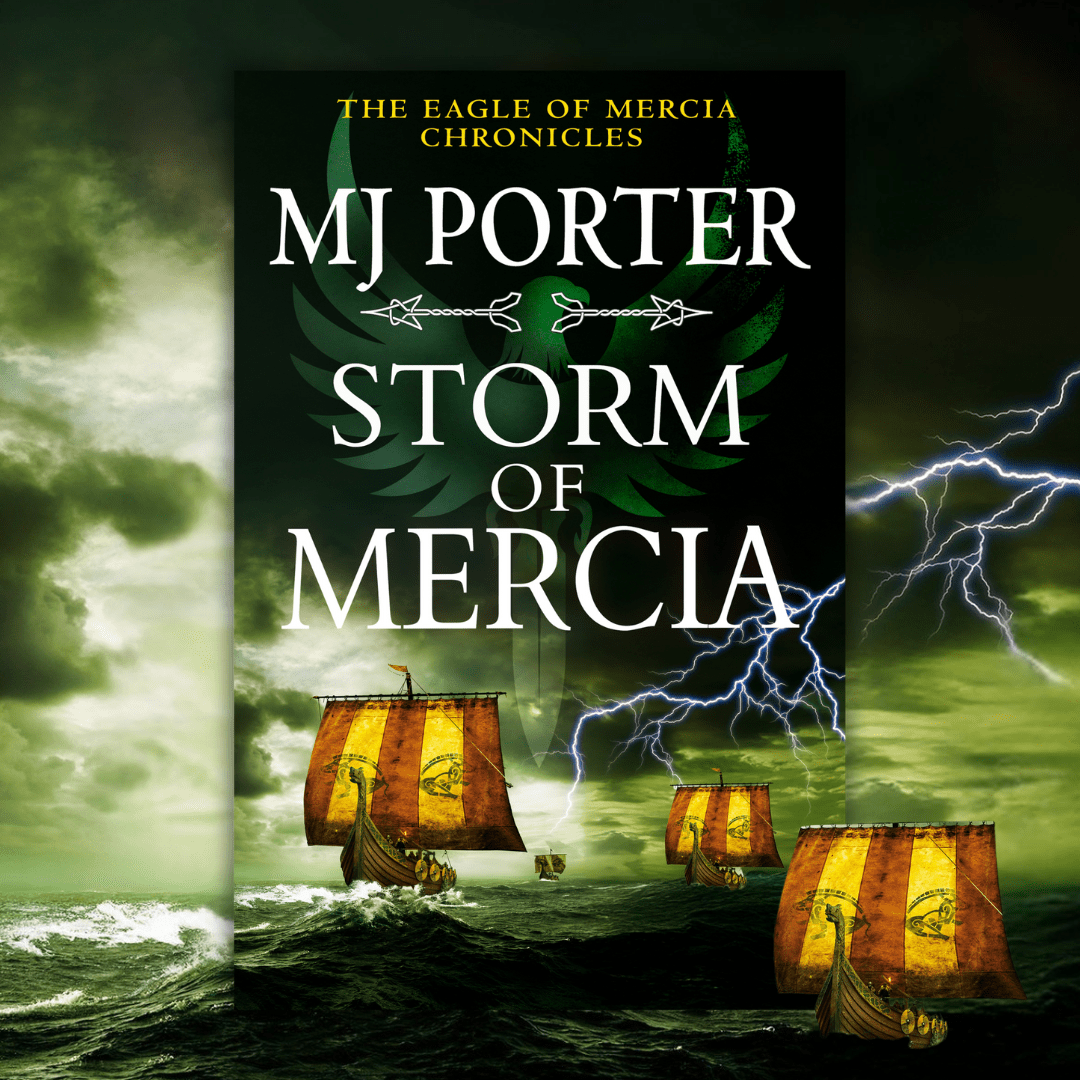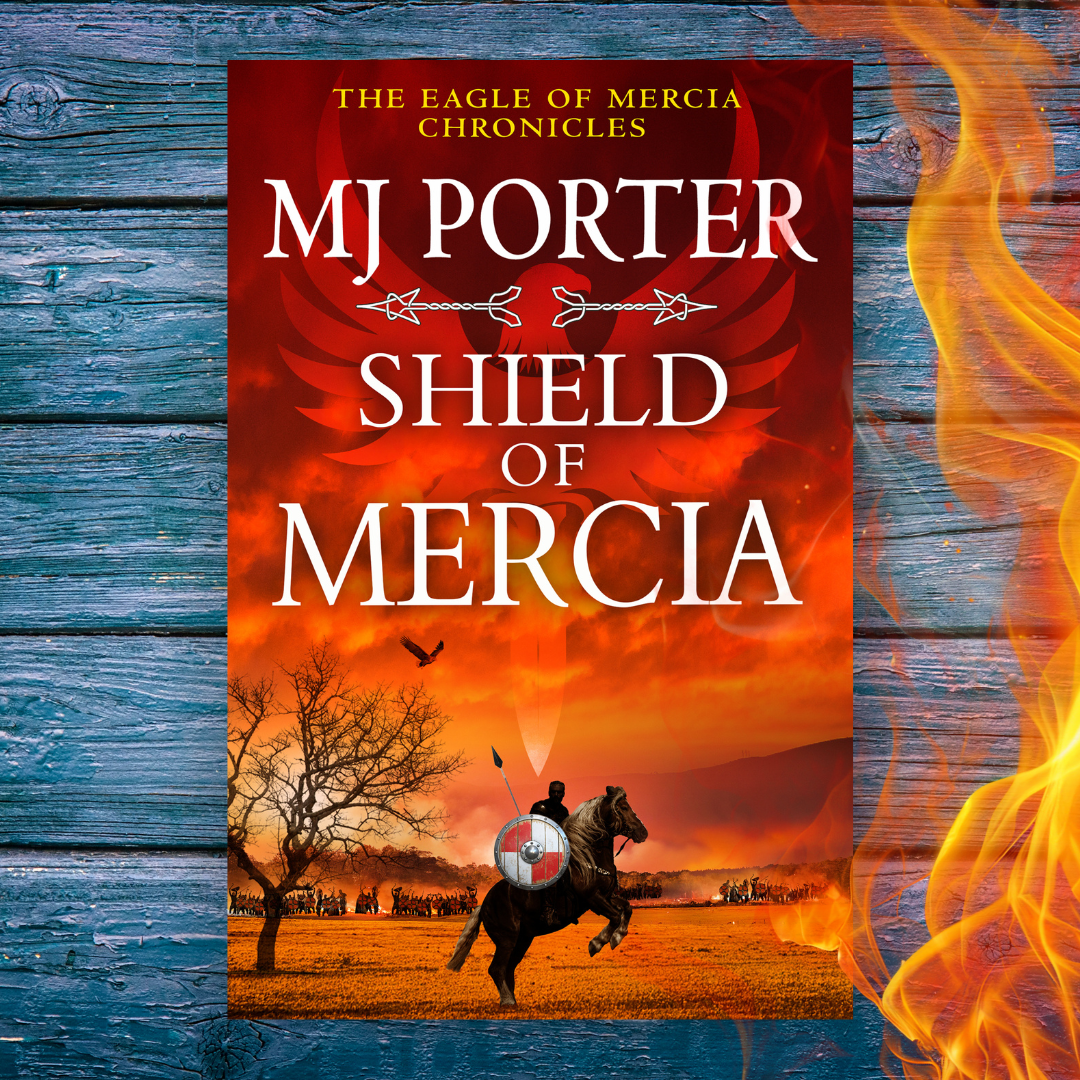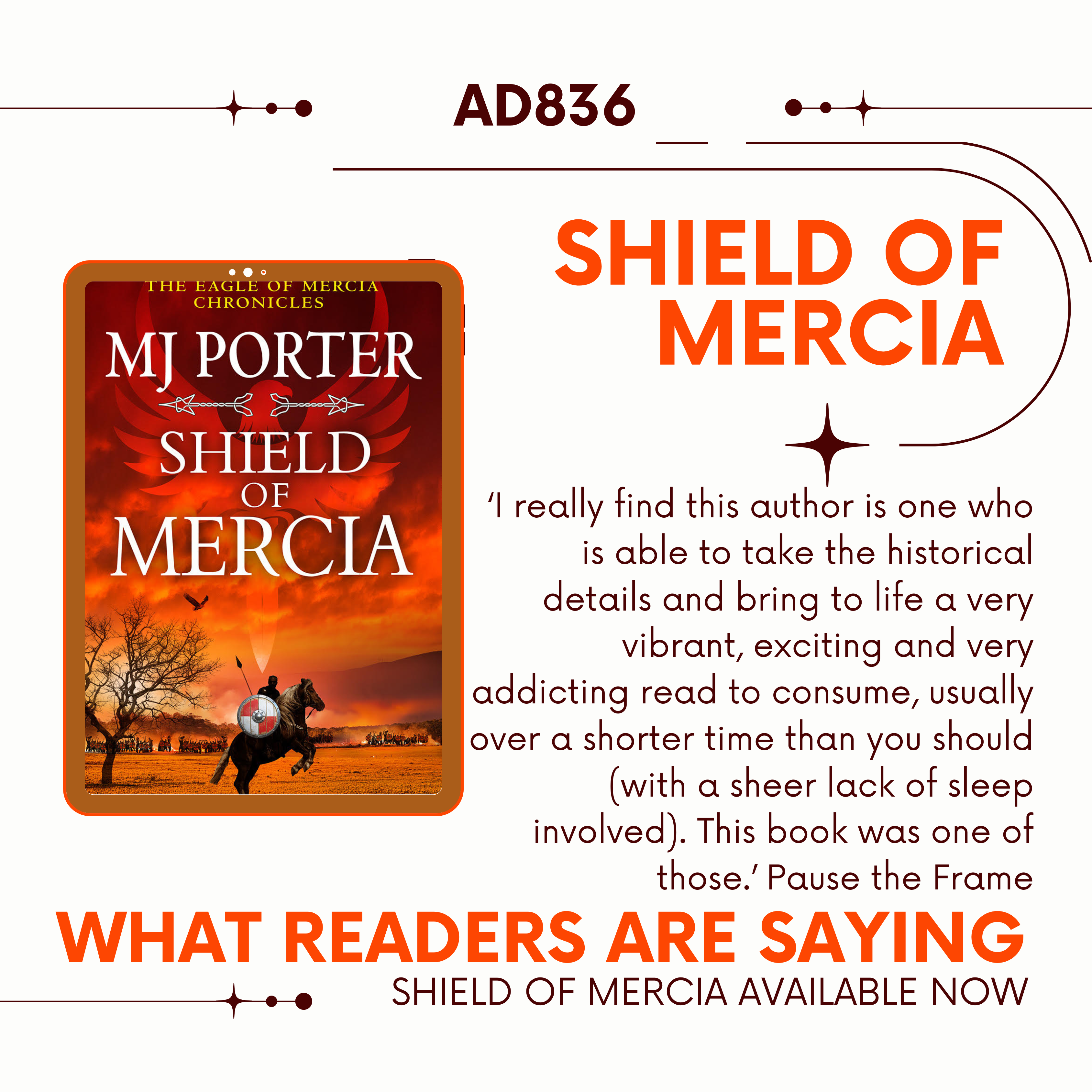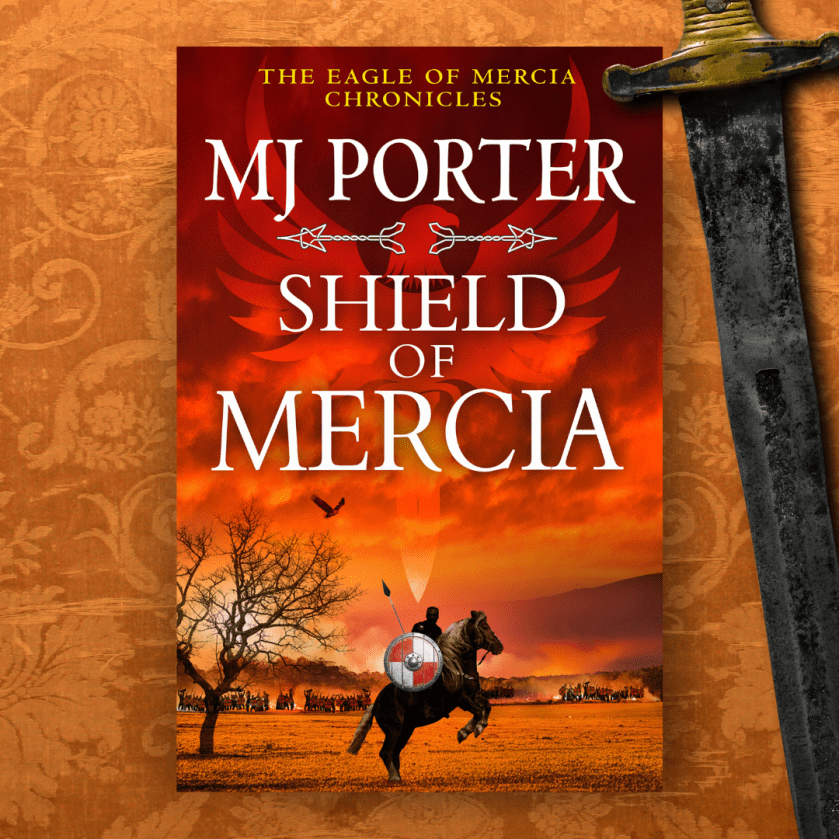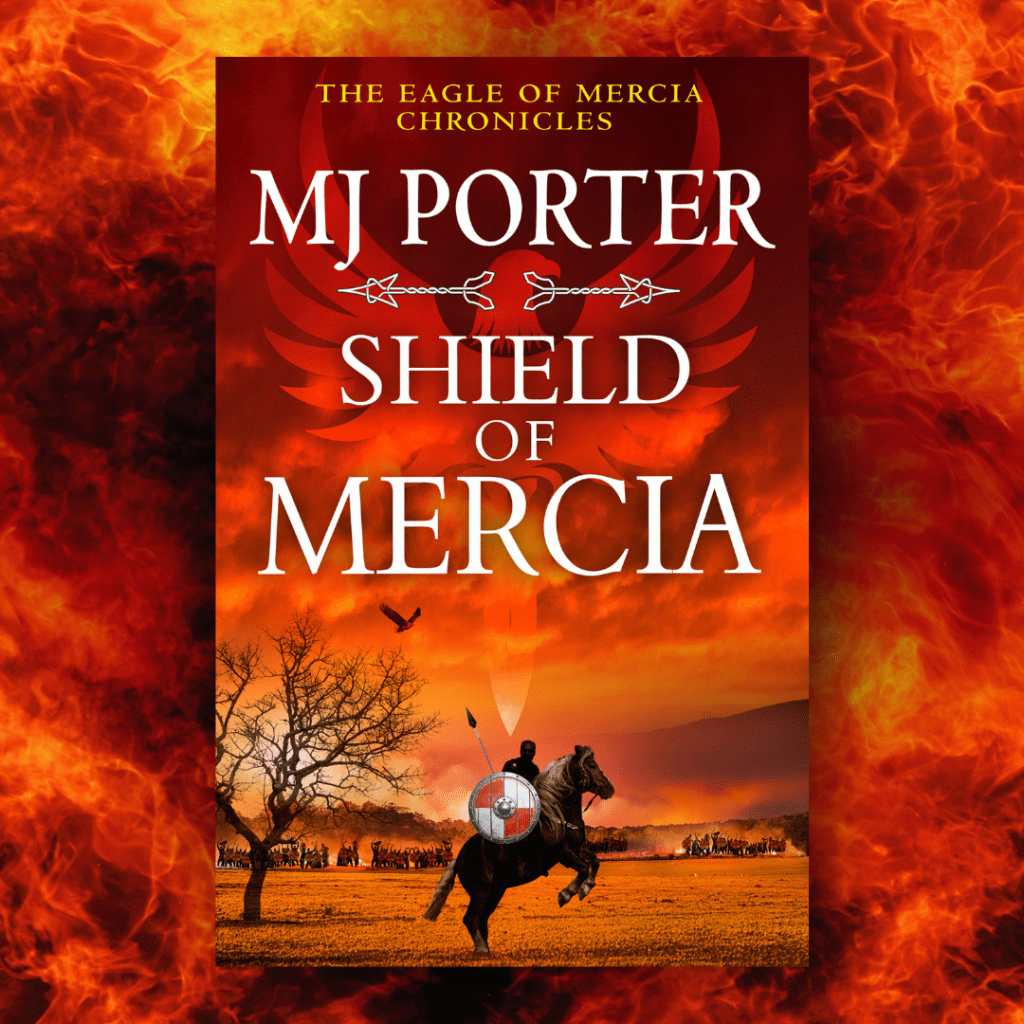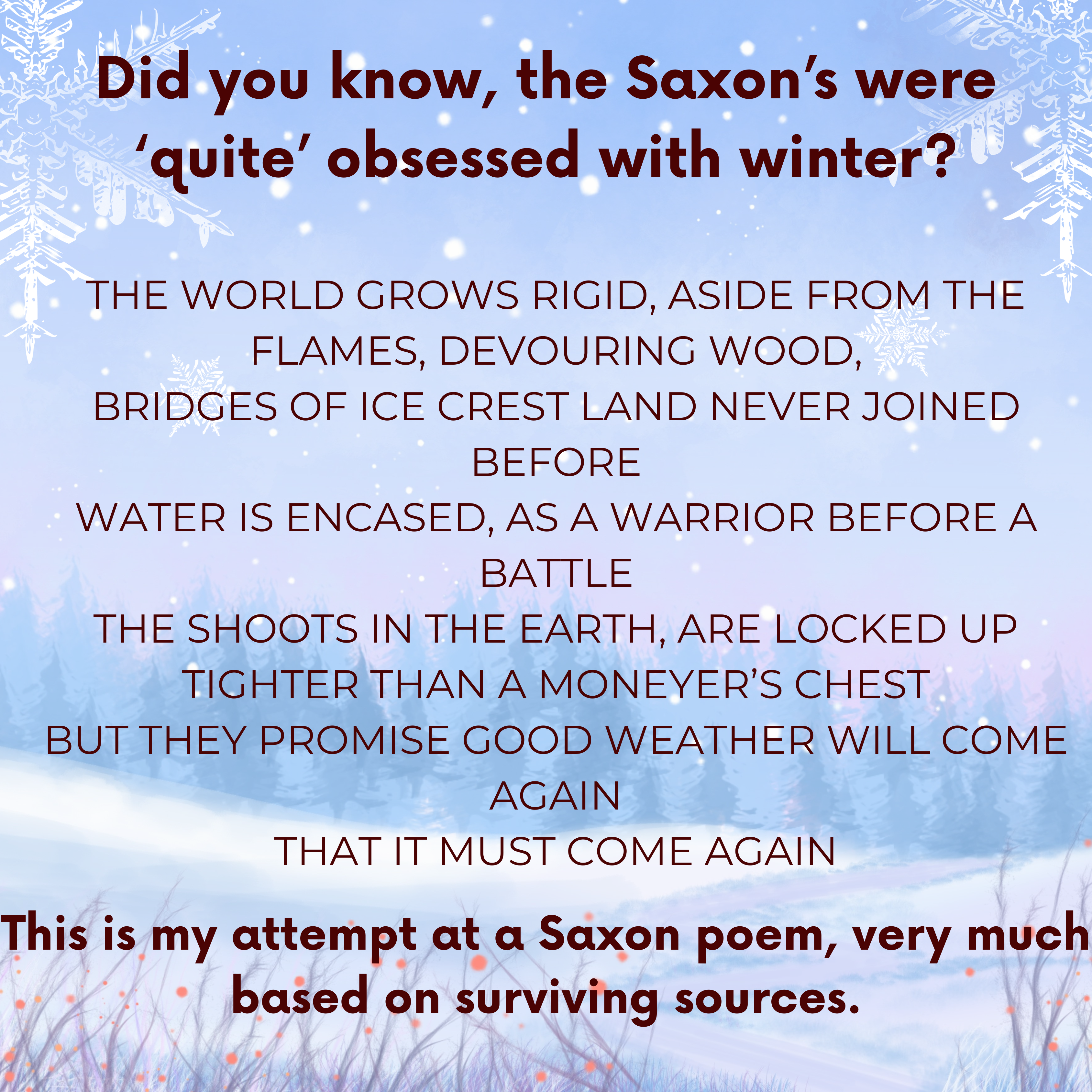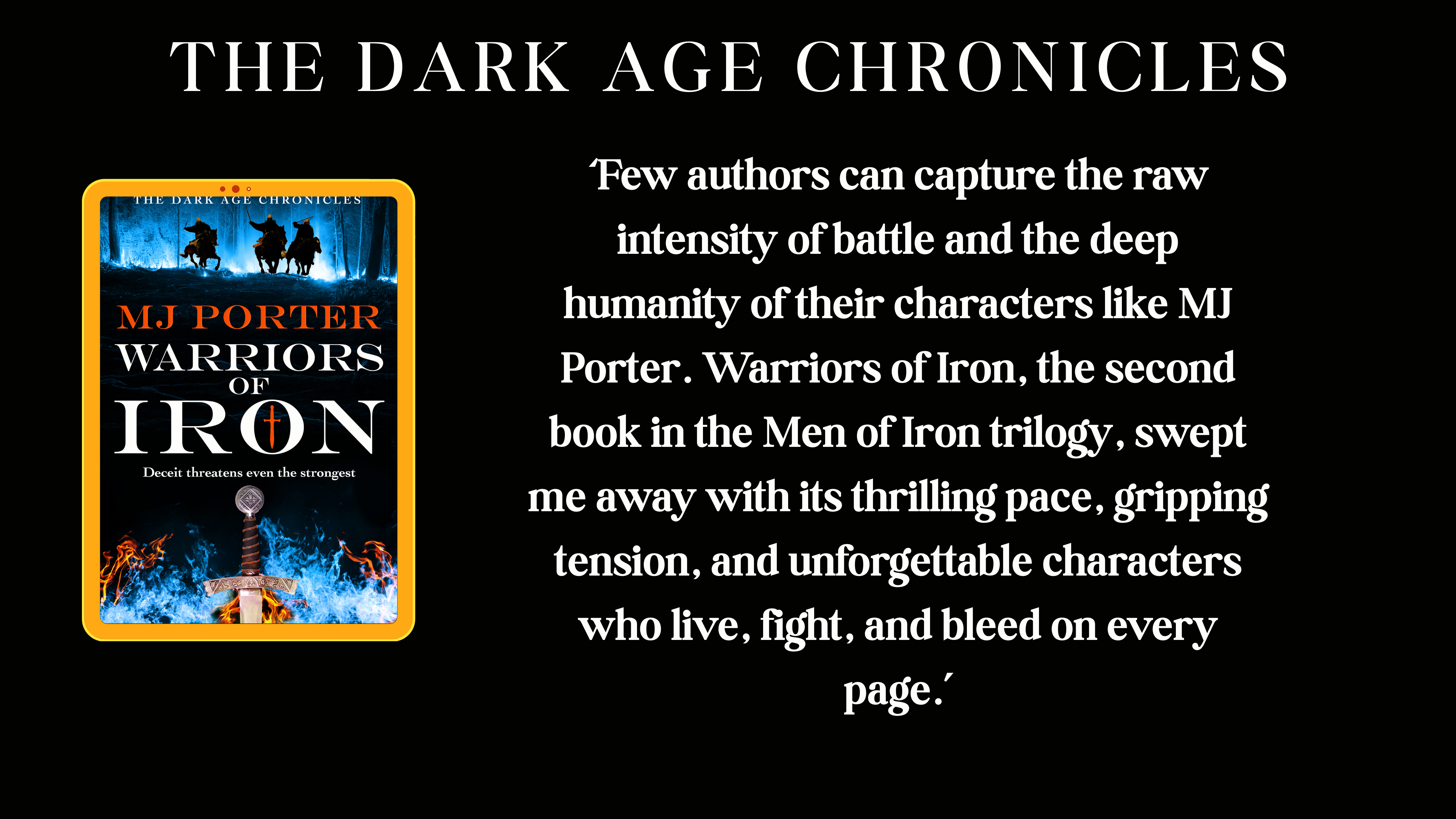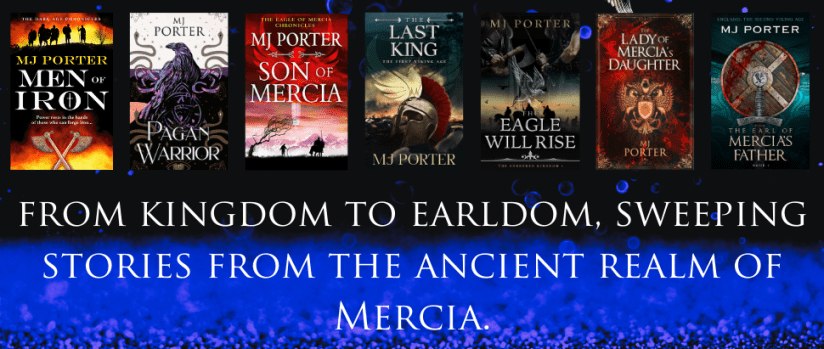

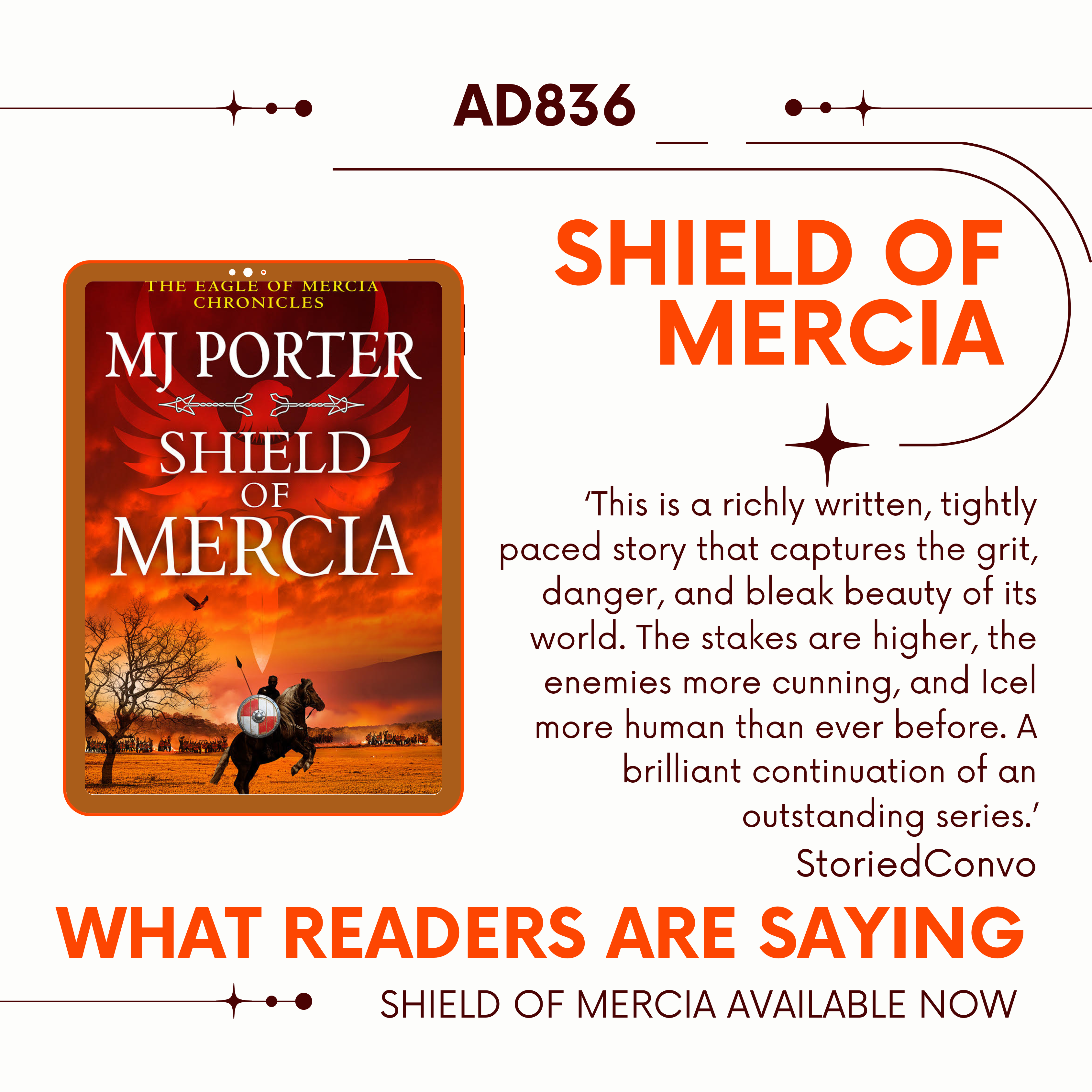
It’s cover reveal time for Shield of Mercia. Return to the world of young Icel. #covereveal #preorder #histfic #EasterEggs
Mercia is triumphant. Her king is safe. But Wessex was never Mercia’s only enemy.
Tamworth, AD836
Following a brutally cold winter, King Wiglaf of Mercia is in the ascendancy. Even Wessex’s Archbishop of Canterbury extraordinarily ventures to Mercia to broker a religious accord. But, can the hard-won peace prevail?
Viking raiders threaten Wessex. These blood-thirsty warriors are fast, skilful and have no reticence about killing those who stand in their way. Their aim isn’t to rule but to overwhelm, slaughter and take ill-gotten wealth.
King Wiglaf is no fool. As the Vikings push to overwhelm Wessex, Mercia’s lands look insecure. King Wiglaf needs the shields of Mercia’s warriors to prevent the overwhelming advancement of their deadliest enemy yet.
To save Mercia, Icel must first prevail over the two men who mean to end his life; King Ecgberht of Wessex and his son, Æthelwulf of Kent and only then the marauding Viking army for whom boundaries have no meaning.
Paris, 1928: Agatha Christie and fellow writer Dorothy L Sayers board the Orient Express, bound for Constantinople. Christie in particular is looking forward to a break from recent dispiriting events in both her work and private life – the finalisation of her divorce from her philanderous husband Archie, and the miserly reception of her latest book.
But before the duo can settle in to enjoy the luxuries of their first-class journey, their journey is derailed when a fellow guest drops dead during the dinner service. And as the last person to speak to the victim, Dorothy finds herself a prime suspect in his murder.
As the train hurtles East, Sayers’ resourceful assistant Eliza and her friend Theo must navigate a maze of suspects. But with each passing mile, the stakes rise, and when another body is discovered, their search to find the killer before they reach their destination becomes increasingly complicated.
Can Eliza and Theo stay one step ahead, crack the mystery and clear Dorothy’s name? Or will this be one journey too far for the amateur sleuths?
The Case of the Body on the Orient Express is a fun murder mystery, reuniting us with outspoken and headstrong Eliza, and her fellow sleuth, Theo, who, in true ‘tormented writer’ guise, has spent the last two years in France, roughing it in an attempt to escape the object of his torment, Eliza. What could be better than throwing them together on the Orient Express, with a host of mystery writers on their way to a writers convention?
As their journey gets underway, Eliza is aware of undercurrents from Dorothy, her employer, and she’s alert to the other passengers as well. She’s not about to accept that Ivan died of a heart attack. And so begins her sleuthing, with the aid, sometimes unwillingly given, of Theo. And the case becomes curioser and curioser as the train finally reaches Istanbul/Constantinople.
Another fab addition to Kelly Oliver’s sleuthing mysteries. I do love the little connections between this series and the Fiona Figg books. But, of course, you don’t need to have read them. I also enjoy the addition of the real-life mystery writers. Fans of the genre will thoroughly enjoy Eliza and Theo’s new escapade.
Kelly Oliver is the award-winning, bestselling author of three mysteries series: The Jessica James Mysteries, The Pet Detective Mysteries, and the historical cozies The Fiona Figg Mysteries, set in WW1. She is also the Distinguished Professor of Philosophy at Vanderbilt University and lives in Nashville, Tennessee
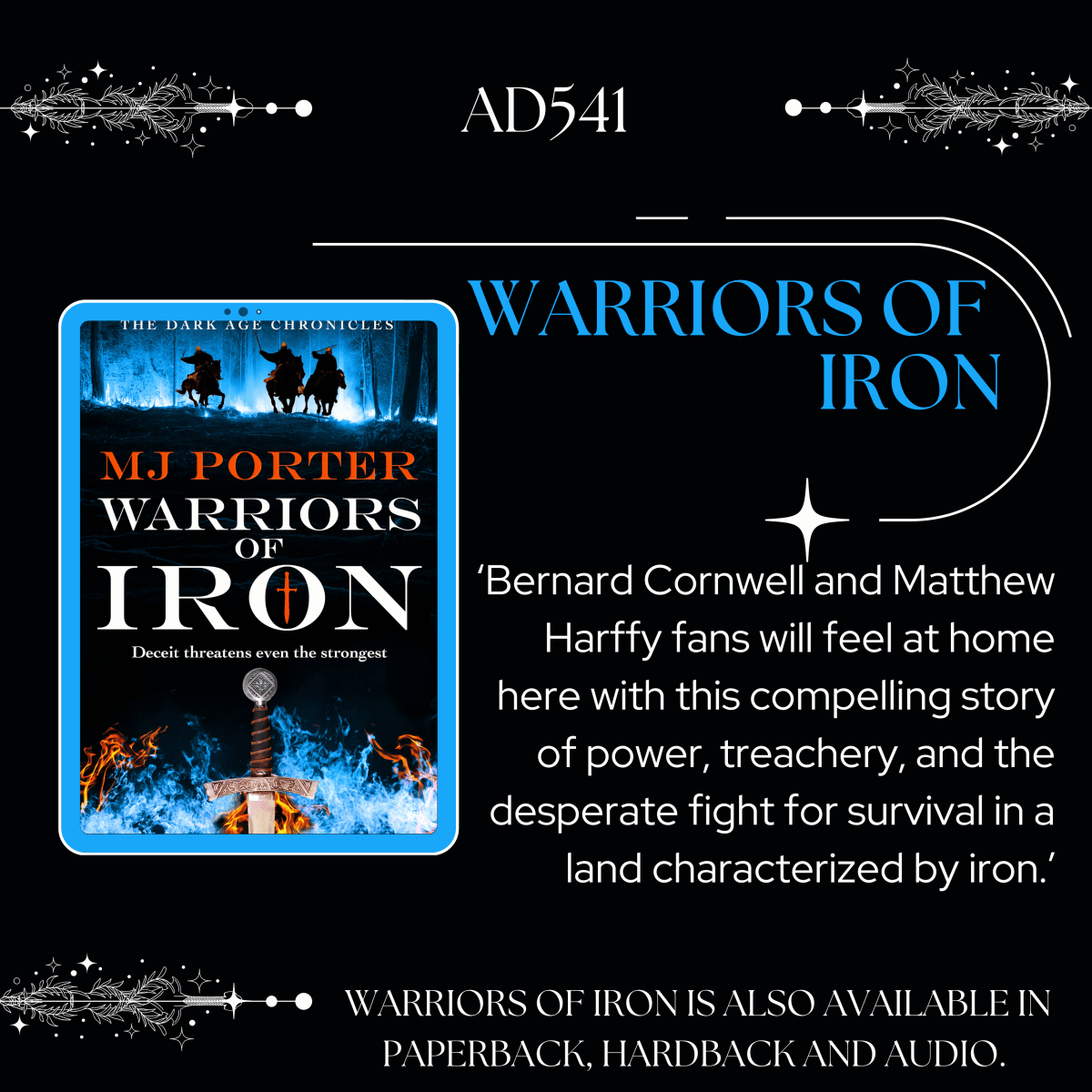
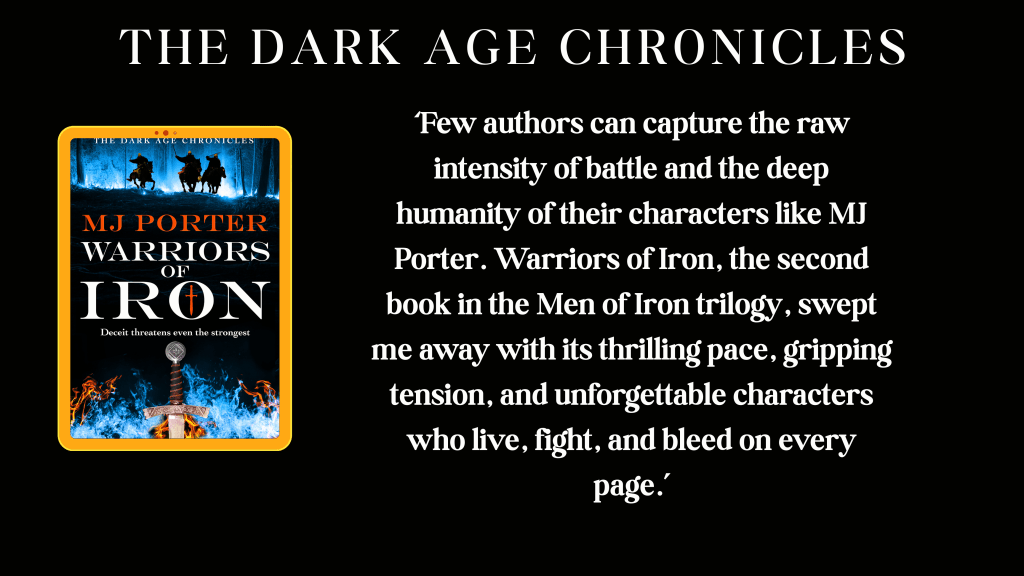
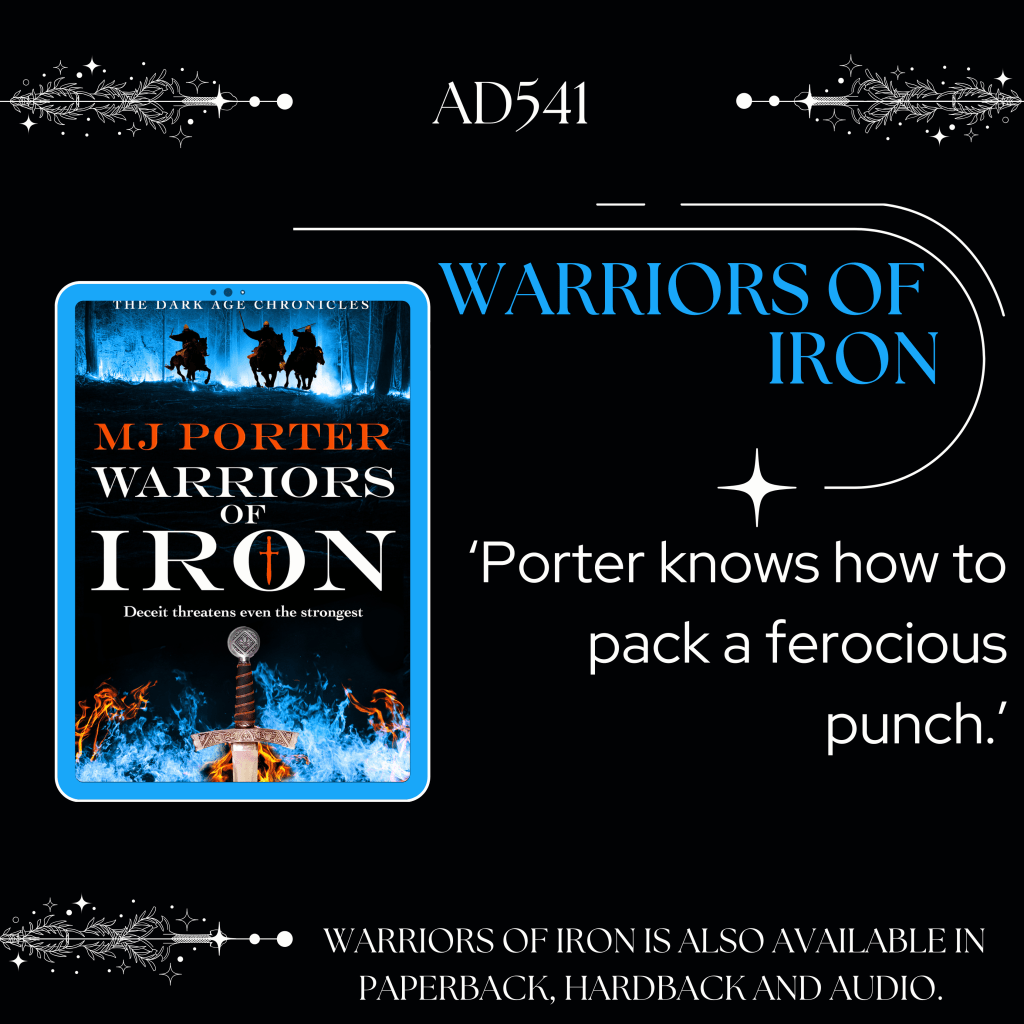
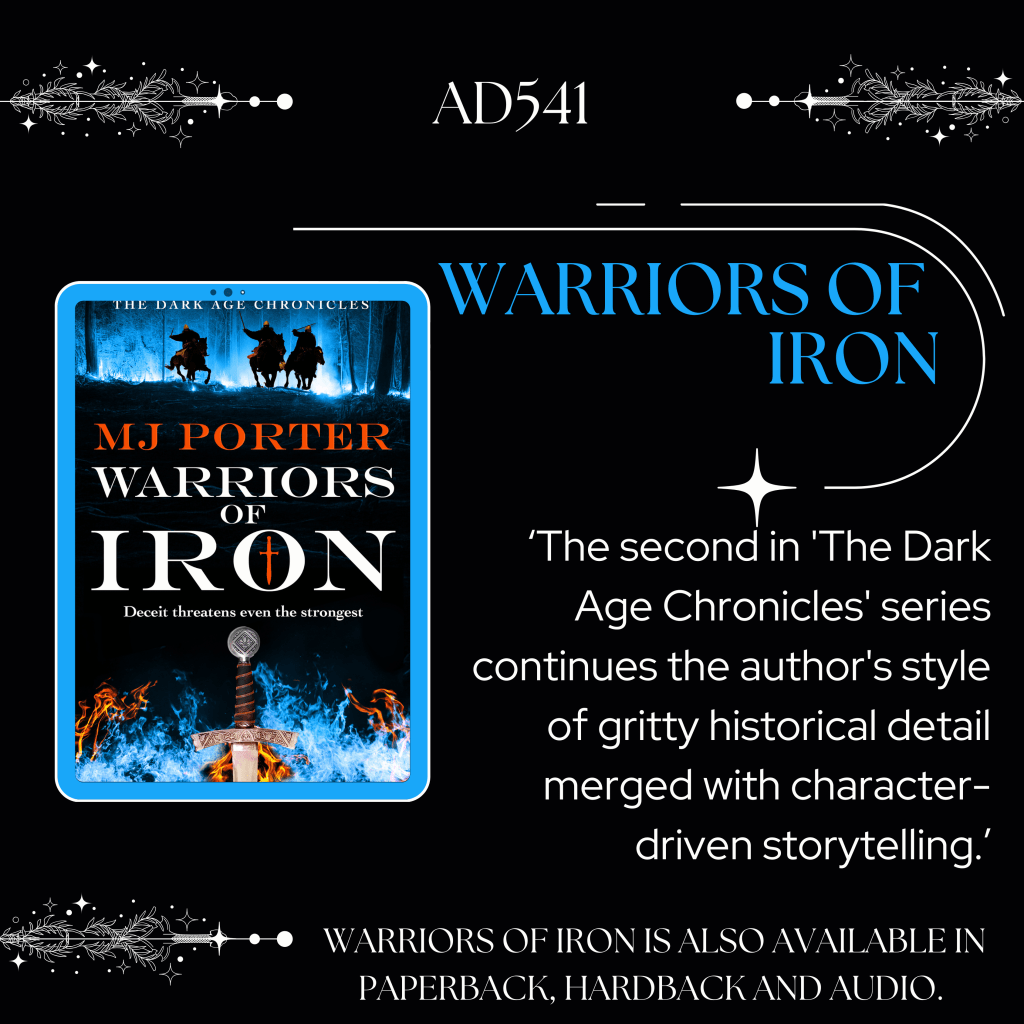
It’s happy release day to Warriors of Iron, the second book in the Dark Age Chronicles Trilogy. I’m sharing some photos from my visit to Sutton Hoo #newrelease #MenOfIron #WarriorsOfIron #histfic
Sutton Hoo
As part of my research for the trilogy, I visited Sutton Hoo in July 2024. While it was a fascinating place to visit (see the images below of the surviving grave mounds), it was actually something else my Canadian guide told me that resonated with me for the series. It was that while this area gets a lot of interest, a further gravesite has also been found under where the car park for the visitor centre is now. This gravesite contained thirty-six graves (I think I’ve got the figures correct), twenty-nine of which were burials while the rest were cremations. The car park burials are believed to date to between 510 and c.600, and so before the Sutton Hoo burial of such fame. Fourteen of the graves were warrior graves, buried with shield and spear.
You might wonder why that intrigued me so much, and you’d be correct to do so. But, of course, I wanted to write the series before the advent of what we know as Saxon England, and this was therefore where I needed to be researching. The ‘shiny’ helmet and sword (reconstructions, I know), have a strange allure for us as we live in a time where we don’t need such things (hopefully), but did the earlier warriors have the same? This trip to Sutton Hoo certainly influenced the way I wrote about Wærmund and his fellow warriors. And the trip to the Norfolk Broads reminded me of how pesky bugs can be, and how much they like to nibble me. I came straight home and added that to the storyline. It always pays to remember the little elements that make characters feel very real to readers.
Board showing the burial mounds at Sutton Hoo
View of one of the burial mounds
View of one of the burial mounds from a distance
One of the other burials
View from the viewing platform
Another view from the viewing platform
The viewing platform over the Sutton Hoo Burial Mounds
Research photo dump with the Sutton Hoo Helmet and image of the burial mounds
Curious about the trilogy? Check out my blog for more details below
It’s happy release day to Men of Iron, the first book in the Dark Age Chronicles Trilogy #newrelease #MenOfIron #histfic
Listen to me waffle about it.
Listen to me (almost competently) introduce you to the Dark Age Chronicles and my two main characters, Meddi and Wærmund, or Wærmund and Meddi (you’ll have to listen to find out:)
Curious about the trilogy? Check out my blog post for more details below (or the really nerdy one below that)
During Britannia’s tribal age only the strongest prevail…
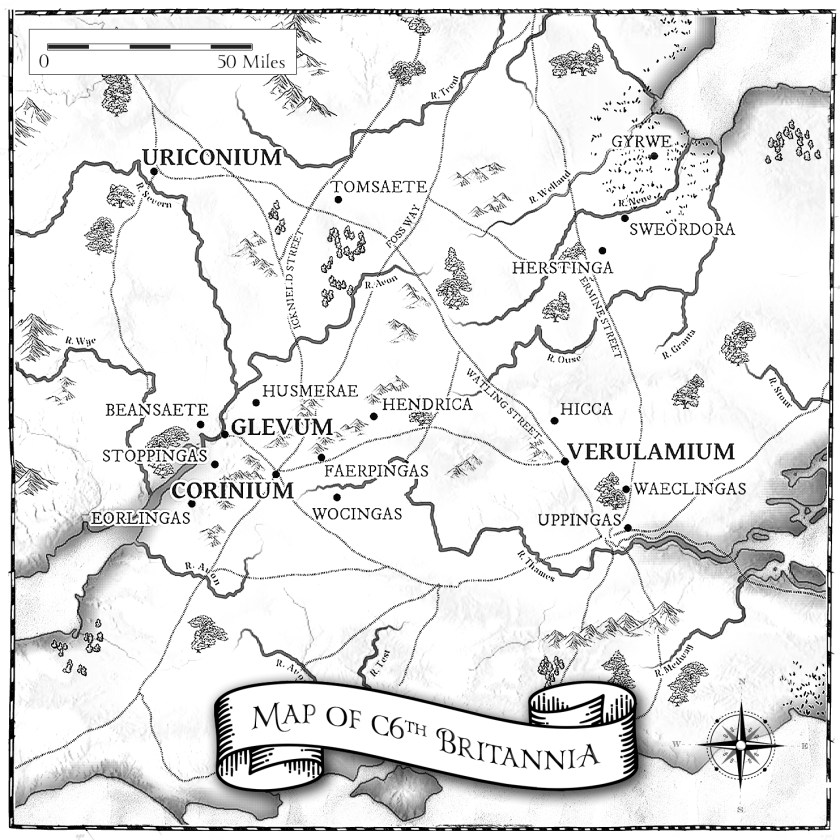
Britain AD541
Seeress Meddi has been restored to her rightful position of influence within the Eorlingas tribe. But a heavy cloud hangs over the tribe’s survival with the escape of the treacherous Elen who seeks to exact a bloody vengeance following Meddi’s reinstatement and her downfall.
Meddi knows Elen will return to settle the blood feud and the tribe must be ready to face this deadly threat with iron. They must toil day and night to harness the power of the lost magiks to make the weapons needed to overpower Elen.
Meanwhile, Wærmund, a warrior of Saxon descent, has escaped his enforced captivity and vows vengeance against his captors. He too hungers for the promise of sharp blades and travels West to find those who can fashion iron into blades sharp enough to kill. But when a lone woman befriends the band of warriors, promising him even more than that, he’s beguiled by her tale of deceit amongst her own tribe, so reminiscent of his own.
Unbeknown, Meddi and Wærmund share a common enemy and one who is just as belligerent as they are…
During Britannia’s tribal age only the strongest prevail…
Britain AD541
Seeress Meddi has been restored to her rightful position of influence within the Eorlingas tribe. But a heavy cloud hangs over the tribe’s survival with the escape of the treacherous Elen who seeks to exact a bloody vengeance following Meddi’s reinstatement and her downfall.
Meddi knows Elen will return to settle the blood feud and the tribe must be ready to face this deadly threat with iron. They must toil day and night to harness the power of the lost magiks to make the weapons needed to overpower Elen.
Meanwhile, Wærmund, a warrior of Saxon descent, has escaped his enforced captivity and vows vengeance against his captors. He too hungers for the promise of sharp blades and travels West to find those who can fashion iron into blades sharp enough to kill. But when a lone woman befriends the band of warriors, promising him even more than that, he’s beguiled by her tale of deceit amongst her own tribe, so reminiscent of his own.
Unbeknown, Meddi and Wærmund share a common enemy and one who is just as belligerent as they are…
Curious about the trilogy? Check out my blog post for more details below
Tensions are high at the Three Counties Show when accusations of cheating add fuel to a longstanding feud. For Jude Gray, whose only hope was to not make a fool of herself showing her Kerry Hill sheep, farming life has never been so dramatic.
When a body is found, belonging to one of the competitors, there is no shortage of suspects. Every sheep farmer in this close-knit community has a motive and beneath their show-ready smiles, they all have something to hide.
Experience has taught Jude that when there’s a murderer at large, nobody is truly safe. And with secrets simmering beneath the surface, this may be her most challenging investigation yet. Can she unearth the truth before it’s too late?
A gripping new instalment in the Malvern Farm Mystery series, perfect for fans of Frances Evesham, Merryn Allingham, and Faith Martin.
Killer at the County Show by Kate Wells is the fifth book in the Malvern Farm Mystery series and I’ve read four of them (see my reviews below).
It’s a delight to return to Jude and her farm and family, and hasn’t she just got involved in yet another murder mystery, all while attending the County Show to exhibit her sheep.
This is another welcome addition to the series. I always enjoy the fact that I never quite manage to guess who the murderer was in every book, and the plot is twisty enough to keep me reading. I will certainly be reading book 6.
Kate Wells is the author of a number of well-reviewed books for children, and is now writing a new cosy crime series set in the Malvern hills, inspired by the farm where she grew up.
1346. France. King Edward III is restless. Despite earlier victories the French crown remains intact. Determined to bring France under his own rule, Edward has devised a new plan of attack – one which he believes will finally bring the French army to its knees: a final, cataclysmic battle …
Berenger Fripper, Vintener of a pox-ridden mob of sixteen who make up the Vintaine of Sir John de Sully, storms the beaches of Normandy to bring victory to their king. But the French are nowhere to be seen…
And so Berenger leads his Vintaine through France and onward to battle – the Battle of Crécy – one which will both bond and break his men and be a decisive turning point in the Hundred Years’ War.
Fields of Glory by Michael Jecks is a novel about the Hundred Years’ War in all its bloody glory. Featuring an ensemble cast of characters, every person has their own story to tell, hidden behind the veneer of bloody war, and the demands of an intolerant king, who appears to preach reconciliation with the French but finds every excuse to change his mind.
I can’t say any of this ragtag collection of men is particularly endearing. Sir John cares more for his horse than his men, while King Edward and the Prince of Wales are just as thoughtless regarding the lives they’re destroying. This makes it a very realistic portrayal, if not for the faint-hearted. Indeed, if seeking some semblance of empathy between the characters, we must look to the men of the Vintaine, and not those who command them.
A blood-drenched traipse through France will bring our characters the opportunity to earn battle booty, if only they can live through it. Fields of Glory is a must-read for fans of the genre and those interested in the Hundred Years’ War.
Meet the author
Studied actuarial science, then became a computer salesman for 13 years- after the 13th company folded, he turned to writing.
He’s the author of 50 novels, 6 novellas, 4 collaborative books and short stories. His tales are inspired by history and legends, but are all grounded in real life and real people, what motivates them, and why they turn to violence.
Founder of Medieval Murderers, he has served on the committees of: Historical Writers’ Association, CWA and Detection Club. He has judged the Debut Dagger, Ian Fleming Steel Dagger and other prizes, as well as serving as Dagger liaison officer and CWA Chair. He has taught writing at Swanwick and Evesham, and tutored for the Royal Literary Fund. He now runs South West Writers in Devon.
His work has been celebrated by Visconti and Conway Stewart pens; 2014 he was International Guest of Honour at the Bloody Words festival in Toronto, and Grand Master of the first parade in the New Orleans Mardi Gras.
It’s happy release day to Men of Iron, the first book in the Dark Age Chronicles Trilogy #newrelease #MenOfIron #histfic
The Dark Ages?
As a bit of a history nerd, I’m not always comfortable with the term ‘Dark Ages’ for my books, mostly because the ‘real’ Dark Ages took place between about 410 and 600 in England, and so, until NOW, my books haven’t strictly fallen into that category. (Also, as a very literal child, I entirely mistook what was meant by the Dark Ages, and I was always perplexed as to why it was so damn dark.)
Admittedly, many apply the term to almost all of the period of Saxon England, which is somewhat incorrect (and indeed it was once applied to the entire Middle Ages). The idea of the Dark Ages stems from a belief there was no scientific or cultural advancement during this period (according to Wiki), but particularly in regards to England it references the lack of surviving written records from the period.
Archaeology is massively changing this interpretation, and there is now an accepted view that much can be understood about the era, just not in the way ‘historians’ might think – the merging of archaeology and history (and other sciences) is rewriting the period. We’re no longer entirely reliant on two written sources, Gildas, and his De Excidio et Conquestu Britanniae – On The Ruin of Britain (who may or may not have a cameo in Men of Iron), or Bede, (amongst historians often called ‘Bloody’ Bede) and his Historia ecclesiastica gentis Anglorum – History of the English People (as well as a few ‘odd’ earlier sources. Check out my blog post for more details.) It might be impossible to apply dates to developments, but it is possible to postulate what was actually happening during these ‘lost’ two hundred years, even if much of our knowledge must rely on finds from graves. It is also increasingly understood that this period was complex and that rarely does ‘one narrative’ adequately explain what was happening throughout England. This is a time before the major Saxon kingdoms, when much was in flux with cultures merging and endeavouring to survive with the loss of the Roman economy.
A new trilogy
And this is where my new trilogy enters stage left. This period fascinates me. I’ve been reading extensively about it for some time, and eventually managed to convince my editor (thank you) to let me tell ‘a‘ story of what ‘might‘ have been happening in this period. It can’t be based on any ‘named’ historical individuals (well, apart from one or two I’ve snuck in there as fictional creations) but it can attempt to populate this complex and little-understood period with people who lived and breathed, and I’m so excited to share it, with my readers. And guess what, it’s about what was ‘Mercia’ before it was ‘Mercia.’ (If you think you’re going to get me away from Mercia, you’re very mistaken.)
So how then to tell this story with so many cultures? I’ve taken the decision to offer a dual narrative, one from Meddi, my seeress in the west of England (close to Gloucester), and the other, Wærmund, my would-be-warrior from the east of England (the Fens). These two main characters allow me to explore the continuity and change taking place in what would become England. Their experiences as a seeress, as a warrior, and with the added complications of family discord driving their actions, ensure the characters from Men of Iron feel like ‘real people’ even in this distant, hazy landscape so similar and yet so different to everything we experience today. I really hope you’ll enjoy it. (I’m also very excited as I have dual narrators for this trilogy.)