Book Review – Breaking the Lore by Andy Redsmith – Fantasy

Here’s the blurb;

“A magical, mischievous mystery perfect for fans of Douglas Adams and Ben Aaronovitch

How do you stop a demon invasion… when you don’t believe in magic? Inspector Nick Paris is a man of logic and whisky. So staring down at the crucified form of a murder victim who is fifteen centimetres tall leaves the seasoned detective at a loss… and the dead fairy is only the beginning.

Suddenly the inspector is offering political asylum to dwarves, consulting with witches, getting tactical advice from elves and taking orders from a chain-smoking talking crow who, technically, outranks him.

With the fate of both the human and magic worlds in his hands Nick will have to leave logic behind and embrace his inner mystic to solve the crime and stop an army of demons from invading Manchester!”

I am a fan of quirky fantasy (Robert Rankin/Terry Pratchett) and was intrigued by the concept of Breaking the Lore. And for about 50% of the book I really quite enjoyed it. It’s not a difficult read, the chapters are short, the characters quite fun – although Malbus is the standout character. However, the story quickly ran out of steam, and I found the last 40% really hard to get into. At this point, the really short chapters didn’t help a great deal, the jokes were all getting a bit stale, and Nick Paris was spending a lot of his time ‘pondering’ but never really finding any answers to his questions, or indeed, doing a great deal to find the answers.
There’s a great deal of potential in Breaking the Lore, but in the end, it fails to live up to that potential, and I was just pleased to get to the end.
With a little less pondering, more of Nick Paris actually doing some police work and following up on his hunches as opposed to leaving them hanging in an effort to extend the story, this could be a really fun book. Perhaps Book 2 will be stronger.
A firm 3/5. Thank you to the publisher and Netgalley for my review copy.

Breaking the Lore was released on 15th April 2019 and is available now from here;

One Word Kill – Book Review – Mark Lawrence

Here’s the blurb;

In January 1986, fifteen-year-old boy-genius Nick Hayes discovers he’s dying. And it isn’t even the strangest thing to happen to him that week.

Nick and his Dungeons & Dragons-playing friends are used to living in their imaginations. But when a new girl, Mia, joins the group and reality becomes weirder than the fantasy world they visit in their weekly games, none of them are prepared for what comes next. A strange—yet curiously familiar—man is following Nick, with abilities that just shouldn’t exist. And this man bears a cryptic message: Mia’s in grave danger, though she doesn’t know it yet. She needs Nick’s help—now.

He finds himself in a race against time to unravel an impossible mystery and save the girl. And all that stands in his way is a probably terminal disease, a knife-wielding maniac and the laws of physics.

Challenge accepted.

I kept my visible review on Goodreads for this one quite short,

“Ah, the 1980’s! Recaptured in all its glory.”

This is mainly because a lot of people are loving this book, and the reason that I gave it 3/5 is that it’s just not really my sort of thing. It is clever, in places, and Good God, if you want to understand the concept of quantum mechanics, I can’t see how there’s a better way to be taught it, but even all the Back to the Future references couldn’t quite make me love this book as much as others even though I am a fan Mark Lawrence’s previous three trilogies – which I would classify as fantasy.

Will I read the next one and then the final part of the trilogy? Time will tell. Right now I’m not too fussed either way, although I am pleased they’re all being released this year so we don’t have to wait forever to read on! What I would say is that if you do like a bit of sci-fi mixed in with Dungeon and Dragons, some bad 80’s clothes and hairstyles, then this is the book for you. Enjoy it, but sadly, it isn’t quite as good as the new 80’s favourite of Stranger Things.

One Word Kill has an official launch date of 1st May 2019. But if you have Prime, you seem to be able to get it now, and it’s also on the Amazon First Reads scheme.

Holy Sister by Mark Lawrence – Book Review – released today in the UK 4th April 2019

Here’s the blurb;

“Nona Grey’s story reaches its shattering conclusion in the third instalment of Book of the Ancestor.

THEY CAME AGAINST HER AS A CHILD. NOW THEY FACE THE WOMAN.

The ice is advancing, the Corridor narrowing, and the empire is under siege from the Scithrowl in the east and the Durns in the west. Everywhere, the emperor’s armies are in retreat.

Nona faces the final challenges that must be overcome if she is to become a full sister in the order of her choice. But it seems unlikely that Nona and her friends will have time to earn a nun’s habit before war is on their doorstep.

Even a warrior like Nona cannot hope to turn the tide of war.
The shiphearts offer strength that she might use to protect those she loves, but it’s a power that corrupts. A final battle is coming in which she will be torn between friends, unable to save them all. A battle in which her own demons will try to unmake her.

A battle in which hearts will be broken, lovers lost, thrones burned.

HOLY SISTER completes the Book of the Ancestor trilogy that began with RED SISTER and GREY SISTER. A ground-breaking series, it has established Mark Lawrence as one of the most exciting new voices in modern speculative fiction.”


Holy Sister is a satisfying conclusion to the Book of the Ancestor Trilogy. For other authors, I would have found that acceptable, but for Mark Lawrence, I confess, I was a bit disappointed.
As with the ending of the previous two trilogies, especially Jalan’s, I’m left wishing there had just been ‘more’.
The concurrent storylines are not without excitement, indeed from about 50-80% the storyline is extremely exciting, but to get there I had to wade through the first 35% and I didn’t enjoy it as much as I’d hoped I would. Yes, a year has passed since I read the previous book, and I had forgotten much, but even so, and especially considering the ‘summation’ at the beginning, I feel I should have been able to grab the characters and events far more quickly. For readers who can just plough on through all 3 books one after another, I’m sure this won’t be a problem but I’m far too impatient to have actually waited for the end of the trilogy.
And the eventual ending, well. It was somewhat anti-climatic.
If this was merely a coming of age story, then I would say the job had been accomplished very well, but it was always more than that, and sadly, Book 3 doesn’t quite do justice to the characters.
I appreciate that there are many who love this book – I’ve been seeing 5-star reviews flying around for Holy Sister for about 6 months. It might just be that, for me, the book suffers from too much hype, and so I would like to apologise to the author if my comments seem too harsh. It’s truly not the author’s fault when something gets blown out of all proportion.
The majority of people will love this book – and I’m excited for Mark Lawrence because that means he’ll get to write more and more books, and share his wonderful ideas with a wider and wider audience.
I think we will get to return to the world of the Book of the Ancestor, and I look forward to that. Perhaps then all my unanswered questions will find answers. Although I doubt it. Mark Lawrence is a sly old fox for a good reason!
Thank you to the publisher for sending me an E-Arc. I confess, there may have been a squeal of delight.

Holy Sister is released in the UK today in hardback, ebook and audiobook and you can purchase it here (other retailers are also available). I give it a 4/5;

2018 in review – (better late than never)

2018 has been an amazing year, and yet, as I think back over it, I struggle to remember all the small details that added up to make it feel so good. Even, I confess, I struggle to remember what books I wrote/published and when they all came out. This, no doubt, is because I had much of December 2018 away from the keyboard (apart from an editing job I had to do) following on from the exhaustion of nailing a ‘quite large’ word count during NaNoWriMo (or November for those not yet inducted into the world of National Novel Writing Month (The word count was bigger than the 50K NaNo suggests, but I’m not bragging about it:))).

But, perhaps, NaNoWriMo is a good place to start, because, I hope, NaNoWriMo2017 brought forth my first release of 2018. Wait. Wait! I tell a lie. NaNoWriMo2017 was a fantasy project. Sigh. Ask me about events 1000 years ago, and I’m fine. Ask me about last January and I utterly fail!

So, again.

Right, 2018 began with the release of The First Queen of England Part 2 on 24th December 2017. My next project, perhaps unsurprisingly, was The First Queen of England Part 3, released in April 2018, and the final title in The First Queen of England Trilogy, although not the last I wrote about Queen Elfrida.

With the trilogy finished, I turned my attention back to a slightly abandoned project, The Earls of Mercia. Quite frankly, I was a bit terrified. I’d not written an Earls book for some time – allowing myself to be swept along by Queen Elfrida, Lady Ælfwynn, a fantasy book and no doubt other things I now can’t remember. What made the return to the Earls all the more terrifying, is that I’d long moved on from the time period I’d studied for my dissertation, and was getting to what I would term, ‘the more complicated bit’ of the eleventh century. Even my ‘timeline’ had run out – filled only with the sporadic accounts of people’s births and deaths and little else. This is the time period (1035 onwards) which many people think they ‘know’ but which was still filled with huge potential for Leofric and his son.

In the end, I thoroughly enjoyed my return to Leofric, and Book 7 was released in July 2018. By now I’d made a monumental ‘life’ decision, and given up the ‘day job’ to turn my hand to full-time writing. This, I confess, worried the hell out of me for the first few weeks – when effectively, I wrote a book in 3 weeks flat – so desperate to prove I had the motivation and desire to succeed without the dislike of the ‘day job’ to drive me ever onwards with my writing goals.

The result was, a somewhat unexpected, return to the world of Queen Elfrida, and The King’s Mother. Purposefully designed to be a little ‘harsher’ in outlook, to give Queen Elfrida the ‘savvy’ she needed to succeed, I thoroughly enjoyed writing The King’s Mother.

So what next? In true style, I didn’t opt for the ‘easier’ option of writing the next book in The King’s Mother Trilogy but instead returned to the world of The Earls of Mercia, and The Earl’s King was released on 24th December 2018.

I’ve taught myself a few tricks when writing sequels. I used to, back in the day, immediately write a draft beginning and end for the next book when I’d finished the previous book, now, I make copious notes on the final edit, and then make even more notes on what I think should happen next – it’s normally a long list of questions and a few character names but I rely on it when I return to old projects to get the ‘feel’ right for the next book. I’ve also started ‘character’ and ‘plot’ summaries for each character. I have a little book for The Earls of Mercia, filled with characters and descriptions, and I’m not sharing it!

But that wasn’t the end of my writing. So to NaNoWriMo2018, and I gave myself (I know, how devilish) a month away from historical fiction (just about), and a month to write fantasy (my first love). I had half a novel from NaNoWriMo2017 which needed finishing, and also another idea that was making my head hurt with its desire to be written. As a back-up, I also had the sequel to The King’s Mother should my fantasy projects crash and burn.

In the end, I wrote a huge amount of words – and have two good first drafts to edit for both my fantasy projects and a small beginning on the historical fiction novel, which will be finished in February this year.

Aside from writing, I went to two author events, (daunting stuff), and met some great people, and had my work assessed by an agent at one of the events, and a publisher at another. While neither moved forward with the project, the feedback was excellent – perhaps if I didn’t write in such a ‘niche’ time-period I would fare better with publishers/agents – but hey, don’t call Anglo-Saxon England and the Viking era ‘niche’!

I also met some lovely authors at the events – all of us just about as awkward as we can be – authors, they don’t get out much you know.

As for book sales throughout 2018 – I must thank each and every reader who chose one of my titles and enjoyed it. Sales have increased, and not just because of ‘new releases’ and I step into 2019 confident that I ‘might’ (just about) finally know what I’m about and how I can achieve it – both with historical fiction and fantasy. I’m still teaming with ideas and have made no firm plans for my writing after the end of February – otherwise, I’ll be stubborn and rebel against it!

I also have a new, far flashier, website thanks to ‘tech-support’ teenager. (I would recommend that all author’s get a ‘tech-support’ teenager – although they are quite an expensive investment.)

Website

So, here’s to an exciting 2018, and hopefully, an even more thrilling 2019.

(I’m going to do a year review of books I recommend next.)


Book Review – Anne of Cleves: Henry VIII’s Unwanted Wife – historical biography

Here’s the blurb;

Anne of Cleves left her homeland in 1539 to marry the king of England. She was never brought up to be a queen yet out of many possible choices, she was the bride Henry VIII chose as his fourth wife. Yet from their first meeting the king decided he liked her not and sought an immediate divorce. After just six months their marriage was annulled, leaving Anne one of the wealthiest women in England. This is the story of Anne’s marriage to Henry, how the daughter of Cleves survived him and her life afterwards.

Anne of Cleves: Henry VIII’s Unwanted Wife is a well-researched, if short, biography of Henry VIII’s fourth wife.

It is clearly very well researched, but it seems that there is little source material to be found, and it is hard to discover who Anne truly was, and just what she thought of the bizarre situation she found herself in. There are some very lengthy quotations from the correspondence of the period, and while these add to the story, the insistence on keeping the original spelling can make it a bit of a challenge to read pages of letters.

Much of the book is taken up with Anne’s short marriage to Henry VIII and I thought the biography was at its strongest when discussing what happened to Anne after the annulment of her marriage, much of which I didn’t know.

Overall, an interesting, short, and enjoyable read. Recommended.

Thanks to Netgalley for my EArc.

Anne of Cleves is available now.

Book Review – The Last Hours – Minette Walters – historical fiction – highly recommended

Here’s the blurb;

“June, 1348: the Black Death enters England through the port of Melcombe in the county of Dorsetshire. Unprepared for the virulence of the disease, and the speed with which it spreads, the people of the county start to die in their thousands.

In the estate of Develish, Lady Anne takes control of her people’s future – including the lives of two hundred bonded serfs. Strong, compassionate and resourceful, Lady Anne chooses a bastard slave, Thaddeus Thurkell, to act as her steward. Together, they decide to quarantine Develish by bringing the serfs inside the walls. With this sudden overturning of the accepted social order, where serfs exist only to serve their lords, conflicts soon arise. Ignorant of what is happening in the world outside, they wrestle with themselves, with God and with the terrible uncertainty of their futures.

Lady Anne’s people fear starvation but they fear the pestilence more. Who amongst them has the courage to leave the security of the walls?

And how safe is anyone in Develish when a dreadful event threatens the uneasy status quo..?”

With the second book of the series out on 4th October, I’ve been lucky enough to get to read both Book 1 and Book 2 before release date.

A stunning novel. Thank you to Netgalley for providing a copy.

The Last Hours is a wonderful book. I can’t recommend it enough. It’s been some time since something has hooked me so entirely and I was thoroughly engrossed by the characters, time period and the portrayal of the Black Death and its devastating consequences. The fact that I now want to research the time period more, is a sure sign that the novel has well and truly drawn me in.

Social upheaval lies at the heart of The Last Hours, with the juxtaposition of the ‘status quo’ of the Norman ‘overlords’ against the perceived possibilities of a future for the serfs of Develish, where they’ve paid their way out of their serfdom, which gains momentum when the implications of the devastation to the population of Dorsetshire starts to be understood and comprehended by those in isolation. Coupled with the influence of the Church, as directed by the Papacy, and a more enlightened Christian doctrine as understood by Lady Anne, raised in a nunnery, social strife is inevitable in the confined space of the seclusion on the moated manor house of Lady Anne’s dead husband.

This is a novel that weaves many threads, and while the images of the devastated villages might be the most haunting, with unburied bodies and an explosion of the rat population, it is the combination of all the stories, that makes this such a rich tapestry. I am only pleased that I have Book 2 to read immediately!

The Last Hours is available now (and it’s only 99p);

Book Review – Lancelot by Giles Kristian – highly recommended (historical fiction)

Here’s the blurb;

“Set in a 5th century post-Roman Britain besieged by invading war bands of Saxons and Franks, Irish and Picts, Giles Kristian’s epic new novel tells – through the warrior’s own words – the story of Lancelot, the most celebrated of all King Arthur’s knights. And it’s a story that’s ready to be re-imagined for our times.
It’s a story imbued with the magic and superstition that was such an integral part of the enchanted landscape of Britain during this dark times. Many of the familiar names from Arthurian mythology will be here – Mordred and Gawain, Morgana and, of course, Merlin – as will be those vital icons of the legend such as the Round Table and the sword in the stone but these will be reinvented, reforged for a new generation of readers.
Lancelot is a story of warriors and kings, of violent, of warfare and bloodshed but it is also a story of loyalty and friendship, of over-arching ambition, of betrayal and guilt, of love and lust, and the win tragedies of revenge and remorse.”

I received a free EArc from Netgalley.

Lancelot is a brilliant book. I really can’t recommend it enough – but at its heart, it is also flawed. The more I think about this, the more I imagine this might have been done on purpose – a mirror image of the character, perhaps.

When I first began reading Lancelot I simply thought the author had been very clever with his book title. (Go check my Goodreads log for the book – I say it there). The story, while it might have been about Lancelot, could just as easily have been about any character in post-Roman/pre-Saxon/settlement period Britain (everyone has their own word for this period). It was not necessarily a Lancelot that anyone would recognise.

For all that, the young Lancelot is an intriguing character, and even if the book had just been an author with a clever title, I would probably have been just as impressed as I ultimately was.

The world Lancelot inhabits is a wonderful reimagining of Britain at this strange time period – with the Romans fled, and the Saxons on the surge. It is stuffed with warlords and kings, with kingdom names and conjures up a wonderful landscape of the time period. While all the action takes place in those areas which would be termed, British or Pictish, the very ‘smell’ of the Saxons is always blowing on the wind., for all that it is modern-day Cornwall, Devon, Wales and Scotland that form the backdrop for the story and there are only very occasional Saxon characters.

We meet Lancelot in the first chapter, Guinevere takes longer to appear, and Arthur? Well, his father makes an appearance before him – and Arthur only arrives 50% through the book. And this is as it should be – after all, this is Lancelot’s story and not that of Arthur’s. We do meet Merlin not long after Guinevere – so the ‘names’ we know from the Arthur Legend are firmly there – Tintagel is often mentioned, as too is Excalibur.

As in any novel about a famous warrior, there is a great deal of training, fighting and ‘rough-stuff’ from the other boys being trained, but mixed with the twin thread of friendship and magic. The magic is artfully arranged – it is just ‘accepted’ without explanation, and that appealed to my less than ‘magical’ mind. Other authors may have ‘overcooked’ the whole Merlin/Druid/Old Gods stuff but I think it is handled exceedingly well throughout the story. The ‘friendship’ element is also very skillfully told – it becomes more and more important as the book progresses.

Lancelot has a lovingly crafted feel to it. It meanders down little-trodden paths, and we might be left wondering why, but just as Robin Hobb manages with her ‘Fitz’ books, it never feels irrelevant. It’s a delightful tale of occasional irrelevance, that I just didn’t want to end, and I never say that about a book.

There were times when I couldn’t fathom what the author would do with his characters next and there were parts where I felt cheated. At 80% through I was completely perplexed, and actually, the ending of the book is either its weakest element or the author at his cleverest (I still can’t decide). it is here that he relies most on the readers ‘prior’ knowledge of the Arthur legend – and we are left to make our own assumptions until the very final scene, when there is, once more, some closure.

I really did love this book, but I would have liked it to be much, much longer – I would have liked all the ‘gaps’ filled in, I would have liked answers to questions that are asked but never resolved, I would have liked more Arthur and Lancelot, and I would certainly have liked more, much more, of those famous battles, but Lancelot is a wonderful and powerful telling of a legend that we already think we know – but which is ripe for retelling. It relies on an understanding of the legend – while also reworking it. A fine piece of work that I thoroughly enjoyed – even if I didn’t initially want to! :)

Lancelot is available now, and Camelot is due for release in May 2020.

Get your copy here;


Book Review – Devil’s Wolf (High Corbett) by Paul Doherty – historical murder mystery

Here’s the blurb;

1296: King Edward I has led his army to Scotland, determined to take the country under his crown. But the fierce Scots have no intention of submitting to their oppressor and violent and bloody war breaks out.

1311: Sir Hugh Corbett, Keeper of the Secret Seal, finds himself back in Scotland and is revisited by the horrors he witnessed there fifteen years ago.

An anonymous letter was delivered to the new king. It promised information about a fatal incident that could allow England to finally bow out of the war with the Scots. Tasked with finding out the truth about the murder, Corbett is forced to take risks he would rather avoid and put his faith in the words of strangers.

But with an unknown traitor lurking in the shadows and danger around every corner, will Corbett be able to unravel the complex web of plots in time?

I received a free EArc from Netgalley.

Devil’s Wolf is an enjoyable jaunt through early fourteenth century England. I found it particularly enjoyable as its setting is very familiar to me.

While the beginning of the novel is somewhat repetitive, as Hugh tries to work out what’s happening and tries to order his thoughts, the end of the novel is far more complex and reads more quickly.

The characterisations are good, and the author certainly doesn’t shy away from killing off characters left, right and centre.

I credit this author with helping me learn to love reading again after a pretty rubbish time many years ago – his Egyptian books are wonderful – as such it’s great to discover all these other books of his, of which I was unaware.

Devil’s Wolf is out now and can be found here;

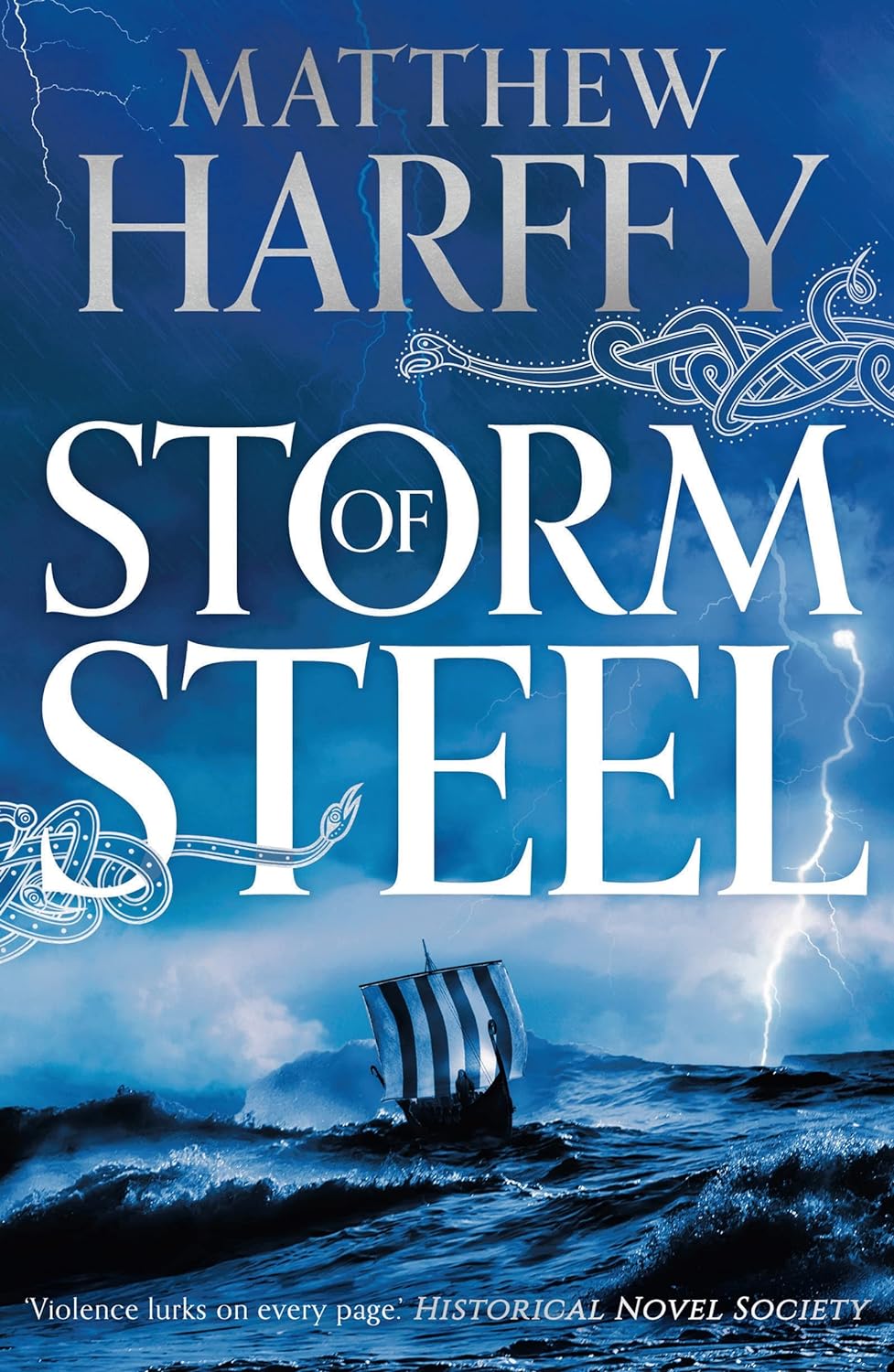
Book Review – Warrior of Woden by Matthew Harffy – historical fiction

Here’s the blurb;

“AD 642. Anglo-Saxon Britain. A gripping, action-packed historical thriller and the fifth instalment in the Bernicia Chronicles. Perfect for fans of Bernard Cornwell.

Oswald has reigned over Northumbria for eight years and Beobrand has led the king to ever greater victories. Rewarded for his fealty and prowess in battle, Beobrand is now a wealthy warlord, with a sizable warband. Tales of Beobrand’s fearsome black-shielded warriors and the great treasure he has amassed are told throughout the halls of the land.

Many are the kings who bow to Oswald. And yet there are those who look upon his realm with a covetous eye. And there is one ruler who will never kneel before him.

When Penda of Mercia, the great killer of kings, invades Northumbria, Beobrand is once more called upon to stand in an epic battle where the blood of many will be shed in defence of the kingdom.

But in this climactic clash between the pagan Penda and the Christian Oswald there is much more at stake than sovereignty. This is a battle for the very souls of the people of Albion.”

I received a free EArc from Netgalley.

Overall Book 5 is far stronger than Book 4 and it doesn’t do what I thought it would do (in a good way).

For nearly 50% of the book, Beobrand is a much happier character than we’ve seen before. I thought this was an excellent evolution of his character, but sadly it doesn’t last and soon he’s moaning as much as in the previous books. This is one of my biggest problems with the series. Beobrand is just not very likeable and I find that hard in a series focused on him and where he’s supposed to be the hero or even the anti-hero. He just isn’t heroic enough for my liking, and will clearly never be. He seems genuinely unhappy with his lot in life – unhappy with his not-wife, his son, his king, his hall, who he’s killed before, who he hasn’t killed before, his horse – it would be nice if he was happy about something! :)

As to the story itself, it’s a very ‘Northumbrian’ interpretation of events in Britain at this time – there is no attempt to offer anything other than the version of events as given by Bede and other sources, which means that poor old Eowa gets very short shift . This is a shame as there was definitely scope for betrayal and double-dealing here, but because the story is about Beobrand, the possibilities are not explored. In fact, the major players of the period are so distant as to almost be missing from the story completely – the story we get could have been written anytime, anywhere, it is not truly about events in Britain at the time – a shame really when the events themselves are so significant. It would have been good to have a stand-off between Oswald and Penda – a real grudge battle, but instead, Penda is never actually encountered, only his actions. The ‘real’ (and I use that with caution) events of the period are simply the background to the story – even as a warrior of the king, the focus remains firmly on Beobrand at all times.

Where events are specifically directed at the period, there is a lack of clarity – they are fighting the Welsh and hate them and yet Cynan is Welsh, and one of Beobrand’s trusted gesithas. Penda is a pagan and reviled as such for this (especially for his blood sacrifice) – and yet Beobrand is pagan as well with his hammer necklace etc. This might pass many people by, or it might annoy. I just found it confusing.

Yet if I overlook all those problems, the book is stronger than previous ones in the series. It could have been great but it doesn’t quite make it because of the issues listed above and because many of the battle scenes are a bit disappointing. Maserfelth – the great battle – becomes a bit of a rugby scrum, and it is the later, smaller (‘made-up’) skirmishes, that are written with more flow and clarity. As I said, it’s as though events in Britain are there only for Beobrand to ride through/stamp through and glower through, and essentially much of the last half of the book is setting up events for future books.

It will also be interesting to see what happens with Penda, for Penda, whether he is the ‘Warrior of Woden’ or not, is going to be around for a very long time to plague and terrorise the kingdom of Bernicia.

A firm 4/5 – the series is getting better but a few issues remain.

Warrior of Woden is released on 1st April 2018 and you can get a copy here.


Book Review – The Seven by Peter Newman – fantasy – recommended

“Years have passed since the Vagrant journeyed to the Shining City, Vesper in arm and Gamma’s sword in hand.

Since then the world has changed. Vesper, following the footsteps of her father, journeyed to the breach and closed the tear between worlds, protecting the last of humanity, but also trapping the infernal horde and all those that fell to its corruptions: willing or otherwise.

In this new age it is Vesper who leads the charge towards unity and peace, with seemingly nothing standing between the world and a bright new future.

That is until eyes open.

And The Seven awakes.”

I received a free EArc from Netgalley and notice that this has just come out in paperback so I am sharing my review again!

After only a few pages, I decided to read the previous book in the series, as the world I discovered was both intriguing and quite alien. I thought I needed some back story, and indeed I did. My review for The Malice is here.

https://www.goodreads.com/review/show/2011536175?book_show_action=false&from_review_page=1

I should also perhaps have taken the time to read The Vagrant but impatience won out, and anyway, The Vagrant, unlike in The Malice, is a real part of this final part of the trilogy (I am assuming it’s the final part).

Anyway, back to The Seven.

The world created by Peter Newman throughout The Vagrant series is inherently alien. It feels new and strange and, on occasion, very, very weird. This, more than anything, immediately draws the reader in, for Newman’s descriptions are sparse in the extreme, and I was often left decrying his lack of description (which is weird for me because I often skip excess descriptions in books content to let my imagination hold sway). Neither is it just his descriptions that are sparse, the whole nature of the book is trimmed down so that you really have to read each and every word – there’s no skipping a bit because you sort of know what’s about to happen. There is also, in the grand scheme of things, little conversation. This ties with the ‘pared’ down nature of the planet that these people inhabit.

The characters in this final book – Vesper, Samael and Scout, The Vagrant, Jem, her daughter, Obeisance and The Seven, as well as The First, Neer and other characters from the earlier book (including The Buck although not as much as I might have liked) – are all scarcely sketched and yet all have very distinct characters. There is no need to’like’ any of the characters (not like in some books) and yet throughout the series you gain respect for them all – even when they might be being cowardly or acting contrary to what we might hope they do. This is a strength of the book – for all the weirdness and strangeness – these are people (I use that word lightly) that we can understand if not relate to.

I very much enjoyed the ‘backstory’ in The Seven. Throughout The Malice I found it a little distracting, but in The Seven, the back story is vitally important, and indeed, at the end, I would have liked to know more about Massala and her creations.

Book 3 is eminently more readable than The Malice – and I don’t think it was because I knew more about the ‘world’ of The Vagrant – I think the storyline is more recognizable and therefore flows better. Yet I don’t think the author ever quite gives the reader what they want – there is not really a happily ever after, there is just an ending, and one which is never wholly assured until it actually happens.

There are very good battle scenes, and very good ‘political’ scenes and yet through it all, the world of The Vagrant remains aloof – difficult to grasp onto. It is not a typical fantasy book and some might well struggle with it, but I think it’s well worth the struggle (The Malice took me a month to read because I struggled with elements of it – The Seven is a much quicker read) and it is refreshing to read something so very different and ‘new’.

The Seven is available now and can be purchased here;