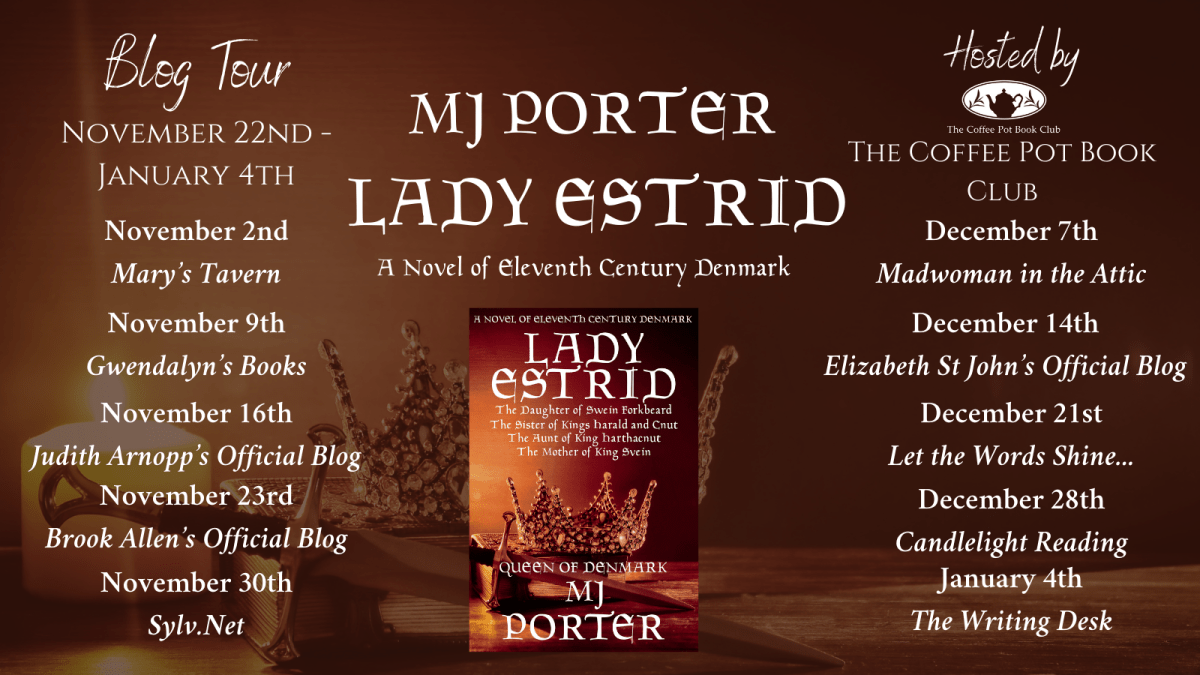
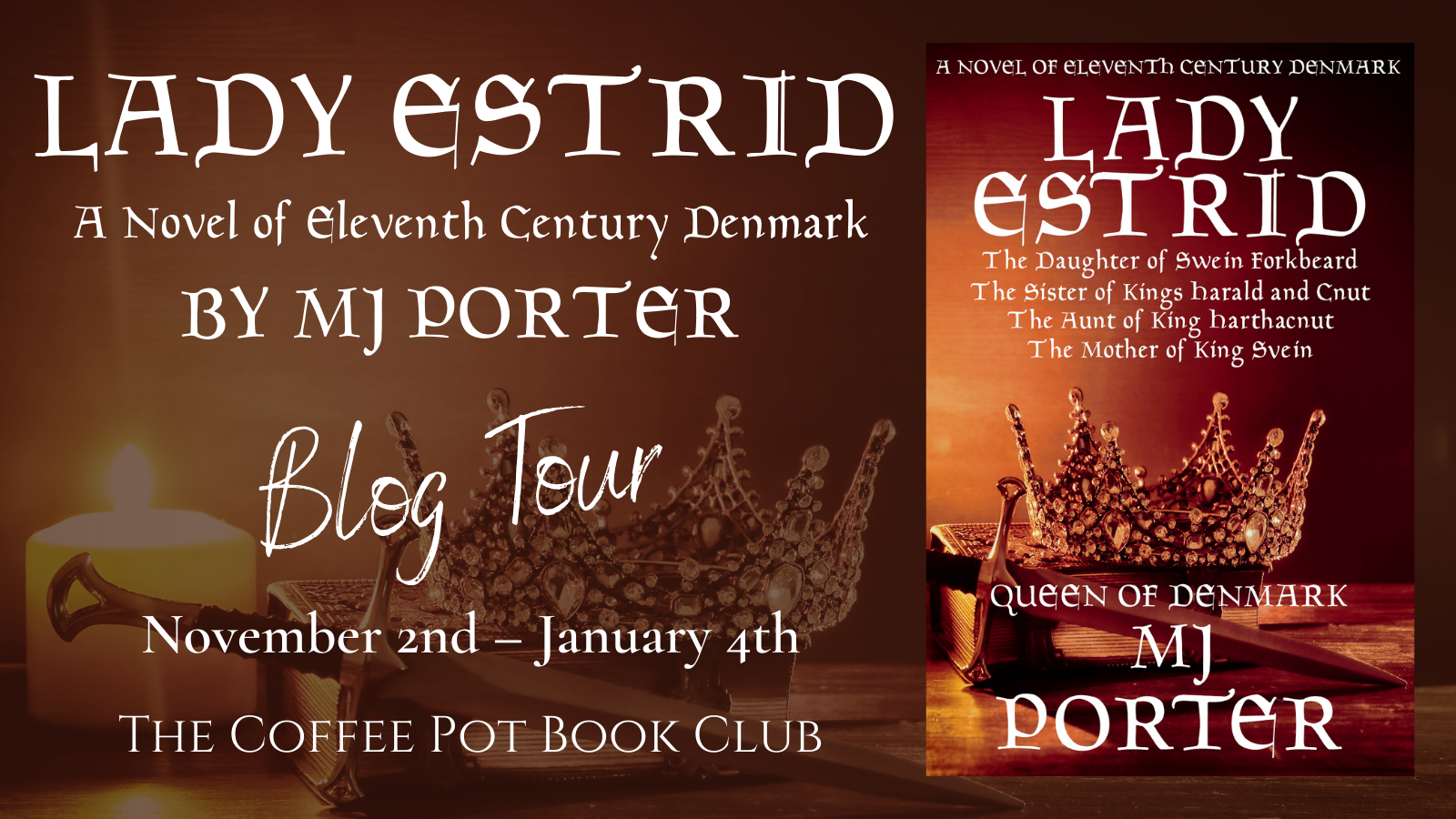
Lady Estrid has taken herself on tour with the fabulous Coffee Pot Book Club. She what she’s been up to, and thank you to everyone for hosting her, and the Coffee Pot Book Club for arranging.
Thank you to all the hosts for allowing Lady Estrid onto their blogs, and to The Coffee Pot Book Club for being so, so, so good at organising everything. Thank you.
(This post contains Amazon affiliate links, which means that at no cost to you, Amazon rewards me.)
Easter, 1177. Canterbury Cathedral, home to the tomb of martyr Saint Thomas Becket, bears the wounds of a terrible fire. Benedict, prior of the great church, leads its rebuilding. But horror interrupts the work. One of the stonemasons is found viciously murdered, the dead man’s face disfigured by a shocking wound.
When King’s clerk Aelred Barling and his assistant, Hugo Stanton, arrive on pilgrimage to the tomb, the prior orders them to investigate the unholy crime.
But the killer soon claims another victim–and another. As turmoil embroils the congregation, the pair of sleuths face urgent pressure to find a connection between the killings.
With panic on the rise, can Barling and Stanton catch the culprit before evil prevails again—and stop it before it comes for them?
THE CANTERBURY MURDERS is the third book in E.M. Powell’s Stanton and Barling medieval murder mystery series. Combining intricate plots, shocking twists and a winning–if unlikely–pair of investigators, this series is perfect for fans of Ellis Peters’ Brother Cadfael or C. J. Sansom’s Shardlake.
This is the first of the Stanton and Barling Mysteries that I’ve read, and I will certainly be going back to the first two books.
The Canterbury Murders is a well constructed and intriguing murder-mystery. The main characters of Stanton and Barling are as unlike as chalk and cheese, and I really enjoyed how they clashed with one another, even though they were working towards the same outcome, of solving the mystery.
The peripheral characters are well sketched, and there were times when I was convinced I knew who the murderer was only to discover I was wrong, and when the big reveal came, it was satisfying, and more importantly, made perfect sense.
This was a very well executed and thoroughly entertaining tale and I look forward to more of the same in the future. I’ve already ordered books 1 and 2.
Thank you to Netgalley and the Publisher for my review copy.
I’m very honoured to have caught a few moments with Lady Cyneswith, the aunt of King Coelwulf. Thank you for finding the time to speak to me.
“Well, I’m sure you’ve discovered that my nephew is a very busy man, a bit rough around the edges some times, and so I’m delighted to speak with you on his behalf, smooth away any ruffles he might have caused.
Yes, I confess, I had noticed that he was short on time when I tried to speak with him earlier.
Short on time, and economical with his words. He is the king, you know, but of course, his priorities are with defeating the Raiders. I think there are those who don’t quite appreciate the persistence of the enemy. It takes a strong and decisive leader to defeat them, and we should be pleased to have one. Much better than our previous king, who gave up Mercia in exchange for his life. Shocking.
I speak for the whole of Mercia when I say we are so pleased to have such a man leading us. Some new, vigourous, blood was needed to ensure Mercia stayed together.
Our previous king, Burgred, was not blessed with the military requirements for the post. But then, I won’t be alone in believing that Burgred should never have been king. He only achieved what he did because of the manipulation of the natural right of succession.
So, you believe that all the kings since King Coelwulf, first of his name, were usurpers?
I make no bones about that. Mercia wouldn’t be in such peril if my family line had retained their hold on power, as they should have done. But, now is not the time to dwell on that. It’s important to think of the future, and of what is yet to be achieved, but which will be, and soon.
I asked King Coelwulf if had a few words to explain why people should read the latest book.
I imagine he said something along the lines of, ‘I don’t have time for reading, so I wouldn’t.’ And, of course, he means that, but it is difficult for him to appreciate the fascination others have with what he’s trying to achieve. So, I would say, read it and discover just what risks your king, and his warriors and ealdormen are making to ensure Mercia’s freedom. Read it, and understand the peril and take steps to ensure your freedom as well.
And, have you read the latest book?
I have yes, and I’m pleased to say there’s a slightly bigger part for me in, than usual. Of course, it’s difficult with all the fighting to find room for the women of Mercia, but I’m sure that one day, in the not too distant future, Mercia will have female warriors to keep her safe. After all, anyone can learn to chop off someone’s head, or slice them through the neck, the skill, of course, is in staying alive afterwards.
Um, yes, quite. Thank you for that. I wondered if I could get a few words from you about King Alfred of Wessex.
No, not really. I don’t speak about neighbouring kings, and I’ve never met the man. Now, if you asked me about the king of Gwent, then I might have something to say about him, but you haven’t, and so, I don’t.
Could I ask you about the language used in the book? It’s quite strong in places.
While I have no particular need to hear such words, I can well appreciate that, on occasion, they might be warranted. After all, our king and his warriors are risking their lives every time they enter a battle against our enemy. I put it down to the rush of adrenaline, and hope everyone else does the same.
I asked King Coelwulf about his warriors, do you have any particular favourite amongst them?
I take pride in teaching all of the men some simple techniques to treat wounds received in battle. It’s important to know how to heal as well as to maim. My favourites are obviously those who listen carefully and learn what I teach them.
Thank you for taking the time to speak with me.
It is of course, my pleasure, and my duty, as the king’s sole surviving relative. Under his leadership, Mercia will once more be great again.
And there you have it. An interesting interview with Lady Cyneswith, a most formidable woman. I should think she’d be as lethal on the battlefield as her nephew is proving to be. If you haven’t read my earlier interview with King Coelwulf, then you can find it here.
An intrepid female reporter matches wits with a serious, sexy detective in award-winning author Manda Collins’ fun and flirty historical romcom, perfect for readers of Evie Dunmore, Julia Quinn Tessa Dare and Netflix’s Enola Holmes!
Of all the crime scenes in all the world, she walks into his. Twice.
England, 1865: Notorious newspaper columnist Lady Katherine Bascomb is determined to educate the ladies of London on the nefarious criminals who are praying on the fairer sex. But when her reporting leads to the arrest of an infamous killer, Katherine flees to a country house party to escape her doubts about the case – only to become witness to a murder herself! When the lead detective accuses Katherine of inflaming – rather than informing – the public with her column, she vows to prove him wrong.
Detective Inspector Andrew Eversham’s refusal to compromise his investigations nearly cost him his career, and he blames Katherine. When he discovers she’s the key witness in a new crime, he’s determined to prevent the beautiful widow from once again wreaking havoc on his case. Yet as Katherine proves surprisingly insightful and Andrew impresses Katherine with his lethal competency, both are forced to admit the fire between them is more flirtatious than furious. But to explore the passion between them, they’ll need to catch a killer . .
A Lady’s Guide to Mischief and Mayhem grabbed my attention due to the title and the cover. It sounded like a light-hearted, fun read, and in many respects, it was.
Lady Katherine is an engaging character, and with much of the story told from her perspective, we get to know her quite well, although some of her true nature is hidden behind the Victorian facade of never showing emotions. The addition of the story-line being told from the perspective of Inspector Eversham adds an entirely different dimension to the story – that of a more disciplined police officer, although it slips quite quickly.
The beginning of the book takes place in London, and I fully expected the action to remain there, but we are abruptly whisked away to the Lake District where the crimes take on an even more sinister nature, and become somewhat more personal.
The author excels here at producing quite a complex case for the main characters to unravel and it did hook me. There were points where I was convinced I had worked out what was happening, only to be wrong. The budding romance between Lady Katherine and Inspector Eversham does feel a little rushed and there were moments where I might have liked more plot development, but overall, it was a fun and reasonably light-hearted read, not because of the content, but because of the way Lady Katherine insists on solving the mystery of who the murderer is.
Thank you to the publisher and Netgalley for my review copy.
A Lady’s Guide to Mischief and Mayhem is available now.
One of the big plusses for choosing the character of Lady Estrid for my most recent novel, was her large and illustrious family and their far-reaching influence over Denmark, Sweden, Norway and England. It meant there was already an excellent story to tell.
While I quickly managed to slot all the different relatives into order (well, I have been writing about them for a while), I’m aware it’s not the easiest of tasks, and so, I have put together some genealogical tables of the main families to make it that bit easier.
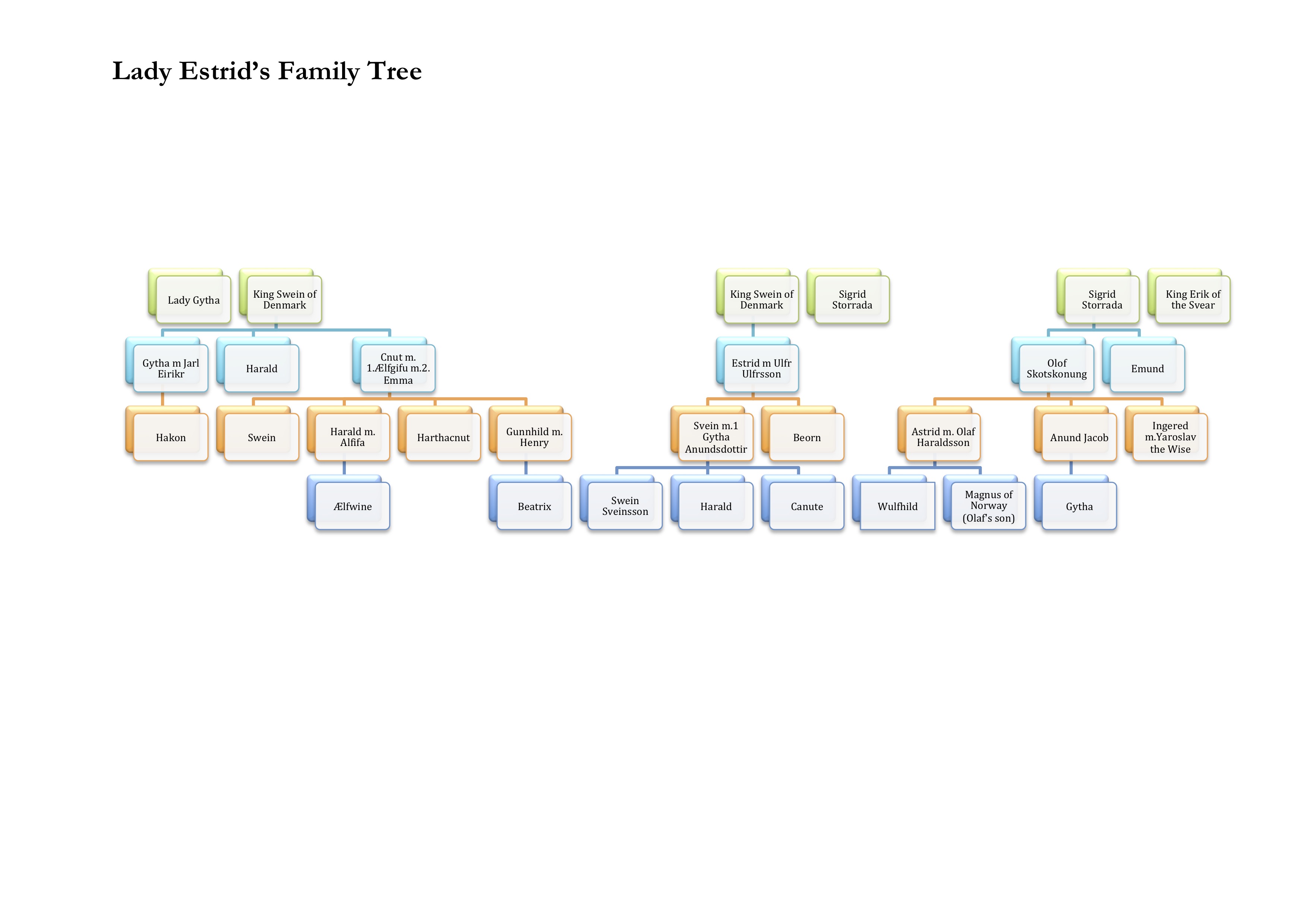
The family of Lady Estrid Sweinsdottir, as mentioned in Lady Estrid.
Due to a lack of information, I have made little mention of the rest of Estrid’s half-sisters, of which she had three or four. I feel it perhaps also helped the story a little – it was complicated enough as it was without giving them the capacity to meddle in affairs in Denmark. I have also made the assumption, that because I don’t know who they married, that they didn’t make international alliances, as Estrid did.
To break it down into more palatable chunks, Lady Estrid’s mother was married twice, once to King Swein of Denmark (second) and also to King Erik of the Svear (first). King Swein was also married twice (in my story at least – as it is debated), to Lady Gytha (who I take to be his first wife) and then to Lady Sigrid (who I take to be his second wife.) Swein was king of Denmark, Erik, king of the Svear (which would become Sweden), and so Sigrid was twice a queen, and she would have expected her children to rule as well, and her grandchildren after her. Sigrid was truly the matriarch of a vast dynasty.
She would have grandchildren who lived their lives in the kingdom of the Rus, in Norway, in England, and Denmark.
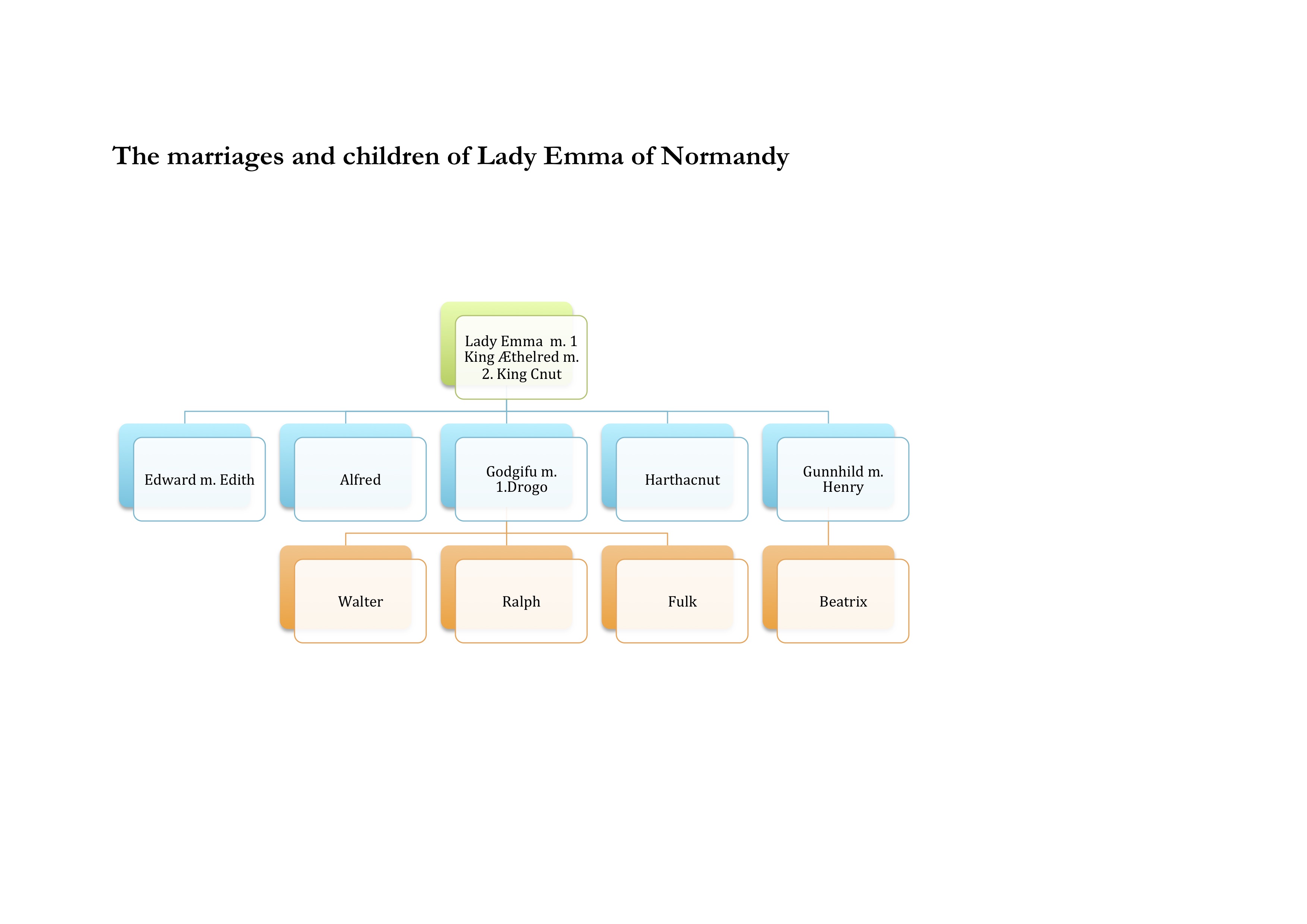
And Sigrid wasn’t the only ‘double queen.’ Lady Emma, twice queen of England, was first married to King Æthelred and then to King Cnut, Estrid’s brother.
Lady Emma, twice queen of England and her children
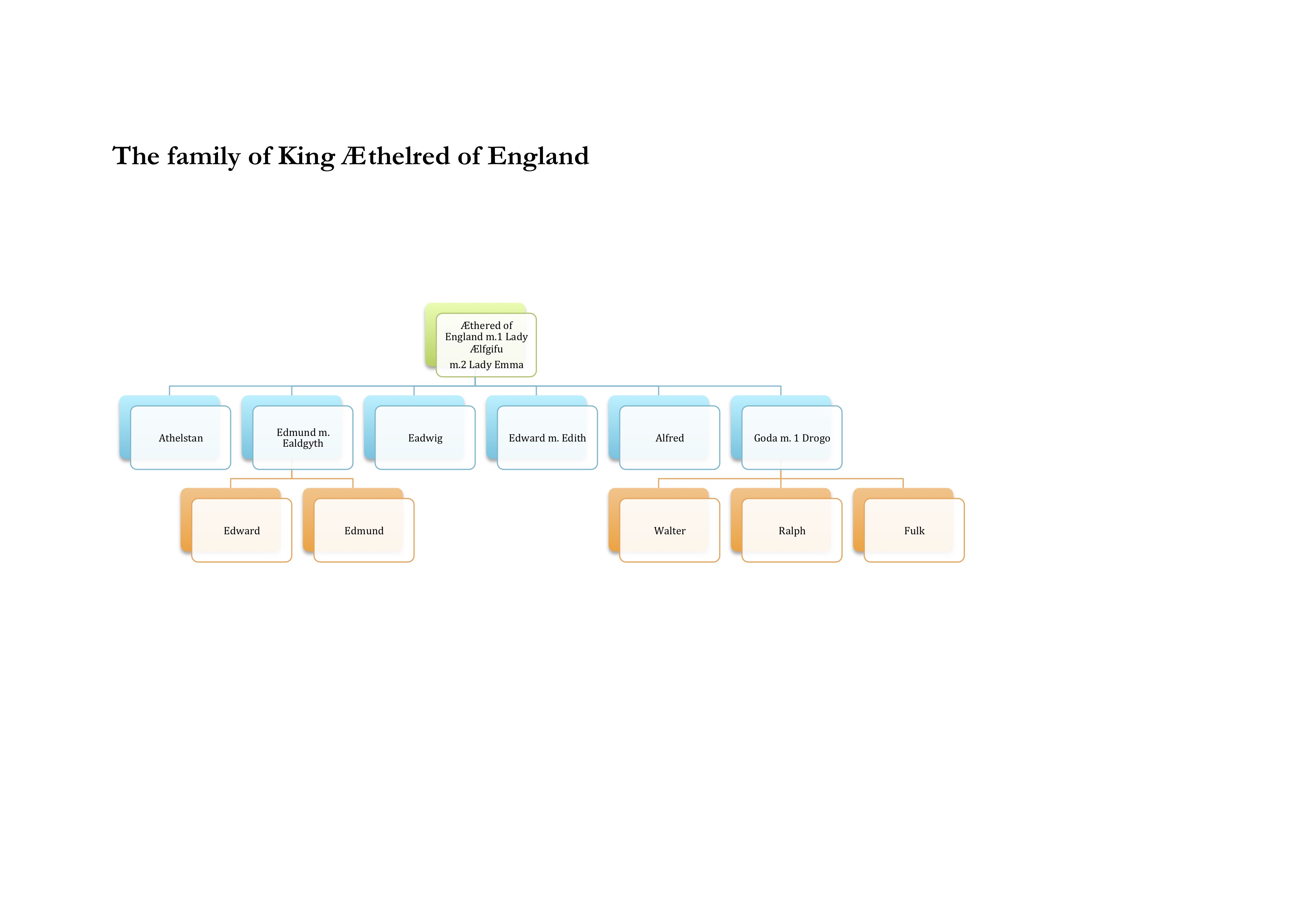
Not that it’s possible to speak of Lady Emma’s children from her two marriages, without considering the children of her first husband’s first marriage. King Æthelred had many children with his first wife, perhaps as many as nine (again, a matter for debate), the below only shows the children mentioned in Lady Estrid. Readers of The Earls of Mercia series, and the Lady Elfrida books, will have encountered the many daughters, as well as sons.
The family of King Æthelred of England
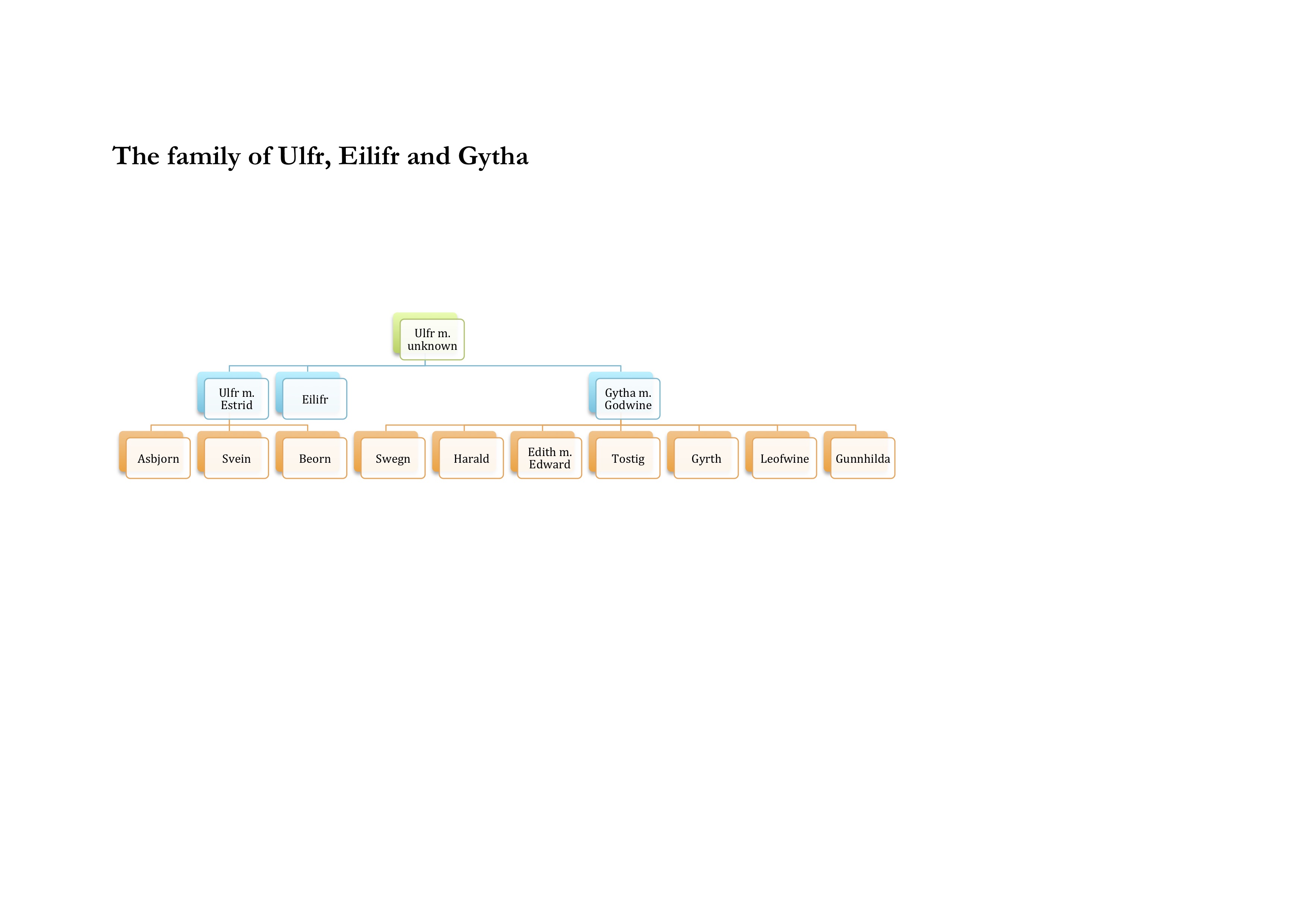
One of the other family’s that had the most impact on Lady Estrid, was that of her third husband, and father of her two sons, Jarl Ulfr.
The family of Ulfr
Ulfr had a brother and a sister, and while little is known about the brother, it is his sister who birthed an extremely illustrious family, through her marriage to Earl Godwine of Wessex. (The family tree doesn’t include all of her children.)
Four such powerful families, all intermarried, make for a heady mix.
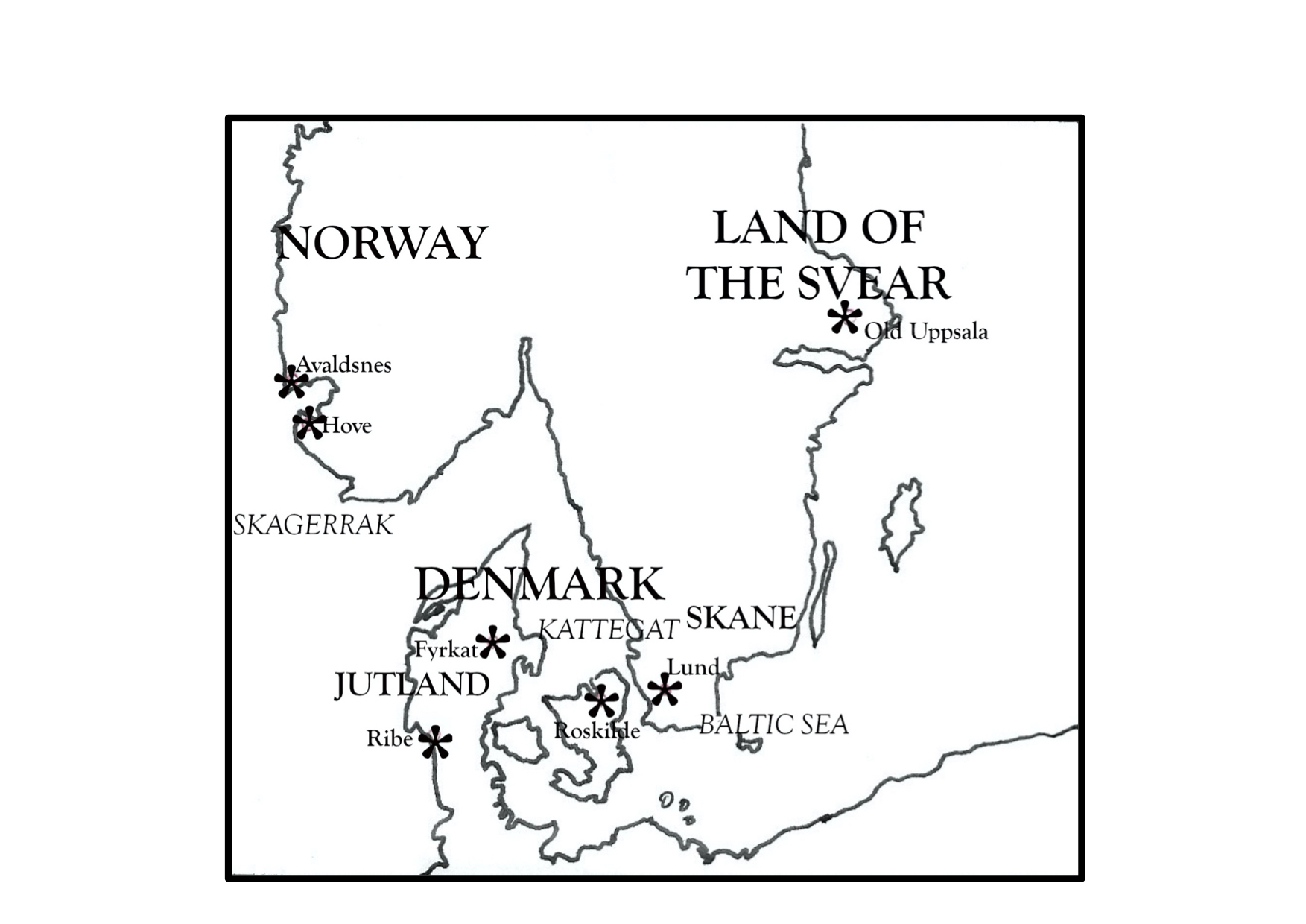
For the modern reader, not only are the family dynamics complicated to understand, but so too is the geography. Sweden was not Sweden as it is today, and the reason I’ve insisted on calling it the Land of the Svear. But equally, Denmark was larger than it’s current geographical extent, covering Skåne, (in modern day Sweden) as well. The map below attempts to make it a little clearer. Norway is perhaps the most recognisable to a modern reader, but even there, there are important difference. King Swein claimed rulership over parts of Norway during his rule, and so too did King Cnut. But, Denmark isn’t the only aggressor, there were rulers in all three kingdoms who wished to increase the land they could control, King Cnut of Denmark, England, Skåne and part of Norway, is merely the most well-known (to an English-speaking historian.)
Today, I’m excited to host the blog tour for the fantastic new release, Sons of Rome, by Gordon Doherty and Simon Turney.
Here’s the blurb.
Four Emperors. Two Friends. One Destiny.
As twilight descends on the 3rd century AD, the Roman Empire is but a shadow of its former self. Decades of usurping emperors, splinter kingdoms and savage wars have left the people beleaguered, the armies weary and the future uncertain. And into this chaos Emperor Diocletian steps, reforming the succession to allow for not one emperor to rule the world, but four.
Meanwhile, two boys share a chance meeting in the great city of Treverorum as Diocletian’s dream is announced to the imperial court. Throughout the years that follow, they share heartbreak and glory as that dream sours and the empire endures an era of tyranny and dread. Their lives are inextricably linked, their destinies ever-converging as they rise through Rome’s savage stations, to the zenith of empire. For Constantine and Maxentius, the purple robes beckon…
Book Review
Sons of Rome is the sort of historical fiction book that really appeals to me – people that really lived, having their story told, often against a backdrop of profound change.
The story is told from the point of view of Constantine and Maxentius. They meet as youths, and while their chance meetings are rare throughout the rest of the book, they have far-reaching consequences, as they both grow to adulthood and are forced into situations they probably never thought possible.
I loved the alternate chapters assigned to Constantine and Maxentius. It means that the reader never feels far away from the characters, and lends an ‘immediacy’ to their ‘friendship’, which wouldn’t be possible to achieve because they are so often apart.
The book is mired in politics – again a bit of a favourite of mine – and even though I had no prior knowledge of the time period, I could easily understand what was happening, and I think this is a particular strength of the story. The characters never feel distant or difficult to understand.
I would highly recommend Sons of Rome and look forward to reading Book 2.
On a personal note, as someone who writes historical fiction, I know just how complex and difficult it can be to ‘tame’ a coherent narrative from the past. I think the authors do an amazing job of making the events feel real and easy to understand, while picking the strands of the story, and the ancillary characters, that are needed to flesh out the distant past.
Thank you to Netgalley and the publisher for my review copy, and for inviting me on the Blog Tour. I’ve really enjoyed it.
About the authors
Simon Turney is the author of the Marius’ Mules and Praetorian series, as well as The Damned Emperor series for Orion and Tales of the Empire series for Canelo. He is based in Yorkshire.
Gordon Doherty is the author of the Legionary and Strategos series, and wrote the Assassin’s Creed tie-in novel Odyssey. He is based in Scotland.
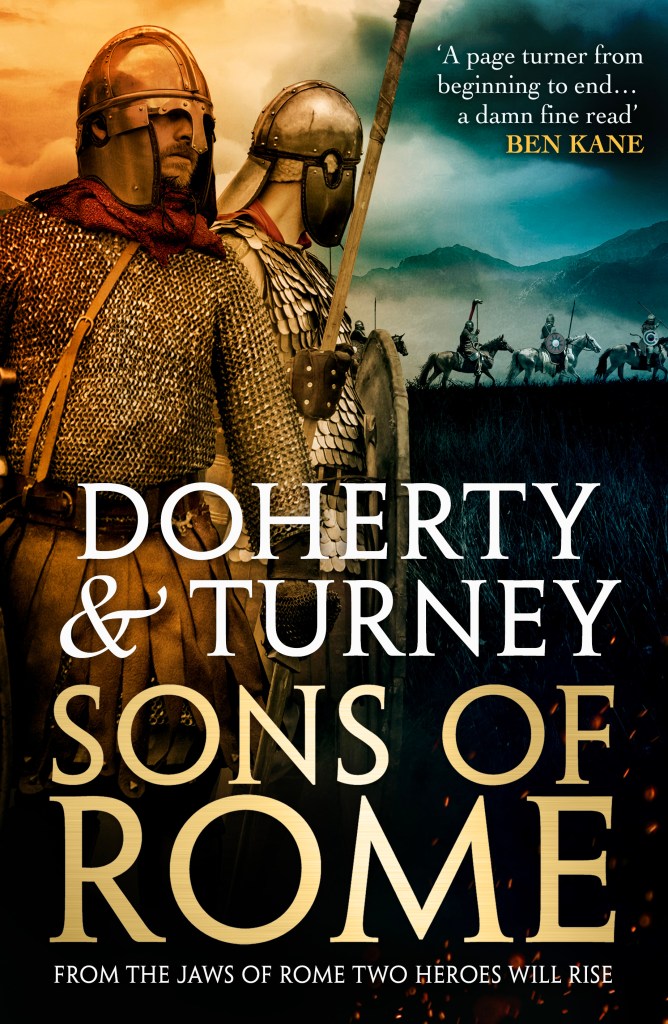
Sons of Rome was released on 15th October, and I would give it 5/5 stars. It’s a great read. (Isn’t the cover fantastic?) And the cover for Book 2 is also amazing.
“Separated by anger and unanswered questions, Byrhtnoth and Saewynn are brought together by a tragic death. Re-united, they set out on an epic voyage to discover the final truth about his father. The journey takes them far to the north, to Orkney, swathed in the mists of treachery, and to Dublin’s slave markets where Byrhtnoth faces a fateful decision. How far will he go, to save those he cares for?”
First things first, Bright Helm is book four in a tightly woven series about young Byrhtnoth, more famous for dying at the Battle of Maldon in AD991, than for anything else. But, he must have had a life before that fateful battle and the author has devised an intriguing and engaging story about his youth, weaving the tale through known historical ‘fact’ of the 940’s and 950’s in Early England.
This is a time period that I’ve also written about and studied, and I have been lucky enough to have early access to Bright Helm, as well as other books in the series. I’ve enjoyed arguing about plot developments and also taken fresh insight from decisions made for the characters. It’s strange to have ‘your’ characters in the hands of someone else, but hey, this is historical fiction, these characters belong only to themselves and the author who writes about them.
What I really enjoyed about Bright Helm was the journey Byrhtnoth has to make. Along the way, he encounters any number of ‘historical’ characters, and winds up visiting both the Orkney Islands and Ireland. I love the Orkney Islands, and I could ‘see’ everything that the author described in such detail.
The book really gather pace as it roars towards its end and I found myself, and this doesn’t often happen in books where I know so much of the back story, just relaxing and allowing the story to unfold without worrying that I might not like it. As I said to the author, I found that she really found ‘her stride’. The pacing was sound, the story thoroughly intriguing, and well, I’m just looking forward to the next book (which might be the last in the series) to find out how it all ends.
I highly recommend this book, and if you’ve not read the earlier books in the series, I believe you could jump in with Book 4, or enjoy starting at the very beginning.
In the aftermath of the Great War, the line between friend and foe may be hard to discern, even for indomitable former Secret Service agent Verity Kent, in award-winning author Anna Lee Huber’s thrilling mystery series.
Peacetime has brought little respite for Verity Kent. Intrigue still abounds, even within her own family. As a favor to her father, Verity agrees to visit his sister in Wiltshire. Her once prosperous aunt has fallen on difficult times and is considering selling their estate. But there are strange goings-on at the manor, including missing servants, possible heirloom forgeries, and suspicious rumors—all leading to the discovery of a dead body on the grounds.
While Verity and her husband, Sidney, investigate this new mystery, they are also on the trail of an old adversary—the shadowy and lethal Lord Ardmore. At every turn, the suspected traitor seems to be one step ahead of them. And even when their dear friend Max, the Earl of Ryde, stumbles upon a code hidden among his late father’s effects that may reveal the truth about Ardmore, Verity wonders if they are really the hunters—or the hunted . . .
A Pretty Deceit is an excellent addition to the series by Anna Lee Huber. I didn’t realise when I started reading it, that I’d already read Book 3, but I soon appreciated that I ‘knew’ the characters. Then came the search on Goodreads, and then it all made a great deal more sense:)
Verity Kent is once more embroiled in a new mystery and also still pursuing an old one from Book 3, the two threads merging together expertly to give an engrossing and deliciously complicated narrative, that ensures all the old favourites make an appearance at some point throughout the book.
It was a thoroughly enjoyable and engrossing read. In fact, as soon as I’d finished it, I went on to read Book 1, and plan on reading Book 2 as well. If you enjoy a well constructed and deeply rooted 1920’s (well, just as about) murder mystery, this is definitely a great series to read.
Thank you to Netgalley and the Publisher for my review copy.
A Pretty Deceit was released on 6th October, and is available here.
Percy Bysshe Shelley’s brief and turbulent life was as passionate as his poetry. Romantic, idealistic and impulsive, Shelley had several intense love affairs. When Shelley drowned at sea in 1822, he took his secrets with him. Did a beautiful, lovelorn lady really follow him throughout Europe, as he claimed? Did Mary Shelley ever learn about this rival for her affections? Shelley and the Unknown Lady is a carefully researched imagining of the true-life tragedy behind the mystery. This novella is a stand-alone story excerpted from Lona Manning’s Mansfield Trilogy.
And here’s my review;
I’m a stranger to the world recreated by Lona Manning, but that doesn’t matter at all when reading Shelley and the Unknown Lady.
The story immediately beguiles the reader, transporting you to another time and place, and it’s such a fascinating story, that you won’t want to stop reading once you start.
The author certainly knows the story of Shelley incredibly well, and it’s a joy to read the notes added by the author which piece together the historical mystery of the unknown lady.
For a novella, or short story, the reader is rewarded with an absorbing story.
I thoroughly enjoyed it, and would highly recommend Shelley and the Unknown Lady.
Disclaimer, I received a free copy of this book via The History Quill Book Club. If you’re interested in The History Quill then please go and check them out.
Well, this is a first. Today, I welcome Stuart Rudge to my blog. He’s going to tell us all about his research for his new book, Blood Feud, Legend of the Cid Book 2, available now. So, I hand it over to Stuart and he’s going to tell us about building Islamic Zaragoza, which features in his new book.
Research can be boring and tedious – or, it can be interesting and engrossing. When I was researching the Islamic city of Zaragoza for my latest novel, Blood Feud, I found myself leaning in the camp of the latter. The more I was looking in to what medieval Islamic cities looked like and how they functioned, the more I was looking forward to describing it in my novel. Today, I am going to show you how I researched Zaragoza, and how it might have looked in the days of El Cid. Let’s go on a little tour.
I will start with the name. Before the Romans came to Spain, it was a village named Salduie, and then the Romans founded a colony for retired veterans and named it Caesaraugusta. After the Islamic invasion and conquest, it was renamed Saraqusta, which eventually evolved in to the modern name, Zaragoza. As I like to have historically authentic names to my novels, I have plumbed for the Islamic version of the name, like I have done with all of the various taifa kingdoms in the same period (e.g. Toledo is Tulaytula, Valencia is Balansiya, etc).
Below is a screenshot from Google Maps of the centre of modern Zaragoza, and includes some of the key features of the Islamic settlement. The orange lines indicate the approximate outline of the walls built by the Moors, along with the site of the Aljaferia palace, and La Zuda palace, which were key landmarks of the city in the eleventh century.
Estimated site of Islamic Saraqust
The Aljaferia
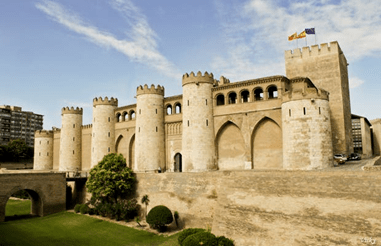
The Aljaferia palace is a unique building, as it is one of the only complete structures standing today which dates to the taifa period of Spanish history. Dating to the eleventh century, the palace was named “Palace of the Joy” by amir al-Muqtadir, and he held his court and greeted his embassies in his “Golden Hall” as he described it. The modern interior is largely different to what the Islamic amirs would have walked through, as the city was conquered by the kingdom of Aragon at the beginning of the twelfth century, and over time the Christian monarchs converted it to suit their tastes, but we do have examples of friezes from the eleventh century, and the columns and archways give us an indication of Islamic architectural and artistic styles from the period, as seen below.
Column capitals and yeseria, c. eleventh century.
Images: Wikipedia
In its zenith it would have been a place of wonder and beauty, a tranquil palace in the centre of a neigh impregnable fortress just outside of the main city. As the building was being renovated during the latter half of the eleventh century, the only part of the citadel which the story of Blood Feud takes part in is the Troubadour tower, which preceded the citadel by around two hundred years, being part of an earlier fortification which was incorporated in to the Aljaferia palace.
Frontal image of the Aljaferia palace, with the Troubadour Palace on the right Image: Wikipedia
La Zuda Palace
Before the amir of Zaragoza moved his court to the Aljaferia palace, the governors of the city were housed in La Zuda palace. Located in the old Roman part of the city, it was built adjacent to the corner section of the Roman wall next to the river, and like the Aljaferia, it was a similarly fortified and secure site.
The current site is occupied by a sixteenth century tower and an eighteenth century church, which has replaced an earlier medieval church, and since none of the Islamic site remains, we have no definitive way of knowing what the palace would have looked like. In my view, the exterior wall would have looked something akin to that of the Aljaferia, albeit on a smaller scale. The interior is where imagination is needed. I took inspiration from the Aljaferia, the Alcazar of Seville and the Alhambra of Granada, three of the most famous Islamic palaces in Spain, thrown in with some artistic creativity, to create what I believe would have been a (roughly) accurate portrayal of what an Islamic palace would have looked like; a tranquil haven away from the hustle and bustle of the city. An example of what I came up with is below:
“Walking around the palace, I wondered why al-Muqtadir was moving his court to the citadel outside the walls. As we passed through the gate, we entered a courtyard with a long pool which stretched to a hall at the opposite end, with trees bearing peaches, lemons and pomegranates that ran parallel to the pool. Pointed archways with alternating black and white painted blocks were held up with thin black columns, and the walls were painted white with black script running down each wall. The colonnades around the periphery led to side rooms shielded with silken drapes, whilst bronze incense burners hung from the ceiling, filled the air with a perfumed scent intensified by the sweetness of the fruit trees. Court officials sauntered here and there as guards stood vigil with tall spears; each man wore the uniform of pale yellow favoured by the amir. There was relative silence within the palace save for the occasional chatter which echoed in the corridors, and made it a tranquil haven away from the commotion of the city.
Idris led us across to the opposite side of the courtyard and through to a large hall, and here the decoration was more elaborate. The walls bore intricate patterns painted in vibrant blues, reds and yellows, and it was one of the most beautiful things I had ever seen. I marvelled and let my jaw hang slack, for something so striking was rare in Castile and I could have lingered all day to drink it in. Fine bronze statues of stags lined the walls too, and the domed ceiling was of smooth, dark stone studded with small pieces of coloured glass, so it resembled the stars twinkling in the night sky. The perfumed scent intensified, and the air was filled with the sound of a man uttering what seemed like poetry to an audience.”
The Roman City
By the eleventh century, the shell of the old Roman city of Caesaraugusta would still have been intact. The fact that part of the Roman walls still stand suggest they would have stood in some capacity in the Islamic period. We know that some parts still stood, as they do today, yet other parts would have been stripped of their masonry to be used elsewhere in the city for new structures, and only the foundations would have remained to form some sort of border or barrier. As the Moors built another wall around their own city, there was no need to fully maintain the Roman fortifications.
Estimated site of Roman Caesaraugusta
Part of the section in Zaragoza involves Antonio tailing an old foe towards the wharfs, and again later on when he is trying to prevent his escape. In my research I found scant information relating to what the Islamic wharf would have looked like at the time, and had to improvise. But around a month or so before I was going to release the book, I stumbled across the website Zaragoza.es. On there, it had a little pamphlet with information about the Roman forum, the wharf and the walls. From the below picture, we can garner quite a lot of how things looked.
Artist impression of how the Roman forum and wharfs would have looked. Image: Zaragoza.es
The central structure and wide open space is the old Roman forum, which was the beating heart of the city, and the structure below it, facing the river, is a huge warehouse. The image below shows a reconstruction of what the warehouse may have looked like.
Cross section of old Roman warehouse. Image from Zaragoza.es
We know from sources that the forum was all but gone by the eleventh century; given the close proximity to the river, it is likely the area was turned in to a large market. It is also likely that the warehouse was still functioning at this time, and was used as a place to store goods coming straight from the ships before being taken to market, or further afield on the back of mules. Given the length of the wharf and the amount of ships that could have been docked at any one time, it is not hard to imagine the area as a hive of activity, with men coming from all corners of Europe, Africa and the Middle East, bringing goods such as spices, leather and metal work, raw materials from far off lands, luxurious silks and linens, and even slaves.
After conducting all of my research, I made myself a little map with all the different sites of the city, and where the Roman and Islamic parts of the city would be. Here is what I came up with:
My interpretation of how Saraqusta would have looked
The characteristics of both the Roman city and the Muslim city would have been very different. Roman cities generally followed a set of rules; wide, straight streets, close to a water source, with strong walls and a central open space called a forum, where the principle administrative buildings were located. Muslim cities tended to be more compact, with narrow, winding streets, branching off to cul-de-sacs of homes for the inhabitants, with a large space reserved for markets, and various mosques scattered throughout the cities. One example for the differences was transport. The Romans used wagons to transport their goods, and so main streets had to be wide enough to accommodate two wagons travelling abreast, whereas Muslim traders used pack animals such as mules, and so the streets would not be as wide. In a warm climate like Spain, narrower streets coupled with white washed walls of the buildings made the cities feel cooler, darker and more compact.
I hope you have enjoyed this little tour around the medieval city of Zaragoza. For a more in depth look at how I envisioned it, pick up a copy of Blood Feud, the second book in the Legend of the Cid series, and explore the secrets of one of the great taifa states of the medieval period.
Blood Feud is available now, and can be picked up from Amazon here.



























 MJ Porter