To celebrate the release of The Last Enemy, my interviewer caught up with Lady Cyneswith. #histfic #TheLastKing

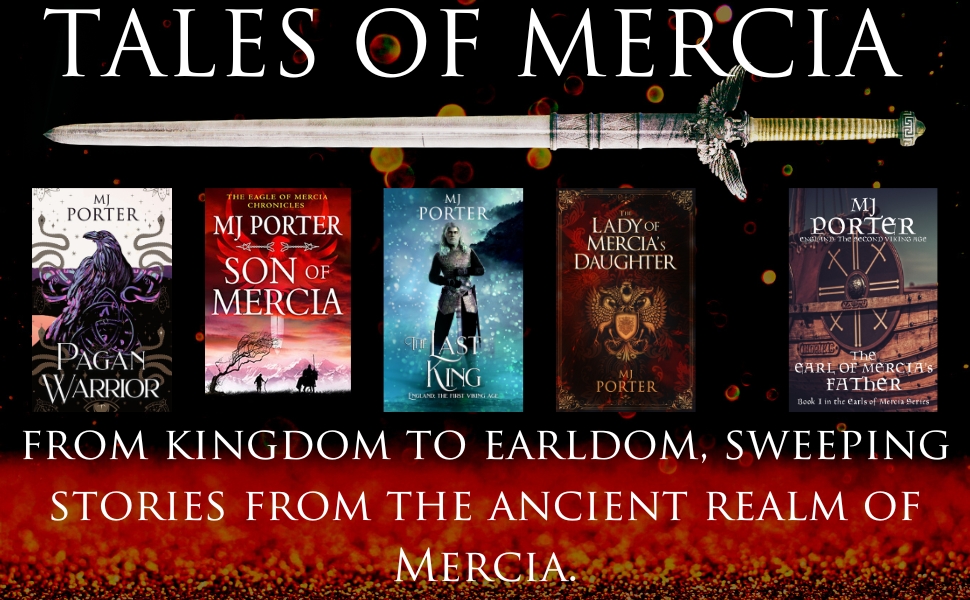
The first eight covers for The Last King series by MJ Porter
The Last King/The Mercian Ninth Century

I’m very honoured to have caught a few moments with Lady Cyneswith, the aunt of King Coelwulf. Thank you for finding the time to speak to me.

“Well, I’m sure you’ve discovered that my nephew is a very busy man, a bit rough around the edges some times, and so I’m delighted to speak with you on his behalf, smooth away any ruffles he might have caused.

Yes, I confess, I had noticed that he was short on time when I tried to speak with him earlier.

Short on time, and economical with his words. He is the king, you know, but of course, his priorities are with defeating the Raiders. I think there are those who don’t quite appreciate the persistence of the enemy. It takes a strong and decisive leader to defeat them, and we should be pleased to have one. Much better than our previous king, who gave up Mercia in exchange for his life. Shocking.

I speak for the whole of Mercia when I say we are so pleased to have such a man leading us. Some new, vigourous, blood was needed to ensure Mercia stayed together.

Our previous king, Burgred, was not blessed with the military requirements for the post. But then, I won’t be alone in believing that Burgred should never have been king. He only achieved what he did because of the manipulation of the natural right of succession.

So, you believe that all the kings since King Coelwulf, first of his name, were usurpers?

I make no bones about that. Mercia wouldn’t be in such peril if my family line had retained their hold on power, as they should have done. But, now is not the time to dwell on that. It’s important to think of the future, and of what is yet to be achieved, but which will be, and soon.

I asked King Coelwulf if had a few words to explain why people should read the latest book.

I imagine he said something along the lines of, ‘I don’t have time for reading, so I wouldn’t.’ And, of course, he means that, but it is difficult for him to appreciate the fascination others have with what he’s trying to achieve. So, I would say, read it and discover just what risks your king, and his warriors and ealdormen are making to ensure Mercia’s freedom. Read it, and understand the peril and take steps to ensure your freedom as well. 

And, have you read the latest book?

I have yes, and I’m pleased to say there’s a slightly bigger part for me in, than usual. Of course, it’s difficult with all the fighting to find room for the women of Mercia, but I’m sure that one day, in the not too distant future, Mercia will have female warriors to keep her safe. After all, anyone can learn to chop off someone’s head, or slice them through the neck, the skill, of course, is in staying alive afterwards.

Um, yes, quite. Thank you for that. I wondered if I could get a few words from you about King Alfred of Wessex.

No, not really. I don’t speak about neighbouring kings, and I’ve never met the man. Now, if you asked me about the king of Gwent, then I might have something to say about him, but you haven’t, and so, I don’t.

Could I ask you about the language used in the book? It’s quite strong in places.

While I have no particular need to hear such words, I can well appreciate that, on occasion, they might be warranted. After all, our king and his warriors are risking their lives every time they enter a battle against our enemy. I put it down to the rush of adrenaline, and hope everyone else does the same.

I asked King Coelwulf about his warriors, do you have any particular favourite amongst them?

I take pride in teaching all of the men some simple techniques to treat wounds received in battle. It’s important to know how to heal as well as to maim. My favourites are obviously those who listen carefully and learn what I teach them. 

Thank you for taking the time to speak with me.

It is of course, my pleasure, and my duty, as the king’s sole surviving relative. Under his leadership, Mercia will once more be great again.

And there you have it. An interesting interview with Lady Cyneswith, a most formidable woman. I should think she’d be as lethal on the battlefield as her nephew is proving to be.  If you haven’t read my earlier interview with King Coelwulf, then you can find it here.

Visit the Mercian Ninth Century page on the blog.

Posts

Lady Estrid, her family and the geography of the eleventh-century #histfic #historicalresearch

One of the big plusses for choosing the character of Lady Estrid for my most recent novel, was her large and illustrious family and their far-reaching influence over Denmark, Sweden, Norway and England. It meant there was already an excellent story to tell.

While I quickly managed to slot all the different relatives into order (well, I have been writing about them for a while), I’m aware it’s not the easiest of tasks, and so, I have put together some genealogical tables of the main families to make it that bit easier.
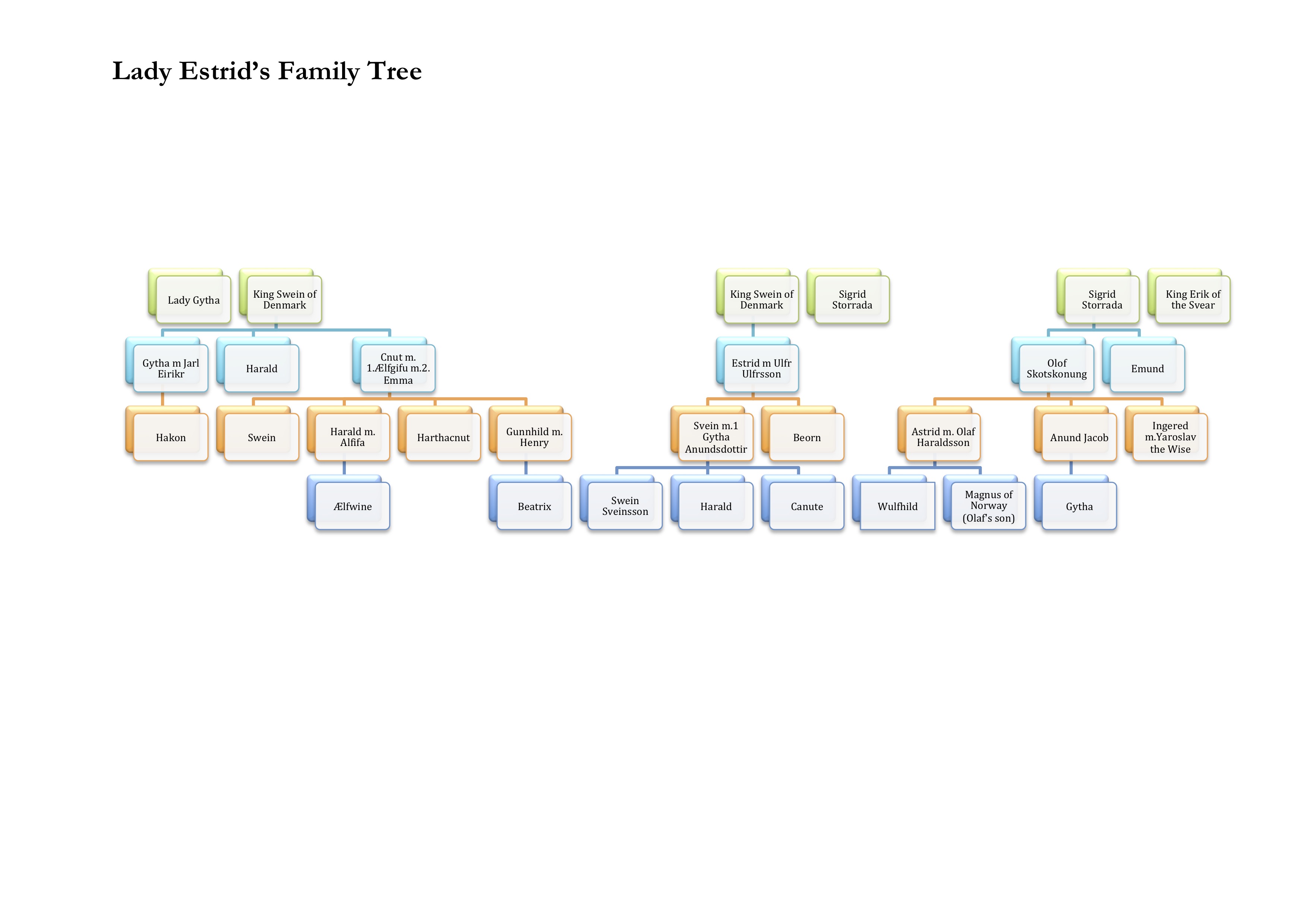
Due to a lack of information, I have made little mention of the rest of Estrid’s half-sisters, of which she had three or four. I feel it perhaps also helped the story a little – it was complicated enough as it was without giving them the capacity to meddle in affairs in Denmark. I have also made the assumption, that because I don’t know who they married, that they didn’t make international alliances, as Estrid did.

To break it down into more palatable chunks, Lady Estrid’s mother was married twice, once to King Swein of Denmark (second) and also to King Erik of the Svear (first). King Swein was also married twice (in my story at least – as it is debated), to Lady Gytha (who I take to be his first wife) and then to Lady Sigrid (who I take to be his second wife.) Swein was king of Denmark, Erik, king of the Svear (which would become Sweden), and so Sigrid was twice a queen, and she would have expected her children to rule as well, and her grandchildren after her. Sigrid was truly the matriarch of a vast dynasty.

She would have grandchildren who lived their lives in the kingdom of the Rus, in Norway, in England, and Denmark.

And Sigrid wasn’t the only ‘double queen.’ Lady Emma, twice queen of England, was first married to King Æthelred and then to King Cnut, Estrid’s brother.
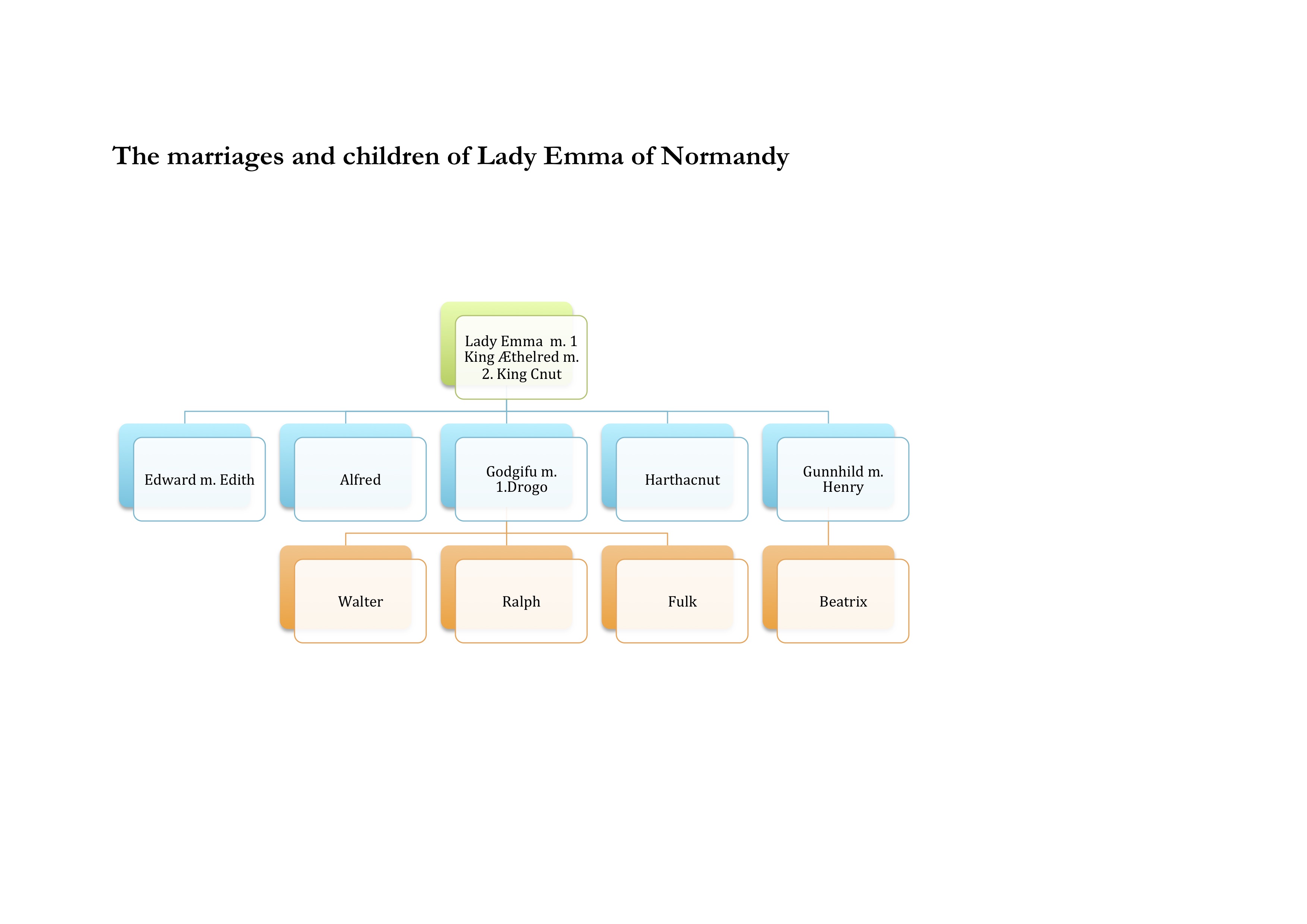
Not that it’s possible to speak of Lady Emma’s children from her two marriages, without considering the children of her first husband’s first marriage. King Æthelred had many children with his first wife, perhaps as many as nine (again, a matter for debate), the below only shows the children mentioned in Lady Estrid. Readers of The Earls of Mercia series, and the Lady Elfrida books, will have encountered the many daughters, as well as sons.
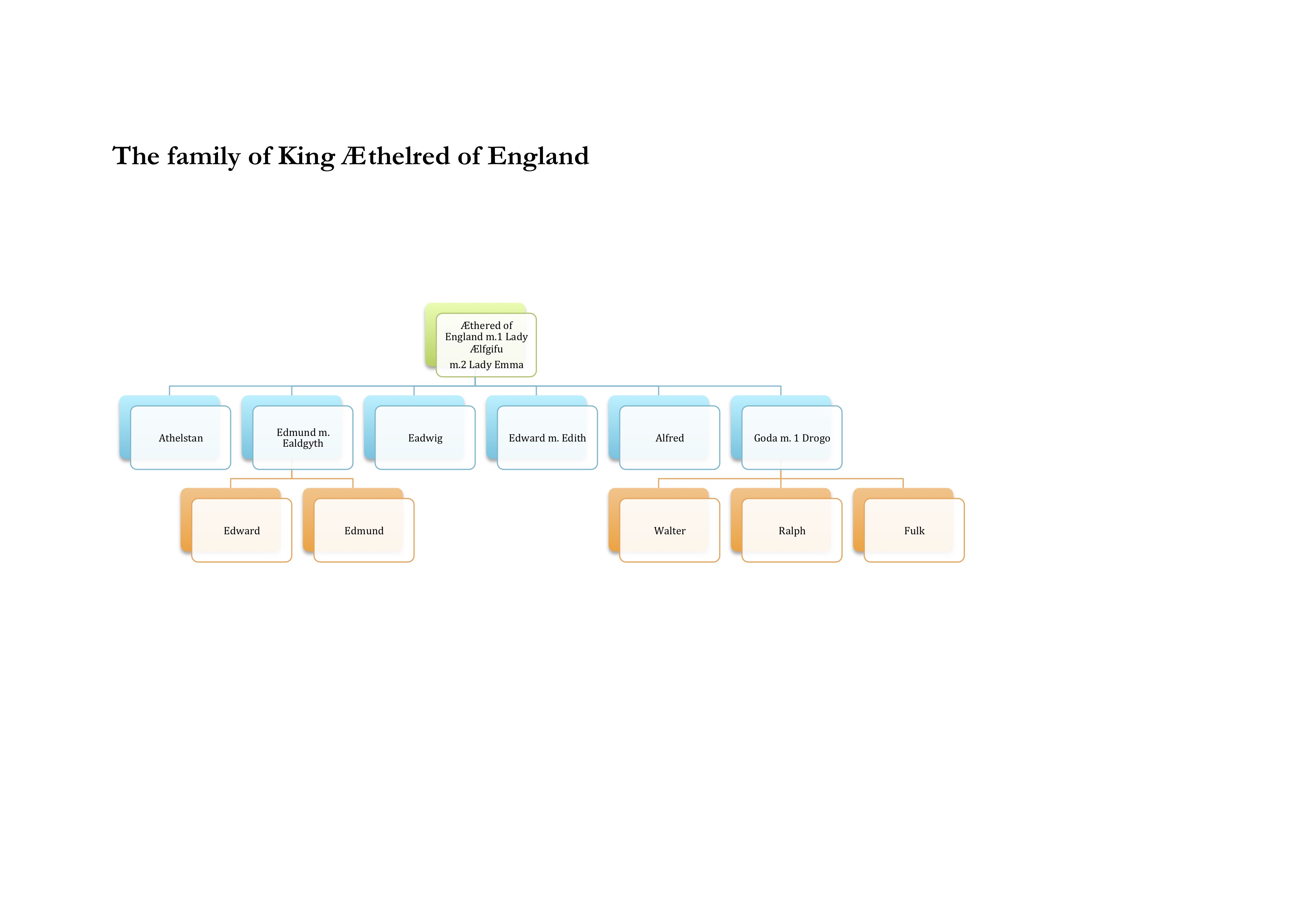
One of the other family’s that had the most impact on Lady Estrid, was that of her third husband, and father of her two sons, Jarl Ulfr.
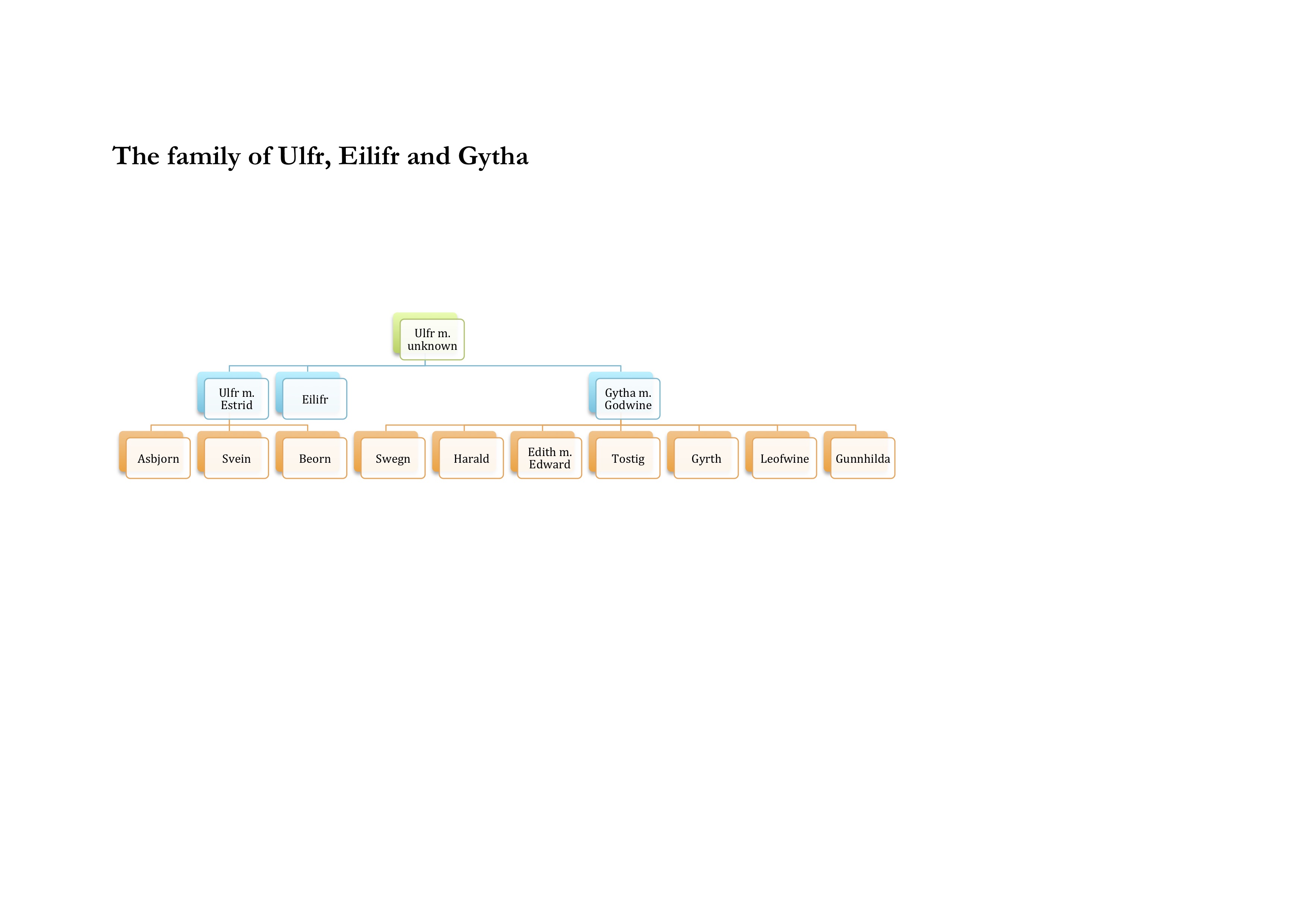
Ulfr had a brother and a sister, and while little is known about the brother, it is his sister who birthed an extremely illustrious family, through her marriage to Earl Godwine of Wessex. (The family tree doesn’t include all of her children.)

Four such powerful families, all intermarried, make for a heady mix.

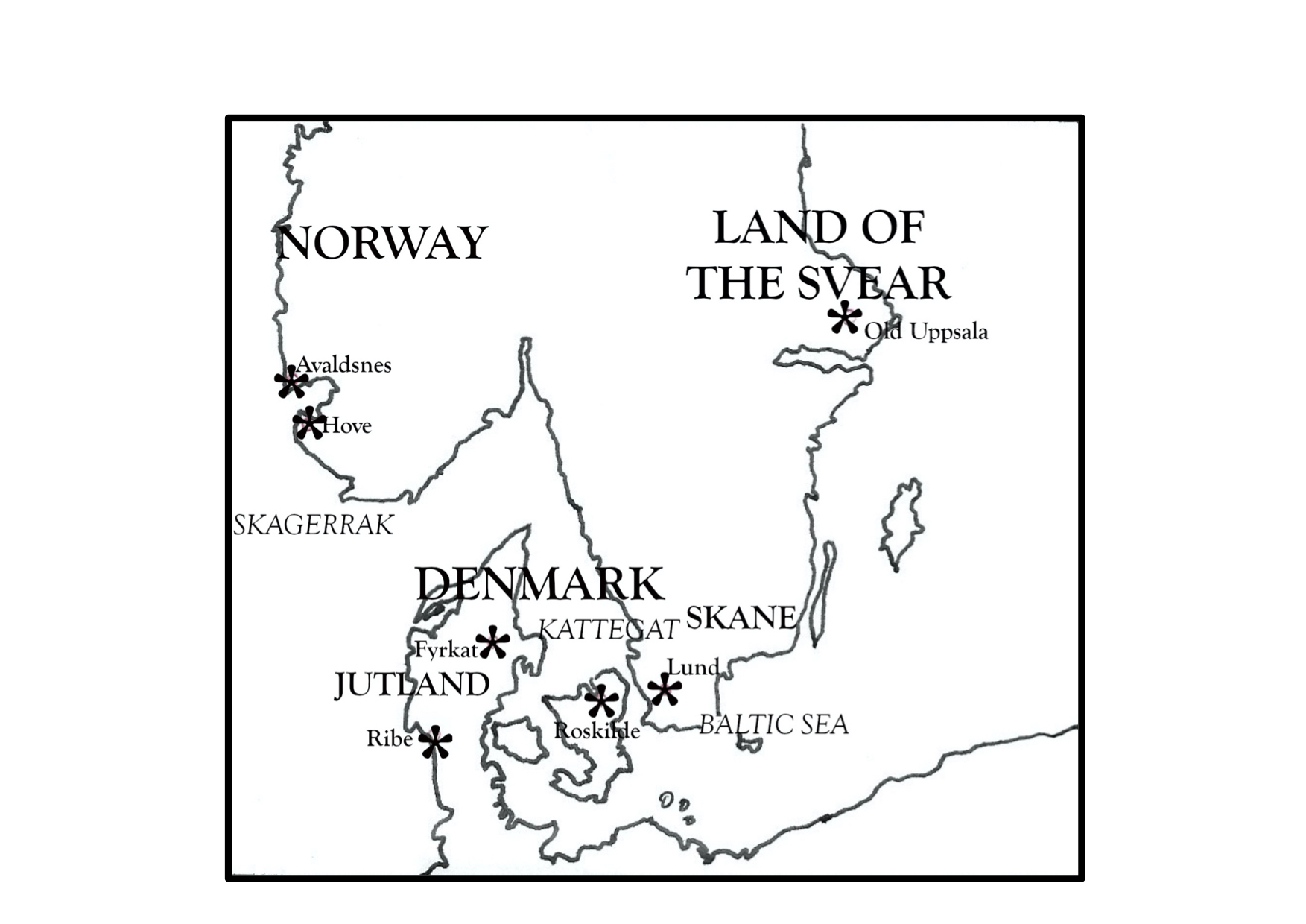
For the modern reader, not only are the family dynamics complicated to understand, but so too is the geography. Sweden was not Sweden as it is today, and the reason I’ve insisted on calling it the Land of the Svear. But equally, Denmark was larger than it’s current geographical extent, covering Skåne, (in modern day Sweden) as well. The map below attempts to make it a little clearer. Norway is perhaps the most recognisable to a modern reader, but even there, there are important difference. King Swein claimed rulership over parts of Norway during his rule, and so too did King Cnut. But, Denmark isn’t the only aggressor, there were rulers in all three kingdoms who wished to increase the land they could control, King Cnut of Denmark, England, Skåne and part of Norway, is merely the most well-known (to an English-speaking historian.)
Lady Estrid is available now
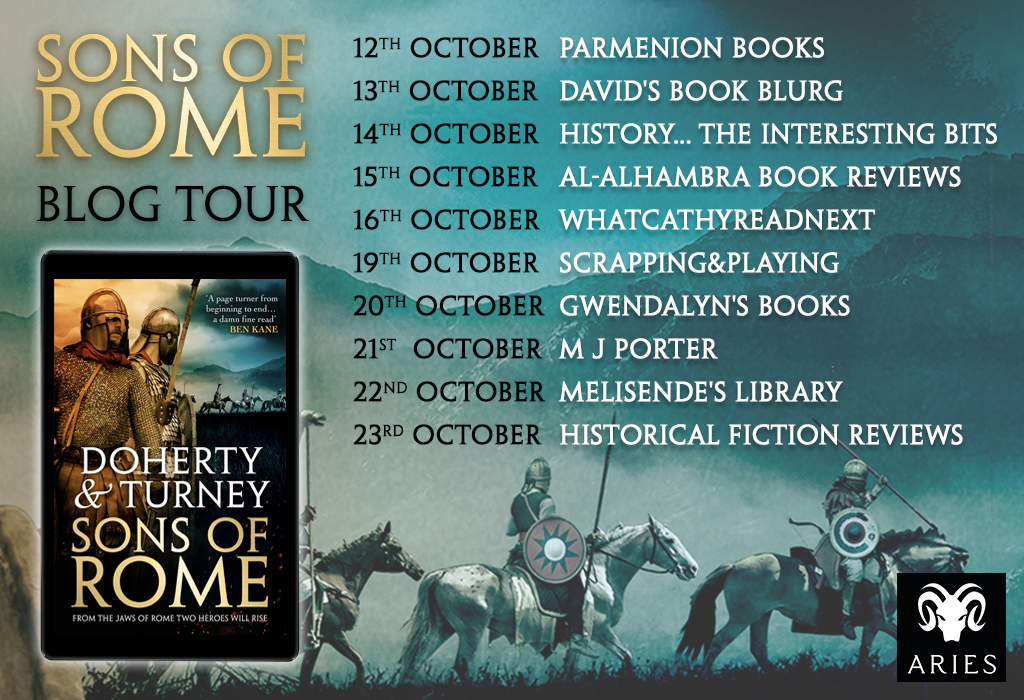
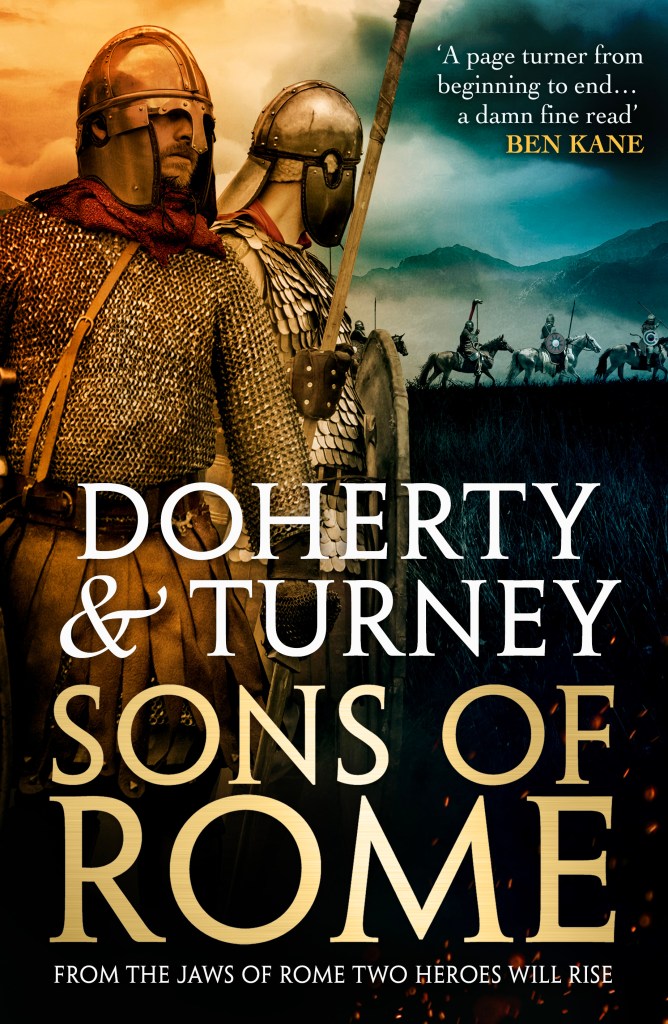
Welcome to today’s stop on the Sons of Rome Blog Tour

Today, I’m excited to host the blog tour for the fantastic new release, Sons of Rome, by Gordon Doherty and Simon Turney.

Here’s the blurb.

Four Emperors. Two Friends. One Destiny.

As twilight descends on the 3rd century AD, the Roman Empire is but a shadow of its former self. Decades of usurping emperors, splinter kingdoms and savage wars have left the people beleaguered, the armies weary and the future uncertain. And into this chaos Emperor Diocletian steps, reforming the succession to allow for not one emperor to rule the world, but four.

Meanwhile, two boys share a chance meeting in the great city of Treverorum as Diocletian’s dream is announced to the imperial court. Throughout the years that follow, they share heartbreak and glory as that dream sours and the empire endures an era of tyranny and dread. Their lives are inextricably linked, their destinies ever-converging as they rise through Rome’s savage stations, to the zenith of empire. For Constantine and Maxentius, the purple robes beckon…

Book Review

Sons of Rome is the sort of historical fiction book that really appeals to me – people that really lived, having their story told, often against a backdrop of profound change.

The story is told from the point of view of Constantine and Maxentius. They meet as youths, and while their chance meetings are rare throughout the rest of the book, they have far-reaching consequences, as they both grow to adulthood and are forced into situations they probably never thought possible.

I loved the alternate chapters assigned to Constantine and Maxentius. It means that the reader never feels far away from the characters, and lends an ‘immediacy’ to their ‘friendship’, which wouldn’t be possible to achieve because they are so often apart.

The book is mired in politics – again a bit of a favourite of mine – and even though I had no prior knowledge of the time period, I could easily understand what was happening, and I think this is a particular strength of the story. The characters never feel distant or difficult to understand.

I would highly recommend Sons of Rome and look forward to reading Book 2.

On a personal note, as someone who writes historical fiction, I know just how complex and difficult it can be to ‘tame’ a coherent narrative from the past. I think the authors do an amazing job of making the events feel real and easy to understand, while picking the strands of the story, and the ancillary characters, that are needed to flesh out the distant past.

Thank you to Netgalley and the publisher for my review copy, and for inviting me on the Blog Tour. I’ve really enjoyed it.

About the authors

Simon Turney is the author of the Marius’ Mules and Praetorian series, as well as The Damned Emperor series for Orion and Tales of the Empire series for Canelo. He is based in Yorkshire. 

Gordon Doherty is the author of the Legionary and Strategos series, and wrote the Assassin’s Creed tie-in novel Odyssey. He is based in Scotland.

Follow Simon and Gordon

Twitter: @SJATurney

Website: http://simonturney.com/

Twitter: @GordonDoherty

Website: https://www.gordondoherty.co.uk/

Follow Aries

Twitter: @AriesFiction

Facebook: Aries Fiction

Website: http://www.headofzeus.com

Sons of Rome was released on 15th October, and I would give it 5/5 stars. It’s a great read. (Isn’t the cover fantastic?) And the cover for Book 2 is also amazing.

Book Review and New Release Alert – Bright Helm by Christine Hancock – historical fiction

Here’s the blurb;

“Separated by anger and unanswered questions, Byrhtnoth and Saewynn are brought together by a tragic death.
Re-united, they set out on an epic voyage to discover the final truth about his father. 
The journey takes them far to the north, to Orkney, swathed in the mists of treachery, and to Dublin’s slave markets where Byrhtnoth faces a fateful decision.
How far will he go, to save those he cares for?” 

First things first, Bright Helm is book four in a tightly woven series about young Byrhtnoth, more famous for dying at the Battle of Maldon in AD991, than for anything else. But, he must have had a life before that fateful battle and the author has devised an intriguing and engaging story about his youth, weaving the tale through known historical ‘fact’ of the 940’s and 950’s in Early England.

This is a time period that I’ve also written about and studied, and I have been lucky enough to have early access to Bright Helm, as well as other books in the series. I’ve enjoyed arguing about plot developments and also taken fresh insight from decisions made for the characters. It’s strange to have ‘your’ characters in the hands of someone else, but hey, this is historical fiction, these characters belong only to themselves and the author who writes about them.

What I really enjoyed about Bright Helm was the journey Byrhtnoth has to make. Along the way, he encounters any number of ‘historical’ characters, and winds up visiting both the Orkney Islands and Ireland. I love the Orkney Islands, and I could ‘see’ everything that the author described in such detail.

The book really gather pace as it roars towards its end and I found myself, and this doesn’t often happen in books where I know so much of the back story, just relaxing and allowing the story to unfold without worrying that I might not like it. As I said to the author, I found that she really found ‘her stride’. The pacing was sound, the story thoroughly intriguing, and well, I’m just looking forward to the next book (which might be the last in the series) to find out how it all ends.

I highly recommend this book, and if you’ve not read the earlier books in the series, I believe you could jump in with Book 4, or enjoy starting at the very beginning.

You can find Christine Hancock here:@YoungByrhtnoth and at https://byrhtnoth.com

Bright Helm is released today, 15th October, and is available in ebook and paperback.

(Some links on this blog are Amazon affiliate links)