

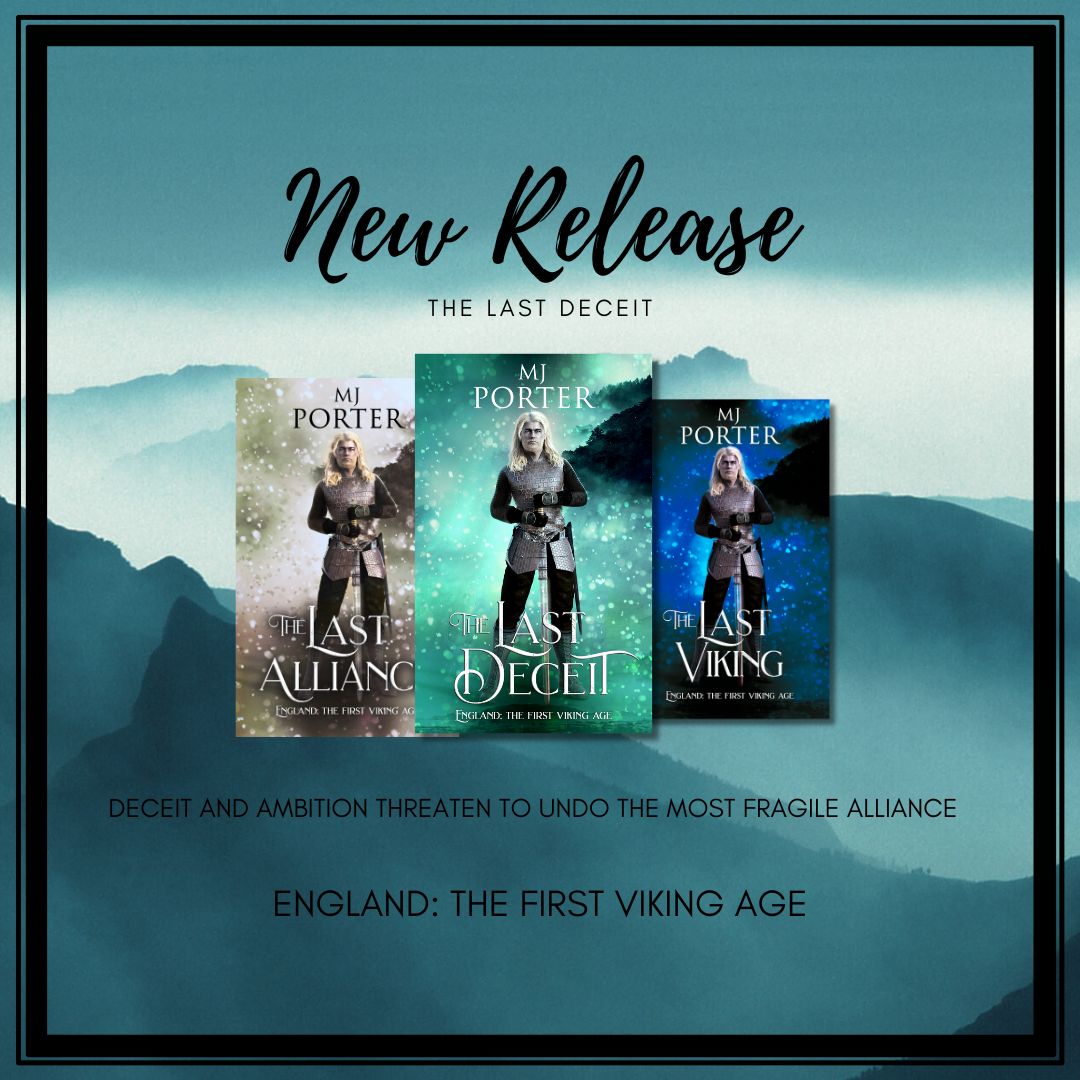
Here’s the blurb
Deceit and ambition threaten to undo the most fragile alliance.
King Coelwulf of Mercia has unwillingly accepted the need to ally with the kingdom of Wessex under the command of King Alfred. But King Alfred of Wessex must still prove himself, and Coelwulf can’t remain absent from Mercia indefinitely.
Returning to London, a place holding more fascination for the West Saxons and the Viking raiders than Coelwulf and his fellow Mercians, Coelwulf sets about reinforcing the walled settlement so long abandoned by all but the most determined traders. But Coelwulf knows Jarl Guthrum has set his eyes on Canterbury, and he must protect the archbishop in Kent, nominally under the control of the West Saxon king, even if King Alfred is no warrior.
But deceit and lies run rife through the West Saxon camp and when Coelwulf believes he’s held to his oaths and alliances, an unexpected enemy might just sneak their way into Mercia. The future of Mercia remains at stake.
Purchase Link
https://www.amazon.co.uk/Last-Deceit-England-action-packed-historical-ebook/dp/B0DK3J8JVK
Available in ebook, paperback, hardback and the Clean(er) Editions, with much of the swearing removed.
The Last Deceit also includes a new short story.
If you’ve not discovered The Last King/The Mercian Ninth Century Series, then please check out the Series page on the blog.
The who now? Who were the Gaini?
In The Last Deceit, reference is explicity made to a Mercian tribe known as the Gaini. It is from this obscure royal line that it’s said King Alfred’s wife, Lady Ealhswith, claimed descent. So, who were the Gaini?
The simple answer is that we don’t know. We don’t know where they were based. We don’t know any other known members of this tribe, but it’s certainly a name that survives from a period-specific resource, The Life of Alfred written by Asser in about 893, and so, some years after the events in The Last Deceit, in which he claims King Alfred’s wife was a descendant of this ruling family. Here are the details from The Royal Women Who Made England.
‘We are told by Asser, that Alfred ‘married a wife from Mercia, of noble family, namely the daughter of Æthelred “who was known as Mucil [Mucel]”, ealdorman of the Gaini. The woman’s mother was called Eadburh, from the royal stock of the king of the Mercians.’ It is possible, but cannot be confirmed that Ealhswith’s father was ealdorman in Mercia from the 820s onward when a man named Mucel is listed as attesting the surviving charters. The location of the tribal region of the Gaini has yet to be ascertained. Mercia was composed of many tribal regions; the most familiar being the Hwicce and the Mægonsate, both on the western borders with the Welsh kingdoms.
Whether Eahlswith’s mother was actually a member of the Mercian ruling family is difficult to conclude. Barbara Yorke determines she was related to King Coenwulf (796–821) and Coelwulf (821–823), two brother kings who ruled in the first quarter of the ninth century. It is impossible to confirm this either way due to a lack of available information. Mercia endured a string of kings throughout the ninth century, some more successful than others, and none of them able to offer the consistency and longevity that had been prevalent in the earlier eighth century during the long reigns of Æthelbald (716–757) and Offa (757–796).
Her possible father, Æthelred Mucel, witnesses two charters in the year of the marriage, S340, surviving in one manuscript, and S1201, surviving in two manuscripts, as well as S337, surviving in four manuscripts, in 867 and S349, surviving in two manuscripts, but deemed spurious, in 895.
What is known is that the union between Lady Eahlswith and Alfred was part of an arrangement with Mercia whereby Alfred’s sister, Æthelswith, married the then king, Burgred, and Ealhswith married Alfred. Little is known of Mercia’s King Burgred (852–74), other than that he fled from Mercia in the wake of sustained Viking raider aggression in the year 874.’
Why then might this royal connection to the Gaini onle be mentioned here? I’m not sure I need to labour the point, but Asser, writing our earliest life of a pre-conquest king, had a remit to follow, and no doubt that was to make much of King Alfred, and his wife. It would have looked a little odd if King Alfred had been married to a lesser woman of Mercia, when he was desperately trying to grow his repuation by having a ‘life’ written about him.
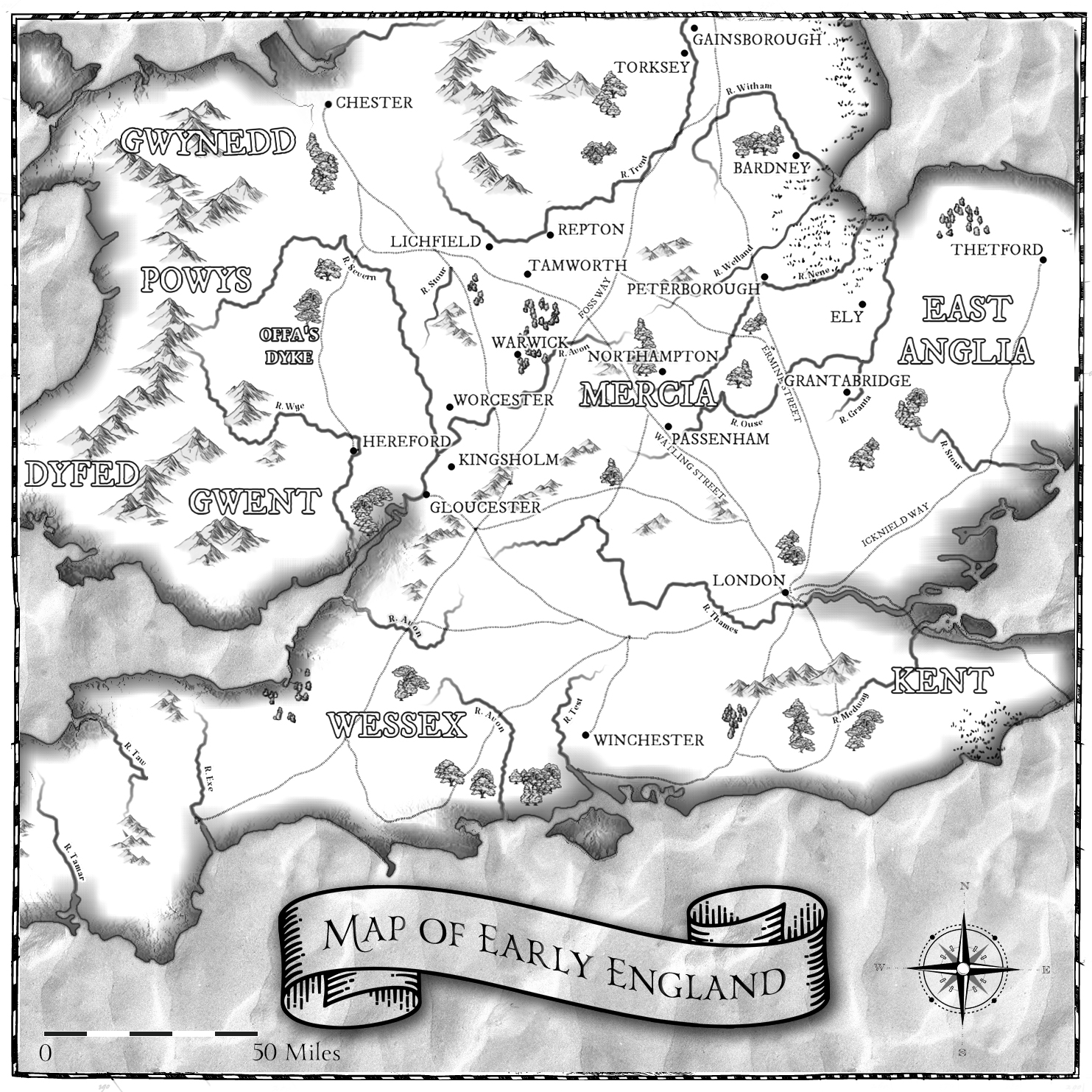
And Mercia is certainly a rich tapestry to either foist a previously unknown tribe upon, or to ‘borrow’ one for the intention of making more of someone. Mercia, ‘the kingdom on the border’ (although we don’t for sure which border this applies to), consisted of many smaller tribal areas, the names of which, if not often the location, have survived in the Tribal Hidage, an eighth-century source (which doesn’t mention the Gaini). More familiar names to travellers to the era are the Hwicce (around Gloucester), the Magonsæte (close to the Welsh border), the Tomsæte (close to Tamworth), to name but a few, have survived in charter documentation which names these distinctive areas and we often have ealdormen of these places, most famously my first historical recreation, Ealdorman Leofwine of the Hwicce of the Earls of Mercia Series.
And so, in The Last Deceit, it is Ealhswith brother, Lord Æthelwulf, who makes mention of the Gaini, as no doubt, he too would have made much of this alleged royal connection.
Discover more from MJ Porter
Subscribe to get the latest posts sent to your email.

 MJ Porter