

I always think that the characters of Saxon England are a little too ethereal for people to really connect with. I think it’s difficult to visualise life before the Norman Conquest, but it doesn’t mean we shouldn’t try.
My current obsession, and victim of my historical fiction endeavours is Leofwine, Ealdorman of the Hwicce during the reign of Æthelred II, who I refuse to call ‘Unready’ because I just don’t think he was. I think, he was a victim of his times, treated harshly by later historians.
My research is going deeper, examining the evidence of the charter attestations that Leofwine made (where he signs, and therefore, it must be assumes, agrees to whatever the charter is concerned with). Charters from before the Norman Conquest are rare, and have only survived in copies because they benefitted someone in some way, normally the monastery or Church that the copy of the original charter has survived in, or a later lay landowner keen to keep hold of the land.
This effectively means that in determining the validity of the charter, historians need to know about what was happening in the world at large, when the COPY of the charter was made. Effectively, to study Saxon history, you have to also study early Anglo-Norman history to work out just what’s going on and why the charter is so important.
In the records of Sherborne, Leofwine’s name can be found attesting two charters. No original copies of the charters survive, and the record as we have it, is in a twelfth century hand. So, should it be trusted? Should it be used as an historical source? Or as with so much history, can it really only be used as a historical record of the time period that produced it? After all, at least a hundred years and probably more like 150 years, separate the copy of the charter and the date of its alleged drafting and attestation.
It’s an interesting dilemma and one I don’t plan on solving today. Would I use it? Yes, I’d but I’d be standing on the shoulders of those giants of academic history who have studied far more charters than me and who’ve decided that the copies are ‘probably’ genuine as they stand. I’d also be wary of this, and all it might mean.
And how relevant are they to Ealdorman Leofwine? I think very, because they appear to show his standing at the royal court. In charter S933 (1015) he signs as the third ‘dux’ (ealdorman) and in S910 from 1005 he also signs as the third ‘dux’. So what does it all mean? Well, as with everything the picture is wider than just Sherborne. In total Leofwine attests 41 charters whilst an ealdorman. So although I think it’s important to examine the validity of the cartularies that the charters survive in, it’s a bit of a painstaking and picky business. But one I’m enjoying. For anyone really keen to look at Leofwine’s charters in more detail, you can start by having a look at the Electronic Sawyer. And you can see an image of S910 it on The British Library Digitised Manuscripts Website ff. 27v-29r and S933 also on The British Library Digitised Manuscripts Website at ff. 4v-6r. The handwriting is amazing.
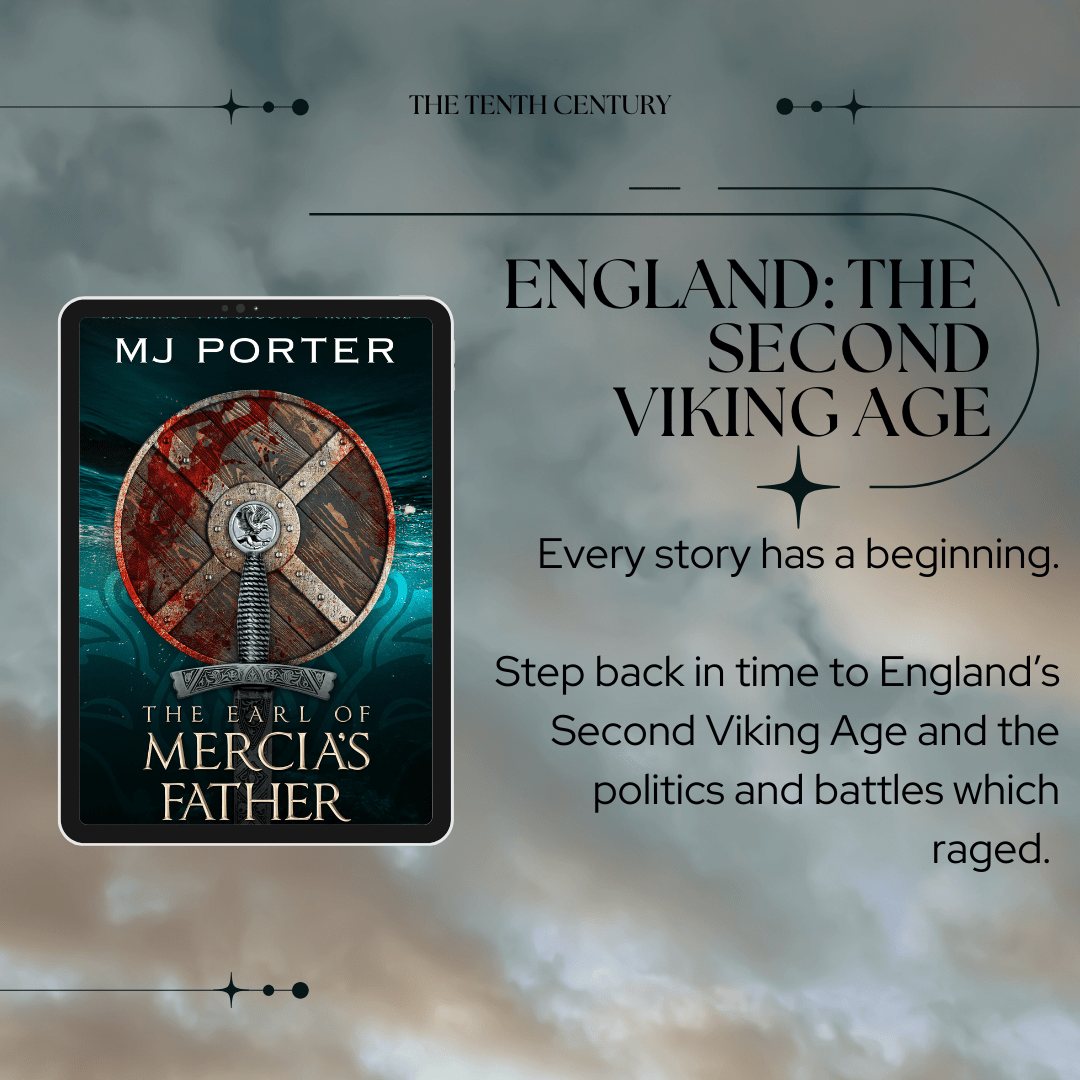
Check out The Earls of Mercia Series Page for more information.
Posts















Discover more from MJ Porter
Subscribe to get the latest posts sent to your email.

 MJ Porter
MJ Porter, I am William Flink. I have been researching the history of Leofwine’s family for several years, not just him, but also his family, both forward and backward. I am under the belief at this time that his lineage extends through my English ancestors. I would be most interested in talking with you about both of our research efforts, if you so choose to contact me. flink_william@yahoo.com ; +1 (208) 204-6664.
I recently purchased The Earl of Mercia’s Father to see what you have written and where I might consider researching to see if there is factual history that I might find to add to my collection of references on Leofwine, etc.
I hope to hear from you in the future.
Respectfully,
William (Bill)
LikeLike
Hi Bill,
Lovely to hear from you. I will send you an email, but I must warn you, I’ve really only researched the family throughout the Saxon era, and not beyond it. Have you managed to find a copy of Baxter’s ‘The Earls of Mercia?’ It is quite academic in nature, but you can pick the family details from it, which is what I did when first writing about Leofwine and his family.
I hope you enjoy The Earl of Mercia’s Father.
Take care
MJ
LikeLike
MJ,
I have not seen The earls of Mercia : lordship and power in late Anglo-Saxon England. I know where I can read it or purchase it. thank you for the tip. I have read other documents that have referenced Baxter, and have used quotes of Baxter’s work in my research, but have not had the opportunity to read his book.
The Leofwine you wrote about would be the second Leofwine (Leofwine II) in my research, and Leofric, his son, appears to be Leofric III if my research proves to be legitimate. I have much more work to do before I know for sure. I have more than one hundred sources that I have read to lead me to where I am right now. I am planning to return to England next Summer to conduct more research and visit many of the sites that I have studied. It will be my third trip to England to research my family’s ancestral past. West Yorkshire is a key focus for my visit, as well as the Midlands.
Maybe, if you are interested, I could share some of my research once I feel it is as accurate as past historians have indicated it might be. I have included material from Domesday, Bede, Florence of Worchester, Roger of Wendover, William Balidon, John Burke, John and Charles Clay, Roger Dodsworth, William Dugdale, and many, many others in my research. I’m working on my rough draft at the present, and it’s not complete at 525 pages. My work is for family purposes, not commercial purposes.
I look forward to communicating with you in the future.
Respectfully,
William
LikeLike