My new book, Clash of Kings, is a multi-viewpoint novel telling the story of events in Britain from 937-942. I thought it would be good to share details of the historical people my main characters are based on.
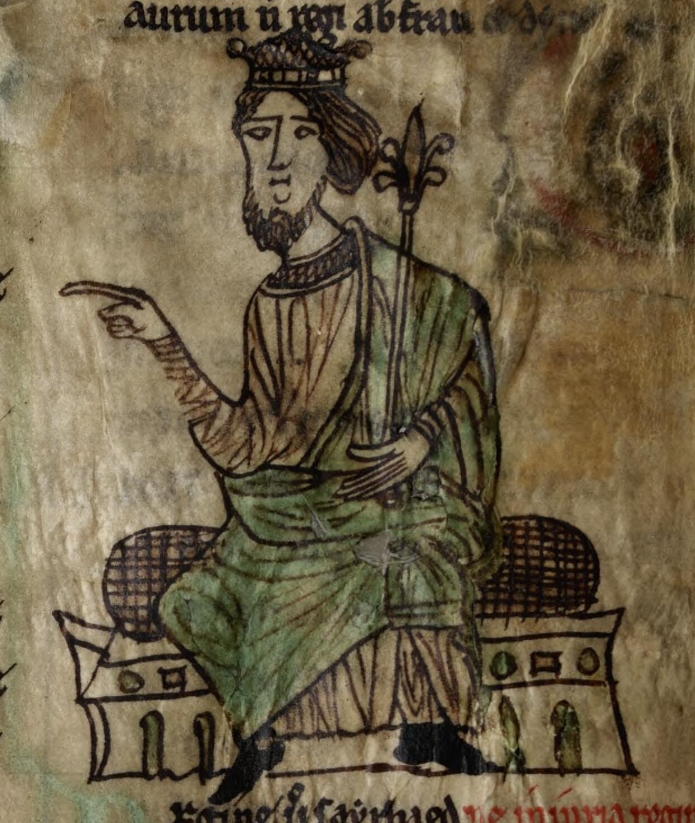
My portrayal of Hywel, better known as Hywel Dda (which autocorrect is determined should say Dad), and which means ‘good’ (a unique epithet in Wales), is of course, fictional, but who was the historical Hywel? Firstly, it should be noted that this epithet is a later invention, not assigned to Hywel until at least the twelfth century, and perhaps, as Dr. Kari Maund has commented in The Welsh Kings: Warriors, Warlords and Princes, a reflection of border events at that period rather than the earlier tenth century. (Dr Maund was one of my university lecturers, so she knows her stuff).
Hywel has no date of birth recorded, and indeed, like Constantin of the Scots, he seems to have ruled for a long time providing much-needed consistency. Hywel ap Cadell was the grandson of the famous Rhodri Mawr, who’d united the kingdoms of the Welsh during his rule. But, this unity fragmented on Rhodri’s death.
To begin with, Hywel ruled Dehuebarth, probably with his brother, Clydog, (who may have been the younger brother) after the death of their father in c.911. He, his brother, and his cousin, Idwal of Gwynedd, submitted to the English king, Edward the Elder in the late 910s.
‘and the kings of Wales: Hywel and Clydog and Idwal and all the race of the Welsh, sought him as their lord [Edward]’. ASC A 922 corrected to 918 (Swanton, M. trans and edit The Anglo-Saxon Chronicles, (Orion Publishing Group, 2000)p.103-4)
Not long after, Clydog died, leaving Hywel as ruler of Dehuebarth. Hywel had also married Elen, the daughter of Llywarch and niece of Rhydderch, the last king of Dyfed, and he was able to use this alliance to eventually claim Dyfed as well.
Hywel’s believed to have been highly educated, and some historians suggest he was particularly fascinated with King Alfred, and all he’d achieved and was therefore keen to emulate many of his actions. This could also be why his name came to be associated with the codification of laws in later traditions. What fascinates me most about Hywel is his decision to ally closely with King Athelstan. Certainly, he’s a intriguing figure in early tenth-century Britain, and not just because we know he made a pilgrimage to Rome in 928, and still managed to return back to his kingdom and continue ruling it.
Hywel seems to have distanced himself from events which led to the battle of Brunanburh in 937, but in my portrayal of him, he still classifies himself as very much Athelstan’s ally. Events in Clash of Kings might well test that allegiance.
Today sees the release of Clash of Kings, the third book in the Brunanburh series. But who was Athelstan, king of the English?
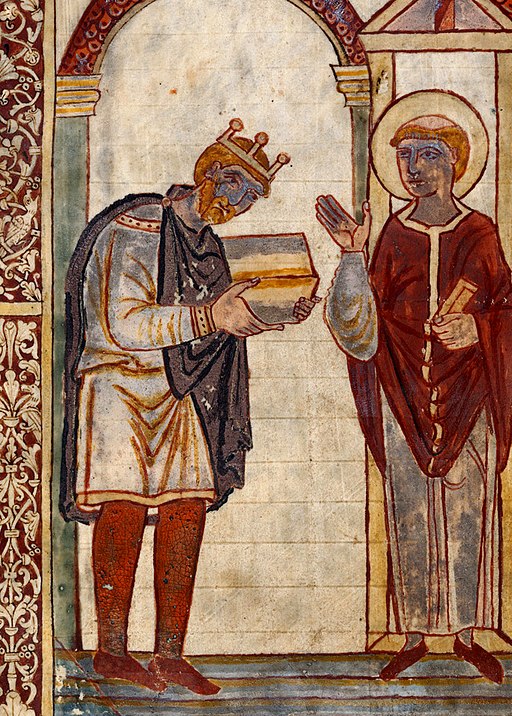
Based on a historical person, my portrayal of him, is of course, fictitious, but there are many historical details known about him. However, we don’t know for sure who his mother was, it’s believed she might have been called Ecgwynn, and we don’t know, for certain, the name of his sister, but it’s believed she might have been named Edith. What is known is that his father was Edward, the son of King Alfred, and known to us today as Edward the Elder. Athelstan is also rare in that he is one of only two Saxon kings for who a contemporary image is available. (The other is Edgar, who would have been his nephew)
It must be supposed that Athelstan was born sometime in the late 890s. And according to a later source, that written by William of Malmesbury in the 1100s (so over two hundred years later), Athelstan was raised at the court of his aunt, Æthelflæd of Mercia. The historian, David Dumville, has questioned the truth of this, but to many, this has simply become accepted as fact.
‘he [Alfred] arranged for the boy’s education at the court of his daughter, Æthelflæd and Æthelred his son in law, where he was brought up with great care by his aunt and the eminent ealdorman for the throne that seemed to await him.’[i]
[i] Mynors, R.A.B. ed and trans, completed by Thomson, R.M. and Winterbottom, M. Gesta Regvm Anglorvm, The History of the English Kings, William of Malmesbury, (Clarendon Press, 1998), p.211 Book II.133
Why then might this have happened? Edward became king on the death of his father, Alfred, and either remarried at that time, or just before. Edward’s second wife (if indeed, he was actually married to Athelstan’s mother, which again, some doubt), Lady Ælfflæd is believed to have been the daughter of an ealdorman and produced a hefty number of children for Edward. Perhaps then, Athelstan and his unnamed sister, were an unwelcome reminder of the king’s first wife, or perhaps, as has been suggested, Alfred intended for Athelstan to succeed in Mercia after the death of Æthelflæd, and her husband, Æthelred, for that union produced one child, a daughter named Ælfwynn.
There is an acknowledged dearth of information surrounding King Edward the Elder’s rule of Wessex. He’s acknowledged as the king of the Anglo-Saxons. His father had been the king of Wessex. Historians normally use the surviving charters to unpick the political machinations of the Saxon kings, but for Edward, there’s a twenty year gap between the beginning and end of his reign, where almost no known genuine charters have survived. What isn’t known for sure, is how much control, if any, he had in Mercia. Was Mercia subservient to Wessex or was it ruled independently? It’s impossible to tell. And this makes it difficult to determine what Athelstan might have been doing, and also what his father’s intentions were towards him.
Frontispiece of Bede’s Life of St Cuthbert, showing King Æthelstan (924–39) presenting a copy of the book to the saint himself. 29.2 x 20cm (11 1/2 x 7 7/8″). Originally from MS 183, f.1v at Corpus Christi College, Cambridge. (Wikimedia Commons)
What is known is that following the death of King Edward in 924, Athelstan was acknowledged as the king of Mercia; his half-brother, Ælfweard was proclaimed king in Wessex. As with all events at this time, it shouldn’t be assumed that just because this is what happened, this is what was always intended.
‘Here King Edward died at Farndon in Mercia; and very soon, 16 days after, his son Ælfweard died at Oxford; and their bodies lie at Winchester. And Athelstan was chosen as king by the Mercians and consecrated at Kingston.’[i]
[i] Swanton, M. trans and edit The Anglo-Saxon Chronicles, (Orion Publishing Group, 2000), D text p.105
But, if Athelstan was raised in Mercia, it’s highly likely he was a warrior from a young age, helping the Mercians defeat the Viking raiders who still had control of the Danish Five Boroughs of Lincoln, Nottingham, Derby, Nottingham and Leicester.
Throughout King of Kings and Kings of War, my character, Athelstan, has proven himself to be amendable to peace as well as prepared to fight for his kingdom. He’s had to contend with some very unruly family members (it’s no wonder he never married), and also some aggressive neighbours. It’s perhaps his relationship with his brother, Edmund, and Hywel, king of the Welsh, that has revealed Athelstan as the man he might like to be remembered, but it is his victory at Brunanburh, against the Norse and the Scots, which he now has to contend with. Has Athelstan finally freed the English from the Viking raider/Norse menace?
Confusingly, Athelstan the Ealdorman shares the same name as King Athelstan of the English, a fact I allow the pair to find amusing because of the uncertainty it causes.
Athelstan is the son of an ealdorman, and one of four brothers, although one has already died . Athelstan, Eadric and Æthelwald are held in high regard by King Athelstan and all become ealdormen.
In my version of events, Athelstan is married to Lady Ælfwynn, the cousin of King Athelstan and daughter of Æthelflæd, the lady of Mercia, a suggestion that isn’t widely accepted, but is certainly a possibility, thus making him a member of King Athelstan’s extended family. His epithet, the Half-King could have arisen because he was indeed married to the king’s cousin (under Athelstan, Edmund and Eadred).
Even if Athelstan Half King wasn’t married to the daughter of Lady Æthelflæd of Mercia, it seems he was married to an Ælfwynn. He was a powerful man, building a dynasty, and also part of a powerful dynasty. Between him and his brothers, they must often have been found at the court of the king in the tenth-century. Athelstan was the ealdorman of East Anglia, his older brother, Ælfstan, one of the ealdormen of Mercia (930-934) before his death, while Eadric was an ealdorman of Wessex (942-949), and Æthelwald was an ealdorman of Kent (940-946).
Athelstan the ealdorman seemed an obvious choice for me to develop as a character in the series. He’s closely bound to the ruling family, married into it, and he’s also a warrior who fought at the battle of Brunanburh. His influence continues to grow in Clash of Kings. His relationships with his brothers was also fun to explore. Powerful men, with warriors at their command, and fiercely invested in the future of the English kingdom.
With Clash of Kings being released on 13th January 2024, I thought I’d reintroduce my readers to the main characters.
Here’s Edmund, ætheling and Prince of the English.
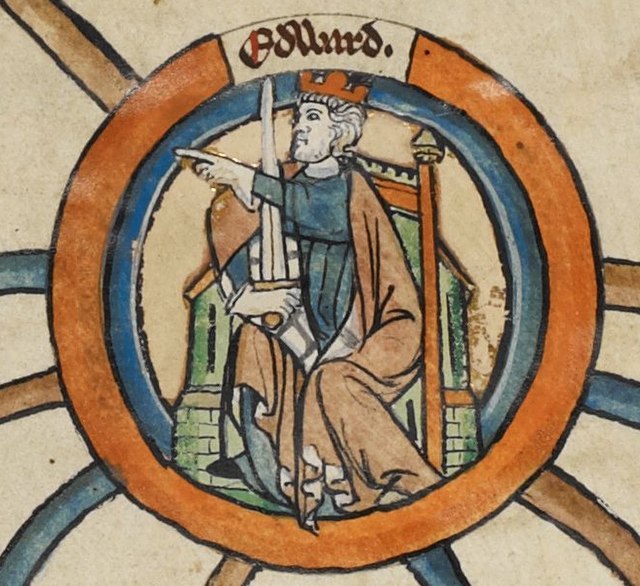
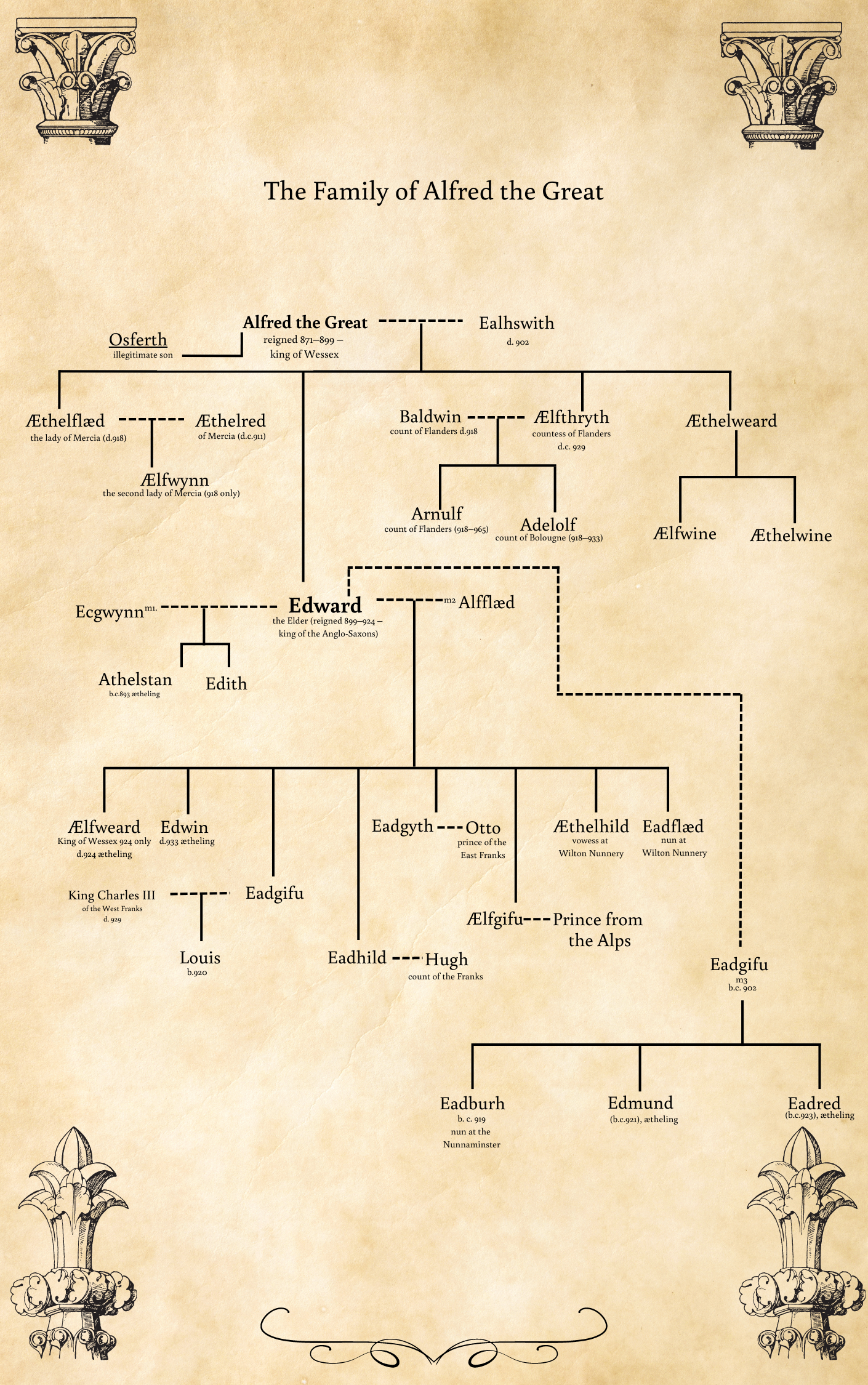
Edmund, of the House of Wessex, is the second-youngest halfbrother of the king of the English, Athelstan. His date of birth is not known for sure, but it’s believed to have been in about 921, as he’s said to have been 18 when he became king on Athelstan’s death. His mother is Lady Eadgifu, the third wife of Edward the Elder. He has a full brother, Eadred, even younger than him, and a sister who may have been older than him, and who became a cloistered woman.
Family tree by Boldwood Books
‘And the Ætheling succeeded to the kingdom; and he was then 18 years old.’ (ASC A)
Edmund would only have been very young when his father, Edward the Elder, died in 924. It’s doubtful whether he had any memory of him at all. It’s long been believed that his mother, Lady Eadgifu, was responsible for raising him and his younger brother. What precisely Edmund was doing during the reign of his older half-brother isn’t known for sure. He is said to have fought beside him at the Battle of Brunanburh, but some historians cast doubt on this.
As a character in Kings of War and Clash of Kings, Edmund has become a man throughout the previous books, and developed a close relationship with Athelstan. But, he’s still young. He’s riven with indecision, and while delighted to have been involved in the success of the battle of Brunanburh, he’s happy to let his older brother rule England. There is also an on-going thread which pitches Edmund against the family of Constantin, the king of the Scots. Events in Clash of Kings will have a profound effect on young Edmund.
Clash of Kings is released on 13th January, so time for a little refresh on who the many characters are.
First up, Olaf Gothfrithson, our friendly Norse Viking ruler. I know he’s someone that many readers really enjoy reading about.
Olaf Gothfrithson, is the son of Gothfrith, who King Athelstan of the English, beat to the kingdom of York or Jorvik in King of Kings in about 927.
Olaf, was perhaps a grandson or great-grandson of Ivarr the Boneless (it’s difficult to piece together the family connections, and indeed, in an initial draft I named Olaf’s brothers entirely incorrectly). Ivarr was the famous Viking raider who led part of the Great Heathen Army in the 860s before meeting his death in 870 or 873, depending on which contemporary source you read.
Olaf claimed Dublin following the death of his father , although not without some fighting. In Ireland, he had many enemies, including Olaf Cenncairech (Scabbyhead) of Limerick and Donnchad of the Southern Ui Neill.
Olaf is known to have been one of four brothers. Halfdan, who died in 926, according to the Irish Annals, Blakari and Rognvaldr being the other two, who both play a role in future events.
Affairs in Ireland at this time were complex. Dublin was largely a Norse enclave, involved in almost constant warfare with the Irish clans. Claire Downham has written extensively on this period. ‘The rivalry between Limerick and Dublin marks an important chapter in the history of vikings in Ireland. The number of viking campaigns recorded in these years rivals any other period of Irish history. The influence of the vikings is reflected in the range of their campaigns across the island and in the involvement of Irish overkings in their wars.’ (Viking Kings of Britain and Ireland: The Dynasty of Ivarr to A.D. 1014, C. Downham, p. 41)
Affairs in Ireland fall far outside my expertise, but I hope I’ve correctly portrayed what events are known from this period and which concern Olaf Gothfrithson (you’ll find his name also written as Óláfr Gu∂rø∂sson and Amlaib), Olaf Cenncairech – Scabbyhead (a wonderful name for the man – again my thanks to C. Downham for including this in her work) – and Olaf’s brothers and sons.
In Kings of War, Olaf is staunchly determined to claim back ‘his’ lost kingdom of Jorvik. I can’t say things went according to plan at Brunanburh, and our first encounter with Olaf in Clash of Kings is of a man beaten and bruised. Will he exact his revenge against Athelstan and Edmund?
My portrayal of Constantin, the king of the Scots, is of course fictional in the Brunanburh series, but he is based on a historical individual, Constantin (e) II, so who exactly was he?
Constantin is a fascinating character. Again, and as with Athelstan, his exact date of birth is unknown, but it must have been, at the latest, by 877/8, when his short-reigned father died.
By 900, Constantin was the king of the Scots (we think – there is some confusion about this). This wasn’t yet quite Scotland, but it was getting there. The ancient kingdoms of Cait, Fortriu, Atholl and Dal Riata, were ruled by one king, Constantin. But, he hadn’t succeeded his father, Aed, but rather a man named Domnall II, his cousin. At this time there were two rival dynasties and they strictly alternated the kingship.
Affairs in the kingdom of the Scots often intermingled with those of the independent kingdom of Bamburgh, Strathclyde, and of course, the Norse, or Viking raiders, if you will. Indeed, the entry recording Constantin’s death in the Annals of Ulster, reads as though there was often strife.
‘Constantinus son of Ed held the kingdom for xl years in whose third year the Northmen plundered Dunkeld and all Albania. In the following year the Northmen were slain in Strath Erenn…And the battle of Tinemore happened in his xviii year between Constantin and Ragnall and the Scotti had the victory. And the battle of Dun Brunde in his xxxiiii year.’ (Alex Woolf, From Pictland to Scotland, 789-1070,p.126)
Constantin, ruling for decades, and I mean decades, seems to have brought much needed stability to the kingdom, as affairs there very much mirrored the emerging ‘England’ to the south.
‘Constantin’s reign has increasingly come to be see as one of the most significant in the history of Scotland. Not only was it very long, at least forty years, but it was also the period during which conflict and diplomatic relations between a kingdom recognisably ancestral to Scotland and one recognisably ancestral to England first occurred.’ (Alex Woolf, From Pictland to Scotland, 789-1070, p.128)
Constantin allied with the rulers of Bamburgh, and York, and also, on occasion, both Æthelflæd of Mercia and Edward the Elder, after her death. But, he seems to have been quite flexible in his thinking, and was prepared to pick and choice as he saw fit.
By the beginning of Clash of Kings, Constantin would have been in his mid-sixties. He was certainly a more than adequate counterpart to Athelstan, king of the English, no doubt helped by his sons and grandsons, as his reign continued, but his participation at the battle of Brunanburh, and its subsequent failure, might well have severely undermined him.
With a successor, Mael Column, desperate to succeed him, and his son, Ildulb, just as keen to succeed Mael, it seems that Constantin is about to enter one of the most turbulent periods of his kingship.
Read Clash of Kings to discover what happens in the kingdom of the Scots.
I’ve just read my 2022 Writing Year in Review post, (you can read it here) and can assure you, I didn’t manage to stick to my carefully thought out first half of the year. Indeed, the only aspect I seem to have stuck is taking it a bit easier in December. I’ve not left myself with a huge looming deadline, although I haven’t accomplished all I might like to have done. But then, I often have unrealistic expectations of myself.
So, what have I been writing/editing in 2023? It’s time to turn to my trusty diary to find out.
In January, I submitted The Royal Women Who Made England: The Tenth Century in Saxon England a few days late – I didn’t correctly calculate how long the editing process would take. I was also working on book 2 of the Brunanburh series – this was a massive rewrite, adding 50% more content to the original version, and I was reediting A Conspiracy of Kings, ready for its book birthday in February. On a side note – it also seems that I undertook some much needed TLC on my iMac, which I’ve written down as ‘taking all afternoon.’ I think it might have slightly annoyed me, but the beast has been working much better ever since. But yes, I didn’t understand what I was doing in replacing the SSD hard drive but I’m glad I did. I also took a trip to Gloucester and I know I spent the entire train journey there, and back, editing Kings of War! (The things you remember). I have decided that if I ever struggle with a deadline, I’m just going to hop on a long train journey. It’s the ultimate means of isolating yourself.
In February, I was writing Protector of Mercia – which wasn’t my working title, and so has confused me as I put this together, and also editing Eagle of Mercia, not once but twice (copyedit and proofread), while King of Kings was released on 10th February.
For March, I set myself four pretty huge tasks – I’ve written them down on 1st March. But how did I get on? I finished the proofread for Eagle of Mercia. I worked on the structural edit for Kings of War, AND I was reediting Warrior King ready to have it made into an audio book, narrated by the trusty and fabulous Matt Coles.
While working on Clash of Kings, I discovered, much to my annoyance that Limerick in Ireland was not at all where I ‘thought’ it was, and so had to do a large rewrite. My geography is woeful. I should have taken the time to check before I started writing the scene. I was also editing Protector of Mercia, which I sent to my editor on 31st March. I also went to work for a week in the school AND we moved house. Jeez. What a month. It seems that my fourth project didn’t even get a look in (I’m not surprised). Let’s see what happened in April.
April began with a scramble for my internet connection, having moved house. I was due to present for The History Quill on 4th April. Luckily, the internet worked after a few stupid mistakes on my part. I finally made it back to my missed project 4 in March, which was The King’s Brother, which I edited and continued to write. I also wrote a short story. And, I was working on some form of edits for Protector of Mercia and Kings of War. All the frantic activity of the last few months paved the way for my Summer holiday in Orkney – the temperature peaked on the last day in the middle of May at 13 degrees, and I came home with a burned bright red face. The light is just different in Orkney. It was a glorious two weeks away, very much in isolation on one of the more northerly islands. We fell foul of the ferry running aground, but we managed to book an alternative route home.
May 3rd saw the release of Eagle of Mercia, and I came back to two weeks of very long hours during the summer exam period at my local school. I spent my weekends working on structural edits for Protector of Mercia, and even managed to sneak in a trip to London for the Boldwood Books summer party. I spent the last week in May frantically editing The King’s Brother, which I should have done months before. I didn’t get much writing done in these two months, and I knew I wouldn’t, that’s why March had been such a mad month.
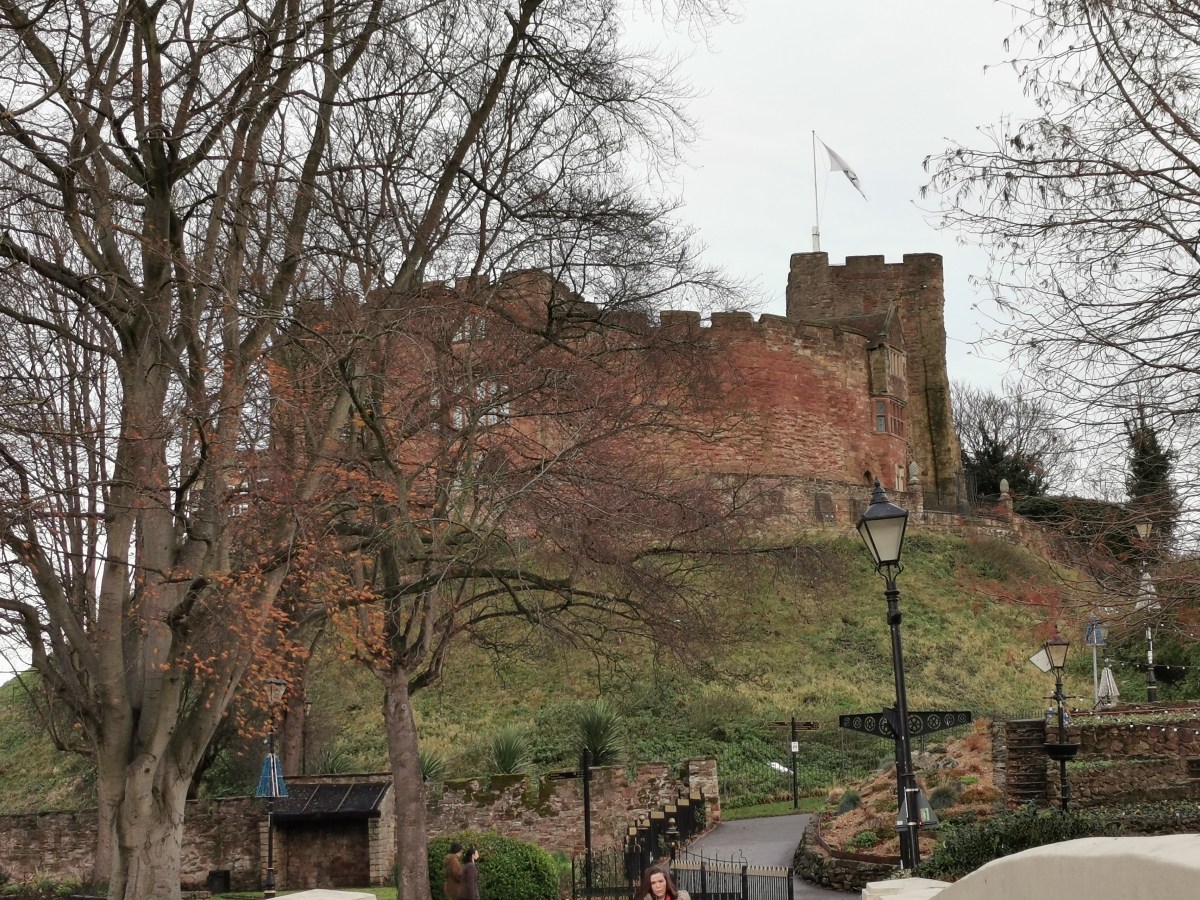
June was another busy month, but not in terms of writing. I participated in Æthelfest at Tamworth and by the end of the month I had (and I’ve not written this down) worked on some edits for Clash of Kings. It also saw the release of The King’s Brother. It had been very hard to return to the world of the Earls of Mercia, but with the help of Lady Godgifu, a character I developed substantially for the book, I felt it worked really well.
July 12th saw the release of Kings of War and I was once more embroiled in editing, both Protector of Mercia and my non-fiction title, as well as the structural edit from hell for Clash of Kings because of a problem when I’d converted it in Vellum, managing to muddle all the chapters. August saw me beginning work on Icel book 6, now Enemies of Mercia, and I really tried to concentrate on the title as I felt I’d done little ‘new’ writing for quite some time.
September saw the release of Protector of Mercia, and I held my first Zoom with readers to celebrate the release. It went really well. I was copyediting Clash of Kings, and also working on the first proof for The Royal Women of the Tenth Century, and producing the index for it. When that was done, I got back to Enemies of Mercia which was nearly finished, but not quite. The index stretched to 13 pages. It was a huge task. Next time I write a non-fiction title, I might miss out everyone’s names.
October saw Enemies of Mercia sent to my editor, and some more work which took me away from my desk. But, never fear readers, November was just around the corner, and that meant it was time for National Novel Writing Month, and a very, very welcome return to the world of Coelwulf from The Last King, but not before the final proofread for Clash of Kings.
In November I wrote, wrote, wrote. Not as much as in the past, but I was determined to get back to a good daily habit, and so I didn’t push myself until I had time to write 5k a day, which wasn’t until later in the month, as I had a structural edit for Enemies of Mercia to work on. And the second proof for The Royal Women also arrived in my inbox.
For December, remember above I said I had to be kinder to myself, I’ve given myself the time to finish writing The Last Viking, the new Coelwulf book, as well as writing a short story on my way home from London, and I’ve also got a final proof for The Royal Women Who Made England to look at. On the whole, a much quieter December to that of 2022, and far more enjoyable. It’s hoped this will recharge my batteries for what I hope will be a busy 2024, with another Coelwulf, Icel, Earls of Mercia and something new in the pipeline.
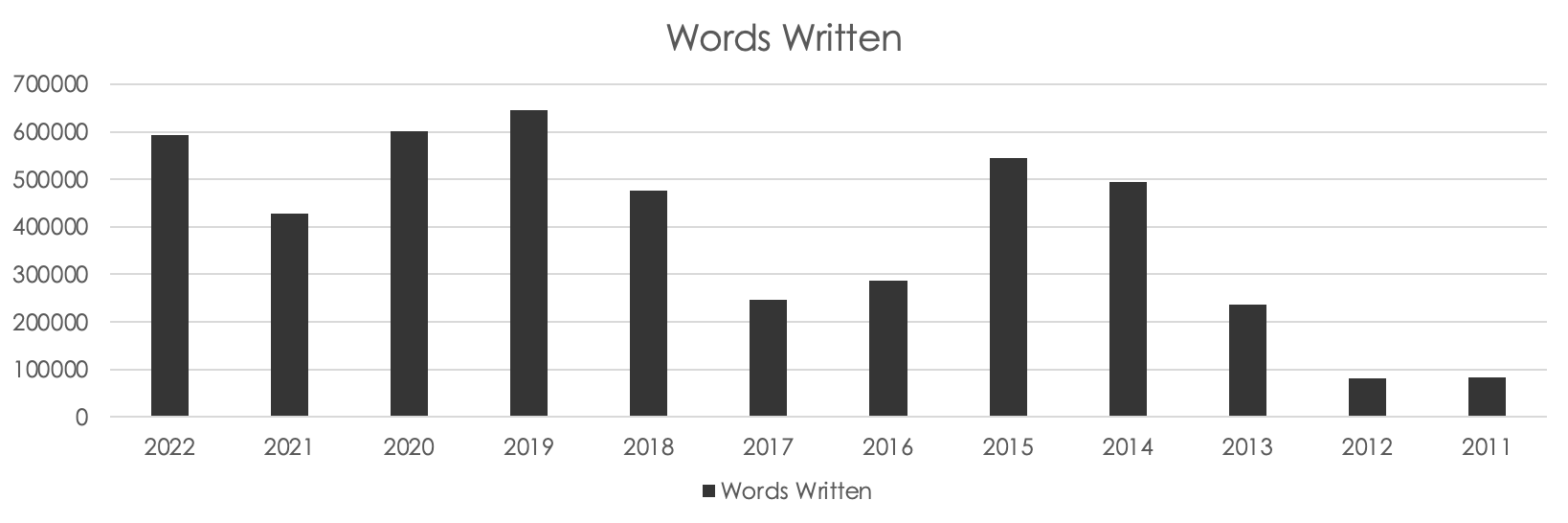
In terms of words written this year, a very rough tally sets it at about 340k, which is one of my lowest since 2017 – see my little chart below. (I can’t correctly determine all of the words written – I sometimes wish Word tracked how many words I deleted as well as how many I added). This might also be because some of my record keeping has been poor. My most prolific day was March 28th when I wrote 7000 words.
For 2024, I’m determined to work on my planning – not always easy with structural, copyedits and proofreads coming at me from all angles, but I am going to try and ensure I have more periods of time when I can write in a sustained way. I only managed this for three months in 2023. My style of writing means that I have to write quickly, or, quite frankly, I lose the thread of the story. I am, after all, a pantser, not a planner, and my characters very much lead the story. Sometimes, I need to give them a bit of time to decide what it is they intend to do.
Forthcoming releases with be Clash of Kings, The Royal Women Who Made England, The Last Viking and Enemies of Mercia. There will also be the fourth part of The Brunanburh Series later in the year. I had thought 2024 would be a quieter year, but clearly not.
If you want to follow my writing journey, join my newsletter. I update readers each month, and you can also join my Facebook group.
I will be sharing my reading year in review soon – there’s a lot of historical mystery in there:)
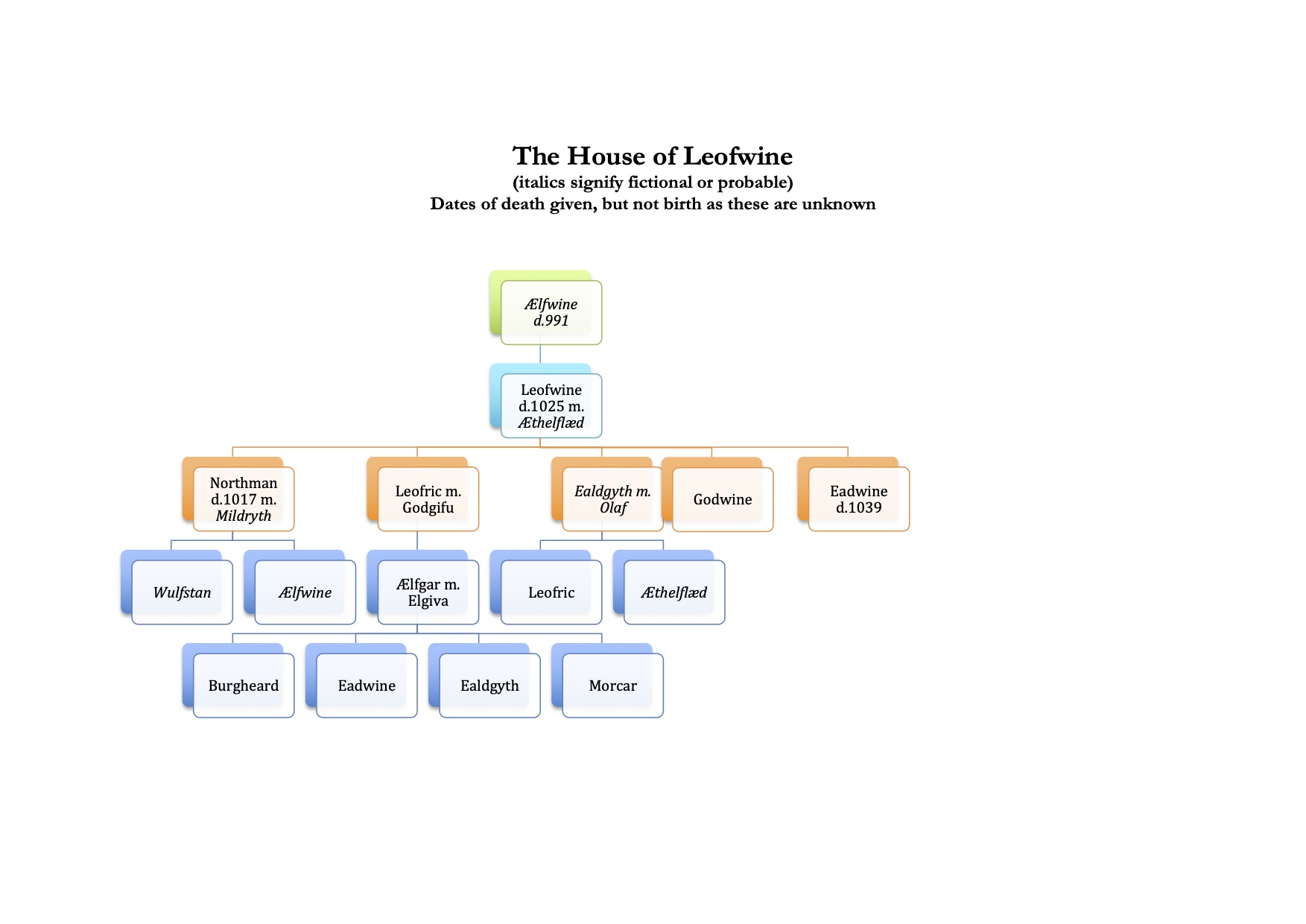
I’m sharing a post about the family of Ealdorman Leofwine, Saxon England and the position of ealdormen/earls #non-fiction #fiction #histfic
Who was Ealdorman Leofwine?
Ealdorman Leofwine , was the ealdorman of the Hwicce (c.994-1023), one of the ancient tribal regions in Mercia, which was a part of England, at the time the story begins. It is possible he may have been related to Ælfwine, who is named, and dies at the Battle of Maldon (more below).
Ealdorman Leofwine and his descendants, who would hold positions of power until the Norman Conquest of 1066, are a unique family in this tumultuous period. No other family, apart from the ruling family of Wessex (and even then there was a minor hiccup caused by those pesky Danish kings) held a position of such power and influence and for such a long period of time, as far as is currently known. The position of ealdorman was not hereditary. It was a position in the gift of the king, and Saxon kings ruled with a varying number of ealdormen. To understand Leofwine’s significance, it’s important to understand this. Unlike an earl – a term we are all perhaps far more familiar with – but specifically a medieval earl in this regard – that position was both more often than not hereditary AND meant that the person involved ‘owned’ significant properties in the area they were earls over. This is not how the ealdormanic system worked in Saxon England, as it’s currently understood.
It is difficult to track many of the ealdormanic families of this period, and the previous century, but there are a few notable individuals, all who bucked the usual trend, which no doubt accounts for why we know who they are.
Perhaps most well-known is Ealdorman Athelstan Half-King, who was the ealdorman of East Anglia from about 934 to 955/6 when he fell from favour at court during the reign of King Eadwig and retired to Glastonbury Abbey. Before he did so, he ensured that his son, Æthelwald, was elevated to the position of ealdorman in his place. This was most unusual, but then, he came from a powerful family, fiercely loyal to the ruling House of Wessex, if not actually a member of them. Athelstan Half-King is believed to have been the son of Ealdorman Æthelfrith, a Mercian ealdorman when Lady Æthelflæd was the Lady of Mercia. Athelstan was one of four brothers. His older brother seems to have either briefly retained the ealdordom after their father’s death in Mercia, or been accorded it a few years later, but when he died, Athelstan Half-King didn’t become ealdorman of Mercia in his place. No, he remained in East Anglia while his two brothers, Eahric and Æthelwald, held ealdordoms in Wessex (Eahric) and Kent (Æthelwald). They didn’t become the ealdorman of Mercia either. The ealdordom passed to a different individual.
When Ealdorman Æthelwald of the East Angles died a few short years later (Athelstan Half-King’s son), his place was taken by Ealdorman Æthelwine, the youngest of Athelstan Half-King’s children. But, the family failed to hold on to the position, despite Ealdorman Æthelwine being married three times, and fathering three sons, one of whom died at the battle of Assandun in 1016. The next to hold the ealdordom of the East Angles after the death of Æthelwine was Leofsige, who was the ealdorman until he fell foul of the king in 1002. In the early 1000s Ulfcytel emerges and may have been married to one of the king’s daughters, but is never officially accorded the title of ealdorman. You can read about Ealdorman Athelstan Half-King in The Brunanburh Series.
Another famous ealdorman was Byrhtnoth of Essex, who died at the Battle of Maldon in 991. But Byrhtnoth was not the son of the previous ealdorman, and indeed, he married the daughter of a very wealthy man and in turn was raised to an ealdordom in Essex at exactly the same time that Ealdorman Athelstan Half-King was being forced to retire from his position in East Anglia. (Byrhtnoth’s wife’s sister had briefly been married to King Edmund (939-946, before his murder). While there are some arguments that Byrhtnoth was from a well regarded family, his appointment was not because of an hereditary claim. It’s known that he was father to a daughter, but not to a son. As such his family did not retain the ealdordom on his death. Indeed, it seems as though Essex and the East Anglian earlordoms were united for a time under Leofsige.
The argument has been put forth that the position of ealdorman may have come with properties that were the king’s to gift to the individual to enable them to carry out their duties in a particular area. The Saxons had a number of types of land tenure, bookland, was land of which the ‘owners’ held the ‘book’ or ‘the title deed.’ (There are some wonderful charters where landed people had to ask for the king to reissue a charter as theirs was lost, often in a fire. There is a wonderful example where King Edgar has to reissue a charter for his grandmother, as he’d lost it while it was in his care). Other land tenure was ‘loan land,’ that is land that could be loaned out, often for a set number of ‘lives.’ Ealdormen might then have held bookland that was hereditary, and not in the area they were ealdorman of, and loan land that was in the king’s to gift to them within the area that they were the appointed ealdorman.
Many will be familiar with the family of Earl Godwine and his sons (thanks to the influence of the Danes, the term ealdorman was replaced by earl, which was the anglicised version of jarl). Much work has been done on the land that the Godwine family held when the great Domesday survey was undertaken during the reign of William the Conqueror. It will quickly become apparent that while they had areas where they held a great deal of land, these were not necessarily the areas over which first Godwin and then his sons Tostig, Harold, Gyrth, Leofwine and Sweyn held the position of earl. Most notably, Tostig was earl of Northumbria from 1055-1065, and yet the family had almost no landed possessions there.
And this is where we return to Ealdorman Leofwine and his family. While everyone knows about Earl Godwine and his sons, they didn’t hold their position for as long as Ealdorman Leofwine and his family. Earl Godwine is first named as an earl in charter S951 dated to 1018. By that period, Leofwine of the Twice had already held a position of importance since 994. The families of both men would converge as the events of 1066 drew nearer, and indeed, Godwine’s son, Harold, was married to Ealdorman Leofwine’s great-granddaughter when he was briefly king of England.
When Ealdorman Leofwine died, his son, Leofric, didn’t become ealdorman in his place. Leofric was a sheriff during the period between his father’s death and his own appointment. And indeed, Leofric’s son, Ælfgar was elevated to an earldom before his father’s death, and so was not initially the earl of Mercia. However, on this occasion, and because of a political situation that was rife with intrigue, Ælfgar did become the earl of Mercia after his father’s death, and after Ælfgar’s death, his young son also took the earldom of Mercia. The family survived the events of 1066, but they didn’t retain their hold on the earldom. The House of Leofwine were a family to not only rival that of Earl Godwine’s, as far as it’s known, but they were also the ONLY family to retain a position as an ealdorman/earl for over seventy years. And yet, very few know about them, and indeed, in many non-fiction books, they’re not even mentioned. And that was the perfect opportunity for me to write about the fabulous family, largely inspired by a non-fiction book, The Earls of Mercia: Lordship and Power in Late Anglo-Saxon England by Stephen Baxter.
It’s often forgotten, in the great swirl of events throughout the eleventh century, that England wasn’t conquered once, but instead three times, by King Swein in 1013, by his son in 1016, and then by William the Conqueror in 1066.
England only reclaimed its English king with the death of King Swein shortly after he claimed the kingship, when Æthelred II, the much-maligned, king of England was restored, it’s said, by his nobility, provided he did ‘a better job’ of it (I paraphrase). At this time, Cnut, Swein’s son, wasn’t deemed as suitable to replace his father, while Æthelred II had many sons who could succeed him. Æthelred was deemed ‘an old man’ by now (born probably in about 966-8), but he had surviving sons from his marriage to his first wife, named as Ælfgifu, and also from the better known Lady Emma. The oldest of these sons,Athelstan, died in 1014, having made a name for himself as an honourable man. His will survives. His next youngest brother had also perished a decade ago, meaning Edmund was the oldest surviving son. In the great swirl of events, people forget Edmund was proclaimed king on his father’s death in April 1016, and that he ruled for a good sixth months, before his own death in November.
The relationship between Edmund and his father is difficult to unpick. It doesn’t seem to have been congenial. Æthelred II is most often accused of having overmighty subjects (somewhat ironic when they invited him back to England after Swein’s death), and there was a particular thorny problem of Eadric Streona, married, it’s said, to one of Æthelred’s daughters, and a tricky character. Eadric is associated with Mercia. To counter his reach, Edmund, married into a Mercian family in 1015, the story being that he rescued the woman from captivity and then married her. As romantic as that might sound, this was sound political expediency. In the tenth century, King Athelstan was strongly associated with Mercia, being declared king of Mercia before becoming king of Wessex. Edgar, in the 950s, seems to have done something similar, being declared king of Mercia while his brother, Eadwig, was king of England, or perhaps only Wessex – there is much uncertainty about this. Eadwig would die young, allowing Edgar to build on his Mercian powerbase and claim England for himself.
As such, Edmund was following known precedent when he looked to Mercia for support when he must have feared that the eyes of the witan would favour his younger half-brother, Edward, for the kingship. No doubt, Edmund actually gained support because while England was at war with Cnut throughout 1016, he was a man grown and could fight for the English. Edward, much younger, would have been unable to do so.
And so to 1016. On the death of his father, Edmund was declared king, but Cnut also took the same title. Many battles later, Cnut and Edmund reached an accord, it’s said, after the English defeat at the unallocated battle of Assandun. England was ‘split,’ Edmund became king of Wessex, Cnut held the remainder and it could have possibly remained split if not for Edmund’s untimely death, perhaps from wounds taken in battle fighting against Cnut and his warriors, and in which, Eadric Streona had played his new king false, defecting to King Cnut’s side.
Edmund II, known as Ironside, left two children, perhaps twins, and these children were raised in exile, away from England and the reach of the Danish conquering force. They did still have a part to play in the future of England, and Edmund’s granddaughter became queen of Scotland in 1070, while his grandson was briefly declared king of England in the tumultuous events of 1066.
You can read the story of Cnut and Edmund in The Earls of Mercia series side story, Cnut: The Conqueror.
Here’s the blurb:
To gain what he wanted, what he felt he was owed, he would do anything, even if it meant breaking oaths to a woman he loved and the mother of his son.
Swein, King of Denmark, and briefly England, lies dead, his son ousted from England as King Æthelred returns from his exile in Normandy at the behest of his witan and the bishops. Æthelred might have relinquished his kingdom to Swein, the Danish conqueror, but with Swein dead, the men have no interest in supporting an untried youth whose name resounds with the murder of one of England’s greatest bishops. A youth known only for his savagery and joy of battle. A true Norseman who utilizes his weapons without thought.
But Cnut wants a kingdom and will do anything to gain one. As England’s ravaged by a civil war between the sons of two former kings, Edmund, son of King Æthelred, and Cnut, son of Swein, the men must make personal decisions in the heat of battle as they strive to reclaim their birthrights whilst doing all they can to stay alive.
Cnut is a side story in the Earls of Mercia series, retelling the story of the last century of Saxon England through the eyes of the powerful Earls of Mercia, the only noble family, apart from the House of Wessex, to hold their position for nearly a century.
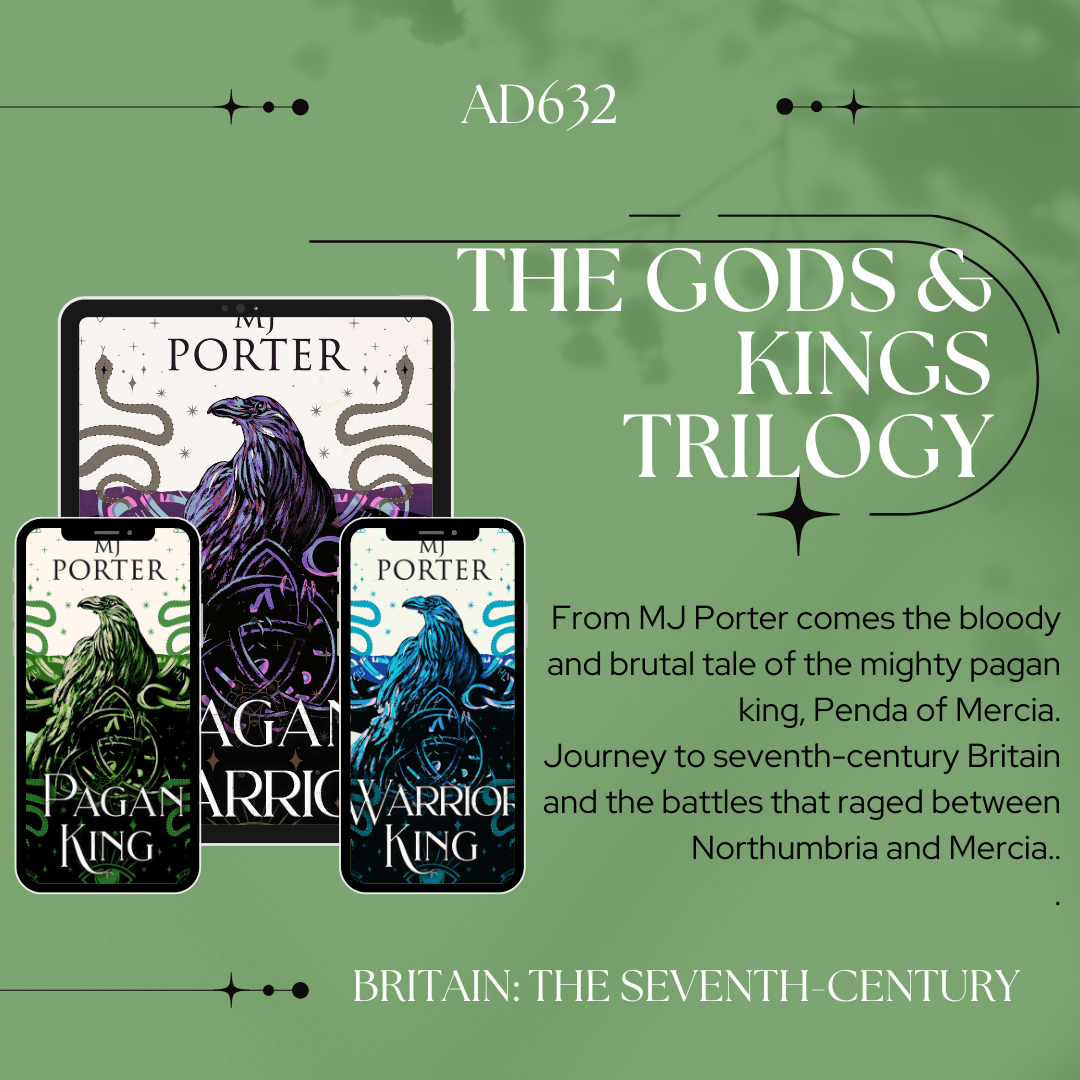
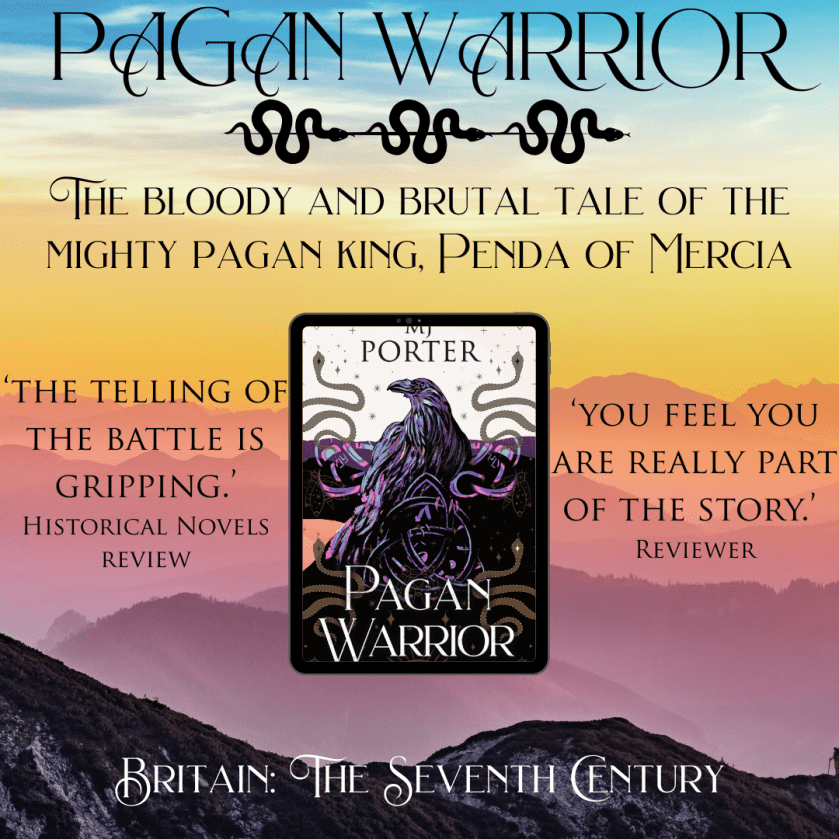
Penda, a warrior of immense renown, has much to prove if he is to rule the Mercian kingdom of his dead father and prevent the neighbouring king of Northumbria from claiming it.
Unexpectedly allying with the British kings, Penda races to battle the alliance of the Northumbrian king, unsure if his brother stands with him or against him as they seek battle glory for themselves, and the right to rule gained through bloody conquest.
There will be a victor and a bloody loser, and a king will rise from the ashes of the great and terrible battle of Hædfeld.
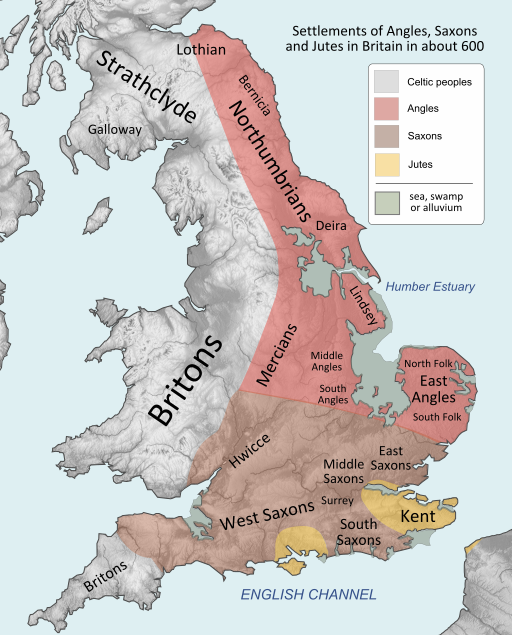
Britain in the Seventh Century – a patchwork of kingdoms
One of the hardest processes when writing about this very early period of Britain is to get an idea of what the kingdoms might have looked like and to explain this to the reader. The seventh century is often seen as the period when the Heptarchy, the seven very well-known kingdoms of the Saxon period, emerged and formed, ultimately derived from potentially very many much smaller kingdoms, the names of which are only rarely still known.
The Heptarchy consisted of the kingdoms of Northumbria (itself derived from the uniting of Deira and Bernicia), Mercia, the kingdom of the East Angles, Wessex, Sussex, Kent, and Essex. In later centuries, these kingdoms would merge until only four main kingdoms remained, and then, from the early middle of the tenth century, England emerged. But the battle of Hædfeld with which Pagan Warrior concludes was a British-wide battle set as this process was formalising in the seventh century, and there are yet more kingdoms that must be mentioned which didn’t form part of Saxon England.
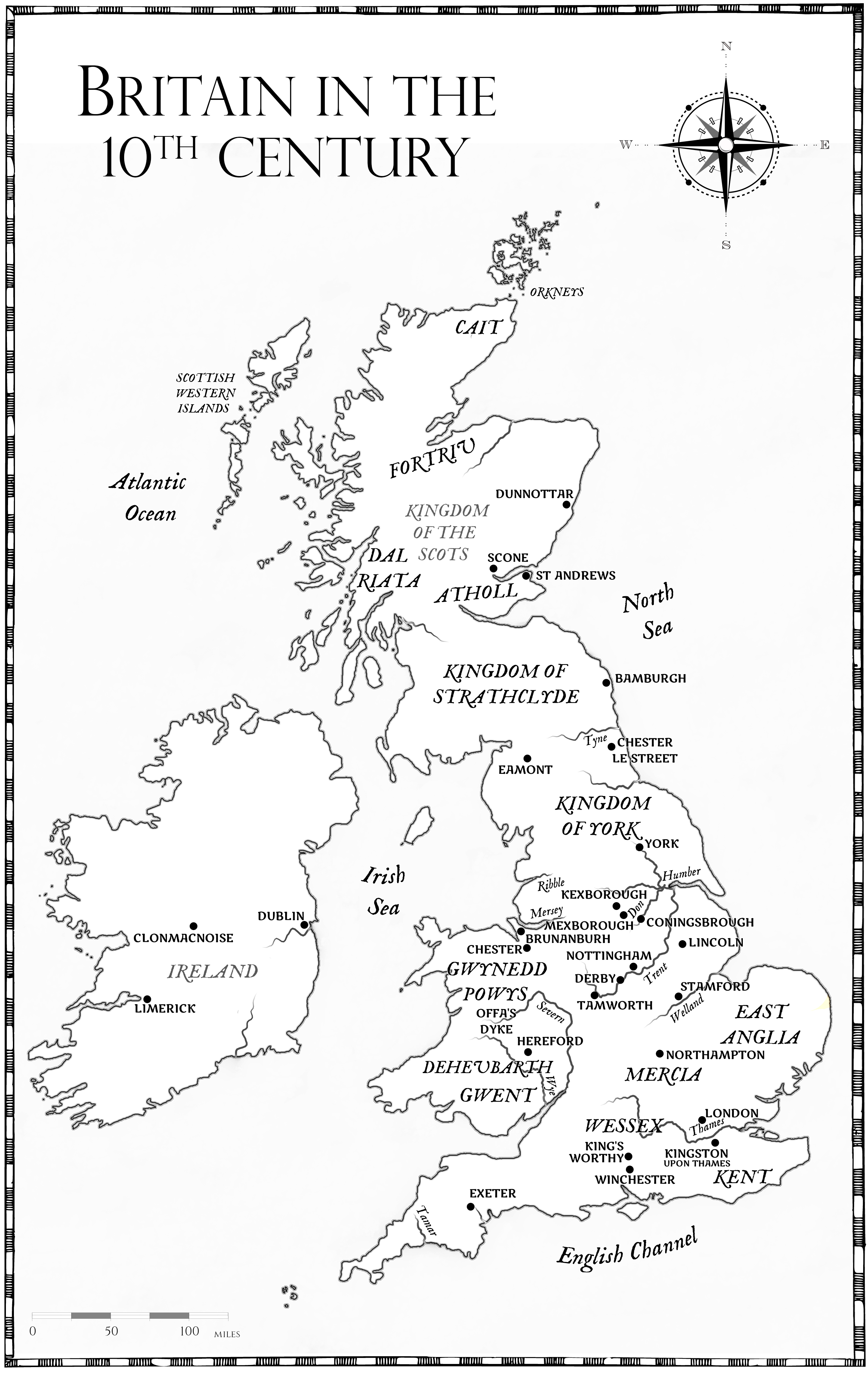
Scotland didn’t yet exist, but Dal Riata, Pictland and Alt Clut (sometimes called Strathclyde) did. Wales didn’t exist, although the kingdoms of Gwynedd, Deheubarth, Ceredigion and Powys did, The kingdom of Dumnonia (modern-day Cornwall), was also in existence and very much not part of Saxon England. Indeed, these kingdoms are often termed British, as opposed to Saxon. As someone woeful at geography – I purposefully don’t adopt the names of places from this period because it confuses me – I’m only too well aware of how much I’m asking from my reader as it is without adding weird place names to already strange sounding personal names, and yet it was necessary to add a whole host of strange names, which often, have no relation to the current names of counties, let alone kingdoms.
All of these different kingdoms, we’re told, were involved in some way in the battle of Hædfeld. Some of the kingdoms joined the alliance, spear-headed by Cadwallon of Gwynedd, Edwin’s foster-brother. Others joined that of Edwin of Northumbria. Almost all of them took one side or another in the mighty battle of Hædfeld fought in 632 or 633 (there is some confusion about the exact date) between the two sides. To ensure my readers have some idea of who’s who, I’ve termed all of the character’s as being ‘of’ their kingdom, although I’m unsure if that’s actually how they might have been named.
I was surprised by how many individuals could be named from the seventh century, particularly for the build-up to the battle of Hædfeld. The cast is not Game of Thrones huge, but it was larger than I expected. Not just Penda of the Hwicce, only later could he be termed of Mercia, and Cadwallon of Gwynedd in the British ‘alliance’, but also Cloten of Deheubarth, Clydog of Ceredigion, Eiludd of Powys, Clemen of Dumnonia, Domnall Brecc of Dal Riata, Beli of Alt Clut and Eanfrith of Bernicia. While on the Northumbrian led alliance were Edwin of Northumbria, alongside his children, Osfrith and Eadfrith, as well as Eowa of the Hwicce, Osric of Deira – Edwin’s cousin, Cynegils of Wessex, Sigeberht of the East Angles and Oswald of Bernicia – Edwin’s nephew. At least, that’s how I stack the two sides as the battle is about to commence. In later periods, it is sometimes a struggle to find who was king of where and when that might have been, so to find so many characters, even if it can seem a little overwhelming, was fantastic and ensured that the British-wide battle of Hædfeld could be retold in Pagan Warrior with a nod to each of these kings, and the part they might, or might not, have played in the events that played out on that fateful day in October 632 or 633.












 MJ Porter


