Book Review – The Wolf of Wessex by Matthew Harffy – historical fiction – highly recommended

Here’s the blurb;

AD 838. Deep in the forests of Wessex, Dunston’s solitary existence is shattered when he stumbles on a mutilated corpse.

Accused of the murder, Dunston must clear his name and keep the dead man’s daughter alive in the face of savage pursuers desperate to prevent a terrible secret from being revealed.

Rushing headlong through Wessex, Dunston will need to use all the skills of survival garnered from a lifetime in the wilderness. And if he has any hope of victory against the implacable enemies on their trail, he must confront his long-buried past – becoming the man he once was and embracing traits he had promised he would never return to. The Wolf of Wessex must hunt again; honour and duty demand it.

I was lucky enough to get an EARC of Wolf of Wessex from the author.

I’ve read all the previous books by Matthew Harffy set in seventh-century Bernicia, and many will know that I have a few complaints about his grumpy main character. Wolf of Wessex is a breath of fresh air, set two centuries later and with a new main character who doesn’t infuriate me with his grumpiness and general ill-temper all the time.

I’d give Wolf of Wessex a full 5/5, without even having to think about it. The story presses on at a good pace,  there are lots of short, sharp chapters, and a good mystery as well.  The attention to detail with regards to the forest landscape was really good as Dunston is forced to leave his home while still utilising the skills his solitary lifestyle has taught him.

The writing truly flows, the descriptions feel natural, and the pacing is fab. It’s a page-turner that I highly recommend.

Wolf of Wessex is released on 14th November, and is available from here:

Book Review – Bright Blade: The Byrhtnoth Chronicles: Book 3 by Christine Hancock – historical fiction

Here’s the blurb;

Byrhtnoth thinks only of killing the man who stole his sword and wounded his wife. But the blade of revenge can strike both ways.
Erik Bloodaxe has broken his oath and claimed the throne of York. In his anger, King Eadred sends his army to ravage Northumbria.
Sent north with the ships, Byrhtnoth suffers storms at sea and fire on land. After an encounter with an old enemy, he is left broken, in mind and body.
Can Byrhtnoth survive until help arrives?
Will he ever fight again?

Bright Blade is the third book about Byrhtnoth (who would, in time, become Ealdorman Byrhtnoth in tenth-century England). I’ve read the previous 2 books and enjoyed them, and I think the cover for book 3 is really striking. With book 3, I felt ‘hooked’ from the beginning and the storyline flowed really well. I enjoyed the ending (no spoilers here), as it built cleverly to an unexpected climax.

This series is set in the tenth century (along with the more recent Uhtred books by Bernard Cornwell, as well as my own books in The Tenth Century series, and the later Chronicles of the English, The First Queen of England books, and even The Earls of Mercia begins in the tenth century) and as such, it’s really enjoyable to see a different perspective to my own, and also to encounter a character, Byrhtnoth, who is so important in The First Queen of England books.

I think all the ‘cool kids’ are writing about the tenth century, and I’m really looking forward to reading the final book in the series when it’s available.

Bright Blade is available now on Amazon.


Book Review – Sword of Kings by Bernard Cornwell – historical fiction

Here’s the blurb;

“Uhtred of Bebbanburg is a man of his word.

An oath bound him to King Alfred. An oath bound him to Æthelflaed. And now an oath will wrench him away from the ancestral home he fought so hard to regain. For Uhtred has sworn that on King Edward’s death, he will kill two men. And now Edward is dying.

A violent attack drives Uhtred south with a small band of warriors, and headlong into the battle for kingship. Plunged into a world of shifting alliances and uncertain loyalties, he will need all his strength and guile to overcome the fiercest warrior of them all.

As two opposing Kings gather their armies, fate drags Uhtred to London, and a struggle for control that must leave one King victorious, and one dead. But fate – as Uhtred has learned to his cost – is inexorable. Wyrd bið ful ãræd. And Uhtred’s destiny is to stand at the heart of the shield wall once again…”

I sometimes feel that this series of books has long since run its course, but Sword of Kings, Book 12, had me intrigued just from reading the blurb.

Lord Uhtred has firmly moved into a time period I know, study and write about, and while sometimes it’s hard to read the way another person treats ‘your’ characters, I thoroughly enjoyed the starkly different interpretation of events surrounding King Edward’s death, because, quite simply, there is no ‘right or wrong’ when writing about this period. It’s a very much anything goes scenario, and into this, Lord Uhtred, bored and old, having finally captured Bebbanburg, is allowed to take centre stage.

Uhtred is older, but not wiser, and once more, if it wasn’t for the intervention of others, he would certainly not make it to the end of Book 12, hale and hearty.

Uhtred has as many enemies as normal, and his loyalties are split, but the will is strong to enact some revenge when he realises his ships are being attacked by an old enemy he ‘s made an oath to kill. Heading South, with the news that King Edward is either dying or dead, while plague pushes its way ever northwards, there’s a great deal of time spent on board ship. There’s a battle on a ship, and then another battle, and then there’s tides, rivers, currents, different boats, oars, sails and many other ship related activities. (It does get a little repetitive). There’s the Farne Islands, Kentish coasts, London, rivers in Mercia, London once more and then a bridge as well as a wall.

The action is pretty full-on but somewhat repetitive. Uhtred makes any number of bad decisions, and then the quest for revenge drives him on, even though it probably shouldn’t.

In effect, Uhtred turns the tide of ‘history’ once more, and not necessarily to his favour.

The old rivalries between paganism and Christianity continue, as does Uhtred’s unease with the plans the new king has for Northumbria, and for him. It’s these scenes that I find most tedious. I would like a little more nuance to Uhtred, but it seems his character will never develop more than it has. BC tries to make Uhtred appear as more than just a thug by adding a few women to the cast, as well as a host of orphans, and having his relationships with them testify that he isn’t ‘a ‘bad man’ just a righteous one who must abide by his oaths.’ Essentially, if Uhtred likes you, then that’s good, but if not, then you’re in trouble.

There are many elements to the story that I would change – the insistence on Anglo-Saxon place names being one of them, the ship ‘lingo’ another one – but hey, it’s Uhtred. You know what you’re getting from the start, and you won’t be disappointed, although you might feel a bit seasick!

Here’s to the next book.

Sword of Kings was released on 3rd October, and is available from here:
Book Review – The Mitford Scandal by Jessica Fellowes – historical fiction

Here’s the blurb;

The newly married and most beautiful of the Mitford sisters, Diana, hot-steps around Europe with her husband and fortune heir Bryan Guinness, accompanied by maid Louisa Cannon, as well as some of the most famous and glamorous luminaries of the era. But murder soon follows, and with it, a darkness grows in Diana’s heart . . .

This wonderful new book in the bestselling The Mitford Murders series sees the Mitford sisters at a time of scandalous affairs, political upheaval and murder.

The Mitford Scandal is not at all what it is sold as – it is not a 1920’s whodunit – but rather a tedious excursion through late 1920’s Europe where I turned every page just waiting for something to happen, only for each ‘event’ to be the ending of a chapter, rather than a beginning.

The writing style is odd in the extreme, some events told in explicit detail, others glossed over as though not important, and the years, yes years, covered in this novel, are done so in choppy chapters that seem to add little or nothing to the story.

I think the author struggles to reconcile the life her ‘main’ character, the lady’s maid, Louisa has, with the events that are being narrated. It just doesn’t work, not at all, and the odd few chapters told from the viewpoint of Guy are equally as jarring.

Hugely disappointing as I am a fan of a good 1920’s murder-mystery, but this is not one, only morbid curiosity kept me reading until the end (it is not a long book), which is as poorly constructed as the rest of the novel.

Apologies. I really don’t like to leave negative reviews, but my thanks to the publisher and Netgalley for my review copy.

I have looked at reading previous books in this series of books (this is book 3), and I know they have a great of deal of hype around them. I think this probably added to my disappointment – sometimes hype is not a good thing for a series of books to have!! Apologies again. (The cover is lovely!)

The Mitford Scandal is released on 26th September and is available from here;

Book Review – Warrior: A Life of War in Anglo-Saxon England by Edoardo Albert and Paul Gething – historical non-fiction/fiction

Here’s the blurb;

“Warrior tells the story of forgotten man, a man whose bones were found in an Anglo-Saxon graveyard at Bamburgh castle in Northumberland. It is the story of a violent time when Britain was defining itself in waves of religious fervour, scattered tribal expansion and terrible bloodshed; it is the story of the fighting class, men apart, defined in life and death by their experiences on the killing field; it is an intricate and riveting narrative of survival and adaptation set in the stunning political and physical landscapes of medieval England. Warrior is a classic of British history, a landmark of popular archaeology, and a must-read for anyone interested in the story of where we’ve come from.”

Warrior is an extremely well-written book. But it is not at all what I thought it would be. It is not so much the story of the warrior whose skeleton was discovered in the Bowl Hole at Bamburgh, as the story of the archaeological digs that have taken place at Bamburgh Castle, and the personalities involved, the ‘history’ (bizarre as it sounds) of the development of archaeology as a science throughout the twentieth century and a snapshot of events that occurred in Northumberland from about AD599-635, mixed in with the history of the Conversion of the Anglo-Saxons, which were taking place at the same time. (On another note, I have been on the beach at Bamburgh when a random storm has blown in – on this occasion hail on a summer’s day. It does happen).

As such, this short book attempts to accomplish a great deal, in only very few words, and for those new to the time period, or with a passing interest in all things archaeological, or for those fans of Bernard Cornwell’s Uhtred and the TV series, The Last Kingdom with its ‘hero’s’ focus on Bebbanburg, this will be a real treat.

The story takes the reader from Kent to Iona and many, many places in between. The research and attention to details can’t be faulted, and neither can the fact that the author admits that much of his story will be ‘made up’ and probably inaccurate, and yet, the ‘fiction’ of the warrior’s story is maintained, along with the desire to make the archaeology ‘fit the ‘facts” of the ‘history’ and it is here that the book falters for anyone who has more than a passing interest in the period, and who will understand all the speech marks in that last sentence.

But, for those new to the study of Anglo-Saxon England, this book will provide an excellent starting point, placing the skeleton in a ‘possible’ historical setting.

(I am hoping that the site report for the dig at Bamburgh will be/is available and this might quench my thirst to know more details about the actual finds rather than the potential historical context in which it might have taken place.).

Thank you to the publisher and Netgalley for the review copy.

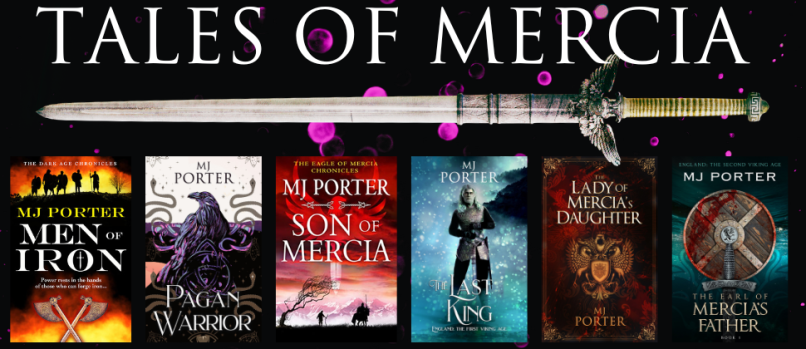
Warrior is available from 19th September 2019 from here. If you are interested in reading more about the time period then try Pagan Warrior, and the two follow-up books which tell the story of King Penda, King Edwin, and Oswald ending in AD955.


Book Review – The Irish Princess by Elizabeth Chadwick – historical fiction

Here’s the blurb;

“Her father’s only daughter.
Her country’s only hope.
Ireland, 1152

The King of Lenister, awaiting news of his newborn child, is disappointed to hear he has a daughter. Diarmait MacMurchada wanted another strapping son to shoulder a spear, wield a sword, and protect his kingdom. But the moment Diarmait holds tiny Aoife in his arms, he realised she would be his most precious treasure.

1166

Forced into exile Aoife and her family find themselves at the mercy of Henry II. Aoife – aware of her beauty but not its power – intrigues and beguiles Henry in equal measure. He agrees to help her father, an alliance that leads the MacMurchadas to the charistmatic Richard de Clare, a man dissatisfied with his lot and open to new horizons.

Diarmit promises Richard Aoife’s hand in marriage in return for his aid in Ireland, but Aoife has her own thoughts on the matter. She may be a prize, but she is not a pawn, and she will play the men at their own game. For herself, for her family, and for her country.

From the royal halls of scheming kings, to staunch Welsh border fortresses and the wild green kingdoms of Ireland, The Irish Princess is a sumptuous, journey of ambition and desire, love and loss, heartbreak and survival.”

The Irish Princess is a welcome return to the world of William the Marshall and Queen Alienor. Yes, they might not appear in the book for any great length of time, if at all, but the reader knows that they are ‘off’ in the background, living their own lives, while young Aoife is trying to do the same. (I am a huge fan of the William Marshall books – in many ways, he was one of the inspirations for Ealdorman Leofwine in the Earls of Mercia books that I write.)

The setting of Ireland for much of the book provides a new arena for readers of Elizabeth Chadwick, and it’s enjoyable. Events in Ireland can be complicated, and the author makes the reader aware of what’s happening without providing too much detail so that it never becomes too complicated.

Aoife is an intriguing character – fiercely proud of her heritage, she is also determined to hold onto her birthright, whatever it takes, and if I would have liked to know more about Aoife, and her Irish family by the end of the novel, then that is a good thing. I don’t know if this is a standalone novel, or if it will have a sequel, and if it doesn’t, I imagine many of my questions could be answered by forcing myself to reread The Scarlet Lion (if I must! – I can’t imagine it’ll be any form of hardship).

A thoroughly enjoyable read – it took me only three days to complete the book – and recommended for all fans of Elizabeth Chadwick, and those with an interest in the Empire of Henry II.

On a personal note – I do enjoy it when an author has the freedom to play around with some of their characters a little bit. This book is very much a prequel to The Scarlet Lion and I’m pleased that both the author and the publisher pursued this idea.

Thank you to Netgalley and the publisher for my review copy.

The Irish Princess is released on 12th September 2019 and is available from here:

Book Review – Silent Water by P K Adams – murder mystery – highly recommended

Here’s the blurb;

“It is Christmas 1519 and the royal court in Kraków is in the midst of celebrating the joyous season. Less than two years earlier, Italian noblewoman Bona Sforza arrived in Poland’s capital from Bari as King Zygmunt’s new bride. She came from Italy accompanied by a splendid entourage, including Contessa Caterina Sanseverino who oversees the ladies of the Queen’s Chamber.

Caterina is still adjusting to the life in this northern kingdom of cold winters, unfamiliar customs, and an incomprehensible language when a shocking murder rocks the court on Christmas night. It is followed by another a few days later. The victims have seemingly nothing in common. Gossip, speculation, and suspicion are rife, but the perpetrator remains elusive as the court heads into the New Year.

As the official investigation stalls, Caterina—aided by Sebastian Konarski, a junior secretary in the king’s household—sets out to find the killer. With clues beginning to point to the queen’s innermost circle, the pair are soon racing against time to stop another murder.

Silent Water is a story of power and its abuse, and the extremes to which a person may go to find redress for justice denied. Although set at the dawn of the Renaissance era, its themes carry disturbing parallels to some of the most topical social issues of the 21st century.”

Silent Water is a thoroughly enjoyable murder-mystery set at the Polish court in 1519.

The main character is an interesting narrator, and if the beginning is a little slow, it isn’t long until the reader is thrust into the court politics of Poland and into the strange events surrounding the murder of a popular courtier.

Having read a few period murder mysteries lately, I must say this has been the most enjoyable. The author has a light touch while ensuring we know enough about the Polish Court and events in the wider European setting of the Reformation to make sense of the story.

Highly recommended for fans of period murder mysteries and those who love the sixteenth century.

I look forward to Book 2!

Silent Water is available now from here;

Book Review – A Tapestry of Treason by Anne O’Brien – historical fiction – highly recommended

Here’s the blurb;

“Her actions could make history – but at what price?

1399: Constance of York, Lady Despenser, proves herself more than a mere observer in the devious intrigues of her magnificently dysfunctional family, The House of York.

Surrounded by power-hungry men, including her aggressively self-centred husband Thomas and ruthless siblings Edward and Richard, Constance places herself at the heart of two treasonous plots against King Henry IV.  Will it be possible for this Plantagenet family to safeguard its own political power by restoring either King Richard II to the throne, or the precarious Mortimer claimant?

Although the execution of these conspiracies will place them all in jeopardy, Constance is not deterred, even when the cost of her ambition threatens to overwhelm her.  Even when it endangers her new-found happiness.

With treason, tragedy, heartbreak and betrayal, this is the story of a woman ahead of her time, fighting for herself and what she believes to be right in a world of men.”

A Tapestry of Treason is a stunning novel. The character of Lady Constance is a revelation – she is perhaps the most complicated of Anne O’Brien’s historical ‘women’ to date, and the book delightfully fluctuates between the conspiracies and treasons that she’s involved in, even though she is, but a woman in a man’s world. How she survived the king’s wrath on so many occasions is a bit of a miracle.

In the end, I was completely hooked on the novel, and just read the last 40% or so in one sitting, in heightened anxiety from each high to each new low. Lady Constance certainly wins the heart of the reader, even if she herself would never admit to even having a heart.

I believe this is the best of Anne O’Brien’s books to date.

Thank you to the Netgalley and the publisher for my review copy. I would certainly have read it anyway – and I’m just delighted I got to read it so far in advance of being released.

A Tapestry of Treason is now available in paperback, and is available here.

Book Review – Council (Helga Finnsdottir 2) by Snorri Kristjansson – historical fiction

Here’s the blurb;

“After five years on the road, Helga has finally settled near King Eirik’s court in Uppsala, where she’s well-regarded as a healer. She’s even in a relationship, of sorts.

But life is about to get a bit more exciting, for King Eirik has summoned all those who owe him fealty to the King’s Council and tempers are already flaring. The body of an unknown boy is found near the river, but with delegations from all over the country arriving and rumours of an imminent attack, there are more important things to attend to than the death of a nobody . . .

Only Helga suspects murder, until a second body makes it clear that someone is intent on breaking up the King’s Council – and that a traitor walks among them . . .”

Council by Snorri Kristjansson is not an ‘easy’ read, but rather a worthwhile one.

Beginning a few years after the events of Kin, the start of Council is a little jarring. I imagine those lucky enough to read Kin and then head straight into Council will not have the same problem of trying to remember who everyone is, and what happened in the previous book.

Which begs the question, do you need to have read Kin to enjoy Council? Possibly not, although it does add to the background story of the main character, and Kin is an excellent book, well worth reading.

Council is deeply ingrained in the day to day lives of the people of Uppsala, and there are many factions and people to come to know, although the story threaded through it is not complicated. The hints of events in the wider world keep the reader hooked – references to Hedeby and Harald Bluetooth.

Yet, it is in the final stages of the novel that the story really comes alive. While some of the book had been a struggle – I was disappointed that it ended when it did, although it does hint at much more to come for the main character.

I have a feeling this might be a ‘bridging’ book, between Kin, and what might happen to Helga in the future, and I find the possibilities exciting.

Thank you to Netgalley and the publisher for my review copy.

Council is available now.

Book Review – A Conspiracy of Wolves by Candace Robb – medieval murder mystery

Here’s the blurb;

“When a prominent citizen is murdered, former Captain of the Guard Owen Archer is persuaded out of retirement to investigate in this gripping medieval mystery.

1374. When a member of one of York’s most prominent families is found dead in the woods, his throat torn out, rumours spread like wildfire that wolves are running loose throughout the city. Persuaded to investigate by the victim’s father, Owen Archer is convinced that a human killer is responsible. But before he can gather sufficient evidence to prove his case, a second body is discovered, stabbed to death. Is there a connection? What secrets are contained within the victim’s household? And what does apprentice healer Alisoun know that she’s not telling?

Teaming up with Geoffrey Chaucer, who is in York on a secret mission on behalf of Prince Edward, Owen’s enquiries will draw him headlong into a deadly conspiracy.”

This is the first book of the series that I’ve read, and it took me a while to click with the characters and work out the ‘normal’ band of characters, and those who were involved in the conspiracy. I imagine that fans of the series would not have had the same problems and would have been able to leap right in.

The reimagining of York is detailed and enjoyable and the solving of the murder(s) is well done, even if the author relies a little too much on the ‘I can’t tell you now, but I’ll tell you later,’ scenario to build tension. Overall, an enjoyable read.

Not perhaps as easy to jump in and out of the world of Owen Archer as other medieval mysteries, but I will certainly be looking for some of the earlier books now.

Thanks to Netgalley and the publisher for my review copy.

A Conspiracy of Wolves, and all the previous ten books in the series are available now.