Glen Craney is sharing some historical research from The Cotillion Brigade #blogtour #historicalresearch

Today, I’m delighted to welcome Glen Craney to the blog with a fascinating post about the historical research that went into writing The Cotillion Brigade.

Thank you, M.J., for inviting me as a guest on your blog.

As part of my research process, I try to travel to the historical locations of my novels. And one of the first things I do is head first for the local cemetery. More than once, I’ve made discoveries from the headstones that changed the trajectory of my stories.

LaGrange, Georgia, is the setting of my latest novel, The Cotillion Brigade, which is based on the true story of the Nancy Hart Rifles, the most famous female militia in American history.

When I pulled into the scenic town of LaGrange to learn more about the Nancy Harts, I parked the car and walked among the monuments of Hillview Cemetery, where many of my characters from The Cotillion Brigade are buried. To my astonishment, and not a little chagrin, my protagonist, Captain Nancy Colquitt Hill Morgan, was nowhere to be found among her comrades in arms. How could she not be buried in the town she helped save?

I learned later that she is buried in Decatur, more than seventy-five miles away. I wondered if this was her wish. Had she moved to Decatur late in life to reside with family? I knew from my research that many Southern families, devastated by the war, could not afford to transport deceased members back to the homesteads.

Nancy Morgan’s Grave

Still feeling a little sad for Captain Nancy in exile, I drove across town to the smaller Stonewall Confederate Cemetery, where I was unprepared for another tragic discovery. Most of the three hundred soldiers buried there died from wounds and disease. After the bloody battle of Chickamauga and during Sherman’s Atlanta campaign, thousands of Confederate wounded were shipped south along the Atlanta and West Point rail line, one of the last surviving transport arteries in the heart of the Confederacy. Cities on the way, like Newnan, LaGrange, and West Point, became hospital centers, and the Nancy Harts took time from their military drills to help nurse the men.

The Stonewall Cemetery sits near the railroad tracks, and as I studied the names on the stones, the horrific reason for this location suddenly dawned on me. Many of the wounded men would not have survived the jarring journey from the battlefields northwest of Atlanta. Their bodies were likely removed from the train cars to be buried immediately.

John Gay-Stonewall Cemetery

Captain Nancy’s close friend, Carolyn Poythress, was widowed very young before the war. She fell in love with another man, Lt. John Gay of the Fourth Georgia infantry regiment, who came back to LaGrange to convalesce from an artillery chest wound received at Antietam. After they married, Lt. Gay returned to Lee’s Army of Northern Virginia. He fell mortally wounded at the siege of Petersburg, only two weeks before the surrender at Appomattox. Caroline, accompanied by the daughter her husband never lived to see, insisted he be buried with his comrades at Stonewall Cemetery. Caroline lies in Hillview.

A thousand miles away, another plot revealed a secret about my second protagonist, Colonel Oscar Hugh LaGrange. The Union officer who confronted Captain Nancy and her militia during the last days of the war lies buried in the Bronx’s Woodland Cemetery. Next to his stone is that of his third wife, Susie Gray LaGrange, who goes unmentioned in the history books. Strange as it seems, the ardent Abolitionist colonel from Wisconsin married not one, but two, Southern plantation belles. That discovery would lead me to a new understanding about the officer’s transformation and the impact the Nancy Harts of Georgia had on him.

Colonel LaGrange’s Grave

Thank you so much for sharing your research with me. It’s always fascinating to understand the discoveries made while researching, and how they add to the finished story.

Here’s the blurb

Georgia burns.

Sherman’s Yankees are closing in.

Will the women of LaGrange run or fight?

Based on the true story of the celebrated Nancy Hart Rifles, The Cotillion Brigade is an epic novel of the Civil War’s ravages on family and love, the resilient bonds of sisterhood in devastation, and the miracle of reconciliation between bitter enemies.

“Gone With The Wind meets A League Of Their Own.”

— John Jeter, The Plunder Room

1856. Sixteen-year-old Nannie Colquitt Hill makes her debut in the antebellum society of the Chattahoochee River plantations. A thousand miles north, a Wisconsin farm boy, Hugh LaGrange, joins an Abolitionist crusade to ban slavery in Bleeding Kansas.

Five years later, secession and war against the homefront hurl them toward a confrontation unrivaled in American history.

Amazon UKAmazon USAmazon CAAmazon AU

KoboIBooksBarnes & Noble

Meet the Author

A graduate of Indiana University School of Law and Columbia University Graduate School of Journalism, Glen Craney practiced trial law before joining the Washington, D.C. press corps to write about national politics and the Iran-contra trial for Congressional Quarterly magazine. In 1996, the Academy of Motion Pictures, Arts and Sciences awarded him the Nicholl Fellowship prize for best new screenwriting. His debut historical novel, The Fire and the Light, was named Best New Fiction by the National Indie Excellence Awards. He is a three-time Finalist/Honorable Mention winner of Foreword Magazine’s Book-of-the-Year and a Chaucer Award winner for Historical Fiction. His books have taken readers to Occitania during the Albigensian Crusade, the Scotland of Robert Bruce, Portugal during the Age of Discovery, the trenches of France during World War I, the battlefields of the Civil War, and the American Hoovervilles of the Great Depression. He lives in Malibu, California.

Connect with Glen:

WebsiteFacebookTwitter

PinterestGoodreadsAmazon Author Page

Don’t forget to check out the other stops on The Cotillion Brigade Blog Tour.

H D Coulter is sharing some historical research from Saving Grace: Deception. Obsession. Redemption #historicalresearch #blogtour

Today, I’m delighted to welcome back H D Coulter, with a post about the historical research that went into writing Saving Grace.

Saving Grace is the sequel to Ropewalk, and the setting couldn’t be more different – from the North of England to Boston. Could you tell me about how you went about researching the setting for Saving Grace, and why you chose that particular location?

I would like to thank M J Porter for inviting me back again to guest post. Today I am discussing how book 1, Ropewalk, which took place in the north of England but book 2 mostly takes place in Beacon Hill, Boston and in the American deep south state of Georgia. 

I will not go into spoilers here. But at the end of book 1, circumstances happened which meant that Bea and Joshua could no longer live in England and needed to flee. I choose to locate some of Saving Grace in Beacon Hill as it was a flourishing hub of Boston. It was a representation of what was happening across America in the 1830s, with various cultures descending on different areas of the hill. A class divide between north and south slope in wealth, with a sense of unrest bubbling underneath. With Joshua’s background in shipping, it was a natural selection for the character to choose that location with Boston harbour situated on the south slope and possible business connections. It was an area much like Ulverston, with new industrial advancement owned by the rich and yet filled with small clusters of different communities scattered from one street to the next. 

For book 1, Ropewalk, there was a lot of research done locally whilst I lived there and into the Reformer’s. However for book 2, Saving Grace, I had to rely on research more for the locations, history, people and society. Moving the story to America and placing the characters into this alien landscape reflected my own sense of discovery into the local culture and the rules of this unknown society. 

Since I couldn’t walk the streets and see Bea walking beside me, I needed more visual resources so that I could picture it in my mind’s eye. Thankfully, there are still locations in Beacon Hill and Georgia, that seem unchanged from that period. So, I read books, watched TV, You Tube documentaries and films, taking place in those locations. An interesting point I’ve noticed whilst I was researching book 2 and now that I’m deep down the rabbit hole for book 3, is that Georgia, South Carolina and into the wilds surrounding those states are like the fells around Cumbria and the south lakes. Which wouldn’t seem so alien to Bea. 

For Beacon Hill, I gathered all the resources I could to transform the streets into the 1830s. There are a lot of original features still left in Beacon Hill of the time they developed it, like Charles Street and Acorn Street. Whilst I was researching Beacon Hill; I discovered the African Meeting house, which was a hub for the abolitionist movement and a rumoured connection to the underground railroad. Which created a whole new subplot to the novel and leading into book 3. It mirrored that of Bob Lightfoot and yet independent to Bea. Once I discovered the Underground Railroad, the story came to life and the character of Sarah was born; a strong, formidable and caring character who has her own story and their friendship becomes vital for Bea as she finds her voice once more. 

 One aspect I found, the Underground Railroad shows, documentaries and films, fixate on to the late 1840s and 1850s. Around the time the legendary Harriet Tubman escapes on the Underground Railroad to the north but had the strength in the characters to return and free her family and slaves from neighbouring plantations. She was another formidable character and opponent against the slave patrollers and developed the nickname “Mosses” as she delivered people to the promise land. But during the 1850 American congress signed the ‘Fugitive Slave Act’ which brought a new law allowing capture of escaped slaves and blocked the sanctuary in the northern states and allowed patrollers to roam the streets and drag them back down south. 

“They were never really free.”

The more I discovered, the more I researched, looking into the tiny details and become fascinated by the smouldering embers that fuelled the American Civil War. 

“She had been born a coastal cottage girl and now she was a lady. But it was all a lie. It wasn’t how she had thought it would be. She carried so many secret labels that she had given up wondering which one was her true calling; a lace-maker, a cottage girl, a wife, a mother, a murderer; a fugitive?”

Saving Grace, chapter 5.

Each one of the principal characters feels like they are battling their own form of deception, obsession and redemption. Unbeknown Hanley is watching in the shadows, controlling their lives and waiting to make his move. 

Some resources I used: 

  • Beacon Hill (Images of America) Kindle Edition

by Cynthia Chalmers Bartlett (Author)  Format: Kindle Edition.

  • Beacon Hill, Back Bay and the Building of Boston’s Golden Age Kindle Edition

by Ted Clarke (Author)  Format: Kindle Edition. 

  • The Underground Railroad: LONGLISTED FOR THE MAN BOOKER PRIZE 2017 Kindle Edition

by Colson Whitehead  (Author)  Format: Kindle Edition. 

  • Passengers: True Stories of the Underground Railroad Kindle Edition

by William Still  (Author), Ta-Nehisi Coates (Introduction).

  • The Underground Railroad: Authentic Narratives and First-Hand Accounts (African American) Kindle Edition

by William Still  (Author), Ian Finseth (Editor).

  • Underground, TV show about a group of slaves trying to escape the south. 

Thank you so much for sharing your research. I do love a good rabbit hole! Good luck with the new book.

Intrigued?

Here’s the blurb;

Beacon Hill, Boston. 1832.

“You are innocent. You are loved. You are mine.”

After surviving the brutal attack and barely escaping death at Lancaster Castle, Beatrice Mason attempts to build a new life with her husband Joshua across the Atlantic in Beacon Hill. But, as Beatrice struggles to cope with the pregnancy and vivid nightmares, she questions whether she is worthy of redemption.

Determined to put the past behind her after the birth of her daughter Grace, Bea embraces her newfound roles of motherhood and being a wife. Nevertheless, when she meets Sarah Bateman, their friendship draws Bea towards the underground railroad and the hidden abolitionist movement, despite the dangerous secrets it poses. Whilst concealed in the shadows, Captain Victor Hanley returns, obsessed with revenge and the desire to lay claim to what is his, exposes deceptions and doubts as he threatens their newly established happiness.

Now, Beatrice must find the strength to fight once more and save Grace, even if it costs her life.

Amazon UKAmazon USUniversal Link to other bookshops

Ropewalk; Rebellion. Love. Survival (The Ropewalk Series, Book 1) is only 0.99 on ebook during the tour. Here are the buy link

Amazon UKAmazon USUniversal Link to other bookshops

Meet the Author

Hayley was born and raised in the lake district and across Cumbria. From a young age, Hayley loved learning about history, visiting castles and discovering local stories from the past. Hayley and her partner lived in Ulverston for three years and spent her weekends walking along the Ropewalk and down by the old harbour. She became inspired by the spirit of the area and stories that had taken place along the historic streets.

As a teacher, Hayley had loved the art of storytelling by studying drama and theatre. The power of the written word, how it can transport the reader to another world or even another time in history. But it wasn’t until living in Ulverston did she discover a story worth telling. From that point, the characters became alive and she fell in love with the story.

Connect with H D Coulter

WebsiteTwitterInstagramFacebook

Sign up to Hayley’s newsletter between now and May 30th to be placed into a giveaway raffle for a personalised BookBox, including a signed copy of Ropewalk and Saving Grace.

http://eepurl.com/hjgxYf

Don’t forget to check out the other stops on the Saving Grace blog tour with The Coffee Pot Book Club.

Anne O’Brien is sharing some historical research from The Queen’s Rival #blogtour #historicalresearch

Today, I’m delighted to welcome Anne O’Brien to the blog to talk about her fantastic book, The Queen’s Rival, a real favourite of mine. (Find my review here).

I have read Queen’s Rival and I found it riveting. Yet, it is deliciously complex, and there’s a huge amount of both primary and secondary material available for study. Can you explain your research process to me, and give an idea of the resources that you rely on the most (other than your imagination, of course) to bring the historical characters to life? 

The complexity of the Wars of the Roses within the story of Cecily Neville was daunting when I first took it on.  Where to start, where to end.  Should I consolidate into one book, or write a sequel?  While I thought about it, all became clear to me.  Because I write about medieval women and form their point of view, many of the political events and battles must dealt with lightly, made only relevant when they had a bearing on Cecily’s experience, and then rarely in grat detail.  To begin: the day that she became a force in her own right – the events at Ludlow after the debacle at Ludford Bridge when she was left to face the rampaging mob of the Lancastrian army, alone with her three younger children.  To end: with the crowning of Richard III when Cecily must come to terms with the political forces that had removed her grandson Edward V from the throne.  

Who to include in Cecily’s story?

Some major figures would have to be short-changed because they did not develop the plot that was Cecily’s life, but were merely people on the periphery of Cecily’s story.  These included such notable characters as Margaret Beaufort,  Anne Neville,  Henry Tudor.  Even Margaret of Anjou might have demanded a more dynamic role although she is not entirely absent.  This may disappoint some readers but these are characters for another book.  There is a finite length to a novel as my editor is keen to tell me; Cecily and her family must take pre-eminence.

Cecily was the youngest of a large family.  To include all her brothers and sisters would definitely be a bad plan.  I deliberately made a choice of those who would be most useful to me   Her brother Richard of Salisbury of course and his son the Earl Warwick.  Two of her sisters, the eldest and the one closest to her in age.  The rest would sadly have to remain anonymous.

Why write in letter format?  I chose to do this to develop the family aspect of the Wars of the Roses.  These were real people who suffered and rejoiced within their families.  I decided that letters would make this a very personal account for Cecily, and thus make the emotion of her losses and achievements even stronger when faced with scandal and treachery.

Mostly when researching I refer to secondary sources.  I do not always find the need to return to primary sources.  For me this would be like re-inventing the wheel since the history of the Wars of the Roses has been magnificently researched by a number of historians, although I admit to being picky over whom I might use. I find myself returning to the works of  Matthew Lewis, Ian Mortimer, Nigel Saul, Anthony Goodman and Michael Jones.  For Cecily herself , when I was was half way through writing, a new long-awaited biography of Cecily was published:  Cecily Duchess of York by J L Laynesmith which proved endlessly useful for tying up a number of loose ends for me.

For primary sources, the chroniclers of the day are fascinating and encouraged me to write my own version of a Chronicle to help the plot to progress in The Queen’s Rival.  Accounts of Cecily’s pious lifestyle in her later years and the vast detail of her will were both excellent.

Taking the facts, together with the reactions of those who knew Cecily, it is then a matter of historical imagination to create an interpretation of her life as accurately as possible.

Do you have a ‘go’ to book/resource that you couldn’t write without having to hand, and if so, what is it?

I don’t have a ‘go to’ book when writing because my medieval women span a number of reigns, but one I find myself referring to frequently is The Senses in Late Medieval England by C M Woolgar.  It opens up the medieval world and life in aristocratic households beautifully, from every possible angle.  I also have quite a collection of books on medieval armour and costume – an essential part of my research, as well as medieval poetry and chivalric tales.  And then there  are the general history reference books …  Altogether my bookshelves are groaning from the weight of medieval history books.

Thank you so much for sharing your process with me. It’s fascinating and I’m in awe of how you managed to fit so much into one novel!

(Isn’t the cover beautiful).

Here’s the blurb;

England, 1459. 

One family united by blood. Torn apart by war…

The Wars of the Roses storm through the country, and Cecily Neville, Duchess of York, plots to topple the weak-minded King Henry VI from the throne.

But when the Yorkists are defeated at the battle of Ludford Bridge, Cecily’s family flee and abandon her to face a marauding Lancastrian army on her own.

Stripped of her lands and imprisoned in Tonbridge Castle, the Duchess begins to spin a web of deceit. One that will eventually lead to treason, to the fall of King Henry VI, and to her eldest son being crowned King Edward IV.

Amazon UKAmazon USAmazon CAAmazon AU

Barnes and NobleWaterstonesKobo

AudioBlackwellsWHSmith

Meet the author

Sunday Times Bestselling author Anne O’Brien was born in West Yorkshire. After gaining a BA Honours degree in History at Manchester University and a Master’s in Education at Hull, she lived in East Yorkshire for many years as a teacher of history.

Today she has sold over 700,000 copies of her books medieval history novels in the UK and internationally. She lives with her husband in an eighteenth-century timber-framed cottage in the depths of the Welsh Marches in Herefordshire. The area provides endless inspiration for her novels which breathe life into the forgotten women of medieval history.

Follow Anne

WebsiteTwitterFacebookLinkedInPinterest

Amazon Author Page: GoodreadsNews Letter sign up:

Don’t forget to check out the other stops on The Queen’s Rival blog tour with The Coffee Pot Book Club.

Faith L Justice is sharing some historical research from Dawn Empress #blogtour #historicalresearch

Today I’m delighted to welcome Faith L Justice to the blog with a post about the way she researched in order to write Dawn Empress.

Q. How Far Could a Roman Army March in a Day and Did They Wear Socks with Their Sandals?

A: 37 miles and “Yes”—Details in the post!

My mission is to tell interesting stories about little-known, but important women, while entertaining the reader. Because I write biographical historical fiction, historical accuracy is extremely important to me. For every novel, I must answer hundreds of questions like those posed in the title, so I do a tremendous amount of research beyond the facts of births, deaths, wars, etc. The sights, smells, sounds, and descriptions of clothes, food, housing, and transportation helps the reader experience a kind of time travel as they immerse themselves in a past culture. Personally, I find research the most fun part of writing my books. I get to learn new stuff, visit interesting places, and share my passions with readers. 

I ran across the empresses who are the subjects of my three-book series The Theodosian Women when I researched my first novel set in the early fifth century. Pulcheria (Dawn Empress) took over the Eastern Roman court at the tender age of fifteen and ruled as regent for her under-age brother Theodosius II. Placidia (Twilight Empress) ruled over the fading Western Empire for her under-age son Valentinian III. Athenais (work in progress), a pagan philosopher/poet married the “Most Christian Emperor” Theodosius II. These women fascinated me. I wanted to tell their stories, but I had a lot of research work to do.

This was hampered by the times. The fifth century experienced great turmoil as barbarians invaded the Roman Empire sacking cities, disrupting education and culture, and destroying records. This left only fragments of primary sources for future historians to ponder. Archaeology filled in some of the blanks, but there was lots of room for my imagination. My print resources consisted of translated copies of primary sources, general histories by well-respected historians, and a couple of obscure biographies. I still remember the unmitigated joy I felt when I found a used copy of Galla Placidia Augusta: A Biographical Essay by Stewart Irvin Oost and plunked down my money. I wrote Pulcheria’s story later when Kenneth G. Holum’s Theodosian Empresses: Women and Imperial Dominion in Late Antiquity was generally available. I’ve provided research bibliographies for each of my novels on my website but here’s a visual sample of my research book shelves. 

My first drafts are usually “white room” versions concentrating on the plot derived from the histories. I spend my second draft answering pesky questions about food, clothing, health, religion, architecture, art, technology, trade, and natural disasters—anything that adds color and context to my character’s lives. These details mostly come from specialized books and academic articles. The Handbook to Life in Ancient Rome (part of the Oxford Facts on File series) is a good place to start, but I couldn’t write with confidence without the academic articles I find at JSTOR (free with a library card) and Academia.edu.

Research has changed enormously in the past twenty-five years, making it much easier for the casual scholar. For my first two novels, I had to haunt the research branch of the New York Public Library looking up academic articles in dusty indices. About half of the journals seemed to be missing when I searched for them in the stacks. Now with a library card and a computer, anyone can access thousands of academic journals and presentations. I have over 300 titles in my miscellaneous research file alone.

The coolest new tool I’ve found is an interactive website called Orbis the Stanford Geospatial Network Model of the Roman World. Created and maintained by Stanford University, Orbis provides travel data in the Roman Empire. I fill in the details and it tells me how long it would take an army to march from Constantinople to Aquileia in January: 26.5 days, covering 1588 km (987 miles) at 60 km (37 miles) per day. Do I have a post rider carrying an important message from Rome to Toulouse in October? How about a trader moving exotic animals from Alexandria to Rome during the summer? No more looking up obscure modes of transportation, determining distance on Google Maps, and hand calculating. Magic!

My all-time favorite research technique is the site visit. I have a dozen books on Constantinople and Ravenna with gorgeous pictures and incredible diagrams, but nothing beats walking the famed walls that lasted a thousand years, feeling the weather change when a storm blows in across the Black Sea, or seeing surviving frescoes and mosaics in fifth century buildings. I took the picture of this stunning mosaic in the Mausoleum of Galla Placidia in Ravenna, Italy. 

I also do hands-on history by volunteering at archaeological digs. While working on Hadrian’s Wall in the UK, I got to visit the Vindolanda Roman Fort and see rare correspondence of a young Roman soldier asking his mother to send him knitted socks for the winter, among many other everyday artifacts, such as a doll, grocery lists, and a birthday party invitation written by the wife of the commander. In Tuscany, I helped uncover and preserve a mosaic of Medusa (pictured below) at a dig of a first century Roman villa. All this fuels a sense of awe and respect for these ordinary people who are long gone, but still very human in their needs, which I hope comes through in my writing. 

Museums come in a close second for favorite personal research. We have world-class ones here in New York. I studied 5C Roman clothing, coins, art, and jewelry at the Metropolitan Museum of Art, giving me a motherlode of detail to enrich my stories. If this pandemic we’re living through has any upside, it’s that museums around the world have made their collections available online. We can now virtually visit special exhibitions, search collections, and order previously inaccessible images and books. But I’m looking forward to going back in person.

So that’s my research process—lots of reading and note taking, punctuated with museum trips, site visits, and archaeology digs (a.k.a. vacations). After living vicariously in the fifth century for twenty-five years, I have an extensive personal library, but I want to give a hearty shout out to all the research librarians who helped me over the years. For accuracy, I trust “Ask A Librarian” over a chat room on the internet any day. Support your local libraries. They are national treasures!

On a final note, my sincere thanks to MJ Porter for hosting me on this blog tour. It’s always a privilege to meet new readers. If any of you have questions about my research process or my books, feel free to get in touch through my website or other social media. I love to hear from people. Stay safe out there!

© Faith L. Justice 2021

Thank you so much for sharing. A pleasure to have you on the blog. Note for UK readers, JSTOR offers some free articles, and others can be purchased with a subscription package:)

Here’s the blurb;

As Rome reels under barbarian assaults, a young girl must step up.

After the Emperor’s unexpected death, ambitious men eye the Eastern Roman throne occupied by seven-year-old Theodosius II. His older sister Pulcheria faces a stark choice: she must find allies and take control of the Eastern court or doom the imperial children to a life of obscurity—or worse. Beloved by the people and respected by the Church, Pulcheria forges her own path to power. Can her piety and steely will protect her brother from military assassins, heretic bishops, scheming eunuchs and—most insidious of all—a beautiful, intelligent bride? Or will she lose all in the trying?

Dawn Empress tells the little-known and remarkable story of Pulcheria Augusta, 5th century Empress of Eastern Rome. Her accomplishments rival those of Elizabeth I and Catherine the Great as she sets the stage for the dawn of the Byzantine Empire. Don’t miss this “gripping tale” (Kirkus Reviews); a “deftly written and impressively entertaining historical novel” (Midwest Book Reviews). Historical Novel Reviews calls Dawn Empress an “outstanding novel…highly recommended” and awarded it the coveted Editor’s Choice.

Ebook/Paperback

Amazon UKAmazon USAmazon CAAmazon AU

Barnes & NobleWaterstonesKobo:  Apple Books

SmashwordsBooks A MillionScribd: 

Audiobook

AudibleiTunes

Nook AudiobookGoogle Play:  Kobo Audio

BingeBooksChirp: Scribd

Meet the Author

Faith L. Justice writes award-winning historical novels, short stories, and articles in Brooklyn, New York where she lives with her family and the requisite gaggle of cats. Her work has appeared in Salon.com, Writer’s Digest, The Copperfield Review, and many more publications. She is Chair of the New York City chapter of the Historical Novel Society, and Associate Editor for Space and Time Magazine. She co-founded a writer’s workshop many more years ago than she likes to admit. For fun, she digs in the dirt—her garden and various archaeological sites.

WebsiteTwitter:   Facebook:  

LinkedInInstagramAmazon Author Page:  

Goodreads:  

Don’t forget to check out the other stops on the Dawn Empress blog tour with The Coffee Pot Book Club.

Judith Arnopp is sharing a post about the historical research for A Matter of Conscience #blogtour #historicalresearch

Today, I’m delighted to welcome Judith Arnopp to the blog with a guest post about her historical research.

A Matter of Conscience is once more set during the reign of the Tudors, a period about which I know you’ve written extensively. Do you feel comfortable in the Tudor era and can you explain your research process to me, and give an idea of the resources that you rely on the most (other than your imagination, of course) to bring the historical landscape and people of Tudor England to life?

I feel very comfortable in the Tudor era, or at least in the Tudor world I have created, peopled with characters from history. Since we can never visit the past, no author can ever be 100% certain they have got it right so I don’t worry too much, if I can convince my reader, I am happy. 

I’ve enjoyed the Tudor period since I was a young girl, some forty-five years or more. As a teenager I read all I could get my hands on, both fiction and non-fiction, and later when I went to university as a mature student, I learned the importance of thorough research. At the time, I never dreamed I’d ever write a book, let alone be published. A Matter of Conscience: Henry VIII, the Aragon Years is my thirteenth novel set in the Tudor era, so I know the setting quite well by now. 

When I wrote my first Tudor books, The Winchester Goose and The Kiss of the Concubine: the story of Anne Boleyn, I needed to research from the ground up. I examined the living conditions, the law, clothes, historical figures, customs, buildings, and court etiquette. I probably did far more research than necessary, but I wanted to get it right. I spent ages researching and still rely quite heavily on the essays and notes I made then. There is an extensive university library in Lampeter, close to where I lived at the time, and I used that a lot but now I have moved farther away, I can no longer do so. Luckily, the basics are in my head, so I only need to double check the things I am unsure of. Who was where at what time? Birth dates, death dates, things like that, or palaces or castles I’ve not researched before. 

When I wrote The Beaufort Chronicle, I became so wrapped up investigating Margaret Beaufort’s many homes, I fell behind with the rest of my work schedule and had to scramble for the deadline.

As for contemporary sources, they are much easier to get hold of than they used to be. When I first began to write I had to order them via the university library and sometimes it took weeks to get into my hands. British History Online is invaluable for documents and I recently discovered another online resource called Academia that is also proving useful.

I have many key reference books in my own library, and I can’t resist historical biographies. There are a few good historians that I trust to have researched properly and as soon as they release a new book, it goes on my pile.

Each time I begin a new project, I tell myself I will be tidier and more organised but before I am half-way through, the usual chaos has resumed. I make heaps of notes that I often cannot interpret afterwards, which often means I need to look up some things again. I seem to get there in the end though. There is always a pile of books by my favourite historians on my desk for dipping in and out of for reference and another pile I read from cover to cover. For this novel I’ve relied on biographies by Tracy Borman, Alison Weir, Eric Ives, Suzannah Lipscomb, Elizabeth Norton. I think I have all Amy Licence’s books now and her new one, 1520: The Field of the Cloth of Gold was published in timely fashion just as I began work on A Matter of Conscience, and I greatly enjoyed it.  

I also listen to Claire Ridgeway on You Tube while I am sewing in my craft room. She knows all there is to know about Anne Boleyn. There are scenes in nearly all my books of women sewing or embroidering, I can empathise with their sore fingers.

I find it best to absorb a wide variety of opinions and perspectives and then mull it all over and make my own conclusion. But not all the information ends up in the finished book because too much fact in a novel can be dull. I write first person narrative so I don’t tend to over describe the everyday objects they use simply because my character would not have found them extraordinary. My books centre on the psyche, or what I imagine might have been.

When writing in Henry’s voice I must be sure to know only what Henry knew and forget what comes after and the events that occurred behind his back. I live in each moment with Henry, as he lived it. A Matter of Conscience takes place during his childhood, adolescence, and marriage to Catherine of Aragon, so I found Henry quite an easy companion. He might, however, prove harder to live with in Book Two, which will follow shortly.

Do you have a ‘go’ to book/resource that you couldn’t write without having to hand, and if so, what is it (if you don’t mind sharing)?

I use the Tudor timeline as a skeleton so always have a print out of that to hand. Also, my Who’s Who in Tudor England is invaluable for reference. Looking at the pile on my desk at his moment, I’d say I rely on Amy Licence’s books the most. I find her very accessible, concise, and most importantly, accurate. Elizabeth Norton is another name that appears often on my shelves.

But my research isn’t all books or written sources, there are also portraits and again, thanks to technology, there is no real need to visit museums and galleries to do this. I build Pinterest boards with interesting Tudor faces and costumes which helps immensely, not just with my fiction but with my non-fiction writing and actual historical sewing too. I visit castles and monastic buildings, palaces, and manor houses. I’m not a great fan of the sites that add waxworks and reconstructed ‘rooms’. I prefer to let my imagination do the work. I am lucky to live in Wales where we have so many castles. I am a founder member of a Tudor re-enactment group called The Fyne Companye of Cambria and we love to dress up in our lovely gowns and ‘swish’ about the castles. All our events were cancelled last year, for obvious reasons and we haven’t booked any this year but are waiting to see what unfolds. We will be so glad when Covid19 restrictions end and we are able to visit them again.

Thank you so much for inviting me on to your blog. It has been lovely.

Thank you so much for sharing your research with me. I can relate to much of it – I am very untidy as well, and never reference anything correctly so always have to find it again.

So, here’s the blurb for the new book. It sounds fantastic. I’ve always been drawn to this particular episode in the Tudor saga.

‘A king must have sons: strong, healthy sons to rule after him.’

On the unexpected death of Arthur Tudor, Prince of Wales, his brother, Henry, becomes heir to the throne of England. The intensive education that follows offers Henry a model for future excellence; a model that he is doomed to fail.

On his accession, he chooses his brother’s widow, Catalina of Aragon, to be his queen. Together they plan to reinstate the glory of days of old and fill the royal nursery with boys. 

But when their first-born son dies at just a few months old, and subsequent babies are born dead or perish in the womb, the king’s golden dreams are tarnished.

Christendom mocks the virile prince. Catalina’s fertile years are ending yet all he has is one useless living daughter, and a baseborn son.

He needs a solution but stubborn to the end, Catalina refuses to step aside.

As their relationship founders, his eye is caught by a woman newly arrived from the French court. Her name is Anne Boleyn.

A Matter of Conscience: the Aragon Years offers a unique first-person account of the ‘monster’ we love to hate and reveals a man on the edge; an amiable man made dangerous by his own impossible expectation

Amazon UK Amazon US 

Meet the Author

A lifelong history enthusiast and avid reader, Judith holds a BA in English/Creative writing and an MA in Medieval Studies.

She lives on the coast of West Wales where she writes both fiction and non-fiction based in the Medieval and Tudor period. Her main focus is on the perspective of historical women but more recently is writing from the perspective of Henry VIII himself.

Her novels include:

A Matter of Conscience: Henry VIII, the Aragon Years 

The Heretic Wind: the life of Mary Tudor, Queen of England

Sisters of Arden: on the Pilgrimage of Grace

The Beaufort Bride: Book one of The Beaufort Chronicle

The Beaufort Woman: Book two of The Beaufort Chronicle

The King’s Mother: Book three of The Beaufort Chronicle

The Winchester Goose: at the Court of Henry VIII

A Song of Sixpence: the story of Elizabeth of York

Intractable Heart: the story of Katheryn Parr

The Kiss of the Concubine: a story of Anne Boleyn

The Song of Heledd

The Forest Dwellers

Peaceweaver

Judith is also a founder member of a re-enactment group called The Fyne Companye of Cambria and makes historical garments both for the group and others. She is not professionally trained but through trial, error and determination has learned how to make authentic looking, if not strictly HA, clothing. You can find her group Tudor Handmaid on Facebook. You can also find her on Twitter and Instagram.

Website • Blog • Twitter • Instagram • Amazon

Don’t forget to check out the other stops on the blog tour for A Matter of Conscience.

Jennier Anton is sharing a post about the historical research for Under the Light of the Italian Moon #blogtour #historicalresearch

Today, I’m delighted to welcome Jennifer Anton to the blog, with a post about her historical research. (I love finding out all the details).

Your book, Under the Light of the Italian Moon, sounds fascinating, and the cover is beautiful. Can you explain your research process to me, and give an idea of the resources that you rely on the most (other than your imagination, of course) to bring the historical characters to life? 

Thanks for having me on the blog and thank you for your kind words about the synopsis and cover of Under the Light of the Italian Moon

I started researching the novel in 2006. My grandmother, who grew up in Italy and told me stories of her Nazi occupied hometown, got very ill before she could answer all the questions I had for her. Soon after, I had my daughter and ended up in heart failure. By the time I recovered, my grandmother died, never meeting my daughter. It was then that I decided to research her life and get answers to the questions left unanswered. 

The first place I began was with her sister, my aunt, who had lived with her in Italy. Over coffee, we would sit for hours with my tape recorder and notebook. She then introduced me to people in the U.S., Canada and Italy who could tell me more. I spent hours on the phone and then took many trips to Fonzaso, Italy, where the novel takes place. My daughter accompanied me, first as a toddler, then as a little girl and then as a teenager, as we sat speaking to elderly Italians about my family, life under Mussolini and Nazi occupation. When I spoke with them, their stories came to life in my head. I did not see the older person in front of me, with grey hair and age spots. I saw them as my characters, full of life, surviving and living day to day under difficult times. It was a beautiful experience and every detail they gave me, I tried to include in the novel. 

Researching with Aunt

While collecting first-hand accounts, I was also doing extensive research regarding the time frame. The novel covers a long period: starting in 1914, jumping to 1919 and then to 1923 and beyond. It allows the reader to see the progression of political forces in the background while we experience the life of Nina Argenta, the daughter of a strong-willed midwife who falls in love with a boy who has emigrated to the coal mines of America. I laid out the historical moments under the stories I was told and the other first hand research I was doing. A narrative began to form. 

Do you have a ‘go’ to book/resource that you couldn’t write without having to hand, and if so, what is it?

The most important resources for me were both non-fiction and fiction. From a non-fiction perspective, Victoria De Grazia’s How Fascism Ruled Women and Perry Willson’s book about the Massaie Rurali were critical to understanding life for women during this time. Because the novel deals with a midwife as a central character, women’s reproductive rights, pressures and women in society were important for me to understand. As well, documents from Ellis Island, Fonzaso church records and websites documenting the fascist and Nazi atrocities in the area were incredibly useful. 

But to fill the gaps for the historical fiction narrative, I needed to get into the hearts and minds of the characters. Non-fiction doesn’t help in that area. I sought out books from Bassani and Moravia and found a fantastic book of translated women’s stories from the time from Robin Pickering-Iazzi. This helped me sense check the life I was breathing into my characters for authenticity.

Over a fourteen-year period, I watched every film, read every book and generally filled my hours living in this time period. When I shut my office door, or opened my laptop, I was not in the place I sat, I was in Italy during the interwar years. 

Fonzaso

I hope my novel will also transport you into this time, into the life of Nina Argenta, her mother—a force of nature—Adelasia Dalla Santa Argenta and Nina’s beloved Pietro Pante. Come with me to Fonzaso and experience love and women’s resilience during the rise of fascism and WWII.  

Thank you so much for sharing your fascinating journey with me. It sounds as though your research was both very personal and incredibly interesting.

Here’s the blurb;

A promise keeps them apart until WW2 threatens to destroy their love forever

Fonzaso Italy, between two wars

Nina Argenta doesn’t want the traditional life of a rural Italian woman. The daughter of a strong-willed midwife, she is determined to define her own destiny. But when her brother emigrates to America, she promises her mother to never leave.

When childhood friend Pietro Pante briefly returns to their mountain town, passion between them ignites while Mussolini forces political tensions to rise. Just as their romance deepens, Pietro must leave again for work in the coal mines of America. Nina is torn between joining him and her commitment to Italy and her mother.

As Mussolini’s fascists throw the country into chaos and Hitler’s Nazis terrorise their town, each day becomes a struggle to survive greater atrocities. A future with Pietro seems impossible when they lose contact and Nina’s dreams of a life together are threatened by Nazi occupation and an enemy she must face alone…

A gripping historical fiction novel, based on a true story and heartbreaking real events.

Spanning over two decades, Under the Light of the Italian Moon is an epic, emotional and triumphant tale of one woman’s incredible resilience during the rise of fascism and Italy’s collapse into WWII.

AmazonBarnes & NobleWaterstones

Bookshop.org (U.S. only):  I am Books Boston

Meet the Author

Jennifer Anton is an American/Italian dual citizen born in Joliet, Illinois and now lives between London and Lake Como, Italy. A proud advocate for women’s rights and equality, she hopes to rescue women’s stories from history, starting with her Italian family.

WebsiteTwitterFacebookInstagram

PinterestBook BubAmazon Author Page

GoodreadsYoutube

Don’t forget to check out the other stops on the Under the Light of the Italian Moon Blog Tour with The Coffee Pot Book Club

Welcome to today’s stop on the blog tour for Two Fatherlands by Chrystyna Lucyk-Berger

Today I’m delighted to welcome Chrystyna Lucyk-Berger and her new book, Two Fatherlands, to my blog, to answer a few questions about the research that went into writing her series.

This sounds like a wonderful book, merging historical fact with a compelling narrative. Can you explain your research process to me, and give an idea of the resources that you rely on the most (other than your imagination, of course) to bring the historical characters/or events to life? 

The research for this series was a journey unlike anything I will ever be able to share in the space available here. It was simply amazing. And daunting.

First, the process. I made the grave mistake of spending almost a decade researching my first novel on Ukraine in WW2, which ended being as much a novel as a documentary is a blockbuster action movie. I was trying to get a grasp on the sheer complexity of a world at war and I lost focus. So, after learning my lesson, I tackled the Reschen Valley series differently. I got the big picture, and had a rough idea of the lay of the land, so to speak, before I started writing. But even that took nearly five years before I could really get started because the majority of my resources were in German, and many more in Italian.
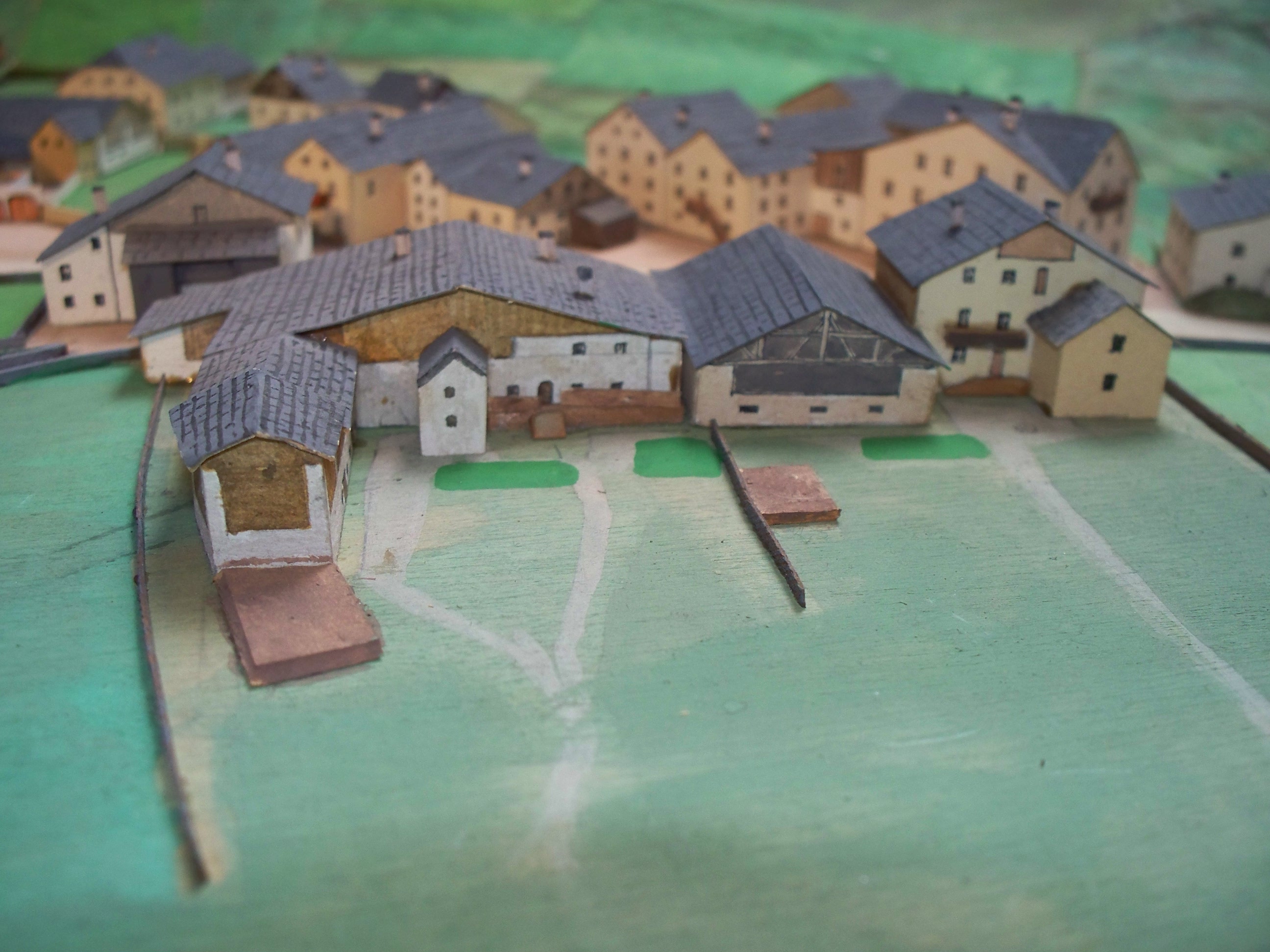
Model of the valley

The other extra challenge I made for myself was that I was a pantser. I did not outline and plot out my books in advance. It wasn’t until I was at Bolzano that I had learned to appreciate outlining and I have never looked back. By the time I started Two Fatherlands, which is the fourth book in the main series (excluding the prequel), writing was all about “what happens to my characters next and how do I get them all to meet up again?”. The historical events take a firm background in the series but they are integral to the plot. I chose specific “drivers” for the different parts of the story. From the beginning, Angelo’s father—Colonel Nicolo Grimani—was my Mussolini rep, steering the Fascist agenda that makes up the main conflict in the series. Therefore, it is Angelo’s story that serves as the catalyst for bringing the historical mile markers to the forefront.

Model of Reschensee Flooding

As I said, the main resources for my research were in German and Italian. I had the idea back in 2005 to write one book about the reservoir before I even started researching. That was before I had any idea how much was involved in the flooding of that valley! And nobody had really written about South Tyrol’s tragic history in English, except for one professor in Innsbruck whose work happened to have been translated thanks to an exchange program with an American university. The other was a Hungarian diplomat from the Sixties, who had written his memoirs about the South Tyrolean conflict in English. That was it! I had to learn German if I wanted to write this story. At the very least. Because the Italians had their own version…
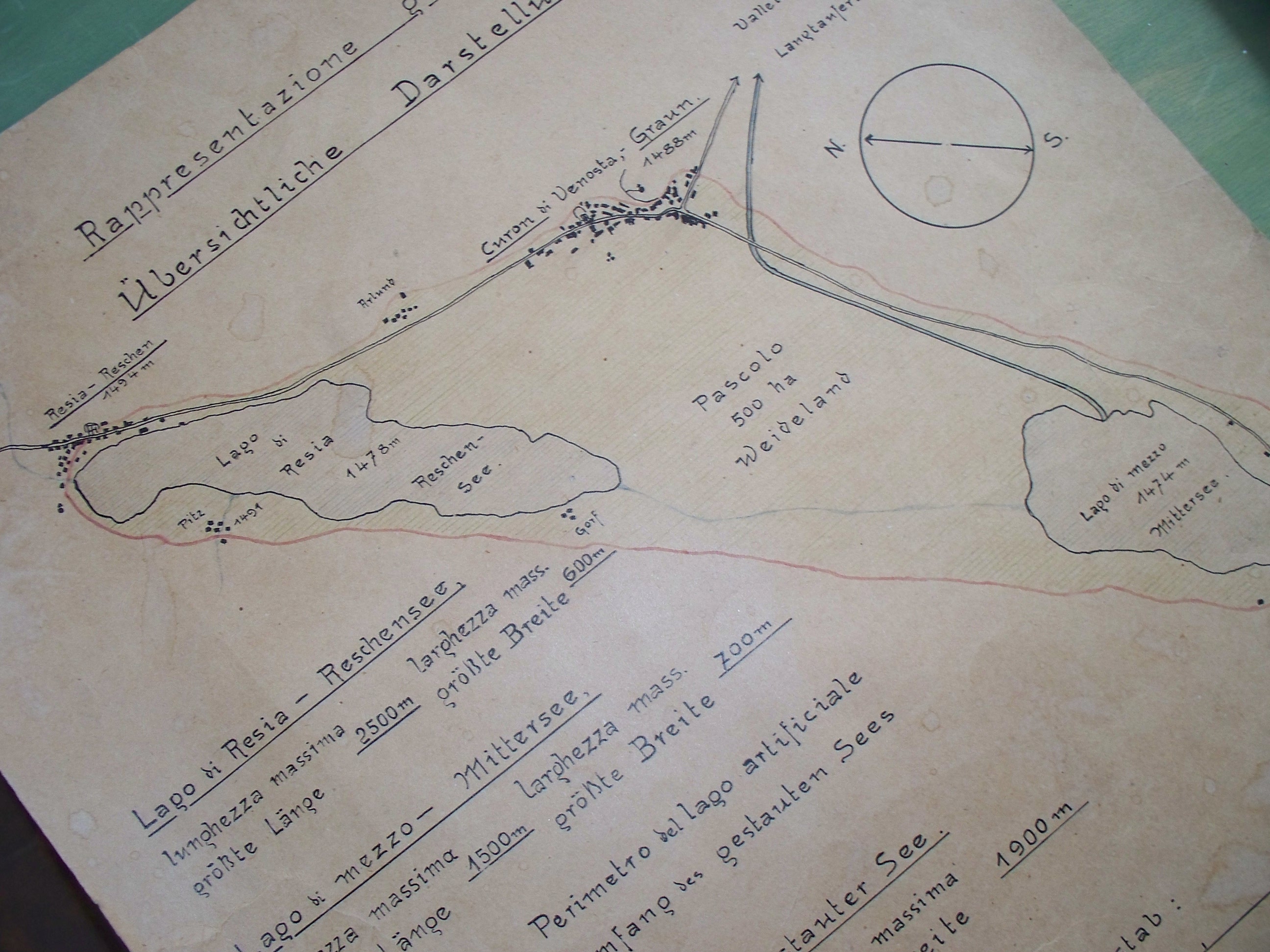
drawing of lakes area that was flooded

I live in Austria. I am one of those language learners who learns by doing. I was immersed in German, I visited South Tyrol at least three times a year (I live half-a-day’s drive away), I pulled up all my Latin language knowledge for the Italian and dug in, trying to interpret the foreign information. It took me over 10 years from the first idea to really getting a grasp on the materials. This was long before Google translator, long before DeepL. I was going with what I could and it was like putting together a million-piece jigsaw puzzle. I didn’t get to work until 2010 and gave myself exactly two weeks to plan my characters and timeline. By the end of the two weeks, I had a three-book series planned. NOT plotted, which eventually put me back quite a bit as well.

the Post Inn in the series Gasthof Trauben in real life

My greatest sources were a museum in Graun and the eye-witnesses whose accounts I recorded about the valley and the flooding in 1950. That was fantastic. One of them gave me three books: someone had gone through all the trouble of recording every single family, every house, drawing out every piece of equipment they used for farming and cooking and cleaning and living, getting down the heritage, culture and lifestyle of the valley into one book. That was amazing. I use a lot of photos when I do research. I also try to travel to the places I write about. It brings so much to life for me. Other than books and books and books, I got copies of the original letters written from the civil engineering department and the offers sent to the landowners with the ridiculous prices. I had logs of how many cows, sheep, goats, pigs, horses, acres, etc., each farmer had. I got images of the aerial maps. I used the models built by those in the Obervinschgau Valley (the real name of the Reschen Valley) who wanted to demonstrate the absolute annihilation of the valley. I panned the huge model of the towns and villages with a video camera like a filmmaker would. That does not mean I stayed true to all the facts. I put, for example, one of the rivers near Katharina’s farm because I loved the sound that river made and I felt it was important to have her near it. I adjusted the lay of the land and even made her farm up higher than it would have been, because I wanted her to have a bird’s eye view of the valley. There’s plenty I fictionalized, but much, much more that I did not and where I stayed authentic.

Eye witnesses to the flooding at the Gasthof Trauben the inspiration for Jutta Hannys Post Inn

Do you have a ‘go’ to book/resource that you couldn’t write without having to hand, and if so, what is it (if you don’t mind sharing)?

Yes, Felix Mitterer’s TV mini-series Verkaufte Heimat (Sold Homeland) was absolutely integral to my research. It provided me with plenty of inspiration and brought so much to life for me including clothing, colors, signage, how the rooms and buildings look, the feel and atmosphere, the body language differences when communicating. I study and train cross cultural communication, and so I am fascinated by how different cultures and personalities communicate; what we understand and what we meant to say, or not. I use these to concoct conflicts. By the time I’d seen the series though, I was already into the second book, The Breach, and had very similar storylines already happening based on anecdotes and eye-witness accounts from other research. 

South Tyrol in the 20th Century by Prof. Rolf Steininger and Schöne Welt, Böse Leut (Beautiful World, Evil People) by Claus Gatterer also provided me tons of material. Only about four years ago, I managed to get my hands on a doctoral thesis by Brigitte Mari Pircher specifically related to the Reschensee reservoir and the building of it. Suddenly I had all those pieces about the lake in one very compact, succinct and accessible book. She used a lot of the same resources as I had, but she because she is bilingual, she had suddenly given me access to the Italian materials as well in German, which I am fluent in now. So that was exceptionally helpful. But I’ll tell you one thing, if I hadn’t at least mastered German, this would have been a difficult story to get down.
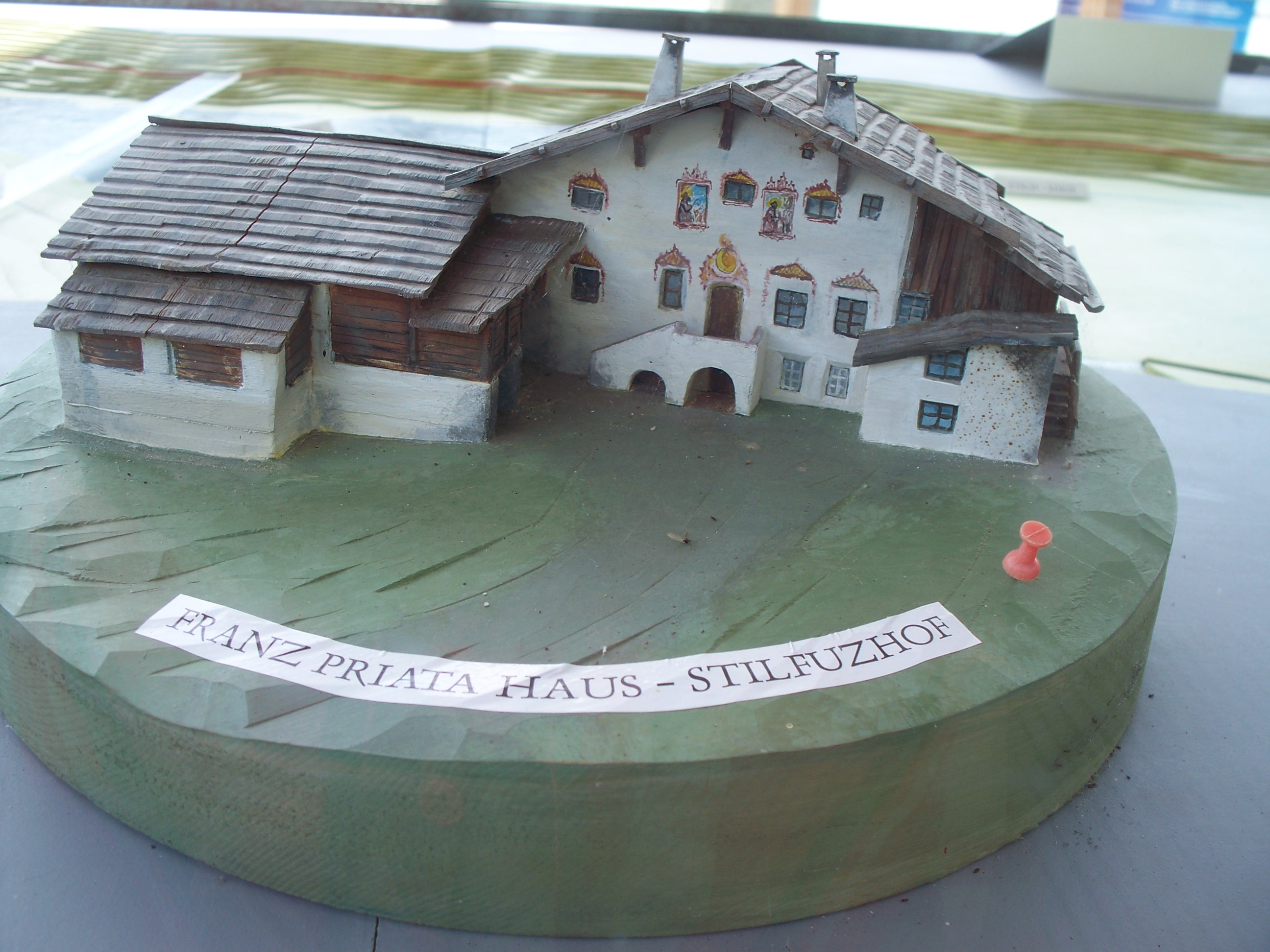
Typical South Tyrolean Hof

A couple of years ago, a South Tyrolean publisher expressed interest in translating the series. I got a ten-page questionnaire about the research and got corrected on five or six things that I had in the books (which I changed immediately) but 95% of what I confirmed and explained was spot on. It turned out that the translation costs were too high for them. Which is sad, because since then a lot of interest has been drummed up about the reservoir by both German and Italian authors, documentary filmmakers and even a Netflix series has been filmed on the Reschensee.

On a personal note, as a child I read all of the Chalet School books (they were old then), and this sounds like it follows some similar threads. I was enthralled when they had to escape from the Tyrol.

I just looked that up. That’s amazing. Sounds like the kind of series I would have devoured when I was younger!

Thank you so much for sharing your research with me. It’s fascinating.
Intrigued?

Here’s the blurb;

It’s a dangerous time to be a dissident…

1938. Northern Italy. Since saving Angelo Grimani’s life 18 years earlier, Katharina is grappling with how their lives have since been entwined. Construction on the Reschen Lake reservoir begins and the Reschen Valley community is torn apart into two fronts – those who want to stay no matter what comes, and those who hold out hope that Hitler will bring Tyrol back into the fold.

Back in Bolzano, Angelo finds one fascist politician who may have the power to help Katharina and her community, but there is a group of corrupt players eager to have a piece of him. When they realise that Angelo and Katharina are joining forces, they turn to a strategy of conquering and dividing to weaken both the community and Angelo’s efforts.

Meanwhile, the daughter Angelo shares with Katharina – Annamarie – has fled to Austria to pursue her acting career but the past she is running away from lands her directly into the arms of a new adversary: the Nazis. She goes as far as Berlin, and as far as Goebbels, to pursue her dreams, only to realise that Germany is darker than any place she’s been before.

Angelo puts aside his prejudices and seeks alliances with old enemies; Katharina finds ingenious ways to preserve what is left of her community, and Annamarie wrests herself from the black forces of Nazism with plans to return home. But when Hitler and Mussolini present the Tyroleans with “The Option”, the residents are forced to choose between Italian and German nationhood with no guarantee that they will be able to stay in Tyrol at all!

Out of the ruins of war, will they be able to find their way back to one another and pick up the pieces?

This blockbuster finale will keep readers glued to the pages. Early readers are calling it, “…engrossing”, “…enlightening” and “…both a heartbreaking and uplifting end to this incredible series!”

Universal Link Amazon Barnes and Noble 

Indigo Kobo iBooks  Mondadori  Angus & Robertson

Meet the Author

Chrystyna Lucyk-Berger is an American author living in Austria. Her focus is on historical fiction. She has been a managing editor for a magazine publishing house, has worked as an editor, and has won several awards for her travel narrative, flash fiction and short stories. She lives with her husband in a “Grizzly Adams” hut in the Alps, just as she’d always dreamt she would when she was a child.

Website • Facebook • Twitter • Instagram • LinkedIn • Goodreads • Amazon Author Page • BookBub

Don’t forget to check out the other stops on the Two Fatherlands blog tour from The Coffee Pot Book Club

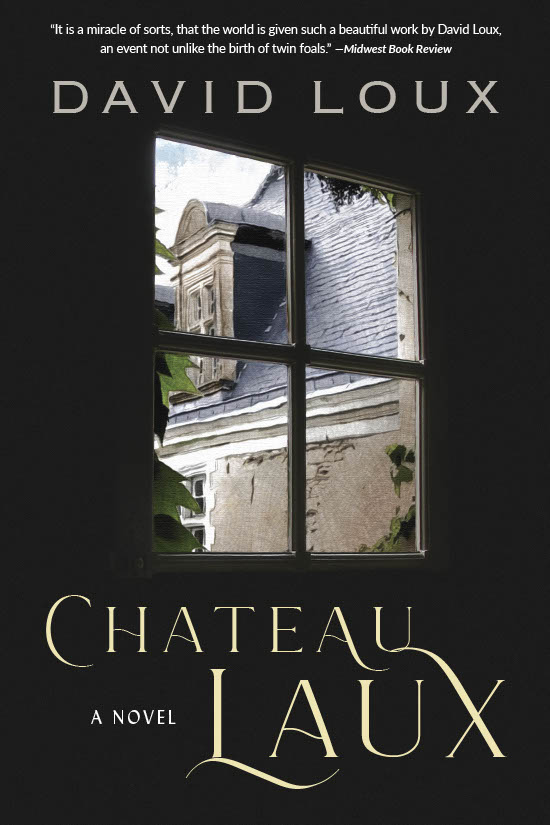
David Loux is sharing some historical research from Chateau Laux #blogtour #historicalresearch #histfic

Today I’m delighted to welcome David Loux to the blog to talk about the research for his new book, Chateau Laux.

Your book, Chateau Laux, is set in a time period I wouldn’t even know how to start writing about. As a historian first and foremost, and then a writer, I’m always interested in how people research their historical stories.

My research did not start out with a novel in mind.  It began with an investigation of the Laux family surname in 2005.  This research resulted in a lot of information related to the provenance of the name, which I presented in a paper addressed to a Laux family reunion in York, Pennsylvania, in 2010.  It subsequently provided the foundational material for Chateau Laux.

Can you explain your research process to me, and give an idea of the resources that you rely on the most (other than your imagination, of course) to bring your historical landscape to life? 

One of the challenges of historical research is that much valuable information is lost over the years—especially the good, warm-blooded stories of individual lives.  Fortunately, interest in the Laux name goes back many years, and I was able to benefit from genealogical publications in 1910 that provided information which would have been increasingly difficult to access over time.  Another very tangible benefit to my research was that the Laux name was of noble origin, which meant that I was able to discover information that went all the way back to the middle ages.  Some of the information was in French and some was in Latin, and the wonderful research assistants at the Bibliothèque Nationale were a big help.  I also benefited from connections made through the Center for Basque Studies at the University of Nevada in Reno, which put me in touch with researchers familiar with Occitan names and pronunciations.  Finally, and most importantly, family group members in southern France were able to provide information from archives that would have been unavailable from other sources.

Do you have a ‘go’ to book/resource that you couldn’t write without having to hand, and if so, what is it (if you don’t mind sharing)?

When I first started my research, I had very little idea of the milieu and other significant associations connected with the name, which means I had to keep an open mind and read anything I could get my hands on.  There were many false starts and dead ends.  As far as critical resources, I would have to say that Chateau Laux would not have been the same without the research assistance of the Bibliothèque Nationale, as they were able to provide context and authenticity that would otherwise have been elusive.  But then again, every resource previously referred to was essential in its own way. It helps that I was able to read French, and to a lesser extent, Spanish, as some of the information was only available in those languages.

Thank you so much for sharing the research you undertook to write your book. It’s so fascinating to find out what makes people write the stories that they do.

Here’s the blurb;

A young entrepreneur from a youthful Philadelphia, chances upon a French aristocrat and his family living on the edge of the frontier. Born to an unwed mother and raised by a disapproving and judgmental grandfather, he is drawn to the close-knit family. As part of his courtship of one of the patriarch’s daughters, he builds a château for her, setting in motion a sequence of events he could not have anticipated.

Amazon UK Amazon US Amazon CA

Amazon AU Barnes and Noble  Kobo

Meet the Author

David Loux is a short story writer who has published under pseudonym and served as past board member of California Poets in the Schools. Chateau Laux is his first novel. He lives in the Eastern Sierra with his wife, Lynn.

Website

Twitter

Goodreads

Amazon Author Page 

Don’t forget to check out the other stops on the Chateau Laux blog tour with The Coffee Pot Book Club.

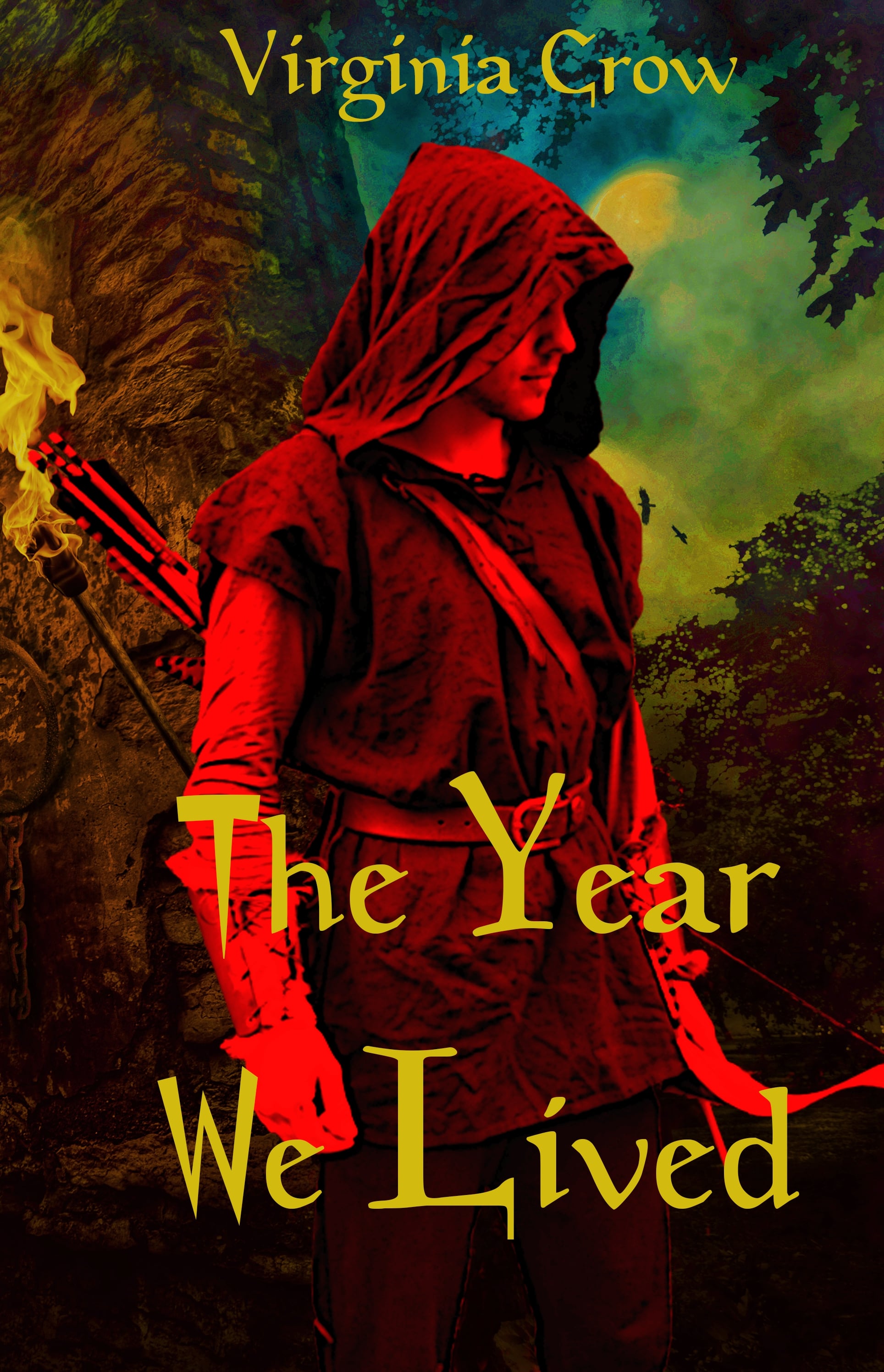
Virginia Crow is sharing historical research from The Year We Lived #blogtour #historicalresearch #histfic

Today I’m delighted to welcome Virgina Crow to the blog with a post about the historical research she undertook to write The Year We Lived.

Hello and thank you for hosting me and my book on your blog, and for inviting me to share such a fantastic topic with your readers!

I know the research process is slightly different for different writers. The first thing I have to say is that I love research! I would say that, for every statement of historical significance in my book there is about ten-times more research which has gone into the writing of it. In fact, my editor does occasionally point out to me that my readers don’t always need quite so much historiographical details!

Researching so far back in time was quite new to me. Most of the historical fiction I’ve written before has a lot more primary sources to excavate and delve into, especially in those pre-Covid days when a trip to a museum was easily available!

The first thing I had to familiarise myself with was the landscape. I’ve always been surrounded by maps – my dad has a collection of hundreds of them – and some of my favourite books as a child were a massive geography book and the Weetabix atlas! Since my dad is an out-and-out Lincolnshire yellowbelly, I have always known the changing landscape of that particular county! To look at a map of the eleventh century fenlands my characters would have known, it is startlingly different to the lay of the land in the twenty-first century!

This landscape was full of islands, which were often indistinguishable from the rest of the boggy marshes, something which made the hidden Hall in The Year We Lived a very believable concept! When I delved deeper into the case of Hereward, I realised how paranoid William the Conqueror was about the Fens and the threat they posed. It made sense to have the brutal lordship of Henry De Bois situated here in an attempt to crush what William was led to believe were a group of Saxons ready for insurrection.

Next came the characters. For this, I knew I wanted people outside the conventional image of the Normans so, on flicking through various websites and pages about the number of non-Normans on William’s side in the Battle of Hastings, I settled on the possibility of making my French characters Burgundian instead. I loved the headstrong and stubborn trait which seemed to come hand in hand with being from Burgundy, and it’s something I tucked into each of those characters.  But the French court at this time was a topic which was totally new to me. When I was studying for my MLitt, I remember my lecturer saying that it was totally acceptable to use Wikipedia as a first port of call providing you checked out everything which was on there, so this was what I did as I researched the major players.

One of the things I love the most about writing historical fiction is how, providing you read around the family and situation, you can convince your audience – and sometimes yourself – of the existence of your characters. Every single one of my Burgundians came from a real family, all of which are referenced in some sneaky way or another. I love weaving little clues into my writing, and I think doing it in a historical setting just makes it all the more fun (but then I could be biased!).

The final thing, which I found perhaps the most fascinating of all, was exploring the superstitions of the time. These were often localised but some things were pretty generally accepted.  Having been raised on a diet of myths and legends, this was something I absolutely loved exploring. Something I discovered was that many of these superstitions made sense.  A lot of them have their roots in logic, but they were without the understanding of science which we have now.  There is no shortage of these words of wisdom, many of which are still in existence today in some shape or form. Perhaps because of the oral nature of these hand-me-downs and the weirdness they relate, these were easier to place in the map and chronology of my research. I tucked into books and theses to uncover some of the most bizarre anecdotes imaginable, and nestling them into The Year We Lived – I hope – helps the plot and characters come to life.

After all, it’s our idiosyncrasies which make us unique!

Thank you so much for sharing your research with me. It’s always fascinating to discover what prompts people to write the books they do.

Here’s the blurb;

It is 1074, 8 years after the fateful Battle of Hastings. Lord Henry De Bois is determined to find the secret community of Robert, an Anglo-Saxon thane. Despite his fervour, all his attempts are met with failure.

When he captures Robert’s young sister, Edith, events are set in motion, affecting everyone involved. Edith is forced into a terrible world of cruelty and deceit, but finds friendship there too.

Will Robert ever learn why Henry hates him so much? Will Edith’s new-found friendships be enough to save her from De Bois? And who is the mysterious stranger in the reedbed who can disappear at will?

A gripping historical fiction with an astonishing twist!

Amazon UK • Amazon US • Amazon CA • Amazon AU • Barnes and Noble • Waterstones • Kobo • Smashwords • Crowvus

Meet the Author

Virginia grew up in Orkney, using the breath-taking scenery to fuel her imagination and the writing fire within her. Her favourite genres to write are fantasy and historical fiction, sometimes mixing the two together such as her newly-published book “Caledon”. She enjoys swashbuckling stories such as the Three Musketeers by Alexandre Dumas and is still waiting for a screen adaption that lives up to the book!

When she’s not writing, Virginia is usually to be found teaching music, and obtained her MLitt in “History of the Highlands and Islands” last year. She believes wholeheartedly in the power of music, especially as a tool of inspiration. She also helps out with the John O’Groats Book Festival which is celebrating its 3rd year this April.

She now lives in the far flung corner of Scotland, soaking in inspiration from the rugged cliffs and miles of sandy beaches. She loves cheese, music and films, but hates mushrooms.

Connect with Virginia

Website • Twitter • Facebook • Instagram • Publisher • BookBub • Amazon Author Page • Goodreads

Don’t forget to check out the other stops on The Year We Lived Blog Tour.

Lady Estrid is on ‘tour’ with the Coffee Pot Book Club – check out the posts so far

Lady Estrid has taken herself on tour with the fabulous Coffee Pot Book Club. She what she’s been up to, and thank you to everyone for hosting her, and the Coffee Pot Book Club for arranging.

November 2nd Mary’s Tavern (Excerpt)

November 9th Gwendalyn’s Books (Review)

November 16th Judith Arnopp’s Official Blog (Excerpt)

November 23rd Brook Allen’s Official Blog (All about the historical Lady Estrid)

November 30th Sylv.Net (Excerpt)

December 7th Madwoman in the Attic (Review)

December 14th Elizabeth St John’s Official Blog (Interview)

December 21st Let the Words Shine (Five facts you didn’t know about me)

December 28th Candlelight Reading (Excerpt)

January 4th The Writing Desk (Letter writing in the eleventh century)

Lady Estrid is available now in ebook and paperback.

Thank you to all the hosts for allowing Lady Estrid onto their blogs, and to The Coffee Pot Book Club for being so, so, so good at organising everything. Thank you.

(This post contains Amazon affiliate links, which means that at no cost to you, Amazon rewards me.)