

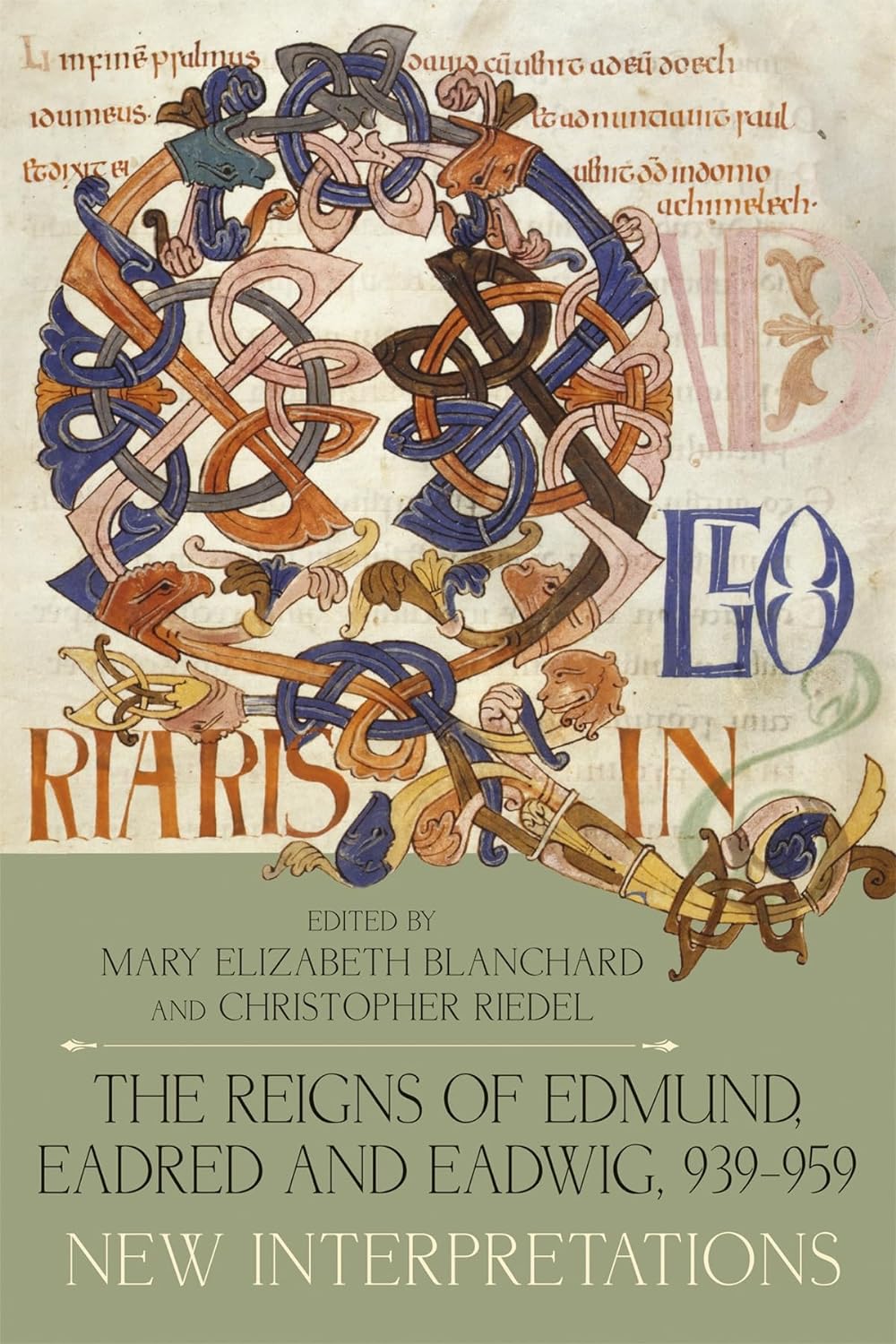
Here’s the blurb
Essays highlighting the importance of three kings – Edmund, Eadred and Eadwig – in understanding England in the tenth century.
Much scholarly attention has been devoted to both the expanding kingdom of Alfred the Great, Edward the Elder, and Æthelstan, and to the larger and integrated realm of their more distant successors, Edgar and Æthelred II. However, the English kingdom in the 940s and 950s, and its three kings, Edmund (939-946), Eadred (946-955), and Eadwig (955-959), the men who inherited and held together the kingdom created by their immediate predecessors, have been somewhat neglected, with little research being dedicated to these men as kings, or the era in which they ruled.
This volume offers a variety of approaches to the period. Its contributors bring to light royal legal innovations to ecclesiastical law, oaths, heriot, complex factional politics, including the crucial role of queens, differing perspectives on the final era of an independent northern kingdom of York, and developments in literary culture outside the domineering trend of the later monastic reformers.
https://boydellandbrewer.com/9781783277643/the-reigns-of-edmund-eadred-and-eadwig-939-959
The Reigns of Edmund, Eadred and Eawig, 939-959: New Interpretations is a fascinating collection of essays reassessing this twenty-year period in 10th century England, which is so often overlooked while historians bicker about who was the ‘better’ king Alfred or Athelstan, while casting disdain on Æthelred II. A similar collection has also been written about Edward the Elder and Edgar, while Athelstan has recently received a new monograph written by Sarah Foot.
This collection consists of nine essays concerning our understanding of these three reigns and political developments and the reputations of those involved, including Archbishop Wulfstan I of York, Eadwig and his coronation-day story, Lady Eadgifu and her second son, Eadred, alongside Edmund’s Oath of Loyalty, finishing with a consideration of how one surviving manuscript could provide illumination into the ‘before and after’ effects of the Benedictine Reformation.
All nine essays are intriguing, presenting new arguments and interpretations for the scant written record of the period.
This is a timely accounting of Edmund, Eadred, and Eadwig, and it will hopefully spark much new debate about how these three brief reigns should be considered in the wider setting of the development of the tenth century within the new kingdom of England.
This is perhaps not intended for those who’ve not studied the period before – all historians do have a tendency to fixate on the minutiae which more casual readers may not appreciate, but with no monograph entirely devoted to any of these three kings, it provides a fascinating insight into what more can be known about them from what information is available. I particularly enjoyed the chapters concerned with how the Anglo-Saxon Chronicle entries for these years may have been manipulated, potentially quite close in time to when they were written, and also the chapter re-examining the often maligned Archbishop Wulfstan I of York, and Lady Eadgifu. I always find fresh insight from collections such as this, and I’m extremely pleased it was released as I was finishing my edits on the Brunanburh Series, which of course, features King Edmund, and his younger brother and mother.
Discover more from MJ Porter
Subscribe to get the latest posts sent to your email.

 MJ Porter
One thought on “I’m reviewing a new non-fiction title: Edmund, Eadred and Eadwig, 939-959, New Interpretations ed. M.E. Blanchard and C. Riedel”