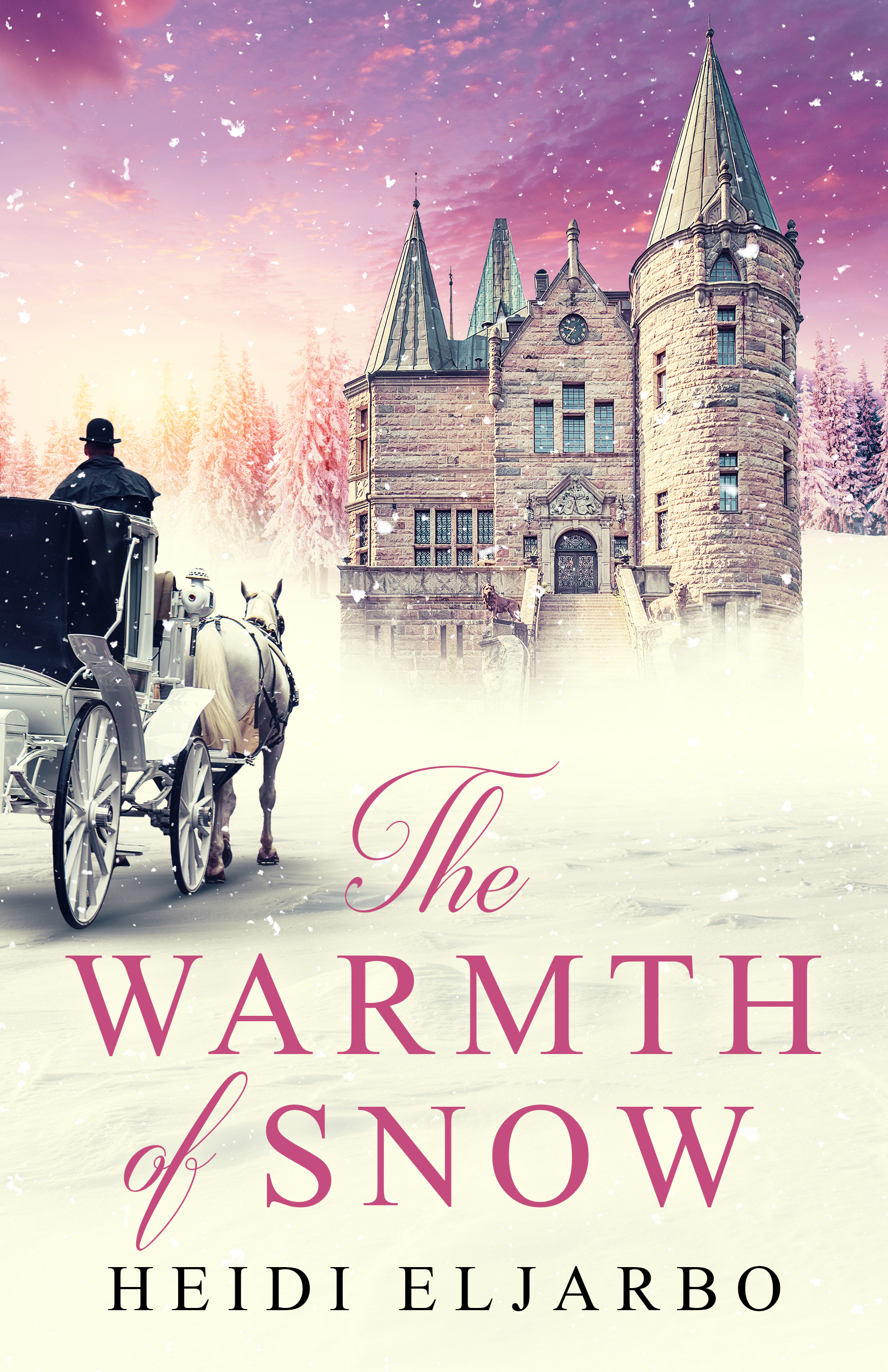
She flung the long-strapped bag on her back and helped the stableboy saddle the gray horse. Soon, she was on her way to town. The first seven cards were meant for elderly widows, gentle women Erica visited from time to time. Most of them had known her mother, and Erica gladly sat and listened to these women repeat their memories of how her sweet mother had spent time with them.
The last cottage she visited belonged to her elderly friend Ingela.
“I have one card left,” Erica said.
“Say, why don’t you ride to Castle Linborg? I heard the count returned from soldiering a while back. He used to be out and about all the time, talking to people and helping them settle disputes. He even showed up unannounced if someone was in need. But since he returned from war down in Europe, hardly anyone has seen him. His reputation as a fair and good nobleman has dwindled since he’s been away from the public eye. Now, rumors say he keeps to himself and has become both grumpy and of little use to people in our area.”
Castle Linborg? Twice Erica had received advice to go there. Although she had considered going there to spite Aunt Brita, here was the same suggestion from dear, old Ingela. The woman had been more family to her than the foursome at Holst Manor had ever been. Erica pulled the inkbottle and quill out of her bag and placed them next to the last card on the table.
“I’ll go see him then.”
“Do you dare? Will you knock on the door of an aristocrat who has the power to make your life miserable if things don’t go his way.”
Erica smiled back. “You just said the count used to be fair and good. My guess is that he still is… And although perhaps these traits are now hidden, there must be a reason for it.” She wrote his name on the back of the last card.
Count August Brandell of Linborg.
Why not try?
Here’s the blurb
There must be a way to thaw a heart long frozen. Can she help him, or does he have other plans?
Sweden 1810. August Brandell, the count of Linborg, has returned home after four years of war against the French Empire under the direction of Napoléon Bonaparte. Wounded and downtrodden, he is a meager shadow of the man he used to be. One day, a lovely young woman comes calling. She’s strong and bright and, unlike the rest, seems unaffected by his wealth and unfortunate disability. He soon discovers he wants more than a sweet friendship, but a life of caring for him would not be fair to such a beautiful soul. Oh, how dearly, deeply he loves her and secretly wants her to stay, but he cannot and will not ask such a sacrifice from her…especially not when it’s out of pity for him.
Erica Gustava Ebbesdotter has primarily been left to herself since she was orphaned at an early age. Although grateful to her aunt and uncle for taking her in, they pay her no attention and even keep her in the dark about her parents. Hearing about Count Brandell’s unfortunate fate on the battlefield, she knocks on the door at Castle Linborg to leave him a card of encouragement. Meeting Count Brandell changes Erica’s entire world. Falling for him is utterly unexpected. Soon, he fills her heart, but he is far above her station. How can a man like him see beyond her less refined clothes and past? Worst of all, he is already betrothed.
This is a sweet and wholesome historical romance—a hauntingly beautiful tale of two hearts meant to be together.
Buy Links:
This title is available to read with #KindleUnlimited.
HEIDI ELJARBO grew up in a home full of books, artwork, and happy creativity. She is the author of award-winning historical novels filled with courage, hope, mystery, adventure, and sweet romance in the midst of challenging times. She’s been named a master of dual timelines and often writes about strong-willed women of past centuries.
After living in Canada, six US states, Japan, Switzerland, and Austria, Heidi now calls Norway home. She lives with her husband on a charming island and enjoys walking their Wheaten Terrier in any kind of weather, hugging her grandchildren, and has a passion for art and history.
Her family’s chosen retreat is a mountain cabin, where they hike in the summer and ski the vast white terrain during winter.
Heidi’s favorites are her family, God’s beautiful nature, and the word whimsical.
I’m delighted to welcome Anna Belfrage to the blog with a post about her main characters.
When loving came with severe restrictions – of anti-miscegenation laws in Colonial America
In 1967, the Supreme Court of the United States unanimously concluded that state laws forbidding interracial relations were in breach of the 14th amendment to the Constitution. Mildred and Richard Loving no longer needed to worry they’d be fined or incarcerated for loving each other. 1967. Not that long ago, is it?
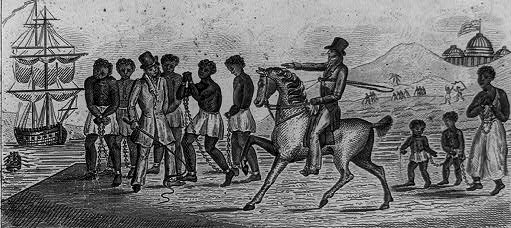
Anti-miscegenation laws were adopted by several of the British American Colonies. First in Maryland, then in Virginia, and subsequently in several others. The laws were harsh and had as their purpose to ensure the races were kept “separate”—well, beyond the obvious intermingling that occurred when a white slave owner decided to sleep with his black slave. Not that much of a problem according to the legislators, as any child born to a slave was automatically defined as a slave. Initially, the laws forbade marriage between a white person and an enslaved or indentured person of colour – probably because this would cause confusion as to the legal status of the unfree person and encroach on the property rights of said unfree person’s “owner”. Over time, the laws were expanded to include any person of colour, free or not. In some states, the laws were extremely detailed, forbidding not only relations between white and black, white and coloured, but also between black and Native American.
Obviously, these laws reflect the biases of a slave-based economy. If, on the one hand, you were arguing that people of colour were less equal than a white person—so much less equal, in fact, that it was perfectly okay to enslave them—it would be difficult to, on the other hand, welcome a person of colour as your equal in the salons of society. Not even a free person of colour could/should be treated as an equal. Yes, they were no longer slaves, but they were definitely “lesser”.
I had never fully immersed myself in researching this dark side of history until I ended up with a woman of colour as my protagonist. Initially, I didn’t even reflect on the fact that Erin Barnes was of mixed race. Yes, I’d given her a half Afghani, half British grandmother, and yes, said lady was very much in love with her black US Army veteran, but I found that aspect of Erin relatively unimportant. I was far more interested in her pursuit of justice for her murdered grandmother and her determination to use all her investigative skills to achieve this, despite the obvious risks to herself.
“You did not notice how beautiful she is?” Duncan asks, sounding shocked. “You didn’t see that her skin is like molten syrup, her hair a cloud of darkest gold?” Umm . . . No, I didn’t. Not really. And obviously, Duncan is biased—he has been since he first saw Erin.
Frankly, it wasn’t until Duncan and Erin ended up in 1715 that it struck me just how difficult life would be for her in this new time. Duncan, of course, immediately realised this, and did what he could to protect her—namely marry her. Fortunately for him, at the time they were in London, where there were no legal prohibitions to wedding someone of a different colour. There were, however, societal reservations, but Duncan didn’t much care.
After a sequence of adventures, my couple returned to Maryland—briefly. Soon enough, Duncan realised that even with the protection of his name and wealth—and that of his powerful friends—Annapolis would never tolerate this union between a white man and a woman of colour. So they moved north, to Pennsylvania.
What exactly was a white man risking by marrying a woman of colour? Well, if a white man had sexual relations with a free woman of colour (note that it was okay for a slave owner to have sexual relations with an enslaved woman of colour) and chose to live with her, they could both be indentured for decades. Should he be foolish enough to marry her, indentureship converted to enslavement—for both of them. And not necessarily together.
Despite these frightening consequences, there are documented cases of people still choosing to marry the person they loved, no matter the colour of their skin. In one of the more well-known cases, an Irish girl named Nell Butler fell in love with and married a black slave, known only as Negro Charles. She thereby became the property of her hubby’s owner, as did all their future children.
As made obvious already in the opening paragraph, anti-miscegenation laws were to remain in existence in many of the US states well into the twentieth century. And throughout all those years of prohibition, as regular as clockwork, cases would crop up where people loved so hard they were willing to face the consequences. It if wasn’t so very, very sad, it would almost be romantic.
Moving Erin and Duncan to Pennsylvania only bought them a few years of grace: in 1725 the colony of Pennsylvania pushed through their own anti-miscegenation laws. My imaginary couple must now find a new home, but sadly I suspect that wherever they go in the early 18th century they will be met by gasps and avid curiosity. A woman of colour—no matter how beautiful—did not belong with a successful white man. Not, at least, as his wife.
“Pah!” Duncan says, drawing Erin close enough to give her a resounding kiss. “What do I care what others think?”
It is not quite as easy for Erin to be dismissive of the opprobrium she so often faces. But she tries, putting on a brave face while swallowing whispered insults and insinuations. But now and then, the independent, modern Erin just can’t hold back—which at times leads to very, very difficult situations!
Thank you for sharing such an interesting post. I imagine your characters have a few tough moments to survive.
Here’s the blurb:
It is 1718 and Duncan Melville and his time traveller wife, Erin, are concentrating on building a peaceful existence for themselves and their twin daughters. Difficult to do, when they are beleaguered by enemies.
Erin Melville is not about to stand to the side and watch as a child is abused—which is how she makes deadly enemies of Hyland Nelson and his family.
Then there’s that ghost from their past, Armand Joseph Chardon, a person they were certain was dead. Apparently not. Monsieur Chardon wants revenge and his sons are tasked with making Duncan—and his wife—pay.
Things aren’t helped by the arrival of Duncan’s cousin, fleeing her abusive husband. Or the reappearance of Nicholas Farrell in their lives, as much of a warped bully now as he was when he almost beat Duncan to death years ago. Plus, their safety is constantly threatened as Erin is a woman of colour in a time and place where that could mean ostracism, enslavement or even death.
Will Duncan and Erin ever achieve their simple wish – to live and love free from fear of those who wish to destroy them?
Had Anna been allowed to choose, she’d have become a time-traveller. As this was impossible, she became a financial professional with two absorbing interests: history and writing. Anna has authored the acclaimed time travelling series The Graham Saga, set in 17th century Scotland and Maryland, as well as the equally acclaimed medieval series The King’s Greatest Enemy which is set in 14th century England.
Anna has also published The Wanderer, a fast-paced contemporary romantic suspense trilogy with paranormal and time-slip ingredients.
More recently, Anna has been hard at work with her Castilian series. The first book, His Castilian Hawk, published in 2020, is set against the complications of Edward I’s invasion of Wales, His Castilian Hawk is a story of loyalty, integrity—and love. In the second instalment, The Castilian Pomegranate, we travel with the protagonists to the complex political world of medieval Spain, while the third, Her Castilian Heart, finds our protagonists back in England—not necessarily any safer than the wilds of Spain! The fourth book, Their Castilian Orphan, is scheduled for early 2024.
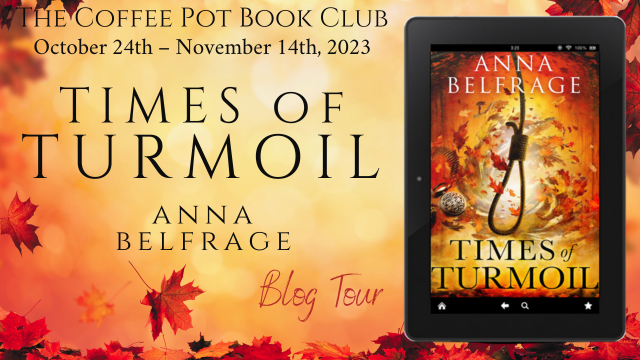
Anna has recently released Times of Turmoil, the sequel to her 2021 release, The Whirlpools of Time. Here she returns to the world of time travel. Where The Whirlpools of Time had Duncan and the somewhat reluctant time-traveller Erin navigating the complexities of the first Jacobean rebellion in Scotland, in Times of Turmoil our protagonists are in Colonial Pennsylvania, hoping for a peaceful existence. Not about to happen—not in one of Anna’s books!
All of Anna’s books have been awarded the IndieBRAG Medallion, she has several Historical Novel Society Editor’s Choices, and one of her books won the HNS Indie Award in 2015. She is also the proud recipient of various Reader’s Favorite medals as well as having won various Gold, Silver and Bronze Coffee Pot Book Club awards.
Find out more about Anna, her books and enjoy her eclectic historical blog on her website, www.annabelfrage.com
I’m delighted to be sharing an excerpt from Victoria Atamian Waterman’s new novel, Who She Left Behind.
“Marta tells me your needlelace is very lovely, and you’re a good teacher.”
“Thank you, Miss Jeppe,” Victoria said.
“It’s important to me that my girls leave here with dignity, knowing their value and confident in their abilities.”
Victoria nodded.
“It’s not enough to churn out girls who can work a loom or stitch a hem, you see. Your people, your culture, they must be preserved even as you scatter into the world. We send girls back to their families when we can. We find them marriages, but most of all we give them the gift of self-sufficiency.”
“It’s a great gift,” Victoria said. “It’s a terrible thing to feel powerless.”
Miss Jeppe dipped her chin in acknowledgment. “Authenticity and quality,” Miss Jeppe continued. “These make your products desirable, they command the best prices in the market. Fine lace and beautiful weavings bring your beautiful history to the eyes of the world and ensure your people aren’t forgotten.”
Victoria nodded again, unsure why she was singled out for this conversation. It was a speech Miss Jeppe and her volunteers made often. “Marta tells me you want to help us with our work.”
“Yes, I do.”
Victoria’s pulse skipped. This was why.
Here’s the blurb
“Who She Left Behind” is a captivating historical fiction novel that spans generations and delves into the emotional lives of its characters. Set in various time periods, from the declining days of the Ottoman Empire in Turkey in 1915 to the Armenian neighborhoods of Rhode Island and Massachusetts in the 1990s, the novel completely immerses its reader in a lesser-known era and the untold stories of the brave and resilient women who became the pillars of reconstructed communities after the Armenian Genocide.
It is a story of survival, motherhood, love, and redemption based on the recounted stories from the author’s own family history. The narrative is framed by a mysterious discovery made almost six decades later of a pair of Armenian dolls left at a gravesite.
Victoria Atamian Waterman is an Armenian American storyteller and speaker who draws inspiration from the quirky multigenerational, multilingual home in which she was raised with her grandparents, survivors of the Armenian Genocide.
Her empowerment of today’s women and girls makes her voice ideal for telling the little-known stories of yesterday’s women leaders. Her TED Talk, “Today’s Girls are Tomorrow’s Leaders” has been seen by thousands of viewers. When she is not writing and speaking, she is reading, puzzle-making and volunteering.
Victoria lives in Rhode Island and is enjoying this next chapter of life with her husband, children, and grandchildren. “Who She Left Behind” is her first novel.
I’m delighted to welcome Rebecca Rosenberg and The Champagne Widows to the blog today.
Join in on Rebecca Rosenberg’s
TREASURE HUNT!
(or, digging for research nuggets that lead to Gold!)
Did you ever make a treasure hunt or hide eggs for children? I’ve done more hunts than I can possibly remember. But, everyday I find myself digging for treasure when I’m writing a novel. I’ll use examples from my novels to explain.
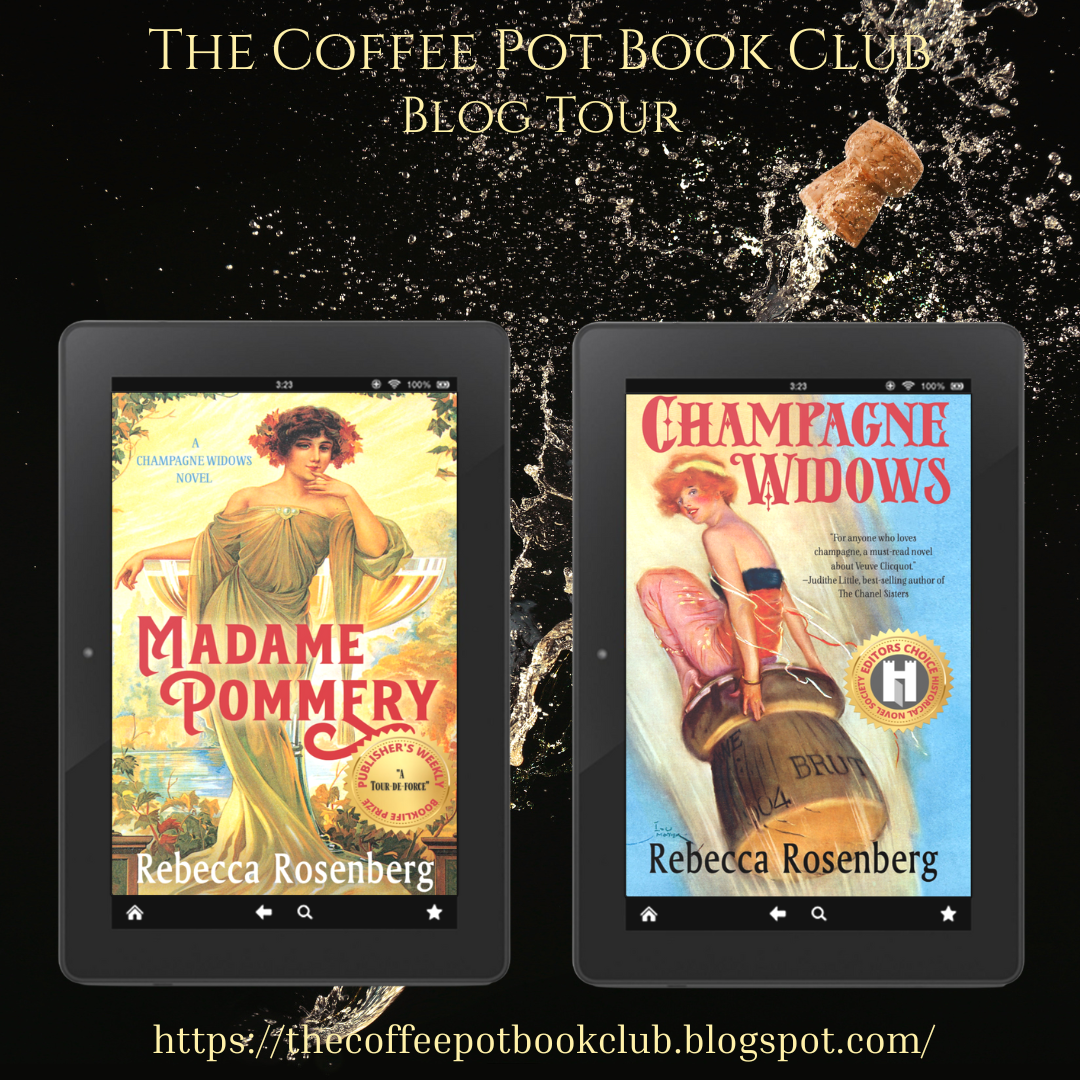
Add your own examples below in comments! We’ll choose a lucky winner for a paperback of Madame Pommery, Creator of Brut Champagne!
The Chatelaine: Have you seen a Chatelaine in a Museum? A Chatelaine, means “mistress of a castle”, and is a chain holding various and sundry household tools like sand timers, needles, thimbles, scissors, magnifying glass. Madame Pommery received a Châtelaine from her husband for her birthday, much like getting a mop or set of deluxe sponges. What does it say about their relationship and her life?
Each novel has many “props” that speak volumes about a character. It can be a personal item like a locket, or a vanity mirror with a large crack in it, or a wine-tasting cup, like Veuve Clicquot received from her great-grandmother. I also consider transportation, the environment, where the character lives, and what she wears (or doesn’t wear, as in my upcoming novel, SILVER DOLLAR) All of these can be intriguing symbols of the character and her plight.
Curse or Gift? In Champagne Widows, Barbe Nicole-Clicquot is told she has Le Nez, the Nose, an extraordinary sense of smell that makes her a great wine maker. It also makes her particular, persnickety, and difficult. Her parents say Le Nez is a curse. Her grandmother says it is a gift that will change her life by making her an extraordinary wine maker.
Character traits form a character’s personality and also sets a course for her future. An ironic character trait makes for controversial and delectable conflict and soul-searching.
Unrequited Love: I write Biographical Historical Fiction about real women who lived in our past. Inevitably there’s a love that did not work out. These are gold nuggets! Why didn’t they work out? Who was hurt? What are the consequences? Could they ever get together? And if not, how do they feel about it? All of these aspects of unrequited love add such emotion to a story.
In Madame Pommery, Creator of Brut Champagne, she hires a young intern, fifteen years younger than her, and his intelligence and helpfulness make her slowly fall in love with him, though it is quite inappropriate. She cannot marry him, or by law he’d own Pommery Champagne House. Ah, unrequited love.
Family squabbles: Families are usually an unresolved dilemma. Madame Pommery has trouble with her son who wants to run the champagne house without knowing what to do. She has trouble with her daughter because the toddler is always underfoot. Her mother is cold and unloving. Ouch! Family differences make good reading, especially when they create havoc for the protagonist. To research information about these family squabbles, I look at the available facts and extrapolate what they could mean. For example, Madame Pommery’s son is 17 when she starts the winery, and he doesn’t join the business for 5 years. Even then, he was not given an important position. And, when Madame Pommery dies, she makes her assistant the head of Pommery, not her son. Those facts add up to a gold nugget for the story.
Friend or Foe? Who can you trust? Who has an ulterior motive? In research, I look for clues about who were Madame Pommery’s business associates, friends, and foes. Then, I look for ways that their relationships can change during the book. For example, Madame Pommery’s banker helps her when her husband dies, but his ulterior motive is that he wants to be her partner.
Habits and Hobbies. I love to research quirky habits and hobbies characters can have. In Champagne Widows, Barbe-Nicole Clicquot’s father has a secret room that he works on constantly, because he doesn’t have the money to hire it done. Barbe-Nicole’s mother loves outrageous fashion and falls deathly ill from the arsenic dye. Both of these are facts that I researched about those real people!
Trials & Tribulations. What are the events of history that affect the characters? For example, in GOLD DIGGER, the Remarkable Baby Doe Tabor is about the Gold and Silver Rush in the nineteenth century, women’s right to vote, and the politics of the day, the Chinese workers imported to build the railroads and mines, then they were hated and killed. All these aspects add texture and context to the story. To research this information, I use libraries, buy books, internet searches, interview historians.
Location, Location, Location! I visit the towns or area I’m writing about and visit every home, winery, mine and theater in search of clues about the person I am writing about so I can breathe life into them on the page.
Skeletons: Everyone has skeletons in their closets, and if you can’t find them for your character, you didn’t look hard enough. The Skeleton can be a human condition like: mental illness, poverty, alcoholism. Or it can be a horrible wound the character suffered, like rape, or losing a child or an affair gone terribly wrong. Character skeletons need to be found and written on the page to make characters feel, hurt, and heal, or not.
She said What? Since I write about real people, I search for real quotes, letters and stories about them to use in building her character. Madame Pommery’s quote informed the entire book, setting the stage from where she came, what she wanted and why, and what her success would look like.
“Inevitably, I find myself in a predicament where the rules do not apply, or worse, they contradict each other.” ~Jeanne Alexandrine Pommery
~Rebecca Rosenberg, #1 Amazon Best Seller, Madame Pommery, Creator of Brut Champagne
“A tour-de-force of historical fiction, Madame Pommery is a deeply fascinating work that blends true-to-life details with artfully crafted elements.” –Publishers Weekly BookLife Prize
Madame Pommery is a story of a woman’s indomitable spirit in the face of insurmountable odds. Set in Champagne, France in 1860, Madame Pommery is a forty-year-old widow and etiquette teacher whose husband has passed away. Now she must find a way to support her family. With no experience, she decides to make champagne, but no champagne makers will teach her their craft. Undeterred, Madame Pommery begins to secretly excavate champagne caves under the Reims city dump and faces numerous obstacles to achieve her dream. From the Franco-Prussian war that conscripts her son and crew to the Prussian General Frederick Franz occupying her home, Madame Pommery perseveres. She even must choose between her champagne dreams and a marriage proposal from her former lover, a Scottish Baron. Inspired by a true story, Madame Pommery is a heroic tale of a woman’s strength and determination to create a champagne legacy. If you enjoyed the novel Sarah’s Key, you will enjoy Madame Pommery.
~~
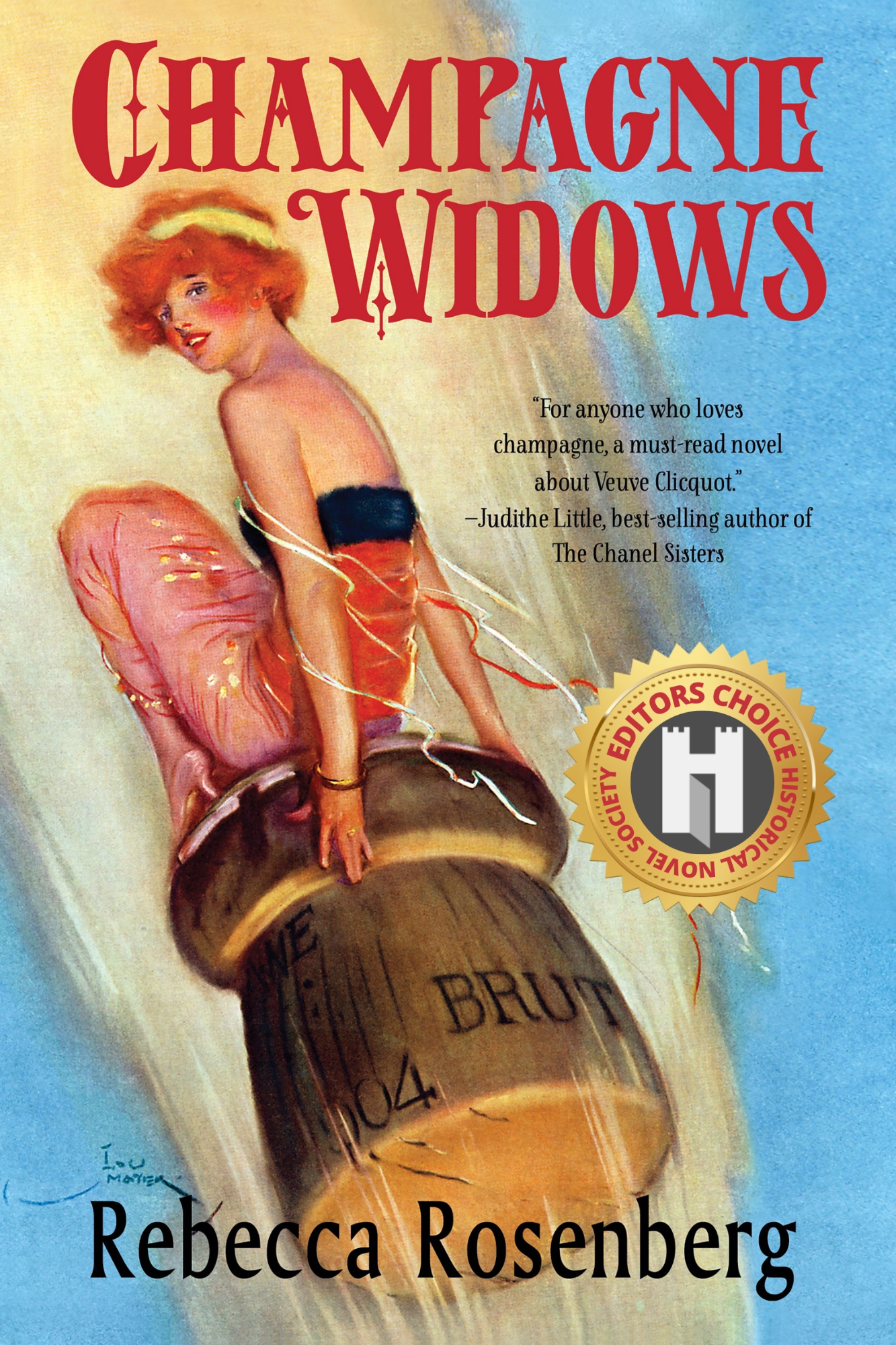
CHAMPAGNE WIDOWS, the First Woman of Champagne
EDITORS CHOICE HISTORICAL NOVEL SOCIETY This engrossing historical novel by Rebecca Rosenberg follows Veuve Clicquot, a strong-minded woman determined to defy the Napoleon Code and become a master champagne maker. In 1800 France, twenty-year-old Barbe-Nicole inherits her great-grandfather’s uncanny sense of smell and uses it to make great champagne, despite the Code prohibiting women from owning a business. When tragedy strikes and she becomes a Veuve (widow), she must grapple with a domineering partner, the complexities of making champagne, and the aftermath of six Napoleon wars. When she falls in love with her sales manager, Louis Bohne, she must choose between losing her winery to her husband to obey the Napoleon Code, or losing Louis. In the ultimate showdown, Veuve Clicquot defies Napoleon himself, risking prison and even death. If you enjoyed books like ‘The Widow of the South’ by Robert Hicks or ‘The Paris Seamstress’ by Natasha Lester, you’ll love ‘Veuve Clicquot’.
Buy Links:
These titles are available to read on #KindleUnlimited.
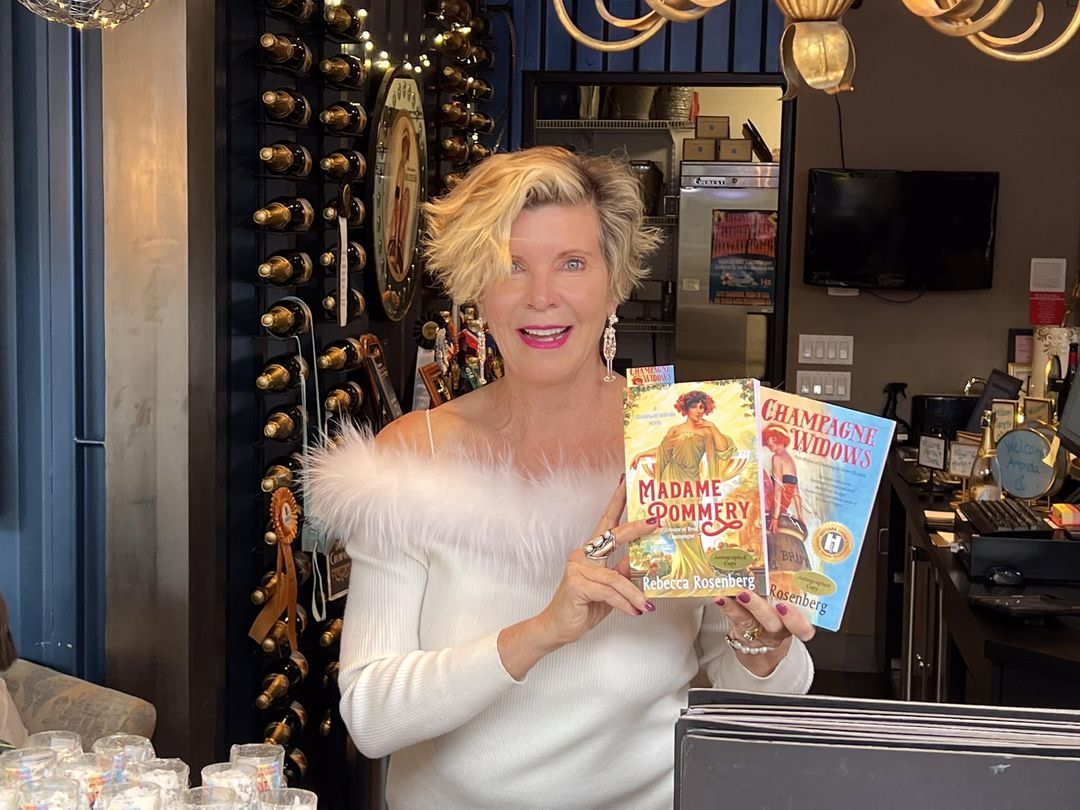
Rebecca Rosenberg is an award-winning novelist, champagne geek, and lavender farmer. Rebecca first fell in love with methode champenoise in Sonoma Valley, California. Over decades of delicious research, she has explored the wine cellars of France, Spain, Italy, and California in search of fine champagne. When Rebecca discovered the real-life stories of the Champagne Widows of France, she knew she’d dedicate years to telling the stories of these remarkable women who made champagne the worldwide phenomenon it is today.
Rebecca is a champagne historian, tour guide, and champagne cocktail expert for Breathless Wines. Other award-winning novels include The Secret Life of Mrs. London and Gold Digger, the Remarkable Baby Doe Tabor.
The Winds of Change is a story of love, loyalty and betrayal on the eve of the Spanish Civil War, when the country is political turmoil with strikes and demonstrations, unemployment is high and the people are starving.
In this complicated love triangle we meet Ramon, a member of the Republican Left, who has accidentally killed a policeman and is on the run from the Guardia Civil and Hugo, the son of the wealthy owner of a local sherry bodega. Both men are in love with Clementina, the beautiful daughter of a well-known gypsy horse trader but there are obstacles in both their paths.
Hugo finds that when he tries to see Clementina again, both his parents and hers do everything they can to stop him.
Meanwhile Ramon’s brother, Pedro, is arrested and imprisoned because he will not reveal his brother’s whereabouts to the Guardia Civil. Now Ramon has to choose between his brother and the woman he loves.
This fast moving historical novel is a story of love, politics, class prejudice, intrigue and betrayal in the year leading up to the Spanish Civil War.
Buy Links:
This title is available to read on #KindleUnlimited.
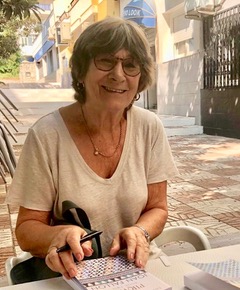
Teacher, management trainer and business woman, the Scottish-born novelist, Joan Fallon moved from the UK to Spain in 1998 and dedicated herself to full-time writing. She is now the self-published author of eighteen books, many of which are historical novels set in southern Spain, and focus on two distinct periods in the country’s history, the Spanish Civil War and Moorish Spain.
More recently she had turned her attention to writing contemporary crime fiction, with a series of novels entitled The Jacaranda Dunne Mysteries but her love of historical fiction has lured her back to writing about Spain in the 20th century in her latest novel The Winds of Change.
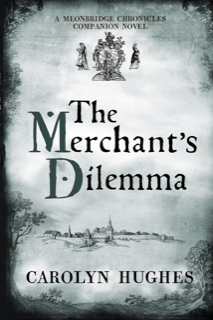
I’m delighted to welcome Carolyn Hughes and her new novel, The Merchant’s Dilemma to the blog, with an excerpt from the book.
From Chapter 1
The door to the chamber opened and then closed softly.
‘Mistress Collyton?’ said a man’s voice, very low but loud enough for Bea to know exactly whose it was. ‘Is she still asleep?’
Bea heard the old woman huff, perhaps as she started awake, then the scrape of the chair.
‘No, no,’ said Riccardo, gently, ‘there is no need to stand.’
‘Thank you, sir,’ said Mistress Collyton. ‘She comes and goes, I think, but never awake long enough for me to speak to her.’
‘It has been so many days. I wonder if she will ever fully wake? How much I wish to look into my sweet Bea’s eyes and hear her laugh.’
Bea’s heart fluttered. “Sweet Bea”? Was that truly what he said? If so, where was his wife? Surely, he’d not refer to heras his sweet if he had a wife? Well, not in his servant’s hearing…
‘It may be yet a while afore she laughs, sir,’ said Mistress Collyton, ‘even when she do come back to us.’
‘Just seeing her eyes open would do for now, when I thought I would never see my lovely girl again.’
‘Indeed, sir.’ Bea heard the old woman grunt a little and the creaking of the chair. ‘Will you stay wi’ her a moment whilst I fetch her gruel?’
‘Glad to,’ he said. The door opened and shut again, then he came over to the bed. He sat down upon it and leaned forward to touch the edge of the bedding covering most of Bea’s face.
Her heart thudded. She had only a moment to decide: was she still asleep, or should she greet the man she loved? And who still, it seemed, loved her.
As the coverlet and sheet were drawn gently back, she let her eyes flick open.
Riccardo gasped, and jerked upright. ‘You are awake.’
She smiled.
‘How do you feel?’
‘Comfortable,’ she murmured.
‘And rested? Stronger?’ His eyes were bright but also brimming with anxiety.
Her shoulders twitched in a little shrug. ‘I still hurt all over, and my head is giddy. I doubt I’d be able to walk far, but maybe I could get up before too long?’
Riccardo’s eyes crinkled. ‘Oh, Bea, I am so pleased to hear it. Of course, I am sorry you are still in pain but, with continued rest and care from Mistress Collyton, God will soon surely grant you a full recovery.’
‘Thank you for taking me in,’ she whispered.
He leaned forward again and stroked her cheek lightly with his fingers. ‘Surely you knew I would. That was why you came.’
‘I hoped you might, or that, if I died, you’d take care of my poor corpse.’
‘Thank God that was not asked of me.’ He held his hand lightly against her cheek. ‘Many weeks and months may still lie ahead of us before you are fully well, but we shall succeed.’
Tears were hovering in his eyes. ‘You must know, darling girl, how very relieved I am you have come back to me.’
She could scarce believe what he was saying. Of course, she’d hoped he’d not abandon her in her frailty. That he’d take her in; maybe even help her to recover. But what he was saying now was much more than that. It sounded as if he was expecting her to stay here, in this house – for months, maybe. And he was saying that he loved her.
‘I can see it in your eyes. How glad I am that dreadful storm drove me to your door.’ She bit her lip. ‘But I have to ask, Riccardo, where is your wife?’
A shadow passed across his face. ‘Ah, of course, you do not know. How could you? Poor Katherine died, as did our little Oliver.’
‘Oh, Riccardo, I’m so sorry––’
He held up his hand. ‘The loss of my little boy was awful.’ He looked up, his eyes moist. ‘He was perfect, you know. But Katherine struggled in the birthing of him, and the midwife said it had simply taken much too long. How I railed at the cruelty of his death…’
‘And your wife?’
He shrugged. ‘Of course, I would never have wished her dead but, in truth, Katherine was not much of a wife to me.’ He spoke it quietly. ‘I regret to say I do not miss her…’ He hung his head.
‘When was this?’ she whispered.
‘September. Not so long ago.’
‘When I came here,’ she said, ‘and found you gone, I remember thinking maybe you’d taken your wife and child out for a visit and had been caught out by the weather, unable to return. I thought I’d likely die here on your doorstep before you reached home again.’
‘In truth, Bea, I was pacing the streets of Winchester, searching for you.’ He gave her a wry grin. ‘You see, I thought I had seen you some weeks before, although the girl I saw then had looked frail and wretched. Then, that night, I was out of my wits with worry that it was you I saw, and you might be out in all that terrible wind and rain, unable to find shelter… Well, I just had to go out and look for you. I searched for hours, and was distraught when I was forced to return home without you. But then there you were, lying on my doorstep…’ He swallowed. ‘At first, I thought that I had come too late. That you were already dead. When I found you were still living, oh, Bea, you cannot imagine how thankful and relieved I was.’
His face lit up again, and her heart turned over. She surely didn’t deserve his love, yet how grateful she was to have it.
Here’s the blurb
1362. Winchester. Seven months ago, accused of bringing plague and death from Winchester, Bea Ward was hounded out of Meonbridge by her former friends and neighbours. Finding food and shelter where she could, she struggled to make her way back to Winchester again.
Yet, once she arrived, she wondered why she’d come.
For her former lover – the love of her life – Riccardo Marchaunt, had married a year ago. And she no longer had the strength to go back to her old life on the streets. Frail, destitute and homeless, she was reduced to begging. Then, in January, during a tumultuous and destructive storm, she found herself on Riccardo’s doorstep. She had no plan, beyond hoping he might help her, or at least provide a final resting place for her poor body.
When Bea awakes to find she’s lying in Riccardo’s bed once more, she’s thankful, thrilled, but mystified. But she soon learns that his wife died four months ago, along with their newborn son, and finds too that Riccardo loves her now as much as he ever did, and wants to make her his wife. But can he? And, even if he can, could she ever really be a proper merchant’s wife?
Riccardo could not have been more relieved to find Bea still alive, when he thought he had lost her forever. She had been close to death, but is now recovering her health. He adores her and wants her to be his wife. But how? His father would forbid such an “unfitting” match, on pain of denying him his inheritance. And what would his fellow merchants think of it? And their haughty wives?
Yet, Riccardo is determined that Bea will be his wife. He has to find a solution to his dilemma… With the help of his beloved mother, Emilia, and her close friend, Cecily, he hatches a plan to make it happen.
But even the best laid plans sometimes go awry. And the path of love never did run smooth…
The Merchant’s Dilemma is a companion novel to the main series of Meonbridge Chronicles, and continues the story of Bea and Riccardo after the end of the fourth Chronicle, Children’s Fate. It is a little more romantic and light-hearted than the other Chronicles but, if you’ve enjoyed reading about the lives of the characters of Meonbridge, you will almost certainly enjoy reading The Merchant’s Dilemma too!
Buy Links
This title is available to read on #KindleUnlimited.
Carolyn Hughes has lived much of her life in Hampshire. With a first degree in Classics and English, she started working life as a computer programmer, then a very new profession. But it was technical authoring that later proved her vocation, word-smithing for many different clients, including banks, an international hotel group and medical instruments manufacturers.
Although she wrote creatively on and off for most of her adult life, it was not until her children flew the nest that writing historical fiction took centre stage. But why historical fiction? Serendipity!
Seeking inspiration for what to write for her Creative Writing Masters, she discovered the handwritten draft, begun in her twenties, of a novel, set in 14th century rural England… Intrigued by the period and setting, she realised that, by writing a novel set in the period, she’d be able to both learn more about the medieval past and interpret it, which seemed like a thrilling thing to do. A few days later, the first Meonbridge Chronicle, Fortune’s Wheel, was under way.
Six published books later (with more to come), Carolyn does now think of herself as an Historical Novelist. And she wouldn’t have it any other way…
Carolyn has a Master’s in Creative Writing from Portsmouth University and a PhD from the University of Southampton.
You can connect with Carolyn through her website www.carolynhughesauthor.com and social media.
I’m delighted to welcome David Fitz-Gerald to the blog with an excerpt from his new historical thriller, If It’s The Last Thing I Do
From Chapter 6
On Thursday morning, Stanley asked me if he could borrow a couple of hundred dollars until next week. He said he had made some miscalculations. His checkbook didn’t add up straight and he didn’t have any savings. I asked him if two hundred dollars would get him through, and he assured me that it would.
Doyle Polk was coming up the sidewalk as I pulled my wallet from my purse and handed cash to the night watchman. I glanced at the general manager and saw his frown, and in that instant, I knew he didn’t approve and I was going to hear about it. I didn’t have long to wait. Stanley’s Plymouth had barely left the parking lot when Doyle confronted me. “What are you doing, giving that man money?”
I felt my face tighten defensively. “He said he needed money, so I agreed to help him until next week.”
“And what will you do next week when he needs money for something else, Lady Fingers?”
“I don’t know, Doyle. I guess I’ll worry about that next week.”
“And what will you do when Stanley’s coworkers find out you lent Stanley some money? Won’t be long and you’ll be making dozens of loans.”
“Good heavens, Doyle. I never met anyone with such a dismal outlook.”
“You don’t know these guys like I do, Misty. Give ’em an inch, they’ll take a mile. Give ’em a dime, they’ll steal a dollar, and ask you for change for a twenty.”
“How did you get to be so jaded?”
“Did I mention I’ve been here for a long time? When I started out, I lent a guy a hundred dollars. Just like I said, before I knew it, everybody was asking me for money. I felt like a flippin’ bank. Learned my lesson and stopped that right away. These guys lead a hardscrabble life, Misty. They go from one emergency to the next as fast as you turn the pages in the Lake Placid News. You gotta harden yourself to it. You’ve heard the story about the swimmer drowning the lifeguard, ain’t you? If you get too close to ’em, they’ll drag you underwater. Gotta stay aloof. That’s what I always say. Unless you gonna give everybody two hundred dollars, don’t give anybody money.”
Here’s the blurb
It’s 1975, and Misty Menard unexpectedly inherits her father’s business in Lake Placid, New York. It never occurred to her that she could wind up as the CEO of a good old-fashioned manufacturing company.
After years of working for lawyers, Misty knows a few things about the law. Her favorite young attorney is making a name for himself, helping traditionally owned companies become employee owned, using a little-known, newly-passed law. When he offers to help Misty convert Adirondack Dowel into an ESOP, pro bono, Misty jumps at the chance.
The employees are stunned, the management team becomes hostile, and the Board of Directors is concerned. Misfortune quickly follows the business transformation. A big customer files for bankruptcy. A catastrophic ice jam floods the business. Stagflation freezes the economy. A mysterious shrouded foe plots revenge. Misty’s family faces a crisis. The Trustee is convinced something fishy is going on, the appraiser keeps lowering the company’s value, and the banker demands additional capital infusions. Misty thought she had left her smoking addiction and alcoholism in the past, but when a worker’s finger is severed in an industrial accident, Misty relapses.
Disasters threaten to doom the troubled company. After surviving two world wars and the Great Depression, it breaks Misty’s heart to think that she has destroyed her father’s company. All she wants is to cement her father’s legacy and take care of the people who built the iconic local business. Can a quirky CEO and her loyal band of dedicated employee owners save an heirloom company from foreclosure, repossession, and bankruptcy?
Get your copy of the thrilling If It’s the Last Thing I Do now… if it’s the last thing you do!
David Fitz-Gerald writes historical fiction in his spare time, with the hope of transporting readers to another time and place.
If It’s the Last Thing I Do is his 7th novel.
Dave has worked for more than 30 years as an accountant, employee owner, and member of the management team at a “silver” ESOP (employee-owned) company. He has championed the cause in national, non-profit association leadership roles.
Dave’s family roots run deep in the Adirondacks, going back generations. He attended college and worked at a deli in Saranac Lake during the 1980s. He spent two summers as an elf at Santa’s Workshop on Whiteface Mountain in the 1970s and is an Adirondack 46-er, which means he has hiked all of New York’s highest peaks.
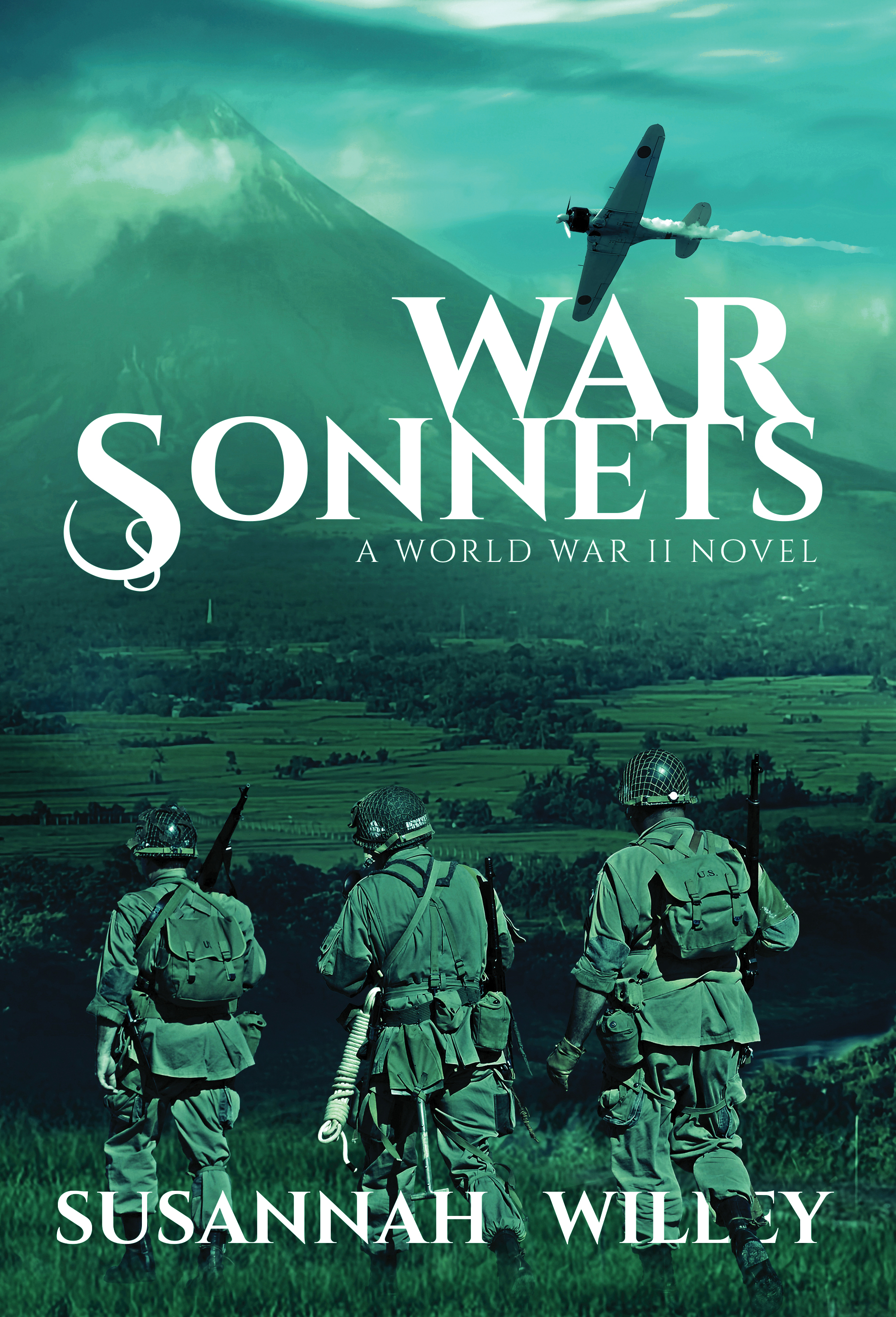
I’m delighted to be sharing an excerpt from War Sonnets by Susannah Willey.
ASSAULT FORCE
The sea is calm; upon its boundless deep
Our troopship glides, lost in infinity.
Beneath her decks two thousand soldiers sleep,
Or, waking, wonder what their fate will be.
From my assigned position here on high
I peer ahead, and in the east I see
The dawn’s pale fingers clawing at the sky,
And then, a speck of land. The enemy
Will not be sleeping.
Now the troops are out
And stand in little groups beside each boat.
The gunship’s roar drowns out the sergeant’s shout.
Rope ladders fall, the LCIs, afloat,
Receive two thousand men in war array.
Each boat, full loaded, quickly moves away.
CHAPTER 18
PHILIPPINE SEA—JANUARY 31, 1945
Leo sat against a pile of life rafts, his knees bent to support the letter he was writing. Dooley perched on a pile of rafts next to him with a handful of Aussie sailors. Their ship, the Australian transport Westralia, was part of a large convoy escorted by agile destroyers. …
“I could spend the rest of the war right here.” Dooley patted the life raft. “Whatcha think, Yankee boy?” Ever since they’d left New Guinea, Dooley had acted like his outburst at Leo’s promotion had never happened.
Leo set down his pen and took a moment to stretch his arms. “I think I’d rather be almost anywhere but on a ship.”
Dooley took a last, deep drag on his cigarette. “With our luck,” he said, exhaling smoke through his nostrils, “we’ll get sunk by a submarine before we get to Luzon.” He flicked his cigarette into the water.
“Not funny.” Leo growled.
“More likely some crazy kamikaze,” an Aussie sailor said, “locked into a bomb-loaded plane they call an Okha. But Baka is more like it: a bloody fool.” His fellow seamen snickered.
“Those mates are crazy.” The sailor propped himself up on one elbow. “One of ’em nearly sent us to kingdom come a couple months ago.” He glanced at his fellow Aussies. “Ain’t that right, mates?”
“Yeah, up in Leyte,” said another. “Missed us by a wallaby’s tail.” He held up his thumb and forefinger, an inch apart.
“About eight of them just dropped from the clouds.” The Aussie launched into his story. “Before you could blink, one of them crashed head-on into one of our carriers. Our mates couldn’t do anything but watch.”
Sitting on the open deck, Leo felt exposed. He subconsciously scanned the sky for enemy planes, strained to hear their engines. His brain struggled with an indistinct image of planes impacting with ships—something he’d really rather not imagine.
“Instead of cats and dogs, it was raining planes and bodies, machine-gun fire and bombs. Seemed like those bloody bastards were hell-bent on dying.”
One of his mates picked up the story. “The ship next to us got clobbered. Bloody Baka took out half the crew. Men flyin’ through the air like rag dolls, others stuck with shrapnel. They said the deck was covered with Jap guts and brains, all kinds of body parts and plane wreckage.”
That was something Leo couldn’t begin to imagine, and he was grateful for that. He dang sure didn’t want to get obsessed about being split into pieces by a kamikaze. “Sitting ducks” was a perfect description of their situation out here in the middle of the ocean. Except a duck was a lot harder to hit than a troopship.
The Aussie storyteller looked at Dooley. “You should’ve seen it, Yank. Helluva mess.”
Dooley bristled at that last remark. “Don’t call me a Yank.”
One of the Australian soldiers snickered. “Well, that accent of yours sure ain’t Brit.”
Dooley jumped to the deck, fists clenched at his sides. “You can call Sergeant Baldwin here a Yank cause he’s a northerner. But I’m from Loo-siana, and where I come from, calling a southern boy a Yank is fightin’ words.”
The Aussie held up a hand. “Don’t go getting your civvies wrinkled, mate. It’s just what we call Americans.”
“American’s full of goddamned mongrels, and I ain’t one of them,” Dooley growled. “We got Russkies and Polacks, Wops—and Yankees.” He spat out the word as if it was the sourest bit of vomit. “We got so many Nips they had to build prison camps to keep ’em outta our hair. And that don’t even count the spics and ni—”
Leo had about enough of Dooley’s bragging and bigotry. He held his hand out for Dooley to stop. “Yeah, we get it. You southern boys are some kind of special all right.”
Dooley glared at Leo and started pacing. “All’s I’m sayin’”—his deep southern drawl thickened as he stopped and pointed an accusing finger at the Aussie—”is don’t put me in the same kennel with the mutts.”
The sailor put up his hands in a defensive gesture. “Slow down and speak English, mate. Whatever language you’re talkin’ sounds more like Chinese.”
“Ain’t no goddamned Chink, mate.”Dooley put up his fists, took a step toward the rafts.
The Aussie jumped off the raft, ready to fight. “You ain’t winnin’ this fight, Yank.”
Dooley snarled and lunged toward the Aussie sailor, who raised his fists and took a step toward Dooley.
“Come on, fellas.” Leo didn’t want any part of this fight. Dooley was being a jerk, and it embarrassed Leo. He stepped between the two men, cautiously put a hand on Dooley’s chest. “You’re making this a bigger deal than it oughta be. Step back and cool off a minute.”
Dooley glared, but what Leo noticed was beyond Dooley: a cloud of smoke bursting from a destroyer escort in the near distance. In seconds, the air boomed with the report of multiple firing K-guns.
The harsh tones of the General Quarters alarm sent the men on the life rafts scrambling. As troops en route to the front lines, they weren’t much more than cargo—there was nothing for them to do but hide.
Adrenaline surged through Leo’s body as his brain went to work. K-guns fired depth charges. Depth charges meant enemy subs. Enemy subs meant torpedoes—likely the ones the Japs called kaitens, manned suicide bombs not unlike the kamikaze planes. They were notoriously inaccurate, but how accurate did a danged torpedo have to be? His mind was spinning out of control even as he fought to stay calm.
“Leo!” Dooley shouted from under the pile of life rafts and gestured for Leo to join him.
Dooley’s shout got his attention.
Leo’s instincts took over. He looked across the ship’s deck, crowded with frantic soldiers trying to find their way, being pushed and shoved by the ship’s crew trying to do their jobs.
“Come on, Yank.” Dooley’s voice was strained and insistent. “Get in here.”
Leo scrambled under the life rafts, pushing his way well back into the pile.
All sound was muffled now, the incessant alarm, the boom of exploding missiles, the shouts of men who hadn’t yet found cover. The skirmish sounded deceptively far away.
Leo’s heart pounded. Every breath took effort in the suffocating enclosure created by the life rafts. Was that a plane he’d heard? He struggled to shut out the noise and concentrate. His body tensed, waiting for the explosion that would collapse the deck underneath him. He struggled to breathe.
This was too soon. They weren’t supposed to fight until Luzon.
Leo thought about his future, his belief that hard work and ethics were all it took to be a success. He hadn’t counted on random things like kamikaze and kaiten. He hadn’t faced the fact that life and death didn’t take sides. He wiped the sweat from his forehead, forced himself to slow his breathing.
I’m not ready to die. Not yet.
At last, the battleships went quiet, the General Quarters alarm stilled, and the order came to stand down.
Leo pulled himself from his hiding place, watching as soldiers slowly emerged from where they had taken cover. Many of them had merely lain prone on deck with their hands covering their head.
“Holy shit.” Dooley slipped out from under the life rafts. “What in hell was that?”
Leo’s hands still trembled as he brushed off his fatigues. “Too close is what that was.” He scanned the ships in the convoy. “Doesn’t look like anyone took any damage.”
Dooley stood and turned in a slow circle as he surveyed the ships. Leo noticed that Dooley’s hands trembled almost as much as his own. The sea was quiet now, the sun bright on the water as each ship sailed on its own reflection. Neither Leo nor Dooley felt compelled to disrupt the calm.
At last, Dooley completed his rounds and turned to Leo. “Yankee boy, I think we’re at war.”
Here’s the blurb
1942: In the war-torn jungles of Luzon, two soldiers scout the landscape. Under ordinary circumstances they might be friends, but in the hostile environment of World War II, they are mortal enemies.
Leal Baldwin, a US Army sergeant, writes sonnets. His sights are set on serving his country honorably and returning home in one piece. But the enemy is not always Japanese…Dooley wants Leo’s job, and he’ll do whatever it takes to get it…Leo finds himself fighting for his reputation and freedom.
Lieutenant Tadashi Abukara prefers haiku. He has vowed to serve his emperor honorably, but finds himself fighting a losing battle. Through combat, starvation, and the threat of cannibalism, Tadashi’s only thought is of survival and return to his beloved wife and son. As Leo and Tadashi discover the humanity of the other side and the questionable moral acts committed by their own, they begin to ask themselves why they are here at all. When they at last meet in the jungles of Luzon, only one will survive, but their poetry will live forever.
Susannah Willey is a baby boomer, mother of four, grandmother of three, and a recovering nerd. To facilitate her healing, she writes novels. In past lives, she has been an office assistant, stay-at-home-mom, Special Education Teaching Assistant, School Technology Coordinator, and Emergency Medical Technician. She holds a Bachelor’s Degree in Instructional Computing from S.U.N.Y. Empire State College, and a Master’s Degree in Instructional Design from Boise State University.
Susannah grew up in the New York boondocks and currently lives in Central New York with her companion, Charlie, their dogs, Magenta and Georgie, and Jelly Bean the cat.
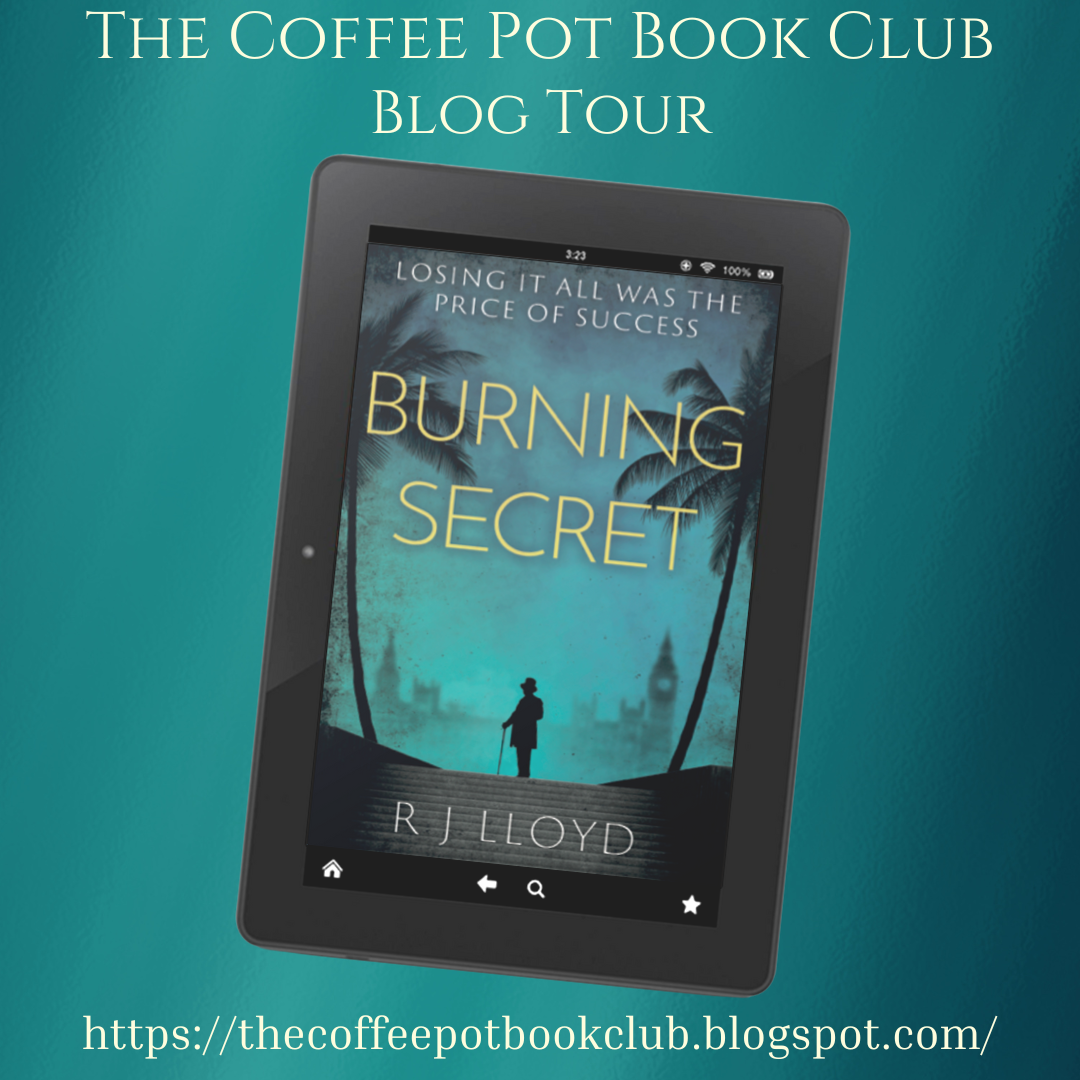
I’m delighted to welcome RJ Lloyd to the blog with a guest post about his new book, Burning Secret.
Burning Secret is a true story. Well, almost. The novel blurs the lines between fact and fiction as it reconstructs the real life of Enoch Price, my great-great-grandfather, and is a story many can relate to through their ancestors and family histories.
Set at the end of the nineteenth century, it spans the ocean from the squalor of Victorian London to the frontier town of Jacksonville, Florida, where civic life struggled to recover from the American Civil War and the end of slavery.
The novel operates on several levels: as a fast-paced thriller with plenty of derring-do, a morality tale of good vs. greed, and how life can easily corrupt the pursuit of happiness. Some have even suggested that underneath it all lies a tragic love story.
Burning Secret took eleven years to research and write, and the more I researched, the more I realised how much more I needed to explore. In 1881, Enoch was listed in the London Gazette as a bankrupt and destined for two years in the debtors’ prison, from which few emerged unscathed. Abandoning his wife and three young daughters, he made for Florida. It was here, in Jacksonville, with his newly created identity of Harry Mason, that he carved out his future, and, by hook or by crook, he amassed a fortune and became a powerful politician. While all of this time, his wife and daughters in England, entirely ignorant of his new persona, languished in poverty.
Researching Harry Mason in Florida required patience and persistent work. Some basic information came from the public records in Jacksonville and Tallahassee, where the librarians and archivists were exceptionally helpful.
Sixteen years after stepping ashore, homeless and destitute, Harry was elected on 15 June 1897 to the Jacksonville City Council, representing the eighth ward of Ortega, Venetia and Avondale, and in 1903, was elected to the Florida State House of Representatives, where the only surviving photograph of him is archived.
From his arrival in 1881, the Jacksonville annual trade directories trace Harry as a bartender at The European House, a bar in the Dutch style run by Nicky Arend at 80– 82 West Bay.
Several academic records held by Florida’s universities mention his involvement in Jacksonville’s 1888 deadly outbreak of Yellow Fever. He again appears in 1901, when the city was razed to the ground by the Great Fire of Jacksonville.
There are several public records and court transcripts, some held in the United States Library of Congress, which cite Harry as the promoter who, against fierce public opposition, brought the 1894 World Heavyweight Boxing Championship fight between Gentleman Jim Corbett and Charlie Mitchell to Jacksonville.
His most outstanding achievement was building the Hotel Mason, at the junction of Bay and Julia Streets, Jacksonville, which opened on 31 December 1913. The largest and most opulent hotel in Florida (demolished in 1978).
Harry, aged 75 years, died on 5 November 1919 at his home, the Villa Alexandria, near the junction of River Road and Arbor Lane in the district of San Marco. The Mitchell family originally built the extensive, almost palatial, villa in the 1870s, which came into Harry’s ownership in somewhat opaque circumstances. Long after his death, the Florida Supreme Court recorded several legal challenges to his ownership.
Indeed, based on his bigamous marriage in Jacksonville in April 1883 to Bessie Nolan, his three English daughters from his first marriage to Eliza challenged his last will in the American courts.
What an amazing story.Thank you so much for sharing.
Here’s the blurb
Inspired by actual events, Burning Secret is a dramatic and compelling tale of ambition, lies and betrayal.
Born in the slums of Bristol in 1844, Enoch Price seems destined for a life of poverty and hardship-but he’s determined not to accept his lot.
Enoch becomes a bare-knuckle fighter in London’s criminal underworld. But in a city where there’s no place for honest dealing, a cruel loan shark cheats him, leaving Enoch penniless and facing imprisonment.
Undaunted, he escapes to a new life in America and embarks on a series of audacious exploits. But even as he helps shape history, Enoch is not content. Tormented by his past and the life he left behind, Enoch soon becomes entangled in a web of lies and secrets.
Will he ever break free and find the happiness he craves?
Influenced by real people and events, Enoch’s remarkable story is one of adventure, daring, political power, deceit and, in the end, the search for redemption and forgiveness.
After retiring as a senior police officer, R J Lloyd turned his detective skills to genealogy, tracing his family history to the 16th century. However, after 15 years of extensive research, he couldn’t track down his great-great-grandfather, Enoch Price, whose wife, Eliza, had, in living memory, helped raise his mother. It was his cousin Gillian who, after several more dead-ends, called one day to say that she had found him through a fluke encounter. Susan Sperry from California, who had recently retired, decided to explore the box of documents given to her thirty years before by her mother, which she had never opened. In the box, she found some references to her great grandfather, Harry Mason, a wealthy hotel owner from Florida who had died in 1919. It soon transpired that Susan’s great grandfather, Harry Mason, was, in fact, Enoch Price.
From this single thread, the extraordinary story of Harry Mason began to unravel, leading R J Lloyd to visit the States to meet his newly discovered American cousins, and it was Susan Sperry and Kimberly Mason, direct descendants, who persuaded R J Lloyd to write the extraordinary story of their ancestor.
R J Lloyd graduated from the University of Warwick with a degree in Philosophy and Psychology and a Masters in Marketing from UWE. Since leaving a thirty-year career in policing, he’s been a non-executive director with the NHS, social housing, and other charities. He lives with his wife in Bristol, spending his time travelling, writing and producing delicious plum jam from the trees on his award-winning allotment.
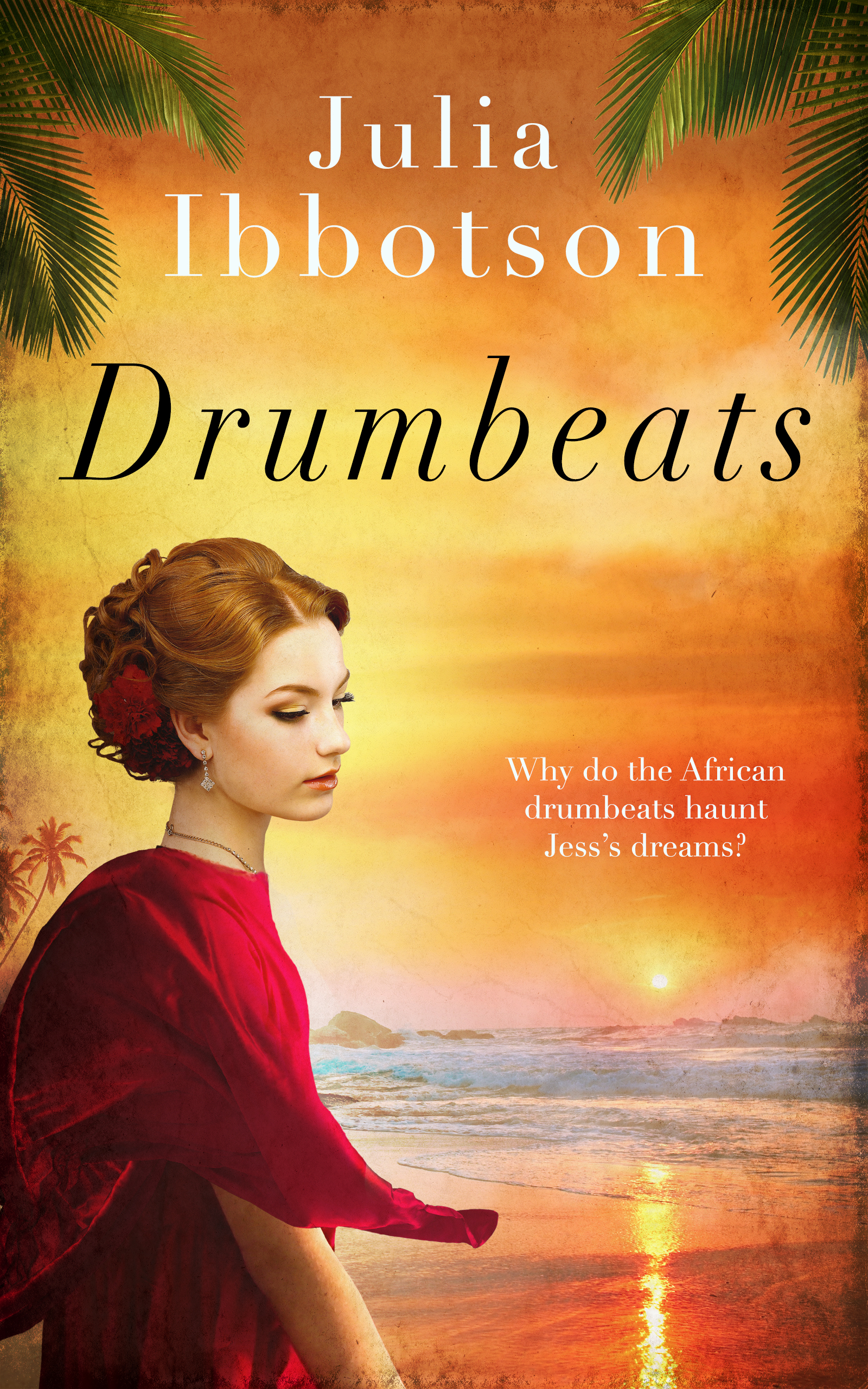
I’m delighted to welcome Julia Ibbotson to the blog with her book, Drumbeats
Here’s the blurb
It’s 1965, and 18 year old Jess escapes her stifling English home for a gap year in Ghana, West Africa. But it’s a time of political turbulence across the region. Fighting to keep her young love who waits back in England, she’s thrown into the physical and emotional dangers of civil war, tragedy and the conflict of a disturbing new relationship. And why do the drumbeats haunt her dreams?
This is a rite of passage story which takes the reader hand in hand with Jess on her journey towards the complexities and mysteries of a disconcerting adult world.
This is the first novel in the acclaimed Drumbeats trilogy: Drumbeats, Walking in the Rain, Finding Jess.
For fans of Dinah Jefferies, Kate Morton, Rachel Hore, Jenny Ashcroft
Buy Links
This title is available to read on #KindleUnlimited.
Award-winning author Julia Ibbotson herself spent an exciting time in Ghana, West Africa, teaching and nursing (like Jess in her books), and always vowed to write about the country and its past. And so, the Drumbeats Trilogy was born. She’s also fascinated by history, especially by the medieval world, and concepts of time travel, and has written haunting time-slips of romance and mystery partly set in the Anglo-Saxon period.
She studied English at Keele University, England, specialising in medieval language, literature and history, and has a PhD in linguistics. She wrote her first novel at age 10, but became a school teacher, then university lecturer and researcher. Her love of writing never left her and to date she’s written 9 books, with a 10th on the way.
Julia is a member of the Romantic Novelists Association, Society of Authors and the Historical Novel Society.































 MJ Porter