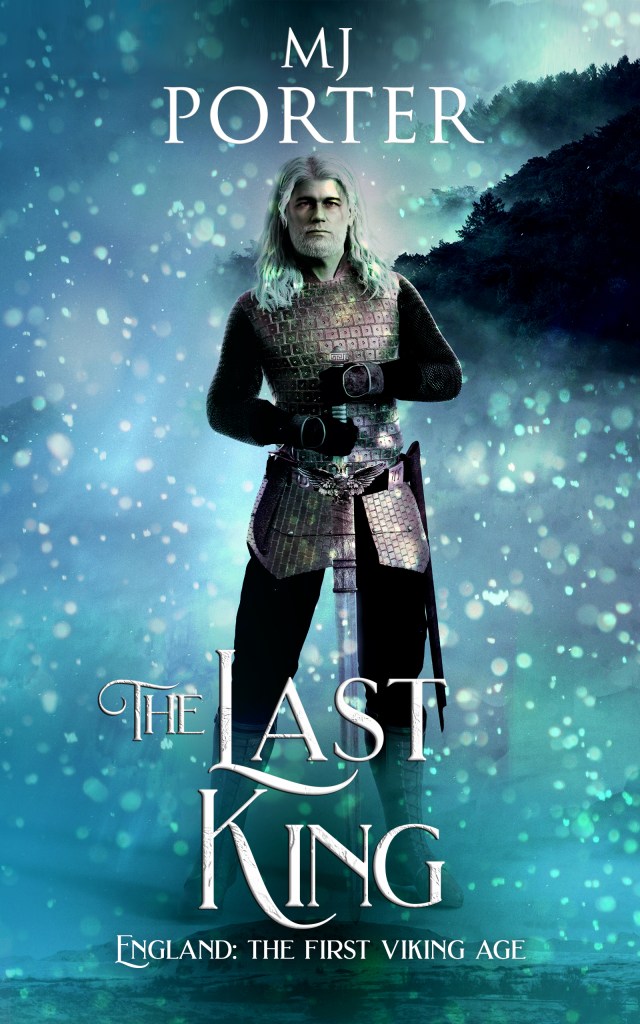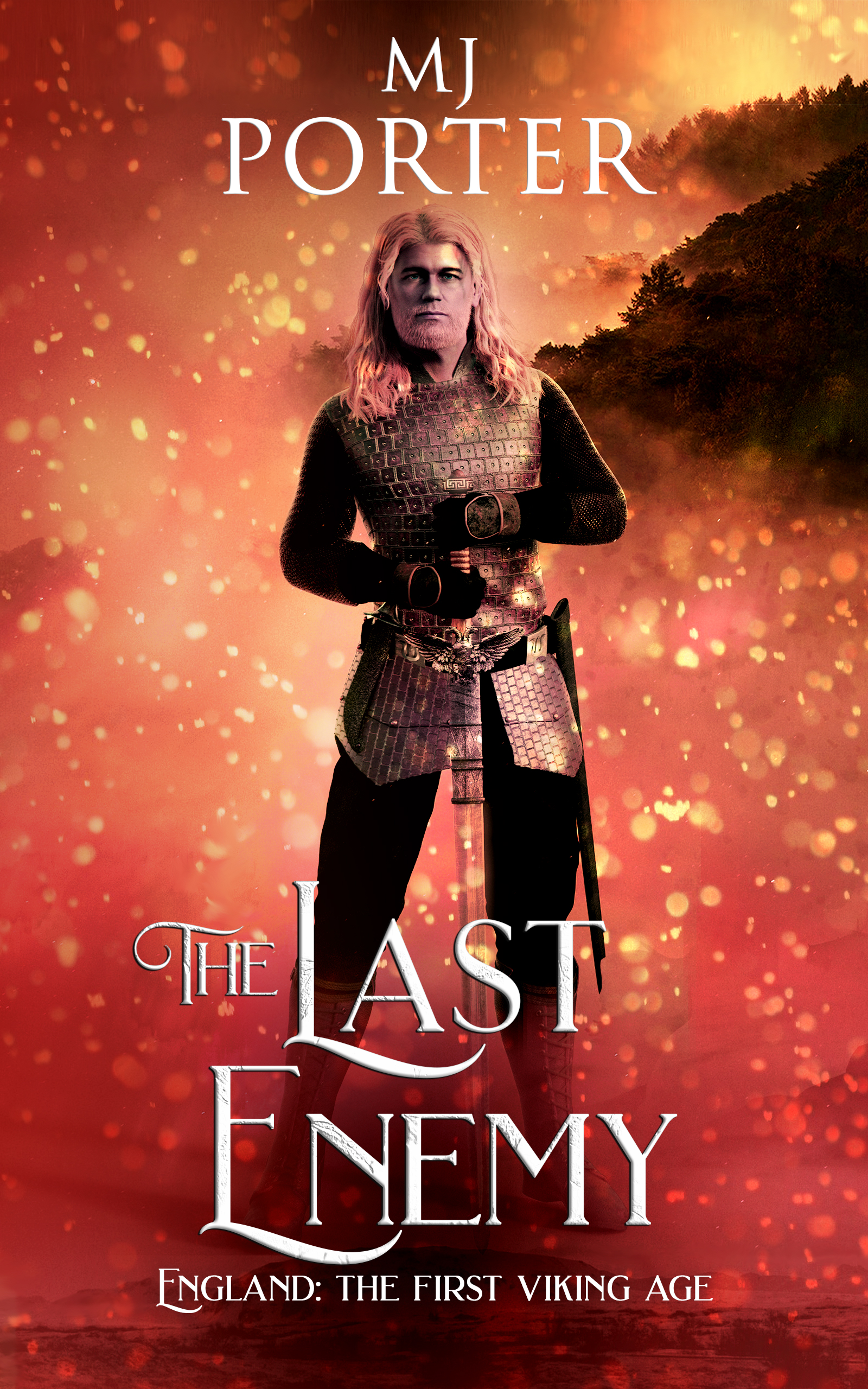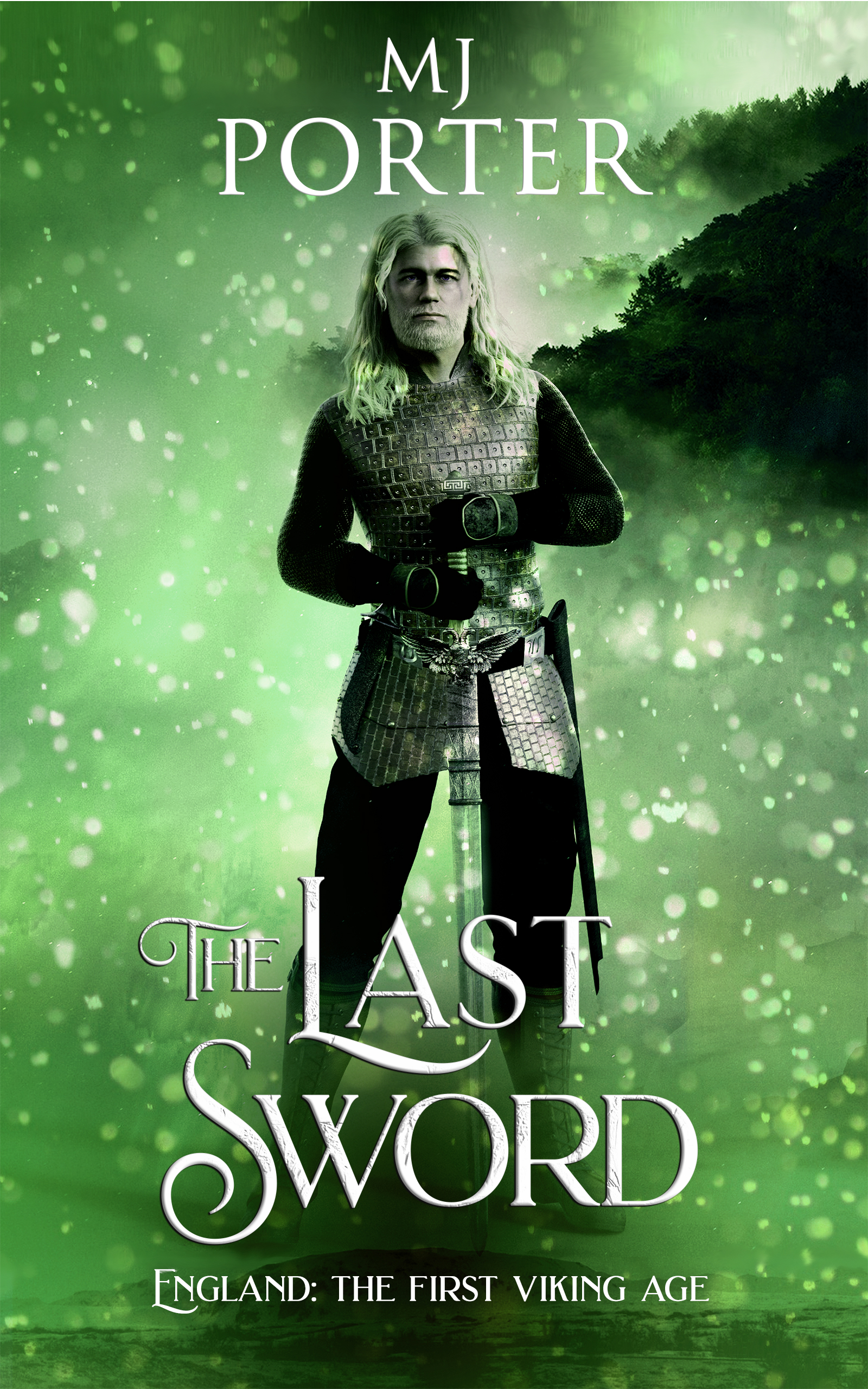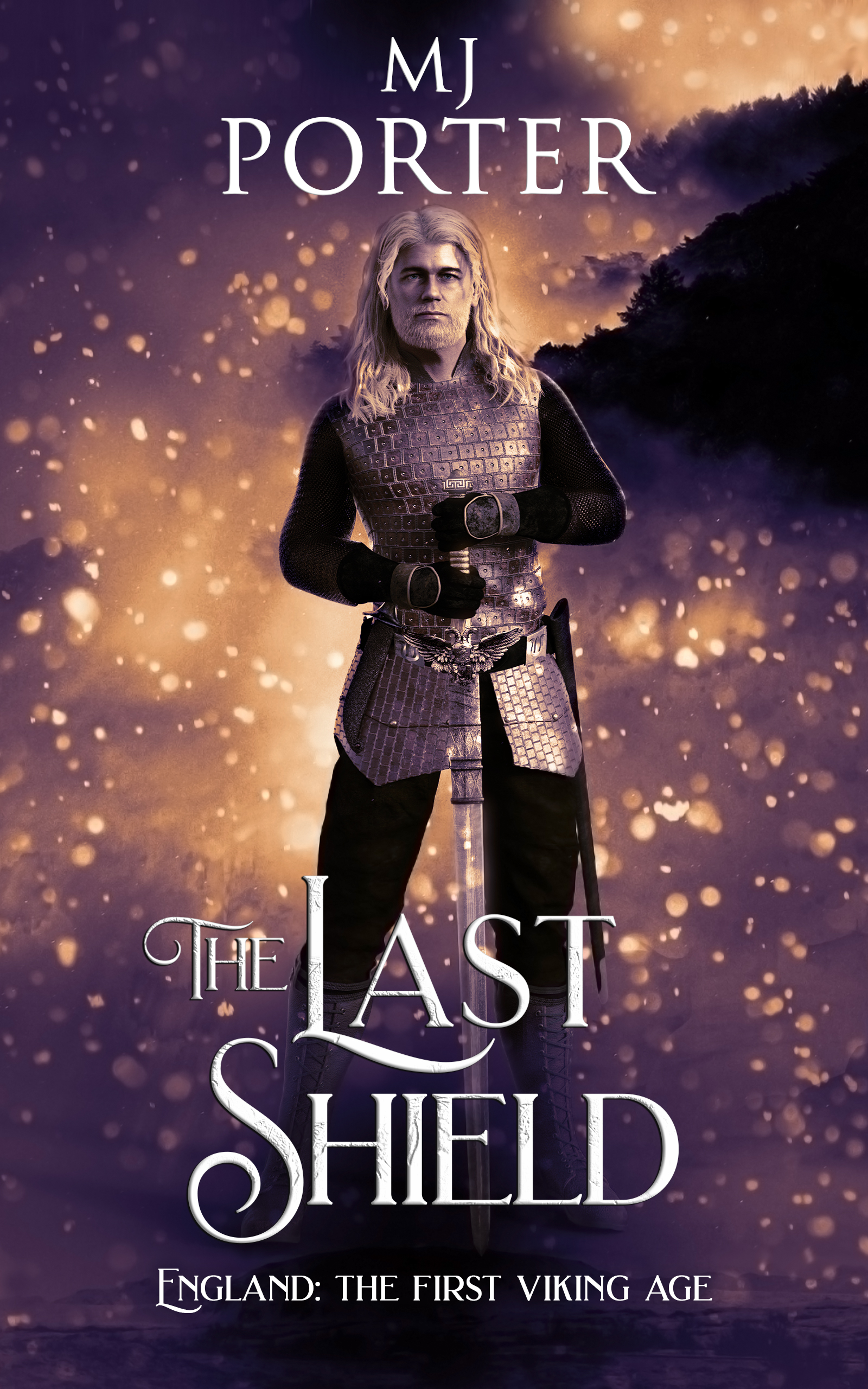

To celebrate the release of The Last Enemy, my interviewer caught up with Lady Cyneswith. #histfic #TheLastKing

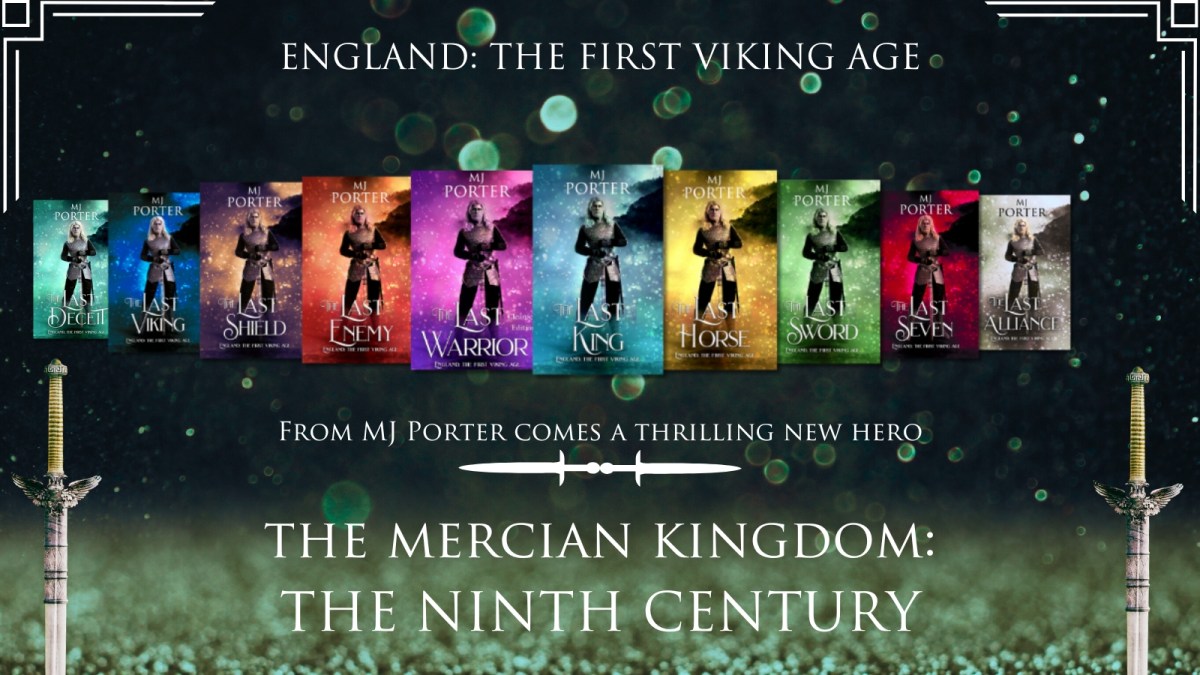
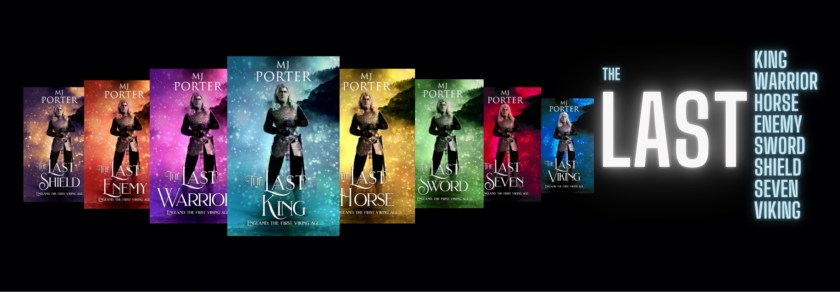
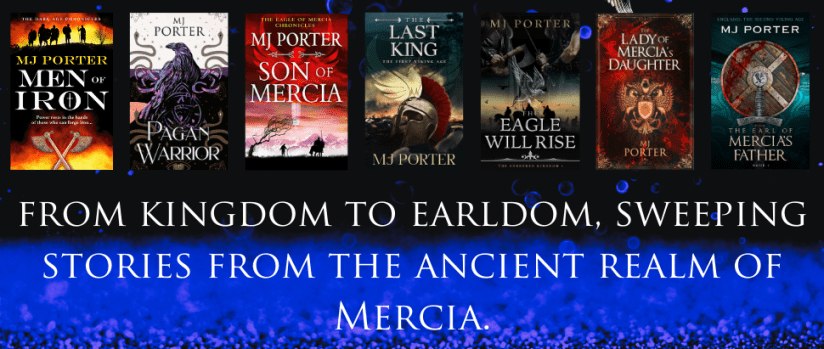
The first eight covers for The Last King series by MJ Porter
The Last King/The Mercian Ninth Century

I’m very honoured to have caught a few moments with Lady Cyneswith, the aunt of King Coelwulf. Thank you for finding the time to speak to me.

“Well, I’m sure you’ve discovered that my nephew is a very busy man, a bit rough around the edges some times, and so I’m delighted to speak with you on his behalf, smooth away any ruffles he might have caused.

Yes, I confess, I had noticed that he was short on time when I tried to speak with him earlier.

Short on time, and economical with his words. He is the king, you know, but of course, his priorities are with defeating the Raiders. I think there are those who don’t quite appreciate the persistence of the enemy. It takes a strong and decisive leader to defeat them, and we should be pleased to have one. Much better than our previous king, who gave up Mercia in exchange for his life. Shocking.

I speak for the whole of Mercia when I say we are so pleased to have such a man leading us. Some new, vigourous, blood was needed to ensure Mercia stayed together.

Our previous king, Burgred, was not blessed with the military requirements for the post. But then, I won’t be alone in believing that Burgred should never have been king. He only achieved what he did because of the manipulation of the natural right of succession.

So, you believe that all the kings since King Coelwulf, first of his name, were usurpers?

I make no bones about that. Mercia wouldn’t be in such peril if my family line had retained their hold on power, as they should have done. But, now is not the time to dwell on that. It’s important to think of the future, and of what is yet to be achieved, but which will be, and soon.

I asked King Coelwulf if had a few words to explain why people should read the latest book.

I imagine he said something along the lines of, ‘I don’t have time for reading, so I wouldn’t.’ And, of course, he means that, but it is difficult for him to appreciate the fascination others have with what he’s trying to achieve. So, I would say, read it and discover just what risks your king, and his warriors and ealdormen are making to ensure Mercia’s freedom. Read it, and understand the peril and take steps to ensure your freedom as well. 

And, have you read the latest book?

I have yes, and I’m pleased to say there’s a slightly bigger part for me in, than usual. Of course, it’s difficult with all the fighting to find room for the women of Mercia, but I’m sure that one day, in the not too distant future, Mercia will have female warriors to keep her safe. After all, anyone can learn to chop off someone’s head, or slice them through the neck, the skill, of course, is in staying alive afterwards.

Um, yes, quite. Thank you for that. I wondered if I could get a few words from you about King Alfred of Wessex.

No, not really. I don’t speak about neighbouring kings, and I’ve never met the man. Now, if you asked me about the king of Gwent, then I might have something to say about him, but you haven’t, and so, I don’t.

Could I ask you about the language used in the book? It’s quite strong in places.

While I have no particular need to hear such words, I can well appreciate that, on occasion, they might be warranted. After all, our king and his warriors are risking their lives every time they enter a battle against our enemy. I put it down to the rush of adrenaline, and hope everyone else does the same.

I asked King Coelwulf about his warriors, do you have any particular favourite amongst them?

I take pride in teaching all of the men some simple techniques to treat wounds received in battle. It’s important to know how to heal as well as to maim. My favourites are obviously those who listen carefully and learn what I teach them. 

Thank you for taking the time to speak with me.

It is of course, my pleasure, and my duty, as the king’s sole surviving relative. Under his leadership, Mercia will once more be great again.

And there you have it. An interesting interview with Lady Cyneswith, a most formidable woman. I should think she’d be as lethal on the battlefield as her nephew is proving to be.  If you haven’t read my earlier interview with King Coelwulf, then you can find it here.

Visit the Mercian Ninth Century page on the blog.

Posts

Book Review and New Release Alert – Bright Helm by Christine Hancock – historical fiction

Here’s the blurb;

“Separated by anger and unanswered questions, Byrhtnoth and Saewynn are brought together by a tragic death.
Re-united, they set out on an epic voyage to discover the final truth about his father. 
The journey takes them far to the north, to Orkney, swathed in the mists of treachery, and to Dublin’s slave markets where Byrhtnoth faces a fateful decision.
How far will he go, to save those he cares for?” 

First things first, Bright Helm is book four in a tightly woven series about young Byrhtnoth, more famous for dying at the Battle of Maldon in AD991, than for anything else. But, he must have had a life before that fateful battle and the author has devised an intriguing and engaging story about his youth, weaving the tale through known historical ‘fact’ of the 940’s and 950’s in Early England.

This is a time period that I’ve also written about and studied, and I have been lucky enough to have early access to Bright Helm, as well as other books in the series. I’ve enjoyed arguing about plot developments and also taken fresh insight from decisions made for the characters. It’s strange to have ‘your’ characters in the hands of someone else, but hey, this is historical fiction, these characters belong only to themselves and the author who writes about them.

What I really enjoyed about Bright Helm was the journey Byrhtnoth has to make. Along the way, he encounters any number of ‘historical’ characters, and winds up visiting both the Orkney Islands and Ireland. I love the Orkney Islands, and I could ‘see’ everything that the author described in such detail.

The book really gather pace as it roars towards its end and I found myself, and this doesn’t often happen in books where I know so much of the back story, just relaxing and allowing the story to unfold without worrying that I might not like it. As I said to the author, I found that she really found ‘her stride’. The pacing was sound, the story thoroughly intriguing, and well, I’m just looking forward to the next book (which might be the last in the series) to find out how it all ends.

I highly recommend this book, and if you’ve not read the earlier books in the series, I believe you could jump in with Book 4, or enjoy starting at the very beginning.

You can find Christine Hancock here:@YoungByrhtnoth and at https://byrhtnoth.com

Bright Helm is released today, 15th October, and is available in ebook and paperback.

(Some links on this blog are Amazon affiliate links)

Book Review – The Queen’s Rival by Anne O’Brien – historical fiction – highly recommended

Here’s the blurb;

“One family united by blood. Torn apart by war…

England, 1459: Cecily Neville, Duchess of York, is embroiled in a plot to topple the weak-minded King Henry VI from the throne. But when the Yorkists are defeated at the Battle of Ludford Bridge, Cecily’s family flee and abandon her to face a marauding Lancastrian army on her own.

Cecily can only watch as her lands are torn apart and divided up by the ruthless Queen Marguerite. From the towers of her prison in Tonbridge Castle, the Duchess begins to spin a web of deceit – one that will eventually lead to treason, to the fall of King Henry VI, and to her eldest son being crowned King Edward IV.

This is a story of heartbreak, ambition and treachery, of one woman’s quest to claim the throne during the violence and tragedy of the Wars of the Roses.”

The Queen’s Rival is a stunning look at the ‘later’ life of Cecily Neville from 1459 until 1483. This is not a ‘quiet’ period of history and to cover the tumultuous events, the author adopts the technique of recording the letters of the main protagonists, either from the pen of Cecily or from those who write to her.

It does take a little while to get used to the technique, but the reader is quickly drawn into the story, not perhaps by the events taking place, but rather by the relationship between Cecily and her two sisters, Anne, Duchess of Buckingham and Katherine, Dowager Duchess of Norfolk. The words they share with each other are just what sisters might well say to each other, especially when they’re not likely to see each other soon.

More importantly, the sisters, while fiercely loyal to their Neville inheritance, are not of one mind about who should rule England, and who has the right to rule England. It highlights just how destructive the War of the Roses was, and is a genius way of quickly ensuring the reader appreciates that families were ripped apart by the protracted war.

This is the story of the women of the later 15th century. It’s their voices that we hear, as they try and come to terms with the rises and falls all of them experience. There are moments when the narrative is hard to read, either because you know what’s going to happen, or just because you really feel for Cecily and don’t want her to experience the tribulations than she does.

I am a huge fan of Anne O’Brien and the ‘forgotten’ women of the medieval period in England. While the author may stress that Cecily is not really a forgotten woman, I was not really aware of her before reading this book. The mother of two kings, the grandmother of future kings, and yet she could also have been queen herself. What an interesting life she led.

I highly recommend this book. And you can find my review here for A Tapestry of Treason.

Thank you to the publisher and Netgalley for my review copy.

The Queen’s Rival is released in ebook and hardbook on 3rd September 2020. (What a stunning cover.) It is released in paperback today, 15th April 2021.

Book Review – Fortress of Fury by Matthew Harffy – Historical Fiction

Here’s the blurb;

“AD 647. Anglo-Saxon Britain. A gripping, action-packed historical thriller and the seventh instalment in the Bernicia Chronicles.

War hangs heavy in the hot summer air as Penda of Mercia and his allies march into the north. Caught unawares, the Bernician forces are besieged within the great fortress of Bebbanburg.

It falls to Beobrand to mount the defence of the stronghold, but even while the battle rages, old and powerful enemies have mobilised against him, seeking vengeance for past events.

As the Mercian forces tighten their grip and unknown killers close in, Beobrand finds himself in a struggle with conflicting oaths and the dreadful pull of a forbidden love that threatens to destroy everything he holds dear.

With the future of Northumbria in jeopardy, will Beobrand be able to withstand the powers that beset him and find a path to victory against all the odds?”

Beobrand is becoming a firm favourite for fans of historical fiction. But, as many will know, I struggle a little with his ‘grumpiness.’ I have enjoyed the author’s new hero, found in The Wolf of Wessex, a whole lot more, and I’m really keen to read the new book A Time For Swords, as well. But, I’m always curious to see what Beobrand is up to, and therefore I was keen to get an advanced copy from Netgalley and the publisher.

Fortress of Fury is a solid addition to The Bernicia Chronicles.

It begins strongly, and slowly builds to the portrayal of Bebbanburg facing one of its greatest challenges throughout its long history. The battle scenes are well-played out and Beobrand earns battle glory for himself.

The scenes that follow the big battle are very much laying the groundwork for future stories about Beobrand and his band of geishas, and for that reason, I very much felt that the book peaked too soon. I was anticipating a blood and gore-drenched battle that lasted for days, and that was not what I got, concerned rather with events after the attack on Bebbanburg. It’s not a direction I was expecting, and it wrong-footed me a little.

That said, I look forward to seeing what trouble Beobrand and his geishas get themselves involved in next. I’m sure it’s not going to be pretty, and if Beobrand cracks a smile, I might well cheer!

Fortress of Fury is released on in ebook on 6th August 2020, and the audiobook and hardback will follow later in the year. (The cover is amazing).

Book Review – The Mitford Scandal by Jessica Fellowes – historical fiction

Here’s the blurb;

The newly married and most beautiful of the Mitford sisters, Diana, hot-steps around Europe with her husband and fortune heir Bryan Guinness, accompanied by maid Louisa Cannon, as well as some of the most famous and glamorous luminaries of the era. But murder soon follows, and with it, a darkness grows in Diana’s heart . . .

This wonderful new book in the bestselling The Mitford Murders series sees the Mitford sisters at a time of scandalous affairs, political upheaval and murder.

The Mitford Scandal is not at all what it is sold as – it is not a 1920’s whodunit – but rather a tedious excursion through late 1920’s Europe where I turned every page just waiting for something to happen, only for each ‘event’ to be the ending of a chapter, rather than a beginning.

The writing style is odd in the extreme, some events told in explicit detail, others glossed over as though not important, and the years, yes years, covered in this novel, are done so in choppy chapters that seem to add little or nothing to the story.

I think the author struggles to reconcile the life her ‘main’ character, the lady’s maid, Louisa has, with the events that are being narrated. It just doesn’t work, not at all, and the odd few chapters told from the viewpoint of Guy are equally as jarring.

Hugely disappointing as I am a fan of a good 1920’s murder-mystery, but this is not one, only morbid curiosity kept me reading until the end (it is not a long book), which is as poorly constructed as the rest of the novel.

Apologies. I really don’t like to leave negative reviews, but my thanks to the publisher and Netgalley for my review copy.

I have looked at reading previous books in this series of books (this is book 3), and I know they have a great of deal of hype around them. I think this probably added to my disappointment – sometimes hype is not a good thing for a series of books to have!! Apologies again. (The cover is lovely!)

The Mitford Scandal is released on 26th September and is available from here;

Book Review – The Seven by Peter Newman – fantasy – recommended

“Years have passed since the Vagrant journeyed to the Shining City, Vesper in arm and Gamma’s sword in hand.

Since then the world has changed. Vesper, following the footsteps of her father, journeyed to the breach and closed the tear between worlds, protecting the last of humanity, but also trapping the infernal horde and all those that fell to its corruptions: willing or otherwise.

In this new age it is Vesper who leads the charge towards unity and peace, with seemingly nothing standing between the world and a bright new future.

That is until eyes open.

And The Seven awakes.”

I received a free EArc from Netgalley and notice that this has just come out in paperback so I am sharing my review again!

After only a few pages, I decided to read the previous book in the series, as the world I discovered was both intriguing and quite alien. I thought I needed some back story, and indeed I did. My review for The Malice is here.

https://www.goodreads.com/review/show/2011536175?book_show_action=false&from_review_page=1

I should also perhaps have taken the time to read The Vagrant but impatience won out, and anyway, The Vagrant, unlike in The Malice, is a real part of this final part of the trilogy (I am assuming it’s the final part).

Anyway, back to The Seven.

The world created by Peter Newman throughout The Vagrant series is inherently alien. It feels new and strange and, on occasion, very, very weird. This, more than anything, immediately draws the reader in, for Newman’s descriptions are sparse in the extreme, and I was often left decrying his lack of description (which is weird for me because I often skip excess descriptions in books content to let my imagination hold sway). Neither is it just his descriptions that are sparse, the whole nature of the book is trimmed down so that you really have to read each and every word – there’s no skipping a bit because you sort of know what’s about to happen. There is also, in the grand scheme of things, little conversation. This ties with the ‘pared’ down nature of the planet that these people inhabit.

The characters in this final book – Vesper, Samael and Scout, The Vagrant, Jem, her daughter, Obeisance and The Seven, as well as The First, Neer and other characters from the earlier book (including The Buck although not as much as I might have liked) – are all scarcely sketched and yet all have very distinct characters. There is no need to’like’ any of the characters (not like in some books) and yet throughout the series you gain respect for them all – even when they might be being cowardly or acting contrary to what we might hope they do. This is a strength of the book – for all the weirdness and strangeness – these are people (I use that word lightly) that we can understand if not relate to.

I very much enjoyed the ‘backstory’ in The Seven. Throughout The Malice I found it a little distracting, but in The Seven, the back story is vitally important, and indeed, at the end, I would have liked to know more about Massala and her creations.

Book 3 is eminently more readable than The Malice – and I don’t think it was because I knew more about the ‘world’ of The Vagrant – I think the storyline is more recognizable and therefore flows better. Yet I don’t think the author ever quite gives the reader what they want – there is not really a happily ever after, there is just an ending, and one which is never wholly assured until it actually happens.

There are very good battle scenes, and very good ‘political’ scenes and yet through it all, the world of The Vagrant remains aloof – difficult to grasp onto. It is not a typical fantasy book and some might well struggle with it, but I think it’s well worth the struggle (The Malice took me a month to read because I struggled with elements of it – The Seven is a much quicker read) and it is refreshing to read something so very different and ‘new’.

The Seven is available now and can be purchased here;

Book Review – Darien-by C F Iggulden – fantasy

Here’s the blurb;

TWELVE FAMILIES. ONE THRONE.

WELCOME TO THE EMPIRE OF SALT.

The city of Darien stands at the weary end of a golden age. Twelve families keep order with soldiers and artefacts, spies and memories, clinging to a peace that shifts and crumbles. The people of the city endure what they cannot change. Here, amongst old feuds, a plot is hatched to kill a king.

It will summon strangers to the city – Elias Post, a hunter, Tellius, an old swordsman banished from his home, Arthur, a boy who cannot speak, Daw Threefold, a chancer and gambler, Vic Deeds, who feels no guilt – and Nancy, a girl whose talent might be the undoing of them all. Their arrival inside the walls as the sun sets will set off a series of explosive events. Before the sun returns, five destinies will have been made – and lost – in Darien.

I received a free EArc from Netgalley.

In the preface to the novel, the author gives his thanks to those writers of fantasy that have influenced his own writing. I was not surprised to find the names of Mark Lawrence and Robin Hobb amongst those mentioned as they are such huge names in the fantasy genre, (there are many others as well, but I've not read them all). As such, I was keen to begin reading the author's first foray into fantasy, expecting great things from such a well-regarded author, if one I've often struggled to appreciate as much as everyone else, finding his style to be a little too cold in regard to his historical characters. This novel certainly feels much warmer towards the various main characters and this is one of its strengths. This warmth makes the storyline much easier to read (I've often been left wondering why he even bothered to write about some of the characters he's chosen in the past- when it seems he had neither passion or regard for them).

Yet for all that, this novel is not astounding or jaw dropping as a Mark Lawrence and Robin Hobb book would be, with their pitch perfect characterizations and world building. It is a reasonably well-crafted novel, although little but character development seems to happen for the first 50% of the novel, and from then on, some of it seems a little rushed. I was also a bit, well peeved, to find a whole new character being introduced at about 80%. I always think this smacks a little too much of desperation (a bit like a who done it when the author brings in a new character as the actual perpetrator even though we've never heard of them before). It is a fairly run of the mill fantasy - the story is enjoyable without being astounding; the magic abilities of some of the characters are interesting; the baddies are bad, the goodies are good and there are a few in-between who we don't ever learn enough about to say one way or another - they are filler for the rest of the story.

I also found some of the author's naming conventions to be annoying - Tellius, Nancy, Daw, Arthur, Lady Sallet - too much of a mix with no firm basis for why these names are relevant  -poor Nancy should have had a much exotic name (although without any X's or Z's in it).

Yet, for all that, this is without doubt, the most enjoyable novel I've yet read by this author. I'm sure that his fans will very much enjoy it, and if it opens their eyes to the wonderful worlds of Robin Hobb and Mark Lawrence, then this should be seen as a plus. Sometimes it takes a popular author to jump genre to find that new genre new fans. 

If there's a second book would I read it? At the moment, I don't know. The novel would need to be about something a little different - I like my fantasy to be bold and new - always a little different and not regurgitating the same old stories (I might be in the minority here) - and as such, this novel is a little too mundane for me. There is nothing new on offer in this fantasy series - but, as I said, this might be just what some people are looking for.

Darien is released on 13th July 2017, and is available from here,

Book Review – The Seven by Peter Newman – fantasy – recommended

“Years have passed since the Vagrant journeyed to the Shining City, Vesper in arm and Gamma’s sword in hand.

Since then the world has changed. Vesper, following the footsteps of her father, journeyed to the breach and closed the tear between worlds, protecting the last of humanity, but also trapping the infernal horde and all those that fell to its corruptions: willing or otherwise.

In this new age it is Vesper who leads the charge towards unity and peace, with seemingly nothing standing between the world and a bright new future.

That is until eyes open.

And The Seven awakes.”

I received a free EArc from Netgalley.

But that said, after only a few pages, I decided to read the previous book in the series, as the world I discovered was both intriguing and quite alien. I thought I needed some back story, and indeed I did. My review for The Malice is here.

https://www.goodreads.com/review/show/2011536175?book_show_action=false&from_review_page=1

I should also perhaps have taken the time to read The Vagrant but impatience won out, and anyway, The Vagrant, unlike in The Malice, is a real part of this final part of the trilogy (I am assuming it’s the final part).

Anyway, back to The Seven.

The world created by Peter Newman throughout The Vagrant series is inherently alien. It feels new and strange and, on occasion, very, very weird. This, more than anything, immediately draws the reader in, for Newman’s descriptions are sparse in the extreme, and I was often left decrying his lack of description (which is weird for me because I often skip excess descriptions in books content to let my imagination hold sway). Neither is it just his descriptions that are sparse, the whole nature of the book is trimmed down so that you really have to read each and every word – there’s no skipping a bit because you sort of know what’s about to happen. There is also, in the grand scheme of things, little conversation. This ties with the ‘pared’ down nature of the planet that these people inhabit.

The characters in this final book – Vesper, Samael and Scout, The Vagrant, Jem, her daughter, Obeisance and The Seven, as well as The First, Neer and other characters from the earlier book (including The Buck although not as much as I might have liked) – are all scarcely sketched and yet all have very distinct characters. There is no need to’like’ any of the characters (not like in some books) and yet throughout the series you gain respect for them all – even when they might be being cowardly or acting contrary to what we might hope they do. This is a strength of the book – for all the weirdness and strangeness – these are people (I use that word lightly) that we can understand if not relate to.

I very much enjoyed the ‘backstory’ in The Seven. Throughout The Malice I found it a little distracting, but in The Seven, the back story is vitally important, and indeed, at the end, I would have liked to know more about Massala and her creations.

Book 3 is eminently more readable than The Malice – and I don’t think it was because I knew more about the ‘world’ of The Vagrant – I think the storyline is more recognizable and therefore flows better. Yet I don’t think the author ever quite gives the reader what they want – there is not really a happily ever after, there is just an ending, and one which is never wholly assured until it actually happens.

There are very good battle scenes, and very good ‘political’ scenes and yet through it all, the world of The Vagrant remains aloof – difficult to grasp onto. It is not a typical fantasy book and some might well struggle with it, but I think it’s well worth the struggle (The Malice took me a month to read because I struggled with elements of it – The Seven is a much quicker read) and it is refreshing to read something so very different and ‘new’.

The Seven is available now and can be purchased here;

The first kings of the ‘English’ – Kings Athelstan and Edmund (924-946) #histfic #non-fiction #Brunanburh

(I’m re-sharing an old post, which I’ve amended slightly and added some new graphics).

England, Wales, Scotland, the smaller kingdoms of Mercia, Wessex, Northumbria, East Anglia, Kent, Powys, Gwynedd, Dal Riada – for the uninitiated (including myself) the sheer number of kingdoms and kings that peopled the period in British history before 1066 can appear as a bewildering display of names, places, times and events, and perhaps never more so than when a historian is trying to sell a book and so makes a statement in their title that applies to that particular king.

Map designed by Flintlock Covers

Phrases such ‘the Golden Age of Northumbria’, ‘the Mercian hegemony’, ‘the rise of Wessex’, they all mask so many events that I find the phrases very unhelpful and perhaps worse, misleading.

I think that Athelstan and his younger half brother, Edmund, probably deserve their titles as Kings of the English. And it’s not just my opinion either. There was, according to Sarah Foot in her book on Athelstan, a concerted effort by the king and his bishops to have him stand apart from his predecessors – to be something ‘different’ to them. They named him king of the English, not king of Mercia (a post he held briefly before another of his younger brothers died) and not king of Wessex, for all that he was both of those things.

They changed his title, they crowned him with a crown, not a helmet. They wanted Athelstan to be something other than his grandfather, King Alfred, and his father, King Edward. It was a bold statement to make, and one they continued when Athelstan died too young and his half-brother, Edmund replaced him. He too was crowned using, it must be supposed, the same Coronation service. (For full details have a peek at Sarah Foot’s book on Athelstan – or read the first few chapters of King of Kings as the service appears in it as well).

So why the change? Essentially the old Saxon kingdoms, for all that they were preserved in the naming of the earls/ealdormens designations, had been swept aside by the Viking raiders. The old kingdoms had become a handy label to apply to certain geographic areas, and the kings of Wessex, whilst keen to hold onto their hereditary titles because of the permanence their own royal line had managed to acquire, were equally as keen to do away with regional boundaries. There was, it can’t be denied, a concerted and almost unrelenting urge to drive any Viking raider or Dane or Norwegian (the Norse) from British soil, and this is what Athelstan and then Edmund were tasked with doing.

Image showing all 4 book covers in The Brunanburh Series

Yet the idea of ‘English’ wasn’t a new concept. Why else would Bede have called his great piece of religious historical writing “The Ecclesiastical History of the English people’, if there hadn’t been a shared consciousness that the people in England, all be it in their separate kingdoms, didn’t have a shared heritage? Why the idea suddenly took flight under King Athelstan could be attributed to a new sense of confidence in Wessex and Mercia at the time. They were confident that they could beat the Viking raiders and they were convinced that England belonged to them.

Or perhaps it was more than that? The destruction wrought by the Viking raiders on the separate kingdoms must have been a stark reminder of just how insular the kingdoms had become, and the Viking raiders showed everyone just how easy it was to run roughshod over the individual kingdoms. Only in unity could the Saxon kingdoms of England survive another onslaught; only with unity could the Saxons hold onto their kingdoms they’d claimed about 500 years before.

It was a message that was learned quickly and taken to heart. Athelstan worked to reunite more of the Saxon kingdoms with the growing ‘England’, and he tried to do so by both diplomacy and through war. Yet, the Viking raiders hadn’t finished with England, and nor were they her only enemies. This also lies at the heart of Athelstan’s ‘masterplan’ his treaty of Eamont (if it truly happened – Benjamin Hudson in his Celtic Scotland is not convinced). Athelstan wanted to be a mighty king, but he also wanted England, and the wider Britain (also a concept already understood otherwise why else would that cantankerous monk – Gildas – have called his even earlier work than Bede’s “On the Ruin of Britain?”) to be united in their attempts to repel the Viking raiders. He was a man with a keen vision of the future and it was a vision that his brother continued, with slightly different direction and results.

Family Tree designed by Boldwood Books

The ‘English Kings” saw safety in unity, and of course, an increase in the power they held went hand-in-hand with that.

Yet at no point during the Saxon period can it be said that the emergence of ‘England’ as we know it, was a given certainty. Throughout the period other great kings had tried to claim sovereignty over other kingdoms, but never with any permanence. The earlier, regional kings, were powerful within their own lifetimes and within their own regions. Few, if any, were able to pass on their patrimony complete upon their death. This was a time of personal kingship, and it was only under Athelstan and Edmund that the leap was taken away from this to a more permanent power base.

Not that it was a smooth transition and it did have the side-effect of allowing other men, those not related to the royal family, to evolve their own individual power bases in the old Saxon kingdoms. The ‘English’ kings had to do more than just rule their own kingdom, they had to rule their ealdormen and earls, their warriors, bishops and archbishops. The number of names of kings might start to deplete in the after math of Athelstan and Edmund’s kingship, but in their place spring up more and more powerful men, men that these English kings  had to rely on.

Becoming King of the English was very much a mixed blessing, bringing with it new and greater responsibilities and more, it brought with it the need to expand personal government further, to have a greater persona to broadcast.

Check out The Brunanburh Series page for more details.

The Anglo Saxon Chronicle Entry for 1016 – the beginning of Cnut’s reign

Primary sources are never without problems. They hold bias, they hold perceived bias, but they are, more often than not, an insight into how people perceived an event as soon after it as details are available to the modern historian.

The Anglo-Saxon Chronicle, with it’s many recensions is a fantastic source, but riddled with problems which can, quite often be clearly seen precisely because it survives in different versions.

For the true student, it’s worth investigating the bias of the different ASCs and taking note of them. Over the years a number of approaches have been taken to the ASC starting from when it was just accepted as the source for Saxon England. This means that for a time all the different recensions were amalgamated. Now, the individuality of each recension is truly appreciated, because as with all early sources, quite often, what isn’t said is just as important as what is said.

(The Anglo-Saxon Chronicle also benefits from a latinised version that was written by Ealdorman Æthelweard at the end of the tenth century and this can likewise be used in a similar way as the Old English recensions.)

Yet, for the sake of not infringing anyone’s copyright, when publishing my books and listing information on my websites, I have to rely on the older translations of the ASC as these are the ones I can use freely. Whilst this isn’t ideal, it does allow me to still make a very valid point, and that is this, the entry for the year 1016 (the year Cnut claimed the English kingdom) is vast, and I mean vast. Compared to previous year’s, 1016 is massive. (I’ve copied it below from http://omacl.org/Anglo/part4.html, but this resource seems to have disappeared, but there is another version available here: https://archive.org/stream/anglosaxonchroni00gile/anglosaxonchroni00gile_djvu.txt) if you want to take a look. I am not sure, as I look at this in 2023, which text this refers to, but possible A). Not until 1023 does an entry even half as long as this appear, and I’m starting to consider if this was all a lot of political rhetoric and whether, the entries for previous years have been purposefully shortened, or amended to show the inevitability of Cnut’s accession to the kingdom of the English. I need to do far more research, but as 2015 roles round to 2016, I can’t see a better time to more fully study the time period and this I plan to do next year.

A.D. 1016. This year came King Knute with a marine force of one hundred and sixty ships, and Alderman Edric with him, over the Thames into Mercia at Cricklade; whence they proceeded to Warwickshire, during the middle of the winter, and plundered therein, and burned, and slew all they met. Then began Edmund the etheling to gather an army, which, when it was collected, could avail him nothing, unless the king were there and they had the assistance of the citizens of London. The expedition therefore was frustrated, and each man betook himself home. After this. an army was again ordered, under full penalties, that every person, however distant, should go forth; and they sent to the king in London, and besought him to come to meet the army with the aid that he could collect. When they were all assembled, it succeeded nothing better than it often did before; and, when it was told the king, that those persons would betray him who ought to assist him, then forsook he the army, and returned again to London. Then rode Edmund the etheling to Earl Utred in Northumbria; and every man supposed that they would collect an army King Knute; but they went into Stafforddhire, and to Shrewsbury, and to Chester; and they plundered on their parts, and Knute on his. He went out through Buckinghamshire to Bedfordshire; thence to Huntingdonshire, and so into Northamptonshire along the fens to Stamford. Thence into Lincolnshire. Thence to Nottinghamshire; and so into Northumbria toward York. When Utred understood this, he ceased from plundering, and hastened northward, and submitted for need, and all the Northumbrians with him; but, though he gave hostages, he was nevertheless slain by the advice of Alderman Edric, and Thurkytel, the son of Nafan, with him. After this, King Knute appointed Eric earl over Northumbria, as Utred was; and then went southward another way, all by west, till the whole army came, before Easter, to the ships. Meantime Edmund Etheling went to London to his father: and after Easter went King Knute with all his ships toward London; but it happened that King Ethelred died ere the ships came. He ended his days on St. George’s day; having held his kingdom in much tribulation and difficulty as long as his life continued. After his decease, all the peers that were in London, and the citizens, chose Edmund king; who bravely defended his kingdom while his time was. Then came the ships to Greenwich, about the gang-days, and within a short interval went to London; where they sunk a deep ditch on the south side, and dragged their ships to the west side of the bridge. Afterwards they trenched the city without, so that no man could go in or out, and often fought against it: but the citizens bravely withstood them. King Edmund had ere this gone out, and invaded the West-Saxons, who all submitted to him; and soon afterward he fought with the enemy at Pen near Gillingham. A second battle he fought, after midsummer, at Sherston; where much slaughter was made on either side, and the leaders themselves came together in the fight. Alderman Edric and Aylmer the darling were assisting the army against King Edmund. Then collected he his force the third time, and went to London, all by north of the Thames, and so out through Clayhanger, and relieved the citizens, driving the enemy to their ships. It was within two nights after that the king went over at Brentford; where he fought with the enemy, and put them to flight: but there many of the English were drowned, from their own carelessness; who went before the main army with a design to plunder. After this the king went into Wessex, and collected his army; but the enemy soon returned to London, and beset the city without, and fought strongly against it both by water and land. But the almighty God delivered them. The enemy went afterward from London with their ships into the Orwell; where they went up and proceeded into Mercia, slaying and burning whatsoever they overtook, as their custom is; and, having provided themselves with meat, they drove their ships and their herds into the Medway. Then assembled King Edmund the fourth time all the English nation, and forded over the Thames at Brentford; whence he proceeded into Kent. The enemy fled before him with their horses into the Isle of Shepey; and the king slew as many of them as he could overtake. Alderman Edric then went to meet the king at Aylesford; than which no measure could be more ill-advised. The enemy, meanwhile, returned into Essex, and advanced into Mercia, destroying all that he overtook. When the king understood that the army was up, then collected he the fifth time all the English nation, and went behind them, and overtook them in Essex, on the down called Assingdon; where they fiercely came together. Then did Alderman Edric as he often did before — he first began the flight with the Maisevethians, and so betrayed his natural lord and all the people of England. There had Knute the victory, though all England fought against him! There was then slain Bishop Ednoth, and Abbot Wulsy, and Alderman Elfric, and Alderman Godwin of Lindsey, and Ulfkytel of East-Anglia, and Ethelward, the son of Alderman Ethelsy (59). And all the nobility of the English nation was there undone! After this fight went King Knute up with his army into Glocestershire, where he heard say that King Edmund was. Then advised Alderman Edric, and the counsellors that were there assembled, that the kings should make peace with each other, and produce hostages. Then both the kings met together at Olney, south of Deerhurst, and became allies and sworn brothers. There they confirmed their friendship both with pledges and with oaths, and settled the pay of the army. With this covenant they parted: King Edmund took to Wessex, and Knute to Mercia and the northern district. The army then went to their ships with the things they had taken; and the people of London made peace with them, and purchased their security, whereupon they brought their ships to London, and provided themselves winter-quarters therein. On the feast of St. Andrew died King Edmund; and he is buried with his grandfather Edgar at Gastonbury. In the same year died Wulfgar, Abbot of Abingdon; and Ethelsy took to the abbacy.

It could be as simple as many events taking place in one year but I harbour the feeling that Cnut might have wanted to portray Edmund as a great warrior to make his own triumphs that little bit greater. After all, Æthelred II receives no treatment as detailed as Edmund throughout his 30 years on the throne and Edmund ruled for a matter of months. While Edmund is still shown as being unable to take decisive military action against Cnut, he fares much better than poor old Æthelred (according to the Anglo-Saxon Chronicle)! Perhaps I should count the words Edmund receives compared to Cnut as a really basic indicator of the bias of the entry?

There are many events planned for the anniversary of Cnut’s accession to the English kingdom, and I know that much will be said and written about the event. Maybe by this time next year, there might be many, many theories abounding about the ASC but for now, I’m happy to be questioning the information I have, or don’t have, and raising the interesting questions of just how much the people of Anglo-Saxon/Anglo-Danish England used propaganda? It’s certainly not a new tool and it’s one the people of England understood a thousand year’s ago just as well as they do now. Cnut’s Queen, Emma/Ælfgifu had a book commissioned about Cnut shortly after his death, and the latinised version of the ASC that I mentioned above, was also a political statement by it’s author, thought to be an ealdorman, and so a member of the nobility.

Be wary of what is accepted as fact, just because someone took the time to a) write it down and b) ensure it survived to modern times!

Posts