Book Review – Oswald: Return of the Kingby Edoardo Albert (historical fiction)

Here’s the blurb:

“The exiled family of King Aethelfrith of Northumbria arrive, after much hardship, on the island of Iona, where the monastery founded by St Columba has become a centre of worship and learning. Young Oswald becomes firm friends with a novice, Aidan. When Aidan professes his final vows, Oswald and his little brother Oswy are received into the church. As befits a young prince, Oswald learns to fight. However, Aidan’s example attacts him and he is on the point of deciding to become a monk when news reaches Iona that his half brother, Eanfrith, has been killed by Cadwallon, the king who defeated Edwin. Oswald sails back to Northumbria and meets Cadwallon in battle, defeating and killing him. Oswald, now undisputed king of Northumbria, gives Aidan the island of Lindisfarne as his base. But Penda, the last great pagan king in England, is raising troops against him.”

I received a free E-Arc from Netgalley.

Oswald, Return of the King is the first book I’ve read by the author.

Oswald is, unfortunately, a dense read that suffers with some pacing issues, but more than anything, is plagued by unnecessary and near constant Bible quotations. It would perhaps, have been better if the novel had been named after the monks of Lindisfarne or Iona, because the focus of the novel is not actually Oswald. The author has made great use of the work of Bede’s Ecclesiastical History of the English People, (as must everyone who writes and studies about this time period), and I couldn’t help thinking that Bede would have been overjoyed by the author’s firm adherence to his ideas – to write a history of the Church – and not a history of the people throughout this period, but for myself, I felt that this detracted from what should have been an exiting read and instead descended into a long and tedious story about a highly fictionalised accounting of how Christianity was introduced to the Saxons of England. Christianity was a weapon, just like a warrior’s sword, shield and spear, but the author, writing for a Christian Press, makes no reference to the political nature of the imposition of Christianity.

As to the story itself, Oswald does not become King of Bernicia until 48% of the book has passed, and then there is some definite fudging of events and dates which takes the reader to the final battle – or should I say ‘finally a battle’. Until this point much has been made of the amassing of troops – but the Battle of Heavenfield, where Oswald gains his kingdom, is a disappointing fight between two men in a quarry, an amassing of troops at York slithers away as a truce is called, and Maserfield is the only battle that gets any ink – even the supposed overthrow of the Gododdin earns no more than the recall of a messenger reporting to his king.

This period of history is defined by its battles and its warriors, but this is a novel of saints and Christianity, and needs to be read with a clear understanding of what it is, and not what it could have been, or what a reader might well expect it to be.

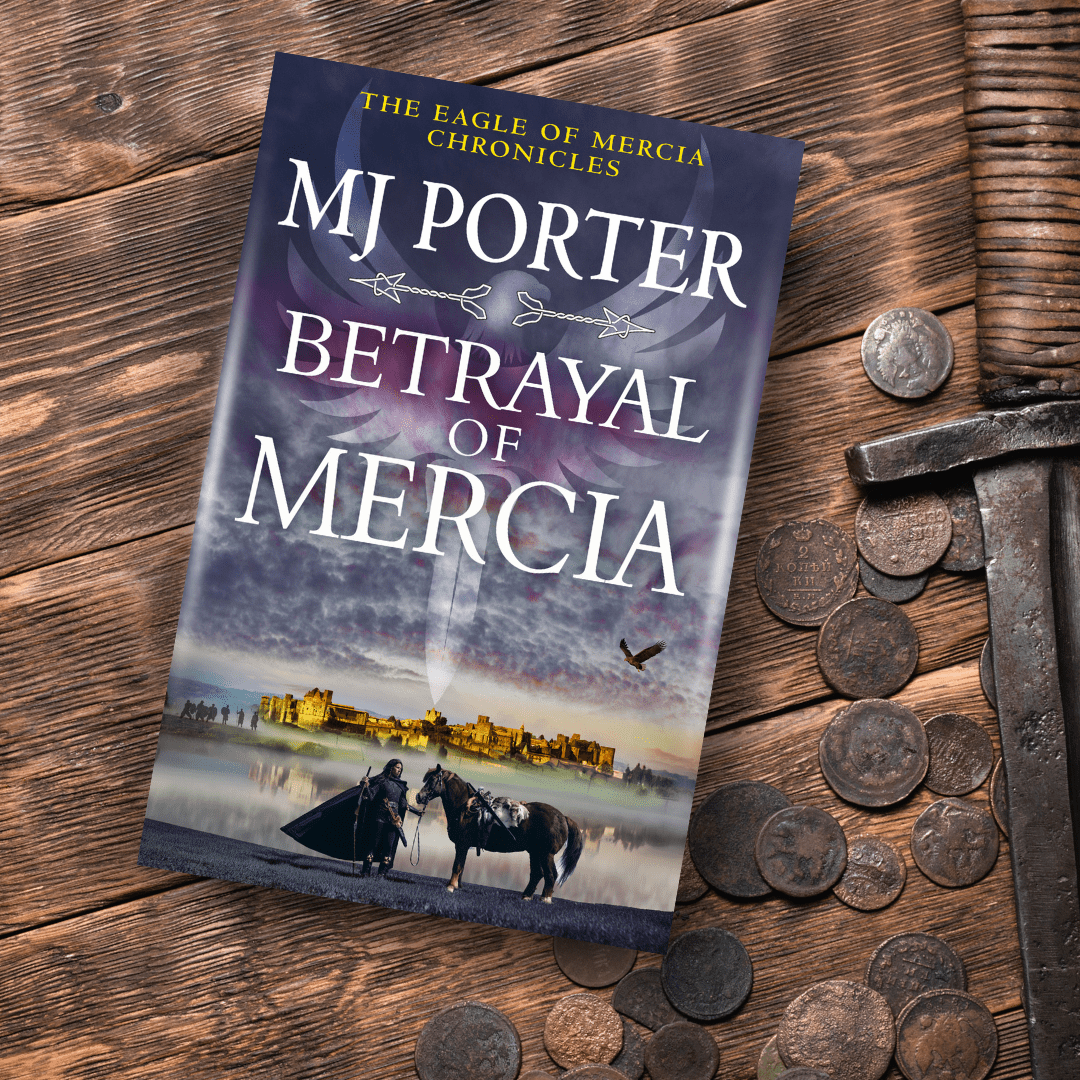
The cover is, however, stunning!

And you can buy it here:

Book Review: A Mighty Dawn by Theodore Brun (historical fantasy)

Here’s the blurb:

“A gripping and brilliantly realized debut epic adventure set in eighth-century Denmark. This is the beginning of an ambitious new series in the vein of George R.R. Martin’s A Game of Thrones.

Hakan, son of Haldan, chosen son of the Lord of the Northern Jutes, swears loyalty to his father in fire, in iron, and in blood. But there are always shadows that roam. When a terrible tragedy befalls Hakan’s household he is forced to leave his world behind. He must seek to pledge his sword to a new king. Nameless and alone, he embarks on a journey to escape the bonds of his past and fulfil his destiny as a great warrior.

Whispers of sinister forces in the north pull Hakan onwards to a kingdom plagued by mysterious and gruesome deaths. But does he have the strength to do battle with such dark foes? Or is death the only sane thing to seek in this world of blood and broken oaths?”

A Mighty Dawn by Theodore Brun is a, sometimes brutal, coming of age tale set in the Scandinavian lands of the middle to second part of the first millennium. Paganism is the worship of choice, and the threads of Norse Mythology mingle through the story, as is to be expected for a story set at this time. It is not a work of historical fiction, but rather historical fantasy, or just plain fantasy with its basis set in the past.

I would divide the novel into three main parts. The first third, when the reader is introduced to Hakon and Inga, is very, very well written. The plot develops in an almost predicatable well (until …. well you’ll have to read it), but the author weaves the plot incredibly well so that when the big reveal came, I was incredibly shocked. I had been expecting the outcome to be very, very different to what actually happened. While Hakon is not exactly the most likable of characters at this point, he is a bit difficult to like because his concern is only with himself, he is well portrayed and the reader understands his anguish, his love and his hatred of Konur, as well as his difficult relationship with his father. The story is mired in the old Norse legends.

The second part of the novel revolves around ‘Hakon’s journey’, after his betrayal, ever northwards, and again, is a well articulated part of the story. While Hakon is now quite glowering and bad tempered, the tone of the story is lightened by the addition of his companion, Kai. a younger man than Hakon and one with a silken tongue and very good cooking skills. The journey ever northwards still contains much of old Norse legends and, because it takes place on the cusp of winter, sees them battling terrible weather in order to reach their destination through an almost deserted landscape.

It is really from this part of the story onwards that I felt the tale faltered a little. It’s still well written but I had some problems with the more fantastical elements of the storyline and these detracted from my overall enjoyment of what had started out as a very entertaining read. I also felt that the author’s great skills in producing characters as engaging as Hakon and Kai faltered a little, relying more on stereotypes than previously.

With all that said, this is a very well articulated story. The author has a good style that means that although the book is quite long, it disappears under the reader’s eyes at a fast rate. I picked the book up to only read the beginning (and work out how long it was as I was reading on the kindle), but soon became embroiled in the storyline and was then unable to put the book down, reading it over one weekend.

I would recommend the book to fans of historical fantasy and look forward to the next book in the series.

And you can buy it here:

I’m reviewing Mistborn by Brandon Sanderson #fantasy #bookreview

Here’s the blurb

“Brandon Sanderson’s epic fantasy trilogy overturns the expectations of readers and then goes on to tell the epic story of evil overturned in a richly imagined world.

A thousand years ago evil came to the land and has ruled with an iron hand ever since. The sun shines fitfully under clouds of ash that float down endlessly from the constant eruption of volcanoes. A dark lord rules through the aristocratic families and ordinary folk are condemned to lives in servitude, sold as goods, labouring in the ash fields.

But now a troublemaker has arrived and there is rumour of revolt. A revolt that depends on criminal that no-one can trust and a young girl who must master Allomancy – the magic that lies in all metals.”

Bok cover for Mistborn Book 1 by fantasy author Brandon Sanderson.

My Review

Wow, this book starts with quite a bang, dragging you in, and then seems to sort of stop for a bit, by which time I was considering not reading anymore but really, did I have any choice?

It was a thoroughly enjoyable novel but didn’t quite produce what I was expecting. It became an almost typical fantasy book, complete with the same themes, etc. Some of it was also a bit too nice! I know that might sound daft, but I was expecting terrible events that never really materialised. I very much enjoyed the interplay of the short chapter headings and the way they contrasted with the story – and the little twist at the end was clearly quite obvious if I’d been paying enough attention!

On a final note – it is a typical fantasy book – it is very long and detailed, and sadly, Book 2 has not started well – but I might persevere. (2024 update – I did not persevere:) I did try the Skyward books).

I’m sharing my review for Requiem for the Wolf by Tara Saunders. #hisfic #historicalfantasy #HighlyRecommended #bookreview

Here’s the blurb

“They told him that the Lost were animals. Crazed and brutal, they said, a danger to themselves and others. Hero, they called him, for providing the mercy of a clean death. They lied.

The Tiarna Beo is a land frozen in the still moment between acts of savage violence. Forty years after a Purging that drove an entire race either into the ground or north through the mountains, every man watches his words and his neighbour. Only a fool draws attention to himself, and only the suicidal travel from the North.

Growing up fatherless in a cold and grieving home, Breag had a clear vision for his future – a good woman, a family of his own and a quiet life. When his good woman betrays him, her confederates force him into the Tiarna on a mission to find one of the Lost and bring it home to be sacrificed. Mired in hopeless duty and wandering rootless among people who would kill him if they knew what he was, Breag struggles to hold on to the frayed edges of his humanity.

But no good deed goes unpunished. When his rescue of a brutalised young woman reveals her to be the Lost he has spent eight years hunting, Breag is forced to choose between her life and his future. And she’s not prepared to go quietly. Breag’s choice will create ripples that ignite the fumes of anger among his people and theirs, and ultimately to burn the entire kingdom down around his ears.”

Cover image for Requiem for the Wolf by Tara Saunders

My Review

This book is, quite simply, an absolute gem. Don’t get me wrong – it’s not the easiest read out there – but it’s well worth persevering with the slightly heavy writing style – which sometimes feels like wading through treacle (in a good way). The author does not, as opposed to some writers, waste a single word in this story. Everything is loaded with importance and each and every word must be read to fully appreciate the nuanced style of writing. I did, on occasion, have to backtrack and reread a paragraph or two. This is not a book to read while doing something else – it’s a book that demands your full attention, all the time, and one where you might have to take designated breaks just to absorb what you’ve read and to think about something slightly less dark and self-centred thoughts.

There is a heavy Celtic influence to the writing – the names of places and people may not roll easily from tongues unused to the elaborate words. Neither is the author the type to throw her entire world building at your feet within the first few paragraphs or sentences – no the world building unravels as deliberately slowly as the writing – but we need to know everything we’re told – there are no wasted words even here.

The conflict between the Brotherhood, the Guard and the Daoine – all with old hurts and new ambitions to temper their relationships with each other, provides a vision of a desperate world – a world on the brink of something – we just don’t know what. Everyone in this book is scared of something being revealed against their wishes.

The book centers around a number of main characters – Breag, Sionna, Carad, Cu, Tarbhal and Laoighre. None of these characters is simple (apart from maybe Cu but even he has his secrets) and none of them is a simple goodie or baddie, they all have back stories and carry life’s judgments like a weight around their neck. This is no simple tale of good vs evil. There are too many lies and half truths from all of them – they all have something they wish to accomplish and seem content to do so at others expense and in the end, the ones who accomplish the most, are those that manage to bend their wants to the reality of events, and you have no idea who that’s going to be. Every betrayal is a fresh wound to the reader, and every success heavy with the scent of future failure.

This book got into my head and stayed there. Perhaps a simple tale, exceeding well told, or perhaps a more complex one, I genuinely think that the reader can take away from the story what they want but I doubt that many will be able to skim read this and will find themselves sunk into the Tiarna Beo and wishing for much, much more in the future.

P.S. You may have guessed that I liked this book – read it, please! Don’t let it get ‘lost’ in the huge number of fantasy books out there.  I’m not sure that the ‘blurb’ does it justice. The story is about much more than just Breag.

(Addition for 2024 – I’ve just checked out the reviews for this book, and there don’t seem to be many. I can only find it in paperback. Don’t let that put you off.)


I’m reviewing Blood and Circuses by Kerry Greenwood, a Phyrne Fisher mystery #histfic #mystery #bookreview

Here’s the blurb

“Phryne Fisher is bored. Life appears to be too easy, too perfect. Her household is ordered, her love life is pleasant, the weather is fine. And then a man from her past arrives at the door. It is Alan Lee from the carnival. Alan and his friends want her to investigate strange happenings at Farrells Circus, where animals have been poisoned and ropes sabotaged. Mr. Christopher has been found with his throat cut in Mrs. Witherspoon s irreproachable boarding house and Miss Parkes, an ex-performer, is charged with his murder.Phryne must go undercover deeper than ever to solve the circus malaise. She must abandon her name, her title, her protection, her comfort, even her clothes. She must fall off a horse twice a day until she can stay on. She must sleep in a girls tent and dine on mutton stew. And she must find some allies.Meanwhile, in Melbourne, the young and fresh-faced policeman Tommy Harris has to solve his own mysteries with the help of the foul-spoken harridan Lizard Elsie, or Miss Parkes will certainly hang. Can Phyrne uncover the truth without losing her life?”

Book cover for Blood and Circuses by Kerry Goodwood, a Phryne Fisher mystery

My Review

This is the second Phryne Fisher book I’ve read (and I’m now addicted to the TV series as well), and I found I enjoyed it much more than the first. This is probably because I’m used to the characters from the TV series. That said, I also think it’s an easier read than the first book I read, which was Ruddy Gore.

The book flows well, although I did notice that by the time the real work of solving the mystery was underway, I was 80% through the novel, and as such, it seems that solving the mystery is of secondary importance to the story of the circus and the attendant ‘hanger-on’s’. A fair portion of the novel is also concerned with the investigation taking place by the police and concerned with the gang warfare – and this rounds out the story nicely, but means that we spend less time with Phryne than you might expect.

Overall – an enjoyable jaunt set in the late 1920s in Australia.

For those who’ve not watched the TV series, or read one of the books, a little more information. Phyrne Fisher is a very elegant lady of the 1920s, but with a penchant to get involved in some quite grizzly murders that the Police can’t solve without her help. She is a confident woman, not the youngest, but because she came into her money later in life, she both appreciates it and flaunts it to equal measure. That being said, it’s difficult not to find her no-nonsense approach to everything life can throw at her invigorating and to enjoy reading about Australia at the same time.

I’ve long been a fan of a really good period piece who done it. I’m never happier than with a good Marple or my firm favourite, Poirot, and I can’t help wondering what the esteemed gentleman would think of the slightly more risque Phryne Fisher. (If you decide not to read the books, please give the TV series a chance – it’s a grower and slightly addictive).


I’m reviewing Blood and Blade by Matthew Harffy #histfic #bookreview

Here’s the blurb

“635AD. Anglo-Saxon Britain. A gripping, action-packed historical thriller and the third instalment in The Bernicia Chronicles. Perfect for fans of Bernard Cornwell. 

Oswald is now King of Northumbria. However, his plans for further alliances and conquests are quickly thrown into disarray when his wedding to a princess of Wessex is interrupted by news of a Pictish uprising.

Rushing north, Oswald leaves Beobrand to escort the young queen to her new home. Their path is fraught with danger and uncertainty, Beobrand must try to unravel secrets and lies if they are to survive.

Meanwhile, old enemies are closing in, seeking brutal revenge. Beobrand will give his blood and blade in service to his king, but will that be enough to avert disaster and save his kith and kin from the evil forces that surround them?”

Cover image for Blood and Blade by historical fiction author Matthew Harffy

My Review

Blood and Blade by Matthew Harffy is the third book in his Bernicia Chronicles following the exploits of his, quite frankly, bad-tempered warrior, Beobrand. He’s no hero – he’s too self-involved, grumpy and lacks any likeable characteristics, even though the author is at pains to explain this away due to the tragedies that have befallen him in Book 2.

However, these do not excuse the foul natured monster that Beobrand has become, and I did struggle to understand why any man, or woman, would want to spend any time with him or rely on him in his guise as a warrior or a lover. He is, quite simply, lacking in any likeable qualities, without even the spark of any humour to soften his harshness, no matter how often Athelstan tries to recount his exploits in the mead hall and make them appear heroic, it simply does not work for me.

The constant shifts in point of view in chapters is annoying, but this is something that I personally don’t understand or like in any novel so it’s not a particular complaint about this author. I’m always left feeling that if the chapter needs a shift in POV then it’s either not a chapter and needs splitting, or the author needs to approach this part of the novel in a different way – give the voice of the story to a different member of the cast.

The storyline of Blood and Blade is somewhat simplistic, and you do reach a certain part of the novel and know exactly what has to happen before it reaches its end. Nothing unexpected happens to bring the novel to its conclusion. This is somewhat of a shame. I would have liked even the idea of a different ending.

The author is at pains to show society, as he perceives it, at this time, and the insistence on the small details is repetitive, as is the constant recounting of Beobrand’s aches and pains, recovering wounds and new ones that he receives.

I would reiterate that Beobrand is no hero, but neither is he an antihero. He’s been thrust into a very exciting time in history, and yet it seems that, with his constant moaning and complaining, he has no appreciation of this and is never likely to. For a young man, he often appears to be about 100 years old.

On a final note. I still do not like the way the author treats women of this period. They are either witches, bed companions, or someone else’s bed companions and are presented as petty and mean to each other. This might be a novel about a (very) grumpy warrior, but Saxon women were and should be given the place in society that they earned and deserved. Much of this is, obviously, to do with the author’s interpretation of this period, and I suppose, it is worth remembering that it is a work of fiction and not fact. Still, this is also a shame and I hope, something, that is corrected in later books to allow the author to reach a wider fan base.

Overall, the novel was enjoyable to read.