The historical setting of the Gods and Kings trilogy
It’s often assumed that we know very little about the men and women of seventh century Britain, and that’s not wrong, however, what is known makes for a compelling narrative.
The Golden Age of Northumbria
The seventh century in Britain is more often than not, lauded as the Golden Age of Northumbria, the northernmost Saxon kingdom of England. Many will have heard of the magnificent fortress on Northumberland’s coast, Bamburgh, or as some will know it Bebbanburg (even though must of what stands to this day is a late nineteenth century addition). Many may have heard of the names Edwin, Oswald Whiteblade, and his brother, Oswiu. Many may know of their Celtic Christianity, of Bishop Aidan from Iona beginning his monastery on Lindisfarne and the explosion in art which seems to come to natural fruition with the works of Bede in the later eighth century. But there is much, much more than that.
The Anglo-Saxon Chronicle tells us of a series of great battles fought on the island of Britain during the seventh century, most, if not all of them, great victories for Northumbria’s royal family, or if not victories, then terrible tragedies. Edwin, the uncle of Oswald Whiteblade, slew his nephew’s father, and Oswald was forced to flee into exile, where he was introduced to Celtic Christianity. And yet, this was only a mirror of Edwin’s own life, when he too had been forced to flee into exile when Oswald’s father claimed the kingdom of Northumbria. And all of this is fascinating, but what of the other kingdoms, and their leaders?
Penda of Mercia
And here, we encounter, Penda of Mercia, a pagan king, at a time when the Saxon kingdoms were slowly becoming converted to Christianity, either from the north and Iona (Bishop Aidan), or from Rome, with Bishop Paulinus. These two religions were to set up their own conflict for supremacy but for the three battles I’ve written about, it’s Penda and his paganism that creates the conflict.
Penda and his brother, Eowa, were to claim Mercia as there’s to rule. They seem to have originated from a royal family with their power base in the kingdom of the Hwicce, a part of Mercia centred around Gloucester and they were not happy with events in Northumbria.
Not once, not twice, but three times, Penda took on the might of Northumbria, in battles taking place at Hædfeld, Maserfeld and Winwæd, spanning a twenty year period.
Hædfeld, Maserfeld and Winwæd
It’s these three battles I offer a retelling of in the Gods and Kings series, and not just because there are these two kingdoms at loggerheads, Mercia and Northumbria, but because these battles brought into play every kingdom within Britain at the time; from Dal Riata and the kingdom of the Picts to the North, to that of the West Saxons and Dumnonia to the south and south-west. These battles were monumental. Great swathes of warriors facing one another with everything to play for, much to lose and even more to gain.
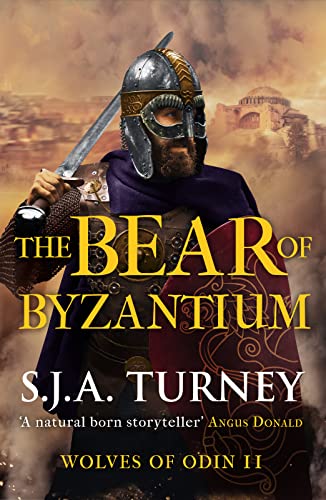
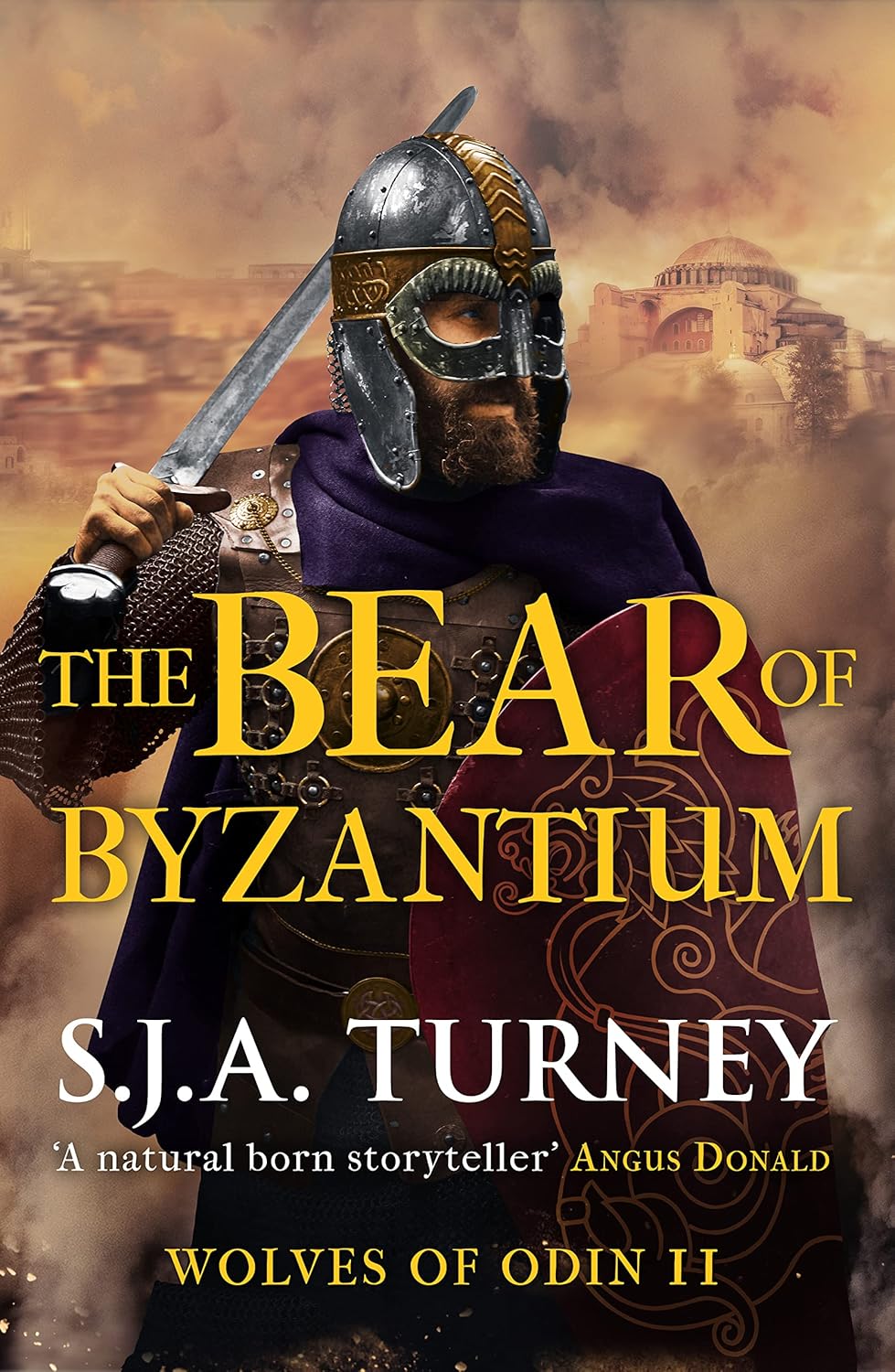
The wolves of Odin sail to the centre of the world: Constantinople.
AD 1041. After successfully avenging the death of his father, Halfdan and the crew of the Sea Wolf seek adventure in strange new lands, far from their Scandinavian home.
They join the fleet of Harald Hardrada, the legendary Viking commander, sailing back to Constantinople from the battlefields of Georgia. There they join the Varangians, the personal bodyguard of the Byzantine Emperors populated almost exclusively by Viking warriors. But Constantinople has changed during Hardrada’s long absence.
The Emperor, Michael IV, is ailing visibly, and powerful factions in his court are setting their plans in motion ahead of his inevitable demise. While courtiers scheme, elements even within the Varangian Guard are picking sides.
Gunnhild, the seer among the Sea Wolf crew, has struck out on her own in the big city. Unable to join the all-male Guard alongside her friends, she establishes herself in a small side-street near the port as a healer and soothsayer, offering cures to the sick and glimpses of the future to the desperate, or the conspiratorial. But in all her visions she sees a wolf, a boar and a golden bear fighting together to support the Byzantine throne. The Norns aren’t finished with them yet…
The epic second instalment in the Wolves of Odin series, taking us to the heart of power in Constantinople and the desperate machinations of the Byzantine emperors. Perfect for fans of Bernard Cornwell, Giles Kristian and Angus Donald.
My Review
The Bear of Byzantium is a fabulous book.
From the opening chapter, which focuses on Harald Hardrada, I knew this was my kind of book – if not just because of the occasional – and it is occasional for anyone who doesn’t appreciate it quite as much as me – use of a little bit of fruity language.
What follows is a journey through Constantinople at a particularly perilous time for emperors and impresses.
The two characters of Gunnhild and Halfdan, who are the main POV throughout the story, are intriguing and have very eventful stories, and the ending is exciting. I thoroughly enjoyed the way the author brought the city of Constantinople to life – something he’s extremely good at in his Roman-era books as well – as well as the customs, regulations, and also, all the paperwork (it’s much more exciting than it sounds:))
A firm favourite for me now and I look forward to continuing the story of Gunnhild and Halfdan – and I will assume Harald Hardrada at some point in the next few books in the series.
My thanks to the publisher and Netgalley for my review copy. The Bear of Byzantium is available now from Amazon and all good booksellers. Just a note that while this might be book 2, I haven’t read book 1, although I have it to read. If you want to jump right in, as I did, it won’t be a struggle to engage with the characters.
In the wild lands of Norway, Hunlaf must quell a vicious slave uprising in Matthew Harffy’s new historical adventure.
A wild land. A lethal fanatic. A violent revolt.
Northumbria, AD 794. Those who rule the seas, rule the land. None know the truth of this more than the Vikings. To compete with the seafaring raiders, the king of Northumbria orders the construction of his own longships under the command of oath-sworn Norseman, Runolf.
When the Vikings attack again, the king sends cleric turned warrior, Hunlaf, on a mission to persuade the king of Rogaland into an alliance. But Hunlaf and Runolf have other plans; kin to seek out, old scores to settle, and a heretical tome to find in the wild lands of the Norse.
Their voyage takes them into the centre of a violent uprising. A slave has broken free of his captors and, with religious fervour, is leading his fanatical followers on a rampage – burning all in his path. Hunlaf must brave the Norse wilderness, and overcome deadly foes, to stop this madman. Can he prevent a night of flames and slaughter?
Review
A Night of Flames returns fans to the world of Hunlaf and Runolf. While book 1 focused on the initial raids against Lindisfarne, book 2, eventually, takes the reader further away to seek out the home of the Raiders. An intriguing idea, and an interesting way of keeping with the same characters, when there’s such a huge historical gap between those first raids, and the later, more sustained ones.
Throughout the book, Hunlaf constantly questions himself – is he a warrior or is he a man of God? There are some illusions, through foreshadowing in the narrative, to possible future adventures for Hunlaf, far from the shores of Northumbria. But for now, we have Hunlaf’s accounting of the building of a ship to brave the Whale Road, and the journey he subsequently takes, via Orkney to Norway. It’s a slow burner. Not until nearly halfway through the book does Hunlaf reach his destination. And even there, his journey isn’t at an end, and nor are the perils he must face.
The author, admits, in the endnotes, that this book is big on the fiction. This is understandable. There’s so little information about events at this time, and I confess to feeling a little sorry for him having to pick a new thread for this story of the late eighth century. It would be ‘easier’ to choose a later period when more is known, and yet, equally, it allows for much wider scope. Hunlaf and his fellow warriors aren’t constrained by history to perform certain tasks.
Fans of the author are sure to enjoy book 2 in Hunlaf’s story. Book 3 promises to take readers even further afield, and I look forward to it.
A Night of Flames is released tomorrow, March 3rd 2022. Preorder now. Unless you’re reading this after March 3rd and then it will be available anyway:)
About the author
Matthew Harffy grew up in Northumberland where the rugged terrain, ruined castles and rocky coastline had a huge impact on him. He now lives in Wiltshire, England, with his wife and their two daughters.
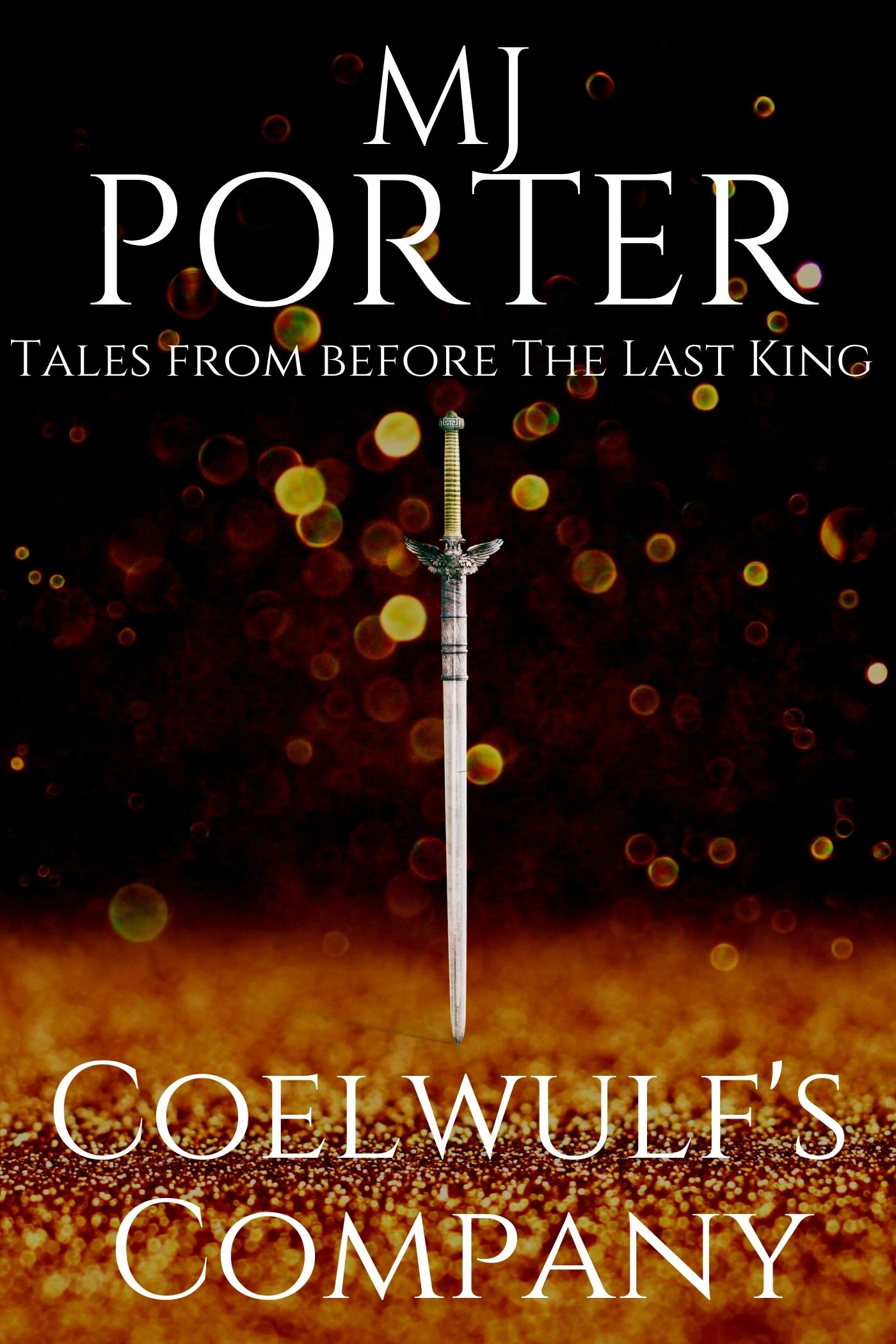
Here it is – a little treat for fans of Coelwulf and his warriors.
Having given many hints as to how the motley crew got together, I decided to write some short stories, from different points of view, to see just what Icel, Edmund, Coelwulf, Pybba and of course, Rudolf, think of one another and how they came to be battling the Raiders in AD874.
The collection consists of 5 short stories, and also another short story which laid the foundation for Coelwulf and his warriors. (This short story is freely available on the Aspects of History website, but I added it just so readers who haven’t discovered it yet could see it. Do please check out my author platform on Aspects of History and all the other excellent authors on there as well.)
I hope you’ll enjoy it, and if you do, I can press on with writing more short stories, because it’s been a great deal of fun! And you know me, I do like to tell a story backwards:)
Coelwulf’s Company is available as an ebook from Kindle and can be read with Kindle Unlimited.
Today, I’m delighted to welcome Tammy Pasterick to the blog with a post about her new book, Veil of Smoke and Ash.
Researching Pittsburgh’s Golden Age of Steel
Writing a novel is never easy, but historical fiction presents its own set of challenges. While all authors strive to make their books entertaining and thought-provoking, historical novelists must also focus on accuracy. The worlds they create should be well-researched and detailed, and the characters should sound like people who actually live during medieval times, colonial times, or in 1910s Pittsburgh, as is the case in my novel, Beneath the Veil of Smoke and Ash. Transporting readers to the past is a daunting process, and I relied on a wide variety of resources to bring Pittsburgh’s golden age of steel to life.
My book started out as a genealogy project, so my research began on Ancestry.com. In the spring of 2012, I couldn’t find my mom’s recipe for stuffed cabbages—a favorite dish in my Slovak family—so I turned to Google for some alternatives. I ended up on several Slovak and Hungarian cultural websites as well as a few genealogy sites. I then joined Ancestry.com on a whim and began a months-long search for information about my great-grandparents, who immigrated to America at the turn of the twentieth century.
I found so many fascinating documents on Ancestry.com and quickly became addicted to the site. I located the ship manifesto for my Slovak great-grandparents who traveled to Ellis Island from Austria-Hungary in 1905 as well as a World War II draft registration card for my Lithuanian great-grandfather who was in his early fifties at the time he signed it. I was in awe of his bravery, as his advanced age exempted him from the draft. These discoveries led to a fascinating conversation with my ninety-year-old grandmother, who rarely spoke of her childhood. I asked her several questions about her family and her in-laws, and she responded in the most unexpected way. She presented me with a scrapbook and a shoebox of old family photos.
I’m not sure why Grandma Pearl had never shown me these treasures until the final months of her life, but I am grateful nonetheless. She opened up to me that day about her childhood and showed me pictures of her Lithuanian parents as well as her Slovak in-laws. She explained that they immigrated to America at the turn of the twentieth century to work in the steel mills of Pittsburgh. She shared as many details as she could about their immigrant experience, but I wanted to know more. My curiosity inspired me to turn my genealogy project into a novel.
While the characters in my novel are fictional, the world they live in is not. My conversation with Grandma Pearl sparked my imagination and gave me a starting point, but I still had much to learn. I read several books about Pennsylvania’s steel and coal mining industries in the early twentieth century such as The Shadow of the Mills: Working-Class Families in Pittsburgh, 1870-1907 by S.J. Kleinberg and Growing Up in Coal Country by Susan Campbell Bartoletti. I also read The Steel Workers by John A. Fitch, which was part of The Pittsburgh Survey, a sociological study conducted from 1907-1908, which chronicled the living conditions of immigrant families. These books provided insight into the daily routines of immigrants as well as the risks they faced in the mills and mines.
In order to better understand the hazardous work steelworkers and coal miners performed in the 1910s and 1920s, I watched silent films on YouTube. Still curious, I visited the Tour-Ed Mine and Museum in Tarentum, Pennsylvania with my father, who shared memories of his thirty years of coal mining with me. I’ll never forget what it was like to stumble through cool, dark tunnels 160 feet below ground and feel the jagged walls of exposed coal beneath my fingertips.
Lisa A. Alzo’s books, Slovak Pittsburgh and Pittsburgh’s Immigrants, contain so many incredible photographs and gave me a deeper understanding of Slovak culture and customs. They even helped me pick out authentic names for my Slovak and Polish characters. The Social Security Administration’s website was also a great source for character names, as it tracks the popularity of baby names as far back as the 1880s.
As for the mental illness and mysterious medical condition featured in my book, I obtained most of my facts from various medical websites suggested by Google. I relied on information from webmd.com, mayoclinic.org, psychiatry.org, and several other sites focusing on women’s health. The Internet and Google make writing historical fiction so much easier than I imagine it was just a few decades ago. The answers to my questions are usually only a few keystrokes away, and the only challenge is determining the reliability of sources. Google is also particularly useful for tracking word usage over time. I learned very quickly that it would not be appropriate for my young character, Sofie, to go to the “movies” with her “boyfriend.” She would instead see a film at the “nickelodeon” with her “sweetheart.”
Historical fiction is definitely challenging to write, but I enjoy the research just as much as the writing. I never know where an Internet rabbit hole will lead and whether it will spark an unexpected plot twist. My modest genealogy project was not supposed to take on a life of its own and become a novel, but I am happy that it did. My deep dive into Pittsburgh’s golden age of steel revealed many fascinating facts about my family’s history, but it also taught me about the labor movement, social inequality, anti-immigration sentiment, and mental illness at the turn of the twentieth century. I am a much smarter and more empathetic person as a result of writing this novel, and I can’t wait to find out what the next one will teach me.
Thank you so much for sharing such a fascinating insight into your new book. Good luck with it.
Here’s the blurb
It’s Pittsburgh, 1910—the golden age of steel in the land of opportunity. Eastern European immigrants Janos and Karina Kovac should be prospering, but their American dream is fading faster than the colors on the sun-drenched flag of their adopted country. Janos is exhausted from a decade of twelve-hour shifts, seven days per week, at the local mill. Karina, meanwhile, thinks she has found an escape from their run-down ethnic neighborhood in the modern home of a mill manager—until she discovers she is expected to perform the duties of both housekeeper and mistress. Though she resents her employer’s advances, they are more tolerable than being groped by drunks at the town’s boarding house.
When Janos witnesses a gruesome accident at his furnace on the same day Karina learns she will lose her job, the Kovac family begins to unravel. Janos learns there are people at the mill who pose a greater risk to his life than the work itself, while Karina—panicked by the thought of returning to work at the boarding house—becomes unhinged and wreaks a path of destruction so wide that her children are swept up in the storm. In the aftermath, Janos must rebuild his shattered family—with the help of an unlikely ally.
Impeccably researched and deeply human, Beneath the Veil of Smoke and Ash delivers a timeless message about mental illness while paying tribute to the sacrifices America’s immigrant ancestors made.
A native of Western Pennsylvania, Tammy Pasterick grew up in a family of steelworkers, coal miners, and Eastern European immigrants. She began her career as an investigator with the National Labor Relations Board and later worked as a paralegal and German teacher. She holds degrees in labor and industrial relations from Penn State University and German language and literature from the University of Delaware. She currently lives on Maryland’s Eastern Shore with her husband, two children, and chocolate Labrador retriever.
Today, I’m delighted to welcome Liz Harris to the blog with a fascinating post about her new book, Darjeeling Inheritance.
Your book, the Darjeeling Inheritance, which sounds fantastic, is set during the 1930s in India. As a historian first and foremost, and then a writer, I’m always interested in how people research their historical stories.
Can you explain your research process to me, and give an idea of the resources that you rely on the most (other than your imagination, of course) to bring the historical landscape to life?
I’ve always believed that if a novel is set in the past, and in a foreign location, the events in the past, and the nature of that location, should be organic in the novel. To ignore the history and nature of an area would result in the setting being no more than a mere backdrop to a story that could have been located anywhere and at any time.
So before I start writing, and before I’ve determined all of the characters who’ll be in my novel, I find out everything I can about my chosen area – its past and its present, every aspect of its geography, the lives of those who live there, their mores and how they’d view the world, and also any difficulties with which they’d have to contend.
My focus in Darjeeling Inheritance was on tea production, and on the plantation owners who lived in India during the British Raj, the period between 1858 and 1947, and also on the people who worked for them, and on those whose job it was to go out on the terraces between March and November and pluck two leaves and a terminal bud.
Books are always my first port of call – bookshops and libraries are an invaluable source of information and help – and as always, the local library was an excellent source of material when writing Darjeeling Inheritance. I’m very lucky in that I live in Oxfordshire, where the libraries are excellent, and also that I can get easily to the Bodleian Library in Oxford.
The resource to which I go after books is the internet. And I also try to make contact with people in the area, such as librarians or curators, if there’s anything I need to know but am struggling to find out.
There’s no greater inspiration, or resource, than going to the location in which one is setting a novel, and if I can go there, I do. Just over two years ago, I booked to go to Darjeeling in October, after the monsoon. Unfortunately, that trip was to prove impossible. Two months before I was due to leave for Darjeeling, the Foreign Office advised against travelling there owing to trouble between the Nepali and Bengali. The issues are now resolved, but at that time, all the tea gardens and most of the hotels were closed.
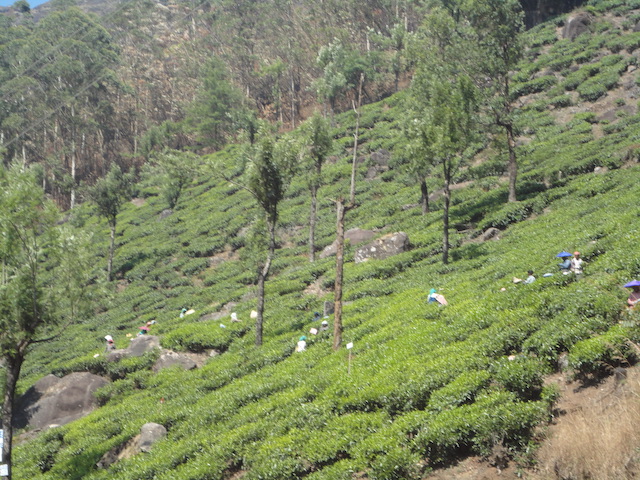
Forced to rethink my plans, I decided to go instead to the famous tea plantations in Munnar, Kerala, and to the tea factory there, and I booked a flight for the following February. October would have been a good month for a trip to Darjeeling, but it would have been too rainy a month for Kerala. My visit was wonderful, and it gave me the first-hand experience I wanted.
A tea plantation near Munnar, India
Do you have a ‘go’ to book/resource that you couldn’t write without having to hand, and if so, what is it?
The following are my ‘go’ to books/resources. I’m making them plural as I have three staples without which I wouldn’t be comfortable writing, and I have these on the piano behind me, no matter the period or location of the work in progress.
Firstly, The Chambers Dictionary. I’m a keen Scrabble player and this is the Scrabble dictionary, so it’s the one I’ve used for years. I infinitely prefer looking up a word in a dictionary than seeking it on the internet.
The second is Roget’s Thesaurus. Repetition is the enemy of writers, and with Roget’s Thesaurus to hand, in which just about every word has a synonym for each of its meanings, an author always has a range of alternative words and phrases from which to choose.
Finally, I have Cassell’s Dictionary of Slang, compiled by Jonathon Green. I’d hate my characters to speak in anachronistic terms, and I don’t want to jar my readers out of the text by using an idiom in my narrative that’s more appropriate for the twenty-first century than the nineteenth or twentieth. By checking the origin and first use of the vocabulary I choose, I do my best to avoid that happening.
The three books upon which I rely
Those are my staples, but then there are the books for each specific novel. I was lucky with Darjeeling Inheritance in that much has been written by those who lived in India in the 1920s and 1930s, and especially by those who grew up there, and I was spoilt for choice. I drew on information from a very large number of books, including several novels by M.M. Kaye and her biography, and Women of the Raj, by Margaret MacMillan.
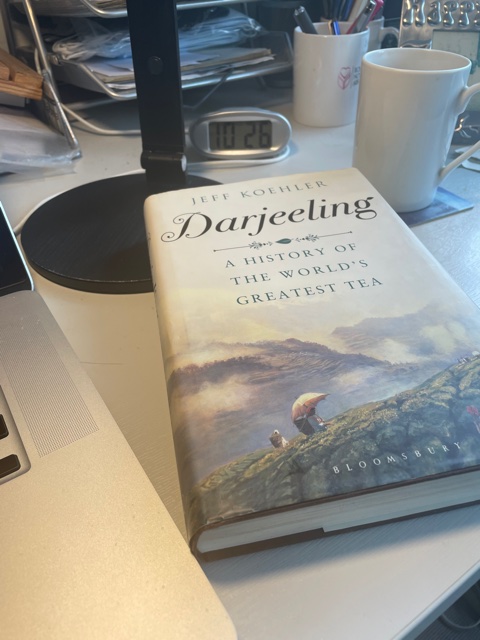
There is one other book that I must mention that’s specific to Darjeeling Inheritance. I owe a huge debt of gratitude to Darjeeling: A History of the World’s Greatest Tea, by Jeff Koehler. This was the first of the books that I bought, and it was at my side throughout my writing of the novel.
Finally, and it’s not exactly a resource, I don’t think I could write if I didn’t have a cup of coffee beside me. Yes, coffee, not tea! I’m saying this very quietly, but I don’t actually like tea!!
Jeff Koehler’s book, flanked by a cup of, dare I say it – coffee!
Many thanks, MJ, for inviting me to talk to you about my research process. I’ve very much enjoyed doing so.
Thank you for such a fascinating post. Good luck with the new book, and enjoy your cup of coffee!
Here’s the blurb:
Darjeeling, 1930
After eleven years in school in England, Charlotte Lawrence returns to Sundar, the tea plantation owned by her family, and finds an empty house. She learns that her beloved father died a couple of days earlier and that he left her his estate. She learns also that it was his wish that she marry Andrew McAllister, the good-looking younger son from a neighbouring plantation.
Unwilling to commit to a wedding for which she doesn’t feel ready, Charlotte pleads with Dan Fitzgerald, the assistant manager of Sundar, to teach her how to run the plantation while she gets to know Andrew. Although reluctant as he knew that a woman would never be accepted as manager by the local merchants and workers, Dan agrees.
Charlotte’s chaperone on the journey from England, Ada Eastman, who during the long voyage, has become a friend, has journeyed to Darjeeling to marry Harry Banning, the owner of a neighbouring tea garden.
When Ada marries Harry, she’s determined to be a loyal and faithful wife. And to be a good friend to Charlotte. And nothing, but nothing, was going to stand in the way of that.
Born in London, Liz Harris graduated from university with a Law degree, and then moved to California, where she led a varied life, from waitressing on Sunset Strip to working as secretary to the CEO of a large Japanese trading company.
Six years later, she returned to London and completed a degree in English, after which she taught secondary school pupils, first in Berkshire, and then in Cheshire.
In addition to the ten novels she’s had published, she’s had several short stories in anthologies and magazines.
Liz now lives in Oxfordshire. An active member of the Romantic Novelists’ Association and the Historical Novel Society, her interests are travel, the theatre, reading and cryptic crosswords. To find out more about Liz, visit her website at: www.lizharrisauthor.com
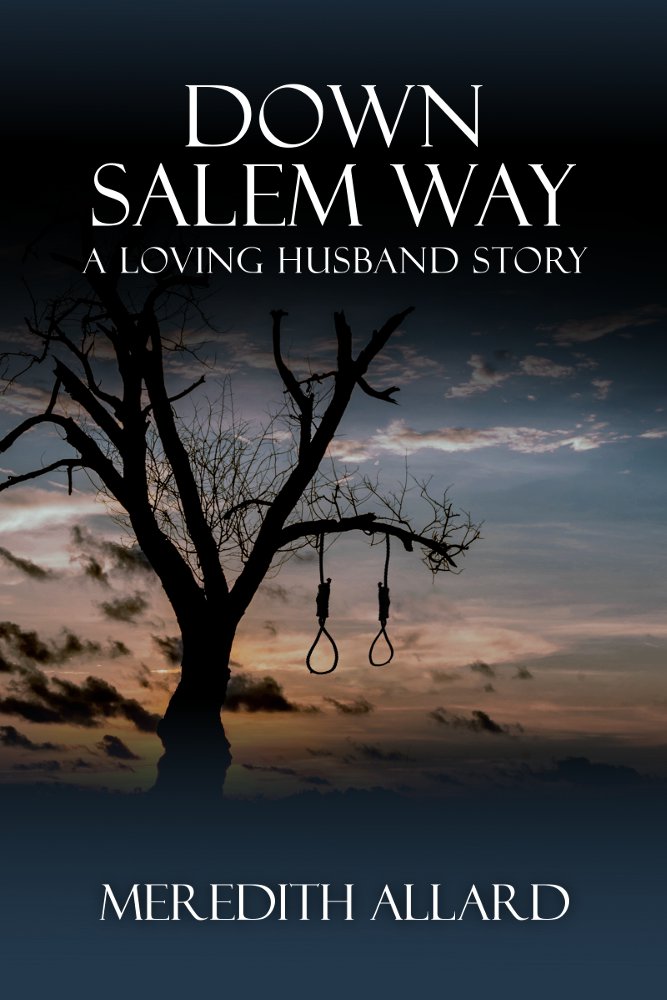
Today, I’m delighted to welcome Meredith Allard to the blog with a post about the historical research she undertook to write her book Down Salem Way.
I’ve been reading, editing, and writing historical fiction for many years. As a matter of fact, I’ve even written a book about how to write historical fiction called Painting the Past: A Guide for Writing Historical Fiction. Thank you to M.J. for allowing me space on the blog today to share my thoughts on one of my favorite subjects.
The way I research historical fiction has changed a lot over the years. When I first started writing historical fiction, I would check as many books as I could carry out of the library, take meticulous notes, color code my notes with highlighters (blue for food, pink for fashion, etc.), return those books and check out another pile, and so on until I felt I had enough knowledge to begin drafting my story. Sometimes it was months worth of research before I started writing anything. Once I started writing I knew exactly where to look in my notebook for what I needed. If I was writing a dinner scene, I could find my notes about food. Notes I referred to often, such as important dates or events that I kept mentioning, were written on index cards, also color-coded, for easier access.
I no longer complete my research before I start writing. As a fellow writer friend said to me, feeling like you have to do all of your research before you start writing slows down your process to the point where your story doesn’t get written. These days I do some preliminary research by reading generally around my topic, perhaps taking a few notes, just enough to keep things clear in my head, and then I begin the prewriting process. Usually, through the process of brainstorming, prewriting, and drafting my story, I recognize what specific bits of historical information I’ll need and then I’ll search for those bits. That’s when my note taking begins in earnest. I create digital folders to organize my notes, citations, and annotations, and I still keep categories of information together (food, clothing, political climate, and so on).
One trick I learned from a history class I took years ago is to think about the historical world I’m creating through the acronym GRAPES.
Geography—How does the climate and landscape affect the people who live there?
Religion—How does the society’s belief system and traditions affect the people who live there?
Achievements—What are the achievements of this society—good and bad?
Politics—What is the power structure in this society?
Economics—How are goods and resources used in this society?
Social Structure—How does this society organize people into classes? Who ends up in which class and why?
I love to travel to the place I’m writing about as well. I always get a lot of good ideas for my story from my travels. As I work to weave the information I learned into my story, one thing I keep in mind is that I want to carry my readers into my world by touching their senses. What do readers see, hear, taste, touch, and smell? Often it’s the smaller details, what people wore, what they ate, the houses they lived in, that brings historical fiction alive since these are details we can relate to, even if what we eat and drink and where we live is different today.
Some dependable online research sources I’ve used over the years are Project Gutenberg, the Library of Congress, the Victorian Web, V&A, and JSTOR. The History Quill has a list of 50+ research sites for writers of historical fiction. I also love to go to the library to see what books I can find, and I’ve found that librarians are more than happy to help if I can’t find what I’m looking for.
I love learning about history, so researching historical fiction is actually fun for me.
Thank you so much for sharing your post with us. Research can indeed be a rabbit hole from which you can’t return:)
Here’s the blurb;
How would you deal with the madness of the Salem witch hunts?
In 1690, James Wentworth arrives in Salem in the Massachusetts Bay Colony with his father, John, hoping to continue the success of John’s mercantile business. While in Salem, James falls in love with Elizabeth Jones, a farmer’s daughter. Though they are virtually strangers when they marry, the love between James and Elizabeth grows quickly into a passion that will transcend time.
But something evil lurks down Salem way. Soon many in Salem, town and village, are accused of practicing witchcraft and sending their shapes to harm others. Despite the madness surrounding them, James and Elizabeth are determined to continue the peaceful, loving life they have created together. Will their love for one another carry them through the most difficult challenge of all?
Meredith Allard is the author of the bestselling paranormal historical Loving Husband Trilogy. Her sweet Victorian romance, When It Rained at Hembry Castle, was named a best historical novel by IndieReader. Her nonfiction book, Painting the Past: A Guide for Writing Historical Fiction, was named a #1 New Release in Authorship and Creativity Self-Help by Amazon. When she isn’t writing she’s teaching writing, and she has taught writing to students ages five to 75. She loves books, cats, and coffee, though not always in that order. She lives in Las Vegas, Nevada. Visit Meredith online at http://www.meredithallard.com.
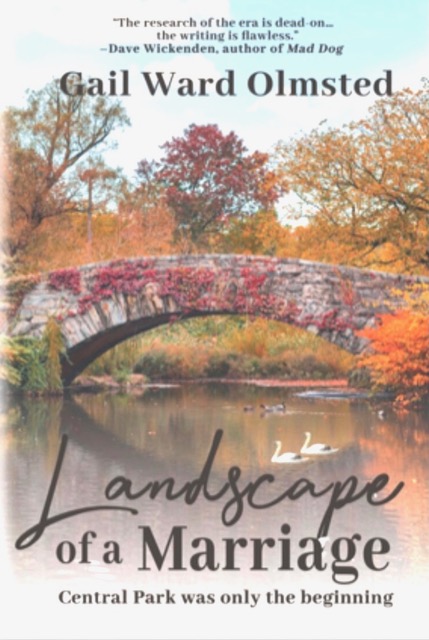
Today, I’m delighted to welcome Gail Ward Olmsted to the blog with a fascinating post about her new book, Landscape of a Marriage.
Separating Fact from Fiction
As a reader, I enjoy historical fiction that stimulates my interest to learn more about a person or a time from the past. Good historical fiction, in my humble opinion, needs to be balanced- a blend of historical facts and accuracy with a riveting storyline and well-developed characters who lived, or at least could have lived, during that time. I don’t believe there is any required ratio between the levels of fact and fiction (maybe 60/40 in favor of facts if I had to wager a guess?) but clearly a well-researched story is ultimately going to garner more attention and a larger number of satisfied readers than one that relies on interesting characters to make up for a historical backdrop that is too thin or inaccurate. But the real question is not how much ‘history’ do you need in your historical fiction, but rather how do you obtain that information?
When it comes to research, at some point you have to tell yourself that it’s time to stop, that enough is enough. Although it is tempting to continue down yet another rabbit hole of information (and there are so many different avenues to explore) a good writer knows when it’s time. Time to put down all those references and sources and actually start writing.
Researching a historical novel is a challenging and at least for me, an ultimately rewarding experience. I have previously written four contemporary novels and Landscape of a Marriage, my first historical novel, was an eye-opener. I blame my public school education or more appropriately, my earlier lack of interest in most things historical for my struggles. Other than the dates I learned of all the major battles in a variety of wars that the U.S. participated in, I don’t recall learning anything of interest to me in all of those history classes I sat through. I was a good student, but never developed a love of history until I started reading on my own. My early favorites are still classics in my mind- Gone with the Wind (Mitchell), The Thornbirds (McCullough) and Trinity (Uris). Great characters and interesting storylines set in different times in the past. What a joy!
I was drawn to the story of renowned landscape architect Frederick Law Olmsted and his late brother’s widow Mary for a number of reasons. The primary one is that Olmsted is a distant relative of my husband’s. Way back when, there were two brothers- Aaron and Benjamin- one is Fred’s grandfather and the other, my husband’s great, great, great grandfather.
Frederick Law Olmsted
But what really drew me into the story was the marriage of Fred and Mary, his former sister-in-law. Although ‘levirate’ marriages were fairly common in the 19th century in order to protect the children and the family name, I felt there was an interesting story lurking right below the surface and I set out to write it. My first step was to find out everything I could about the lives of Fred and Mary. I reviewed many different resources while researching Landscape of a Marriage. There are a number of beautifully written books on Frederick Law Olmsted and that was where I began, including A Clearing in the Distance (Rybczynski) and Genius of Place (Martin). I highly recommend them both.
Mary Cleveland Olmsted
These books helped me to understand quite a bit about the times and Olmsted’s professional accomplishments. I made careful notes and drafted an outline, filling in the most significant events happening during the tumultuous years of the second half of the 19th century in America- the Civil War, Lincoln’s assassination, the women’s suffrage movement, the Gold Rush and the Second Industrial Revolution.
Mrs Fred Olmsted
This provided the backdrop or the overall foundation for Landscape. Then I moved on to the Olmsteds themselves. I began with their marriage, the births of their children and significant personal and professional milestones along the way, including Fred’s work on such notable projects as Central Park in NYC, Mount Royal in Montreal, the Chicago World’s Fair and the reopening of Niagara Falls. The Olmsteds moved from New York, to Washington, DC, to California and back to New York before dividing their time between Brookline, a Boston suburb and Deer Isle, Maine. Each location would have an impact on their lives together and needed to be researched carefully to identify exactly how.
From there, I continued my research and Google provided me with access to numerous articles, posts and images that added to my base of knowledge. Who knew how interesting it could be to learn about the culture, the lifestyles, the clothing and the hobbies enjoyed during the second half of the 19th century? I remembered very little about the Civil War (except for those all important dates!) but never took the time to imagine what it was like for the soldiers, their mothers, their families. Before committing to landscape architecture as a career, Fred worked for the United States Sanitary Commission (the precursor to the American Red Cross) and his efforts revealed a caring, empathetic man who loved his country and fought to improve living conditions for the soldiers. This was a far cry from the critical and driven workaholic persona that frequently is assigned to Olmsted and it helped me to portray him as a loving and passionate man dedicated to both his profession and his wife and children. I hope readers who enjoy Landscape will be inspired to visit Olmsted’s parks and learn more about this creative visionary who transformed the American landscape forever.
Do you have a story to tell about a real or fictional person or an important time in history? The more research you do, the more likely it is that you will craft a story that you will enjoy writing and your readers will enjoy reading.
Here’s the blurb:
A marriage of convenience leads to a life of passion and purpose. A shared vision transforms the American landscape forever.
New York, 1858: Mary, a young widow with three children, agrees to marry her brother-in-law Frederick Law Olmsted, who is acting on his late brother’s deathbed plea to “not let Mary suffer”. But she craves more than a marriage of convenience and sets out to win her husband’s love. Beginning with Central Park in New York City, Mary joins Fred on his quest to create a ‘beating green heart’ in the center of every urban space.
Over the next 40 years, Fred is inspired to create dozens of city parks, private estates and public spaces with Mary at his side. Based upon real people and true events, this isthe story of Mary’s journey and personal growth and the challenges inherent in loving a brilliant and ambitious man.
Gail Ward Olmsted was a marketing executive and a college professor before she began writing fiction on a fulltime basis. A trip to Sedona, AZ inspired her first novel Jeep Tour. Three more novels followed before she began Landscape of a Marriage, a biographical work of fiction featuring landscape architect Frederick Law Olmsted, a distant cousin of her husband’s, and his wife Mary.
For more information, please visit her on Facebook and at GailOlmsted.com.
“Nona Grey’s story reaches its shattering conclusion in the third instalment of Book of the Ancestor.
THEY CAME AGAINST HER AS A CHILD. NOW THEY FACE THE WOMAN.
The ice is advancing, the Corridor narrowing, and the empire is under siege from the Scithrowl in the east and the Durns in the west. Everywhere, the emperor’s armies are in retreat.
Nona faces the final challenges that must be overcome if she is to become a full sister in the order of her choice. But it seems unlikely that Nona and her friends will have time to earn a nun’s habit before war is on their doorstep.
Even a warrior like Nona cannot hope to turn the tide of war.
The shiphearts offer strength that she might use to protect those she loves, but it’s a power that corrupts. A final battle is coming in which she will be torn between friends, unable to save them all. A battle in which her own demons will try to unmake her.
A battle in which hearts will be broken, lovers lost, thrones burned.
HOLY SISTER completes the Book of the Ancestor trilogy that began with RED SISTER and GREY SISTER. A ground-breaking series, it has established Mark Lawrence as one of the most exciting new voices in modern speculative fiction.”
Holy Sister is a satisfying conclusion to the Book of the Ancestor Trilogy. For other authors, I would have found that acceptable, but for Mark Lawrence, I confess, I was a bit disappointed.
As with the ending of the previous two trilogies, especially Jalan’s, I’m left wishing there had just been ‘more’.
The concurrent storylines are not without excitement, indeed from about 50-80% the storyline is extremely exciting, but to get there I had to wade through the first 35% and I didn’t enjoy it as much as I’d hoped I would. Yes, a year has passed since I read the previous book, and I had forgotten much, but even so, and especially considering the ‘summation’ at the beginning, I feel I should have been able to grab the characters and events far more quickly. For readers who can just plough on through all 3 books one after another, I’m sure this won’t be a problem but I’m far too impatient to have actually waited for the end of the trilogy.
And the eventual ending, well. It was somewhat anti-climatic.
If this was merely a coming of age story, then I would say the job had been accomplished very well, but it was always more than that, and sadly, Book 3 doesn’t quite do justice to the characters.
I appreciate that there are many who love this book – I’ve been seeing 5-star reviews flying around for Holy Sister for about 6 months. It might just be that, for me, the book suffers from too much hype, and so I would like to apologise to the author if my comments seem too harsh. It’s truly not the author’s fault when something gets blown out of all proportion.
The majority of people will love this book – and I’m excited for Mark Lawrence because that means he’ll get to write more and more books, and share his wonderful ideas with a wider and wider audience.
I think we will get to return to the world of the Book of the Ancestor, and I look forward to that. Perhaps then all my unanswered questions will find answers. Although I doubt it. Mark Lawrence is a sly old fox for a good reason!
Thank you to the publisher for sending me an E-Arc. I confess, there may have been a squeal of delight.
Holy Sister is released in the UK today in hardback, ebook and audiobook and you can purchase it here (other retailers are also available). I give it a 4/5;
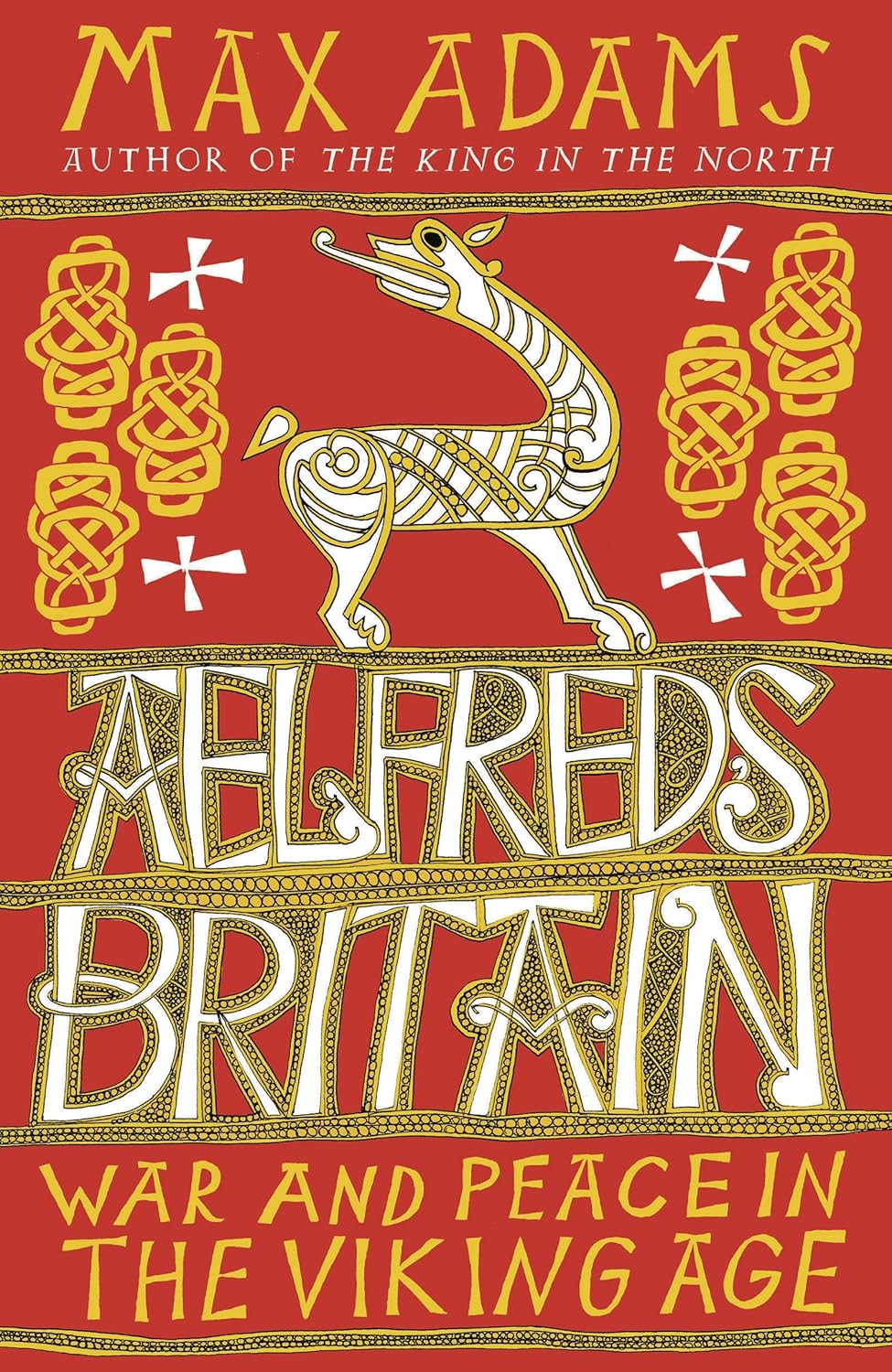
“In 865, a great Viking army landed in East Anglia, precipitating a series of wars that would last until the middle of the following century. It was in this time of crisis that the modern kingdoms of Britain were born. In their responses to the Viking threat, these kingdoms forged their identities as hybrid cultures: vibrant and entrepreneurial peoples adapting to instability and opportunity.
Traditionally, Ælfred the Great is cast as the central player in the story of Viking Age Britain. But Max Adams, while stressing the genius of Ælfred as war leader, law-giver, and forger of the English nation, has a more nuanced and variegated narrative to relate. The Britain encountered by the Scandinavians of the ninth and tenth centuries was one of regional diversity and self-conscious cultural identities: of Picts, Dál Riatans and Strathclyde Britons; of Bernicians and Deirans, East Anglians, Mercians and West Saxons.”
My Review
Ælfred’s Britain is an excellent book. It does not confine itself to the period of Alfred’s rule but comprehensively offers an account of England from the reign of Alfred’s grandfather to the end of the reign of his youngest grandson (King Eadred) in 955. This makes it much more than a book about Alfred but rather a book about Britain and the Vikings just before, after, and during the First Viking Age. Instead of focusing on England and the Vikings, the book covers the activities of the Vikings in Ireland, Scotland, England and Wales, in a very similar vein to the wonderful book by Claire Downham ‘Viking Kings of Britain and Ireland: The Dynasty of Ívarr to A.D. 1014’, along the way noting events on the Continent and in the homelands of the Vikings and Danes. This ia an important development in the history of the period and a step that should have been taken long, long ago. There is little point in knowing events in England in isolation during this period – a wider view point should and must be adopted. The author also employs an enjoyable and enlightening look at the ‘map’ of Britain – offering something of a handy guide to the various ‘stopping-off’ points available to the men and women from Scandinavia along the coast and riverways. Some may find the author’s naming conventions a little annoying, but it seems to me that all historians have a preferred naming convention and insist on sticking to it no matter what. It is only a slight bugbear, but that is because I know much of the period well. This is a far more ‘historical’ book than The King in The North (which I always felt was too much like a travel guide for comfort). Still, it is, at heart, a book by an archaeologist, and this means that archaeology is used to ‘clothe’ the ‘known’ historical facts and vice versa. Yet, and I must applaud this, the author while relying on some slightly dubious ‘primary’ sources, ensures that the reader is aware of this – and the reader would do well to heed the warnings. Overall, this is a very enjoyable book, filled with fascinating insights. It adopts a view point that has been a long time in being applied to this time period.
















 MJ Porter