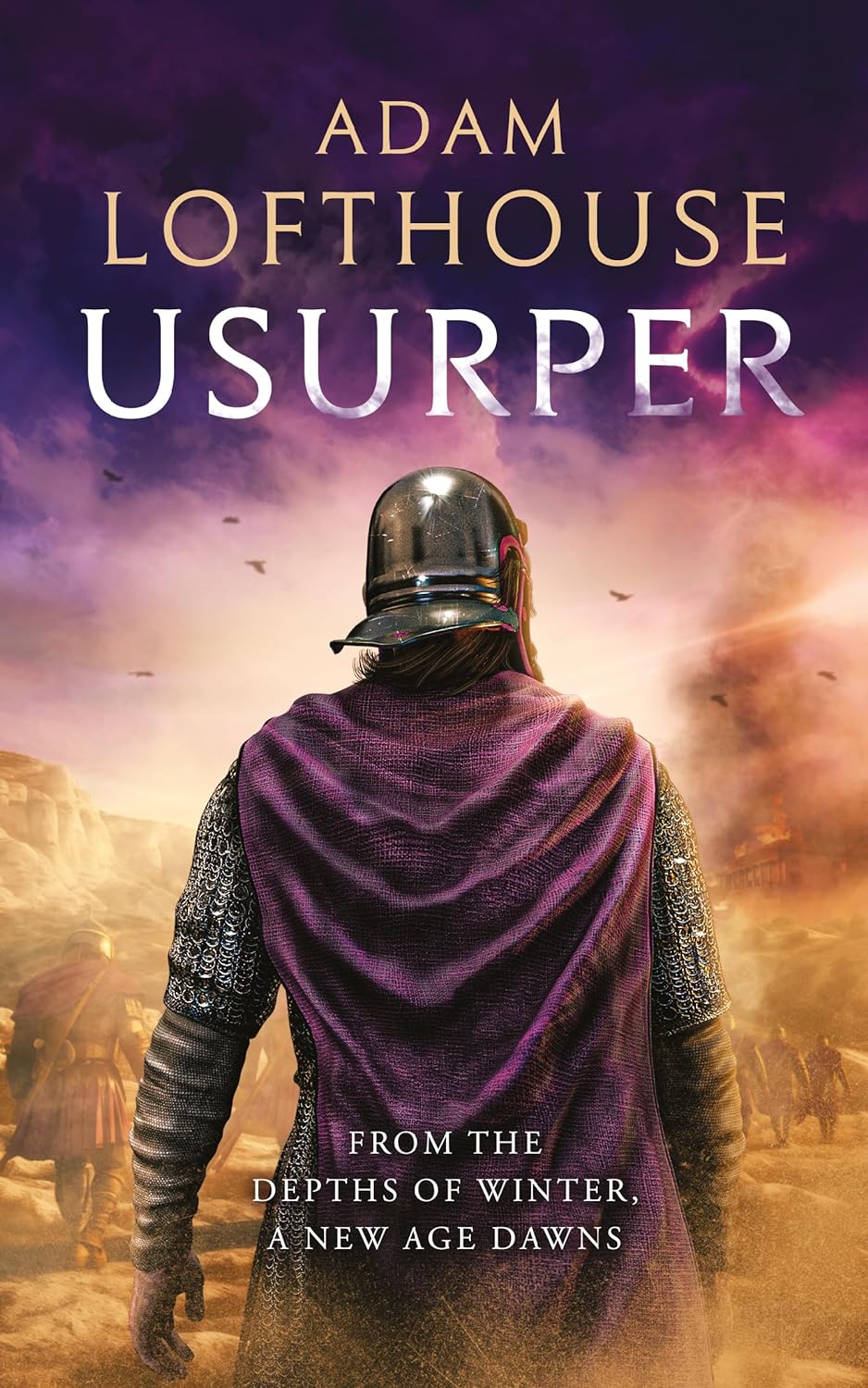

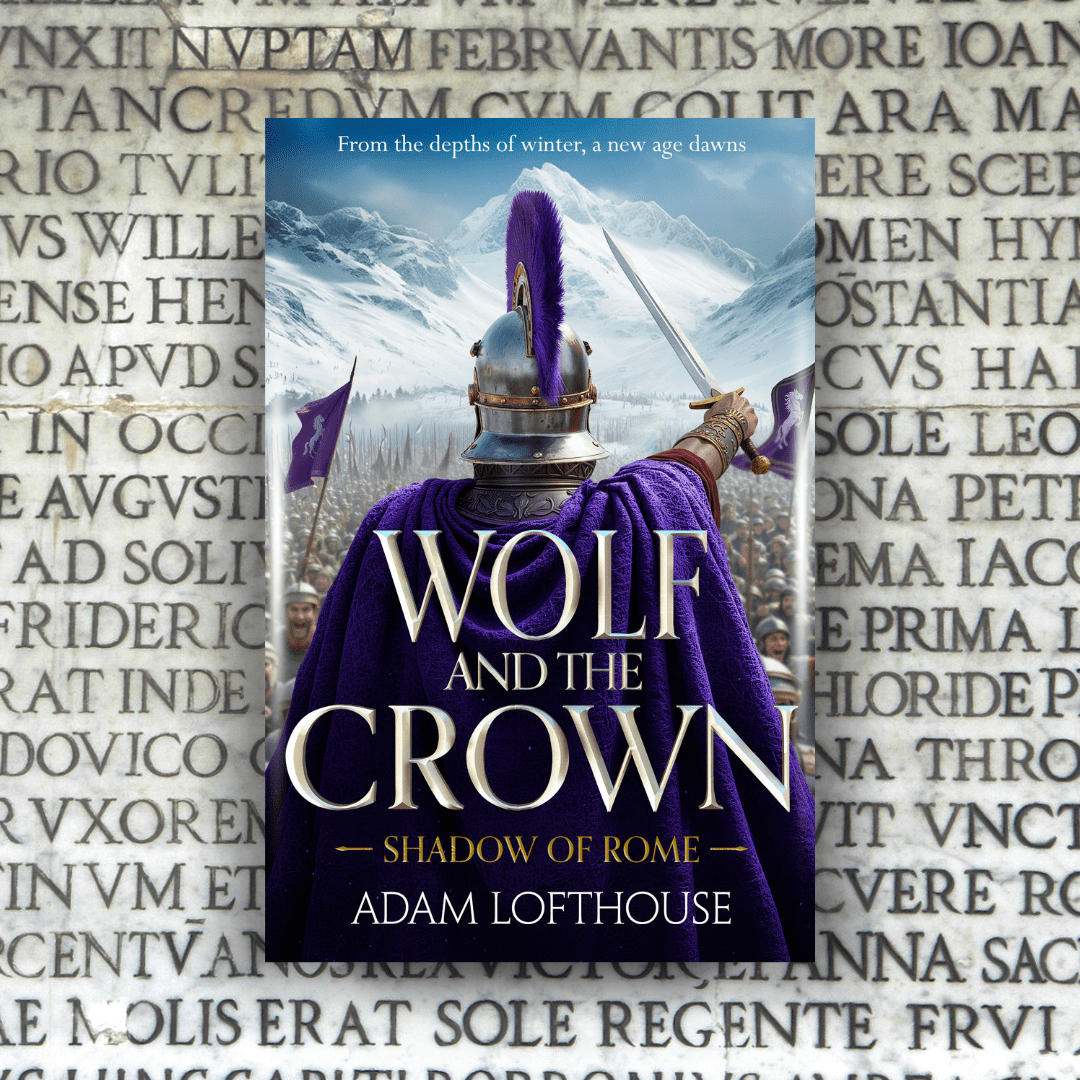
I’m delighted to share my review for Adam Lofthouse’s new Roman-era historical fiction novel, Usurper, which is released today

Here’s the blurb

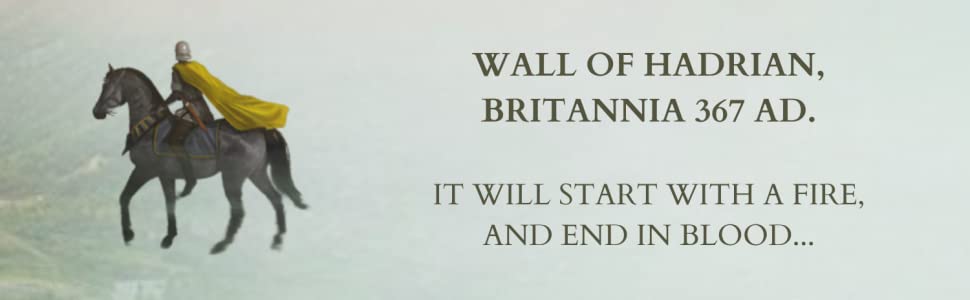
Wall of Hadrian. Britannia, 382 AD

War is creeping back into the land. As silent as snowfall, as inevitable as winter. They’ve had sixteen years of peace, but all things must end.

Tribune Sixtus Victorinus has grown old, complacent. Blind to the truth that stares him in the face, he contents himself with what he has. He runs errands for the Dux Britanniarum Flavius Maximus and watches with joy as his boys grow to become men.

It is his friend, Prefect Gaius Felicius, who first spots the signs. Once more, the Caledonian tribes are rearing their heads in the north, but the greatest danger does not lie with them.

For there is a new pretender to the throne of the West. Another man who seeks to drape himself in purple. Caught up in a scheme they cannot comprehend, Victorinus and Felicius must navigate their way through both a war in the depths of winter, and a treasonous plot that will shake the Roman Empire to its core.

A new age dawns on the men of Britannia. For Victorinus, he must fight for the right to see the sun rise over it.
Purchase Link

https://amzn.to/3OfYAAn

My Review

I’ve just been checking my review for book 1 in this series, and I see I also gave it five stars. Adam is a lucky author because I’m always told that I don’t often hand out a 5-star review. (Check out my review for Valentia here).

And he’ll be pleased to know he’s done it again with Usurper.

I will say that this era – the coming end of Roman Britain fascinates me. Adam’s recreation of it speaks to me. We know what’s coming. The people in these books do not, although perhaps they suspect it.

Usurper continues the story from Valentia, but we move forward 16 years. Our two main characters remain Tribune Sixtus Victorinus and Felicius. Felicius is still a career Roman. Sixtus is not. They are both older, perhaps wiser, and contending with the results of their decisions as younger men.

Sixtus has finally given up the drink, but he is beset with heartache at the breakdown of his marriage and the long-ago death of his small son, which he missed because he was away fighting. Sixtus is a man trying to do his best in a world where the Roman influence of his younger days seems to have bled away. He’s still a friend and ally of Theodosius, the younger emperor, and indeed, they remain in contact via letter – a fabulous device ensuring the reader knows what’s happening beyond the shores of Britannia.

With all that said, this is an action-packed novel. There is barely a chapter that goes by without one fight or another. As we travel from Londinium to many locations on the Wall and even further north, Sixtus gets an absolute beating. Drost makes a welcome reappearance, and conspiracies abound. The set-up for book 3 in this trilogy is impeccably well-paced – I didn’t know how the book would end – although I had some suspicions. It didn’t do what I thought it would, and now I can’t wait for the concluding volume in the trilogy.

It is a fabulous Roman-era action and adventure story that rings with conviction and conspiracy, which readers of the genre will devour.
Meet the author

Adam has for many years held a passion for the ancient world.
As a teenager he picked up Gates of Rome by Conn Iggulden, and has been obsessed with all things Rome ever since.

After ten years of immersing himself in stories of the Roman world, he decided to have a go at writing one for himself, and hasn’t stopped since. Check out the books on the website, or follow Adam on Social Media for regular updates.

Follow Adam on Twitter: @AdamPLofthouse
Find him on Facebook: facebook.com/AdamPLofthouse
Instagram: adamplofthouse

https://www.adamlofthouse.com

Today, I’m really delighted to be welcoming Adam Lofthouse to the blog, with a post about his new Roman-era historical novel, Valentia, which is released today (and which I’ve already read and reviewed)

Here’s the blurb:

Meet Tribune Sixtus Victorinus. Drunken soldier. Absent father. Unlikely hero.

Wall of Hadrian, Britannia, AD 367

It’s just another day, until it isn’t. Tribune Sixtus Victorinus is scouting north of the Wall when he first sees the smoke. Little does he know it’s about to change his life forever. Riding south he finds a province in chaos, the local populace in flight, the soldiers absent. 

For rebellion is in the air at the far reaches of empire. The land is ablaze, overrun with barbarians, ‘Valentia’, is the word on everyone’s lips. And no one seems to have the first clue what to do about it. 

And so Victorinus must act. He has let his life run to ruin, drunk his youth away. Now he must forge himself into the soldier he always wanted to be, the hero his children think he is. 

Because his family are among the missing, and traitors lurk much closer than he could ever believe. 

To save his family, he must first save an empire.

Buy Now

Adam Lofthouse the idea behind Valentia

I’m not very good at remembering where the ideas for my stories come from. I can remember researching for my first, The Centurion’s Son, and trying to find a period in Roman history that hadn’t already been ‘done’ by the authors I loved reading (Ben Kane, Anthony Riches, Conn Iggulden, Simon Scarrow etc) I settled on the Marcomannic War, but as for the idea of Albinus and his strained relationship with his father, I literally couldn’t tell you how I came up with it. 

For this one though, I sort of know. I was reading the excellent Imperial Brothers by William Hughes, which covers in great detail the reigns of Emperor Valentinian in the west and his brother Valens in the east. I’d researched the period before, and my first attempt at a novel was even set in the eastern empire during Valens’ reign, based around the battle of Adrianople (the book was bloody awful, but I learnt a few things whilst hacking away at my keyboard)

But researching the same period again, and having a few novels under my belt, I felt much more confident diving back into the time period. I discovered something known as the barbarico conspirito (barbarian conspiracy to you and me) which took place in the year 367AD. Britain in that year was effectively cut off from the western empire, as tribes from north of Hadrian’s wall, Ireland and Germania all swarmed on the isolated population at once. 

It instantly caught my attention, my imagination running wild as I thought of the possibilities. I needed a hero, a man to base my story around. What I came up with was Sixtus Victorinus, an aging tribune of the miles areani (a scouting unit that roamed the wild lands north of Hadrian’s Wall, keeping tabs on the Picts). I’ve always been drawn to the sort of anti-hero, and some of the best books I’ve read are centred around them (read The Damned by Tarn Richardson; Inquisitor Poldek Tacit is a phenomenal creation). I started delving into his past, into his mind. The idea of an estranged wife and kids, of drinking to hide the shame of a wasted life, full of regret for the path that remained untrodden, sprang from me, and I knew I had my man. 

The other thing that drew me to this event was the amount of real-life people I could throw in to the story. Magnus Maximus and Theodosius the Great both feature (before they elevated themselves to the purple and took those names, pointed their respective armies at each other and brought the Roman world into civil war – but that’s a tale for another book), so too do the magister militum Flavius Jovinus, and the Theodosius the Great’s father, the Count Theodosius. The more I researched the more found myself itching to get started, but I still needed an antagonist, someone who could have been powerful and ambitious enough to be the man behind the conspirito. 

Enter stage and left, Lupus Valentinus. A senator recorded as being banished from the emperor’s court for a crime that has not survived the centuries, only avoiding execution thanks to a friend in Rome having a word in Valentinian’s ear. He was perfect, not in the least because of his name. 

Valentia is a word that crops up when researching the later western empire, but no one can quite agree on what it was. Some say it was for a time the northernmost province in Britain, between Hadrian’s Wall and the Antonine Wall, others have it as being south of the Wall. Others say it was something else entirely. Again, this worked perfectly for me. I could have it as Valentinus’ own province, the beginning of a new world he was birthing on Britain’s northern soil. He hadn’t though, banked on our anti hero Victorinus to step up and fight him for the right.  

So, I had my story, throw in some stunning artwork by the wonderful folk at More Visual (check them out at bookartwork.com) and I have a book. It was an utter joy to write, and I do hope you’ll enjoy reading it.

Thank you so much for sharing Adam. I wish you tonnes of luck for the new release, and below is my review of Valentia, a fantastic novel.

My Review

Valentia by Adam Lofthouse is a fascinating reimagining of Britannia during the late 360s. This then is Roman Britain, complete with Roman soldiers and senators, Roman weapons and, of course, Hadrian’s Wall. (It’s the 1900 anniversary of Hadrian’s Wall this year, so it’s all quite apt:)) But, this is also a world of Germanic warriors, Saxon invaders, the tribes from beyond the Wall, and even some pirates.

Historically, the end of Roman Britain might be a few years in the future, but this is a world on the brink, the reach of the Romans starting to fade, and the events in Valentia tell of a people as yet unaware of the coming calamities, and, Adam tells it very well. We have abandoned Roman forts, discontent Roman soldiers who aren’t getting paid on time, and the tribes from across Hadrian’s Wall more aware of what might be happening than the Romans. And the emperor is very far away in Rome.

Our two main characters, Tribune Sixtus Victorinus, and Felicius are opposites of the same coin; one jaded and a drunk, the other, still a career Roman soldier. Between them, they must disentangle the unexplained events on the borderlands, and then they must rouse support from all that they can to defeat the coming rebellion.

Valentia starts fantastically well, immediately sucking the reader into the world of the 360s. It’s really quite hard to put the book down as the tension ramps up. Tribune Sixtus is a sympathetic character, for all, he is perhaps to blame for many of his problems. The small group of warriors who make up his area of command are well-sketched, and there is tragedy in the offing. Felicius’ life is more regimented, and it is Felicius who gives us the glimpse of what it was to be a Roman in the waning years of the Empire.

I really enjoyed Valentia. The book starts with a bang and builds really well to its conclusion, meeting a great cast of characters on the way. If you’re a fan of stories set in Saxon England, then you’ll love this earlier glimpse of Britannia.

Book Review – Oathbreaker by Adam Lofthouse – historical fiction

Review of Oathbreaker by Adam Lofthouse (Roman historical fiction)

Here’s the blurb;

“It’s not the shadows you should fear, but what hides within.”
Alaric is an enemy of Rome.
For too long he has thwarted the empires attempts to gain control over the land that has long resisted them: Germania.
To the Romans he is a scourge, always evading their carefully laid traps. But to the tribes he is much worse: Outlaw, chief killer, battle turner, Oathbreaker.
All men know him, all men fear him. At his back is a war host, on his shoulder sits Loki, the Trickster.
A deal has been struck between the legions and the tribes: lifelong enemies agree to become friends, for a time. The eagles’ march with the wolves, together they hunt the raven.
Isolated and lacking in allies, will Alaric be able to break free from the noose that slowly encircles him? Or will the Sly One once more come to his rescue?
OATHBREAKER: One man’s stand against the tyranny of empire.

Here’s my review:

The main character in Oathbreaker, Alaric, is very far from being any sort of hero. Yes, he might be prepared to stand apart from the might of the Roman Empire, but he doesn’t care who he tramples on along the way. Sometimes he’s almost likeable, but a lot of the time, he’s just a single man, making slightly dodgy decisions, often based on his own rage and fury, and trying to live with the consequences.
Alaric is proud of his reputation, but of course, it means that he has far more enemies than allies, as becomes clear as the plotline develops. Alaric also suffers from that most common of problems, he believes the accolades he receives and even revels in them. Having not read the previous two books by this author, which feature Alaric, I’m not sure how his character develops after the events of Oathbreaker, but I’m curious to find out.
Unlike many ‘Roman’ era books, there is actually very little Roman in Oathbreaker. Rather the story is of outsiders looking in, understanding how the Roman Empire works, perhaps better than the Romans do!
Oathbreaker rarely falls into the traps of novels sent in this era, although there are a few ‘back story’ elements that are a little too expected, and the reader, just like Alaric’s most loyal friend, Ketill, does work out what’s actually happening long before Alaric does!
A firm four stars from me – it’s great to read a book that merges the Roman world and that of tribal Germania and have it told from the viewpoint of those tribes. I look forward to reading more.

Oathbreaker is available now, and should be on the list of all who read Roman historical fiction!

You can get a copy from here: