Author of Saxon historical fiction and non-fiction, 20th-century historical mysteries, and Norse-inspired historical romantasy. Book reviewer and blog host.
In the aftermath of the Great War, the line between friend and foe may be hard to discern, even for indomitable former Secret Service agent Verity Kent, in award-winning author Anna Lee Huber’s thrilling mystery series.
Peacetime has brought little respite for Verity Kent. Intrigue still abounds, even within her own family. As a favor to her father, Verity agrees to visit his sister in Wiltshire. Her once prosperous aunt has fallen on difficult times and is considering selling their estate. But there are strange goings-on at the manor, including missing servants, possible heirloom forgeries, and suspicious rumors—all leading to the discovery of a dead body on the grounds.
While Verity and her husband, Sidney, investigate this new mystery, they are also on the trail of an old adversary—the shadowy and lethal Lord Ardmore. At every turn, the suspected traitor seems to be one step ahead of them. And even when their dear friend Max, the Earl of Ryde, stumbles upon a code hidden among his late father’s effects that may reveal the truth about Ardmore, Verity wonders if they are really the hunters—or the hunted . . .
A Pretty Deceit is an excellent addition to the series by Anna Lee Huber. I didn’t realise when I started reading it, that I’d already read Book 3, but I soon appreciated that I ‘knew’ the characters. Then came the search on Goodreads, and then it all made a great deal more sense:)
Verity Kent is once more embroiled in a new mystery and also still pursuing an old one from Book 3, the two threads merging together expertly to give an engrossing and deliciously complicated narrative, that ensures all the old favourites make an appearance at some point throughout the book.
It was a thoroughly enjoyable and engrossing read. In fact, as soon as I’d finished it, I went on to read Book 1, and plan on reading Book 2 as well. If you enjoy a well constructed and deeply rooted 1920’s (well, just as about) murder mystery, this is definitely a great series to read.
Thank you to Netgalley and the Publisher for my review copy.
A Pretty Deceit was released on 6th October, and is available here.
Percy Bysshe Shelley’s brief and turbulent life was as passionate as his poetry. Romantic, idealistic and impulsive, Shelley had several intense love affairs. When Shelley drowned at sea in 1822, he took his secrets with him. Did a beautiful, lovelorn lady really follow him throughout Europe, as he claimed? Did Mary Shelley ever learn about this rival for her affections? Shelley and the Unknown Lady is a carefully researched imagining of the true-life tragedy behind the mystery. This novella is a stand-alone story excerpted from Lona Manning’s Mansfield Trilogy.
And here’s my review;
I’m a stranger to the world recreated by Lona Manning, but that doesn’t matter at all when reading Shelley and the Unknown Lady.
The story immediately beguiles the reader, transporting you to another time and place, and it’s such a fascinating story, that you won’t want to stop reading once you start.
The author certainly knows the story of Shelley incredibly well, and it’s a joy to read the notes added by the author which piece together the historical mystery of the unknown lady.
For a novella, or short story, the reader is rewarded with an absorbing story.
I thoroughly enjoyed it, and would highly recommend Shelley and the Unknown Lady.
Disclaimer, I received a free copy of this book via The History Quill Book Club. If you’re interested in The History Quill then please go and check them out.
Well, this is a first. Today, I welcome Stuart Rudge to my blog. He’s going to tell us all about his research for his new book, Blood Feud, Legend of the Cid Book 2, available now. So, I hand it over to Stuart and he’s going to tell us about building Islamic Zaragoza, which features in his new book.
Research can be boring and tedious – or, it can be interesting and engrossing. When I was researching the Islamic city of Zaragoza for my latest novel, Blood Feud, I found myself leaning in the camp of the latter. The more I was looking in to what medieval Islamic cities looked like and how they functioned, the more I was looking forward to describing it in my novel. Today, I am going to show you how I researched Zaragoza, and how it might have looked in the days of El Cid. Let’s go on a little tour.
I will start with the name. Before the Romans came to Spain, it was a village named Salduie, and then the Romans founded a colony for retired veterans and named it Caesaraugusta. After the Islamic invasion and conquest, it was renamed Saraqusta, which eventually evolved in to the modern name, Zaragoza. As I like to have historically authentic names to my novels, I have plumbed for the Islamic version of the name, like I have done with all of the various taifa kingdoms in the same period (e.g. Toledo is Tulaytula, Valencia is Balansiya, etc).
Below is a screenshot from Google Maps of the centre of modern Zaragoza, and includes some of the key features of the Islamic settlement. The orange lines indicate the approximate outline of the walls built by the Moors, along with the site of the Aljaferia palace, and La Zuda palace, which were key landmarks of the city in the eleventh century.
Estimated site of Islamic Saraqust
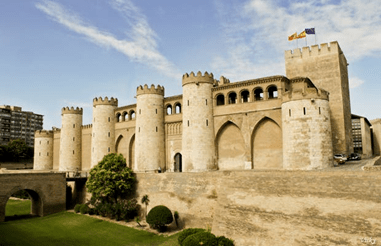
The Aljaferia
The Aljaferia palace is a unique building, as it is one of the only complete structures standing today which dates to the taifa period of Spanish history. Dating to the eleventh century, the palace was named “Palace of the Joy” by amir al-Muqtadir, and he held his court and greeted his embassies in his “Golden Hall” as he described it. The modern interior is largely different to what the Islamic amirs would have walked through, as the city was conquered by the kingdom of Aragon at the beginning of the twelfth century, and over time the Christian monarchs converted it to suit their tastes, but we do have examples of friezes from the eleventh century, and the columns and archways give us an indication of Islamic architectural and artistic styles from the period, as seen below.
Column capitals and yeseria, c. eleventh century.
Images: Wikipedia
In its zenith it would have been a place of wonder and beauty, a tranquil palace in the centre of a neigh impregnable fortress just outside of the main city. As the building was being renovated during the latter half of the eleventh century, the only part of the citadel which the story of Blood Feud takes part in is the Troubadour tower, which preceded the citadel by around two hundred years, being part of an earlier fortification which was incorporated in to the Aljaferia palace.
Frontal image of the Aljaferia palace, with the Troubadour Palace on the right Image: Wikipedia
La Zuda Palace
Before the amir of Zaragoza moved his court to the Aljaferia palace, the governors of the city were housed in La Zuda palace. Located in the old Roman part of the city, it was built adjacent to the corner section of the Roman wall next to the river, and like the Aljaferia, it was a similarly fortified and secure site.
The current site is occupied by a sixteenth century tower and an eighteenth century church, which has replaced an earlier medieval church, and since none of the Islamic site remains, we have no definitive way of knowing what the palace would have looked like. In my view, the exterior wall would have looked something akin to that of the Aljaferia, albeit on a smaller scale. The interior is where imagination is needed. I took inspiration from the Aljaferia, the Alcazar of Seville and the Alhambra of Granada, three of the most famous Islamic palaces in Spain, thrown in with some artistic creativity, to create what I believe would have been a (roughly) accurate portrayal of what an Islamic palace would have looked like; a tranquil haven away from the hustle and bustle of the city. An example of what I came up with is below:
“Walking around the palace, I wondered why al-Muqtadir was moving his court to the citadel outside the walls. As we passed through the gate, we entered a courtyard with a long pool which stretched to a hall at the opposite end, with trees bearing peaches, lemons and pomegranates that ran parallel to the pool. Pointed archways with alternating black and white painted blocks were held up with thin black columns, and the walls were painted white with black script running down each wall. The colonnades around the periphery led to side rooms shielded with silken drapes, whilst bronze incense burners hung from the ceiling, filled the air with a perfumed scent intensified by the sweetness of the fruit trees. Court officials sauntered here and there as guards stood vigil with tall spears; each man wore the uniform of pale yellow favoured by the amir. There was relative silence within the palace save for the occasional chatter which echoed in the corridors, and made it a tranquil haven away from the commotion of the city.
Idris led us across to the opposite side of the courtyard and through to a large hall, and here the decoration was more elaborate. The walls bore intricate patterns painted in vibrant blues, reds and yellows, and it was one of the most beautiful things I had ever seen. I marvelled and let my jaw hang slack, for something so striking was rare in Castile and I could have lingered all day to drink it in. Fine bronze statues of stags lined the walls too, and the domed ceiling was of smooth, dark stone studded with small pieces of coloured glass, so it resembled the stars twinkling in the night sky. The perfumed scent intensified, and the air was filled with the sound of a man uttering what seemed like poetry to an audience.”
The Roman City
By the eleventh century, the shell of the old Roman city of Caesaraugusta would still have been intact. The fact that part of the Roman walls still stand suggest they would have stood in some capacity in the Islamic period. We know that some parts still stood, as they do today, yet other parts would have been stripped of their masonry to be used elsewhere in the city for new structures, and only the foundations would have remained to form some sort of border or barrier. As the Moors built another wall around their own city, there was no need to fully maintain the Roman fortifications.
Estimated site of Roman Caesaraugusta
Part of the section in Zaragoza involves Antonio tailing an old foe towards the wharfs, and again later on when he is trying to prevent his escape. In my research I found scant information relating to what the Islamic wharf would have looked like at the time, and had to improvise. But around a month or so before I was going to release the book, I stumbled across the website Zaragoza.es. On there, it had a little pamphlet with information about the Roman forum, the wharf and the walls. From the below picture, we can garner quite a lot of how things looked.
Artist impression of how the Roman forum and wharfs would have looked. Image: Zaragoza.es
The central structure and wide open space is the old Roman forum, which was the beating heart of the city, and the structure below it, facing the river, is a huge warehouse. The image below shows a reconstruction of what the warehouse may have looked like.
Cross section of old Roman warehouse. Image from Zaragoza.es
We know from sources that the forum was all but gone by the eleventh century; given the close proximity to the river, it is likely the area was turned in to a large market. It is also likely that the warehouse was still functioning at this time, and was used as a place to store goods coming straight from the ships before being taken to market, or further afield on the back of mules. Given the length of the wharf and the amount of ships that could have been docked at any one time, it is not hard to imagine the area as a hive of activity, with men coming from all corners of Europe, Africa and the Middle East, bringing goods such as spices, leather and metal work, raw materials from far off lands, luxurious silks and linens, and even slaves.
After conducting all of my research, I made myself a little map with all the different sites of the city, and where the Roman and Islamic parts of the city would be. Here is what I came up with:
My interpretation of how Saraqusta would have looked
The characteristics of both the Roman city and the Muslim city would have been very different. Roman cities generally followed a set of rules; wide, straight streets, close to a water source, with strong walls and a central open space called a forum, where the principle administrative buildings were located. Muslim cities tended to be more compact, with narrow, winding streets, branching off to cul-de-sacs of homes for the inhabitants, with a large space reserved for markets, and various mosques scattered throughout the cities. One example for the differences was transport. The Romans used wagons to transport their goods, and so main streets had to be wide enough to accommodate two wagons travelling abreast, whereas Muslim traders used pack animals such as mules, and so the streets would not be as wide. In a warm climate like Spain, narrower streets coupled with white washed walls of the buildings made the cities feel cooler, darker and more compact.
I hope you have enjoyed this little tour around the medieval city of Zaragoza. For a more in depth look at how I envisioned it, pick up a copy of Blood Feud, the second book in the Legend of the Cid series, and explore the secrets of one of the great taifa states of the medieval period.
Blood Feud is available now, and can be picked up from Amazon here.
England, 1459: Cecily Neville, Duchess of York, is embroiled in a plot to topple the weak-minded King Henry VI from the throne. But when the Yorkists are defeated at the Battle of Ludford Bridge, Cecily’s family flee and abandon her to face a marauding Lancastrian army on her own.
Cecily can only watch as her lands are torn apart and divided up by the ruthless Queen Marguerite. From the towers of her prison in Tonbridge Castle, the Duchess begins to spin a web of deceit – one that will eventually lead to treason, to the fall of King Henry VI, and to her eldest son being crowned King Edward IV.
This is a story of heartbreak, ambition and treachery, of one woman’s quest to claim the throne during the violence and tragedy of the Wars of the Roses.”
The Queen’s Rival is a stunning look at the ‘later’ life of Cecily Neville from 1459 until 1483. This is not a ‘quiet’ period of history and to cover the tumultuous events, the author adopts the technique of recording the letters of the main protagonists, either from the pen of Cecily or from those who write to her.
It does take a little while to get used to the technique, but the reader is quickly drawn into the story, not perhaps by the events taking place, but rather by the relationship between Cecily and her two sisters, Anne, Duchess of Buckingham and Katherine, Dowager Duchess of Norfolk. The words they share with each other are just what sisters might well say to each other, especially when they’re not likely to see each other soon.
More importantly, the sisters, while fiercely loyal to their Neville inheritance, are not of one mind about who should rule England, and who has the right to rule England. It highlights just how destructive the War of the Roses was, and is a genius way of quickly ensuring the reader appreciates that families were ripped apart by the protracted war.
This is the story of the women of the later 15th century. It’s their voices that we hear, as they try and come to terms with the rises and falls all of them experience. There are moments when the narrative is hard to read, either because you know what’s going to happen, or just because you really feel for Cecily and don’t want her to experience the tribulations than she does.
I am a huge fan of Anne O’Brien and the ‘forgotten’ women of the medieval period in England. While the author may stress that Cecily is not really a forgotten woman, I was not really aware of her before reading this book. The mother of two kings, the grandmother of future kings, and yet she could also have been queen herself. What an interesting life she led.
I highly recommend this book. And you can find my review here for A Tapestry of Treason.
Thank you to the publisher and Netgalley for my review copy.
The Queen’s Rival is released in ebook and hardbook on 3rd September 2020. (What a stunning cover.) It is released in paperback today, 15th April 2021.
“AD 647. Anglo-Saxon Britain. A gripping, action-packed historical thriller and the seventh instalment in the Bernicia Chronicles.
War hangs heavy in the hot summer air as Penda of Mercia and his allies march into the north. Caught unawares, the Bernician forces are besieged within the great fortress of Bebbanburg.
It falls to Beobrand to mount the defence of the stronghold, but even while the battle rages, old and powerful enemies have mobilised against him, seeking vengeance for past events.
As the Mercian forces tighten their grip and unknown killers close in, Beobrand finds himself in a struggle with conflicting oaths and the dreadful pull of a forbidden love that threatens to destroy everything he holds dear.
With the future of Northumbria in jeopardy, will Beobrand be able to withstand the powers that beset him and find a path to victory against all the odds?”
Beobrand is becoming a firm favourite for fans of historical fiction. But, as many will know, I struggle a little with his ‘grumpiness.’ I have enjoyed the author’s new hero, found in The Wolf of Wessex, a whole lot more, and I’m really keen to read the new book A Time For Swords, as well. But, I’m always curious to see what Beobrand is up to, and therefore I was keen to get an advanced copy from Netgalley and the publisher.
Fortress of Fury is a solid addition to The Bernicia Chronicles.
It begins strongly, and slowly builds to the portrayal of Bebbanburg facing one of its greatest challenges throughout its long history. The battle scenes are well-played out and Beobrand earns battle glory for himself.
The scenes that follow the big battle are very much laying the groundwork for future stories about Beobrand and his band of geishas, and for that reason, I very much felt that the book peaked too soon. I was anticipating a blood and gore-drenched battle that lasted for days, and that was not what I got, concerned rather with events after the attack on Bebbanburg. It’s not a direction I was expecting, and it wrong-footed me a little.
That said, I look forward to seeing what trouble Beobrand and his geishas get themselves involved in next. I’m sure it’s not going to be pretty, and if Beobrand cracks a smile, I might well cheer!
Fortress of Fury is released on in ebook on 6th August 2020, and the audiobook and hardback will follow later in the year. (The cover is amazing).
“Many Anglo-Saxon kings are familiar. Æthelred the Unready is one, yet less is written of his wife, who was consort of two kings and championed one of her sons over the others, or his mother who was an anointed queen and powerful regent, but was also accused of witchcraft and regicide. A royal abbess educated five bishops and was instrumental in deciding the date of Easter; another took on the might of Canterbury and Rome and was accused by the monks of fratricide.
Anglo-Saxon women were prized for their bloodlines – one had such rich blood that it sparked a war – and one was appointed regent of a foreign country. Royal mothers wielded power; Eadgifu, wife of Edward the Elder, maintained a position of authority during the reigns of both her sons.
Æthelflaed, Lady of the Mercians, was a queen in all but name, while few have heard of Queen Seaxburh, who ruled Wessex, or Queen Cynethryth, who issued her own coinage. She, too, was accused of murder, but was also, like many of the royal women, literate and highly-educated.
From seventh-century Northumbria to eleventh-century Wessex and making extensive use of primary sources, Women of Power in Anglo-Saxon England examines the lives of individual women in a way that has often been done for the Anglo-Saxon men but not for their wives, sisters, mothers and daughters. It tells their stories: those who ruled and schemed, the peace-weavers and the warrior women, the saints and the sinners. It explores, and restores, their reputations.”
Women of Power in Anglo-Saxon England is an ambitious project, on a scale that few may truly appreciate as it covers over 600 years of Early English history. That’s even before factoring in just how fragmented the surviving sources are, and how complicated they can be and how many languages are involved. Or the fact that the majority of such sources were written by men, and not just men, but men in holy orders. As someone who has written about some of these fabulous women, I know just how difficult and complicated a task it is, and just how far you have to go in order to tease out the smallest details.
It is for this reason, that the book can feel a little unwieldy in places. I think that people new to the subject matter and to the time period might well struggle with the first section of the book on Pioneers in Northumbria. In an effort to include every woman, of whom so little is known that sometimes it is just a name, it can feel a little bit like a long list of women who you might not be able to fully grasp their importance in the events of the period. There might also be some frustration that the women could only be powerful because of who they married, gave birth to, or were born to. This, however, can’t be avoided. It is the nature of the sources.
And I must urge people to continue reading as the author soon lands on more solid ground (because there is more information available and the women feel more fully formed.) The chapters on Mercia and Wessex are a much easier read, and by the time we reach the chapters on Serial Monogamy and Dowager Queens, the women feel ‘real.’ Again, this is because of an increase in the source material, and potentially, because readers will know more about the tenth and eleventh centuries.
The author manages to cover an extraordinary number of women over the long centuries of the Early English period, and if there are moments where I might have included different information, or rejected some of the Saints Lives and Anglo-Norman historians from the narrative, this is a personal choice, based on my own research methodology which does seem to be the exception rather than the norm.
I confess, the book would have benefitted from a chronology for each chapter, and perhaps a slightly different format (I read an ebook so this might display differently in the paperback), but overall, I am in awe of the author’s ability to hold the narrative together and to produce something that I hope will encourage people to further research these wonderful characters who should be just as well known as their male counterparts.
Thank you to Netgalley and the publisher for my review copy.
Women of Power is released today, 30th May, and is available from the publisher as well as on other sites, although it is showing as a preorder.
‘Britain is a land riven by anarchy, slaughter, famine, filth and darkness. Its armies are destroyed, its heroes dead, or missing. Arthur and Lancelot fell in the last great battle and Merlin has not been these past ten years. But in a small, isolated monastery in the west of England, a young boy is suddenly plucked from his simple existence by the ageing warrior, Gawain. It seems he must come to terms with his legacy and fate as the son of the most celebrated yet most infamous of Arthur’s warriors: Lancelot. For this is the story of Galahad, Lancelot’s son – the reluctant warrior who dared to keep the dream of Camelot alive.’
I’ve just reread the review I wrote for Lancelot nearly two years ago, and even I’m blushing about how effusive I was about it!
Camelot begins in much the same way. The lead character is a young man, about to take his vows to become a monk on the tor at Glastonbury when his world completely changes. The depiction of life on the tor is wonderfully evoked, and even if the author could have just written ‘bird’ ‘tree’ and ‘flower’ I’m sure many will appreciate the attention to detail. (I’ve never been ‘at one’ with nature).
The story starts quite slowly, drawing you back into the world of post-Roman/pre-Anglo-Saxon Britain with deft skill and then the story truly begins to take shape, secrets are revealed, and the ties to the previous book begin to be revealed.
I truly don’t want to give too much of the story away, but the ‘quest’, for that is what it becomes, takes readers from Cornwall to Anglesey and then further, the fear of what is to come in the future a palpable threat and even though we all know what’s going to happen, in the end (outside the scope of the book) I couldn’t help but hope that it would all be very, very different. The characters demand it from the reader.
And the end, is once more, where I have some small complaints about the story. It’s not that it doesn’t do what I want it to do, it’s just that the ending seems wrong for the story, but then, perhaps, it was always going to because that is the legend of Arthur.
But before that ending, the legends of Arthur and his knights are beautifully evoked, and I think a particular strength is the depiction of King Constantine, a bit part character, but immensely powerful and the very embodiment of a land falling to chaos all around him, and yet not prepared to give way and accept what seems to be the inevitable.
This book, once more, has its flaws, some scenes seem unnecessary, and others are skipped over too quickly, but it feels so true to the legends. There’s so much that’s only half-seen, hinted at but never actually known.
A welcome return to Giles Kristian’s ‘world’ first created in Lancelot, and, I think the author notes at the end of the novel explain a great deal. Now, give me the story of Arthur and his knights at the height of their prowess (please!).
Thank you to Netgalley and the publisher for my review copy.
Camelot is available from 14th May 2020 from here:
Return to a world of crystal armour, savage wilderness, and corrupt dynasties in book two of The Deathless series from Gemmell award-winning author Peter Newman.
THE REBEL
For years, Vasin Sapphire has been waiting for the perfect opportunity to strike. Now, as other Deathless families come under constant assault from the monsters that roam the Wild, that time has come.
THE RUTHLESS
In the floating castle of Rochant Sapphire, loyal subjects await the ceremony to return their ruler to his rightful place. But the child raised to give up his body to Lord Rochant is no ordinary servant. Strange and savage, he will stop at nothing to escape his gilded prison.
AND THE RETURNED…
Far below, another child yearns to see the human world. Raised by a creature of the Wild, he knows their secrets better than any other. As he enters into the struggle between the Deathless houses, he may be the key to protecting their power or destroying it completely.
THE WILD HAS BEGUN TO RISE.
The Ruthless by Peter Newman is a fantastic ‘Part 2’ of what will be a trilogy, charting The Deathless. The action picks up exactly where it left off, although sixteen years have passed, allowing the babies of the book to be all grown up and therefore more involved in what’s happening.
The likeable characters of Book 1 are there, Sa-at, Pari, Vasin, Chandi as well as a few that we didn’t like so much. The world created by Newman continues to be vivid and downright ‘weird’ and there were a few times when I felt a little ‘itchy’ so good were the descriptions of The Wild! All of the characters are set on paths that will see them coming into contact at one point or another, and the end is entirely satisfying, leaving me with many questions still to be answered, and a fear that something really BAD is going to happen in the concluding book of the trilogy. I read this book in just over 24 hours. It’s entirely absorbing, wonderful ‘weird’ and incredibly rewarding. Newman uses words to great effect and I just ‘got’ exactly what he was trying to portray. I really can’t recommend it enough.
Thank you to Netgalley for the review copy. I will be ‘singing’ about this series whenever I get the opportunity
The Ruthless is available from 30th April 2020 in paperback. I highly recommend it!
East of the Black Rock, out on the ice, lies a hole down which broken children are thrown
On the vastness of the ice there is no room for individuals. No one survives alone.
To resist the cold, to endure the months of night when even the air itself begins to freeze, requires a special breed. Variation is dangerous, difference is fatal. And Yaz is different.
Torn from her family, from the boy she thought she would spend her life with, Yaz has to carve a new path for herself in a world whose existence she never suspected. A world full of danger.
Beneath the ice, Yaz will learn that Abeth is older and stranger than she had ever imagined.
She will learn that her weaknesses are another kind of strength. And she will learn to challenge the cruel arithmetic of survival that has always governed her people.
Only when it’s darkest can you see the stars.”
The Girl and the Stars is set on the same world as The Book of the Ancestor, and I’m aware that there are many more stories that need to be told to fully understand Abeth. Not that new readers can’t pick up from here. There is no need to have read The Books of the Ancestors.
I’ve heard a great deal about The Girl and the Stars on twitter and I was looking forward to reading it. The story starts strongly and Yaz is an enjoyable character to read about. The set up of the story is intriguing and not at all where I expected it to go. Foolishly, I thought I knew where Lawrence was going with this new trilogy. There are many fascinating elements and I was really enjoying exploring the landscape of ‘the stars,’
Lawrence titillates with fragments of what’s actually happening and what’s happened in the past (he’s a bit good at this) but I found I wanted to know more about that, and less about Yaz and her group of friends. And by the time I was a decent distance into the book, I was beginning to suffer from the same sensory deprivation as the characters. This probably isn’t a good thing. My enjoyment of the story did drop away – the relentless pacing couldn’t quite make up for my lessening enjoyment, and while the ending is bloody stunning, I can’t help but think it could have been reached at least a hundred pages earlier!
I’m still very much looking forward to reading all the books in this new trilogy, but hopefully, they won’t share the same setting!
Thank you to Netgalley and the publisher for my review copy.
The Girl and the Stars is available in ebook now and hardback from next week. You can snap up a copy from here:
‘Britain is a land riven by anarchy, slaughter, famine, filth and darkness. Its armies are destroyed, its heroes dead, or missing. Arthur and Lancelot fell in the last great battle and Merlin has not been these past ten years. But in a small, isolated monastery in the west of England, a young boy is suddenly plucked from his simple existence by the ageing warrior, Gawain. It seems he must come to terms with his legacy and fate as the son of the most celebrated yet most infamous of Arthur’s warriors: Lancelot. For this is the story of Galahad, Lancelot’s son – the reluctant warrior who dared to keep the dream of Camelot alive.’
I’ve just reread the review I wrote for Lancelot nearly two years ago, and even I’m blushing about how effusive I was about it!
Camelot begins in much the same way. The lead character is a young man, about to take his vows to become a monk on the tor at Glastonbury when his world completely changes. The depiction of life on the tor is wonderfully evoked, and even if the author could have just written ‘bird’ ‘tree’ and ‘flower’ I’m sure many will appreciate the attention to detail. (I’ve never been ‘at one’ with nature).
The story starts quite slowly, drawing you back into the world of post-Roman/pre-Anglo-Saxon Britain with deft skill and then the story truly begins to take shape, secrets are revealed, and the ties to the previous book begin to be revealed.
I truly don’t want to give too much of the story away, but the ‘quest’, for that is what it becomes, takes readers from Cornwall to Anglesey and then further, the fear of what is to come in the future a palpable threat and even though we all know what’s going to happen, in the end (outside the scope of the book) I couldn’t help but hope that it would all be very, very different. The characters demand it from the reader.
And the end, is once more, where I have some small complaints about the story. It’s not that it doesn’t do what I want it to do, it’s just that the ending seems wrong for the story, but then, perhaps, it was always going to because that is the legend of Arthur.
But before that ending, the legends of Arthur and his knights are beautifully evoked, and I think a particular strength is the depiction of King Constantine, a bit part character, but immensely powerful and the very embodiment of a land falling to chaos all around him, and yet not prepared to give way and accept what seems to be the inevitable.
This book, once more, has its flaws, some scenes seem unnecessary, and others are skipped over too quickly, but it feels so true to the legends. There’s so much that’s only half-seen, hinted at but never actually known.
A welcome return to Giles Kristian’s ‘world’ first created in Lancelot, and, I think the author notes at the end of the novel explain a great deal. Now, give me the story of Arthur and his knights at the height of their prowess (please!).
Thank you to Netgalley and the publisher for my review copy.
Camelot is available from 14th May 2020 from here: (the preorder is currently only £2.99 for kindle – wowsers – so I’m posting this before release date for everyone to take advantage of the offer)