
I’m delighted to welcome Anna Belfrage to the blog with a post about her main characters.
When loving came with severe restrictions – of anti-miscegenation laws in Colonial America
In 1967, the Supreme Court of the United States unanimously concluded that state laws forbidding interracial relations were in breach of the 14th amendment to the Constitution. Mildred and Richard Loving no longer needed to worry they’d be fined or incarcerated for loving each other. 1967. Not that long ago, is it?
Anti-miscegenation laws were adopted by several of the British American Colonies. First in Maryland, then in Virginia, and subsequently in several others. The laws were harsh and had as their purpose to ensure the races were kept “separate”—well, beyond the obvious intermingling that occurred when a white slave owner decided to sleep with his black slave. Not that much of a problem according to the legislators, as any child born to a slave was automatically defined as a slave. Initially, the laws forbade marriage between a white person and an enslaved or indentured person of colour – probably because this would cause confusion as to the legal status of the unfree person and encroach on the property rights of said unfree person’s “owner”. Over time, the laws were expanded to include any person of colour, free or not. In some states, the laws were extremely detailed, forbidding not only relations between white and black, white and coloured, but also between black and Native American.
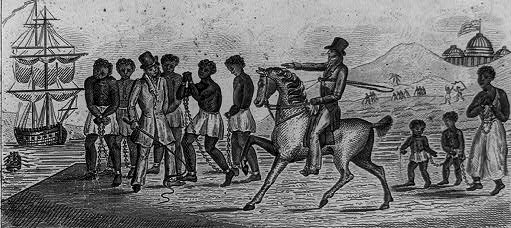
Obviously, these laws reflect the biases of a slave-based economy. If, on the one hand, you were arguing that people of colour were less equal than a white person—so much less equal, in fact, that it was perfectly okay to enslave them—it would be difficult to, on the other hand, welcome a person of colour as your equal in the salons of society. Not even a free person of colour could/should be treated as an equal. Yes, they were no longer slaves, but they were definitely “lesser”.
I had never fully immersed myself in researching this dark side of history until I ended up with a woman of colour as my protagonist. Initially, I didn’t even reflect on the fact that Erin Barnes was of mixed race. Yes, I’d given her a half Afghani, half British grandmother, and yes, said lady was very much in love with her black US Army veteran, but I found that aspect of Erin relatively unimportant. I was far more interested in her pursuit of justice for her murdered grandmother and her determination to use all her investigative skills to achieve this, despite the obvious risks to herself.
“You did not notice how beautiful she is?” Duncan asks, sounding shocked. “You didn’t see that her skin is like molten syrup, her hair a cloud of darkest gold?”
Umm . . . No, I didn’t. Not really. And obviously, Duncan is biased—he has been since he first saw Erin.
Frankly, it wasn’t until Duncan and Erin ended up in 1715 that it struck me just how difficult life would be for her in this new time. Duncan, of course, immediately realised this, and did what he could to protect her—namely marry her. Fortunately for him, at the time they were in London, where there were no legal prohibitions to wedding someone of a different colour. There were, however, societal reservations, but Duncan didn’t much care.
After a sequence of adventures, my couple returned to Maryland—briefly. Soon enough, Duncan realised that even with the protection of his name and wealth—and that of his powerful friends—Annapolis would never tolerate this union between a white man and a woman of colour. So they moved north, to Pennsylvania.
What exactly was a white man risking by marrying a woman of colour? Well, if a white man had sexual relations with a free woman of colour (note that it was okay for a slave owner to have sexual relations with an enslaved woman of colour) and chose to live with her, they could both be indentured for decades. Should he be foolish enough to marry her, indentureship converted to enslavement—for both of them. And not necessarily together.

Despite these frightening consequences, there are documented cases of people still choosing to marry the person they loved, no matter the colour of their skin. In one of the more well-known cases, an Irish girl named Nell Butler fell in love with and married a black slave, known only as Negro Charles. She thereby became the property of her hubby’s owner, as did all their future children.
As made obvious already in the opening paragraph, anti-miscegenation laws were to remain in existence in many of the US states well into the twentieth century. And throughout all those years of prohibition, as regular as clockwork, cases would crop up where people loved so hard they were willing to face the consequences. It if wasn’t so very, very sad, it would almost be romantic.
Moving Erin and Duncan to Pennsylvania only bought them a few years of grace: in 1725 the colony of Pennsylvania pushed through their own anti-miscegenation laws. My imaginary couple must now find a new home, but sadly I suspect that wherever they go in the early 18th century they will be met by gasps and avid curiosity. A woman of colour—no matter how beautiful—did not belong with a successful white man. Not, at least, as his wife.
“Pah!” Duncan says, drawing Erin close enough to give her a resounding kiss. “What do I care what others think?”
It is not quite as easy for Erin to be dismissive of the opprobrium she so often faces. But she tries, putting on a brave face while swallowing whispered insults and insinuations. But now and then, the independent, modern Erin just can’t hold back—which at times leads to very, very difficult situations!
Thank you for sharing such an interesting post. I imagine your characters have a few tough moments to survive.
Here’s the blurb:
It is 1718 and Duncan Melville and his time traveller wife, Erin, are concentrating on building a peaceful existence for themselves and their twin daughters. Difficult to do, when they are beleaguered by enemies.
Erin Melville is not about to stand to the side and watch as a child is abused—which is how she makes deadly enemies of Hyland Nelson and his family.
Then there’s that ghost from their past, Armand Joseph Chardon, a person they were certain was dead. Apparently not. Monsieur Chardon wants revenge and his sons are tasked with making Duncan—and his wife—pay.
Things aren’t helped by the arrival of Duncan’s cousin, fleeing her abusive husband. Or the reappearance of Nicholas Farrell in their lives, as much of a warped bully now as he was when he almost beat Duncan to death years ago. Plus, their safety is constantly threatened as Erin is a woman of colour in a time and place where that could mean ostracism, enslavement or even death.
Will Duncan and Erin ever achieve their simple wish – to live and love free from fear of those who wish to destroy them?

Buy Links:
This title is available on #KindleUnlimited.
Amazon US: Amazon UK: Amazon CA: Amazon AU:
Meet the author
Had Anna been allowed to choose, she’d have become a time-traveller. As this was impossible, she became a financial professional with two absorbing interests: history and writing. Anna has authored the acclaimed time travelling series The Graham Saga, set in 17th century Scotland and Maryland, as well as the equally acclaimed medieval series The King’s Greatest Enemy which is set in 14th century England.
Anna has also published The Wanderer, a fast-paced contemporary romantic suspense trilogy with paranormal and time-slip ingredients.
More recently, Anna has been hard at work with her Castilian series. The first book, His Castilian Hawk, published in 2020, is set against the complications of Edward I’s invasion of Wales, His Castilian Hawk is a story of loyalty, integrity—and love. In the second instalment, The Castilian Pomegranate, we travel with the protagonists to the complex political world of medieval Spain, while the third, Her Castilian Heart, finds our protagonists back in England—not necessarily any safer than the wilds of Spain! The fourth book, Their Castilian Orphan, is scheduled for early 2024.
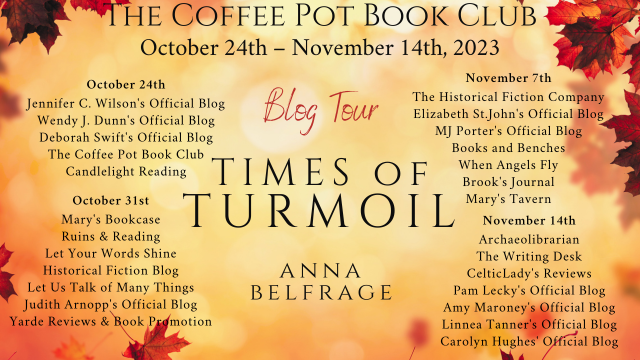
Anna has recently released Times of Turmoil, the sequel to her 2021 release, The Whirlpools of Time. Here she returns to the world of time travel. Where The Whirlpools of Time had Duncan and the somewhat reluctant time-traveller Erin navigating the complexities of the first Jacobean rebellion in Scotland, in Times of Turmoil our protagonists are in Colonial Pennsylvania, hoping for a peaceful existence. Not about to happen—not in one of Anna’s books!
All of Anna’s books have been awarded the IndieBRAG Medallion, she has several Historical Novel Society Editor’s Choices, and one of her books won the HNS Indie Award in 2015. She is also the proud recipient of various Reader’s Favorite medals as well as having won various Gold, Silver and Bronze Coffee Pot Book Club awards.
Find out more about Anna, her books and enjoy her eclectic historical blog on her website, www.annabelfrage.com

Connect with the author
Amazon Author Page: or http://amazon.com/author/anna_belfrage
 MJ Porter