
Check out my review for Storm of Steel by Matthew Harffy #hisfic #bookreview #Beobrand

Here’s the blurb

“AD 643. Anglo-Saxon Britain. A gripping, action-packed historical thriller and the sixth instalment in the Bernicia Chronicles. Perfect for fans of Bernard Cornwell.

Heading south to lands he once considered his home, Beobrand is plunged into a dark world of piracy and slavery when an old friend enlists his help to recover a kidnapped girl.

Embarking onto the wind-tossed seas, Beobrand pursues his quarry with single-minded tenacity. But the Whale Road is never calm and his journey is beset with storms, betrayal and violence.

As the winds of his wyrd blow him ever further from what he knows, will Beobrand find victory on his quest or has his luck finally abandoned him?”
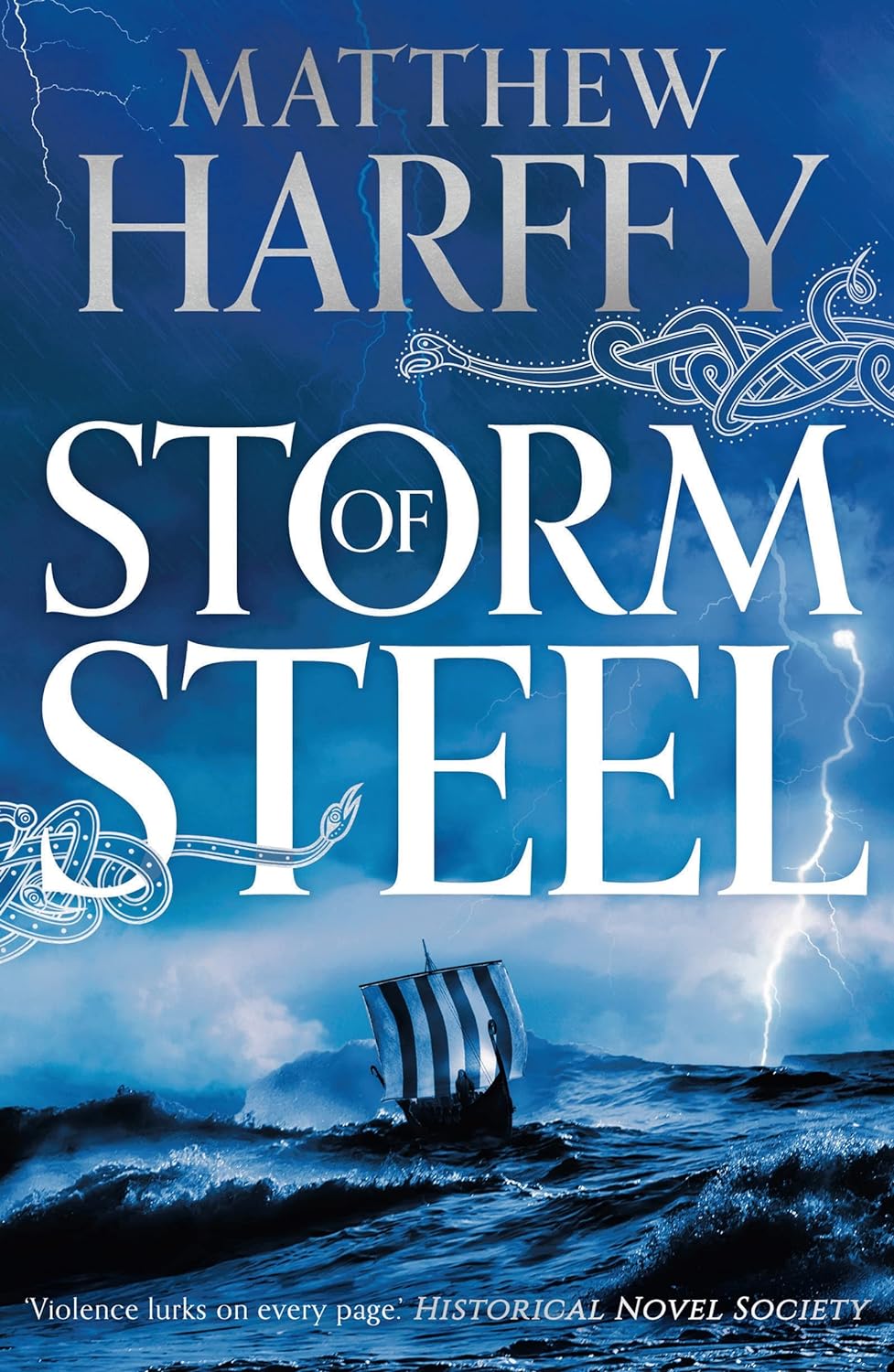
Cover image for Storm of Steel by Matthew Harffy

My Review

Storm of Steel is the next book in the Bernicia Chronicles, following the life of Beobrand – henceforth known as ‘grimdark’ Beo or just plain grumpy. Life seems quite hard for Beo, often torn between the decisions he makes and the oaths he must fulfil, and this is just another of those occasions when he’s forced to take actions he might not strictly have wanted to.

Most of Storm of Steel occurs at sea or near the sea. There’s a lot of ‘ship’ stuff and the weather, as always in Saxon England (he he) is rubbish, and its winter and no one sails in the winter, apart from grimdark Beobrand. There are storms aplenty and it always seems to rain/snow/sleet! There’s a lot of seasickness and quite a bit of action. And then, almost abruptly, the book ends.
There are many things about the book that are good, but at times the story feels a little laboured, and I still don’t like the scenes where the POV moves away from Beobrand. The story is not particularly complicated, and because it’s Beobrand, even the scenes where his life might be in peril are destined to end with his survival. That said, the final big ‘scene’ is very well written and enjoyable (but yes, it takes place both at sea. on the shore and in the rain – in fact, I think it’s snowing and sleeting), but I would have liked a bit more here, rather than moving forward to a few months later.

Check out my other views for The Bernicia Chronicles
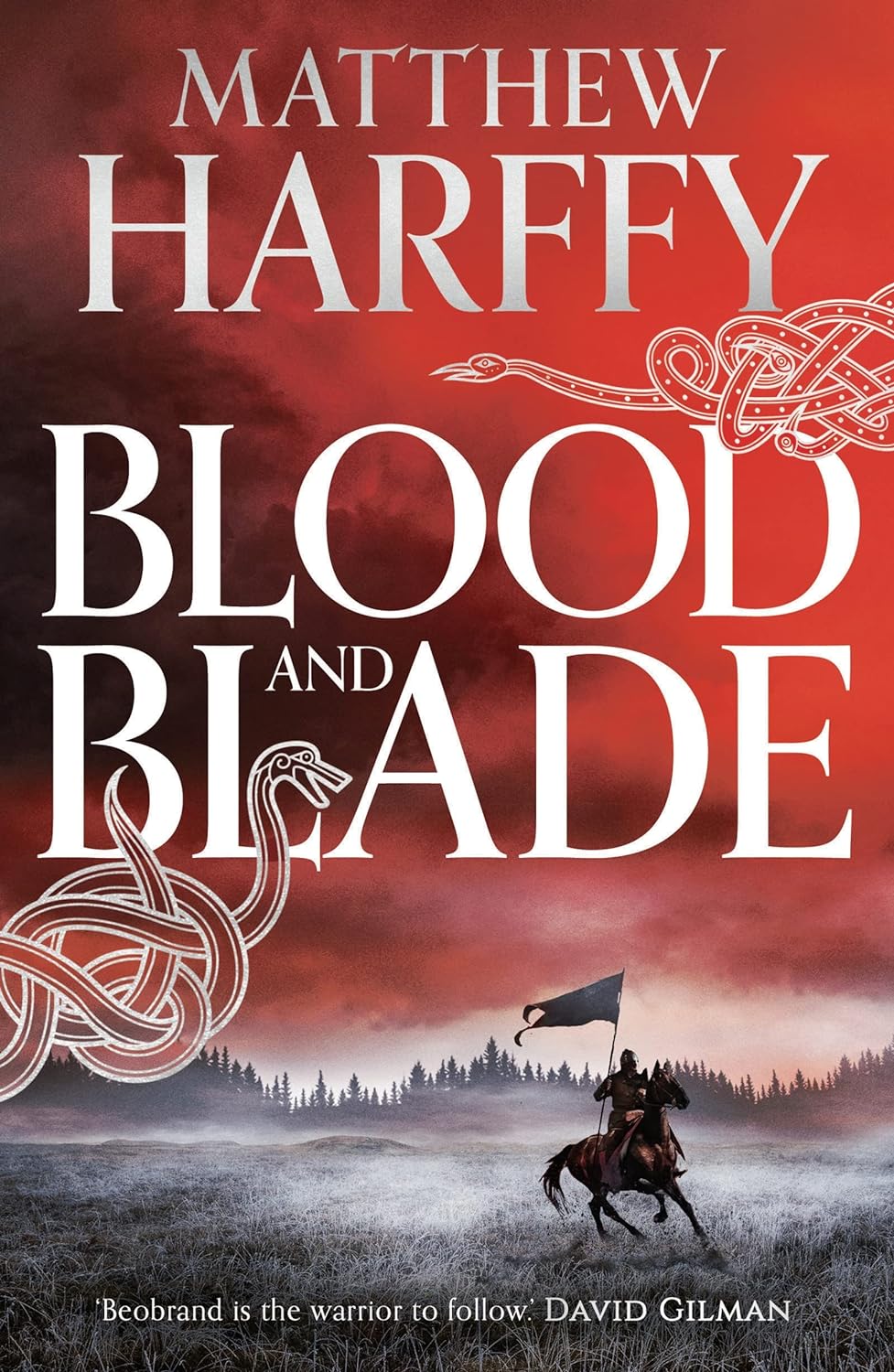
Blood and Blade

Killer of Kings

Fortress of Fury

Book Review – Warrior of Woden by Matthew Harffy – historical fiction

Here’s the blurb;

“AD 642. Anglo-Saxon Britain. A gripping, action-packed historical thriller and the fifth instalment in the Bernicia Chronicles. Perfect for fans of Bernard Cornwell.

Oswald has reigned over Northumbria for eight years and Beobrand has led the king to ever greater victories. Rewarded for his fealty and prowess in battle, Beobrand is now a wealthy warlord, with a sizable warband. Tales of Beobrand’s fearsome black-shielded warriors and the great treasure he has amassed are told throughout the halls of the land.

Many are the kings who bow to Oswald. And yet there are those who look upon his realm with a covetous eye. And there is one ruler who will never kneel before him.

When Penda of Mercia, the great killer of kings, invades Northumbria, Beobrand is once more called upon to stand in an epic battle where the blood of many will be shed in defence of the kingdom.

But in this climactic clash between the pagan Penda and the Christian Oswald there is much more at stake than sovereignty. This is a battle for the very souls of the people of Albion.”

I received a free EArc from Netgalley.

Overall Book 5 is far stronger than Book 4 and it doesn’t do what I thought it would do (in a good way).

For nearly 50% of the book, Beobrand is a much happier character than we’ve seen before. I thought this was an excellent evolution of his character, but sadly it doesn’t last and soon he’s moaning as much as in the previous books. This is one of my biggest problems with the series. Beobrand is just not very likeable and I find that hard in a series focused on him and where he’s supposed to be the hero or even the anti-hero. He just isn’t heroic enough for my liking, and will clearly never be. He seems genuinely unhappy with his lot in life – unhappy with his not-wife, his son, his king, his hall, who he’s killed before, who he hasn’t killed before, his horse – it would be nice if he was happy about something! :)

As to the story itself, it’s a very ‘Northumbrian’ interpretation of events in Britain at this time – there is no attempt to offer anything other than the version of events as given by Bede and other sources, which means that poor old Eowa gets very short shift . This is a shame as there was definitely scope for betrayal and double-dealing here, but because the story is about Beobrand, the possibilities are not explored. In fact, the major players of the period are so distant as to almost be missing from the story completely – the story we get could have been written anytime, anywhere, it is not truly about events in Britain at the time – a shame really when the events themselves are so significant. It would have been good to have a stand-off between Oswald and Penda – a real grudge battle, but instead, Penda is never actually encountered, only his actions. The ‘real’ (and I use that with caution) events of the period are simply the background to the story – even as a warrior of the king, the focus remains firmly on Beobrand at all times.

Where events are specifically directed at the period, there is a lack of clarity – they are fighting the Welsh and hate them and yet Cynan is Welsh, and one of Beobrand’s trusted gesithas. Penda is a pagan and reviled as such for this (especially for his blood sacrifice) – and yet Beobrand is pagan as well with his hammer necklace etc. This might pass many people by, or it might annoy. I just found it confusing.

Yet if I overlook all those problems, the book is stronger than previous ones in the series. It could have been great but it doesn’t quite make it because of the issues listed above and because many of the battle scenes are a bit disappointing. Maserfelth – the great battle – becomes a bit of a rugby scrum, and it is the later, smaller (‘made-up’) skirmishes, that are written with more flow and clarity. As I said, it’s as though events in Britain are there only for Beobrand to ride through/stamp through and glower through, and essentially much of the last half of the book is setting up events for future books.

It will also be interesting to see what happens with Penda, for Penda, whether he is the ‘Warrior of Woden’ or not, is going to be around for a very long time to plague and terrorise the kingdom of Bernicia.

A firm 4/5 – the series is getting better but a few issues remain.

Warrior of Woden is released on 1st April 2018 and you can get a copy here.


Book Review – Killer of Kings by Matthew Harffy – historical fiction

Here’s the blurb;

“AD 636. Anglo-Saxon Britain. A gripping, action-packed historical thriller and the fourth instalment in The Bernicia Chronicles. Perfect for fans of Bernard Cornwell.

Beobrand has land, men and riches. He should be content. And yet he cannot find peace until his enemies are food for the ravens. But before Beobrand can embark on his bloodfeud, King Oswald orders him southward, to escort holy men bearing sacred relics.

When Penda of Mercia marches a warhost into the southern kingdoms, Beobrand and his men are thrown into the midst of the conflict. Beobrand soon finds himself fighting for his life and his honour.

In the chaos that grips the south, dark secrets are exposed, bringing into question much that Beobrand had believed true. Can he unearth the answers and exact the vengeance he craves? Or will the blood-price prove too high, even for a warrior of his battle-fame and skill?”

Killer of Kings is the fourth full-length novel in The Bernicia Chronicles, but only the third that I’ve read, although I’ve also read the short-story that accompanies the series which I actually enjoyed more than the full-length novels because it was about Beobrand’s brother, who seems to be a wee bit cheerier than poor grumpy Beobrand.

Killer of Kings starts very strongly – the short prologue is excellent and I thought, because of what happens in it, that it was the beginning of something quite monumental. Sadly that’s not the case and instead, the first 50% of the novel is taken up with almost only one battle. Personally, I found it to be a very long build up to the battle, and then dismissed far too quickly.

The remainder of the story is very much a trip down memory lane for Beobrand, and this bit of the novel I really quite enjoyed before Beobrand goes off to settle an old blood feud.

I found the novel to be moderately entertaining but would have appreciated more sophistication in the plot line. As I said, 50% of the novel is concerned with only one battle, and so what comes after feels at times rushed and also a little bit too easy for old Beobrand to accomplish what he wants. He quickly takes up with moaning and grumbling about his injuries (as he did throughout book 3) but he is almost a happier Beobrand than throughout the previous book.

Overall, he is too easily swayed from his own wishes by weak attempts to incite him to honour which fall a little flat. The ongoing Christianity/Pagan Gods thing is, I know, a staple of the time period, but as with the Bernard Cornwell books, I feel it could be handled in a far more sophisticated manner, if not, entirely forgotten about for much of the book. Penda the Pagan was, as the author admits, no persecutor of Christians and as such, it’s difficult to make the East Anglian battle about religion – it was about ambition and strength, and we are told little about what happens as a consequence of the battle in terms of who is, or isn’t king, and what impact this might have had on Penda and Oswald..

The side-story – taking place at home and in his absence – is used to string the novel along – a battle scene followed by what’s happening in his absence – and while I know this is a literary convention employed by many to great affect. I found the back story to be a distraction from Beobrand’s tale, and also, a little too predictable, even as it mingles with Beobrand’s journey to his childhood home.

Overall I think the novel is a firm three star, bordering on a four, and therefore I’ve given it a four. The author has a strong view of the Albion inhabited by Beobrand and his comrades and this is a strength of the novel.

Killer of Kings is available from 1st June 2017.

I’m reviewing Blood and Blade by Matthew Harffy #histfic #bookreview

Here’s the blurb

“635AD. Anglo-Saxon Britain. A gripping, action-packed historical thriller and the third instalment in The Bernicia Chronicles. Perfect for fans of Bernard Cornwell. 

Oswald is now King of Northumbria. However, his plans for further alliances and conquests are quickly thrown into disarray when his wedding to a princess of Wessex is interrupted by news of a Pictish uprising.

Rushing north, Oswald leaves Beobrand to escort the young queen to her new home. Their path is fraught with danger and uncertainty, Beobrand must try to unravel secrets and lies if they are to survive.

Meanwhile, old enemies are closing in, seeking brutal revenge. Beobrand will give his blood and blade in service to his king, but will that be enough to avert disaster and save his kith and kin from the evil forces that surround them?”

Cover image for Blood and Blade by historical fiction author Matthew Harffy

My Review

Blood and Blade by Matthew Harffy is the third book in his Bernicia Chronicles following the exploits of his, quite frankly, bad-tempered warrior, Beobrand. He’s no hero – he’s too self-involved, grumpy and lacks any likeable characteristics, even though the author is at pains to explain this away due to the tragedies that have befallen him in Book 2.

However, these do not excuse the foul natured monster that Beobrand has become, and I did struggle to understand why any man, or woman, would want to spend any time with him or rely on him in his guise as a warrior or a lover. He is, quite simply, lacking in any likeable qualities, without even the spark of any humour to soften his harshness, no matter how often Athelstan tries to recount his exploits in the mead hall and make them appear heroic, it simply does not work for me.

The constant shifts in point of view in chapters is annoying, but this is something that I personally don’t understand or like in any novel so it’s not a particular complaint about this author. I’m always left feeling that if the chapter needs a shift in POV then it’s either not a chapter and needs splitting, or the author needs to approach this part of the novel in a different way – give the voice of the story to a different member of the cast.

The storyline of Blood and Blade is somewhat simplistic, and you do reach a certain part of the novel and know exactly what has to happen before it reaches its end. Nothing unexpected happens to bring the novel to its conclusion. This is somewhat of a shame. I would have liked even the idea of a different ending.

The author is at pains to show society, as he perceives it, at this time, and the insistence on the small details is repetitive, as is the constant recounting of Beobrand’s aches and pains, recovering wounds and new ones that he receives.

I would reiterate that Beobrand is no hero, but neither is he an antihero. He’s been thrust into a very exciting time in history, and yet it seems that, with his constant moaning and complaining, he has no appreciation of this and is never likely to. For a young man, he often appears to be about 100 years old.

On a final note. I still do not like the way the author treats women of this period. They are either witches, bed companions, or someone else’s bed companions and are presented as petty and mean to each other. This might be a novel about a (very) grumpy warrior, but Saxon women were and should be given the place in society that they earned and deserved. Much of this is, obviously, to do with the author’s interpretation of this period, and I suppose, it is worth remembering that it is a work of fiction and not fact. Still, this is also a shame and I hope, something, that is corrected in later books to allow the author to reach a wider fan base.

Overall, the novel was enjoyable to read.