Author of Saxon historical fiction and non-fiction, 20th-century historical mysteries, and Norse-inspired historical romantasy. Book reviewer and blog host.
On This Day In History 1066 – The Battle of Gate Fulford (well, yesterday. I’m a day late)
What was the battle of Gate Fulford,or Fulford Gate?
The battle took place on 20th September 1066, between the Norwegian forces led by Harald Hardrada and the English forces commanded by the two brother earls, and was the first of three battles in 1066, which eventually ended Saxon England, and brought about the beginning of the Norman era (Boo).
Having arrived near York two days earlier, Harald Hardrada had his first encounter with the forces of the English, led by two young earls, Morcar and Edwin (Eadwine) of the House of Mercia, at Gate Fulford. Morcar was earl of Northumbria, replacing the disgraced Tostig Godwineson (who had enticed Hardrada to England), while Edwin was the earl of Mercia, succeeding to the position after the death of his father Ælfgar, who’d held Mercia after his father Leofric. (Fans of the Earls of Mercia series will so far have only encountered Morcar and Eadwine as children).
Their youth, their inexperience, and the perceived defeat in this terrible battle are all that people know about Edwin and Morcar. What’s so often overlooked is that they marched into battle determined to counter the might of what many believe was the last great Viking warrior, and they were also the king’s brothers by marriage; their sister now married to Harold Godwineson. They also survived the battle and probably fought at Stamford Bridge and Hastings.
So, who was Harald Hardrada?
Hardrada was king of Norway, half-brother to St Olaf, who was killed at the battle of Stiklestad in 1030 by forces loyal to King Cnut, who’d claimed Norway as part of his determination to rule much of Scandinavia. Harald was forced to flee and spent many years fighting in the Varangian guard until he decided to advance his claims to the kingship once more (in 1045), initially forging an alliance with Sweyn of Denmark (nephew of King Cnut) until allying with King Magnus of Norway, who was his nephew, and somewhat conveniently, died only the next year, making Harald the sole king of Norway. (You will find some of this story told in my Earls of Mercia series, and also in Lady Estrid, the story of Sweyn of Denmark’s mother).
Why did he invade England in 1066?
It is from the alliance with King Magnus that Harald Hardrada exerted his right to rule England, as Magnus stated he had a claim, having earlier agreed it with King Harthacnut of England (Cnut’s son), that he (Magnus) would rule England after Harthacnut’s death and equally that Harthacnut would rule Norway after Magnus’ death.
And so, the man lauded as the last great Viking made his way to England, and on this day, he first encountered the English resistance. And while most say the brother earls were defeated, I wonder if the narrative should be a little different. After all, their brother by marriage, their king, was already on his way north to counter the threat. Did they do what needed to be done? Did they temporarily halt the Norwegian invasion and buy Harald time to bring his warriors to the battle…
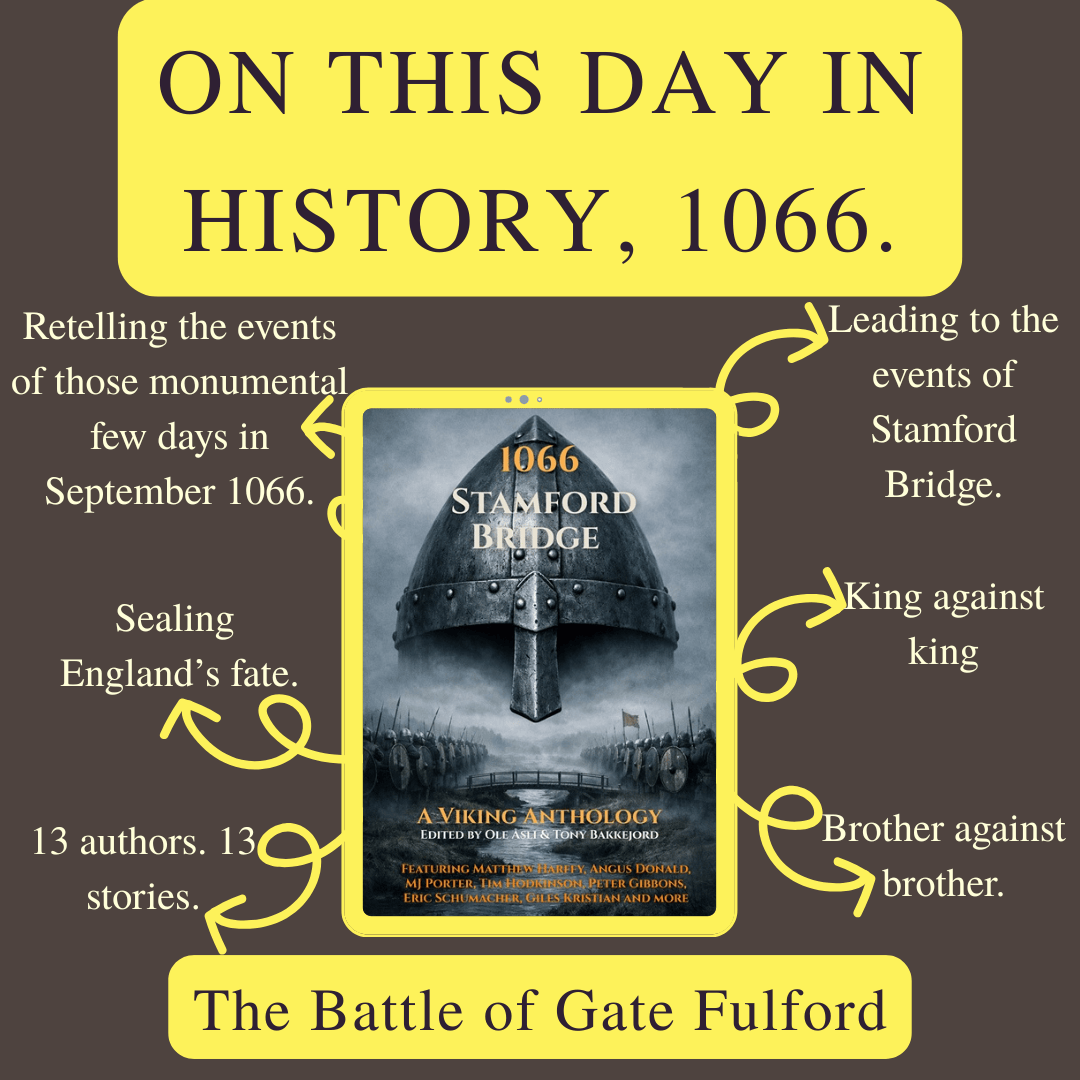
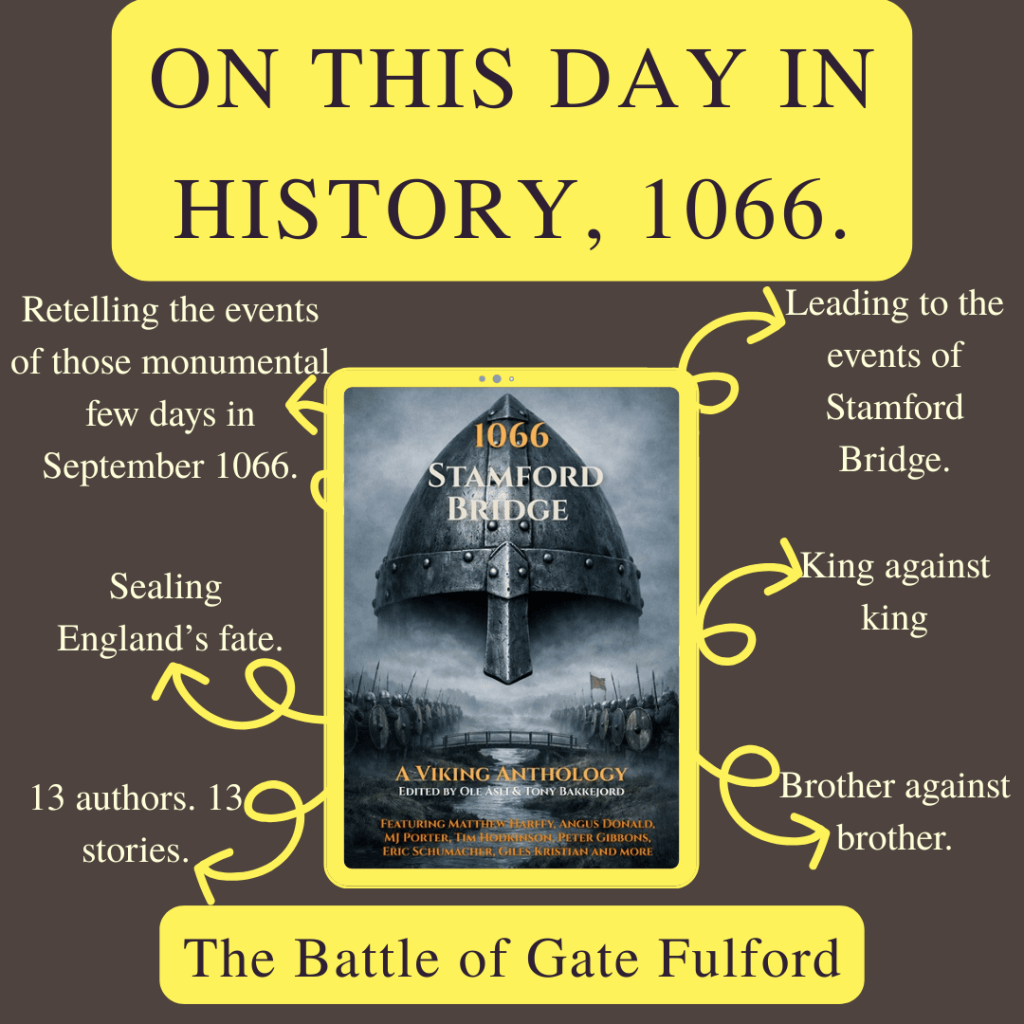
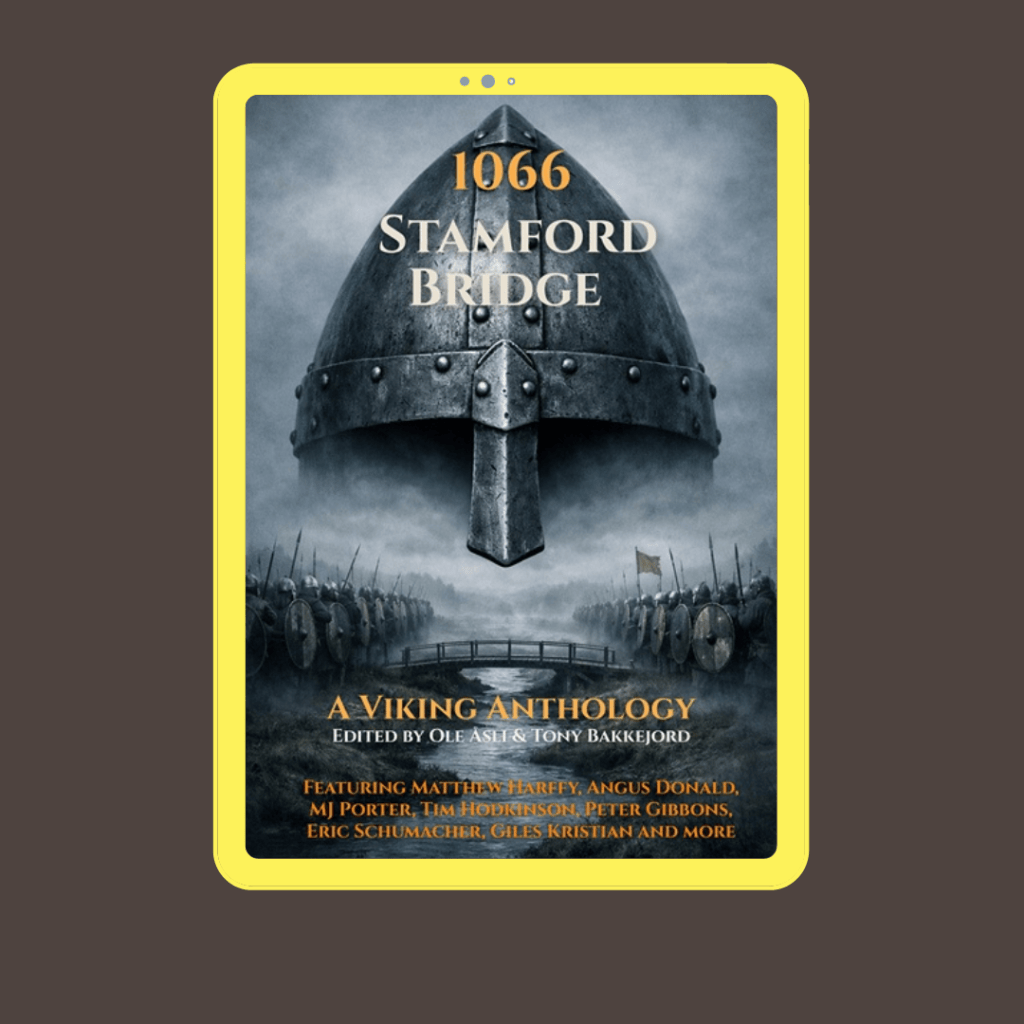
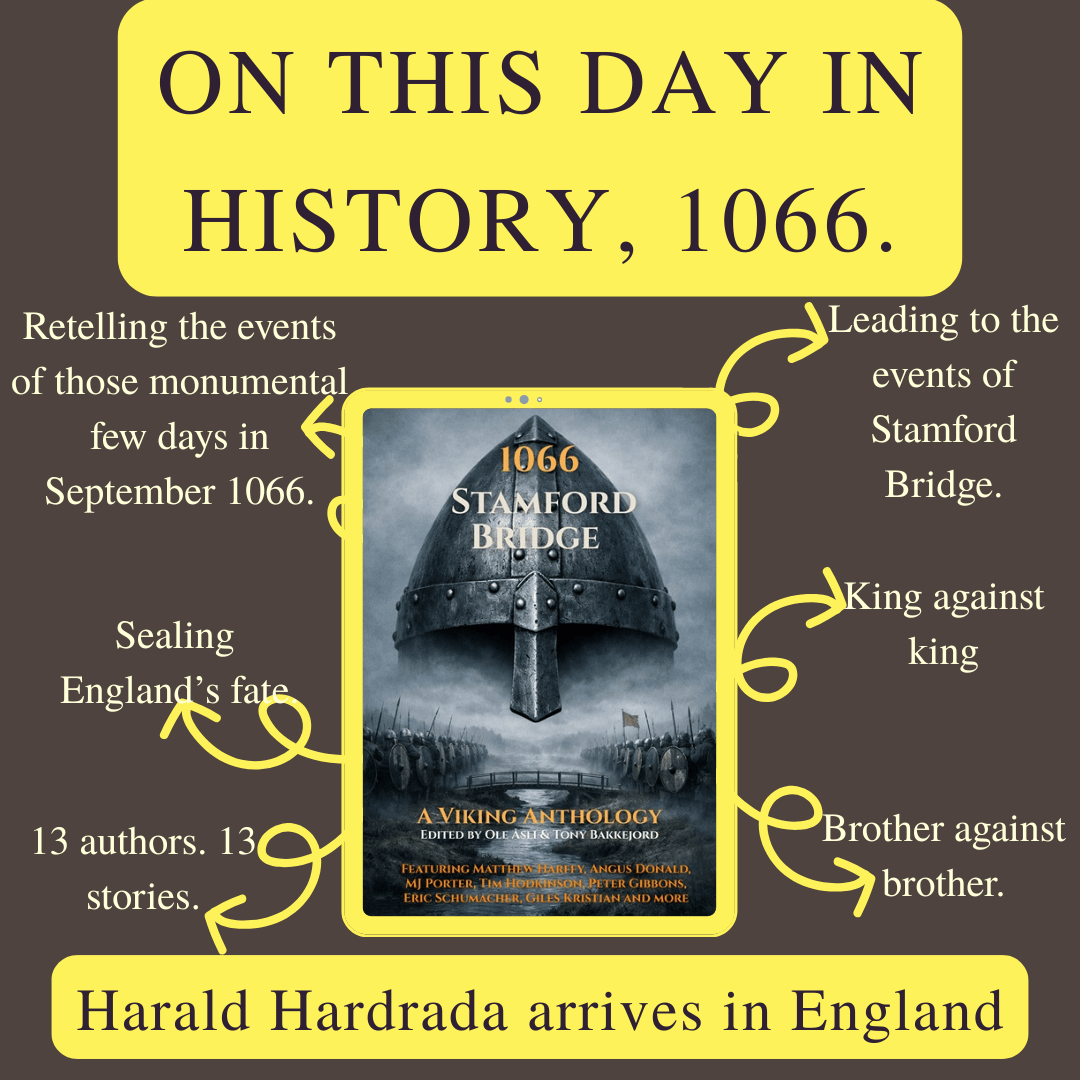
The Stamford Bridge Anthology
Thirteen writers. One battle. The same afternoon, told from both sides of the bridge.
Giles Kristian · Matthew Harffy · Angus Donald · Tim Hodkinson · Peter Gibbons · MJ Porter · Justin Hill · Theodore Brun · Eric Schumacher · Will Dowling · M. Thomas Kingsley · Mark Oxbrow · Åsli & Bakkejord
On 25 September 1066, a Norwegian army lay resting on both banks of the Derwent, seven miles from York. They had beaten one English army five days earlier and taken the city’s surrender, and the fighting was done. Most of them had left their mail at the ships.
They were not expecting Harold Godwinson.
The battle that followed ended the Viking age in England. Three weeks later it helped decide a second one, on a hill near Hastings, that everyone remembers instead.
A king who has spent his life outrunning the end of an age. A skald asked to praise a man he no longer believes in. A priest tends the wounded on the eve of a battle nobody knows is coming. A lone axeman on the bridge, and the Englishman in the water beneath him. Afterwards, a farmer walks the field looking for his son, and twenty years later an old earl sits in a Norman prison, still deciding what to tell his gaoler.
The man who holds the bridge in one story is watched from the water in another. Thirteen stories, one day.
Over 100,000 words of Viking historical fiction, published on the 960th anniversary of the battle.
On This Day In History 1066 – Harald Hardrada, king of Norway, arrives near York, England to advance his claims to be England’s king
Who was Harald Hardrada?
Hardrada was king of Norway, half-brother to St Olaf, who was killed at the battle of Stiklestad in 1030 by forces loyal to King Cnut, who’d claimed Norway as part of his determination to rule much of Scandinavia. Harald was forced to flee and spent many years fighting in the Varangian guard until he decided to advance his claims to the kingship once more (in 1045), initially forging an alliance with Sweyn of Denmark (nephew of King Cnut) until allying with King Magnus of Norway, who was his nephew, and somewhat conveniently, died only the next year, making Harald the sole king of Norway. (You will find some of this story told in my Earls of Mercia series, and also in Lady Estrid, the story of Sweyn of Denmark’s mother).
Why did he invade England in 1066?
It is from the alliance with King Magnus that Harald Hardrada exerted his right to rule England, as Magnus stated he had a claim, having earlier agreed it with King Harthacnut of England (Cnut’s son), that he (Magnus) would rule England after Harthacnut’s death and equally that Harthacnut would rule Norway after Magnus’ death.
And so, the man lauded as the last great Viking made his way to England and arrived on this day, 1066. And the rest can be discovered in…
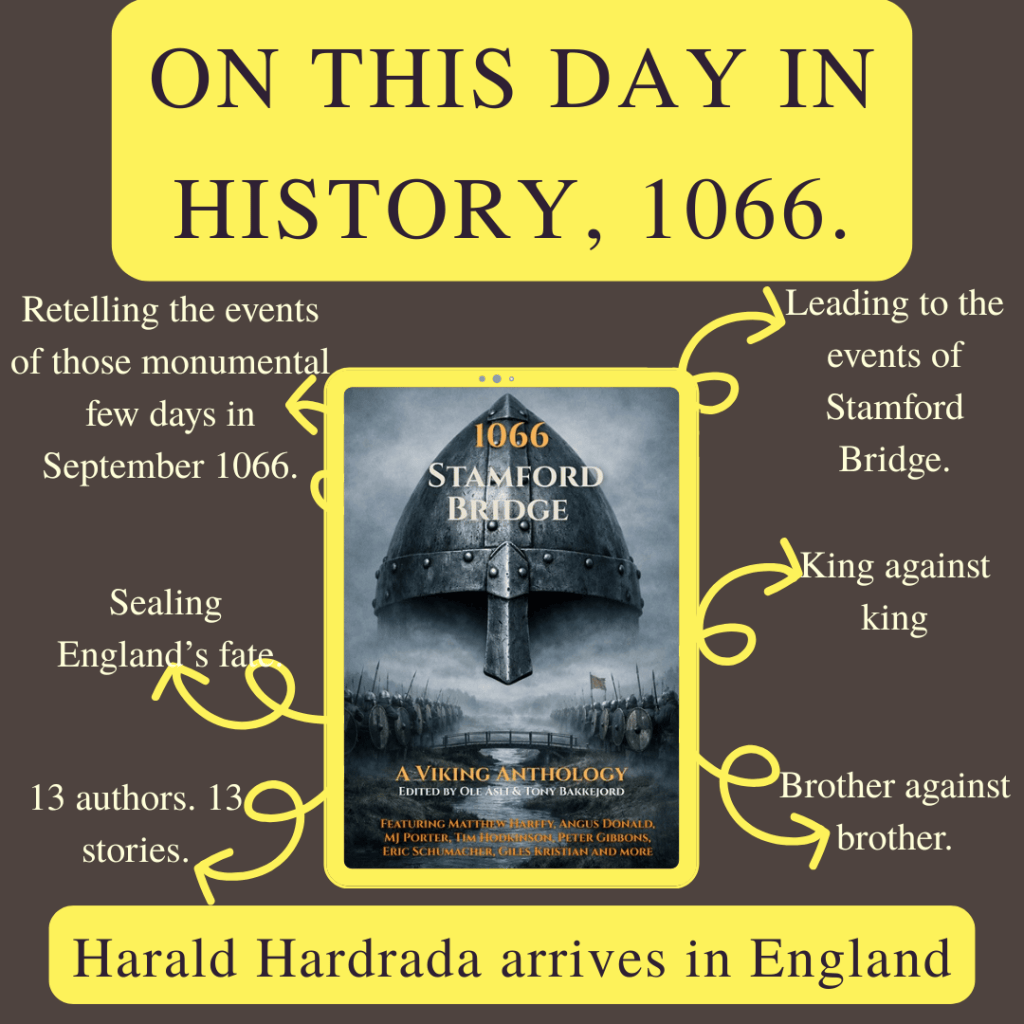
The Stamford Bridge Anthology
Thirteen writers. One battle. The same afternoon, told from both sides of the bridge.
Giles Kristian · Matthew Harffy · Angus Donald · Tim Hodkinson · Peter Gibbons · MJ Porter · Justin Hill · Theodore Brun · Eric Schumacher · Will Dowling · M. Thomas Kingsley · Mark Oxbrow · Åsli & Bakkejord
On 25 September 1066, a Norwegian army lay resting on both banks of the Derwent, seven miles from York. They had beaten one English army five days earlier and taken the city’s surrender, and the fighting was done. Most of them had left their mail at the ships.
They were not expecting Harold Godwinson.
The battle that followed ended the Viking age in England. Three weeks later it helped decide a second one, on a hill near Hastings, that everyone remembers instead.
A king who has spent his life outrunning the end of an age. A skald asked to praise a man he no longer believes in. A priest tends the wounded on the eve of a battle nobody knows is coming. A lone axeman on the bridge, and the Englishman in the water beneath him. Afterwards, a farmer walks the field looking for his son, and twenty years later an old earl sits in a Norman prison, still deciding what to tell his gaoler.
The man who holds the bridge in one story is watched from the water in another. Thirteen stories, one day.
Over 100,000 words of Viking historical fiction, published on the 960th anniversary of the battle.
Letter writing in the Eleventh Century, how I recreated Lady Estrid’s connections with her vast family. #non-fiction #histfic
In trying to bring together the narrative for Lady Estrid, I faced a bit of a problem: the vast distances involved. Lady Estrid had family in England, Denmark, Sweden and Norway, many of them she may never have met in person.
Today, we might pick up the phone, or have a quick look on the internet, but in the eleventh century, how would people have communicated?
And so to letter writing. There are two surviving letters from the eleventh-century that were sent by King Cnut, Estrid’s brother, to the English, when he was absent from his newly conquered country, in AD1020 and AD1027. I give a small example below.
;Be it known therefore to all of you, that I have humbly vowed to the Almighty God himself henceforward to amend my life in all respects, and to rule the kingdoms and the people subject to me with justice and clemency, giving equitable judgments in all matters; and if, through the intemperance of my youth or negligence, I have hitherto exceeded the bounds of justice in any of my acts, I intend by God’s aid to make an entire change for the better.’ From Cnut’s letter to the English from AD1027.
These might well have been an exercise for Cnut in asserting his authority over the English, and giving his regents a little bit of extra support, but they open up the possibility of just who else was busy writing and sending letters to one another.
There’s always the assumption that unless you were a holy man, you perhaps couldn’t read or write, and in fact, in one of the books I referenced for Lady Estrid, I found a fascinating chart detailing people who are known to have been used by the ruling family of Normandy as messengers, another way that messages could be sent between people. But surely, sometimes, it was just better to write everything down, that way nothing could be lost in translation.
Without the possibility of Lady Estrid ever meeting some members of her family, using letter writing allowed me to artificially create conversations between the characters, and while it might not have been the ‘norm’ it was certainly something that happened. Indeed, three centuries earlier, there’s a great wealth of information to be found in the letters of Alcuin of York (c735-804), so it wasn’t as though it was a new thing. With Denmark’s conversion to Christianity, there would have been a ready selection of scribes just waiting to note down Lady Estrid’s frustrations and complaints, even if she didn’t pen them herself.
Here’s an example of one of Estrid’s letters I create in the book.
Dearest Mother, Lady Sigrid. Queen of Denmark.’
‘This marriage doesn’t agree with me. How could you agree to it? I trusted you more than any other to understand how difficult it would be to be forced to live amongst strangers. I relied on you to argue with my father about the necessity of the union.’
And don’t tell me I will one day be the queen of the Rus, as my father planned. Prince Ilja is not a strong man. I don’t foresee him living long. Not at all. The poor man. He has barely been able to consummate our union. I hope I will not carry his child. It will be weak and feeble, and I will not tolerate such.’
My children will be strong and powerful. One day, it is they who will be kings and queens. But these children will not be shared with Prince Ilja. I am sure of it.’
And even if he were to survive, his brothers are a treasonous coven. None of them wishes the other to succeed at their expense. I foresee only bloodshed and paranoia when Ilja’s father is dead.’
Frida is my only friend and ally, reminding me of home. I hope to return to Denmark one day. I never imagined leaving her. I miss her. The kingdom of the Rus is not the same. Not at all.’
Send me news of my father and brothers. I wish to know if my father has finally triumphed in England over King Æthelred. I should like to know that he didn’t callously send me away without so much as seeing me in person for no good reason, because he was absent, in England, as so often the case. If he fails in England again, I will never forgive him for his actions towards me.’
Your despairing daughter, Lady Estrid Sweinsdottir, from Kiev.’
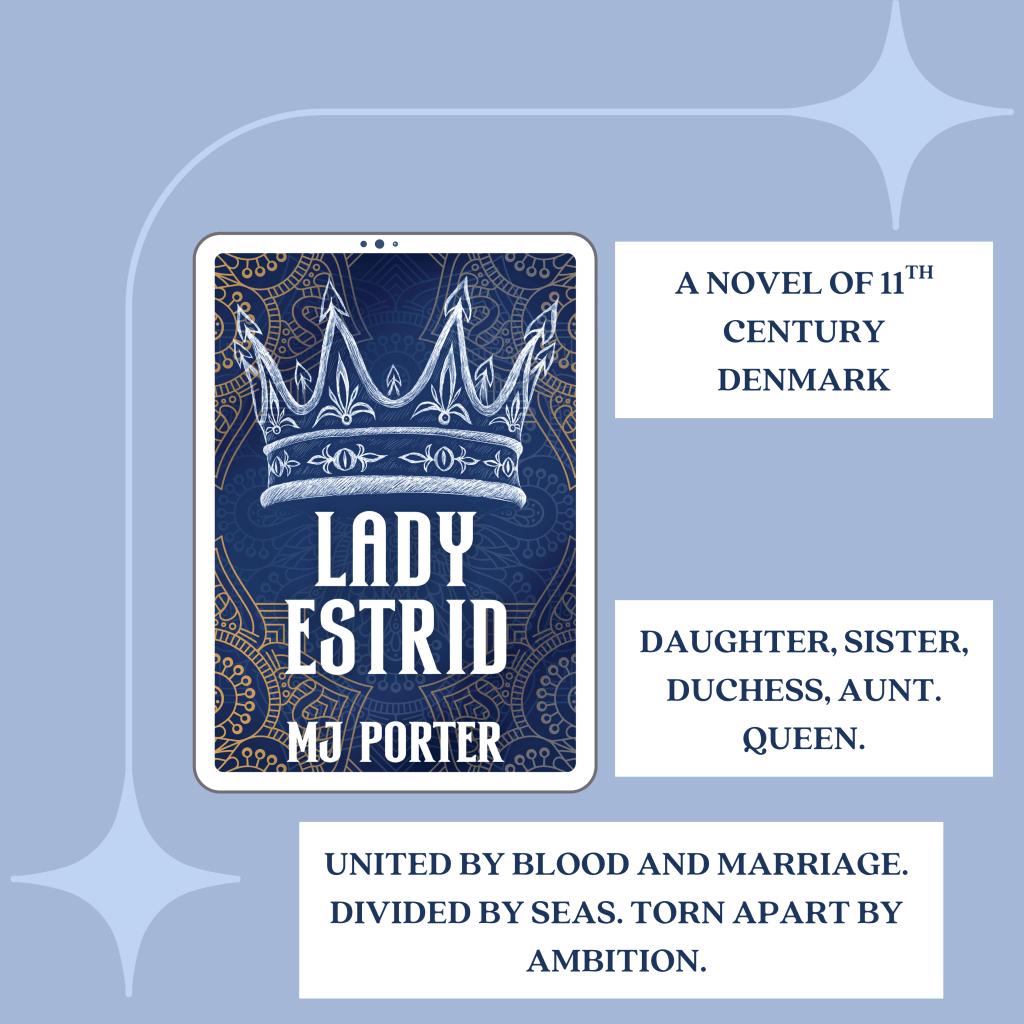
The physical and political setting for Lady Estrid, a novel of eleventh century Denmark #histfic #lostwomenofhistory
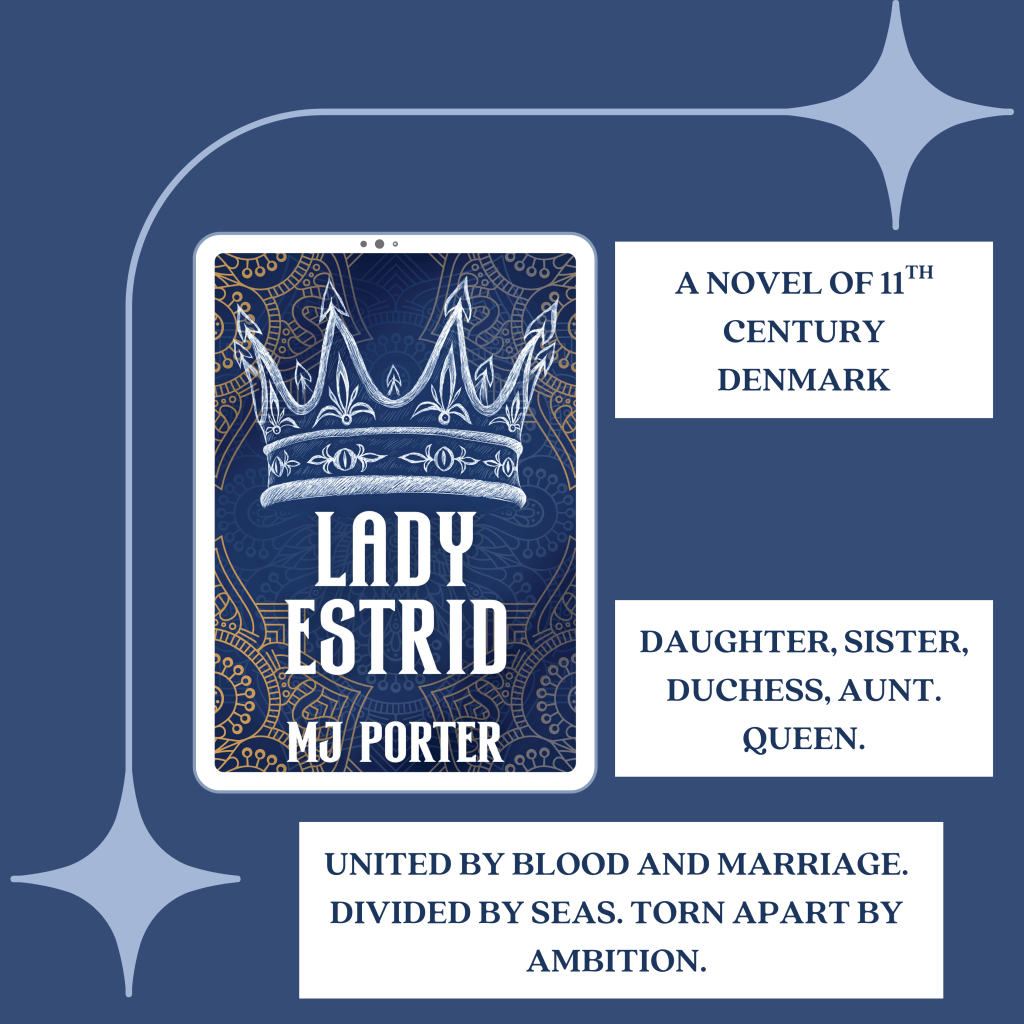
Lady Estrid is set in Denmark, as well as in wider Scandinavia and England, during the eleventh century. But it’s events in Denmark, Norway and Sweden that inspired me to write about Lady Estrid, although, of course, I couldn’t do it without including England.
Denmark, at this time, is really starting to cohere into what we might think of as a coherent kingdom. I’m not an expert on what comes before, but The House of Gorm, into which Lady Estrid is born, has ruled Denmark for a couple of decades (through her grandfather, Gorm, and father, Swein Forkbeard), but a lasting peace hasn’t necessarily been achieved. The family are portrayed as conquerors, coming into what would become Denmark, and imposing themselves over an unruly elite. The number of intermarriages between families in (what we call today) Norway, Sweden and Denmark offers a landscape that is riddled with double-crossing and the potential for mischief and war against a backdrop of uncertainty in Denmark. You can find family trees for Lady Estrid here.
And what a cast of characters I had to play with – King Swein of Denmark, his two sons, his daughters, and the men they marry, and the sons and daughters they birth, and of course, his wife as well. It seems that not only was she married to Swein, she was also the wife of the king of Sweden before his death, and might even have been pursued by Olaf Tryggvason. (There are arguments about her actual identity, but not about her marital history.)
And into all this steps Lady Estrid, who, like similar royal women, has the advantage of living a much longer life than many of her male family members. She is someone who would have lived through turbulent times, and I always find that overriding viewpoint, just too good to ignore, because it gives an author so much scope to play with. Yes, I might know what ultimately happens, but when you weave the story of Lady Estrid, and what is, and isn’t known about her, around bigger events, in Denmark, Norway, Sweden and England, it makes for both a complex and a simple story. The people she met along the way are perhaps better known than she is herself, but that’s just a means of adding context to a much longer narrative than can often be explored when writing about Swein, or Cnut, or Harald or Harthacnut or Svein (yes, another one) or Beorn.
I’m resharing an interview I gave when I’d finished writing Lady Estrid, a novel of eleventh century Denmark #histfic #writingadvice #authorinterview
Why did you decide to write about Lady Estrid?
Lady Estrid has been a character that’s long fascinated me. She crops up as a ‘bit part’ character in another series I write, but as time has gone on, I’ve realised that she offers a lot more than I’ve been allowing her so far. And so, I hope at a suitable point in the other series, I decided to explore Lady Estrid for herself. It involves stepping away from my comfort zone of pre-Conquest England in the eleventh century, and allows me to write about Scandinavia at this time period, which has always been a huge area of interest for me.
I’ve written a few long story arcs before, but only two other books which cover such a huge amount of time (about four decades). Such a project allows me to focus on the bigger picture and to put historical characters into a much wider story-arc than writing just about them would allow.
By necessity, Lady Estrid must be a strong woman, able to manipulate the politics taking place around her. I think that there’s a huge and growing interest in such women, and of course, Denmark (and Scandinavia as a whole) at this time, isn’t something that I believe has been tackled before, potentially because of the lack of English Language books about the era.
What drew you towards the Early Medieval era in which you set your book?
I’m fascinated by everything pre-1066 in England, but also wider afield. It’s impossible to tell the story of just one of these later countries, inhabited by Northmen or Norsemen, without looking to what’s happening elsewhere. These characters didn’t abide by our current national boundaries.
What were the challenges you faced in researching this period of history and were there any unexpected surprises?
The biggest problem with writing about this time period is the sources. I’m not as familiar with the Saga material and the works of Adam of Bremen and Saxon Gramaticus, as I’d like to be. As such, I rely much more on secondary sources than I might when writing about the Early English period. And of course, it’s a period where written sources are quite scarce anyway. Not only is it difficult to ‘find’ Lady Estrid, but, as you might have noticed, many of the character share the same names – there are no ends of Swein/Svein/Sven’s and equally, just as many Gytha’s and Gunnhild’s.
I was surprised by just how little the women of the Danish royal family are mentioned in any secondary sources. I’ve recently been on a book buying spree, and even in a new monograph on Cnut, Lady Estrith is only cited in the index seven times, and in a 798-page book, she has about 3 words!
What do you think is the most challenging aspect of writing Historical Fiction?
I think this depends on how much history you want to put in your book. I’ve just written three books in The Ninth Century Series, and while they’re historical in nature, much of the day-to-day activity is actually fighting and swearing. Lady Estrid has a much weightier content. It has a cast of many more people; they all have to be placed in the right time period and at the right events, and there is not as much information about any of them as I’d like there to be. Obviously, The Ninth Century Series was easier to write once the time period was set. Lady Estrid was an altogether different project. It took much longer, and was more frustrating because I was trying to ensure it didn’t conflict with previous stories I’ve written, which have a very ‘Early English’ basis.
What advice do you have for aspiring Historical Fiction authors?
Know the time period you’re writing about, and not just what happens during it, but also what happens both before, and after, and in neighbouring countries as well. And, be aware of what ‘might have happened’ if certain events – normally births, deaths or wars – hadn’t happened. Remember, your characters don’t have the benefit of hindsight that you have as a writer. Everything to them would have been immediate, imminent and happening to them. Don’t fall into the trap of presenting everything as a fait accompli.
And, be prepared to be frustrated. There’s always some niggly little fact that is just not mentioned anywhere. The decision then has to be made as to whether to ‘make it up’ or write around it, and readers will somehow always know if you make it up.
And on a final note, be prepared to do something a little bit ‘different,’ be bold, be creative, do whatever has to be done to engage an audience with the time period.
Lady Estrid was born into a large and illustrious family with far-reaching influence over Denmark, Sweden, Norway and England.
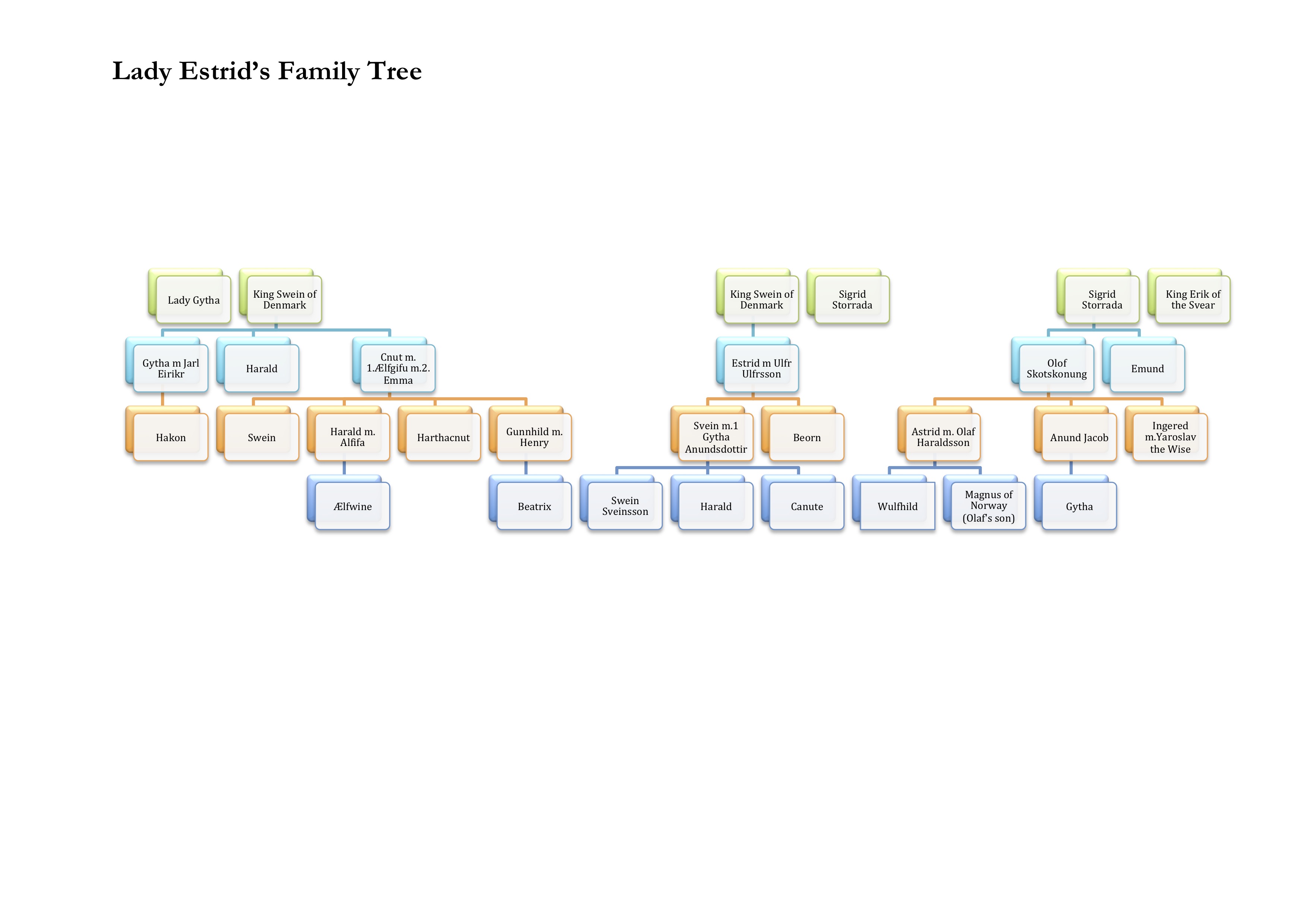
I’ve put together some genealogical tables of the main families to make easier to work out how everyone connected. (You can click on the images to make them bigger).
The family of Lady Estrid Sweinsdottir, as mentioned in Lady Estrid.
Due to a lack of information, I have made little mention of the rest of Estrid’s half-sisters, of which she had three or four. I feel it perhaps also helped the story a little – it was complicated enough as it was without giving them the capacity to meddle in affairs in Denmark.
To break it down into more palatable chunks, Lady Estrid’s mother was married twice, once to King Swein of Denmark (second) and also to King Erik of the Svear (first). King Swein was also married twice (in my story at least – as it is debated), to Lady Gytha (who I take to be his first wife) and then to Lady Sigrid (who I take to be his second wife.) Swein was king of Denmark, Erik, king of the Svear (which would become Sweden), and so Sigrid was twice a queen, and she would have expected her children to rule as well, and her grandchildren after her. Sigrid was truly the matriarch of a vast dynasty.
She would have grandchildren who lived their lives in the kingdom of the Rus, in Norway, in England, and Denmark.
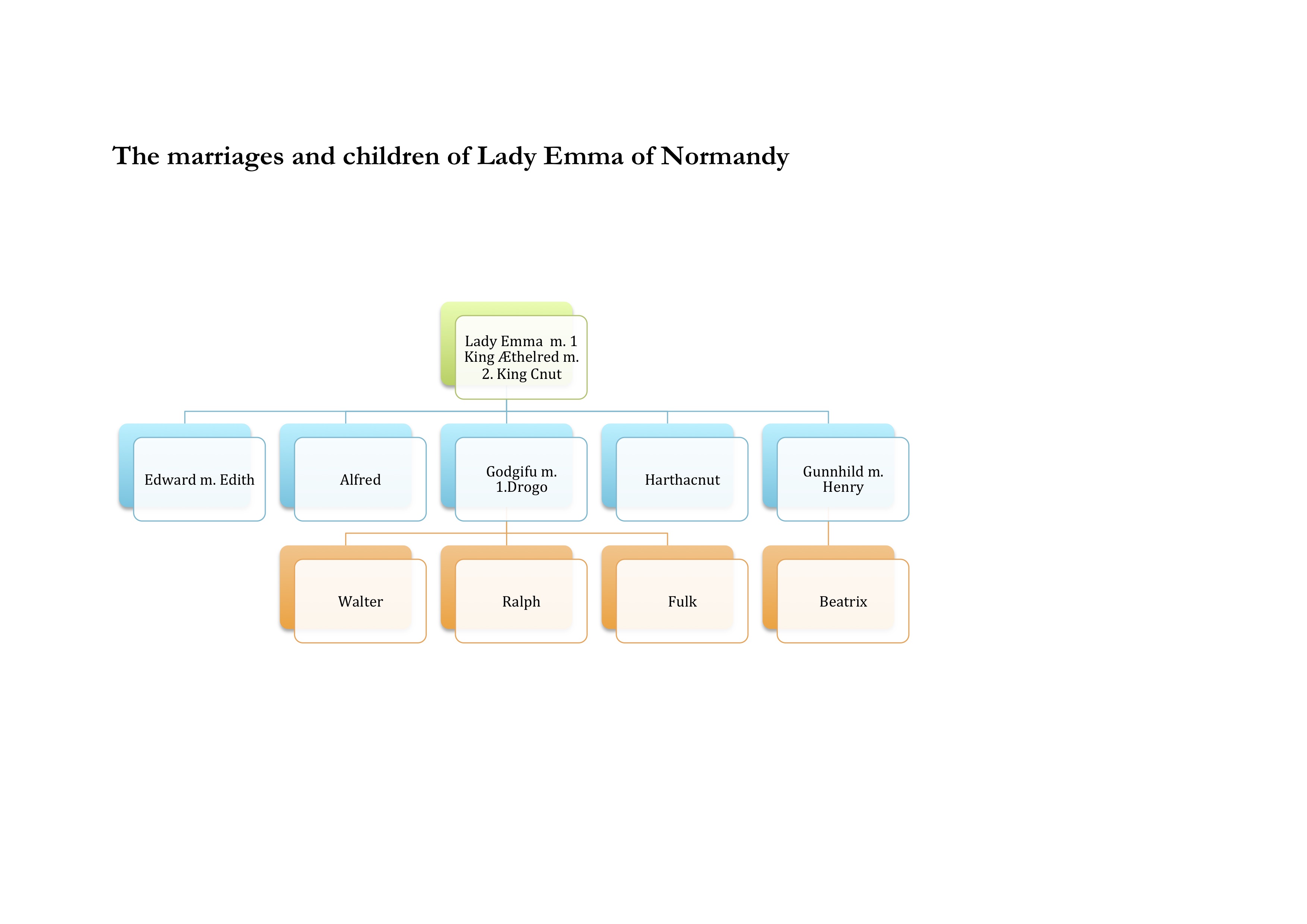
And Sigrid wasn’t the only ‘double queen.’ Lady Emma, twice queen of England, was first married to King Æthelred and then to King Cnut, Estrid’s brother.
Lady Emma, twice queen of England and her children
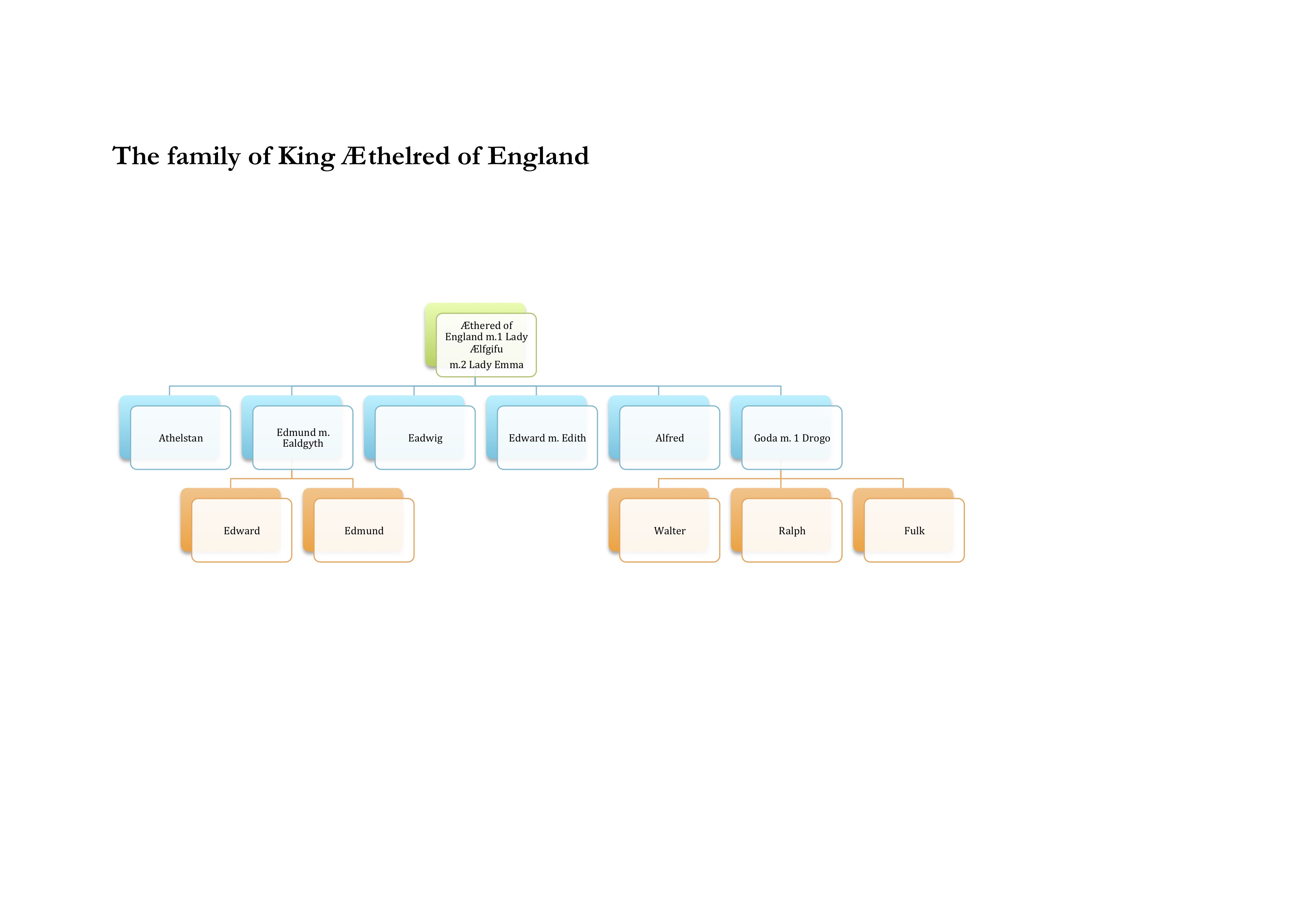
Not that it’s possible to speak of Lady Emma’s children from her two marriages, without considering the children of her first husband’s first marriage. King Æthelred had many children with his first wife, perhaps as many as nine (again, a matter for debate), the below only shows the children mentioned in Lady Estrid. Readers of The Earls of Mercia series, and the Lady Elfrida books, will have encountered the many daughters, as well as sons.
The family of King Æthelred of England
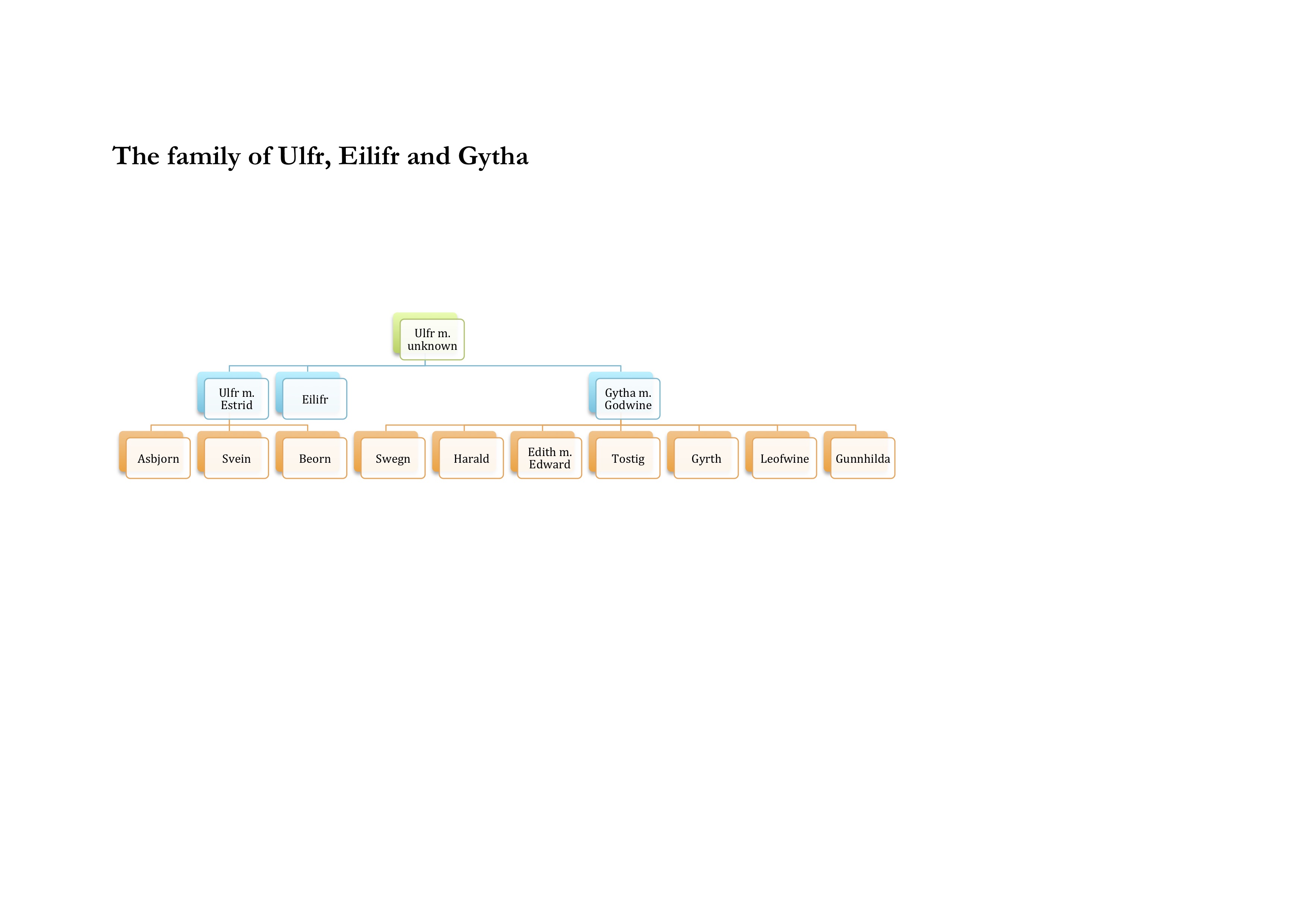
One of the other family’s that had the most impact on Lady Estrid, was that of her third husband, and father of her two sons, Jarl Ulfr.
The family of Ulfr
Ulfr had a brother and a sister, and while little is known about the brother, it is his sister who birthed an extremely illustrious family, through her marriage to Earl Godwine of Wessex. (The family tree doesn’t include all of her children.)
Four such powerful families, all intermarried, make for a heady mix.
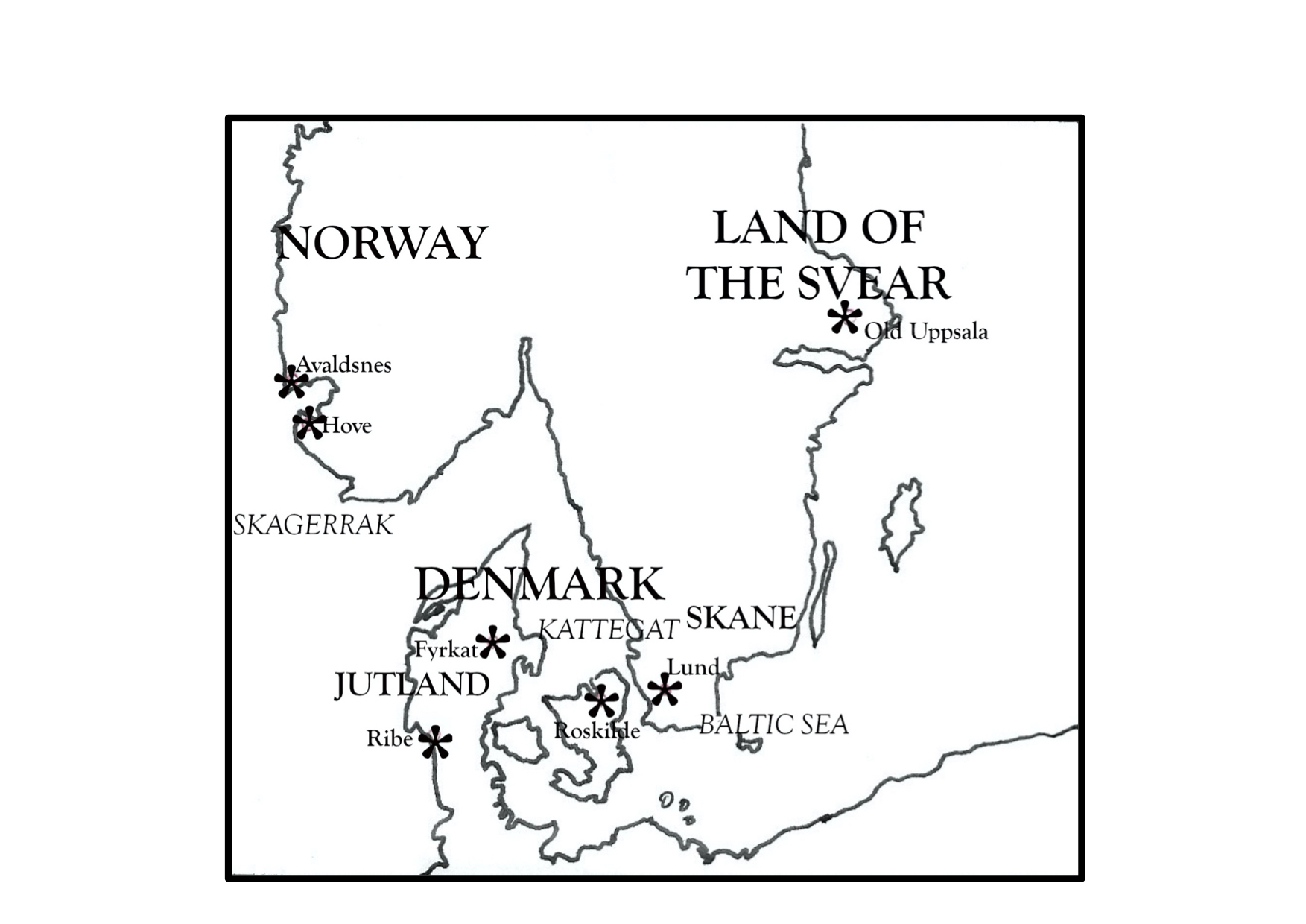
For the modern reader, not only are the family dynamics complicated to understand, but so too is the geography. Sweden was not Sweden as it is today, and the reason I’ve insisted on calling it the Land of the Svear. But equally, Denmark was larger than it’s current geographical extent, covering Skåne, (in modern day Sweden) as well. The map below attempts to make it a little clearer. Norway is perhaps the most recognisable to a modern reader, but even there, there are important difference. King Swein claimed rulership over parts of Norway during his rule, and so too did King Cnut. But, Denmark isn’t the only aggressor, there were rulers in all three kingdoms who wished to increase the land they could control, King Cnut of Denmark, England, Skåne and part of Norway, is merely the most well-known (to an English-speaking historian.)
Lady Estrid is a standalone novel, but it does incorporate characters and events from The Earls of Mercia series. So, if you’ve not yet read The King’s Brother, it might contain some spoilers, and vice versa.
I have also written about Lady Estrid’s brother, Cnut, and her father, Swein. I classify the books as side stories to the main Earls of Mercia series, but they can all be read as standalones, or as a trilogy about the powerful family.
Interested in the unknown women of the tenth and the eleventh century? I’ve written about quite a few of them now. Check out The Tenth Century Series, featuring Lady Ælfwynn, Lady Eadgifu and the daughters of Edward the Elder, and the stories of Lady Elfrida as well as The Royal Women Who Made England.
It’s been a funny old year, I think we can all agree on that. While, at times, I’ve really struggled to focus to write, I’ve also been lucky to chance upon a good number of characters that I really enjoy writing about – Coelwulf and his comrades – not that it makes it easy, but it makes it enjoyable, sometimes in a sick and twisted way. So here goes, a review of just what I’ve been up to during the weirdest year in living memory.
For the first time with any great degree of consistency, I’ve tried to track what I’m doing on a day to day basis. It’s been intriguing, but only lasted for about a third of the year, you’ll see why as we go.
I finished A Conspiracy of Kings, the sequel to The Lady of Mercia’s Daughter in January, ready for release in February. I’m really pleased I returned to Lady Ælfwynn because it moved my mind onto the project I’d been considering writing for a few years – about King Coelwulf of Mercia. I think that if I’d not written A Conspiracy of Kings, Coelwulf might still be waiting for me to start his story. But luckily, I did start to write about him in January, with a scene that has still to make it into any of the books, and in February I started with how I hoped to begin the story. Looking at my notes for the year, once I’d started writing the first book, it was all a bit of a whirlwind and a first draft was completed by the end of the month. One day I wrote 10,000 words. It seems he was really in my head. Those two years of thinking about writing about him, had paid off with a great character just waiting to come out of my imagination.
I’ve said elsewhere that there were quite a few influences on The Last King, the film, The Gentlemen directed by Guy Ritchie, the one that really made me think I should do anything I wanted with the storyline – make it bloody, make it brutal, make it sweary, and give it the ‘hook’ at the very beginning of the book. Another influence was the idea of a sportsperson at the height of their game – someone so good that they don’t really consider it anymore, and in fact, are a bit surprised that others aren’t there with them – that was the sort of warrior I wanted Coelwulf to be – already fully-formed with no backstory to wade through before getting on with the story of ‘right now.’
After finishing The Last King, I immediately pressed on with the follow-up, which became The Last Warrior. By now, it was March, and my part-time job as an exam invigilator was about to be suspended for the rest of the year – and of course, we were about to be plunged into Lockdown Part One. I had Coelwulf and pals to keep me going – and keep me going they did. By 8th April, my diary states that the first draft of The Last Warrior was complete, and I’d placed The Last King on Netgalley because I was really curious to see what people thought about it. I’d also reached out to a few people and given them advanced copies to read. The response was overwhelmingly positive as reviews started to trickle in throughout April. But now I turned my mind to Lady Estrid, and the eleventh century in Denmark.
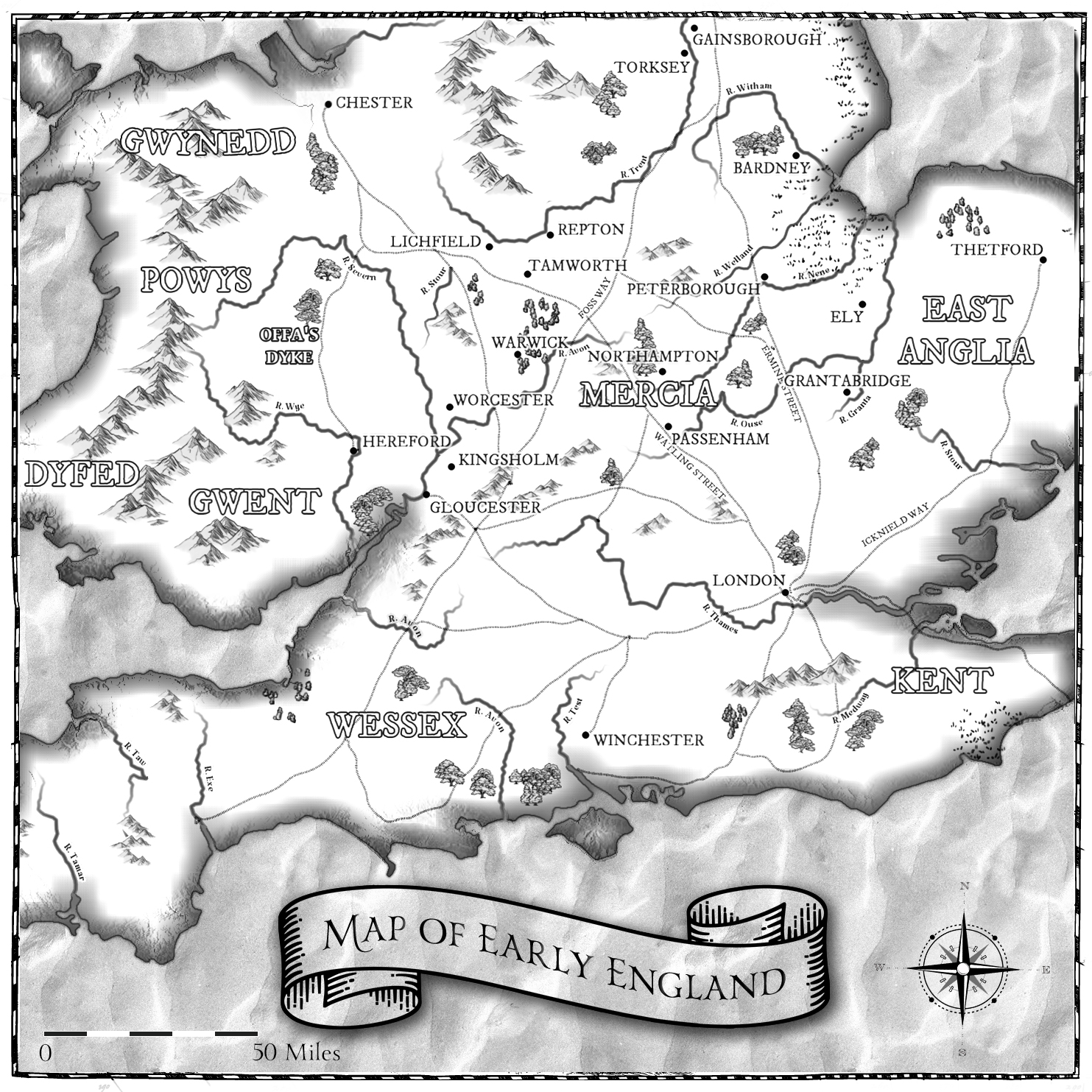
Map by Flintlock Covers
Again, Estrid was a character I’d considered writing about for some time. She was a bit part character in my Earls of Mercia books, but she seemed to me the perfect vehicle for writing about comparable events in Denmark, as opposed to England, in the eleventh century.
I am fascinated by all of the Scandinavian countries in the ‘Viking’ Age, and beyond. But, I’m certainly no expert on what was happening.
My diary says I started writing the book on April 9th, but I know I’d written about 5000 words in February (to enter a competition that I didn’t win:)). I gave myself about two weeks of working on Lady Estrid, a breather as it were, and then went back to the edit for The Last Warrior. I know some people wait months between a finished draft and an edit, but I don’t like to wait quite that long, although I do think even a little bit of ‘distance’ can help the process. At this point, with very little else to do due to Lockdown, my notes become really detailed about editing and words added, but I won’t bore with those little details. Suffice to say, I’m normally someone that adds words rather than deletes them throughout the first edit – I tracked the words added, but not deleted, and how many pages I edited in a day.
At this point, I was also hoping to do a quick edit, and finish off my NaNoWriMo project from the previous November. Throne of Ash is a historical fantasy, and goodness me, it has bedevilled my year. So much so that I have it to thank for the number of books I’ve written about Coelwulf. At the moment, it just doesn’t ‘work’ and I know it just doesn’t ‘work’ and I still can’t quite work out how to make it ‘work’ but it will. Eventually. Or it won’t, and it will just continue to drive me a bit bonkers. But hey, I’ll share a mock-up cover all the same. (I like to have the cover designed before I start a book.)
The Last King was released on 23rd April. The next day, I began work on book 3 – which at the time I was calling The Last Lord, which quickly changed to The Last Sword, and then became The Last Horse. Throne of Ash was pushed aside, and so too was Lady Estrid. The women in my life, (Throne of Ash’s main character is a woman) were giving me grief. Coelwulf, Rudolf, Edward, Pybba and Haden were much easier going – the banter, the fighting, the ‘scenario’ – it all just fit what I was able to write at that time.
I know what you’re thinking – I was slightly over-achieving at this point – don’t worry, it’s all about to come to an abrupt stop because Lockdown was about to change. I’d had a month where not much had been any different, (I’m a writer, I write, I spend most of my time at home anyway) but now my other-half was furloughed and now began the great ‘walk,’ which I’ve also spent much of the year doing (a walk almost everyday building up to the point where I now go for my walk, rain or shine, sleet or snow.) Now my routine really suffered, and would continue to do so for months. It’s not a complaint, but I’m aware that I need my routine to accomplish all the tasks I set myself. I was still trying to write every day but my word count was down to 1000-2000. But, at least the story still wanted to be told.
By the middle of June I was doing a final edit on The Last Warrior, and the book was released on 25th June, just as The Last Sword had become known as The Last Horse, and I was happy that the first draft was complete. By 1st July, I’d noted in my diary that The Last Horse was ‘completed.’
People were really enjoying The Last King, and by the time The Last Warrior was released at the end of June I had three times as many preorders as I’d had for my ‘new’ series.
By now, some of the restrictions had been removed because Lockdown had ‘allegedly’ come to an end, but I remained local, although this was when my weekly, and now twice-weekly, walks at Cragside began. This was also when I attended (virtually) the International Medieval Congress hosted by Leeds University. I spent an enjoyable week attending so many talks and really reconnecting with my love of academic history. I purchased many, many books on my time period, and really hope they do the same next year, as it meant I could keep up with my almost daily walks.
I was also back to Lady Estrid, and editing The Last Horse, both must have been finished in August, but there’s a note on 11th August saying that Lady Estrid was ‘finished.’ (It wasn’t, but that’s a story for later on – I thought it was finished.) I turned my mind back to the next book about Coelwulf.
But, big things were happening for The Last King throughout the summer months. I’d managed to get an international BookBub deal for it and I’d taken the book on tour with The Coffee Pot Book Club (check here for details of the posts) and was also running a promotion on The History Quill in August.
The Last Horse was released on 27th August, and now I’d had more than double the preorders that I’d had for The Last Warrior, which had been triple the preorders I’d had for The Last King. I think my readers liked Coelwulf – and so did I.
By now I’m into September, and I had to have day-surgery to remove half of my thyroid, so again, things slowed down a bit – although I used the experience when writing The Last Enemy. And I was also into Tier 3 restrictions. By now, my notes have become really sporadic and I can’t track what I was doing to any degree of accuracy as earlier in the year. I think everything was coming off the rails a little bit – two difficult books, surgery, which knocked me more than I thought it would, and Lockdown. It wasn’t easy going with the writing and it was started to frustrate me – I needed my routine back but it was to be a few more months before it returned.
I’d spent my time pummelling Lady Estrid into submission. It had taken a great deal of time to edit, and I’d also written many more words from when I’d so confidently stated it was ‘finished’ in August. The ending was changed, the beginning was changed and I added to many more of my characters. I think in the edit I added about 15k words, and removed some of the elements that were giving me bother.
At some point, I finished The Last Enemy, and was back to editing it, and Lady Estrid, making use of Netgalley and The History Quill, was about to be released to a mixture of feedback – a bit of a Marmite book but one I was really pleased with. It had been a hard slog, over six months of thinking and writing about it, and with a bit of inspiration from Anne O’Brien’s The Queen’s Rival, I hoped I’d accomplished what I’d set out to do – a history of Denmark from the 1020s to 1050 – through the eyes of Lady Estrid, and her large, and extremely influential, far-flung family.
And then to November and NaNoWriMo once more. Did I think about finishing last year’s abandoned project? I didn’t, not at all, but instead took myself to the 1940s for a project I’m calling The Custard Corpses, and also a return to the Earls of Mercia books. Throughout November, I got my ‘routine’ back. I remembered all the restrictions I needed to place on myself to achieve what I wanted to achieve, the fact I prefer to write in the morning, and the knowledge that I can easily write at least 2000 words a day, even when I don’t really want. (I take part in NaNoWriMo every November and have done since 2013. I can’t stress how good it is for reinforcing all the things I know, but often forget, and because I always allow myself to step aside from my usual writing projects, how freeing it can be.)
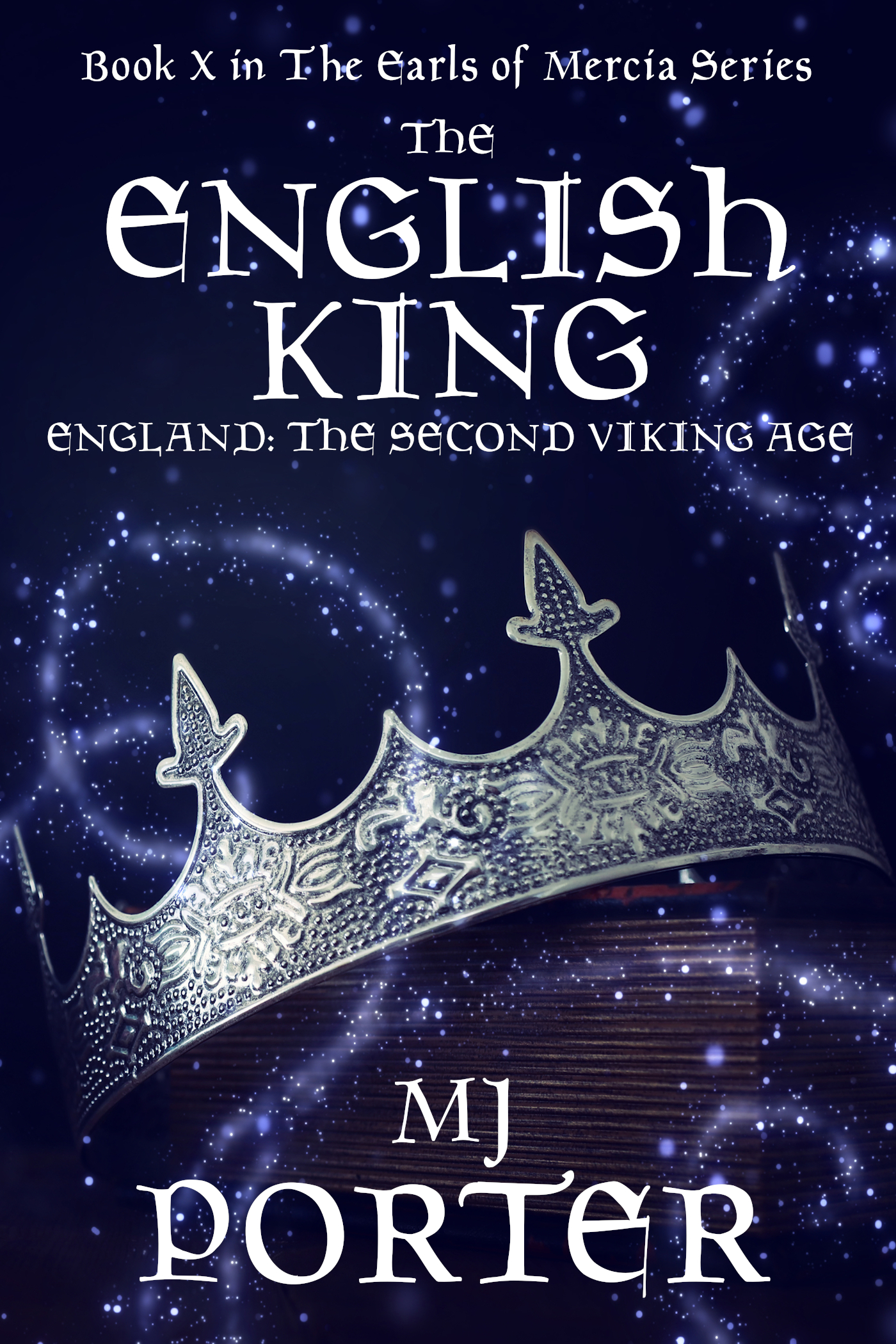
At 50k, I put The Custard Corpses to one side, and powered through The English King – another story that took a while to find its way – but which did with enough ‘routine.’ The Last Enemy was released at the end of November, and the number of preorders continued to exceed my expectations, as did the number of people reading and reviewing and rating. Thank you to you all.
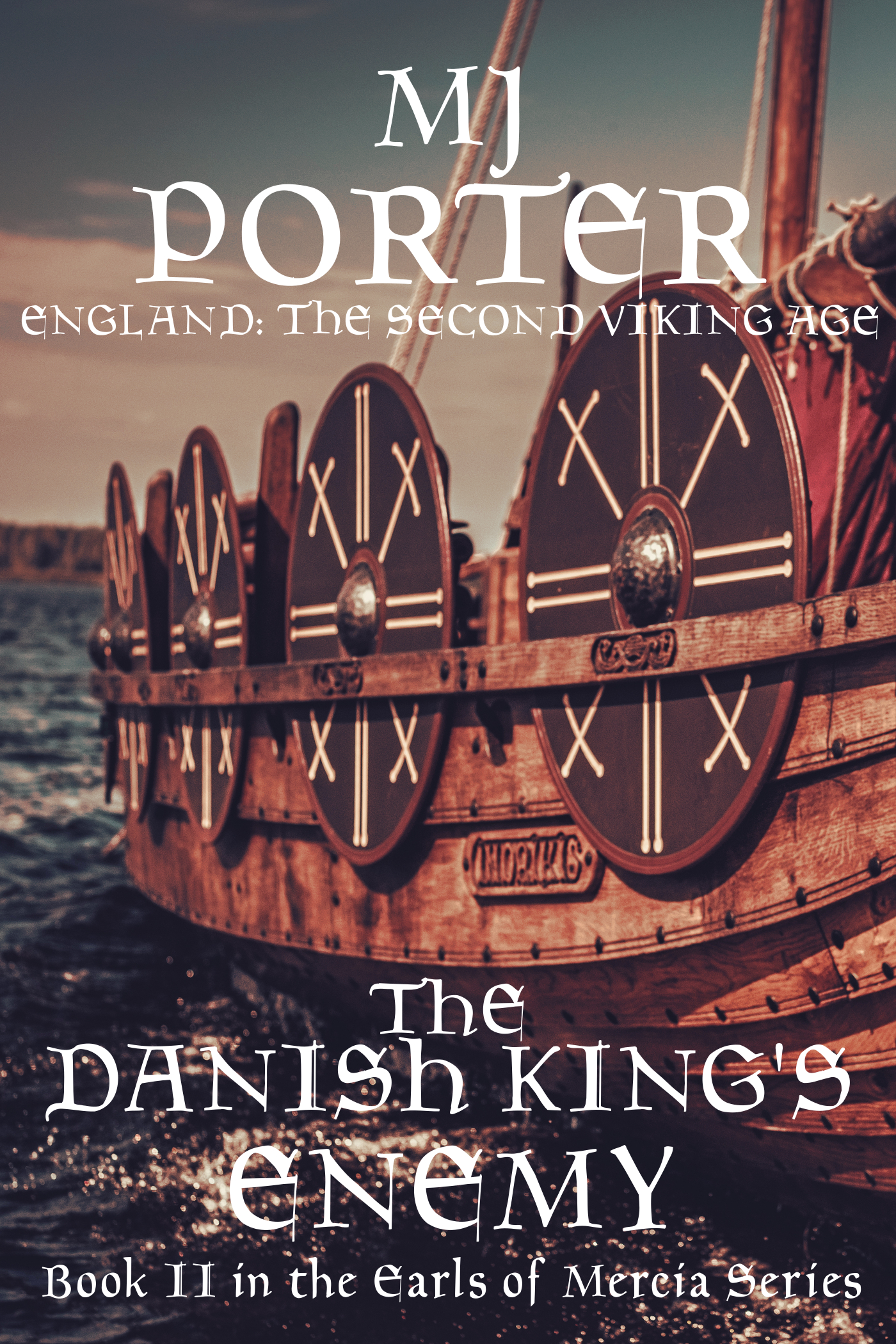
And to top the year off, I’ve also had the copyright restored to me for the second Earls of Mercia book. It’s a long and tedious story, but suffice to say, it was all reedited and rewritten during 2019 but I only had the paperback rights, and now I can release it in ebook as well. So, The Danish King’s Enemy is mine once more – a new name, a big section rewritten, a new cover, but still the same old Ealdorman Leofwine. If you’ve read one of the previous incarnations, please consider popping a review on the new one. It would be a huge help. And if not, it is in Kindle Unlimited, and it’ll be on special offer at the end of January 2021 too.
I can’t say I’m unhappy with what I’ve written in 2020, but it has been a challenge – not just because of events in the wider-world but also because my characters didn’t always behave – I’m looking at you Lady Estrid, and Throne of Ash.
But, 2020 has been fantastic in terms of the readers and reviewers that I’ve met along the way. I couldn’t have done it without them encouraging me on – demanding to know ‘what next’ for Coelwulf. I’m grateful to have been able to interact with them, and it’s shown me how powerful Netgalley can be, if the book finds a willing audience. I’ve also discovered a huge array of non-fiction books that I’ve been using to help me with my works in progress – and for that I’m grateful to the VIMC in Leeds. Without that my passion wouldn’t have been reignited and without that, I wouldn’t have powered myself through Lady Estrid, and she might well be mouldering in a corner, like other, abandoned projects.
For those thinking that I’ve written too much this year, remember, it has been Lockdown for nearly nine months, in my head, if not in others. I’ve only had my characters to distract me from the wider world. As a comparison, I released seven books in 2019, two of which were largely written in 2018. In 2020 I released six books, one of which was written in 2019, and another book which is ready for January 2021. I’ve managed about the same workload – I have suffered with my routine, and my motivation, but have taken great joy in the response my books have received.
And so to 2021. I have three books to edit and finish, and then I’ll return to the world of Coelwulf. I hope you, as my readers, will stay with me, but if not, thank you for spending 2020 with me. I hope I’ve managed to distract you from events outside our own front doors, and I will continue to try and do so. If you want to follow me, I have a newsletter which can be joined here.
Stay safe, people. I hope 2021 will be ‘better’, although I think for many of us ‘better’ is not quite what we once thought it would be.
(This page contains some Amazon Affiliate links, and some Booklinker links)
Lady Estrid has taken herself on tour with the fabulous Coffee Pot Book Club. She what she’s been up to, and thank you to everyone for hosting her, and the Coffee Pot Book Club for arranging.
Thank you to all the hosts for allowing Lady Estrid onto their blogs, and to The Coffee Pot Book Club for being so, so, so good at organising everything. Thank you.
(This post contains Amazon affiliate links, which means that at no cost to you, Amazon rewards me.)
One of the big plusses for choosing the character of Lady Estrid for my most recent novel, was her large and illustrious family and their far-reaching influence over Denmark, Sweden, Norway and England. It meant there was already an excellent story to tell.
While I quickly managed to slot all the different relatives into order (well, I have been writing about them for a while), I’m aware it’s not the easiest of tasks, and so, I have put together some genealogical tables of the main families to make it that bit easier.
The family of Lady Estrid Sweinsdottir, as mentioned in Lady Estrid.
Due to a lack of information, I have made little mention of the rest of Estrid’s half-sisters, of which she had three or four. I feel it perhaps also helped the story a little – it was complicated enough as it was without giving them the capacity to meddle in affairs in Denmark. I have also made the assumption, that because I don’t know who they married, that they didn’t make international alliances, as Estrid did.
To break it down into more palatable chunks, Lady Estrid’s mother was married twice, once to King Swein of Denmark (second) and also to King Erik of the Svear (first). King Swein was also married twice (in my story at least – as it is debated), to Lady Gytha (who I take to be his first wife) and then to Lady Sigrid (who I take to be his second wife.) Swein was king of Denmark, Erik, king of the Svear (which would become Sweden), and so Sigrid was twice a queen, and she would have expected her children to rule as well, and her grandchildren after her. Sigrid was truly the matriarch of a vast dynasty.
She would have grandchildren who lived their lives in the kingdom of the Rus, in Norway, in England, and Denmark.
And Sigrid wasn’t the only ‘double queen.’ Lady Emma, twice queen of England, was first married to King Æthelred and then to King Cnut, Estrid’s brother.
Lady Emma, twice queen of England and her children
Not that it’s possible to speak of Lady Emma’s children from her two marriages, without considering the children of her first husband’s first marriage. King Æthelred had many children with his first wife, perhaps as many as nine (again, a matter for debate), the below only shows the children mentioned in Lady Estrid. Readers of The Earls of Mercia series, and the Lady Elfrida books, will have encountered the many daughters, as well as sons.
The family of King Æthelred of England
One of the other family’s that had the most impact on Lady Estrid, was that of her third husband, and father of her two sons, Jarl Ulfr.
The family of Ulfr
Ulfr had a brother and a sister, and while little is known about the brother, it is his sister who birthed an extremely illustrious family, through her marriage to Earl Godwine of Wessex. (The family tree doesn’t include all of her children.)
Four such powerful families, all intermarried, make for a heady mix.
For the modern reader, not only are the family dynamics complicated to understand, but so too is the geography. Sweden was not Sweden as it is today, and the reason I’ve insisted on calling it the Land of the Svear. But equally, Denmark was larger than it’s current geographical extent, covering Skåne, (in modern day Sweden) as well. The map below attempts to make it a little clearer. Norway is perhaps the most recognisable to a modern reader, but even there, there are important difference. King Swein claimed rulership over parts of Norway during his rule, and so too did King Cnut. But, Denmark isn’t the only aggressor, there were rulers in all three kingdoms who wished to increase the land they could control, King Cnut of Denmark, England, Skåne and part of Norway, is merely the most well-known (to an English-speaking historian.)