
I’m delighted to welcome Justin Newland to the blog with a guest post about his new book, The Mark of the Salamander. #HistoricalFiction #TudorFiction #GoldenHind #BlogTour #CoffeePotBookClub

I’m delighted to welcome Justin Newland to the blog with a guest post about his new book, The Mark of the Salamander.

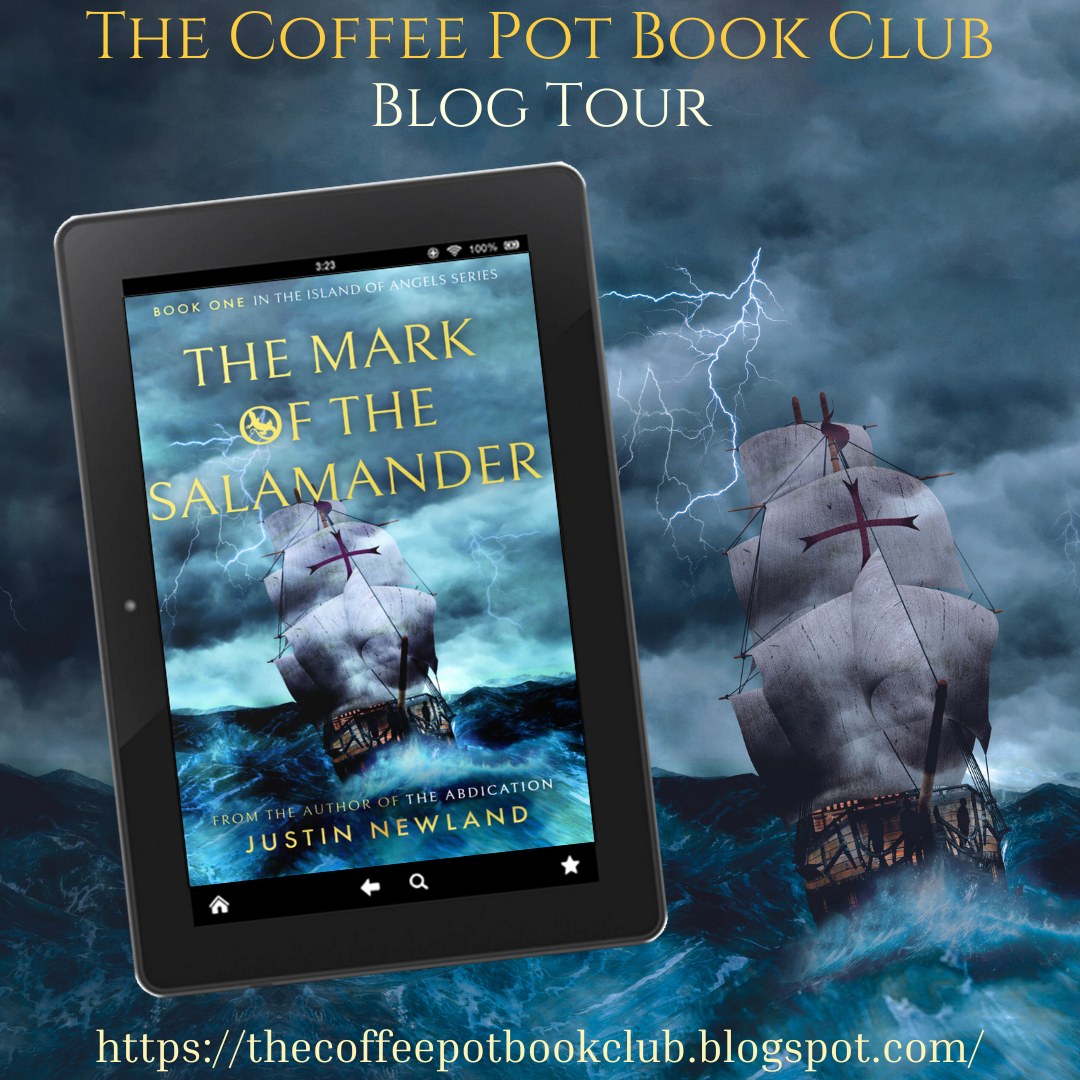
The Mark of the Salamander is the first part of a two-book series entitled The Island of Angels, which tells the epic story and secret history of England’s coming of age during the Elizabethan era.

Queen Elizabeth of England and King Philip II of Spain opposed each other in a religious war in the late 16th century. Even as enemies, they shared plenty in common.

Elizabeth was known as the Virgin Queen because she never married.
King Philip II of Spain was known as ‘the Prudent’ because he was frugal with his money.

Process El Escorial Monastery

She too was a spendthrift, and was exceedingly careful with money, and so in the same way as Philip, she was prudent too. For many years, Philip lived in the castle- monastery of El Escorial near Madrid. There he was surrounded by Hieronymite monks, who lived an austere life in the image of the their founder, the biblical scholar, St Jerome. Living like a monk, study, austerity and discipline were Philip’s daily fare.

Elizabeth on the other hand, moved around using the River Thames to head from her favourite palace at Richmond to her other royal estates at Whitehall and Greenwich.

She also went on royal progresses to visit the estates of her senior courtiers, like Kenilworth, Osterley and Theobalds.

Elizabeth I

Astrologically, Elizabeth was a Virgo, actually a double Virgo, because her rising
sign was also Virgo. Curiously, Virgo means virgin. The coincidences don’t end there. Because the flag that the Spanish Armada flew had, on one side of it, an image of Madonna, Mary, the mother of Jesus who was herself a virgin.

Philip was himself a Taurus, the bull, and bullish he was in defiance. Stubborn as a mule, he sent several Armadas to invade England, but none of them succeeded. Taurus and Virgo are both Earth signs; Elizabeth and Philip shared that in common too.

King Philip II of Spain

The boundaries between the two nations would not have been as explicit had England and Spain been at war today. Today there would be sanctions on trade between the warring nations. In the 16th Century, things were not as cut and dried.

For example, it would have been quite normal for the Queen, Drake and the other English aristocrats to enjoy a glass of Spanish wine and sherry. The other irony to this is that one of the major exporters of said Spanish wine was from the estates of the Duke of Medina Sidonia. Said Duke was the commander of the Spanish Armada sent to invade England’s shores in the summer of 1588.

Elizabeth’s personal motto was ‘Semper Eadem’ which means ‘Always the Same.’ But what was ‘the same’ where she was concerned? She saw herself as married and in service to the people and land of England, and that never varied. She saw herself as protector of the realm, and that never varied either. She too was always fierce in her defiance against the Duke of Parma, who had invaded the Netherlands on behalf of King Philip. This resolution is enshrined in the words from her famous Tilbury speech:

“… I think foul scorn that Parma or Spain, or any prince of Europe, should dare to invade the borders of my realm.”

By comparison, King Philip’s motto was Orbis non Sufficit, which means the World is Not Enough. If the world is not enough, what is? The solar system? The universe? This motto reeks of hubris, or excessive pride. Perhaps this is what led King Philip to miss out certain orders to his naval commander, the Duke of Medina Sidonia.

Two opponents.
One a man, who rested in one place, static.
The other a woman, who moved from place to place, ever mobile.
One led the life of a scholarly monk.
The other danced her way into the hearts of the English people and gave her name to an era.
Here’s the blurb

1575.

Nelan Michaels is a young Flemish man fleeing religious persecution in the Spanish Netherlands. Settling in Mortlake outside London, he studies under Queen Elizabeth’s court astrologer, conjuring a bright future – until he’s wrongly accused of murder. 

Forced into the life of a fugitive, Nelan hides in London, before he is dramatically pressed into the crew of the Golden Hind.

Thrust into a strange new world on board Francis Drake’s vessel, Nelan sails the seas on a voyage to discover discovery itself. Encountering mutiny, ancient tribes and hordes of treasure, Nelan must explore and master his own mystical powers – including the Mark of the Salamander, the mysterious spirit of fire. 

THE MARK OF THE SALAMANDER is the first in The Island of Angels series: a two-book saga that tells the epic story and secret history of England’s coming of age during the Elizabethan era. 

Buy Links:

Universal Link

Barnes and NobleWaterstonesKobo

WH SmithSaxo DKUK Bookshop

WorderyBlackwellsFoyles

Meet the author

Justin Newland’s novels represent an innovative blend of genres from historical adventure to supernatural thriller and magical realism. His stories explore the themes of war and religion, and speculate on the human’s spiritual place in the universe.

Undeterred by the award of a Doctorate in Mathematics from Imperial College, London, he conceived his debut novel, The Genes of Isis (Matador, 2018), an epic fantasy set under Ancient Egyptian skies. 

The historical thriller, The Old Dragon’s Head (Matador, 2018), is set in Ming Dynasty China in the shadows of the Great Wall. 

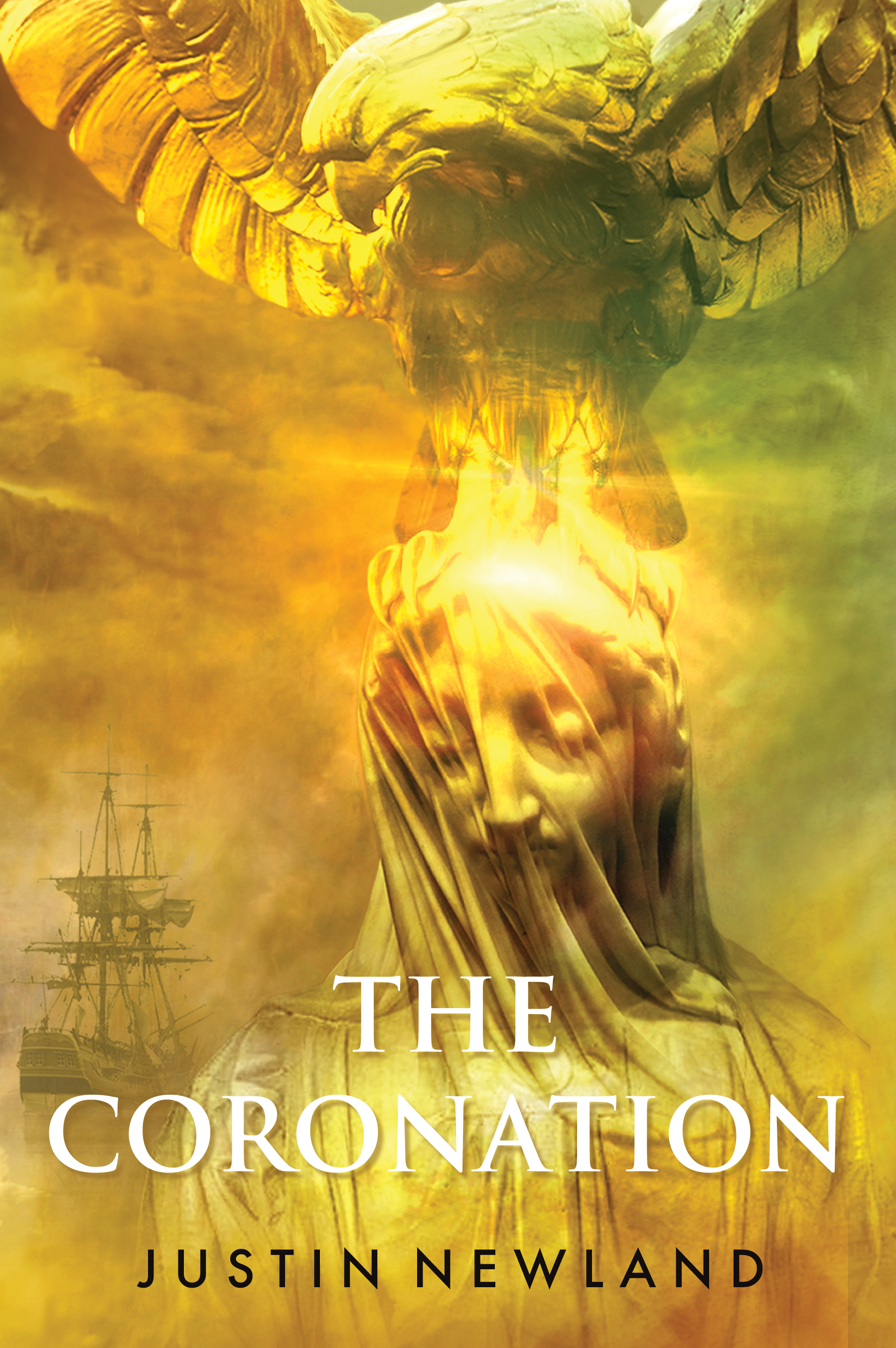
The Coronation (Matador, 2019) was another historical adventure and speculates on the genesis of the most important event in the modern world – the Industrial Revolution. 

The Abdication (Matador, 2021) is a mystery thriller in which a young woman confronts her faith in a higher purpose and what it means to abdicate that faith.

The Mark of the Salamander (Book Guild, 2023) is the first in a two-book series, The Island of Angels. Set in the Elizabethan era, it’s an epic tale of England’s coming of age. 

His work in progress is the second in the series, The Midnight of Eights, the charting of the uncanny coincidences that led to the repulse of the Spanish Armada. 

Author, speaker and broadcaster, Justin appears on LitFest panels, gives talks to historical associations and libraries and enjoys giving radio interviews and making podcasts. 

Born three days before the end of 1953, he lives with his partner in plain sight of the Mendip Hills in Somerset, England.

Connect with the author


WebsiteBook Bub:

Follow The Mark of the Salamander blog tour with The Coffee Pot Book Club

Today, I’m delighted to welcome Justin Newland to the blog with his book, The Coronation

Your book, The Coronation, sounds fascinating. What was the first idea that made you decide to write this story? 

To begin this, I’d like to describe how I work, how I come at or conceive my novels. I didn’t know this on my first novel, but have subsequently discovered this about how best I work, and how I best like to work.

So, to start, I tend to conceive the themes I want to explore in a story. Then I find the setting – the plot, the characters, the place, and the historical period – that best allows me to explore those themes and the message I want to put across. 

Before I talk about The Coronation, my third novel, I’d like to give a bit of background as to my own writing journey up to the time I conceived it.

My first novel, The Genes of Isis, was an epic fantasy set in Ancient Egypt, and a re-telling of the Biblical story of the flood. Its plot was loosely based on the myth of Isis and Osiris.

Then I wrote a historical fantasy, The Old Dragon’s Head. It’s set in the 1400’s in Ming Dynasty China on the far eastern end of the Great Wall, and explored the supernatural beliefs of the Chinese mindset of those times.

Egypt and China – two of the largest historical contributors to the mores of civilisation. 

Then, towards the end of 2017, I conceived the idea of a third novel, The Coronation

Looking back at my notes, I wanted one of the themes of the story to be about famine, not only physical famine but also the spiritual famine. I wanted to use physical famine as a metaphor for spiritual famine, such as we encounter everywhere in today’s world.

So, I had to find a period of history, or a setting, when famine was prevalent.

I wanted also to explore the Ancient Greek idea of Arcadia, of an unspoiled, harmonious living together of a people and the land, played out through custom and ceremony, poem and dressage, song and dance. And I wanted to find a recent time and a place in history when the Arcadian ideal was still alive and well. 

So, I also had to find a period of history when this Arcadian ideal was still alive and well and prospering. 

This led me to the 18th Century in Europe. 

It was a huge change-over, from feudal times to the beginning of the industrial era. It was time when there were few large cities, when people often only moved around within a 10- or 20-mile radius of their place of birth in all of their lives. It was a time when, in Europe, society was structured according to the Sachenspiegel, the Saxon Mirror, in the same way that God had ordered the Universe, from the stars down to the moon, from kings down to the peasants. This was a fixed, static view. In other words, people had to stay in and couldn’t move out of their strata of society, otherwise there would be upheaval and revolution.

It seemed to me that the Industrial Revolution had much to do with engendering that spiritual famine, so I looked for its genesis. 

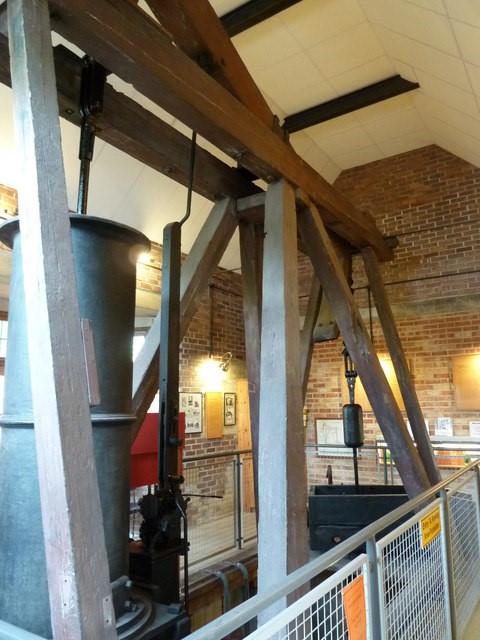
It began with the so-called Newcomen Engine. 

Newcomen Steam Engine

This was a rather inefficient pump designed by a Devon pastor by the name of Thomas Newcomen. It was used to pump water out of Cornish tin mines. 

There’s a photo here showing a reconstruction of that engine.

That led me to research James Watt and the origins of his steam engine. I found that he didn’t invent the steam engine, but he simply improved on the existing design, i.e., the Newcomen Engine. 

So, in the 1760’s, James Watt made his discovery of the improvement to the efficiency of the steam engine, and we now live in the results of that, that is, we live in an industrialised society. That’s what we have inherited, whether we like it or not. 

But was that how it was meant to be? Because at the time, a time they now call the Great Enlightenment, there were great advances in science, in biology, in chemistry, and medical science. These helped dispel the mists of superstition enshrouding the people of the time, and which prevented further growth and development.

But were we, as a people, as a genus, meant to take the industrial route? Was there an alternative? It must have been there, so what was it, and why didn’t we take it? 

So, what was the ‘coronation’ alluded to in the book title? It wasn’t the coronation of a king or a queen or an emperor. So, what was it? Was it to do with the coronation of mankind, and if so, what form did that take? What did it, or would it look like, if mankind was crowned? And what did it have to do with the eagle? 

These were the themes which set me off researching Europe on the 18th Century, and the period of the Great Enlightenment. And if it really was just that, a Great Enlightenment, how come we aren’t living in a greatly enlightened society today? Why didn’t it progress and develop? And should that day ever come, what would it look like? And would we recognise it?

These were some of the questions I wanted to explore in the novel. 

Thank you so much for sharing. Your inspiration sounds fascinating. Good luck with the book.

Here’s the blurb

It is 1761. Prussia is at war with  Russia and Austria. As the Russian army occupies East Prussia, King Frederick the Great and his men fight hard to win back their homeland. 

In Ludwigshain, a Junker estate in East Prussia, Countess Marion von Adler celebrates an exceptional harvest. But it is requisitioned by Russian troops. When Marion tries to stop them, a Russian captain strikes her. His lieutenant, Ian Fermor, defends Marion’s honour and is stabbed for his insubordination. Abandoned by the Russians, Fermor becomes a divisive figure on the estate.

Close to death, Fermor dreams of the Adler, a numinous eagle entity, whose territory extends across the lands of Northern Europe and which is mysteriously connected to the Enlightenment. What happens next will change of the course of human history… 

Buy Links:

Amazon UKAmazon USAmazon CAAmazon AU

Barnes and NobleWaterstonesKobo

Author’s Website (buyers can enter a dedication to be signed by the author): 

Publisher’s WebsiteWordery (UK)

Bookswagon (India)Booktopia (Au)Saxo (Dk)Exclusive Books (SA)

Meet the author

Justin Newland is an author of historical fantasy and secret history thrillers – that’s history with a supernatural twist. His stories feature known events and real people from history which are re-told and examined through the lens of the supernatural. He gives author talks and is a regular contributor to BBC Radio Bristol’s Thought for the Day. He lives with his partner in plain sight of the Mendip Hills in Somerset, England. 

His Books

The Genes of Isis is a tale of love, destruction and ephemeral power set under the skies of Ancient Egypt. A re-telling of the Biblical story of the flood, it reveals the mystery of the genes of Isis – or genesis – of mankind. ISBN 9781789014860.

The novel is creative, sophisticated, and downright brilliant! I couldnt ask more of an Egyptian-esque book!” – Lauren, Books Beyond the Story.

The Old Dragons Head is a historical fantasy and supernatural thriller set during the Ming Dynasty and played out in the shadows the Great Wall of China. It explores the secret history of the influences that shaped the beginnings of modern times.  ISBN 9781789015829.

The author is an excellent storyteller.” – British Fantasy Society. 

Set during the Great Enlightenment, The Coronation reveals the secret history of the Industrial Revolution. ISBN 9781838591885.

The novel explores the themes of belonging, outsiders… religion and war…  filtered through the lens of the other-worldly.” – A. Deane, Page Farer Book Blog.

His latest, The Abdication (July, 2021), is a suspense thriller, a journey of destiny, wisdom and self-discovery. ISBN 9781800463950.  

“In Topeth, Tula confronts the truth, her faith in herself, faith in a higher purpose, and ultimately, what it means to abdicate that faith.” 

V. Triola, Coast to Coast.

Connect with Justin

WebsiteFacebookLinkedIn

InstagramAmazon Author PageGoodreads

Don’t forget to check out the other stops on The Coronation Blog Tour with The Coffee Pot Book Club