

I’m delighted to welcome Brodie Curtis and his book, Showboat Soubrette, to the blog #HistoricalFiction #AmericanHistoricalFiction #HistoricalAdventure #BlogTour #TheCoffeePotBookClub

I’m delighted to welcome Brodie Curtis and his book, Showboat Soubrette, to the blog with a guest post.

Guest Post
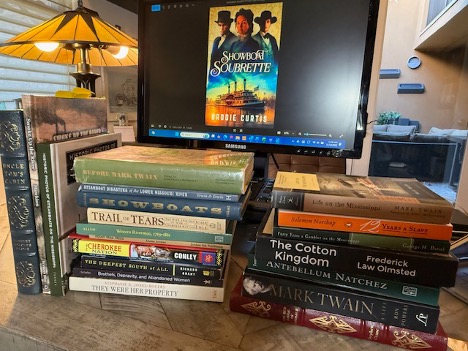
SHOWBOAT SOUBRETTE is my third historical novel set in the riverboat era on the lower Mississippi River prior to the Civil War. To learn about the period, I dug into a variety of research sources that are listed below. I truly got energized to tell my story by taking a drive along the Big Muddy, from Hannibal down to Natchez, stopping frequently at historical sites, and along the river itself. Had to feel it!

Brodie Curtis Looks Upriver from Natchez

UNDERSTANDING THE ANTEBELLUM DEEP SOUTH:

Romanticism of the Antebellum American Deep South could be found in the pageantry of the attire worn by the privileged, and in the heady adornment of passenger-hauling riverboats that paddle-wheeled the Mississippi. But the period exhibited almost unbelievable cruelty in its institution of slavery and in the bigoted attitudes of the times. And in its violence. Perhaps the first title listed below, Olmsted’s The Cotton Kingdom illuminates these contradictions best.

Olmsted, F. (1861). The Cotton Kingdom: A Traveller’s Observations on Cotton and Slavery in the American Slave States 1853-1861

McDermott, J. (“Edited with an Introduction and Forward”) ( 1968). Before Mark Twain: A Sampler of Old, Old Times on the Mississippi.

Stowe, H.B. (1852). Uncle Tom’s Cabin.

Northup, S. (1853). 12 Years a Slave.

Devol, G. (1894). Forty Years a Gambler on the Mississippi.

Jones-Rogers, S. (2019). They Were Her Property: White Women as Slave Owners in the American South.

James, D.C. (1968). Antebellum Natchez.

Kelleher Schafer, J. (2009). Brothels, Depravity, and Abandoned Women: Illegal Sex in Antebellum New Orleans.

Sharp, A. and Sharp, G. (2009). Antebellum Myths and Folklore: A Search for the Truth.

Grant, R. (2020). The Deepest South of All: True Stories from Natchez, Mississippi.

RIVERBOATS:

Is there a more majestic image than a multi-decked steamboat gliding on the river, smoke billowing from its stacks while water clicks over its paddles? Yet idyllic portraits belied the dangers, from collisions and boiler explosions to snags, sandbars, fire and ice and other in climate conditions. Thousands of boats ended up at the bottom of the river. Mark Twain’s memoir of his cub pilot days and old images in many of the sources below sparked my imagination.

Twain, M. (1883). Life on the Mississippi

Powers, R. (2005). Mark Twain: A Life.

Brodie Curtis took in the Mark Twain Attractions in Hannibal MO

Shapiro, D. (2009). Historic Photos of Steamboats on the Mississippi.

Graham, P. (1951). Showboats: The History of an American Institution.

Allen, M. (1990). Western Rivermen, 1763-1861: Ohio and Mississippi Boatmen and the Myth of the Alligator Horse.

Lloyd, J. (1855). Lloyd’s Steamboat Directory, and Disasters on the Western Waters.

Hawkins, V. (2016). Smoke up the River: Steamboats and the Arkansas Delta.

Berger Erwin, V. and Erwin, J. (2020). Steamboat Disasters of the Lower Missouri River.

Sandlin, L. (2010). Wicked River: The Mississippi When it Last Ran Wild.
Buck, R. (2023). Life on the Mississippi: An Epic American Adventure.

Here’s the Blurb

FROM STAR SHOWBOAT SINGER 
TO PIRATE PREY ON THE WICKED RIVER!

Showboat singer Stella Parrot’s star rises in the Antebellum South with every sold-out performance along the lower Mississippi River. When a river pirate viciously assaults her, new friends Toby Freeman and John Dee Franklin foil the attack. However, the pirate’s family is bent on revenge.

Stella, Toby, and John Dee escape their riverboat with able assistance from young cub pilot Sam Clemens, only to be pursued by the notorious Burton Gang. As the trio runs for their lives, mortal perils await at every turn: a fierce storm, high-stakes gambling confrontations, deadly combat, and a cotton boat up in flames. Stella, a Cherokee Indian, and Toby, a free Black man, and their friend White man John Dee endure relentless racial prejudices and injustices in the gritty underbelly of the Wicked River while fleeing to New Orleans—where the Burtons will be waiting!

SHOWBOAT SOUBRETTE’s fast-paced lower river adventure chase features romantic showboat scenes and is unsparing in its exploration of the bigoted and sometimes lawless riverboat era.

Praise:

“Captivating characters? A fast-paced storyline? Cameos from historical figures? Brodie Curtis checks all the boxes in his novel set along the Mississippi River on the eve of the Civil War. Well done.”

  • Tim Wendell, author of CASTRO’s CURVEBALL and REBEL FALLS

“SHOWBOAT SOUBRETTE is a novel that transcends a simple river chase, unfolding instead as a richly textured portrait of time and place where beauty and brutality are forced to coexist. Brodie Curtis has crafted a story that entertains without simplifying, thrills without trivializing, and ultimately delivers a powerful testament to courage and solidarity on the margins of history…For readers who crave historical fiction with pace and teeth, this novel will be a compelling and unforgettable ride.”

  • THE HISTORICAL FICTION COMPANY

“This was an unputdownable read for me!…It’s an optimistic picture of a shocking time in American history….SHOWBOAT SOUBRETTE is ideal for fans of historical adventure fiction, especially fans of Twain himself and Percival Everett’s JAMES.”

  • Ruth F. Stevens, author of STAGE SEVEN and THE SOUTH BAY SERIES Books 1 and 2

“Readers of historical fiction will love SHOWBOAT SOUBRETTE…a river adventure down the great Mississippi to New Orleans in the 1850s when racial tension is ripe in the Old South…an adventure worthy of Mark Twain’s pen… Curtis is a master of description and atmosphere.”

  • Tyler R. Tichelaar, PhD and award-winning author of THE MYSTERIES OF MARQUETTE

“(E)xtensive research draws the reader in and carries them along on this fast-paced adventure, blending interesting historical facts with compelling fictional characters. I thoroughly enjoyed the journey and recommend this voyage down the mighty Mississippi.”

  • Kris Abel-Helwig, author of THE HERO SERIES and the upcoming RULE OF ODDS.

Buy Link

Universal Link

This title is available to read on #KindleUnlimited

Meet the Author

Raised in the Midwest, Brodie Curtis was educated as a lawyer and left the corporate world to embrace life in Colorado with his wife and two sons. 

Curtis is the author of THE FOUR BELLS, a novel of The Great War, which is the product of extensive historical research, including long walks through the fields of Flanders, where much of the book’s action is set. His second novel, ANGELS AND BANDITS, takes his protagonists into The Battle of Britain. Curtis’ third novel is set on a Mississippi Riverboat prior to the Civil War.

A lover of history, particularly American history and the World Wars, Curtis reviews historical fiction for the Historical Novels Review and more than 100 of his published reviews and short takes on historical novels can be found on his website: brodiecurtis.com.  

Connect with the Author

Follow the Showboat Soubrette blog tour with The Coffee Pot Book Club

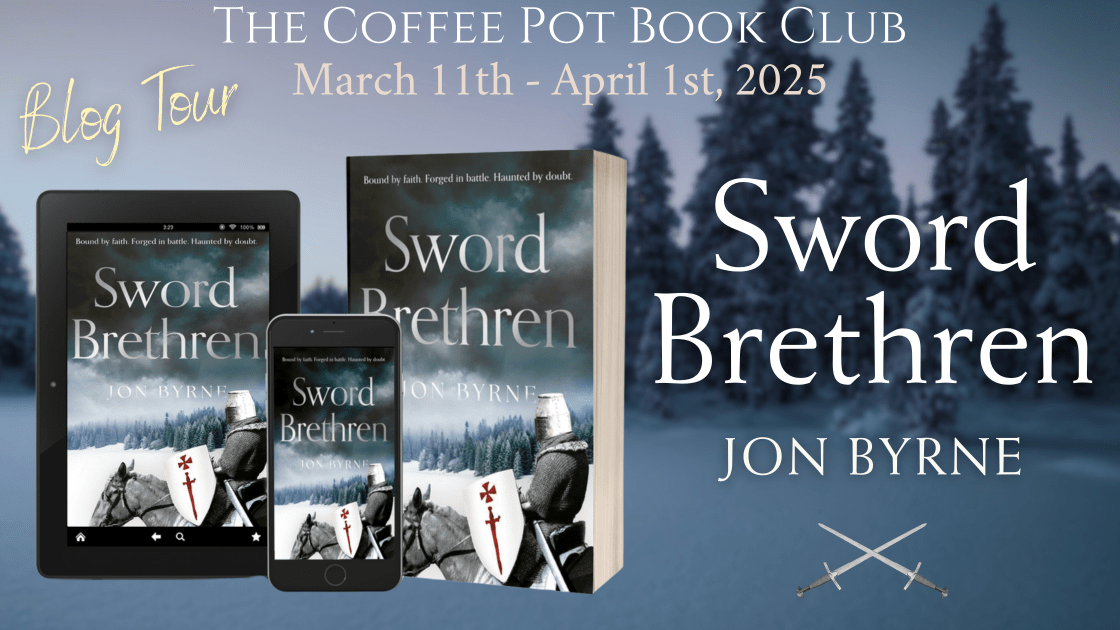
I’m delighted to welcome Jon Byrne and his book, Sword Brethren, to the blog #HistoricalFiction #HistoricalAdventure #medieval #BlogTour #TheCoffeePotBookClub

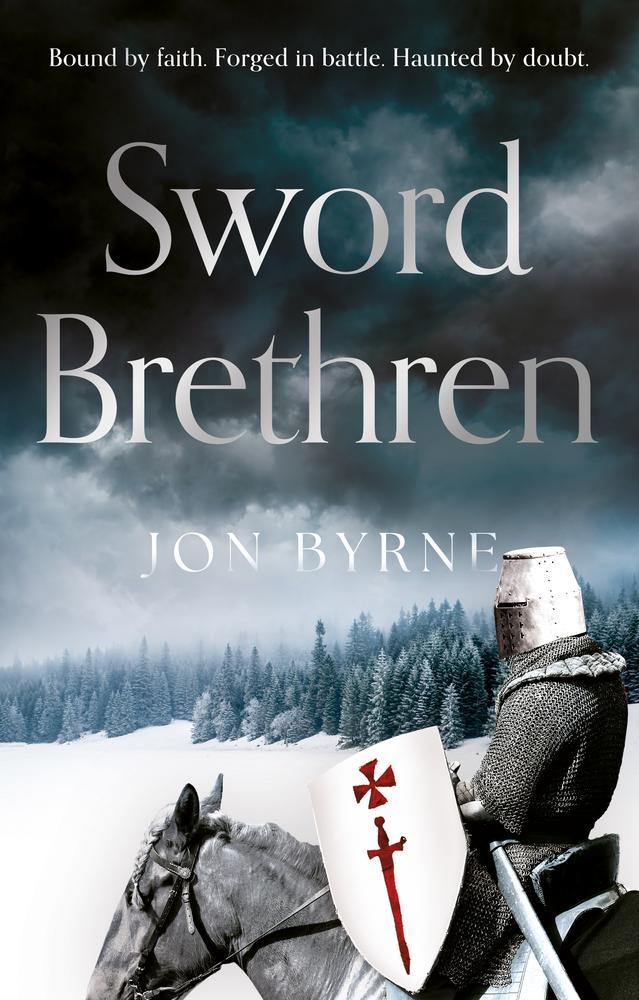
I’m delighted to welcome Jon Byrne and his book, Sword Brethren, The Northern Crusader Chronicles, to the blog with an excerpt.

Excerpt

Yuriev Monastery, Novgorod Republic, April-May 1242

We were already in disarray when the arrow slammed into my shoulder, punching through my mail coat and nearly felling me from my horse. Our charge across the ice had been peppered with missiles fired with deadly accuracy, and the freezing air was raucous with the screams of dying men and thrashing animals. I could still see the eyes of the mounted archer who had loosed the arrow widen in triumph. His face I would never forget. Was he a Mongol? For some reason it mattered to me. I had never fought these fierce people from the steppe, but their reputation and ferocity were well known. I was not even aware they had been part of the Novgorodian army. Whether this had affected the outcome of the battle, only God in all his wisdom knew. We had been so confident. Overconfident. Our defeat had been absolute.

I woke in a room with whitewashed walls. An old, bearded man, his craggy face not unkind, loomed over me, his fingers gentle as he probed my wound and changed my dressing. Nevertheless, despite his care, searing flames coursed through me with every touch of his parchment-dry fingers. When the burning finally subsided, I blinked my eyes open. Through tears, I saw a small picture on the opposite wall of a man with a halo around his head spearing a serpent. It must have been Saint George killing the dragon. The halo made him look more like an angel. The bearded man mumbled to himself in a soft voice as he worked, however the language was unfamiliar. It sounded Slavic, probably Russian. That could only mean I was a prisoner.

With any movement, shafts of fire shot through my body, an agony so great I thought I would pass out again. By Christ Almighty and all His Holy Saints, I just wanted it to stop. But, of course, it didn’t. It was unrelenting. Perhaps when I was younger, I would have borne it better. Who knows? At my venerable age, death should come as a welcome relief, and I almost felt ready to succumb to it – to give up my fight and drift into the hallowed afterlife. Almost, but not quite. I was not yet ready to die. There was still too much to be done. There was still my vengeance to be had. A vengeance that stretched back to my youth.

The room was cool, but at times I felt like a sizzling pig roasting on a spit. The old man put strips of damp cloth on my face, but it hardly helped. Only blessed unconsciousness relieved me of it. My body fought a desperate battle to survive.

It is strange that, despite everything, the gift of life is most precious when it is about to be taken away.

*

But survive I did. In the weeks following the battle, the fever gradually released its grip, and I could feel my strength slowly returning. I was still as feeble as a child, but my bearded nurse nodded his head and smiled encouragement as he spooned a watery cabbage soup through my cracked lips. Perhaps I would live after all.

Now, at least, I could sit up in bed, but any other movement still sent stabbing bolts of pain through my chest. I was too weak to get up, and one time the effort broke the healing scabs on my wound, causing me to sink back into the pit of sweat my cot had become. It was clear to me now that the bearded man was a monk, a monk of the heretical Greek Church, and I was in the infirmary of a monastery. Nevertheless, my skin crawled and itched with lice, my hair was filthy and unkempt, and there was nothing I could do about it. Outside, the bells of a church clang the times for prayer. Never in my life had I felt so helpless, unable to piss or shit without help from the bearded monk and one of his helpers, a pale-faced youth of no more than seventeen or eighteen winters.

I still did not know how long I had lain there, but one morning I received a visitor. Or, more accurately, two visitors. I had been dozing when the door banged open without warning and the bearded monk led in two men. The first was tall, at least my height, and I am taller than most, but younger – young enough to be my son. He had the athletic build of a warrior, and his angled face was framed by a shortly trimmed beard and sandy-brown, shoulder-length hair, plastered across his head with sweat as if he had just taken off a hat or helmet. He wore a red cloak edged with fur worn over his left shoulder, fastened with a gold clasp fashioned in the shape of the three-barred Greek cross on the right shoulder, and a blue brocade surcoat over a long-sleeved white shirt. On his feet were high, leather riding boots of obvious quality, although they were spattered with mud.

When he looked me in the eyes, I felt the power behind his gaze despite his youth. There was a harshness there, a cynical coldness strange in someone so young. He said something to the other man, who was older, of slight build, with long auburn hair tied back from the nape of his neck. This man was no warrior. He looked more like a scholar, and his chestnut-coloured, homespun tunic, although of good quality cotton, clearly denoted his lower rank. It was this man who spoke to me in Latin.

‘Prince Alexander Yaroslavich Nevsky of Novgorod the Great, welcomes you to Yuriev Monastery and hopes you are recovering from your wounds.’

His words slapped me in the face. Alexander Yaroslavich had commanded the Russian army in the battle on the ice where we had been defeated, as well as being victorious against the Swedish army two years earlier on the Neva River. My surprise must have been obvious because the young prince, Alexander, smiled at my reaction, speaking again quickly before waiting for his words to be translated.

‘You are one of six German knights captured in the battle,’ the interpreter continued, ‘but you were the most badly wounded. Prince Alexander says that under Brother Dimitri’s care and with God’s grace, you have made a vast improvement. But it is doubtful that at your age you shall ever be able to take up arms against his people again.’

‘How long have I lain here?’ I said in Latin. As a warrior monk of the Livonian Order, my Latin was respectable, though not as good as my Low German, or Norman French – the language of my birth.

‘The battle by Lake Chudskoe was over a month ago. You were carried here in a wain.’

A month already. I struggled to rise but the bearded monk who had tended me all this time, whom Prince Alexander had named as Brother Dimitri, came forward to restrain me. I collapsed back in a wave of dizziness. While I lay there panting, my weakness open to all, the three men spoke quickly to each other.

Here’s the Blurb

1242. After being wounded in the Battle on the Ice, Richard Fitz Simon becomes a prisoner of Prince Alexander Nevsky of Novgorod. Alexander, intrigued by his captive’s story, instructs his scholar to assist Richard in writing about his life.

Richard’s chronicle begins in 1203, when his training to be a knight is disrupted by treachery. He is forced to flee England for Lübeck, where he begins work for a greedy salt merchant. After an illicit love affair, his new life is thrown into turmoil, and he joins the Livonian Brothers of the Sword as they embark on imposing the will of God on the pagans of the eastern Baltic. Here, he must reconcile with his new life of prayer, danger and duty – despite his own religious doubts, with as many enemies within the fortified commandery as the wilderness outside. However, when their small outpost in Riga is threatened by a large pagan army, Richard is compelled to make a crucial decision and fight like never before.

Buy Link

Universal Link:

Meet the Author

Jon Byrne, originally from London, now lives with his German family by a lake in Bavaria with stunning views of the Alps. As well as writing, he works as a translator for a local IT company and occasionally as a lumberjack.

He has always been fascinated by history and has studied the Medieval world for over twenty years, building up a comprehensive library of books. In his research, he has travelled to all of the locations mentioned in the book (East Anglia, Bremen, Lübeck, Latvia, etc).

Sword Brethren (formerly Brothers of the Sword) made it to the shortlist of the Yeovil Literary Prize 2022 and the longlist of the prestigious Grindstone International Novel Prize 2022. It is the first book in The Northern Crusader Chronicles.

Connect with the Author

Follow the Sword Brethren blog tour with The Coffee Pot Book Club