
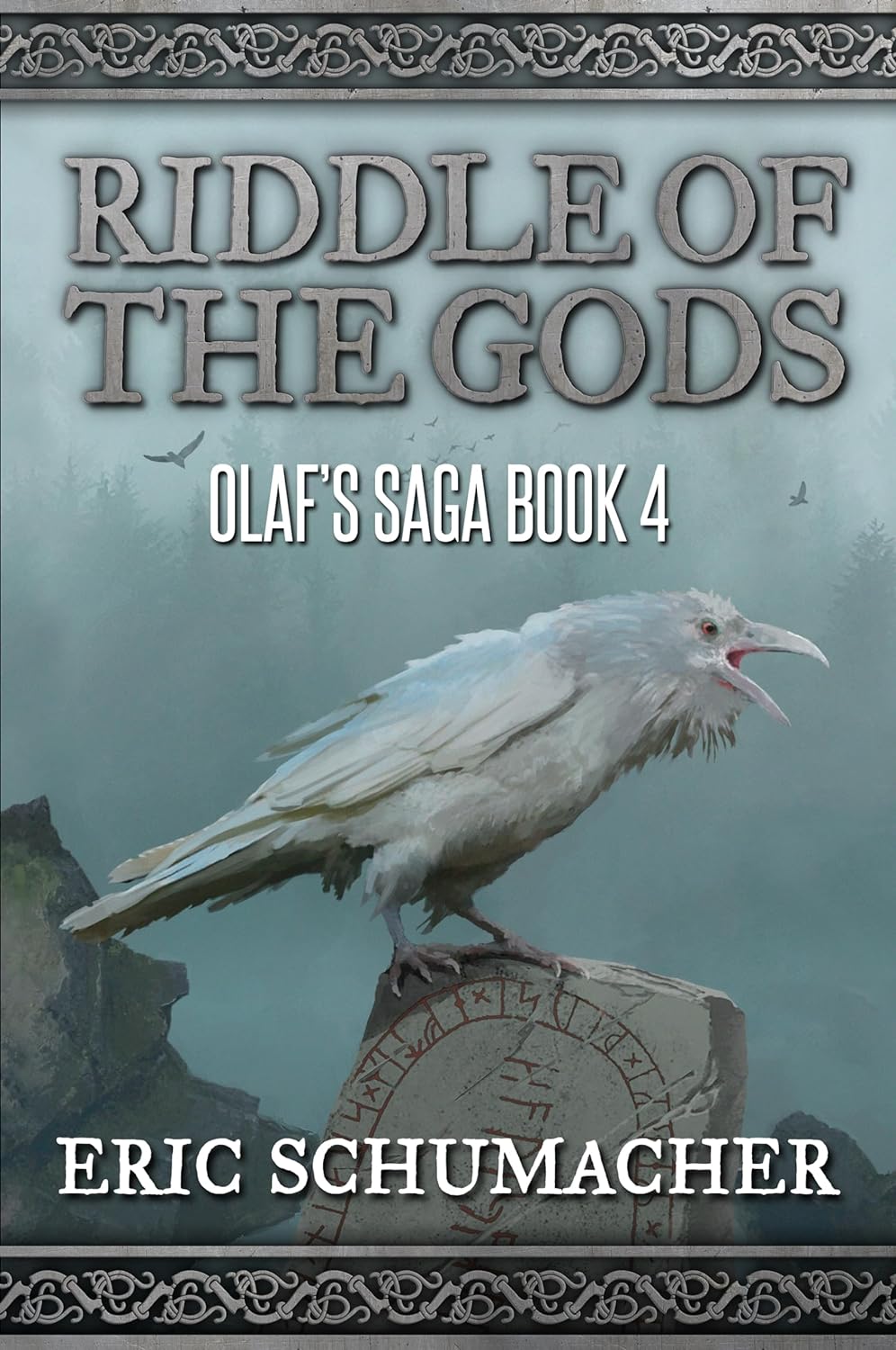
It’s release day for Eric Schumacher’s new book in Olaf’s Saga, Riddle of the Gods #bookreview #newrelease #historicalfiction

Here’s the blurb

Riddle of the Gods is the riveting fourth novel in the best-selling series chronicling the life and adventures of one of Norway’s most controversial kings, Olaf Tryggvason.

It is AD 976. Olaf Tryggvason, the renegade prince of Norway, has lost his beloved wife to a tragedy that turns the lords of the land he rules against him. With his family gone and his future uncertain, Olaf leaves his realm and embarks on a decades-long quest to discover his course in life.

Though his journey brings him power and wealth, it is not until he encounters the strange man in the streets of Dublin that his path to fame unfolds. And in that moment, he is forced to make a choice as the gods look on – a choice that could, at worst, destroy him and at best, ensure his name lives on forever.
Purchase Link

https://amzn.to/4akXbBf

My Review

Riddle of the Gods is the fourth book in the Olaf’s Saga series of novels detailing the life of the famous Olaf Tryggvason (the man whose name I can never spell correctly). Riddle of the Gods begins in Wagaria, where Olaf is married and expecting his first child, only for tragedy to strike. Deciding to jump ship rather than being forced out, Olaf leaves Wagaria and determines to change his future by taking up raiding.

Fast forward about six years, and Olaf and his warriors arrive in Ireland to continue their pursuit of wealth. While we hear little of Olaf’s life for the preceding six years, our narrator, Torgil, offers some insights into just how they’ve been growing their wealth. With it, we begin to realise that Olaf is perhaps not the hero we might expect him to be, taking part in enslaving people who fall foul of his blades, even though he was once enslaved himself.

Torgil is our narrator for Olaf’s tale, having once sworn an oath to Olaf’s father to protect a man he considers as his friend. But this friendship is tested as Olaf casts aside any belief that stands in his way of growing wealthy and powerful, and earning himself an enemy in the form of Torgil.

While Torgil returns to Dublin on Olaf’s remarriage, seemingly cast out by his powerful friend, Olaf continues to grow richer and more influential in northern England, although we only hear about this from Torgil’s old ship brothers. Olaf, it transpires, has no problem being less than honest with his fellow warriors, casting Torgil as a traitor when he’s not. The book’s final act follows Torgil as he understands just how far Olaf has fallen in his estimations but also how Olaf isn’t the only one to have put ambition above all else. There will be more to follow in continuing books.

Torgil is an engaging character, and his part in Olaf’s tale is that of an honourable friend pushed to the limits of his endurance. While the two don’t meet again in the final act of the book, it’s to be assumed that they will once more come into conflict with one another in subsequent stories. Olaf himself is a slippery character – knowing full well what lies in Olaf’s future – it’s intriguing to encounter him as a younger warrior, hellbent on achieving as much as he can no matter what.

Riddle of the Gods is sure to appeal to readers of the era and genre—and yes, it might be book 4 in a series—but like me, readers could pick up the tale here quite easily. It is an engaging and confident story that takes the reader from Wagaria to Norway to Ireland and England at the advent of the Second Viking Age.

Read more about the earlier books in the series.

Meet the author

Eric Schumacher discovered his love for writing and medieval European history at a very early age, as well as authors like J.R.R. Tolkien, C.S. Lewis, Bernard Cornwell, Jack Whyte, and Wilbur Smith. Those discoveries fueled his imagination and continue to influence the stories he tells. His first novel, God’s Hammer, was published in 2005.

You can follow Eric Schumacher on Amazon or by joining his newsletter at https://www.ericschumacher.net/readers-club.

Eric Schumacher is sharing some historical details for Sigurd’s Swords #blogtour #historicalresearch

Today I’m delighted to welcome Eric Schumacher to the blog with a fantastic post about his new book (available for preorder now) Sigurd’s Swords.

Your book, Sigurd’s Sword, is set in a time period I love, but I don’t know as much about events in the land of the Rus as I’d like, or about Olaf Tryggvason’s early years. As a historian first and foremost, and then a writer, I’m always interested in how people research their historical stories.

Can you explain your research process to me, and give an idea of the resources that you rely on the most (other than your imagination, of course) to bring your historical landscape to life? 

First of all, thank you for having me on your wonderful blog and for your interest in Sigurd’s Swords

My research isn’t as much of a process as it is a series of rabbit holes that I tend to climb down to gather information that I then convert to notes. I keep those notes in the writing program I use so that I can refer to them often as I write. That said, I often go back to the original sources for more information or for clarity. 

It is a bit tricky writing about Vikings, because they did not chronicle their events in writing. There’s was an oral culture. So what information we have comes from outside sources, and usually from sources who wrote their works decades or even centuries after the people lived and the events occurred. Thanks to the Byzantines, Sigurd’s Swords is the only book I have written that actually had a contemporary writer who chronicled some of the events in the book.

Do you have a ‘go’ to book/resource that you couldn’t write without having to hand, and if so, what is it (if you don’t mind sharing)?

Yes! I usually start in the same place for all of my books. That place is the sagas, and in particular, Snorre Sturlason’s Heimskringla, or “The Lives of the Norse Kings.” That provides me with the guardrails and the general outline of the story. However, Snorre wrote his series of tales centuries after my character Olaf lived, so I cannot rely on him 100% for the details of my books. Nor does he get into the minutiae that help add flavour and depth to the story, such as weaponry, fighting styles, flora and fauna, food and beverages, the types of dwellings that existed, and so on. For those things, I rely more on individual books or research papers I find online. 

In the case of Olaf and his time in Kievan Rus’, I also turned to other sources that I found. The Russian Primary Chronicle, to which I found a reference on Wikipedia, was a tremendous help. Like the Anglo-Saxon Chronicle, it is broken down by year, so it provided me with a better sense of the timing of events and what events my characters may have experienced during their time in that kingdom. That, in turn, led me to other sources for more detailed descriptions of those events. The Byznatines were a great help for this. Civil servant John Sylitzes wrote his “A Synopsis of Byzantine History” in AD 1081, which covered the Siege of Drastar I have in my novel. Leo the Deacon, who was at the siege, also wrote about it in his Historia. The foreign policy of the Byzantines is described in The Grand Strategy of the Byzantine Empire, and was also helpful to provide larger context for why certain events might have unfolded the way they did, such as the Siege of Kyiv in AD 968. Having these sources also provided a secondary verification of the timing of things. 

All that said, there was still much I could not unearth about the Rus or Olaf during that time. So I tried to fill in the gaps with plausible plotlines and information based on the research I could find. I hope it all comes together in an enjoyable story for your readers!

Thank you so much for sharing your research with me. It sounds fascinating, and I will have to hunt some of it down. Good luck with the new book.

Here’s the blurb;

From best-selling historical fiction novelist, Eric Schumacher, comes the second volume in Olaf’s Saga: the adrenaline-charged story of Olaf Tryggvason and his adventures in the kingdom of the Rus.

AD 968. It has been ten summers since the noble sons of the North, Olaf and Torgil, were driven from their homeland by the treachery of the Norse king, Harald Eriksson. Having then escaped the horrors of slavery in Estland, they now fight among the Rus in the company of Olaf’s uncle, Sigurd. 

It will be some of the bloodiest years in Rus history. The Grand Prince, Sviatoslav, is hungry for land, riches, and power, but his unending campaigns are leaving the corpses of thousands in their wakes. From the siege of Konugard to the battlefields of ancient Bulgaria, Olaf and Torgil struggle to stay alive in Sigurd’s Swords, the riveting sequel to Forged by Iron

Pre-order link

Meet the Author

Eric Schumacher (1968 – ) is an American historical novelist who currently resides in Santa Barbara, California, with his wife and two children. He was born and raised in Los Angeles and attended college at the University of San Diego.

At a very early age, Schumacher discovered his love for writing and medieval European history, as well as authors like J.R.R. Tolkien and C.S. Lewis. Those discoveries continue to fuel his imagination and influence the stories he tells. His first novel, God’s Hammer, was published in 2005.

Connect with Eric

Website:  Twitter

FacebookLinkedInBookBub:

Amazon Author PageGoodreads:

Don’t forget to check out the other stops on the Sigurd’s Swords blog tour with The Coffee Pot Book Club.