With Clash of Kings being released on 13th January 2024, I thought I’d reintroduce my readers to the main characters.
Here’s Edmund, ætheling and Prince of the English.
Edmund, of the House of Wessex, is the second-youngest halfbrother of the king of the English, Athelstan. His date of birth is not known for sure, but it’s believed to have been in about 921, as he’s said to have been 18 when he became king on Athelstan’s death. His mother is Lady Eadgifu, the third wife of Edward the Elder. He has a full brother, Eadred, even younger than him, and a sister who may have been older than him, and who became a cloistered woman.
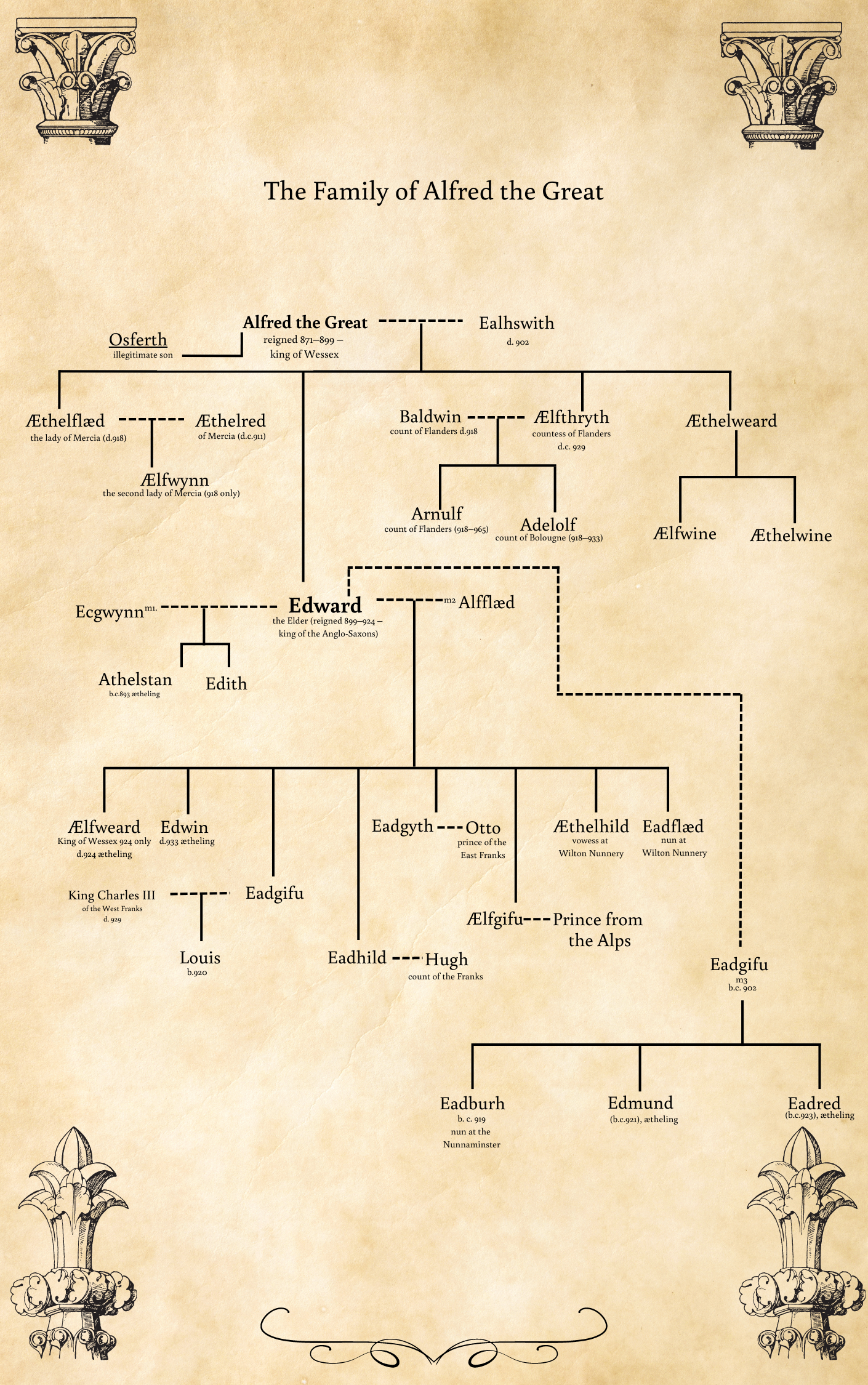
Family tree by Boldwood Books
‘And the Ætheling succeeded to the kingdom; and he was then 18 years old.’ (ASC A)
Edmund would only have been very young when his father, Edward the Elder, died in 924. It’s doubtful whether he had any memory of him at all. It’s long been believed that his mother, Lady Eadgifu, was responsible for raising him and his younger brother. What precisely Edmund was doing during the reign of his older half-brother isn’t known for sure. He is said to have fought beside him at the Battle of Brunanburh, but some historians cast doubt on this.
As a character in Kings of War and Clash of Kings, Edmund has become a man throughout the previous books, and developed a close relationship with Athelstan. But, he’s still young. He’s riven with indecision, and while delighted to have been involved in the success of the battle of Brunanburh, he’s happy to let his older brother rule England. There is also an on-going thread which pitches Edmund against the family of Constantin, the king of the Scots. Events in Clash of Kings will have a profound effect on young Edmund.
There are a few new characters in Kings of War, the sequel to King of Kings. Here I’ll explain who the historical individuals probably were, and what’s known about them, if anything. That said, Edmund did feature in King of Kings, but I’ve not shared his information before.
Edmund, of the House of Wessex, is the second-youngest halfbrother of the king, Athelstan. His date of birth is not known for sure, but it’s believed to have been in about 921, as he’s said to have been 18 when he became king on Athelstan’s death. His mother is Lady Eadgifu, the third wife of Edward the Elder. He has a full brother, Eadred, even younger than him.
Family tree by Boldwood Books
‘And the Ætheling succeeded to the kingdom; and he was then 18 years old.’ (ASC A)
Edmund would only have been very young when his father, Edward the Elder, died in 924. It’s doubtful whether he had any memory of him at all. It’s long been believed that his mother, Lady Eadgifu, was responsible for raising him and his younger brother. What precisely Edmund was doing during the reign of his older half-brother isn’t known for sure. He is said to have fought beside him at the Battle of Brunanburh, but some cast doubt on this.
What is known is that Edmund had a sister (possibly two) and his sister, Eadburh, c.919-952, became a nun and was regarded as a saint.
William of Malmesbury in his Gesta Pontificum Anglorum tells the story of Edmund’s sister, Eadburh,[i] being consigned to the Nunnaminster in infancy as she showed such signs of devotion.[ii]
‘There had been a convent on this spot before, in which Eadburg, daughter of king Edward the Elder, had lived and died, but by then it was almost in ruins. When she was barely three, Eadburg had given a remarkable proof of her future holiness. Her father had wanted to find out whether his little girl would turn towards God or the world. He set out in the dining room the adornments of the different ways of life, on this side a chalice and the Gospels, on the other bangles and necklaces. The little girl was brought in by the nurse and sat on her father’s knees. He told her to choose which she wanted. With a fierce look she spat out the things of the world, and immediately crawling on hands and knees towards the Gospels and chalice adored them in girlish innocence…Her father honoured his offspring with more restrained kisses and said, ‘Go where heaven calls you, follow the bridegroom you have chosen and a blessing be upon your going.’…Countless miracles during her life and after her death bear witness to the devotion of her heart and the integrity of her body.’[iii]
William later adds that, ‘Some of the bones of Eadburg the happy are buried,’[iv] at Pershore.
Aside from the later William of Malmesbury (who wrote long after the Norman Conquest of 1066), Eadburh is the recipient of land in one charter, that of S446, dated to 939 and surviving in one manuscript. ‘King Athelstan to Eadburh, his sister; grant of 17 hides (mansae) at Droxford, Hants.’[v] Other that, nothing is known of Eadburh with any certainty.
I won’t share more details of Edmund just yet as he has an important part to play in the Brunanburh Series.
You can read King of Kings for FREE for a very limited time on Amazon, Kobo and Apple Books in the UK, US, Australia and Canada. (3rd-10th July ’23)
[ii] Foot, S Athelstan (Yale University Press, 2011), p.45 Priest, D trans, Gesta Pontificum Anglorum, The Deeds of the Bishops of England, (The Boydell Press, 2002)
[iii] Priest, D trans, Gesta Pontificum Anglorum, The Deeds of the Bishops of England, (The Boydell Press, 2002), pp115-6
[iv] Priest, D trans, Gesta Pontificum Anglorum, The Deeds of the Bishops of England, (The Boydell Press, 2002), p.202
[v] Sawyer, P. H. (Ed.), Anglo-Saxon charters: An annotated list and bibliography, rev. Kelly, S. E., Rushforth, R., (2022). http://www.esawyer.org.uk/ S446




 MJ Porter