

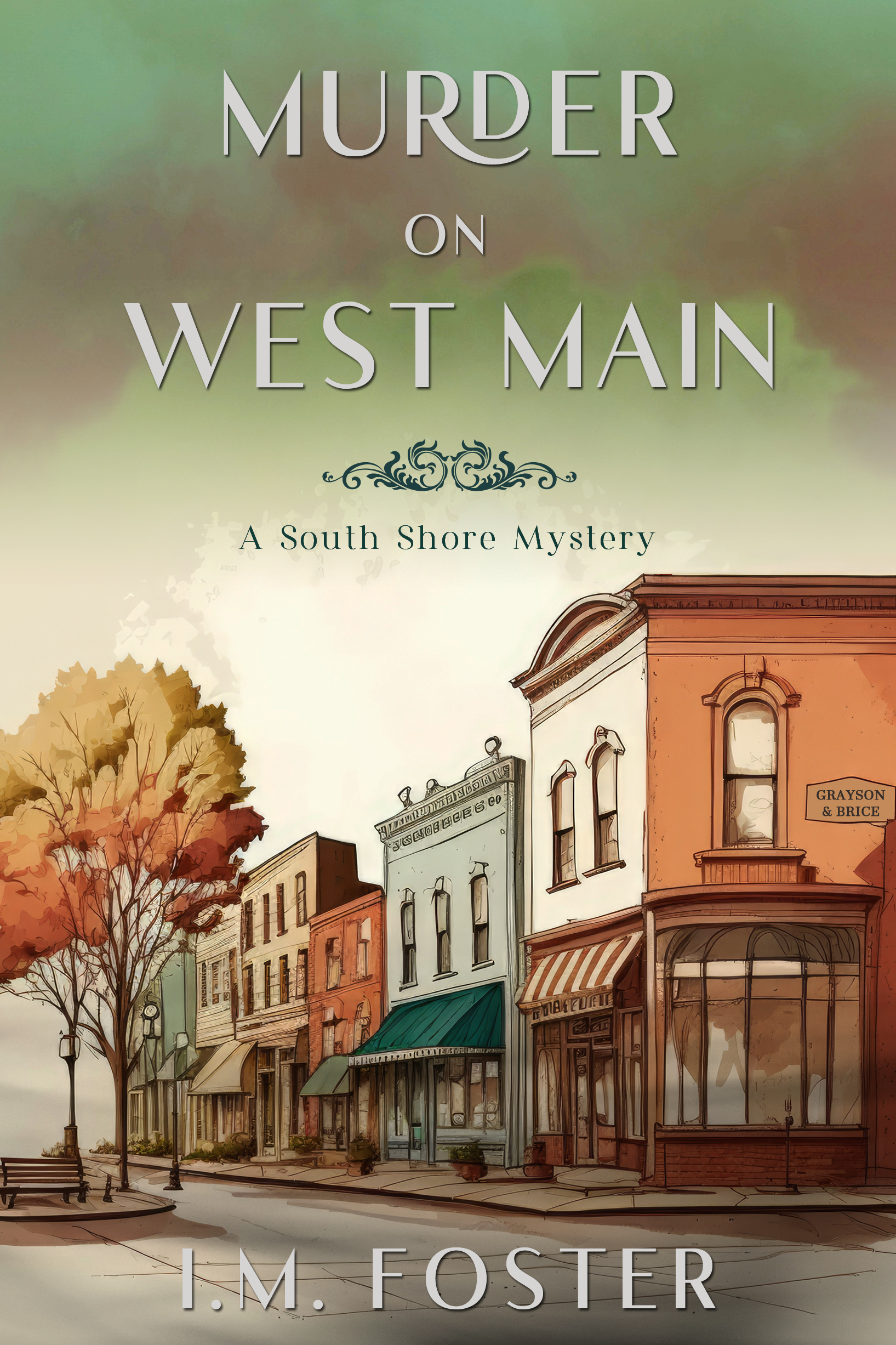
I’m delighted to welcome I.M. Foster and her new book, Murder on West Main, to the blog with a snippet.
Snippet
A knot tightened in his stomach, for it wasn’t like her to seek him out in this manner.
Here’s the blurb
When Colin Brissedon arrives at work one summer morning to find his new boss murdered, all eyes turn to him. After all, the man had threatened to fire him just a few days before, and his colleagues are more than happy to tell the tale. Kathleen admits her brother is no angel, but she can’t believe he would sink this low. Fortunately for them, neither does Daniel O’Halleran, the village’s new coroner’s assistant. Of course, he needs more than his gut feeling to prove it.
But that’s not going to be an easy task, considering the victim does not appear to have been held in high regard. In fact, Daniel is hard-pressed to find anyone who did like him, though there are more than a few who had reason to wish the man dead. To make matters worse, Kathleen is intent on conducting her own investigation despite his wishes, and he fears the consequences could be deadly.
And yet, with the pieces of the puzzle laid before him, he can’t shake the feeling that something is missing, an integral clue that will tie everything else together. Will Daniel be able to find the elusive detail and discover the reason behind the gruesome murder of the prominent attorney? Or will the guilty party live to kill again?
I. M. Foster is the pen name author Inez Foster uses to write her South Shore Mystery series, set on Edwardian Long Island. Inez also writes historical romances under the pseudonym Andrea Matthews, and has so far published two series in that genre: the Thunder on the Moor series, a time-travel romance set on the 16th century Anglo-Scottish Borders, and the Cross of Ciaran series, which follows the adventures of a fifth century Celt who finds himself in love with a twentieth century archaeologist.
Inez is a historian and librarian, who love to read and write and search around for her roots, genealogically speaking. She has a BA in History and an MLS in Library Science and enjoys the research almost as much as she does writing the story. In fact, many of her ideas come to her while doing casual research or digging into her family history. Inez is a member of the Long Island Romance Writers, and the Historical Novel Society.
I’m delighted to welcome back David Fitz-Gerald and his new book, Rolling Home from the Ghosts Along the Oregon Trail series, to the blog with a series trailer.
Ghosts Along the Oregon Trail Series Trailer
Here’s the blurb
Climb aboard! Don’t miss the heart-pounding climax of the Ghosts Along the Oregon Trail series. Rolling Home is the final installment.
In the heart of the rolling village, dissent brews as the stubbornest naysayer refuses to continue the journey. With an ominous early snowfall and memories of the ill-fated Donner Party haunting the pioneers, Dorcas Moon faces a new wave of challenges. Just when she believes things can’t get worse, a disastrous river crossing claims their wagon and submerges their belongings.
As the rolling village approaches the final leg of the journey, the looming threat of outlaws intensifies. The notorious bandit known as The Viper and his ruthless brothers are determined to rob the greenhorns, sell their stock, and kill every last one of them. The pioneers had heard tales of their brutality, but now, with Dorcas’ daughter kidnapped and Dorcas captured, everyone is in danger.
What will become of Dorcas Moon, her family, and their friends? Will anyone survive the perilous journey?
Rejoin the expedition and witness the thrilling end to a gripping saga.
This title is available to read on #KindleUnlimited
Meet the author
David Fitz-Gerald writes westerns and historical fiction. He is the author of twelve books, including the brand-new series, Ghosts Along the Oregon Trail set in 1850. Dave is a multiple Laramie Award, first place, best in category winner; a Blue Ribbon Chanticleerian; a member of Western Writers of America; and a member of the Historical Novel Society.
Alpine landscapes and flashy horses always catch Dave’s eye and turn his head. He is also an Adirondack 46-er, which means that he has hiked to the summit of the range’s highest peaks. As a mountaineer, he’s happiest at an elevation of over four thousand feet above sea level.
Dave is a lifelong fan of western fiction, landscapes, movies, and music. It should be no surprise that Dave delights in placing memorable characters on treacherous trails, mountain tops, and on the backs of wild horses.
I’m delighted to welcome Richard Buxton and his trilogy, the Shire’s Union Trilogy, to the blog with a series trailer.
Shire’s Union Trilogy Series Trailer
Tigers in Blue – Excerpt
Giles County, Tennessee – November 1864
Their train stopped again. The three of them disembarked and walked beyond the engine. It had pulled up a handful of crossties before a fire-blackened and wounded trestle bridge that spanned a deep and wide ravine. There must have been three hundred men or more working on the repairs. They swarmed over the bridge, a busy blue infestation, some out along the incomplete top span, others either end of a crane carried on a flatbed railcar, many more perilously among the posts and cross-struts. Men struggled to shout instructions over a chorus of hammer and saw. Way down in the ravine and across a swift creek stood a clump of engineer officers. One held a sheet of paper so big he looked in danger of being lifted into the air. Others pointed and gestured up at the bridge. As Shire watched, a steam winch puffed into action on the crane-car and a thick trestle rose and swayed up from below like a miracle, before being claimed by many hands and dragged into the great puzzle of wood. Despite their industry, the nearer half of the bridge was missing the top forty feet.
The engine driver came and stood beside them, wiping sooty hands on a dirty rag. Rice, greasy hair pushed back off his forehead, asked, ‘If you knew the bridge was broke, why did you set out? We’ll be stuck for days.’
The driver took his time surveying the works. ‘Well,’ he said, ‘you’re welcome to climb down and up the other side, but any trains that happen along from Nashville will only queue up to go south. Watch a while.’ He turned to walk back to his engine. ‘These people will have us over before nightfall.’
With nothing to do but wait, Shire and Tuck left Rice at the engine and worked their way along the top of the ravine to a spot where they could watch the repair. The ground fell steeply away before them. Predictably, Tuck dropped his pack, took up his fiddle and sat. He hadn’t said a word today. A stiff breeze struck up under a gray sky. At least they had the car to retreat to if it came on to rain. Shire got out his dog-eared map of Tennessee and Kentucky and unfolded it carefully so as not to bring on further dishevelment. He found Pulaski and traced the rail line to Nashville via Columbia. Short of Franklin he found Spring Hill. They would pass right by. Clara had been full of dubious enthusiasm for her move when he’d left her. What would have changed since? He wouldn’t need the train to stop again to be certain how he felt. That question had always been for her, though he wondered if she’d answered it quietly to herself a long time ago.
He folded his map away and got busy with a fire. In the army it paid to eat when the opportunity presented itself. ‘I’ll cook your pork. We ate mine yesterday,’ he said. They often shared rations. That way if one of them got a runt portion the hardship was shared too.
There was no response from Tuck. Sometimes it was like living with an elderly relative whose mind had been misplaced. In his own time, Tuck bowed into a slow waltz, utterly at odds with the exertions of the bridge builders. Evidently, it carried on the wind into the ravine and on to those high on the bridge, as not a few faces turned their way. There was a moment’s lull in the hammering before it stuttered up again. Two men on the flatbed end of the crane-car moved elegantly into closed hold and took a turn or two before their corporal beat them apart with his hat. Shire smiled but saw Tuck was too far inside his tune to take it in.
Once he had the fire going, he dug in Tuck’s pack for the salt belly-pork they’d been doled out back in Athens. It was a mess in there. An apple long past saving, percussion caps loose that should have been in a box, a lone dollar bill left to its own devices. The string hadn’t been tied properly on the pork paper. The exposed meat had picked up a covering of cotton threads and other miniature detritus. Shire reasoned it would cook off in his small skillet. Tuck’s ration was more than ample, so he cut off two-thirds and put it to cook slowly, not too close to the heat so that the fat would stay aboard. He wrapped the remains with care and was finding a safe corner back in Tuck’s pack when he happened on something round and hard. He drew out an enamel doorknob.
He recognized it. Tuck kept it as a grim reminder of his parents who were burned alive in their farmhouse, Tuck’s home. The enamel was scorched on one side, a smooth, mute witness to their murders. He’d been about to look for some wild onion or anything that might flavor the meat, but instead he took the doorknob and went to sit next to Tuck.
He didn’t expect to be acknowledged, but the lack irked Shire all the same. The waltz looped around and around. Shire could have sworn some of the hammering was striking out one, two, three… one, two, three. ‘I think you’re slowing down their industry,’ he said. Tuck played on. Shire felt a bubble of anger pop inside.
Blurb
Shire leaves his home and his life in Victorian England for the sake of a childhood promise, a promise that pulls him into the bleeding heart of the American Civil War. Lost in the bloody battlefields of the West, he discovers a second home for his loyalty.
Clara believes she has escaped from a predictable future of obligation and privilege, but her new life in the Appalachian Hills of Tennessee is decaying around her. In the mansion of Comrie, long hidden secrets are being slowly exhumed by a war that creeps ever closer.
The Shire’s Union trilogy is at once an outsider’s odyssey through the battle for Tennessee, a touching story of impossible love, and a portrait of America at war with itself. Self-interest and conflict, betrayal and passion, all fuse into a fateful climax.
Written by award winning author Richard Buxton, the Shire’s Union trilogy begins with Whirligig, is continued in The Copper Road, and concludes with Tigers in Blue.
Richard lives with his family in the South Downs, Sussex, England. He completed an MA in Creative Writing at Chichester University in 2014. He has an abiding relationship with America, having studied at Syracuse University, New York State, in the late eighties. He travels extensively for research, especially in Tennessee, Georgia and Ohio, and is rarely happier than when setting off from a motel to spend the day wandering a battlefield or imagining the past close beside the churning wheel of a paddle steamer.
Richard’s short stories have won the Exeter Story Prize, the Bedford International Writing Competition and the Nivalis Short Story Award. His first novel, Whirligig (2017) was shortlisted for the Rubery International Book Award. It was followed by The Copper Road (2020) and the Shire’s Union trilogy was completed by Tigers in Blue (2023). To learn more about Richard’s writing visit www.richardbuxton.net.
I’m delighted to welcome Nancy Jardine and her new book, Novice Threads from the Silver Sampler Series, to the blog with Growing Up Brings More Questions Than Answers.
Growing Up Brings More Questions Than Answers
September 1850
“What do you need help with, Father?” Margaret asked on her return from assisting Granny Maggie to bake a batch of fruit pies, the apple harvest having been plentiful as had the plums in the little strip of garden behind her granny’s house.
“I’m not sure you’ll be so keen in a minute, lass.” Her father’s expression was a little bit whimsical and lit up his unusually bright grey eyes. It was a sight to see replacing the usual serious and sombre. “However, you can help me tidy some shelves later on.”
She had been expecting to spend the rest of the day doing shop chores, since it was still September and her new school session was not due to restart before mid-October. She’d attended a smattering of classes during July and August, though the bulk of of Mister Anderson’s summer teaching time was being spent with his most senior pupils who were learning Latin and Greek.
The smile she sent her father’s way was a puzzled one.
“I’m not sure I understand you.”
William leant closer, still teasing her with a whisper. “You have another letter.”
She flew along the passage and opened the kitchen door so quickly it startled her mother who was placing a pot of soup to heat on the range.
“I’ve another letter from Jessie?”
“That you have. It’s here on the table.”
Snatching it into her eager fingers, Margaret first savoured the writing on the front.
“Look, at how carefully she’s written my name,” she cried.
Her mother glanced at the letter. “She’s still making mistakes, though. Our shop name has been written twice.”
Margaret was undaunted. “I couldn’t have written an address if I had never had writing lessons from Mister Anderson. Would you have had the courage to try if you were in Jessie’s shoes?”
To her relief, Peggy didn’t take offence. “No, I suppose not. Your father needed me to compose and address our shop correspondence so I learned quickly to produce a good standard.”
Opening the seal, Margaret wandered around the room as she read.
“Jessie’s handwriting is much less scratchy, this time. I can read it more easily.”
“That’s good,” Peggy said. “I wonder how she’s managing to practise?”
Margaret agreed that was a very good question. It looked as though someone might be helping Jessie.
“Oh, my!” she declared, her tone making her mother lay down her sharp knife.
“What’s wrong?”
“Not wrong exactly. Jessie says the family she’s been sent to are related to the minister of the Free Kirk here in Milnathort.”
“That’s interesting,” Peggy declared, something odd lighting up her expression.
“I think Jessie means that it’s the Reverend Leslie Duncan’s brother, a man named Stewart, that she’s working for?” She handed the letter over to Peggy to help her understand it.
“Yes, that seems to be what she’s writing. And that it’s a very big house.” Peggy looked as puzzled as Margaret felt. “Now, I wonder why Jessie was sent there?”
Her grin was an excited one. “Isn’t she lucky to have got the work there?”
Peggy lifted the bread knife to slice a fresh loaf for their mid-day meal. “Well, until Jessie is able to tell you more, you’ll just have to assume that she’s found her feet.”
“What?” She questioned the now doubtful look on her mother’s face.
“Jessie doesn’t yet say if there are a lot of servants. If it’s a very big house then I hope she’s one of many servants, and not being expected to do too much on her own.”
“Oh!” Margaret hadn’t thought of that, just imagining that it must be fun to work in the big city of Edinburgh. She’d been thinking that it was a privilege for Jessie to work there, in the same way that it had been a privilege for Jessie to get some basic schooling in Milnathort paid for by her mystery benefactor – though now she wasn’t so sure. It was a pity to be so undecided, because having a benefactor had sounded special.
“Have you ever heard of the Reverend Duncan organising anything like this for other girls in Milnathort?” she asked Peggy.
Her mother shook her head. “Not until now, but who knows what that man’s likely to do?”
“What do you mean?” Margaret was puzzled.
“Never you mind. There’s always gossip enough in Milnathort, and I for one will not be adding to it. You just be careful who you tell about Jessie’s good fortune.”
Margaret realised her mother had grown quite serious, though she was happy to keep her knowledge of Jessie’s plight a secret. Apart from herself, Jessie hadn’t made other proper friends in Milnathort.
“And if Mistress Byers asks if you’ve heard anything from Jessie, you just tell her that all you know is that she arrived safely and is working. Nothing about where her job is. Mind my words! Since your father moved us all to the United Presbyterian Church, I never hear anything about the Free Kirk anyway, and that’s how I want it to stay!”
Margaret knew there was never a time to share any of her memories of Mistress Morison’s gripes. She could almost hear the old woman mouthing the words ‘That Free Kirk Reverend ought to have known better. The man should have left Ruth’s skirts well alone. That one mistake was bad enough but more were unforgiveable.’ Margaret couldn’t stop those memories from surfacing every now and then, but she’d vowed to keep them secret forever– for Jessie’s sake.
Now that she was older, she’d a better inkling of what Mistress Morison’s grumbles might have meant. Men chasing skirts she now knew often led to surprise babies being born, but exactly how they were produced was for her to learn another day.
It was confusing. Many of her conclusions were very disheartening.
Blurb
A thirst for education. Shattered dreams. Fragile relations.
1840s Scotland
Being sent to school is the most exhilarating thing that’s ever happened to young Margaret Law. She sharpens her newly-acquired education on her best friend, Jessie Morison, till Jessie is spirited away to become a scullery maid. But how can Margaret fulfil her visions of becoming a schoolteacher when her parents’ tailoring and drapery business suddenly collapses and she must find a job?
Salvation from domestic drudgery – or never-ending seamstress work – comes via Jessie whose employer seeks a tutor for his daughter. Free time exploring Edinburgh with Jessie is great fun, but increasing tension in the household claws at Margaret’s nerves.
Margaret also worries about her parents’ estrangement, and the mystery of Jessie’s unknown father.
When tragedy befalls the household in Edinburgh, Margaret must forge a new pathway for the future – though where will that be?
This title is available to read on #KindleUnlimited
Meet the Author
Nancy writes historical and contemporary fiction. 1st Century Roman Britain is the setting of her Celtic Fervour Series. Victorian and Edwardian history has sneaked into two of her ancestry-based contemporary mysteries, and her current Silver Sampler Series is set in Victorian Scotland.
Her novels have achieved Finalist status in UK book competitions (People’s Book Prize; Scottish Association of Writers) and have received prestigious Online Book Awards.
Published with Ocelot Press, writing memberships include – Historical Novel Society; Romantic Novelists Association; Scottish Association of Writers; Federation of Writers Scotland; Alliance of Independent Authors.
I’m delighted to welcome Bonnie Suchman and her new book, Stumbling Stones, to the blog with an excerpt.
Excerpt 2
The weekend following the incident at the Westend Synagogue was the opening weekend of the summer season for the Frankfurt bath resorts. Frankfurt had a number of public bath resorts along the Main River, but the Heppenheimer family had always gone to the Nierderrad Licht- und Luftbad (Light and Air Bath). Located on a peninsula in the Main River, the bath had a sand beach, a river pool, and a café. When Alice was a child, the facilities were rather primitive. But while she was living in Nuremberg, the city had added changing rooms and showers. And while the consumption of alcohol was forbidden through the 1920s, the café began serving wine and beer in 1933. After Alice returned to Frankfurt, one of her favorite activities in the summer was to spend an entire Sunday at the Nierderrad bath, swimming in the pool and enjoying the afternoon with family or friends.
Unfortunately for Frankfurt’s Jews, the enactment of the Nuremberg Laws impacted this coveted summer leisure activity. While Jews could frequent any of the public baths before those laws were passed, beginning in the summer of 1937, Jews in Frankfurt could only visit the Nierderrad Light and Air Bath. Asit turned out, this was one of the few new directives that did not affect Alice, since she had always gone to the Nierderrad Bath. And that was Alice’s plan for the first Sunday the bath was open.
Alice woke early that Sunday morning and was just too excited to remain in bed. She began packing the wicker basket with enough food for lunch and an afternoon snack, taking her time as she made the sandwiches. Alfred and Alice had planned to pick up Selma and Emma around 10 am, and the four of them would take the tram to the bath. Fortunately for Alice, Leo would not be joining them – he claimed it would be too hot for him. After she finished preparing all of the food for the day, Alice still had an hour before they needed to leave, and so sat down with a cup of coffee and read yesterday’s paper. Alice didn’t mind the wait — it was nice to just sit and not have to work.
Just before 10 am, Alice and Alfred left the apartment and walked to Selma’s apartment. Of course, when they arrived, Emma was not even close to being ready. But Alice expected that her mother would be late and joined her sister in the kitchen. Selma inspected the food basket, made a face at Alice, and then replaced much of what Alice had packed with food she had prepared. Alice laughed, but did not object. When Emma was finally ready, the four left the apartment and walked to the tram stop. As they boarded the tram, they could see others carrying baskets for a day at the bath. As they continued the ride, Alice could see the car filling with more and more Jews taking the tram to the Niederrad Bath. Alice thought to herself, regardless of all the other challenges in their lives, today, Frankfurt’s Jews were going to enjoy a day in the sun. That was certainly the case for Alice.
The tram stopped just outside the gates of the bath, and virtually everyone exited the tram. They all walked up to the ticket booth to pay the small admission fee. The Jewish community had been forced to lease the bath from the city for the 1937 summer season, and the fee was intended to cover the cost of the lease. After entering the facilities, the ladies went to the right and Alfred went to the left to change into their bathing suits. After they finished changing, Alfred rented four chairs and an umbrella and then the four found a place to settle for the day.
Alice and Selma had taken swimming lessons as children and both immediately went into the pool to swim. Emma did not like the water, but enjoyed watching her daughters swim. Alfred was afraid of the water, but was happy to sit in a chair and read his book. He also enjoyed talking to his mother-in-law. Emma had been raised by a religious scholar and Alfred had attended an orthodox yeshiva. Alfred was no longer religious, but Emma still attended services when she could and liked to discuss the week’s Torah portion with Alfred when they were together. Emma’s scholarly father believed it was important for all of his children to receive a Jewish education, and Emma was happy to share that knowledge in conversations with her son-in-law. At some point, Alice stopped swimming and looked over at her mother and Alfred. It was clear they were arguing over some point and having fun. Without having to worry about whether Alice or Selma would be bored by the conversation, the two could enjoy challenging each other with various arguments, which they were clearly doing. But it was always in good fun, and neither ever left the discussion with bruised egos, so Alice went back to her swim.
Around noon, Alice opened the food basket. Alfred had already walked to the café for cold drinks. The sun was strong, but the breeze from the river kept everyone comfortable as they ate their lunch. After lunch, Alice decided to take a nap, and was soon sound asleep. Deep into a dream, Alice could hear her name and woke with a start. She stared at Alfred.
“What’s wrong? What’s happened?”
Alfred smiled at her. “Nothing has happened. I am sorry I startled you. They are about to start the boat races and I thought you would want to watch.”
Alice took a deep breath to calm herself. “I was dreaming that you were being chased by Nazis and then I heard you call my name in the dream. I thought something bad had happened. But it was just a dream. Yes, let’s go watch the races. Where are Selma and Mama?”
“Your mom was getting a bit warm, so Selma took her to the café for a cold coffee.”
The Jewish sports club Schild was on the peninsula next to the Nierderrad bath and had built a boathouse in the 1920s. Following the restriction on Jewish participation in all sporting events, Schild invited other Jewish boat clubs to store their boats at the boathouse and then organized rowing races to run through the summer. The first rowing race was about to start when Alice and Alfred reached the shoreline. There were so many people there to watch the race that Alice and Alfred had trouble seeing the river. Six boats were in the water and then the gun went off to start the race. People started to cheer for their team and Alice and Alfred soon found themselves cheering for Schild. The race lasted about a minute and Schild was victorious. Alice and Alfred hugged each other and then hugged others who had been cheering for Schild.
There were several other boat races, but Alice and Alfred decided to take a walk instead along the path that followed the water. Others were also walking along the path, and Alice and Alfred stopped to chat with several people they knew. Alfred noticed someone selling ices and bought them both ices. They reached their chairs as they were finishing their ices. Selma was reading and Emma was napping.
“Welcome back. How were the races?”
“We only watched the first race. Schild won, which was pretty exciting. Then Alfred and I took a walk along the water. How is Mama doing?”
“I think Mama might be ready to leave.”
“I am also ready to leave. Let’s pack up everything and then we can wake Mama. We can all change in the changing rooms and then head home.”
By the time they left the bath, it was nearly 3 pm. The tram arrived almost immediately after they reached the stop, and it soon filled with other Jews, exhausted from their day at Niederrad Bath. Alfred found a seat for Emma and Selma, but he and Alice were forced to stand. That was okay, Alice thought. The ride would be relatively quick. As the tram started to empty of bathers, Alice could hear several teenage boys in the back bothering an elderly Jewish couple.
Alfred looked at Alice and shook his head. “Alice, say nothing. Just look to the front of the tram. Out stop is next.”
As soon as the tram stopped, Alice and Selma helped up their mother and the four quickly left the tram. I hope that couple is okay, Alice thought to herself. But she knew it would not have helped them if she had tried to intervene. What could she or Alfred have been able to do? They actually could have made things worse. She tried not to think about the couple as they walked her sister and mother home.
Alice was singing to herself as she prepared dinner that evening. Nothing fancy, just a cold soup and a cold chicken salad. She could hear Alfred enter the kitchen. Her hugged her from behind and kissed the back of her neck.
“Well, someone is in a particularly good mood.”
“I am. It was just a really nice day. The weather was perfect and it was nice not to have to worry about being hassled by people that hate you. The only bad thing that happened to me today was that my shoulders got a little too much sun. But being there today makes me think maybe we can wait out this craziness. Maybe if the Nazis gave us our own space to live, we could be okay.”
“I know what you mean about feeling safe in a place. It was really nice to be in a place where it was okay to be Jewish. But that was only because the Nazi won’t let Jews visit the other baths.
And we are not safe even in places that are just for Jews. Remember what happened last week at the concert in the synagogue? Today was just a respite from reality. We will never be truly safe as long as we are in Germany. And I believe it will only get worse. We need to leave as soon as we can.”
“I agree. Still, it was nice to feel totally safe, at least for a few hours. Hopefully, we will feel that all the time once we are in America.”
Heres the blurb
“Alice knew that Selma sometimes felt judged by their mother and didn’t always like it when Alice was praised and Selma was not. Alice glanced over at her sister, but Selma was smiling at Alice. In what Alice understood might be Selma’s last act of generosity towards her sister, Selma was going to let Alice bask in the glow of Emma’s pride toward her elder daughter. Then the three shared a hug, a hug that seemed to last forever.”
Alice Heppenheimer, born into a prosperous German Jewish family around the turn of the twentieth century, comes of age at a time of growing opportunities for women.
So, when she turns 21 years old, she convinces her strict family to allow her to attend art school, and then pursues a career in women’s fashion. Alice prospers in her career and settles into married life, but she could not anticipate a Nazi Germany, where simply being Jewish has become an existential threat. Stumbling Stones is a novel based on the true story of a woman driven to achieve at a time of persecution and hatred, and who is reluctant to leave the only home she has ever known.
But as strong and resilient as Alice is, she now faces the ultimate challenge – will she and her husband be able to escape Nazi Germany or have they waited too long to leave?
Bonnie Suchman is an attorney who has been practicing law for forty years. Using her legal skills, she researched her husband’s family’s 250-year history in Germany, and published a non-fiction book about the family, Broken Promises: The Story of a Jewish Family in Germany. Bonnie found one member of the family, Alice Heppenheimer, particularly compelling. Stumbling Stones tells Alice’s story. Bonnie has two adult children and lives in Maryland with her husband, Bruce.
In which Lionel—still hurting after having been told everything he though he knew about his parentage is a lie—and Noor reconcile
Noor had only visited the huge abbey church once before. As she recalled, it had been full of pilgrims and clerics, the sour scent of sweat and grime mingling with that of incense. She’d been too uncomfortable by the press of people to truly take in the magnificence of this huge space consecrated to God, but today, as she followed Father Alain in, the church was relatively empty. It was an hour or so after prime, and she was out of breath after hurrying after the priest, who’d appeared at their little inn, insisting she accompany him.
Despite the early hour, Robert and his men had already left for Clerkenwell. Elena was still asleep on the pallet in the room she shared with Noor and Robert, but Noor herself had been up since dawn, unable to sleep. All night, Lionel’s words had gnawed at her, and even if Robert was probably right when he said the lad did not mean them—not really—they still hurt. They hurt even more when she considered that they were still lying to him, still denying him his true lineage. But to tell him was impossible, for his sake as well as theirs.
“Beautiful, isn’t it?” Father Alain murmured beside her, and she bit back an annoyed remark along the lines that she had other matters preying on her mind—far more important matters. But she reluctantly agreed he was right, amazed by the vivid colours that wound their way up the wooden screens that portioned off the various chapels, the statues in red and blue and gold. She craned her head back to study the ceiling so high up above, and from beyond the rood screen came the sound of singing.
Robes swished as a group of priests passed by. A couple of women stood close together and prayed, and Noor bent her head and clasped her hands. Dearest Lord, keep Lionel safe. Safe from his true past, safe from too much suffering and pain. Help him find his way; help him know that he is so, so loved.
Father Alain’s touch on her arm brought her out of her fervent praying.
“He’s over there,” he said, dipping his head to gesture to a small shape that sat hunched in a corner, knees to his chest. “He was here when I came for prime. I think he has slept as badly as you have.” He gave her a smile. “Go on. He needs his mother.”
“He told me yesterday that I am not his mother.”
Father Alain brushed her cheek. “Of course you are. You have loved him and cared for him since he was a swaddled babe. Who else deserves to be called his mother? Those words, he said them in anger—and he regrets them.”
“Did he say as much?”
“Nay. But it suffices to look at him, don’t you think?”
Noor approached Lionel hesitantly. Once she reached him, she crouched before him, only to realise he was fast asleep, his face streaked with tear tracks. As she’d done so many times in his life, she adjusted his coif, cupping his cheek in the process. Still the downy cheek of a young lad, but when he opened his eyes, he looked far too weary for a lad not yet twelve.
“I am sorry,” he said hoarsely.
“So am I.” She slid down to sit on the floor beside him, ignoring the disapproving tsk from a passing priest. “But it was never my intention to cause you pain. All I wanted was to keep you safe—and with me.”
He nodded. “What was he like, my father?”
She frowned. “Dark hair, dark eyes, shorter than Robert and slim rather than stout. Strong shoulders, though. You could see he was a man accustomed to handling weapons.”
“Do I look like him?”
She studied him. “Maybe. I never knew him as a lad—truth is, I didn’t know him at all. He just rode into Orton Manor and asked me to take care of you.”
“Why?”
Noor sighed. “I do not know. There was so much upheaval at the time: Robert was God knows where helping the king finalise his conquest, there was falling out among the Welsh, far too many Marcher lords eager to claim more land from the defeated Welsh. A veritable quagmire, and I think your father found it hard to navigate through such turbulent times.”
“Do you believe he fought against the English?”
She knew he had. Fought and lost and died so, so bravely that distant day in Shrewsbury.
“I do not know,” she lied. Holy Mother, save her soul! But this lie was for Lionel’s sake, not hers. “I think that had he been fighting against the English, he’d have left you with his Welsh kin. Instead, he left—”
“Kin? You were his kin?”
“His very distant, very English kin,” she replied drily. “My grandmother was Welsh,” she offered.
“So you are my kin as well,” Lionel said, leaning against her. She wrapped an arm round his shoulders.
“I am.”
They sat like that for a while until Lionel began fidgeting. “I must get back,” he muttered. “Wilbur will be most displeased with me for slipping out as I did.” He exhaled. “He’ll likely belt me.”
Noor shot to her feet. “What? Do you want me to talk to him?”
Lionel looked horrified. “No! I can take it. Besides, Wilbur isn’t like Ambrose.”
“How so?” Father Alain asked, rising from where he’d been sunk in his own private devotions.
“Ambrose liked to hurt. Wilbur doesn’t.” Lionel shrugged.
Together, they made for the western doors. When they were some yards away, a clerk came scurrying from the direction of the choir, his sandals clacking on the stone floor. Noor had an impression of someone of a height with her and very thin, his face angular and dominated by shrewd eyes under heavy brows.
The man hurried by. Lionel grabbed hold of Noor’s kirtle. “That’s him,” he hissed. “That’s Humphrey!”
He’d not kept his voice down. The clerk turned, frowning at Lionel before glancing at Noor. He paled, even more so when he caught sight of Father Alain. With a little yelp, he took to his feet, leaping like a hunted hart towards the door.
“Well,” Father Alain said. “That was unfortunate.”
“Do you think he’ll flee?” Noor asked.
“I hope he does, for his sake. I hope he isn’t foolish enough to mention to his lord and master that we might know who he is.” Father Alain looked grim.
“Why would that be foolish?” Lionel asked.
“Eustace might be displeased,” Noor said lightly. “He expects Humphrey to keep to the shadows.” She ushered Lionel outside. “You hurry back to Wilbur and apologise profoundly. Tell him your foster mother desired your companionship for prime.”
Lionel nodded and trotted off.
“And Lionel,” she called, causing him to stop. She caught up with him. “Stay well away from Eustace—and Humphrey. Promise.”
Here’s the blurb
It is 1294 and Eustace de Lamont is back in England after five years in exile. He will stop at nothing to ruin Robert FitzStephan and his wife, Noor d’Outremer.
Robert’s half brother, Eustace de Lamont, has not mellowed during his absence. He is more ruthless than ever, and this time he targets Robert’s and Noor’s foster son, Lionel.
Lionel is serving King Edward as a page when Eustace appears at court. Not only does Lionel become the horrified witness to Eustace’s violent streak, Eustace also starts voicing his suspicions about Lionel’s parentage. The truth about Lionel’s heritage is explosive—should King Edward find out, all would be lost for Robert and Noor.
In October of 1294, Wales rises in rebellion. Robert must leave his family unprotected to fight the Welsh rebels on the king’s behalf, comforted only by the fact that Eustace too is called to fight.
Except that Eustace has no intention of allowing his duty to his king—or a mere rebellion—come between him and his desire to destroy Robert FitzStephan . . .
Buy Links
This title is available to read on #KindleUnlimited.
Had Anna been allowed to choose, she’d have become a time-traveller. As this was impossible, she became a financial professional with three absorbing interests: history, romance and writing. Anna has authored the acclaimed time travelling series The Graham Saga, set in 17th century Scotland and Maryland, as well as the equally acclaimed medieval series The King’s Greatest Enemy which is set in 14th century England. Anna has just released the final instalment, Their Castilian Orphan, in her other medieval series, The Castilian Saga ,which is set against the conquest of Wales. She has recently released Times of Turmoil, a sequel to her time travel romance, The Whirlpools of Time, and is now considering just how to wiggle out of setting the next book in that series in Peter the Great’s Russia, as her characters are demanding. . .
All of Anna’s books have been awarded the IndieBRAG Medallion, she has several Historical Novel Society Editor’s Choices, and one of her books won the HNS Indie Award in 2015. She is also the proud recipient of various Reader’s Favorite medals as well as having won various Gold, Silver and Bronze Coffee Pot Book Club awards.
“A master storyteller”
“This is what all historical fiction should be like. Superb.”
Find out more about Anna, her books and enjoy her eclectic historical blog on her website, www.annabelfrage.com
Sign up to Anna’s newsletter to keep up with new releases, give-ways and other fun stuff: http://eepurl.com/cjgatT
In the opening pages of The Lost Women of Mill Street, sisters Clara and Kitty Douglas each work a pair of power looms in a Roswell, Georgia, cotton mill. The Civil War has been raging for more than three years and will soon find its way to their village.
Like (fictional) Clara and Kitty, most mill workers in the antebellum South came from small, struggling farms, and their income was needed to make ends meet. Mill owners often recruited families who could provide several workers, as is the case with Clara and Kitty, whose mother, now deceased, had come with them to the mill years earlier.
At the Roswell mills and others throughout the South, employees went to work at sunrise and labored for ten to twelve hours, six days a week. Working conditions were poor: the noise was deafening, the ever-present dust and lint caused health problems, and the heat and humidity could be overwhelming. Working the rapidly moving spinning frames and power looms was dangerous: fingers, long hair, or clothing could become entangled in the machinery, causing severe injury or even death.
Some antebellum mill owners were slaveowners, and a small number of them put enslaved men to work in the mills doing the heaviest work: moving large bales of cotton, loading wagons with finished goods, and working in the pickers room, where raw cotton was cleaned of dirt and seeds. Black women were generally excluded from mill work.
While a small number of white men were employed by the mills, working as loom fixers or supervisors, the labor of poor white women and children was the cheapest. Women held jobs in the spinning and weaving rooms. Children worked entry-level jobs such as spinner or doffer. The spinner’s job was to move quickly up and down a row of machines, repairing breaks and snags. A doffer removed bobbins holding spun fiber from a spinning frame and replaced them with empty ones.
The mills featured in my novel are owned by the Roswell Manufacturing Company. Founded in 1839, the company became one of the largest textile mill operations in Georgia. Though the mills thrived, the mill workers did not. They were paid in scrip, which they spent at the company store for goods and supplies, after rent for factory housing was deducted from their pay. If they became sick or injured from the hazardous working conditions, there was no employer-provided health care or sick pay.
A source that was invaluable to my research on textile mills of the era, Neither Lady nor Slave: Working Women of the Old South, states that despite the Roswell mills’ success, the owners showed little concern for their employees’ welfare: “When new state legislation required operatives’ working hours be limited to from sunup to sundown, the board members voted that all Roswell employees, the majority of whom were women and children, could either work under the new laws but suffer reduced wages or work the old, longer hours for the same pay.”
During the Civil War, the Roswell mills produced gray woolen cloth for Confederate uniforms, as well as military supplies such as tent cloth, candlewick, and rope. When Federal troops arrived in Roswell during General Sherman’s 1864 advance through Georgia, it wasn’t surprising that they destroyed the mills. What was surprising was that the mill workers, mostly women and children, were arrested and sent hundreds of miles north.
In The Lost Women of Mill Street, Clara and Kitty’s experiences are based on actual events, and their troubles at the mill are just the beginning.
Here’s the blurb
1864: As Sherman’s army marches toward Atlanta, a cotton mill commandeered by the Confederacy lies in its path. Inside the mill, Clara Douglas weaves cloth and watches over her sister Kitty, waiting for the day her fiancé returns from the West.
When Sherman’s troops destroy the mill, Clara’s plans to start a new life in Nebraska are threatened. Branded as traitors by the Federals, Clara, Kitty, and countless others are exiled to a desolate refugee prison hundreds of miles from home.
Cut off from all they’ve ever known, Clara clings to hope while grappling with doubts about her fiancé’s ambitions and the unsettling truths surrounding his absence. As the days pass, the sisters find themselves thrust onto the foreign streets of Cincinnati, a city teeming with uncertainty and hostility. She must summon reserves of courage, ingenuity, and strength she didn’t know she had if they are to survive in an unfamiliar, unwelcoming land.
Inspired by true events of the Civil War, The Lost Women of Mill Street is a vividly drawn novel about the bonds of sisterhood, the strength of women, and the repercussions of war on individual lives.
Kinley Bryan’s debut novel, Sisters of the Sweetwater Fury, inspired by the Great Lakes Storm of 1913 and her own family history, won the 2022 Publishers Weekly Selfies Award for adult fiction. An Ohio native, she lives in South Carolina with her husband and three children. The Lost Women of Mill Street is her second novel.
I’m delighted to welcome V P Felmlee and her new book, Autumn and The Silver Moon Stallion, book 3 in The Abandoned Trilogy, to the blog with an excerpt.
Excerpt
As one, Becky, Autumn, and Silver Moon looked up just in time to see a tower of water coming over the top of the canyon, right towards them.
Autumn turned to run.
Becky turned to run.
Silver Moon was still coming down the trail, watched as waves hit the ground, then rose up like a living thing several feet in the air before crashing down first on Autumn then on the girl.
More water was coming from above, splashing and crashing, ramming its way from canyon wall to canyon wall, shoving anything in its way forward, relentless and unstoppable.
Without thinking, Silver Moon jumped in.
Becky looked back, trying to see Autumn, swallowing ice-cold water in the process. She spat it out, then saw the palomino struggling to get her footing. The water was too deep, and was forcing them along at an incomprehensible speed.
Becky grasped a large boulder. She couldn’t hold on to it. Her body banged against an outcrop, driving the air from her lungs.
I have to watch where I’m going, she thought, don’t look back, look forward.
The filly was trying hard to get to Becky, who was just ahead of her. The water pushed her against the canyon walls, forcing her to one side, then another. Instinct took over, her legs began to move. I have to keep my head up.
She was now whale-eyed, growing more terrified with each second. She couldn’t avoid the boulders and slammed into them time and again.
She began to panic.
Silver Moon was strong and big but he was almost no match for the churning maelstrom the canyon had become.
Just ahead, he saw Autumn losing the fight to keep her head up. He saw her disappear, briefly emerge, then disappear.
Here’s the Blurb
An abused, neglected filly is abandoned on a remote country road, left to die.
A young woman grieves the loss of her best friend, the champion horse she had built
her life and future around.
The heir to one of the largest ranches in Wyoming comes home to face the ire and
disappointment of his grandfather.
A world-renown scientist clashes with the U.S.government over a brutal,
decades-long war to decide the fate of thousands of
mustangs, a beloved icon of the American West.
Autumn and The Silver Moon Stallion is their story of love, hatred, and death.
Will their struggles give them hope to fight for their beliefs, or tear them forever apart?
This title is available to read on #KindleUnlimited
Meet the Author
V P Felmlee is the author of The Abandoned Trilogy: Price Tadpole & Princess Clara; Good Boy Ben; and the third book in the series, Autumn and the Silver Moon Stallion. A former newspaper reporter and editor, she has a degree in geology, and has been active in historic preservation and animal welfare issues. Her articles have appeared in several magazines and she has won numerous awards.
She will be the 2025 president of Women Writing the West and lives in Grand Junction, Colorado, with her husband, two dogs, and six cats.
I’m delighted to welcome Ann Bennett and her new book, A Rose In The Blitz of the Sisters of War series, to the blog.
Here’s the blurb
Escape into the dramatic world of London during the Blitz in this sweeping family saga of love, war and betrayal.
Northamptonshire: 1980: Wealthy landowner, Hadan Rose, is dying. His daughter, May, rushes to his country estate, Rose Park, with her daughter, Rachel, to nurse him through his final days.
In the afternoons, while Hadan sleeps, May tells Rachel about her wartime experiences.
In 1940, Three of the four Rose sisters leave Rose Park to serve the war effort. May, the youngest is left behind. But she soon runs away from home to join an ambulance crew in London. She experiences the horrors of the Blitz first-hand but what happens to her there has remained secret her whole life.
In 1980, at Rose Park, Rachel wanders through the old house, looking at old photographs and papers, uncovering explosive family secrets from ninety years before. Secrets that her grandfather wanted to take to his grave. At the local pub, Rachel meets Daniel Walters, a local journalist and musician who takes an interest in her. But can she trust him, or does he have an ulterior motive for seeking her company?
As the secrets of the past gradually reveal themselves, both Rachel and May realise that their worlds are forever changed.
Fans of Lucinda Riley, Dinah Jeffries and Victoria Hislop will love this escapist wartime saga, Book 1 in the Rose Park Chronicles.
This title is available to read on #KinldeUnlimited
Meet the Author

Ann Bennett is a British author of historical fiction. Her first book, Bamboo Heart: A Daughter’s Quest, was inspired by researching her father’s experience as a prisoner of war on the Thai-Burma Railway and by her own travels in South-East Asia. Since then, that initial inspiration has led her to write more books about the second world war in SE Asia. Bamboo Island: The Planter’s Wife, A Daughter’s Promise, Bamboo Road: The Homecoming, The Tea Planter’s Club, The Amulet and her latest release The Fortune Teller of Kathmandu are also about WWII in South East Asia. All seven make up the Echoes of Empire Collection.
Ann is also the author of The Lake Pavilion, The Lake Palace, both set in British India during the 1930s and WWII, and The Lake Pagoda and The Lake Villa, both set in French Indochina. The Runaway Sisters, bestselling The Orphan House, The Child Without a Home and The Forgotten Children are set in Europe during the same era and are published by Bookouture.
Ann is married with three grown up sons and a granddaughter and lives in Surrey, UK. For more details please visit www.annbennettauthor.com.
I’m delighted to welcome back David Fitz-Gerald and his new book, Snarling Wolf, book 4 in the Ghosts Along the Oregon Trail series, to the blog with a series trailer.
Series Trailer
Ghosts Along the Oregon Trail series trailer
Here’s the blurb
Dive back into the gripping, frontier chaos. Snarling Wolf is the fourth adventurous installment in the Ghosts Along the Oregon Trail series.
The famed Snake River marks the point the wagon master claims that all the greenhorns turn loco. After twelve hundred grueling miles and four relentless months on the trail, the expedition teeters on the brink. Frayed nerves, exhausted patience, and the specter of doom cast a dark cloud over the travelers.
At every turn, new dangers emerge. A young man who is like a brother to Dorcas Moon is ravaged in a mountain lion attack. A heat wave grips the dusty, barren plains and spreads sickness. The wolves that lurk in the shadows edge closer. Even the rattlesnakes seem emboldened.
Dorcas’ daughter, Rose’s descent into madness can no longer be ignored. What began as an eerie preoccupation with death takes a shocking turn when Rose reveals her truths. Dorcas is thrust into a realm of disbelief, and her worst fears about Rose’s mysterious suitor become a stark reality.
As weary emigrants yearn for respite, tales of murderous outlaws spread like wildfire across the prairie. Passing strangers share the latest terrifying news. It’s only a matter of when, not if, the notorious highwaymen will strike. Which bend of the mighty snake shelters the feared outlaws?
Grab your copy of Snarling Wolf now and unveil the next chapter in Dorcas Moon’s relentless saga. Sink your teeth into this tale of survival, madness, and the unyielding spirit of those who brave the treacherous migration.
This title is available to read on #KindleUnlimited
Meet the Author
David Fitz-Gerald writes westerns and historical fiction. He is the author of twelve books, including the brand-new series, Ghosts Along the Oregon Trail set in 1850. Dave is a multiple Laramie Award, first place, best in category winner; a Blue Ribbon Chanticleerian; a member of Western Writers of America; and a member of the Historical Novel Society.


Alpine landscapes and flashy horses always catch Dave’s eye and turn his head. He is also an Adirondack 46-er, which means that he has hiked to the summit of the range’s highest peaks. As a mountaineer, he’s happiest at an elevation of over four thousand feet above sea level.
Dave is a lifelong fan of western fiction, landscapes, movies, and music. It should be no surprise that Dave delights in placing memorable characters on treacherous trails, mountain tops, and on the backs of wild horses.