
Happy release day to Arthur by Giles Kristian, the last in the Arthurian Trilogy #histfic #newrelease

Here’s the blurb

Years have passed since the clash of shield-walls echoed across the land . . .

The Saxons are now the lords of Britain. And yet the bards still sing of Arthur – ‘In our darkest time, when we need him most, shall he come again.’

Ageing mercenary Beran has no love of bards’ songs. Nor of people. Unless they are paying him to steal or kill. Now he has been ordered to murder a boy. But this is no ordinary child. The son of King Constantine and the grandson of High King Ambrosius, this boy could be the saviour of Britain . . . if he lives.

Betraying his companions and returning to a world he believed he’d forsaken, Beran vows to take the boy to the one place that still holds out against the invader: Camelot.

Hunted by Saxons, Queen Morgana and those he deceived, he will seek the help of Guivret, called the Little King, and the Saracen, Palamedes who once rode beneath Arthur’s banner. They will meet the doomed lovers, Tristan and Isolde. And they will fight for their lives and for each other.

For if there’s to be any hope for Britain, Beran must deliver the boy to Camelot. And to do that, he must come to terms with his past . . .

Arthur is the breathtaking new novel from the author of the bestselling Lancelot, called ‘a masterpiece’ by Conn Iggulden . . .

Purchase Link

https://amzn.to/4aPRjzL

My Review

Arthur by Giles Kristian is the third and final book in his retelling of the Arthurian Legend, in sub-Roman, or Post-Roman, Britain. I’ve read all three books, although they have been spread over several years. I adored Lancelot and enjoyed Camelot, which takes us to Arthur.

Arthur has left me somewhat perplexed. I’ve not jumped right on here to write a review. I needed time to think about it. I’m unsure if this is because of the book or because of my mind putting some pieces together about the entire legend and asking even more questions about the legend rather than the book. However, there are a few authors whose work I really enjoy, but I seem to take away something different from others (Mark Lawrence being one of those authors), and this is also one of those books.

The world-building is both vast and intimate. The characters we meet, a young Arthur, Beran and Constantine’s grandson, are intriguing choices. True to the legend as we know it, Arthur falls prey to some ill-advised antics and seeks to distance himself from them and his father, although that’s never going to work. Beran is an old, tired man, aching and bedevilled by his past and the main driving force of the narrative. Constantine’s grandson embodies a young boy, entirely out of his element, believing his position is all he needs to ensure his survival in a world turned upside down. The twin storylines very much run independently of one another. Arthur, as a young man, never quite feels fully formed – the story depends very much on readers knowing the legends of Arthur. Beran feels more fully formed, and his decisions perhaps make more sense to a modern audience. The juxtaposition between Beran and Constantine’s grandson gains poignancy as the tale progresses.

Yet, as beautiful as some of the phrases are, some of them are not. The world-building is both well done and also somewhat laboured and repetitive. Huge elements of the storyline are only explained much later in the book, and for much of it, I was unsure why I persisted in reading. The title is particularly vexing. I fear readers will not persevere to understand its relevance. I’m glad that I did.

The poignancy of a world lost is perfectly evoked. The men and women living in it are almost ‘out of time,’ with events taking place around them. The book is tinged with sorrow. 

I think that if I had read all three books together, the trilogy would work very well. Returning to the trilogy after so many years means I’ve lost the threads from Lancelot and Camelot, which both feature Arthur.

This is a bold end to a trilogy that has tried to be very different. I believe readers will love it or hate it. I can certainly appreciate the crafting of the story, even if I’m left perplexed by it. It is an absorbing tale, sucking me in and not letting me go. I read it in a few days. Perhaps, after all, it is as ephemeral as the legends themselves, and that is a testament to the author evoking such a response in me. 

Check out my reviews for Lancelot and Camelot

If you read my reviews, you’ll know I don’t usually highlight elements of them, but for Arthur I want you as a perspective reader to understand that I feel much of my reaction was perhaps as personal as the writing of the novel was for the author.
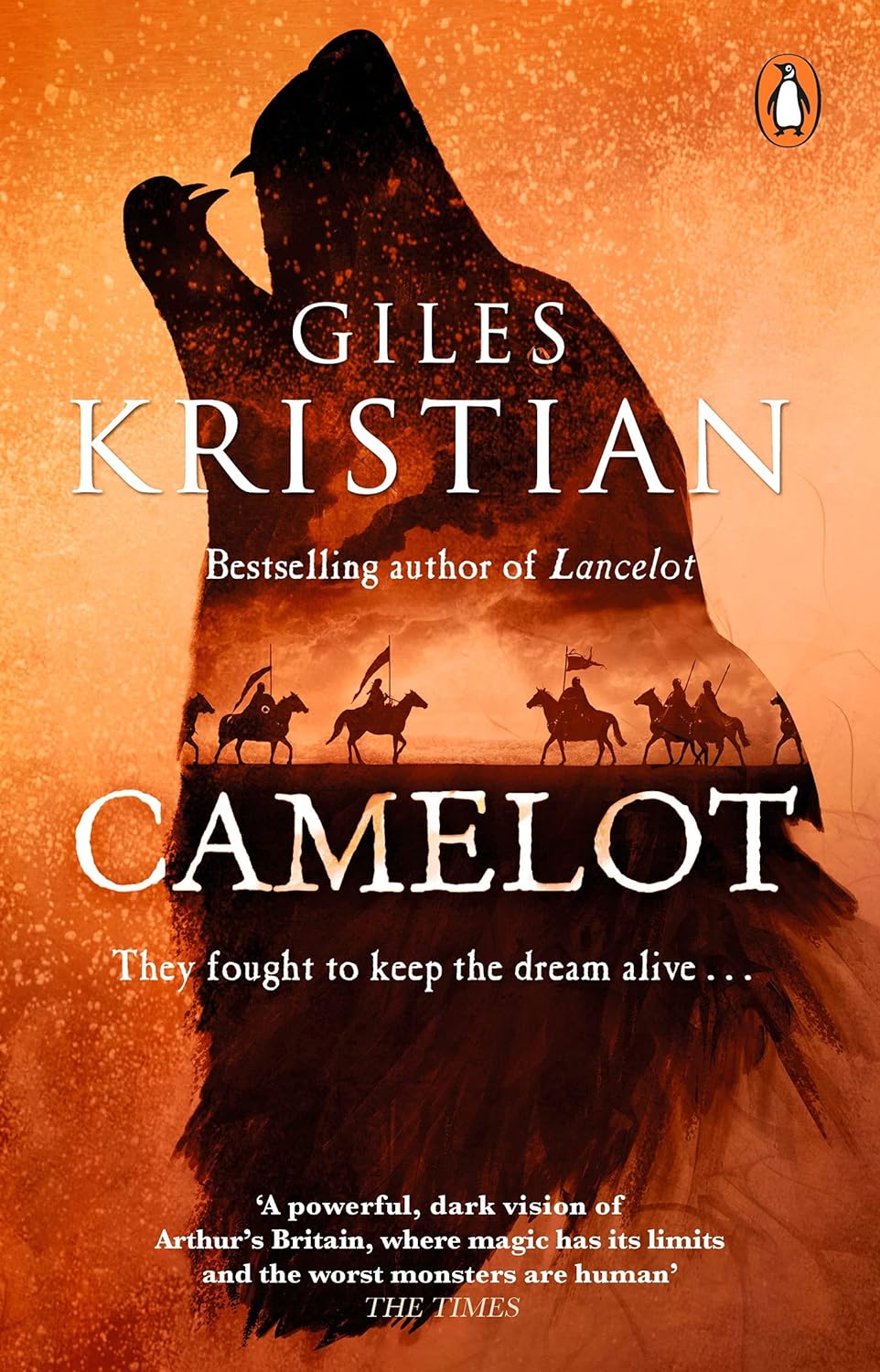
Check out my review for Camelot by Giles Kristian #hisfic #bookreview

Here’s the blurb

‘Britain is a land riven by anarchy, slaughter, famine, filth and darkness. Its armies are destroyed, its heroes dead, or missing. Arthur and Lancelot fell in the last great battle and Merlin has not been these past ten years. But in a small, isolated monastery in the west of England, a young boy is suddenly plucked from his simple existence by the ageing warrior, Gawain. It seems he must come to terms with his legacy and fate as the son of the most celebrated yet most infamous of Arthur’s warriors: Lancelot. For this is the story of Galahad, Lancelot’s son – the reluctant warrior who dared to keep the dream of Camelot alive.’

Cover image for Camelot by Giles Cristian

My Review

I’ve just reread the review I wrote for Lancelot nearly two years ago, and even I’m blushing about how effusive I was about it!

Camelot begins in much the same way. The lead character is a young man, about to take his vows to become a monk on the tor at Glastonbury when his world completely changes. The depiction of life on the tor is wonderfully evoked, and even if the author could have just written ‘bird’ ‘tree’ and ‘flower’ I’m sure many will appreciate the attention to detail. (I’ve never been ‘at one’ with nature).

The story starts quite slowly, drawing you back into the world of post-Roman/pre-Anglo-Saxon Britain with deft skill and then the story truly begins to take shape, secrets are revealed, and the ties to the previous book begin to be revealed.

I truly don’t want to give too much of the story away, but the ‘quest’, for that is what it becomes, takes readers from Cornwall to Anglesey and then further, the fear of what is to come in the future a palpable threat and even though we all know what’s going to happen, in the end (outside the scope of the book) I couldn’t help but hope that it would all be very, very different. The characters demand it from the reader.

And the end, is once more, where I have some small complaints about the story. It’s not that it doesn’t do what I want it to do, it’s just that the ending seems wrong for the story, but then, perhaps, it was always going to because that is the legend of Arthur.

But before that ending, the legends of Arthur and his knights are beautifully evoked, and I think a particular strength is the depiction of King Constantine, a bit part character, but immensely powerful and the very embodiment of a land falling to chaos all around him, and yet not prepared to give way and accept what seems to be the inevitable.

This book, once more, has its flaws, some scenes seem unnecessary, and others are skipped over too quickly, but it feels so true to the legends. There’s so much that’s only half-seen, hinted at but never actually known.

A welcome return to Giles Kristian’s ‘world’ first created in Lancelot, and, I think the author notes at the end of the novel explain a great deal. Now, give me the story of Arthur and his knights at the height of their prowess (please!).

Check out my review for Arthur

Book Review – Camelot by Giles Kristian – historical fiction

Here’s the blurb:

‘Britain is a land riven by anarchy, slaughter, famine, filth and darkness. Its armies are destroyed, its heroes dead, or missing. Arthur and Lancelot fell in the last great battle and Merlin has not been these past ten years. But in a small, isolated monastery in the west of England, a young boy is suddenly plucked from his simple existence by the ageing warrior, Gawain. It seems he must come to terms with his legacy and fate as the son of the most celebrated yet most infamous of Arthur’s warriors: Lancelot. For this is the story of Galahad, Lancelot’s son – the reluctant warrior who dared to keep the dream of Camelot alive.’

I’ve just reread the review I wrote for Lancelot nearly two years ago, and even I’m blushing about how effusive I was about it!

Camelot begins in much the same way. The lead character is a young man, about to take his vows to become a monk on the tor at Glastonbury when his world completely changes. The depiction of life on the tor is wonderfully evoked, and even if the author could have just written ‘bird’ ‘tree’ and ‘flower’ I’m sure many will appreciate the attention to detail. (I’ve never been ‘at one’ with nature).

The story starts quite slowly, drawing you back into the world of post-Roman/pre-Anglo-Saxon Britain with deft skill and then the story truly begins to take shape, secrets are revealed, and the ties to the previous book begin to be revealed.

I truly don’t want to give too much of the story away, but the ‘quest’, for that is what it becomes, takes readers from Cornwall to Anglesey and then further, the fear of what is to come in the future a palpable threat and even though we all know what’s going to happen, in the end (outside the scope of the book) I couldn’t help but hope that it would all be very, very different. The characters demand it from the reader.

And the end, is once more, where I have some small complaints about the story. It’s not that it doesn’t do what I want it to do, it’s just that the ending seems wrong for the story, but then, perhaps, it was always going to because that is the legend of Arthur.

But before that ending, the legends of Arthur and his knights are beautifully evoked, and I think a particular strength is the depiction of King Constantine, a bit part character, but immensely powerful and the very embodiment of a land falling to chaos all around him, and yet not prepared to give way and accept what seems to be the inevitable.

This book, once more, has its flaws, some scenes seem unnecessary, and others are skipped over too quickly, but it feels so true to the legends. There’s so much that’s only half-seen, hinted at but never actually known.

A welcome return to Giles Kristian’s ‘world’ first created in Lancelot, and, I think the author notes at the end of the novel explain a great deal. Now, give me the story of Arthur and his knights at the height of their prowess (please!).

Thank you to Netgalley and the publisher for my review copy.

Camelot is available from 14th May 2020 from here:

Book Review – Camelot by Giles Kristian – historical fiction

Here’s the blurb:

‘Britain is a land riven by anarchy, slaughter, famine, filth and darkness. Its armies are destroyed, its heroes dead, or missing. Arthur and Lancelot fell in the last great battle and Merlin has not been these past ten years. But in a small, isolated monastery in the west of England, a young boy is suddenly plucked from his simple existence by the ageing warrior, Gawain. It seems he must come to terms with his legacy and fate as the son of the most celebrated yet most infamous of Arthur’s warriors: Lancelot. For this is the story of Galahad, Lancelot’s son – the reluctant warrior who dared to keep the dream of Camelot alive.’

I’ve just reread the review I wrote for Lancelot nearly two years ago, and even I’m blushing about how effusive I was about it!

Camelot begins in much the same way. The lead character is a young man, about to take his vows to become a monk on the tor at Glastonbury when his world completely changes. The depiction of life on the tor is wonderfully evoked, and even if the author could have just written ‘bird’ ‘tree’ and ‘flower’ I’m sure many will appreciate the attention to detail. (I’ve never been ‘at one’ with nature).

The story starts quite slowly, drawing you back into the world of post-Roman/pre-Anglo-Saxon Britain with deft skill and then the story truly begins to take shape, secrets are revealed, and the ties to the previous book begin to be revealed.

I truly don’t want to give too much of the story away, but the ‘quest’, for that is what it becomes, takes readers from Cornwall to Anglesey and then further, the fear of what is to come in the future a palpable threat and even though we all know what’s going to happen, in the end (outside the scope of the book) I couldn’t help but hope that it would all be very, very different. The characters demand it from the reader.

And the end, is once more, where I have some small complaints about the story. It’s not that it doesn’t do what I want it to do, it’s just that the ending seems wrong for the story, but then, perhaps, it was always going to because that is the legend of Arthur.

But before that ending, the legends of Arthur and his knights are beautifully evoked, and I think a particular strength is the depiction of King Constantine, a bit part character, but immensely powerful and the very embodiment of a land falling to chaos all around him, and yet not prepared to give way and accept what seems to be the inevitable.

This book, once more, has its flaws, some scenes seem unnecessary, and others are skipped over too quickly, but it feels so true to the legends. There’s so much that’s only half-seen, hinted at but never actually known.

A welcome return to Giles Kristian’s ‘world’ first created in Lancelot, and, I think the author notes at the end of the novel explain a great deal. Now, give me the story of Arthur and his knights at the height of their prowess (please!).

Thank you to Netgalley and the publisher for my review copy.

Camelot is available from 14th May 2020 from here: (the preorder is currently only £2.99 for kindle – wowsers – so I’m posting this before release date for everyone to take advantage of the offer)

Book Review – Lancelot by Giles Kristian – highly recommended (historical fiction)

Here’s the blurb;

“Set in a 5th century post-Roman Britain besieged by invading war bands of Saxons and Franks, Irish and Picts, Giles Kristian’s epic new novel tells – through the warrior’s own words – the story of Lancelot, the most celebrated of all King Arthur’s knights. And it’s a story that’s ready to be re-imagined for our times.
It’s a story imbued with the magic and superstition that was such an integral part of the enchanted landscape of Britain during this dark times. Many of the familiar names from Arthurian mythology will be here – Mordred and Gawain, Morgana and, of course, Merlin – as will be those vital icons of the legend such as the Round Table and the sword in the stone but these will be reinvented, reforged for a new generation of readers.
Lancelot is a story of warriors and kings, of violent, of warfare and bloodshed but it is also a story of loyalty and friendship, of over-arching ambition, of betrayal and guilt, of love and lust, and the win tragedies of revenge and remorse.”

I received a free EArc from Netgalley.

Lancelot is a brilliant book. I really can’t recommend it enough – but at its heart, it is also flawed. The more I think about this, the more I imagine this might have been done on purpose – a mirror image of the character, perhaps.

When I first began reading Lancelot I simply thought the author had been very clever with his book title. (Go check my Goodreads log for the book – I say it there). The story, while it might have been about Lancelot, could just as easily have been about any character in post-Roman/pre-Saxon/settlement period Britain (everyone has their own word for this period). It was not necessarily a Lancelot that anyone would recognise.

For all that, the young Lancelot is an intriguing character, and even if the book had just been an author with a clever title, I would probably have been just as impressed as I ultimately was.

The world Lancelot inhabits is a wonderful reimagining of Britain at this strange time period – with the Romans fled, and the Saxons on the surge. It is stuffed with warlords and kings, with kingdom names and conjures up a wonderful landscape of the time period. While all the action takes place in those areas which would be termed, British or Pictish, the very ‘smell’ of the Saxons is always blowing on the wind., for all that it is modern-day Cornwall, Devon, Wales and Scotland that form the backdrop for the story and there are only very occasional Saxon characters.

We meet Lancelot in the first chapter, Guinevere takes longer to appear, and Arthur? Well, his father makes an appearance before him – and Arthur only arrives 50% through the book. And this is as it should be – after all, this is Lancelot’s story and not that of Arthur’s. We do meet Merlin not long after Guinevere – so the ‘names’ we know from the Arthur Legend are firmly there – Tintagel is often mentioned, as too is Excalibur.

As in any novel about a famous warrior, there is a great deal of training, fighting and ‘rough-stuff’ from the other boys being trained, but mixed with the twin thread of friendship and magic. The magic is artfully arranged – it is just ‘accepted’ without explanation, and that appealed to my less than ‘magical’ mind. Other authors may have ‘overcooked’ the whole Merlin/Druid/Old Gods stuff but I think it is handled exceedingly well throughout the story. The ‘friendship’ element is also very skillfully told – it becomes more and more important as the book progresses.

Lancelot has a lovingly crafted feel to it. It meanders down little-trodden paths, and we might be left wondering why, but just as Robin Hobb manages with her ‘Fitz’ books, it never feels irrelevant. It’s a delightful tale of occasional irrelevance, that I just didn’t want to end, and I never say that about a book.

There were times when I couldn’t fathom what the author would do with his characters next and there were parts where I felt cheated. At 80% through I was completely perplexed, and actually, the ending of the book is either its weakest element or the author at his cleverest (I still can’t decide). it is here that he relies most on the readers ‘prior’ knowledge of the Arthur legend – and we are left to make our own assumptions until the very final scene, when there is, once more, some closure.

I really did love this book, but I would have liked it to be much, much longer – I would have liked all the ‘gaps’ filled in, I would have liked answers to questions that are asked but never resolved, I would have liked more Arthur and Lancelot, and I would certainly have liked more, much more, of those famous battles, but Lancelot is a wonderful and powerful telling of a legend that we already think we know – but which is ripe for retelling. It relies on an understanding of the legend – while also reworking it. A fine piece of work that I thoroughly enjoyed – even if I didn’t initially want to! :)

Lancelot is available now, and Camelot is due for release in May 2020.

Get your copy here;