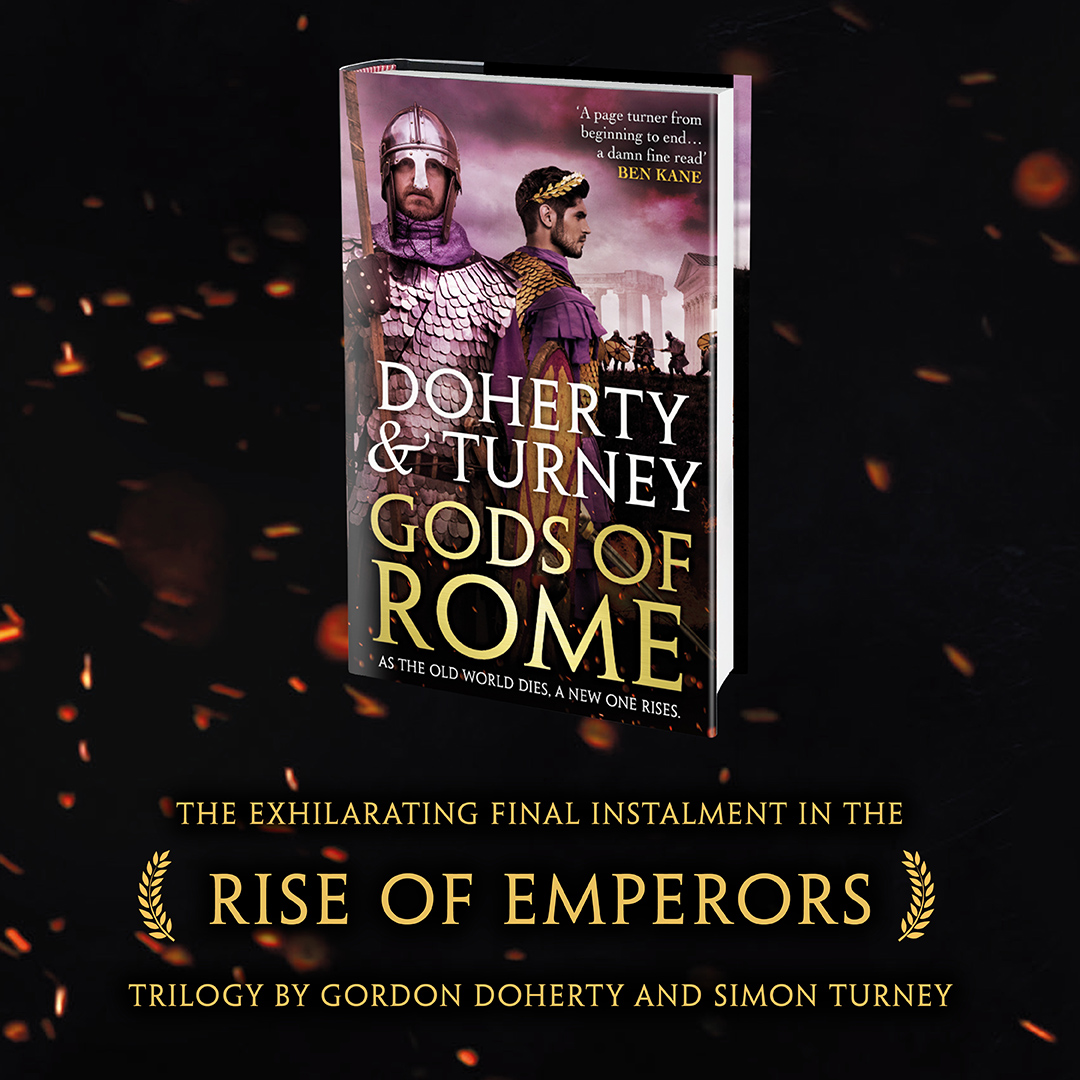
Cor, I’ve loved all three of these books. But before I get to the nitty gritty of the review for book 3, here’s the blurb:
For one to rule, the other must die.
312 AD is a year of horrific and brutal warfare. Constantine’s northern army is a small force, plagued by religious rivalries, but seemingly unstoppable as they invade Maxentius’ Italian heartlands. These relentless clashes, incidents of treachery and twists of fortune see Maxentius’ armies driven back to Rome.
Constantine has his prize in sight, yet his army is diminished and on the verge of revolt. Maxentius meanwhile works to calm a restive and dissenting Roman populace. When the two forces clash in the Battle of the Milvian Bridge, there are factors at work beyond their control and soon they are left with carnage.
There is only one way Constantine and Maxentius’ rivalry will end. With one on a bloodied sword and the other the sole ruler of Rome . . .
My Review
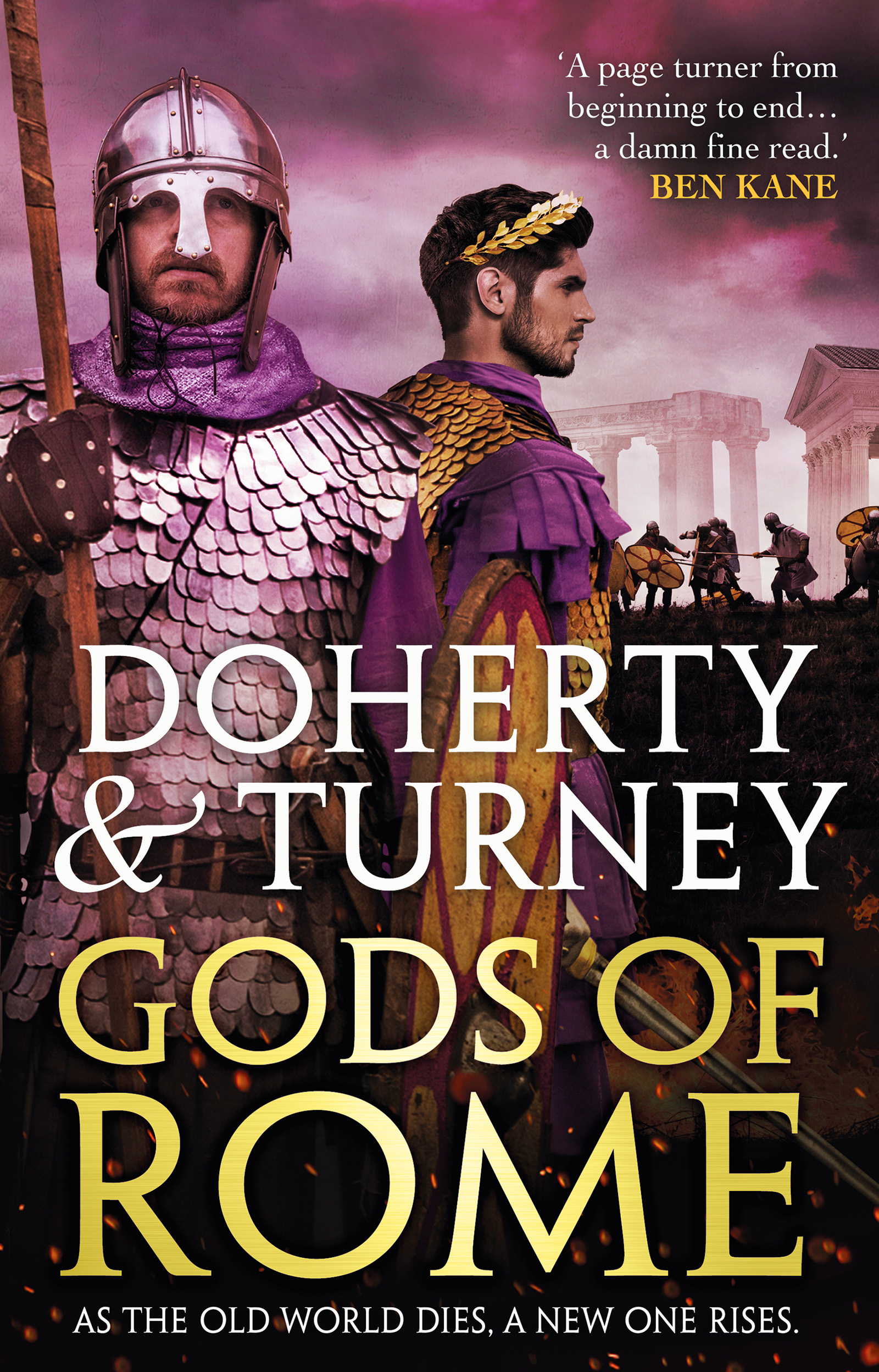
Gods of Rome is a stunning climax to the Rise of Emperors trilogy. The reader has followed the lives of Maxentius and Constantine in the two previous books, through their childhood friendship and adult rivalries, which have resulted in them being firm enemies. In this non-stop and thrilling climax, there is all to play for, and don’t Doherty and Turney manage to ramp up the tension to unbearable heights.
I’m no expert on Roman history, and certainly not on the period leading up to AD312, but the authors manage to convey the chaos of the ruling elite without ever getting bogged down in the minutiae of all the internal power struggles. It’s a light touch that I certainly appreciate. The focus is on Constantine and Maxentius, and the men and women who stand at their side. And this is a particular strength of the book. It would be quite easy to forget about the men’s wives as the book focuses so much on warfare but Fausta and Valeria are given their own storylines, standing firm beside their men, even if they don’t always approve of what they’re doing, and not above some treachery themselves.
Maxentius and Constantine are two very different characters, grappling for the same thing, and the reader never tires of their internal monologues as they goad themselves onwards.
From about 50% through the book, I had to force myself not to turn to the back to read the historical notes, and to find out what ‘truth’ this story was based on.
I have adored this trilogy of books. It is my type of historical fiction – people who lived and breathed, brought to life and made to live their lives as opposed to authors focusing on the inevitability of what would happen, and presenting it as a fait accompli.
I can only hope that Simon Turney and Gordon Doherty are able to collaborate once more. After all, they have a lot of Roman era history they could delve into. (Hint, hint, nudge, nudge).
About the authors
Simon Turney is the author of the Marius’ Mules and Praetorian series, as well as The Damned Emperor series for Orion and Tales of the Empire series for Canelo. He is based in Yorkshire.
Gordon Doherty is the author of the Legionary and Strategos series, and wrote the Assassin’s Creed tie-in novel Odyssey. He is based in Scotland.

Purchase link
Follow Simon
Website: http://simonturney.com/
Follow Gordon
Website: https://www.gordondoherty.co.uk/
Follow Aries
Website: http://www.headofzeus.com
Extract from Gods of Rome
1
CONSTANTINE
The Cottian Alpes, 27th January 312 ad
We moved through the mountains like winter wolves. The ferocious blizzard sped southwards with us, carried on the famous bora winds, singing a dire song. For days we marched through that driving snow, seeing nothing but great white-clad peaks either side of us; rugged, inhospitable highlands which in these frozen months soldiers were not meant to cross. All around me the gale screamed, boots crunched endlessly through the successively deeper drifts of white, men’s teeth chattered violently, mules brayed, exhausted. It felt at times as if we were wandering, snow-blind, to our deaths, but I knew what lay ahead… so close now.
I called upon my chosen men and a handful of their best soldiers – a group of thirty – and we roved ahead of the army like advance scouts. The blizzard raked through my bear cloak, the snow rattling like slingshot against my gemmed ridge helm and bronze scales as I scoured the valley route. Yet I refused to blink. When the speeding hail of white slowed and the murky grey ahead thinned a little, I saw them: a pair of stone and timber watchtowers, northern faces plastered in snow. Gateposts watching this passage between two realms. I dropped to my haunches behind the brow of a snowdrift and my chosen men hunkered down with me. I gazed over the drift’s brow, regarding the narrow gap between the towers and the valley route beyond, on through the winter-veined mountains. Thinking of the land that lay beyond these heights, my frozen lips moved soundlessly.
Italia…
Land of Roman forefathers. Home of the man I had once considered my friend… but that territory was rightfully mine. Mine! My surging anger scattered when I spotted movement atop one of the two towers: a freezing Maxentian scout blowing into his hands, oblivious to our presence. Then the blizzard fell treacherously slack, and the speeding veil of white cleared for a trice. I saw his ice-crusted eyebrows rise as he leaned forward, peering into the momentary clarity, right at us. His eyes bulged, mouth agog.
‘He is here!’ he screamed to be heard over the sudden return of the storm’s wrath. ‘Constantine is h—’
With a wet punch, an arrow whacked into the man’s chest and shuddered there. He spasmed then folded over the edge of the timber parapet and fell like a sack of gravel, crunching into a pillowy snowdrift at the turret’s foot. I glanced to my right, seeing my archer nock and draw again, shifting his bow to the heights of the other tower, his eyes narrowing within the shadow of his helm brow. He loosed, but the dark-skinned sentry up there ducked behind the parapet, screaming and tolling a warning bell. At once, three more Maxentians spilled from the door at the base of that rightmost tower, rushing south towards a simple, snow-topped stable twenty paces away, in the lee of a rocky overhang. This was one of the few gateways through the mountains – albeit the least favoured and most treacherous – and it was guarded by just five men? Instantly, suspicion and elation clashed like swords in my mind. We had no time to rake over the facts. These watchmen could not be allowed to ride south and warn the legions of Italia. They had to die.