
I’m delighted to welcome Richard Buxton and his trilogy, the Shire’s Union Trilogy, to the blog #ShiresUnion #AmericanCivilWar #Historical Fiction #BlogTour #TheCoffeePotBookClub

I’m delighted to welcome Richard Buxton and his trilogy, the Shire’s Union Trilogy, to the blog with a series trailer.

Shire’s Union Trilogy Series Trailer

Shire’s Union Trilogy Series Trailer

Tigers in Blue – Excerpt

Giles County, Tennessee – November 1864

Their train stopped again. The three of them disembarked and walked beyond the engine. It had pulled up a handful of crossties before a fire-blackened and wounded trestle bridge that spanned a deep and wide ravine. There must have been three hundred men or more working on the repairs. They swarmed over the bridge, a busy blue infestation, some out along the incomplete top span, others either end of a crane carried on a flatbed railcar, many more perilously among the posts and cross-struts. Men struggled to shout instructions over a chorus of hammer and saw. Way down in the ravine and across a swift creek stood a clump of engineer officers. One held a sheet of paper so big he looked in danger of being lifted into the air. Others pointed and gestured up at the bridge. As Shire watched, a steam winch puffed into action on the crane-car and a thick trestle rose and swayed up from below like a miracle, before being claimed by many hands and dragged into the great puzzle of wood. Despite their industry, the nearer half of the bridge was missing the top forty feet.

The engine driver came and stood beside them, wiping sooty hands on a dirty rag. Rice, greasy hair pushed back off his forehead, asked, ‘If you knew the bridge was broke, why did you set out? We’ll be stuck for days.’

The driver took his time surveying the works. ‘Well,’ he said, ‘you’re welcome to climb down and up the other side, but any trains that happen along from Nashville will only queue up to go south. Watch a while.’ He turned to walk back to his engine. ‘These people will have us over before nightfall.’

With nothing to do but wait, Shire and Tuck left Rice at the engine and worked their way along the top of the ravine to a spot where they could watch the repair. The ground fell steeply away before them. Predictably, Tuck dropped his pack, took up his fiddle and sat. He hadn’t said a word today. A stiff breeze struck up under a gray sky. At least they had the car to retreat to if it came on to rain. Shire got out his dog-eared map of Tennessee and Kentucky and unfolded it carefully so as not to bring on further dishevelment. He found Pulaski and traced the rail line to Nashville via Columbia. Short of Franklin he found Spring Hill. They would pass right by. Clara had been full of dubious enthusiasm for her move when he’d left her. What would have changed since? He wouldn’t need the train to stop again to be certain how he felt. That question had always been for her, though he wondered if she’d answered it quietly to herself a long time ago.

He folded his map away and got busy with a fire. In the army it paid to eat when the opportunity presented itself. ‘I’ll cook your pork. We ate mine yesterday,’ he said. They often shared rations. That way if one of them got a runt portion the hardship was shared too.

There was no response from Tuck. Sometimes it was like living with an elderly relative whose mind had been misplaced. In his own time, Tuck bowed into a slow waltz, utterly at odds with the exertions of the bridge builders. Evidently, it carried on the wind into the ravine and on to those high on the bridge, as not a few faces turned their way. There was a moment’s lull in the hammering before it stuttered up again. Two men on the flatbed end of the crane-car moved elegantly into closed hold and took a turn or two before their corporal beat them apart with his hat. Shire smiled but saw Tuck was too far inside his tune to take it in.

Once he had the fire going, he dug in Tuck’s pack for the salt belly-pork they’d been doled out back in Athens. It was a mess in there. An apple long past saving, percussion caps loose that should have been in a box, a lone dollar bill left to its own devices. The string hadn’t been tied properly on the pork paper. The exposed meat had picked up a covering of cotton threads and other miniature detritus. Shire reasoned it would cook off in his small skillet. Tuck’s ration was more than ample, so he cut off two-thirds and put it to cook slowly, not too close to the heat so that the fat would stay aboard. He wrapped the remains with care and was finding a safe corner back in Tuck’s pack when he happened on something round and hard. He drew out an enamel doorknob.

He recognized it. Tuck kept it as a grim reminder of his parents who were burned alive in their farmhouse, Tuck’s home. The enamel was scorched on one side, a smooth, mute witness to their murders. He’d been about to look for some wild onion or anything that might flavor the meat, but instead he took the doorknob and went to sit next to Tuck.

He didn’t expect to be acknowledged, but the lack irked Shire all the same. The waltz looped around and around. Shire could have sworn some of the hammering was striking out one, two, three… one, two, three. ‘I think you’re slowing down their industry,’ he said. Tuck played on. Shire felt a bubble of anger pop inside.

Blurb

Shire leaves his home and his life in Victorian England for the sake of a childhood promise, a promise that pulls him into the bleeding heart of the American Civil War. Lost in the bloody battlefields of the West, he discovers a second home for his loyalty.

Clara believes she has escaped from a predictable future of obligation and privilege, but her new life in the Appalachian Hills of Tennessee is decaying around her. In the mansion of Comrie, long hidden secrets are being slowly exhumed by a war that creeps ever closer.

The Shire’s Union trilogy is at once an outsider’s odyssey through the battle for Tennessee, a touching story of impossible love, and a portrait of America at war with itself. Self-interest and conflict, betrayal and passion, all fuse into a fateful climax.

Written by award winning author Richard Buxton, the Shire’s Union trilogy begins with Whirligig, is continued in The Copper Road, and concludes with Tigers in Blue.

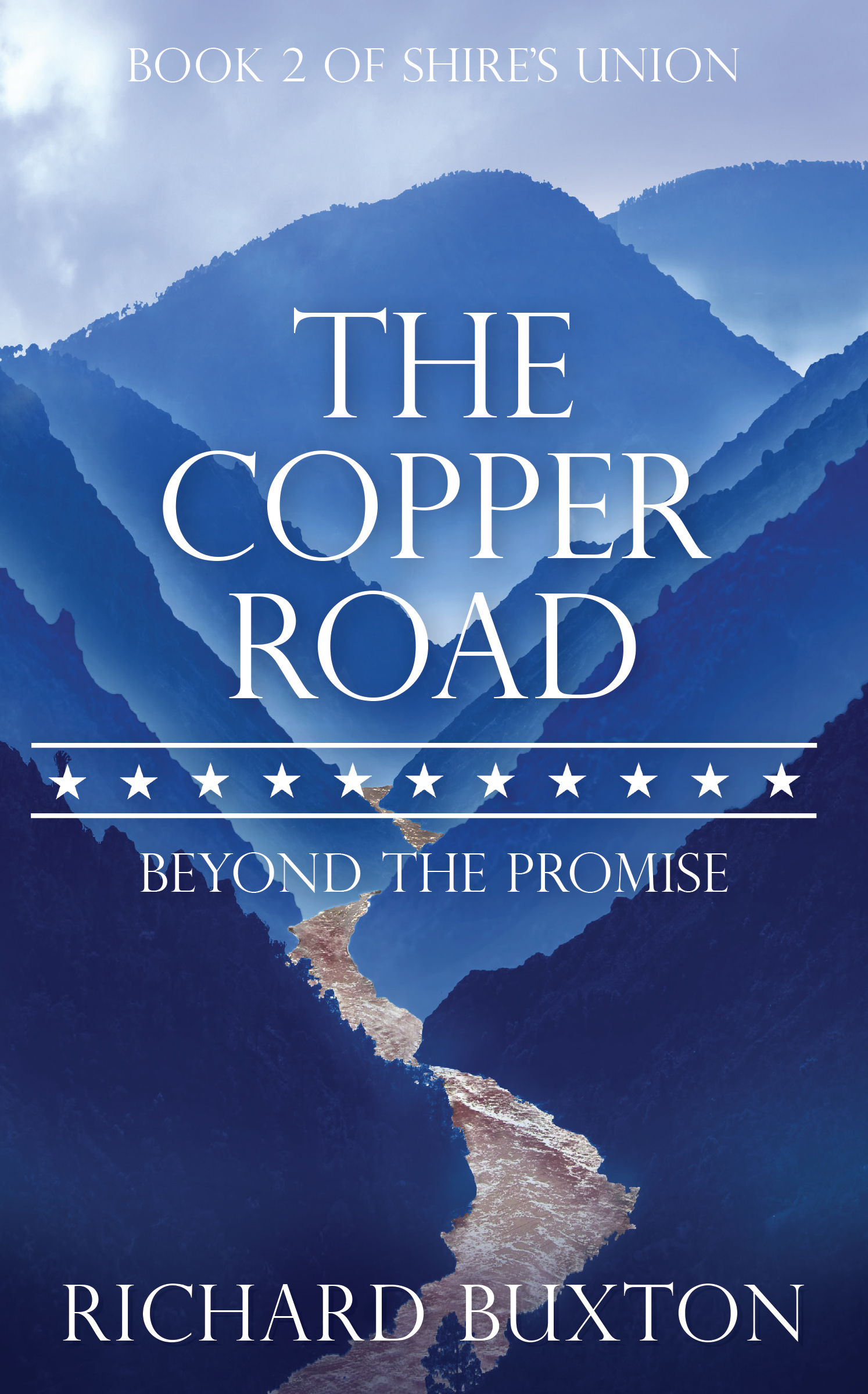
Trilogy Buy Links:

US: UK:

Meet the Author

Richard lives with his family in the South Downs, Sussex, England. He completed an MA in Creative Writing at Chichester University in 2014. He has an abiding relationship with America, having studied at Syracuse University, New York State, in the late eighties. He travels extensively for research, especially in Tennessee, Georgia and Ohio, and is rarely happier than when setting off from a motel to spend the day wandering a battlefield or imagining the past close beside the churning wheel of a paddle steamer.

Richard’s short stories have won the Exeter Story Prize, the Bedford International Writing Competition and the Nivalis Short Story Award. His first novel, Whirligig (2017) was shortlisted for the Rubery International Book Award. It was followed by The Copper Road (2020) and the Shire’s Union trilogy was completed by Tigers in Blue (2023). To learn more about Richard’s writing visit www.richardbuxton.net.

Connect with the Author

Website: BookBub:

Follow the Shire’s Union Trilogy with The Coffee Pot Book Club

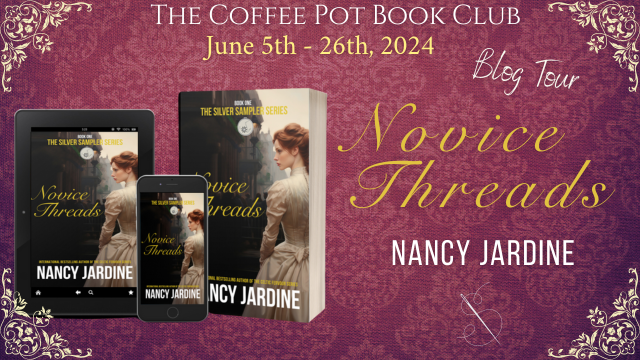
I’m delighted to welcome Nancy Jardine and her new book, Novice Threads, to the blog #VictorianSaga #HistoricalFiction #Scotland #WomensFiction #BlogTour #TheCoffeePotBookClub

I’m delighted to welcome Nancy Jardine and her new book, Novice Threads from the Silver Sampler Series, to the blog with Growing Up Brings More Questions Than Answers.

Growing Up Brings More Questions Than Answers

September 1850

“What do you need help with, Father?” Margaret asked on her return from assisting Granny Maggie to bake a batch of fruit pies, the apple harvest having been plentiful as had the plums in the little strip of garden behind her granny’s house.

“I’m not sure you’ll be so keen in a minute, lass.” Her father’s expression was a little bit whimsical and lit up his unusually bright grey eyes. It was a sight to see replacing the usual serious and sombre. “However, you can help me tidy some shelves later on.”

She had been expecting to spend the rest of the day doing shop chores, since it was still September and her new school session was not due to restart before mid-October. She’d attended a smattering of classes during July and August, though the bulk of of Mister Anderson’s summer teaching time was being spent with his most senior pupils who were learning Latin and Greek.

The smile she sent her father’s way was a puzzled one.

“I’m not sure I understand you.”

William leant closer, still teasing her with a whisper. “You have another letter.”

She flew along the passage and opened the kitchen door so quickly it startled her mother who was placing a pot of soup to heat on the range.

“I’ve another letter from Jessie?”

“That you have. It’s here on the table.”

Snatching it into her eager fingers, Margaret first savoured the writing on the front.

“Look, at how carefully she’s written my name,” she cried.

Her mother glanced at the letter. “She’s still making mistakes, though. Our shop name has been written twice.”

Margaret was undaunted. “I couldn’t have written an address if I had never had writing lessons from Mister Anderson. Would you have had the courage to try if you were in Jessie’s shoes?”

To her relief, Peggy didn’t take offence. “No, I suppose not. Your father needed me to compose and address our shop correspondence so I learned quickly to produce a good standard.”

Opening the seal, Margaret wandered around the room as she read.

“Jessie’s handwriting is much less scratchy, this time. I can read it more easily.”

“That’s good,” Peggy said. “I wonder how she’s managing to practise?”

Margaret agreed that was a very good question. It looked as though someone might be helping Jessie.

“Oh, my!” she declared, her tone making her mother lay down her sharp knife.

“What’s wrong?”

“Not wrong exactly. Jessie says the family she’s been sent to are related to the minister of the Free Kirk here in Milnathort.”

“That’s interesting,” Peggy declared, something odd lighting up her expression.

“I think Jessie means that it’s the Reverend Leslie Duncan’s brother, a man named Stewart, that she’s working for?” She handed the letter over to Peggy to help her understand it.

“Yes, that seems to be what she’s writing. And that it’s a very big house.” Peggy looked as puzzled as Margaret felt. “Now, I wonder why Jessie was sent there?”

Her grin was an excited one. “Isn’t she lucky to have got the work there?”

Peggy lifted the bread knife to slice a fresh loaf for their mid-day meal. “Well, until Jessie is able to tell you more, you’ll just have to assume that she’s found her feet.”

“What?” She questioned the now doubtful look on her mother’s face.

“Jessie doesn’t yet say if there are a lot of servants. If it’s a very big house then I hope she’s one of many servants, and not being expected to do too much on her own.”

“Oh!” Margaret hadn’t thought of that, just imagining that it must be fun to work in the big city of Edinburgh. She’d been thinking that it was a privilege for Jessie to work there, in the same way that it had been a privilege for Jessie to get some basic schooling in Milnathort paid for by her mystery benefactor – though now she wasn’t so sure. It was a pity to be so undecided, because having a benefactor had sounded special.

“Have you ever heard of the Reverend Duncan organising anything like this for other girls in Milnathort?” she asked Peggy.

Her mother shook her head. “Not until now, but who knows what that man’s likely to do?”

“What do you mean?” Margaret was puzzled.

“Never you mind. There’s always gossip enough in Milnathort, and I for one will not be adding to it. You just be careful who you tell about Jessie’s good fortune.”

Margaret realised her mother had grown quite serious, though she was happy to keep her knowledge of Jessie’s plight a secret. Apart from herself, Jessie hadn’t made other proper friends in Milnathort.

“And if Mistress Byers asks if you’ve heard anything from Jessie, you just tell her that all you know is that she arrived safely and is working. Nothing about where her job is. Mind my words! Since your father moved us all to the United Presbyterian Church, I never hear anything about the Free Kirk anyway, and that’s how I want it to stay!”

Margaret knew there was never a time to share any of her memories of Mistress Morison’s gripes. She could almost hear the old woman mouthing the words ‘That Free Kirk Reverend ought to have known better. The man should have left Ruth’s skirts well alone. That one mistake was bad enough but more were unforgiveable.’ Margaret couldn’t stop those memories from surfacing every now and then, but she’d vowed to keep them secret forever– for Jessie’s sake.

Now that she was older, she’d a better inkling of what Mistress Morison’s grumbles might have meant. Men chasing skirts she now knew often led to surprise babies being born, but exactly how they were produced was for her to learn another day.

It was confusing. Many of her conclusions were very disheartening.

Blurb

A thirst for education.  Shattered dreams. Fragile relations.

1840s Scotland

Being sent to school is the most exhilarating thing that’s ever happened to young Margaret Law. She sharpens her newly-acquired education on her best friend, Jessie Morison, till Jessie is spirited away to become a scullery maid. But how can Margaret fulfil her visions of becoming a schoolteacher when her parents’ tailoring and drapery business suddenly collapses and she must find a job?

Salvation from domestic drudgery – or never-ending seamstress work – comes via Jessie whose employer seeks a tutor for his daughter. Free time exploring Edinburgh with Jessie is great fun, but increasing tension in the household claws at Margaret’s nerves.

Margaret also worries about her parents’ estrangement, and the mystery of Jessie’s unknown father.

When tragedy befalls the household in Edinburgh, Margaret must forge a new pathway for the future – though where will that be?

Buy Link

Universal Link:

This title is available to read on #KindleUnlimited

Meet the Author

Nancy writes historical and contemporary fiction. 1st Century Roman Britain is the setting of her Celtic Fervour Series. Victorian and Edwardian history has sneaked into two of her ancestry-based contemporary mysteries, and her current Silver Sampler Series is set in Victorian Scotland.

Her novels have achieved Finalist status in UK book competitions (People’s Book Prize; Scottish Association of Writers) and have received prestigious Online Book Awards.

Published with Ocelot Press, writing memberships include – Historical Novel Society; Romantic Novelists Association; Scottish Association of Writers; Federation of Writers Scotland; Alliance of Independent Authors.

Connect with the Author

Website: BlueSky: BookBub:

Follow the Novice Threads blog tour with The Coffee Pot Book Club

Today I’m reviewing Rogue Hero by Rob Sinclair #blogtour #thriller #newrelease

Here’s the blurb

When a mystery bystander stops an assassination attempt on a prominent politician, it sparks a national search that captivates the nation…

Curtis Delaney watches the footage play out on the news, and immediately recognises the unidentified hero. He hasn’t seen his brother Finn in six years. He doesn’t know where he’s been in that time, or what he’s been doing. But there’s one thing he does know: Finn is no hero.

Curtis is determined to find his brother, but equally, Curtis is no detective. A husband and lawyer (and not the ‘good’ kind), with a mortgage and responsibilities, Curtis isn’t cut out for delving into whatever seedy business Finn has gotten involved with. But when armed men turn up on his doorstep, claiming to be FBI, he quickly realises he’s been left with no choice.

The hunt for the truth will take them from the Capitol building in Washington, to the sun-kissed beaches of Mexico, and the cold streets of London, uncovering secrets of fraud, blackmail and murder. Can the brothers reunite before the real hero is discovered by the wrong people?

Purchase Link

https://mybook.to/rogueherosocial

My Review

Rogue Hero by Rob Sinclair is a standalone novel told from the viewpoint of two brothers, Finn and Curtis Delaney, with a timeline that eventually merges, although they are not concurrent. Mostly set in the US and Mexico, we do have side trips to Italy and the UK.

Our two main characters are far from likeable, and neither are the individuals they interact with. There’s a lot going on. Both brothers have complex backstories and there is a huge cast of characters, although in the end, it does come down to a few main players.

Complex plotting sees the reader switching between the two brothers’ point of views, and also two different time lines. With a collection of unsavoury characters, possible FBI intervention, a possibly dirty-politician and a web of financial chaos, the eventual ending is somewhat unexpected.

A complex thriller, sure to appeal to fans of the genre.

Meet the author

Rob Sinclair is the million copy bestseller of over twenty thrillers, including the James Ryker series. Most recently published by Bloodhound, Boldwood will publish his latest action thriller, Rogue Hero, in June 2024 and will be republishing all the James Ryker series over the coming months.

Connect with the author

Facebook: https://www.facebook.com/robsinclairauthor

Twitter: https://twitter.com/RSinclairAuthor

Newsletter Sign Up: https://bit.ly/RobSinclairNews

Bookbub profile: https://www.bookbub.com/authors/rob-sinclair

It’s cover reveal day for Kings of Conflict, the final book in the Brunanburh series

The final, thrilling instalment in MJ Porter’s The Brunanburh Series.

Can King Edmund of the English banish the Norse invaders from England one final time?

AD942

In the wake of the agreement reached at Lincoln between Edmund and Anlaf Sihtricson of the Norse, Edmund returns to Wessex to reflect and rebuild, impatient to reverse his losses at Lincoln.

But this is the winter of discontent. In Jorvik and the kingdom of the Scots, those who’ve waited too long to become kings in their own right grow restless.

As the enemies of the English turn on themselves, Edmund senses the opportunity to reclaim all his brother, the victor of Brunanburh, managed to gain before his untimely death plunged England back into war with her many foes.

With his sights set firmly on York, can he recreate the England his brother built, or will the enemies of England realise the error of their ways and once more unite to drive Edmund back to Wessex, leaving York in the hands of the Norse.

books2read.com/KingsOfConflict10th

Check out the Brunanburh Series page.

Happy release day to Arthur by Giles Kristian, the last in the Arthurian Trilogy #histfic #newrelease

Here’s the blurb

Years have passed since the clash of shield-walls echoed across the land . . .

The Saxons are now the lords of Britain. And yet the bards still sing of Arthur – ‘In our darkest time, when we need him most, shall he come again.’

Ageing mercenary Beran has no love of bards’ songs. Nor of people. Unless they are paying him to steal or kill. Now he has been ordered to murder a boy. But this is no ordinary child. The son of King Constantine and the grandson of High King Ambrosius, this boy could be the saviour of Britain . . . if he lives.

Betraying his companions and returning to a world he believed he’d forsaken, Beran vows to take the boy to the one place that still holds out against the invader: Camelot.

Hunted by Saxons, Queen Morgana and those he deceived, he will seek the help of Guivret, called the Little King, and the Saracen, Palamedes who once rode beneath Arthur’s banner. They will meet the doomed lovers, Tristan and Isolde. And they will fight for their lives and for each other.

For if there’s to be any hope for Britain, Beran must deliver the boy to Camelot. And to do that, he must come to terms with his past . . .

Arthur is the breathtaking new novel from the author of the bestselling Lancelot, called ‘a masterpiece’ by Conn Iggulden . . .

Purchase Link

https://amzn.to/4aPRjzL

My Review

Arthur by Giles Kristian is the third and final book in his retelling of the Arthurian Legend, in sub-Roman, or Post-Roman, Britain. I’ve read all three books, although they have been spread over several years. I adored Lancelot and enjoyed Camelot, which takes us to Arthur.

Arthur has left me somewhat perplexed. I’ve not jumped right on here to write a review. I needed time to think about it. I’m unsure if this is because of the book or because of my mind putting some pieces together about the entire legend and asking even more questions about the legend rather than the book. However, there are a few authors whose work I really enjoy, but I seem to take away something different from others (Mark Lawrence being one of those authors), and this is also one of those books.

The world-building is both vast and intimate. The characters we meet, a young Arthur, Beran and Constantine’s grandson, are intriguing choices. True to the legend as we know it, Arthur falls prey to some ill-advised antics and seeks to distance himself from them and his father, although that’s never going to work. Beran is an old, tired man, aching and bedevilled by his past and the main driving force of the narrative. Constantine’s grandson embodies a young boy, entirely out of his element, believing his position is all he needs to ensure his survival in a world turned upside down. The twin storylines very much run independently of one another. Arthur, as a young man, never quite feels fully formed – the story depends very much on readers knowing the legends of Arthur. Beran feels more fully formed, and his decisions perhaps make more sense to a modern audience. The juxtaposition between Beran and Constantine’s grandson gains poignancy as the tale progresses.

Yet, as beautiful as some of the phrases are, some of them are not. The world-building is both well done and also somewhat laboured and repetitive. Huge elements of the storyline are only explained much later in the book, and for much of it, I was unsure why I persisted in reading. The title is particularly vexing. I fear readers will not persevere to understand its relevance. I’m glad that I did.

The poignancy of a world lost is perfectly evoked. The men and women living in it are almost ‘out of time,’ with events taking place around them. The book is tinged with sorrow. 

I think that if I had read all three books together, the trilogy would work very well. Returning to the trilogy after so many years means I’ve lost the threads from Lancelot and Camelot, which both feature Arthur.

This is a bold end to a trilogy that has tried to be very different. I believe readers will love it or hate it. I can certainly appreciate the crafting of the story, even if I’m left perplexed by it. It is an absorbing tale, sucking me in and not letting me go. I read it in a few days. Perhaps, after all, it is as ephemeral as the legends themselves, and that is a testament to the author evoking such a response in me. 

Check out my reviews for Lancelot and Camelot

If you read my reviews, you’ll know I don’t usually highlight elements of them, but for Arthur I want you as a perspective reader to understand that I feel much of my reaction was perhaps as personal as the writing of the novel was for the author.