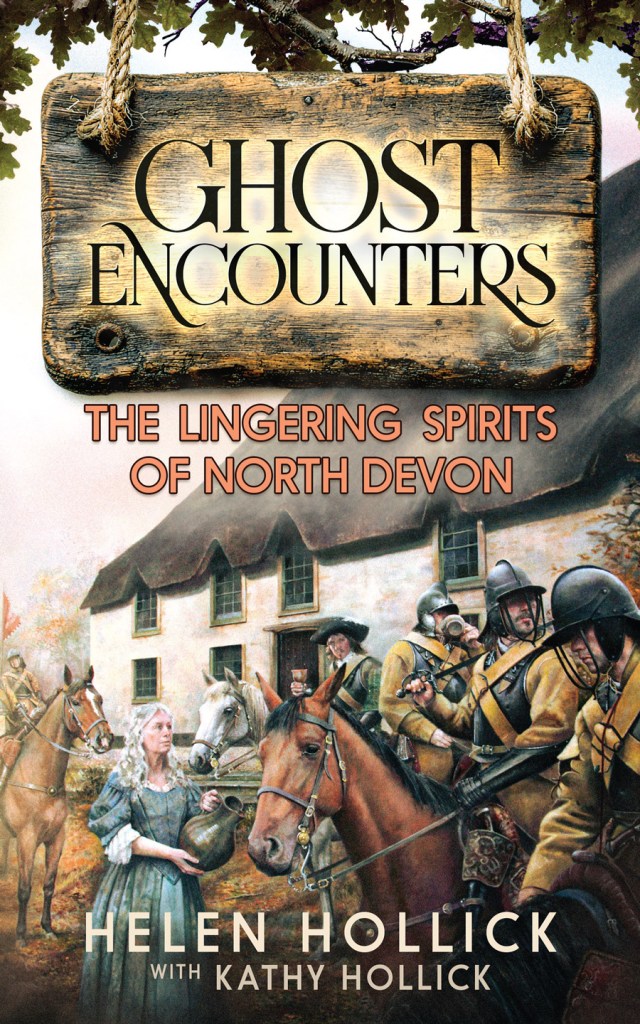
I’m delighted to welcome Helen Hollick with Kathy Hollick and their new book, Ghost Encounters: The Lingering Spirits of North Devon, to the blog.
Here’s the Blurb
Everyone assumes that ghosts are hostile. Actually, most of them are not.
You either believe in ghosts or you don’t. It depends on whether you’ve encountered something supernatural or not. But when you share a home with several companionable spirits, or discover benign ghosts in public places who appear as real as any living person, scepticism is abandoned and the myth that ghosts are to be feared is realised as nonsense.
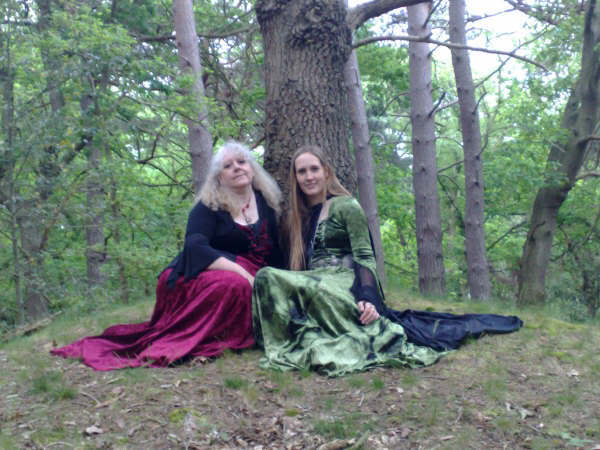
It is a matter for individual consideration whether you believe in ghosts or not, but for those who have the gift to see, hear or be aware of people from the past, meeting with them in today’s environment can generate a connection to years gone by. Kathy and Helen Hollick have come across several such departed souls in and around North Devon and at their 18th-century home, which they share with several ‘past residents’.
In GHOST ENCOUNTERS: The Lingering Spirits Of North Devon, mother and daughter share their personal experiences, dispelling the belief that spirits are to be feared.
Ghost Encounters will fascinate all who enjoy this beautiful region of rural South-West England, as well as interest those who wish to discover more about its history… and a few of its ghosts.
(Includes a bonus of two short stories and photographs connected to North Devon)
cover design: Avalon Graphics cover artwork: Chris Collingwood
This title will be available to read on #KindleUnlimited
Meet the Authors
ABOUT HELEN HOLLICK
Known for her captivating storytelling and rich attention to historical detail, Helen might not see ghosts herself, but her nautical adventure series, and some of her short stories, skilfully blend the past with the supernatural, inviting readers to step into worlds where the boundaries between the living and the dead blur.
In addition to her historical fiction, Helen has written several short stories, further exploring themes of historical adventure or the supernatural with her signature style. Whether dealing with the echoes of the past or the weight of lost souls, her stories are as compelling as they are convincing. Through her work, she invites readers into a world where the past never truly lets us go.
Helen started writing as a teenager, but after discovering a passion for history, was published in the UK with her Arthurian Pendragon’s Banner Trilogy and two Anglo-Saxon novels about the events that led to the 1066 Battle of Hastings, one of which, The Forever Queen (USA title – A Hollow Crown in the UK) became a USA Today best-seller. Her Sea Witch Voyages are nautical-based adventures inspired by the Golden Age of Piracy. She also writes the Jan Christopher cosy mystery series set during the 1970s, and based around her, sometimes hilarious, years of working as a North London library assistant.
Helen, husband Ron and daughter Kathy moved from London to Devon in January 2013 after a Lottery win on the opening night of the London Olympics, 2012. She spends her time glowering at the overgrown garden and orchard, fending off the geese, helping with the horses and, when she gets a moment, writing the next book…
ABOUT KATHY HOLLICK
Diagnosed as severely dyslexic when she was ten, Helen pulled Kathy out of school at fifteen to concentrate on everything equine.
When not encountering friendly ghosts, Kathy’s passion is horses and mental well-being. She started riding at the age of three, had her own Welsh pony at thirteen, and discovered showjumping soon after. Kathy now runs her own Taw River Equine Events, and coaches riders of any age or experience, specialising in positive mindset and overcoming confidence issues via her Centre10 accreditation and Emotional Freedom Technique training. EFT, or ‘tapping’, uses the body’s pressure points to aid calm relaxation and to promote gentle healing around emotional, mental or physical issues.
Kathy lives with her farmer partner, Andrew, in their flat adjoining the main farmhouse. She regularly competes at affiliated British Showjumping, and rides side-saddle (‘aside’) when she has the opportunity. She produces her own horses, several from home-bred foals.
She also has a fun diploma in Dragons and Dragon Energy, which was something amusing to study during the Covid lockdown.
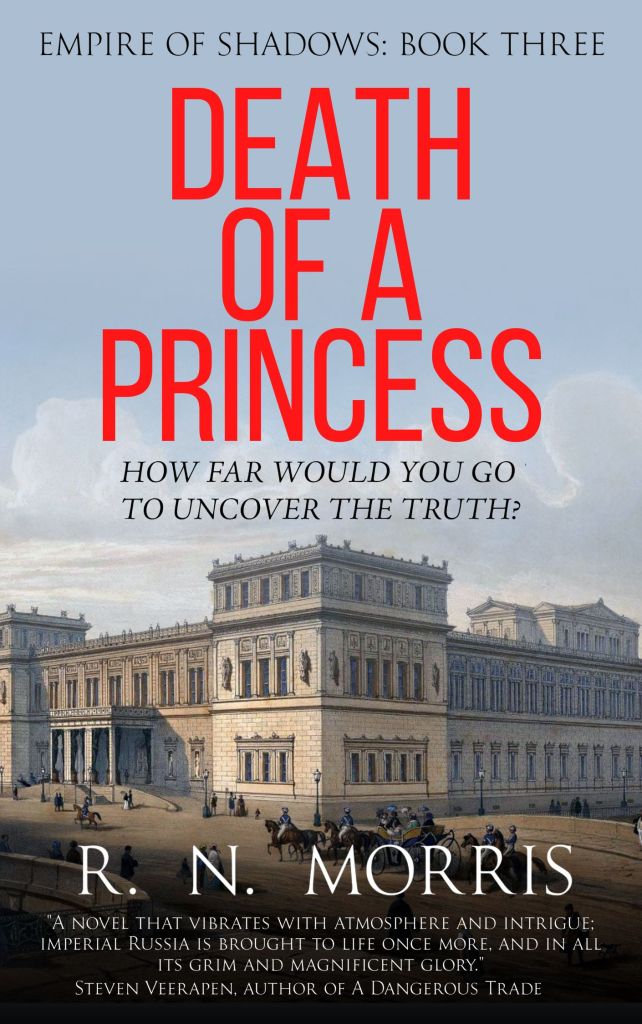
I’m delighted to welcome R.N. Morris and his book, Death of a Princess, Empire of Shadows Book 3, to the blog.
Here’s the blurb
Summer 1880.
Lipetsk, a spa town in Russia.
The elderly and cantankerous Princess Belskaya suffers a violent reaction while taking a mud bath at the famous Lipetsk Sanatorium. Soon after, she dies.
Dr Roldugin, the medical director of the sanatorium, is at a loss to explain the sudden and shocking death.
He points the finger at Anna Zhdanova, a medical assistant who was supervising the princess’s treatment.
Suspicion also falls on the princess’s nephew Belsky, who appears far from grief-stricken at his aunt’s death.
Meanwhile, investigating magistrate Pavel Pavlovich Virginsky arrives in Lipetsk from St Petersburg, seeking treatment after a nervous breakdown.
Against his better judgement, Virginsky is drawn in to the investigation. But is he getting closer to the truth or walking straight into a deadly trap?
This title is available to read on #KindleUnlimited
My Review
Death of a Princess is an intriguing and quite complex mystery set in the 1880s in Russia. It is the third book in the series, and I’ve not read the earlier two, but it didn’t diminish my enjoyment, and readers will easily be able to start with this title.
It has a wide cast of characters and follows them as they interact with one another and resolve other issues before fully resolving how the princess’s death came about.
It feels very ‘Russian.’ All the characters have delightful Russian names and attitudes, and the story well depicts the social structure of society. It’s an engaging read, pulling the reader along with some very tense moments until reaching the grand finale.
I very much enjoyed the mystery and look forward to reading more in the series.
Meet the Author
Roger (R.N) Morris is the author of 18 books, including a quartet of historical crime novels set in St Petersburg featuring Porfiry Petrovich, the investigating magistrate from Dostoevsky’s great novel Crime and Punishment. These were followed by the Silas Quinn series set in London in 1914. He has been shortlisted for the CWA Duncan Lawrie Gold Dagger and the CWA Historical Dagger.
A former advertising copywriter, Roger has written the libretto for an opera, modern retellings of Frankenstein and Macbeth for French school children. He’s also a scriptwriter for an award winning audio producer, working on true crime and history podcasts including The Curious History of your Home.
His work has been published in 16 countries.
Married with two grown-up children, Roger lives in Chichester where he keeps an eye out for seagulls.
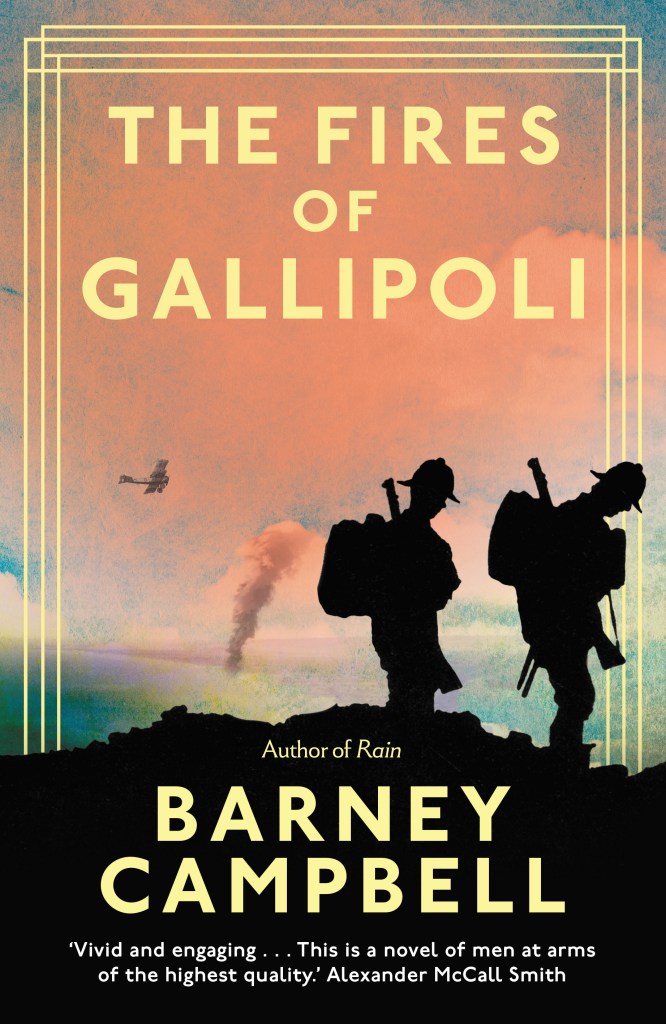
I’m delighted to welcome Barney Campbell and his new book, The Fires of Gallipoli, to the blog with an excerpt.
Excerpt
Edward’s thick jumper proved its mettle and he slept soundly, stirring only around midnight as a snuffling deer broke nearby branches around the edge of the tree. He was awake for a few minutes while memories of nights on the front came to him, staring out into a dark night or peeping fearfully over the parapet when a baleful alabaster shone over the Peninsula in a sniper’s moon. He remembered nights on the line as he and Thorne tried desperately to suppress their chuckles into yelps of breathing. He was sure that he let out a giggle into the night before nothingness then fell over him, dreamless and warm.
He woke with his thighs damp from dew and drew away the groundsheet to see the million droplets on the cow parsley sparkle gold and rainbow colours from the low sun breaching the underside of the tree. A ghostly network of spiders’ webs hung above his head, made fuller by the dew, more ossified. He felt an awful pang, as Thorne stirred beside him, that he wasn’t able to see any of it.
They wormed out from under the tree and creaked limbs back to life, shaking away the residue of sleep and rubbing their sandpaper chins, teeth chattering at the morning’s chill. They got ready to go, the imprint of their bodies in the cow parsley already disappearing as the crushed stalks started to lean up again, and they rejoined the path and carried on.
The route took them over miles of gentle fields and woods, folds in the ground offering one of the most beautiful mornings Edward could remember; folds that, on a battlefield, would become must-take ridges and valleys raked by machine gun fire. Here though was a perfect land, unpoisoned by such snaky heads. The rising sun, still yet to gain its heat, uncovered spring’s half-built hedgerows as nearby woodpeckers saluted their arrival. So infrequent was any sign of habitation, with only a couple of soft yellow stone farmhouses nestling nearly invisibly into their surroundings, that it seemed for a time that they were walking through a zero-humaned world.
They moved so softly, boots tracing their way noiselessly over the grass and the soft earth, that at every wood or new field animals failed to notice them and carried on their activities unalarmed. In one small clump of trees were a cock and hen pheasant, he strutting and boastful with his neck thrust out in grandiose stupidity and she following along behind him picking up the food and grubs that he, in his magnificent self-regard, missed on his morning passeggiata.
Edward stopped for a while to watch them, and then started to describe the scene to Thorne, but not going on as long as he thought he might, seeing writ across his face a sheer exultation in the day and being where they were. Not the sights, of course, but the scents and the touch of the air on his skin seemed to be elevating him to the same sense of contented rapture as Edward felt. The gap between them may not be quite as unbridgeable as he had feared, then. Perhaps.
Here’s the Blurb
The Fires of Gallipoli is a heartbreaking portrayal of friendship forged in the trenches of the First World War.
‘In this vivid and engaging novel of war and friendship, Barney Campbell shows us once again that he is a natural writer. This is a novel of men at arms of the highest quality.’ ~ Alexander McCall Smith
Edward Salter is a shy, reserved lawyer whose life is transformed by the outbreak of war in 1914. On his way to fight in the Gallipoli campaign, he befriends the charming and quietly courageous Theodore Thorne. Together they face the carnage and slaughter, stripped bare to their souls by the hellscape and only sustained by each other and the moments of quiet they catch together.
Thorne becomes the crutch whom Edward relies on throughout the war. When their precious leave from the frontline coincides, Theo invites Edward to his late parents’ idyllic estate in Northamptonshire. Here Edward meets Thorne’s sister Miranda and becomes entranced by her.
Edward escapes the broiling, fetid charnel-house of Gallipoli to work on the staff of Lord Kitchener, then on to the Western Front and post-war espionage in Constantinople. An odd coolness has descended between Edward and Theo. Can their connection and friendship survive the overwhelming sense of loss at the end of the war when everything around them is corrupted and destroyed?
The Fires of Gallipoli is a heartbreaking, sweeping portrayal of friendship and its fragility at the very limits of humanity.
Barney Campbell, author of The Fires of Gallipoli, was brought up in the Scottish Borders and studied Classics at university. He then joined the British Army where he commanded soldiers on a tour of Helmand Province, Afghanistan at the height of the war there.
That experience inspired him to write his first novel Rain, a novel about the war, which was published by Michael Joseph in 2015. The Times called it ‘the greatest book about the experience of soldiering since Robert Graves’s First World War classic Goodbye To All That’.
Barney has walked the length of the Iron Curtain, from Szczecin in Poland to Trieste in Italy. He currently works and lives in London.
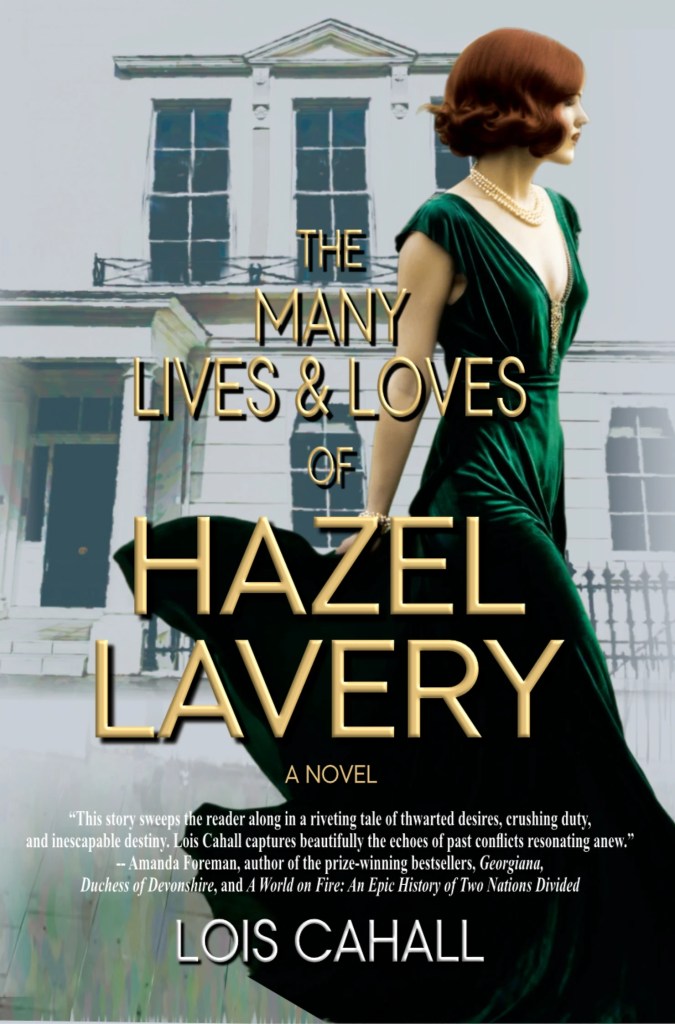
I’m delighted to welcome Lois Cahall and her new book, The Many Lives & Loves of Hazel Lavery to the blog with an excerpt.
Excerpt
Alice was out on Regent Street for drinks at the Café Royal, a thriving Victorian restaurant known to cater to the upper crust and apparently British spies. And then she was off to the Savoy for dinner with her international crowd. Like mother like daughter, I suppose. Christmas eve she’d be traveling to Ireland, spending more and more time in Kilkenny. She even had dreams of living there. I suspect my Irish bug bit her, too. And she even expressed it to me in a letter:
Dearest Mommy,
The Irish are such delightfully kind and amusing people. It is nothing like English hunting, either field or country, everyone helps everyone else, and no one swears at anyone and you’re always welcome in the country if you’re a stranger…. I think Ireland is the freshest, simplest, nicest country and people I have ever met, and I love every inch of it, so you can say ‘I told you so’ and crow over me to your heart’s content now. You were right! And I love you!
My stepdaughter, Eileen, wrapped gifts in the parlor. Nearby were her daughters, Ann Moira and June Mary, which now made John and I official grandparents.
Winston and John were in the library deep into cigars, gin and political talk with our son-in-law, William, while Clementine and I sat sipping sherry in the drawing room, the doors closed. My newest friend, Jessie Louisa “Louie” Rickard, an Irish writer, whose romantic novels we all devoured, joined us, listening on as Clementine cackled about some latest fashion.
My eyes watered up for the tenth time that day. I didn’t intend for her to notice but she instantly figured it out as I turned the other way to avoid eye contact.
“Hazel,” said Clementine, leaning in, her voice full of pity, “Hazel, look at me.” I turned as she gained my full attention. “You must gather yourself, darling girl.”
“Oh Clemmie, I don’t know how to…”
“Of course, you don’t. You’re American,” she said, patting my hand. “But try you must.”
“He was the love of…”
“…your life, yes, I know. But he’s gone. It’s been years,” said Clementine. “Those chapters of life are best left unpublished.”
Then she eyed my wardrobe, black from head to toe, compared to her layers of lapis and pitch blue – a bias-cut dress with belted waist and large yoke collar. “And Hazel, dearest, you’re not in mourning, you’re married…”
“Well, I suppose marriage is a form of mourning.” The three of us women shared a look.
“Fer sure,” said Louie with her Irish brogue. She was sporty. Wearing high waisted sailor pants and striped blouse.
As I admired their zest for life in the present, I longed to tell them right then and there that I mourned not only for Michael, but for our unborn child, and the recent loss of yet another one of Michael’s friends.
“It’s been so difficult, ladies. You’re the only ones I can confide in except for Michael’s sister, Hannie. We’ve stayed close. My love for him is always with me. He once said we were like swans who mate for life.”
“Pain comes from always wanting…” said Louie, trailing off and turning the other way, like a true romantic writer, gazing out the window. Whenever she spoke, rain practically fell on cue.
Clementine began pinching the puffed sleeves on her dress and then gazed up at me, clearing her throat to speak. “I have five tips for any woman where the living men are concerned, not the dead ones.”
“Oh?” I sat up, eager.
“Firstly,” said Clementine, “it is important that a man hires you a skilled staff and has an admirable career. Second, that he makes you laugh. Third, it is important to find a man you can count on who doesn’t lie to you. And that this man loves you and spoils you. And, finally,” she added, “it is most important that these four men don’t know each other!” A pause, and then Clementine burst out laughing.
“Oh Clemmie, you’re wretched! Is this your way of saying I should have an affair?”
“It’s time dear. It’s time.”
“I concur!” said Louie.
“But I’m a Catholic now,” I declared, “I don’t believe in divorce.”
“Nobody is saying to divorce, just have a good ole roll in the hay with a man more your age,”
said Louie, tipping her head to suggest John was very old.
I regretted the way that I segued into the next words that fell from my mouth since rumors had already begun circulating about me. “And Kevin O’Higgins is dead, too. Michael’s friend.”
“Another one?” asked Clementine. “Dead?”
“Yes, back in July, didn’t I tell you then… though it feels like yesterday. The assassins poured lead into his body just like they did to Michael except they murdered him on his way to Mass.”
“Disgraceful!” said Clementine.
“Sometimes, I just feel frozen in misery,” I added.
“So, you were close, yeah?” asked Louie.
Trying to avoid the question instead reframing with a different answer. “I was watching polo at Ranelagh when I was told the news. The first thing I thought was the same thing I always think
when I hear of the death of a man close to me. It’s always the men close to my life who die.”
Leaning forward I poured more sherry, and topped Clementine’s off, too. “O’Higgins so much wanted to see Michael’s achievements and endeavors for the country. They’re saying he was perhaps the greatest diplomat of them all. You know, he wrote me the most charming note. Ended it by saying he wished I could be there as his Parliament meets again. And then he went on about how much the Irish appreciate my help and sympathy.”
Clementine studied her sherry glass, took a sip, and then spoke, “Hazel, I suspect that your views of Ireland are unsuited to the harsh reality of sectarian strife.”
“But I love Ireland so. It was purely by accident of birth that America claimed me. Although,” I said, easing back into the chair and pouting, “Perhaps John was right. He once said that ‘Hazel’s Ireland is as unreal as a mirage in the desert.’”
Here’s the Blurb
In the heart of tumultuous times, amidst the grandeur of Victorian opulence, there existed an American socialite whose influence altered the course of the Anglo-Irish treaty: Lady Hazel Lavery
Boston-born Hazel ascended from her Irish roots to become the quintessential Society Queen of Chicago, and later London, where she lived a delicate dance between two worlds: one with her esteemed husband, Sir John Lavery, a portrait artist to royalty, and the other with Michael Collins, the daring Irish rebel whose fiery spirit ignited her heart. Together, they formed a love triangle that echoed through the corridors of power at 10 Downing Street, London.
Hazel’s wit and charm touched on the lives of the who’s-who of England, including Winston Churchill, George Bernard Shaw and Evelyn Waugh. The image of her memorable face graced the Irish note for close to half-a-century.
Lois Cahall began her writing career as a columnist for Cape Cod newspapers and local periodicals, including Cape Cod Life. She spent a decade writing for national magazines (Conde Nast/Hearst). Her articles have been published in Cosmo Girl, Seventeen, SELF, Marie Claire, Redbook, Ladies Home Journal, Reader’s Digest, Men’s Journal, and Bon Appetit. In the UK she wrote for RED, GQ, Psychologies, and for The Times. In addition, Lois wrote profiles for The Palm Beach Post.
Lois’s first novel, Plan C: Just in Case, was a #1 bestseller in the UK, where it remained in the top three fiction for the year before selling into foreign translation markets. In July of 2014, her novel hit #1 on the Nook “Daily Deal” in America. Her second novel, Court of the Myrtles, was hailed as “Tuesdays with Morrie on estrogen” by the Ladies Home Journal. Her newest book, The Many Lives of Hazel Lavery, is a work of historical fiction and will be published in 2025.
Lois is the former Creative Director of Development for James Patterson Entertainment. She credits her friend, Jim Patterson, the world’s most successful bestselling author, with teaching her about the importance of children’s reading and literacy. As a result, she founded the Palm Beach Book Festival in 2015, an annual event bringing in NYT bestselling and celebrity authors. The event is for book lovers, nurturing the written word for the children and adults of southern Florida.
In 2024 Lois also founded The Cape Cod Book Festival, an annual autumn event that promises to be a new cultural footprint in Massachusetts. It will be for locals and ‘washashores’ alike – a magical place where charitably minded readers can rub elbows with great writers and thinkers.
Lois divides her life between New York and Cape Cod, although her spiritual home is London. But most importantly, Lois can do the Hula Hoop for an hour non-stop and clear a Thanksgiving table in just under ten minutes.
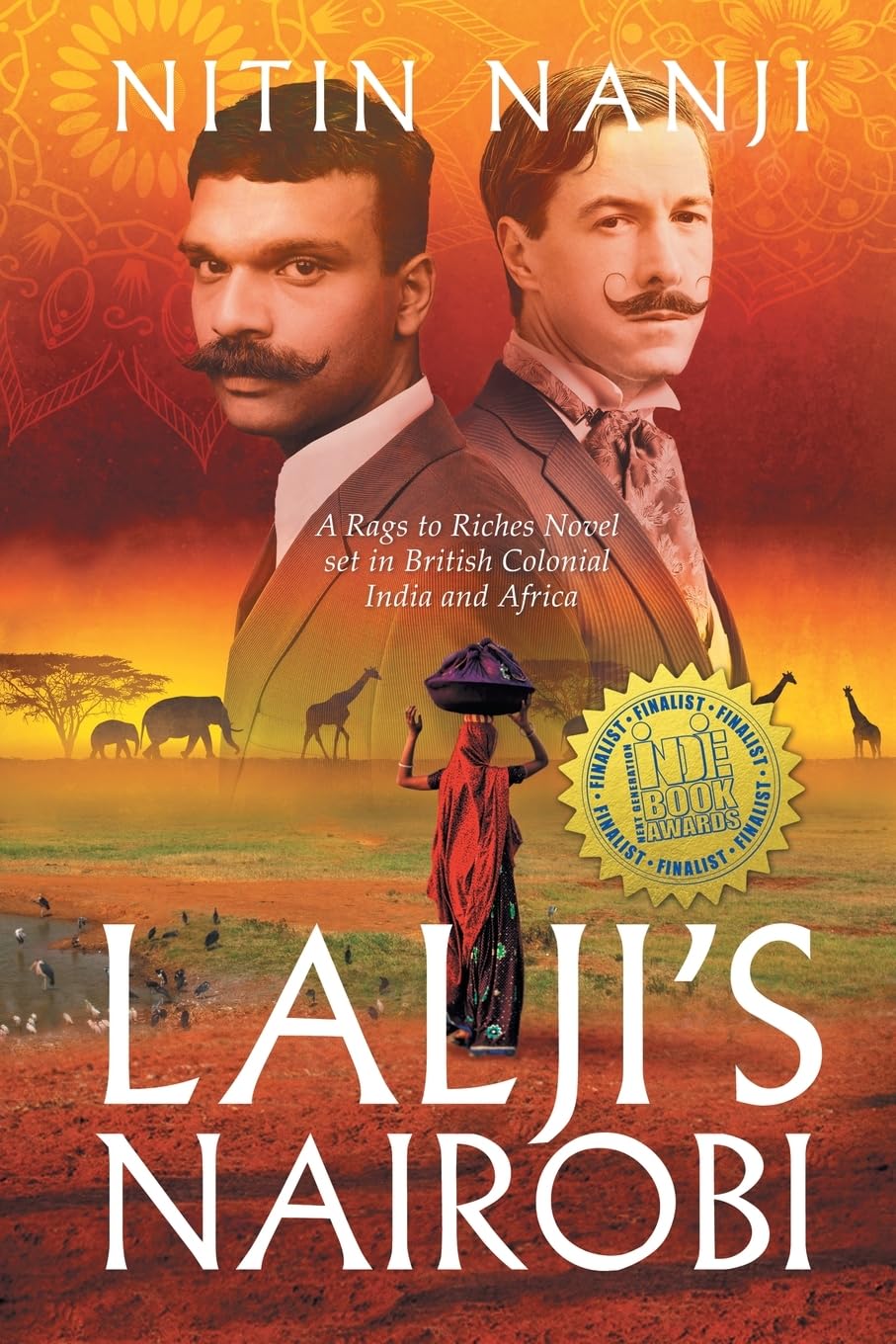
I’m delighted to welcome Nitin Nanji and his book, Lalji’s Nairobi, to the blog with an excerpt.
Excerpt 1
The next morning brought an early visitor to their door in the shape of the village Sarpanch, Thakorbhai. The Sarpanch was the elected head of the village and led the Panchayat. His role was to officiate over disputes, collect fines and enforce the law with the help of the police.
Thakorbhai was a large man with short legs and a bull neck. He sported a moustache that was long and curled upwards at the ends, like two cobras poised to strike. When he sat on a chair, he folded his legs under him and they disappeared under his enormous belly. The children of the village were thrown into fits of giggles at this sight as he looked like an overgrown hen sprawled over her eggs. For that reason, he was also known unkindly as ‘Murgiben’ (mother hen).
He invited himself into the yard and sat down on Parshottam’s charpoy. He had come about the story going around that Parshottam’s son was to head out to Africa. He knew Parshottam had been making inquiries about the next meeting of the Panchayat and thought the two matters may well be connected.
“You are right, I was hoping to have the matter considered at the Panchayat,” said Parshottam before calling out for Lalji to join them. Rambai appeared with a tumbler of salted buttermilk for the Sarpanch and joined in the chorus calling for Lalji.
“What does the boy say?” inquired Thakorbhai.
“He hasn’t made up his mind. See, I was thinking with the lack of prospects here after the famines and with the tax situation….”
“You leave the tax situation to me, Parshottam,” bellowed Thakorbhai. “We need to know if the boy is willing to go and take his chances!”
At that instance, both Lalji and Naran appeared. They paid their respects to the Sarpanch by bowing to him and gesturing to touch his feet hidden under his belly.
“So, what’s your decision young man?” he inquired of Lalji. “Are you ready to cross the big ocean and arrive at the opposite shore to start a new life, away from your family?”
Lalji seated himself down in a squatting position and looked straight at the Sarpanch. Without hesitation announced, “Yes, I willl be taking the vaan and see what destiny has in store for me. It is my role as the eldest son.”
“Shabhash (well said), my boy! That’s the right answer.” The cobras parted to reveal pink gums.
“The son of Dhiraj will be accompanying him, so as he is not alone,” interjected Parshottam.
Thakorbhai waved the idea away as being of no consequence. He told Parshottam his son was in a different league from many and he was supportive of the idea. He mentioned others had considered it before but no son of the village had made the journey.
“The reasons are many but the fact is no one has had the strength of character to take the step. If I was twenty years younger, I would have given the same answer as Lalji here,” he said.
Turning to Lalji he asked, “Would you lead a group of three others from here to go with you?”
Lalji was taken aback by the question, having never considered himself as taking on such responsibility. He didn’t feel unable to lead, but he wanted to know whom the Sarpanch had in his mind.
“It would be you as their leader with Nizar the hardware merchant’s son, and Ramji the eldest son of Karsan the builder. Then there’s that idle son of Dhiraj your father has been talking about.”
“But I hardly know them. Will they follow my wishes?” inquired Lalji.
“Leave that to me. I have spoken to Karsan and Noormohammed about that and they have both pledged their sons will do as you say. They have been waiting for such an opportunity for a long time to get their sons to Africa. They are good boys and want to succeed for their families. They need sound advice and guidance from someone who is mature and responsible. None of them are capable of it on their own. They all need to be led by someone sensible and smart.”
“But I am eighteen and I think they are older,” responded Lalji. The words seem to stop the Sarpanch in his tracks momentarily. He retorted dismissively, “Arre! When I was your age, I ran both the shop and farmed the land. And I did the accounts for my elder brothers. Ability trumps age!”
Having gulped the buttermilk in one long action with his head tossed back. Then he got up briskly to leave, adding, “I hear you have an Arab sea master in mind, Parshottam. For my part, I will speak to my contacts in Porbander to find out who they should contact in Africa. I suggest you start putting together enough food and grains for the journey for him.” The two cobras were drowned in buttermilk.
Book Trailer
Here’s the blurb
British Gujarat, 1905.
Despairing of the social injustices and crippling taxes under the British Raj, Lalji, 19, flees to British East Africa hoping to build a better life using his natural business skills and acumen. But he soon finds unexpected dangers in his new home- turbulent politics and war with German East Africa- as well as some surprising opportunities. A combination of luck, coincidence, and his flair for commerce lead to early success.
Then, just as he is at his most vulnerable, a new threat emerges from where he least expects: from within his own family.
Can Lalji beat overwhelming odds to fulfill his hopes and ambitions?
A story about survival, faith, ability, humanity, and a deep desire to succeed.
The ebook will be free to download on Kindle from February 4th – 8th
This title is available to read on #KindleUnlimited
Meet the Author
Historical novelist of Indian parentage, born and raised in Kenya, educated in England, writing about India and East Africa under the British Empire.
Nitin has come to writing his debut novel after retiring as a doctor. Born in Kenya before its independence he came to England at the age of fifteen. His parentage is Indian, his grandfather having moved during the British Raj from Gujarat in India to Colonial East Africa as an economic migrant.
‘Lalji’s Nairobi’ is set in the early part of the last century, inspired by the stories of Indian migrants who settled in East Africa. A ‘rags to riches’ story of the experiences of Lalji as a determined young businessman who grapples with the challenges of living in the new colony.
Within the backdrop of a racist administration, Nitin immerses the reader into the times and norms of colonial society and shows how Lalji achieves rapid success despite difficult odds, leading a team of four compatriots from his village.
The novel is well-researched and retains the undertones of the era. Nitin’s intimate knowledge of the three cultures of the colony (British, Indian, and African) succeeds in making this an enjoyable and authentic read.
‘Lalji’s Nairobi’ is now an award-winning novel that recently won acclaim from the prestigious New Generation Indie Book Awards as a ‘Finalist’. It also earned Five Stars and the ‘Highly Recommended’ award of excellence from The Historical Fiction Company, which has recently also awarded the book with a silver medal in the Blixen Africa Category.
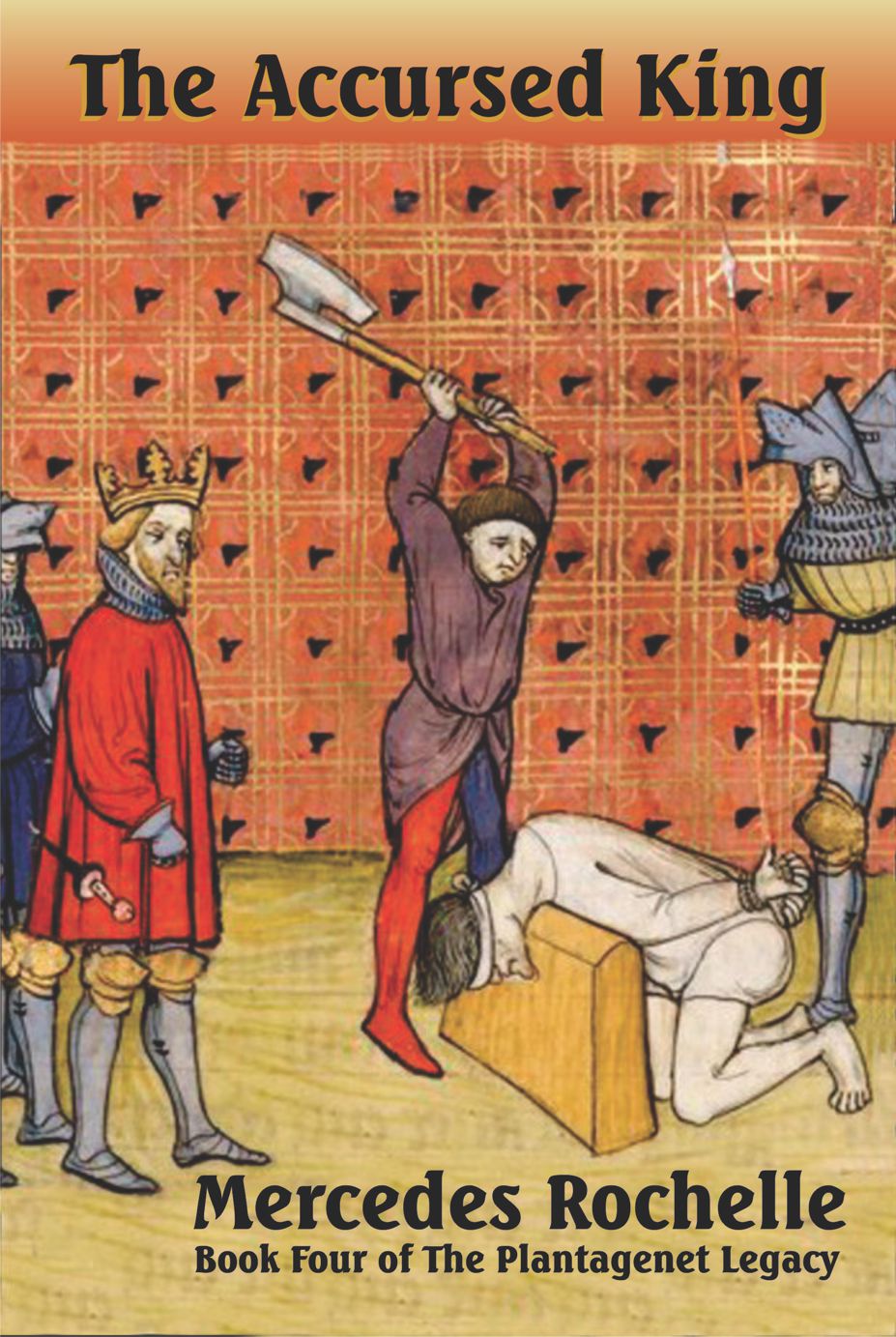
I’m delighted to welcome Mercedes Rochelle to the blog with an excerpt from The Accursed King.
MURDER OF THE DUKE OF ORLÉANS
It was St. Clement’s day, 23 November. Isabeau of Bavaria, the Queen of France was ill and in mourning for her twelfth child, who died at birth ten days before. Louis hoped to cheer her up by arranging a supper at her Hôtel Barbette in the Rue du Temple. A merry party gathered, with all the most fashionable cavaliers and dames, who diverted the queen with pleasantries and songs of love. Despite herself, Isabeau smiled and engaged in a little wordplay, trying to forget her unhappiness for a few hours.
Around nine o’clock, a messenger was admitted. Louis recognized him; his name was Courteheuse, one of the king’s valets. He bowed to the queen and then turned to the duke who was sitting beside her.
“Monsieur le Duc d’Orléans, I come from his Majesty. He requests your presence at once at St. Pol to discuss most urgent business.”
“Ah, Madame la Reine, I must go.” Kissing the queen’s hand, Louis rose immediately.
Outside the room, two of his squires waited for him. “The king commands,” the duke said, reaching for his black furred cloak. “We must go quickly.” Not pausing for an answer, Louis made his way outside and waited while his squires brought up one horse for the both of them and his own palfrey. He looked up, noticing the sky was overcast. It was very dark and the streets were already deserted.
“There you are. Good. Let us go.” He mounted and started off at a fast walk, his squires behind him. Three valets carrying torches followed, but they were on foot and had trouble keeping up. The buildings were shuttered for the night and only an occasional sliver of light from barred windows lit the street. Louis didn’t mind. As they rode down the Rue Vielle du Temple, he was fiddling with his gloves and humming to himself.
They came to a place where the road widened around a well in the centre. Without warning eight muffled men sprung out from the shadows and ran at him. Thinking they were thieves, Louis shouted, “I am the Duke of Orléans!”
“That’s who we are looking for,” yelled one of them, and struck with an axe, severing Louis’s bridle hand. The duke shrieked, and another man slammed an axe into the back of his head. They pulled Louis from his horse and a third axe cleft his skull to the teeth, spilling his brains over the frozen paving stones.
The squires’ horse sidestepped, shied and bolted. The valets carrying the torches stopped when they reached the opening and two of them turned away and ran. The third dashed forward, pushing aside one of the attackers and threw himself onto the duke, not realizing he was too late. He vainly tried to protect his master but found himself in dire trouble, for by now the murderers were stabbing again and again with their daggers.
“Murder! Murder!” shrieked a witness from a window overhead.
“Shut up, you damned woman!” yelled one of the murderers. “Shut up!”
Frightened for a moment, the woman withdrew. The attackers heaved the valet aside and dragged the mangled duke over to the well, propping him up against the stones. His head lolled to one side. They picked up the still-burning torch and brought it closer to make sure he was truly dead.
At that moment, a burly man in a red hood came out of the house across the street, known as the Hôtel de l’Image de Notre Dame. He raised an axe one more time and brought it down on the duke’s head. “Give me that torch,” he growled. “Let’s go! He’s dead.”
The murderers were interrupted by a clatter at the end of the street; the squires, having gained control of their horse returned with the duke’s palfrey. They assumed he had fallen off.
The man in the red hood stepped forward. “Be gone! Or you shall share his fate.” He pointed to the dead man.
Terrified, they turned and fled, crying out, “Murder! Murder!”
Their task finished, the red-hooded man threw his torch into the Hôtel, setting it on fire. They all fled down the Rue des Blancs Manteaux, scattering caltrops on the ground to deter anyone from giving chase. At the same time, the woman started screaming “Murder” again, and the poor valet lay on the ground, crying, “My master! My Lord!” Soon his voice failed and he, too, was gone.
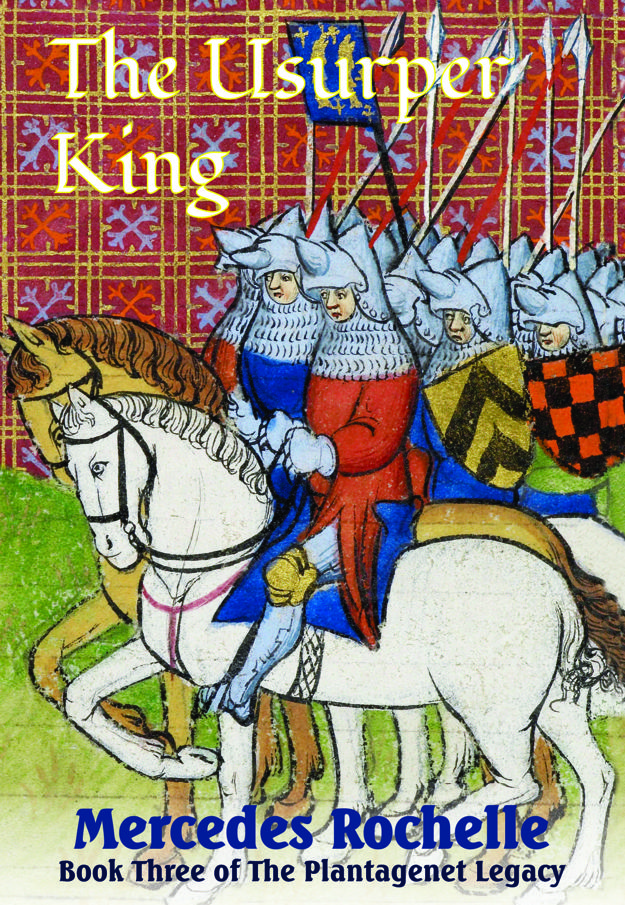
Here’s the blurb for The Usurper King
From Outlaw to Usurper, Henry Bolingbroke fought one rebellion after another.
First, he led his own uprising. Then he captured a forsaken king. Henry had no intention of taking the crown for himself; it was given to him by popular acclaim. Alas, it didn’t take long to realize that that having the kingship was much less rewarding than striving for it. Only three months after his coronation, Henry IV had to face a rebellion led by Richard’s disgruntled favorites. Repressive measures led to more discontent. His own supporters turned against him, demanding more than he could give. The haughty Percies precipitated the Battle of Shrewsbury which nearly cost him the throne—and his life.
To make matters worse, even after Richard II’s funeral, the deposed monarch was rumored to be in Scotland, planning his return. The king just wouldn’t stay down and malcontents wanted him back.
The day Henry IV could finally declare he had vanquished his enemies, he threw it all away with an infamous deed. No English king had executed an archbishop before. And divine judgment was quick to follow. Many thought he was struck with leprosy—God’s greatest punishment for sinners. From that point on, Henry’s health was cursed and he fought doggedly on as his body continued to betray him—reducing this once great warrior to an invalid.
Fortunately for England, his heir was ready and eager to take over. But Henry wasn’t willing to relinquish what he had worked so hard to preserve. No one was going to take away his royal prerogative—not even Prince Hal. But Henry didn’t count on Hal’s dauntless nature, which threatened to tear the royal family apart.
These titles are available to read on #KindleUnlimited
Meet the Author
Mercedes Rochelle is an ardent lover of medieval history, and has channeled this interest into fiction writing. Her first four books cover eleventh-century Britain and events surrounding the Norman Conquest of England. The next series is called “The Plantagenet Legacy” and begins with the reign of Richard II.
She also writes a blog: www.HistoricalBritainBlog.com to explore the history behind the story. Born in St. Louis, MO, she received by BA in Literature at the Univ. of Missouri St.Louis in 1979 then moved to New York in 1982 while in her mid-20s to “see the world”. The search hasn’t ended!
Today she lives in Sergeantsville, NJ with her husband in a log home they had built themselves.
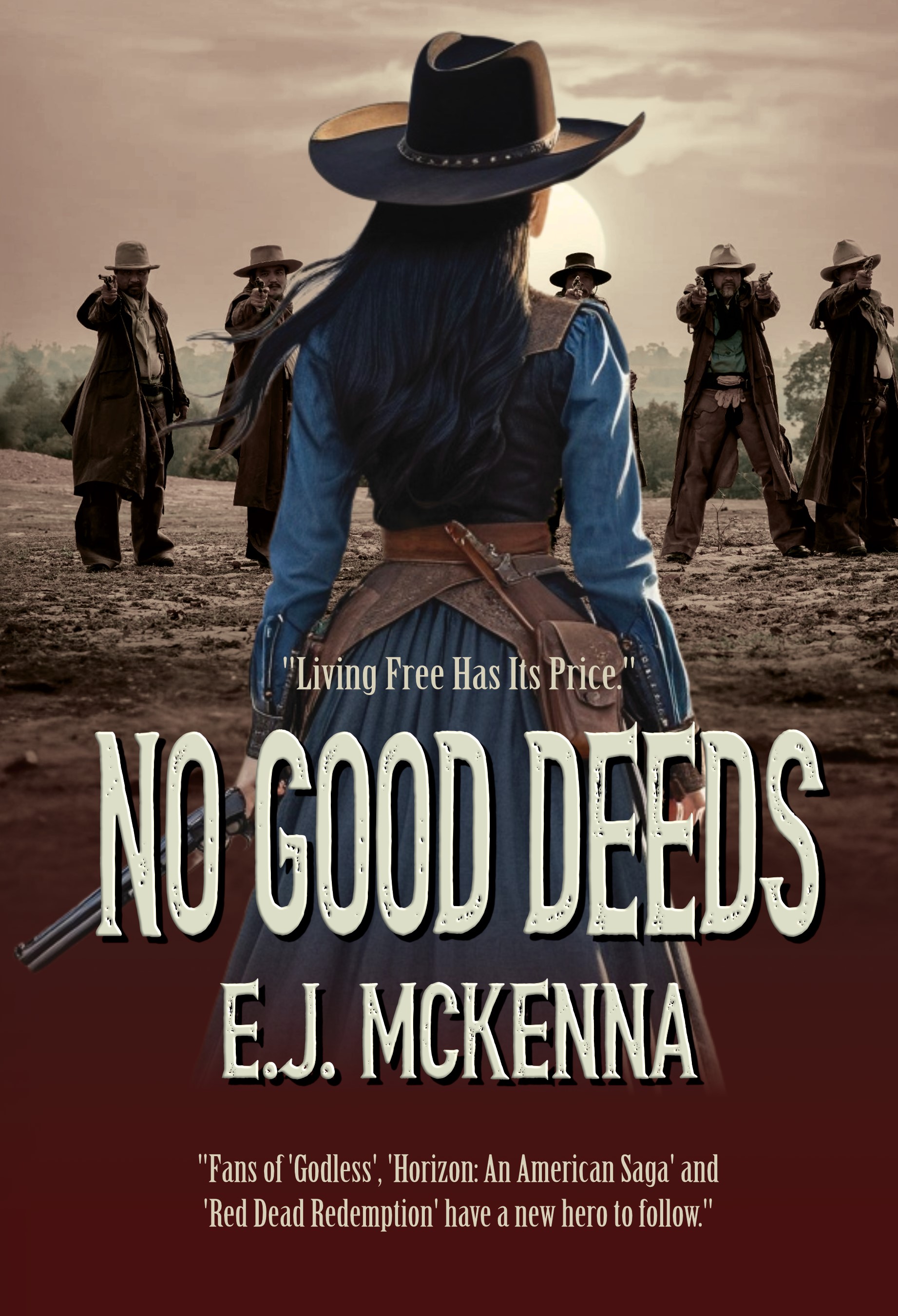
I’m delighted to welcome E.j. McKenna and her new book, No Good Deeds, to the blog with an excerpt.
Excerpt
“You know what I want beyond all else in this world? Four walls and a roof. All my own. Don’t even need another room.” She gave an embarrassed laugh. “I know it’s simple, but I ain’t never had that. It’d be out of town, but not too far out, maybe close to a river, I dunno. I’d be a Bounty Hunter or a Trapper or somethin’, to pay any costs I have. And I’d live off the land, all quiet like.”
Blurb
Annie Schaeffer is no stranger to violence. Born of an outlaw father, she was sold to a traveling show at the age of six, now finally escaping as an adult.
On the run and wounded, she finds an unlikely ally In Nathan Healey – a member of the Needham Boys gang.
As she earns her place among the outlaws, Annie’s survival hinges on her lethal skills and growing bond with Nathan.
Nate’s moral compass shifts with his circumstances, especially when those he loves are involved. Upon meeting Annie, he finds himself drawn to a woman determined to live differently to the expectations others place upon her; to live freely and fairly. The way he has always wanted.
Annie’s quest for independence takes a dark turn as the gang begins to collapse. Betrayal runs deep, and the cost of trust is high.
No Good Deeds is a gripping tale of resilience and retribution in the untamed West, where loyalty is fleeting and justice is won at the barrel of a gun. Annie Schaeffer’s story is one of fierce determination, as she battles her past and the outlaws who seek to control her fate.
E.J. McKennais a freelance writer in the UK with a great interest in American History, and a degree in English and American Literature with Creative Writing from the University of Kent.
At the end of 2023, she co-created a creative writing app for people of all ages to improve their writing skills in a fun, relaxed environment.
Born and raised in the UK, but a lover of traveling, she has a fascination with all social history across different countries and cultures. One of her favourite historical periods is the Victorian era, especially with United States history.
“The juxtaposition between the established countries of Europe, and the new world of America is fascinating to me. So many people trying to survive harsh frontier life, while trying to continue the uptight decorum of Victorian society.”
A huge advocate for feminism and human equity, her writing centres around determined female protagonists in traditionally male roles, tackling the perceptions of women in history. Her strong female protagonists go out of their way to change their society’s expectations for the fairer.
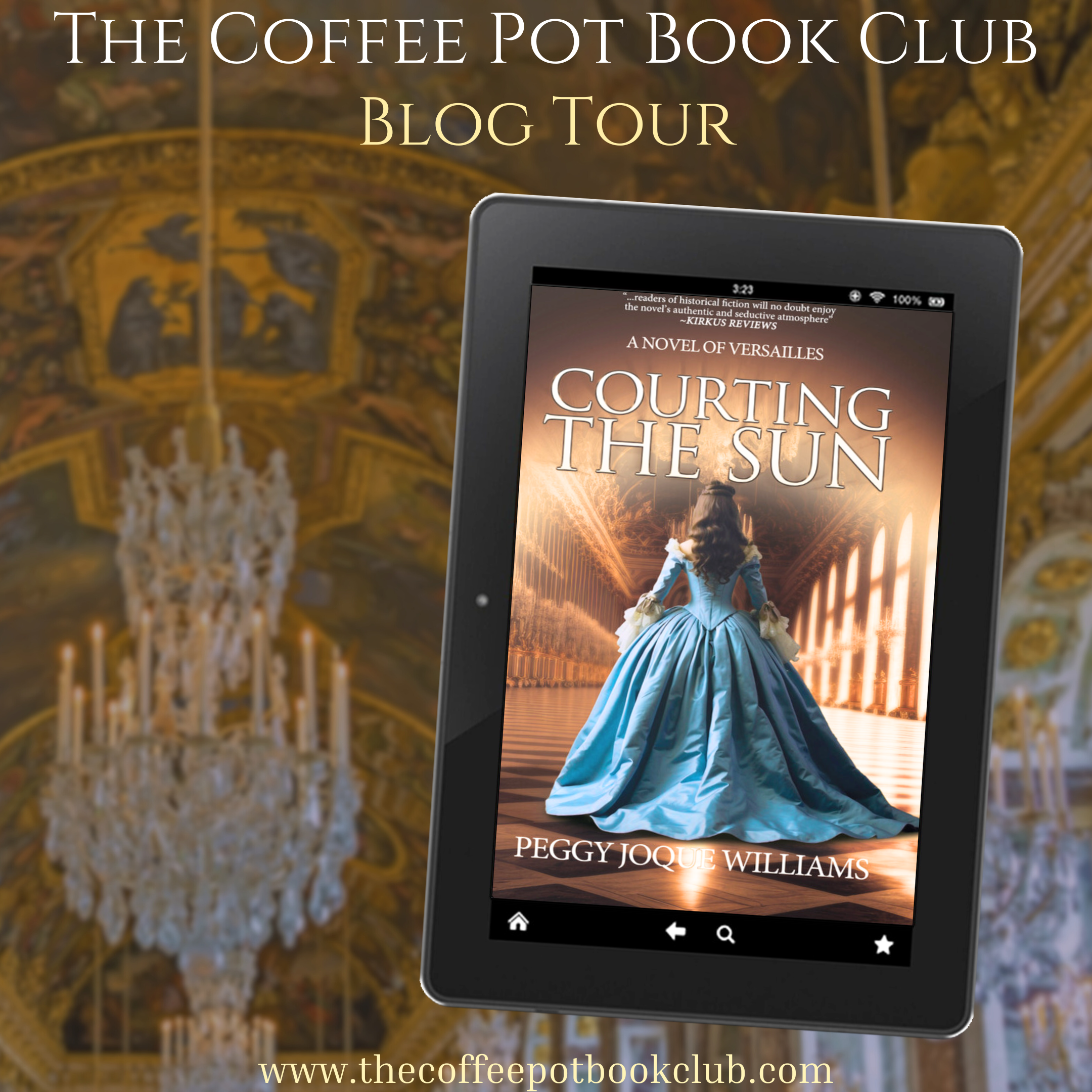
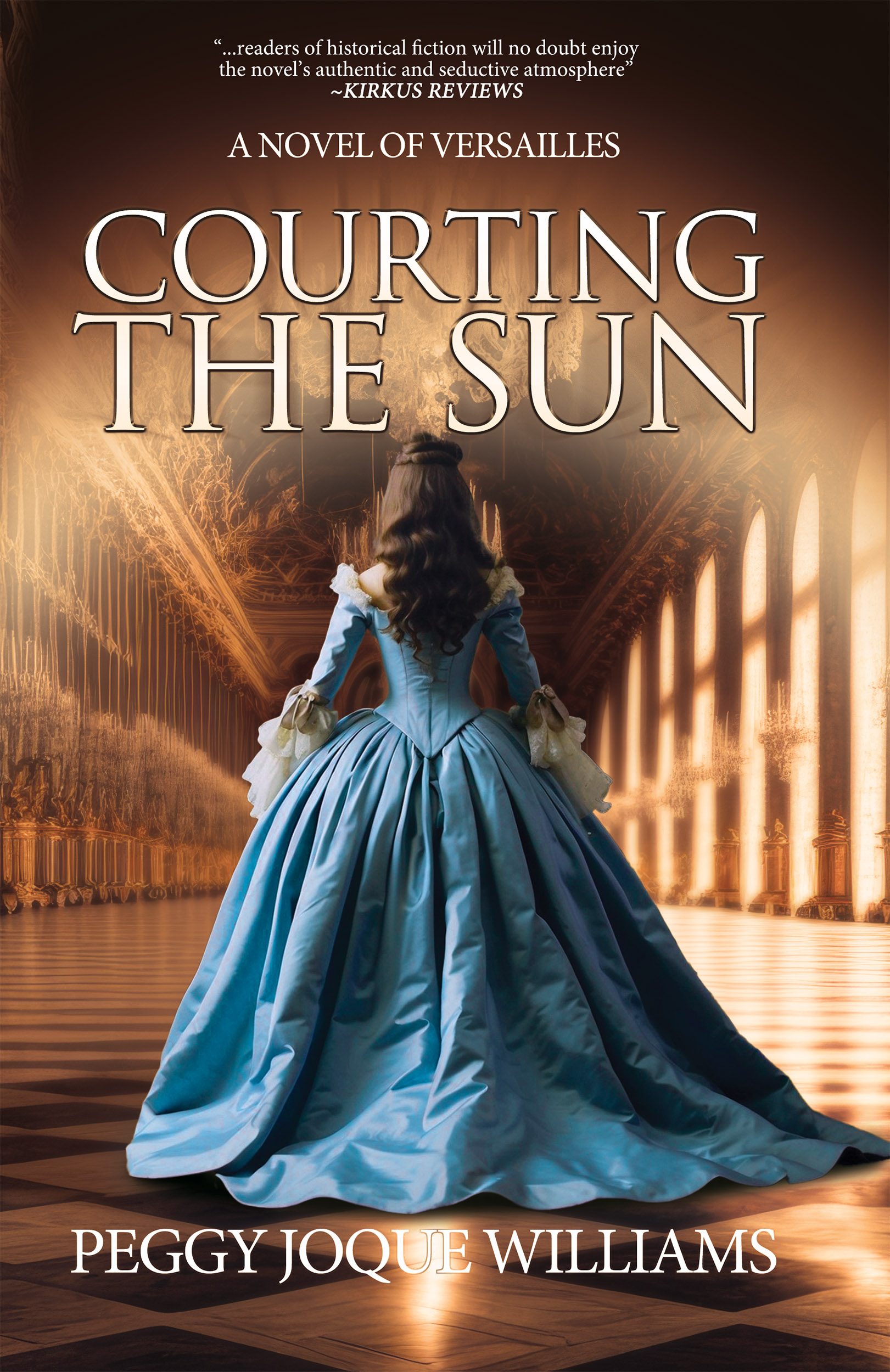
I’m delighted to welcome Peggy Joque Williams and her book, Courting the Sun: A Novel of Versailles, to the blog with some research.
Research and Background
Peggy Joque Williams
Researching Dining Traditions in 17th Century France
As I was writing Courting the Sun: A Novel of Versailles, I found myself researching the dining traditions of 17th century France to know what my characters would eat, when, and how. Two of my favorite go-to sources were A Revolution in Taste: The Rise of French Cuisine by Susan Pinkard (Cambridge University Press, 2010) and the website en.chateauversailles.fr/.
Courting the Sun takes place in 1670. My character, fifteen-year-old Sylvienne, lives with her mother in a cottage outside Amiens about 145 km (90 miles) north of Paris. They maintain a “potage garden” in which they grow vegetables—carrots, cabbage, onions, peas, spinach, squash, turnips. cauliflower, asparagus, and radish—enough to occasionally share with neighbors. They purchase their bread from the boulangerie (bakery) in town. Boulangeries were quite popular at the time, because bread baking required a brick oven, an expensive and dangerous piece of equipment not found in most homes.
Sylvienne and her family eat simple but savory soups and stews made with vegetables from the garden and rabbit, chicken, or fish purchased from the open-air market. At Christmas after Midnight Mass, her family enjoys a petit réveillon, a platter of meat and cheeses. On New Year’s Day, Sylvienne’s Maman receives gifts of candied chestnuts, sugar-coated almonds, and other sweets. She serves mulled wine to her guests. At the Mardi Gras celebration in February, Sylvienne encounters outdoor vendors selling food.
At Easter, after the long, meatless fast of Lent, the family dines on a lamb shank garnished with mint and roasted on a spit over the kitchen fireplace.
When Sylvienne attends the court of King Louis XIV at Versailles, she encounters dining habits vastly different from that in Amiens. The meal most astonishingly different for Sylvienne is the grand couvert, a publicly observed late night dinner, most often served in the queen’s antechamber. As cousin to the king, Sylvienne finds herself seated at the royal table. Here is an excerpt from the book describing her first experience with the grand couvert.
To my astonishment, crowded at the far end of the room stood a throng of nobles gawking at the royal table.
“Pay no attention to the flock,” Monsieur said in an undertone. “One of the disadvantages of royal life.”
“Why are they here?”
“A dividend granted to devotees of the monarchy. Annoying, but unavoidable.”
A semi-circle of elegantly dressed dowagers perched on brocade-cushioned ottomans served as a barrier between those standing and the royal diners.
“The duchesses,” Monsieur whispered before handing me off to a page. “Oodles of money. Never turned away.”
The page escorted me to my seat—a cushioned stool at the farthest end of one of the linen-draped tables set to form the arms of a U-shape. Philippe strutted to the head table and stood behind an exquisitely carved straight-back chair to the left of the red velvet, royal armchairs. Other members of the royal family, who I would eventually learn were princes and princesses of the blood, drifted in and stood behind their assigned seats.
Before long, Madame de Montespan entered. A momentary hush descended as the courtiers in the gallery bowed and curtsied. King Louis’s favorite took her place behind a chair next to what would be the King’s.
Moments later the banging of halberds on the floor preceded a guard who called out, “Le Roi! Le Roi!” The dowager duchesses rose. A hush fell again.
King Louis and Queen Marie-Thérèse entered followed by the two spaniels. Along with the others, I dipped in obeisance. The royal couple sat, a signal to the rest of us diners to sit as well.
The majordomo marched in leading a parade of uniformed footmen with tureens of soup. When the footmen exited, a servant stepped forward and dipped a spoon into the King’s tureen, brought it to his own mouth, and swallowed. He waited a moment then—not having keeled over from poisoning—bowed to his Majesty.
Another servant ladled the soup into the royal bowls. And then the rest of us were served. The aroma was heavenly. I dipped my spoon into the creamy broth and brought it to my lips. It had an earthy yet sweet taste but with a hint of sage and thyme.
Before I had even finished my soup, platters of fish were set on the tables. A footman offered me a plate of shells. In a panic, I realized they were oysters. The market in Amiens sold oysters, but they were very expensive, and I had never tried them. To be honest, I didn’t know how. I watched the others loosen the meat with their spoons then slurp it out of the shell. I poked at mine. The slimy look of it made me cringe.
The Marquise de Montespan smirked across the expanse of the table. “Your little country cousin appears to be unfamiliar with Parisian cuisine, Sire.”
My spoon stopped half-way to my mouth as I realized everyone had turned to look at me. I set the spoon down and put my hands in my lap again, willing myself to disappear.
“Eat, cousine! Eat! Like this.” King Louis lifted a shell to his lips and slurped noisily.
Philippe offered me an encouraging smile, lifted his oyster shell as if to toast me with it, then poured the meat down his throat in one quick elegant motion. No noise, no slurping.
My hand trembled as I brought the oyster shell to my lips. Tilting it, I let the meat slide into my mouth and down my throat, worried I would gag at the slippery texture. I didn’t. Rather, the salty, almost buttery taste was surprisingly pleasurable.
The nobles in the gallery broke into applause. I stopped breathing for a moment, wishing to die on the spot.
But King Louis only laughed. “There is much more to come.!”
And indeed, another course was delivered to the table, silver platters heaped with roasted meats, vegetables, and breads.
King Louis XIV was known for his immense appetite. At another grand couvert Sylvienne eats poached cod spread with a butter glaze, asparagus in a silky cream sauce, and egg halves filled with an artichoke paste—just one of many courses at that dinner.
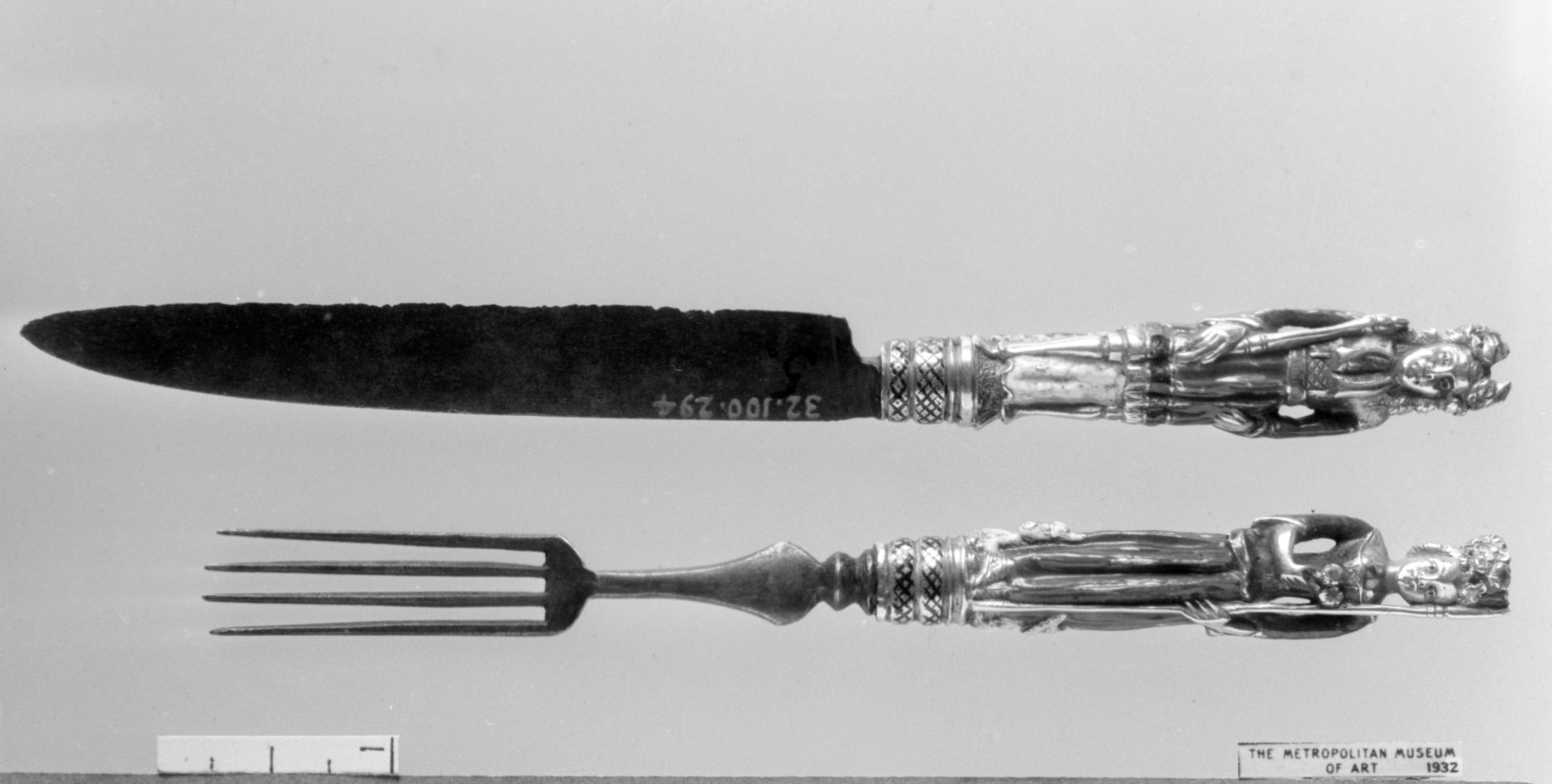
The dining implements used at the time were generally limited to spoons and knives. Forks had only recently been introduced into Europe. In one scene, the king’s mistress, Athénaïs, decides she prefers to eat with a fork.
The first course was served…an array of cheeses. Mimolette. Brie de Meaux. The pungent Livarot. And the nutty goat cheese they called Crottin de Chavignol.
The second course was lamb stew. “Most delectable,” King Louis said as he scooped chunks of the tender meat with his fingers.
The Queen used a spoon to lift bits of carrots and turnips to her lips.
Athénaïs studied her bowl, a look of consternation clouding her face. She held up a hand to summon the majordomo hovering nearby. “I wish to have a fork.”
All conversation stopped. Spoons halted in mid-air. The lamb between the King’s fingers dripped sauce midway to his mouth. The majordomo, disconcerted, looked to him for guidance. Without even glancing in Athénaïs’s direction, King Louis sighed and nodded. The majordomo hurried to the door where he whispered to a waiting footman who hustled off.
Disgruntled, Louis returned the meat to his bowl, wiped his fingers on a napkin, then folded his hands in his lap. The rest of us did the same, sitting with our hands folded, saying nothing until the footman returned holding aloft a gilded platter. He handed the platter with great ceremony to the majordomo, and themajordomo with even more ceremony presented it to Athénaïs. She took the small silver fork from the platter and held it up for all to see, its pearl handle glimmering in the candlelight.
With a smile, Athénaïs poked the fork into her stew, picked out a chunk of lamb and brought it to her lips.
“Satisfactory?” the King asked.
“Oui. Merci.” Athénaïs offered her most alluring smile then dipped her fork again.
Louis nodded, then scooped the almost certainly cold meat from his bowl with his fingers.
The next day, Sylvienne is amazed to learn all the courtiers have rushed out to purchase forks to use at their own meals.
Queen’s Antechamber – Attribution: Jorge Lascar from Melbourne, Australia via Wikimedia CommonsMarket Scene – Attribution: Louise Moillon, Public Domain, via Wikimedia CommonsKnife and fork – Attribution: Metropolitan Museum of Art, CC0, via Wikimedia Commons
Blurb
“A rich journey through 17th century France in all its aspects—its bucolic countryside, the still-unmatched splendor of the court of Louis XIV, and the struggling French colony in Canada.” ~ Margaret George, New York Times bestselling author of Elizabeth I, The Autobiography of Henry VIII & The Memoirs of Cleopatra
France, 1670. On her sixteenth birthday, Sylvienne d’Aubert thinks her dream has come true. She holds in her hands an invitation from King Louis XIV to attend his royal court. However, her mother harbors a longtime secret she’s kept from both her daughter and the monarch, a secret that could upend Sylvienne’s life.
In Paris, Sylvienne is quickly swept up in the romance, opulence, and excitement of royal life. Assigned to serve King Louis’s favorite mistress, she is absorbed into the monarch’s most intimate circle. But the naïve country girl soon finds herself ill-prepared for the world of intrigue, illicit affairs, and power-mongering that takes place behind the shiny façade of Versailles.
This debut historical novel from Peggy Joque Williams captures the vibrancy and quandaries of 17th century life for a village girl seeking love and excitement during the dangerous reign of the Sun King.
This title is available to read on #KindleUnlimited
Meet the Author
Peggy Joque Williams is the author of Courting the Sun: A Novel of Versailles and co-author of two mystery novels, On the Road to Death’s Door and On the Road to Where the Bells Toll, written under the penname M. J. Williams. She is an alumnus of Michigan State University and the University of Wisconsin-Madison.
A retired elementary school teacher and avid researcher, Peggy’s fascination with genealogy and her French-Canadian, European, and Native American ancestry inspires her historical fiction. She lives in Madison, Wisconsin.
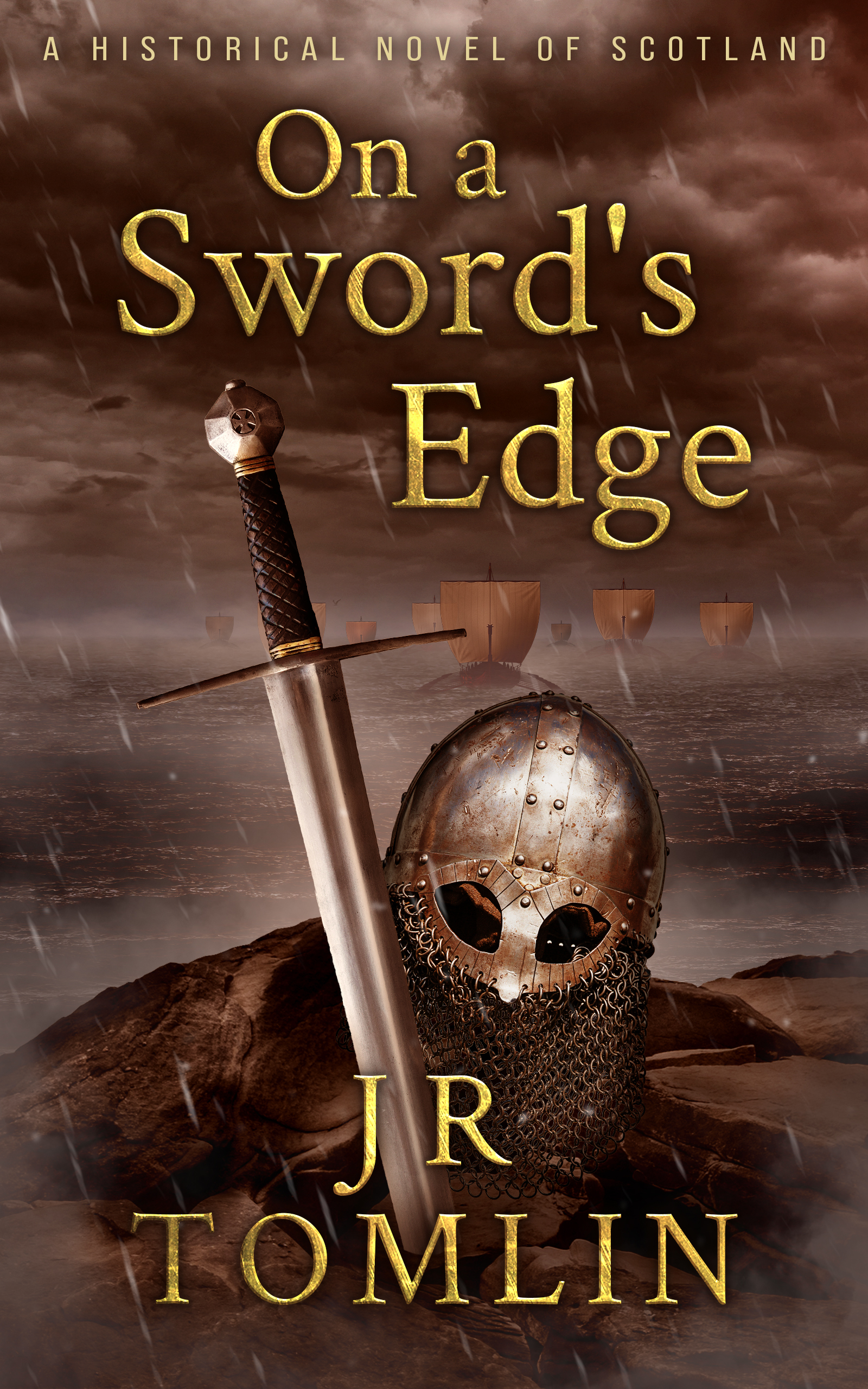
I’m delighted to welcome JR Tomlin and her new book, On a Sword’s Edge, The Swords of Scotland book, to the blog with a guest post.
Guest Post
Research for a historical novel tends to have a thousand parts, a few looming large and others twinkling bagatelles. Those large parts, of course, you must get right, in my opinion anyway. But never underestimate the importance of bagatelles, though. They are often the pieces that give a novel its verisimilitude.
One of the very large looming pieces in ‘One a Sword’s Edge’ is the Battle of Largs in October 1263 between the Norse, led by King Haakon of Norway, and the army of Scotland. This battle is an important one in the development of Scotland as it is today, but there are amazing differences of opinion on the nature and outcome of the battle. Some historians claim it was not a battle, merely a skirmish. Many claim the result was indecisive, with no clear winner. Many state with absolute certitude that King Haakon was doing nothing more with his vast fleet of more an a hundred Norse longboats than defending Shetland and the Hebrides from Scottish invasion.
I admit I had a problem with some of these historians’ opinions. If Haakon was defending the Hebrides, why was he doing it more than 400 miles south of the Hebrides in the Firth of Clyde? And why had he gathered one of the largest fleets the Norse ever assembled when there had been no invasion by Scotland? Scotland had not ever gathered an army to invade.
This is where research comes in and after a lot of looking, I found a fairly obscure article by a professor of Medieval Studies at the University of Edinburgh that brought out some facts from the Saga of King Haakon. One of the many isles claimed by the King of Norway in the waters surrounding Scotland was the Isle of Bute near the mouth of the Firth of Clyde. Its importance lies in that it is in a position to control shipping lanes. A few years earlier, rather quietly, Sir Alexander Stewart of Dundonald, Lord High Steward of Scotland, subjugated the Isle of Bute and established Rothesay Castle as a power base there.
It took a while for the former Lord of Bute to reach King Haakon and bring this serious matter to the king’s attention. King Haakon was a formidable man who had, among other things, subjugated both Greenland and Iceland.
The King of Scots had opened negotiations with Haakon to buy the Hebrides and all the Scottish Isles. This news was what caused those negotiations to totally break down. Haakon immediately assembled his fleet. So it was not some nonexistent defense of the Hebrides but a very definite loss of the Isle of Bute that took him so far south.
King Haakon sailed his fleet around the Cape of Wrath and proceeded hundreds of miles south to attack and retake Bute and Rothesay Castle. He then had his fleet ravage a large area around Loch Lomond. Life being full of surprises, he did not expect a severe storm or to face the same Alexander Stewart leading a large Scottish army.
So much for large, looming battles, but the novel also needed research for some amusing bagatelles. My main character and his family celebrated Christmas that year at Fawdon Tower. How to show them celebrating? You can’t have a Christmas celebration without a carol.
Oh, dearie me. That is easier said than done. If the ordinary people of the Middle Ages sang carols, and I am pretty convinced they did, there are no records of them. However, after quite a bit of searching, I found a delightful carol with an irresistible title: “The Boar’s Head Carol”.
To be honest, it is dated two hundred years after the events of the novel. I tend to think that it had probably been around for a while and simply had not been written down. Like most ‘folk music’, it may well have gone through various permutations. I rewrote it slightly but felt I had a bagatelle that was very close to what they might have merrily danced to on that Christmas of the year 1263.
It sometimes feels a bit like a jigsaw puzzle, but investigating the large pieces and those tiny gems is what makes writing historical fiction so enjoyable and satisfying.
Blurb
Scotland. 1263. The scent of rain mingles with the smoke of campfires as word spreads: the Norse are coming…
As tempers rise between King Alexander and the Norse King Haakon, at the center of it all is sixteen-year-old William Douglas, a squire in service to Sir John Stewart, Lord High Steward of Scotland.
When Haakon’s fearsome fleet is espied approaching Scotland’s shores, carrying the greatest invasion force the Norse have ever mustered, the dread of battle settles over the land. Summoned to Ayr Castle, William joins the Scottish forces in a desperate defense. Now tasked with serving his newly knighted brother, Hugh, William has little time to dwell on the fear – or thrill – of his first real taste of war.
And once the Norse’s menacing line of ships finally touches shore, Scotland’s fate may rest on more than noble titles and knightly deeds— it’ll take the mettle of every soul on the ground for them to triumph.
Set against the wind-swept coast of medieval Scotland, On a Sword’s Edge takes you right into the center of The Battle of Largs alongside a mere – yet fearless – squire.
J. R. Tomlin is the author of more than twenty historical novels, set for the most part in Scotland. Her love of that nation is traced from the stories of King Robert the Bruce and the Good Sir James her grandmother read to her when she was small to hillwalking through the Cairngorms where the granite hills have a gorgeous red glow under the setting sun. Later, her writing was influenced by the work of authors such as Alexander Dumas, Victor Hugo, and of course, Sir Walter Scott.
When JR isn’t writing, she enjoys spending time hiking, playing with her Westie, and killing monsters in computer games. In addition to having lived in Scotland, she has traveled in the US, Europe and the Pacific Rim. She now lives in Oregon in the beautiful Pacific Northwest.
I’m delighted to welcome Rosemary Hayes and her book, Traitor’s Game, book 1, Soldier Spy series, to the blog with some background and research.
Background and Research
When I was asked to write a series of novellas set during the Napoleonic Wars, I knew I would find it a daunting task. The wars took place from about 1800 to 1815 and were a continuation of the French Revolutionary wars, which ran from 1792 to 1799. Together these conflicts represented 23 years of nearly uninterrupted war in Europe. I say nearly uninterrupted because there was a short period of peace when the Treaty of Amiens (March 27, 1802) was signed by Britain, France, Spain and the Netherlands. However, it only achieved peace in Europe for a mere 14 months.
The Napoleonic Wars spanned so many years, were fought at sea and on land in so many different countries and involved so many combatants that it would have been impossible to cover the full extent of them in three short historical novellas, so I chose to concentrate on a short timeframe – from 1808-1811.
I decided not to describe battles in any detail. I’m not an historian and I felt that the complexities of regiments, formations and tactics should not be described by an amateur. So I chose to concentrate more on the human story of my main protagonists.
What particularly interested me was the secret war against Napoleon. That underbelly of every war where agents pass information to their handlers through secret channels, where things are not always what they seem, where the most unlikely people turn out to be working for the enemy. So, the work of spies is the main focus of my stories.
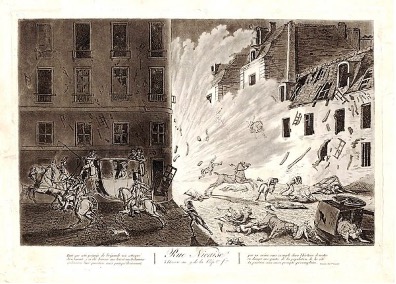
There was a network of Royalist spies in France collaborating with the British Government and which organised uprisings against the Republic which were brutally suppressed by the Minister of Police, Joseph Fouché. There were several attempts to assassinate Napoleon, one of which very nearly succeeded. It was the world’s first car bomb (or cart bomb). Britain was closely involved in the plot, which was almost certainly controlled from London.
Although there was high level espionage, there were also many ordinary French citizens, including fishing families, shopkeepers and others who wished to undermine Napoleon’s rule. They were working for the British and provided shelter for British spies – and girls and women often dressed as men to avoid detection. There was a respected French priest (with a beautiful mistress) who was an agent for the British – and a schoolmaster on the Normandy coast who passed on French naval signals to the British so that their ships would be let through as French.
Then there were those who regularly crossed the Channel, legally, spying for their country’s enemies in plain sight. And, of course, there were double agents, too, one of whom is the mysterious traitor mentioned in my story.
Spies were active in every theatre of war but this first story of my trilogy is set only in France and England. Inevitably, both smugglers and fishermen (often one and the same) were involved in helping spies. At one point there was a spying headquarters in Jersey and one Jersey fisherman made nearly 200 trips over to France delivering spies, letters and money; he was eventually caught and executed but never revealed the names of his contacts.
Smuggling had always taken place along the South coast of England, too, and it was rife during the Napoleonic wars when contraband was taken both ways across the Channel as were spies and escaped prisoners of war. Hastings had a long tradition of smuggling and many of the fishing families augmented their incomes with smuggling activities. As part of my research I visited St Clement’s Caves, a large network of caves in Hastings where contraband was concealed and from where boats set off across to France.
St Clements Caves in Hastings
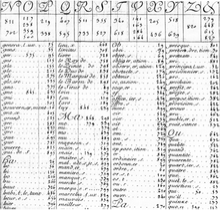
The Alien Office, based in London, was the first comprehensive British secret service in the modern sense, and therefore the forerunner of not only the Special Operations Executive (S.O.E.) but also of MI5 and MI6. Although ostensibly part of the Home Office, the wider remit of The Alien Office included the domestic and external surveillance of foreign people of interest. John Reeves (one of the real people who appears in my story) was head of the Alien Office from 1803-1814 and had a network of agents who sent information back to their handlers. Messages were often written in code and/or in special inks to try and ensure that their contents would not be revealed should they be intercepted. Each intelligence agency had its own ciphers and ink composition.
Major George Scovell was one of Wellington’s staff who successfully cracked a number of French codes. He had no background in intelligence and was a self-taught code breaker. He established himself as Wellington’s cipher expert when he cracked the Army of Portugal code in two days. He also broke enough of the Great Paris Cipher to provide Wellington with valuable information that facilitated the British victory at Vitoria.
My main protagonist, Captain Will Fraser, is sent home from the Peninsular War in disgrace. I have imagined that Will was wrongly accused of insubordination and cowardice. In this first story we don’t learn much about the circumstances of his dismissal; details of this come out in a later book, but I am careful not to say that he was cashiered.
It was extremely rare for an officer to be cashiered from the military in the 19th century and would only happen following imprisonment and a trial. If found guilty he could be publicly humiliated which could involve a parade-ground ceremony in front of assembled troops with the destruction of his symbols of status. His epaulettes would be ripped off his shoulders, his badges and insignia stripped, his sword broken, his cap knocked away and his medals torn off and dashed to the ground. Italso meant that the amount he had paid for his commission was lost, as he could not sell it on.
So that is the background to the first book in the Soldier Spy stories, Traitor’s Game, and in it we meet Will Fraser, bitter, disgraced and desperate to clear his name. In London he seeks out his brother, Jack, only to find that Jack has vanished and, in order to track him down, Will reluctantly becomes entangled in the murky world of espionage.
For information on the spies and their networks, among other sources, I consulted Tim Clayton’s excellent and extensively researched book ‘This Dark Business – The Secret War Against Napoleon. And, of course, Tom Williams’ series – the James Burke books. I also crawled around the caves in Hastings and visited Portugal where I saw the site of Napoleon’s headquarters and that of Wellington’s, staring at each other across the River Douro.
Blurb
‘Right from page one you know you are in the hands of a talented storyteller… An exciting tale of espionage and adventure in the classic mould.’
~ R.N. Morris, author of The Gentle Axe
1808.
Captain Will Fraser has just returned from the Front in the Peninsular War. He is disgraced and penniless, the victim of a conspiracy led by a jealous and influential officer. Fraser has been falsely accused of insubordination and cowardice and dismissed from his regiment.
Fraser and Duncan Armstrong, his wounded Sergeant, arrive in London to seek out Will’s brother, Jack, who works for King George’s Government.
But Jack has disappeared. He vanished from his lodgings a week ago and no one has seen him since. Friends and colleagues are baffled by his disappearance as is the young woman, Clara, who claims to be his wife.
Then Will is viciously attacked, seemingly mistaken for his brother, and only just escapes with his life. When news of this reaches Jack’s colleagues in Government, Will is recruited to find his brother and he and Armstrong set out to follow a trail littered with half-truths and misinformation.
For their task is not quite what it seems.
Will closely resembles his brother and it becomes evident that he is being used as a decoy to flush out Jack’s enemies. These are enemies of the State, for Jack Fraser is a spy and his colleagues believe he has uncovered evidence which will lead to the identity of a French spymaster embedded in the British Government.
Will’s search leads him to France but in this murky world of espionage, nothing is straightforward.
The soldier turned spy must unmask a traitor, before it’s too late.
This title is available to read on #KindleUnlimited
Meet the Author
Rosemary Hayes has written over fifty books for children and young adults. She writes in different genres, from edgy teenage fiction (The Mark), historical fiction (The Blue Eyed Aborigine and Forgotten Footprints), middle grade fantasy (Loose Connections, The Stonekeeper’s Child and Break Out) to chapter books for early readers and texts for picture books. Many of her books have won or been shortlisted for awards and several have been translated into different languages.
Rosemary has travelled widely but now lives in South Cambridgeshire. She has a background in publishing, having worked for Cambridge University Press before setting up her own company Anglia Young Books which she ran for some years. She has been a reader for a well-known authors’ advisory service and runs creative writing workshops for both children and adults.
Rosemary has now turned her hand to adult fiction and her historical novel ‘The King’s Command’ is about the terror and tragedy suffered by a French Huguenot family during the reign of Louis XIV.
And Traitor’s Game, the first book in the Soldier Spy trilogy, set during the Napoleonic Wars, has recently been published.
















































 MJ Porter