
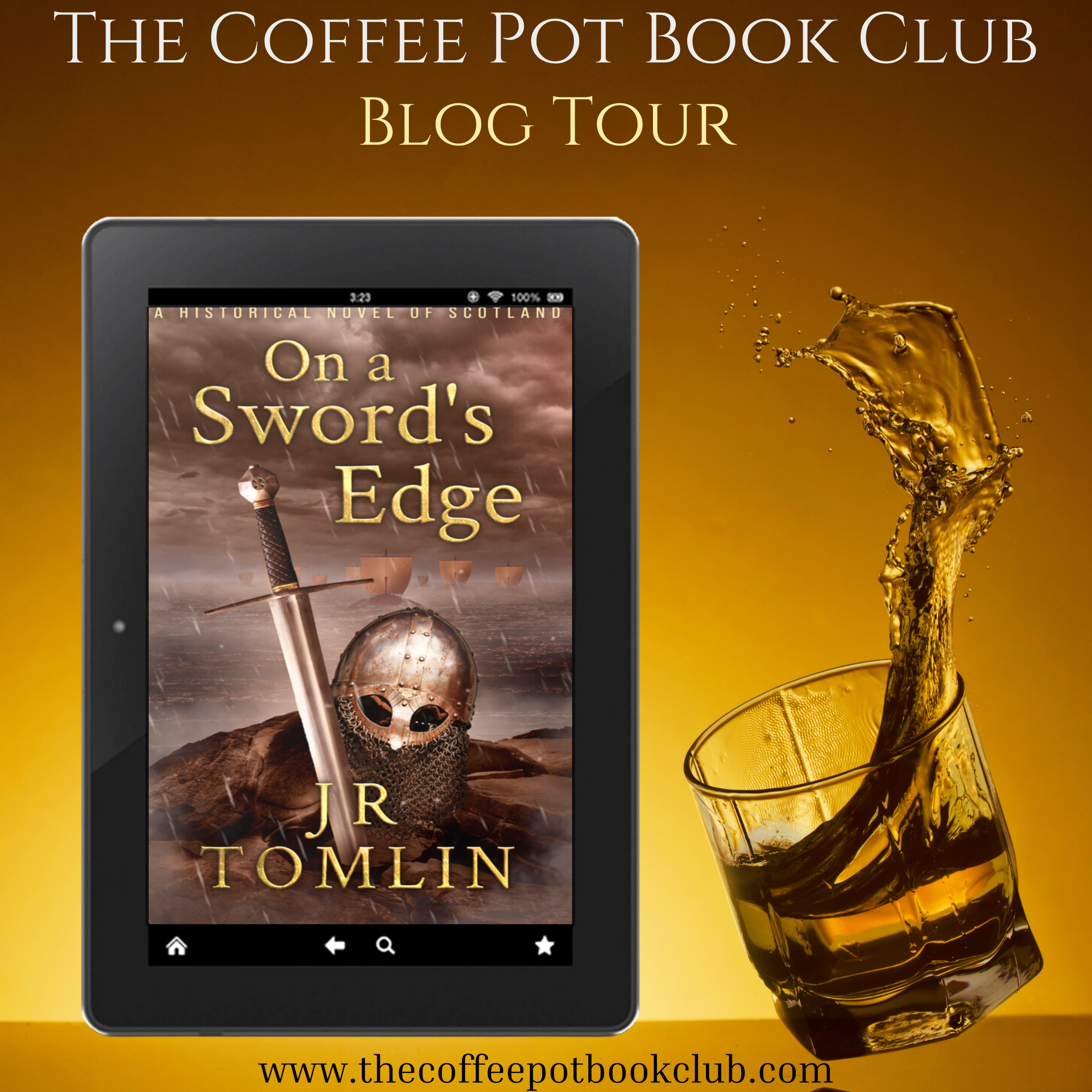
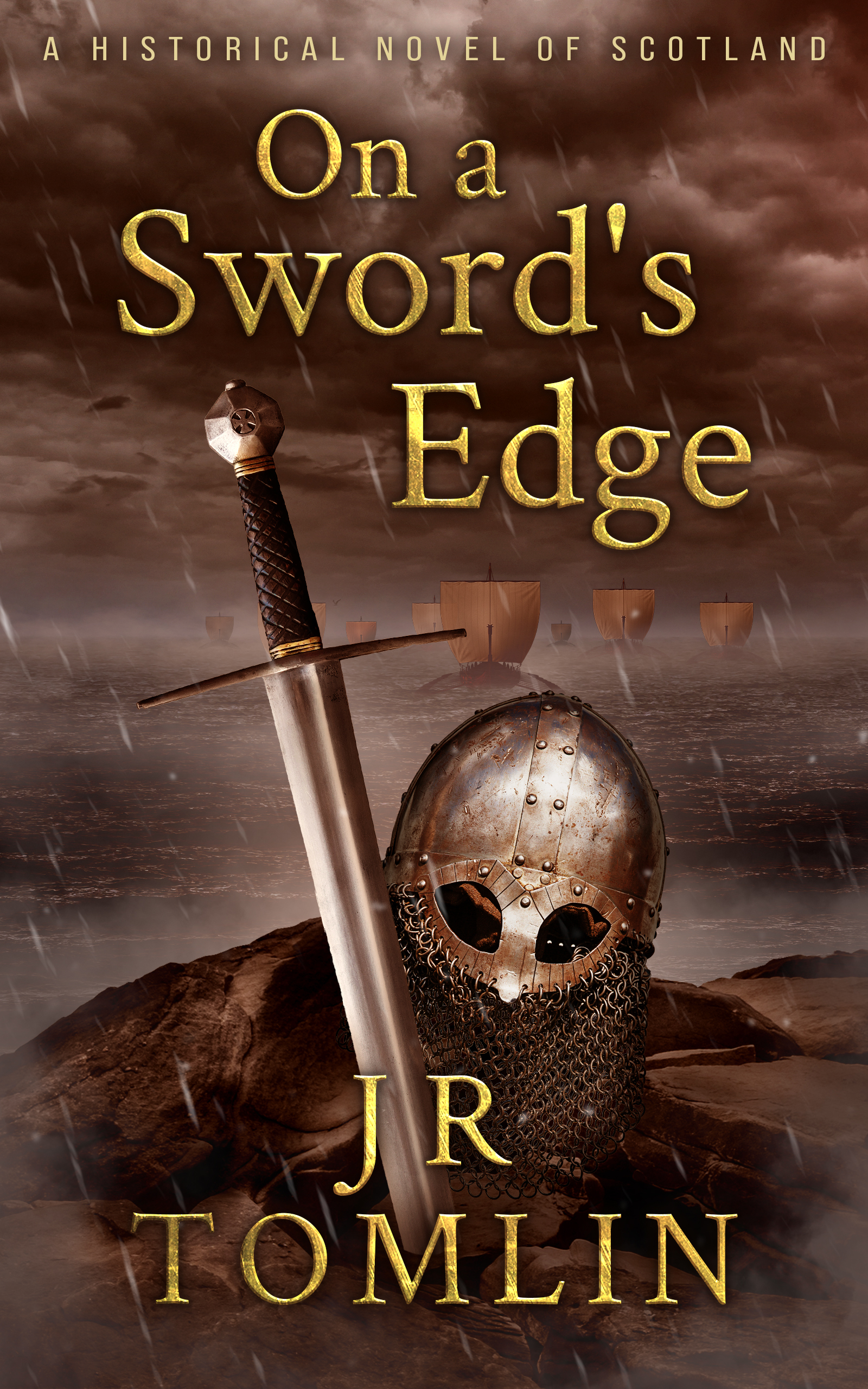
I’m delighted to welcome JR Tomlin and her new book, On a Sword’s Edge, The Swords of Scotland book, to the blog with a guest post.
Guest Post
Research for a historical novel tends to have a thousand parts, a few looming large and others twinkling bagatelles. Those large parts, of course, you must get right, in my opinion anyway. But never underestimate the importance of bagatelles, though. They are often the pieces that give a novel its verisimilitude.
One of the very large looming pieces in ‘One a Sword’s Edge’ is the Battle of Largs in October 1263 between the Norse, led by King Haakon of Norway, and the army of Scotland. This battle is an important one in the development of Scotland as it is today, but there are amazing differences of opinion on the nature and outcome of the battle. Some historians claim it was not a battle, merely a skirmish. Many claim the result was indecisive, with no clear winner. Many state with absolute certitude that King Haakon was doing nothing more with his vast fleet of more an a hundred Norse longboats than defending Shetland and the Hebrides from Scottish invasion.
I admit I had a problem with some of these historians’ opinions. If Haakon was defending the Hebrides, why was he doing it more than 400 miles south of the Hebrides in the Firth of Clyde? And why had he gathered one of the largest fleets the Norse ever assembled when there had been no invasion by Scotland? Scotland had not ever gathered an army to invade.
This is where research comes in and after a lot of looking, I found a fairly obscure article by a professor of Medieval Studies at the University of Edinburgh that brought out some facts from the Saga of King Haakon. One of the many isles claimed by the King of Norway in the waters surrounding Scotland was the Isle of Bute near the mouth of the Firth of Clyde. Its importance lies in that it is in a position to control shipping lanes. A few years earlier, rather quietly, Sir Alexander Stewart of Dundonald, Lord High Steward of Scotland, subjugated the Isle of Bute and established Rothesay Castle as a power base there.
It took a while for the former Lord of Bute to reach King Haakon and bring this serious matter to the king’s attention. King Haakon was a formidable man who had, among other things, subjugated both Greenland and Iceland.
The King of Scots had opened negotiations with Haakon to buy the Hebrides and all the Scottish Isles. This news was what caused those negotiations to totally break down. Haakon immediately assembled his fleet. So it was not some nonexistent defense of the Hebrides but a very definite loss of the Isle of Bute that took him so far south.
King Haakon sailed his fleet around the Cape of Wrath and proceeded hundreds of miles south to attack and retake Bute and Rothesay Castle. He then had his fleet ravage a large area around Loch Lomond. Life being full of surprises, he did not expect a severe storm or to face the same Alexander Stewart leading a large Scottish army.
So much for large, looming battles, but the novel also needed research for some amusing bagatelles. My main character and his family celebrated Christmas that year at Fawdon Tower. How to show them celebrating? You can’t have a Christmas celebration without a carol.
Oh, dearie me. That is easier said than done. If the ordinary people of the Middle Ages sang carols, and I am pretty convinced they did, there are no records of them. However, after quite a bit of searching, I found a delightful carol with an irresistible title: “The Boar’s Head Carol”.
To be honest, it is dated two hundred years after the events of the novel. I tend to think that it had probably been around for a while and simply had not been written down. Like most ‘folk music’, it may well have gone through various permutations. I rewrote it slightly but felt I had a bagatelle that was very close to what they might have merrily danced to on that Christmas of the year 1263.
It sometimes feels a bit like a jigsaw puzzle, but investigating the large pieces and those tiny gems is what makes writing historical fiction so enjoyable and satisfying.
Blurb
Scotland. 1263. The scent of rain mingles with the smoke of campfires as word spreads: the Norse are coming…
As tempers rise between King Alexander and the Norse King Haakon, at the center of it all is sixteen-year-old William Douglas, a squire in service to Sir John Stewart, Lord High Steward of Scotland.
When Haakon’s fearsome fleet is espied approaching Scotland’s shores, carrying the greatest invasion force the Norse have ever mustered, the dread of battle settles over the land. Summoned to Ayr Castle, William joins the Scottish forces in a desperate defense. Now tasked with serving his newly knighted brother, Hugh, William has little time to dwell on the fear – or thrill – of his first real taste of war.
And once the Norse’s menacing line of ships finally touches shore, Scotland’s fate may rest on more than noble titles and knightly deeds— it’ll take the mettle of every soul on the ground for them to triumph.
Set against the wind-swept coast of medieval Scotland, On a Sword’s Edge takes you right into the center of The Battle of Largs alongside a mere – yet fearless – squire.
Buy Link
Meet the Author
J. R. Tomlin is the author of more than twenty historical novels, set for the most part in Scotland. Her love of that nation is traced from the stories of King Robert the Bruce and the Good Sir James her grandmother read to her when she was small to hillwalking through the Cairngorms where the granite hills have a gorgeous red glow under the setting sun. Later, her writing was influenced by the work of authors such as Alexander Dumas, Victor Hugo, and of course, Sir Walter Scott.
When JR isn’t writing, she enjoys spending time hiking, playing with her Westie, and killing monsters in computer games. In addition to having lived in Scotland, she has traveled in the US, Europe and the Pacific Rim. She now lives in Oregon in the beautiful Pacific Northwest.

Connect with the Author
 MJ Porter